General principles of Stress Management

  1. Self-knowledge

    Self-knowledge appears as the first principle, because most of the others build on it. It involves knowing your capabilities and your limits, your personal temperament and typical coping style, and your values and goals.
    Aspects of self-knowledge
    Are you what Hans Selye calls a racehorse, or are you a turtle?. Racehorses thrive on stress and are only happy with a vigorous, fast-paced lifestyle. Turtles require peace, quiet, and a generally tranquil environment. These are of course extremes – people are usually somewhere in between.

    What are your values, what matters to you? Though many aspects will be shared with others in your social group, every person has a unique system of values and goals.
    Everyone has certain abilities – and limits. Do you recognise your abilities and make the most of them? Do you also acknowledge your limits and know when to stop?

    Why knowing yourself is important to stress management
    You may feel comfortable with some of your characteristics, less happy with others. In either case, to effectively manage stress you need to be aware of your own optimum stress level and coping style, as well as the goals and values that guide your reactions.
    Everyone has their own temperament, style of managing stress, and value system. You need to develop strategies relevant to your personal style and compatible with your personal values, otherwise you are not likely to use them.
    Developing self-knowledge
    How can you become more aware of your coping style and optimum stress level? Here are some suggestions.
    Identify your typical stress triggers. What situations do you typically react to? Keep a log for a few weeks.

    You are the best intuitive judge of your optimum stress level. Observe what your body is doing – note your typical stress signs.

    Observe how you typically cope with problems. What works for you? What do you tend to do that is unhelpful?

    There are some strategies to help you identify your values and goals in Chapter Nine of GoodStress. Use these to check out your preferences, values and standards. Are they realistic and appropriate? Have you thought them through for yourself?
    Completing rational self-analyses will help you identify the underlying values that guide your reactions to specific events and circumstances.

    2. Self-acceptance and confidence

    Self-acceptance and confidence are closely related concepts. One builds on the other. Being able to accept yourself as you are, free of any demand that you be different, provides the basis for confidence in your abilities. Confidence, in turn, will enable you to take risks, try new things, and direct your own life.
    Accepting yourself
    To accept yourself is to acknowledge three things: (1) you exist, (2) there is no reason why you should be any different from how you are, and (3) you are neither worthy nor unworthy.

    Acknowledgment that you exist is probably straightforward. It is the other two parts that most people find hard to grasp.
    Self-acceptance involves rejection of any demand that you be different. You may sensibly prefer to be different. You may decide it is in your interests to change some things. But keep the desire to change as a preference. Instead of believing that you have to change, see change as a choice.
    Do not attempt to measure your selfor set some kind of valueon yourself. Self-acceptance is radically different to self-esteem. Self-esteem is based on the idea that you are a goodor worthwhileperson. Worthwhileness requires some criteria, like how well you perform, or the idea that you are worthwhile simply because you exist. Self-acceptance, on the other hand, is based on the idea that you dont have to be goodor worthwhile. In fact, there is no need to evaluate yourself at all! Instead of evaluating your self, you use your energy and time to evaluate (1) your behaviour, and (2) the quality of your existence.
    Evaluating your behaviour is a good idea. You can check whether it helps you enjoy your life and achieve your goals. It is also a good idea to evaluate the quality of your existence. Your enjoyment of life is surely important – more important than worrying about whether you are a worthwhileperson.
    Having confidence in your abilities
    Self-knowledge and self-acceptance are preconditions for confidence. To have confidence in your abilities involves three things. First, you know what you can and cant do. Second, you are prepared to try things to the limit of your ability. And third, you regularly work at extending your capabilities.
    Having confidence in your abilities is different to having confidence in your self. Self-confidence implies perfection – that you, as a total person, are able to do everything well. This is unrealistic and grandiose.

    Having confidence in your abilities is more realistic. Instead of talking about self-confidence, follow the advice of Paul Hauck and talk about social confidence, work confidence, driving confidence, house-care confidence, examination confidence, relationship confidence, and so on. In other words, develop confidence in specific abilities rather than in your total self.
    In practice, ability-confidence would involve behaviours like the following:
    Doing things without demanding you succeed, and viewing mistakes as opportunities for learning. Confidence grows out of the attempt, the doing, rather than from the result.
    Evaluating your actions and performances in terms of how they help you reach your goals – not what they prove about you as a person.
    Taking calculated risks with important activities such as choosing a career, changing jobs, or starting a new relationship.
    Persevering – not giving up when you do less well than you want; rejecting any belief that everything should come easy; and accepting that many good things involve overcoming obstacles, setbacks, and persisting over a period of time.
    Learning from your experiences – trying something, analysing your experience, seeing where you went wrong and working out what you can do to improve your abilities.
    Why these are important to stress management

    If you are prone to rating your total self, you may want to avoid looking closely at your actions because to do so may lead to self-downing. Paradoxically, self-acceptance is more likely than self-evaluation to lead to constructive change. Confidence in your abilities will free you to take risks, try new experiences and learn new lessons.
    If you can accept yourself with your unique characteristics and preferences, you will be less likely to live your life to suit other people.
    As Martin Seligman has pointed out, there are limits to how much we can change ourselves. Human beings are not perfectible. If you can accept imperfection in yourself, you are less likely to engage in dangerous behaviour striving for the unattainable.
    Developing self-acceptance and confidence
    Self-acceptance as an alternative to self-evaluation is not an easy concept to grasp. The tendency to self-evaluation seems to be built in to human beings, and the self-esteem concept is pervasive in our thinking and culture.
    Think through the philosophy of self-acceptance. Read about it. Write down your thoughts on it. Talk about it with others (many people will argue against the concept, which will give you the opportunity to hone your thinking!).

    Finally, and most important, behave like a self-accepting and confident person. As far as possible, practice living in accordance with your preferences, values and standards. Say what you believe, be open and honest as to who you are (but do this appropriately with people significant to you, and take into account their preferences and feelings). Treat yourself to things you used to think you did not deserve. Try things you used to be afraid to do – without any demand that you succeed.

    3. Enlightened self-interest

    The ability to act in your own interests follows on from self-acceptance and confidence. As we shall see, it is also important to take into account the interests of others. The principle of enlightened self-interest takes into account both parts:
    You place your own interests first.
    You keep in mind that your own interests will be best served if you take into account the interests of others.
    Human beings are fundamentally self-interested
    Notwithstanding any precepts that say we shouldbe otherwise, human beings appear to be intrinsically concerned first with their own welfare.

    Hans Selye has argued that the desire to maintain oneself and stay happy is the most ancient – and one of the most important – impulses that motivates living beings. All living beings protect their own interests first of all. Selye points out that this begins with our basic biological make-up, in that the various cells in our bodies only cooperate with each other to ensure their own survival.

    Human beings are also motivated by social interest
    Selye has pointed out, though, that we are also strongly motivated by altruistic feelings. As well as self-interest, we also possess social interest – the wish to ensure that the social system as a whole survives and develops.
    How is that two apparently contradictory tendencies can co-exist? The answer is that we help others in order to help ourselves. In other words, our self-interest is enlightened.
    It appears that like self-interest, social interest is also inherent within human beings – both have biological roots. Collaboration between body cells promotes the survival of each individual cell and enables the total organism to function.
    In effect, individual interests are best served by mutual cooperation. Accordingly, self-interest without social interest is misguided. So is social interest without self-interest. Always putting others first leads to resentment or a martyr attitude. People who believe they are acting purely in the interests of others are dangerous. By denying (to themselves) that their own self-interest is involved, such people may justify all types of manipulative and controlling behaviour toward others.

    You are both self-interested and socially-interested. This dual tendency is built in to your very being and begins with your basic biology. By accepting this about yourself, you will be able to do a better job of acting in your own interests – in an enlightened manner.
    What is it to be enlightened?
    The word enlightenedhas several related meanings. It is humanitarian – charitable, liberal, and idealistic; and at the same time utilitarian – useful, beneficial, and practical.
    Can you see how merging an enlightened attitude with innate self-interest can apply at all levels – to yourself, to your family, to your town or city, to your country, and to the world as a whole? Consider the effect on this planet if every person acknowledged their self-interest and then practiced it in an enlightened manner. What if every country based its external and foreign policies on the humanitarian and practical principle of enlightened self-interest?
    Why enlightened self-interest is important to stress management
    If human beings did not have an inherent will to protect themselves and further their own interests, they would not survive. If you dont attend to your own interests, who will? Knowing what is in your interests will help you get what is best for you and avoid what is harmful. It will keep you moving toward your goals – and ensure that your goals are the right ones for you.

    But you had better simultaneously take into account the interests of others. Getting people to have positive feelings toward you is a good idea. They will be more likely to treat you well and less likely to harm you. Contributing to their welfare will encourage them to contribute to yours. And contributing to the development and survival of the society in which you live will mean a better environment in which to pursue your interests.
    If you acknowledge that self-interest is inherent in your nature, you will feel less guilty about looking after yourself. If you acknowledge that altruistic behaviour is in your interests, you will be more likely to cooperate with others. If you do both, everyone gains.
    Developing enlightened self-interest
    Begin by practicing enlightened behaviours. Here are some ideas to get you started now:

  • Go out of your way to show positive feelings towards others – gratitude, respect, trust – which in turn will arouse goodwill from them.
  • Choose some new activities in various life areas – work, family, leisure – that will bring goodwill.
  • At the same time, act assertively. Ask for what you want, say Noto what you dont, and tell others (when appropriate) what you think and how you feel.
    Make a point of doing something just for yourself each day for a while.
  • Until enlightened self-interest becomes part of you, consciously seek to get more of what you want while facilitating the interests of the other people in your world.
  1. Tolerance for frustration and discomfort

    The ability to tolerate frustration and discomfort is central to stress management. High tolerance will keep you from overreacting to things you dislike. It will help you tackle problems and issues rather than avoid them. It will enable you to take risks and try new experiences.
    What is high tolerance?
    As we shown in Chapter Four of GoodStress, low tolerance for frustration and discomfort is a key cause of unnecessary distress. It arises from beliefs like: Life should not be hard, it is awful and I cant stand it when it is hard; so I must avoid pain, difficulties and frustrations.
    High tolerance, on the other hand, means accepting the reality of frustration and discomfort, and keeping their badness in perspective.
    To accept frustration and discomfort is to acknowledge that, while you may dislike them, they are realities. They exist, and there is no Law of the Universe says they shouldnot exist (though you may prefer they not). You expect to experience appropriate negative emotions like concern, remorse, regret, sadness, annoyance, and disappointment. But you avoid exaggerating these emotions (by telling yourself you cant stand them) into anxiety, guilt, shame, depression, hostile anger, hurt, or self-pity.
    To keep frustration and discomfort in perspective is to regard them as unpleasant rather than awful. You dislike rejection, pain, bad health, financial insecurity and other unwanted circumstances – but you believe that you can cope with the discomfort when they happen to you.
    Why is high tolerance important to stress management?
    Low tolerance creates distress by causing you to overreact to discomfort. It may lead to secondary problems (having a problem about having a problem) where you react to your own symptoms and end up with additional symptoms. You might for example, get angry and then feel guilty, or become depressed because you feel anxious. Low tolerance also gets in the way of using stress management strategies like changing your diet, exercising, managing your time or acting assertively.
    High tolerance, on the other hand, will help you in many ways. You will be:
    Less likely to create secondary problems by overreacting to unwanted events and circumstances.
    More willing to experience present discomfort to achieve long-term goals and enjoyment.
    Prepared to take reasonable risks.
    More able to assert yourself appropriately with other people.
    Less likely to put off difficult tasks and issues, including personal change.
    How to raise your tolerance for discomfort and frustration
    Know when you are engaging in low-tolerance behaviour designed to avoid discomfort or frustration. Keep a log of such behaviour for several weeks or longer. Watch for things like:

  • avoiding uncomfortable situations;
  • overusing drugs or alcohol;
  • compulsive gambling, shopping, exercising, or bingeing on food;
  • losing your temper;
  • putting off difficult tasks.

The technique of exposure is the best way to increase your tolerance. Make a list of things you typically avoid – situations, events, thoughts, risks and so on. Commit yourself to face at least one of these each day. Actively confront discomfort by going into uncomfortable situations. Instead of trying to get away from the frustration or discomfort as you normally would, stay with the discomfort until it diminishes of its own accord.
You can prepare yourself to cope with the discomfort by using rational self-analysis, imagery, and the blow-up technique. Afterwards, do a catastrophe scale to get your reaction to the discomfort into perspective. (These techniques are described in GoodStress and in many other REBT books).

  1. Long-range enjoyment

    Like most people, you probably want to enjoy life. As well as avoid distress, you want to experience pleasure. And you probably want to get your pleasure now, not tomorrow. As Alice said in Through the Looking Glass: It must come sometimes to jam today. But there are times when it is in our interests to forgo immediate pleasure in order to have greater enjoyment in the longer term.
    What is long-range enjoyment?
    There are two parts to this principle. You seek to get enjoyment from each of your present moments, rather than always putting off pleasure till tomorrow, or dwelling on things that have happened in the past.
    However, to keep on enjoying your present moments you will sometimes choose to postpone pleasure. You may wish to drink more alcohol – but you restrict your intake now so your body will still let you drink in ten years time. Or you wish to buy a new stereo, but instead you save the money for an overseas trip. This is the long-termpart.
    The principle can be summed up as follows: live for the present with an eye to the future. In other words, seek to get as much pleasure and enjoyment as you can in the present – while taking into account the desirability of enjoying your life in the long term.
    The concept is not new
    The underlying thinking behind long-range enjoyment has been around for a long time. The Greek philosopher Epicurus (341270 BC) proposed the idea that pleasure is the supreme good and main goal of life – and that only through self-restraint and moderation can people achieve true happiness.
    John Stuart Mill, British philosopher and economist, argued that an act is right if it brings pleasure, and wrong if it brings pain. But he introduced the caveat that the ultimate value is the good of society, and the guiding principle of individual conduct is the welfare of the greatest number of people.
    Developing long-range enjoyment
    Learn to calculate gains and losses. Weigh the short-term pleasurable effects of an action against its possible longer-term negative effects. Make sure that immediate gain doesn’t set you up for future pain – as with overindulgence in alcohol. If in doubt, do a benefits calculation.
    Weigh short-term discomfort and frustration against the prospect of greater and more enduring comfort in the long term. To start exercising will be more uncomfortable than watching television – but later you will not only feel the health benefits, you will even begin to enjoy the exercise itself.
    The strategy of paradoxical behaviour will help you put the philosophical change into action. Practice deliberately postponing gratification in order to increase your tolerance for frustration. List a few things you could go without and earmark the money you save for something you would really like. Reduce your intake of alcohol, caffeine or fatty foods, and reward yourself with an occasional special treat you would otherwise see as an indulgence. Be creative – what other ideas for practicing long-range enjoyment can you come up with?
    By now you will probably see that many of the twelve principles are interdependent. To delay gratification involves tolerating frustration. Sensible long-range enjoyment involves enlightened self-interest and moderation.
    To sum up
    If you always postponed your enjoyment till tomorrow, you would never enjoy yourself. But, if you always lived just for the present moment, your happiness and stress management in the future would eventually be compromised. Live your life with the goal of getting as much enjoyment as possible both now and in the future.
    1993.

    6. Risk-taking

    Human beings, by nature, seek safety, predictability, and freedom from fear. But humans also pursue risk. A totally secure life would be a boring one. To grow as a person and improve your quality of life means being prepared to take some chances.
    The principle

    What we are talking about is a willingness to take sensible risks in order to get more out of life and avoid the distress of boredom, listlessness and dissatisfaction. Here are some important areas of risk-taking that relate to stress management:

  • Learning new things which may challenge existing beliefs.
  • Tackling tasks which have no guarantee of success.
  • Trying new relationships.

Doing things that risk the disapproval of other people.
How is risk-taking relevant to stress management?
Risk-taking is necessary for self-knowledge. To discover your limits, you need to take some risks and try yourself out. You can open up fresh opportunities to increase pleasure and avoid boredom.
Problem-solving means risking solutions that may backfire. To act assertively is to risk disapproval or rejection. Maintaining a support system involves trusting and opening up to other people.
Finally, experimenting with different activities to discover what you like and dislike will increase your self-knowledge and help you clarify your goals and values.
Increasing your willingness to take risks
Exposure is a key technique for practicing risk-taking. Develop a list of things you would like to try, such as:

  • Asking someone for something – like a date or favour – where there is a chance of rejection.
  • Doing something where there is a chance others will disapprove – for example, speaking up and telling a group of people what you think.
  • Trying something where there is no guarantee of success.
  • Put one item a day into practice. As you do so, remind yourself that the discomfort involved is not intolerable, and that staying with it will gradually increase your tolerance.

The benefits calculation can help you make rational decisions about the usefulness of risks you are considering.
You can prepare yourself for taking risks and cope with the discomfort involved using rational self-analysis, coping rehearsal, the blow-up technique, and role-playing.

7. Moderation

Sensible risk-taking recognises the innate human desire for safety and security. The principle of moderation will help you avoid extremes in thinking, feeling, and behaving.
Why moderation is important to stress management
Extreme expectations – too high or too low, will set you up for either constant failure or a life of boredom.
Addictive or obsessional behaviour can take control of you, creating new distress. Unrestrained eating, drinking or exercising will stress your body and lead to long term health complications.
Obsessive habits in areas as diverse as your work or your sexual behaviour can damage relationships as well as stress your body.
The principle of moderation
Taking a moderate approach to your life starts with your ultimate goals and ranges through to your daily activities.

You need to develop long-term goals, short-term objectives, and tasks that will challenge and move you on. But it is equally important they are potentially achievable and do not set you up for failure and disillusionment.

If your goal, for example, is to maintain your weight at a certain level, ensure you set that level appropriate for your age and other personal factors. Avoid any tasks and activities that are extreme – like a diet that provides massive weight loss in a short time. Otherwise, not only will you damage your health, but eventually the weight is likely to go back on (probably worse than it was before), leaving you with a feeling of hopelessness. The best way to keep to an appropriate weight without stressing the body is not to go on a radical diet, but rather to moderate eating and drinking in the long-term.
This applies in most areas of life. Throw yourself into your work, play, exercise and sexual life – but avoid the stress of over-involvement. Moderate, too, your self-help work – commit yourself to personal change, but without obsessiveness.
Note that moderation does not exclude risk-taking. In fact, moderation will help you avoid taking security too far. But you can take risks without being foolhardy.
Developing a moderate approach to life

Identify any areas of your life where you tend to behave excessively – eating, exercising, sexual activity, using your computer, and so on. Note when you are demanding full satisfaction of your urges, or catastrophising about the frustration involved in restraint. Keeping a log will help you do this.

Use the strategies of exposure and paradoxical behaviour to get into action. Set up a list of tasks, sorted according to difficulty, which will give you practice in behaving moderately. In advance, set limits in each of these areas, and commit yourself to keeping within those limits.
Handle your frustration using rational self-analysis. The benefits calculation will help you decide what areas of your life you are best to moderate. Finally, if you are unable to change behaviour which has become addictive, seek professional help.

8. Emotional and behavioural responsibility

As we saw in Part One, people who see their emotions and behaviours as under their control are less prone to distress than people who see themselves as controlled by external forces. The principle of responsibility can help you take charge of your emotions, your actions, and in turn your life. It involves taking responsibility for (1) what you feel, and (2) how you act.
To be emotionally responsible is to believe that you create your own feelings in reaction to what life throws at you. You avoid blaming other people – your parents, partner, boss, or anyone else – for how you feel.
Behavioural responsibility means accepting that you cause your own actions and behaviours, and are not compelled to behave in any particular way.

The inner-controlled person
An inner-controlled person can be identified by characteristics like the following:

  • Uses language – I think that or I would like you to rather than Everyone knows that or You should.
  • Tends to be assertive when relating to other people, rather than passive or aggressive.
  • Gets on with life now – rather than dwelling in the past or dreaming about the future but doing nothing.
  • Takes setbacks in their stride – rather than catastrophising or bemoaning fate.
  • Has a problem-solving approach – when things go wrong, looks for possible solutions.
  • Does not believe in luck- believes that action and the application of skill is what makes things happen, rather than luck or fate.
  • Limits to emotional and behavioural responsibility

While your emotions are mainly caused by what you believe, there are some exceptions. Biochemical changes, for example, can lead to emotional changes. (How you react to biochemical changes, though, will still depend on how you view what is happening in your body).
While you can, largely, control your thoughts, it is unlikely that anyone could do so perfectly. Expecting flawlessness will only lead to discouragement and self-downing.
While you are largely responsible for the consequences of your actions, some outcomes will be outside your control. If, for example, you say Noto a request, the other person may be disappointed – an appropriate reaction. You would be somewhat responsible, in that your Nowas the trigger. But what if they became clinically depressed – an inappropriate over-reaction? That would be their responsibility, not yours. You have no control over whether people choose to view your actions in ways that are rational or self-defeating.

Finally, an important point. Dont fall into the trap of blaming yourself because you are responsible for what you feel and do. Blame and responsibility are not the same thing. Blameis moralistic. It seeks not only to identify who may be the cause of a problem, but also to damn and condemn them.
Responsibility, on the other hand, is practical. It seeks either to identify a cause so it can be dealt with; or to identify who needs to take action for the problem to get solved – irrespective of who or what causedit. Responsibility is concerned not with moralising, but with finding solutions.
Why responsibility is important to stress management
Suzanne Kobasa has conducted research on, as she calls them, hardypeople – people who thrive on stress rather than become sick. A key characteristic of such people is their belief that they are in control of their lives. Hardy people generally have better physical and mental health – they are less affected by the ageing process, recover faster from medical episodes such as a heart attack or surgery, and are less likely to suffer from depression and anxiety.

If you take responsibility for your feelings and behaviours, you will avoid making yourself a victim or over-reacting to what other people say or do. You will be able to change your own feelings even though the world does not change to suit you. Finally, you will have confidence in your ability to handle your feelings, whatever happens – freeing you to take risks and try new experiences.

Developing responsibility
Use rational self-analysis to identify and dispute any irresponsible thinking.
Make a list of things you do that show irresponsibility – unassertiveness, dwelling in the past, catastrophising, drifting with problems hoping something will come along. Use the technique of paradoxical behaviour to act differently in these areas, taking responsibility for how you feel and behave.

9. Self-direction and commitment

Emotional and behavioural responsibility lay the basis for taking control over your life and committing yourself to action and involvement.

Self-direction
Taking responsibility for the direction of your life involves:

  • Choosing your goals, making sure they are your own.
  • Actively pursuing your goals, rather than waiting and dreaming.
  • Making your own decisions, even though you may seek opinions from others.
  • Choosing to work at managing stress, developing your potential, and changing things you dislike, rather than just drifting along or expecting a miracle to occur.
  • Not condemning any person (including yourself) when things go wrong in your life, even though you or someone else may be responsible; but rather identifying any causes and looking for solutions.

Self-direction does not mean open opposition and non-cooperation with others. You can keep your self-direction on the right track by balancing it with other principles such as enlightened self-interest, long-range enjoyment, moderation, and flexibility.
There are several prerequisites for self-direction. First, you need to see what happens to you as influenced (though not totally controlled) by what you do. As we saw earlier, inner-controlled people tend to be assertive, get on with life, and do not see themselves as victims. Second, to direct your own life you need to know what you want to do with it. Have you clarified your goals and values? Chapter Nine will show you how to do this.

Commitment
Commitment follows on from self-direction. There are two elements:
Perseverance. The ability to bind yourself emotionally and intellectually to courses of action. This involves a willingness to do the necessary work (and tolerate the discomfort involved) in personal change and goal-achievement.
Deep involvement. The ability to enjoy and become absorbed in (but not addicted to) other people, activities and interests as ends in themselves – where you get pleasure from the doing, irrespective of the final result. This may include such areas as work, sports, hobbies, creative activities, and the world of ideas.

Limits to self-direction and commitment
Some of what happens to you will be out of your control, and this will place limits on how much you can influence them. Remember, though, that how you react is your responsibility.
Further, while self-direction implies independence, it recognises some limits in the interests of mutual support and cooperation with others.
If carried too far, commitment can become obsession. Dont get so involved with one or a few things that other areas of your life suffer. Avoid, for example, allowing work to stop you from any recreational activity, or recreation to leave no time for relationships.
Why self-direction and commitment are important to stress management
Avoiding decisions or action creates tension and leaves problems unsolved. Action and persistence are needed to break unwanted patterns of behaviour and achieve personal change. A life of superficial involvements would lead to boredom and dissatisfaction.
Commitment is required for confidence to develop. You dont, for example, develop confidence in playing a musical instrument unless you commit yourself to practicing with it.

Self-direction can affect your health. Salvatore Maddi, from the University of Chicago, ran courses for men and women in management aimed at increasing their sense of control. These led to lower anxiety, depression, obsessiveness, headaches, insomnia, and blood pressure, as well as more job satisfaction – results which lasted well beyond the end of the courses.

Aiming for your own goals rather than having others direct your life will affect how you implement many of the strategies in Part Three of Good Stress. It will determine how you manage your time. It will help you assert yourself. You will also maintain more stimulation and variety in your life by doing the things you want.
Developing self-direction and commitment
Make a list of things you do that indicate lack of self-direction. Watch for behaviours like asking for permission, avoidance due to fear of disapproval, unnecessarily seeking other peoples opinions, and the like. Select one item each week and deliberately act differently, in line with what you would rather be doing.
Use rational self-analysis and imagery to cope with the discomfort involved.
Make a decision now to develop one new interest in your life in which you will get absorbed. Commit yourself to taking some steps toward it over the next week or so.

10. Flexibility
Flexible people can bend with the storm rather than be broken by it. They know how to adapt and adjust to new circumstances that call for new ways of thinking and behaving. They have resilience – the ability to bounce back from adversity.

The principle of flexibility
To be flexible is to be open to change in yourself and in the world. As circumstances alter, you are able to modify your plans and behaviours. You are able to adopt new ways of thinking that help you cope with a changing world. You are able to let others hold their own beliefs and do things in ways appropriate to them while you do what is right for you.
Flexibility in thinking means:

  • Your values are preferences rather than rigid, unvarying rules.
  • You are open to changing ways of thinking in the light of new information and evidence.
  • You view change as a challenge rather than a threat.

Flexibility in behaviour means:

  • You are able to change direction when it is in your interests.
  • You are willing to try new ways of dealing with problems and frustrations.
  • You can let others do things their way.
  • You avoid distressing yourself when others think or act in ways you dislike.

Why flexibility is important to stress management
Flexibility aids survival in a changing world. The world, as it always has, continues to change – but the pace of change is increasing. If there is not a corresponding change in attitudes there will be distress. We see this in the so-called generation gap. Parents who are inflexible find it harder to cope when their children behave in ways unthinkable in their generation. We can cope better when we see change as a challenge rather than a threat. As Suzanne Kubosa has found, this attitude is one of the characteristics of hardiness.
Flexibility leads to better problem-solving. As Roger Von Oech states, there are times we need to step outside what we know or usually do and look at a problem from new angles in order to find new solutions. Even negative events like being made redundant – can create opportunities to step outside.
Flexibility will make it easier to change your goals to suit new circumstances. Getting older or sustaining a disability, for example, usually requires one to adapt to significant lifestyle changes.
Flexibility will help you break out of boring routines and maintain stimulation and variety in your life. It will also help you manage your time better, by enabling you to change your plans to suit changing situations.
Developing flexibility
Use rational self-analysis to identify and change inflexible thinking. Watch especially for any demanding shouldsand musts.
Expose yourself to new ways of looking at things. Read books that adopt positions other than yours, talk to people with differing views, watch movies you would normally not bother with.
Practice flexibility by rearranging your office or home furniture, hanging some new pictures, visiting places you have never been.
Get into the habit of pausing before you take action on a problem and look at ways of solving it different to what you would normally do. In other words, attempt to act out of character on a regular basis.

11. Objective thinking

Flexibility and openness, as well as the other principles, require freedom from ways of thinking that are narrow-minded, sectarian, bigoted and fanatical; or that rely on uncritical acceptance of dogmatic beliefs or magicalexplanations for the world and what happens in it.
Objective thinking is scientific in nature. There are four aspects – it is (1) empirical, (2) logical, (3) pragmatic, and (4) flexible.
Objective thinking is empirical
It is based on evidence gained from observation and experience rather than on subjective feelings or uncritical belief. It seeks to avoid distortions of reality.
Objective thinking is logical
It reaches conclusions that validly follow from the evidence. It is possible, as the example below demonstrates, to have the right evidence but draw the wrong conclusions:
Evidence: My supervisor has criticised me, I don’t like being criticised
Conclusion: I can’t stand this, it shouldn’t happen to me, and it shows that my supervisor is a rotten person.
Even though the two pieces of evidence are correct, this does not make the conclusion correct. It does not logically follow that because I have been criticized and I don’t like this (both of which are true), that my supervisor is rotten, I cant stand it, and it shouldn’t happen (beliefs which go beyond the evidence).
More logical conclusions could be: My supervisor has done something I dislike; This is unpleasant; and I prefer this not to happen to me.
Illogical beliefs are often overgeneralizations, like, for example:
Something that is unpleasant becomes terrifying (awfulising);
Something that is hard to bear, becomes intolerable (discomfort intolerance);
Because I prefer to avoid discomfort, therefore I absolutely must avoid it (demandingness);
Because I behaved stupidly, therefore I as a person am stupid (self-rating).
To check the logical validity of your conclusions, ask yourself questions like:
Do my conclusions logically follow from the evidence?
What other conclusions may be possible?
Am I catastrophising, demanding, or self/other-rating?
Objective thinking is pragmatic
Science evaluates an idea not just on its evidence or logical validity, but also on its usefulness to human beings. In other words, we need to be concerned with the effects, both short- and long-term, of what we believe. Questions to ask might be:
What effect does believing this have on how I feel and behave?
Does this belief help or hinder me in achieving my goals?
Objective thinking is open-minded and flexible
Nothing is seen as absolute or the last word. Beliefs are seen as theories that are subject to change as new evidence comes along and existing ideas are proved false. Objectivity encourages us to continually search for explanations that are more accurate and useful than the ones we have now.
Why objective thinking is important to stress management
Objective thinking is a necessary component of the other attitudes. For example, increasing your tolerance for frustration and discomfort means keeping their badness in perspective, rather than overgeneralising them into awful or intolerable.
Unscientific thinking can itself create distress. This can happen when you view criticism as unbearable, demand that you succeed, or rate yourself as a total person because you fail at something.
Believing you are controlled by outside forces, like fate or luck, can lead to feelings of anxiety, powerlessness and hopelessness; and cause you to take a passive approach to life and its problems.
Erroneous thinking, as we shall see later, can also make it hard to practice the coping strategies in Part Three.
Developing objective thinking
Use rational self-analysis to challenge erroneous thinking
Use essays to critically examine magical thinking.
Read up on rational thinking.
Developing many of the other principles will also move you toward more objective ways of thinking (especially emotional and behavioural responsibility, self-direction, and flexibility).

12. Acceptance of reality

It makes sense, wherever possible, to change things you dislike. But there will be some things you will not be able to change. You then have two choices – you can rail against fate and stay distressed; or you can accept reality and move on.
The principle of acceptance
To accept something is to (1) acknowledge that it exists, (2) believe there is no reason it should not exist, and (3) see it as bearable. Lets examine these three aspects of acceptance in more detail:
Acknowledgment of reality. This involves admitting that reality – including unpleasant reality – exists. You see it as inevitable that many things will not be to your liking. You view uncertainty, frustration and disappointment as aspects of normal life.
Absence of any demand that reality not exist. This means that although you may prefer yourself, other people, things, or circumstances to be different from how they are (and you may even work at changing them), you know there is no Law of the Universe which says they should or must be different.
Keeping unwanted realities in perspective. You dislike some things, and find them unpleasant – but you avoid catastrophising them into horribleor unbearable.
Acceptance of reality includes many things
There are many realities people are called upon to accept. Here are some that are especially relevant to stress management:
Uncertainty. In the real world there are no certainties. The outcomes of our actions can never be guaranteed. It is helpful to anticipate the future, but we can never know for sure what it holds.
Utopia is unlikely. You and I will almost certainly never get everything we want. This includes total happiness or personal perfection. We will probably always experience some pain, anxiety, or depression.
There are limitations to personal change. There are many things we can change, like anxiety and depression. But there are some things that will not change no matter how much we try, as Martin Seligman points out in his book What You Can Change and What You Cant. Accepting this reality can help people avoid much unnecessary distress.
We cannot change others. One thing we can never change is other people. Only they can change themselves. Accepting this reality may save a lot of pain.
What acceptance is not
Many people have trouble with the idea of acceptance. They think that to accept something means they have to like it, agree with it, justify it, be indifferent to it, or resign themselves to it.
Acceptance is none of these things. You can dislike something, see it as unjustified and continue to prefer that it not exist. You can be concerned about it. You can take action to change it, if change is possible. But you can still accept it by rejecting the idea that it should not exist and that it absolutely must be changed.
Why acceptance is important to stress management
Hurting yourself does not change what you dislike, and will only take away energy better used to confront and solve problems. By reducing the intensity of your bad feelings, you will be less disabled by them. Acceptance can, paradoxically, increase your chances of changing what you dislike!
Acceptance will help you tolerate what you cannot change, and avoid adding unnecessary emotional pain to the unpleasantness of the situation itself.
Acceptance, finally, will help you avoid wasting time and energy and risking your emotional or physical health by striving for what is unattainable.
Developing acceptance of reality
Take note of non-accepting thoughts and behaviour. Watch out for:
Believing that people or things should be different to how they are; that it is awful and intolerable when things are not as they should be; that the world should be a fair place; that one should always be treated fairly.
Feeling angry but unable to do anything.
Needing to get other people to admit they are wrong, or avoiding acceptance because it might mean giving away a sense of self-rightness.
Keep reality in perspective. When facing an unpleasant development in your life:
Use the time-projection technique.
Ask Is this situation, event or possibility really so bad for me?
Develop a catastrophe scale.
Query yourself: How much do I really need to upset myself over this?
Challenge your demands that reality not be as it is. Ask yourself:
Can I really change (this person, this situation, etc.)?
Though I would prefer that be different to how it is, where is it written that it should be?
Why must this not happen?
Is demanding that this person change going to make them change – or would I be better to try and understand how they see things and then attempt to talk with them?
Practice acceptance:
Regularly remind yourself that human beings are fallible and not perfectible.
Don’t retaliate when people do things you dislike.
See the world for what it really is (and always has been) – imperfect.
Practice being satisfied with compromises and less than perfect solutions to problems.
To sum up
We can sum up our discussion of acceptance – and in fact all the rational principles – with a paraphrase of a well-known saying. It suggests that to achieve happiness, there are three things to strive for: the courage to change the things we can, the serenity to accept the things we cant – and the wisdom to know the difference.
One last thing. Dont make these principles into demands. They are ideals. Probably no-one could practice them all consistently. Rather than see them as absolute mustsfor managing your stress, use them as guidelines to a better life.
Business Process Re-engineering, Objectives, Steps, Benefits

Business Process Re-engineering (BPR) fundamentally transforms an organization’s processes to achieve significant improvements in critical performance metrics. BPR involves rethinking and redesigning workflows and business processes from the ground up, aiming to enhance efficiency, reduce costs, and improve quality. By focusing on outcomes rather than tasks, BPR often leads to radical changes in how work is done, potentially resulting in up to a 30-50% improvement in process performance. Successful BPR initiatives require strong leadership, a clear vision, and employee engagement to overcome resistance and ensure alignment with organizational goals.

Objectives of Business Process Re-engineering:

  • Improving Efficiency

One of the primary objectives of BPR is to enhance operational efficiency. By analyzing and redesigning workflows, organizations can eliminate redundancies and streamline processes. This leads to faster turnaround times, reduced resource consumption, and ultimately, lower operational costs.

  • Enhancing Quality

BPR aims to improve the quality of products and services by identifying and addressing flaws in existing processes. By focusing on quality improvement, organizations can increase customer satisfaction and loyalty, which are critical for long-term success. This might involve implementing standardized procedures and using technology for better accuracy.

  • Increasing Flexibility

In today’s rapidly changing business environment, organizations must be agile. BPR encourages the creation of flexible processes that can quickly adapt to new market conditions, customer needs, or technological advancements. This flexibility allows companies to respond promptly to opportunities and challenges, maintaining a competitive edge.

  • Boosting Customer Satisfaction

BPR is to enhance customer experience. By re-engineering processes to be more customer-centric, organizations can provide better service, reduce response times, and meet customer needs more effectively. Increased customer satisfaction not only fosters loyalty but also attracts new clients through positive word-of-mouth.

  • Leveraging Technology

BPR emphasizes the integration of modern technologies to automate and optimize processes. By adopting new technologies, organizations can improve communication, data management, and workflow efficiency. This can result in significant cost savings and productivity gains, allowing employees to focus on higher-value tasks.

  • Fostering Innovation

BPR encourages a culture of innovation within the organization. By rethinking established processes, organizations can identify new opportunities for improvement and growth. This objective supports the development of creative solutions and innovative products, helping companies stay ahead of competitors.

  • Aligning with Strategic Goals

BPR seeks to align business processes with the overall strategic goals of the organization. By ensuring that processes support the broader objectives, companies can achieve greater coherence and synergy in their operations. This alignment facilitates better decision-making and resource allocation, ultimately driving organizational success.

Steps of Business Process Re-engineering:

  • Identify Processes for Re-engineering

Start by identifying which processes need re-engineering. This involves analyzing current workflows to pinpoint inefficiencies, bottlenecks, or areas that do not align with organizational goals. Prioritize processes that will have the most significant impact on performance and customer satisfaction.

  • Define Objectives and Goals

Clearly articulate the objectives of the re-engineering effort. Establish specific, measurable, achievable, relevant, and time-bound (SMART) goals that align with the organization’s strategic vision. These goals will guide the re-engineering process and help measure success.

  • Assemble a Cross-Functional Team

Form a team that includes members from various departments affected by the process. A cross-functional team brings diverse perspectives and expertise, which is crucial for understanding the complexities of the existing processes and for designing effective solutions.

  • Analyze Current Processes

Conduct a thorough analysis of the existing processes to understand how they function. Use tools like process mapping, flowcharts, or value stream mapping to visualize workflows. Identify inefficiencies, redundancies, and areas for improvement by examining how work is currently performed.

  • Design New Processes

Based on the analysis, design new, streamlined processes that eliminate inefficiencies and enhance performance. Focus on creating processes that are customer-centric, leveraging technology and best practices. Ensure the new design aligns with the established objectives and goals.

  • Implement Changes

Develop a detailed implementation plan that outlines the steps, timelines, and resources needed to execute the new processes. Communicate the changes to all stakeholders, and provide training and support to ensure a smooth transition. This step often requires strong leadership to guide the organization through the change.

  • Monitor and Evaluate

After implementation, continuously monitor the performance of the new processes against the established metrics and goals. Gather feedback from employees and customers to assess the effectiveness of the changes. Use this data to identify areas for further improvement and make necessary adjustments.

  • Continuous Improvement

BPR is not a one-time effort but a continuous process. Foster a culture of continuous improvement by regularly reviewing processes and seeking feedback. Encourage innovation and adaptability to ensure that the organization remains responsive to changing market conditions and customer needs.

Benefits of Business Process Reengineering:

  • Increased Efficiency

One of the most immediate benefits of BPR is improved efficiency. By re-evaluating and redesigning processes, organizations can eliminate redundant steps and streamline workflows. This leads to faster execution of tasks and better utilization of resources, resulting in lower operational costs.

  • Enhanced Quality

BPR focuses on identifying and rectifying process flaws, which can lead to higher quality products and services. By implementing standardized processes and best practices, organizations can reduce errors and improve consistency. Enhanced quality not only boosts customer satisfaction but also strengthens the organization’s reputation.

  • Greater Customer Satisfaction

BPR prioritizes customer needs by creating processes that are more responsive and tailored to client expectations. By reducing response times and improving service delivery, organizations can enhance the overall customer experience. Increased customer satisfaction fosters loyalty and can lead to repeat business and referrals.

  • Flexibility and Agility

In a dynamic business environment, the ability to adapt quickly is crucial. BPR enables organizations to design flexible processes that can easily accommodate changes in market conditions, customer demands, or technological advancements. This agility allows businesses to seize new opportunities and respond to challenges more effectively.

  • Cost Reduction

Through the elimination of inefficiencies and redundancies, BPR can lead to significant cost savings. Organizations can reduce labor costs, minimize waste, and optimize resource allocation. Lower operational costs improve the bottom line and enable reinvestment in growth initiatives.

  • Improved Employee Morale

Streamlined processes reduce frustration among employees caused by bureaucratic hurdles and inefficiencies. When employees work in an environment with clear, efficient processes, their productivity increases, leading to higher job satisfaction and morale. Engaged employees are more likely to contribute positively to the organization.

  • Innovation and Competitive Advantage

BPR encourages a culture of innovation by challenging existing practices and promoting creative thinking. Organizations that embrace BPR are more likely to identify new opportunities and develop innovative products or services. This focus on innovation can provide a significant competitive advantage in the marketplace.

Challenges of Business Process Reengineering:

  • Resistance to Change

One of the most significant hurdles in BPR is employee resistance. Many individuals are comfortable with established routines and may view changes as threats to their job security or work processes. Overcoming this resistance requires effective communication, involvement, and change management strategies to foster buy-in from all levels of the organization.

  • Lack of Clear Vision

BPR initiatives can falter without a clear vision and objectives. If the goals of the reengineering process are not well-defined or communicated, employees may lack direction, leading to confusion and ineffective implementation. Establishing a clear and compelling vision is essential for aligning efforts and motivating the team.

  • Insufficient Leadership Support

Successful BPR requires strong leadership commitment and support. Without active engagement from top management, initiatives may lack the necessary resources, authority, and visibility. Leaders must champion the change, provide direction, and demonstrate commitment to the reengineering process for it to gain traction.

  • Inadequate Training and Skills

Reengineering processes often require new skills and knowledge. If employees are not adequately trained to adapt to new systems, technologies, or workflows, the implementation can suffer. Organizations must invest in comprehensive training programs to equip employees with the skills needed to succeed in the transformed environment.

  • Complexity of Processes

Analyzing and redesigning complex processes can be overwhelming. Organizations may struggle to identify all variables and interdependencies within their existing workflows. This complexity can lead to incomplete assessments and poorly designed processes, undermining the effectiveness of the reengineering effort.

  • Scope Creep

BPR projects progress, there is a risk of scope creep, where the focus expands beyond the original objectives. This can lead to resource overextension, delays, and confusion about priorities. Organizations must maintain a disciplined approach, ensuring that the scope of the project remains focused and aligned with strategic goals.

  • Measurement and Evaluation Challenges

Measuring the success of BPR initiatives can be difficult. Organizations may struggle to define appropriate metrics or benchmarks to evaluate performance improvements effectively. Without clear metrics, it can be challenging to assess the impact of changes and make necessary adjustments, leading to potential stagnation or regression.

Path Goal Theory, Assumptions, Behaviors, Factors, Strengths, Criticism

The Path-Goal Theory of leadership was developed by Robert House in 1971. This theory is based on the premise that a leader’s primary role is to clear the path for subordinates so they can achieve their goals. The name “Path-Goal” comes from its central idea: leaders influence followers by providing the necessary guidance, support, and resources, thus making it easier for them to reach their objectives. Unlike earlier theories that emphasize leader traits or fixed styles, Path-Goal Theory highlights flexibility, suggesting that leaders should adapt their behaviors to suit the needs of their team and the environment.

Core Assumptions of Path-Goal Theory

  • Leader Behavior Impacts Subordinate Satisfaction and Performance:

Leaders must exhibit behaviors that enhance follower satisfaction and increase productivity. A leader’s behavior should complement, not replace, the work environment.

  • Adaptive Leadership:

Different tasks, environments, and individual characteristics require different leadership styles. Leaders must assess situational factors and adjust their behavior accordingly.

  • Subordinate Motivation:

Leaders play a crucial role in motivating their subordinates by clarifying the path to achieving goals, removing obstacles, and offering rewards for successful task completion.

Leader Behaviors in Path-Goal Theory:

The theory identifies four distinct leadership styles, each suited to different situations:

  • Directive Leadership:

This style involves giving clear instructions about what tasks need to be done, how they should be performed, and the expected outcomes. It is most effective in environments where tasks are complex or ambiguous, and subordinates need clear guidance.

Example: A project manager providing detailed steps to a team working on a complicated project.

  • Supportive Leadership:

Supportive leaders show concern for the well-being of their subordinates. They foster a friendly and inclusive work environment, which helps reduce stress and increase job satisfaction. This style is most effective when tasks are monotonous or stressful.

Example: A customer service manager offering emotional support to employees dealing with difficult customers.

  • Participative Leadership:

Participative leaders involve subordinates in decision-making processes. This style works best in environments where tasks require high levels of commitment and creativity. By seeking input, leaders make employees feel valued, which increases their engagement.

Example: A marketing manager involving the team in developing a new campaign strategy.

  • Achievement-Oriented Leadership:

Achievement-oriented leaders set high expectations and encourage subordinates to perform at their best. They show confidence in their team’s abilities and push them to take on challenging tasks. This style is most effective when subordinates are highly skilled and motivated.

Example: A sales manager setting ambitious sales targets and motivating the team to exceed them.

Key Situational Factors

Path-Goal Theory emphasizes the importance of situational factors that influence leadership effectiveness. These factors are divided into two main categories:

  1. Subordinate Characteristics:
    • Ability Level: Leaders need to adjust their style based on the skill and competence of their subordinates. For example, a highly skilled team may benefit from an achievement-oriented style, while a less experienced team may require a directive approach.
    • Locus of Control: Individuals with an internal locus of control prefer participative leadership, as they like to be involved in decision-making. Those with an external locus of control prefer directive leadership, as they rely on external guidance.
    • Experience and Confidence: Experienced employees may prefer less directive and more supportive or participative leadership, whereas less experienced individuals may need clear guidance.
  2. Task and Environmental Characteristics:
    • Task Structure: When tasks are highly structured and routine, supportive leadership can improve morale. In contrast, when tasks are unstructured or complex, directive leadership helps clarify goals and reduce ambiguity.
    • Team Dynamics: The overall cohesiveness and morale of the team can determine which leadership style will be most effective.
    • Workplace Culture: In a participative culture, leaders who involve subordinates in decisions will be more successful, while directive leadership may be more appropriate in hierarchical or bureaucratic environments.

Strengths of Path-Goal Theory

  • Flexibility in Leadership Style:

The theory’s emphasis on adapting leadership behavior based on situational factors makes it highly practical for diverse work environments.

  • Focus on Employee Motivation:

Path-Goal Theory highlights the importance of understanding what motivates employees and adjusting leadership to meet those needs.

  • Enhances Job Satisfaction and Performance:

By providing the right level of support and guidance, leaders can improve both employee morale and productivity.

Criticisms of Path-Goal Theory:

  • Complexity in Application:

The theory requires leaders to continuously assess numerous factors, which can be challenging in dynamic and fast-paced environments.

  • Overemphasis on the Leader’s Role:

Some critics argue that the theory places too much responsibility on the leader for employee success, ignoring other factors such as team dynamics and organizational resources.

  • Limited Empirical Support:

Although widely accepted, empirical evidence supporting the theory’s effectiveness is mixed, with some studies questioning its validity in certain contexts.

Practical Implications for Managers

Path-Goal Theory provides a framework for managers to enhance team performance by adapting their leadership style to the needs of their subordinates and the nature of the tasks. Managers can use this theory to:

  • Assess the competence and motivation of their team members.
  • Identify the level of task complexity and adjust their behavior accordingly.
  • Provide appropriate support, guidance, or autonomy to foster employee growth and satisfaction.
  • Create a work environment where obstacles are minimized, and goals are clearly defined.

Steps in Control Process

Control in Management refers to the process of monitoring and evaluating performance against established standards and objectives. It involves setting performance benchmarks, measuring actual outcomes, comparing them with targets, and taking corrective actions as needed. The ultimate goal of control is to ensure that organizational activities align with strategic goals, thereby enhancing efficiency and effectiveness.

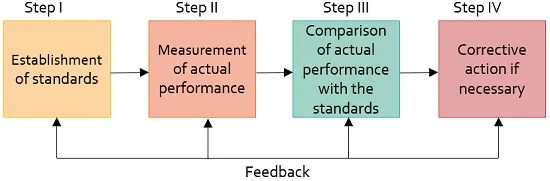
Control Process involves the following Steps as shown in the figure:

The control process involves several key steps:

  1. Establishing Standards

Standards serve as benchmarks for evaluating performance in business functions and are classified into two categories:

  • Measurable (Tangible) Standards: These standards are quantifiable and expressed in terms of cost, output, time, profit, etc.
  • Non-Measurable (Intangible) Standards: These cannot be quantified monetarily. Examples include manager performance, employee attitudes, and workplace morale.

Establishing these standards simplifies the control process, as control is exercised based on them.

  1. Measurement of Actual Performance

The second step is assessing actual performance levels to identify deviations from established standards. Measuring tangible standards is generally straightforward, as they can be quantified easily. However, evaluating intangible standards, such as managerial performance, can be challenging and may rely on factors like:

  • Employee attitudes
  • Workforce morale
  • Improvements in the work environment
  • Communication with superiors

Performance measurement may also be supported by various reports (weekly, monthly, quarterly, or yearly).

  1. Comparison of Actual Performance with Standards:

Comparing actual performance against planned targets is crucial. A deviation is defined as the gap between actual and planned performance. Managers need to identify two key aspects:

  • Extent of Deviation: Is the deviation positive, negative, or aligned with expectations?
  • Cause of Deviation: Understanding why deviations occurred is vital for effective management.

Managers should focus on critical deviations while overlooking minor ones. For instance, a 5-10% increase in stationery costs may be considered minor, whereas a continuous decline in monthly production signifies a major issue.

Common causes of deviations:

  • Faulty planning
  • Lack of coordination
  • Defective plan implementation
  • Ineffective supervision and communication
  1. Taking Corrective Actions

After identifying the extent and causes of deviations, managers must implement remedial measures. They have two options:

  1. Corrective Measures: Address the deviations that have already occurred.
  2. Revision of Targets: If the corrective actions do not align actual performance with planned targets, managers may choose to adjust the targets.

Controlling, Definition, Importance, Nature, Scope, Elements, Limitations

Controlling is a fundamental management function that involves monitoring organizational performance, comparing it against established standards, and taking corrective actions when necessary. It ensures that the organization’s activities align with its goals and objectives. The controlling process includes setting performance standards, measuring actual performance, and evaluating deviations from the standards. Effective controlling helps identify areas for improvement, ensures resource optimization, and enhances decision-making. By providing feedback on performance, controlling enables managers to make informed adjustments to strategies and operations, fostering efficiency and effectiveness in achieving organizational goals.

Definition of Controlling:

  • Henri Fayol:

Fayol, a pioneer in management theory, defined controlling as “the process of verifying whether everything occurs in conformities with the plan adopted, the instructions issued, and the principles established.” This emphasizes the alignment of actual performance with planned objectives.

  • George R. Terry:

Terry defined controlling as “the measurement of accomplishment against standards and the correction of deviation to ensure achievement of organizational objectives.” This highlights the evaluative aspect of controlling in relation to organizational goals.

  • Harold Koontz and Cyril O’Donnell:

They defined controlling as “the function of management which ensures that everything occurs in accordance with the standards established.” This definition stresses the importance of standards in the controlling process.

  • Peter Drucker:

Drucker defined controlling as “the process of measuring performance and taking corrective actions when necessary.” His focus is on performance measurement and the proactive nature of controlling.

  • Luther Gulick:

Gulick described controlling as “the function of management which ensures that organizational goals are met through appropriate actions.” This definition emphasizes the role of controlling in achieving organizational objectives.

  • American Management Association (AMA):

AMA defines controlling as “the process of establishing standards to achieve organizational goals, measuring actual performance against those standards, and taking corrective action when necessary.” This definition encapsulates the overall purpose of the controlling function.

  • Robert J. Mockler:

Mockler defined controlling as “the process of monitoring performance, comparing it with the established standards, and taking corrective action if necessary to ensure that the organization’s objectives are achieved.” This highlights the cyclical nature of controlling in the management process.

Importance of Controlling:

  • Ensures Goal Achievement:

The primary purpose of controlling is to ensure that organizational goals are met. By setting performance standards and measuring actual performance against these benchmarks, managers can identify deviations and take corrective actions, ensuring that the organization remains on track to achieve its objectives.

  • Enhances Efficiency:

Controlling helps to improve the efficiency of organizational processes. By monitoring operations, managers can identify bottlenecks, redundancies, and areas for improvement. This allows for the optimization of resource utilization, reducing waste and improving overall productivity.

  • Facilitates Decision-Making:

Effective controlling provides managers with relevant and timely information about performance. This information is critical for informed decision-making. Managers can analyze trends, identify problems, and evaluate the effectiveness of different strategies, enabling them to make better decisions that align with organizational goals.

  • Promotes Accountability:

Control systems establish clear expectations and performance standards for employees. This promotes accountability, as individuals are aware of the metrics against which their performance will be evaluated. When employees understand that their work is being monitored, they are more likely to take ownership of their responsibilities and strive to meet performance standards.

  • Encourages Continuous Improvement:

Controlling fosters a culture of continuous improvement within the organization. Regular performance assessments and feedback mechanisms encourage employees to seek ways to enhance their work processes, leading to innovation and higher quality outcomes. This proactive approach contributes to long-term organizational success.

  • Identifies Problems Early:

Through ongoing monitoring and evaluation, controlling enables managers to identify potential issues before they escalate into significant problems. Early detection allows for timely interventions, minimizing the impact on operations and helping to maintain organizational stability.

  • Facilitates Coordination:

Controlling ensures that different departments and teams within the organization are working harmoniously toward common goals. By monitoring interdependencies and ensuring that performance aligns with overall objectives, controlling promotes coordination and cooperation among various organizational units.

  • Provides a Basis for Future Planning:

The information gathered during the controlling process serves as valuable input for future planning. By analyzing performance data, managers can assess the effectiveness of previous strategies, identify trends, and make informed projections for the future. This alignment between past performance and future planning helps organizations remain agile and responsive to changing circumstances.

Nature of Controlling:

  • Goal-Oriented:

Controlling is fundamentally concerned with achieving organizational goals. It involves setting performance standards that align with these goals and continuously monitoring progress toward their attainment. By focusing on objectives, controlling ensures that all activities are directed towards fulfilling the organization’s mission.

  • Continuous Process:

Controlling is an ongoing process that occurs throughout the life of an organization. It involves regular monitoring and evaluation of performance, enabling managers to identify deviations and take corrective actions as needed. This continuous nature ensures that organizations remain adaptable to changes and can maintain effective performance.

  • Feedback Mechanism:

One of the critical functions of controlling is to provide feedback on performance. By comparing actual performance with established standards, managers can assess whether goals are being met. This feedback loop is essential for identifying areas for improvement and making informed decisions regarding resource allocation and operational adjustments.

  • Dynamic Function:

Controlling is not a static function; it evolves with the organization and its environment. As organizations face new challenges and opportunities, the controlling process must adapt to reflect changes in strategies, technologies, and market conditions. This dynamism ensures that controlling remains relevant and effective in guiding organizational performance.

  • Involves Decision-Making:

Controlling is closely linked to decision-making processes. Managers must analyze performance data, interpret results, and make decisions about corrective actions when performance deviates from standards. This aspect highlights the importance of analytical skills and judgment in effective controlling, as managers must be able to determine the best course of action based on performance assessments.

  • Universal Applicability:

The principles of controlling apply to all types of organizations, regardless of size or industry. Whether in manufacturing, services, or non-profit sectors, controlling is essential for ensuring that organizational activities are aligned with strategic objectives. This universality underscores the importance of controlling as a core function of management.

  • Emphasizes Efficiency and Effectiveness:

The primary aim of controlling is to enhance organizational efficiency and effectiveness. By monitoring processes and performance, organizations can optimize resource use and improve productivity. Effective controlling helps identify waste, streamline operations, and ensure that activities are conducted in the most efficient manner possible, ultimately contributing to organizational success.

Scope of Controlling:

  • Performance Measurement:

One of the primary scopes of controlling is to measure the actual performance of employees, departments, and the organization as a whole. This involves establishing performance standards and metrics, collecting data on actual performance, and comparing it with the set standards. Performance measurement provides insights into how well an organization is functioning and identifies areas that require improvement.

  • Deviation Analysis:

Controlling involves analyzing deviations between actual performance and planned performance. When discrepancies arise, managers must determine the causes of these deviations. This analysis helps in understanding whether the deviations are due to external factors, such as market conditions, or internal factors, such as operational inefficiencies. By identifying the root causes, organizations can implement corrective actions to address the issues.

  • Corrective Actions:

Based on the analysis of deviations, controlling encompasses the development and implementation of corrective actions. These actions are designed to realign actual performance with established standards and objectives. Corrective measures may include changes in processes, resource reallocation, or additional training for employees. The goal is to ensure that the organization remains on track to achieve its goals.

  • Resource Management:

Controlling plays a critical role in managing organizational resources effectively. This includes financial resources, human resources, and physical assets. By monitoring resource utilization and efficiency, managers can ensure that resources are allocated appropriately, minimizing waste and maximizing productivity. Effective resource management contributes to the overall effectiveness of the organization.

  • Budgetary Control:

A significant aspect of controlling is budgetary control, which involves monitoring the organization’s financial performance against budgeted figures. Managers use budgetary controls to assess spending, revenue generation, and profitability. By analyzing variances between budgeted and actual figures, managers can make informed financial decisions and adjust budgets as necessary to meet organizational objectives.

  • Quality Control:

Controlling also encompasses quality control measures to ensure that products and services meet established quality standards. This includes implementing processes for inspecting and testing outputs, as well as continuous improvement initiatives. Quality control helps organizations maintain high standards, enhance customer satisfaction, and reduce costs associated with defects and rework.

  • Strategic Control:

Controlling extends to strategic control, which involves monitoring the organization’s progress toward achieving its long-term goals and strategic objectives. This includes assessing the effectiveness of strategies, evaluating competitive positioning, and ensuring that the organization adapts to changing market conditions. Strategic control helps organizations remain proactive and responsive in a dynamic business environment.

Elements of Controlling:

  • Setting Performance Standards

The first step in controlling is setting clear and measurable performance standards. These standards serve as a benchmark for evaluating actual performance. They may be quantitative (e.g., sales targets, production levels) or qualitative (e.g., customer satisfaction, employee engagement). Performance standards should be realistic, achievable, and aligned with organizational goals.

  • Measuring Actual Performance

Once performance standards are set, it is essential to measure actual performance. This involves collecting data, tracking results, and monitoring activities to evaluate whether targets are being met. The methods of measurement can vary, such as financial reports, production logs, or customer feedback, depending on the nature of the performance standards.

  • Comparing Actual Performance with Standards

After measuring actual performance, it is compared with the established performance standards. This step helps identify any variances between planned and actual outcomes. If the actual performance exceeds or meets the standards, it indicates success. If there is a shortfall, corrective actions will be needed to bring performance in line with the targets.

  • Analyzing Deviations

When deviations from the set standards are identified, it is important to analyze the causes. These deviations may occur due to various factors such as external influences (market changes, economic conditions), internal inefficiencies (lack of resources, poor management), or human factors (motivation, skills). A thorough analysis of the reasons behind the deviations helps in deciding the appropriate corrective measures.

  • Taking Corrective Actions

Once the reasons for deviations are analyzed, corrective actions should be taken. These actions aim to eliminate the causes of deviations and bring performance back on track. Corrective actions can involve adjusting strategies, reallocating resources, modifying processes, or enhancing employee training. The effectiveness of corrective actions should also be monitored to ensure continuous improvement.

  • Feedback and Adjustments

The final element of controlling is the feedback loop. After taking corrective actions, it’s crucial to gather feedback to assess their effectiveness. Based on feedback, further adjustments may be needed. Continuous monitoring and adjustment ensure that performance standards are kept relevant and that the organization stays on course to achieve its objectives.

Limitations of Controlling:

  • Inflexibility:

Controlling can lead to rigidity in an organization. Overemphasis on control mechanisms may result in inflexible procedures, stifling creativity and innovation. Employees may feel constrained by strict guidelines and metrics, which can hinder their ability to adapt to changing circumstances or propose new ideas.

  • Costly Process:

Implementing a comprehensive control system can be expensive. The costs associated with setting up control measures, monitoring performance, and conducting audits can strain organizational resources. Small businesses, in particular, may find it challenging to allocate sufficient funds for effective control systems.

  • Time-Consuming:

The controlling process can be time-consuming. Collecting data, analyzing performance, and implementing corrective actions require considerable time and effort from managers and employees. This time investment may distract from other critical activities and delay decision-making processes.

  • Subjectivity in Evaluation:

Controlling often involves subjective judgment in performance evaluation. Managers may rely on their interpretations of data, which can lead to bias and inconsistencies in assessing employee performance. This subjectivity can create misunderstandings, conflicts, and decreased morale among staff.

  • Limited Scope:

Control systems may focus primarily on quantitative measures, neglecting qualitative factors such as employee satisfaction, teamwork, and organizational culture. A narrow focus on numbers can overlook important aspects of performance that contribute to overall success.

  • Resistance to Control:

Employees may resist control measures due to perceived threats to their autonomy and job security. This resistance can result in a lack of cooperation, reduced morale, and a negative organizational climate. Overly strict control measures can lead to disengagement and decreased productivity among staff.

  • Delayed Feedback:

In some cases, feedback from control systems may be delayed, making it challenging to address issues promptly. If performance data is not available in real-time, managers may miss opportunities to make timely corrections, allowing problems to escalate.

  • Overreliance on Control Systems:

Organizations may become overly dependent on control systems, leading to a lack of initiative and accountability among employees. When individuals feel that their work is constantly monitored, they may become less proactive and less willing to take risks, ultimately affecting overall performance.

Determinants of an Effective Control System

Control System in management refers to the processes and mechanisms used by managers to ensure that an organization’s activities align with its goals and objectives. It involves setting performance standards, measuring actual performance, comparing it with established standards, and taking corrective actions when necessary. Control systems help monitor efficiency, ensure quality, and address deviations from plans. They can be applied across various areas, such as finance, production, and human resources, to maintain consistency and achieve organizational targets. A well-designed control system contributes to improved decision-making, accountability, and continuous improvement within the organization.

Prerequisites of Effective Control System

  • Accuracy

Effective controls generate accurate data and information. Accurate information is essential for effective managerial decisions. Inaccurate controls would divert management efforts and energies on problems that do not exist or have a low priority and would fail to alert managers to serious problems that do require attention.

  • 2. Timeliness

There are many problems that require immediate attention. If information about such problems does not reach management in a timely manner, then such information may become useless and damage may occur. Accordingly controls must ensure that information reaches the decision makers when they need it so that a meaningful response can follow.

  • Flexibility

The business and economic environment is highly dynamic in nature. Technological changes occur very fast. A rigid control system would not be suitable for a changing environment. These changes highlight the need for flexibility in planning as well as in control.

Strategic planning must allow for adjustments for unanticipated threats and opportunities. Similarly, managers must make modifications in controlling methods, techniques and systems as they become necessary. An effective control system is one that can be updated quickly as the need arises.

  • Acceptability

Controls should be such that all people who are affected by it are able to understand them fully and accept them. A control system that is difficult to understand can cause unnecessary mistakes and frustration and may be resented by workers.

Accordingly, employees must agree that such controls are necessary and appropriate and will not have any negative effects on their efforts to achieve their personal as well as organizational goals.

  • Integration

When the controls are consistent with corporate values and culture, they work in harmony with organizational policies and hence are easier to enforce. These controls become an integrated part of the organizational environment and thus become effective.

  • Economic feasibility

The cost of a control system must be balanced against its benefits. The system must be economically feasible and reasonable to operate. For example, a high security system to safeguard nuclear secrets may be justified but the same system to safeguard office supplies in a store would not be economically justified. Accordingly the benefits received must outweigh the cost of implementing a control system.

  • Strategic placement

Effective controls should be placed and emphasized at such critical and strategic control points where failures cannot be tolerated and where time and money costs of failures are greatest.

The objective is to apply controls to the essential aspect of a business where a deviation from the expected standards will do the greatest harm. These control areas include production, sales, finance and customer service.

  • Corrective action

An effective control system not only checks for and identifies deviation but also is programmed to suggest solutions to correct such a deviation. For example, a computer keeping a record of inventories can be programmed to establish “if-then” guidelines. For example, if inventory of a particular item drops below five percent of maximum inventory at hand, then the computer will signal for replenishment for such items.

  • Emphasis on exception

A good system of control should work on the exception principle, so that only important deviations are brought to the attention of management, In other words, management does not have to bother with activities that are running smoothly. This will ensure that managerial attention is directed towards error and not towards conformity. This would eliminate unnecessary and uneconomic supervision, marginally beneficial reporting and a waste of managerial time.

Management by Exception (MBE), Steps, Advantages and Limitations

Management by Exception (MBE) is a management approach where leaders focus on significant deviations from set standards or expected outcomes, rather than on routine operations. Managers intervene only when performance significantly deviates from targets, either exceeding or falling short of expectations. This allows them to concentrate on critical issues that require attention, while routine matters are handled by subordinates. MBE improves efficiency by reducing the time managers spend on day-to-day activities and encourages employee autonomy. It ensures effective resource allocation and quick response to major problems or opportunities.

Steps of Management by Exception (MBE):

  1. Set Clear Objectives and Performance Standards

The first step in MBE is to establish clear organizational goals and performance standards. These benchmarks provide a basis for evaluating results and identifying exceptions. The standards must be measurable, relevant, and aligned with the company’s strategic objectives. Employees should be well-informed about these expectations to ensure understanding and compliance.

  1. Measure Actual Performance

Once the objectives and standards are set, managers need to continuously monitor and measure actual performance. This involves collecting data from various sources, such as reports, audits, or performance reviews, to ensure accurate and timely measurement of employee or departmental outputs. The performance data should be transparent and easily accessible to facilitate ongoing monitoring.

  1. Compare Performance Against Standards

In this step, managers compare the measured performance against the set standards. The goal is to identify any significant deviations that require attention. This comparison helps determine whether performance is on track or if there are substantial differences that necessitate intervention.

  1. Identify Exceptions

Managers focus only on deviations that are significant enough to be considered exceptions. These exceptions could be positive, such as exceeding sales targets, or negative, such as underperforming in a key area. Identifying exceptions helps managers concentrate on the most critical areas, while routine matters are handled by employees.

  1. Analyze the Cause of Exceptions

Once exceptions are identified, managers analyze the underlying causes of the deviations. This involves investigating whether the exception was caused by internal factors, such as inadequate resources or poor planning, or external factors, such as market changes. Understanding the root cause is essential for developing appropriate corrective actions.

  1. Take Corrective Action

After identifying the cause of exceptions, managers take corrective action to resolve the issue. The nature of the corrective action will depend on the severity and type of deviation. It could involve reallocating resources, providing additional training, revising strategies, or making adjustments to the performance standards.

  1. Monitor Results of Corrective Action

Once corrective measures are implemented, the next step is to monitor the results to ensure the actions have successfully addressed the exception. This continuous monitoring helps prevent future deviations and ensures that the organization remains on track toward achieving its goals.

  1. Review and Adjust Standards (if necessary)

In some cases, the performance standards themselves may need adjustment. If the deviation is not due to employee performance but rather unrealistic or outdated standards, managers may need to revise the objectives or benchmarks to reflect changing circumstances. This step ensures that the standards remain relevant and achievable.

Advantages of Management by Exception (MBE):

  1. Efficient Use of Managerial Time

One of the primary advantages of MBE is that it saves time for managers by allowing them to focus on critical issues instead of routine matters. Managers only step in when performance deviates significantly from the plan, which frees them from constantly micromanaging every aspect of operations. This selective attention helps in better time management and ensures that their focus is directed where it is most needed.

  1. Promotes Employee Autonomy

MBE encourages employees to take responsibility for day-to-day operations, as managers intervene only when necessary. Employees gain autonomy over routine tasks, which can boost their confidence, decision-making abilities, and job satisfaction. This empowerment of employees leads to increased accountability and promotes a sense of ownership over their work.

  1. Encourages Better Decision-Making

Since MBE focuses on exceptions or significant deviations, it ensures that managerial attention is drawn to issues that require immediate decision-making. This system of management helps managers make quicker and more informed decisions about critical matters, leading to timely corrective actions. It also helps in prioritizing the most pressing concerns, thus improving overall decision-making efficiency.

  1. Increased Productivity

By allowing employees to handle regular tasks independently and focusing managerial attention on significant issues, MBE can enhance productivity. Managers are not bogged down by routine matters and can concentrate on strategic activities, which in turn improves overall organizational efficiency. This division of focus also ensures that employees perform their tasks with minimal supervision, leading to a smoother workflow.

  1. Reduction in Information Overload

MBE reduces the burden of information overload for managers. Since they are only required to intervene when performance falls outside established norms, they receive fewer reports and updates about routine activities. This selective information flow allows managers to concentrate on critical reports, reducing unnecessary data handling and simplifying decision-making.

  1. Effective Resource Allocation

By focusing on significant deviations from the norm, MBE ensures that resources—both human and financial—are allocated efficiently. Managers can direct resources towards solving key issues or seizing important opportunities, rather than wasting them on minor adjustments. This strategic allocation of resources helps in optimizing organizational performance.

  1. Improved Control Mechanism

MBE establishes a clear control mechanism by setting performance standards and monitoring outcomes. Managers can quickly identify areas of concern and take corrective actions when deviations occur. This ensures that problems are addressed before they escalate, maintaining better control over operations and ensuring adherence to goals and policies.

  1. Encourages Focus on Strategic Issues

Since MBE directs managerial attention to exceptions, it ensures that managers focus on strategic issues that require intervention. This ability to concentrate on important matters allows for more effective long-term planning, risk management, and opportunity exploitation. It aligns managerial efforts with the organization’s strategic objectives, promoting growth and competitiveness.

Limitations of Management by Exception (MBE):

  1. Overlooking Minor issues

MBE’s focus on significant deviations can lead to the neglect of minor problems that, if left unresolved, may escalate into larger issues. These small discrepancies might seem insignificant but can compound over time, eventually affecting overall performance or creating inefficiencies in processes.

  1. Delayed Managerial Intervention

One of the potential downsides of MBE is that by waiting for deviations to become significant, managers may respond too late. This delay in intervention might cause problems to worsen before they are addressed. Timely management involvement is crucial, but MBE may cause managers to overlook issues until they require immediate attention.

  1. Dependence on Pre-Established Standards

MBE relies heavily on pre-established performance standards or benchmarks. If these standards are outdated or inappropriate, the entire system of exception management may fail. Poorly set benchmarks can lead to either excessive managerial intervention or insufficient control over processes.

  1. Employee Demotivation

Employees may feel demotivated or neglected under MBE, as managers only step in when there are issues. Without consistent feedback and engagement, employees might feel undervalued or ignored. This can reduce motivation and lower job satisfaction, ultimately affecting overall productivity.

  1. Limited Managerial Involvement in Daily Operations

MBE encourages minimal involvement in routine operations. While this can increase efficiency, it also means that managers might lose touch with day-to-day activities. Lack of involvement in operational matters could result in managers being disconnected from the realities faced by employees, leading to ineffective decision-making when intervention is required.

  1. Potential for Over-Reliance on Technology

In many MBE systems, technology is used to monitor performance and detect deviations. This reliance on technology can create issues if the systems fail or produce inaccurate data. Over-reliance on technology may also lead to a reduction in the human element of management, weakening the ability to understand the nuances of workplace dynamics.

  1. Reactive Rather than Proactive Management

MBE is inherently reactive, meaning that managers wait for problems to arise before acting. This reactive approach can hinder the organization’s ability to proactively address potential risks or exploit emerging opportunities. Being proactive is essential for long-term success, but MBE may limit this forward-thinking capability.

  1. Challenges in Defining “Exception”

Determining what constitutes a significant exception can be challenging. Different departments or managers may have varying thresholds for what they consider an exception, leading to inconsistency in when interventions are triggered. This inconsistency can create confusion and reduce the effectiveness of MBE.

  1. Stifling Innovation

MBE’s emphasis on conformity to standards may stifle creativity and innovation. Employees may focus solely on meeting established benchmarks, avoiding risks or new ideas to prevent deviations. This could limit opportunities for improvement and hinder the organization’s ability to innovate and adapt to changing environments.

Control, Meaning, Definition, Types, Process and Requirements for Effective Control

Control is an important function of management concerned with ensuring that organizational activities are performed according to planned objectives and standards. It involves measuring actual performance, comparing it with predetermined standards, identifying deviations, and taking corrective action when necessary. Control helps managers determine whether plans are being properly implemented and whether organizational resources are being used efficiently. It is closely related to planning, because control evaluates actual performance against planned performance. Effective control does not merely identify mistakes; it also helps prevent future deviations and improve organizational performance. Therefore, control ensures that managerial efforts remain directed toward achieving organizational goals.

Definition of Control

Control has been defined by different management thinkers in various ways:

  • Henry Fayol: “Control consists in verifying whether everything occurs in conformity with the plan adopted, the instructions issued and principles established.”
  • Koontz and O’Donnell: Control is the measurement and correction of performance in order to ensure that enterprise objectives and plans devised to attain them are accomplished.
  • George R. Terry: Control is determining what is being accomplished, evaluating the performance, and, if necessary, applying corrective measures so that performance takes place according to plans.

Types of Control

  • Feed-Forward Controls

These controls are proactive, aiming to identify and address potential problems before they arise. They can be diagnostic (indicating what has deviated from standards) or therapeutic (explaining why deviations occurred and recommending corrective actions).

  • Concurrent (Prevention) Control

This type of control allows for adjustments during an ongoing process. By establishing clear job descriptions and specifications, concurrent controls prevent errors before they happen, improving overall efficiency.

  • Feedback Controls

Feedback controls are historical and assess performance after the fact. They focus on end results and provide information for future activities to avoid repeating past mistakes.

Controlling Process in Business Management

  • Setting Performance Standards

The first step involves establishing benchmarks for measuring actual performance, which can be quantitative (e.g., revenue targets) or qualitative (e.g., improving employee motivation).

  • Measurement of Actual Performance

After setting standards, actual performance is measured using various techniques, such as performance reports, financial ratios, and direct observation.

  • Comparing Actual Performance with Standards

This step involves evaluating actual results against the established standards to identify any deviations.

  • Analyzing Deviations

Significant deviations warrant urgent management attention, while minor deviations can be addressed later. Techniques such as critical point control and management by exception are useful in this phase.

  • Taking Corrective Action

If deviations exceed acceptable limits, management must implement corrective measures to align performance with standards, focusing particularly on critical areas that impact overall business success.

Control Techniques

Control Techniques are methods used by managers to ensure that organizational goals are achieved effectively and efficiently. They involve measuring actual performance against established standards, identifying deviations, and implementing corrective actions. Common control techniques include direct supervision, financial analysis, budgetary control, and management information systems. These techniques help organizations monitor operations, assess performance, and make informed decisions, ultimately facilitating continuous improvement and ensuring that objectives are met within the desired timeframe and resource constraints.

Types of Control Techniques

  • Direct Supervision and Observation

This is the oldest technique of controlling, where supervisors observe employees directly during their work. This method allows supervisors to address issues in real-time and gain firsthand insights into employee performance. It’s particularly effective in small businesses where close interaction is feasible.

  • Financial Statements

Organizations prepare Profit and Loss Accounts and Balance Sheets to summarize financial performance over specific periods. These statements help compare current figures with previous years and facilitate ratio analysis, which assesses profitability, liquidity, and solvency.

  • Budgetary Control

Budgetary control involves the establishment of budgets for various business aspects, including income, expenditures, production, and capital. It serves as a managerial control tool, enabling businesses to monitor financial performance against planned budgets.

  • Break-Even Analysis

Break-Even Analysis identifies the point at which total revenues equal total costs, meaning no profit or loss is incurred. By determining this point, businesses can assess performance and make necessary adjustments to improve future outcomes.

  • Return on Investment (ROI)

ROI measures the profitability of investments in fixed assets and working capital. A high ROI indicates strong financial performance, while a low ROI highlights areas needing improvement. It allows for performance comparisons over time and between firms.

  • Management by Objectives (MBO)

MBO is a collaborative process where objectives are set jointly by superiors and subordinates. It includes periodic evaluations and feedback, ensuring that individual performances are assessed against established goals, which can lead to rewards for achievement.

  • Management Audit

Management audit evaluates the entire management process, including planning, organizing, directing, and controlling. Conducted by experts, it assesses efficiency by analyzing plans, objectives, policies, and procedures, providing insights into managerial performance.

  • Management Information System (MIS)

MIS collects and processes accurate information about internal operations and external environments. By providing managers with relevant data, it supports informed decision-making and allows for effective delegation without losing control.

  • PERT and CPM Techniques

Program Evaluation and Review Technique (PERT) and Critical Path Method (CPM) focus on the sequential completion of activities within a project. These techniques help manage time and resources effectively, ensuring timely project completion.

  • Self-Control

Self-control empowers individuals to set their own targets and evaluate their performance independently. While it’s crucial for top-level managers, subordinates should also be encouraged to adopt self-control to reduce the burden of constant oversight by superiors.

Requirements for Effective Control

1. Clear Objectives and Standards

Effective control requires clearly defined organizational objectives and performance standards. Managers must know what results are expected before actual performance can be measured. Standards should be specific, realistic, measurable, and related to organizational goals. Clear standards provide a basis for comparing actual performance and identifying deviations. They also help employees understand the level of performance expected from them. Without proper standards, control becomes uncertain and managers may find it difficult to determine whether activities are progressing satisfactorily.

2. Accurate and Reliable Information

Effective control depends on accurate, relevant, and reliable information about organizational performance. Managers need timely information regarding production, sales, costs, employee performance, quality, and other important activities. Incorrect or incomplete information can lead to inappropriate decisions and ineffective corrective action. Therefore, organizations should establish reliable reporting and information systems. Proper information enables managers to identify deviations accurately and take suitable action before problems become serious.

3. Timely Reporting

Control should provide timely information and reports to managers. Information received too late may lose its usefulness because corrective action may no longer be effective. Managers should receive performance reports at appropriate intervals depending on the nature of the activity. For example, critical production activities may require frequent monitoring, while routine activities may be reviewed periodically. Timely reporting enables management to identify problems quickly and respond before deviations significantly affect organizational performance.

4. Flexibility

An effective control system should be flexible enough to adjust to changes in organizational conditions. Business environments may change because of technology, competition, customer preferences, economic conditions, or government policies. Rigid control systems may become unsuitable when circumstances change. Managers should therefore be able to modify standards, procedures, and methods when necessary. Flexible control enables organizations to respond to changing conditions while continuing to maintain appropriate performance standards.

5. Economy and Cost Effectiveness

The control system should be economical and cost-effective. The cost of establishing and operating control mechanisms should not exceed the benefits obtained from them. Organizations should concentrate control efforts on important activities where deviations can significantly affect performance. Excessive monitoring can waste time, money, and managerial resources. An economical control system provides useful information and effective supervision while keeping administrative costs within reasonable limits.

6. Simplicity

An effective control system should be simple and easy to understand. Employees and managers should be able to understand the standards, procedures, reports, and methods used for controlling performance. Complicated control systems may create confusion, increase administrative work, and reduce employee cooperation. Simple procedures make it easier to identify deviations and take corrective action. Therefore, control mechanisms should be designed according to the organization’s size, activities, and managerial requirements.

7. Focus on Critical Areas

Effective control requires managers to concentrate on critical areas and significant deviations. It is not practical or necessary to monitor every activity with the same level of attention. Managers should identify key areas where performance has a major effect on organizational objectives, such as costs, quality, productivity, sales, and customer satisfaction. The exception principle can be applied by giving greater attention to significant deviations. This allows managers to use their time and resources efficiently.

8. Corrective Action

The purpose of control is not simply to identify deviations but to ensure appropriate corrective action. When actual performance differs significantly from standards, managers should determine the causes and take suitable measures. Corrective action may involve changing methods, reallocating resources, providing employee training, revising schedules, or modifying plans. A control system is effective only when identified problems lead to meaningful improvements in performance and help the organization return toward its planned objectives.

Organizing, Principles, Nature, Significance, Limitations

Organizing is a fundamental management function that involves arranging resources and activities in a structured way to achieve the organization’s objectives efficiently. It includes identifying and grouping tasks, assigning roles, delegating authority, and allocating resources. Through organizing, a clear framework is established that defines the responsibilities and relationships within the organization, ensuring that all efforts are coordinated toward common goals. This process helps streamline operations, improve communication, and enhance the overall effectiveness of the workforce by aligning human, financial, and material resources with the organization’s strategy.

Principles of Organizing:

Principles of Organizing serve as guidelines for managers to structure resources and activities effectively within an organization. These principles ensure that the organization operates efficiently and achieves its objectives.

  1. Division of Work

This principle involves breaking down tasks into smaller, manageable activities. Specialization allows employees to focus on specific tasks, improving productivity and efficiency.

  1. Unity of Command

Each employee should report to only one superior to avoid confusion, overlapping instructions, and conflicts, ensuring clear accountability.

  1. Unity of Direction

All activities related to the same goal should be directed by one manager using one plan. This ensures that the team works toward the same objectives in a coordinated manner.

  1. Authority and Responsibility

Authority is the right to make decisions and issue commands, while responsibility is the obligation to carry out duties. There must be a balance between the two, with authority aligned with responsibility for efficient functioning.

  1. Delegation of Authority

Delegation involves assigning tasks and granting the necessary authority to subordinates. Proper delegation allows managers to focus on higher-level tasks, while empowering subordinates to make decisions.

  1. Chain of Command

The chain of command is the clear line of authority within an organization, from the top management to the lowest ranks. It establishes communication channels and maintains order.

  1. Span of Control

This principle defines the number of subordinates that a manager can effectively oversee. A manageable span of control helps ensure better supervision and communication.

  1. Coordination

Organizing involves aligning all efforts and resources within an organization to ensure smooth collaboration between departments and employees, preventing conflicts and duplication of efforts.

  1. Flexibility

The organizational structure should be flexible enough to adapt to changes in the environment, allowing the organization to respond efficiently to new challenges and opportunities.

  1. Scalar Principle

There should be a clear and direct line of authority from the top management to every individual at the bottom of the hierarchy, ensuring that decisions and instructions flow seamlessly.

  1. Simplicity

The organizational structure should be simple and easy to understand, avoiding unnecessary complexity that could lead to confusion and inefficiency.

  1. Balance

There must be a balance between centralization and decentralization. Some decisions should be made at higher levels, while others can be delegated to lower levels, ensuring effective control and operational flexibility.

Nature of Organizing:

  1. Goal-Oriented Process

Organizing is inherently a goal-oriented process. The primary purpose of organizing is to arrange resources and activities in a way that helps the organization achieve its objectives. It involves identifying what needs to be done, how tasks will be grouped, and how resources will be allocated to accomplish specific goals. Without clear goals, the organizing function loses direction.

  1. Specialization and Division of Labour

One of the defining characteristics of organizing is the division of labor and specialization. This concept involves breaking down the overall work into smaller, manageable tasks, each assigned to individuals or departments based on their expertise. Specialization leads to increased efficiency, as employees can focus on specific tasks in which they excel, fostering greater productivity and quality.

  1. Hierarchy and Authority

Organizing establishes a clear hierarchy within the organization, defining roles, responsibilities, and lines of authority. This hierarchy ensures that there is a well-defined chain of command, allowing for proper communication, delegation of tasks, and control. The hierarchical structure promotes accountability, as every individual knows their responsibilities and to whom they are accountable.

  1. Coordination of Efforts

Organizing also focuses on coordinating the efforts of different departments and individuals to ensure that the organization functions harmoniously. Without coordination, different units may work in isolation, leading to inefficiencies, duplication of efforts, and potential conflicts. A well-organized structure ensures that all parts of the organization are aligned toward common objectives and work in unison.

  1. Flexibility

While organizing creates a structured framework for the organization, it must also be flexible enough to adapt to changing conditions. Businesses operate in dynamic environments where market conditions, technology, and customer needs can change rapidly. A rigid structure may hinder an organization’s ability to respond effectively to new challenges. Flexibility ensures that the organization can reorganize resources, roles, and processes when necessary to stay competitive.

  1. Delegation of Authority

Delegation is a crucial part of organizing. Managers cannot do everything themselves, so they need to delegate tasks and authority to subordinates. Delegation involves giving others the responsibility and authority to perform certain tasks, allowing managers to focus on more strategic activities. It promotes empowerment and accountability at different levels within the organization.

Significance of Organizing:

  1. Efficient Resource Utilization

Organizing helps in the optimal allocation and use of resources, including human, financial, and material assets. By dividing work into specific tasks and assigning these tasks to the right people or departments, organizing ensures that resources are used in the most productive manner. This prevents wastage, reduces duplication of efforts, and maximizes output, ensuring that resources contribute directly to achieving organizational goals.

  1. Clear Hierarchy and Structure

Organizing creates a well-defined structure within the organization, establishing clear lines of authority, roles, and responsibilities. This hierarchy ensures that every employee knows their position in the organizational framework, who they report to, and their specific duties. Clear authority and accountability prevent confusion, enhance coordination, and streamline decision-making processes, resulting in smoother operations.

  1. Improves Communication

Effective organizing promotes clear communication within the organization. With clearly defined roles, responsibilities, and relationships, the flow of information becomes more structured. Organizing facilitates vertical and horizontal communication, ensuring that important information reaches the right people on time. This reduces misunderstandings and fosters better coordination between departments and teams.

  1. Facilitates Coordination

One of the primary objectives of organizing is to ensure that all departments, teams, and individuals work in harmony to achieve common goals. Organizing brings together various efforts by coordinating tasks and resources. It aligns the activities of different units, ensuring that they do not operate in isolation or at cross-purposes. This coordination is essential for avoiding duplication of efforts and achieving efficiency in operations.

  1. Promotes Specialization

Through division of labor and specialization, organizing ensures that individuals focus on tasks suited to their skills and expertise. This specialization enhances proficiency, reduces learning time, and increases the overall quality of work. By assigning tasks based on skills, organizing improves job performance and satisfaction, as employees are better able to contribute effectively.

  1. Flexibility and Adaptability

Organizing provides a flexible structure that can be adjusted according to changing business environments. An effective organizing system allows an organization to respond quickly to market changes, new technologies, and external challenges by reallocating resources, modifying roles, and introducing new processes. This adaptability is essential for staying competitive in a dynamic market.

  1. Fosters Growth and Innovation

A well-organized structure encourages innovation and business expansion. By ensuring clear responsibilities and efficient coordination, organizing frees up time for managers and employees to focus on creative thinking and long-term planning. A flexible and structured environment supports experimentation and the development of new ideas, contributing to the organization’s overall growth and success.

Limitations of Organizing:

  1. Inflexibility

One of the major limitations of organizing is the rigid structure it can create. Once roles, responsibilities, and hierarchies are established, it can be challenging to make adjustments. This rigidity makes it difficult for the organization to adapt quickly to changes in the business environment, such as shifts in customer preferences, new technologies, or market conditions.

  1. Over-Specialization

While specialization leads to efficiency, over-specialization can cause problems. When tasks are divided too narrowly, employees may become too focused on their specific roles, losing sight of the broader organizational goals. This narrow focus can result in a lack of innovation, reduced flexibility, and difficulty in adapting to new responsibilities outside their specialization.

  1. Coordination Challenges

Although organizing aims to promote coordination, in large and complex organizations, ensuring effective coordination between various departments and teams can be a significant challenge. Different units may have conflicting objectives, creating silos that prevent smooth communication and collaboration. This misalignment can slow down decision-making and lead to inefficiencies.

  1. High Costs

Organizing can sometimes lead to increased costs, particularly when an organization expands or adopts a more complex structure. Costs may arise from the need for more management personnel, more detailed systems of communication, and increased overheads related to maintaining coordination and control across various departments.

  1. Difficulties in Delegation

Effective organizing requires proper delegation of authority. However, in practice, many managers struggle to delegate tasks effectively, either because they are reluctant to give up control or because subordinates may lack the necessary skills. Poor delegation can lead to inefficiencies, overburdening managers and underutilizing the potential of lower-level employees.

  1. Conflict of Authority

In some cases, organizing can lead to confusion about who holds authority in specific situations. When roles and responsibilities overlap, conflicts may arise between managers and employees regarding decision-making power. This can lead to power struggles and hamper the overall efficiency of the organization.

  1. Slow Decision-Making

A well-organized structure often comes with layers of hierarchy. While hierarchy is essential for clarity, it can also slow down decision-making, as decisions may need to pass through multiple levels of approval. This can be particularly problematic in fast-moving industries where quick decisions are critical.

  1. Resistance to Change

Employees and managers often become accustomed to their roles and responsibilities within a particular organizational structure. When changes in the structure are necessary, such as during restructuring or reorganization, resistance to change can emerge. This resistance can slow down the transition process and hinder the organization’s ability to adapt.

  1. Lack of Innovation

An overly rigid organizational structure can stifle creativity and innovation. When employees are confined to specific roles with limited cross-functional interaction, they may have fewer opportunities to share new ideas or explore innovative approaches. This can hinder the organization’s ability to develop new products, services, or processes.

Line and Staff Relationships

In organizational management, the concepts of line and staff relationships are fundamental to understanding how authority, responsibility, and roles are structured. These relationships define the interaction between individuals or departments with direct operational responsibility (line) and those providing support and specialized expertise (staff).

Line Relationships

Line relationships refer to the direct chain of command within an organization. They are based on the principle of scalar chain, which establishes authority and responsibility in a vertical hierarchy. Individuals in line positions have the authority to make decisions and ensure the execution of core business activities.

Characteristics of Line Relationships:

  1. Direct Authority: Line managers have direct authority over their subordinates, enabling them to supervise and control operations effectively.
  2. Decision-Making Power: They are responsible for making decisions that directly affect organizational goals and objectives.
  3. Focus on Objectives: Line managers concentrate on achieving the primary goals of the organization, such as production, sales, or service delivery.
  4. Accountability: They are accountable for the outcomes of the decisions they make and the performance of their teams.

Staff Relationships

Staff relationships, on the other hand, involve advisory and supportive roles. Staff members do not have direct authority over operational activities but provide specialized expertise, guidance, and resources to assist line managers in achieving objectives.

Characteristics of Staff Relationships:

  1. Advisory Role: Staff members offer advice and expertise in areas like finance, human resources, legal compliance, and research.
  2. Supportive Function: They assist line managers by providing the necessary tools, data, and services required for decision-making.
  3. No Direct Authority: Staff positions lack direct control over line employees, focusing instead on influencing through recommendations.
  4. Focus on Efficiency: Staff members aim to enhance organizational efficiency by introducing best practices and innovative solutions.

Types of Staff

  1. Personal Staff: Assist specific line managers in their duties (e.g., executive assistants).
  2. Specialized Staff: Provide expertise in specific areas such as legal, IT, or marketing.
  3. General Staff: Offer advice across multiple areas and functions.

Line and Staff Coordination

Coordination between line and staff roles is essential for organizational success. The line executes plans, while the staff ensures that those plans are well-informed and optimized. Effective collaboration ensures that both operational and advisory roles contribute to the organization’s goals.

Advantages of Line and Staff Relationships

  1. Expertise Utilization: Staff members bring specialized knowledge and skills, enhancing decision-making.
  2. Focused Operations: Line managers concentrate on achieving operational targets, supported by staff resources.
  3. Improved Efficiency: The division of roles ensures that managers are not overburdened, leading to better performance.
  4. Innovation: Staff roles encourage the adoption of new techniques and practices, fostering organizational growth.

Challenges in Line and Staff Relationships

  1. Conflict of Authority: Disputes may arise if staff members try to exert influence beyond their advisory roles.
  2. Communication Gaps: Misunderstandings between line and staff can lead to inefficiencies and errors.
  3. Resistance to Advice: Line managers may resist recommendations from staff, especially if they perceive it as interference.
  4. Role Ambiguity: Overlapping responsibilities can create confusion and hinder collaboration.

Ways to Improve Line and Staff Relationships

  1. Clear Role Definition: Clearly defining the roles and authority of line and staff positions minimizes conflicts and confusion.
  2. Effective Communication: Regular communication ensures that both line and staff understand each other’s perspectives and work collaboratively.
  3. Mutual Respect: Encouraging mutual respect between line and staff fosters a positive working relationship.
  4. Training and Development: Providing training for both line and staff helps them understand their interdependent roles.
  5. Integration of Functions: Encouraging joint planning and decision-making processes improves coordination and alignment.

Examples of Line and Staff Roles

  • Line Roles: Production managers, sales managers, and operations supervisors who directly contribute to the organization’s core activities.
  • Staff Roles: Human resources advisors, legal consultants, and financial analysts who support the line roles with expertise and advisory services.
error: Content is protected !!