Different aspects of Strategic cost Management

Strategic cost management initiative is taken at the top and a dedicated team should be involved in the whole process of formulation, implementation and monitoring process.

A control standard is a target against which subsequent performance will be compared. Standards are the criteria that enable managers to evaluate future, current, or past actions. They are measured in a variety of ways, including physical, quantitative, and qualitative terms. Five aspects of the performance can be managed and controlled: quantity, quality, time, cost, and behavior.

Organization should have its own policy regarding recording and reporting of following information:

  • Choice of strategic positioning, cost leadership or product differentiation;
  • Choice of cost drivers, structural or executional;
  • Cost reduction strategies with reference to value analysis;
  • Value chain related activities;
  • Periodic evaluation report;
  • Strategic cost management framework for the firm
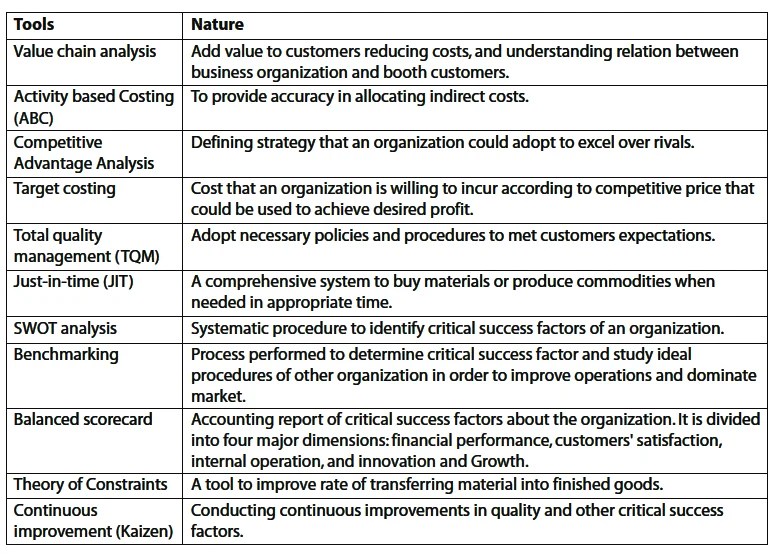
  • List of tools applied by the firm as a part of strategic cost management.
  • Any other types of reporting as required.

Effective control systems tend to have certain qualities in common. These can be stated thus:

  1. Suitable: The control system must be suitable to the needs of an organisation. It must conform to the nature and needs of the job and the area to be controlled. For example, the control system used in production department will be different from that used in sales department.
  2. Simple: The control system should be easy to understand and operate. A complicated control system will cause unnecessary mistakes, confusion and frustration among employees. When the control system is understood properly, employees can interpret the same in a right way and ensure its implementation.
  3. Selective: To be useful, the control system must focus attention on key, strategic and important factors which are critical to performance. Insignificant deviations need not be looked into. By concentrating attention on important aspects, managers can save their time and meet problems head-on in an effective manner.
  4. Sound and economical: The system of control should be economical and easy to maintain. Any system of control has to justify the benefits that it gives in relation to the costs it incurs. To minimize costs, management should try to impose the least amount of control that is necessary to produce the desired results.
  5. Flexible: Competitive, technological and other environmental changes force organizations to change their plans. As a result, control should be necessarily flexible. It must be flexible enough to adjust to adverse changes or to take advantage of new opportunities.
  6. Forward-looking: An effective control system should be forward-looking. It must provide timely information on deviations. Any departure from the standard should be caught as soon as possible. This helps managers to take remedial steps immediately before things go out of gear.
  7. Reasonable: According to Robbins, controls must be reasonable. They must be attainable. If they are too high or unreasonable, they no longer motivate employees. On the other hand, when controls are set at low levels, they do not pose any challenge to employees. They do not stretch their talents. Therefore, control standards should be reasonable they should challenge and stretch people to reach higher performance without being demotivating.
  8. Objective: A control system would be effective only when it is objective and impersonal. It should not be subjective and arbitrary. When standards are set in clear terms, it is easy to evaluate performance. Vague standards are not easily understood and hence, not achieved in a right way. Controls should be accurate and unbiased. If they are unreliable and subjective, people will resent them.
  9. Responsibility for failures: An effective control system must indicate responsibility for failures.

Detecting deviations would be meaningless unless one knows where in the organisation they are occurring and who is responsible for them. The control system should also point out what corrective actions are needed to keep actual performance in line with planned performance.

  1. Acceptable: Controls will not work unless people want them to. They should be acceptable to chose to whom they apply, controls will be acceptable when they are:
  • Quantified
  • Objective
  • Attainable
  • Understood by everyone

Features

Allows for Risk Management

Risk management can be considered as a subset or a specific form of strategic management. Risk is the probability of a future loss and risk management involves formulating various strategies to combat the risks making risk management a form or variety of strategic management.

Strategic management in this form allows for identifying and eliminating the risks posed by various hazards to the business.

Conscious Process

Strategies are a product of the developed conscience and intellect that we humans proudly possess and employ. Strategic management implies the usage of the brain and the heart and is not a routine ever-continuing process. It requires great skill and experience to be carried out effectively and requires a full application of one’s conscience.

Requires Foresight

The future is uncertain. We cannot predict what will happen. However, on the basis of the information that is available to us, we will be able to presume certain things about the future.

For instance, a discovery that the item XYZ causes cancer can allow us to make a very reasonable presumption that the item XYZ will be banned in the near future. This presumption thus allows us to not make any investment in anything directly related to XYZ.

Drives Innovation

The development of strategy is not a simple process and requires making the best out of often very restrictive situations. This drives innovations and allows managers to approach problems from different angles and solve problems more efficiently. After all, necessity is the mother of all inventions.

Strategic Management as a process is quite complicated and requires years of experience and inherent skills to be carried out efficiently. The process is pervasive and is central to any business. It is a discipline in itself and requires more study for enthusiasts wanting to pursue management.

Goal-Oriented Process

The process of Strategic Management is a goal-oriented process. The process is done with the intention and goal of analyzing the various elements through SWOT analysis and other tools and to develop a plan or strategy that effectively allows the business to maneuver itself around every hurdle and make use of its strength.

This process also plays the role of making all other functions of the business goal-oriented as well.

Facilitates decision making

Strategic Management plays an integral role in making important decisions. Whenever a manager has to make a decision he has to think about the bearing of such a decision on the overall strategy and the business’ trajectory.

Thus, the strategies developed to act as a guide to making efficient and accurate decisions.

Primary Process

Strategic Management is the primary process in any business. The strategies that the business has to apply in its activities is developed at the initial stage itself and only after the creation of the strategy that other processes commence by making the strategy as its basis.

Pervasive Process

Strategic Management is a pervasive process seen in all levels of the business.

The core strategies are formulated for the entire business by the top-level management and strategies to efficiently achieve the overall goal so laid down by the top-level management is developed through the various lower business units.

Dependent on Personal Qualities

The above two considerations make it amply clear that Strategic Management is heavily dependent on the personal qualities of the managers occupying the top-level positions.

These personal qualities including skills and experience obtained over years of employment and observation cannot be imparted by training or coaching classes and require practical exposure for extended periods of time unless the person is born with the talent of strategizing (which is rare).

Control of Total Distribution cost & Supply cost

Distribution Cost or the Distribution expenses are the costs that a company incurs to make its goods or services available to the end-users or resellers. It is a broad accounting term that covers several types of expenses.

Total distribution cost (TDC) analysis requires some assumptions. These include current observed rates and transit times for standard air freight, full containerload (FCL), and less-than containerload (LCL) service.

For any company which is involved in distribution, distribution cost is a major bottleneck. There are many different distribution expenses which must be taken care of. Furthermore, these expenses are not consistent and may change from time to time thereby changing the distribution cost as well.

If the shipper is a distributor and it further sells to the retailer and the retailer sells to the end user then all the separate distribution costs at each stage would be included in the total distribution cost. Moreover, in some cases the manufacturer has a production unit at one place and the “product pick up place” by the forwarder at another place. The cost of moving the product from the place of production to the pickup point is also included in distribution cost.

There are other types of costs as well that that are included in the distribution’s costs. Handling cost of inventory at all points for example production place, storehouse, sales point is part of distribution cost. Packing costs are also part of distribution costs. Distribution managerial cost such as the salary expense of distribution manager and his/her office expenses are also part of distribution costs.

Freight cost is usually the most important component of distribution costs. If the product is manufactured and sold in same country then freight cost refers to the “Trucking” or such transport fare to deliver the product.

If the product is sold internationally then it may include “Air Freight, Less than container load (LCL), Day-Definite LCL or Full container load (FCL).” In case the product is transported by air the cost would be higher and if it is transported through LCL the cost would be lower but there is one further point to contemplate i.e. “Transit Time”. The transit time for LCL is longer and the transit time for moving by air is smaller. Covering all ends there is a need for comparative analysis between the product demand urgency and transport cost. If the product is urgently needed and the shipper is losing sales revenue then it is optimum to reduce transit time and increase the freight expense.

Distribution expenses: The individual expenses made by the company for various reasons is known as Distribution expenses. These are individual or repeated transactions happening over time. An example may include; Rent, Salaries, Administrative expenses etc. All these are individual transactions or repeat transactions and these transactions can be called distribution expenses.

Distribution cost: The combination of all distribution expenses made by a company is known as Distribution cost. So, continuing the above example; the total of rent, salaries, and administrative expenses will be considered as distribution cost. In terms of Formula

[The sum of all Distribution Expenses] = Distribution cost

1) Sales returns

If a dealer or a retailer rejects a material, then the material comes back to the manufacturer provided it is in the returns policy of the company. This returned material may have come back due to cosmetic conditions (it was damaged or dented) or it may have come back due to performance issues. In any condition, the returned product is a cost to the company.

2) Direct Selling Expenses

Any expense made towards selling the product to the target customer is a direct selling. Many manufacturers, wholesalers, and distributors carry out direct selling in the regions that they want to expand. They also would like to know the distribution cost of that region. Thus, they consider all direct selling expenses as the primary expense made by the firm.

3) Commercials & Accountancy

It is a government requirement to present all your sales and purchases as well as balance and profit sheets to the government to determine profit earned by your firm. Furthermore, these statements are also important for the firm itself to note the growth year on year as well as to determine the performance and future potential. Thus, commercials and accounts are documented precisely in any firm.

4) Advertising & Sales promotion expenses

If a company wants to establish itself in a new region, it needs to have OOH advertising, it needs to run in-store branding, it needs to run ads in local newspapers or local channels. Thus, the company will be spending a lot towards advertising and promotions which are various forms of distribution expenses.

5) Product and Packaging expenses

The product packaging was good but was not strong. As a result, the packaging suffered a huge wear and tear by the time it reached the customer and the customers returned the product.

6) Shipping and Delivery

With the rise of E-commerce, delivery is a huge focus area for all manufacturers. The stock must be in the market, whether it is on an E-commerce portal or in a retail outlet or with the distributor. Everyone knows that if there is no stock on display, the sale will not happen and this creates friction between the different distribution channels.

7) Trade discounts

Besides sales promotion exercises like advertising and marketing, a company launches several trade promotional exercises as well. This includes giving discounts to retailers, distributors, and suppliers on achieving certain targets.

8) Market research

When reputed companies like Samsung, LG or Sony want to establish themselves in a new market, they buy market research reports from the likes of IMRB or Nielson. These reports may cost hundreds or thousands of dollars. Not only in a new market, even in an old market, a company might want to conduct a satisfaction survey or a survey of new ideas regarding distribution.

9) Credit, Outstanding and Overdue

A distributor who operates in a regional market needs the huge amount of money to conduct business. To arrange this money, the distributor takes a loan from the banks. This is known as an Overdue account. Hypothetically, If the distributor takes 1 lakh from the bank, within 30 days he should give back 1 lakh + 1% interest. Thus, a dealer suffers a loss when his money does not come back from the market in time.

10) Warehousing and handling within warehouse

Warehousing is a major cost of distribution. When a company expands to newer markets, it needs to have new warehouses in each new territory. Domino’s or McDonald’s practically have warehouses for every 3-4 towns so that they can supply to local retail outlets very fast. Because of Domino’s and McDonald’s handle frozen goods (burgers or fries), their expenses are even higher because they need cold rooms and cold chains to deliver the products.

NOTE: Warehousing cost is different from transportation and delivery cost which is calculated separately.

Under these assumptions, the analysis shows:

  • Standard LCL would minimize transport-related costs, but would incur by far the highest inventory-related expenses due to long and highly variable transit times.
  • Using full containerload (FCL) rather than LCL reduces inventory-related costs but to do so would spend more than the inventory-related savings on transport-related costs due to the wasted space in 20-ft. containers occupied by only 2,500 metric tons of freight.
  • Switching to air freight to minimize inventory-related costs would incur the highest transport-related expenses, leading to the highest overall total distribution costs.
  • Day-definite LCL could minimize total distribution costs (sum of transport and inventory related costs). Compared to LCL, the shipper would spend about $600,000 more on transportation to use day-definite LCL service ($1.8 million vs. $1.2 million per year) but would capture approximately $825,000 in inventory related cost savings ($1.3 million vs. $2.2 million per year).

Data information needs for HR Manager: Contents and Usage of Data

The Human Resource Information System (HRIS) is a software or online solution for the data entry, data tracking, and data information needs of the Human Resources, payroll, management, and accounting functions within a business. It is useful for all processes that you want to track and from which you hope to gather useful and purposeful data.

Normally packaged as a database, hundreds of companies sell some form of HRIS and every HRIS has different capabilities. Pick your HRIS carefully based on the capabilities you need in your company. As HRIS has become increasingly sophisticated, the choice among the various systems has become enough to practically paralyze an HR department.

Content to consider as you select your HRIS.

Number of Employees

Remember that even if your company is only a few people today, it may have twice that many or even 10 times that many employees in the future, so pick a system that can grow with your business.

System Capabilities

Another key factor that you must consider is that many HRIS are able to accomplish only part of what you need automation to accomplish. In these cases, you will want to make certain that the components of any add-ons or additional systems work together flawlessly. Again, don’t take the salesperson’s word about the systems working together. Do your research to ascertain that they do.

Performance development plans:

It’s not just enough to have plans if they are recorded in a central system, then they can easily follow the employee from position to position. Senior leadership can run reports to see where people are and what their individual managers are planning in terms of succession planning for their futures.

Disciplinary Actions:

It’s important to keep track of who has been suspended, demoted, or had other negative actions taken against them noted even after the employee leaves your organization. When a company calls and asks for a former employee reference, it’s easy for an admin in the HR department to look up and report back whether or not the person is eligible for rehire.

Training records:

This is especially critical in a company where certifications and licenses are required. In other companies, training records may not have that level of importance, but you may still find that having the information is useful as you develop your employees, a key factor that they want from work.

Training and Support

Check also to see what kinds of training and ongoing support are available for your staff. You should also ensure that the sales consultant’s promises about training and follow-up following the purchase are written right into your contract to purchase the HRIS. And, check with other organizations to make certain that your selected company has a track record of ongoing, helpful support.

Expected Functionality of Better HRIS Choices

Typically, the better Human Resource Information Systems (HRIS) provide overall:

Management of all employee information:

Data such as names, titles, addresses, and salaries are a basic start. Salary and position history, reporting structures, performance appraisal histories, and other critical employee information.

Company-related documents:

This includes such items as employee handbooks, emergency evacuation procedures, and safety guidelines.

Benefits administration:

You will want benefits administration including enrollment, status changes, and personal information updating. In an ideal system, you can allow employees to look up and review their own information, including vacation tracking.

Complete integration with payroll:

This integration will also include other company financial software and accounting systems. When these are connected, you can ensure that paychecks are correct. There is never a disconnect between what the official pay rate is and the information that payroll has. If the systems don’t integrate, it’s easy to update a salary in one system and not in the other.

Applicant tracking and resume management: 

When your system is seamless, the recruiter can click a hired button and all of the information from the applicant is transferred to the employee side of things. This saves so much time because your data entry and paperwork practically disappear.

Data used for

  • Attendance and PTO use
  • Pay raises and history
  • Pay grades and positions held
  • Performance development plans
  • Training received
  • Disciplinary action received
  • Personal employee information, and occasionally
  • Management and key employee succession plans
  • High potential employee identification
  • Applicant tracking, interviewing, and selection

Benefits, Limitations, Barriers in effective implementations of HRIS

Benefits

Collective Bargaining:

HRIS through a computer terminal can provide up-to-date relevant and required information, facts and figures and, thus, can facilitate collective bargaining. It can he p collective bargaining as “what if analysis” rather as feelings and fictions. In the same manner, HRIS can also help maintain better human relations in the organisation.

Career Planning:

By providing necessary information such as which employees have been earmarked for which positions, HRIS facilitates positional advancement of employees. In other words, HRIS helps in planning for succession.

Recruitment:

Recruitment forms the most essential function of HRM. HRIS helps in the recruitment process in a big way by recording the details of activities involved in employee recruitment. These may include cost and method of recruitment and time taken to fill the positions level wise.

Performance Appraisal:

In order to form a comprehensive overview about an employee, HRIS maintains performance appraisal data such as the due date of the appraisal, potential for promotion, scores of each performance criteria and alike. The textual information can be combined with the factual data obtained from the HRIS and the combination of information can be used for imparting training and affecting employee mobility in the form of transfer and promotion.

Manpower Planning:

HRIS is used for manpower planning also. It keeps information of organisational requirements in terms of positions. HRIS connects employees to the required positions in the organisation. It is also used to identify vacancies and establish employees thereon. HRIS can also help identify a logical progression path and the steps to be taken for employee progress/ advancement.

Medical History:

The HRIS is also used to maintain occupational health data required for industrial safety purposes, accident monitoring, and so on.

Skill Inventory:

Recording employee skills and monitoring a skill data base is yet another use of the HRIS. Such a skill record helps identify employees with the necessary skill for certain positions or jobs in an organisation.

Leave/Absence Increase:

HRIS is also used to control leave/absence of employees. This is done by maintaining a leave history of each employee. Every employee can be issued an identity card writing every employee’s token number coded on it. Employee’s entry and exit from the organisation should be recorded on the identity card. This reduces chances for malpractice or oversight in calculating wages for each employee.

Salary Administration:

One of the functions of HRIS is to provide a report containing information like present salary, benefits, last pay increase and proposed increase in future.

Personnel Administration:

It encompasses personal information of an employee. These may include name, address, date of birth, marital status, and the date of joining the organisation. It also contains the name and address of next kin of the employee concern. These information describe the employee.

Limitations

Inadequate Information:

Some enterprises do not have requisite information about their employees. In the absence of adequate information and data base, this system cannot be properly implemented. So, there is a need to collect, store and retrieval of information before implementing human resource management.

In many organisations, even the professionals misunderstand HRM as synonymous with HRD. Some class room training programmes are generally arranged, which are called HRD programmes. These programmes are understood as human resources management. Such casual class room programmes are not the actual HRM programmes.

Even a well planned and executed HRD programme is not HRM. HRD is only a part of HRM which is an integrated approach to management. Undoubtedly, human resource management suffers from such limitations. But the impact it has made on the managerial effectiveness has been spectacular wherever it was introduced. Actually speaking a real need exists in every Indian organisation for an HRM approach.

Security. Security is one of the biggest worries. Systems must be designed to prevent unauthorized access to sensitive and confidential data and also the unintended publication of such information. This typically required many “compartments” and many levels of authority for access, all of which have to be monitored and maintained.

Inadequate Development Programmes:

HRM needs implementation of programmes such as career planning, on the job training, development programmes, MBO, counselling etc. There is a need to create an atmosphere of learning in the organisation. In reality HRM programmes are confined to class room lectures and expected results are not coming out of this approach.

Staffing. With larger installations, there’s probably the cost of hiring an IT specialist to manage the system.

Lack of Support of Top Management:

HRM should have the support of top-level management. The change in attitude at the top can bring good results while implementing HRM. Owing to passive attitude at the top, this work is handled by personnel management people. Unless there is a change in approach and attitude of top management nothing remarkable will happen.

Improper Actualisation:

HRM should be implemented by assessing the training and development requirements of employees. The aspirations and needs of people should be taken into account while making human resource policies. HRM is actuated half-heartedly. The organising of some training programmes is considered as the implementation of HRM. With this, management’s productivity and profitability approach remain undisturbed in many organisations.

Recent Origin:

HRM is of recent origin. So, it lacks universally approved academic base. Different people try to define the term differently. Some thinkers consider it as a new name to personnel management. Some enterprises have named their traditional personnel management department as human resource management department.

Such superficial actions may not bear much fruit. What is actually required is a fundamental change in attitudes, approaches and the very management philosophy. Without such a change, particularly at the top management level, renaming of personnel department or redisgnating the personnel officer may not serve the purpose. With the passage of time an acceptable approach will be developed.

Barriers in effective implementations of HRIS

Insufficient Information:

In most of the Indian organisations, human resource information system (HRIS) has not been fully developed. In the absence of reliable data, it may not be possible to develop effective human resource plans.

Uncertainties:

Labour absenteeism, labour turnover, trade cycles, technological changes and market fluctuations are the uncertainties which serve as constraints to Human Resources planning. It is risky to depend upon general estimates of human resource in the face of rapid changes in environment.

Expensive and Time Consuming:

Human resource planning is an expensive and time-consuming process. Employers may resist human resource planning feeling that it increases the cost of human resource.

Coordination with other Managerial Functions:

There is generally a tendency on the part of the human resource planners to remain aloof from other operating managers and to become totally absorbed in their own world. To be effective human resource planning must be integrated with other management functions.

Identity Crisis:

There is generally identity crisis and many managers as well as Human Resource specialists do not fully understand the total Human resource planning process. There can be little doubt that unless the Human resource planning specialists develop a strong sense of purpose; they are more likely to fail.

Resistance from Employees:

Employees and trade unions often resist human resource planning. They feel that this planning increases their overall workload and regulates them through productivity bargaining. They also feel that it would lead to wide spread unemployment, especially of unskilled labour.

Insufficient Initial Efforts:

Successful human resource planning flourishes slowly and gradually. Sometimes sophisticated technologies are forcefully introduced just because competitors have adopted them. These may not be successful unless matched with the needs and environment of the particular enterprise.

Lack of Support of Top Management:

Human resource planning requires full and wholehearted support from the top management. In the absence of this support and commitment, it would not be possible to ensure the necessary resources, cooperation and support for the success of the human resource planning.

Requisites for Successful Human Resource Planning:

  • Plans should be prepared by skill level rather than aggregates.
  • Backing of top management.
  • HRP responsibility should be centralised for better coordination and consultation between different management levels.
  • Personnel record must be complete.
  • The technique of planning should be best suited to data available.
  • It must be recognised as an integral part of corporate planning.
  • Data collection, analysis of planning and plans themselves must be continuously revised and improved.

HRIS for HRP

HRIS stands for Human Resources Information System. The HRIS is a system that is used to collect and store data on an organization’s employees.

An HRIS is also known as HRIS software. This is a bit confusing as it implies that different systems can have different software running on them. However, this is not the case. The HRIS is, in essence, a software package.

The HRIS can either run on the company’s own technical infrastructure, or, what’s more common nowadays, be cloud-based. This means that the software is running outside of the company’s premises, making it much easier to update.

As technology evolves, so does its impact on strategic human resource planning. Human resource information systems are electronic systems that compile information in databases to be easily accessed and analyzed. Some information systems allow automation of processes, such as payroll tax calculations, while others streamline processes by minimizing the need for manual data entry and paper records, thus increasing accuracy and efficiency.

Workforce Planning

Human resource information systems keep track of critical employee data such as demographic information, job titles and Equal Employment Opportunity Commission identification codes. Storing this information in an electronic database allows you to analyze it more easily when working on recruitment strategies, progression planning and affirmative action programs. HR reps can quickly run reports to determine items such as how many employees were hired last year, average length of tenure and a breakdown of the employee population.

Total Rewards

One HR function that can benefit from the use of human resource information systems is total rewards, which refers to all components of the overall compensation model, including salary and benefits. Your company’s HR department can more effectively track and plan for changes to employees’ salary, insurance, retirement and other benefits options using an HRIS. Electronic records keep track of current expenses, and many systems offer projection models and calculators that can help you analyze the impact of various changes. This is especially useful when preparing for annual increases or benefits open enrollment.

Risk Management

Human resource information systems also minimize risks and potential liabilities. This is accomplished by keeping electronic records of items such as employee discipline notices, safety training employees have received, accident logs and workers’ compensation claims. This data is analyzed by the HR department to identify ways to improve workplace conditions, safety training classes and disciplinary processes to ensure compliance with all federal and state labor laws.

Training and Development

Small businesses also may look to an HRIS to assist with training and development initiatives. Depending on the needs of your company, you can use an HRIS to facilitate the annual performance review process, to allow employees to sign up for company-sponsored training classes or to build a talent inventory of what education, experience and training each employee has. Having this information readily accessible by managers and human resources representatives is an asset when developing new training programs or when restructuring departments or positions.

Human Resource Information System (HRIS), Meaning, Evolution, Objectives, Types, Components, Applications, Limitations

Human Resource Information System (HRIS) is a comprehensive software solution designed to manage and automate core HR functions. It acts as a centralized database that stores, processes and manages all employee-related information such as personal details, payroll, attendance, recruitment, performance, training and benefits. By integrating HR operations with Information Technology, HRIS improves efficiency, ensures accuracy and reduces manual workload. It provides real-time reports and analytics to support strategic decision-making and enables employee self-service. Ultimately, HRIS helps in effective workforce planning, ensures legal compliance, and enhances overall organizational productivity and growth.

Evolution of HRIS:

The evolution of HRIS began in the 1950s and 1960s when organizations first used computers for payroll processing and basic record keeping. These early systems were mainframe-based, highly expensive, and limited to routine administrative tasks. In the 1970s, with the development of database management systems, HRIS expanded to include personnel management functions like employee data storage, benefits administration and regulatory compliance reporting. However, systems were still centralized, complex, and operated only by IT specialists. By the late 1970s and early 1980s, HR departments realized the need for more efficient workforce management to reduce paperwork, improve data accuracy and handle large volumes of employee information, which laid the foundation for modern HR systems.

In the 1980s, the advent of personal computers and Relational Databases made HRIS more affordable and user-friendly for HR professionals. The 1990s saw a major shift with the introduction of Client-Server architecture and integration with ERP systems like SAP and PeopleSoft, connecting HR with finance and other functions. The 2000s brought web-based HRIS and Employee Self-Service portals, enabling remote access. Today, HRIS has evolved into cloud-based and AI-powered strategic systems offering talent analytics, recruitment automation, performance management and predictive insights, transforming HR from an administrative function to a strategic business partner.

Objectives of HRIS:

1. Efficient Data Management and Centralization

The primary objective of HRIS is to ensure efficient data management through a centralized database system. It aims to store, organize, and maintain all employee-related information such as personal details, payroll, attendance, and performance records in one secure place. This eliminates paperwork, duplication, and data inconsistency. HRIS provides quick retrieval, easy updating, and accurate record-keeping, which saves time and administrative costs. By creating a single source of truth for HR data, it ensures data integrity and enables HR managers to manage a large workforce systematically and effectively without manual errors.

2. Automation of HR Operations and Processes

Another key objective is the automation of HR operations to improve operational efficiency. HRIS automates routine and repetitive tasks like payroll processing, leave management, recruitment, attendance tracking, and benefits administration. This reduces manual workload, minimizes human errors, and speeds up HR processes. Automation allows HR professionals to shift focus from administrative work to strategic activities like talent development and workforce planning. It also ensures uniformity and transparency in HR procedures, leading to faster decision-making, reduced processing time, and enhanced overall productivity of the HR department.

3. Strategic Decision Making and Planning

HRIS aims to support strategic decision making by providing accurate and timely information to management. It generates real-time reports, HR analytics, and predictive insights related to workforce trends, turnover, performance, and training needs. This data-driven approach helps top management in effective workforce planning, succession planning, and talent management. By analyzing HR metrics, organizations can identify skill gaps, forecast manpower requirements, and formulate strategic HR policies. Thus, HRIS transforms the HR function from a traditional administrative role into a strategic business partner contributing to organizational growth.

4. Legal Compliance and Data Security

A crucial objective of HRIS is to ensure legal compliance and data security. The system helps organizations comply with various labour laws, tax regulations, and employment standards by maintaining accurate records and generating compliance reports automatically. It keeps track of policy changes and ensures timely statutory filings. Simultaneously, HRIS protects sensitive employee data through access controls, encryption, and audit trails, preventing unauthorized access and data breaches. This dual objective safeguards the organization from legal penalties, financial losses, and reputational damage while building employee trust regarding confidentiality.

5. Employee Empowerment and Self-Service

HRIS aims to promote employee empowerment through Employee Self-Service (ESS) features. It allows employees to access and update their personal information, view payslips, apply for leave, check attendance, and track performance through a self-service portal. This objective enhances transparency, improves communication, and increases employee satisfaction and engagement. It also reduces the burden on HR staff for routine queries and fosters a sense of ownership among employees. By providing Manager Self-Service, it enables managers to approve requests and monitor team performance, leading to better employee-manager relationships.

Types of HRIS:

1. Operational HRIS

Operational HRIS is the most basic and traditional type focused on day-to-day HR operations. Its main objective is to maintain and manage routine employee-related data such as payroll processing, attendance, personal details, and benefits administration. It automates repetitive administrative tasks, reduces paperwork, and ensures data accuracy. This system is primarily used by lower-level HR staff for record-keeping and transaction processing. It provides quick data retrieval and generates basic reports but lacks advanced analytical capabilities, serving as the foundation for other strategic HRIS types in the organization.

2. Tactical HRIS

Tactical HRIS focuses on supporting middle-level management decisions related to HR resource allocation. It deals with functions like recruitment, job analysis, training and development, and compensation management. Unlike operational HRIS, it provides tools for analyzing workforce requirements, designing salary structures, and tracking employee skills and performance. This type helps in effective workforce planning and ensures the right talent is available. It generates analytical reports for decision-making and helps managers in implementing HR policies, improving productivity and aligning human resources with short-term organizational goals and departmental needs.

3. Strategic HRIS

Strategic HRIS is an advanced type designed for top-level management to make long-term strategic decisions. It focuses on strategic HR planning, succession planning, talent forecasting, and organizational development. This system uses HR analytics, predictive modeling, and business intelligence to analyze workforce trends, labour market conditions, and employee potential. It helps in formulating policies for mergers, expansions, and leadership development. Strategic HRIS transforms HR from an administrative function into a strategic business partner, contributing directly to competitive advantage, organizational growth, and long-term sustainability through data-driven insights.

4. Comprehensive HRIS

Comprehensive HRIS is an integrated system that combines operational, tactical, and strategic functions into a single platform. It is often a part of ERP systems like SAP, Oracle, and PeopleSoft. This type provides an all-in-one solution covering employee lifecycle from hiring to retirement, including payroll, self-service, performance management, and analytics. It ensures seamless system integration across departments like finance and inventory. By centralizing all HR processes, it offers high data security, ensures legal compliance, and supports both routine operations and strategic planning, making it ideal for large enterprises.

Components of HRIS:

1. Hardware

Hardware refers to the physical equipment used to operate an HRIS. It includes computers, servers, storage devices, scanners, printers, biometric devices, and networking equipment. HR employees use computers and other devices to enter, process, and access employee information. Biometric devices may be used for attendance and time recording, while servers or cloud infrastructure can store HR databases and applications. Reliable hardware is necessary for smooth system operation and quick access to employee information. Therefore, hardware provides the physical foundation required for collecting, processing, storing, and communicating human resource information.

2. Software

Software includes the programmes and applications used to manage human resource information. HRIS software can support activities such as employee records, recruitment, payroll, attendance, leave management, performance appraisal, training, and benefits administration. It provides interfaces through which authorised users can enter, update, retrieve, and analyse employee information. Modern HRIS applications may also provide self-service facilities for employees and managers. Software should be secure, reliable, user-friendly, and suitable for organisational requirements. Thus, HRIS software enables the automation and systematic management of various human resource activities.

3. Employee Data

Employee data is the basic information processed by an HRIS. It may include employee identification details, job information, salary, attendance, leave, qualifications, training, performance, and employment history. Recruitment-related information and benefits records may also be maintained. Accurate employee data is essential because HR reports and decisions depend on the quality of information stored in the system. Data should be updated regularly and protected from unauthorised access. Proper data management helps HR professionals understand workforce characteristics and manage employee-related activities efficiently. Therefore, employee data forms the core information resource of an HRIS.

4. Database

A database stores employee and HR-related information in an organised and structured manner. It may contain records related to employees, departments, positions, salaries, attendance, leave, recruitment, training, and performance. A database management system allows authorised users to store, retrieve, update, and manage HR information efficiently. Centralised data storage can reduce duplication and improve consistency across HR activities. It can also support reporting and analysis by combining information from different HR functions. Appropriate access controls and backups are necessary to protect the database. Thus, the database provides the central storage system for HR information.

5. Procedures

Procedures are the rules and methods used to operate and control an HRIS. They specify how employee information should be collected, entered, verified, updated, processed, stored, and reported. Procedures may cover recruitment data entry, attendance processing, payroll preparation, leave approval, employee record updates, and data backup. Clearly defined procedures help HR employees perform activities consistently and reduce errors. They also support security, accountability, and proper use of employee information. Therefore, procedures provide a structured framework for managing HRIS activities and ensure that human resource information is handled systematically.

6. People

People are an essential component of HRIS because they operate, manage, maintain, and use the system. They include HR managers, HR executives, employees, managers, IT professionals, system administrators, and database administrators. HR employees use the system for maintaining records and performing HR activities, while managers may access information for workforce planning and performance management. IT professionals maintain the technical environment and address system issues. Employees may also use self-service functions for viewing personal information or submitting requests. Therefore, people provide the knowledge, judgement, supervision, and operational support required for effective HRIS functioning.

7. Network and Communication

Network and communication infrastructure enables HR information to be shared between employees, departments, offices, and HR applications. It includes internet connections, local networks, communication systems, routers, and related networking technologies. A reliable network allows authorised users to access HRIS applications from different locations and supports communication between integrated HR functions. For example, attendance information can be connected with payroll processing through the system. Secure network connections are important because HRIS contains sensitive employee information. Therefore, network infrastructure supports information sharing, system integration, remote access, and communication within human resource management.

8. Security and Access Controls

Security and access controls protect employee information from unauthorised access, alteration, disclosure, or loss. HRIS contains sensitive information such as salaries, personal details, attendance records, and performance information. Organisations can use user authentication, role-based access, passwords, encryption, audit trails, backups, and access permissions to protect this information. Employees should receive access only to information required for their responsibilities. Regular monitoring and security reviews can further strengthen protection. Therefore, security and access controls are essential for maintaining the confidentiality, integrity, availability, and privacy of employee information within an HRIS.

Applications of HRIS:

1. Employee Record Management

HRIS is widely used for maintaining employee records in a centralised and organised system. It can store information such as employee details, qualifications, job position, department, salary, employment history, attendance, leave, and other relevant records. HR professionals can retrieve and update employee information efficiently without maintaining large numbers of physical files. Centralised records also help reduce duplication and improve data consistency. Access controls can restrict sensitive information to authorised users. Therefore, HRIS makes employee record management more systematic, accessible, accurate, and secure, while reducing the administrative effort required for maintaining employee information.

2. Recruitment and Selection

HRIS supports recruitment and selection by helping organisations manage job vacancies, applications, candidate information, interview schedules, and recruitment records. HR departments can store applicant information and track candidates throughout different stages of the recruitment process. The system can also support communication with candidates and maintain records of recruitment activities. By organising recruitment information in one system, HR professionals can reduce paperwork and improve coordination between recruiters and managers. HRIS may also support online applications and automated workflow processes. Thus, HRIS helps make recruitment activities more organised, efficient, and easier to monitor.

3. Payroll Management

One of the important applications of HRIS is payroll management. The system can process information related to employee salaries, allowances, deductions, attendance, leave, bonuses, and other payroll components. HRIS can use employee and attendance data to support salary calculations and generate payroll reports. Integration with financial systems can also facilitate the flow of payroll information to accounting functions. Automation reduces repetitive calculations and can minimise manual processing errors. Appropriate controls are required to protect salary information. Therefore, HRIS helps organisations manage payroll activities in a systematic, efficient, and controlled manner.

4. Attendance and Leave Management

HRIS can be used for attendance and leave management by recording employee working hours, attendance, absences, overtime, and leave details. Attendance information may be collected through digital or biometric systems and connected with the HRIS. Employees can submit leave requests through the system, while authorised managers can review and approve them. The system can maintain updated leave balances and generate attendance reports. Integration with payroll can also help ensure that relevant attendance and leave information is considered during salary processing. Thus, HRIS improves attendance tracking, leave administration, record accuracy, and administrative efficiency.

5. Performance Management

HRIS supports employee performance management by maintaining information related to performance objectives, appraisal results, feedback, and development requirements. Managers can use the system to record performance evaluations and monitor progress against established goals. HR departments can analyse performance information to identify training or development needs. A centralised system also helps maintain consistent records of employee evaluations over time. Properly designed performance processes can improve communication between managers and employees regarding expectations and development. Therefore, HRIS provides a structured platform for performance monitoring, appraisal administration, feedback, and employee development.

6. Training and Development

HRIS is used for training and development management by maintaining information about employee skills, training programmes, participation, certifications, and development requirements. HR professionals can identify skill gaps and plan suitable training programmes based on employee and organisational needs. The system can maintain training schedules, participant records, and completion information. Managers can use available information to support employee development planning. HRIS can also help track whether employees have completed required training. Therefore, HRIS supports systematic training administration, skill development, career planning, and monitoring of employee learning activities.

7. Compensation and Benefits Management

HRIS helps organisations manage employee compensation and benefits by maintaining information about salaries, incentives, allowances, bonuses, benefits, and other compensation-related elements. HR professionals can use the system to maintain compensation records and support salary reviews and benefits administration. Integrated information can help managers analyse compensation structures across departments and positions. The system can also support communication of relevant benefits information to employees. Appropriate access controls are important because compensation information is sensitive. Thus, HRIS improves the organisation, administration, monitoring, and reporting of employee compensation and benefits.

8. Workforce Planning

HRIS supports workforce planning by providing information about employee numbers, skills, positions, turnover, vacancies, and workforce requirements. HR managers can analyse current workforce information and identify future staffing needs. The system can help organisations monitor employee movements, retirement requirements, vacancies, and skill availability. This information supports decisions related to recruitment, workforce allocation, succession planning, and employee development. HRIS can also provide reports and analytical information for management planning. Therefore, workforce planning through HRIS helps organisations align employee availability and skills with current and future organisational requirements.

9. Employee Self-Service

HRIS can provide employee self-service (ESS) facilities that allow employees to access and manage certain HR-related information themselves. Employees may view personal records, salary information, attendance details, leave balances, benefits information, or submit requests through the system, depending on organisational configuration. Managers may also use manager self-service facilities for approvals and workforce information. This reduces the need for HR staff to handle every routine request manually. It can also improve communication and information accessibility. Therefore, employee self-service helps increase employee convenience, administrative efficiency, transparency, and access to HR information.

10. HR Reporting and Analytics

HRIS supports HR reporting and analytics by collecting information from different human resource activities and converting it into useful reports. HR managers can analyse data related to employee turnover, absenteeism, recruitment, compensation, performance, training, and workforce composition. Reports can help identify trends and areas requiring management attention. HR analytics can support workforce planning and evidence-based HR decisions when data is accurate and appropriately interpreted. Therefore, HRIS provides managers with a structured information base for monitoring HR performance, analysing workforce trends, planning resources, and supporting managerial decision making.

Limitations of HRIS:

1. High Implementation Cost

The high cost of implementation is an important limitation of HRIS, particularly for small and medium-sized organisations. Expenses may include software licences, hardware or cloud services, customisation, data migration, implementation support, employee training, security measures, and maintenance. Additional costs may arise when the organisation needs to integrate HRIS with payroll, accounting, attendance, or other systems. If the project is not properly planned, costs can exceed the initial budget. Although HRIS may provide long-term efficiency benefits, organisations must carefully evaluate their requirements and resources before implementation. Therefore, financial investment can be a significant limitation.

2. Data Security and Privacy Risks

HRIS stores sensitive employee information such as personal details, salary, attendance, performance, qualifications, and employment records. Unauthorised access, cyberattacks, accidental disclosure, or improper handling of data can create security and privacy risks. Weak passwords, incorrect access permissions, system vulnerabilities, or poor security practices may expose confidential information. Organisations therefore need appropriate authentication, access controls, encryption, monitoring, backups, and data protection procedures. Security also depends on employee awareness and proper system administration. Thus, the need to continuously protect sensitive employee information is an important limitation and responsibility associated with HRIS.

3. Dependence on Technology

HRIS is highly dependent on technology, hardware, software, networks, and system availability. Technical failures, internet disruptions, server problems, software errors, or power interruptions can affect access to HR information and services. If the system becomes unavailable during important activities such as payroll processing, attendance management, or recruitment, HR operations may be disrupted. Organisations may require technical support and backup arrangements to reduce these risks. Employees may also face difficulties when system interfaces or processes change. Therefore, technological dependence can become a limitation when organisations do not have adequate technical infrastructure, support, and contingency arrangements.

4. Employee Resistance to Change

Employee resistance can limit the successful use of HRIS. Employees who are accustomed to traditional paperwork or existing HR procedures may hesitate to adopt a new digital system. Some employees may feel uncomfortable with technology or may perceive the new system as complicated. Resistance can reduce system usage and affect the quality of information entered into HRIS. Organisations need effective communication, training, demonstrations, and user support to encourage adoption. Employees should understand how the system benefits their work. Therefore, acceptance and willingness to use the system are important factors that can limit the effectiveness of HRIS.

5. Need for Training

HRIS requires employees and managers to have appropriate technical and system-related skills. Users may need training to enter information, generate reports, use self-service functions, follow workflows, and protect confidential data. Without adequate training, employees may make data-entry mistakes or fail to use important system features. Training also becomes necessary when new modules, features, or system versions are introduced. This creates additional time and financial requirements for organisations. Therefore, the continuous need for user training and skill development can be a limitation, particularly when an organisation has many employees or frequent system changes.

6. Data Quality Problems

The effectiveness of HRIS depends heavily on the quality of employee data stored in the system. Incorrect, incomplete, outdated, duplicated, or inconsistent information can produce unreliable reports and affect HR decisions. For example, inaccurate attendance or employee records may affect payroll and workforce analysis. An HRIS can process information efficiently, but it cannot automatically guarantee that all input data is correct. Organisations must establish procedures for data validation, updating, cleaning, and verification. Therefore, poor data quality can limit the usefulness of HRIS and may result in incorrect information and ineffective HR decision making.

7. Complexity of Implementation

HRIS implementation can be a complex process because it may involve multiple HR functions, departments, employees, technologies, and existing information systems. Organisations may need to redesign processes, migrate employee data, configure workflows, integrate payroll or attendance systems, and establish security controls. Complex requirements can increase implementation time and create difficulties for users. Organisations may also require external consultants or specialised IT professionals. Poor planning can lead to delays and implementation problems. Therefore, the technical and organisational complexity of HRIS implementation can be a significant limitation for organisations with limited resources or expertise.

8. Maintenance and Upgrading Requirements

HRIS requires regular maintenance, updates, upgrades, and technical support to remain effective. Software may need security updates, performance improvements, new features, or changes to meet organisational and regulatory requirements. Maintenance can involve additional costs and may require specialised technical expertise. System upgrades may also require employee retraining and testing to ensure that existing HR processes continue to work properly. Failure to maintain the system can create security vulnerabilities or reduce performance. Therefore, the ongoing requirement for maintenance, technical support, and system upgrades can increase the resources needed to operate an HRIS.

9. Reduced Personal Interaction

Excessive dependence on HRIS may reduce direct interaction between employees and HR professionals for certain routine activities. Employees may use self-service portals to submit requests, access records, or obtain information without speaking directly with HR staff. While this improves administrative efficiency, some sensitive HR matters require personal communication and human judgement. Issues involving employee concerns, workplace relationships, grievances, or complex performance situations may not be effectively handled through automated systems alone. Therefore, HRIS should support rather than completely replace human interaction, because human judgement and communication remain important in HR management.

10. Dependence on Accurate System Configuration

HRIS processes information according to its configured rules, workflows, permissions, and business processes. If the system is configured incorrectly, it may produce inappropriate calculations, reports, approvals, or notifications. For example, incorrect payroll settings or leave rules can affect employee records and administrative processes. Changes in organisational policies may also require corresponding changes in the system. Regular review and testing are therefore necessary to ensure that system configurations remain appropriate. Thus, dependence on correct system configuration and administration can be a limitation, particularly when organisations lack adequate technical and HR expertise.

Security issues in HRIS

With the rise of cloud-based HRIS solutions that enable users to log in from any device, security concerns are on the rise. The addition of unknown IP address access can make systems susceptible to outside hackers, as well as devious computer-savvy employees. Information breaches and identity theft occurring from inside company walls are also a concern that must be addressed.

Organizations should:

  • Appoint a data protection officer to be in charge of all aspects of information including.
  • Audit information systems to find out who holds what data, and why.
  • Consider why information is collected and how it is used. Issue guidelines for managers about how to gather, store and retrieve data.
  • Ensure that all information collected now complies with the Data Protection Act.
  • Check the security of information stored.
  • Check the transfer of data outside.
  • Check the organization’s use of automated decision making.
  • Review policy and practice in respect of references.
  • Review or introduce a policy for the private use of telephones, email and post.

A HRIS contains highly sensitive data, including employees’ social security numbers, payroll information, and even medical information. Information leaks and data breaches of the HRIS can be detrimental to individual employees and your organization as a whole. As such, it is important to take steps to make sure that that information is as safe as possible, from both internal and external threats.

For all companies, the implementation phase is the time when systems are the most susceptible to breaches and other security concerns. Employers should work closely with vendors and managers to ensure that security is maintained throughout implementation phases, and as the system starts being used on a regular basis.

Purchase with Intention

When you are looking to purchase a new HRIS, look into the reviews and pay close attention to what other companies say about the security of the software. While you may put additional security measures in place after the system has been implemented, going with a vendor that is known for offering a secure HRIS can help to keep your data more secure while limiting the amount of work that you have to put into adding security features.

Check Vendor Security Measures

The security measures a vendor takes to ensure that a company’s data are secure should be understood before the company makes a final HRIS selection. All HRIS vendors take precautions to keep company data safe, but the quality of their security measures may vary.

If no one on the HRIS selection team is a security expert, footing the bill to consult with someone that is qualified may help to ensure that the selected system has adequate security precautions in place.

Restrict Access Based on Needs

During the configuration stage of implementation, employers and managers must be mindful to set up the system so that information is limited and controlled.

Employees should only have access to their own personal information. In addition, every change made by an employee using the system must require authorization. Managers should have limits set, based on relevancy to job needs. This way, only the most critical information is accessible.

Employees and managers are not always honest and looking out for the best interests of the company or the other employees. It is important to make sure that only the most necessary information is accessible by employees at each level. Connecting passwords to access levels is a smart way to make sure that employees and managers are only able to see the information that pertains to them or their job duties.

Putting role-based access restrictions in place during the implementation phase can help to minimize internal threats to data security right from the start. Employees don’t really need access to information that doesn’t pertain to them, and each level of management really only needs access to certain information. By restricting access to just what is needed for employees and managers at each level, you also make it easier for employees to use the system and make it possible to tell who is doing what in the system for audit purposes.

It is also important to make sure that terminated employees are immediately restricted from the system. Bitter employees can do monumental damage to companies when allowed access for just a short amount of time after being let go. In some cases, ex-employees have caused companies thousands of dollars and many hours with just a few clicks.

Before the system goes live, create a few fake employees and test the system to see what you can access. This way you can identify any weak points in the system and work out the bugs before giving everyone access to the system.

Keep Your HRIS Information Safe from Hackers

The HRIS is a veritable gold mine for hackers. Employee names, dates of birth, social security numbers, salaries, and even banking information can be accessed through an HRIS, providing cyber-savvy thieves with everything they need to secure credit cards and commit countless acts of identity theft if they can breach the system’s safeguards. Even large and formidable companies are not immune to breaches and hacks, as evidenced by the breach at CareerBuilder.

Keeping electronic records secure is not impossible, though, it just takes a little knowledge and action. The following are a few ways to make sure that the data in your system stays secure.

Be Aware of Cyber Security

Most employers and HR professionals have absolutely no idea what safeguards are in place on their HRIS, nor what safeguards should be in place. Becoming knowledgeable about these issues is the first step to becoming more cyber secure. HRIS vendors should be happy to explain more about what steps are taken to protect information and a little online research will help to make sure their measures are adequate.

Beware of Phishing Schemes

Most cyber hacks are pulled off not because of system weakness, but because of human folly. Phishing schemes target employees and managers, tricking them into giving up usernames, passwords, and other sensitive information. By spreading awareness throughout the company of these types of schemes, suspicious pop-ups, emails, and phone calls may be flagged and shut down before harm can be done.

Create and Educate Employees on Security Protocols

Even if every employee can only access certain information with their code or card, these access restrictions are ineffective if managers and employees are sharing codes and cards. It is important to make sure that managers and employees know what the stakes are if they share this information. Create disciplinary policies that highlight the possible consequences of sharing access to discourage employees from doing so.

One of the most common causes of internal security breaches is lax internal security protocols. If managers hand out passwords that allow employees to perform certain activities (especially late clock-ins and early clock-outs), it undermines the effectiveness of passwords as a security measure.

To mitigate this issue, employees and managers should be trained to understand the reasons behind security measures as part of implementation training. They should also be held accountable for non-compliance with procedures.

Keep Software Up To Date

Security measures such as firewalls and security patches are only effective if they are up to date. Periodic maintenance should be scheduled to continually make sure that the system is secure and to make changes as needed. Hackers are always figuring out how to bypass security protocols, so it is necessary to stay one step ahead to protect your company.

Enable Timeout Features

Since most HRIS are now cloud-based and can be accessed from any device, timeout features can be extremely helpful. If there is an option to log employees out of the system after a certain amount of inactive time, make sure to activate this potentially valuable option. By the same token, disable features that would allow employees to stay logged into the system, just in case an employee inadvertently leaves a device where it can be stolen or tampered with.

Taking precautions to protect the information in your HRIS can save headaches and prevent damaging breaches. While information is generally more secure in a HRIS than in old-fashioned files, the technology comes with risks that must be addressed.

Frequent Password Changes

Most HRIS systems can be configured to require a password change every so often, usually once every 60 days. While managers and employees may express complaints regarding this measure, it can help to provide an extra layer of security as it protects sensitive information from both internal and external threats. It will also aid in keeping employees and managers from using passwords that are easy to guess based on personal information, as employees must be more inventive when creating new passwords.

Prepare for the Worst

Some of the most sensitive information in any company is contained within its HR files. Much of the information detailed in employee files is helpful or necessary for operations, ensuring that employees are compensated in a timely manner and that all reporting is completed according to legal requirements. However, this same information is valuable and tempting for hackers and thieves.

Security breaches can be devastating to a company’s employees and can sully a company’s reputation. Additionally, new privacy laws under the General Data Protection Regulation (GDPR) in Europe are enforceable as of May, which may result in hefty penalties for non-compliance for any company doing business in Europe (even if headquarters is located elsewhere).

Unfortunately, hackers continue to find new ways around security measures as they are created. It’s important to stay vigilant when it comes to protecting data so that your company is always one step ahead. The following are a few ways that you can work to establish the highest standards for data security and privacy.

Develop Password Priorities

Roughly 63 percent of data breaches can be traced back to weak, default, or stolen passwords according to a Verizon 2016 Data Breach Investigation Report. Passwords can be guessed by coworkers, phished by scammers, or even given away by the managers or employees themselves in the interest of efficiency. Once a thief has infiltrated the system, it can be difficult to re-establish control.

Creating strong passwords and using them properly can prevent data breaches. Forming guidelines that assist employees with setting up strong passwords and guarding them can make a big difference. Outlining policies that prohibit password sharing and enforcing them can also discourage poor practices.

Provide Data Security Training

HR managers, IT professionals, and front line managers should all undergo some type of security training. These individuals all have access to sensitive employee data, so it’s critical to make sure they understand the importance of keeping this data secure. Vendor representatives may be helpful when it comes to teaching employees the best ways to use the features of an HRIS to improve security.

Create Cyber Secure Policies

Not all cybersecurity tactics require technical skills and seminars to achieve. Simply instituting smart policies can sometimes be a company’s greatest prevention against hackers. If HRIS data can be accessed remotely, it is important to institute policies against leaving devices unattended or failing to log out every single time.

Password sharing is another policy centric issue that has cost companies time and money. While password sharing is generally forbidden (otherwise what would be the point of assigning passwords,) it is a common practice in some workplaces where employees often need approvals from busy managers. Creating harsh disciplinary policies to discourage password sharing may seem like an annoyance when instituted, but may help to keep employee information secure and prevent internal breaches.

Minimize Data Collection

One of the main elements of the GDPR is an emphasis on minimizing the amount of data collected to just what is necessary to conduct business with the individual. Minimizing the amount of information collected and stored limits the amount of information available in the system, thereby limiting what hackers and thieves can potentially access in the event of a breach. Even if your business doesn’t operate in Europe, information minimization can assist with improving data security.

Have a Disaster Recovery Plan

A proactive approach in keeping HR information safe can mitigate security threats, but it is important to understand that breaches can still occur. Having a disaster recovery plan in place will minimize the amount of time that your system is down and help to re-secure your data faster. There should be clear procedures in place for responding to a data breach so that the right employees know what to do in the event of a breach.

When a breach does occur, it’s essential that HR managers understand how to handle the breach. Employees whose information has been breached must be notified and proper authorities must be contacted to investigate and report the breach. Having a plan in place can make it quicker and easier to recover from a breach, helping to secure information before further damage can be done and resolving issues stemming from the breach.

Every company must be proactive in order to keep employee data safe and secure. While an HRIS already comes with certain security measures in place, the best practices in this article can help to optimize the effectiveness of those tools.

Data Must Be:

  • Fairly and lawfully processed
  • Processed for limited purposes
  • Adequate, relevant and not excessive
  • Accurate
  • Not kept for longer than is necessary
  • Processed in line with an individual’s rights
  • Secure

Original Post: https://www.hrpayrollsystems.net/keeping-information-secure-throughout-hris-implementation/

Steps in Designing of HRIS, HRIS Subsystems, Mechanisms of HRIS

Steps in Designing of HRIS

(1) Study the Present System:

In defining requirements or assessing the existing information system, three questions need to be answered; what is the present flow of information? How is the information used? How valuable is the information to decision making?

(2) Develop a Priority of Information that Managers Need:

Once the current system is understood well it is used to develop priorities. A manager must have certain information in order to make proper decisions. Other information is nice to have but is not essential to the manager’s decision-making. The HRIS must ensure provision of high priority information. Lower priority data should be generated only if the benefits exceed the costs of producing it.

One approach would be to have individual managers develop their own priority lists and then integrate them into a list for the entire organization. Certain departments will find that the information they identify as top priority would be far down the list for the organization as a whole. Here the needs of the entire organization might be the controlling factor.

(3) Develop the New Information System:

The organization wide priority list should govern the design of the HRIS. Information not worth the cost is excluded. A system of required reports should be developed and diagrammed. The entire organization is treated as a unit to eliminate duplicity of information.

(4) Choose a Computer:

Today, it is reasonable to assume that HRIS of most organizations will be computerized. Because of the increasing reliance on computers, the HR managers should be computer literate. The presence of computers is far too pervasive and their usefulness far too great for human resource managers to ignore their capabilities. Human resource software for personal computers is almost always the responsibility of the HR department.

The modern day complexities involved in managing a global labour force makes developing an effective global HRIS a necessity. Information concerning many factors affecting human resource must be shared. This information must be relevant and timely to assure that the best HR decisions are made.

HRIS Subsystems

Presently, HRIS is an integration of ‘HRM’ and the ‘Information System’. With the development of various concepts and sub-systems of the HR function, the top management’s perspective of HR has undergone a tremendous change prompting extensive use of computers that have the capability of pro­cessing, storing, and retrieving massive information of complex and diverse nature.

It helps managers to perform the HR function in a more effective, efficient, and systematic manner. It can be a potent weapon for lowering administrative costs, increasing productivity, speeding up response times, and improv­ing decision-making and customer service.

HRIS is now taken as an integration of activities of the HRM function and the information system in relation to basic HR activities, and covers people, poli­cies, procedures, and data required to manage the HR function. The most potent output of HRIS is the generation of various predesigned reports and graphical formats that help in the analysis of HR activi­ties for sound decision-making.

Top managements are increasingly making use of HRIS in various HR activities like HR planning and analysis, compensation and benefits, staffing, development of employees, performance evaluation, health, safety, and security, collective bargaining etc. Top managements are noted to have become more efficient by way of reduction in time spent on administrative work by 20 to 25 per cent and redeployment of time saved to higher tasks such as decision-making and employee development, eliminating paper and process inefficiencies.

Top managements’ horizon seems to have widened in realizing the transition of HR from an administrative department to a strategic department. Unlike in the past, the modern-day managements think of sharing data among all the functional areas to achieve organizational goals.

With that end in view, depending upon the financial constraints, choice of separate software for HR functions, and similar other considerations, an organization may choose either an integrated information technology solution like the ‘ERP System’ or a software like People Soft, SAP-HR, Abra Suite, Vantage, or Oracle-HRMS which are specifically developed for HR activities of an organization.

Mechanisms of HRIS

  1. Organizational Management Module:

It is mainly used to perform numerous business and HR processes. This module is installed before any of the aforesaid modules is introduced. The information entered in this module is regarding the jobs, tasks, positions and their relationship in the organization, job description, employees working in dif­ferent positions along with their qualifications, profiles, and tasks performed by them, and the different departments in the organization.

(1) The module creates an organizational plan which depicts the functional structure of an enterprise. By relating jobs, tasks, and positions with relationship a network that mirrors the organizational reporting structure can be created and depicted via easy-to-use graphical tools. In addition to this, relationship to objects from other components like cost centres, employee, or user can be created.

(2) When an organization changes the core business process which in turn necessitates staffing adjustments, HR people can dynamically adjust the organizational model to reflect the new situa­tion. Regular evaluation of personnel situation can help avoid qualification deficit in the future.

(3) This component can be used to match employees’ qualification profiles with job requirement pro­files on a regular basis in order to pinpoint training needs and take the measures necessary to offset it.

(4) It also gives instant access to information on number of vacant positions, their associated job descriptions, activity and requirement profiles of the position, and when the vacancies must be filled. With organizational development and the organizational structure model in place an enterprise can swiftly and efficiently determine current and future staffing requirements.

(5) This module gives reliable information on the staffing position in the organization along with the reports on staff assignments, existing jobs, positions, and tasks in the organization.

2. Recruitment Module:

It is a powerful tool which optimizes the recruitment procedure and reduces administrative overheads, time, and money spent on handling job applications. By automating routine tasks and delegating them to the system, it relieves the strain of the HR department. Information regarding the advertisement of job vacancies, basic data of the applicants, minimum requirements of the job, and standard text for letter of receipt, letter of rejection, and contract of employment are entered in this module.

(1) Using the SAP-HR recruitment model the organization can advertise a job vacancy on the internet.

(2) When applicant data are entered, it also checks to see if any of the applicants are former employ­ees or are currently employed in the company. This module automatically provides the existing master records of these applicants. It also passes the electronic documents submitted by these applicants to the HR administrator.

(3) The status of the application can be found by the applicant by using the applicant number and password.

(4) The applicants are given a confirmation that the application has been received. When an applicant’s data are entered, this module automatically generates a confirmation of receipt of the applicant. The applicants can receive a letter of rejection generated automatically by the system.

(5) The application documents are scanned into the system and archived. This means that the applica­tion documents can be called upon directly from the system.

(6) This module reports the applicants transferred to the applicant pool who do not fulfill require­ments of the position advertised but have a qualification profile. It also reports the list of unsolic­ited applicants and the applicants put on hold.

(7) When a candidate is selected, a contract of employment is offered to the selected candidate. The HR manager completes the selection procedure by entering the data of hiring and information by transferring them to the personnel administration module and the HR master data.

(8) The system can create statistical reports or lists on applications received, vacancies, and adver­tisement. It finds the cost of recruitment and replacement. It studies the sources from which employees were drawn and correlates this with success on the job to see if some sources should be dropped or added. The skill database is maintained, allowing retrieval of a potential candidate for a specified job.

(9) This module is integrated with personnel development and training and enables the management to determine whether the applicant requires further training in certain areas.

3. Personnel Administration Module:

It creates and processes employee data precisely and efficiently. This module deals with employee-related personnel activities which are called ‘personnel actions’. The basic personnel activities such as hiring, organizational assignment or leaving are handled in the Master Data Administration in this system.

The personal data of each of the employees is entered—his name, date of birth, marital status, family mem­bers, blood group, email address, emergency contact phone numbers, permanent and temporary address, etc. Besides this, date of hiring, official assignments, dates of promotion, change of pay, date of leaving, etc. are also entered in this module.

(1) It tracks the chronology of data of all times and forms the basis for sound HR decisions at all levels.

(2) Through this system every type of employee information can be saved using HR info types. Info types are data entry screens. They contain separate items of information entered into fields.

(3) The system automatically adjusts all relevant employee data to actual entry data of the employee. If the employee moves to another cost centre of the company the organizational assignment of employee also changes.

(4) This software ensures consistent data at all times. This module allows automatic monitoring of data for HR processes that require follow-up activities. For example, when hiring an employee, the HR manager can specifically be reminded when the probation period ends so that necessary follow-up activities can be done.

(5) Optical archiving allows scanning original documents such as work contracts, performance appraisal, or employee photo and archive them in the system.

(6) The top management can evaluate lists like employees’ directory, family members, bank details, anniversaries of years of service, and statistical information like staffing levels, nationality, age, wage, and seniority. SAP Business Graphics enables to the editing of evaluation results in a graph­ical form.

(7) It gives the ‘personnel action’ list of employees regarding his hiring, organizational assignment, reassignment to another cost centre, change of pay, termination, and re-entry.

  1. Payroll and Time Management Module:

It is an automatic planning table that is in-built in the system, and provides an overview of HRs available at a given moment. It helps in planning shifts, absenteeism management, recording working times, and compliance of labour laws. The country-wise versions are available to handle the payroll function. This can take care of multiple factors such as valuation of time data, partial payment calculation, reduction of company loans, etc.

Payroll is integrated with personnel administration, time management, and account­ing. Standardized data retention enables to use most of the data and payroll data from the personnel administration module. Time data entered via time management are automatically included in the pay­roll and valued during the payroll run.

The master file is composed of discrete pieces of information called data elements. Data are keyed into the system, updating the data elements. The elements on the master file are combined in different ways to make up reports of interest to the management and govern­ment agencies and pay cheques sent to employees.

(1) It calculates pay and includes tax tables in accordance with compensation regulations.

(2) The information on expenses and payables from the payroll is posted for accounting directly in financial accounting and it becomes easier to assign the costs to the appropriate cost centres.

(3) The system calculates gross and net pay which comprises individual payments and deductions that are calculated during the payroll period and received by an employee.

(4) The payroll system keeps track of money paid to the employee.

(5) The system generates pay cheques or direct deposits which are electronic transfers of compensa­tion funds from the company’s bank account to those of the employees.

(6) It determines the optimal health and retirement plans for each employee based on factors such as marital status, age, and other data.

2. Personnel Development Module:

It ensures that employees develop in line with the company’s goals, and at the same time enables to take individual preference of the employees into account. Personnel development has two important objec­tives. One is to ensure that there are enough qualified employees and managers in the organization; the other is to show all employees the career opportunities that are open to them, and to promote their work-related and social skills.

The career and succession planning components of the personnel develop­ment module provide powerful planning tools that help to achieve these aims. The data regarding career planning, succession planning, and performance appraisal are entered into this module. This module uses career planning to show employees what career opportunities are available if they perform well and prove suitable.

Pre-defined careers provide employees and applicants with the information on how they can progress within the organization. It can portray vertical and horizontal movements within the organizational structure and thus create all kinds of career paths for the employees.

Succession planning identifies candidates who are qualified in all respects to occupy a post at the present moment or in the future. In succession planning, the system enters information about qualifica­tions, career preferences of employees, estimated potential of employees, dislikes, and a pre-defined career.

(1) The system helps in obtaining the suitability of the potential successor and also gives concrete proposals for the training measures that need to be taken for individual candidates.

(2) The module reports the employees’ current suitability and personal preferences and forecasts what they are likely to be in the future. This system provides a powerful reporting and evaluation system.

(3) By performing various targets/actual comparisons the module helps in obtaining a realistic over­view of the company’s staffing structure.

(4) It helps in comparing employees’ profiles and displays the results in various formats so that analy­sis becomes easier.

(5) It can search through the entire company for persons with a particular qualification. This module is flexible and can be tailored to meet the company’s specific needs and personnel development strategy.

(6) It helps in identifying succession planning gaps in an organizational unit.

The organization can use this module for performance appraisal of employees. The appraisals are con­ducted using standardized criteria, thus ensuring maximum objectivity when results are calculated. It standardizes the process of employee evaluation by providing step-by-step guidelines to writing per­formance reviews, a check list of performance areas to be included in the evaluation and compute sub­totals of each category and weighted grade which can then be electronically stored as part of employees’ records.

(1) The system reports whether an employee was appraised in a given time period or not.

(2) It helps in determining which of the employees in an organizational unit have been appraised and by whom. It gives a list of the appraisals which have not been completed.

(3) It identifies persons who are over-qualified or under-qualified.

(4) It also identifies suitable applicants for a vacancy. As a personnel development instrument, an employee’s appraisal provides clear and reliable information to plan and monitor personnel development measures.

The additional modules in SAP-HR are travel management, training and event management, intranet employee self-service, and business workflow. SAP-HR is an integrated tool which is highly useful in multi-unit organizations whose operations are spread geographically.

Many of the HR decisions are data-based and fool proof maintenance of the same is imperative. Thus, integration of data helps an orga­nization to save on duplication efforts, man hours, and consequential financial cost. Circulation of data, transparency, and on-line employee communication are in-built benefits with this system.

HRP as Tool to enhance Organizational Productivity

The history of planning is old as man himself planning had started from the ancient era during the primitive period when there were no industries or firms. Planning is a basic function of management thus therefore means that planning pervades all the functional area of management which include personnel, production, research and development, marketing and finance.

Through planning organization goals and objective are determined; the resources available must be strategies to achieve the goals and objectives. Planning provide answers to what? How? When? And their relationship to organization activities.

Business productivity depends to some extent on how your human resources department plans to motivate and manage your workforce. Employees may produce more when they are well-rewarded, recognized and suited for the work they are assigned. Once you understand that productivity is not merely a matter of urging workers to do more, you can work with HR on planning ahead to provide a work environment where employees will want to increase their productivity.

In personnel management function, human resources panel is a basic function. Human resources planning is sometime referred to as workforce planning, which is defined as the process of the right number of qualified people into the right job at the right time. To ensure adequate workforce in the organization, management must plan properly, proper planning in this respect involves accurate projection of the future, taking inventory of existing workforce, comparing the force with the existing one and take corrective measure.

Specialization

The HR department must either recruit employees with the technical skills necessary for the business or create training programs to foster those skills among existing employees. Failure to plan for technical proficiency can leave the company lacking essential competencies it needs to compete. Conversely, effective HR planning can keep the company on the cutting edge of technical proficiency and position it to capture market share through superior execution of essential tasks.

Teamwork

Careful planning in assigning employees to teams helps increase productivity. This is both a managerial and an HR skill. Managers must monitor teams to see that they remain on task. The HR department can assist in assessing which skill sets individuals have and determine how they may contribute to an effective team effort. In fact, HR can plan ahead for teams it knows the company will need and either hire or train so that the necessary skill sets are available when the need for the team arises.

Cross Training

The HR department can promote employment competency in more than one job. By providing training, the company can have employees who are able to switch departments and do tasks on an as-needed basis. This is particularly useful when you are temporarily ramping up production for a new client or engaging in an activity that will not require a full-time employee year round. HR must plan ahead to train for such tasks.

Incentive Pay

If your HR department plans ahead, you can use bonuses to boost productivity. The planning helps determine a budget for bonuses, as well as which positions to offer them to in order to get the most benefit from essential tasks. Take care that your HR department doesn’t provide bonuses to employees simply for doing their jobs. Bonuses for extra work or improved productivity will give employees incentives to work harder or more efficiently. Have HR show the bonuses on paychecks separately from regular wages so that employees understand this is extra pay for extra effort and not something they are entitled to regularly.

Objectives

  • Planning helps to resolve problem of shortage of staff in organization
  • It also helps in determining and planning whatever capital, material, equipment and personnel required in an organization in order to achieve organization objectives
  • Human resource planning defining the duties and responsibilities of the personnel employed and determining the manner in which their activities are to be interrelated
  • Human resource use planning to assess external forces to help the firm deal with environmental uncertainty by mobilizing scare or limited resources to neutralize potential threats.
  • Planning make control possible, which is, comparing actual outcome with performance standards and taking corrective action if variance exists
  • Human resource planning management development by helping managers to take proactive role in moving the organization toward a future desired state.

Career Management, Factors, Importance, Process, Types

Career Management refers to the structured process through which individuals plan, develop, and manage their professional growth over time. It involves identifying career goals, assessing current skills and competencies, and creating strategies to achieve long-term aspirations. Organizations also play a crucial role in career management by providing employees with development opportunities, such as training, mentoring, and performance appraisals. Effective career management helps individuals align their personal ambitions with organizational objectives, leading to increased job satisfaction, employee engagement, and retention. It fosters continuous learning, adaptability, and upward mobility, which are essential in today’s dynamic work environment.

Factors of Career Management:

  • Self-Assessment

Effective career management begins with self-assessment. Individuals must evaluate their strengths, weaknesses, skills, interests, and values. By understanding their preferences and areas for improvement, employees can set realistic career goals and make informed decisions about career paths. Tools like personality tests and career counseling aid in this process.

  • Goal Setting

Clear career goals are essential for successful career management. Setting short-term and long-term objectives provides direction and helps individuals measure progress. These goals should be specific, measurable, achievable, relevant, and time-bound (SMART). Without well-defined goals, career growth becomes uncertain and haphazard.

  • Skill Development

Continuous skill enhancement is a key factor in career progression. As industries evolve, employees need to acquire new technical and soft skills to stay competitive. Organizations offering training and development programs can help individuals bridge skill gaps, boosting their confidence and career advancement potential.

  • Networking

Building professional networks is crucial for career success. Networking allows individuals to learn from peers, gain insights into industry trends, and explore new job opportunities. Strong professional relationships can open doors to mentorship, collaboration, and career advancement.

  • Mentoring and Coaching

Mentorship and coaching play a significant role in career development. A mentor provides guidance, shares experiences, and helps individuals navigate challenges. Coaching, often offered by managers or HR professionals, focuses on skill development and performance improvement.

  • Organizational Support

Organizations influence career management by creating a supportive work environment. Career development initiatives, such as training, internal mobility, performance appraisals, and succession planning, encourage employees to grow within the organization. Companies that invest in career management enhance employee retention and satisfaction.

  • Work-Life Balance

Maintaining a healthy work-life balance is essential for long-term career success. Individuals who manage stress effectively and prioritize personal well-being are more likely to sustain their performance over time. Organizations that promote flexible work arrangements help employees achieve this balance.

  • Feedback and Performance Evaluation

Regular feedback and performance evaluations help individuals track their progress, understand areas of improvement, and stay aligned with their career goals. Constructive feedback encourages self-improvement and keeps employees motivated to achieve higher levels of performance.

Importance of Career Management:

  • Enhances Career Clarity and Focus

Career management helps individuals gain clarity about their career aspirations and set specific goals. By evaluating their skills, interests, and values, employees can focus on career paths that align with their long-term ambitions. This clarity reduces career-related anxiety and improves decision-making.

  • Boosts Skill Development

An effective career management process encourages continuous learning and skill enhancement. It motivates employees to develop both technical and soft skills, making them more adaptable to changing work environments. Regular upskilling ensures they remain competitive in the job market.

  • Improves Job Satisfaction

When employees have a clear career plan and feel supported in their development, they are more likely to experience job satisfaction. Career management helps individuals pursue roles that match their interests and strengths, leading to increased engagement and fulfillment at work.

  • Facilitates Career Advancement

Career management provides individuals with the tools and strategies needed for upward mobility. By setting realistic goals, identifying opportunities for growth, and seeking feedback, employees can advance in their careers more effectively. Organizations that foster career advancement retain top talent.

  • Enhances Employee Retention

For organizations, career management is crucial for retaining employees. When employees feel that their career development is valued, they are less likely to seek external opportunities. This reduces turnover costs and helps maintain a stable, experienced workforce.

  • Promotes Work-Life Balance

Career management encourages individuals to prioritize personal well-being along with professional goals. It helps employees set boundaries, manage stress, and achieve a healthy work-life balance. A balanced lifestyle leads to sustained productivity and long-term success.

  • Increases Organizational Productivity

Organizations benefit from career management through improved employee performance. A motivated and well-trained workforce contributes to higher productivity, innovation, and better overall results. Career management aligns employees’ goals with organizational objectives, ensuring collective success.

  • Builds Future Leaders

Career management identifies and develops future leaders. Through mentoring, coaching, and leadership development programs, organizations can groom high-potential employees for senior roles. This ensures a strong leadership pipeline for the future.

Process of Career Management:

Career management is a dynamic process that involves a series of steps aimed at helping individuals plan and achieve their professional goals. It requires self-reflection, goal setting, skill development, and continuous evaluation to ensure long-term success.

  • Self-Assessment

The first step in career management is self-assessment, where individuals evaluate their interests, values, skills, and personality traits. This helps them understand what motivates them, their strengths, and the areas they need to improve. Tools like SWOT analysis (Strengths, Weaknesses, Opportunities, and Threats), personality assessments, and career counseling can aid in this process.

  • Career Exploration

After self-assessment, individuals explore various career options that match their skills, interests, and values. This stage involves gathering information about different industries, roles, and potential career paths. Job shadowing, informational interviews, and online research are effective ways to explore career opportunities.

  • Goal Setting

Once individuals have a clear understanding of their potential career options, they set specific, measurable, achievable, relevant, and time-bound (SMART) career goals. These goals can be both short-term (e.g., improving a particular skill) and long-term (e.g., achieving a leadership position in a specific field).

  • Skill Development

Career advancement requires continuous skill enhancement. Based on their career goals, individuals identify the skills they need to acquire or improve. Skill development can involve formal education, professional certifications, on-the-job training, mentoring, or online courses. Organizations play a crucial role in this stage by offering learning and development opportunities.

  • Career Strategy Formulation

In this step, individuals create a strategic plan for achieving their career goals. This includes identifying action steps, setting deadlines, and determining the resources required. A career strategy also involves networking, gaining relevant experience, and seeking mentorship to enhance career prospects.

  • Implementation

The next step is to put the career strategy into action. This involves actively seeking opportunities, applying for relevant roles, attending training programs, and building professional networks. Regular monitoring of progress ensures that individuals remain on track toward their goals.

  • Feedback and Evaluation

Career management is an ongoing process that requires regular feedback and evaluation. Individuals should periodically review their progress, reassess their goals, and make adjustments as needed. Performance appraisals, peer feedback, and self-reflection are essential tools for evaluation.

  • Career Progression and Re-assessment

As individuals achieve their career goals, they often set new ones. Career management is not a one-time activity but a lifelong process. With changing personal aspirations and market dynamics, individuals must continuously reassess their career plans and adapt accordingly.

Types of Career Management:

1. Individual Career Management

Individual career management refers to the activities undertaken by employees to plan, develop and manage their own careers. Employees identify their interests, abilities, strengths, weaknesses and career aspirations and establish suitable career goals. They take responsibility for acquiring new skills, seeking feedback, building professional networks and exploring career opportunities. Self learning, professional courses, mentoring and challenging assignments can support individual career growth. This approach encourages employees to become active participants in their professional development rather than depending entirely on the organisation. Therefore, individual career management helps employees make informed career decisions and achieve long term professional objectives.

2. Organisational Career Management

Organisational career management refers to the systematic efforts made by an organisation to support employee career development. Organisations provide career counselling, training, mentoring, job rotation, promotions, succession planning and development opportunities. Managers help employees identify career goals and understand possible career paths within the organisation. Organisational career management also helps identify employees with potential for future responsibilities and prepares them through suitable development programmes. It can improve employee motivation, retention and organisational capability. Therefore, organisational career management aligns employee career aspirations with organisational requirements and creates opportunities for employees to grow within the organisation.

3. Formal Career Management

Formal career management involves structured programmes and policies established by an organisation to support employee career development. These may include career planning systems, formal training programmes, mentoring schemes, assessment centres, succession planning and internal promotion policies. Formal procedures provide employees with clearly defined career paths and development opportunities. They also enable organisations to systematically identify talent and prepare employees for future positions. Formal career management is generally documented and implemented according to established organisational policies. Therefore, it provides consistency and transparency in career development while helping organisations manage employee capabilities and future workforce requirements effectively.

4. Informal Career Management

Informal career management occurs through regular workplace interactions and development activities that are not necessarily part of formal organisational programmes. Employees may receive career guidance from managers, senior colleagues or mentors through discussions and everyday work experiences. Learning may also occur through observation, networking, challenging assignments and knowledge sharing. Informal career management can be flexible and personalised according to individual needs. However, access to informal opportunities may depend on workplace relationships and managerial support. Therefore, organisations should encourage healthy informal development while ensuring that career opportunities remain fair and accessible to employees across different groups.

5. Traditional Career Management

Traditional career management generally follows a structured career path within one organisation, where employees gradually progress from lower positions to higher positions through experience, performance and promotion. The organisation plays a major role in determining career progression and providing training for future roles. Employees are expected to develop loyalty and build long term careers within the same organisation. This approach provides stability, predictable advancement and clearly defined career levels. However, changing employment patterns have made such linear careers less common. Therefore, traditional career management remains useful in organisations with established hierarchies and clearly defined internal career paths.

6. Boundaryless Career Management

Boundaryless career management recognises that careers may develop across different organisations, industries, occupations or geographical locations rather than remaining within one organisation. Employees take greater responsibility for managing their career and develop transferable skills that can be used in different work environments. Professional networking, continuous learning and mobility are important features of this approach. Employees may change employers or career fields to gain better opportunities, experience or personal growth. Organisations can support such employees through skill development and career guidance. Therefore, boundaryless career management reflects modern careers where professional growth is not limited to a single organisation.

7. Protean Career Management

Protean career management is an individual centred approach in which employees take primary responsibility for directing their careers according to personal values, interests and goals. Career success is not measured only through promotion or salary but may also include job satisfaction, learning, meaningful work and personal achievement. Employees actively make career decisions and continuously develop their skills to respond to changing opportunities. Organisations can support this approach through flexible development opportunities, learning programmes and career counselling. Therefore, protean career management provides employees with greater control over their career direction and encourages continuous adaptation to changing professional circumstances.

error: Content is protected !!