Implementation at Project

In project implementation or project execution, we put it all together. Project planning is complete, as detailed as possible, yet providing enough flexibility for necessary changes. In a customer-contractor relationship, the contract is signed, based on the right decisions about the contract structures, and including clauses for change and claim management.

  1. Prepare the infrastructure

Many solutions are implemented into a production environment that is separate and distinct from where the solution was developed and tested. It is important that the characteristics of the production environment be accounted for. This strategy includes a review of hardware, software, communications, etc. In our example above, the potential desktop capacity problem would have been revealed if we had done an evaluation of the production (or real-world) environment. When you are ready for implementation, the production infrastructure needs to be in place.

  1. Coordinate with the organizations involved in implementation

This may be as simple as communicating to your client community. However, few solutions today can be implemented without involving a number of organizations. For IT solutions, there are usually one or more operations and infrastructure groups that need to be communicated to ahead of time. Many of these groups might actually have a role in getting the solution successfully deployed. Part of the implementation work is to coordinate the work of any other groups that have a role to play. In some cases, developers simply failed to plan ahead and make sure the infrastructure groups were prepared to support the implementation. As a result, the infrastructure groups were forced to drop everything to make the implementation a success.

  1. Implement training

Many solutions require users to attend training or more informal coaching sessions. This type of training could be completed in advance, but the further out the training is held, the less information will be retained when implementation rolls around. Training that takes place close to the time of implementation should be made part of the actual implementation plan.

  1. Install the production solution

This is the piece everyone remembers. Your solution needs to be moved from development to test. If the solution is brand new, this might be finished in a leisurely and thoughtful manner over a period of time. If this project involves a major change to a current solution, you may have a lot less flexibility in terms of when the new solution moves to production, since the solution might need to be brought down for a period of time. You have to make sure all of your production components are implemented successfully, including new hardware, databases, and program code.

  1. Convert the data

Data conversion, changing data from one format to another, needs to take place once the infrastructure and the solution are implemented.

  1. Perform final verification in production

You should have prepared to test the production solution to ensure everything is working as you expect. This may involve a combination of development and client personnel. The first check is just to make sure everything is up and appears okay. The second check is to actually push data around in the solution, to make sure that the solution is operating as it should. Depending on the type of solution being implemented, this verification step could be extensive.

  1. Implement new processes and procedures

Many IT solutions require changes to be made to business processes as well. These changes should be implemented at the same time that the actual solution is deployed.

  1. Monitor the solution

Usually the project team will spend some period of time monitoring the implemented solution. If there are problems that come up immediately after implementation, the project team should address and fix them.

Process and Structural of Implementation

Process of Strategy Implementation

  • Building an organization, that possess the capability to put the strategies into action successfully.
  • Supplying resources, in sufficient quantity, to strategy-essential activities.
  • Developing policies which encourage strategy.
  • Such policies and programs are employed which helps in continuous improvement.
  • Combining the reward structure, for achieving the results.
  • Using strategic leadership.

The process of strategy implementation has an important role to play in the company’s success. The process takes places after environmental scanning, SWOT analyses and ascertaining the strategic issues.

Structural of Implementation

Before implementing a new or revised strategy, company leaders must ensure the organizational structure can support the planned activities. After identifying the tasks that the company must perform well to succeed, company executives configure organizational hierarchies to support primary strategic goals and achieve competitive advantages. They also identify areas of weakness that pose risks and devise techniques for handling crises. Successful strategic implementation depends on structuring the organization’s employees so they can most effectively use the tools and resources available to create quality products and services.

Structuring Activities

To prevent their staff from spending time on activities not directly related to achieving companies’ strategic goals, managers identify tasks that can be outsourced to third-party vendors. Structuring work this way allows experts to perform these jobs, typically at a lower cast, while employees focus on their core competencies supporting main businesses. For example, computer manufacturers typically outsource assembly while focusing internally on design, sales and distribution duties.

Aligning Functions to Strategic Objectives

Before corporate leaders can implement new strategyies, they need to ensure that all personnel in the organizational structure possess the necessary skills, knowledge and resources to accomplish the tasks. Work must flow from one function to another so leaders should establish clear processes with policies and procedures that define roles and responsibilities. The strategy must be consistent across all departments, adaptive to changes, competitively advantageous and technically feasible.

Establishing Authority

Successfully implementing a new strategy requires that managers and employees understand what activities require executive approval and which decisions employees have the empowerment to make without further approval. Ideally, decision makers should be those people who are closest to the situation and most knowledgeable about the impact. By avoiding micro-managing the organization, managers streamline operations and eliminate wasteful tasks. If the organization is structured to allow employees the flexibility to make critical decisions, they must also be held accountable for their actions.

Developing Partnerships

Strategic implementations require personnel to work together to achieve specific, measurable, attainable, relevant and time-constrained goals and objectives. Establishing a common balanced scorecard prevents groups from competing against each other to succeed individually at the expense of the whole company. If company executives foster a cooperative environment between departments, managers share resources, personnel and knowledge effectively. Additionally, the organizational structure should encourage new employees to seek out coaching and mentoring from corporate executives. By encouraging learning and development, company leaders establish a framework for sustainable growth.

Behavioral in Strategic Implementation

It is vital to bear in mind that organizational change is not an intellectual process concerned with the design of ever-more-complex and elegant organization structures. It is to do with the human side of enterprise and is essentially about changing people’s attitudes, feelings and above all else their behavior. The behavioral of the employees affect the success of the organization. Strategic implementation requires support, discipline, motivation and hard work from all manager and employees.

  1. Influence Tactics

The organizational leaders have to successfully implement the strategies and achieve the objectives. Therefore the leader has to change the behavior of superiors, peers or subordinates. For this they must develop and communicate the vision of the future and motivate organizational members to move into that direction.

  1. Power

It is the potential ability to influence the behavior of others. Leaders often use their power to influence others and implement strategy. Formal authority that comes through leaders position in the organization (He cannot use the power to influence customers and government officials) the leaders have to exercise something more than that of the formal authority (Expertise, charisma, reward power, information power, legitimate power, coercive power).

  1. Empowerment as a way of Influencing Behavior

The top executives have to empower lower level employees. Training, self managed work groups eliminating whole levels of management in organization and aggressive use of automation are some of the ways to empower people at various places.

  1. Political Implications of Power

Organization politics is defined as those set of activities engaged in by people in order to acquire, enhance and employ power and other resources to achieve preferred outcomes in organizational setting characterized by uncertainties.   Organization must try to manage political behavior while implementing strategies. They should;

  • Define job duties clearly.
  • Design job properly.
  • Demonstrate proper behaviors.
  • Promote understanding.
  • Allocate resources judiciously.
  1. Leadership Style and Culture Change

Culture is the set of values, beliefs, behaviors that help its members understand what the organization stands for, how it does things and what it considers important. Firms culture must be appropriate and support their firm. The culture should have some value in it. To change the corporate culture involves persuading people to abandon many of their existing beliefs and values, and the behaviors that stem from them, and to adopt new ones. The first difficulty that arises in practice is to identify the principal characteristics of the existing culture. The process of understanding and gaining insight into the existing culture can be aided by using one of the standard and properly validated inventories or questionnaires that a number of consultants have developed to measure characteristics of corporate culture. These offer the advantage of being able to benchmark the culture against those of other, comparable firms that have used the same instruments. The weakness of this approach is that the information thus obtained tends to be more superficial and less rich than material from other sources such as interviews and group discussions and from study of the company’s history. In carrying out this diagnostic exercise, such instruments can be supplemented by surveys of employee opinions and attitudes and complementary information from surveys of customers and suppliers or the public at large.

  1. Values and Culture

Value is something that has worth and importance to an individual. People should have shared values. This value keeps the everyone from the top management down to factory persons on the factory floor pulling in the same direction.

  1. Ethics and Strategy

Ethics are contemporary standards and a principle or conducts that govern the action and behavior of individuals within the organization. In order that the business system function successfully, the organization has to avoid certain unethical practices and the organization has to bound by legal laws and government rules and regulations.

  1. Managing Resistance to Change

To change is almost always unavoidable, but its strength can be minimized by careful advance. Top management tends to see change in its strategic context. Rank-and-file employees are most likely to be aware of its impact on important aspects of their working lives. Some resistance planning, which involves thinking about such issues as: Who will be affected by the proposed changes, both directly and indirectly? From their point of view, what aspects of their working lives will be affected? Who should communicate information about change, when and by what means? What management style is to be used?

  1. Managing Conflict

Conflict is a process in which an effort is purposefully made by one person or unit to block another that results in frustrating the attainment of the others goals or the furthering of his interests. The organization has to resolve the conflicts.

Process and Level of Strategy

Strategic management process has following five steps:

  1. Mission and Goals

The first step in the strategic management begins with senior managers evaluating their position in relation to the organization’s current mission and goals. The mission describes the organization’s values and aspirations; and indicates the direction in which senior management is going. Goals are the desired ends sought through the actual operating procedures of the organization. It typically describe short-term measurable outcomes.

  1. Environmental Scanning

Environmental scanning refers to a process of collecting, scrutinizing and providing information for strategic purposes and helps in analyzing the internal and external factors influencing an organization. After executing the process, management should evaluate it on a continuous basis and strive to improve it.

  1. Strategy Formulation

Strategy formulation is the process of deciding best course of action for achieving organizational objectives. After conducting environment scanning process, managers formulate corporate, business and functional strategies.

  1. Strategy Implementation

Strategy implementation implies putting the organization’s chosen strategy in to action and making it work as intended. Strategy implementation includes designing the organization’s structure, distributing resources, developing decision making process, and effectively managing human resources.

  1. Strategy Evaluation

Strategy evaluation which is the final step of strategy management process involves- appraising internal and external factors, measuring performance, and taking remedial/corrective actions. Evaluation assure the management that the organizational strategy as well as its implementation meets the organizational objectives.

These steps are carried by the businesses, in chronological order, when creating a new strategic management plan. Present businesses that have already created a strategic management plan will revert to these steps as per the situation’s requirement, so as to make essential changes.

The Three Levels of Strategy

Strategy is at the heart of business. All businesses have competition, and it is strategy that allows one business to rise above the others to become successful. Even if you have a great idea for a business, and you have a great product, you are unlikely to go anywhere without strategy.

Many of the most successful business men and women throughout history have been great strategic thinkers, and that is no accident. If you wish to take your business to the top of the market as quickly as possible, it is going to be strategy that leads the way.

Of course, before you can get into the process of determining your own business strategies, you need to understand what the word ‘strategy’ really means in a business context. Does it involve long-term planning as to the general course of the business? Or is it related to the day-to-day operations and how they are designed in order to achieve success? Well, in practical application, strategy can refer to both of those things and more.

To help you understand strategy in business, this article is going to look at the three levels of strategy that are typically used by organizations. Only when all three of these levels are carefully considered will your business be able to get on the right path toward a prosperous future.

  1. Corporate Strategy

The first level of strategy in the business world is corporate strategy, which sits at the ‘top of the heap’. Before you dive into deeper, more specific strategy, you need to outline a general strategy that is going to oversee everything else that you do. At a most basic level, corporate strategy will outline exactly what businesses you are going to engage in, and how you plan to enter and win in those markets.

It is easy to overlook this planning stage when getting started with a new business, but you will pay the price in the long run for skipping this step. It is crucially important that you have an overall corporate strategy in place, as that strategy is going to direct all of the smaller decisions that you make.

For some companies, outlining a corporate strategy will be a quick and easy process. For example, smaller businesses who are only going to enter one or two specific markets with their products or services are going to have an easy time identifying what it is that makes up the overall corporate strategy. If you are running an organization that bakes and sells cookies, for instance, you already know exactly what the corporate strategy is going to look like – you are going to sell as many cookies as possible.

However, for a larger business, things quickly become more complicated. Carrying that example forward to a larger company, imagine you run an organization that is going to sell cookies but is also going to sell equipment that is used while making cookies. Entering into the kitchen equipment market is a completely different challenge from selling the cookies themselves, so the complexity of your corporate strategy will need to rapidly increase. Before you get any farther into the strategic planning of your business, be sure you have your corporate strategy clearly defined.

  1. Business Strategy

It is best to think of this level of strategy as a ‘step down’ from the corporate strategy level. In other words, the strategies that you outline at this level are slightly more specific and they usually relate to the smaller businesses within the larger organization.

Carrying over our previous example, you would be outlining separate strategies for selling cookies and selling cookie-making equipment at this level. You may be going after convenience stores and grocery stores to sell your cookies, while you may be looking at department stores and the internet to sell your equipment. Those are dramatically different strategies, so they will be broken out at this level.

Even in smaller businesses, it is a good idea to pay attention to the business strategy level so you can decide on how you are going to handle each various part of your operation. The strategy that you highlighted at the corporate level should be broad in scope, so now is the time to boil it down into smaller parts which will enable you to take action.

  1. Functional Strategy

This is the day-to-day strategy that is going to keep your organization moving in the right direction. Just as some businesses fail to plan from a top-level perspective, other businesses fail to plan at this bottom-level. This level of strategy is perhaps the most important of all, as without a daily plan you are going to be stuck in neutral while your competition continues to drive forward. As you work on putting together your functional strategies, remember to keep in mind your higher level goals so that everything is coordinated and working toward the same end.

It is at this bottom-level of strategy where you should start to think about the various departments within your business and how they will work together to reach goals. Your marketing, finance, operations, IT and other departments will all have responsibilities to handle, and it is your job as an owner or manager to oversee them all to ensure satisfactory results in the end. Again, the success or failure of the entire organization will likely rest on the ability of your business to hit on its functional strategy goals regularly. As the saying goes, a journey of a million miles starts with a single step – take small steps in strategy on a daily basis and your overall corporate strategy will quickly become successful.

Good strategy alone isn’t going to automatically lead you to success in business, but it certainly is a good place to start. Once you have sound strategies in place, the focus of the organization will shift toward executing those strategies properly day after day. Of course, your strategies will need to be continually monitored and adjusted as you move forward to ensure you are staying on a path that is consistent with the goals of the business, so always keep the three levels of strategy near the front of your mind as your guide your company.

Strategic Business Unit

Strategic Business Unit (SBU) implies an independently managed division of a large company, having its own vision, mission and objectives, whose planning is done separately from other businesses of the company. The vision, mission and objectives of the division are both distinct from the parent enterprise and elemental to the long-term performance of the enterprise.

Simply put, an SBU is a cluster of associated businesses which are responsible for its combined planning treatment, i.e. the company engaged in a diversified range of businesses, categorises its multitude of businesses into a few separate divisions, in a scientific way. The task may include analysis and bifurcation of a variety of businesses.

It can be a business division, a product line of the division or even a specific product/brand, targeting a particular group of customers or a geographical location.

Characteristics of Strategic Business Unit

  • Separate business or a grouping of similar businesses, offering scope for autonomous planning.
  • Own set of competitors.
  • A manager who is accountable for strategic planning, profitability and performance of the division.

A strategic business unit is specially formed to target a particular market segment, which requires expertise in production or management, not present in the parent company.

Strategic Business Unit Structure

The structure of SBU consist of operating units; wherein the units serve as an autonomous business. The top corporate officer assigns the responsibility of the business to the managers, for the regular operations and business unit strategy. So, the corporate officer is accountable for the formulation and implementation of the comprehensive strategy and administers the SBU by way of strategic and financial controls.

In this way, the structure combines related divisions of business into the strategic business unit and the senior executive is empowered for taking decisions for each unit. The senior executive works under the supervision of a chief executive officer.

There are three levels in a strategic business unit, wherein the corporate headquarters remain at the top, SBU’s in the middle and divisions clustered by similarity, within each SBU, remain at the bottom. Hence, the divisions within the SBU are associated with each other, and the SBU groups are independent of each other. From the strategic viewpoint, each SBU is an independent business.

A single strategic business unit is considered as a profit centre and governed by the corporate officers. It stresses over strategic planning instead of operational control so that the separate divisions of the SBU can respond as fast as they can, to the changing business environment.

Importance of Strategic Business Unit

  1. Responsibility

One of the first role of strategic business units is to assign responsibility and more importantly outsource responsibility to others. With this, the top management has an overview of work being done in each individual unit and they do not have to get involved in day to day activities for these strategic business units.

  1. Accountability

When handling multiple brands or products, it is easier if there are separate business units which are accountable for the success or failure of the business or product. By making these business units accountable, the company can directly take a call when hard decisions are to be taken.

  1. Accountancy

Profit and loss and balance sheets will look more prettier and more manageable if the statements are prepared separately for separate strategic business units. This makes the accountancy more transparent and at the same time, when companies have to make investment decision than this accountancy will come in use for the company.

  1. Strategy

Companies like Nestle have 4 different strategic units. One SBU like Maggi deals in Food products, another deals in Dairy products like Nestle milkmaid, the third SBU deals in Chocolate products like Kitkat so on and so forth. Thus, in the above example, it is very simple to change strategy for each business unit because the strategy for each is independent of the other.

  1. Independence

The managers of the strategic business units get more independence to manage their own unit which gives them the opportunity to be more creative and innovative and empowers them for making decisions. The best thing that can happen for SBU’s are fast decision making which is possible only when these SBU’s are given independence to work by themselves.

  1. Funds allocation

The last but not the least advantage of strategic business units are that funds allocation becomes simpler for the parent company. Depending on the performance of the SBU, funds allocation can be done on priority.

Thus, there are many advantages of having strategic business units and it is highly recommended that any firm which has multiple products adopt strategic business units in its organization structure.

Strategic Intent

Strategic Intent can be understood as the philosophical base of strategic management process. It implies the purpose, which an organization endeavors of achieving. It is a statement that provides a perspective of the means, which will lead the organization, reach the vision in the long run.

Strategic intent gives an idea of what the organization desires to attain in future. It indicates the long-term market position, which the organization desires to create or occupy and the opportunity for exploring new possibilities.

  1. Vision

Vision implies the blueprint of the company’s future position. It describes where the organization wants to land. It is the dream of the business and an inspiration, base for the planning process. It depicts the company’s aspirations for the business and provides a peep of what the organization would like to become in future. Every single component of the organization is required to follow its vision.

  1. Mission

Mission delineates the firm’s business, its goals and ways to reach the goals. It explains the reason for the existence of business. It is designed to help potential shareholders and investors understand the purpose of the company. A mission statement helps to identify, ‘what business the company undertakes.’ It defines the present capabilities, activities, customer focus and business makeup.

  1. Business Definition

It seeks to explain the business undertaken by the firm, with respect to the customer needs, target audience, and alternative technologies. With the help of business definition, one can ascertain the strategic business choices. The corporate restructuring also depends upon the business definition.

  1. Business Model

Business model, as the name implies is a strategy for the effective operation of the business, ascertaining sources of income, desired customer base, and financing details. Rival firms, operating in the same industry relies on the different business model due to their strategic choice.

  1. Goals and Objectives

These are the base of measurement. Goals are the end results, that the organization attempts to achieve. On the other hand, objectives are time-based measurable actions, which help in the accomplishment of goals. These are the end results which are to be attained with the help of an overall plan, over the particular period.

The vision, mission, business definition, and business model explains the philosophy of business but the goals and objectives are established with the purpose of achieving them.

Strategic Intent is extremely important for the future growth and success of the enterprise, irrespective of its size and nature.

Capital flows

Capital inflows from Multi-National Companies (MNCs) refer to inward investment from MNC into European economies.

Capital flows can also involve the purchase of assets, such as property, assets and government bonds.

The effect of these capital inflows involves increased levels of Investment. MNCs inject investment into the economy. This causes several benefits for the economy.

  1. Increased Aggregate Demand As a component of AD, higher Investment will boost AD, causing improved economic growth. This should lead to lower levels of unemployment.
  • However, as a percentage of total Aggregate Demand, inward investment from MNCs are quite small. Therefore, the impact on AD may be quite limited.
  • The effect of increased AD depends on the situation of the economy. For example, when Ireland had low growth and high unemployment, inward investment helped to boost the economy. However, if the economy is close to full capacity, increased AD may cause inflation.
  1. Increased productive capacity. Inward investment will not only increase AD but also increase Aggregate Supply. Investment in new factories increases productive capacity, and AS should shift to the right. This enables an increase in economic growth without inflation.
  2. Technological improvements. MNCs may not only invest in new capacity. They may also introduce new working practices that help increase labour productivity. For example, when Japanese firms invested in the UK, it was said that they helped to improve labour relations and get more out of the workforce. Japanese firms introduced new practices such as ‘Just in time management’ and a less confrontational attitude between workers and managers. Therefore, it can contribute to increased labour productivity.
  3. Surplus on the Financial Account of the Balance of Payments

Capital inflows from abroad can help to finance a current account deficit. Through attracting capital flows, it enables UK households to effectively import more goods and services. Without these capital inflows, a current account deficit would lead to a devaluation in the exchange rate to restore equilibrium in the balance of payments.

  1. Lower Prices for Consumers

Investment from foreign firms offers the chance for goods to be produced more efficiently and could lead to lower prices for domestic firms.

  1. Finance public sector debt

Capital flows which involve foreigners buying UK government bonds means it is easier and cheaper for UK to finance its government borrowing.

Potential disadvantages of capital inflows

Potential Capital outflows. If foreign firms increase their capital holdings in the UK, it means that the UK becomes more dependent on the health of other economies. For example, a severe recession in Japan, may cause Japanese firms to withdraw from the UK economy, leading to job losses.

  • However, in an era of globalisation, it is not really possible to insulate the UK economy from global effects. Also, despite the slowdown in the Japanese economy, most Japanese investment continued in the UK.

Domestic firms may lose out to the new multinational firms. For example, local coffee shops may lose out to bigger chains, such as Starbucks. We can get increase homogonesiation of products

Tax avoidance. An issue is that large multinationals like Facebook, Apple and Google have moved to countries with the lowest corporate tax rates. For example; Amazon Luxumberg, Google in Ireland. This power of multinational companies to choose the lowest corporate tax rates means it encourages tax competition with countries feeling they have to cut corporate tax to remain competitive. As a result, global corporate tax rates have fallen in recent decades putting a bigger burden on consumers and workers.

Distorted asset markets. Capital inflows can also include the purchase of property and assets. Foreign firms and individuals have played a considerable role in buying UK property and investing in new property development – especially in London. On the positive side, we could see this as investment in the UK economy and providing funds for building new property. But, in an overheated property market, it has had the effect of pushing property prices above long-term price to income ratios making them less affordable for average workers. Some have called for limits on the foreign ownership of UK property.

Money laundering. Another concern is that foreign money gained by illegal or semi-illegal ways is effectively laundered by investing in UK property.

Company Deposits

Section 2 (31) of Companies Act and Rule 2(1)(v) DEFINITION OF DEPOSIT ‘Deposit’ includes any receipt of money by way of deposit or loan or in any other form, by a company But does not include;

  • Any amount received from the CG or a SG, or any amount received from any other source whose repayment is guaranteed by the CG or a SG, or any amount received from a local authority, or any amount received from a statutory authority constituted under an Act of Parliament or a State Legislature;
  • Any amount received from Foreign Governments, foreign or international banks,multilateral financial institutions, foreign bodies corporate and foreign citizens, foreign authorities or persons resident outside India subject to the provisions of Foreign Exchange Management Act, 1999 (42 of 1999) and rules and regulations made there under;
  • Any amount received as a loan or facility from any Bank or FI;
  • Any amount received as a loan or financial assistance from Public Financial Institutions notified by the Central Government in this behalf in consultation with the Reserve Bank of India or any regional financial institutions or Insurance Companies or Scheduled Banks as defined in the Reserve Bank of India Act, 1934
  • Any amount received against issue of commercial paper or any other instruments issued under guidelines or notification issued by RBI;
  • Any amount received by a company from any other company (Inter-corporate Deposits);
  • Any amount received towards subscription to any securities, including share application money or advance towards allotment of securities pending allotment, provided that securities are allotted within 60 days from the date of receipt of money failing which, money should be refunded within 15 days after the expiry of 60 days, otherwise it shall be treated as deposit;
  • Any amount received from a person who, at the time of the receipt of the amount, was a director of the company or a relative of the director of the Private company, provided it is not being given out of borrowed funds;
  • Any amount raised by the issue of bonds or debentures secured by a first charge or a charge ranking pari passu with the first charge on any assets referred to in Schedule III of the Act excluding intangible assets of the company or bonds or debentures compulsorily convertible into shares of the company within ten years, provided the amount of borrowing is not more than the market value of such assets assessed by a registered value;
  • Any amount raised by issue of non-convertible debenture not constituting a charge on the assets of the company and listed on a recognised stock exchange as per applicable regulations made by Securities and Exchange Board of India
  • Any amount received from an employee of the company not exceeding his annual salary under a contract of employment with the company in the nature of non-interest bearing security deposit;
  • Any non-interest bearing amount received or held in trust;
  • Any amount received in the course of, or for the purposes of the business of the company, such as an advance for the supply of goods or provision of services accounted for in any manner whatsoever provided that such advance is appropriated against supply of goods or provision of services within a period of three hundred and sixty five days from the date of acceptance of such advance:

Provided that in case of any advance which is subject matter of any legal proceedings before any court of law, the said time limit of three hundred and sixty five days shall not apply;

  • Any amount received in the course of, or for the purposes of the business of the company which are as follows:
  1. as a advance, accounted for in any manner whatsoever, received in connection with consideration for an immovable property
  2. as a security deposit for the performance of the contract for supply of goods or provision of services for supply of capital goods
  3. as an advance towards consideration for providing future services in the form of a warranty or maintenance contract as per written agreement or arrangement, if the period for providing such services does not exceed the period prevalent as per common business practice or five years, from the date of acceptance of such service whichever is less;
  4. as an advance received and as allowed by any sectoral regulator or in accordance with directions of Central or State Government;
  5. as an advance for subscription towards publication, whether in print or in electronic to be adjusted against receipt of such publications

Provided that if the aforesaid amount becomes refundable on account of not getting the requisite approval/permission, then the money should be refunded within 15 days from the date it becomes due for refund, otherwise it shall be treated as deposit;

  • Any amount brought in by the promoters of the company by way of unsecured loan subject to fulfilment of the following conditions, namely:-

a)The loan is brought in pursuance of the stipulation imposed by the lending FI or bank on the promoters to contribute such finance;

b) The loan is provided by the promoters themselves or by their relatives or by both and not by their friends and business associates; and

c) The exemption shall be available only till the loans of financial institution or bank are repaid and not thereafter.

DEPOSITOR RULE 2 (1) (d):

-Any member of the company who has made a deposit with the company u/s 73 of the Companies Act; or

-Any person who has made a deposit with an eligible company u/s 76 of the Companies Act.

ELIGIBLE COMPANY: RULE 2(1)(e)

-A Public company having a net worth of not less than Rs. 100 Cr. or a turnover of not less than Rs. 500 Cr. and which has obtained the prior consent of the company in General Meeting  by means of a Sepcial Resolution and filed the said resolution with the ROC and where applicable, with the RBI before making any invitation to the public for acceptance of Deposits;

Provided that an eligible company, which is accepting deposits within the limits specified u/s 180(1)(c), may accept deposits by means of an ordinary resolution.

KINDS OF DEPOSITS:

  1. Acceptance of deposit from Members: Any company (whether private or public) can accept deposits from its members, subject to the passing of a resolution in general meeting and the commencement of this Act or payment of interest on such deposits. [Section 73].
  2. Acceptance of deposits from the Public: Only a public company, having a net worth of not less than Rs. 100 Cr. OR a turnover of not less than Rs. 500 Cr., can accept deposits from the Public. Such kind of public company, shall be referred to as ‘Eligible Company.

SECTION 73 PROHIBITION ON ACCEPTANCE OF DEPOSIT FROM PUBLIC:

(1) No company shall invite, accept or renew deposits under this Act from the public except in a manner provided under Chapter V. Exceptions:

-A banking company

-Non-banking financial company as defined in RBI Act, 1934 and

-To such other company as the CG may, after consultation with the Reserve Bank of India, specify in this behalf.

(2) Section 73(2) states that a company may, subject to

-The passing of a resolution in General Meeting and

-Subject to such rules as may be prescribed in consultation with the RBI, accept the deposits from its members on such terms and conditions, including the provisions of security, if any, on such repayment of such deposits with interest , as may be agreed upon between the company and its members, Subject to the fulfilment of the following conditions, namely

 a)Issuance of a circular to its members including therein a statement showing the financial position of the company, the credit rating obtained, the total number of depositors and the amount due towards deposits in respect of any previous deposits accepted by the company and such other particulars in such manner as may be prescribed.

  1. b) Filing a copy of the circular along with such statement with the ROC 30 days before the date of issue of the circular;
  2. c) Depositing sum not less than 20% of the amount of its deposits maturing during a FY and the FY next following, and kept in a scheduled bank in a separate bank account to be called as Deposit Repayment Reserve Account;
  3. d) Certifying that the company has not committed any default in the repayment of deposits accepted either before or after the commencement of this act or payment of interest on such deposits and where such default has occurred, the company made good the default and a period of 5 years had lapsed since the date of making good the default.
  4. e) Providing security, if any for the due repayment of the amount of deposit or the interest thereon including the creation if such charge on the property or assets of the company. In case when a company does not secure the deposits or secures such deposits partially, then, the deposits shall be termed as “unsecured Deposits” and shall be so quoted in every circular, form, advertisement or in any document related to invitation or acceptance of deposits.

(3) Section 73(3) states that every deposit accepted by a company shall be repaid with interest as per terms and conditions of the agreement.

(4) Section 73(4) If a company fails to repay the deposit or part thereof or any interest thereon, the depositor concerned may apply to NCLT for an order directing the company to pay the sum due or for any loss or damage incurred by him as a result of such non-payment and for such other orders as NCLT may deem fit.

(5) Section 73(5) The deposit repayment reserve account shall not be used by the company for any purpose other than repayment of deposits.

Debt to equity ratio

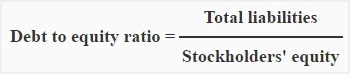
Debt to equity ratio (also termed as debt equity ratio) is a long term solvency ratio that indicates the soundness of long-term financial policies of a company. It shows the relation between the portion of assets financed by creditors and the portion of assets financed by stockholders. As the debt to equity ratio expresses the relationship between external equity (liabilities) and internal equity (stockholder’s equity), it is also known as “external-internal equity ratio”.

Formula:

Debt to equity ratio is calculated by dividing total liabilities by stockholder’s equity.

The numerator consists of the total of current and long term liabilities and the denominator consists of the total stockholders’ equity including preferred stock. Both the elements of the formula are obtained from company’s balance sheet.

Significance and interpretation:

A ratio of 1 (or 1 : 1) means that creditors and stockholders equally contribute to the assets of the business.

A less than 1 ratio indicates that the portion of assets provided by stockholders is greater than the portion of assets provided by creditors and a greater than 1 ratio indicates that the portion of assets provided by creditors is greater than the portion of assets provided by stockholders.

Creditors usually like a low debt to equity ratio because a low ratio (less than 1) is the indication of greater protection to their money. But stockholders like to get benefit from the funds provided by the creditors therefore they would like a high debt to equity ratio.

Debt equity ratio vary from industry to industry. Different norms have been developed for different industries. A ratio that is ideal for one industry may be worrisome for another industry. A ratio of 1 : 1 is normally considered satisfactory for most of the companies.

Emerging trends in FDI

Foreign direct investment in India is the most influential financial resource, especially for the emerging sectors. Foreign direct investment helps in exploiting a wide range of opportunities and utilizing the same to attain the desired level of development in the nation (Gola, Dharwal, & Agarwal, 2013). The world economy including both the developed countries and other emerging countries are facing some varying trends of foreign direct investment in recent years.

The major player that is coming into view of late in India. Analyzing the trend of foreign direct investment in India shows that it is rising and the main reasons for such an increase are due to new government policies and various initiatives such as Make in India. The country has faced elevated trends of the foreign direct investment due to building investor-friendly climate in the country, thereby enabling the ease of doing business. India has been able to climb up to 10th position in 2015 from 15th position in 2014 as a trusted nation for Foreign direct investment. As a result, India has attracted foreign direct investments worth of $40 billion for the financial year 2015- 16, which was  29.2% higher than the last year (UNCTAD, 2016).

Sources of foreign direct investment in India

By catching the attention of the economies worldwide, India has been able to gain a huge sum by the way of equity inflows. Singapore has become the largest investor with a total investment of $13.69 billion during the financial year 2015-16. Followed by Singapore are the economies including Mauritius and USA investing $8.35 and $4.19 billion respectively. The aggregate Merger and Acquisition (M&A) deals as well as the private equity deals, which are the methods of foreign direct investment inflow, have grown up 2 times from the last year of 2015 (IBEF, 2016a).

Foreign direct investment in India has shot up 318.2 times starting from the year 1991 to 2005, from $129 million in 1991-92 to $41050 million (Dutta & Sarma, 2008). Before the year 2015-16, Mauritius was the topmost investor in the country as succeeded by Singapore. Still, the country is the major investor with its cumulative percentage share to total inflows being 34% more than double the percentage of Singapore.

The report of the department of industrial policy and promotion has shown that India has been able to gain value in various sectors including the service sector, information technology (IT) sector, automobile industry, pharmaceutical sector, power industry and construction business from the period of 2000 until 2015.

Trends of foreign direct investment in the service sector

The service sector has been able to draw the highest amount of foreign direct investment equity in the country, totalling up to $240.57 billion during 2000-2015. In 2015 the total amount of foreign direct investment in this sector amounted to $27.63 billion (DIPP, 2015). From 1991-2000, the share of service sector in the foreign direct investment in India was 15.2% as compared to the share in 2000-2011 is 19.9%.

The notable increase in the foreign investments in the service sector from the year 2014 was due to the current government coming in power and introducing a more investor-friendly climate. The major reason for such a rise in foreign direct investment in this respective sector includes the various initiatives taken by the government. The investment cap has risen in various sectors including the insurance sector from 26% to 49% and others including defence and railways. Changes in the timelines of the approval of foreign direct investment projects have also contributed to such growth of investment in this sector (IBEF, 2016).

Trends of foreign direct investment in the information technology sector

The information technology sector is the second most attractive industry for foreign investments in India. The total inflows in this sector have reached the mark of $108.13 billion in 2015 since 2000 and in the year 2015, it amounted to $34.3 billion (DIPP, 2015). Some notable motivation in this regard is that the IT industry in the country is rapidly growing and the availability of cheap labour that is highly attracting the companies from the overseas market. Again the turning year in this regard is the year 2014.

Trends of foreign direct investment in the construction industry

The construction business is again a major sector attracting foreign direct investment in the country from the past 15 years. The industries draw $113.8 billion foreign direct investment starting from the year 2000 till 2015. Various initiatives introduced by the Indian government such as Make in India helps to attract a large amount of foreign direct investment in this sector. However, the influx of foreign direct investment in the year 2015 dipped to $0.67 billion (DIPP, 2015). It is observed that even though the amount of investment is decreasing from the year 2011 itself, but its cumulative inflows from the year 2000 have been the second highest, only after service sector. The rise of foreign direct investment in such sector owes it to the rising opportunities in the power sector including power generation, distribution, transmission and equipment. Besides, the infrastructure sector has also gained momentum on an average from the year 2000. Foreign direct investment in the construction sector contributes 9% to the total foreign direct investment inflows in the country (IBEF, 2016b).

Government’s Policy in Regard to Foreign Capital:

After India became independent in August 1947, Jawaharlal Nehru, the then Prime Minister of India, made a statement in April 1949 giving the following assurances to foreign capital:

  1. There would be no discrimination between foreign companies and purely Indian companies which meant that foreign capital would get the same treatment as indigenous capital.
  2. Foreign investors would be permitted to remit profits and repatriate capital, taking into consideration India’s position in regard to availability of foreign exchange.
  3. In case a foreign company was nationalised, fair and equitable compensation will be given to foreign investors.

The above policy was based on several considerations. There was a shortage of indigenous capital and that needed supplementing by foreign capital, if rapid industrial and economic development were to be brought about. Also, there was need of capital goods and equipment and technical know-how from abroad as India then lacked these essential requisites of growth and development.

Tax Concessions:

In the initial stages, with a view to attract foreign capital (that is, foreign companies) to India, Government offered various tax concessions and to avoid delays in finalising foreign collaboration agreements, streamlined its licensing policy of procedures to quickly approve foreign collaboration agreements.

In 1961 the Indian Investment Centre was opened, the objective being to bring together Indian and foreign businessmen and appraise foreign investors of the vast business opportunities in India.

In 1972 the Government of India took another major step to attract foreign capital into the country. It permitted wholly-owned subsidiaries in India of foreign companies, provided they undertook to export 100 per cent of their production.

Export Liability:

If the export liability was less than 100 per cent of its output, the extent of permissible foreign capital was to be decided by negotiations between the foreign companies and the Government of India.

Thus, the Government of India had to choose between the Indianisation of foreign subsidiary companies in India or boosting up export through their help. Government preferred the second of the above two possible courses. But Government’s choice of the second policy was beset with many difficulties.

error: Content is protected !!