Top Trends in AI for 2024

Artificial intelligence (AI) is one of the most dynamic and influential fields of technology today. It has the potential to transform various industries, sectors and domains, from healthcare to education, from entertainment to security, from manufacturing to agriculture. As we enter the year 2024, let us take a look at some of the top trends in AI that are expected to shape the future of innovation and society.

  • Explainable AI:

As AI systems become more complex and powerful, there is a growing need for transparency and accountability in how they make decisions and perform actions. Explainable AI (XAI) is a branch of AI that aims to provide human-understandable explanations for the behavior and outcomes of AI models. XAI can help increase trust, confidence and adoption of AI solutions, as well as enable ethical and responsible use of AI.

  • Federated Learning:

Federated learning is a distributed learning paradigm that allows multiple devices or nodes to collaboratively train a shared AI model without exchanging raw data. This can help preserve data privacy and security, as well as reduce communication and computation costs. Federated learning can enable scalable and efficient AI applications in scenarios where data is distributed, sensitive or scarce, such as edge computing, healthcare or finance.

  • Neurosymbolic AI:

Neurosymbolic AI is an emerging approach that combines the strengths of neural networks and symbolic reasoning. Neural networks are good at learning from data and handling uncertainty, but they often lack interpretability and generalization. Symbolic reasoning is good at representing knowledge and logic, but it often requires manual encoding and suffers from brittleness. Neurosymbolic AI can leverage the advantages of both methods to create more robust, versatile and intelligent AI systems.

  • SelfSupervised Learning:

Self-supervised learning is a form of unsupervised learning that uses the data itself as a source of supervision. Instead of relying on external labels or rewards, self-supervised learning generates its own learning objectives or tasks from the data, such as predicting missing words, colors or sounds. Self-supervised learning can help unlock the vast potential of unlabeled data, as well as enable more autonomous and efficient learning for AI models.

  • Artificial General Intelligence:

Artificial general intelligence (AGI) is the ultimate goal of AI research, which is to create machines that can perform any intellectual task that humans can. AGI is still a distant and elusive vision, but there are some promising signs of progress and breakthroughs in this direction. Some of the challenges and opportunities for achieving AGI include creating more human-like cognition, reasoning and emotions, integrating multiple modalities and domains, and aligning AI goals with human values and ethics.

Trends

Advanced Natural Language Processing (NLP):

  • Contextual Understanding:

AI systems are expected to achieve a deeper understanding of context in language, enabling more accurate and context-aware natural language interactions. This involves advancements in semantic understanding and sentiment analysis.

  • Multilingual Capabilities:

Continued progress in multilingual NLP models, allowing AI systems to comprehend and generate content in multiple languages with improved accuracy and fluency.

Generative AI and Creativity:

  • AI-Generated Content:

The rise of AI-generated content across various domains, including art, music, and literature. AI systems are becoming more proficient in creating content that resonates with human preferences and creativity.

  • Enhanced Creativity Tools:

Integration of AI into creative tools for professionals, assisting artists, writers, and musicians in ideation, content creation, and creative exploration.

Explainable AI (XAI):

  • Interpretable Models:

Increased emphasis on creating AI models that are more interpretable and transparent. This trend is essential for building trust in AI systems, especially in critical applications like healthcare and finance.

  • Ethical AI Practices:

Growing awareness and implementation of ethical AI practices, ensuring that AI decisions are explainable, fair, and free from biases.

Edge AI and IoT Integration:

  • On-Device AI:

Continued advancements in on-device AI capabilities, enabling more processing to occur directly on edge devices. This reduces latency, enhances privacy, and optimizes bandwidth usage.

  • AIoT (AI + Internet of Things):

The integration of AI with IoT devices for smarter, more autonomous systems. This includes applications in smart homes, industrial IoT, and healthcare.

AI in Healthcare:

  • Personalized Medicine:

AI-driven approaches for personalized treatment plans, drug discovery, and diagnostics. AI is expected to play a crucial role in tailoring healthcare solutions to individual patient profiles.

  • Health Monitoring:

AI-powered health monitoring systems that leverage wearables and sensors for continuous tracking of health parameters, facilitating early disease detection and prevention.

Autonomous Systems and Robotics:

  • Robotic Process Automation (RPA):

Continued growth in RPA, with more businesses adopting AI-driven automation for routine and repetitive tasks across industries.

  • Autonomous Vehicles:

Advancements in AI algorithms for self-driving cars and other autonomous vehicles, with a focus on safety, efficiency, and real-world adaptability.

AI in Cybersecurity:

  • Threat Detection:

AI-powered cybersecurity solutions that can detect and respond to evolving cyber threats in real-time. This includes the use of machine learning for anomaly detection and behavior analysis.

  • Adversarial AI Defense:

Development of AI systems to counter adversarial attacks, ensuring the robustness and security of AI models against manipulation.

Quantum Computing and AI:

  • Hybrid QuantumAI Systems:

Exploration of synergies between quantum computing and AI for solving complex problems. Quantum computing may offer advantages in optimization tasks and machine learning algorithms.

  • Quantum Machine Learning:

Research and development in quantum machine learning algorithms that leverage the unique properties of quantum systems for enhanced computational power.

AI Governance and Regulation:

  • Ethical AI Guidelines:

Growing efforts to establish global standards and guidelines for ethical AI development and deployment. Governments and industry bodies are likely to play a more active role in regulating AI practices.

  • Responsible AI:

Increased focus on responsible AI practices, emphasizing transparency, accountability, and fairness in AI decision-making processes.

AI Democratization:

  • Accessible AI Tools:

Continued efforts to make AI tools and technologies more accessible to individuals and smaller businesses. This includes the development of user-friendly platforms and AI-as-a-Service offerings.

  • AI Education:

Increased emphasis on AI education and literacy across diverse demographics. Initiatives to empower people with the skills needed to understand, use, and contribute to AI technologies.

Disclaimer: This article is provided for informational purposes only, based on publicly available knowledge. It is not a substitute for professional advice, consultation, or medical treatment. Readers are strongly advised to seek guidance from qualified professionals, advisors, or healthcare practitioners for any specific concerns or conditions. The content on intactone.com is presented as general information and is provided “as is,” without any warranties or guarantees. Users assume all risks associated with its use, and we disclaim any liability for any damages that may occur as a result.

Frequency Distribution, Meaning, Principles, Types, Steps and Advantages

Frequency distribution is a systematic arrangement of data showing the number of times each value or group of values occurs in a dataset. It is one of the most important methods of organizing statistical data. Frequency distribution simplifies a large volume of raw data by grouping observations into classes and showing their respective frequencies. This makes the data easier to understand, analyze, and interpret.

The construction of a frequency distribution involves arranging data into class intervals and recording the number of observations falling within each interval.

Principles for Constructing Frequency Distribution

1. Principle of Clearly Defined Class Intervals

Class intervals should be clearly defined so that every observation can be placed in the correct class without confusion. Ambiguous or overlapping class limits may lead to incorrect classification and inaccurate results. Clear intervals improve the reliability and usefulness of the frequency distribution. The lower and upper limits of each class should be specified precisely. Readers should easily understand the scope of every class interval. Well-defined classes ensure consistency in data organization and make statistical analysis more accurate. Therefore, clarity in class interval definition is a fundamental principle of constructing an effective frequency distribution.

2. Principle of Mutual Exclusiveness

The classes in a frequency distribution should be mutually exclusive. This means that an observation must belong to only one class and not fit into multiple classes simultaneously. Overlapping class intervals create confusion and may result in double counting. For example, intervals such as 10–20 and 20–30 can create ambiguity regarding the value 20. To avoid this problem, class limits should be designed carefully. Mutual exclusiveness ensures accuracy and consistency in classification. It allows each observation to be counted only once, thereby improving the reliability of the frequency distribution.

3. Principle of Continuity

Class intervals should be continuous without gaps between successive classes. Every possible observation within the range of data should have a place in the distribution. Continuous classes ensure smooth classification and prevent the omission of observations. If gaps exist between intervals, some values may remain unclassified, reducing the completeness of the distribution. Continuous class intervals are especially important in grouped frequency distributions involving measurable variables. By maintaining continuity, statisticians can ensure that all data values are represented properly and that the frequency distribution provides a complete picture of the dataset.

4. Principle of Exhaustiveness

A frequency distribution should be exhaustive, meaning that it must include all observations in the dataset. Every data value should fit into one of the class intervals. No observation should be left out of the distribution. Exhaustiveness ensures completeness and accuracy in data presentation. If certain observations remain unclassified, the frequency totals will not match the total number of observations collected. This can lead to incorrect conclusions and statistical errors. Therefore, class intervals should be designed in such a way that they cover the entire range of data and accommodate every observation.

5. Principle of Appropriate Number of Classes

The number of classes should be chosen carefully. Too many classes make the frequency distribution lengthy and complicated, while too few classes may hide important details and variations. A reasonable number of classes provides a balance between simplicity and completeness. Generally, frequency distributions contain between five and fifteen classes, depending on the size of the dataset. The objective is to present information clearly without losing significant details. Proper selection of the number of classes improves readability, facilitates analysis, and ensures that the distribution effectively summarizes the data.

6. Principle of Suitable Class Width

Class width refers to the size of each class interval. The width should be neither too large nor too small. Very wide intervals may conceal important variations within the data, while very narrow intervals may create an excessive number of classes and make the table difficult to interpret. Uniform class widths are generally preferred because they simplify analysis and comparison. Appropriate class width ensures meaningful grouping of observations and enhances the usefulness of the frequency distribution. Therefore, selecting a suitable class width is essential for effective data presentation and statistical interpretation.

7. Principle of Simplicity and Clarity

A frequency distribution should be simple and easy to understand. The arrangement of class intervals and frequencies should be logical and straightforward. Complex classifications and unnecessary details should be avoided because they may confuse readers. Simplicity improves readability and allows users to interpret the information quickly. Clear headings, properly arranged classes, and accurate frequencies contribute to effective communication. A simple frequency distribution is more useful for statistical analysis and decision-making. Therefore, maintaining simplicity and clarity is an important principle in the construction of frequency distributions.

8. Principle of Accuracy

Accuracy is one of the most important principles in constructing a frequency distribution. Frequencies must be counted carefully, and observations should be classified correctly. Errors in tallying, counting, or classifying data can distort the distribution and lead to incorrect statistical analysis. Every step, from data collection to frequency calculation, should be performed with precision. Accurate frequency distributions provide reliable information for research, business analysis, and decision-making. Since statistical conclusions depend on the correctness of the data presented, maintaining accuracy is essential for ensuring the credibility and usefulness of the frequency distribution.

Types of Frequency Distribution

1. Simple Frequency Distribution

Simple frequency distribution is the most basic type of frequency distribution. It presents each value of a variable along with the number of times it occurs in the dataset. This method is suitable when the data contains a limited number of distinct values. It helps organize raw data into a concise and understandable form. Simple frequency distribution is widely used in educational and business studies to summarize information efficiently. It allows researchers to identify the occurrence of each value and understand the overall distribution of observations without dealing with complex classifications.

Example:

Number of Defects Frequency
0 5
1 8
2 6
3 4
4 2

2. Grouped Frequency Distribution

Grouped frequency distribution arranges data into class intervals and records the frequency of observations within each interval. This type is used when the dataset contains a large number of observations or continuous values. Grouping reduces complexity and makes data easier to analyze. It helps identify trends, patterns, and concentration of observations. Grouped frequency distributions are commonly used in business, economics, and research studies. By organizing data into intervals, they provide a compact summary of large datasets and facilitate statistical calculations such as averages and measures of dispersion.

Example:

Marks Frequency
0–10 4
10–20 8
20–30 12
30–40 10
40–50 6

3. Ungrouped Frequency Distribution

An ungrouped frequency distribution lists every individual value separately along with its frequency. Unlike grouped distributions, no class intervals are used. This type is suitable for small datasets where observations can be displayed individually without making the table lengthy. Ungrouped frequency distributions provide exact information about each value and its occurrence. They are useful in situations where detailed analysis of individual observations is required. However, they become less practical when the dataset is large. Therefore, they are generally applied in small-scale studies and introductory statistical exercises.

Example:

Number of Books Sold Frequency
5 2
6 4
7 5
8 3
9 1

4. Cumulative Frequency Distribution

Cumulative frequency distribution shows the running total of frequencies. Instead of presenting individual frequencies alone, it accumulates frequencies from one class to the next. This type helps determine the number of observations below or above a particular value. Cumulative frequency distributions are useful for calculating median, quartiles, percentiles, and for constructing ogives. They provide insights into the cumulative position of observations within the dataset. There are two forms: less-than cumulative frequency and more-than cumulative frequency distributions.

Example (Less Than Type):

Marks Less Than Cumulative Frequency
10 4
20 12
30 24
40 34
50 40

5. Relative Frequency Distribution

Relative frequency distribution expresses frequencies as fractions or proportions of the total number of observations. It shows the relative importance of each class within the dataset. Relative frequencies are calculated by dividing class frequencies by the total frequency. This distribution helps compare different datasets, especially when they differ in size. It provides a clearer understanding of the proportion represented by each category. Relative frequency distributions are widely used in market research, quality control, and business analysis where percentage comparisons are important.

Example:

Product Type Frequency Relative Frequency
A 20 0.40
B 15 0.30
C 10 0.20
D 5 0.10

Total Frequency = 50

6. Percentage Frequency Distribution

A percentage frequency distribution is similar to a relative frequency distribution, but frequencies are expressed as percentages rather than proportions. This format is easy to understand and interpret because percentages are familiar to most users. It helps compare categories effectively and is widely used in business reports, surveys, and demographic studies. Percentage frequency distributions simplify communication and make statistical findings more accessible. They are particularly useful when presenting data to audiences who may not have extensive statistical knowledge.

Example:

Customer Preference Frequency Percentage
Product A 40 40%
Product B 30 30%
Product C 20 20%
Product D 10 10%

7. Discrete Frequency Distribution

Discrete frequency distribution is used for variables that take distinct and countable values. Each value is listed separately along with its corresponding frequency. Examples include the number of employees, number of children, number of products sold, or number of defects. Since discrete variables cannot take fractional values, frequencies are assigned to individual observations. This distribution provides precise information and helps analyze count-based data. It is commonly used in business operations, production management, and social science research where variables are measured in whole numbers.

Example:

Number of Children Frequency
1 6
2 10
3 8
4 4
5 2

8. Continuous Frequency Distribution

Continuous frequency distribution is used for variables that can take any value within a specified range. Data is grouped into continuous class intervals, and frequencies are recorded for each interval. Examples include age, income, height, weight, and sales revenue. This type of distribution is suitable for large datasets involving measurable quantities. Continuous frequency distributions simplify complex information and facilitate statistical analysis. They are also essential for constructing histograms, frequency polygons, and other graphical representations used in business and research.

Example:

Income (₹) Frequency
0–10,000 5
10,000–20,000 12
20,000–30,000 18
30,000–40,000 10
40,000–50,000 5

Steps in the Construction of Frequency Distribution

Step 1. Collection of Raw Data

The first step in constructing a frequency distribution is the collection of raw data. Raw data refers to the original facts and figures gathered from surveys, observations, experiments, questionnaires, or records. At this stage, the information is usually unorganized and arranged randomly. Since raw data is difficult to analyze directly, it must first be collected accurately and systematically. The quality of the frequency distribution depends on the reliability of the collected data. Any errors during collection may affect the final results. Therefore, proper collection of data is essential for meaningful statistical analysis and interpretation.

Example: Marks of 15 students:

25, 30, 45, 50, 35, 40, 55, 60, 65, 70, 75, 80, 45, 50, 55

Step 2. Determination of Range

After collecting the raw data, the next step is determining the range. The range measures the spread of the data and is calculated by subtracting the smallest value from the largest value. It helps in deciding suitable class intervals and class widths. A larger range generally requires more classes, whereas a smaller range may require fewer classes. Determining the range gives a preliminary understanding of data distribution and assists in organizing observations effectively. It is an important step because the entire frequency distribution is based on the extent of variation present in the dataset.

Formula: Range = Highest Value − Lowest Value

Example:

Highest value = 80

Lowest value = 25

Range = 80 − 25 = 55

Step 3. Determination of Number of Classes

The third step involves deciding the number of class intervals into which the data will be grouped. The number of classes should be reasonable because too many classes make the table complex, while too few classes may hide important information. Generally, between 5 and 15 classes are used depending on the size of the dataset. Statisticians often use Sturges’ Formula to determine an appropriate number of classes. Proper selection of classes improves clarity, comparability, and usefulness of the frequency distribution. This step ensures that the data is grouped in a balanced and meaningful manner.

Formula: k = 1 + 3.322 log N

Where:

k = Number of classes

N = Total observations

Example:

If N = 50,

k = 1 + 3.322 log (50)

k ≈ 7 classes

Step 4. Calculation of Class Width

Class width refers to the size of each class interval. After determining the range and number of classes, the class width is calculated by dividing the range by the number of classes. The result is generally rounded to a convenient whole number. Appropriate class width is important because very narrow intervals create too many classes, while very wide intervals may hide significant variations. A suitable class width ensures that the frequency distribution remains clear, balanced, and informative. This step provides the basis for creating meaningful class intervals that adequately represent the data.

Formula: Class Width = Range ÷ Number of Classes

Example:

Range = 55

Number of Classes = 6

Class Width = 55 ÷ 6 ≈ 9.17

Rounded Class Width = 10

Step 5. Formation of Class Intervals

Once the class width is determined, class intervals are formed. Class intervals are groups into which observations are categorized. These intervals should be mutually exclusive, continuous, and exhaustive. Every observation should belong to one and only one class. Properly formed intervals make the frequency distribution easier to understand and analyze. The intervals may follow the inclusive or exclusive method depending on the nature of the data. The formation of suitable class intervals is crucial because it directly affects the accuracy and usefulness of the frequency distribution.

Example:

Class Interval
20–29
30–39
40–49
50–59
60–69
70–79
80–89

These intervals cover all observations and maintain equal width.

Step 6. Tallying the Observations

After forming class intervals, each observation is examined and placed into its appropriate class using tally marks. Tally marks are simple counting symbols used to record frequencies accurately. Every observation falling within a class interval is represented by a tally mark. Groups of five tally marks are usually shown with the fifth mark crossing the previous four. Tallying helps avoid counting errors and provides an easy method of organizing observations before calculating frequencies. This step acts as a bridge between raw data and frequency counting, ensuring accuracy and completeness in the frequency distribution process.

Example:

Class Interval Tally Marks
20–29 |
30–39 ||
40–49 |||
50–59 ||||
60–69 |||
70–79 ||
80–89 |

Step 7. Counting Frequencies

Once tallying is completed, the tally marks in each class interval are counted to determine the frequency. Frequency refers to the number of observations that fall within a particular class. This step converts tally marks into numerical values and provides a summarized picture of the data. Accurate frequency counting is essential because it forms the basis for statistical analysis, graphs, and interpretation. Frequencies reveal how data is distributed across different classes and help identify concentration, patterns, and trends. This step transforms raw observations into meaningful statistical information.

Example:

Class Interval Frequency
20–29 1
30–39 2
40–49 3
50–59 4
60–69 3
70–79 2
80–89 1

Step 8. Preparation of the Final Frequency Distribution Table

The final step is preparing the frequency distribution table. In this table, class intervals and their corresponding frequencies are arranged systematically. The table should include a suitable title, properly labeled columns, and accurate totals. It provides a concise summary of the entire dataset and serves as the basis for further statistical analysis and graphical presentation. A well-prepared frequency distribution table helps readers understand data patterns quickly and facilitates interpretation. This final presentation converts scattered raw data into an organized and meaningful statistical form suitable for business and research purposes.

Example: Frequency Distribution of Students’ Marks

Marks Frequency
20–29 1
30–39 2
40–49 3
50–59 4
60–69 3
70–79 2
80–89 1
Total 16

This table clearly summarizes the distribution of marks and makes analysis simple and effective.

Advantages of Frequency Distribution

  • Simplifies Large Volumes of Data

One of the greatest advantages of frequency distribution is that it simplifies large and complex datasets. Raw data often contains numerous observations that are difficult to understand and analyze. Frequency distribution organizes this information into classes and frequencies, making it more manageable and meaningful. Instead of examining each individual observation, users can study summarized information. This saves effort and improves understanding. By presenting data in a structured form, frequency distribution enables researchers, managers, and students to grasp the overall nature of the dataset quickly and efficiently without being overwhelmed by excessive details.

  • Facilitates Statistical Analysis

Frequency distribution provides a strong foundation for statistical analysis. Various statistical measures such as mean, median, mode, standard deviation, and variance can be calculated more easily when data is organized into a frequency distribution. The arrangement of observations into classes simplifies computations and reduces complexity. Researchers can identify patterns and relationships more effectively. Without frequency distribution, statistical calculations involving large datasets would be cumbersome and time-consuming. Therefore, frequency distribution serves as an essential tool for conducting accurate and efficient statistical analysis in business, economics, and research studies.

  • Improves Understanding of Data

Frequency distribution enhances the understanding of data by presenting information in a clear and organized manner. Raw data often appears confusing because observations are scattered randomly. By grouping similar observations into classes, frequency distribution provides a concise summary of the dataset. Readers can quickly understand how data is distributed and where observations are concentrated. This organized presentation improves comprehension and reduces the possibility of misunderstanding. As a result, students, researchers, and decision-makers can interpret information more effectively and draw meaningful conclusions from the data presented.

  • Reveals Patterns and Trends

A frequency distribution helps identify patterns, trends, and characteristics within the data. It shows how observations are distributed across different classes, making it easier to detect concentrations, gaps, and variations. Researchers can observe whether data is evenly distributed or clustered around certain values. Trends that may not be visible in raw data become more apparent through frequency distribution. This advantage is particularly useful in business forecasting, market research, and performance evaluation. By revealing important patterns, frequency distributions assist organizations in understanding situations and making informed decisions based on statistical evidence.

  • Facilitates Comparison

Frequency distribution makes comparison easier by presenting data in a structured format. Different groups, categories, or datasets can be compared by examining their frequencies. For example, sales performance across regions or customer age groups can be compared effectively using frequency distributions. Comparisons help identify similarities, differences, strengths, and weaknesses. Such information is valuable for business planning and evaluation. Without organized frequency data, comparisons would require examining individual observations, which is both difficult and time-consuming. Therefore, the comparative advantage of frequency distribution significantly enhances its usefulness in statistical studies.

  • Supports Graphical Presentation

Frequency distribution serves as the basis for various graphical presentations such as histograms, frequency polygons, ogives, and bar charts. Graphs require organized frequency data for accurate construction. By summarizing observations into class intervals and frequencies, frequency distributions provide the necessary information for visual representation. Graphical presentations make data more attractive, understandable, and accessible to a wider audience. Visual displays also help identify patterns and trends quickly. Therefore, frequency distribution plays a vital role in transforming numerical information into graphical forms that facilitate effective communication and interpretation.

  • Saves Time and Space

Another important advantage of frequency distribution is that it saves both time and space. Large datasets can be summarized in a compact table instead of presenting every individual observation. This reduces the amount of space required for data presentation and makes information easier to handle. Analysts and decision-makers can quickly review summarized data rather than spending time examining extensive raw information. The concise nature of frequency distributions improves efficiency and productivity. Consequently, they are widely used in business reports, research studies, and statistical publications where clear and economical presentation is essential.

  • Assists Decision-Making

Frequency distribution provides valuable information for decision-making by presenting data in a clear and meaningful form. Managers, researchers, and policymakers can use frequency distributions to evaluate performance, identify trends, and assess alternatives. Organized data enables them to understand situations accurately and make informed decisions. For example, businesses can analyze customer preferences, sales patterns, and production levels through frequency distributions. Reliable statistical information reduces uncertainty and improves planning. Therefore, frequency distribution is an important tool that supports effective decision-making and contributes to the success of business and research activities.

Business Mathematics & Statistics Bangalore University B.com 3rd Semester NEP Notes

Unit 1 Commercial Arithmetic [Book]
Percentage VIEW
Cost, Profit and Selling price VIEW
Ratio Proportion VIEW
Problems on Speed and Time VIEW
Interest-Simple interest and Compound interest VIEW
Annuity VIEW


Unit 2 Theory of Equations [Book] No Update


Unit 3 Matrices and Determinants [Book] No Update


Unit 4 Measures of Central Tendency and Dispersion [Book]
Introduction Meaning and Definition, Objectives of measures of Central tendency VIEW
Types of averages: Arithmetic mean (Simple average only) VIEW
Median VIEW
Mode VIEW
Meaning and Objectives of measures of Dispersion VIEW
VIEW VIEW
Standard deviation and coefficient of Variation VIEW
Skewness VIEW VIEW
Problems on Direct method only VIEW


Unit 5 Correlation and Regression [Book]
Correlation: Meaning and definition-uses VIEW VIEW
VIEW
Karl Pearson’s coefficient of correlation (deviation from actual mean only) VIEW
Spearman’s Rank Correlation Coefficient VIEW
Regression Meaning VIEW
Regression Equations, Estimating x and y values VIEW
Finding correlation coefficient with Regression coefficient VIEW VIEW

Normal Distribution: Importance, Central Limit Theorem

Normal distribution, or the Gaussian distribution, is a fundamental probability distribution that describes how data values are distributed symmetrically around a mean. Its graph forms a bell-shaped curve, with most data points clustering near the mean and fewer occurring as they deviate further. The curve is defined by two parameters: the mean (μ) and the standard deviation (σ), which determine its center and spread. Normal distribution is widely used in statistics, natural sciences, and social sciences for analysis and inference.

The general form of its probability density function is:

The parameter μ is the mean or expectation of the distribution (and also its median and mode), while the parameter σ is its standard deviation. The variance of the distribution is σ^2. A random variable with a Gaussian distribution is said to be normally distributed, and is called a normal deviate.

Normal distributions are important in statistics and are often used in the natural and social sciences to represent real-valued random variables whose distributions are not known. Their importance is partly due to the central limit theorem. It states that, under some conditions, the average of many samples (observations) of a random variable with finite mean and variance is itself a random variable whose distribution converges to a normal distribution as the number of samples increases. Therefore, physical quantities that are expected to be the sum of many independent processes, such as measurement errors, often have distributions that are nearly normal.

A normal distribution is sometimes informally called a bell curve. However, many other distributions are bell-shaped (such as the Cauchy, Student’s t, and logistic distributions).

Importance of Normal Distribution:

  1. Foundation of Statistical Inference

The normal distribution is central to statistical inference. Many parametric tests, such as t-tests and ANOVA, are based on the assumption that the data follows a normal distribution. This simplifies hypothesis testing, confidence interval estimation, and other analytical procedures.

  1. Real-Life Data Approximation

Many natural phenomena and datasets, such as heights, weights, IQ scores, and measurement errors, tend to follow a normal distribution. This makes it a practical and realistic model for analyzing real-world data, simplifying interpretation and analysis.

  1. Basis for Central Limit Theorem (CLT)

The normal distribution is critical in understanding the Central Limit Theorem, which states that the sampling distribution of the sample mean approaches a normal distribution as the sample size increases, regardless of the population’s actual distribution. This enables statisticians to make predictions and draw conclusions from sample data.

  1. Application in Quality Control

In industries, normal distribution is widely used in quality control and process optimization. Control charts and Six Sigma methodologies assume normality to monitor processes and identify deviations or defects effectively.

  1. Probability Calculations

The normal distribution allows for the easy calculation of probabilities for different scenarios. Its standardized form, the z-score, simplifies these calculations, making it easier to determine how data points relate to the overall distribution.

  1. Modeling Financial and Economic Data

In finance and economics, normal distribution is used to model returns, risks, and forecasts. Although real-world data often exhibit deviations, normal distribution serves as a baseline for constructing more complex models.

Central limit theorem

In probability theory, the central limit theorem (CLT) establishes that, in many situations, when independent random variables are added, their properly normalized sum tends toward a normal distribution (informally a bell curve) even if the original variables themselves are not normally distributed. The theorem is a key concept in probability theory because it implies that probabilistic and statistical methods that work for normal distributions can be applicable to many problems involving other types of distributions. This theorem has seen many changes during the formal development of probability theory. Previous versions of the theorem date back to 1810, but in its modern general form, this fundamental result in probability theory was precisely stated as late as 1920, thereby serving as a bridge between classical and modern probability theory.

Characteristics Fitting a Normal Distribution

Poisson Distribution: Importance Conditions Constants, Fitting of Poisson Distribution

Poisson distribution is a probability distribution used to model the number of events occurring within a fixed interval of time, space, or other dimensions, given that these events occur independently and at a constant average rate.

Importance

  1. Modeling Rare Events: Used to model the probability of rare events, such as accidents, machine failures, or phone call arrivals.
  2. Applications in Various Fields: Applicable in business, biology, telecommunications, and reliability engineering.
  3. Simplifies Complex Processes: Helps analyze situations with numerous trials and low probability of success per trial.
  4. Foundation for Queuing Theory: Forms the basis for queuing models used in service and manufacturing industries.
  5. Approximation of Binomial Distribution: When the number of trials is large, and the probability of success is small, Poisson distribution approximates the binomial distribution.

Conditions for Poisson Distribution

  1. Independence: Events must occur independently of each other.
  2. Constant Rate: The average rate (λ) of occurrence is constant over time or space.
  3. Non-Simultaneous Events: Two events cannot occur simultaneously within the defined interval.
  4. Fixed Interval: The observation is within a fixed time, space, or other defined intervals.

Constants

  1. Mean (λ): Represents the expected number of events in the interval.
  2. Variance (λ): Equal to the mean, reflecting the distribution’s spread.
  3. Skewness: The distribution is skewed to the right when λ is small and becomes symmetric as λ increases.
  4. Probability Mass Function (PMF): P(X = k) = [e^−λ*λ^k] / k!, Where is the number of occurrences, is the base of the natural logarithm, and λ is the mean.

Fitting of Poisson Distribution

When a Poisson distribution is to be fitted to an observed data the following procedure is adopted:

Binomial Distribution: Importance Conditions, Constants

The binomial distribution is a probability distribution that summarizes the likelihood that a value will take one of two independent values under a given set of parameters or assumptions. The underlying assumptions of the binomial distribution are that there is only one outcome for each trial, that each trial has the same probability of success, and that each trial is mutually exclusive, or independent of each other.

In probability theory and statistics, the binomial distribution with parameters n and p is the discrete probability distribution of the number of successes in a sequence of n independent experiments, each asking a yes, no question, and each with its own Boolean-valued outcome: success (with probability p) or failure (with probability q = 1 − p). A single success/failure experiment is also called a Bernoulli trial or Bernoulli experiment, and a sequence of outcomes is called a Bernoulli process; for a single trial, i.e., n = 1, the binomial distribution is a Bernoulli distribution. The binomial distribution is the basis for the popular binomial test of statistical significance.

The binomial distribution is frequently used to model the number of successes in a sample of size n drawn with replacement from a population of size N. If the sampling is carried out without replacement, the draws are not independent and so the resulting distribution is a hypergeometric distribution, not a binomial one. However, for N much larger than n, the binomial distribution remains a good approximation, and is widely used

The binomial distribution is a common discrete distribution used in statistics, as opposed to a continuous distribution, such as the normal distribution. This is because the binomial distribution only counts two states, typically represented as 1 (for a success) or 0 (for a failure) given a number of trials in the data. The binomial distribution, therefore, represents the probability for x successes in n trials, given a success probability p for each trial.

Binomial distribution summarizes the number of trials, or observations when each trial has the same probability of attaining one particular value. The binomial distribution determines the probability of observing a specified number of successful outcomes in a specified number of trials.

The binomial distribution is often used in social science statistics as a building block for models for dichotomous outcome variables, like whether a Republican or Democrat will win an upcoming election or whether an individual will die within a specified period of time, etc.

Importance

For example, adults with allergies might report relief with medication or not, children with a bacterial infection might respond to antibiotic therapy or not, adults who suffer a myocardial infarction might survive the heart attack or not, a medical device such as a coronary stent might be successfully implanted or not. These are just a few examples of applications or processes in which the outcome of interest has two possible values (i.e., it is dichotomous). The two outcomes are often labeled “success” and “failure” with success indicating the presence of the outcome of interest. Note, however, that for many medical and public health questions the outcome or event of interest is the occurrence of disease, which is obviously not really a success. Nevertheless, this terminology is typically used when discussing the binomial distribution model. As a result, whenever using the binomial distribution, we must clearly specify which outcome is the “success” and which is the “failure”.

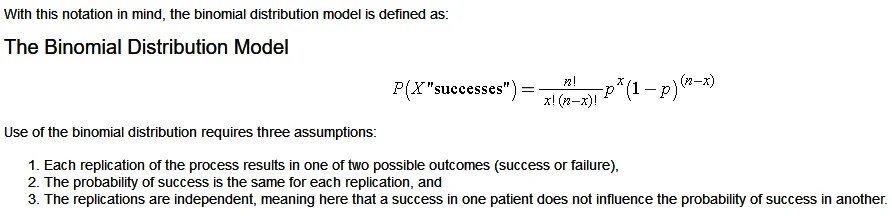
The binomial distribution model allows us to compute the probability of observing a specified number of “successes” when the process is repeated a specific number of times (e.g., in a set of patients) and the outcome for a given patient is either a success or a failure. We must first introduce some notation which is necessary for the binomial distribution model.

First, we let “n” denote the number of observations or the number of times the process is repeated, and “x” denotes the number of “successes” or events of interest occurring during “n” observations. The probability of “success” or occurrence of the outcome of interest is indicated by “p”.

The binomial equation also uses factorials. In mathematics, the factorial of a non-negative integer k is denoted by k!, which is the product of all positive integers less than or equal to k. For example,

  • 4! = 4 x 3 x 2 x 1 = 24,
  • 2! = 2 x 1 = 2,
  • 1!=1.
  • There is one special case, 0! = 1.

Conditions

  • The number of observations n is fixed.
  • Each observation is independent.
  • Each observation represents one of two outcomes (“success” or “failure”).
  • The probability of “success” p is the same for each outcome

Constants

Fitting of Binomial Distribution

Fitting of probability distribution to a series of observed data helps to predict the probability or to forecast the frequency of occurrence of the required variable in a certain desired interval.

To fit any theoretical distribution, one should know its parameters and probability distribution. Parameters of Binomial distribution are n and p. Once p and n are known, binomial probabilities for different random events and the corresponding expected frequencies can be computed. From the given data we can get n by inspection. For binomial distribution, we know that mean is equal to np hence we can estimate p as = mean/n. Thus, with these n and p one can fit the binomial distribution.

There are many probability distributions of which some can be fitted more closely to the observed frequency of the data than others, depending on the characteristics of the variables. Therefore, one needs to select a distribution that suits the data well.

Important Terminologies: Variable, Quantitative Variable, Qualitative Variable, Discrete Variable, Continuous Variable, Dependent Variable, Independent Variable, Frequency, Class Interval, Tally Bar

Important Terminologies:

  • Variable:

Variable is any characteristic, number, or quantity that can be measured or quantified. It can take on different values, which may vary across individuals, objects, or conditions, and is essential in data analysis for observing relationships and patterns.

  • Quantitative Variable:

Quantitative variable is a variable that is measured in numerical terms, such as age, weight, or income. It represents quantities and can be used for mathematical operations, making it suitable for statistical analysis.

  • Qualitative Variable:

Qualitative variable represents categories or attributes, rather than numerical values. Examples include gender, color, or occupation. These variables are non-numeric and are often used in classification and descriptive analysis.

  • Discrete Variable:

Discrete variable is a type of quantitative variable that takes distinct, separate values. These values are countable and cannot take on intermediate values. For example, the number of children in a family is a discrete variable.

  • Continuous Variable:

Continuous variable is a quantitative variable that can take an infinite number of values within a given range. These variables can have decimals or fractions. Examples include height, temperature, or time.

  • Dependent Variable:

Dependent variable is the outcome or response variable that is being measured in an experiment or study. Its value depends on the changes in one or more independent variables. It is the variable of interest in hypothesis testing.

  • Independent Variable:

An independent variable is the variable that is manipulated or controlled in an experiment. It is used to observe its effect on the dependent variable. For example, in a study on plant growth, the amount of water given would be the independent variable.

  • Frequency:

Frequency refers to the number of times a particular value or category occurs in a dataset. It is used in statistical analysis to summarize the distribution of data points within various categories or intervals.

  • Class Interval:

A class interval is a range of values within which data points fall in grouped data. It is commonly used in frequency distributions to organize data into specific ranges, such as “0-10,” “11-20,” etc.

  • Tally Bar:

A tally bar is a method of recording data frequency by using vertical lines. Every group of five tallies (four vertical lines and a fifth diagonal line) represents five occurrences, helping to visually track counts in surveys or experiments.

Important Terminologies in Statistics: Data, Raw Data, Primary Data, Secondary Data, Population, Census, Survey, Sample Survey, Sampling, Parameter, Unit, Variable, Attribute, Frequency, Seriation, Individual, Discrete and Continuous

Statistics is the branch of mathematics that involves the collection, analysis, interpretation, presentation, and organization of data. It helps in drawing conclusions and making decisions based on data patterns, trends, and relationships. Statistics uses various methods such as probability theory, sampling, and hypothesis testing to summarize data and make predictions. It is widely applied across fields like economics, medicine, social sciences, business, and engineering to inform decisions and solve real-world problems.

1. Data

Data is information collected for analysis, interpretation, and decision-making. It can be qualitative (descriptive, such as color or opinions) or quantitative (numerical, such as age or income). Data serves as the foundation for statistical studies, enabling insights into patterns, trends, and relationships.

2. Raw Data

Raw data refers to unprocessed or unorganized information collected from observations or experiments. It is the initial form of data, often messy and requiring cleaning or sorting for meaningful analysis. Examples include survey responses or experimental results.

3. Primary Data

Primary data is original information collected directly by a researcher for a specific purpose. It is firsthand and authentic, obtained through methods like surveys, experiments, or interviews. Primary data ensures accuracy and relevance to the study but can be time-consuming to collect.

4. Secondary Data

Secondary data is pre-collected information used by researchers for analysis. It includes published reports, government statistics, and historical data. Secondary data saves time and resources but may lack relevance or accuracy for specific studies compared to primary data.

5. Population

A population is the entire group of individuals, items, or events that share a common characteristic and are the subject of a study. It includes every possible observation or unit, such as all students in a school or citizens in a country.

6. Census

A census involves collecting data from every individual or unit in a population. It provides comprehensive and accurate information but requires significant resources and time. Examples include national population censuses conducted by governments.

7. Survey

A survey gathers information from respondents using structured tools like questionnaires or interviews. It helps collect opinions, behaviors, or characteristics. Surveys are versatile and widely used in research, marketing, and public policy analysis.

8. Sample Survey

A sample survey collects data from a representative subset of the population. It saves time and costs while providing insights that can generalize to the entire population, provided the sampling method is unbiased and rigorous.

9. Sampling

Sampling is the process of selecting a portion of the population for study. It ensures efficiency and feasibility in data collection. Sampling methods include random, stratified, and cluster sampling, each suited to different study designs.

10. Parameter

A parameter is a measurable characteristic that describes a population, such as the mean, median, or standard deviation. Unlike a statistic, which pertains to a sample, a parameter is specific to the entire population.

11. Unit

A unit is an individual entity in a population or sample being studied. It can represent a person, object, transaction, or observation. Each unit contributes to the dataset, forming the basis for analysis.

12. Variable

A variable is a characteristic or property that can change among individuals or items. It can be quantitative (e.g., age, weight) or qualitative (e.g., color, gender). Variables are the focus of statistical analysis to study relationships and trends.

13. Attribute

An attribute is a qualitative feature that describes a characteristic of a unit. Attributes are non-measurable but observable, such as eye color, marital status, or type of vehicle.

14. Frequency

Frequency represents how often a specific value or category appears in a dataset. It is key in descriptive statistics, helping to summarize and visualize data patterns through tables, histograms, or frequency distributions.

15. Seriation

Seriation is the arrangement of data in sequential or logical order, such as ascending or descending by size, date, or importance. It aids in identifying patterns and organizing datasets for analysis.

16. Individual

An individual is a single member or unit of the population or sample being analyzed. It is the smallest element for data collection and analysis, such as a person in a demographic study or a product in a sales dataset.

17. Discrete Variable

A discrete variable takes specific, separate values, often integers. It is countable and cannot assume fractional values, such as the number of employees in a company or defective items in a batch.

18. Continuous Variable

A continuous variable can take any value within a range and represents measurable quantities. Examples include temperature, height, and time. Continuous variables are essential for analyzing trends and relationships in datasets.

Perquisites of Good Classification of Data

Good classification of data is essential for organizing, analyzing, and interpreting the data effectively. Proper classification helps in understanding the structure and relationships within the data, enabling informed decision-making.

1. Clear Objective

Good classification should have a clear objective, ensuring that the classification scheme serves a specific purpose. It should be aligned with the goal of the study, whether it’s identifying trends, comparing categories, or finding patterns in the data. This helps in determining which variables or categories should be included and how they should be grouped.

2. Homogeneity within Classes

Each class or category within the classification should contain items or data points that are similar to each other. This homogeneity within the classes allows for better analysis and comparison. For example, when classifying people by age, individuals within a particular age group should share certain characteristics related to that age range, ensuring that each class is internally consistent.

3. Heterogeneity between Classes

While homogeneity is crucial within classes, there should be noticeable differences between the various classes. A good classification scheme should maximize the differences between categories, ensuring that each group represents a distinct set of data. This helps in making meaningful distinctions and drawing useful comparisons between groups.

4. Exhaustiveness

Good classification system must be exhaustive, meaning that it should cover all possible data points in the dataset. There should be no omission, and every item must fit into one and only one class. Exhaustiveness ensures that the classification scheme provides a complete understanding of the dataset without leaving any data unclassified.

5. Mutually Exclusive

Classes should be mutually exclusive, meaning that each data point can belong to only one class. This avoids ambiguity and ensures clarity in analysis. For example, if individuals are classified by age group, someone who is 25 years old should only belong to one age class (such as 20-30 years), preventing overlap and confusion.

6. Simplicity

Good classification should be simple and easy to understand. The classification categories should be well-defined and not overly complicated. Simplicity ensures that the classification scheme is accessible and can be easily used for analysis by various stakeholders, from researchers to policymakers. Overly complex classification schemes may lead to confusion and errors.

7. Flexibility

Good classification system should be flexible enough to accommodate new data or changing circumstances. As new categories or data points emerge, the classification scheme should be adaptable without requiring a complete overhaul. Flexibility allows the classification to remain relevant and useful over time, particularly in dynamic fields like business or technology.

8. Consistency

Consistency in classification is essential for maintaining reliability in data analysis. A good classification system ensures that the same criteria are applied uniformly across all classes. For example, if geographical regions are being classified, the same boundaries and criteria should be consistently applied to avoid confusion or inconsistency in reporting.

9. Appropriateness

Good classification should be appropriate for the type of data being analyzed. The classification scheme should fit the nature of the data and the specific objectives of the analysis. Whether classifying data by geographical location, age, or income, the scheme should be meaningful and suited to the research question, ensuring that it provides valuable insights.

Quantitative and Qualitative Classification of Data

Data refers to raw, unprocessed facts and figures that are collected for analysis and interpretation. It can be qualitative (descriptive, like colors or opinions) or quantitative (numerical, like age or sales figures). Data is the foundation of statistics and research, providing the basis for drawing conclusions, making decisions, and discovering patterns or trends. It can come from various sources such as surveys, experiments, or observations. Proper organization and analysis of data are crucial for extracting meaningful insights and informing decisions across various fields.

Quantitative Classification of Data:

Quantitative classification of data involves grouping data based on numerical values or measurable quantities. It is used to organize continuous or discrete data into distinct classes or intervals to facilitate analysis. The data can be categorized using methods such as frequency distributions, where values are grouped into ranges (e.g., 0-10, 11-20) or by specific numerical characteristics like age, income, or height. This classification helps in summarizing large datasets, identifying patterns, and conducting statistical analysis such as finding the mean, median, or mode. It enables clearer insights and easier comparisons of quantitative data across different categories.

Features of Quantitative Classification of Data:

  • Based on Numerical Data

Quantitative classification specifically deals with numerical data, such as measurements, counts, or any variable that can be expressed in numbers. Unlike qualitative data, which deals with categories or attributes, quantitative classification groups data based on values like height, weight, income, or age. This classification method is useful for data that can be measured and involves identifying patterns in numerical values across different ranges.

  • Division into Classes or Intervals

In quantitative classification, data is often grouped into classes or intervals to make analysis easier. These intervals help in summarizing a large set of data and enable quick comparisons. For example, when classifying income levels, data can be grouped into intervals such as “0-10,000,” “10,001-20,000,” etc. The goal is to reduce the complexity of individual data points by organizing them into manageable segments, making it easier to observe trends and patterns.

  • Class Limits

Each class in a quantitative classification has defined class limits, which represent the range of values that belong to that class. For example, in the case of age, a class may be defined with the limits 20-30, where the class includes all data points between 20 and 30 (inclusive). The lower and upper limits are crucial for ensuring that data is classified consistently and correctly into appropriate ranges.

  • Frequency Distribution

Frequency distribution is a key feature of quantitative classification. It refers to how often each class or interval appears in a dataset. By organizing data into classes and counting the number of occurrences in each class, frequency distributions provide insights into the spread of the data. This helps in identifying which ranges or intervals contain the highest concentration of values, allowing for more targeted analysis.

  • Continuous and Discrete Data

Quantitative classification can be applied to both continuous and discrete data. Continuous data, like height or temperature, can take any value within a range and is often classified into intervals. Discrete data, such as the number of people in a group or items sold, involves distinct, countable values. Both types of quantitative data are classified differently, but the underlying principle of grouping into classes remains the same.

  • Use of Central Tendency Measures

Quantitative classification often involves calculating measures of central tendency, such as the mean, median, and mode, for each class or interval. These measures provide insights into the typical or average values within each class. For example, by calculating the average income within specific income brackets, researchers can better understand the distribution of income across the population.

  • Graphical Representation

Quantitative classification is often complemented by graphical tools such as histograms, bar charts, and frequency polygons. These visual representations provide a clear view of how data is distributed across different classes or intervals, making it easier to detect trends, outliers, and patterns. Graphs also help in comparing the frequencies of different intervals, enhancing the understanding of the dataset.

Qualitative Classification of Data:

Qualitative classification of data involves grouping data based on non-numerical characteristics or attributes. This classification is used for categorical data, where the values represent categories or qualities rather than measurable quantities. Examples include classifying individuals by gender, occupation, marital status, or color. The data is typically organized into distinct groups or classes without any inherent order or ranking. Qualitative classification allows researchers to analyze patterns, relationships, and distributions within different categories, making it easier to draw comparisons and identify trends. It is often used in fields such as social sciences, marketing, and psychology for descriptive analysis.

Features of  Qualitative Classification of Data:

  • Based on Categories or Attributes

Qualitative classification deals with data that is based on categories or attributes, such as gender, occupation, religion, or color. Unlike quantitative data, which is measured in numerical values, qualitative data involves sorting or grouping items into distinct categories based on shared qualities or characteristics. This type of classification is essential for analyzing data that does not have a numerical relationship.

  • No Specific Order or Ranking

In qualitative classification, the categories do not have a specific order or ranking. For instance, when classifying individuals by their profession (e.g., teacher, doctor, engineer), the categories do not imply any hierarchy or ranking order. The lack of a natural sequence or order distinguishes qualitative classification from ordinal data, which involves categories with inherent ranking (e.g., low, medium, high). The focus is on grouping items based on their similarity in attributes.

  • Mutual Exclusivity

Each data point in qualitative classification must belong to one and only one category, ensuring mutual exclusivity. For example, an individual cannot simultaneously belong to both “Male” and “Female” categories in a gender classification scheme. This feature helps to avoid overlap and ambiguity in the classification process. Ensuring mutual exclusivity is crucial for clear analysis and accurate data interpretation.

  • Exhaustiveness

Qualitative classification should be exhaustive, meaning that all possible categories are covered. Every data point should fit into one of the predefined categories. For instance, if classifying by marital status, categories like “Single,” “Married,” “Divorced,” and “Widowed” must encompass all possible marital statuses within the dataset. Exhaustiveness ensures no data is left unclassified, making the analysis complete and comprehensive.

  • Simplicity and Clarity

A good qualitative classification should be simple, clear, and easy to understand. The categories should be well-defined, and the criteria for grouping data should be straightforward. Complexity and ambiguity in categorization can lead to confusion, misinterpretation, or errors in analysis. Simple and clear classification schemes make the data more accessible and improve the quality of research and reporting.

  • Flexibility

Qualitative classification is flexible and can be adapted as new categories or attributes emerge. For example, in a study of professions, new job titles or fields may develop over time, and the classification system can be updated to include these new categories. Flexibility in qualitative classification allows researchers to keep the data relevant and reflective of changes in society, industry, or other fields of interest.

  • Focus on Descriptive Analysis

Qualitative classification primarily focuses on descriptive analysis, which involves summarizing and organizing data into meaningful categories. It is used to explore patterns and relationships within the data, often through qualitative techniques such as thematic analysis or content analysis. The goal is to gain insights into the characteristics or behaviors of individuals, groups, or phenomena rather than making quantitative comparisons.

error: Content is protected !!