Elements of Uncertainty Peril

Risk is the chance of loss, and peril is the direct cause of the loss. If a house burns down, then fire is the peril. A hazard is anything that either causes or increases the likelihood of a loss. For instance, gas furnaces are a hazard for carbon monoxide poisoning. A physical hazard is a physical condition that increases the possibility of a loss. Thus, smoking is a physical hazard that increases the likelihood of a house fire and illness.

Moral hazards are losses that results from dishonesty. Thus, insurance companies suffer losses because of fraudulent or inflated claims. The legal system is a moral hazard in that it motivates many people to sue simply for financial profit because of the enormous amount of money that can sometimes be won, and because there is little cost to the plaintiff, even if he loses. A good example is the current asbestos litigation, which has bankrupted many companies, even though very few plaintiffs show any real evidence of disease, and are unlikely to ever develop any disease that can be shown, by the preponderance of the evidence, to have resulted from asbestos exposure. This type of moral hazard is often referred to as legal hazard. Legal hazard can also result from laws or regulations that force insurance companies to cover risks that they would otherwise not cover, such as including coverage for alcoholism in health insurance.

Insurance can be regarded as a morale hazard because it increases the possibility of a loss that results from the insured worrying less about losses. Therefore, they take fewer precautions and may engage in riskier activities because they have insurance. A good example of morale hazard is when the federal government bails out financial institutions who have made bad decisions. Many financial institutions have taken significant risks in the recent subprime debacle by buying toxic instruments, such as CDOs and mortgage-backed securities based on subprime mortgages that paid high yields, but were extremely risky. The financial institutions have considered themselves too big to fail in other words, if things started going badly, then the federal government would step in to stop their collapse for fear that the whole financial system will collapse, which is exactly what the federal government did in September, 2008. Freddie Mac and Fannie Mae have both been taken over by the government, and American International Group (AIG) has been propped up by an infusion of $85 billion of taxpayers’ money. AIG sold credit default swaps on mortgage-backed securities to buyers, mostly banks, thinking that they could collect the premiums, but would never have to actually to pay for defaults but if they were wrong, then the government would save them, because otherwise the banks that had bought that credit default protection could also possibly fail. As recent events have demonstrated all too clearly, this federal government “insurance” creates a morale hazard for financial institutions taxpayers pay the premium, but the big financial institutions, with their overpaid CEOs and managers, receive the benefits.

Introduction to Risk Management

Risk management encompasses the identification, analysis, and response to risk factors that form part of the life of a business. Effective risk management means attempting to control, as much as possible, future outcomes by acting proactively rather than reactively. Therefore, effective risk management offers the potential to reduce both the possibility of a risk occurring and its potential impact.

Risks Management Structures

Risk management structures are tailored to do more than just point out existing risks. A good risk management structure should also calculate the uncertainties and predict their influence on a business. Consequently, the result is a choice between accepting risks or rejecting them. Acceptance or rejection of risks is dependent on the tolerance levels that a business has already defined for itself.

Risk Management in Indian banks is a relatively newer practice but has already shown to increase efficiency in governing of these banks as such procedures tend to increase the corporate governance of a financial institution. In times of volatility and fluctuations in the market, financial institutions need to prove their mettle by withstanding the market variations and achieve sustainability in terms of growth and well as have a stable share value. Hence, an essential component of risk management framework would be to mitigate all the risks and rewards of the products and service offered by the bank. Thus, the need for an efficient risk management framework is paramount to factor in internal and external risks.

Total Impact of Risk

Total impact of the risk (TIR) occurring would entail as the impact (I), the risk would cause multiplied by the Risk Ratio. It is essentially how much a bank would be impacted in the chance that the risk did occur. This essentially helps ascertain what is the total value of their investments that may be subject to risk and how it would impact them.

TIR = I × RR

Types of Risk

Types of Risks in Banking

The term Risk and the types associated to it would refer to mean financial risk or uncertainty of financial loss. The Reserve Bank of India guidelines issued in Oct. 1999 has identified and categorized the majority of risk into three major categories assumed to be encountered by banks. These belong to the clusters:

  • Credit risk
  • Market risk
  • Operational risk

The type of risks can be fundamentally subdivided in primarily of two types, i.e. Financial and Non-Financial Risk. Financial risks would involve all those aspects which deal mainly with financial aspects of the bank. These can be further subdivided into Credit Risk and Market Risk. Both Credit and Market Risk may be further subdivided.

Non-Financial risks would entail all the risk faced by the bank in its regular workings, i.e. Operational risk, Strategic risk, Funding risk, Political risk, and Legal risk.

If a business sets up risk management as a disciplined and continuous process for the purpose of identifying and resolving risks, then the risk management structures can be used to support other risk mitigation systems. They include planning, organization, cost control, and budgeting. In such a case, the business will not usually experience many surprises, because the focus is on proactive risk management.

Response to Risks

Response to risks usually takes one of the following forms:

  • Avoidance: A business strives to eliminate a particular risk by getting rid of its cause.
  • Mitigation: Decreasing the projected financial value associated with a risk by lowering the possibility of the occurrence of the risk.
  • Acceptance: In some cases, a business may be forced to accept a risk. This option is possible if a business entity develops contingencies to mitigate the impact of the risk, should it occur.

When creating contingencies, a business needs to engage in a problem-solving approach. The result is a well-detailed plan that can be executed as soon as the need arises. Such a plan will enable a business organization to handle barriers or blockage to its success, because it can deal with risks as soon as they arise.

Importance of Risk Management

Risks management is an important process because it empowers a business with the necessary tools so that it can adequately identify and deal with potential risks. Once a risk’s been identified, it is then easy to mitigate it. In addition, risk management provides a business with a basis upon which it can undertake sound decision-making.

For a business, assessment and management of risks is the best way to prepare for eventualities that may come in the way of progress and growth. When a business evaluates its plan for handling potential threats and then develops structures to address them, it improves its odds of becoming a successful entity.

In addition, progressive risk management ensures risks of a high priority are dealt with as aggressively as possible. Moreover, the management will have the necessary information that they can use to make informed decisions and ensure that the business remains profitable.

Other important benefits of risk management include:

  • Creates a safe and secure work environment for all staff and customers.
  • Increases the stability of business operations while also decreasing legal liability.
  • Provides protection from events that are detrimental to both the company and the environment.
  • Protects all involved people and assets from potential harm.
  • Helps establish the organization’s insurance needs in order to save on unnecessary premiums.

The importance of combining risk management with patient safety has also been revealed. In most hospitals and organizations, the risk management and patient safety departments are separated; they incorporate different leadership, goals and scope. However, some hospitals are recognizing that the ability to provide safe, high-quality patient care is necessary to the protection of financial assets and, as a result, should be incorporated with risk management.

Risk Analysis Process

Risks analysis is a qualitative problem-solving approach that uses various tools of assessment to work out and rank risks for the purpose of assessing and resolving them. Here is the risk analysis process:

  1. Identify existing risks

Risk identification mainly involves brainstorming. A business gathers its employees together so that they can review all the various sources of risk. The next step is to arrange all the identified risks in order of priority. Because it is not possible to mitigate all existing risks, prioritization ensures that those risks that can affect a business significantly are dealt with more urgently.

  1. Assess the risks

In many cases, problem resolution involves identifying the problem and then finding an appropriate solution. However, prior to figuring out how best to handle risks, a business should locate the cause of the risks by asking the question, “What caused such a risk and how could it influence the business?”

  1. Develop an appropriate response

Once a business entity is set on assessing likely remedies to mitigate identified risks and prevent their recurrence, it needs to ask the following questions: What measures can be taken to prevent the identified risk from recurring? In addition, what is the best thing to do if it does recur?

  1. Develop preventive mechanisms for identified risks

Here, the ideas that were found to be useful in mitigating risks are developed into a number of tasks and then into contingency plans that can be deployed in the future. If risks occur, the plans can be put to action.

Conclusion

Our business ventures encounter many risks that can affect their survival and growth. As a result, it is important to understand the basic principles of risk management and how it can be used to help mitigate the effects of risks on business entities.

Budgetary Control Introduction, Meaning

Budgetary Control is a process of monitoring and controlling the actual financial performance of an organization against the budgeted or planned financial performance. It involves comparing actual financial results with the budgeted results and taking corrective action if the actual results are not aligned with the planned results. The goal of budgetary control is to ensure that an organization’s financial resources are used effectively and efficiently to achieve its objectives.

Process of Budgetary Control:

  • Budget Preparation:

The first step in budgetary control is the preparation of a comprehensive budget. This involves estimating the revenue and expenses for a particular period, typically a fiscal year, and allocating resources to various activities based on the organization’s priorities and goals.

  • Budget Approval:

Once the budget is prepared, it needs to be approved by the relevant authorities in the organization. This ensures that the budget is aligned with the organization’s goals and objectives and is realistic and achievable.

  • Implementation:

The approved budget is then implemented by the organization. This involves allocating resources to various activities and departments based on the budgeted amounts.

  • Monitoring:

Once the budget is implemented, it is important to monitor actual financial performance against the budgeted performance. This involves tracking actual revenue and expenses and comparing them with the budgeted amounts.

  • Variance Analysis:

Any differences between the actual financial results and the budgeted results are analyzed to determine the reasons for the variances. This analysis can help identify areas where corrective action is needed to bring the actual results in line with the budgeted results.

  • Corrective Action:

Based on the variance analysis, corrective action is taken to address any issues that are causing the actual results to deviate from the budgeted results. This can involve adjusting resource allocation, reducing expenses, increasing revenue, or implementing other changes to bring the financial results back on track.

  • Reporting:

Finally, the results of the budgetary control process are reported to relevant stakeholders in the organization. This includes financial reports that show the actual financial performance compared to the budgeted performance, as well as reports that detail any corrective actions taken and their impact on the organization’s financial performance.

Budgetary Control Types

There are several types of budgetary control that organizations use to ensure that their budgetary goals are met.

  • Financial Budgetary Control:

This type of budgetary control focuses on the financial aspects of budgeting, such as revenue, expenses, cash flow, and profit. Financial budgetary control helps organizations to identify financial risks, make informed financial decisions, and ensure that financial targets are met.

  • Performance Budgetary Control:

This type of budgetary control focuses on the performance aspects of budgeting, such as productivity, efficiency, and effectiveness. Performance budgetary control helps organizations to identify areas where performance can be improved, set performance targets, and monitor progress towards those targets.

  • Zero-Based Budgetary Control:

This type of budgetary control involves starting each budgeting period from scratch, with no assumptions made about previous budgets. Zero-based budgeting requires that every expense must be justified, regardless of whether it was included in the previous budget.

  • Flexible Budgetary Control:

This type of budgetary control allows for changes to be made to the budget as circumstances change. Flexible budgeting helps organizations to adapt to changes in the business environment, such as changes in customer demand, market conditions, or economic factors.

  • Static Budgetary Control:

This type of budgetary control is based on fixed assumptions about revenue and expenses and does not allow for changes to be made to the budget. Static budgeting is useful when there is a high degree of certainty about revenue and expenses, but it can be less effective when there is a high degree of uncertainty.

  • Incremental Budgetary Control:

This type of budgetary control involves making incremental changes to the budget each period, based on previous budgets. Incremental budgeting is useful when there is a high degree of certainty about revenue and expenses and when there is a need for stability in the budgeting process.

  • Activity-Based Budgetary Control:

This type of budgetary control focuses on the activities that drive costs and revenue in an organization. Activity-based budgeting helps organizations to allocate resources to the most important activities, identify cost savings opportunities, and optimize revenue generation.

Budgetary Control Objectives

  • Planning:

The primary objective of budgetary control is to plan and allocate resources effectively and efficiently. It helps in identifying the goals and objectives of an organization and creating a roadmap to achieve them.

  • Coordination:

Budgetary control facilitates coordination among different departments and functional areas of an organization. It ensures that everyone is working towards the same goals and objectives, and that resources are being allocated optimally.

  • Communication:

Budgetary control involves regular communication between managers and subordinates. This helps in creating a culture of transparency and accountability, and ensures that everyone is aware of the organization’s goals and objectives.

  • Control:

The main objective of budgetary control is to ensure that actual performance is in line with planned performance. It helps in identifying variances and taking corrective actions to ensure that the organization stays on track towards its goals.

  • Motivation:

Budgetary control can be used to motivate employees by providing them with clear targets and goals. When employees know what is expected of them, they are more likely to work harder and achieve better results.

  • Evaluation:

Budgetary control helps in evaluating the performance of an organization against its planned objectives. It provides a basis for measuring the efficiency and effectiveness of different departments and functional areas, and helps in identifying areas for improvement.

  • Forecasting:

Budgetary control involves the creation of financial forecasts for the future. These forecasts can be used to identify potential problems and opportunities, and to plan accordingly.

Merits of Budgetary Control:

  • Planning:

Budgetary control involves a comprehensive planning process that helps organizations to allocate their resources effectively and efficiently. This helps in achieving the organization’s goals and objectives.

  • Coordination:

Budgetary control helps in coordinating different departments and functional areas of an organization. It ensures that everyone is working towards the same goals and objectives, and that resources are being allocated optimally.

  • Communication:

Budgetary control involves regular communication between managers and subordinates. This helps in creating a culture of transparency and accountability, and ensures that everyone is aware of the organization’s goals and objectives.

  • Control:

The primary advantage of budgetary control is that it provides a basis for measuring actual performance against planned performance. This helps in identifying variances and taking corrective actions to ensure that the organization stays on track towards its goals.

  • Motivation:

Budgetary control can be used to motivate employees by providing them with clear targets and goals. When employees know what is expected of them, they are more likely to work harder and achieve better results.

  • Evaluation:

Budgetary control helps in evaluating the performance of an organization against its planned objectives. It provides a basis for measuring the efficiency and effectiveness of different departments and functional areas, and helps in identifying areas for improvement.

  • Forecasting:

Budgetary control involves the creation of financial forecasts for the future. These forecasts can be used to identify potential problems and opportunities, and to plan accordingly.

Limitations of Budgetary Control:

  • Time-consuming:

Budgetary control can be a time-consuming process, particularly in large organizations. This can lead to delays in decision-making and may result in missed opportunities.

  • Resistance to Change:

Budgetary control can sometimes meet resistance from employees who are not accustomed to the process. This can lead to delays and difficulties in implementation.

  • Unrealistic assumptions:

Budgetary control is based on assumptions about future events, which may not always be accurate. This can result in budgets that are unrealistic or unachievable.

  • Lack of Flexibility:

Budgetary control can be inflexible, particularly when unexpected events occur. This can lead to difficulties in adapting to changing circumstances.

  • Overemphasis on short-term results:

Budgetary control can sometimes result in an overemphasis on short-term results at the expense of long-term goals and objectives.

  • Inadequate data:

Budgetary control requires accurate and timely data, which may not always be available. This can lead to inaccuracies in the budget and difficulties in measuring performance.

  • Costly:

Budgetary control can be a costly process, particularly in terms of the resources required for planning, implementation, and monitoring.

Marginal Costing, Introduction, Meaning, Definition, Objectives, Features, Applications, Assumptions, Advantages and Limitations

Marginal Costing is an important technique of cost accounting and managerial decision-making in which only variable costs are charged to products, while fixed costs are treated as period costs and written off against the profit of the period. It helps management analyze the relationship between cost, volume, and profit and supports various short-term decisions such as pricing, product mix, make-or-buy decisions, and profit planning. Marginal Costing focuses on the contribution made by each product toward covering fixed costs and generating profit. Due to its simplicity and usefulness, it is widely used in cost management and decision-making.

Meaning of Marginal Costing

Marginal Costing is a costing technique in which only variable costs are considered product costs. Fixed costs are not included in the cost of production but are treated as expenses of the accounting period.

The difference between sales revenue and variable cost is known as Contribution, which is used to cover fixed costs and earn profit.

Definition of Marginal Costing

According to the terminology of cost accounting:

“Marginal Costing is the ascertainment of marginal costs and the effect on profit of changes in volume or type of output by differentiating between fixed costs and variable costs.”

Key Concepts of Marginal Costing

1. Marginal Cost

Marginal cost refers to the additional cost incurred by producing one more unit of output. It consists only of variable costs.

Formula: Marginal Cost = Direct Material + Direct Labour + Direct Expenses + Variable Overheads

2. Contribution

Contribution is the excess of sales revenue over variable costs.

Formula: Contribution=Sales−Variable Cost

Contribution first covers fixed costs, and the remaining amount becomes profit.

3. Profit

Profit arises when total contribution exceeds total fixed costs.

Formula: Profit=Contribution−Fixed Costs

4. Profit-Volume Ratio (P/V Ratio)

The Profit-Volume Ratio measures the relationship between contribution and sales.

Formula: P/V Ratio = (Contribution / Sales) × 100

5. Break-Even Point (BEP)

Break-Even Point is the level of sales at which total revenue equals total cost and there is neither profit nor loss.

Formula (Units): BEP=Fixed CostsContribution per Unit

6. Margin of Safety (MOS)

Margin of Safety represents the excess of actual sales over break-even sales.

Formula: MOS=Actual Sales−Break-Even Sales

Objectives of Marginal Costing

  • Determine the Variable Cost of Products

One of the primary objectives of Marginal Costing is to determine the variable cost of producing goods or services. It considers only variable costs such as direct materials, direct labour, direct expenses, and variable overheads while calculating product costs. Accurate determination of variable costs helps management understand the cost behaviour of products and services. It also provides a basis for pricing and production decisions. By focusing on variable costs, organizations can identify cost-saving opportunities and improve efficiency. Therefore, determining the variable cost of products is a fundamental objective of Marginal Costing and supports effective cost management.

  • Assist Managerial Decision-Making

Marginal Costing aims to provide relevant cost information for managerial decisions. Managers use marginal cost data while making decisions related to pricing, product selection, production levels, and resource allocation. Since only variable costs are considered, management can evaluate the impact of different alternatives on profitability more effectively. This technique helps in choosing the most profitable course of action under changing business conditions. Therefore, assisting managerial decision-making is one of the most important objectives of Marginal Costing because it supports efficient planning and control.

  • Measure Contribution

Another important objective of Marginal Costing is to determine the contribution made by each product, service, or department. Contribution is the difference between sales revenue and variable costs. It indicates the amount available to cover fixed costs and generate profit. Measuring contribution helps management identify profitable and unprofitable products and take appropriate corrective actions. Contribution analysis also assists in determining the profitability of different business segments. Therefore, measuring contribution is a significant objective of Marginal Costing and an essential tool for profitability analysis.

  • Facilitate Profit Planning

Marginal Costing assists organizations in planning future profits by analyzing the relationship between costs, sales, and output levels. It enables management to estimate the effects of changes in production volume, selling price, and cost structure on profits. Profit planning helps businesses set realistic targets and formulate effective strategies for achieving organizational objectives. Marginal Costing provides a basis for preparing budgets and forecasts. Therefore, facilitating profit planning is an important objective of Marginal Costing and contributes to long-term business success.

  • Analyze Cost-Volume-Profit Relationship

A major objective of Marginal Costing is to study the relationship between cost, volume, and profit. This analysis helps management understand how changes in sales volume or costs affect profitability. Through cost-volume-profit analysis, managers can determine the break-even point, margin of safety, and required sales levels. Understanding these relationships assists in effective planning and decision-making. Therefore, analyzing the cost-volume-profit relationship is a key objective of Marginal Costing and provides valuable insights into business performance.

  • Facilitate Cost Control

Marginal Costing helps organizations control costs by separating costs into fixed and variable components. This classification enables management to identify cost behaviour and take appropriate measures to control unnecessary expenses. Variable costs can be monitored more effectively, while fixed costs can be managed through proper planning and budgeting. Effective cost control improves efficiency and profitability. Therefore, facilitating cost control is an important objective of Marginal Costing and supports efficient utilization of organizational resources.

  • Determine the Break-Even Point

Another objective of Marginal Costing is to determine the break-even point, which is the level of sales where total revenue equals total costs and there is neither profit nor loss. Knowledge of the break-even point helps management assess business risk and determine the minimum sales required for survival. It also assists in setting sales targets and evaluating the effects of changes in costs and prices. Therefore, determining the break-even point is a significant objective of Marginal Costing and an important tool for financial planning.

  • Improve Managerial Efficiency

Marginal Costing seeks to improve managerial efficiency by providing accurate and timely cost information. The technique supports planning, decision-making, performance evaluation, and cost control activities. Managers can make informed decisions regarding production, pricing, and resource allocation based on marginal cost data. Better information leads to improved operational efficiency and profitability. By enhancing the quality of managerial decisions, Marginal Costing contributes to the overall effectiveness of the organization. Therefore, improving managerial efficiency is an essential objective of Marginal Costing.

Features of Marginal Costing

  • Classification of Costs into Fixed and Variable Costs

The most important feature of Marginal Costing is the classification of costs into fixed and variable components. Variable costs change according to the level of production or sales, whereas fixed costs remain constant within a specific period. This classification helps management understand cost behaviour and its impact on profitability. It also forms the basis for contribution analysis and decision-making. Proper classification of costs enables managers to plan production levels, control expenses, and estimate profits accurately. Therefore, distinguishing between fixed and variable costs is a fundamental feature of Marginal Costing.

  • Only Variable Costs Are Charged to Products

Under Marginal Costing, only variable costs are considered while determining the cost of products or services. These costs include direct materials, direct labour, direct expenses, and variable overheads. Fixed costs are excluded from product costs because they do not vary with production volume in the short run. This approach provides the marginal cost per unit and helps management make decisions regarding pricing and production. Therefore, charging only variable costs to products is a distinctive feature of Marginal Costing.

  • Fixed Costs Are Treated as Period Costs

Another important feature of Marginal Costing is that fixed costs are treated as expenses of the accounting period in which they are incurred. They are not absorbed into the cost of production or inventory valuation. Fixed costs are written off directly against the contribution earned during the period. This treatment simplifies cost calculations and emphasizes the role of contribution in profit determination. Therefore, treating fixed costs as period costs is a significant feature of Marginal Costing.

  • Emphasis on Contribution

Marginal Costing places special emphasis on contribution rather than gross profit. Contribution is the difference between sales revenue and variable costs and represents the amount available to cover fixed costs and generate profit. Contribution analysis helps management evaluate product profitability, determine the break-even point, and make various business decisions. Since contribution is central to profit planning and decision-making, its importance makes Marginal Costing a highly useful managerial tool. Therefore, emphasis on contribution is one of the key features of Marginal Costing.

  • Useful for Decision-Making

Marginal Costing is primarily designed to assist management in decision-making. It provides relevant cost information for decisions related to pricing, product mix, make-or-buy choices, acceptance of special orders, and shutdown decisions. By focusing on costs that change with decisions, Marginal Costing enables managers to choose the most profitable alternatives. This feature makes the technique highly valuable for short-term planning and operational decisions. Therefore, its usefulness in managerial decision-making is a major feature of Marginal Costing.

  • Facilitates Cost-Volume-Profit Analysis

Marginal Costing facilitates Cost-Volume-Profit (CVP) analysis by studying the relationship between costs, sales volume, and profits. Through CVP analysis, management can determine the break-even point, margin of safety, and expected profit levels. It helps managers understand how changes in costs or sales affect profitability. This information is essential for planning, budgeting, and decision-making. Therefore, facilitating Cost-Volume-Profit analysis is an important feature of Marginal Costing.

  • Simple and Easy to Understand

Marginal Costing is relatively simple and easy to understand compared with many other costing techniques. Since it focuses only on variable costs and excludes fixed costs from product costing, calculations become less complex. The concepts of contribution, break-even analysis, and profit planning are easy to apply and interpret. Managers can quickly analyze business situations and make decisions without complicated computations. Therefore, simplicity and ease of understanding are important features that contribute to the popularity of Marginal Costing.

  • Useful for Profit Planning and Cost Control

Marginal Costing is an effective tool for profit planning and cost control. By separating fixed and variable costs, management can prepare budgets, estimate future profits, and monitor cost behaviour more effectively. The technique helps identify areas where costs can be reduced and resources can be used more efficiently. It also assists in setting profit targets and evaluating business performance. Therefore, its usefulness in profit planning and cost control is one of the most significant features of Marginal Costing.

Applications of Marginal Costing

  • Pricing Decisions

One of the most important applications of Marginal Costing is in pricing decisions. Management uses marginal cost information to determine the minimum selling price of a product, especially during periods of intense competition or low demand. Since fixed costs are already incurred, decisions regarding additional production can be based on whether the selling price covers variable costs and contributes toward fixed costs. Marginal Costing helps businesses adopt competitive pricing strategies without incurring losses. Therefore, it is widely used in determining prices for products and services under different market conditions.

  • Product Mix Decisions

When resources such as labour, machine hours, or raw materials are limited, management must select the most profitable combination of products. Marginal Costing assists in this decision by analyzing the contribution generated by each product. Products with a higher contribution per limiting factor are given priority in production. This helps organizations maximize overall profitability and utilize available resources efficiently. Therefore, Marginal Costing is an important tool for determining the optimum product mix and improving business performance.

  • Make or Buy Decisions

Organizations often face decisions regarding whether to manufacture a component internally or purchase it from an external supplier. Marginal Costing provides relevant cost information for comparing the costs of both alternatives. Management considers only the relevant variable costs and avoidable fixed costs while making the decision. If purchasing the component is cheaper than producing it internally, the organization may choose to buy it. Therefore, Marginal Costing plays a significant role in make-or-buy decisions and helps businesses minimize costs.

  • Acceptance of Special Orders

Businesses sometimes receive special orders at prices lower than the normal selling price. Marginal Costing helps determine whether such orders should be accepted by comparing the additional revenue with the additional variable costs involved. If the special order generates a positive contribution and unused production capacity exists, accepting the order may increase overall profit. Therefore, Marginal Costing provides a useful basis for evaluating special orders and making profitable decisions.

  • Profit Planning

Marginal Costing is extensively used for profit planning and forecasting. By analyzing the relationship between costs, sales volume, and profits, management can estimate future profitability under different conditions. It helps determine the level of sales required to achieve a desired profit target. Managers can also evaluate the effects of changes in costs, prices, and production levels on profitability. Therefore, Marginal Costing is an essential tool for planning future profits and setting organizational objectives.

  • Break-Even Analysis

Another important application of Marginal Costing is determining the break-even point, where total revenue equals total cost and there is neither profit nor loss. Break-even analysis helps management understand the minimum sales level required to avoid losses. It also assists in evaluating business risk and planning future operations. Knowledge of the break-even point enables managers to make informed decisions regarding pricing, production, and expansion. Therefore, break-even analysis is one of the most valuable applications of Marginal Costing.

  • Shutdown and Continuation Decisions

During periods of economic downturn or declining demand, organizations may consider temporarily shutting down operations. Marginal Costing helps management evaluate whether production should continue or be suspended. If the contribution generated by operations is sufficient to cover a portion of fixed costs, continuing production may be preferable. However, if losses are excessive, temporary shutdown may be advisable. Therefore, Marginal Costing assists in making rational shutdown and continuation decisions.

  • Budgeting and Cost Control

Marginal Costing is widely used in budgeting and cost control activities. By separating costs into fixed and variable components, management can prepare flexible budgets and monitor cost behaviour effectively. Variable costs can be controlled by analyzing their relationship with production levels, while fixed costs can be managed through proper planning. Marginal Costing helps identify cost variances and areas requiring corrective action. Therefore, it is an effective tool for budgeting, cost control, and improving organizational efficiency.

Assumptions of Marginal Costing

  • Costs Can Be Classified into Fixed and Variable

Marginal Costing assumes that all costs can be clearly divided into fixed costs and variable costs. Variable costs change directly with the level of production, while fixed costs remain constant within a relevant range. This classification forms the basis of contribution analysis and decision-making. Although some costs may be semi-variable in practice, the technique assumes a clear distinction between the two categories. Therefore, proper classification of costs is a fundamental assumption of Marginal Costing.

  • Variable Cost Per Unit Remains Constant

Another assumption is that the variable cost per unit remains constant regardless of the level of production or sales. If production increases or decreases, the total variable cost changes proportionately, but the variable cost per unit remains unchanged. This assumption simplifies cost calculations and contribution analysis. However, in reality, discounts on purchases or changes in efficiency may alter variable costs. Nevertheless, Marginal Costing assumes constant variable cost per unit for effective analysis.

  • Total Fixed Costs Remain Constant

Marginal Costing assumes that total fixed costs remain constant during a specific period and within a relevant range of activity. Fixed costs such as rent, salaries, and insurance do not change with short-term fluctuations in production volume. This assumption helps management analyze the impact of changes in sales and output on profitability. Although fixed costs may change in the long run, they are considered constant for the purpose of Marginal Costing.

  • Selling Price Per Unit Remains Constant

The technique assumes that the selling price of a product remains constant regardless of the quantity sold. This means that additional units can be sold at the same price without affecting demand or market conditions. A constant selling price helps in calculating contribution and profit accurately. However, market competition and economic conditions may influence prices in reality. Despite these practical limitations, Marginal Costing assumes a constant selling price for analysis.

  • Production and Sales Are Equal

Marginal Costing generally assumes that the number of units produced is equal to the number of units sold. This assumption eliminates the effect of opening and closing inventory on profit calculations. When production and sales are equal, all fixed costs of the period are charged against current revenue. This simplifies the determination of contribution and profit. Therefore, equality between production and sales is an important assumption of Marginal Costing.

  • Efficiency and Technology Remain Unchanged

Marginal Costing assumes that the efficiency of workers, production methods, and technology remain constant during the period of analysis. There are no changes in production techniques, labour productivity, or machine efficiency that could affect costs. This assumption ensures that cost behaviour remains stable and predictable. In practice, technological improvements may alter costs and productivity, but Marginal Costing assumes stable operating conditions.

  • Product Mix Remains Constant

In a multi-product organization, Marginal Costing assumes that the proportion of different products sold remains constant. A stable product mix is necessary for calculating the overall contribution and break-even point accurately. Changes in product mix may significantly affect profitability because different products generate different contribution margins. Therefore, maintaining a constant sales mix is an important assumption of Marginal Costing.

  • Costs and Revenues Are Influenced Mainly by Volume

Marginal Costing assumes that costs and revenues are affected primarily by changes in production and sales volume. Other factors such as inflation, market conditions, government regulations, and technological changes are assumed to remain constant. This assumption helps establish a direct relationship between cost, volume, and profit. Therefore, the technique focuses mainly on volume as the principal factor influencing profitability and decision-making.

Advantages of Marginal Costing

  • Simple and Easy to Understand

One of the major advantages of Marginal Costing is its simplicity. The technique divides costs into fixed and variable categories, making cost analysis easier and more understandable. Since only variable costs are charged to products, calculations become less complicated than in absorption costing. Managers can quickly interpret cost information and make decisions without complex accounting procedures. The concepts of contribution, break-even point, and margin of safety are easy to understand and apply. Therefore, the simplicity of Marginal Costing makes it a popular and useful technique for managerial decision-making and cost management.

  • Helpful in Managerial Decision-Making

Marginal Costing provides relevant information for various managerial decisions such as pricing, product selection, make-or-buy decisions, and acceptance of special orders. By focusing on costs that change with decisions, it helps managers evaluate alternatives more effectively. The technique emphasizes contribution and profitability, enabling management to choose the most beneficial course of action. It also assists in short-term planning and operational decisions. Therefore, Marginal Costing is a valuable decision-making tool that improves managerial efficiency and organizational performance.

  • Facilitates Profit Planning

Another important advantage of Marginal Costing is its usefulness in profit planning. It enables management to estimate profits at different levels of sales and production. By studying the relationship between cost, volume, and profit, managers can determine the sales required to achieve a desired profit target. The technique also assists in preparing budgets and financial forecasts. Effective profit planning improves organizational performance and supports long-term business growth. Therefore, facilitating profit planning is one of the significant advantages of Marginal Costing.

  • Useful in Break-Even Analysis

Marginal Costing greatly facilitates break-even analysis by focusing on contribution and fixed costs. It helps management determine the level of sales at which total revenue equals total costs. Knowledge of the break-even point enables managers to evaluate business risk and plan production and sales activities more effectively. It also assists in setting realistic sales targets and estimating future profitability. Therefore, its usefulness in break-even analysis is an important advantage of Marginal Costing.

  • Facilitates Cost Control

Marginal Costing helps organizations control costs by classifying them into fixed and variable categories. This classification allows management to identify cost behaviour and take corrective measures to control unnecessary expenses. Variable costs can be monitored closely, and fixed costs can be managed through proper planning and budgeting. Effective cost control improves productivity and profitability. Therefore, facilitating cost control is one of the major advantages of Marginal Costing.

  • Eliminates Problems of Fixed Cost Allocation

Under Marginal Costing, fixed costs are treated as period costs and are not allocated to products. This eliminates the difficulties and arbitrariness associated with apportioning fixed overheads among different products or departments. As a result, product costs are determined more objectively and accurately. This approach also simplifies accounting procedures and improves the reliability of cost information. Therefore, eliminating fixed cost allocation problems is an important benefit of Marginal Costing.

  • Helps in Product Mix Decisions

Marginal Costing assists management in selecting the most profitable combination of products when resources are limited. By analyzing contribution per unit and contribution per limiting factor, managers can prioritize products that generate higher profits. This helps organizations utilize resources efficiently and maximize profitability. Product mix decisions are particularly important in industries facing production constraints. Therefore, Marginal Costing plays a vital role in determining the optimum product mix.

  • Useful for Short-Term Decisions

Marginal Costing is especially useful for short-term business decisions because it focuses on relevant costs and immediate profitability. Decisions such as accepting special orders, continuing or discontinuing products, and selecting production methods require information about variable costs and contribution. The technique enables management to respond quickly to changing market conditions and business opportunities. Therefore, its usefulness in short-term decision-making is one of the most significant advantages of Marginal Costing.

Limitations of Marginal Costing

  • Ignores Fixed Costs in Product Costing

One of the major limitations of Marginal Costing is that it excludes fixed costs from product costs. Fixed costs are essential expenses incurred to maintain production capacity and cannot be ignored in the long run. By considering only variable costs, product costs may appear lower than their actual cost. This may result in incorrect pricing and profitability decisions. Therefore, ignoring fixed costs is a significant limitation of Marginal Costing.

  • Difficulty in Cost Classification

Marginal Costing requires a clear distinction between fixed and variable costs. However, in practice, many costs are semi-variable or mixed and cannot be easily classified into either category. Incorrect classification may lead to inaccurate cost information and poor decision-making. The complexity of cost behaviour reduces the reliability of the technique in certain situations. Therefore, difficulty in cost classification is an important limitation of Marginal Costing.

  • Unsuitable for Long-Term Decisions

Marginal Costing is mainly designed for short-term decision-making and may not be appropriate for long-term decisions. In the long run, both fixed and variable costs are relevant and must be considered. Decisions related to expansion, capital investment, and strategic planning require complete cost information. Therefore, the limited usefulness of Marginal Costing for long-term decisions is a significant drawback.

  • Not Suitable for External Reporting

Financial accounting standards generally require inventory and profit calculations based on absorption costing rather than marginal costing. Since fixed manufacturing costs are excluded from inventory valuation under Marginal Costing, financial statements prepared using this technique may not comply with accounting standards. Therefore, Marginal Costing cannot normally be used for external financial reporting purposes.

  • Assumes Constant Selling Price and Costs

Marginal Costing often assumes that selling prices, variable costs per unit, and fixed costs remain constant. In reality, these factors frequently change due to market conditions, inflation, and operational factors. Such assumptions may reduce the accuracy of the analysis and limit the practical usefulness of the technique. Therefore, unrealistic assumptions are an important limitation of Marginal Costing.

  • Problems in Multi-Product Organizations

In organizations producing multiple products, contribution analysis becomes more complex because products often use common resources and have different contribution margins. Determining the optimal product mix and allocating resources can be difficult. As a result, Marginal Costing may not provide simple solutions for multi-product businesses. Therefore, complexity in multi-product situations is a limitation of Marginal Costing.

  • Inventory Valuation Issues

Under Marginal Costing, inventories are valued only at variable cost and exclude fixed manufacturing overheads. This results in lower inventory values and different profit figures compared to absorption costing. The method may not accurately reflect the total cost of production and can create difficulties in financial reporting and performance evaluation. Therefore, inventory valuation issues are an important limitation of Marginal Costing.

  • Limited Scope of Application

Marginal Costing is mainly useful for short-term planning, operational decisions, and internal management purposes. It does not provide complete information for strategic decisions, long-term investments, or external reporting requirements. Since the technique focuses primarily on variable costs and contribution, its scope of application is limited. Therefore, the restricted applicability of Marginal Costing is one of its major limitations.

Budget and Budgetary Control, Classifications of Budgets

Concept of budget

According to CIMA, London, budget is described as financial and quantitative statement prepared and approved prior to defined period of time, of the policy to be pursued during that period for the purpose of accomplishing a given objective. It may include income, expenditure and employment of capital. In other words, budget refers to a plan covering all the sectors of operations expressed in monetary or quantitative terms for a definite future period.

A budget can be made for a person, family, and group of people, business, government, country, multinational organization or for any thing that makes and spends money. Budget facilitates people to vigilantly look at how much money they are taking in during a given period, and work out the best way to divide it among various categories. When making a personal budget, an individual will normally assign the appropriate amount of money to fixed expenses such as rent, car payments, or utility bills, and then make an educated estimation for how much money they will spend in other categories, such as groceries, clothing, or entertainment.

Batty explained that the entire process of preparing the budget is known as budgeting. Therefore the term budgeting refers to the act of preparing budget (Bhattacharyya, 2011). In technical view, a budget is a statement that includes a conjecture of revenues and expenditures for a period of time, generally a year. It is a broad plan of action intended to accomplish the policy objectives set by the government for the coming year. A budget is a plan and a budget document is a manifestation of the government actions in future. While any plan need not be a budget, a budget has to be necessarily a plan. It explains detailed and location of resources and pro production and taxation or other method for their understanding. More explicitly, a budget contains information about plans, programmes, projects, schemes and activities-current as well as new proposals for the coming year, resource position and income from different sources, including tax and non-tax revenues, actual receipts and expenditure for the previous year; and economic, statistical and accounting data regarding financial and physical performance of the various agencies and organs of the government.

Many persons, corporations and governments plan their financial actions by preparing budgets. In order to get huge success in business area, an organization must plan its financial activities well in advance. It must assess its income and expenditures using historical data of activities in the past and predict future trends. The budget as explained by numerous experts is not just a financial plan that sets forth cost and revenue goals but it is an effective tool for controlling, synchronization, communication, enthusiasm and performance measurement.

Attributes of budget:

A budget must have following features :

  1. It should reflect the managerial plans and policies to accomplish business goals and objectives.
  2. It must be expressed in monetary or quantitative terms or both.
  3. It is comprehensive plan for definite future period.
  4. Though it is basically an instrument of planning, it still provides the basis for performance evaluation.

Classification of Budgets

Budget is generally categorized on the basis of the need of respective organization. Preparation of budget may be required by organization for the purpose of its flexibility of production or its functions involved or for the purpose of its period covered.

Classification of budget on the basis of period: On the basis of period, or time covered in budget, it is grouped into short term and long term budget. When budget is prepared for business activity covering a period of more than one year, it is called long term budget. . When budget is prepared for business activity covering a period of one year or less, it is termed as short term budget such as for sales, cash.

Classification of budget on the basis of flexibility of production: In this category, budget is classified into three parts that include fixed, flexible and current budget. Fixed budget is prepared for particular level of production. Flexible budget include series of budgets prepared in respect of different levels of activity during a budget period. Current budget is associated with current business activities of a concern and is prepared under current condition for a very short period.

Classification of budget on the basis of function and coverage: In this heading, budget is grouped into three parts such as operating, financial and master budget. Operating budget is related to different activities of concern. It is a plan of expected revenues and cost. This budget has three categories that include production, cost and sales budget. Financial budgets of function and coverage is associated with all expected financial transactions that are to be incurred during budget period. This is classified into cash and capital expenditure budget. Master budget is the summary of all financial budgets. This budget includes sales budget, production budget, cost budget, cash budget, projected income statement, and projected balance sheet.

Figure: Classification of budget:

The Concept of Budgetary Control

Budgetary control is a method to control costs which includes the preparation of budgets. Budgeting is only a part of the budgetary control. Chartered Institute of Management Accountants explained Budgetary Control as “the establishment of the budgets relating to the responsibilities of the executive to meet the objective of an organization and the continuous comparison of actual with budgeted estimates so that if remedial is necessary it may be taken at an early stage”. CIMA London elucidated that budgeting control is establishment of budgets relating to the responsibilities of executives of a policy and the continuous comparison of actual with budgeted results either to secure by individual action objective of the policy or to provide a basis for its revision. It can be established that budgeting control is a technique of control under which budgets are prepared at first for all business activities of an organization and actual performance of all those business activities are compared with the respective budgeted data so that corrective measures can be taken for any adverse deviation from the budget.

Other experts described it as a continuous process which reviews and adjusts budgetary targets during the financial year and produces a control mechanism to hold budget holder to account. This signifies that budgetary control is a system that encompasses the complete process starting from the preparation of the budget or the action plan, covering monitoring and review culminating in counteractive action.

The characteristics of budgetary control are as follows:

  1. Establish target of performance/budget
  2. Record the actual performance
  3. Compare the actual performance with the budgeted
  4. Establish the differences and analyse the reason
  5. Act immediately for corrective actions.

Objectives of budgetary control:

Planning: A budget provides a comprehensive plan of action for activities over a definite period of time. Planning helps to anticipate many problems long before they arrive and solutions wanted through careful study.

Next is to coordinate: Budgeting helps managers in coordinating their efforts so that objectives of the organization are synchronized with the objectives of its constituents. This will help in achieving result.

Other objective is to effectively communicate: A budget is a communication tool. The approved budget represents the details of planned activities which assist in communicating the plans. The copies are distributed to the different ministries, extra ministerial departments and agencies.

Another objective is to control: The budget guarantees that plans and objectives are being achieved. Control in budgeting may be combined effort aimed at keeping management informed of what pre-determined plans will achieve. Control comes through variance analysis and reporting.

Objective of budgetary control is to motivate: Careful budgeting control motivates the human resource of the organization.

Performance evaluation: It is most powerful device to management for performance evaluation.

Advantages of Budgetary Control

There are numerous advantages of budgeting control:

It offers an efficient plan based on facts. It provides definite objectives with regard to future operation.

It acts as standard for evaluation of actual performance.

Control: It facilitates management to control each function, sector, ministry or department in order to accomplish the best possible result.

Coordination: It supports and encourages synchronization between departments of activities for the accomplishment of the overall progress of the organization/institution

Cost awareness: It makes management to become more cost conscious and reduce waste and inefficiency in its operations.

Management by exception: It is a time saving device, as attention is directed to areas of more serious needs.

Management Responsibility: It allows each manager to presume responsibility which is clearly established. It clearly defines the area of responsibility for all concerned executives who are engaged in various business activities.

It increases the operational efficiency of various business actions.

It assists in effective utilization of resources of organization.

Limitations of Budgetary Control:

The budget plan is based on estimates: Budgets are based on forecasts and prediction estimates. Absolute exactness is not possible in forecasting and budgeting. The potency or flaw of the budgetary control system depends to a large extent on the precision with which estimates are made.

Danger of rigidity: Budget will not stand the test of time if not flexible because of the dynamic and constant change in business condition.

Management tool: Budget is typically a mechanism of management and cannot reinstate it. Its implementation depends on the will and nature of management concerned. The tool is as good as its applier.

Expensive technique: Budget operation is expensive and need expert team as well as there is incidental expenditure.

Inappropriate condition: Budgets are made round existing organizational structure which may be unsuitable for existing conditions.

In budgets, it is difficult to make clear objectives, fulfil the desired goal.

The process of budgetary control lose its usefulness if it is not revised with changing circumstances.

Importance of Budgetary Control:

In management, there is great significance of budgeting control:

  1. It increases competence
  2. It reveals inefficiency positions
  3. The causes of variances between the budgeted and actual are recognized to chart the remedial process.
  4. It checks over-expenditure on the part of spending officer.
  5. It reduces huge losses since it is a constant measuring of actual and budgeted.

Essentials of good budgetary control system:

Good budgetary system must fulfill following requirement:

  1. It should be headed by senior management of organization.
  2. Representatives of all departments should be made part of the budget committee.
  3. Organizational goals must be clearly defined.
  4. There should be proper management information system.
  5. Periodic reports should be made to disclose the performance of budgeting system.
  6. Effective follow-up system should be present.

When comparing Budget and Budgetary Control, it can be demonstrated that budget is quantitative plan of action for future period. Whereas Budgetary Control is a system of controlling cost and performances of various business actions through preparation of budgets, assigning responsibilities, evaluation of actual performance by comparing actual results with budgeted data and taking corrective measures in case of any adverse deviation is noticed. Although budget is essential part of Budgetary Control system, both are interrelated and dependent on each other.

To summarize, Budget and Budgetary Control is the staying power of financial control system. In management literature, budget is plan relating to future. It is statement of various activities to be performed in future and these activities are supported funds. Control exercise for execution of budget is called Budgeting control. Budgeting control represents the application of comprehensive system of budgeting in the organization to help the management in the process of its planning, organizing, coordinating, controlling and performance evaluation. It is an effective device to the management to accomplish the business goals and objectives of the organization.

The stress of financial control was in the private sector. Government organize master budget which is supported by budget classification as revenue, capital expenditure and cash budget. The budget targets are traditionally evolved not by agreement but from top to bottom. The incremental approach to budgeting surpasses the zero-base and programme-cum-performance approaches.

Meaning, Requisites of Management Reporting

The reporting to management is a process of providing information to various levels of management so as to enable in judging the effectiveness of their responsibility centres and become a base for taking corrective measures, if necessary.

Meaning of Reporting:

The term “reporting” mean different things as follows:

(a) Narrating some facts

(b) Reviewing certain matter with its merits and demerits and offering comments

(c) Furnishing data at regular intervals in standardized forms

(d) Submitting specific information for particular purpose upon specific request instruction.

Management reporting refers to the formal system whereby relevant required information is furnished to management by means of reports constantly. Thus ‘report’ is the essence of any manage­ment reporting system.

The term ‘Report’ normally refers to a formal communication, which moves upwards, i.e., for factual communication by a lower level to a higher level of authority in response to orders received from higher level. Reports provide the means of checking the performance. A person, who is issued with orders or instructions to do certain things, should report back what he has done in compliance thereof. Reports may be oral or written and also routine or special.

Objectives or Purpose of Reporting to management

A Management Accountant has to prepare the report for the following purposes.

  1. Means of Communication: A report is used as a means of upward communication. A report is prepared and submitted to someone who needs that information for carrying out functions of management.
  2. Satisfy Interested Parties: The interested parties of management report are top management executives, government agencies, shareholders, creditors, customers and general public. Different types of management reports are prepared to satisfy above mentioned interested parties.
  3. Serve as a Record: Reports provide valuable and important records for reference in the future. As the facts and investigations are recorded with utmost care, they become a rich source of information for the future.
  4. Legal Requirements: Some reports are prepared to satisfy the legal requirements. The annual reports of company accounts is prepared to furnished the same to the shareholders of the company under Companies Act 1946. Likewise, audit report of the company accounts is submitted before the income tax authorities under Income Tax Act 1961.
  5. Develop Public Relations: Reports of general progress of business and utilization of national resources are prepared and presented before the public. It is useful for increasing the goodwill of the company and developing public relations.
  6. Basis to Measure Performance: The performance of each employee is prepared in a report form. In some cases, group or department performance is prepared in a report form. The individual performance report is used for promotion and incentives. The group performance report is used for giving bonus.
  7. Control: Reports are the basis of control process. On the basis of reports, actions are initiated and instructions are given to improve the performance.

Requisites of a Good Reporting System:

A good reporting system is a better guide and effective tool for efficient managerial decision ­making.

Hence, the essentials of a good reporting system are as follows:

  1. Proper Form:

In order to facilitate decision-making the information supplied should be in proper form. The style and layout of a report depend upon the needs of the individual who will use the same. The report may be submitted in the form of narration [written statement of facts], statisti­cal tabulations, graphs, charts, etc.

  1. Proper Time:

Promptness is very important because information delayed is information denied. Reports are meant for action and when adverse tendencies or events are noticed, actions should follow forthwith. The sooner the report is made, the quicker the corrective action be taken.

  1. Proper Flow of Information:

The information should flow from the right level of authority to the level of authority where the decisions are to be made. Further complete and consistent infor­mation should flow in a systematic manner.

  1. Flexibility:

The system should be capable of being adjusted according to the requirements of the user. For example, production manager should be provided with information relating to his division or area of control only.

  1. Facilitation of Evaluation:

The system should distinctively report deviations from standards or estimates. Controllable factors should be distinguished from non-controllable factors and re­ported separately. A good reporting system should give information required for the evaluation of each manager’s area of responsibility in relation to the goals of the organization.

  1. Economy:

There is a cost for rendering information and such cost should be compared with benefits derived from the report or loss sustained by not having the report. Economy is an informa­tion aspect to be considered while developing reporting system.

Purpose of Reporting for Management:

The reports serve the following purposes:

(a) Communication Mode:

The basic object of preparation of reports for reporting purposes is to facilitate upward communication. Through reports someone who has some information communicates to higher authority who needs that information for carrying out various functions of management.

Reports serve as a communication mode to communicate relevant information to management executives, government agencies, shareholders, creditors, suppliers, customers or general public. Reports also communicate authentic information to research scholars who are interested in collecting data information for various research matters. Hence reports can be considered most effective communication mode.

(b) Helpful in Record Keeping:

Reports also facilitate record keeping function. Since reports provide valuable and authentic records for future references. Reports usually include facts and findings of investigations which can be stored as valuable information. These stored facts can be of great importance in future.

(c) Meeting Legal Requirements:

Some of the reports are also prepared and submitted to fulfill legal requirements. For instance, annual report of company’s accounts is necessary to be furnished to the shareholders under Companies Act 1956. Similarly, audit report of accounts must accompany the Income tax return under Income tax Act, 1961, Interim reports are submitted quarterly as per clause 41 of listing agreement.

(d) Provides Basis for Taking Important Decisions:

Reports usually contain factual information related with some event. Reports kept as a valuable record also help management in providing basis for taking important decision. For instance salesman’s report and dealers report will provide basis for taking any decision related with sales matters.

(e) Develop Public Relations:

Sometimes reports are also written and submitted presenting information of general progress of business and utilization of national resources. These reports are usually available for general public and help in enhancing goodwill of the reporting entity and hence in developing public relations.

(f) Provide Basis to Measure Performance:

Routine reports about the work performance of employees help the management to measure performance in view of the objects. The reports on performance of employees shall also become basis for promotions and incentives.

(g) Facilitates Control:

Reports also facilitate control process in the organisation. Reports provide a relevant basis of any control process. In normal course of the business, it is on the basis of reports, actions are initiated and instructions are given to improve the performance.

(h) Feedback:

Reports also help the lower levels in providing feedback to the management in form of reactions on decisions taken by the management.

Author and Reece have rightly said, “Reports on what has happened in a business, are useful for two general purposes which may be called information and control respectively.”

So information reports are useful to tell management what is going on. Control reports on the other hand, are useful in assessing personal performance and economic performance.

(i) Help in Combating Changes:

Since business itself is dynamic one, business conditions keep on changing, they pose a serious challenge to the existence of a corporate entity. Reports aim at analyzing the impact of business dynamics and how best changes can be exploited to the benefit of the company.

(j) Facilitates Coordination:

Reporting also helps in coordinating the activities in an organisation. The act of coordinating can be best performed with the help of various reports.

(k) Contact with Users:

Reports act as a mean to remain in touch with consumers, suppliers, shareholders and Government agencies.

Principles of Good Reporting System

A good reporting system helps the management in proper planning and controlling. If the reports are available to every level of management at the proper time, current activities may be regulated and controlled and necessary corrective actions may also be taken in time. Hence, some principles have been followed for making the reporting system more effective. Such principles are briefly explained below.

General Principles of Reporting System

  1. Proper Flow of Information: The information should be free flow from the proper place to the right end user of the report. Hence, the information should be presented in the right format and at a proper time so that it helps in planning and co-ordination. The flow of report should not be delayed at any cost. Flow of information is a continuous activity. Information may flow upward, downward or sideways within an organization. Orders, instructions, plans etc may flow from top to bottom. Reports of grievances, suggestions etc. may flow from bottom to top. Notifications, letters, settlements and complaints may flow from outside. Annual Report, Financial Statement Analysis Report, Directors Report, Auditors report etc. may flow from inside to outside. Information flows as sideways from one manager to another at the same level through meetings, discussion etc.
  2. Proper Timing: The very purpose of preparation of report is controlling the unfavorable activities. Hence, the report should be submitted at the required time at any cost. If not so, there is no use of preparing such report. Moreover, the efforts used for preparing the report and time are also waste. In the case of routine report, the time schedule should be strictly adhered to. The absence of information at required time leads to taking wrong decision.
  3. Accurate Information: The report contains only accurate information. If wrong information are included in the report, it may lead to take wrong decision. Hence, the supply of accurate information helps the managerial executives to understand the situation very clearly. At the same time, the presentation of accurate information in the report should not involve excessive cost of preparation and should not result in the delay in the presentation of report.
  4. Relevant Information: Proper attention should be devoted to include only relevant information in the report. The inclusion of irrelevant information is waste one and increase the time in the report preparation. Moreover, the irrelevant information confuse the end user of the report.
  5. Basis of Comparison: The information bestowed by reports will be helpful when it carries provision to compare with past figures, standards set or objectives. The trend of the variation can be find out only through the comparison. Corrective action can be taken with the help of comparative information.
  6. Reports should be Clear and Simple: The very purpose of preparing a report is helping the management in planning, coordinating and controlling. Hence, the report should be presented in very simple terms and can be clearly understood by anybody. If not so, there is no meaning of preparing a report. The method of presenting a report is in such a way that attracts the eye of the readers and enables them to arrive at a conclusion. The arrangement of information in a report is in brief, complete, clear and simple.
  7. Cost: The management incur some expenses with regard to report preparation. Such expenses should be commensurate with the benefits derived from the report preparation. If possible, more benefits may be available than the expenses incurred. In this way, reporting system can be installed. In other words, there should be an endeavor to make the system as economical as possible.
  8. Evaluation of Responsibility: The reporting system has been installed in such a way to evaluate the managerial responsibility. The standards or targets are fixed for each functional department. The record of actual performance is monitored along with the standards so as to enable management to assess the performance of different individuals.
  9. Factual: A good reporting system should be based on reports containing factual information’s. Management has to take decision in future on the basis of the information contained in various reports. Any false information contained in the reports will not be helpful in taking correct decisions.
  10. Principle of Brevity: Principle of brevity should be followed while reporting since long reports are very difficult to analyze and long reports generally rely greatly on highlighting irrelevant minor details and major issues involved are not taken up properly.
  11. Principle of Scheduling: Principle of scheduling should also be followed in a way that reports can be prepared without excess burden on the staff. Employees must be given sufficient time to do the work well on the preparation of report. Time lag between collection of data and finished report should not be much longer.

Kinds of Management Reports

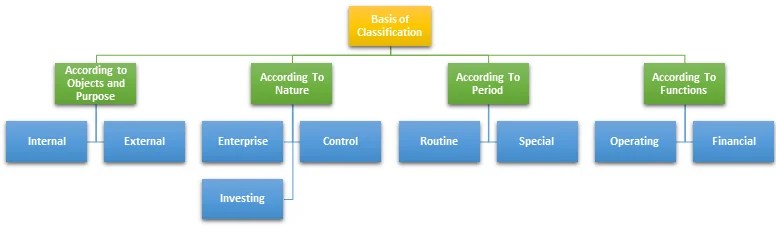
  1. Classification on the Basis of Object and Purpose:

(a) External Reports:

The reports prepared for external users or for the persons outside the business are known as external reports. External users may include shareholders, investors, creditors, suppliers and bankers. Though company may not be answerable to outsiders but still some reports are meant for outsiders.

The company publishes income statement and balance sheet at the end of every financial year and these statements are filed with the Registrar of companies and stock exchanges. Final statements of accounts are expected to conform to certain basic details in India Companies Act 1956 has made it obligatory to disclose some minimum information in final accounts. Following is an instance of Balance

(b) Internal Reports:

Internal reports refers to those reports which are meant for different level of management. Internal reports are not public documents and they are not expected to conform to any standards. These reports are prepared by keeping in view the needs of disposal for scanning them.

These reports may be meant for top level, middle level and lower level. The report meant for different levels of management may be regarded as internal reports. The frequency of these reports vary in accordance with purpose they serve.

Some of the internal reports that are commonly used are! Period report about profit and loss account and financial position, statement of cash flow, changes in working capital, report about cost of production, production trends and utilization of capacity.Labour turnover reports, material utilization reports, periodic reports on sales, credit collection periods and selling and distribution expenses, report on stock position etc.

2. Classification on the Basis of Nature:

According to nature, reports can be classified into three categories:

(a) Enterprise Reports:

These reports are prepared for the concern as a whole. These reports serve as a channel of communication with outsiders. Enterprise reports may concern all activities of the enterprise or may be related to different activities. Enterprise reports may include balance sheet, income statement, income tax returns, employment report, chairman’s report.

These reports contain standardized information and are beneficial to outsiders. The interpretation of financial statement can also be undertaken from these reports. The reports are important from financial analysis point of view. For instance following is chairman’s report presented by ShashiRuia Chairman of Essar Steel Ltd. reproduced for information:

Chairman’s Statement:

Dear Shareholder,

It is now well accepted by economic pundits and studies conducted across the globe that India and China will dominate the world economy in the 21st century. India is today the fourth largest economy in terms of purchasing power parity and is expected to overtake Japan and become third largest economic power after the United States of America and China, before the end of the decade. As India prepares to become an economic super power, it must further quicken the pace of reform and liaberalization by enabling the development of world class infrastructure, competitive manufacturing in scale and technology and sustainable development.

GDP growth of over 6.5% significant investments in infrastructure, a good agricultural output and a spurt in consumer demand across all sectors augurs for industry. If we are able to achieve a GDP growth of 8% annually, India will be the fastest growing free market democracy in the world.

Steel the backbone of Industry:

The steel industry is crucial to a nation’s economic competitiveness and security. Steel is integral to building of bridges, railroads, homes, automobiles, appliances and much more. Today’s steels are radically different than what was available ten years ago. They are lighter, higher in strength and more versatile.

The industry has undergone a major transformation in the last few years with companies investing in new process and product technologies, capacity enhancements and customer service initiatives. Indian steel companies are at the ‘leading edge’ of technology and spend considerable amounts on research and development.

The industry and particularly your company are able to compete internationally on technology, quality and price and have demonstrated that the India of tomorrow belongs to Indian entrepreneurs and Indian consumers. The Government needs to encourage and support the industry with a more realistic iron ore policy that creates level playing field.

Essar Steel- an eventful year:

Essar Steel’s excellent results demonstrate the company’s success in structurally improving its operating performance as a result of strategic actions and timely execution of projects. We have seen some signs of over-supply in international markets, but we do not see this as a long term issue. Your company is also much better prepared to manage cyclically in markets due to its geographic coverage and product portfolio.

Essar Steel is now a fully integrated producer with end-to-end control of all operations related to steel making. The acquisition of Hy-Grade Pellets Ltd. and Steel Corporation of Gujarat Ltd. make your company a totally integrated steel producer. The company has taken a number of initiatives in its manufacturing facilities to fulfill its mission of being one of the most cost efficient producers of steel globally.

From Bailadilla- where the iron ore beneficiation plant is located, close to the iron mines- to the final stage where the end products are dispatched to domestic and international destinations, your company has ensured that every stage of manufacture is seamlessly integrated. This will enable us to offer high quality, customized products for use by wide range of industries such as automobile and auto components, white goods, construction and consumer durables.

We focus on value addition at every stage of manufacture and also direct our efforts to high revenue generating markets. We do this by targeted marketing in specialized customer segments and technical and aftermarket support. We expect these value added products to contribute over 35% of the company’s revenues in the coming year.

Looking Ahead:

Currently we are producing at a capacity of 3 million tonnes and we have planned to augment this to 4.6 million tonnes by June 2006, making us the largest producer of flat steel in the private sector in India. This will involve an incremental investment ofRs 2000 crore, which is much below industry average and will considerably reduce our cost of production. We also plan to increase the pellet making capacity at Visakhapatnam from 4 to 8 million tonnes in this fiscal year.

The acquisitions, capacity expansions, technology upgradation and other productivity improvement measures will give you company a significant competitive edge in domestic and international markets. Our thrust on maintaining cost leadership through integrated manufacturing processes, research and new innovation and high productivity will provide a hedge against cyclically.

Managing Financial Turnaround:

Your company has been able to build a platform for consolidation and sustain the rejuvenation of its performance. In October 2002, at the time of the announcement of the CDR package, the Company had a term debt of? 5371 crore, which has been reduced to Rs 4262 crore as at March 31, 2005, a reduction of over Rs 1100 crore. The significant financial turnaround by the Company in such a short period of time is indeed noteworthy. With all other parameters of financial performance showing considerable improvement, your company is in a much stronger position to plan for more aggressive growth.

Our Driving Force:

Essar Steel is today at a significant point in its history. The past has given us learning’s that we have used to build a platform of security from the future. I must acknowledge the tremendous efforts put in by employees at all levels, who have to admirably risen to the challenges that change inevitably brings. Organizations must continuously change in order to survive and prosper. The Essar family has shown the capability and resilience to manage this change. We look to the future with confidence that arises out of our actions and the achievements of our people, as we prepare to face the “Brave New World”.

I also take this opportunity to thank our customers, vendors, business associates and bankers who have helped us come this far and look forward to their continued support in our journey to globalization.

Thank You.

ShashiRuia Chairman

(b) Control Reports:

Control reports deal with two aspects. One aspect relates to the personal performance and the other aspect deals with the economic performance. The first type of reports are prepared and reported to judge performance of managers and heads of various responsibility centres with what performance should have been under the prevailing circumstances.

The reasons for deviations in performance are also identified. The second type of reports shows how well the responsibility centre has fared as an economic activity. Such analysis is made periodically. This type of analysis requires the use of full cost accounting rather than responsibility accounting.

Control reports should consider the following:

(i) Control reports should be related to personal responsibility.

(ii) They should compare actual performance with the standards.

(iii) They should highlight significant information.

(iv) These reports should be sent at a proper time as to enable taking corrective measures.

(v) If possible various accounting ratios like, capacity, efficiency, activity and calendar ratios may be calculated.

(c) Investigating Reports:

These reports are linked with control reports. In case some serious problem arises then the causes of this situation are studied and analyzed, investigative reports are based on outcome of special solution studies. These reports are intermittent and are prepared only when a situation arises. They are prepared according to the nature of every situation. They are helpful to the management in analyzing the causes of some problem.

Example of Investigating Report:

The following information is available from monthly cost report of M/s Hard Engineering Co.:—

3. Classification on the Basis of Period:

According to the period repots can be classified as under:

(a) Routine Reports:

These reports are prepared about day to day working of the concern. They are periodically sent to various levels of management. These persons may differ according to the nature of information about details to be reported so far as the timing is concerned they may be sent daily, weekly, monthly or quarterly.

Routine reports may relate to sales information, production figures, capital expenditures, purchases of raw materials, market trends etc. There is a tendency to ignore routine reports by all recipients because of their routine nature. Important information in the report should be high-lighted or presented in a different way or may be written in a different ink.

Example of two routine reports are:

  1. Statement of Production
  2. Statement of Expenses

(b) Special Reports:

The management may confront some difficulties and routine report may not give sufficient information to tackle such situations. Under such circumstances, special reports are called for. Special reports are required for special purposes only.

These reports are prepared according to the need of situation. Available accounting information may not be sufficient, so data may have to be specially collected. There may be need to put extra staff for compiling these reports. It may also involve co-ordination of different departments and different levels of management. According to J. Batty33 special reports should be divided into sections each covering the following main purposes: 1. Reason for the report 2. Investigation made 3. Finding a conclusion and recommendations.

Special reports may deal with following topics:

(i) Information about market analysis and methods of distribution of competitors.

(ii) Technological changes in industry.

(iii) Problems about the purchase of materials.

(iv) Reports about change in methods of production and their implications.

(v) Trade association matters.

(vi) Report by secretary on company matters.

(vii) Political development at home and abroad having impact on business.

(ix) Report effect of idle capacity on cost of production.

(x) Make or buy decisions.

(xi) Report most suitable method of raising funds.

(xii) The effect of labour disputes on production and cost of production.

(xiii) Report on general economic forecast.

(xiv) Feasibility study for a project.

(xv) Report on effect of change in Government Policy.

4. Classification of Reports on the Basis of Functions:

According to function the reports may be divided into two categories:

(a) Operating Reports

(b) Financial Reports

(a) Operating Reports:

These reports provide information about operations of the concern.

The operating reports may consist of the following:

(i) Control Reports:

These reports are used for management control purposes. They are intended to spot deviations from budgeted performance without loss of time so that corrective action can be taken. Control reports are also used to assess the performance of individuals.

(ii) Information Reports:

These reports are prepared to provide useful information which will enable planning and policy formation for future. Information reports can take the form of trend reports and analytical reports. Trend reports provide information in comparative form over a period of time. Graphic presentation can be effectively used in trend reports. As opposed to trend reports, analytical reports provide information in a classified manner about composition of certain results so that one can identify specific factors in the overall total.

(b) Financial Reports:

These reports provide information about the financial position of the concern on specific dates or movement of finances during a specific period. The Balance Sheet provides information about a concern on a specific date. On the other hand Cash Flow Statement provides data about the movement of cash during a particular period. These reports can be either static or dynamic. Balance Sheet and other subsidiary reports are examples of static reports; Cash Flow, Fund Flow Statements and other reports showing financial position as compared to the budgeted are examples of dynamic reports.

Limitations of Cash Flow Statement

  • A Cash Flow Statement only reveals the inflow and outflow of cash. The cash balance disclosed by this statement may not depict the true liquid position. There are controversies over a number of items like Cheques, stamps, postal orders etc. to be included in cash.
  • A Cash Flow Statement cannot be equated with the income statement. An income statement takes into account both cash and non-cash items. Hence Cash Fund does not mean net income of the business.
  • Working Capital being a wider concept of funds, a funds flow statement presents a more complete picture than cash flow statement.
  • Fails to Present Net Profit: The cash flow statement fails to present the net income of a firm for the period as it ignores non-cash items which are considered by Profit and Loss Statement. The cash flow statement does not help to assess profitability as it neither considers cost nor revenues. However, it can be used as a supplement to the income statement.
  • Not a substitute to Funds Flow Statement or Income Statement: The functions which are performed by funds flow statement or income statement cannot be done by cash flow statement.
  • Industry Comparison not possible: As the cash flow statement does not measure the efficiency of the firm, intercomparison with other inter-industry is not possible. A firm having less capital investment shall have less cash flow than the firm which more capital investment resulting in higher cash flows.
  • Does not Properly Assess Liquidity position: In a practical scenario, the cash flow statement does not assess liquidity or solvency position of the firm as it presents cash position only on a particular date. It only helps to know what amount of obligation can be met. In nutshell, it does not represent the real liquidity position.
  • It does not give complete picture of the financial position of the business concern.
  • The preparation of cash flow statement is only postmortem analysis. There is no projection of cash in future in this method.
  • It is not a substitute of Income Statement.
  • The accuracy of cash flow statement is based on the balance sheet. If balance sheet is wrong, the cash flow statement is also wrong.
  • It is not prepared on the basic accounting concept of accrual basis. Hence, the accuracy of cash flow statement is questionable.
  • It is not suitable for judging the profitability of a firm as non-cash items are not included in the calculation of cash flow from operating activities.

Uses of Cash Flow Statement

The purpose of the cash flow statement is to show where an entities cash is being generated (cash inflows), and where its cash is being spent (cash outflows), over a specific period of time (usually quarterly and annually). It is important for analyzing the liquidity and long term solvency of a company.

The cash flow statement uses cash basis accounting instead of accrual basis accounting which is used for the balance sheet and income statement by most companies. This is important because a company may accrue accounting revenues but may not actually receive the cash. This could produce profits and taxes payable but not provide the resources to stay solvent.

Cash Flow Statement Components

The cash flow statement components provide a detailed view of cash flow from operations, investing, and financing:

Cash Flow from Operating Activities

The net amount of cash coming in or leaving from the day to day business operations of an entity is called Cash Flow from Operations. Basically it is the operating income plus non-cash items such as depreciation added. Since accounting profits are reduced by non-cash items (i.e. depreciation and amortization) they must be added back to accounting profits to calculate cash flow.

Cash flow from operations is an important measurement because it tells the analyst about the viability of an entities current business plan and operations. In the long run, cash flow from operations must be cash inflows in order for an entity to be solvent and provide for the normal outflows from investing and finance activities.

Cash Flow from Investing Activities

Cash flow from investing activities would include the outflow of cash for long term assets such as land, buildings, equipment, etc., and the inflows from the sale of assets, businesses, securities, etc. Most cash flow investing activities are cash out flows because most entities make long term investments for operations and future growth.

Cash Flow from Finance Activities

Cash flow from finance activities is the cash out flow to the entities investors (i.e. interest to bondholders) and shareholders (i.e. dividends and stock buybacks) and cash inflows from sales of bonds or issuance of stock equity. Most cash flow finance activities are cash outflows since most entities only issue bonds and stocks occasionally.

Main uses of cash flow statement.

  • Since a cash flow statement is based on the cash basis of accounting, it is very useful in the evaluation of cash position of a firm.
  • A projected cash flow statement can be prepared in order to know the future cash position of a concern so as to enable a firm to plan and coordinate its financial operations properly. By preparing this statement, a firm can come to know as to how much cash will be generated into the firm and how much cash will be needed to make various payments and hence the firm can well plan to arrange for the future requirements of cash.
  • A comparison of the historical and projected cash flow statements can be made so as to find the variations and deficiency or otherwise in the performance so as to enable the firm to take immediate and effective action.
  • A series of intra-firm and inter-firm cash flow statements reveals whether the firm’s liquidity (short-term paying capacity) is improving or deteriorating over a period of time and in comparison to other firms over a given period of time.
  • Cash flow statement helps in planning the repayment of loans, replacement of fixed assets and other similar long-term planning of cash. It is also significant for capital budgeting decisions.
  • It better explains the causes for poor cash position in spite of substantial profits in a firm by throwing light on various applications of cash made by the firm. It further helps in answering some intricate questions like -what happened to the net profits? Where did the profits go? Why more dividends could not be paid in spite of sufficient available profit?
  • Cash flow analysis is more useful and appropriate than funds flow analysis for short-term financial analysis as in a very short period it is cash which is more elevant then the working capital for forecasting the ability of the firm to meet its immediate obligations.
  • Cash flow statement prepared according to AS-3 (Revised) is more suitable for making comparisons than the funds flow statement as there is no standard format used for the same.
  • Cash flow statement provides information of all activities classified under operating, investing and financing activities. The funds statement even when prepared on cash basis, did not disclose cash flows from such activities separately. Thus, cash flow statement is more useful than the funds statement.
error: Content is protected !!