Strategy, Definition, Meaning and Features, Types

Strategy is a comprehensive plan formulated by an organization to achieve its long-term goals and gain a competitive advantage. It involves setting objectives, analyzing internal and external environments, allocating resources, and implementing actions to meet business goals effectively. Strategy provides direction and guides decision-making to respond to dynamic market conditions. It integrates organizational strengths with opportunities, while minimizing threats and overcoming weaknesses. Strategic management includes formulating, implementing, and evaluating strategies. Overall, strategy is crucial for aligning the organization’s mission with its environment, ensuring sustainability, profitability, and growth in a competitive business landscape.

Definition of Strategy:

  • Alfred D. Chandler (1962)

“Strategy is the determination of the basic long-term goals and objectives of an enterprise, and the adoption of courses of action and the allocation of resources necessary for carrying out these goals.”

  • Michael E. Porter (1980)

“Strategy is the creation of a unique and valuable position, involving a different set of activities.”

  • Igor Ansoff (1965)

“Strategy is a rule for making decisions determined by product-market scope, growth vector, competitive advantage, synergy, and resource allocation.”

  • Henry Mintzberg (1994)

“Strategy is a pattern in a stream of decisions.”
(He also proposed the 5 Ps of strategy: Plan, Ploy, Pattern, Position, and Perspective.)

  • William F. Glueck (1980)

“Strategy is a unified, comprehensive, and integrated plan designed to ensure that the basic objectives of the enterprise are achieved.”

  • The Oxford Dictionary of Business (2002)

“Strategy is a plan of action designed to achieve a long-term or overall aim.”

Features of Strategy:

  • Long-Term Orientation

Strategy is fundamentally long-term in nature. It focuses on setting and achieving goals that may span several years, guiding an organization toward sustained growth and competitive advantage. Unlike operational decisions, which are short-term and tactical, strategy aims to shape the future by preparing the organization to deal with changes in the external environment. It influences the direction of the company by setting priorities and allocating resources accordingly. Strategic thinking considers trends, uncertainties, and risks, ensuring the organization’s relevance, survival, and success over time. This long-term view helps in making informed decisions for future sustainability.

  • Direction and Scope

Strategy provides a clear direction and defines the scope of an organization’s activities. It answers the fundamental questions: What business are we in? Where do we want to go? And how will we get there? By identifying specific markets, products, services, and customer segments, strategy aligns the organization’s efforts toward common objectives. It ensures that all departments and units work toward a unified vision. This clarity in direction and scope enables efficient use of resources, facilitates performance tracking, and enhances decision-making across all levels of the organization.

  • Competitive Advantage

One of the key features of strategy is to help an organization achieve and sustain competitive advantage. This involves creating a unique position in the marketplace that allows the business to outperform competitors. It may be achieved through cost leadership, differentiation, or focus strategies. A sound strategy identifies an organization’s core competencies and matches them with market needs in a way that is difficult for competitors to replicate. Competitive advantage leads to higher customer loyalty, increased market share, and improved profitability, thus playing a vital role in long-term success.

  • Environmentally Oriented

Strategy is developed with a strong focus on the external environment, including economic, political, social, technological, legal, and environmental (PESTLE) factors. Strategic planning involves continuous environmental scanning to identify opportunities and threats. By understanding market dynamics, customer preferences, industry trends, and competitor behavior, organizations can craft strategies that are proactive and adaptive. This environmental orientation helps in mitigating risks and exploiting opportunities, ensuring that the organization remains agile and resilient in a rapidly changing business landscape.

  • Integration and Coordination

A good strategy integrates various functions and coordinates activities across the organization. It unifies departments such as marketing, finance, operations, and human resources under a common framework. This ensures that all parts of the organization are aligned and moving toward the same strategic goals. Integration fosters synergy, enhances communication, eliminates redundancy, and promotes efficient use of resources. Strategic management thus bridges the gap between different levels of the organization, enabling better control, execution, and achievement of objectives.

  • Dynamic and Flexible

Strategy is not rigid; it is dynamic and flexible to accommodate changes in the internal and external environment. Businesses operate in unpredictable markets where trends, customer expectations, regulations, and technologies constantly evolve. A successful strategy must be reviewed and revised regularly to remain relevant and effective. Flexibility allows an organization to adapt to unexpected challenges or capitalize on emerging opportunities. This feature of adaptability helps in sustaining long-term performance and competitiveness, especially in volatile or uncertain business conditions.

Types of Strategy:

1. Corporate-Level Strategy

Corporate-level strategy is concerned with the overall direction and scope of an organisation. It is formulated by top-level management and determines which businesses or industries the organisation should enter, continue, expand, or exit. Major strategies include growth, stability, retrenchment, and combination strategies. It also involves decisions regarding diversification, mergers, acquisitions, and allocation of resources among different business units. Corporate strategy focuses on achieving long-term organisational objectives and creating value for stakeholders. Large organisations with multiple products or businesses use corporate-level strategies to manage their overall portfolio effectively. Thus, it provides the broad strategic framework for the entire organisation.

2. Business-Level Strategy

Business-level strategy focuses on how an organisation competes successfully within a particular industry or market. It is generally developed by business-unit managers and translates corporate objectives into competitive actions. The major approaches include cost leadership, differentiation, and focus strategy. The strategy considers customers, competitors, market conditions, product positioning, and organisational capabilities. Its primary objective is to achieve competitive advantage and satisfy customer needs better than competitors. Business-level strategy helps an organisation decide how to compete, what value to offer customers, and how to strengthen its market position within a specific business or industry.

3. Functional-Level Strategy

Functional-level strategy is developed for individual functional areas such as marketing, finance, human resources, production, and research and development. It supports the successful implementation of business-level and corporate-level strategies. Functional managers formulate specific plans regarding resource utilisation, operational efficiency, employee development, production processes, promotion, and financial management. For example, a marketing strategy may focus on branding and customer acquisition, while an HR strategy may focus on recruitment and training. The main purpose is to improve functional efficiency and coordination. Effective functional strategies ensure that departmental activities contribute consistently to the organisation’s broader strategic objectives.

4. Operational-Level Strategy

Operational-level strategy focuses on the day-to-day activities and processes required to implement higher-level strategies. It is generally formulated by operational managers and supervisors. It deals with areas such as production schedules, inventory management, quality control, customer service, workflow, and resource utilisation. The objective is to achieve operational efficiency, productivity, quality, and cost control. Operational strategies convert broader strategic plans into specific actions and procedures. Their success depends on effective coordination, monitoring, and timely decision-making. By improving routine activities and processes, operational-level strategy helps an organisation achieve its short-term targets while supporting its long-term strategic objectives.

Corporate Social Responsibility (CSR), Components, Importance, Stakeholders

Corporate Social Responsibility (CSR) refers to the ethical obligation of companies to contribute positively to society beyond their financial interests. It is a business model in which companies integrate social, environmental, and ethical concerns into their operations, decision-making processes, and interactions with stakeholders, such as employees, customers, investors, and communities. CSR is based on the idea that businesses should not only focus on generating profits but also consider their impact on society and the environment.

The concept of CSR has evolved from a simple philanthropic activity to a comprehensive approach where businesses strive to be responsible corporate citizens. Today, CSR encompasses a wide range of activities aimed at enhancing the well-being of communities, reducing environmental harm, promoting fair labor practices, and ensuring ethical business practices.

Components of CSR

  • Environmental Responsibility:

A significant component of CSR is the responsibility of companies to reduce their environmental footprint. This includes efforts to reduce pollution, conserve natural resources, manage waste, promote sustainable practices, and minimize the ecological impact of their operations. Many companies implement practices such as reducing carbon emissions, using renewable energy, recycling materials, and adopting sustainable sourcing practices to contribute positively to environmental protection.

  • Social Responsibility:

CSR also involves a company’s commitment to society and its people. Social responsibility focuses on improving the quality of life of employees, customers, and communities. This could include providing fair wages, promoting diversity and inclusion, supporting local community projects, and ensuring access to education and healthcare. Social responsibility is about companies engaging in ethical practices that benefit society at large.

  • Economic Responsibility:

CSR extends to ethical business practices, such as ensuring fair trade, avoiding corruption, and providing fair wages to employees. Economic responsibility also involves transparency in financial reporting, paying taxes, and fostering economic development through innovation and job creation. Companies are expected to generate profit in a manner that is ethical, fair, and sustainable for all stakeholders.

  • Ethical Responsibility:

Ethical responsibility in CSR involves conducting business in an honest, transparent, and fair manner. This includes ensuring that products and services are safe, treating employees and customers with respect, and adhering to legal and moral standards. It is also about ensuring that the company’s practices do not harm individuals or communities and that they operate with integrity.

  • Philanthropy:

Many companies engage in philanthropic activities such as charitable donations, volunteering, and sponsoring community development initiatives. While this is just one aspect of CSR, it plays a key role in improving the social and economic well-being of the communities where businesses operate.

  • Stakeholder Engagement:

A key element of CSR is maintaining good relationships with all stakeholders, including employees, customers, suppliers, investors, and local communities. By engaging stakeholders and addressing their concerns, companies can better understand societal expectations and improve their CSR strategies.

Importance of CSR:

  • Building Brand Reputation and Trust:

Companies that actively engage in CSR build a strong reputation as responsible corporate citizens. This enhances their brand image and fosters trust among consumers, investors, and other stakeholders. A positive reputation can lead to increased customer loyalty, improved employee morale, and better relationships with government and regulatory bodies.

  • Attracting and Retaining Talent:

Today’s workforce is increasingly attracted to companies that align with their values. Companies with strong CSR practices are more likely to attract top talent who want to work for organizations that are committed to making a positive impact. Employees who feel that their employer is socially responsible are also more likely to stay with the company long-term, leading to lower turnover rates.

  • Customer Loyalty:

Consumers are becoming more socially conscious and prefer to purchase from companies that share their values and demonstrate a commitment to social and environmental responsibility. CSR initiatives such as ethical sourcing, fair trade, and environmental sustainability can lead to greater customer loyalty and support for a company’s products and services.

  • Financial Performance:

Contrary to the belief that CSR is a financial burden, many studies have shown that companies that invest in CSR programs can achieve better financial performance over time. Engaging in ethical and socially responsible practices can lead to cost savings (e.g., through energy efficiency and waste reduction), enhanced brand value, and increased consumer demand.

  • Risk Management:

CSR can help companies mitigate risks related to their operations. By addressing social and environmental concerns, companies can avoid negative publicity, fines, and legal challenges. Proactively managing CSR helps businesses avoid potential controversies that could damage their reputation and harm their financial stability.

  • Sustainable Development:

CSR plays a crucial role in promoting sustainable development. By taking a long-term view of their impact on society and the environment, companies can contribute to sustainable economic development. CSR initiatives such as promoting renewable energy, reducing waste, and improving labor standards all support the global goal of sustainability.

CSR and Its Stakeholders:

  • Employees:

A company’s commitment to CSR enhances employee morale and job satisfaction. Employees tend to feel proud to work for an organization that is socially responsible and committed to ethical practices. CSR programs can also offer employees opportunities for personal involvement, such as volunteer work or engagement in community initiatives.

  • Customers:

Customers are increasingly seeking products and services that are produced ethically and sustainably. Companies that prioritize CSR are likely to attract socially conscious consumers who care about the origins and environmental impact of the products they purchase. CSR initiatives enhance customer loyalty and retention.

  • Shareholders and Investors:

Investors are placing greater emphasis on companies that adopt CSR practices. Many institutional investors look for businesses that not only promise financial returns but also adhere to environmental, social, and governance (ESG) principles. A strong CSR program can make a company more attractive to investors, leading to increased funding and support.

  • Communities:

CSR helps to improve the social and economic conditions of the communities where a company operates. Whether through donations, community development programs, or local environmental initiatives, businesses can directly contribute to improving the standard of living and well-being in the regions they serve.

  • Government and Regulatory Bodies:

Governments are increasingly requiring businesses to adhere to CSR-related regulations, especially in areas like environmental protection, labor rights, and corporate governance. Companies that proactively adopt CSR policies can reduce their exposure to regulatory risks and improve their relationship with government bodies.

Applicability of CSR as per Section 135 of Companies Act 2013:

Section 135 of the Companies Act, 2013 mandates Corporate Social Responsibility (CSR) for companies meeting specific financial thresholds. The provision applies to every company, including its holding or subsidiary and foreign companies having a branch office or project office in India, that satisfies any one of the following criteria in the immediately preceding financial year:

✅ Applicability Criteria (Any one of the following):

  1. Net worth of ₹500 crore or more,

  2. Turnover of ₹1,000 crore or more, or

  3. Net profit of ₹5 crore or more.

Requirements for Applicable Companies

  1. CSR Committee:
    Companies to whom CSR is applicable must constitute a CSR Committee of the Board with:

    • At least 3 directors (including 1 independent director),

    • (Private companies need only 2 directors; unlisted/public companies with no independent director are exempt from appointing one).

  2. CSR Policy:
    The CSR Committee shall:

    • Formulate and recommend a CSR Policy to the Board,

    • Recommend the amount of expenditure,

    • Monitor the CSR policy implementation.

  3. Minimum CSR Expenditure:
    The Board must ensure that the company spends at least 2% of the average net profits (before tax) made during the three immediately preceding financial years on CSR activities.

  4. Disclosure:

CSR policy and initiatives must be disclosed in the Board’s report and on the company website, if any.

CSR Activities (Schedule VII)

CSR initiatives must fall under activities specified in Schedule VII, such as:

  • Eradicating hunger and poverty,

  • Promoting education and gender equality,

  • Environmental sustainability,

  • Protection of national heritage,

  • Support to armed forces veterans,

  • PM’s National Relief Fund, etc.

Penalty for Non-Compliance (Post Amendment):

As per the Companies (Amendment) Act, 2019:

  • If the required amount is not spent, the company must transfer the unspent amount to a specified fund (like PM CARES) within a stipulated time.

  • Non-compliance attracts penalty:

    • Company: Twice the unspent amount or ₹1 crore (whichever is less),

    • Officers in default: 1/10th of the unspent amount or ₹2 lakh (whichever is less).

Red Herring Prospectus, Concepts, Purpose, Components, Process, Contents and Importance

Red Herring Prospectus (RHP) is a preliminary document issued by a company that is planning to offer its securities (such as shares or bonds) to the public in an initial public offering (IPO) or other securities offering. The document provides important information about the company, including financial details, business operations, and risks, but it does not include the offer price or the number of securities being issued, which are typically finalized later.

The term “red herring” refers to the red ink used on the cover page of the document to highlight that the document is not the final prospectus and that certain details are yet to be finalized.

Purpose of Red Herring Prospectus

1. Providing Information to Investors

The primary purpose of a Red Herring Prospectus (RHP) is to provide prospective investors with detailed information about the company and its proposed public issue. It generally explains the company’s business, financial position, management, operations, objectives, and risks. By making relevant information available before the final issue terms are determined, the RHP helps investors understand the company and conduct their own analysis before deciding whether to participate in the public offering.

2. Promoting Transparency

An RHP promotes transparency in the public-issue process by requiring the company to disclose important information to prospective investors. Information about business operations, financial performance, management, risks, and proposed use of funds allows investors to understand the company more clearly. Transparent disclosure reduces information gaps between the company and potential investors. It also strengthens accountability and supports a more informed securities market by making material information available before the securities are offered.

3. Supporting Informed Investment Decisions

The RHP enables investors to make informed investment decisions by presenting important information about the company and the proposed issue. Investors can examine the company’s financial position, business model, industry environment, risk factors, management, and intended use of funds. This information allows investors to conduct independent evaluation before subscribing to the issue. The RHP therefore serves as an important source of preliminary information during the public-offering process.

4. Explaining Business and Operations

Another purpose of the RHP is to explain the company’s business activities and operations to prospective investors. It generally provides information about products or services, markets, business strategies, competitive conditions, industry characteristics, and significant operational factors. Such information helps investors understand how the company conducts its business and generates revenue. A clear description of operations allows investors to assess the nature of the proposed investment and identify important business-related opportunities and risks.

5. Disclosing Risk Factors

The RHP provides investors with information about risk factors associated with the company and its proposed securities issue. These may include business risks, industry risks, financial risks, regulatory risks, competitive pressures, and other material uncertainties. Disclosure of risks helps investors understand that investment decisions involve uncertainty. By presenting relevant risks before the public issue, the RHP supports greater awareness and enables investors to consider the possible implications of these risks in their independent assessment.

6. Describing Use of Issue Proceeds

An RHP explains the proposed utilization of funds raised through the public issue. The company may intend to use the proceeds for purposes such as expansion, capital expenditure, repayment of debt, working capital, acquisitions, or general corporate purposes, subject to the disclosed terms. This information helps investors understand why the company is raising capital and how the funds are expected to contribute to its activities. It also promotes accountability regarding the stated objectives of the issue.

7. Facilitating Regulatory Compliance

The RHP helps the company fulfill applicable legal and regulatory disclosure requirements associated with a public issue. Companies making public offerings must comply with relevant provisions of company law and securities regulations. Preparing and submitting the required offer document allows regulatory authorities and market participants to examine prescribed information. Compliance supports orderly functioning of the securities market and provides investors with standardized disclosures. The exact requirements depend on the applicable laws and regulations governing the particular issue.

8. Creating a Basis for the Final Issue

The RHP serves as a preliminary offer document that provides the foundation for the final prospectus or offer document. It contains substantial information about the company and the proposed securities issue, while certain final issue details may be determined later. The document allows investors to review the company before final terms are established. Once the relevant terms are finalized, the final offer document incorporates the required definitive information in accordance with applicable regulatory requirements.

Components of a Red Herring Prospectus

A Red Herring Prospectus typically includes several key sections, which help investors assess the offering, even though the final terms are still pending.

1. Company Overview

RHP provides a comprehensive overview of the company’s history, management, structure, and business model. It outlines the products or services the company offers, its competitive landscape, and its strategic plans for growth.

2. Financial Information

It includes key financial statements, such as the balance sheet, income statement, and cash flow statement, as well as financial ratios and performance metrics. This section helps investors gauge the company’s financial health, profitability, and potential risks.

3. Risk Factors

One of the most important sections, the risk factors section, outlines potential risks that investors should be aware of before purchasing securities. These risks could include industry-specific risks, regulatory risks, market competition, and financial uncertainties.

4. Use of Proceeds

This section explains how the company plans to utilize the funds raised from the offering. The funds might be used for purposes such as expansion, debt repayment, research and development, or working capital.

5. Management and Governance

RHP contains details about the company’s directors, senior executives, and their experience and qualifications. Information about corporate governance practices, including board composition and committees, is also provided.

6. Offer Details (Preliminary)

RHP includes preliminary details of the offering, such as the size of the issue and the type of securities being offered, but does not specify the final offer price or the exact number of securities. These details will be determined closer to the offering date.

7. Legal and Regulatory Disclosures

Information about the company’s legal standing, compliance with regulations, and any pending lawsuits or regulatory investigations will be disclosed in the RHP. This is crucial for investors to understand any potential legal or regulatory risks.

8. Underwriting Arrangements

The underwriting section describes the institutions or banks that will manage the offering process and whether they are acting as lead underwriters. It provides details on underwriting fees, their responsibilities, and the process of distributing the shares to the public.

Red Herring Prospectus vs. Final Prospectus

Red Herring Prospectus is not the final document that investors receive. It is part of the IPO process and is used to generate interest in the offering before all details are finalized. The final prospectus, often referred to as the Prospectus, includes all the necessary details about the offering, including the offer price and the number of securities being issued. The final prospectus is issued once the company has completed its regulatory filing and the offer details are confirmed.

Process of Issuing a Red Herring Prospectus

  • Preparation and Filing:

The company prepares a Red Herring Prospectus and files it with the regulatory authority (such as the Securities and Exchange Board of India (SEBI) in India or the U.S. Securities and Exchange Commission (SEC) in the United States). This document is made available to the public and investors before the offering.

  • Review by Regulatory Authorities:

The regulatory authorities review the RHP to ensure that all required disclosures are made and that it complies with securities laws. The company may need to make revisions based on feedback from the regulators.

  • Roadshow and Marketing:

After the regulatory approval, the company may conduct a “roadshow,” where the company’s management meets with potential institutional investors to generate interest in the offering. The RHP is typically used during these meetings to provide detailed information about the company.

  • Pricing and Final Prospectus:

After the roadshow, the company finalizes the offer price, the number of securities being issued, and other final terms. A final Prospectus is issued, which includes these finalized details, and the securities are offered to the public.

Contents of Red Herring Prospectus

1. General Information

A Red Herring Prospectus contains general information about the company and the proposed public issue. It includes the company name, registered office, corporate identity details, contact information, issue size, and details of intermediaries such as merchant bankers, registrars, and legal advisers. This information helps investors identify the issuer and understand the basic structure of the proposed offering. It provides an initial overview of the company and the securities that are intended to be offered to the public.

2. Company and Business Information

The RHP provides comprehensive information about the company’s history, business activities, products, services, industry, business model, subsidiaries, and operational activities. It may also describe the company’s competitive position, growth strategies, major markets, and important developments. This information enables investors to understand how the company generates revenue and operates within its industry. A clear description of business activities helps investors assess the nature, scope, and potential opportunities associated with the company.

3. Financial Information

The prospectus contains relevant financial information relating to the company, including historical financial statements, revenues, profits, assets, liabilities, cash flows, and other important financial indicators. Financial information allows investors to examine the company’s past performance and financial position. It may also include information about borrowings, financial ratios, and material changes in financial circumstances. Such disclosures provide investors with a basis for understanding the company’s financial condition before considering participation in the public issue.

4. Risk Factors

A major component of the RHP is the disclosure of risk factors associated with the company and the proposed investment. These may include business risks, industry risks, regulatory risks, financial risks, operational risks, technological risks, and market risks. The prospectus explains circumstances that may adversely affect the company’s operations, profitability, or financial position. Disclosure of these risks improves investor awareness and helps investors understand the uncertainties involved in purchasing the securities offered through the public issue.

5. Objects of the Issue

The RHP explains the objects or purposes for which the company proposes to raise funds through the public issue. The proceeds may be intended for purposes such as business expansion, capital expenditure, working capital, repayment of debt, acquisitions, or other specified corporate requirements. This section helps investors understand why the company requires additional funds. It also provides information about the proposed utilisation of issue proceeds and enables investors to assess the company’s financing objectives.

6. Capital Structure

The RHP provides information regarding the company’s capital structure, including authorised, issued, subscribed, and paid-up share capital. It may disclose existing equity shares, securities issued previously, changes in share capital, and the proposed capital structure after the issue. Details regarding promoters’ holdings and other relevant ownership information may also be provided. This information helps investors understand the company’s ownership pattern, existing equity position, and the effect of the proposed public issue on its capital structure.

7. Promoters and Management

The prospectus contains information about the company’s promoters, directors, and key managerial personnel. Their names, qualifications, professional experience, positions, responsibilities, and relevant interests may be disclosed. Information concerning relationships among promoters or management personnel may also be provided where required. These disclosures help investors understand the people responsible for managing and directing the company. The background of key individuals is relevant for evaluating the company’s organisational and managerial structure.

8. Legal and Regulatory Information

The RHP includes important legal and regulatory information concerning the company. This may include details of material litigation, pending legal proceedings, regulatory actions, statutory approvals, licences, permissions, and other significant legal matters. Such information helps investors identify potential legal or regulatory issues that could influence the company’s business or financial performance. Disclosure of these matters supports transparency and enables investors to consider significant legal uncertainties before participating in the public issue.

9. Issue-Related Information

The RHP provides important information concerning the public issue and its procedures. It may include the number and type of securities offered, issue structure, bidding process, application procedures, allocation methodology, subscription details, and relevant timelines. Depending on the issue, certain price-related information may be finalised later. This section helps investors understand how the public offering will be conducted and provides practical information required for participating in the issue.

10. Material Contracts and Documents

The RHP may disclose important material contracts, agreements, financial arrangements, licences, and other significant documents associated with the company or the public issue. Certain documents may be made available for inspection by investors as prescribed under applicable regulations. These documents can provide additional information about significant commitments, obligations, and arrangements affecting the company. Their disclosure contributes to transparency and allows investors to examine important matters relevant to the proposed public offering.

Importance of Red Herring Prospectus

1. Provides Information to Investors

Red Herring Prospectus (RHP) provides investors with essential information about a company before its public issue. It generally contains details about the business, management, financial performance, capital structure, risks, and objectives of the issue. This information enables investors to understand the company and its proposed securities. By making relevant information available, the RHP helps investors examine the company’s position and make investment decisions based on disclosed facts rather than incomplete information.

2. Promotes Transparency

The RHP promotes transparency in the public issue process by requiring companies to disclose material information to potential investors. Information regarding the company’s operations, financial position, management, risks, and proposed use of funds is presented in the prospectus. Such disclosure reduces the information gap between the company and investors. Greater transparency also helps investors understand the circumstances surrounding the proposed issue and provides a clearer basis for evaluating the securities.

3. Supports Informed Investment Decisions

Investors require adequate information before purchasing securities. The RHP provides information about the company’s financial performance, business operations, growth plans, risks, and management. Investors can study these details and assess whether the proposed investment is consistent with their individual objectives and risk tolerance. Therefore, the prospectus serves as an important source of information that supports informed investment decisions and reduces dependence on rumours, advertisements, or unsupported promotional claims.

4. Discloses Risk Factors

One of the important purposes of the RHP is to disclose significant risks and uncertainties associated with the company and its securities. These may include business risks, industry competition, financial risks, regulatory risks, operational risks, and market-related risks. Presenting these risks allows investors to understand circumstances that could negatively affect the company’s performance. Proper risk disclosure improves investor awareness and helps investors consider the uncertainties associated with participating in the public issue.

5. Explains the Company’s Business

The RHP provides detailed information about the company’s business model, products, services, industry, operations, subsidiaries, markets, and strategies. This information helps potential investors understand the nature of the company’s activities and the factors affecting its revenue and performance. Investors can use these disclosures to develop a clearer understanding of the company’s operations. This is particularly useful when evaluating a company that operates in an unfamiliar industry or business segment.

6. Explains the Use of Issue Proceeds

The RHP explains the objects of the issue and how the company proposes to utilise funds raised from investors. The proceeds may be used for capital expenditure, business expansion, working capital requirements, repayment of borrowings, acquisitions, or other specified purposes. This information helps investors understand the company’s financing requirements and planned use of capital. It also provides greater clarity regarding the purpose behind raising funds through the proposed public issue.

7. Facilitates Regulatory Compliance

Preparation and filing of an RHP form an important part of the regulatory framework governing public issues. Companies are required to provide prescribed disclosures and follow applicable securities-market requirements. In India, public issues are subject to applicable regulations of the Securities and Exchange Board of India (SEBI) and other relevant legal requirements. Compliance with disclosure and procedural requirements promotes orderly functioning of the capital market and strengthens investor protection.

8. Provides a Basis for the Final Prospectus

The RHP contains substantial information about the company and the proposed public issue and serves as an important disclosure document during the issue process. Certain information, including some final issue-related details, may be incorporated or updated subsequently as required. The final prospectus contains the relevant final information for the offering. Thus, the RHP provides an important preliminary basis for communicating material information before the public issue is completed.

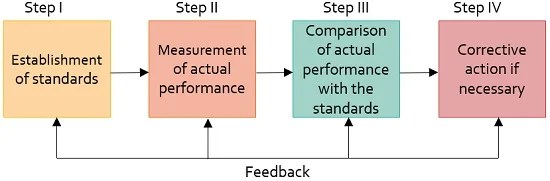
Steps in Control Process

Control in Management refers to the process of monitoring and evaluating performance against established standards and objectives. It involves setting performance benchmarks, measuring actual outcomes, comparing them with targets, and taking corrective actions as needed. The ultimate goal of control is to ensure that organizational activities align with strategic goals, thereby enhancing efficiency and effectiveness.

Control Process involves the following Steps as shown in the figure:

The control process involves several key steps:

  1. Establishing Standards

Standards serve as benchmarks for evaluating performance in business functions and are classified into two categories:

  • Measurable (Tangible) Standards: These standards are quantifiable and expressed in terms of cost, output, time, profit, etc.
  • Non-Measurable (Intangible) Standards: These cannot be quantified monetarily. Examples include manager performance, employee attitudes, and workplace morale.

Establishing these standards simplifies the control process, as control is exercised based on them.

  1. Measurement of Actual Performance

The second step is assessing actual performance levels to identify deviations from established standards. Measuring tangible standards is generally straightforward, as they can be quantified easily. However, evaluating intangible standards, such as managerial performance, can be challenging and may rely on factors like:

  • Employee attitudes
  • Workforce morale
  • Improvements in the work environment
  • Communication with superiors

Performance measurement may also be supported by various reports (weekly, monthly, quarterly, or yearly).

  1. Comparison of Actual Performance with Standards:

Comparing actual performance against planned targets is crucial. A deviation is defined as the gap between actual and planned performance. Managers need to identify two key aspects:

  • Extent of Deviation: Is the deviation positive, negative, or aligned with expectations?
  • Cause of Deviation: Understanding why deviations occurred is vital for effective management.

Managers should focus on critical deviations while overlooking minor ones. For instance, a 5-10% increase in stationery costs may be considered minor, whereas a continuous decline in monthly production signifies a major issue.

Common causes of deviations:

  • Faulty planning
  • Lack of coordination
  • Defective plan implementation
  • Ineffective supervision and communication
  1. Taking Corrective Actions

After identifying the extent and causes of deviations, managers must implement remedial measures. They have two options:

  1. Corrective Measures: Address the deviations that have already occurred.
  2. Revision of Targets: If the corrective actions do not align actual performance with planned targets, managers may choose to adjust the targets.

Controlling, Definition, Importance, Nature, Scope, Elements, Limitations

Controlling is a fundamental management function that involves monitoring organizational performance, comparing it against established standards, and taking corrective actions when necessary. It ensures that the organization’s activities align with its goals and objectives. The controlling process includes setting performance standards, measuring actual performance, and evaluating deviations from the standards. Effective controlling helps identify areas for improvement, ensures resource optimization, and enhances decision-making. By providing feedback on performance, controlling enables managers to make informed adjustments to strategies and operations, fostering efficiency and effectiveness in achieving organizational goals.

Definition of Controlling:

  • Henri Fayol:

Fayol, a pioneer in management theory, defined controlling as “the process of verifying whether everything occurs in conformities with the plan adopted, the instructions issued, and the principles established.” This emphasizes the alignment of actual performance with planned objectives.

  • George R. Terry:

Terry defined controlling as “the measurement of accomplishment against standards and the correction of deviation to ensure achievement of organizational objectives.” This highlights the evaluative aspect of controlling in relation to organizational goals.

  • Harold Koontz and Cyril O’Donnell:

They defined controlling as “the function of management which ensures that everything occurs in accordance with the standards established.” This definition stresses the importance of standards in the controlling process.

  • Peter Drucker:

Drucker defined controlling as “the process of measuring performance and taking corrective actions when necessary.” His focus is on performance measurement and the proactive nature of controlling.

  • Luther Gulick:

Gulick described controlling as “the function of management which ensures that organizational goals are met through appropriate actions.” This definition emphasizes the role of controlling in achieving organizational objectives.

  • American Management Association (AMA):

AMA defines controlling as “the process of establishing standards to achieve organizational goals, measuring actual performance against those standards, and taking corrective action when necessary.” This definition encapsulates the overall purpose of the controlling function.

  • Robert J. Mockler:

Mockler defined controlling as “the process of monitoring performance, comparing it with the established standards, and taking corrective action if necessary to ensure that the organization’s objectives are achieved.” This highlights the cyclical nature of controlling in the management process.

Importance of Controlling:

  • Ensures Goal Achievement:

The primary purpose of controlling is to ensure that organizational goals are met. By setting performance standards and measuring actual performance against these benchmarks, managers can identify deviations and take corrective actions, ensuring that the organization remains on track to achieve its objectives.

  • Enhances Efficiency:

Controlling helps to improve the efficiency of organizational processes. By monitoring operations, managers can identify bottlenecks, redundancies, and areas for improvement. This allows for the optimization of resource utilization, reducing waste and improving overall productivity.

  • Facilitates Decision-Making:

Effective controlling provides managers with relevant and timely information about performance. This information is critical for informed decision-making. Managers can analyze trends, identify problems, and evaluate the effectiveness of different strategies, enabling them to make better decisions that align with organizational goals.

  • Promotes Accountability:

Control systems establish clear expectations and performance standards for employees. This promotes accountability, as individuals are aware of the metrics against which their performance will be evaluated. When employees understand that their work is being monitored, they are more likely to take ownership of their responsibilities and strive to meet performance standards.

  • Encourages Continuous Improvement:

Controlling fosters a culture of continuous improvement within the organization. Regular performance assessments and feedback mechanisms encourage employees to seek ways to enhance their work processes, leading to innovation and higher quality outcomes. This proactive approach contributes to long-term organizational success.

  • Identifies Problems Early:

Through ongoing monitoring and evaluation, controlling enables managers to identify potential issues before they escalate into significant problems. Early detection allows for timely interventions, minimizing the impact on operations and helping to maintain organizational stability.

  • Facilitates Coordination:

Controlling ensures that different departments and teams within the organization are working harmoniously toward common goals. By monitoring interdependencies and ensuring that performance aligns with overall objectives, controlling promotes coordination and cooperation among various organizational units.

  • Provides a Basis for Future Planning:

The information gathered during the controlling process serves as valuable input for future planning. By analyzing performance data, managers can assess the effectiveness of previous strategies, identify trends, and make informed projections for the future. This alignment between past performance and future planning helps organizations remain agile and responsive to changing circumstances.

Nature of Controlling:

  • Goal-Oriented:

Controlling is fundamentally concerned with achieving organizational goals. It involves setting performance standards that align with these goals and continuously monitoring progress toward their attainment. By focusing on objectives, controlling ensures that all activities are directed towards fulfilling the organization’s mission.

  • Continuous Process:

Controlling is an ongoing process that occurs throughout the life of an organization. It involves regular monitoring and evaluation of performance, enabling managers to identify deviations and take corrective actions as needed. This continuous nature ensures that organizations remain adaptable to changes and can maintain effective performance.

  • Feedback Mechanism:

One of the critical functions of controlling is to provide feedback on performance. By comparing actual performance with established standards, managers can assess whether goals are being met. This feedback loop is essential for identifying areas for improvement and making informed decisions regarding resource allocation and operational adjustments.

  • Dynamic Function:

Controlling is not a static function; it evolves with the organization and its environment. As organizations face new challenges and opportunities, the controlling process must adapt to reflect changes in strategies, technologies, and market conditions. This dynamism ensures that controlling remains relevant and effective in guiding organizational performance.

  • Involves Decision-Making:

Controlling is closely linked to decision-making processes. Managers must analyze performance data, interpret results, and make decisions about corrective actions when performance deviates from standards. This aspect highlights the importance of analytical skills and judgment in effective controlling, as managers must be able to determine the best course of action based on performance assessments.

  • Universal Applicability:

The principles of controlling apply to all types of organizations, regardless of size or industry. Whether in manufacturing, services, or non-profit sectors, controlling is essential for ensuring that organizational activities are aligned with strategic objectives. This universality underscores the importance of controlling as a core function of management.

  • Emphasizes Efficiency and Effectiveness:

The primary aim of controlling is to enhance organizational efficiency and effectiveness. By monitoring processes and performance, organizations can optimize resource use and improve productivity. Effective controlling helps identify waste, streamline operations, and ensure that activities are conducted in the most efficient manner possible, ultimately contributing to organizational success.

Scope of Controlling:

  • Performance Measurement:

One of the primary scopes of controlling is to measure the actual performance of employees, departments, and the organization as a whole. This involves establishing performance standards and metrics, collecting data on actual performance, and comparing it with the set standards. Performance measurement provides insights into how well an organization is functioning and identifies areas that require improvement.

  • Deviation Analysis:

Controlling involves analyzing deviations between actual performance and planned performance. When discrepancies arise, managers must determine the causes of these deviations. This analysis helps in understanding whether the deviations are due to external factors, such as market conditions, or internal factors, such as operational inefficiencies. By identifying the root causes, organizations can implement corrective actions to address the issues.

  • Corrective Actions:

Based on the analysis of deviations, controlling encompasses the development and implementation of corrective actions. These actions are designed to realign actual performance with established standards and objectives. Corrective measures may include changes in processes, resource reallocation, or additional training for employees. The goal is to ensure that the organization remains on track to achieve its goals.

  • Resource Management:

Controlling plays a critical role in managing organizational resources effectively. This includes financial resources, human resources, and physical assets. By monitoring resource utilization and efficiency, managers can ensure that resources are allocated appropriately, minimizing waste and maximizing productivity. Effective resource management contributes to the overall effectiveness of the organization.

  • Budgetary Control:

A significant aspect of controlling is budgetary control, which involves monitoring the organization’s financial performance against budgeted figures. Managers use budgetary controls to assess spending, revenue generation, and profitability. By analyzing variances between budgeted and actual figures, managers can make informed financial decisions and adjust budgets as necessary to meet organizational objectives.

  • Quality Control:

Controlling also encompasses quality control measures to ensure that products and services meet established quality standards. This includes implementing processes for inspecting and testing outputs, as well as continuous improvement initiatives. Quality control helps organizations maintain high standards, enhance customer satisfaction, and reduce costs associated with defects and rework.

  • Strategic Control:

Controlling extends to strategic control, which involves monitoring the organization’s progress toward achieving its long-term goals and strategic objectives. This includes assessing the effectiveness of strategies, evaluating competitive positioning, and ensuring that the organization adapts to changing market conditions. Strategic control helps organizations remain proactive and responsive in a dynamic business environment.

Elements of Controlling:

  • Setting Performance Standards

The first step in controlling is setting clear and measurable performance standards. These standards serve as a benchmark for evaluating actual performance. They may be quantitative (e.g., sales targets, production levels) or qualitative (e.g., customer satisfaction, employee engagement). Performance standards should be realistic, achievable, and aligned with organizational goals.

  • Measuring Actual Performance

Once performance standards are set, it is essential to measure actual performance. This involves collecting data, tracking results, and monitoring activities to evaluate whether targets are being met. The methods of measurement can vary, such as financial reports, production logs, or customer feedback, depending on the nature of the performance standards.

  • Comparing Actual Performance with Standards

After measuring actual performance, it is compared with the established performance standards. This step helps identify any variances between planned and actual outcomes. If the actual performance exceeds or meets the standards, it indicates success. If there is a shortfall, corrective actions will be needed to bring performance in line with the targets.

  • Analyzing Deviations

When deviations from the set standards are identified, it is important to analyze the causes. These deviations may occur due to various factors such as external influences (market changes, economic conditions), internal inefficiencies (lack of resources, poor management), or human factors (motivation, skills). A thorough analysis of the reasons behind the deviations helps in deciding the appropriate corrective measures.

  • Taking Corrective Actions

Once the reasons for deviations are analyzed, corrective actions should be taken. These actions aim to eliminate the causes of deviations and bring performance back on track. Corrective actions can involve adjusting strategies, reallocating resources, modifying processes, or enhancing employee training. The effectiveness of corrective actions should also be monitored to ensure continuous improvement.

  • Feedback and Adjustments

The final element of controlling is the feedback loop. After taking corrective actions, it’s crucial to gather feedback to assess their effectiveness. Based on feedback, further adjustments may be needed. Continuous monitoring and adjustment ensure that performance standards are kept relevant and that the organization stays on course to achieve its objectives.

Limitations of Controlling:

  • Inflexibility:

Controlling can lead to rigidity in an organization. Overemphasis on control mechanisms may result in inflexible procedures, stifling creativity and innovation. Employees may feel constrained by strict guidelines and metrics, which can hinder their ability to adapt to changing circumstances or propose new ideas.

  • Costly Process:

Implementing a comprehensive control system can be expensive. The costs associated with setting up control measures, monitoring performance, and conducting audits can strain organizational resources. Small businesses, in particular, may find it challenging to allocate sufficient funds for effective control systems.

  • Time-Consuming:

The controlling process can be time-consuming. Collecting data, analyzing performance, and implementing corrective actions require considerable time and effort from managers and employees. This time investment may distract from other critical activities and delay decision-making processes.

  • Subjectivity in Evaluation:

Controlling often involves subjective judgment in performance evaluation. Managers may rely on their interpretations of data, which can lead to bias and inconsistencies in assessing employee performance. This subjectivity can create misunderstandings, conflicts, and decreased morale among staff.

  • Limited Scope:

Control systems may focus primarily on quantitative measures, neglecting qualitative factors such as employee satisfaction, teamwork, and organizational culture. A narrow focus on numbers can overlook important aspects of performance that contribute to overall success.

  • Resistance to Control:

Employees may resist control measures due to perceived threats to their autonomy and job security. This resistance can result in a lack of cooperation, reduced morale, and a negative organizational climate. Overly strict control measures can lead to disengagement and decreased productivity among staff.

  • Delayed Feedback:

In some cases, feedback from control systems may be delayed, making it challenging to address issues promptly. If performance data is not available in real-time, managers may miss opportunities to make timely corrections, allowing problems to escalate.

  • Overreliance on Control Systems:

Organizations may become overly dependent on control systems, leading to a lack of initiative and accountability among employees. When individuals feel that their work is constantly monitored, they may become less proactive and less willing to take risks, ultimately affecting overall performance.

Determinants of an Effective Control System

Control System in management refers to the processes and mechanisms used by managers to ensure that an organization’s activities align with its goals and objectives. It involves setting performance standards, measuring actual performance, comparing it with established standards, and taking corrective actions when necessary. Control systems help monitor efficiency, ensure quality, and address deviations from plans. They can be applied across various areas, such as finance, production, and human resources, to maintain consistency and achieve organizational targets. A well-designed control system contributes to improved decision-making, accountability, and continuous improvement within the organization.

Prerequisites of Effective Control System

  • Accuracy

Effective controls generate accurate data and information. Accurate information is essential for effective managerial decisions. Inaccurate controls would divert management efforts and energies on problems that do not exist or have a low priority and would fail to alert managers to serious problems that do require attention.

  • 2. Timeliness

There are many problems that require immediate attention. If information about such problems does not reach management in a timely manner, then such information may become useless and damage may occur. Accordingly controls must ensure that information reaches the decision makers when they need it so that a meaningful response can follow.

  • Flexibility

The business and economic environment is highly dynamic in nature. Technological changes occur very fast. A rigid control system would not be suitable for a changing environment. These changes highlight the need for flexibility in planning as well as in control.

Strategic planning must allow for adjustments for unanticipated threats and opportunities. Similarly, managers must make modifications in controlling methods, techniques and systems as they become necessary. An effective control system is one that can be updated quickly as the need arises.

  • Acceptability

Controls should be such that all people who are affected by it are able to understand them fully and accept them. A control system that is difficult to understand can cause unnecessary mistakes and frustration and may be resented by workers.

Accordingly, employees must agree that such controls are necessary and appropriate and will not have any negative effects on their efforts to achieve their personal as well as organizational goals.

  • Integration

When the controls are consistent with corporate values and culture, they work in harmony with organizational policies and hence are easier to enforce. These controls become an integrated part of the organizational environment and thus become effective.

  • Economic feasibility

The cost of a control system must be balanced against its benefits. The system must be economically feasible and reasonable to operate. For example, a high security system to safeguard nuclear secrets may be justified but the same system to safeguard office supplies in a store would not be economically justified. Accordingly the benefits received must outweigh the cost of implementing a control system.

  • Strategic placement

Effective controls should be placed and emphasized at such critical and strategic control points where failures cannot be tolerated and where time and money costs of failures are greatest.

The objective is to apply controls to the essential aspect of a business where a deviation from the expected standards will do the greatest harm. These control areas include production, sales, finance and customer service.

  • Corrective action

An effective control system not only checks for and identifies deviation but also is programmed to suggest solutions to correct such a deviation. For example, a computer keeping a record of inventories can be programmed to establish “if-then” guidelines. For example, if inventory of a particular item drops below five percent of maximum inventory at hand, then the computer will signal for replenishment for such items.

  • Emphasis on exception

A good system of control should work on the exception principle, so that only important deviations are brought to the attention of management, In other words, management does not have to bother with activities that are running smoothly. This will ensure that managerial attention is directed towards error and not towards conformity. This would eliminate unnecessary and uneconomic supervision, marginally beneficial reporting and a waste of managerial time.

Management by Exception (MBE), Steps, Advantages and Limitations

Management by Exception (MBE) is a management approach where leaders focus on significant deviations from set standards or expected outcomes, rather than on routine operations. Managers intervene only when performance significantly deviates from targets, either exceeding or falling short of expectations. This allows them to concentrate on critical issues that require attention, while routine matters are handled by subordinates. MBE improves efficiency by reducing the time managers spend on day-to-day activities and encourages employee autonomy. It ensures effective resource allocation and quick response to major problems or opportunities.

Steps of Management by Exception (MBE):

  1. Set Clear Objectives and Performance Standards

The first step in MBE is to establish clear organizational goals and performance standards. These benchmarks provide a basis for evaluating results and identifying exceptions. The standards must be measurable, relevant, and aligned with the company’s strategic objectives. Employees should be well-informed about these expectations to ensure understanding and compliance.

  1. Measure Actual Performance

Once the objectives and standards are set, managers need to continuously monitor and measure actual performance. This involves collecting data from various sources, such as reports, audits, or performance reviews, to ensure accurate and timely measurement of employee or departmental outputs. The performance data should be transparent and easily accessible to facilitate ongoing monitoring.

  1. Compare Performance Against Standards

In this step, managers compare the measured performance against the set standards. The goal is to identify any significant deviations that require attention. This comparison helps determine whether performance is on track or if there are substantial differences that necessitate intervention.

  1. Identify Exceptions

Managers focus only on deviations that are significant enough to be considered exceptions. These exceptions could be positive, such as exceeding sales targets, or negative, such as underperforming in a key area. Identifying exceptions helps managers concentrate on the most critical areas, while routine matters are handled by employees.

  1. Analyze the Cause of Exceptions

Once exceptions are identified, managers analyze the underlying causes of the deviations. This involves investigating whether the exception was caused by internal factors, such as inadequate resources or poor planning, or external factors, such as market changes. Understanding the root cause is essential for developing appropriate corrective actions.

  1. Take Corrective Action

After identifying the cause of exceptions, managers take corrective action to resolve the issue. The nature of the corrective action will depend on the severity and type of deviation. It could involve reallocating resources, providing additional training, revising strategies, or making adjustments to the performance standards.

  1. Monitor Results of Corrective Action

Once corrective measures are implemented, the next step is to monitor the results to ensure the actions have successfully addressed the exception. This continuous monitoring helps prevent future deviations and ensures that the organization remains on track toward achieving its goals.

  1. Review and Adjust Standards (if necessary)

In some cases, the performance standards themselves may need adjustment. If the deviation is not due to employee performance but rather unrealistic or outdated standards, managers may need to revise the objectives or benchmarks to reflect changing circumstances. This step ensures that the standards remain relevant and achievable.

Advantages of Management by Exception (MBE):

  1. Efficient Use of Managerial Time

One of the primary advantages of MBE is that it saves time for managers by allowing them to focus on critical issues instead of routine matters. Managers only step in when performance deviates significantly from the plan, which frees them from constantly micromanaging every aspect of operations. This selective attention helps in better time management and ensures that their focus is directed where it is most needed.

  1. Promotes Employee Autonomy

MBE encourages employees to take responsibility for day-to-day operations, as managers intervene only when necessary. Employees gain autonomy over routine tasks, which can boost their confidence, decision-making abilities, and job satisfaction. This empowerment of employees leads to increased accountability and promotes a sense of ownership over their work.

  1. Encourages Better Decision-Making

Since MBE focuses on exceptions or significant deviations, it ensures that managerial attention is drawn to issues that require immediate decision-making. This system of management helps managers make quicker and more informed decisions about critical matters, leading to timely corrective actions. It also helps in prioritizing the most pressing concerns, thus improving overall decision-making efficiency.

  1. Increased Productivity

By allowing employees to handle regular tasks independently and focusing managerial attention on significant issues, MBE can enhance productivity. Managers are not bogged down by routine matters and can concentrate on strategic activities, which in turn improves overall organizational efficiency. This division of focus also ensures that employees perform their tasks with minimal supervision, leading to a smoother workflow.

  1. Reduction in Information Overload

MBE reduces the burden of information overload for managers. Since they are only required to intervene when performance falls outside established norms, they receive fewer reports and updates about routine activities. This selective information flow allows managers to concentrate on critical reports, reducing unnecessary data handling and simplifying decision-making.

  1. Effective Resource Allocation

By focusing on significant deviations from the norm, MBE ensures that resources—both human and financial—are allocated efficiently. Managers can direct resources towards solving key issues or seizing important opportunities, rather than wasting them on minor adjustments. This strategic allocation of resources helps in optimizing organizational performance.

  1. Improved Control Mechanism

MBE establishes a clear control mechanism by setting performance standards and monitoring outcomes. Managers can quickly identify areas of concern and take corrective actions when deviations occur. This ensures that problems are addressed before they escalate, maintaining better control over operations and ensuring adherence to goals and policies.

  1. Encourages Focus on Strategic Issues

Since MBE directs managerial attention to exceptions, it ensures that managers focus on strategic issues that require intervention. This ability to concentrate on important matters allows for more effective long-term planning, risk management, and opportunity exploitation. It aligns managerial efforts with the organization’s strategic objectives, promoting growth and competitiveness.

Limitations of Management by Exception (MBE):

  1. Overlooking Minor issues

MBE’s focus on significant deviations can lead to the neglect of minor problems that, if left unresolved, may escalate into larger issues. These small discrepancies might seem insignificant but can compound over time, eventually affecting overall performance or creating inefficiencies in processes.

  1. Delayed Managerial Intervention

One of the potential downsides of MBE is that by waiting for deviations to become significant, managers may respond too late. This delay in intervention might cause problems to worsen before they are addressed. Timely management involvement is crucial, but MBE may cause managers to overlook issues until they require immediate attention.

  1. Dependence on Pre-Established Standards

MBE relies heavily on pre-established performance standards or benchmarks. If these standards are outdated or inappropriate, the entire system of exception management may fail. Poorly set benchmarks can lead to either excessive managerial intervention or insufficient control over processes.

  1. Employee Demotivation

Employees may feel demotivated or neglected under MBE, as managers only step in when there are issues. Without consistent feedback and engagement, employees might feel undervalued or ignored. This can reduce motivation and lower job satisfaction, ultimately affecting overall productivity.

  1. Limited Managerial Involvement in Daily Operations

MBE encourages minimal involvement in routine operations. While this can increase efficiency, it also means that managers might lose touch with day-to-day activities. Lack of involvement in operational matters could result in managers being disconnected from the realities faced by employees, leading to ineffective decision-making when intervention is required.

  1. Potential for Over-Reliance on Technology

In many MBE systems, technology is used to monitor performance and detect deviations. This reliance on technology can create issues if the systems fail or produce inaccurate data. Over-reliance on technology may also lead to a reduction in the human element of management, weakening the ability to understand the nuances of workplace dynamics.

  1. Reactive Rather than Proactive Management

MBE is inherently reactive, meaning that managers wait for problems to arise before acting. This reactive approach can hinder the organization’s ability to proactively address potential risks or exploit emerging opportunities. Being proactive is essential for long-term success, but MBE may limit this forward-thinking capability.

  1. Challenges in Defining “Exception”

Determining what constitutes a significant exception can be challenging. Different departments or managers may have varying thresholds for what they consider an exception, leading to inconsistency in when interventions are triggered. This inconsistency can create confusion and reduce the effectiveness of MBE.

  1. Stifling Innovation

MBE’s emphasis on conformity to standards may stifle creativity and innovation. Employees may focus solely on meeting established benchmarks, avoiding risks or new ideas to prevent deviations. This could limit opportunities for improvement and hinder the organization’s ability to innovate and adapt to changing environments.

Control, Meaning, Definition, Types, Process and Requirements for Effective Control

Control is an important function of management concerned with ensuring that organizational activities are performed according to planned objectives and standards. It involves measuring actual performance, comparing it with predetermined standards, identifying deviations, and taking corrective action when necessary. Control helps managers determine whether plans are being properly implemented and whether organizational resources are being used efficiently. It is closely related to planning, because control evaluates actual performance against planned performance. Effective control does not merely identify mistakes; it also helps prevent future deviations and improve organizational performance. Therefore, control ensures that managerial efforts remain directed toward achieving organizational goals.

Definition of Control

Control has been defined by different management thinkers in various ways:

  • Henry Fayol: “Control consists in verifying whether everything occurs in conformity with the plan adopted, the instructions issued and principles established.”
  • Koontz and O’Donnell: Control is the measurement and correction of performance in order to ensure that enterprise objectives and plans devised to attain them are accomplished.
  • George R. Terry: Control is determining what is being accomplished, evaluating the performance, and, if necessary, applying corrective measures so that performance takes place according to plans.

Types of Control

  • Feed-Forward Controls

These controls are proactive, aiming to identify and address potential problems before they arise. They can be diagnostic (indicating what has deviated from standards) or therapeutic (explaining why deviations occurred and recommending corrective actions).

  • Concurrent (Prevention) Control

This type of control allows for adjustments during an ongoing process. By establishing clear job descriptions and specifications, concurrent controls prevent errors before they happen, improving overall efficiency.

  • Feedback Controls

Feedback controls are historical and assess performance after the fact. They focus on end results and provide information for future activities to avoid repeating past mistakes.

Controlling Process in Business Management

  • Setting Performance Standards

The first step involves establishing benchmarks for measuring actual performance, which can be quantitative (e.g., revenue targets) or qualitative (e.g., improving employee motivation).

  • Measurement of Actual Performance

After setting standards, actual performance is measured using various techniques, such as performance reports, financial ratios, and direct observation.

  • Comparing Actual Performance with Standards

This step involves evaluating actual results against the established standards to identify any deviations.

  • Analyzing Deviations

Significant deviations warrant urgent management attention, while minor deviations can be addressed later. Techniques such as critical point control and management by exception are useful in this phase.

  • Taking Corrective Action

If deviations exceed acceptable limits, management must implement corrective measures to align performance with standards, focusing particularly on critical areas that impact overall business success.

Control Techniques

Control Techniques are methods used by managers to ensure that organizational goals are achieved effectively and efficiently. They involve measuring actual performance against established standards, identifying deviations, and implementing corrective actions. Common control techniques include direct supervision, financial analysis, budgetary control, and management information systems. These techniques help organizations monitor operations, assess performance, and make informed decisions, ultimately facilitating continuous improvement and ensuring that objectives are met within the desired timeframe and resource constraints.

Types of Control Techniques

  • Direct Supervision and Observation

This is the oldest technique of controlling, where supervisors observe employees directly during their work. This method allows supervisors to address issues in real-time and gain firsthand insights into employee performance. It’s particularly effective in small businesses where close interaction is feasible.

  • Financial Statements

Organizations prepare Profit and Loss Accounts and Balance Sheets to summarize financial performance over specific periods. These statements help compare current figures with previous years and facilitate ratio analysis, which assesses profitability, liquidity, and solvency.

  • Budgetary Control

Budgetary control involves the establishment of budgets for various business aspects, including income, expenditures, production, and capital. It serves as a managerial control tool, enabling businesses to monitor financial performance against planned budgets.

  • Break-Even Analysis

Break-Even Analysis identifies the point at which total revenues equal total costs, meaning no profit or loss is incurred. By determining this point, businesses can assess performance and make necessary adjustments to improve future outcomes.

  • Return on Investment (ROI)

ROI measures the profitability of investments in fixed assets and working capital. A high ROI indicates strong financial performance, while a low ROI highlights areas needing improvement. It allows for performance comparisons over time and between firms.

  • Management by Objectives (MBO)

MBO is a collaborative process where objectives are set jointly by superiors and subordinates. It includes periodic evaluations and feedback, ensuring that individual performances are assessed against established goals, which can lead to rewards for achievement.

  • Management Audit

Management audit evaluates the entire management process, including planning, organizing, directing, and controlling. Conducted by experts, it assesses efficiency by analyzing plans, objectives, policies, and procedures, providing insights into managerial performance.

  • Management Information System (MIS)

MIS collects and processes accurate information about internal operations and external environments. By providing managers with relevant data, it supports informed decision-making and allows for effective delegation without losing control.

  • PERT and CPM Techniques

Program Evaluation and Review Technique (PERT) and Critical Path Method (CPM) focus on the sequential completion of activities within a project. These techniques help manage time and resources effectively, ensuring timely project completion.

  • Self-Control

Self-control empowers individuals to set their own targets and evaluate their performance independently. While it’s crucial for top-level managers, subordinates should also be encouraged to adopt self-control to reduce the burden of constant oversight by superiors.

Requirements for Effective Control

1. Clear Objectives and Standards

Effective control requires clearly defined organizational objectives and performance standards. Managers must know what results are expected before actual performance can be measured. Standards should be specific, realistic, measurable, and related to organizational goals. Clear standards provide a basis for comparing actual performance and identifying deviations. They also help employees understand the level of performance expected from them. Without proper standards, control becomes uncertain and managers may find it difficult to determine whether activities are progressing satisfactorily.

2. Accurate and Reliable Information

Effective control depends on accurate, relevant, and reliable information about organizational performance. Managers need timely information regarding production, sales, costs, employee performance, quality, and other important activities. Incorrect or incomplete information can lead to inappropriate decisions and ineffective corrective action. Therefore, organizations should establish reliable reporting and information systems. Proper information enables managers to identify deviations accurately and take suitable action before problems become serious.

3. Timely Reporting

Control should provide timely information and reports to managers. Information received too late may lose its usefulness because corrective action may no longer be effective. Managers should receive performance reports at appropriate intervals depending on the nature of the activity. For example, critical production activities may require frequent monitoring, while routine activities may be reviewed periodically. Timely reporting enables management to identify problems quickly and respond before deviations significantly affect organizational performance.

4. Flexibility

An effective control system should be flexible enough to adjust to changes in organizational conditions. Business environments may change because of technology, competition, customer preferences, economic conditions, or government policies. Rigid control systems may become unsuitable when circumstances change. Managers should therefore be able to modify standards, procedures, and methods when necessary. Flexible control enables organizations to respond to changing conditions while continuing to maintain appropriate performance standards.

5. Economy and Cost Effectiveness

The control system should be economical and cost-effective. The cost of establishing and operating control mechanisms should not exceed the benefits obtained from them. Organizations should concentrate control efforts on important activities where deviations can significantly affect performance. Excessive monitoring can waste time, money, and managerial resources. An economical control system provides useful information and effective supervision while keeping administrative costs within reasonable limits.

6. Simplicity

An effective control system should be simple and easy to understand. Employees and managers should be able to understand the standards, procedures, reports, and methods used for controlling performance. Complicated control systems may create confusion, increase administrative work, and reduce employee cooperation. Simple procedures make it easier to identify deviations and take corrective action. Therefore, control mechanisms should be designed according to the organization’s size, activities, and managerial requirements.

7. Focus on Critical Areas

Effective control requires managers to concentrate on critical areas and significant deviations. It is not practical or necessary to monitor every activity with the same level of attention. Managers should identify key areas where performance has a major effect on organizational objectives, such as costs, quality, productivity, sales, and customer satisfaction. The exception principle can be applied by giving greater attention to significant deviations. This allows managers to use their time and resources efficiently.

8. Corrective Action

The purpose of control is not simply to identify deviations but to ensure appropriate corrective action. When actual performance differs significantly from standards, managers should determine the causes and take suitable measures. Corrective action may involve changing methods, reallocating resources, providing employee training, revising schedules, or modifying plans. A control system is effective only when identified problems lead to meaningful improvements in performance and help the organization return toward its planned objectives.

Organizing, Principles, Nature, Significance, Limitations

Organizing is a fundamental management function that involves arranging resources and activities in a structured way to achieve the organization’s objectives efficiently. It includes identifying and grouping tasks, assigning roles, delegating authority, and allocating resources. Through organizing, a clear framework is established that defines the responsibilities and relationships within the organization, ensuring that all efforts are coordinated toward common goals. This process helps streamline operations, improve communication, and enhance the overall effectiveness of the workforce by aligning human, financial, and material resources with the organization’s strategy.

Principles of Organizing:

Principles of Organizing serve as guidelines for managers to structure resources and activities effectively within an organization. These principles ensure that the organization operates efficiently and achieves its objectives.

  1. Division of Work

This principle involves breaking down tasks into smaller, manageable activities. Specialization allows employees to focus on specific tasks, improving productivity and efficiency.

  1. Unity of Command

Each employee should report to only one superior to avoid confusion, overlapping instructions, and conflicts, ensuring clear accountability.

  1. Unity of Direction

All activities related to the same goal should be directed by one manager using one plan. This ensures that the team works toward the same objectives in a coordinated manner.

  1. Authority and Responsibility

Authority is the right to make decisions and issue commands, while responsibility is the obligation to carry out duties. There must be a balance between the two, with authority aligned with responsibility for efficient functioning.

  1. Delegation of Authority

Delegation involves assigning tasks and granting the necessary authority to subordinates. Proper delegation allows managers to focus on higher-level tasks, while empowering subordinates to make decisions.

  1. Chain of Command

The chain of command is the clear line of authority within an organization, from the top management to the lowest ranks. It establishes communication channels and maintains order.

  1. Span of Control

This principle defines the number of subordinates that a manager can effectively oversee. A manageable span of control helps ensure better supervision and communication.

  1. Coordination

Organizing involves aligning all efforts and resources within an organization to ensure smooth collaboration between departments and employees, preventing conflicts and duplication of efforts.

  1. Flexibility

The organizational structure should be flexible enough to adapt to changes in the environment, allowing the organization to respond efficiently to new challenges and opportunities.

  1. Scalar Principle

There should be a clear and direct line of authority from the top management to every individual at the bottom of the hierarchy, ensuring that decisions and instructions flow seamlessly.

  1. Simplicity

The organizational structure should be simple and easy to understand, avoiding unnecessary complexity that could lead to confusion and inefficiency.

  1. Balance

There must be a balance between centralization and decentralization. Some decisions should be made at higher levels, while others can be delegated to lower levels, ensuring effective control and operational flexibility.

Nature of Organizing:

  1. Goal-Oriented Process

Organizing is inherently a goal-oriented process. The primary purpose of organizing is to arrange resources and activities in a way that helps the organization achieve its objectives. It involves identifying what needs to be done, how tasks will be grouped, and how resources will be allocated to accomplish specific goals. Without clear goals, the organizing function loses direction.

  1. Specialization and Division of Labour

One of the defining characteristics of organizing is the division of labor and specialization. This concept involves breaking down the overall work into smaller, manageable tasks, each assigned to individuals or departments based on their expertise. Specialization leads to increased efficiency, as employees can focus on specific tasks in which they excel, fostering greater productivity and quality.

  1. Hierarchy and Authority

Organizing establishes a clear hierarchy within the organization, defining roles, responsibilities, and lines of authority. This hierarchy ensures that there is a well-defined chain of command, allowing for proper communication, delegation of tasks, and control. The hierarchical structure promotes accountability, as every individual knows their responsibilities and to whom they are accountable.

  1. Coordination of Efforts

Organizing also focuses on coordinating the efforts of different departments and individuals to ensure that the organization functions harmoniously. Without coordination, different units may work in isolation, leading to inefficiencies, duplication of efforts, and potential conflicts. A well-organized structure ensures that all parts of the organization are aligned toward common objectives and work in unison.

  1. Flexibility

While organizing creates a structured framework for the organization, it must also be flexible enough to adapt to changing conditions. Businesses operate in dynamic environments where market conditions, technology, and customer needs can change rapidly. A rigid structure may hinder an organization’s ability to respond effectively to new challenges. Flexibility ensures that the organization can reorganize resources, roles, and processes when necessary to stay competitive.

  1. Delegation of Authority

Delegation is a crucial part of organizing. Managers cannot do everything themselves, so they need to delegate tasks and authority to subordinates. Delegation involves giving others the responsibility and authority to perform certain tasks, allowing managers to focus on more strategic activities. It promotes empowerment and accountability at different levels within the organization.

Significance of Organizing:

  1. Efficient Resource Utilization

Organizing helps in the optimal allocation and use of resources, including human, financial, and material assets. By dividing work into specific tasks and assigning these tasks to the right people or departments, organizing ensures that resources are used in the most productive manner. This prevents wastage, reduces duplication of efforts, and maximizes output, ensuring that resources contribute directly to achieving organizational goals.

  1. Clear Hierarchy and Structure

Organizing creates a well-defined structure within the organization, establishing clear lines of authority, roles, and responsibilities. This hierarchy ensures that every employee knows their position in the organizational framework, who they report to, and their specific duties. Clear authority and accountability prevent confusion, enhance coordination, and streamline decision-making processes, resulting in smoother operations.

  1. Improves Communication

Effective organizing promotes clear communication within the organization. With clearly defined roles, responsibilities, and relationships, the flow of information becomes more structured. Organizing facilitates vertical and horizontal communication, ensuring that important information reaches the right people on time. This reduces misunderstandings and fosters better coordination between departments and teams.

  1. Facilitates Coordination

One of the primary objectives of organizing is to ensure that all departments, teams, and individuals work in harmony to achieve common goals. Organizing brings together various efforts by coordinating tasks and resources. It aligns the activities of different units, ensuring that they do not operate in isolation or at cross-purposes. This coordination is essential for avoiding duplication of efforts and achieving efficiency in operations.

  1. Promotes Specialization

Through division of labor and specialization, organizing ensures that individuals focus on tasks suited to their skills and expertise. This specialization enhances proficiency, reduces learning time, and increases the overall quality of work. By assigning tasks based on skills, organizing improves job performance and satisfaction, as employees are better able to contribute effectively.

  1. Flexibility and Adaptability

Organizing provides a flexible structure that can be adjusted according to changing business environments. An effective organizing system allows an organization to respond quickly to market changes, new technologies, and external challenges by reallocating resources, modifying roles, and introducing new processes. This adaptability is essential for staying competitive in a dynamic market.

  1. Fosters Growth and Innovation

A well-organized structure encourages innovation and business expansion. By ensuring clear responsibilities and efficient coordination, organizing frees up time for managers and employees to focus on creative thinking and long-term planning. A flexible and structured environment supports experimentation and the development of new ideas, contributing to the organization’s overall growth and success.

Limitations of Organizing:

  1. Inflexibility

One of the major limitations of organizing is the rigid structure it can create. Once roles, responsibilities, and hierarchies are established, it can be challenging to make adjustments. This rigidity makes it difficult for the organization to adapt quickly to changes in the business environment, such as shifts in customer preferences, new technologies, or market conditions.

  1. Over-Specialization

While specialization leads to efficiency, over-specialization can cause problems. When tasks are divided too narrowly, employees may become too focused on their specific roles, losing sight of the broader organizational goals. This narrow focus can result in a lack of innovation, reduced flexibility, and difficulty in adapting to new responsibilities outside their specialization.

  1. Coordination Challenges

Although organizing aims to promote coordination, in large and complex organizations, ensuring effective coordination between various departments and teams can be a significant challenge. Different units may have conflicting objectives, creating silos that prevent smooth communication and collaboration. This misalignment can slow down decision-making and lead to inefficiencies.

  1. High Costs

Organizing can sometimes lead to increased costs, particularly when an organization expands or adopts a more complex structure. Costs may arise from the need for more management personnel, more detailed systems of communication, and increased overheads related to maintaining coordination and control across various departments.

  1. Difficulties in Delegation

Effective organizing requires proper delegation of authority. However, in practice, many managers struggle to delegate tasks effectively, either because they are reluctant to give up control or because subordinates may lack the necessary skills. Poor delegation can lead to inefficiencies, overburdening managers and underutilizing the potential of lower-level employees.

  1. Conflict of Authority

In some cases, organizing can lead to confusion about who holds authority in specific situations. When roles and responsibilities overlap, conflicts may arise between managers and employees regarding decision-making power. This can lead to power struggles and hamper the overall efficiency of the organization.

  1. Slow Decision-Making

A well-organized structure often comes with layers of hierarchy. While hierarchy is essential for clarity, it can also slow down decision-making, as decisions may need to pass through multiple levels of approval. This can be particularly problematic in fast-moving industries where quick decisions are critical.

  1. Resistance to Change

Employees and managers often become accustomed to their roles and responsibilities within a particular organizational structure. When changes in the structure are necessary, such as during restructuring or reorganization, resistance to change can emerge. This resistance can slow down the transition process and hinder the organization’s ability to adapt.

  1. Lack of Innovation

An overly rigid organizational structure can stifle creativity and innovation. When employees are confined to specific roles with limited cross-functional interaction, they may have fewer opportunities to share new ideas or explore innovative approaches. This can hinder the organization’s ability to develop new products, services, or processes.

Line and Staff Relationships

In organizational management, the concepts of line and staff relationships are fundamental to understanding how authority, responsibility, and roles are structured. These relationships define the interaction between individuals or departments with direct operational responsibility (line) and those providing support and specialized expertise (staff).

Line Relationships

Line relationships refer to the direct chain of command within an organization. They are based on the principle of scalar chain, which establishes authority and responsibility in a vertical hierarchy. Individuals in line positions have the authority to make decisions and ensure the execution of core business activities.

Characteristics of Line Relationships:

  1. Direct Authority: Line managers have direct authority over their subordinates, enabling them to supervise and control operations effectively.
  2. Decision-Making Power: They are responsible for making decisions that directly affect organizational goals and objectives.
  3. Focus on Objectives: Line managers concentrate on achieving the primary goals of the organization, such as production, sales, or service delivery.
  4. Accountability: They are accountable for the outcomes of the decisions they make and the performance of their teams.

Staff Relationships

Staff relationships, on the other hand, involve advisory and supportive roles. Staff members do not have direct authority over operational activities but provide specialized expertise, guidance, and resources to assist line managers in achieving objectives.

Characteristics of Staff Relationships:

  1. Advisory Role: Staff members offer advice and expertise in areas like finance, human resources, legal compliance, and research.
  2. Supportive Function: They assist line managers by providing the necessary tools, data, and services required for decision-making.
  3. No Direct Authority: Staff positions lack direct control over line employees, focusing instead on influencing through recommendations.
  4. Focus on Efficiency: Staff members aim to enhance organizational efficiency by introducing best practices and innovative solutions.

Types of Staff

  1. Personal Staff: Assist specific line managers in their duties (e.g., executive assistants).
  2. Specialized Staff: Provide expertise in specific areas such as legal, IT, or marketing.
  3. General Staff: Offer advice across multiple areas and functions.

Line and Staff Coordination

Coordination between line and staff roles is essential for organizational success. The line executes plans, while the staff ensures that those plans are well-informed and optimized. Effective collaboration ensures that both operational and advisory roles contribute to the organization’s goals.

Advantages of Line and Staff Relationships

  1. Expertise Utilization: Staff members bring specialized knowledge and skills, enhancing decision-making.
  2. Focused Operations: Line managers concentrate on achieving operational targets, supported by staff resources.
  3. Improved Efficiency: The division of roles ensures that managers are not overburdened, leading to better performance.
  4. Innovation: Staff roles encourage the adoption of new techniques and practices, fostering organizational growth.

Challenges in Line and Staff Relationships

  1. Conflict of Authority: Disputes may arise if staff members try to exert influence beyond their advisory roles.
  2. Communication Gaps: Misunderstandings between line and staff can lead to inefficiencies and errors.
  3. Resistance to Advice: Line managers may resist recommendations from staff, especially if they perceive it as interference.
  4. Role Ambiguity: Overlapping responsibilities can create confusion and hinder collaboration.

Ways to Improve Line and Staff Relationships

  1. Clear Role Definition: Clearly defining the roles and authority of line and staff positions minimizes conflicts and confusion.
  2. Effective Communication: Regular communication ensures that both line and staff understand each other’s perspectives and work collaboratively.
  3. Mutual Respect: Encouraging mutual respect between line and staff fosters a positive working relationship.
  4. Training and Development: Providing training for both line and staff helps them understand their interdependent roles.
  5. Integration of Functions: Encouraging joint planning and decision-making processes improves coordination and alignment.

Examples of Line and Staff Roles

  • Line Roles: Production managers, sales managers, and operations supervisors who directly contribute to the organization’s core activities.
  • Staff Roles: Human resources advisors, legal consultants, and financial analysts who support the line roles with expertise and advisory services.
error: Content is protected !!