Traditional Approach, Concepts, Definition, Assumptions, Optimum Capital Structure, Advantages and Limitations

Traditional Approach to capital structure is a compromise between the Net Income (NI) Approach and the Net Operating Income (NOI) Approach. It was developed to explain the relationship between capital structure, cost of capital, and firm value in a more realistic manner.

According to this approach, a firm can increase its value and reduce its overall cost of capital by using debt up to a certain limit. Beyond this limit, excessive debt increases financial risk, causing both the cost of debt and the cost of equity to rise. As a result, the overall cost of capital begins to increase and the value of the firm starts to decline.

The Traditional Approach therefore suggests that an optimum capital structure exists, where the firm’s value is maximized and the weighted average cost of capital (WACC) is minimized.

Definition of Traditional Approach

The Traditional Approach states that a firm can achieve an optimum capital structure by using a proper combination of debt and equity, resulting in the minimum overall cost of capital and maximum firm value.

Concept of Traditional Approach

The Traditional Approach divides capital structure into three stages:

Stage 1: Increasing Value Stage

  • Debt is introduced into the capital structure.
  • Cost of debt remains low.
  • Cost of equity rises slowly.
  • WACC decreases.
  • Firm value increases.

Result

Debt financing benefits outweigh financial risk.

Stage 2: Optimum Capital Structure Stage

  • WACC reaches its minimum level.
  • Firm value reaches its maximum level.
  • Best debt-equity combination is achieved.

Result

This is the ideal capital structure for the firm.

Stage 3: Declining Value Stage

  • Excessive debt increases financial risk.
  • Cost of debt rises.
  • Cost of equity rises sharply.
  • WACC increases.
  • Firm value decreases.

Result

Additional leverage becomes harmful.

Diagrammatic Representation

Cost of Capital Behaviour

  • Kd (Cost of Debt): Constant initially, then rises.
  • Ke (Cost of Equity): Increases gradually, then sharply.
  • Ko (Overall Cost of Capital): Falls initially, reaches minimum, then rises.

Firm Value Behaviour

  • Increases initially.
  • Reaches maximum at optimum capital structure.
  • Declines beyond the optimum point.

Example of Traditional Approach

Case 1: Moderate Debt

  • Debt = ₹4,00,000
  • Equity = ₹6,00,000
  • WACC = 10%

Firm Value:

V=EBIT/WACCV = EBIT / WACC

Assume EBIT = ₹2,00,000

V=2,00,000/0.10V = 2,00,000 / 0.10 V=₹20,00,000V = ₹20,00,000

Case 2: Optimum Capital Structure

  • Debt = ₹6,00,000
  • Equity = ₹4,00,000
  • WACC = 8%

V=2,00,000/0.08V = 2,00,000 / 0.08 V=₹25,00,000V = ₹25,00,000

Result

Firm value is maximum.

Case 3: Excessive Debt

  • Debt = ₹9,00,000
  • Equity = ₹1,00,000
  • WACC = 12%

V=2,00,000/0.12V = 2,00,000 / 0.12 V=₹16,66,667V = ₹16,66,667

Result

Firm value decreases due to excessive leverage.

Assumptions of the Traditional Approach

1. Existence of an Optimal Capital Structure

The Traditional Approach assumes that every firm has an optimal capital structure where the proportion of debt and equity minimizes the overall cost of capital and maximizes the value of the firm. Initially, increasing the use of debt reduces the cost of capital because debt is cheaper than equity. However, beyond a certain level, additional debt increases financial risk, causing both the cost of debt and the cost of equity to rise. Therefore, the firm should maintain a balanced mix of debt and equity to achieve maximum market value and long term financial stability.

2. Debt is Cheaper than Equity

The Traditional Approach assumes that debt financing is less expensive than equity financing. Interest paid on debt is fixed and generally lower than the return expected by equity shareholders. Moreover, interest is tax deductible, making debt an economical source of finance. Therefore, using a reasonable amount of debt reduces the overall cost of capital. However, this advantage exists only up to a certain limit. Beyond that point, excessive borrowing increases financial risk and reduces the benefits of low cost debt. This assumption supports the use of moderate debt in the firm’s capital structure.

3. Cost of Debt Remains Constant Initially

According to the Traditional Approach, the cost of debt remains constant when the company borrows within a reasonable limit. Lenders consider the company financially stable during the early stages of borrowing and therefore do not increase the interest rate. As a result, additional debt reduces the overall cost of capital. However, when the debt level becomes excessively high, lenders perceive greater financial risk and demand higher interest rates. Thus, the cost of debt increases only after a certain borrowing limit is crossed, influencing the firm’s capital structure and financing decisions.

4. Cost of Equity Increases Gradually

The Traditional Approach assumes that the cost of equity increases gradually as the proportion of debt in the capital structure rises. Initially, shareholders do not perceive significant financial risk because the company uses only a moderate amount of debt. Therefore, the required return on equity remains almost unchanged. As borrowing continues to increase, financial risk also increases, prompting equity investors to demand higher returns. This gradual increase in the cost of equity eventually offsets the benefits of cheaper debt, leading to an increase in the overall cost of capital after the optimal level.

5. Financial Risk Increases with Excessive Debt

The Traditional Approach assumes that financial risk remains low when debt is used moderately but increases significantly when borrowing becomes excessive. Higher debt results in larger fixed interest obligations, increasing the possibility of financial distress during periods of low earnings. As financial risk rises, both lenders and shareholders demand higher returns to compensate for the additional risk. This increase in financing costs causes the overall cost of capital to rise. Therefore, excessive dependence on debt is considered harmful and should be avoided to maintain financial stability and maximize firm value.

6. Market Value Depends on Capital Structure

The Traditional Approach assumes that the market value of a firm is influenced by its capital structure. Changes in the proportion of debt and equity affect the overall cost of capital, which in turn affects the firm’s market value. A proper balance between debt and equity reduces financing costs and increases the value of the business. However, if debt exceeds the optimal level, financial risk increases, causing the market value to decline. Thus, the firm’s value is directly related to the financing decisions made by management regarding its capital structure.

7. Investors Consider Financial Risk

The Traditional Approach assumes that investors carefully evaluate the financial risk associated with the company’s capital structure before making investment decisions. When the company uses moderate debt, investors consider the risk acceptable and require normal returns. However, if the debt level increases beyond the optimal point, investors perceive greater financial risk and demand higher returns on both debt and equity investments. This behaviour influences the cost of capital and the firm’s market value. Therefore, investor perception of financial risk plays an important role in determining the ideal capital structure.

8. Business Risk Remains Constant

The Traditional Approach assumes that the company’s business risk remains constant regardless of changes in its capital structure. Business risk arises from the nature of the firm’s operations, industry conditions, competition, and management efficiency, not from the method of financing. Therefore, any change in the overall risk of the firm is attributed mainly to financial risk created by the use of debt. This assumption allows the approach to focus specifically on the effect of debt and equity financing on the cost of capital and the market value of the firm while keeping operating risk unchanged.

Optimum Capital Structure under the Traditional Approach:

Debt plays an important role in achieving the optimum capital structure because it is generally cheaper than equity. Moderate use of debt reduces the overall cost of capital due to lower interest rates and tax benefits. This increases the firm’s value and improves shareholders’ wealth. However, debt should be used only up to a reasonable limit. Excessive borrowing increases financial risk, interest obligations, and the cost of both debt and equity. Therefore, the Traditional Approach recommends using debt carefully to achieve the most efficient capital structure and maximize firm value.

Advantages of the Traditional Approach

  • Helps in Achieving Optimum Capital Structure

The Traditional Approach emphasizes that a company can achieve an optimum capital structure by maintaining the right balance between debt and equity. It explains that moderate use of debt reduces the overall cost of capital and increases the market value of the firm. At the optimum point, the company enjoys maximum benefits from low cost debt without facing excessive financial risk. This concept helps finance managers determine the most suitable financing mix for long term growth, profitability, and financial stability while avoiding the disadvantages of excessive borrowing or overdependence on equity.

  • Reduces Overall Cost of Capital

One of the major advantages of the Traditional Approach is that it shows how the careful use of debt can reduce the firm’s overall cost of capital. Since debt is generally cheaper than equity and provides tax benefits, moderate borrowing lowers financing costs. A lower cost of capital increases the profitability of investment projects and improves business performance. However, the approach also warns against excessive debt, which may increase financial risk. Thus, it provides practical guidance for minimizing financing costs while maintaining a healthy capital structure.

  • Maximizes the Value of the Firm

The Traditional Approach explains that the market value of a firm increases when it maintains an appropriate mix of debt and equity. As the overall cost of capital decreases through moderate use of debt, the present value of future earnings increases, resulting in a higher market value. This enables the company to create greater wealth for its shareholders. The approach therefore helps management understand the relationship between financing decisions and firm value. It encourages financial policies that improve shareholder wealth and support long term business success.

  • Balances Risk and Return

The Traditional Approach recognizes that while debt can increase returns because of its lower cost, it also increases financial risk if used excessively. Therefore, it recommends maintaining a balance between risk and return by selecting an appropriate level of debt. This balanced approach helps companies enjoy the benefits of borrowing without exposing themselves to unnecessary financial difficulties. By considering both profitability and financial stability, the Traditional Approach supports sound financial management and helps firms make responsible capital structure decisions.

  • Practical and Easy to Understand

The Traditional Approach is simple, logical, and easy to understand, making it useful for students, researchers, and finance managers. It clearly explains how changes in the proportion of debt and equity affect the cost of capital and the value of the firm. Unlike some highly theoretical models, it provides a practical explanation of financing decisions based on business realities. Its straightforward concepts make it easier to apply in financial planning and capital structure analysis, helping organizations choose suitable sources of finance for their operations and expansion.

  • Provides a Basis for Financial Decision Making

The Traditional Approach serves as a valuable guide for finance managers while making financing decisions. It helps compare different debt and equity combinations to identify the most beneficial capital structure. By focusing on minimizing the overall cost of capital and maximizing firm value, the approach supports effective planning of long term financing strategies. It also encourages regular evaluation of the firm’s financial position and borrowing capacity. As a result, the Traditional Approach contributes to better financial management, improved profitability, and sustainable business growth.

  • Recognizes the Impact of Financial Risk

Another important advantage of the Traditional Approach is that it recognizes the effect of financial risk on a firm’s capital structure. Unlike the Net Income Approach, which assumes that increasing debt always benefits the firm, the Traditional Approach acknowledges that excessive borrowing can increase financial risk and raise the cost of equity and debt. This realistic perspective helps managers understand that leverage has both benefits and costs. By considering the relationship between debt and risk, the approach promotes cautious borrowing practices and encourages firms to maintain financial stability while pursuing growth and profitability objectives.

  • More Realistic than Other Traditional Theories

The Traditional Approach is considered more realistic than the Net Income (NI) and Net Operating Income (NOI) Approaches because it combines the advantages of both theories. It accepts that moderate debt can reduce the cost of capital and increase firm value, but it also recognizes that excessive debt can increase financial risk and financing costs. This balanced view reflects actual business conditions more accurately. As a result, the approach is widely accepted in corporate finance and serves as a practical framework for analyzing capital structure decisions, financing strategies, and the long-term financial health of a firm.

Limitations of the Traditional Approach

  • Difficult to Determine the Optimum Capital Structure

The Traditional Approach states that an optimum capital structure exists where the overall cost of capital is minimum and the value of the firm is maximum. However, it does not provide a clear method for identifying this exact point. In practice, determining the ideal mix of debt and equity is difficult because interest rates, business risks, market conditions, and investor expectations constantly change. As a result, finance managers cannot accurately determine the optimum capital structure, limiting the practical usefulness of the Traditional Approach in real world financial decision making.

  • Assumes Gradual Increase in Cost of Equity

The Traditional Approach assumes that the cost of equity increases gradually as the proportion of debt increases. However, this assumption may not hold true in practice. Shareholders may react differently depending on the company’s financial position, market conditions, and economic environment. In some cases, the cost of equity may rise sharply rather than gradually when financial risk increases. Since investor behaviour is unpredictable, the assumption of a gradual increase in the cost of equity oversimplifies real market conditions and reduces the accuracy of the approach.

  • Ignores Market Imperfections

The Traditional Approach does not adequately consider market imperfections such as taxes, transaction costs, flotation costs, government regulations, and information asymmetry. These factors significantly influence financing decisions and the actual cost of capital. In reality, companies operate in imperfect markets where financing choices are affected by legal, economic, and institutional constraints. By ignoring these practical considerations, the Traditional Approach provides only a simplified explanation of capital structure. This limits its application in modern financial management, where market imperfections play an important role in financing decisions.

  • Based on Theoretical Assumptions

The Traditional Approach relies on several theoretical assumptions that may not exist in real business situations. It assumes predictable investor behaviour, stable business conditions, and a specific relationship between debt, equity, and the cost of capital. However, financial markets are dynamic, and many factors such as inflation, competition, economic changes, and government policies continuously influence financing decisions. Because these assumptions rarely hold true in practice, the conclusions of the Traditional Approach may not always reflect the actual financial position of a company or support accurate decision making.

  • Does Not Clearly Explain Risk Measurement

Although the Traditional Approach recognizes that financial risk increases with excessive debt, it does not provide a clear method for measuring or evaluating this risk. It does not explain how much additional debt is acceptable before financial risk becomes excessive. In practice, risk assessment requires detailed analysis of cash flows, debt servicing ability, market conditions, and business uncertainty. The absence of a scientific method to measure financial risk makes it difficult for finance managers to apply the approach effectively while planning the company’s capital structure.

  • Limited Practical Applicability

The Traditional Approach has limited practical applicability because modern financial decisions are influenced by many factors beyond debt and equity proportions. Corporate taxation, bankruptcy costs, agency costs, changing interest rates, market volatility, and investor preferences all affect the cost of capital and firm value. The approach does not fully consider these real world factors, making its conclusions less reliable for present day financial management. Although it remains useful for understanding the basic concepts of capital structure, more advanced theories provide a better explanation of actual financing decisions and business practices.

  • Lack of Clear Mathematical and Empirical Support

A significant limitation of the Traditional Approach is that it lacks a precise mathematical foundation and strong empirical evidence. While the theory suggests that the cost of capital decreases initially and then increases after a certain level of debt, it does not clearly explain the exact relationship between leverage and firm value. Different analysts may arrive at different conclusions regarding the optimum capital structure. Moreover, research studies have often produced mixed results regarding the existence of an ideal debt-equity ratio. This lack of scientific precision reduces the reliability of the Traditional Approach as a comprehensive tool for financial decision-making.

  • Assumes Stable Business and Economic Conditions

The Traditional Approach assumes relatively stable business, financial, and economic conditions. However, in reality, companies operate in environments characterized by changing interest rates, inflation, competition, technological developments, and economic uncertainties. These factors can significantly affect the cost of debt, cost of equity, and overall capital structure decisions. During economic downturns, even moderate debt levels may become risky, while favorable conditions may support higher leverage. Because the approach does not adequately account for these dynamic changes, its recommendations may not always be suitable for firms operating in rapidly changing business environments.

Net Operating Income Approach (NOI), Meaning, Definition, Concepts, Examples, Features, Assumptions, Capital Structure, Advantages and Limitations

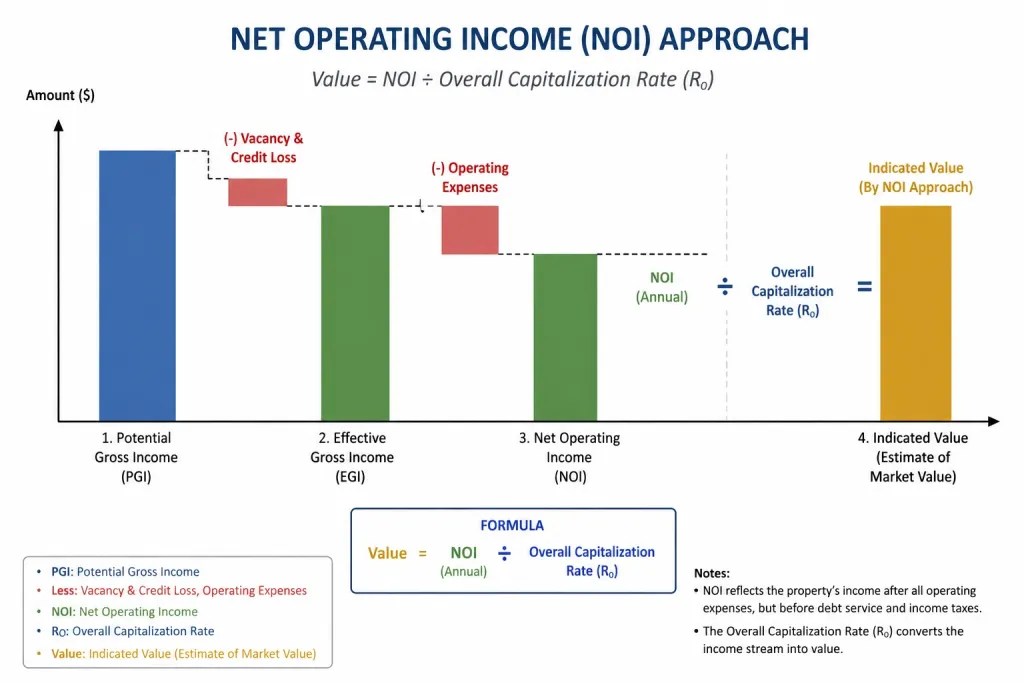
Net Operating Income (NOI) Approach is a traditional theory of capital structure developed by David Durand. This approach argues that the capital structure of a firm is irrelevant and does not affect the overall value of the firm or its weighted average cost of capital (WACC). According to the theory, changes in the proportion of debt and equity financing do not influence the total market value of the company.

The NOI Approach states that although debt is cheaper than equity, any increase in debt financing causes the cost of equity to rise proportionately because shareholders demand higher returns due to increased financial risk. As a result, the overall cost of capital remains constant regardless of the firm’s capital structure.

Definition of Net Operating Income (NOI) Approach

Net Operating Income Approach states that the value of a firm depends on its operating income and business risk, not on its capital structure. Therefore, changes in debt-equity proportions do not affect the firm’s total value or overall cost of capital.


Concept of NOI Approach

According to the NOI Approach:

Value of Firm (V)

V = EBIT / Ko

Where:

  • V = Total Value of Firm
  • EBIT = Earnings Before Interest and Taxes
  • Ko = Overall Cost of Capital

Market Value of Equity (S)

S = V − D

Where:

  • S = Market Value of Equity
  • V = Total Value of Firm
  • D = Market Value of Debt

Cost of Equity (Ke)

Ke = NI / S

Where:

  • NI = Net Income Available to Equity Shareholders
  • S = Market Value of Equity

Example of NOI Approach

Given

  • EBIT = ₹3,00,000
  • Debt = ₹5,00,000
  • Cost of Debt (Kd) = 10%
  • Overall Cost of Capital (Ko) = 12%

Step 1: Calculate Value of Firm

V = EBIT / Ko

V = ₹3,00,000 / 0.12

V = ₹25,00,000

Step 2: Calculate Market Value of Equity

S = V − D

S = ₹25,00,000 − ₹5,00,000

S = ₹20,00,000

Step 3: Calculate Interest

Interest = ₹5,00,000 × 10%

Interest = ₹50,000

Step 4: Calculate Net Income

NI = EBIT − Interest

NI = ₹3,00,000 − ₹50,000

NI = ₹2,50,000

Step 5: Calculate Cost of Equity

Ke = NI / S

Ke = ₹2,50,000 / ₹20,00,000

Ke = 12.5%

Answer

  • Value of Firm = ₹25,00,000
  • Market Value of Equity = ₹20,00,000
  • Cost of Equity = 12.5%
  • Overall Cost of Capital = 12% (Constant)

Features of Net Operating Income (NOI) Approach

  • Capital Structure is Irrelevant

A key feature of the Net Operating Income (NOI) Approach is that capital structure does not affect the value of the firm. According to this theory, whether a company finances its operations through debt, equity, or a combination of both, the total value of the firm remains unchanged. Investors focus on the firm’s earning capacity and business risk rather than its financing pattern. Therefore, changes in leverage do not create additional value. This feature forms the foundation of the NOI Approach and distinguishes it from theories that consider capital structure relevant to firm valuation.

  • Value of the Firm Depends on Operating Income

The NOI Approach states that the value of a firm is determined by its operating income, particularly Earnings Before Interest and Taxes (EBIT). The firm’s earning power and business performance are considered the primary factors influencing its market value. Financing decisions do not alter the company’s operating income; therefore, they do not affect firm value. A company with higher and stable operating income will generally have a higher valuation. This feature emphasizes that operational efficiency and profitability are more important than financing choices in determining the overall worth of a business.

  • Overall Cost of Capital Remains Constant

According to the NOI Approach, the overall cost of capital (Ko) remains constant regardless of changes in the debt-equity ratio. Even if a company increases its use of debt financing, the weighted average cost of capital does not decline. This occurs because any benefit obtained from cheaper debt is exactly offset by an increase in the cost of equity. As a result, the firm’s overall capitalization rate remains unchanged. This feature supports the idea that leverage does not influence firm value and that financing decisions have no effect on the company’s total cost of capital.

  • Cost of Equity Increases with Leverage

The NOI Approach recognizes that higher debt financing increases financial risk for equity shareholders. As leverage rises, shareholders face greater uncertainty because debt holders have a prior claim on earnings. To compensate for this additional risk, equity investors demand a higher rate of return. Therefore, the cost of equity increases proportionately with leverage. This increase offsets the advantage of lower-cost debt financing. This feature reflects the relationship between financial risk and shareholder expectations and explains why the overall cost of capital remains constant despite changes in capital structure.

  • Cost of Debt Remains Constant

Another important feature of the NOI Approach is the assumption that the cost of debt remains constant at all levels of leverage. Lenders are assumed to charge the same interest rate regardless of the amount of debt used by the company. Although this assumption may not be realistic in practice, it simplifies the analysis of capital structure. Since the cost of debt remains unchanged, the entire adjustment to increased leverage occurs through a rise in the cost of equity. This feature helps explain the mechanism through which the overall cost of capital remains constant.

  • No Optimum Capital Structure Exists

Under the NOI Approach, there is no optimum capital structure because changes in debt and equity proportions do not affect firm value or overall cost of capital. Since leverage neither increases nor decreases the total value of the firm, no particular financing mix is considered superior. Managers cannot create additional value simply by altering the debt-equity ratio. This feature contrasts sharply with the Net Income Approach, which suggests that an optimum capital structure exists. The NOI theory therefore supports the view that financing decisions are irrelevant to maximizing firm value.

  • Focuses on Business Risk Rather Than Financial Risk

The NOI Approach emphasizes business risk as the primary determinant of firm value. Business risk arises from the nature of the company’s operations, industry conditions, competition, and economic environment. While financial risk increases with leverage, the theory assumes that investors adjust their required returns accordingly. As a result, firm value continues to depend mainly on operating performance rather than financing decisions. This feature highlights the importance of managerial efficiency, profitability, and operational stability in determining market value, reinforcing the theory’s focus on the earning power of the firm.

  • Supports Capital Structure Irrelevance Theory

A significant feature of the NOI Approach is its support for the concept of capital structure irrelevance. The theory argues that investors cannot gain additional wealth merely because a firm changes its financing pattern. Since the overall cost of capital remains constant and firm value is unaffected by leverage, capital structure decisions do not influence shareholder wealth. This idea later influenced modern financial theories, particularly the Modigliani-Miller propositions. As a result, the NOI Approach occupies an important place in financial management by providing a theoretical foundation for understanding the relationship between leverage and firm value.

Assumptions of the NOI Approach

1. Overall Capitalization Rate Remains Constant

The NOI Approach assumes that the overall capitalization rate, also known as the overall cost of capital or Ko, remains constant regardless of the degree of leverage employed by the firm. This means that no matter how the company structures its financing between debt and equity, the market always values the firm by capitalizing its net operating income at the same fixed rate. This constant capitalization rate implies that the total market value of the firm is determined solely by its earning power and operating income, not by its financing decisions, making capital structure completely irrelevant to overall firm valuation under this theoretical framework.

2. Cost of Equity Rises with Increasing Leverage

Unlike the NI Approach, the NOI Approach explicitly recognizes that equity shareholders are rational investors who perceive and respond to increasing financial risk as leverage rises. As the proportion of debt in the capital structure increases, the fixed interest obligations create greater earnings volatility and higher financial risk for equity holders. Consequently, shareholders demand a progressively higher rate of return to compensate for this increased risk, causing the cost of equity to rise proportionally with leverage. This rise in equity cost precisely offsets the benefit of using cheaper debt, ensuring that the overall weighted average cost of capital remains unchanged regardless of the debt-equity mix.

3. Cost of Debt Remains Constant

The NOI Approach assumes that the cost of debt remains constant at all levels of leverage, reflecting the idea that debt holders maintain a prior claim on the firm’s assets and earnings, shielding them from the financial risk of moderate leverage levels. Since debt holders enjoy priority in repayment and their returns are fixed through contractual interest obligations, they do not demand higher returns as the company takes on additional debt within reasonable limits. This constant cost of debt, combined with the rising cost of equity, ensures that the overall capitalization rate remains stable as the firm shifts its financing mix between debt and equity.

4. No Corporate Taxes

Similar to the NI Approach, the basic NOI Approach assumes a taxation-free environment, meaning that corporate income taxes do not exist and therefore the tax-deductibility benefit of interest payments on debt is not considered. In a world without taxes, debt loses its additional advantage of generating a tax shield, making the theoretical argument for capital structure irrelevance more straightforward and internally consistent. This assumption eliminates a significant real-world advantage of debt financing, allowing the model to demonstrate that the only cost benefit of debt, its lower rate, is entirely offset by the rise in equity cost, leaving total firm value and overall cost of capital unaffected by leverage.

5. The Market Values the Firm as a Whole

A fundamental assumption of the NOI Approach is that investors and the market value the firm as a total entity based on its overall earning power and net operating income stream, rather than separately valuing the individual components of its capital structure. This holistic valuation perspective means that the split of total firm value between debt and equity is considered inconsequential, as the market focuses on the overall cash generating ability of the business rather than how those cash flows are divided among different capital providers. Consequently, any restructuring of the financing mix merely redistributes the existing total value between debt holders and shareholders without changing the aggregate firm value.

6. Investors Have Homogeneous Expectations

The NOI Approach assumes that all investors share identical expectations regarding the firm’s future net operating income, overall risk profile, and growth prospects. This homogeneity of expectations ensures that all market participants agree on the appropriate overall capitalization rate to apply when valuing the firm’s earnings stream. Without this assumption, different investors might assign different values to the same firm based on varying perceptions of risk arising from leverage, potentially disrupting the clean theoretical conclusion that capital structure is irrelevant. Homogeneous expectations simplify the model by ensuring consistent market-wide agreement on firm valuation, regardless of the debt-equity composition chosen by management.

Capital Structure under the NOI Approach:

1. Capital Structure is Irrelevant to Firm Value

The most fundamental proposition of the NOI Approach regarding capital structure is that the total market value of a firm is completely independent of its financing mix, making capital structure decisions entirely irrelevant to overall firm valuation. According to this approach, the market values the firm solely based on its net operating income and the overall capitalization rate, both of which remain unaffected by how the firm chooses to divide its financing between debt and equity. Whether a firm uses no debt or substantial leverage, its total market value remains unchanged. Any attempt to increase firm value by substituting equity with cheaper debt is self-defeating, as the resulting rise in equity cost exactly neutralizes the apparent benefit of cheaper debt financing.

2. No Optimal Capital Structure Exists

Unlike the NI Approach, which identifies maximum leverage as the optimal point, the NOI Approach concludes that no single optimal capital structure exists for any firm. Since the overall cost of capital remains constant at every possible debt-equity ratio, there is no particular financing mix that minimizes WACC or maximizes firm value. Every capital structure is equally good or equally bad from a valuation perspective, as changing the proportion of debt and equity merely redistributes value between debt holders and shareholders without altering total firm value. This conclusion challenges the traditional notion that finance managers can enhance firm value through careful capital structure engineering, suggesting that managerial effort is better focused on improving operating performance rather than financing decisions.

3. Cost of Equity Adjusts to Keep WACC Constant

A central mechanism underlying the NOI Approach’s capital structure conclusion is that the cost of equity automatically adjusts upward as leverage increases, precisely offsetting the benefit of incorporating cheaper debt into the capital structure. As the firm takes on more debt, equity shareholders perceive greater financial risk arising from fixed interest obligations and the increased probability of earnings volatility. Rational investors respond by demanding a higher required rate of return on their equity investment to compensate for this additional risk. This systematic rise in equity cost ensures that the weighted average of debt and equity costs, that is WACC, remains constant at all leverage levels, preventing any capital structure change from altering the firm’s overall cost of capital.

4. Market Value of the Firm is Determined by NOI

Under the NOI Approach, the total market value of the firm is determined exclusively by capitalizing the firm’s net operating income at the constant overall capitalization rate, completely independent of the capital structure chosen. The formula used is Total Market Value of Firm = Net Operating Income divided by Overall Capitalization Rate. Since both net operating income and the capitalization rate are unaffected by leverage decisions, the resulting total firm value remains fixed regardless of the debt-equity mix employed. The individual values of debt and equity components may change as the financing mix changes, but their combined total always remains the same, confirming the irrelevance of capital structure to aggregate firm valuation under this approach.

5. Graphical Representation of Capital Structure Irrelevance

When the NOI Approach is represented graphically with the degree of leverage on the horizontal axis, the overall cost of capital curve appears as a perfectly horizontal straight line at a constant level, indicating that WACC does not change regardless of how much debt the firm uses. Simultaneously, the cost of equity curve slopes upward as leverage increases, reflecting the rising financial risk premium demanded by shareholders, while the cost of debt curve remains flat. The horizontal WACC line powerfully illustrates the core conclusion of the NOI Approach, that no capital structure decision can move the overall cost of capital up or down, reinforcing the irrelevance proposition through clear visual representation.

6. Practical Implications of the NOI Approach

Although the NOI Approach concludes that capital structure is theoretically irrelevant, it carries important practical implications for financial managers. It suggests that firms should not waste resources or management attention attempting to find a mythical optimal debt-equity ratio, as no such ratio genuinely exists under this framework. Instead, management should focus on decisions that directly improve operating performance, revenue generation, cost efficiency, and investment returns, since these are the true drivers of firm value. The approach also highlights the importance of investor rationality and market efficiency, reminding managers that sophisticated investors will see through superficial capital restructuring exercises and price the firm based on its fundamental earning power rather than its financing arrangement.

Advantages of the NOI Approach

  • Simplicity and Practical Applicability

The NOI Approach offers remarkable conceptual simplicity, making it highly practical for financial managers. It posits that the overall cost of capital (WACC) and firm value remain constant regardless of the debt-equity mix, assuming no taxes and perfect markets. This straightforward framework allows managers to focus on operational efficiency rather than getting entangled in complex capital structure optimization calculations. Unlike the Net Income Approach, which requires intricate computations of changing equity costs, the NOI model provides a clean, easy-to-understand baseline. Practitioners can use this as a starting point for strategic decisions without excessive mathematical modeling, saving both time and analytical resources.

  • Emphasis on Operating Efficiency Over Financing

A fundamental advantage of the NOI Approach is its strategic shift in management focus toward operational excellence rather than financial engineering. Since the theory asserts that firm value depends solely on net operating income and business risk—not on how that income is financed—it encourages managers to concentrate on improving production, sales, marketing, and cost control. This operational orientation fosters sustainable competitive advantages through better products, efficient processes, and market expansion. By de-emphasizing the debt-equity mix, the approach prevents management from wasting energy on fruitless arbitrage between debt and equity, redirecting attention toward genuine value-creating activities.

  • Recognition of Market Imperfections (Arbitrage Process)

The NOI Approach uniquely validates the existence of investor-level arbitrage as a equilibrating mechanism in financial markets. According to this theory, if two identical firms with different capital structures trade at different valuations, rational investors will engage in homemade leverage—borrowing personally to purchase equity of the unlevered firm and selling the levered firm’s shares. This arbitrage activity quickly corrects any mispricing, ensuring that market values converge. This built-in self-correction mechanism gives the approach strong intuitive appeal, as it acknowledges that sophisticated investors will not pay a premium for what they can replicate personally, thereby maintaining market efficiency.

  • Logical Treatment of Equity Capitalization Rate

The NOI Approach provides a logical, intuitive explanation for the behavior of the equity capitalization rate (Ke). As a firm increases its debt proportion, the financial risk borne by equity shareholders rises proportionately. Consequently, the required rate of return on equity (Ke) increases linearly to exactly offset the benefits of cheaper debt. This elegant inverse relationship ensures that the weighted average cost of capital (WACC) remains perfectly unchanged. This treatment recognizes shareholder psychology realistically—investors rationally demand higher compensation for bearing greater residual risk, and this natural market reaction neutralizes any apparent advantage from substituting debt for equity.

  • Foundation for Modern Capital Structure Theories

Despite its restrictive assumptions, the NOI Approach serves as the intellectual bedrock for contemporary capital structure theories, most notably Modigliani-Miller (M-M) Proposition I. By establishing that leverage does not affect firm value in a no-tax world, it paved the way for further research incorporating taxes, bankruptcy costs, and asymmetric information. Students and practitioners who master the NOI framework gain a critical conceptual lens for understanding trade-off theory, pecking order theory, and signaling models. Without this foundational understanding, modern financial management becomes disjointed; the NOI Approach offers the essential starting point for all advanced capital structure deliberations.

  • Encourages Rational Capital Budgeting Decisions

Since the NOI Approach asserts a constant WACC irrespective of leverage, it allows financial managers to evaluate investment projects using a stable, unchanging discount rate. This consistency eliminates the complex, iterative calculations required to adjust hurdle rates for varying debt proportions across different projects. Managers can therefore focus purely on the project’s operating cash flows and risk characteristics rather than worrying about how the project will be financed. This separation of investment and financing decisions (the famous “separation theorem”) streamlines capital budgeting, reduces computational errors, and ensures that projects are evaluated on their fundamental economic merits alone.

  • Neutralizes Unproductive Tax Arbitrage Arguments

In its pure form (assuming no corporate taxes), the NOI Approach effectively neutralizes the temptation for firms to engage in unproductive tax-driven arbitrage through excessive leverage. By demonstrating that the value of the firm remains invariant to the debt-equity mix, it discourages management from taking on dangerous debt levels simply to exploit interest tax shields. This conservative implication protects firms from over-leveraging, which in the real world leads to financial distress, agency conflicts, and bankruptcy. Thus, the approach implicitly advocates for prudent, moderate leverage policies rather than aggressive, high-risk financial structures that could destabilize the enterprise during economic downturns.

Limitations of the NOI Approach

  • Assumes Constant Overall Cost of Capital

The NOI approach assumes that the overall cost of capital remains constant regardless of changes in the capital structure. In reality, increasing debt raises the financial risk of the company, causing both the cost of debt and the cost of equity to change. Investors demand higher returns as risk increases. Therefore, the assumption of a constant overall cost of capital is unrealistic and does not reflect actual market conditions. This limitation reduces the practical applicability of the NOI approach in making financing decisions for modern business organizations.

  • Ignores Financial Risk

The NOI approach assumes that increasing debt does not affect the firm’s financial risk. However, excessive borrowing increases fixed interest obligations and the possibility of financial distress. As debt rises, shareholders face greater risk because earnings become more uncertain. Consequently, investors demand higher returns on equity. By ignoring the impact of financial risk, the NOI approach fails to represent the real relationship between leverage and the cost of capital. This makes the approach less suitable for practical financial management and capital structure planning.

  • Unrealistic Assumption of Perfect Capital Market

The NOI approach is based on the assumption of a perfect capital market where there are no taxes, transaction costs, or information differences among investors. In practice, capital markets are imperfect due to taxes, brokerage charges, government regulations, and unequal access to information. These market imperfections influence financing decisions and affect the cost of capital. Since the assumptions of the NOI approach rarely exist in the real business environment, its conclusions may not accurately represent actual corporate financing situations.

  • Ignores Tax Benefits of Debt

The NOI approach assumes that debt financing does not provide any tax advantage. In reality, interest paid on debt is generally tax deductible, reducing the company’s taxable income and lowering the effective cost of debt. This tax shield makes debt financing more attractive than equity in many situations. By ignoring the tax benefits associated with borrowing, the NOI approach underestimates the value of debt financing and provides an incomplete explanation of capital structure decisions in modern financial management.

  • Assumes Cost of Debt Remains Constant

According to the NOI approach, the cost of debt remains unchanged regardless of the amount of borrowing. In practice, lenders charge higher interest rates when a company’s debt level increases because the risk of default becomes greater. As financial leverage rises, the cost of debt usually increases rather than remaining constant. This unrealistic assumption weakens the practical usefulness of the NOI approach and limits its ability to explain the actual behaviour of borrowing costs in competitive financial markets.

  • Difficult to Apply in Practice

The assumptions of the NOI approach are highly theoretical and difficult to apply in real business situations. Market conditions, investor expectations, interest rates, taxes, and business risks continuously change over time. As a result, the cost of debt, cost of equity, and overall cost of capital rarely remain constant. Finance managers must consider these changing factors while making capital structure decisions. Therefore, the NOI approach provides only a simplified theoretical framework and has limited practical application in financial management.

  • Overlooks Investor Behaviour

The NOI approach assumes that investors are rational and react uniformly to changes in the company’s capital structure. However, investor decisions are influenced by factors such as market sentiment, expectations, risk perception, and economic conditions. Different investors may value the same company differently based on their individual preferences and investment objectives. By overlooking these behavioural factors, the NOI approach fails to explain how investor attitudes can influence the market value of the firm and its financing decisions.

  • Limited Practical Acceptance

The NOI approach has limited acceptance in modern financial management because its assumptions do not match real business conditions. Financial decisions today are influenced by taxes, bankruptcy costs, agency costs, market imperfections, and changing investor expectations. Modern capital structure theories provide more realistic explanations by considering these practical factors. Although the NOI approach is important for understanding the theoretical relationship between capital structure and firm value, it is mainly useful for academic study rather than practical financial decision making.

Net Income (NI) Approach, Concepts, Definition, Assumptions, Optimum Capital Structure, Advantages and Limitations

Net Income Approach, propounded by David Durand, suggests that a firm’s capital structure decision is relevant to its overall valuation and cost of capital. According to this approach, a firm can increase its total value and reduce its overall cost of capital by increasing the proportion of debt in its capital structure, since debt is generally a cheaper source of financing compared to equity. As the degree of leverage increases, the Weighted Average Cost of Capital decreases, leading to an increase in the market value of the firm. This approach assumes that both the cost of debt and cost of equity remain constant regardless of changes in the leverage level.

Definition of Net Income Approach

Net Income Approach states that the value of a firm can be increased and the overall cost of capital can be reduced by increasing the proportion of debt in the capital structure, assuming the costs of debt and equity remain constant.

Net Income (NI) Diagram:

  • Cost of Equity (Ke) → constant (horizontal red line)
  • Cost of Debt (Kd) → constant (horizontal blue line)
  • Weighted Average Cost of Capital (WACC) → decreases as leverage increases (downward-sloping green line)

Concept of Net Income Approach

According to the NI Approach:

Value of Firm (V)

V = S + D

Where:

  • V = Total Value of Firm
  • S = Market Value of Equity
  • D = Market Value of Debt

Cost of Equity

Ke = NI / S

Where:

  • NI = Net Income Available to Equity Shareholders
  • S = Market Value of Equity

Overall Cost of Capital

Ko = EBIT / V

Where:

  • Ko = Overall Cost of Capital
  • EBIT = Earnings Before Interest and Taxes
  • V = Total Value of Firm

Example of Net Income Approach

Given

  • EBIT = ₹2,00,000
  • Debt = ₹5,00,000
  • Cost of Debt (Kd) = 10%
  • Cost of Equity (Ke) = 15%

Step 1: Calculate Interest

Interest = ₹5,00,000 × 10%

= ₹50,000

Step 2: Calculate Net Income

Net Income = EBIT − Interest

= ₹2,00,000 − ₹50,000

= ₹1,50,000

Step 3: Calculate Market Value of Equity

S = NI / Ke

= ₹1,50,000 / 0.15

= ₹10,00,000

Step 4: Calculate Total Value of Firm

V = S + D

= ₹10,00,000 + ₹5,00,000

= ₹15,00,000

Step 5: Calculate Overall Cost of Capital

Ko = EBIT / V

= ₹2,00,000 / ₹15,00,000

= 13.33%

Answer

  • Market Value of Equity = ₹10,00,000
  • Total Value of Firm = ₹15,00,000
  • Overall Cost of Capital = 13.33%

Assumptions of the NI Approach

1. Cost of Debt Remains Constant

The NI Approach assumes that the cost of debt remains constant and unaffected regardless of the degree of leverage employed by the firm. This means that as the company increases its borrowing, lenders do not demand a higher interest rate to compensate for the increased financial risk associated with higher debt levels. In reality, as debt increases, the risk of default rises, and creditors typically require higher returns to compensate for this added risk. However, this approach simplifies the analysis by holding the cost of debt fixed, allowing the focus to remain solely on how the debt-equity mix affects overall valuation.

2. Cost of Equity Remains Constant

Similarly, the NI Approach assumes that the cost of equity remains unchanged irrespective of how much debt the firm takes on. This implies that shareholders do not perceive any additional financial risk from increased leverage and therefore do not demand a higher rate of return as the company’s debt proportion rises. In practical scenarios, increased debt typically heightens the financial risk borne by equity shareholders due to fixed interest obligations, which would normally lead to a higher required return on equity. This assumption isolates the effect of capital structure on firm value by holding the equity cost constant throughout the analysis.

3. No Corporate Taxes

The original NI Approach assumes a world without corporate taxes, meaning that the tax-deductibility benefit of interest payments on debt is not considered in the analysis. This assumption simplifies the model by ignoring the tax shield advantage that debt financing typically provides in real-world scenarios, where interest expense reduces taxable income and lowers the effective cost of debt. Without this assumption, the conclusion that increasing leverage always reduces the overall cost of capital might be even more pronounced due to the additional tax benefits, but the basic NI Approach intentionally excludes this factor for analytical simplicity.

4. Cost of Debt is Less Than Cost of Equity

A fundamental assumption underlying the NI Approach is that the cost of debt is always lower than the cost of equity, since debt holders bear lower risk than equity shareholders due to their priority claim on assets and fixed, contractual returns. This cost differential is the primary driver behind the conclusion that increasing the proportion of debt in the capital structure reduces the overall weighted average cost of capital. Without this assumption that debt is cheaper, the entire premise of the NI Approach, that leverage enhances firm value, would not hold true within the theoretical framework presented.

5. No Change in Investors’ Risk Perception

The NI Approach assumes that investors, both debt holders and equity shareholders, do not alter their risk perception of the firm as its degree of financial leverage increases. This means the market does not penalize the company with higher required returns despite the increased financial risk associated with higher fixed interest obligations. In actual capital markets, investors are generally risk-averse and tend to demand higher compensation as leverage rises due to increased bankruptcy risk and earnings volatility. This unrealistic assumption is a major criticism of the approach, as it does not reflect rational investor behavior in efficient markets.

6. The Firm Has a 100% Dividend Payout Ratio

The NI Approach assumes that the firm distributes all of its earnings as dividends to shareholders, with no retained earnings kept within the business for reinvestment purposes. This simplifies the valuation process by ensuring that the net income available to equity shareholders directly translates into dividend payments, making it easier to calculate the market value of equity using the capitalization rate. This assumption avoids complications that would arise from retained earnings affecting future growth, earnings per share, or stock valuation, allowing the model to focus purely on the immediate relationship between capital structure and firm value.

Optimum Capital Structure under the NI Approach

1. Maximum Leverage as the Optimal Point

According to the Net Income Approach, the optimum capital structure is achieved at the point of maximum possible debt, theoretically approaching 100% debt financing. Since the cost of debt is assumed to remain constant and lower than the cost of equity at all levels of leverage, every additional unit of debt replacing equity continuously reduces the overall Weighted Average Cost of Capital. Consequently, the approach concludes that there is no single moderate optimal debt-equity ratio; instead, firm value keeps rising indefinitely as leverage increases, with the theoretical optimum lying at the extreme point where the firm relies almost entirely on debt capital.

2. Continuous Decline in WACC with Increasing Leverage

As the proportion of debt in the capital structure rises, the overall cost of capital declines steadily because debt, being cheaper than equity, pulls down the weighted average. Since both individual component costs, debt and equity, are assumed constant under this approach, there is no offsetting increase in cost to counteract the benefit of higher leverage. This creates a straight, downward-sloping WACC curve as leverage increases, reinforcing the conclusion that the firm should continuously substitute equity with debt to minimize its overall cost of capital and thereby maximize its market value at every incremental stage of borrowing.

3. Corresponding Increase in Market Value of the Firm

As WACC continuously decreases with rising leverage, the market value of the firm correspondingly increases, since firm value under this approach is calculated by capitalizing the net operating income at the declining overall cost of capital. This inverse relationship between WACC and firm value means that as debt is added, the present value of the firm’s future earnings stream rises. Under the NI Approach, this increase in value continues without limit as leverage rises, theoretically suggesting that firm value is maximized only when the company is financed almost entirely through debt rather than equity capital.

4. No Realistic Trade-Off Point Identified

Unlike more balanced theories of capital structure, the NI Approach does not identify a realistic trade-off point where the benefits of cheap debt are offset by rising financial risk. Since the cost of equity is assumed unaffected by leverage, there is no rising risk premium to counterbalance the advantage of cheaper debt at higher leverage levels. This means the approach fails to capture a genuine optimal balance between debt and equity that reflects real-world risk considerations, making its conclusion of “more debt is always better” a theoretical extreme rather than a practically achievable or sustainable capital structure target.

5. Graphical Representation of the Optimum Point

When plotted graphically, with leverage (debt-to-equity ratio) on the horizontal axis and cost of capital or firm value on the vertical axis, the NI Approach shows a continuously declining WACC curve and a continuously rising firm value curve as leverage increases. There is no minimum point on the WACC curve or maximum point on the value curve within the relevant range; both curves move monotonically in their respective directions. This graphical representation visually reinforces the theoretical conclusion that the optimum capital structure lies at the boundary of maximum debt usage, rather than at some interior point of moderate leverage.

6. Practical Unrealism of the Conclusion

While theoretically elegant, the conclusion that 100% debt represents the optimum capital structure is widely criticized as unrealistic and impractical in real-world financial markets. Excessive reliance on debt significantly increases financial risk, bankruptcy probability, and the likelihood of default, which would naturally cause both cost of debt and cost of equity to rise as leverage increases, contradicting the approach’s core assumptions. This limitation highlights why the NI Approach is considered more of a theoretical benchmark for understanding the directional impact of leverage on firm value, rather than a practically applicable guideline for determining actual optimal financing decisions.

Advantages of the NI Approach

  • Increases the Value of the Firm

The Net Income Approach suggests that a firm can increase its total market value by using a higher proportion of debt in its capital structure. Since debt is generally cheaper than equity, replacing expensive equity with lower-cost debt reduces financing costs. As a result, the market value of equity and the overall value of the firm increase. This concept helps financial managers understand how leverage can positively influence shareholder wealth. The approach emphasizes that an appropriate use of debt can create value for the business and improve its financial position in the market.

  • Reduces the Overall Cost of Capital

A major advantage of the NI Approach is that it demonstrates how the overall cost of capital can be reduced through increased debt financing. Because debt carries a lower cost than equity, a greater proportion of debt lowers the weighted average cost of capital (WACC). A lower cost of capital enables firms to undertake more profitable investment projects and improve returns. This principle highlights the financial benefits of leverage and assists managers in selecting financing sources that minimize capital costs and maximize the efficiency of resource utilization.

  • Supports Wealth Maximization

The NI Approach aligns with the objective of maximizing shareholder wealth. By reducing the overall cost of capital and increasing the value of the firm, the approach contributes directly to increasing shareholders’ wealth. Higher firm value generally leads to higher market prices for shares, benefiting investors. Financial managers can use the theory to design financing strategies that enhance company performance and investor confidence. Therefore, the approach supports one of the primary goals of financial management, which is the creation and maximization of value for shareholders.

  • Highlights the Importance of Debt Financing

The NI Approach clearly explains the advantages of debt financing in a firm’s capital structure. It recognizes debt as a relatively inexpensive source of funds compared to equity. By emphasizing the cost advantage of debt, the approach encourages firms to consider leverage as a tool for improving financial performance. This understanding helps managers evaluate financing alternatives more effectively and make informed decisions regarding capital structure. The theory also demonstrates how debt can be strategically used to increase firm value while lowering the overall cost of capital.

  • Helps in Determining Optimum Capital Structure

Another advantage of the NI Approach is that it assists in identifying the optimum capital structure. According to the theory, the optimum structure is achieved when the proportion of debt is increased to the point where the firm’s value is maximized and the cost of capital is minimized. This concept provides a useful framework for financial planning and financing decisions. By understanding the relationship between leverage and firm value, managers can develop capital structures that support long-term growth, profitability, and shareholder wealth maximization.

  • Simple and Easy to Understand

The NI Approach is relatively simple and straightforward compared to many modern financial theories. Its assumptions and calculations are easy to understand, making it suitable for students, researchers, and financial managers. The approach uses basic concepts such as cost of debt, cost of equity, and firm value, allowing users to analyze the effects of leverage without complex mathematical models. This simplicity makes it an excellent introductory theory for understanding capital structure decisions and their impact on company value and cost of capital.

  • Useful for Academic and Theoretical Analysis

The NI Approach plays an important role in academic studies and financial management education. It provides a foundation for understanding how capital structure can influence firm value and cost of capital. Many advanced theories, including the Net Operating Income (NOI) Approach and Modigliani-Miller Theory, are studied in comparison with the NI Approach. As a result, it serves as a valuable learning tool for students and researchers. The theory helps develop a deeper understanding of leverage, financing decisions, and the relationship between risk and return in corporate finance.

  • Encourages Efficient Financial Planning

The NI Approach encourages financial managers to carefully evaluate financing options and adopt efficient capital structures. By demonstrating the benefits of low-cost debt financing, it promotes strategic financial planning and better allocation of resources. Managers can use the theory to assess the impact of different financing mixes on firm value and cost of capital. This understanding supports informed decision-making and helps organizations achieve financial objectives more effectively. Consequently, the approach contributes to improved financial management practices and long-term organizational success.

Limitations of the NI Approach

  • Assumes Constant Cost of Equity

One of the major limitations of the NI Approach is its assumption that the cost of equity remains constant regardless of changes in financial leverage. In reality, as a company increases its debt, equity shareholders face higher financial risk because debt obligations must be paid before dividends. Consequently, shareholders demand a higher rate of return to compensate for this increased risk. Therefore, the cost of equity generally rises with higher leverage. By ignoring this practical reality, the NI Approach presents an unrealistic view of capital structure and may lead to inaccurate conclusions regarding firm value.

  • Assumes Constant Cost of Debt

The NI Approach assumes that the cost of debt remains unchanged even when a company significantly increases its borrowings. However, lenders generally perceive highly leveraged firms as riskier and may demand higher interest rates on additional debt. As debt levels increase, the probability of financial distress and default also rises. Consequently, the cost of debt tends to increase rather than remain constant. This unrealistic assumption weakens the practical applicability of the NI Approach because financing costs in real-world situations are influenced by the firm’s risk profile and borrowing capacity.

  • Ignores Financial Risk

A significant limitation of the NI Approach is that it ignores the increasing financial risk associated with excessive debt financing. Debt creates fixed obligations in the form of interest and principal repayments. As leverage rises, the risk of financial distress also increases, particularly during periods of declining earnings. The NI Approach assumes that investors and lenders do not react to this increased risk, which is not realistic. By overlooking financial risk, the theory overestimates the benefits of debt financing and fails to provide a balanced assessment of capital structure decisions.

  • Unrealistic Assumptions

The NI Approach is based on several assumptions that rarely exist in actual business environments. It assumes constant costs of debt and equity, no taxes, efficient capital markets, and rational investor behavior. In practice, these conditions are seldom met. Market imperfections, taxation, transaction costs, and changing investor expectations significantly affect financing decisions. Because the theory relies heavily on unrealistic assumptions, its conclusions may not accurately reflect real-world corporate finance situations. This limitation reduces its usefulness as a practical guide for determining an optimal capital structure.

  • Ignores Corporate Taxes

Another limitation of the NI Approach is that it ignores the impact of corporate taxes on financing decisions. In reality, interest payments on debt are generally tax-deductible, creating a tax shield that reduces the effective cost of debt. Taxes play an important role in determining the attractiveness of debt financing and the overall cost of capital. By excluding taxation from its analysis, the NI Approach fails to capture a key factor influencing capital structure decisions. As a result, its conclusions regarding firm value and financing choices may not accurately represent actual business conditions.

  • Promotes Excessive Use of Debt

According to the NI Approach, increasing debt continuously lowers the cost of capital and increases the value of the firm. This conclusion may encourage companies to rely excessively on debt financing. However, excessive debt can create serious financial problems, including higher interest burdens, liquidity difficulties, and bankruptcy risk. In practice, firms cannot increase debt indefinitely without facing adverse consequences. Therefore, the theory’s recommendation of continuous leverage is unrealistic and potentially dangerous. This limitation highlights the need for a more balanced approach to capital structure decisions.

  • Limited Practical Applicability

Although the NI Approach provides useful theoretical insights, its practical application is limited. Real-world financing decisions involve numerous factors such as market conditions, investor expectations, business risk, taxation, and regulatory requirements. The approach does not adequately address these complexities. As a result, financial managers rarely rely solely on the NI Approach when making capital structure decisions. Instead, they use more comprehensive models that incorporate risk, taxation, and market behavior. Therefore, the NI Approach serves primarily as a theoretical concept rather than a practical financial management tool.

  • Overlooks Market Reactions

The NI Approach assumes that investors and lenders do not change their behavior as a company’s leverage increases. In reality, financial markets respond to changes in risk. Investors may demand higher returns, lenders may increase interest rates, and credit ratings may decline when debt levels become excessive. These market reactions significantly affect a firm’s financing costs and value. By ignoring the dynamic relationship between leverage and market perception, the NI Approach oversimplifies capital structure decisions. Consequently, it may produce results that differ substantially from actual outcomes observed in financial markets.

Unlevering and Relevering of Beta

Beta (β) is a measure of the systematic risk of a company’s stock in relation to the overall market. It indicates how sensitive a company’s returns are to changes in market returns. However, a company’s beta is influenced not only by its business risk but also by its financial risk arising from the use of debt financing.

To separate these risks, financial analysts use the concepts of Unlevering Beta and Relevering Beta.

1. Unlevering Beta (Asset Beta)

Unlevering Beta, also known as Asset Beta, is the process of removing the effect of financial leverage (debt) from a company’s equity beta. The resulting beta reflects only the business risk of the company’s assets and operations, excluding the additional risk created by debt financing.

Since different companies use different amounts of debt in their capital structures, comparing their equity betas directly may be misleading. Unlevering beta eliminates the impact of financial risk and provides a common basis for comparison. Therefore, Asset Beta represents the true operating risk of a company and is widely used in valuation, mergers and acquisitions, capital budgeting, and investment analysis.

Definition

Unlevered Beta is the beta that measures the risk of a company’s assets without considering the effects of debt financing. It reflects only the business risk associated with the company’s operations.

Formula of Unlevering Beta

βU = βL / [1 + (1 − T) (D/E)]

Where:

  • βU = Unlevered Beta (Asset Beta)
  • βL = Levered Beta (Equity Beta)
  • T = Corporate Tax Rate
  • D = Market Value of Debt
  • E = Market Value of Equity

Calculation of Unlevering Beta

Example 1

Given:

  • Levered Beta = 1.50
  • Debt = ₹400 lakh
  • Equity = ₹600 lakh
  • Tax Rate = 30%

Step 1: Calculate Debt-Equity Ratio

D/E = 400 / 600 = 0.667

Step 2: Apply Formula

βU = 1.50 / [1 + (1 − 0.30)(0.667)]

βU = 1.50 / [1 + 0.467]

βU = 1.50 / 1.467

βU = 1.02

Answer

Unlevered Beta = 1.02

This beta represents only the business risk of the company’s assets.

Example 2

Given:

  • Levered Beta = 1.80
  • Debt = ₹500 lakh
  • Equity = ₹1,000 lakh
  • Tax Rate = 25%

Solution

D/E = 500 / 1000 = 0.50

βU = 1.80 / [1 + (1 − 0.25)(0.50)]

βU = 1.80 / 1.375

βU = 1.31

Answer

Asset Beta = 1.31

Components of Unlevering Beta (Asset Beta)

  • Levered Beta (Equity Beta)

Levered Beta, also known as Equity Beta, is the starting point in the process of unlevering beta. It measures the total risk faced by equity shareholders, including both business risk and financial risk arising from debt financing. Since companies often use borrowed funds, the equity beta reflects the impact of leverage on shareholder returns. During unlevering, this beta is adjusted to remove the influence of debt and isolate business risk. Therefore, levered beta is a crucial component because it provides the base value from which the asset beta is derived.

  • Market Value of Debt (D)

The market value of debt represents the total value of the company’s long-term borrowings, debentures, bonds, and loans. Debt increases financial leverage and consequently increases the risk borne by equity shareholders. In the unlevering process, the amount of debt is considered to determine how much financial risk is embedded in the equity beta. A higher level of debt generally results in a greater difference between levered beta and unlevered beta. Therefore, the market value of debt is an essential component for accurately separating financial risk from business risk.

  • Market Value of Equity (E)

The market value of equity refers to the total market capitalization of a company, calculated by multiplying the number of outstanding shares by their market price. It represents the ownership value held by shareholders and forms an important part of the debt-equity relationship. During the unlevering process, the market value of equity is used along with debt to calculate the debt-equity ratio. This ratio helps determine the extent to which financial leverage influences shareholder risk. Therefore, market value of equity plays a significant role in deriving the company’s true business risk.

  • Debt-Equity Ratio (D/E Ratio)

The Debt-Equity Ratio is a key component in the unlevering beta formula. It measures the proportion of debt financing relative to shareholders’ equity. This ratio indicates the degree of financial leverage employed by the company. A higher debt-equity ratio signifies greater financial risk and a larger adjustment when converting levered beta into unlevered beta. Conversely, a lower ratio indicates less financial leverage and a smaller adjustment. The debt-equity ratio is critical because it directly determines the extent to which financial risk is removed from the equity beta.

  • Corporate Tax Rate (T)

The corporate tax rate is an important component because debt financing provides a tax advantage through the deductibility of interest expenses. The unlevering beta formula incorporates the tax rate to account for this tax shield. A higher tax rate increases the benefit of debt financing and affects the adjustment made to remove financial risk. By including the tax factor, the formula provides a more realistic measure of business risk. Therefore, the corporate tax rate ensures that the impact of debt is accurately reflected when calculating the unlevered beta.

  • Financial Risk

Financial risk is the additional risk borne by shareholders due to the use of debt financing. It arises because debt obligations require fixed interest and principal payments regardless of business performance. Unlevering beta aims to remove this financial risk from the equity beta so that only business risk remains. Understanding financial risk is essential because it explains the difference between levered beta and unlevered beta. The greater the financial risk, the larger the adjustment required. Thus, financial risk serves as a fundamental component in the concept and application of unlevering beta.

  • Business Risk

Business risk refers to the uncertainty associated with a company’s core operations, industry conditions, competition, and economic environment. Unlike financial risk, business risk exists regardless of how the company is financed. The primary objective of unlevering beta is to isolate and measure this business risk independently. Asset beta obtained after unlevering reflects only operational risk and excludes the effects of leverage. Since business risk forms the foundation of a company’s overall risk profile, it is one of the most important components in the unlevering beta process.

  • Unlevered Beta (Asset Beta)

Unlevered Beta, also called Asset Beta, is the final outcome of the unlevering process. It measures the systematic risk of a company’s assets without considering debt financing. This beta reflects only the business risk associated with the company’s operations and investments. Asset beta is widely used for comparing companies with different capital structures, valuing businesses, and estimating project-specific risks. It serves as a neutral risk measure unaffected by financing decisions. Therefore, unlevered beta is both a component and the ultimate objective of the unlevering process in financial analysis.

2. Relevering Beta (Equity Beta)

Relevering Beta is the process of adjusting an unlevered beta (asset beta) to reflect the impact of a specific or target capital structure. It involves adding the effect of financial leverage (debt) back to the asset beta to determine the Equity Beta (Levered Beta). While unlevered beta measures only business risk, relevered beta measures both business risk and financial risk.

Relevering beta is commonly used in corporate valuation, mergers and acquisitions, capital budgeting, and CAPM calculations. It helps analysts estimate the risk faced by equity shareholders when a company uses debt financing. Since different capital structures create different levels of financial risk, relevering beta provides a more realistic measure of shareholder risk under a specific financing arrangement.

Definition

Relevering Beta is the process of adjusting asset beta to incorporate the effect of debt financing and obtain the equity beta that reflects both business and financial risk.

Formula of Relevering Beta

βL = βU × [1 + (1 − T)(D/E)]

Where:

  • βL = Levered Beta (Equity Beta)
  • βU = Unlevered Beta (Asset Beta)
  • T = Corporate Tax Rate
  • D = Market Value of Debt
  • E = Market Value of Equity

Calculation of Relevering Beta

Example 1

Given:

  • Unlevered Beta = 1.10
  • Debt = ₹400 lakh
  • Equity = ₹500 lakh
  • Tax Rate = 30%

Step 1: Calculate Debt-Equity Ratio

D/E = 400 / 500 = 0.80

Step 2: Apply Formula

βL = 1.10 × [1 + (1 − 0.30)(0.80)]

βL = 1.10 × [1 + 0.56]

βL = 1.10 × 1.56

βL = 1.72

Answer

Relevered Beta (Equity Beta) = 1.72

Example 2

Given:

  • Asset Beta = 0.95
  • Debt = ₹600 lakh
  • Equity = ₹600 lakh
  • Tax Rate = 25%

Solution

D/E = 600 / 600 = 1.00

βL = 0.95 × [1 + (1 − 0.25)(1)]

βL = 0.95 × 1.75

βL = 1.66

Answer

Equity Beta = 1.66

Components of Relevering Beta (Equity Beta)

1. Unlevered Beta (Asset Beta)

Unlevered Beta, also known as Asset Beta, is the foundation of the relevering process. It measures the systematic risk of a company’s assets without considering the effects of debt financing. This beta reflects only business risk arising from the company’s operations, industry conditions, and market environment. During relevering, the unlevered beta is adjusted to include financial risk and obtain the equity beta. Since it serves as the starting point for the calculation, its accuracy is crucial. A higher unlevered beta indicates greater operational risk, which ultimately influences the resulting relevered beta.

Example: If Asset Beta = 1.10, this value will be adjusted based on the company’s capital structure to determine Equity Beta.

2. Levered Beta (Equity Beta)

Levered Beta, or Equity Beta, is the final outcome of the relevering process. It measures the total systematic risk borne by equity shareholders, including both business risk and financial risk. When a company uses debt financing, shareholders face additional risk because debt obligations must be paid regardless of profitability. Relevering beta incorporates this risk into the calculation. Equity beta is widely used in CAPM, business valuation, and investment analysis. It helps determine the return expected by shareholders and provides a realistic assessment of shareholder risk under a specific capital structure.

Example: If Asset Beta = 1.10 and leverage increases risk, the resulting Equity Beta may become 1.72.

3. Market Value of Debt (D)

The market value of debt represents the current value of long-term borrowings, bonds, debentures, and loans used by the company. Debt financing increases financial leverage and therefore raises the risk faced by equity shareholders. During the relevering process, the amount of debt determines how much additional financial risk is added to the asset beta. A higher debt level generally results in a higher equity beta. Therefore, the market value of debt is an important component because it directly influences the magnitude of leverage and the overall risk reflected in the relevered beta.

Example: If Debt = ₹500 lakh, it contributes to increasing shareholder risk and affects the relevered beta calculation.

4. Market Value of Equity (E)

The market value of equity refers to the total value of shareholders’ ownership in the company, measured by market capitalization. It is calculated by multiplying the market price per share by the number of outstanding shares. Equity forms the denominator in the debt-equity ratio used during relevering. A larger equity base reduces the impact of debt on financial leverage, while a smaller equity base increases leverage effects. Therefore, the market value of equity is essential in determining the degree of financial risk that is incorporated into the equity beta.

Example

If Equity = ₹1,000 lakh, the leverage effect is lower than when equity is only ₹500 lakh.

5. Debt-Equity Ratio (D/E Ratio)

The Debt-Equity Ratio is one of the most significant components of relevering beta. It measures the proportion of debt financing relative to shareholders’ equity. This ratio determines the extent of financial leverage used by the company. A higher debt-equity ratio means that the company relies more heavily on borrowed funds, increasing financial risk and shareholder exposure. Consequently, the equity beta rises. A lower ratio indicates less leverage and a smaller increase in beta. Thus, the debt-equity ratio plays a critical role in adjusting asset beta to reflect shareholder risk accurately.

Example

If Debt = ₹600 lakh and Equity = ₹600 lakh:

D/E = 600 / 600 = 1

This ratio significantly increases the equity beta.

6. Corporate Tax Rate (T)

The corporate tax rate is included in the relevering beta formula because debt financing provides a tax shield through deductible interest payments. The tax shield reduces the effective cost of debt and influences the impact of leverage on shareholder risk. By incorporating the tax rate, the relevering formula provides a more realistic adjustment to beta. A higher tax rate increases the tax benefit associated with debt and affects the extent to which leverage contributes to risk. Therefore, the corporate tax rate is an essential component for accurately estimating equity beta.

Example

If the corporate tax rate is 30%, the debt adjustment factor becomes:

(1 − 0.30) = 0.70

This factor is applied in the relevering formula.

7. Financial Risk

Financial risk refers to the additional risk borne by shareholders due to the use of debt financing. Unlike business risk, financial risk arises because the company must meet fixed interest and principal repayment obligations. As debt levels increase, shareholders face greater uncertainty regarding returns. Relevering beta incorporates this financial risk into the asset beta, resulting in a higher equity beta. Understanding financial risk is crucial because it explains why companies with similar operations can have different equity betas. Therefore, financial risk is a central component in the relevering process.

Example: A company with substantial debt will generally have a higher equity beta than a debt-free company operating in the same industry.

8. Capital Structure

Capital structure refers to the combination of debt and equity used to finance a company’s assets and operations. It is the ultimate factor influencing the relevered beta because different financing mixes create different levels of financial risk. Relevering beta adjusts asset beta according to a specific capital structure, enabling analysts to estimate shareholder risk under alternative financing scenarios. Companies with aggressive debt financing generally have higher equity betas, while conservatively financed firms have lower equity betas. Thus, capital structure serves as the overall framework within which the relevering process operates.

Example: A company financed with 70% debt and 30% equity will generally have a higher equity beta than a company financed with 20% debt and 80% equity.

Regular Method (Dividend Yield Method), Meaning, Definition, Formula, Features, Components, Advantages and Limitations

Regular Method, also known as the Dividend Yield Method, is one of the simplest methods used to calculate the cost of equity capital. This method assumes that shareholders invest in a company primarily to receive dividends. Therefore, the cost of equity is determined by comparing the annual dividend per share with the current market price of the share.

According to this method, the dividend received by shareholders represents the return expected on their investment. The higher the dividend relative to the market price, the higher will be the cost of equity. The method is particularly suitable for companies that pay stable and regular dividends over time.

Definition of Regular Method (Dividend Yield Method)

The Dividend Yield Method defines the cost of equity capital as the rate of return obtained by dividing the annual dividend per share by the current market price per share.

Formula of Dividend Yield Method

Ke = D / P × 100

Where:

  • Ke = Cost of Equity Capital
  • D = Annual Dividend per Share
  • P = Current Market Price per Share

Features of Regular Method (Dividend Yield Method)

  • Based on Dividend Income

The Dividend Yield Method is primarily based on the dividend income received by shareholders. It assumes that dividends are the main source of return for equity investors. The cost of equity is determined by comparing the annual dividend per share with the current market price of the share. Since dividends represent the actual cash return earned by shareholders, this method directly links shareholder expectations with dividend payments. This feature makes the method simple and practical for companies that maintain a consistent dividend policy and regularly distribute profits to shareholders.

  • Uses Market Price of Shares

A significant feature of the Dividend Yield Method is the use of the current market price of shares in calculating the cost of equity. The market price reflects investors’ perception of the company’s value and future prospects. By relating dividends to market price, the method determines the return expected by shareholders on their investment. Changes in market price directly affect the calculated cost of equity. This feature ensures that the method considers prevailing market conditions and investor expectations while estimating the return required by equity shareholders.

  • Simple and Easy to Calculate

The Dividend Yield Method is one of the simplest methods used for calculating the cost of equity capital. It requires only two pieces of information: annual dividend per share and market price per share. The formula is straightforward and easy to understand, making it suitable for students, investors, and financial managers. Unlike advanced models such as CAPM, it does not involve complex calculations or risk assessments. This simplicity makes the method highly useful for basic financial analysis and quick estimation of shareholder-required returns in dividend-paying companies.

  • Suitable for Stable Dividend-Paying Companies

This method is particularly appropriate for companies that have a stable and regular dividend policy. When dividends are paid consistently over time, the method can provide a reasonable estimate of the cost of equity capital. Companies with predictable earnings and established dividend records are ideal candidates for this approach. However, the method becomes less reliable when dividend payments fluctuate significantly. Therefore, its effectiveness largely depends on the stability and consistency of dividend distributions made by the company to its shareholders.

  • Focuses on Shareholder Returns

The Dividend Yield Method directly focuses on the return expected by equity shareholders. Since shareholders invest funds with the expectation of receiving dividends, the method measures the cost of equity from their perspective. It helps management understand the minimum return required to satisfy investors and maintain shareholder confidence. This feature makes the method useful for evaluating financing decisions and determining the attractiveness of equity investments. By emphasizing shareholder returns, the method supports financial planning and contributes to shareholder wealth maximization objectives.

  • Does Not Consider Growth in Dividends

A notable feature of the Regular Method is that it considers only the current dividend and ignores future growth in dividend payments. The calculation assumes that dividends remain constant over time and does not account for potential increases resulting from higher profits or business expansion. This feature simplifies the method but may reduce its accuracy in growing companies. As a result, the calculated cost of equity may be lower than the actual return expected by shareholders. Therefore, the method is more suitable for firms with stable rather than rapidly growing dividends.

  • Traditional Approach to Cost of Equity

The Dividend Yield Method is regarded as one of the oldest and most traditional approaches for estimating the cost of equity capital. Before the development of modern risk-based models, this method was widely used by financial managers and investors. Its popularity stemmed from its simplicity and reliance on easily available information. Although more sophisticated methods are now available, the Dividend Yield Method continues to be taught and used for basic financial analysis. This traditional nature makes it an important foundation for understanding the concept of cost of equity.

  • Limited Consideration of Risk Factors

Another important feature of the Dividend Yield Method is that it does not explicitly consider investment risk. Unlike CAPM, which incorporates systematic risk through the beta coefficient, this method focuses only on dividends and market price. As a result, differences in business risk, market volatility, and economic conditions are not reflected in the calculation. While this simplicity is advantageous, it may also reduce the accuracy of the estimated cost of equity. Therefore, the method is best used when risk considerations are relatively stable or when a basic estimate is sufficient.

Components of Regular Method (Dividend Yield Method)

Regular Method (Dividend Yield Method) calculates the cost of equity capital by relating the annual dividend paid to shareholders with the current market price of the share. The formula is:

Ke = D / P × 100

Where:

  • Ke = Cost of Equity Capital
  • D = Annual Dividend per Share
  • P = Market Price per Share

The effectiveness of this method depends on its key components. Each component plays an important role in determining the return expected by equity shareholders.

1. Annual Dividend per Share (D)

Annual Dividend per Share is the amount of profit distributed by a company to each equity shareholder during a financial year. It represents the direct cash return received by investors on their investment. In the Dividend Yield Method, the dividend is considered the primary source of shareholder return. A higher dividend generally results in a higher cost of equity, assuming the market price remains unchanged.

Example

Suppose a company declares an annual dividend of ₹12 per share.

Then:

D = ₹12

If the market price is ₹150:

Ke = 12 / 150 × 100

Ke = 8%

Thus, the dividend directly influences the cost of equity calculation.

2. Current Market Price per Share (P)

The current market price per share is the price at which a company’s share is trading in the stock market. It reflects investor expectations, company performance, market conditions, and future growth prospects. In the Dividend Yield Method, the market price represents the amount invested by shareholders to earn dividend income.

A higher market price reduces the dividend yield and therefore lowers the cost of equity, while a lower market price increases the dividend yield.

Example

Dividend per Share = ₹10

Market Price = ₹125

Ke = 10 / 125 × 100

Ke = 8%

If the market price falls to ₹100:

Ke = 10 / 100 × 100

Ke = 10%

This shows the importance of market price in determining shareholder returns.

3. Dividend Yield

Dividend yield is the percentage return that shareholders receive from dividends relative to the market price of the share. It forms the basis of the Dividend Yield Method and indicates the earning power of a share from dividend payments alone.

The dividend yield helps investors compare the returns offered by different companies and assess the attractiveness of equity investments. It serves as a measure of the return expected by shareholders under this method.

Example

Dividend per Share = ₹15

Market Price = ₹200

Dividend Yield = 15 / 200 × 100

Dividend Yield = 7.5%

Therefore, shareholders earn a dividend return of 7.5% on their investment.

4. Shareholder Expected Return

The Dividend Yield Method assumes that shareholders primarily expect returns through dividend payments. Therefore, shareholder expected return is an important component of the method. The calculated dividend yield is treated as the return required by investors for investing in the company’s equity shares.

This expected return serves as the company’s cost of equity capital because it represents the minimum return needed to satisfy shareholders and maintain the market value of shares.

Example

If shareholders receive a dividend yield of 9%, the company must earn at least 9% on equity-financed investments to meet shareholder expectations.

5. Stable Dividend Policy

A stable dividend policy is an important component underlying the Dividend Yield Method. The method works effectively only when a company pays dividends regularly and consistently. Stable dividends allow investors to estimate future returns more accurately and make the cost of equity calculation more reliable.

Companies with irregular dividend payments may produce misleading results because dividend yield can fluctuate significantly from year to year.

Example

A company consistently pays dividends of ₹8, ₹8.5, ₹9, and ₹9.5 over four years.

Such stability makes the Dividend Yield Method more applicable and reliable for estimating the cost of equity.

6. Equity Share Capital

The Dividend Yield Method specifically focuses on equity share capital because dividends are paid only to equity shareholders after meeting all other financial obligations. Equity shareholders bear the highest level of risk and therefore expect returns through dividend income and capital appreciation.

This component emphasizes that the method is designed exclusively for estimating the cost of equity and not the cost of debt or preference shares.

Example

A company has:

  • Equity Share Capital = ₹50,00,000
  • Dividend Rate = 10%

The dividends distributed to equity shareholders become the basis for calculating the cost of equity using this method.

7. Market Valuation of Shares

Market valuation reflects how investors assess a company’s performance, profitability, and future growth prospects. Since the Dividend Yield Method uses the market price of shares, market valuation becomes an indirect but important component.

A company with strong investor confidence generally has a higher market price, resulting in a lower dividend yield. Conversely, lower market valuation increases the dividend yield and cost of equity.

Example

Dividend = ₹10

Company A Market Price = ₹200

Ke = 5%

Company B Market Price = ₹100

Ke = 10%

Thus, market valuation directly influences the estimated cost of equity.

8. Relationship Between Dividend and Investment Value

The core principle of the Dividend Yield Method is the relationship between dividend income and the amount invested in purchasing shares. This relationship determines the rate of return expected by shareholders and forms the foundation of the method.

The method assumes that investors evaluate their returns by comparing the dividend received with the investment made in acquiring the shares. Therefore, this relationship is essential for calculating the cost of equity.

Example

Investment per Share = ₹250

Dividend per Share = ₹20

Ke = 20 / 250 × 100

Ke = 8%

This means shareholders earn an 8% return based on the relationship between dividend income and investment value.

Advantages of Regular Method (Dividend Yield Method)

  • Simple and Easy to Understand

The Dividend Yield Method is one of the simplest methods for calculating the cost of equity capital. It uses only two variables—annual dividend per share and market price per share. The formula is straightforward and can be easily understood by students, investors, and financial managers. Unlike advanced methods such as CAPM, it does not require complex calculations or statistical analysis. This simplicity makes the method practical for basic financial evaluation and quick decision-making. It is particularly useful when a company wants a fast estimate of the return expected by equity shareholders.

  • Easy to Calculate

The calculation process involved in the Dividend Yield Method is simple and requires minimal effort. Since dividend and market price information are readily available, the cost of equity can be determined quickly without sophisticated financial tools. This advantage saves time and reduces computational complexity. Financial managers can easily apply the method to estimate shareholder returns and compare financing alternatives. The ease of calculation also makes it suitable for educational purposes and introductory financial analysis. Therefore, it remains a popular traditional method for understanding the concept of cost of equity capital.

  • Uses Readily Available Information

The Dividend Yield Method relies on information that is easily obtainable from company financial statements and stock market data. Annual dividend payments are disclosed in company reports, while market prices are available through stock exchanges. Because no specialized data is required, the method can be applied without extensive research or forecasting. This availability of information increases the practicality and convenience of the method. Investors and managers can quickly estimate the cost of equity using publicly accessible data, making the approach both economical and efficient.

  • Suitable for Stable Dividend-Paying Companies

This method is particularly effective for companies that maintain a stable and consistent dividend policy. In such organizations, dividends accurately reflect shareholder returns and provide a reliable basis for calculating the cost of equity. Mature companies with predictable earnings often fit this category. The method helps management evaluate financing decisions and estimate investor expectations with reasonable accuracy. Because dividend payments remain relatively stable, the calculated cost of equity is more dependable. Therefore, the Dividend Yield Method is especially useful for established companies operating in stable business environments.

  • Reflects Shareholder Income

The Dividend Yield Method directly focuses on the income received by shareholders through dividends. Since dividends represent an actual cash return, the method provides a realistic measure of the immediate benefits earned by investors. This shareholder-oriented approach helps management understand investor expectations and evaluate whether company returns are sufficient. By emphasizing actual dividend income, the method aligns cost of equity calculations with shareholder interests. Consequently, it supports better communication between management and investors regarding returns, profitability, and dividend policy decisions.

  • Useful for Comparative Analysis

The Dividend Yield Method allows investors to compare the returns offered by different companies based on dividend payments. By calculating dividend yields, investors can identify which shares provide higher returns relative to their market prices. This comparative feature assists in selecting investment opportunities and evaluating market performance. Companies can also compare their cost of equity with industry competitors. Such comparisons help investors make informed decisions and encourage companies to maintain attractive dividend policies. Therefore, the method serves as a useful tool for comparative financial analysis.

  • Supports Financial Decision-Making

Financial managers use the Dividend Yield Method to estimate the cost of equity and incorporate it into financing and investment decisions. The method helps determine whether equity financing is economical compared to other sources of funds. It also contributes to capital budgeting and overall cost of capital calculations. Although simple, the method provides valuable information regarding shareholder expectations. By understanding the cost associated with equity capital, management can make better financing choices and ensure efficient utilization of resources. Thus, it supports effective financial planning and decision-making.

  • Provides a Basic Measure of Cost of Equity

The Dividend Yield Method offers a basic yet useful estimate of the cost of equity capital. It introduces the concept of shareholder-required return and helps users understand how equity financing involves a cost to the company. While more advanced methods exist, this approach serves as an important starting point for financial analysis. It is especially valuable for educational purposes and preliminary evaluations. By providing a straightforward measure of equity cost, the method helps investors and managers gain insights into the relationship between dividends, share prices, and expected returns.

Limitations of Regular Method (Dividend Yield Method)

  • Ignores Future Growth in Dividends

One of the major limitations of the Dividend Yield Method is that it ignores future growth in dividends. The method considers only the current dividend and assumes that it remains constant over time. In reality, companies often increase dividends as profits and business operations expand. By excluding growth prospects, the method may underestimate the actual return expected by shareholders. This limitation reduces its accuracy, particularly for growing companies. As a result, the calculated cost of equity may not fully reflect investor expectations regarding future earnings and dividend increases.

  • Not Suitable for Non-Dividend-Paying Companies

The Dividend Yield Method can only be applied to companies that regularly pay dividends. Many modern companies, especially startups and growth-oriented firms, prefer to retain profits for expansion rather than distribute dividends. Since the method depends entirely on dividend payments, it cannot be used for such organizations. This significantly restricts its applicability in today’s business environment. Investors and financial managers must rely on alternative methods like CAPM when evaluating non-dividend-paying companies. Therefore, the method has limited usefulness across different types of businesses.

  • Ignores Risk Factors

A significant drawback of the Dividend Yield Method is that it does not consider investment risk. Shareholders expect higher returns when investing in riskier companies, but the method focuses only on dividends and market price. It ignores systematic risk, business risk, and market volatility. Consequently, two companies with different risk levels may appear to have the same cost of equity if their dividend yields are identical. This omission reduces the reliability of the method and makes it less suitable for sophisticated financial analysis and investment decision-making.

  • Depends on Stable Dividend Policy

The effectiveness of the Dividend Yield Method depends heavily on the existence of a stable dividend policy. Companies with irregular or fluctuating dividend payments may produce misleading results because dividend yields can vary significantly from year to year. Economic conditions, profitability, and management decisions often influence dividend distributions. When dividends are unstable, the calculated cost of equity may not accurately represent shareholder expectations. Therefore, the method is most reliable only for mature companies with consistent dividend records and becomes less useful in uncertain business environments.

  • May Underestimate Shareholder Expectations

Shareholders generally expect returns not only through dividends but also through capital appreciation resulting from growth in share prices. The Dividend Yield Method focuses exclusively on dividend income and ignores potential gains from increasing market values. Consequently, the estimated cost of equity may be lower than the actual return expected by investors. This underestimation can lead management to make inappropriate investment and financing decisions. As a result, the method may fail to provide a complete picture of shareholder expectations and the true cost of equity capital.

  • Influenced by Market Price Fluctuations

The cost of equity calculated under the Dividend Yield Method is highly sensitive to changes in market price. Share prices fluctuate due to economic conditions, investor sentiment, industry trends, and market speculation. These fluctuations can significantly alter the calculated dividend yield without any change in the company’s dividend policy. Consequently, the cost of equity may vary considerably over short periods. This dependence on market price reduces the stability and consistency of the method. Therefore, temporary market movements can sometimes produce misleading estimates of shareholder-required returns.

  • Uses Historical or Current Data Only

The Dividend Yield Method relies primarily on current or historical dividend payments and market prices. It does not incorporate future expectations regarding earnings growth, investment opportunities, or changes in business performance. Since financial decisions often involve future-oriented considerations, this limitation reduces the predictive value of the method. Investors and managers may require more comprehensive approaches that account for anticipated developments. Therefore, the method may not provide an accurate estimate of the cost of equity in dynamic and rapidly changing business environments.

  • Limited Applicability in Modern Finance

Modern financial management emphasizes risk-return relationships, market efficiency, and future growth prospects. Compared with advanced models such as CAPM, the Dividend Yield Method appears overly simplistic because it ignores many important financial variables. As a result, it is rarely used as the sole basis for major investment and financing decisions. Although it remains useful for educational purposes and basic analysis, its practical application in modern corporate finance is limited. Consequently, financial managers often prefer more sophisticated methods that provide a comprehensive assessment of the cost of equity capital.

Cost of Retained Earnings, Concepts, Definition, Calculation, Features, Components, Importance and Limitations

Cost of retained earnings refers to the return that shareholders expect on profits retained by the company instead of being distributed as dividends. Although retained earnings do not involve any direct cash payment like interest on debt or dividends on preference shares, they are not free of cost. Shareholders sacrifice current dividends with the expectation that the retained funds will generate higher future returns. Therefore, retained earnings have an opportunity cost equal to the return shareholders could have earned by investing those funds elsewhere.

Retained earnings are considered an internal source of finance and form an important component of a company’s capital structure. Financial managers must evaluate the cost of retained earnings while making investment and financing decisions to ensure that retained profits are utilized efficiently.

Definition of Cost of Retained Earnings

The cost of retained earnings can be defined as the minimum rate of return that a company must earn on retained profits to satisfy shareholders and maintain the market value of its shares.

It represents the opportunity cost of reinvesting profits in the business rather than distributing them to shareholders.

Formula for Cost of Retained Earnings

1. Simple Approach

Kr = Ke

Where:

  • Kr = Cost of Retained Earnings
  • Ke = Cost of Equity Capital

This approach assumes that shareholders expect the same return on retained earnings as on equity investments.

2. Adjusted Approach

When personal taxes and brokerage costs are considered:

Kr = Ke (1 − T) (1 − B)

Where:

  • Kr = Cost of Retained Earnings
  • Ke = Cost of Equity Capital
  • T = Shareholders’ Tax Rate
  • B = Brokerage Cost

Calculation of Cost of Retained Earnings

Example 1: Simple Method

A company has a cost of equity capital of 15%.

Solution

Using:

Kr = Ke

Kr = 15%

Answer: Cost of Retained Earnings = 15%

This means the company must earn at least 15% on retained profits to satisfy shareholders.

Example 2: Adjusted Method

Given:

  • Cost of Equity (Ke) = 16%
  • Tax Rate (T) = 20%
  • Brokerage Cost (B) = 5%

Solution

Kr = Ke (1 − T) (1 − B)

Kr = 16% × (1 − 0.20) × (1 − 0.05)

Kr = 16% × 0.80 × 0.95

Kr = 12.16%

Answer: Cost of Retained Earnings = 12.16%

Components of Cost of Retained Earnings

The cost of retained earnings represents the return expected by shareholders on profits that are retained in the business instead of being distributed as dividends. While calculating the cost of retained earnings, several components are considered. These components help determine the opportunity cost associated with retaining profits and ensure that shareholder expectations are properly reflected in financial decisions.

1. Expected Return on Equity (Ke)

The most important component of the cost of retained earnings is the expected return on equity. Shareholders invest in a company with the expectation of earning a certain return on their investment. When profits are retained, shareholders sacrifice immediate dividends and expect the company to generate returns at least equal to their required rate of return. Therefore, the cost of retained earnings is often considered equal to the cost of equity capital. This component serves as the foundation for calculating the opportunity cost of retained profits and evaluating investment proposals financed through retained earnings.

Example: If shareholders expect a return of 15% on their investment, the retained earnings should generate at least 15% to justify retention.

2. Dividend Foregone by Shareholders

When a company retains earnings, shareholders do not receive dividends that could have been distributed. This forgone dividend represents a significant component of the cost of retained earnings. Investors lose the opportunity to use those funds for personal consumption or alternative investments. Therefore, management must ensure that retained funds generate sufficient returns to compensate shareholders for the dividends sacrificed. The larger the amount of retained earnings, the greater the dividend sacrifice by shareholders. This component highlights that retained earnings are not free funds and carry an implicit cost.

Example: If a shareholder could have received a dividend of ₹10,000, retaining that amount creates an opportunity cost equivalent to the return that could have been earned on those funds.

3. Shareholders’ Personal Tax Consideration

Dividends received by shareholders may be subject to personal income tax. When profits are retained, shareholders avoid immediate tax liability on dividends. Therefore, tax considerations influence the actual cost of retained earnings. Some financial analysts adjust the cost of retained earnings to reflect the after-tax return that shareholders would have received if dividends had been distributed. This adjustment provides a more realistic estimate of the opportunity cost associated with retaining profits.

Example: If a shareholder faces a tax rate of 20%, a dividend of ₹1,000 would provide only ₹800 after tax. This affects the actual return sacrificed by the shareholder.

4. Brokerage and Transaction Costs

If dividends were distributed, shareholders might invest those funds in alternative securities. Such investments generally involve brokerage charges, transaction costs, and other investment expenses. Since retained earnings eliminate the need for shareholders to reinvest dividends themselves, these costs are avoided. Therefore, brokerage and transaction costs are considered while calculating the adjusted cost of retained earnings. The cost is often slightly lower than the cost of equity because shareholders avoid these additional expenses.

Example: If an investor incurs 5% brokerage charges on alternative investments, the effective opportunity cost of retained earnings may be adjusted downward to reflect this saving.

5. Growth Opportunities of the Company

The growth potential of the company is another important component influencing the cost of retained earnings. Shareholders are more willing to allow profit retention when management can invest retained funds in profitable projects that generate higher future returns. Strong growth opportunities increase the value of retained earnings because they can lead to higher earnings, dividends, and share prices in the future. Conversely, limited growth opportunities may reduce the effectiveness of retaining profits.

Example: A company earning 18% on retained profits when shareholders require only 14% creates additional value and justifies profit retention.

6. Risk Associated with Reinvestment

Retained earnings are often reinvested in business projects, and the level of risk associated with those projects affects the cost of retained earnings. If retained funds are invested in high-risk ventures, shareholders may demand a higher return as compensation for additional uncertainty. On the other hand, low-risk investments may require a lower return. Therefore, risk plays a crucial role in determining the opportunity cost of retained profits and influences management’s investment decisions.

Example: If retained earnings are invested in a risky expansion project, shareholders may expect a return of 16% instead of 12% to compensate for the increased risk.

7. Market Expectations

The cost of retained earnings is also influenced by market expectations regarding future profitability, dividend growth, and company performance. Investors evaluate whether retained profits are likely to generate higher future returns. Positive market expectations can increase investor confidence and support the retention of earnings. Negative expectations may cause shareholders to prefer immediate dividend payments. Therefore, management must consider market perceptions while determining the appropriate use of retained earnings.

Example: If investors expect strong future growth due to retained profits, they may support retention despite receiving lower current dividends.

8. Opportunity Cost of Alternative Investments

The final component of the cost of retained earnings is the return shareholders could earn from alternative investment opportunities. Investors may choose to invest dividend income in stocks, bonds, mutual funds, or other assets. The return available from these alternatives represents the opportunity cost of retaining profits within the company. Management must ensure that retained funds generate returns at least equal to these alternative opportunities. Otherwise, retaining earnings may reduce shareholder wealth instead of increasing it.

Example: If shareholders can earn 13% from alternative investments, retained earnings should generate at least 13% to be considered beneficial.

Importance of Cost of Retained Earnings

  • Helps in Capital Budgeting Decisions

The cost of retained earnings plays an important role in capital budgeting decisions. Retained profits are often used to finance investment projects, expansion plans, and modernization activities. Before investing these funds, management must ensure that the expected return from a project is at least equal to the cost of retained earnings. If a project generates returns below this cost, shareholder wealth may decline because investors could have earned higher returns elsewhere. Therefore, the cost of retained earnings acts as a benchmark for evaluating investment proposals and helps management select projects that maximize profitability and create long-term value.

  • Indicates the Opportunity Cost of Funds

Retained earnings are often considered a free source of finance because they do not involve direct interest or dividend payments. However, they have an opportunity cost because shareholders sacrifice current dividends when profits are retained. The cost of retained earnings measures this sacrificed return and reminds management that retained funds are not costless. By recognizing the opportunity cost, companies can make more realistic financing and investment decisions. This concept ensures that retained profits are invested efficiently and generate returns that justify shareholders’ decision to leave their funds invested in the company.

  • Assists in Determining the Cost of Capital

The cost of retained earnings is an essential component of a company’s overall cost of capital. Many firms rely heavily on retained profits as a source of long-term financing. Since retained earnings form part of shareholders’ funds, their cost must be included while calculating the weighted average cost of capital (WACC). Accurate estimation of this cost helps management determine the minimum required return on investments. It also ensures that capital budgeting and financing decisions are based on realistic financial information. Consequently, the cost of retained earnings contributes significantly to effective financial planning and control.

  • Supports Shareholder Wealth Maximization

The primary objective of financial management is to maximize shareholder wealth. The cost of retained earnings helps achieve this objective by ensuring that retained profits are invested in projects that generate adequate returns. If management invests retained earnings in projects earning less than the required return, shareholders may lose potential income and wealth. On the other hand, investments that exceed the cost of retained earnings increase company value and shareholder prosperity. Thus, understanding this cost helps management make decisions that align with the interests of shareholders and contribute to long-term value creation.

  • Facilitates Dividend Policy Decisions

The cost of retained earnings is closely related to dividend policy decisions. Management must decide whether profits should be distributed as dividends or retained for future investments. By comparing the expected return on retained funds with the shareholders’ required return, management can determine whether retaining profits is beneficial. If retained earnings can generate returns greater than the cost of retained earnings, retaining profits may be justified. Otherwise, distributing dividends may be a better option. Therefore, the cost of retained earnings helps companies maintain an appropriate balance between dividend payments and reinvestment opportunities.

  • Improves Financial Planning and Resource Allocation

Financial planning requires efficient allocation of available resources among various investment opportunities. The cost of retained earnings provides a standard for comparing the profitability of different projects. Management can prioritize investments that generate returns above the required level and avoid projects that fail to meet shareholder expectations. This helps in optimal resource utilization and improves overall financial performance. By considering the cost of retained earnings during planning, companies can make informed decisions regarding expansion, diversification, modernization, and other strategic initiatives. Consequently, financial resources are allocated more effectively and productively.

  • Enhances Capital Structure Decisions

Retained earnings are an important source of long-term finance and form a significant part of a company’s capital structure. Understanding their cost enables management to compare retained earnings with other financing sources such as debt, equity shares, and preference shares. This comparison helps determine the most economical mix of financing options. Although retained earnings may appear cheaper than external funds, they still carry an opportunity cost. By incorporating this cost into capital structure analysis, companies can achieve an optimal balance between different sources of finance and minimize their overall cost of capital.

  • Strengthens Long-Term Business Growth

Retained earnings are a major source of funds for business expansion, research and development, technological improvements, and strategic investments. The cost of retained earnings ensures that these funds are used responsibly and generate adequate returns. When management carefully evaluates investment opportunities using the cost of retained earnings, it reduces the likelihood of wasteful expenditures and unprofitable projects. This disciplined approach supports sustainable growth and financial stability. By investing retained profits in value-creating activities, companies can strengthen their competitive position, improve profitability, and achieve long-term business success while meeting shareholder expectations.

Limitations of Retained Earnings

  • Limited Availability of Funds

Retained earnings depend entirely on the profitability of the company. If a business earns low profits or incurs losses, the amount available for retention will be limited. Therefore, retained earnings may not provide sufficient funds for large-scale expansion, modernization, or diversification projects. Growing businesses often require substantial capital that cannot be generated solely through retained profits. As a result, companies may need to rely on external sources of finance such as equity shares, debentures, or bank loans. This limitation makes retained earnings an unreliable source of finance for businesses with fluctuating earnings.

  • Shareholder Dissatisfaction

Retaining a large portion of profits may lead to dissatisfaction among shareholders who expect regular dividends. Many investors depend on dividend income and may not appreciate the company’s decision to retain earnings instead of distributing profits. If shareholders feel that the retained funds are not being used effectively, their confidence in management may decline. This can negatively affect the company’s market reputation and share price. Therefore, excessive retention of profits may create conflicts between management’s growth objectives and shareholders’ expectations for immediate returns on their investments.

  • Opportunity Cost of Funds

Although retained earnings do not involve explicit interest payments, they are not free of cost. Shareholders sacrifice the opportunity to invest dividend income elsewhere and earn returns from alternative investments. This sacrificed return represents the opportunity cost of retained earnings. If the company fails to generate returns equal to or greater than this opportunity cost, shareholder wealth may decrease. Therefore, retained earnings carry an implicit cost that management must consider while making investment decisions. Ignoring this cost may lead to inefficient use of resources and reduced shareholder satisfaction.

  • Risk of Mismanagement

Retained earnings provide management with internally generated funds that can be used without seeking approval from external financiers. While this offers flexibility, it may also increase the risk of inefficient investment decisions. Management may invest retained profits in projects that are unprofitable, excessively risky, or unrelated to the company’s core business. Such misuse of funds can reduce profitability and shareholder wealth. Without proper evaluation and control, retained earnings may encourage overinvestment and poor resource allocation. Therefore, effective financial planning and monitoring are essential when utilizing retained profits.

  • May Lead to Overcapitalization

Excessive retention of profits over a long period may result in overcapitalization. When retained earnings accumulate beyond the company’s productive investment opportunities, the business may possess more capital than it can use efficiently. This can reduce the return on investment and lower earnings per share. Overcapitalization may also lead to inefficient operations and declining shareholder value. Investors may perceive excessive retention as a sign that management lacks profitable investment opportunities. Consequently, the company’s market valuation and financial performance may suffer due to the accumulation of surplus funds.

  • Not Suitable for New Companies

Retained earnings are unavailable to newly established businesses because they have not yet generated sufficient profits. Startups and young companies generally require substantial capital for establishment and growth but cannot rely on retained earnings as a financing source. They must depend on equity capital, venture capital, loans, or other external financing options. Therefore, retained earnings are only useful for companies that have achieved a certain level of profitability. This limitation reduces their importance as a source of finance during the early stages of business development.

  • Possibility of Reduced Market Confidence

Investors often evaluate a company’s dividend policy when making investment decisions. If a company consistently retains a large proportion of its profits without providing adequate returns or explanations, investors may become concerned about management’s intentions and performance. This may reduce confidence in the company and negatively affect its share price. Shareholders may interpret excessive retention as an indication of poor profitability, uncertain future prospects, or lack of commitment to shareholder interests. Consequently, an inappropriate retention policy can harm the company’s reputation and market standing.

  • Insufficient for Large Expansion Projects

Major expansion projects often require substantial amounts of capital that exceed the funds available through retained earnings. Even highly profitable companies may find retained profits inadequate for financing large acquisitions, infrastructure projects, technological advancements, or international expansion. In such situations, the company must seek external financing to supplement internal resources. Dependence solely on retained earnings may delay important growth opportunities and restrict business expansion. Therefore, while retained earnings are a valuable source of finance, they are often insufficient to meet the capital requirements of large-scale strategic initiatives.

Insolvency and Bankruptcy Code (IBC), 2016, Institutional Framework and Process

Insolvency and Bankruptcy Code, 2016 is a comprehensive legislation enacted by the Government of India to consolidate and amend laws relating to insolvency resolution and bankruptcy. It came into force on 28 May 2016 with the objective of providing a time-bound process for resolving insolvency of companies, Limited Liability Partnerships (LLPs), partnership firms, and individuals. Before the enactment of the Code, insolvency matters were governed by multiple laws, leading to delays and inefficiencies. The IBC introduced a unified framework that focuses on the revival of financially distressed entities while protecting the interests of creditors and other stakeholders. It established specialized institutions such as the Insolvency and Bankruptcy Board of India (IBBI), National Company Law Tribunal (NCLT), and Insolvency Professionals. The Code aims to maximize asset value, improve credit availability, promote entrepreneurship, and strengthen financial discipline. Since its implementation, the IBC has significantly transformed India’s insolvency ecosystem and improved the country’s business environment by ensuring faster and more transparent resolution of financial distress.

Institutional Framework of Insolvency and Bankruptcy Code (IBC), 2016

1. Insolvency and Bankruptcy Board of India (IBBI)

The Insolvency and Bankruptcy Board of India (IBBI) is the apex regulatory authority established under the Insolvency and Bankruptcy Code, 2016. It regulates insolvency professionals, insolvency professional agencies, and information utilities. The Board is responsible for framing regulations, monitoring compliance, and ensuring the effective implementation of the Code. IBBI promotes transparency, accountability, and professionalism in insolvency proceedings. It also conducts inspections and investigations to maintain standards within the insolvency ecosystem. By supervising various stakeholders involved in the insolvency process, the IBBI plays a central role in ensuring efficient insolvency resolution and bankruptcy administration.

2. National Company Law Tribunal (NCLT)

The National Company Law Tribunal (NCLT) serves as the adjudicating authority for corporate insolvency resolution and liquidation proceedings under the IBC. It hears applications filed by creditors, debtors, and insolvency professionals relating to companies and Limited Liability Partnerships (LLPs). The NCLT has the power to admit or reject insolvency applications, appoint insolvency professionals, approve resolution plans, and order liquidation when necessary. It ensures that insolvency proceedings are conducted according to the provisions of the Code. The NCLT plays a crucial role in delivering timely decisions and facilitating effective resolution of corporate insolvency cases.

3. National Company Law Appellate Tribunal (NCLAT)

The National Company Law Appellate Tribunal (NCLAT) acts as the appellate authority for decisions passed by the National Company Law Tribunal under the Insolvency and Bankruptcy Code. Parties aggrieved by NCLT orders can file appeals before the NCLAT within the prescribed time. The tribunal reviews legal and procedural issues arising from insolvency proceedings and ensures fairness in adjudication. Its decisions help maintain consistency and clarity in the interpretation of insolvency laws. NCLAT strengthens the appellate framework under the Code and provides an important mechanism for resolving disputes related to insolvency and bankruptcy matters.

4. Debt Recovery Tribunal (DRT)

The Debt Recovery Tribunal (DRT) serves as the adjudicating authority for insolvency and bankruptcy proceedings involving individuals and partnership firms. It examines insolvency applications, supervises bankruptcy proceedings, and ensures compliance with the provisions of the Code. The DRT has powers to issue orders relating to debt recovery, insolvency resolution, and bankruptcy administration. It provides a specialized forum for handling financial disputes involving individuals and partnerships. By offering a dedicated mechanism for resolving such matters, the DRT contributes to the efficient implementation of the IBC and supports the objective of timely insolvency resolution.

5. Debt Recovery Appellate Tribunal (DRAT)

The Debt Recovery Appellate Tribunal (DRAT) functions as the appellate authority for decisions made by the Debt Recovery Tribunal. Any person dissatisfied with an order passed by the DRT may appeal to the DRAT. The tribunal reviews cases involving insolvency and bankruptcy matters relating to individuals and partnership firms. It ensures that legal principles are correctly applied and that justice is delivered fairly. The DRAT enhances the effectiveness of the insolvency framework by providing an additional layer of review and oversight. Its role helps strengthen confidence in the insolvency resolution and bankruptcy process.

6. Insolvency Professionals (IPs)

Insolvency Professionals are licensed experts responsible for managing the insolvency resolution process. They act as intermediaries between debtors, creditors, adjudicating authorities, and other stakeholders. Upon appointment, an Insolvency Professional takes control of the debtor’s management and oversees the Corporate Insolvency Resolution Process (CIRP). Their duties include verifying claims, managing assets, convening meetings of creditors, and facilitating the preparation of resolution plans. Insolvency Professionals must maintain high standards of integrity, independence, and competence. Their expertise is essential for ensuring efficient and transparent insolvency proceedings under the IBC framework.

7. Insolvency Professional Agencies (IPAs)

Insolvency Professional Agencies are organizations recognized by the Insolvency and Bankruptcy Board of India to regulate and monitor Insolvency Professionals. These agencies enroll insolvency professionals as members and establish professional standards, codes of conduct, and disciplinary mechanisms. They provide education, training, and continuous professional development opportunities to their members. IPAs help maintain ethical practices and professional competence within the insolvency profession. By supervising the conduct of insolvency professionals and ensuring compliance with regulatory requirements, Insolvency Professional Agencies contribute significantly to the credibility and effectiveness of the insolvency resolution framework.

8. Information Utilities (IUs)

Information Utilities are specialized entities established to collect, authenticate, store, and provide financial information relating to debtors. They maintain records of loans, defaults, security interests, and other financial transactions. The information stored by these utilities serves as reliable evidence during insolvency proceedings and helps reduce disputes regarding claims and liabilities. Information Utilities improve transparency, facilitate faster verification of financial information, and enhance the efficiency of insolvency resolution. Their role is particularly important in ensuring accurate data availability for creditors, insolvency professionals, and adjudicating authorities under the Insolvency and Bankruptcy Code.

Process under the Insolvency and Bankruptcy Code (IBC), 2016

Insolvency and Bankruptcy Code (IBC), 2016 provides a structured, transparent, and time-bound process for resolving insolvency and bankruptcy cases. The process is designed to maximize the value of assets, protect the interests of creditors, and revive financially distressed entities whenever possible. It involves several stages, beginning with the filing of an insolvency application and ending with either approval of a resolution plan or liquidation of the debtor’s assets. Various stakeholders, including creditors, debtors, insolvency professionals, and adjudicating authorities, participate in the process. The IBC framework ensures efficiency, accountability, and fairness throughout insolvency proceedings.

1. Occurrence of Default

The insolvency process begins when a debtor fails to repay a debt on the due date. Such failure is known as a default. The default may involve financial creditors, operational creditors, or even the corporate debtor itself. The existence of default is the primary condition for initiating insolvency proceedings under the IBC. Once default occurs, the concerned party becomes eligible to approach the adjudicating authority for commencement of the Corporate Insolvency Resolution Process (CIRP). This stage acts as the foundation of the insolvency process and triggers the legal mechanism for debt resolution.

2. Filing of Insolvency Application

After the occurrence of default, an insolvency application may be filed before the National Company Law Tribunal (NCLT). Financial creditors, operational creditors, or the corporate debtor itself can initiate the process. The application must contain evidence of default and relevant supporting documents. The NCLT examines the application to determine whether the default has occurred and whether legal requirements have been fulfilled. Filing the application formally initiates the insolvency process and allows the tribunal to consider the admission of the case for further proceedings under the Code.

3. Admission or Rejection of Application

The National Company Law Tribunal reviews the insolvency application and supporting evidence. If the tribunal is satisfied that a default has occurred and the application meets all legal requirements, it admits the application. If deficiencies exist or the claim is not valid, the application may be rejected. Admission of the application officially commences the Corporate Insolvency Resolution Process. Upon admission, several important consequences follow, including the declaration of a moratorium and appointment of an Interim Resolution Professional. This stage ensures that only genuine insolvency cases proceed under the IBC framework.

4. Declaration of Moratorium

Once the application is admitted, the NCLT declares a moratorium on the debtor. During the moratorium period, legal proceedings, recovery actions, asset transfers, and enforcement actions against the debtor are suspended. The objective is to provide a calm period during which the resolution process can proceed without external interference. Creditors cannot initiate fresh legal actions against the debtor during this time. The moratorium helps preserve the value of assets and creates an environment conducive to restructuring and negotiation. It is one of the most significant protections provided under the IBC.

5. Appointment of Interim Resolution Professional (IRP)

The NCLT appoints an Interim Resolution Professional (IRP) to take control of the corporate debtor’s affairs. The IRP manages the operations of the company and assumes powers previously exercised by the board of directors. The IRP collects information about the debtor’s assets, liabilities, and financial position. It also invites claims from creditors and verifies those claims. The appointment of the IRP ensures independent management during the insolvency process and helps maintain transparency. The IRP plays a crucial role in stabilizing the business and facilitating further stages of the resolution process.

6. Formation of Committee of Creditors (CoC)

After verifying creditor claims, the Interim Resolution Professional constitutes the Committee of Creditors (CoC). The committee primarily consists of financial creditors and serves as the key decision-making body during the insolvency process. The CoC evaluates the debtor’s financial condition and determines the future course of action. It has the authority to appoint the Resolution Professional, approve resolution plans, and make important decisions regarding the debtor’s business. The Committee of Creditors ensures that the interests of creditors are adequately represented and protected throughout the insolvency resolution process.

7. Appointment of Resolution Professional (RP)

The Committee of Creditors may confirm the Interim Resolution Professional as the Resolution Professional or appoint another qualified professional. The Resolution Professional manages the entire insolvency resolution process and acts as a facilitator between stakeholders. The RP prepares an information memorandum, invites prospective resolution applicants, and oversees the submission and evaluation of resolution plans. The professional ensures compliance with legal requirements and maintains transparency throughout the process. The Resolution Professional plays a central role in coordinating activities and helping stakeholders reach a viable solution for the financially distressed entity.

8. Submission and Evaluation of Resolution Plans

Prospective resolution applicants submit resolution plans for reviving the distressed company. These plans may include restructuring of debts, infusion of capital, change of management, or other revival strategies. The Resolution Professional evaluates the plans and presents them to the Committee of Creditors. The CoC assesses the feasibility, viability, and potential benefits of each plan. Only plans that comply with the requirements of the Insolvency and Bankruptcy Code are considered. The evaluation process aims to identify the most effective solution for preserving the business and maximizing value for stakeholders.

9. Approval of Resolution Plan

If the Committee of Creditors finds a suitable resolution plan, it may approve the plan through the required voting threshold. The approved plan is then submitted to the National Company Law Tribunal for final approval. The tribunal examines whether the plan complies with legal requirements and adequately protects stakeholder interests. Once approved by the NCLT, the resolution plan becomes binding on the debtor, creditors, employees, and other stakeholders. Successful approval results in the revival and restructuring of the company, allowing it to continue operations and avoid liquidation.

10. Liquidation of the Corporate Debtor

If no resolution plan is approved within the prescribed period or if the approved plan fails, the corporate debtor may be ordered into liquidation. During liquidation, the company’s assets are sold and the proceeds are distributed among creditors according to the priority established by the Code. A liquidator is appointed to manage the liquidation process and ensure compliance with legal requirements. Liquidation represents the final stage of insolvency proceedings when business revival is not feasible. It aims to maximize recovery for creditors while ensuring an orderly closure of the debtor’s affairs.

IBC 2016, Objectives and Why its called Code and Not the Act?

Insolvency and Bankruptcy Code, 2016 is a landmark legislation enacted by the Government of India to consolidate and amend the laws relating to insolvency resolution and bankruptcy of companies, limited liability partnerships (LLPs), partnership firms, and individuals. Prior to the enactment of the Code, India had multiple laws dealing with insolvency and debt recovery, resulting in delays, inefficiencies, and uncertainty in the resolution process. The IBC was introduced to establish a unified and time-bound framework for resolving insolvency and bankruptcy cases. The primary objective of the Code is to maximize the value of assets, promote entrepreneurship, ensure the availability of credit, and balance the interests of all stakeholders, including creditors, debtors, employees, and investors. The Code provides a structured process for insolvency resolution through specialized institutions such as the Insolvency and Bankruptcy Board of India (IBBI), National Company Law Tribunal (NCLT), National Company Law Appellate Tribunal (NCLAT), and Insolvency Professionals. By emphasizing timely resolution and creditor participation, the IBC has significantly improved India’s business environment and strengthened the financial system. It is regarded as one of the most important economic reforms in India, contributing to ease of doing business and enhancing confidence among domestic and foreign investors.

Meaning of Insolvency and Bankruptcy

Insolvency refers to a financial condition in which an individual or business is unable to pay its debts when they become due. It indicates financial distress and may result from poor business performance, excessive liabilities, economic downturns, or other financial difficulties. Bankruptcy, on the other hand, is the legal declaration of insolvency by a competent authority. It is a formal legal process through which the assets of the insolvent person or entity are administered and distributed among creditors. While insolvency represents a financial state, bankruptcy refers to the legal procedure undertaken to address that situation. The Insolvency and Bankruptcy Code, 2016 provides mechanisms for resolving insolvency before liquidation becomes necessary. The Code seeks to revive financially distressed entities through restructuring and resolution plans. If revival is not possible, liquidation proceedings may be initiated to distribute assets among creditors. Understanding the distinction between insolvency and bankruptcy is essential because the Code primarily focuses on insolvency resolution rather than merely liquidating assets. This approach helps preserve business value, protect employment, and maximize returns for creditors. Therefore, the IBC aims to transform insolvency from a process of closure into a process of revival and value creation.

Objectives of the Insolvency and Bankruptcy Code (IBC), 2016

  • Time-Bound Resolution of Insolvency

One of the primary objectives of the Insolvency and Bankruptcy Code, 2016 is to provide a time-bound process for resolving insolvency and bankruptcy cases. Before the Code, insolvency proceedings often took several years, leading to loss of asset value and uncertainty among stakeholders. The IBC prescribes specific timelines for completing the resolution process, ensuring quicker decision-making and efficient handling of distressed entities. A time-bound framework helps preserve the value of assets, reduces legal delays, and increases the chances of business revival. This objective enhances confidence among creditors, investors, and other stakeholders.

  • Maximization of Asset Value

The Code aims to maximize the value of the assets of financially distressed entities. Delays in insolvency proceedings often result in depreciation of assets and reduced recovery for creditors. By ensuring a structured and timely resolution process, the IBC seeks to preserve and enhance the value of businesses and their assets. The focus is on finding viable resolution plans that keep businesses operational whenever possible. Maximization of asset value benefits creditors, employees, investors, and the economy as a whole. It ensures that productive resources continue to contribute to economic growth and development.

  • Promotion of Entrepreneurship

The Insolvency and Bankruptcy Code encourages entrepreneurship by providing a fair and transparent mechanism for addressing business failures. Entrepreneurs often face financial difficulties due to market risks and changing economic conditions. The Code allows viable businesses to restructure and recover rather than being immediately liquidated. This creates an environment where individuals are more willing to take business risks and invest in innovative ventures. By offering a structured resolution framework, the IBC reduces the stigma associated with business failure and promotes a culture of responsible entrepreneurship and economic innovation.

  • Balancing the Interests of Stakeholders

Another important objective of the IBC is to balance the interests of all stakeholders involved in the insolvency process. These stakeholders include financial creditors, operational creditors, employees, shareholders, government authorities, and investors. The Code establishes a transparent mechanism that considers the rights and interests of each group. By ensuring fairness and equitable treatment, the IBC reduces conflicts and promotes cooperation among stakeholders. A balanced approach contributes to effective resolution outcomes and strengthens confidence in the insolvency framework. This objective supports stability and trust within the business and financial ecosystem.

  • Improving Availability of Credit

The Code seeks to improve the availability of credit in the economy by strengthening creditor confidence. Lenders are more willing to provide loans when there is an effective legal framework for recovering debts in case of default. The IBC ensures that creditors have a clear and enforceable mechanism for addressing insolvency situations. Improved recovery prospects encourage banks and financial institutions to extend credit to businesses and individuals. Increased credit availability supports entrepreneurship, business expansion, investment, and economic growth. This objective plays a significant role in strengthening the overall financial system.

  • Establishing a Unified Insolvency Framework

Before the enactment of the IBC, insolvency matters were governed by multiple laws and authorities, leading to confusion and inefficiency. One objective of the Code is to establish a unified and comprehensive insolvency framework for companies, LLPs, partnership firms, and individuals. The Code consolidates various insolvency-related provisions into a single legislation and creates specialized institutions for implementation. A unified framework promotes consistency, transparency, and efficiency in insolvency proceedings. It simplifies legal processes and reduces overlaps among different laws. This objective contributes to a more effective and streamlined insolvency system.

  • Promoting Financial Discipline

The Insolvency and Bankruptcy Code promotes financial discipline among borrowers and business entities. Knowing that default may trigger insolvency proceedings encourages debtors to manage finances responsibly and meet their obligations on time. The Code creates accountability by providing creditors with effective legal remedies in cases of default. Financial discipline helps reduce non-performing assets and improves the health of the banking sector. It also fosters a culture of responsible borrowing and lending. By encouraging prudent financial behavior, the IBC contributes to the stability and sustainability of the financial system.

  • Supporting Economic Growth and Stability

A broader objective of the IBC is to support economic growth and financial stability. Efficient insolvency resolution ensures that distressed assets are utilized productively and that viable businesses continue operations. The Code facilitates the reallocation of resources from inefficient enterprises to more productive uses. This improves overall economic efficiency and promotes investment. By reducing uncertainties associated with insolvency and strengthening creditor rights, the IBC enhances investor confidence and supports economic development. A stable insolvency framework contributes to a healthy business environment and strengthens the resilience of the economy.

Why is the Insolvency and Bankruptcy Code, 2016 Called a “Code” and Not an “Act”?

1. Consolidates Various Insolvency Laws

One of the primary reasons why the Insolvency and Bankruptcy Code (IBC), 2016 is called a “Code” rather than an “Act” is that it consolidates numerous insolvency and bankruptcy laws into a single comprehensive framework. Before the introduction of IBC, insolvency matters in India were governed by different laws such as the Sick Industrial Companies Act, 1985, the Recovery of Debts Due to Banks and Financial Institutions Act, 1993, the Companies Act, 2013, the Presidency Towns Insolvency Act, 1909, and the Provincial Insolvency Act, 1920. These laws often overlapped, creating confusion, delays, and inefficiencies in insolvency proceedings. The IBC replaced or amended several of these provisions and established a unified system for dealing with insolvency and bankruptcy matters. Since it brings together various legal provisions under one umbrella and creates a single mechanism for resolution and liquidation, it is referred to as a “Code.” A code generally signifies a collection of laws systematically organized around a particular subject. Therefore, the IBC is called a Code because it consolidates and harmonizes insolvency laws, making the legal framework more coherent, efficient, and accessible for creditors, debtors, investors, and regulatory authorities.

2. Provides a Complete Legal Framework

The Insolvency and Bankruptcy Code, 2016 is known as a “Code” because it provides a complete and self-contained legal framework for insolvency and bankruptcy matters. Unlike ordinary Acts that may deal with only specific aspects of a subject, the IBC comprehensively covers all stages of insolvency proceedings. It contains provisions relating to the initiation of insolvency proceedings, appointment of insolvency professionals, formation of committees of creditors, preparation and approval of resolution plans, liquidation processes, bankruptcy procedures, and appellate mechanisms. The Code clearly defines the rights, duties, powers, and responsibilities of all stakeholders involved in insolvency resolution. It also establishes institutional mechanisms such as the Insolvency and Bankruptcy Board of India (IBBI), National Company Law Tribunal (NCLT), and National Company Law Appellate Tribunal (NCLAT). By covering every aspect of insolvency and bankruptcy under one legislation, the IBC functions as a comprehensive legal guide. Such extensive coverage is characteristic of a legal code. Therefore, it is called a Code because it not only establishes substantive rights and obligations but also provides procedural rules and institutional structures necessary for effective insolvency resolution and bankruptcy administration in India.

3. Establishes Uniform and Time-Bound Procedures

Another reason why the Insolvency and Bankruptcy Code, 2016 is termed a “Code” is that it establishes a uniform and time-bound procedure for insolvency resolution and bankruptcy cases. Prior to the IBC, insolvency proceedings were often delayed due to multiple laws, overlapping jurisdictions, and lengthy litigation. Different forums handled different aspects of insolvency, resulting in inconsistency and uncertainty. The IBC introduced a standardized process applicable across the country, ensuring that insolvency cases follow a uniform framework. It prescribes strict timelines for completing the Corporate Insolvency Resolution Process (CIRP), thereby minimizing delays and maximizing value preservation. The Code ensures consistency in decision-making by assigning jurisdiction to specialized tribunals such as the National Company Law Tribunal and Debt Recovery Tribunal. Uniform procedures reduce ambiguity and improve efficiency in insolvency administration. A legal code typically provides a systematic and consistent set of rules applicable to all similar cases. Since the IBC creates a structured and standardized mechanism for handling insolvency and bankruptcy matters throughout India, it is appropriately called a Code. This uniformity has significantly improved creditor confidence and strengthened the country’s business environment.

4. Codifies Insolvency and Bankruptcy Law

The term “Code” is also used because the Insolvency and Bankruptcy Code, 2016 codifies the law relating to insolvency and bankruptcy in India. Codification refers to the process of collecting, organizing, and systematizing legal rules into a single, comprehensive legal document. Before the IBC, insolvency laws were fragmented across multiple statutes, making the legal framework complex and difficult to navigate. The IBC brought together these scattered provisions and organized them into a coherent structure. It clearly defines key concepts, outlines procedures, establishes authorities, and specifies the rights and obligations of stakeholders. This systematic arrangement of legal principles is a defining characteristic of a code. Similar examples include the Code of Civil Procedure and the Code of Criminal Procedure, which comprehensively regulate specific areas of law. The IBC performs a similar function for insolvency and bankruptcy matters. By codifying insolvency law, the Code enhances legal clarity, reduces inconsistencies, and promotes efficient dispute resolution. Therefore, it is called a Code because it serves as a complete and organized legal compilation governing insolvency and bankruptcy proceedings in India.

5. Creates Specialized Institutions and Regulatory Mechanisms

The Insolvency and Bankruptcy Code, 2016 is referred to as a “Code” because it not only lays down legal provisions but also establishes specialized institutions and regulatory mechanisms necessary for implementing insolvency law. The Code created the Insolvency and Bankruptcy Board of India (IBBI) as the primary regulatory authority responsible for overseeing insolvency professionals, insolvency professional agencies, and information utilities. It also designated the National Company Law Tribunal (NCLT) and Debt Recovery Tribunal (DRT) as adjudicating authorities for insolvency matters. Additionally, the Code provides for appellate forums such as the National Company Law Appellate Tribunal (NCLAT). These institutions play a crucial role in ensuring effective implementation of insolvency procedures. A legal code often includes both substantive legal provisions and institutional frameworks required for enforcement. The IBC goes beyond merely defining rights and obligations by creating an entire ecosystem for insolvency resolution and bankruptcy administration. This comprehensive approach distinguishes it from ordinary legislation and justifies its designation as a Code. By integrating regulatory bodies, adjudicatory authorities, and insolvency professionals into a single framework, the IBC ensures efficient administration and contributes to a more robust insolvency regime in India.

Offences and Penalties under Cyber Law

Cyber law refers to the legal framework governing the use of computers, digital networks, the internet, and electronic communications. In India, cyber-related offences are primarily regulated by the Information Technology Act, 2000, along with relevant provisions of the Bharatiya Nyaya Sanhita, 2023. As digital technologies have become an integral part of daily life, cybercrimes such as hacking, identity theft, online fraud, cyberstalking, and data breaches have increased significantly. Cyber laws aim to prevent such offences, protect individuals and organizations, and ensure the secure use of information technology. The Information Technology Act prescribes penalties and punishments for various cyber offences to deter criminals and maintain trust in digital systems. These offences can result in financial loss, privacy violations, reputational damage, and threats to national security. Therefore, understanding cyber offences and their penalties is essential for individuals, businesses, and government agencies. Effective enforcement of cyber laws promotes cybersecurity, protects digital assets, and supports the safe growth of the digital economy.

Offences under Cyber Law

1. Unauthorized Access

Unauthorized Access involves entering or accessing a computer, computer system, or network without proper permission. It may include accessing restricted information, downloading or copying data, introducing harmful programs, or disrupting computer resources. Such activities can compromise the confidentiality, integrity, and security of digital information. The Information Technology Act, 2000 provides civil compensation and, where the required dishonest or fraudulent intention exists, criminal consequences for specified unauthorized acts involving computer resources. These provisions help protect individuals and organizations from unauthorized interference with their digital systems and information.

2. Data Theft

Data Theft involves illegally copying, extracting, downloading, or obtaining information from computer systems without authorization. Stolen information may include personal details, financial records, passwords, business information, and intellectual property. Data theft can cause financial losses, privacy violations, and reputational damage and may expose organizations to further cyberattacks. Indian cyber law provides legal remedies and penalties for unauthorized acts involving computer resources, depending on the circumstances and applicable provisions. Organizations can reduce these risks through access controls, encryption, authentication, monitoring, regular backups, and employee awareness.

3. Hacking and Computer Damage

Hacking and Computer Damage generally involve unauthorized interference with or manipulation of computer systems and resources. Activities may include deleting information, introducing malicious software, disrupting services, altering data, or damaging computer resources. Under the Information Technology Act, 2000, certain acts causing damage to computer systems can attract compensation under Section 43. When such acts are committed dishonestly or fraudulently, Section 66 may provide criminal punishment, including imprisonment and fine. These provisions help protect computer systems against deliberate interference, destruction, and unauthorized manipulation of digital resources.

4. Identity Theft

Identity Theft is an offence under Section 66C of the Information Technology Act, 2000. It involves the fraudulent or dishonest use of another person’s electronic signature, password, or other unique identification feature. Cybercriminals may use stolen credentials to access accounts, conduct unauthorized transactions, or impersonate individuals. Identity theft can result in financial loss, privacy violations, and misuse of personal information. A person convicted under Section 66C may face imprisonment of up to three years and a fine of up to ₹1 lakh. This provision protects digital identities and electronic credentials.

5. Cheating by Personation

Cheating by Personation is addressed under Section 66D of the Information Technology Act, 2000. The offence occurs when a person cheats or deceives another by pretending to be someone else through a communication device or computer resource. It may involve certain forms of online impersonation, digital fraud, and fraudulent electronic communication. Offenders may use false identities to obtain money, confidential information, or other benefits from victims. A person convicted under Section 66D may face imprisonment of up to three years and a fine of up to ₹1 lakh under the Act.

6. Violation of Privacy

Violation of Privacy is addressed under Section 66E of the Information Technology Act, 2000. It applies to intentional or knowing acts involving capturing, publishing, or transmitting an image of a person’s private area without consent, in circumstances covered by the provision. Such conduct can seriously affect an individual’s personal privacy and dignity. The provision provides legal protection against specified forms of unauthorized handling of private images. A person convicted under Section 66E may face imprisonment for up to three years, a fine of up to ₹2 lakh, or both.

7. Cyber Terrorism

Cyber Terrorism is addressed under Section 66F of the Information Technology Act, 2000. It covers specified serious activities involving computer resources that threaten India’s sovereignty, integrity, security, or other protected interests, or are intended to cause terror in circumstances covered by the provision. Such activities may potentially affect critical systems, government infrastructure, and national security. Because of the serious nature of the offence, the law provides severe punishment. A person convicted of cyber terrorism under Section 66F may be punished with imprisonment for life.

8. Publishing or Transmitting Obscene Material

Publishing or Transmitting Obscene Material through electronic means is regulated by Sections 67, 67A, and 67B of the Information Technology Act, 2000. These provisions address specified forms of obscene material, sexually explicit material, and material involving children in electronic form. The applicable punishment depends on the nature of the offence and the circumstances, including whether it is a subsequent conviction. The provisions aim to prevent the misuse of digital platforms for distributing prohibited content and provide legal protection against online exploitation and harmful electronic publications.

9. Breach of Confidentiality

Breach of Confidentiality involves the unauthorized disclosure or misuse of information obtained through lawful access or a contractual relationship. Section 72 of the Information Technology Act addresses breach of confidentiality and privacy in specified circumstances, while Section 72A addresses disclosure of information in breach of lawful contract. These provisions are particularly relevant to persons handling confidential or sensitive information during professional activities. Unauthorized disclosure can cause financial, commercial, or privacy-related harm. The provisions encourage responsible information handling, confidentiality, and protection of sensitive digital information.

Penalties under Cyber Law

1. Penalty for Unauthorized Access

Unauthorized Access to a computer, computer system, network, or data without permission can result in legal liability under the Information Technology Act, 2000. Specified acts such as unauthorized access, downloading, copying, extracting information, introducing computer contaminants, or causing damage may attract compensation under Section 43. Where the acts are committed dishonestly or fraudulently, criminal punishment may apply under Section 66. The nature of liability depends upon the specific conduct and circumstances. These provisions discourage unauthorized interference and help protect digital resources, information, and computer systems.

2. Penalty for Computer-Related Offences

Computer-Related Offences committed dishonestly or fraudulently can attract criminal punishment under Section 66 of the Information Technology Act, 2000. Where specified acts covered by Section 43 are carried out with the required dishonest or fraudulent intention, the offender may face imprisonment up to three years, or a fine up to ₹5 lakh, or both. The provision addresses serious misuse of computer resources and helps protect computer systems, electronic information, and digital business activities from intentional interference, unauthorized manipulation, and other prohibited conduct.

3. Penalty for Identity Theft

Identity Theft involving the fraudulent or dishonest use of another person’s electronic signature, password, or other unique identification feature is punishable under Section 66C of the Information Technology Act, 2000. An offender convicted under this provision may face imprisonment up to three years and a fine up to ₹1 lakh. The provision protects individuals and organizations against misuse of digital identities and electronic credentials. It is particularly relevant to unauthorized use of passwords, electronic signatures, identification features, and other credentials for fraudulent or dishonest purposes.

4. Penalty for Online Cheating

Online Cheating by Personation is covered under Section 66D of the Information Technology Act, 2000. It applies when a person cheats or deceives another by pretending to be someone else through a communication device or computer resource. Examples may include certain forms of online impersonation, digital fraud, and fraudulent electronic communication. A person convicted under Section 66D may face imprisonment up to three years and a fine up to ₹1 lakh. The provision helps address fraudulent conduct involving electronic communication, online accounts, computer resources, and digital transactions.

5. Penalty for Violation of Privacy

Violation of Privacy is punishable under Section 66E of the Information Technology Act, 2000 in specified circumstances. The provision covers intentional or knowing acts involving capturing, publishing, or transmitting an image of a person’s private area without consent. Such conduct can seriously affect an individual’s privacy and dignity. A person convicted under Section 66E may face imprisonment up to three years, a fine up to ₹2 lakh, or both. The provision provides criminal consequences for specified unauthorized handling or transmission of private images in the digital environment.

6. Penalty for Cyber Terrorism

Cyber Terrorism is addressed under Section 66F of the Information Technology Act, 2000. It covers specified activities involving computer resources that threaten India’s sovereignty, integrity, security, or other interests protected by the provision, or are intended to strike terror in circumstances covered by the law. Because such conduct may have serious implications for national security and critical systems, the offence carries severe punishment. A person convicted of cyber terrorism under Section 66F may be punished with imprisonment for life. This reflects the seriousness of the offence.

7. Penalties for Obscene and Prohibited Online Content

Sections 67, 67A, and 67B of the Information Technology Act, 2000 provide penalties for specified forms of prohibited electronic content. Section 67 addresses obscene material, Section 67A concerns material containing sexually explicit acts or conduct, and Section 67B addresses specified material involving children in sexually explicit or related prohibited activities. The applicable punishment varies according to the offence and circumstances, including subsequent convictions. Penalties may include imprisonment and fines. These provisions seek to regulate unlawful digital content and protect individuals from online exploitation.

8. Penalty for Breach of Confidentiality

Breach of Confidentiality can attract legal consequences under the Information Technology Act, 2000 in specified circumstances. Section 72 addresses breach of confidentiality and privacy, while Section 72A addresses disclosure of information in breach of lawful contract. These provisions may apply when persons who obtain information through authorized access or contractual relationships improperly disclose protected information. Depending on the applicable provision and circumstances, offenders may face imprisonment and fines. The provisions encourage confidentiality, responsible data handling, privacy protection, and secure management of sensitive information.

E-Records, Privacy and Data Protection

Electronic Records, commonly known as E-Records, are records, data, documents, images, sounds, or information generated, stored, received, or transmitted in electronic form. The Information Technology Act, 2000 grants legal recognition to electronic records, making them equivalent to paper-based records for many legal and commercial purposes. E-records have become an essential component of modern communication, business transactions, e-governance, banking, healthcare, and education. They facilitate the storage, retrieval, and exchange of information through computers, mobile devices, and digital networks. The legal recognition of electronic records has significantly reduced dependence on physical documents and promoted paperless operations. E-records improve efficiency, reduce costs, and support faster decision-making. They are widely used for contracts, invoices, applications, certificates, emails, financial records, and official communications. The growing adoption of digital technologies has increased the importance of electronic records in both public and private sectors. As a result, E-records play a crucial role in the development of the digital economy and information society.

Features of E-Records

  • Electronic Form of Information

E-records exist in digital or electronic form rather than on paper. They may include text, images, audio, video, databases, emails, and electronic documents stored on computers or digital devices. This electronic nature makes them easy to create, modify, store, and transmit. Unlike traditional records, electronic records can be accessed instantly from different locations. Their digital format supports efficient information management and communication. The ability to maintain records electronically has transformed business operations and administrative processes. Electronic records are now widely used across industries due to their convenience and accessibility.

  • Legal Recognition

One of the most important features of E-records is their legal recognition under the Information Technology Act, 2000. Electronic records are treated as legally valid documents in many transactions and proceedings. Courts, government agencies, and businesses can accept electronic records as evidence, provided they meet legal requirements. This recognition enables organizations to conduct transactions electronically without relying on paper documents. Legal validity promotes confidence in digital communication and supports the growth of e-commerce and e-governance. The recognition of E-records has significantly contributed to the digital transformation of society.

  • Easy Storage and Retrieval

Electronic records can be stored efficiently in digital storage systems such as hard drives, cloud platforms, and databases. Large volumes of information can be stored in limited physical space, reducing storage costs and administrative burdens. Retrieval of electronic records is quick and convenient through search functions and indexing systems. Users can access information within seconds, improving productivity and decision-making. Efficient storage and retrieval capabilities make electronic records highly valuable for businesses, educational institutions, healthcare organizations, and government departments. This feature enhances overall information management and operational efficiency.

  • Quick Transmission

E-records can be transmitted instantly through the internet, email, communication networks, and digital platforms. Unlike physical documents that require transportation, electronic records can be shared across geographical boundaries within seconds. This speed improves communication and facilitates faster business transactions. Organizations can exchange contracts, reports, invoices, and official communications electronically without delays. Quick transmission enhances collaboration among individuals, businesses, and government agencies. It also supports remote working and global business operations. The ability to transmit information rapidly is one of the key advantages of electronic records.

  • Cost Efficiency

Electronic records help reduce costs associated with paper, printing, photocopying, postage, and physical storage. Organizations can manage information digitally, minimizing administrative expenses and resource consumption. Reduced reliance on paper-based processes also contributes to environmental sustainability. Cost efficiency is particularly beneficial for businesses and government agencies that handle large volumes of documents. Electronic record systems streamline operations and reduce the need for manual record management. By lowering operational costs and improving efficiency, E-records provide significant economic benefits while supporting digital transformation initiatives.

  • Improved Security

Electronic records can be protected through passwords, encryption, digital signatures, access controls, and backup systems. These security measures help prevent unauthorized access, modification, loss, or theft of information. Organizations can monitor user activities and implement security policies to safeguard sensitive data. Digital security mechanisms provide greater control over information compared to traditional paper records. Properly secured electronic records ensure confidentiality, integrity, and availability of information. This feature is especially important for financial institutions, healthcare providers, government agencies, and businesses handling sensitive or confidential data.

  • Easy Duplication and Backup

Electronic records can be easily copied and backed up without affecting the original document. Organizations can create multiple backup copies and store them in different locations, including cloud servers and external storage devices. This reduces the risk of data loss caused by hardware failure, natural disasters, or accidental deletion. Backup systems ensure business continuity and quick recovery of information when needed. The ability to duplicate records accurately and efficiently makes electronic record management more reliable than traditional paper-based systems and enhances the overall security of important information.

  • Accessibility from Multiple Locations

One of the major features of electronic records is their accessibility from multiple locations through digital networks. Authorized users can access records remotely using computers, smartphones, or tablets connected to the internet. This feature supports remote work, online collaboration, and efficient communication among individuals and organizations. Employees, customers, and government officials can retrieve information without being physically present at a particular location. Improved accessibility increases productivity, enhances decision-making, and ensures the availability of important information whenever required, making electronic records highly convenient and effective.

Importance of E-Records

  • Supports E-Commerce

Electronic records form the foundation of e-commerce activities by enabling businesses to conduct transactions electronically. Orders, invoices, receipts, contracts, and payment confirmations can be generated and maintained digitally. Legal recognition of E-records ensures that online transactions are enforceable and reliable. This supports the growth of online marketplaces and digital business operations. E-records facilitate efficient communication between buyers and sellers while reducing paperwork. Their use enhances customer convenience and business efficiency. As e-commerce continues to expand, electronic records remain essential for managing digital transactions effectively.

  • Facilitates E-Governance

Government agencies use electronic records to provide services, maintain records, and communicate with citizens. Applications, licenses, certificates, tax filings, and public records can be processed electronically. E-records improve transparency, accountability, and efficiency in public administration. Citizens benefit from faster service delivery and easier access to government information. Electronic governance reduces paperwork and administrative costs while improving record management. The use of E-records has become a key component of digital governance initiatives aimed at modernizing public administration and enhancing citizen services.

  • Enhances Business Efficiency

Businesses use electronic records to manage operations, maintain customer information, track transactions, and support decision-making. Digital record management improves productivity by reducing manual processes and enabling quick access to information. Electronic records facilitate collaboration among employees and departments. They also support automation and integration with business applications. Efficient information management helps organizations respond quickly to market changes and customer needs. By improving operational efficiency and reducing administrative burdens, E-records contribute significantly to business success and competitiveness.

  • Promotes Paperless Environment

The use of electronic records reduces dependence on paper documents and supports environmentally sustainable practices. Organizations can minimize paper consumption, printing requirements, and physical storage needs. A paperless environment helps conserve natural resources and reduces waste generation. Digital documentation also simplifies record management and improves accessibility. Governments and businesses increasingly encourage paperless operations as part of sustainability initiatives. By reducing environmental impact while improving efficiency, E-records contribute to both economic and ecological benefits.

  • Improves Accuracy and Reduces Errors

Electronic records help improve accuracy by reducing manual data entry and paperwork-related errors. Automated systems can validate information, detect inconsistencies, and ensure proper formatting of records. This minimizes the chances of mistakes that commonly occur in paper-based documentation. Accurate records support better decision-making, regulatory compliance, and operational efficiency. Businesses and government agencies benefit from reliable information that can be processed and analyzed quickly. By reducing human errors and enhancing data quality, electronic records contribute to more effective management and improved organizational performance.

  • Supports Better Record Management

Electronic records provide an organized and systematic method of storing and managing information. Advanced record management systems allow categorization, indexing, searching, and tracking of documents. This makes it easier to maintain, update, and retrieve records whenever required. Effective record management improves administrative efficiency and ensures compliance with legal and regulatory requirements. Organizations can manage large volumes of information without physical storage limitations. By streamlining record-keeping processes, electronic records enhance productivity and facilitate smooth business and governmental operations.

  • Facilitates Global Communication and Collaboration

Electronic records enable seamless communication and collaboration across different geographical locations. Organizations can share documents, reports, contracts, and other information instantly with employees, partners, customers, and stakeholders worldwide. This promotes international business operations and strengthens global connectivity. Electronic records support teamwork by allowing multiple users to access and work on documents simultaneously. Faster information exchange improves coordination and decision-making. By facilitating global communication and collaboration, electronic records contribute significantly to business expansion, knowledge sharing, and international cooperation.

  • Enhances Disaster Recovery and Business Continuity

Electronic records play a crucial role in disaster recovery and business continuity planning. Digital records can be backed up regularly and stored securely in remote locations or cloud platforms. In the event of natural disasters, cyberattacks, hardware failures, or other emergencies, organizations can quickly restore important information and resume operations. This minimizes downtime and financial losses. Effective disaster recovery mechanisms ensure that critical data remains available even during unexpected situations. Consequently, electronic records enhance organizational resilience and support uninterrupted business and administrative functions.

Privacy and Data Protection

Privacy and Data Protection are essential aspects of the digital age, where large amounts of personal and sensitive information are collected, processed, stored, and transmitted electronically. Privacy refers to an individual’s right to control how personal information is collected, used, and shared. Data protection involves the legal, technical, and organizational measures adopted to safeguard information from unauthorized access, misuse, alteration, disclosure, or destruction. In India, the Information Technology Act, 2000 provides provisions relating to the protection of electronic data and privacy. Organizations handling sensitive personal information are expected to implement reasonable security practices and procedures to protect user data. Effective privacy and data protection measures are crucial for maintaining trust in digital systems, online services, e-commerce, and e-governance. As cyber threats continue to increase, protecting personal information has become a major concern for individuals, businesses, and governments. Therefore, privacy and data protection play a vital role in ensuring security, confidentiality, and responsible use of digital information.

Features of Privacy and Data Protection

  • Protection of Personal Information

Privacy and data protection aim to safeguard personal information such as names, addresses, phone numbers, financial details, medical records, and identification data. Organizations collecting such information must ensure that it is protected against unauthorized access and misuse. Proper security measures help prevent identity theft, fraud, and privacy violations. Individuals gain confidence when they know that their personal data is being handled responsibly. Protecting personal information is a fundamental objective of data protection laws and cybersecurity practices. It ensures that sensitive information remains confidential and is used only for legitimate purposes.

  • Confidentiality of Data

Confidentiality is a key feature of data protection. It ensures that information is accessible only to authorized individuals and remains protected from unauthorized disclosure. Organizations use security mechanisms such as passwords, encryption, and access controls to maintain confidentiality. This protection is especially important for financial records, healthcare information, and business secrets. Confidentiality helps preserve privacy and prevents sensitive information from being exposed to unauthorized persons. By maintaining strict control over access to information, confidentiality strengthens trust in digital systems and promotes responsible data management practices.

  • Data Integrity

Data integrity refers to the accuracy, consistency, and reliability of information throughout its lifecycle. Privacy and data protection measures help ensure that information is not altered, modified, or corrupted without authorization. Maintaining data integrity is essential for decision-making, legal compliance, and business operations. Security controls such as digital signatures, encryption, and audit trails help protect data from tampering. Reliable information improves organizational efficiency and reduces risks associated with inaccurate records. Data integrity is therefore a fundamental component of effective information security and privacy protection.

  • Secure Data Storage and Transmission

Privacy and data protection require organizations to secure data both during storage and transmission. Sensitive information should be protected using encryption, firewalls, secure servers, and other cybersecurity measures. Secure storage prevents unauthorized access to databases and digital records, while secure transmission safeguards information during online communication. This protection is particularly important for online banking, e-commerce, healthcare systems, and government services. By ensuring that data remains secure throughout its lifecycle, organizations can reduce cybersecurity risks and maintain the trust of users and stakeholders.

  • User Consent and Control

An important feature of privacy protection is obtaining the user’s consent before collecting, processing, or sharing personal information. Individuals should be informed about how their data will be used and should have control over their personal information. Organizations must provide transparency regarding data collection practices and respect user preferences. User consent promotes accountability and ensures that personal information is handled ethically and legally. By empowering individuals to make informed decisions about their data, this feature strengthens privacy rights and enhances trust in digital services.

  • Accountability of Organizations

Organizations that collect and process personal information are responsible for protecting that data. Accountability requires businesses and institutions to implement security policies, conduct risk assessments, train employees, and comply with legal requirements. Organizations may face legal consequences if they fail to protect personal information adequately. Accountability encourages responsible data handling and promotes a culture of cybersecurity and privacy awareness. It ensures that organizations recognize their obligations toward users and take appropriate measures to safeguard information from unauthorized access, disclosure, or misuse.

  • Transparency in Data Processing

Transparency is an important feature of privacy and data protection. Organizations must clearly inform individuals about what data is being collected, why it is being collected, how it will be used, and with whom it may be shared. Transparent data practices help users make informed decisions regarding their personal information. Privacy policies, consent forms, and data usage notices contribute to greater openness and accountability. By ensuring transparency, organizations build trust and reduce misunderstandings regarding data handling practices. This feature promotes ethical management of information and strengthens user confidence in digital services.

  • Right to Access and Correction of Data

Privacy and data protection principles often allow individuals to access their personal information and request corrections if the data is inaccurate or incomplete. This feature ensures that organizations maintain accurate records and respect the rights of data subjects. Access to personal data enables individuals to verify how their information is being used and identify any errors. The ability to update or correct information improves data quality and reduces the risk of adverse consequences resulting from incorrect records. This feature supports fairness, accountability, and responsible data management.

Importance of Privacy and Data Protection

  • Protects Individual Privacy Rights

Privacy and data protection safeguard the fundamental right of individuals to control their personal information. These measures prevent unauthorized collection, use, or disclosure of personal data. Protecting privacy helps individuals maintain autonomy and freedom from unnecessary surveillance. Strong privacy protections ensure that personal information is used only for legitimate and authorized purposes. By respecting privacy rights, organizations build trust with users and promote ethical handling of information. Protecting individual privacy is essential for maintaining human dignity and supporting a secure digital environment.

  • Prevents Identity Theft and Fraud

Effective data protection measures reduce the risk of identity theft, financial fraud, and cybercrime. Cybercriminals often target personal information such as passwords, bank account details, and identification numbers. Security controls like encryption, authentication, and access management help prevent unauthorized access to sensitive data. By protecting personal information, organizations reduce opportunities for criminals to misuse data for fraudulent purposes. Prevention of identity theft enhances user confidence and contributes to safer online transactions. Strong privacy and data protection practices are therefore essential for combating cyber threats.

  • Builds Trust in Digital Services

Trust is a critical factor in the success of digital services, including e-commerce, online banking, social media, and e-governance. Users are more likely to share information and engage in online activities when they believe their data is secure. Privacy and data protection measures reassure users that organizations are committed to safeguarding their information. Increased trust encourages the adoption of digital technologies and supports business growth. By maintaining high standards of data security and privacy, organizations strengthen customer relationships and enhance their reputation.

  • Supports Legal and Regulatory Compliance

Organizations must comply with laws and regulations governing privacy and data protection. Compliance helps avoid legal penalties, financial losses, and reputational damage. Implementing appropriate security measures demonstrates a commitment to responsible data management. Regulatory compliance also improves organizational governance and risk management practices. By adhering to legal requirements, businesses and institutions can operate more effectively while protecting the rights and interests of users. Compliance with privacy standards contributes to a safer and more trustworthy digital ecosystem.

  • Enhances Cybersecurity

Privacy and data protection are closely linked to cybersecurity. Security measures such as encryption, firewalls, intrusion detection systems, and access controls help protect information from cyberattacks. Effective cybersecurity reduces the likelihood of data breaches, ransomware attacks, and unauthorized access. Strong protection mechanisms safeguard organizational assets and user information. By enhancing cybersecurity, privacy and data protection measures contribute to the stability and reliability of digital systems. This protection is essential for maintaining confidence in modern technology and online services.

  • Supports Business Reputation and Growth

Organizations that prioritize privacy and data protection are more likely to gain customer trust and maintain a positive reputation. Consumers prefer to engage with businesses that demonstrate a commitment to safeguarding personal information. Strong privacy practices can provide a competitive advantage and contribute to long-term business success. Data breaches and privacy violations can damage reputation and result in financial losses. Therefore, investing in privacy and data protection helps organizations strengthen customer relationships, improve credibility, and support sustainable growth in the digital economy.

  • Encourages Digital Transformation

Privacy and data protection encourage the adoption of digital technologies by creating a secure environment for users and organizations. People are more willing to use online banking, e-commerce platforms, cloud services, and digital government services when they trust that their information is protected. Strong privacy safeguards reduce concerns about data misuse and cyber threats. This confidence promotes innovation and accelerates digital transformation across various sectors. By ensuring secure handling of information, privacy and data protection contribute to the successful growth of the digital economy and technological advancement.

  • Protects Organizational Assets and Competitive Advantage

Data is a valuable asset for modern organizations. Privacy and data protection measures help safeguard confidential business information, trade secrets, customer databases, and strategic plans from unauthorized access and theft. Protecting such information preserves an organization’s competitive advantage and prevents financial losses. Data breaches can damage reputation, reduce customer trust, and weaken market position. Effective privacy and security practices ensure that valuable information remains secure and available only to authorized personnel. Therefore, privacy and data protection are essential for organizational success, sustainability, and long-term competitiveness in the digital marketplace.

error: Content is protected !!