Business Process Re-engineering, Objectives, Steps, Benefits

Business Process Re-engineering (BPR) fundamentally transforms an organization’s processes to achieve significant improvements in critical performance metrics. BPR involves rethinking and redesigning workflows and business processes from the ground up, aiming to enhance efficiency, reduce costs, and improve quality. By focusing on outcomes rather than tasks, BPR often leads to radical changes in how work is done, potentially resulting in up to a 30-50% improvement in process performance. Successful BPR initiatives require strong leadership, a clear vision, and employee engagement to overcome resistance and ensure alignment with organizational goals.

Objectives of Business Process Re-engineering:

  • Improving Efficiency

One of the primary objectives of BPR is to enhance operational efficiency. By analyzing and redesigning workflows, organizations can eliminate redundancies and streamline processes. This leads to faster turnaround times, reduced resource consumption, and ultimately, lower operational costs.

  • Enhancing Quality

BPR aims to improve the quality of products and services by identifying and addressing flaws in existing processes. By focusing on quality improvement, organizations can increase customer satisfaction and loyalty, which are critical for long-term success. This might involve implementing standardized procedures and using technology for better accuracy.

  • Increasing Flexibility

In today’s rapidly changing business environment, organizations must be agile. BPR encourages the creation of flexible processes that can quickly adapt to new market conditions, customer needs, or technological advancements. This flexibility allows companies to respond promptly to opportunities and challenges, maintaining a competitive edge.

  • Boosting Customer Satisfaction

BPR is to enhance customer experience. By re-engineering processes to be more customer-centric, organizations can provide better service, reduce response times, and meet customer needs more effectively. Increased customer satisfaction not only fosters loyalty but also attracts new clients through positive word-of-mouth.

  • Leveraging Technology

BPR emphasizes the integration of modern technologies to automate and optimize processes. By adopting new technologies, organizations can improve communication, data management, and workflow efficiency. This can result in significant cost savings and productivity gains, allowing employees to focus on higher-value tasks.

  • Fostering Innovation

BPR encourages a culture of innovation within the organization. By rethinking established processes, organizations can identify new opportunities for improvement and growth. This objective supports the development of creative solutions and innovative products, helping companies stay ahead of competitors.

  • Aligning with Strategic Goals

BPR seeks to align business processes with the overall strategic goals of the organization. By ensuring that processes support the broader objectives, companies can achieve greater coherence and synergy in their operations. This alignment facilitates better decision-making and resource allocation, ultimately driving organizational success.

Steps of Business Process Re-engineering:

  • Identify Processes for Re-engineering

Start by identifying which processes need re-engineering. This involves analyzing current workflows to pinpoint inefficiencies, bottlenecks, or areas that do not align with organizational goals. Prioritize processes that will have the most significant impact on performance and customer satisfaction.

  • Define Objectives and Goals

Clearly articulate the objectives of the re-engineering effort. Establish specific, measurable, achievable, relevant, and time-bound (SMART) goals that align with the organization’s strategic vision. These goals will guide the re-engineering process and help measure success.

  • Assemble a Cross-Functional Team

Form a team that includes members from various departments affected by the process. A cross-functional team brings diverse perspectives and expertise, which is crucial for understanding the complexities of the existing processes and for designing effective solutions.

  • Analyze Current Processes

Conduct a thorough analysis of the existing processes to understand how they function. Use tools like process mapping, flowcharts, or value stream mapping to visualize workflows. Identify inefficiencies, redundancies, and areas for improvement by examining how work is currently performed.

  • Design New Processes

Based on the analysis, design new, streamlined processes that eliminate inefficiencies and enhance performance. Focus on creating processes that are customer-centric, leveraging technology and best practices. Ensure the new design aligns with the established objectives and goals.

  • Implement Changes

Develop a detailed implementation plan that outlines the steps, timelines, and resources needed to execute the new processes. Communicate the changes to all stakeholders, and provide training and support to ensure a smooth transition. This step often requires strong leadership to guide the organization through the change.

  • Monitor and Evaluate

After implementation, continuously monitor the performance of the new processes against the established metrics and goals. Gather feedback from employees and customers to assess the effectiveness of the changes. Use this data to identify areas for further improvement and make necessary adjustments.

  • Continuous Improvement

BPR is not a one-time effort but a continuous process. Foster a culture of continuous improvement by regularly reviewing processes and seeking feedback. Encourage innovation and adaptability to ensure that the organization remains responsive to changing market conditions and customer needs.

Benefits of Business Process Reengineering:

  • Increased Efficiency

One of the most immediate benefits of BPR is improved efficiency. By re-evaluating and redesigning processes, organizations can eliminate redundant steps and streamline workflows. This leads to faster execution of tasks and better utilization of resources, resulting in lower operational costs.

  • Enhanced Quality

BPR focuses on identifying and rectifying process flaws, which can lead to higher quality products and services. By implementing standardized processes and best practices, organizations can reduce errors and improve consistency. Enhanced quality not only boosts customer satisfaction but also strengthens the organization’s reputation.

  • Greater Customer Satisfaction

BPR prioritizes customer needs by creating processes that are more responsive and tailored to client expectations. By reducing response times and improving service delivery, organizations can enhance the overall customer experience. Increased customer satisfaction fosters loyalty and can lead to repeat business and referrals.

  • Flexibility and Agility

In a dynamic business environment, the ability to adapt quickly is crucial. BPR enables organizations to design flexible processes that can easily accommodate changes in market conditions, customer demands, or technological advancements. This agility allows businesses to seize new opportunities and respond to challenges more effectively.

  • Cost Reduction

Through the elimination of inefficiencies and redundancies, BPR can lead to significant cost savings. Organizations can reduce labor costs, minimize waste, and optimize resource allocation. Lower operational costs improve the bottom line and enable reinvestment in growth initiatives.

  • Improved Employee Morale

Streamlined processes reduce frustration among employees caused by bureaucratic hurdles and inefficiencies. When employees work in an environment with clear, efficient processes, their productivity increases, leading to higher job satisfaction and morale. Engaged employees are more likely to contribute positively to the organization.

  • Innovation and Competitive Advantage

BPR encourages a culture of innovation by challenging existing practices and promoting creative thinking. Organizations that embrace BPR are more likely to identify new opportunities and develop innovative products or services. This focus on innovation can provide a significant competitive advantage in the marketplace.

Challenges of Business Process Reengineering:

  • Resistance to Change

One of the most significant hurdles in BPR is employee resistance. Many individuals are comfortable with established routines and may view changes as threats to their job security or work processes. Overcoming this resistance requires effective communication, involvement, and change management strategies to foster buy-in from all levels of the organization.

  • Lack of Clear Vision

BPR initiatives can falter without a clear vision and objectives. If the goals of the reengineering process are not well-defined or communicated, employees may lack direction, leading to confusion and ineffective implementation. Establishing a clear and compelling vision is essential for aligning efforts and motivating the team.

  • Insufficient Leadership Support

Successful BPR requires strong leadership commitment and support. Without active engagement from top management, initiatives may lack the necessary resources, authority, and visibility. Leaders must champion the change, provide direction, and demonstrate commitment to the reengineering process for it to gain traction.

  • Inadequate Training and Skills

Reengineering processes often require new skills and knowledge. If employees are not adequately trained to adapt to new systems, technologies, or workflows, the implementation can suffer. Organizations must invest in comprehensive training programs to equip employees with the skills needed to succeed in the transformed environment.

  • Complexity of Processes

Analyzing and redesigning complex processes can be overwhelming. Organizations may struggle to identify all variables and interdependencies within their existing workflows. This complexity can lead to incomplete assessments and poorly designed processes, undermining the effectiveness of the reengineering effort.

  • Scope Creep

BPR projects progress, there is a risk of scope creep, where the focus expands beyond the original objectives. This can lead to resource overextension, delays, and confusion about priorities. Organizations must maintain a disciplined approach, ensuring that the scope of the project remains focused and aligned with strategic goals.

  • Measurement and Evaluation Challenges

Measuring the success of BPR initiatives can be difficult. Organizations may struggle to define appropriate metrics or benchmarks to evaluate performance improvements effectively. Without clear metrics, it can be challenging to assess the impact of changes and make necessary adjustments, leading to potential stagnation or regression.
Path Goal Theory, Assumptions, Behaviors, Factors, Strengths, Criticism

The Path-Goal Theory of leadership was developed by Robert House in 1971. This theory is based on the premise that a leader’s primary role is to clear the path for subordinates so they can achieve their goals. The name “Path-Goal” comes from its central idea: leaders influence followers by providing the necessary guidance, support, and resources, thus making it easier for them to reach their objectives. Unlike earlier theories that emphasize leader traits or fixed styles, Path-Goal Theory highlights flexibility, suggesting that leaders should adapt their behaviors to suit the needs of their team and the environment.

Core Assumptions of Path-Goal Theory

  • Leader Behavior Impacts Subordinate Satisfaction and Performance:

Leaders must exhibit behaviors that enhance follower satisfaction and increase productivity. A leader’s behavior should complement, not replace, the work environment.

  • Adaptive Leadership:

Different tasks, environments, and individual characteristics require different leadership styles. Leaders must assess situational factors and adjust their behavior accordingly.

  • Subordinate Motivation:

Leaders play a crucial role in motivating their subordinates by clarifying the path to achieving goals, removing obstacles, and offering rewards for successful task completion.

Leader Behaviors in Path-Goal Theory:

The theory identifies four distinct leadership styles, each suited to different situations:

  • Directive Leadership:

This style involves giving clear instructions about what tasks need to be done, how they should be performed, and the expected outcomes. It is most effective in environments where tasks are complex or ambiguous, and subordinates need clear guidance.

Example: A project manager providing detailed steps to a team working on a complicated project.

  • Supportive Leadership:

Supportive leaders show concern for the well-being of their subordinates. They foster a friendly and inclusive work environment, which helps reduce stress and increase job satisfaction. This style is most effective when tasks are monotonous or stressful.

Example: A customer service manager offering emotional support to employees dealing with difficult customers.

  • Participative Leadership:

Participative leaders involve subordinates in decision-making processes. This style works best in environments where tasks require high levels of commitment and creativity. By seeking input, leaders make employees feel valued, which increases their engagement.

Example: A marketing manager involving the team in developing a new campaign strategy.

  • Achievement-Oriented Leadership:

Achievement-oriented leaders set high expectations and encourage subordinates to perform at their best. They show confidence in their team’s abilities and push them to take on challenging tasks. This style is most effective when subordinates are highly skilled and motivated.

Example: A sales manager setting ambitious sales targets and motivating the team to exceed them.

Key Situational Factors

Path-Goal Theory emphasizes the importance of situational factors that influence leadership effectiveness. These factors are divided into two main categories:

  1. Subordinate Characteristics:
    • Ability Level: Leaders need to adjust their style based on the skill and competence of their subordinates. For example, a highly skilled team may benefit from an achievement-oriented style, while a less experienced team may require a directive approach.
    • Locus of Control: Individuals with an internal locus of control prefer participative leadership, as they like to be involved in decision-making. Those with an external locus of control prefer directive leadership, as they rely on external guidance.
    • Experience and Confidence: Experienced employees may prefer less directive and more supportive or participative leadership, whereas less experienced individuals may need clear guidance.
  2. Task and Environmental Characteristics:
    • Task Structure: When tasks are highly structured and routine, supportive leadership can improve morale. In contrast, when tasks are unstructured or complex, directive leadership helps clarify goals and reduce ambiguity.
    • Team Dynamics: The overall cohesiveness and morale of the team can determine which leadership style will be most effective.
    • Workplace Culture: In a participative culture, leaders who involve subordinates in decisions will be more successful, while directive leadership may be more appropriate in hierarchical or bureaucratic environments.

Strengths of Path-Goal Theory

  • Flexibility in Leadership Style:

The theory’s emphasis on adapting leadership behavior based on situational factors makes it highly practical for diverse work environments.

  • Focus on Employee Motivation:

Path-Goal Theory highlights the importance of understanding what motivates employees and adjusting leadership to meet those needs.

  • Enhances Job Satisfaction and Performance:

By providing the right level of support and guidance, leaders can improve both employee morale and productivity.

Criticisms of Path-Goal Theory:

  • Complexity in Application:

The theory requires leaders to continuously assess numerous factors, which can be challenging in dynamic and fast-paced environments.

  • Overemphasis on the Leader’s Role:

Some critics argue that the theory places too much responsibility on the leader for employee success, ignoring other factors such as team dynamics and organizational resources.

  • Limited Empirical Support:

Although widely accepted, empirical evidence supporting the theory’s effectiveness is mixed, with some studies questioning its validity in certain contexts.

Practical Implications for Managers

Path-Goal Theory provides a framework for managers to enhance team performance by adapting their leadership style to the needs of their subordinates and the nature of the tasks. Managers can use this theory to:

  • Assess the competence and motivation of their team members.
  • Identify the level of task complexity and adjust their behavior accordingly.
  • Provide appropriate support, guidance, or autonomy to foster employee growth and satisfaction.
  • Create a work environment where obstacles are minimized, and goals are clearly defined.

Steps in Control Process

Control in Management refers to the process of monitoring and evaluating performance against established standards and objectives. It involves setting performance benchmarks, measuring actual outcomes, comparing them with targets, and taking corrective actions as needed. The ultimate goal of control is to ensure that organizational activities align with strategic goals, thereby enhancing efficiency and effectiveness.

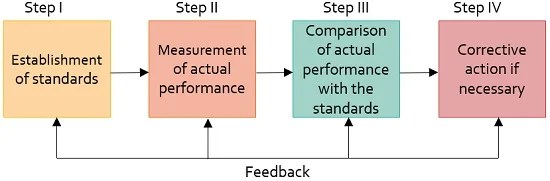
Control Process involves the following Steps as shown in the figure:

The control process involves several key steps:

  1. Establishing Standards

Standards serve as benchmarks for evaluating performance in business functions and are classified into two categories:

  • Measurable (Tangible) Standards: These standards are quantifiable and expressed in terms of cost, output, time, profit, etc.
  • Non-Measurable (Intangible) Standards: These cannot be quantified monetarily. Examples include manager performance, employee attitudes, and workplace morale.

Establishing these standards simplifies the control process, as control is exercised based on them.

  1. Measurement of Actual Performance

The second step is assessing actual performance levels to identify deviations from established standards. Measuring tangible standards is generally straightforward, as they can be quantified easily. However, evaluating intangible standards, such as managerial performance, can be challenging and may rely on factors like:

  • Employee attitudes
  • Workforce morale
  • Improvements in the work environment
  • Communication with superiors

Performance measurement may also be supported by various reports (weekly, monthly, quarterly, or yearly).

  1. Comparison of Actual Performance with Standards:

Comparing actual performance against planned targets is crucial. A deviation is defined as the gap between actual and planned performance. Managers need to identify two key aspects:

  • Extent of Deviation: Is the deviation positive, negative, or aligned with expectations?
  • Cause of Deviation: Understanding why deviations occurred is vital for effective management.

Managers should focus on critical deviations while overlooking minor ones. For instance, a 5-10% increase in stationery costs may be considered minor, whereas a continuous decline in monthly production signifies a major issue.

Common causes of deviations:

  • Faulty planning
  • Lack of coordination
  • Defective plan implementation
  • Ineffective supervision and communication
  1. Taking Corrective Actions

After identifying the extent and causes of deviations, managers must implement remedial measures. They have two options:

  1. Corrective Measures: Address the deviations that have already occurred.
  2. Revision of Targets: If the corrective actions do not align actual performance with planned targets, managers may choose to adjust the targets.

Controlling, Definition, Importance, Nature, Scope, Elements, Limitations

Controlling is a fundamental management function that involves monitoring organizational performance, comparing it against established standards, and taking corrective actions when necessary. It ensures that the organization’s activities align with its goals and objectives. The controlling process includes setting performance standards, measuring actual performance, and evaluating deviations from the standards. Effective controlling helps identify areas for improvement, ensures resource optimization, and enhances decision-making. By providing feedback on performance, controlling enables managers to make informed adjustments to strategies and operations, fostering efficiency and effectiveness in achieving organizational goals.

Definition of Controlling:

  • Henri Fayol:

Fayol, a pioneer in management theory, defined controlling as “the process of verifying whether everything occurs in conformities with the plan adopted, the instructions issued, and the principles established.” This emphasizes the alignment of actual performance with planned objectives.

  • George R. Terry:

Terry defined controlling as “the measurement of accomplishment against standards and the correction of deviation to ensure achievement of organizational objectives.” This highlights the evaluative aspect of controlling in relation to organizational goals.

  • Harold Koontz and Cyril O’Donnell:

They defined controlling as “the function of management which ensures that everything occurs in accordance with the standards established.” This definition stresses the importance of standards in the controlling process.

  • Peter Drucker:

Drucker defined controlling as “the process of measuring performance and taking corrective actions when necessary.” His focus is on performance measurement and the proactive nature of controlling.

  • Luther Gulick:

Gulick described controlling as “the function of management which ensures that organizational goals are met through appropriate actions.” This definition emphasizes the role of controlling in achieving organizational objectives.

  • American Management Association (AMA):

AMA defines controlling as “the process of establishing standards to achieve organizational goals, measuring actual performance against those standards, and taking corrective action when necessary.” This definition encapsulates the overall purpose of the controlling function.

  • Robert J. Mockler:

Mockler defined controlling as “the process of monitoring performance, comparing it with the established standards, and taking corrective action if necessary to ensure that the organization’s objectives are achieved.” This highlights the cyclical nature of controlling in the management process.

Importance of Controlling:

  • Ensures Goal Achievement:

The primary purpose of controlling is to ensure that organizational goals are met. By setting performance standards and measuring actual performance against these benchmarks, managers can identify deviations and take corrective actions, ensuring that the organization remains on track to achieve its objectives.

  • Enhances Efficiency:

Controlling helps to improve the efficiency of organizational processes. By monitoring operations, managers can identify bottlenecks, redundancies, and areas for improvement. This allows for the optimization of resource utilization, reducing waste and improving overall productivity.

  • Facilitates Decision-Making:

Effective controlling provides managers with relevant and timely information about performance. This information is critical for informed decision-making. Managers can analyze trends, identify problems, and evaluate the effectiveness of different strategies, enabling them to make better decisions that align with organizational goals.

  • Promotes Accountability:

Control systems establish clear expectations and performance standards for employees. This promotes accountability, as individuals are aware of the metrics against which their performance will be evaluated. When employees understand that their work is being monitored, they are more likely to take ownership of their responsibilities and strive to meet performance standards.

  • Encourages Continuous Improvement:

Controlling fosters a culture of continuous improvement within the organization. Regular performance assessments and feedback mechanisms encourage employees to seek ways to enhance their work processes, leading to innovation and higher quality outcomes. This proactive approach contributes to long-term organizational success.

  • Identifies Problems Early:

Through ongoing monitoring and evaluation, controlling enables managers to identify potential issues before they escalate into significant problems. Early detection allows for timely interventions, minimizing the impact on operations and helping to maintain organizational stability.

  • Facilitates Coordination:

Controlling ensures that different departments and teams within the organization are working harmoniously toward common goals. By monitoring interdependencies and ensuring that performance aligns with overall objectives, controlling promotes coordination and cooperation among various organizational units.

  • Provides a Basis for Future Planning:

The information gathered during the controlling process serves as valuable input for future planning. By analyzing performance data, managers can assess the effectiveness of previous strategies, identify trends, and make informed projections for the future. This alignment between past performance and future planning helps organizations remain agile and responsive to changing circumstances.

Nature of Controlling:

  • Goal-Oriented:

Controlling is fundamentally concerned with achieving organizational goals. It involves setting performance standards that align with these goals and continuously monitoring progress toward their attainment. By focusing on objectives, controlling ensures that all activities are directed towards fulfilling the organization’s mission.

  • Continuous Process:

Controlling is an ongoing process that occurs throughout the life of an organization. It involves regular monitoring and evaluation of performance, enabling managers to identify deviations and take corrective actions as needed. This continuous nature ensures that organizations remain adaptable to changes and can maintain effective performance.

  • Feedback Mechanism:

One of the critical functions of controlling is to provide feedback on performance. By comparing actual performance with established standards, managers can assess whether goals are being met. This feedback loop is essential for identifying areas for improvement and making informed decisions regarding resource allocation and operational adjustments.

  • Dynamic Function:

Controlling is not a static function; it evolves with the organization and its environment. As organizations face new challenges and opportunities, the controlling process must adapt to reflect changes in strategies, technologies, and market conditions. This dynamism ensures that controlling remains relevant and effective in guiding organizational performance.

  • Involves Decision-Making:

Controlling is closely linked to decision-making processes. Managers must analyze performance data, interpret results, and make decisions about corrective actions when performance deviates from standards. This aspect highlights the importance of analytical skills and judgment in effective controlling, as managers must be able to determine the best course of action based on performance assessments.

  • Universal Applicability:

The principles of controlling apply to all types of organizations, regardless of size or industry. Whether in manufacturing, services, or non-profit sectors, controlling is essential for ensuring that organizational activities are aligned with strategic objectives. This universality underscores the importance of controlling as a core function of management.

  • Emphasizes Efficiency and Effectiveness:

The primary aim of controlling is to enhance organizational efficiency and effectiveness. By monitoring processes and performance, organizations can optimize resource use and improve productivity. Effective controlling helps identify waste, streamline operations, and ensure that activities are conducted in the most efficient manner possible, ultimately contributing to organizational success.

Scope of Controlling:

  • Performance Measurement:

One of the primary scopes of controlling is to measure the actual performance of employees, departments, and the organization as a whole. This involves establishing performance standards and metrics, collecting data on actual performance, and comparing it with the set standards. Performance measurement provides insights into how well an organization is functioning and identifies areas that require improvement.

  • Deviation Analysis:

Controlling involves analyzing deviations between actual performance and planned performance. When discrepancies arise, managers must determine the causes of these deviations. This analysis helps in understanding whether the deviations are due to external factors, such as market conditions, or internal factors, such as operational inefficiencies. By identifying the root causes, organizations can implement corrective actions to address the issues.

  • Corrective Actions:

Based on the analysis of deviations, controlling encompasses the development and implementation of corrective actions. These actions are designed to realign actual performance with established standards and objectives. Corrective measures may include changes in processes, resource reallocation, or additional training for employees. The goal is to ensure that the organization remains on track to achieve its goals.

  • Resource Management:

Controlling plays a critical role in managing organizational resources effectively. This includes financial resources, human resources, and physical assets. By monitoring resource utilization and efficiency, managers can ensure that resources are allocated appropriately, minimizing waste and maximizing productivity. Effective resource management contributes to the overall effectiveness of the organization.

  • Budgetary Control:

A significant aspect of controlling is budgetary control, which involves monitoring the organization’s financial performance against budgeted figures. Managers use budgetary controls to assess spending, revenue generation, and profitability. By analyzing variances between budgeted and actual figures, managers can make informed financial decisions and adjust budgets as necessary to meet organizational objectives.

  • Quality Control:

Controlling also encompasses quality control measures to ensure that products and services meet established quality standards. This includes implementing processes for inspecting and testing outputs, as well as continuous improvement initiatives. Quality control helps organizations maintain high standards, enhance customer satisfaction, and reduce costs associated with defects and rework.

  • Strategic Control:

Controlling extends to strategic control, which involves monitoring the organization’s progress toward achieving its long-term goals and strategic objectives. This includes assessing the effectiveness of strategies, evaluating competitive positioning, and ensuring that the organization adapts to changing market conditions. Strategic control helps organizations remain proactive and responsive in a dynamic business environment.

Elements of Controlling:

  • Setting Performance Standards

The first step in controlling is setting clear and measurable performance standards. These standards serve as a benchmark for evaluating actual performance. They may be quantitative (e.g., sales targets, production levels) or qualitative (e.g., customer satisfaction, employee engagement). Performance standards should be realistic, achievable, and aligned with organizational goals.

  • Measuring Actual Performance

Once performance standards are set, it is essential to measure actual performance. This involves collecting data, tracking results, and monitoring activities to evaluate whether targets are being met. The methods of measurement can vary, such as financial reports, production logs, or customer feedback, depending on the nature of the performance standards.

  • Comparing Actual Performance with Standards

After measuring actual performance, it is compared with the established performance standards. This step helps identify any variances between planned and actual outcomes. If the actual performance exceeds or meets the standards, it indicates success. If there is a shortfall, corrective actions will be needed to bring performance in line with the targets.

  • Analyzing Deviations

When deviations from the set standards are identified, it is important to analyze the causes. These deviations may occur due to various factors such as external influences (market changes, economic conditions), internal inefficiencies (lack of resources, poor management), or human factors (motivation, skills). A thorough analysis of the reasons behind the deviations helps in deciding the appropriate corrective measures.

  • Taking Corrective Actions

Once the reasons for deviations are analyzed, corrective actions should be taken. These actions aim to eliminate the causes of deviations and bring performance back on track. Corrective actions can involve adjusting strategies, reallocating resources, modifying processes, or enhancing employee training. The effectiveness of corrective actions should also be monitored to ensure continuous improvement.

  • Feedback and Adjustments

The final element of controlling is the feedback loop. After taking corrective actions, it’s crucial to gather feedback to assess their effectiveness. Based on feedback, further adjustments may be needed. Continuous monitoring and adjustment ensure that performance standards are kept relevant and that the organization stays on course to achieve its objectives.

Limitations of Controlling:

  • Inflexibility:

Controlling can lead to rigidity in an organization. Overemphasis on control mechanisms may result in inflexible procedures, stifling creativity and innovation. Employees may feel constrained by strict guidelines and metrics, which can hinder their ability to adapt to changing circumstances or propose new ideas.

  • Costly Process:

Implementing a comprehensive control system can be expensive. The costs associated with setting up control measures, monitoring performance, and conducting audits can strain organizational resources. Small businesses, in particular, may find it challenging to allocate sufficient funds for effective control systems.

  • Time-Consuming:

The controlling process can be time-consuming. Collecting data, analyzing performance, and implementing corrective actions require considerable time and effort from managers and employees. This time investment may distract from other critical activities and delay decision-making processes.

  • Subjectivity in Evaluation:

Controlling often involves subjective judgment in performance evaluation. Managers may rely on their interpretations of data, which can lead to bias and inconsistencies in assessing employee performance. This subjectivity can create misunderstandings, conflicts, and decreased morale among staff.

  • Limited Scope:

Control systems may focus primarily on quantitative measures, neglecting qualitative factors such as employee satisfaction, teamwork, and organizational culture. A narrow focus on numbers can overlook important aspects of performance that contribute to overall success.

  • Resistance to Control:

Employees may resist control measures due to perceived threats to their autonomy and job security. This resistance can result in a lack of cooperation, reduced morale, and a negative organizational climate. Overly strict control measures can lead to disengagement and decreased productivity among staff.

  • Delayed Feedback:

In some cases, feedback from control systems may be delayed, making it challenging to address issues promptly. If performance data is not available in real-time, managers may miss opportunities to make timely corrections, allowing problems to escalate.

  • Overreliance on Control Systems:

Organizations may become overly dependent on control systems, leading to a lack of initiative and accountability among employees. When individuals feel that their work is constantly monitored, they may become less proactive and less willing to take risks, ultimately affecting overall performance.

Management by Exception (MBE), Steps, Advantages and Limitations

Management by Exception (MBE) is a management approach where leaders focus on significant deviations from set standards or expected outcomes, rather than on routine operations. Managers intervene only when performance significantly deviates from targets, either exceeding or falling short of expectations. This allows them to concentrate on critical issues that require attention, while routine matters are handled by subordinates. MBE improves efficiency by reducing the time managers spend on day-to-day activities and encourages employee autonomy. It ensures effective resource allocation and quick response to major problems or opportunities.

Steps of Management by Exception (MBE):

  1. Set Clear Objectives and Performance Standards

The first step in MBE is to establish clear organizational goals and performance standards. These benchmarks provide a basis for evaluating results and identifying exceptions. The standards must be measurable, relevant, and aligned with the company’s strategic objectives. Employees should be well-informed about these expectations to ensure understanding and compliance.

  1. Measure Actual Performance

Once the objectives and standards are set, managers need to continuously monitor and measure actual performance. This involves collecting data from various sources, such as reports, audits, or performance reviews, to ensure accurate and timely measurement of employee or departmental outputs. The performance data should be transparent and easily accessible to facilitate ongoing monitoring.

  1. Compare Performance Against Standards

In this step, managers compare the measured performance against the set standards. The goal is to identify any significant deviations that require attention. This comparison helps determine whether performance is on track or if there are substantial differences that necessitate intervention.

  1. Identify Exceptions

Managers focus only on deviations that are significant enough to be considered exceptions. These exceptions could be positive, such as exceeding sales targets, or negative, such as underperforming in a key area. Identifying exceptions helps managers concentrate on the most critical areas, while routine matters are handled by employees.

  1. Analyze the Cause of Exceptions

Once exceptions are identified, managers analyze the underlying causes of the deviations. This involves investigating whether the exception was caused by internal factors, such as inadequate resources or poor planning, or external factors, such as market changes. Understanding the root cause is essential for developing appropriate corrective actions.

  1. Take Corrective Action

After identifying the cause of exceptions, managers take corrective action to resolve the issue. The nature of the corrective action will depend on the severity and type of deviation. It could involve reallocating resources, providing additional training, revising strategies, or making adjustments to the performance standards.

  1. Monitor Results of Corrective Action

Once corrective measures are implemented, the next step is to monitor the results to ensure the actions have successfully addressed the exception. This continuous monitoring helps prevent future deviations and ensures that the organization remains on track toward achieving its goals.

  1. Review and Adjust Standards (if necessary)

In some cases, the performance standards themselves may need adjustment. If the deviation is not due to employee performance but rather unrealistic or outdated standards, managers may need to revise the objectives or benchmarks to reflect changing circumstances. This step ensures that the standards remain relevant and achievable.

Advantages of Management by Exception (MBE):

  1. Efficient Use of Managerial Time

One of the primary advantages of MBE is that it saves time for managers by allowing them to focus on critical issues instead of routine matters. Managers only step in when performance deviates significantly from the plan, which frees them from constantly micromanaging every aspect of operations. This selective attention helps in better time management and ensures that their focus is directed where it is most needed.

  1. Promotes Employee Autonomy

MBE encourages employees to take responsibility for day-to-day operations, as managers intervene only when necessary. Employees gain autonomy over routine tasks, which can boost their confidence, decision-making abilities, and job satisfaction. This empowerment of employees leads to increased accountability and promotes a sense of ownership over their work.

  1. Encourages Better Decision-Making

Since MBE focuses on exceptions or significant deviations, it ensures that managerial attention is drawn to issues that require immediate decision-making. This system of management helps managers make quicker and more informed decisions about critical matters, leading to timely corrective actions. It also helps in prioritizing the most pressing concerns, thus improving overall decision-making efficiency.

  1. Increased Productivity

By allowing employees to handle regular tasks independently and focusing managerial attention on significant issues, MBE can enhance productivity. Managers are not bogged down by routine matters and can concentrate on strategic activities, which in turn improves overall organizational efficiency. This division of focus also ensures that employees perform their tasks with minimal supervision, leading to a smoother workflow.

  1. Reduction in Information Overload

MBE reduces the burden of information overload for managers. Since they are only required to intervene when performance falls outside established norms, they receive fewer reports and updates about routine activities. This selective information flow allows managers to concentrate on critical reports, reducing unnecessary data handling and simplifying decision-making.

  1. Effective Resource Allocation

By focusing on significant deviations from the norm, MBE ensures that resources—both human and financial—are allocated efficiently. Managers can direct resources towards solving key issues or seizing important opportunities, rather than wasting them on minor adjustments. This strategic allocation of resources helps in optimizing organizational performance.

  1. Improved Control Mechanism

MBE establishes a clear control mechanism by setting performance standards and monitoring outcomes. Managers can quickly identify areas of concern and take corrective actions when deviations occur. This ensures that problems are addressed before they escalate, maintaining better control over operations and ensuring adherence to goals and policies.

  1. Encourages Focus on Strategic Issues

Since MBE directs managerial attention to exceptions, it ensures that managers focus on strategic issues that require intervention. This ability to concentrate on important matters allows for more effective long-term planning, risk management, and opportunity exploitation. It aligns managerial efforts with the organization’s strategic objectives, promoting growth and competitiveness.

Limitations of Management by Exception (MBE):

  1. Overlooking Minor issues

MBE’s focus on significant deviations can lead to the neglect of minor problems that, if left unresolved, may escalate into larger issues. These small discrepancies might seem insignificant but can compound over time, eventually affecting overall performance or creating inefficiencies in processes.

  1. Delayed Managerial Intervention

One of the potential downsides of MBE is that by waiting for deviations to become significant, managers may respond too late. This delay in intervention might cause problems to worsen before they are addressed. Timely management involvement is crucial, but MBE may cause managers to overlook issues until they require immediate attention.

  1. Dependence on Pre-Established Standards

MBE relies heavily on pre-established performance standards or benchmarks. If these standards are outdated or inappropriate, the entire system of exception management may fail. Poorly set benchmarks can lead to either excessive managerial intervention or insufficient control over processes.

  1. Employee Demotivation

Employees may feel demotivated or neglected under MBE, as managers only step in when there are issues. Without consistent feedback and engagement, employees might feel undervalued or ignored. This can reduce motivation and lower job satisfaction, ultimately affecting overall productivity.

  1. Limited Managerial Involvement in Daily Operations

MBE encourages minimal involvement in routine operations. While this can increase efficiency, it also means that managers might lose touch with day-to-day activities. Lack of involvement in operational matters could result in managers being disconnected from the realities faced by employees, leading to ineffective decision-making when intervention is required.

  1. Potential for Over-Reliance on Technology

In many MBE systems, technology is used to monitor performance and detect deviations. This reliance on technology can create issues if the systems fail or produce inaccurate data. Over-reliance on technology may also lead to a reduction in the human element of management, weakening the ability to understand the nuances of workplace dynamics.

  1. Reactive Rather than Proactive Management

MBE is inherently reactive, meaning that managers wait for problems to arise before acting. This reactive approach can hinder the organization’s ability to proactively address potential risks or exploit emerging opportunities. Being proactive is essential for long-term success, but MBE may limit this forward-thinking capability.

  1. Challenges in Defining “Exception”

Determining what constitutes a significant exception can be challenging. Different departments or managers may have varying thresholds for what they consider an exception, leading to inconsistency in when interventions are triggered. This inconsistency can create confusion and reduce the effectiveness of MBE.

  1. Stifling Innovation

MBE’s emphasis on conformity to standards may stifle creativity and innovation. Employees may focus solely on meeting established benchmarks, avoiding risks or new ideas to prevent deviations. This could limit opportunities for improvement and hinder the organization’s ability to innovate and adapt to changing environments.

Control, Meaning, Definition, Types, Process and Requirements for Effective Control

Control is an important function of management concerned with ensuring that organizational activities are performed according to planned objectives and standards. It involves measuring actual performance, comparing it with predetermined standards, identifying deviations, and taking corrective action when necessary. Control helps managers determine whether plans are being properly implemented and whether organizational resources are being used efficiently. It is closely related to planning, because control evaluates actual performance against planned performance. Effective control does not merely identify mistakes; it also helps prevent future deviations and improve organizational performance. Therefore, control ensures that managerial efforts remain directed toward achieving organizational goals.

Definition of Control

Control has been defined by different management thinkers in various ways:

  • Henry Fayol: “Control consists in verifying whether everything occurs in conformity with the plan adopted, the instructions issued and principles established.”
  • Koontz and O’Donnell: Control is the measurement and correction of performance in order to ensure that enterprise objectives and plans devised to attain them are accomplished.
  • George R. Terry: Control is determining what is being accomplished, evaluating the performance, and, if necessary, applying corrective measures so that performance takes place according to plans.

Types of Control

  • Feed-Forward Controls

These controls are proactive, aiming to identify and address potential problems before they arise. They can be diagnostic (indicating what has deviated from standards) or therapeutic (explaining why deviations occurred and recommending corrective actions).

  • Concurrent (Prevention) Control

This type of control allows for adjustments during an ongoing process. By establishing clear job descriptions and specifications, concurrent controls prevent errors before they happen, improving overall efficiency.

  • Feedback Controls

Feedback controls are historical and assess performance after the fact. They focus on end results and provide information for future activities to avoid repeating past mistakes.

Controlling Process in Business Management

  • Setting Performance Standards

The first step involves establishing benchmarks for measuring actual performance, which can be quantitative (e.g., revenue targets) or qualitative (e.g., improving employee motivation).

  • Measurement of Actual Performance

After setting standards, actual performance is measured using various techniques, such as performance reports, financial ratios, and direct observation.

  • Comparing Actual Performance with Standards

This step involves evaluating actual results against the established standards to identify any deviations.

  • Analyzing Deviations

Significant deviations warrant urgent management attention, while minor deviations can be addressed later. Techniques such as critical point control and management by exception are useful in this phase.

  • Taking Corrective Action

If deviations exceed acceptable limits, management must implement corrective measures to align performance with standards, focusing particularly on critical areas that impact overall business success.

Control Techniques

Control Techniques are methods used by managers to ensure that organizational goals are achieved effectively and efficiently. They involve measuring actual performance against established standards, identifying deviations, and implementing corrective actions. Common control techniques include direct supervision, financial analysis, budgetary control, and management information systems. These techniques help organizations monitor operations, assess performance, and make informed decisions, ultimately facilitating continuous improvement and ensuring that objectives are met within the desired timeframe and resource constraints.

Types of Control Techniques

  • Direct Supervision and Observation

This is the oldest technique of controlling, where supervisors observe employees directly during their work. This method allows supervisors to address issues in real-time and gain firsthand insights into employee performance. It’s particularly effective in small businesses where close interaction is feasible.

  • Financial Statements

Organizations prepare Profit and Loss Accounts and Balance Sheets to summarize financial performance over specific periods. These statements help compare current figures with previous years and facilitate ratio analysis, which assesses profitability, liquidity, and solvency.

  • Budgetary Control

Budgetary control involves the establishment of budgets for various business aspects, including income, expenditures, production, and capital. It serves as a managerial control tool, enabling businesses to monitor financial performance against planned budgets.

  • Break-Even Analysis

Break-Even Analysis identifies the point at which total revenues equal total costs, meaning no profit or loss is incurred. By determining this point, businesses can assess performance and make necessary adjustments to improve future outcomes.

  • Return on Investment (ROI)

ROI measures the profitability of investments in fixed assets and working capital. A high ROI indicates strong financial performance, while a low ROI highlights areas needing improvement. It allows for performance comparisons over time and between firms.

  • Management by Objectives (MBO)

MBO is a collaborative process where objectives are set jointly by superiors and subordinates. It includes periodic evaluations and feedback, ensuring that individual performances are assessed against established goals, which can lead to rewards for achievement.

  • Management Audit

Management audit evaluates the entire management process, including planning, organizing, directing, and controlling. Conducted by experts, it assesses efficiency by analyzing plans, objectives, policies, and procedures, providing insights into managerial performance.

  • Management Information System (MIS)

MIS collects and processes accurate information about internal operations and external environments. By providing managers with relevant data, it supports informed decision-making and allows for effective delegation without losing control.

  • PERT and CPM Techniques

Program Evaluation and Review Technique (PERT) and Critical Path Method (CPM) focus on the sequential completion of activities within a project. These techniques help manage time and resources effectively, ensuring timely project completion.

  • Self-Control

Self-control empowers individuals to set their own targets and evaluate their performance independently. While it’s crucial for top-level managers, subordinates should also be encouraged to adopt self-control to reduce the burden of constant oversight by superiors.

Requirements for Effective Control

1. Clear Objectives and Standards

Effective control requires clearly defined organizational objectives and performance standards. Managers must know what results are expected before actual performance can be measured. Standards should be specific, realistic, measurable, and related to organizational goals. Clear standards provide a basis for comparing actual performance and identifying deviations. They also help employees understand the level of performance expected from them. Without proper standards, control becomes uncertain and managers may find it difficult to determine whether activities are progressing satisfactorily.

2. Accurate and Reliable Information

Effective control depends on accurate, relevant, and reliable information about organizational performance. Managers need timely information regarding production, sales, costs, employee performance, quality, and other important activities. Incorrect or incomplete information can lead to inappropriate decisions and ineffective corrective action. Therefore, organizations should establish reliable reporting and information systems. Proper information enables managers to identify deviations accurately and take suitable action before problems become serious.

3. Timely Reporting

Control should provide timely information and reports to managers. Information received too late may lose its usefulness because corrective action may no longer be effective. Managers should receive performance reports at appropriate intervals depending on the nature of the activity. For example, critical production activities may require frequent monitoring, while routine activities may be reviewed periodically. Timely reporting enables management to identify problems quickly and respond before deviations significantly affect organizational performance.

4. Flexibility

An effective control system should be flexible enough to adjust to changes in organizational conditions. Business environments may change because of technology, competition, customer preferences, economic conditions, or government policies. Rigid control systems may become unsuitable when circumstances change. Managers should therefore be able to modify standards, procedures, and methods when necessary. Flexible control enables organizations to respond to changing conditions while continuing to maintain appropriate performance standards.

5. Economy and Cost Effectiveness

The control system should be economical and cost-effective. The cost of establishing and operating control mechanisms should not exceed the benefits obtained from them. Organizations should concentrate control efforts on important activities where deviations can significantly affect performance. Excessive monitoring can waste time, money, and managerial resources. An economical control system provides useful information and effective supervision while keeping administrative costs within reasonable limits.

6. Simplicity

An effective control system should be simple and easy to understand. Employees and managers should be able to understand the standards, procedures, reports, and methods used for controlling performance. Complicated control systems may create confusion, increase administrative work, and reduce employee cooperation. Simple procedures make it easier to identify deviations and take corrective action. Therefore, control mechanisms should be designed according to the organization’s size, activities, and managerial requirements.

7. Focus on Critical Areas

Effective control requires managers to concentrate on critical areas and significant deviations. It is not practical or necessary to monitor every activity with the same level of attention. Managers should identify key areas where performance has a major effect on organizational objectives, such as costs, quality, productivity, sales, and customer satisfaction. The exception principle can be applied by giving greater attention to significant deviations. This allows managers to use their time and resources efficiently.

8. Corrective Action

The purpose of control is not simply to identify deviations but to ensure appropriate corrective action. When actual performance differs significantly from standards, managers should determine the causes and take suitable measures. Corrective action may involve changing methods, reallocating resources, providing employee training, revising schedules, or modifying plans. A control system is effective only when identified problems lead to meaningful improvements in performance and help the organization return toward its planned objectives.

Organizing, Principles, Nature, Significance, Limitations

Organizing is a fundamental management function that involves arranging resources and activities in a structured way to achieve the organization’s objectives efficiently. It includes identifying and grouping tasks, assigning roles, delegating authority, and allocating resources. Through organizing, a clear framework is established that defines the responsibilities and relationships within the organization, ensuring that all efforts are coordinated toward common goals. This process helps streamline operations, improve communication, and enhance the overall effectiveness of the workforce by aligning human, financial, and material resources with the organization’s strategy.

Principles of Organizing:

Principles of Organizing serve as guidelines for managers to structure resources and activities effectively within an organization. These principles ensure that the organization operates efficiently and achieves its objectives.

  1. Division of Work

This principle involves breaking down tasks into smaller, manageable activities. Specialization allows employees to focus on specific tasks, improving productivity and efficiency.

  1. Unity of Command

Each employee should report to only one superior to avoid confusion, overlapping instructions, and conflicts, ensuring clear accountability.

  1. Unity of Direction

All activities related to the same goal should be directed by one manager using one plan. This ensures that the team works toward the same objectives in a coordinated manner.

  1. Authority and Responsibility

Authority is the right to make decisions and issue commands, while responsibility is the obligation to carry out duties. There must be a balance between the two, with authority aligned with responsibility for efficient functioning.

  1. Delegation of Authority

Delegation involves assigning tasks and granting the necessary authority to subordinates. Proper delegation allows managers to focus on higher-level tasks, while empowering subordinates to make decisions.

  1. Chain of Command

The chain of command is the clear line of authority within an organization, from the top management to the lowest ranks. It establishes communication channels and maintains order.

  1. Span of Control

This principle defines the number of subordinates that a manager can effectively oversee. A manageable span of control helps ensure better supervision and communication.

  1. Coordination

Organizing involves aligning all efforts and resources within an organization to ensure smooth collaboration between departments and employees, preventing conflicts and duplication of efforts.

  1. Flexibility

The organizational structure should be flexible enough to adapt to changes in the environment, allowing the organization to respond efficiently to new challenges and opportunities.

  1. Scalar Principle

There should be a clear and direct line of authority from the top management to every individual at the bottom of the hierarchy, ensuring that decisions and instructions flow seamlessly.

  1. Simplicity

The organizational structure should be simple and easy to understand, avoiding unnecessary complexity that could lead to confusion and inefficiency.

  1. Balance

There must be a balance between centralization and decentralization. Some decisions should be made at higher levels, while others can be delegated to lower levels, ensuring effective control and operational flexibility.

Nature of Organizing:

  1. Goal-Oriented Process

Organizing is inherently a goal-oriented process. The primary purpose of organizing is to arrange resources and activities in a way that helps the organization achieve its objectives. It involves identifying what needs to be done, how tasks will be grouped, and how resources will be allocated to accomplish specific goals. Without clear goals, the organizing function loses direction.

  1. Specialization and Division of Labour

One of the defining characteristics of organizing is the division of labor and specialization. This concept involves breaking down the overall work into smaller, manageable tasks, each assigned to individuals or departments based on their expertise. Specialization leads to increased efficiency, as employees can focus on specific tasks in which they excel, fostering greater productivity and quality.

  1. Hierarchy and Authority

Organizing establishes a clear hierarchy within the organization, defining roles, responsibilities, and lines of authority. This hierarchy ensures that there is a well-defined chain of command, allowing for proper communication, delegation of tasks, and control. The hierarchical structure promotes accountability, as every individual knows their responsibilities and to whom they are accountable.

  1. Coordination of Efforts

Organizing also focuses on coordinating the efforts of different departments and individuals to ensure that the organization functions harmoniously. Without coordination, different units may work in isolation, leading to inefficiencies, duplication of efforts, and potential conflicts. A well-organized structure ensures that all parts of the organization are aligned toward common objectives and work in unison.

  1. Flexibility

While organizing creates a structured framework for the organization, it must also be flexible enough to adapt to changing conditions. Businesses operate in dynamic environments where market conditions, technology, and customer needs can change rapidly. A rigid structure may hinder an organization’s ability to respond effectively to new challenges. Flexibility ensures that the organization can reorganize resources, roles, and processes when necessary to stay competitive.

  1. Delegation of Authority

Delegation is a crucial part of organizing. Managers cannot do everything themselves, so they need to delegate tasks and authority to subordinates. Delegation involves giving others the responsibility and authority to perform certain tasks, allowing managers to focus on more strategic activities. It promotes empowerment and accountability at different levels within the organization.

Significance of Organizing:

  1. Efficient Resource Utilization

Organizing helps in the optimal allocation and use of resources, including human, financial, and material assets. By dividing work into specific tasks and assigning these tasks to the right people or departments, organizing ensures that resources are used in the most productive manner. This prevents wastage, reduces duplication of efforts, and maximizes output, ensuring that resources contribute directly to achieving organizational goals.

  1. Clear Hierarchy and Structure

Organizing creates a well-defined structure within the organization, establishing clear lines of authority, roles, and responsibilities. This hierarchy ensures that every employee knows their position in the organizational framework, who they report to, and their specific duties. Clear authority and accountability prevent confusion, enhance coordination, and streamline decision-making processes, resulting in smoother operations.

  1. Improves Communication

Effective organizing promotes clear communication within the organization. With clearly defined roles, responsibilities, and relationships, the flow of information becomes more structured. Organizing facilitates vertical and horizontal communication, ensuring that important information reaches the right people on time. This reduces misunderstandings and fosters better coordination between departments and teams.

  1. Facilitates Coordination

One of the primary objectives of organizing is to ensure that all departments, teams, and individuals work in harmony to achieve common goals. Organizing brings together various efforts by coordinating tasks and resources. It aligns the activities of different units, ensuring that they do not operate in isolation or at cross-purposes. This coordination is essential for avoiding duplication of efforts and achieving efficiency in operations.

  1. Promotes Specialization

Through division of labor and specialization, organizing ensures that individuals focus on tasks suited to their skills and expertise. This specialization enhances proficiency, reduces learning time, and increases the overall quality of work. By assigning tasks based on skills, organizing improves job performance and satisfaction, as employees are better able to contribute effectively.

  1. Flexibility and Adaptability

Organizing provides a flexible structure that can be adjusted according to changing business environments. An effective organizing system allows an organization to respond quickly to market changes, new technologies, and external challenges by reallocating resources, modifying roles, and introducing new processes. This adaptability is essential for staying competitive in a dynamic market.

  1. Fosters Growth and Innovation

A well-organized structure encourages innovation and business expansion. By ensuring clear responsibilities and efficient coordination, organizing frees up time for managers and employees to focus on creative thinking and long-term planning. A flexible and structured environment supports experimentation and the development of new ideas, contributing to the organization’s overall growth and success.

Limitations of Organizing:

  1. Inflexibility

One of the major limitations of organizing is the rigid structure it can create. Once roles, responsibilities, and hierarchies are established, it can be challenging to make adjustments. This rigidity makes it difficult for the organization to adapt quickly to changes in the business environment, such as shifts in customer preferences, new technologies, or market conditions.

  1. Over-Specialization

While specialization leads to efficiency, over-specialization can cause problems. When tasks are divided too narrowly, employees may become too focused on their specific roles, losing sight of the broader organizational goals. This narrow focus can result in a lack of innovation, reduced flexibility, and difficulty in adapting to new responsibilities outside their specialization.

  1. Coordination Challenges

Although organizing aims to promote coordination, in large and complex organizations, ensuring effective coordination between various departments and teams can be a significant challenge. Different units may have conflicting objectives, creating silos that prevent smooth communication and collaboration. This misalignment can slow down decision-making and lead to inefficiencies.

  1. High Costs

Organizing can sometimes lead to increased costs, particularly when an organization expands or adopts a more complex structure. Costs may arise from the need for more management personnel, more detailed systems of communication, and increased overheads related to maintaining coordination and control across various departments.

  1. Difficulties in Delegation

Effective organizing requires proper delegation of authority. However, in practice, many managers struggle to delegate tasks effectively, either because they are reluctant to give up control or because subordinates may lack the necessary skills. Poor delegation can lead to inefficiencies, overburdening managers and underutilizing the potential of lower-level employees.

  1. Conflict of Authority

In some cases, organizing can lead to confusion about who holds authority in specific situations. When roles and responsibilities overlap, conflicts may arise between managers and employees regarding decision-making power. This can lead to power struggles and hamper the overall efficiency of the organization.

  1. Slow Decision-Making

A well-organized structure often comes with layers of hierarchy. While hierarchy is essential for clarity, it can also slow down decision-making, as decisions may need to pass through multiple levels of approval. This can be particularly problematic in fast-moving industries where quick decisions are critical.

  1. Resistance to Change

Employees and managers often become accustomed to their roles and responsibilities within a particular organizational structure. When changes in the structure are necessary, such as during restructuring or reorganization, resistance to change can emerge. This resistance can slow down the transition process and hinder the organization’s ability to adapt.

  1. Lack of Innovation

An overly rigid organizational structure can stifle creativity and innovation. When employees are confined to specific roles with limited cross-functional interaction, they may have fewer opportunities to share new ideas or explore innovative approaches. This can hinder the organization’s ability to develop new products, services, or processes.

Evolution of Management Thoughts: Pre-Scientific Management Era and Modern Management Era

The evolution of management thought has undergone significant changes over time, from the early traditional practices to the structured and scientific approaches seen in modern management. This development can be broadly classified into two key eras: Pre-Scientific Management Era and the Modern Management Era.

Pre-Scientific Management Era

The Pre-Scientific Management Era refers to the period before the advent of scientific management principles, which was largely informal and based on trial and error, experience, and traditional practices.

Key Characteristics:

  • Craftsmanship and Manual Work:

In ancient civilizations, such as in Egypt, Greece, and Rome, management practices were rudimentary. The focus was on craftsmanship and manual labor, often passed down through apprenticeships. Workers learned their trades on the job under the supervision of masters or foremen.

  • Division of Labor:

Although not as systematic as in modern times, there was some recognition of division of labor. For example, the assembly line in the production of weapons or monuments used a division of labor, albeit in a less efficient manner compared to modern standards.

  • Rule of Thumb and Tradition:

Management was largely informal and based on “rule of thumb,” with each organization functioning under traditional practices handed down through generations. There was little standardization or systematic approach to the management of resources.

  • Top-Down Approach:

In ancient and medieval organizations, authority was largely centralized, with decision-making concentrated at the top. The owner, king, or manager made decisions with little input from subordinates.

Examples:

  • Egyptian Pyramids Construction:

The construction of pyramids in ancient Egypt is an example of management practices prior to the scientific approach. It involved large numbers of workers, rudimentary planning, and a hierarchical structure.

  • Medieval Guilds:

During the medieval period, guilds played a significant role in the management of craft industries, with a focus on quality control, training, and apprenticeship.

Modern Management Era (Scientific Management and Beyond)

The Modern Management Era, starting in the late 19th and early 20th centuries, brought about more formalized and systematic approaches to management. This era saw the rise of scientific management and various management theories that laid the foundation for contemporary management practices.

Characteristics:

  • Scientific Management:

The most notable contribution to the Modern Management Era was the development of scientific management, spearheaded by Frederick W. Taylor. His principles aimed at improving productivity by scientifically analyzing tasks and optimizing work processes. Taylor’s approach emphasized standardization, specialization, time studies, and efficiency in the workplace.

  • Administrative Management:

Another major development came from Henri Fayol, who introduced the administrative theory of management. Fayol emphasized the importance of functions such as planning, organizing, commanding, coordinating, and controlling. He is known for outlining 14 Principles of Management, which form the foundation for modern managerial practices.

  • Behavioral Management Theories:

Moving beyond scientific management, the human relations movement led by Elton Mayo and others emphasized the importance of human behavior in the workplace. The Hawthorne studies revealed that employee motivation and satisfaction could enhance productivity. This led to a more human-centered approach to management, focusing on teamwork, leadership, and organizational culture.

  • Systems Theory:

In the mid-20th century, management thinking evolved further with the systems theory, which viewed organizations as complex systems composed of interrelated parts. This theory encouraged managers to consider the organization as a whole rather than focusing on isolated tasks or functions.

  • Contingency Approach:

Contingency theory, developed by scholars like Fred Fiedler and Paul Lawrence, emphasized that there is no one-size-fits-all approach to management. Instead, the best management practices depend on the situation, and managers must adapt their strategies to the specific circumstances they face.

  • Technological and Information Revolution:

In the latter part of the 20th century and into the 21st century, technology and information systems became central to management. The rise of computer systems, the internet, and data analytics has led to an era of e-management and knowledge management, reshaping how decisions are made, how organizations operate, and how they engage with customers.

Notable Figures and Theories:

  • Frederick W. Taylor (Scientific Management): Emphasized efficiency, time-and-motion studies, and optimization of tasks.
  • Henri Fayol (Administrative Management): Developed principles for managerial functions and organizational structure.
  • Elton Mayo (Human Relations): Focused on the impact of social factors and employee well-being on productivity.
  • Max Weber (Bureaucratic Management): Introduced the concept of a formal hierarchical structure with clear rules and responsibilities.

Comparison of Pre-Scientific and Modern Management Eras

Aspect Pre-Scientific Management Era Modern Management Era
Management Approach Informal, based on tradition and experience Formal, systematic, and scientific
Focus Task execution and craftsmanship Efficiency, productivity, and human behavior
Decision-Making Centralized, top-down Decentralized, based on data and analysis
Work Organization Manual labor, apprenticeship Division of labor, specialization, teams
Key Theorists None in the formal sense Taylor, Fayol, Mayo, Weber, etc.

Group Formation and Development

Group development is a dynamic process where groups evolve through various stages as they work together toward common goals. The most widely accepted model of group development is Bruce Tuckman’s “Stages of Group Development”, which outlines five key stages that groups typically go through: Forming, Storming, Norming, Performing, and Adjourning. Each stage represents a different phase of group interaction, and understanding these stages can help optimize group performance and dynamics.

1. Forming (Initial Stage)

The forming stage occurs when a group is first created. During this phase, members are introduced to each other and begin to understand the group’s objectives. The interactions are typically polite, and members are tentative, testing boundaries, and trying to understand their roles. There is little conflict at this stage, as group members are still getting to know one another and are focused on understanding the group’s purpose and structure. Leadership is usually provided by a formal leader or an external facilitator. The group’s success in this stage depends on creating a welcoming environment that fosters open communication and trust-building.

Key Characteristics:

  • Members are polite and cautious.
  • Group goals and roles are unclear.
  • Leadership is directive, as members depend on the leader for guidance.
  • Uncertainty about individual roles and tasks.

2. Storming (Conflict Stage)

The storming stage is characterized by conflict and competition as group members start to assert their individuality. Differences in ideas, working styles, and values become apparent, leading to disagreements and tensions. This stage is often marked by frustration as members challenge each other’s opinions or question the leadership. Despite the conflict, this stage is essential for group development, as it allows members to work through differences, establish clearer roles, and develop a sense of mutual respect. Effective conflict management and open communication are key to moving through this stage successfully.

Key Characteristics:

  • Increased conflict and disagreements.
  • Individuals assert their ideas and challenge each other.
  • Struggles for power and leadership may emerge.
  • Group cohesion may be low due to conflicts.

3. Norming (Cohesion Stage)

In the norming stage, group members begin to resolve their differences and develop a sense of unity and cohesion. The conflicts that arose in the storming phase are addressed, and the group starts to establish norms, values, and expected behaviors. Communication becomes more open, and collaboration increases as trust builds among members. Roles become clearer, and people understand their responsibilities within the group. Members are more willing to share ideas, give constructive feedback, and support one another in achieving the group’s goals. Leadership is often shared, with members taking on different roles depending on their strengths.

Key Characteristics:

  • Improved communication and cooperation.
  • Group norms, roles, and expectations are established.
  • Greater cohesion and trust among members.
  • The focus shifts toward achieving group goals collaboratively.

4. Performing (High-Functioning Stage)

The performing stage is when the group reaches its peak in terms of productivity, collaboration, and efficiency. At this stage, the group has a clear understanding of its goals, roles, and processes, and members work together harmoniously. There is minimal conflict, and the group’s energy is focused on achieving objectives. Decision-making is collaborative, and members take initiative and contribute actively. Leadership is often shared, and the group operates with high levels of trust, respect, and autonomy. The group is now highly effective at solving problems and executing tasks with minimal supervision.

Key Characteristics:

  • High productivity and goal achievement.
  • Effective collaboration with minimal conflict.
  • Clear roles and responsibilities.
  • Self-directed work with shared leadership.

5. Adjourning (Termination Stage)

The adjourning stage (sometimes called the “mourning” stage) occurs when the group has completed its goals or tasks. At this point, members may feel a sense of loss or sadness as the group disbands or transitions to a new phase. This stage often involves reflection on the group’s accomplishments, celebrating successes, and recognizing individual contributions. If the group was working on a temporary project or task, members will move on to other assignments or groups. It’s important to provide closure and acknowledge the group’s achievements to ensure that members leave with a sense of accomplishment and positive feelings.

Key Characteristics:

  • The group’s tasks are completed.
  • Members experience a sense of closure or loss.
  • Reflection on the group’s accomplishments.
  • Transition or disbandment of the group.

Attitude Meaning, Nature, Types, Components

Attitude is a psychological construct that reflects an individual’s feelings, beliefs, and predispositions toward a person, object, idea, or situation. It influences how one perceives and interacts with their environment, shaping behavior and decision-making. Attitudes are composed of three components: cognitive (beliefs and thoughts), affective (emotions and feelings), and behavioral (actions or intentions). They can be positive, negative, or neutral and are formed through experiences, social influences, and education.

Nature of Attitude:

1. Learned Behavior

Attitudes are not innate but are acquired over time through experiences, education, and interactions.

  • They develop as individuals observe and interpret events in their environment.
  • For instance, a positive experience with teamwork may foster a favorable attitude toward collaboration.

2. Influenced by Social Context

Attitudes are shaped by cultural norms, peer groups, family, and societal values.

  • Socialization plays a critical role in forming attitudes, especially during childhood and adolescence.
  • Media, education, and social institutions further reinforce or challenge these attitudes.

3. Composed of Three Components

Attitudes consist of three interrelated components:

  • Cognitive Component: Beliefs and thoughts about the subject (e.g., “I believe exercise is beneficial”).
  • Affective Component: Emotional reactions (e.g., “I enjoy exercising”).
  • Behavioral Component: Action tendencies or intentions (e.g., “I go to the gym regularly”).

This tri-component model explains how attitudes influence thoughts, feelings, and actions.

4. Dynamic and Flexible

While attitudes can be stable, they are not rigid.

  • They may evolve over time due to new information, experiences, or changes in circumstances.
  • For example, a negative attitude toward technology can shift to positive after learning its benefits.

5. Vary in Intensity and Direction

Attitudes can range from strongly positive to strongly negative, with varying levels of intensity.

  • A person may feel strongly about environmental conservation, displaying active advocacy.
  • Conversely, a neutral or weak attitude may result in indifference.

6. Predict Behavior but Not Always Precisely

Attitudes often guide behavior, but external factors, such as situational constraints or social pressures, can influence actions.

  • For example, someone with a positive attitude toward sustainability might still use non-recyclable products if alternatives are unavailable.

Types of Attitude:

1. Positive Attitude

Positive attitude reflects optimism, hope, and confidence. Individuals with this mindset tend to see opportunities in challenges and maintain a constructive approach to life. They are enthusiastic, motivated, and resilient, making them effective in team environments and problem-solving scenarios. For example, a person with a positive attitude might view a setback as a learning experience rather than a failure.

2. Negative Attitude

Negative attitude is characterized by pessimism, doubt, and resistance to change. Such individuals often focus on problems rather than solutions, leading to reduced productivity and morale. They may resist new ideas or reject feedback, creating friction in personal and professional relationships. This attitude can stem from past failures, low self-esteem, or external influences like a toxic environment.

3. Neutral Attitude

Neutral attitude represents indifference or lack of strong feelings toward a person, object, or situation. Individuals with a neutral attitude neither support nor oppose an idea, often choosing to remain passive. This type of attitude may arise from insufficient knowledge or personal disinterest. While it minimizes conflict, it can also hinder decision-making and active participation.

4. Stereotyped Attitude

Stereotyped attitudes are preconceived notions or beliefs about a group of people, based on characteristics like race, gender, religion, or profession. These attitudes are often formed without direct experience and can lead to biases and discrimination. For instance, believing that a certain gender is better suited for leadership roles reflects a stereotyped attitude. Such attitudes can perpetuate social inequalities and hinder diversity.

5. Ego-Defensive Attitude

An ego-defensive attitude is adopted to protect one’s self-esteem or justify actions. Individuals with this attitude may deny facts or blame others to avoid accountability. For instance, an employee who misses deadlines might develop a negative attitude toward the manager to justify their own shortcomings. This type of attitude, while self-protective, can create conflicts and hinder personal growth.

6. Value-Expressive Attitude

A value-expressive attitude reflects an individual’s core beliefs, values, or principles. It helps individuals express their identity and align with causes they feel strongly about. For example, someone passionate about environmental conservation may actively support eco-friendly initiatives. This attitude is deeply rooted and often serves as a foundation for long-term behavior.

7. Social Attitude

Social attitudes are shaped by societal norms, traditions, and peer influences. These attitudes determine how individuals interact with others in a community setting. For example, a person might adopt a socially positive attitude to conform to group expectations, even if it conflicts with personal beliefs.

Components of Attitudes:

  1. Informational or Cognitive Component

The informational component consists of beliefs, values, ideas and other information a person has about the object. It makes no difference whether or not this information is empirically correct or real. For example, a person seeking a job may learn from his own sources and other employees working in the company that in a particular company the promotion chances are very favourable. In reality, it may or may not be correct. Yet the information that person is using is the key to his attitude about that job and about that company.

  1. Emotional or Affective Component

Informational component sets the stage for the more critical part of an attitude, its affective component. The emotional components involve the person’s feeling or affect-positive, neutral or negative-about an object. This component can be explained by this statement.” I like this job because the future prospects in this company are very good”.

  1. Behavioural Component

Behavioural component consists of the tendency of a person to behave in a particular manner towards an object. For example, the concerned individual in the above case may decide to take up the job because of good future prospects. Out of the three components of attitudes, only the behavioural component can be directly observed. One cannot see another person’s beliefs (the informational component) and his feelings (the emotional component). These two components can only be inferred. But still understanding these two components is essential in the study of organizational behaviour or the behavioural component of attitudes.

The components are illustrated in the following table:

ABC Model of Attitude

All the three components of attitude explained above constitute, what is OF called the ABC model. Here, in the ABC model, the alphabet A stands for Affective component, B for Behavioural and C for the cognitive component. The importance of this model is that to have a proper and thorough understanding of the concept of attitude, all the three components mentioned above must be properly assessed. It is only the behavioural component which can be directly observed, the other two components: affective and cognitive can however only be inferred.

error: Content is protected !!