Porter Five Forces Model

The main purpose of industry analysis, in the context of strategic choice is to determine the industry attractiveness, and to understand the structure and dynamics of the industry with a view to find out the continued relevance to strategic alternatives that are there before a firm.

It follows that, for instance, if the industry is not, or no longer, sufficiently attractive (i.e. it does not offer long-term growth opportunities), then the strategic alternatives that lie within the industry should not be considered. It also means that alternative may have to be sought outside the industry calling for diversification moves.

Porter’s Five Forces is a business analysis model that helps to explain why different industries are able to sustain different levels of profitability. The model was originally published in Michael Porter’s book, “Competitive Strategy: Techniques for Analyzing Industries and Competitors” in 1980.

The model is widely used to analyze the industry structure of a company as well as its corporate strategy. Porter identified five undeniable forces that play a part in shaping every market and industry in the world. The forces are frequently used to measure competition intensity, attractiveness and profitability of an industry or market.

These Forces are:

  1. Threat of New entrants

This force determines how easy (or not) it is to enter a particular industry. If an industry is profitable and there are few barriers to enter, rivalry soon intensifies. When more organizations compete for the same market share, profits start to fall. It is essential for existing organizations to create high barriers to enter to deter new entrants.

  • Low amount of capital is required to enter a market;
  • Existing companies can do little to retaliate;
  • Existing firms do not possess patents, trademarks or do not have established brand reputation;
  • There is no government regulation;
  • Customer switching costs are low (it doesn’t cost a lot of money for a firm to switch to other industries);
  • There is low customer loyalty;
  • Products are nearly identical;
  • Economies of scale can be easily achieved.

New entrants raise the level of competition in an industry and reduce its attractiveness. Threat of new entrants depends on barriers to entry. More barriers to entry reduce the threat of new entrants. Some of the key entry barriers are:

  • Economies of scale

Industries where the fixed investment is high (such as automobiles), yield higher profits with larger scale of operations. In such industries, established players may have economies of scale of production which new entrants will not have, thus acting as a barrier.

  • Capital requirements

Industries that require large seed capital for establishing the business (such as steel) discourage new entrants that cannot invest this amount.

  • Switching costs

Customers may face some switching cost like having to buy new spare parts or train employees to run the new machine, in moving from one company to the other, thus discouraging movement of customers from existing players to new entrants.

  • Access to distribution

Established players may have access to the most efficient distribution channels. Distribution channel members may not tie up with new entrants who pose competition to their existing partners.

  • Expected retaliation

If existing players have large stakes in continuing their business (large investment, substantial revenues, strategic importance), or if they are dominant players, they would retaliate strongly to any new entrant.

  • Brand equity

Existing players have established product reputation and built a strong brand image over the years. New players would find it hard to convince customers to switch over to their offering. To incumbent competitors, industry attractiveness can be increased by raising entry barriers. In fact, one of the main objectives of existing players in the industry is to erect strong entry barriers to prevent new competitors from entering the industry.

  1. Bargaining Power of Suppliers

Strong bargaining power allows suppliers to sell higher priced or low quality raw materials to their buyers. This directly affects the buying firms’ profits because it has to pay more for materials. Suppliers have strong bargaining power when:

  • There are few suppliers but many buyers
  • Suppliers are large and threaten to forward integrate
  • Few substitute raw materials exist
  • Suppliers hold scarce resources
  • Cost of switching raw materials is especially high

Bargaining power of suppliers will be high when:

  • Many buyers and few sellers

There are many buyers and few dominant suppliers. Suppliers would be in a position to charge higher prices or cause instability in supply of essential products. The buyers should develop more suppliers by agreeing to invest in them and helping them with technologies.

  • Differentiated supplies

When suppliers offer differentiated and highly valued components, their bargaining power is higher, since the buyer cannot switch suppliers easily. When many suppliers offer a standardized product, their bargaining power reduces. The buyer should bring the processes that enable the supplier to make differentiated products in-house and buy only standard components from the supplier.

  • Crucial supplies

If the product sold by the supplier is a key component for the buyer, or it is crucial for its smooth operations, then the bargaining power of suppliers is higher. The buyer should always keep the production of key components with itself.

  • Forward integration

When there is a threat of forward integration into the industry by the suppliers, their bargaining power is higher. There is a strong threat of forward integration when the supplier supplies a very crucial part of the final product. The supplier of engines to an automobile maker is in a very strong position to contemplate making automobiles because it already has expertise over a key component of the final product.

  • Backward integration

When there is threat of backward integration by buyers, the bargaining power of suppliers becomes weaker, as the supplier may become redundant if the buyer starts making the same product. The buyer should always have an idea of the technologies that are being employed in making crucial and differentiated products and should be capable of putting together the resources to make these components. Suppliers should always understand that if the buyer is cornered, he will start making the components himself.

  • Level of dependence

When the industry is not a key customer group for suppliers, their bargaining power increases. Buyers are dependent on suppliers, though suppliers do not focus on the customer group. The suppliers can survive even when they stop supplying to the buyers as the major part of their business is coming from some other industry. The buyers should be careful in selecting their suppliers. They should select suppliers who have strong stake in the buyers’ industry and not those who only have peripheral interests in the buyers’ industry.

  1. Bargaining Power of Buyers

Buyers have the power to demand lower price or higher product quality from industry producers when their bargaining power is strong. Lower price means lower revenues for the producer, while higher quality products usually raise production costs. Both scenarios result in lower profits for producers. Buyers exert strong bargaining power when:

  • Buying in large quantities or control many access points to the final customer
  • Only few buyers exist
  • Switching costs to other supplier are low
  • They threaten to backward integrate
  • There are many substitutes
  • Buyers are price sensitive

Higher bargaining power of customers implies that they can seek greater compliance from the companies of the industry.

  • Few dominant customers

When there are few dominant customers and many sellers, customers can exercise greater choice. They also dictate terms and conditions to the supplier. This is true in industrial markets where many suppliers make standard components for a few Original Equipment Manufacturers. The OEMs are able to extract big concessions on price and coerce the suppliers to provide expensive services like just-in-time supplies. The suppliers have to agree to debilitating terms of the buyers if they have to continue to supply to them.

  • Non-differentiated products

If products sold by the players in the industry are standardized, or there are little differences among them, buyers can easily switch over to competitors, increasing their bargaining power. This is increasingly happening in consumer markets. Customers are not able to tell one manufacturer’s product from that of another. The result is that the customers are buying mostly on price and the manufacturers are reducing prices to lure customers.

The problem with such an approach is that with reduced profits, a company’s ability to differentiate its product further goes down. The manufacturer is caught in the spiral of low differentiation-low price-low profits- further low differentiation-further low prices-further low profits. The manufacturer has to break this chain and collect resources to differentiate its product so that it can fetch a higher price and profit.

  • Small proportion of customer’s total purchase

If the product offered by the firm is not important or critical for the customer, the bargaining power of customers is higher. The product may be of a relatively smaller value in the overall disposable income of the customer. This may work out to be to the advantage of the seller.

The customer will not be overly worried if the supplier raises its price by small amount as the slightly increased expenditure will not be a big dent in the income of the customer. As level of economic prosperity rises, manufacturers of packaged foods and other fast moving consumer goods can increase the quality and price of their products. Customers would not mind paying slightly higher prices for better products.

  • Backward integration

Customers may threaten to integrate backward into the industry, and compete with suppliers. This may be a reality in industrial markets but it is very rare in consumer markets. Most customers do not have the resources to start making what they buy.

  • Forward integration

Suppliers can threaten to integrate forward into customers’ industry. The customers have to understand and contain the imminent threat of competition from their suppliers. This threat is meaningless in consumer markets but the threat is real in industrial markets, particularly when the supplier is supplying a key component.

  • Key supplies

The industry is not a key supplying group for buyers. In consumer markets, one manufacturer supplies only a small fraction of his total purchases.

  1. Threat of Substitutes

This force is especially threatening when buyers can easily find substitute products with attractive prices or better quality and when buyers can switch from one product or service to another with little cost. For example, to switch from coffee to tea doesn’t cost anything, unlike switching from car to bicycle.

  • Buyer’s willingness to substitute

Buyers will substitute when the industry’s product is not strongly differentiated, so the buyers will not have developed strong preference for the product. In industrial markets, the product should be either enhancing value of the final product it becomes a part of, or is enhancing the operation of the buyer.

  •  Relative prices and performance of substitutes

If the substitute enhances the operation of the customer without incurring additional costs, substitute product would be preferred.

  • Costs of switching over to substitutes

In industrial markets, if a company has to buy another manufacturer’s product, the company will have to buy new spare parts and will have to train its operations and maintenance staff on the new machine.

The substitute products satisfy the same general need of the customer. The customer evaluates various aspects of the substitute products such as prices, quality, availability, ease of use etc. Relative substitutability of products varies among customers. The threat of substitute products depends on how sophisticated the needs of the buyers are, and how strongly entrenched their habits are. Some people will continue to drink coffee, and will never ever switch to drinking tea, no matter how costly coffee may become.

A company can lower threat of substitute products by building up switching costs, which may be monetary or psychological-by creating strong distinctive brand personalities and maintaining a price differential commensurate with perceived consumer value.

  1. Rivalry among existing competitors

This force is the major determinant on how competitive and profitable an industry is. In competitive industry, firms have to compete aggressively for a market share, which results in low profits. Rivalry among competitors is intense when:

  • There are many competitors
  • Exit barriers are high
  • Industry of growth is slow or negative
  • Products are not differentiated and can be easily substituted
  • Competitors are of equal size
  • Low customer loyalty

The intensity of rivalry between competitors depends on:

  • Structure of competition

An industry witnesses intense rivalry amongst its players, when it has large number of small companies or a few equally entrenched companies. An industry witnesses less rivalry when it has a clear market leader. The market leader is significantly larger than the industry’s second largest player, and it also has a low cost structure.

  • Structure of costs

In an industry which has high fixed costs, a player will cut price to attract competitors’ customers to fill capacity. A player may be willing to price just above its marginal cost, and since the industry’s marginal cost is low, it is not unusual to see price cuts of 50-70 per cent Such price cuts are almost always matched by competitors, because all of them are trying to fill capacity. The inevitable result is a price war.

  • Degree of differentiation

Players of an industry whose products are commoditized will essentially compete on price, and hence price cuts of a player will be swiftly matched by competitors, resulting in intense rivalry. But when players of an industry can differentiate their products, they understand that customers do not associate the industry’s products with a single price, and that the price of a product is dependent on its features, benefits and brand strength. Players of such an industry compete on features, benefits and brand strength, and hence rivalry is less intense. When a player cuts price, its competitor can react by adding more features, providing more benefits, or hiring a celebrity in its advertisements, instead of cutting price.

  • Switching costs

Switching cost is high when product is highly specialized, and when the customer has expended lot of resources and efforts to learn how to use it. Switching cost is also high when the customer has made investments that will become worthless if he uses any other product. Since a customer of a company is not likely to be lured by competitors’ price cuts and other manoeuvres, competitive rivalry is less in such an industry.

  • Strategic objectives

When competitors are pursuing build strategies, they will match the price cuts of a player because they do not want to lose market share to the player who has cut price. Therefore, rivalry will be intense. But when competitors are pursuing hold or harvest strategies, they will not be too keen to match the price cuts of a player, because they are more interested in profits than market share. Therefore, rivalry will be less intense.

  • Exit barriers

When players cannot leave an industry due to factors such as lack of opportunities elsewhere, high vertical integration, emotional barriers or high cost of closing down a plant, rivalry will be more intense. In such an industry, players will compete bitterly as they do not have the option to quit. But, when exit barriers are low, players who are not good enough, or who have found more attractive industries to enter, can exit. With fewer numbers of players in the industry now, rivalry will be less intense.

Although, Porter originally introduced five forces affecting an industry, scholars have suggested including the sixth force: complements. Complements increase the demand of the primary product with which they are used, thus, increasing firm’s and industry’s profit potential. For example, iTunes was created to complement iPod and added value for both products. As a result, both iTunes and iPod sales increased, increasing Apple’s profits.

Red herring prospectus, Components, Process, Importance

Red Herring Prospectus (RHP) is a preliminary document issued by a company that is planning to offer its securities (such as shares or bonds) to the public in an initial public offering (IPO) or other securities offering. The document provides important information about the company, including financial details, business operations, and risks, but it does not include the offer price or the number of securities being issued, which are typically finalized later.

The term “red herring” refers to the red ink used on the cover page of the document to highlight that the document is not the final prospectus and that certain details are yet to be finalized.

Purpose of Red Herring Prospectus:

The primary purpose of a Red Herring Prospectus is to inform potential investors about a company’s offerings, business, and financial situation while the company seeks to finalize the terms of its public offering. The document serves as a tool for initial evaluation by investors and is often used to generate interest in the offering.

Components of a Red Herring Prospectus

A Red Herring Prospectus typically includes several key sections, which help investors assess the offering, even though the final terms are still pending.

  • Company Overview:

RHP provides a comprehensive overview of the company’s history, management, structure, and business model. It outlines the products or services the company offers, its competitive landscape, and its strategic plans for growth.

  • Financial Information:

It includes key financial statements, such as the balance sheet, income statement, and cash flow statement, as well as financial ratios and performance metrics. This section helps investors gauge the company’s financial health, profitability, and potential risks.

  • Risk Factors:

One of the most important sections, the risk factors section, outlines potential risks that investors should be aware of before purchasing securities. These risks could include industry-specific risks, regulatory risks, market competition, and financial uncertainties.

  • Use of Proceeds:

This section explains how the company plans to utilize the funds raised from the offering. The funds might be used for purposes such as expansion, debt repayment, research and development, or working capital.

  • Management and Governance:

RHP contains details about the company’s directors, senior executives, and their experience and qualifications. Information about corporate governance practices, including board composition and committees, is also provided.

  • Offer Details (Preliminary):

RHP includes preliminary details of the offering, such as the size of the issue and the type of securities being offered, but does not specify the final offer price or the exact number of securities. These details will be determined closer to the offering date.

  • Legal and Regulatory Disclosures:

Information about the company’s legal standing, compliance with regulations, and any pending lawsuits or regulatory investigations will be disclosed in the RHP. This is crucial for investors to understand any potential legal or regulatory risks.

  • Underwriting Arrangements:

The underwriting section describes the institutions or banks that will manage the offering process and whether they are acting as lead underwriters. It provides details on underwriting fees, their responsibilities, and the process of distributing the shares to the public.

Red Herring Prospectus vs. Final Prospectus

Red Herring Prospectus is not the final document that investors receive. It is part of the IPO process and is used to generate interest in the offering before all details are finalized. The final prospectus, often referred to as the Prospectus, includes all the necessary details about the offering, including the offer price and the number of securities being issued. The final prospectus is issued once the company has completed its regulatory filing and the offer details are confirmed.

Process of Issuing a Red Herring Prospectus:

  • Preparation and Filing:

The company prepares a Red Herring Prospectus and files it with the regulatory authority (such as the Securities and Exchange Board of India (SEBI) in India or the U.S. Securities and Exchange Commission (SEC) in the United States). This document is made available to the public and investors before the offering.

  • Review by Regulatory Authorities:

The regulatory authorities review the RHP to ensure that all required disclosures are made and that it complies with securities laws. The company may need to make revisions based on feedback from the regulators.

  • Roadshow and Marketing:

After the regulatory approval, the company may conduct a “roadshow,” where the company’s management meets with potential institutional investors to generate interest in the offering. The RHP is typically used during these meetings to provide detailed information about the company.

  • Pricing and Final Prospectus:

After the roadshow, the company finalizes the offer price, the number of securities being issued, and other final terms. A final Prospectus is issued, which includes these finalized details, and the securities are offered to the public.

Importance of Red Herring Prospectus:

  • Transparency:

RHP helps ensure transparency in the process of raising funds through public offerings. By providing crucial financial data, business details, and risk factors, it allows potential investors to make informed decisions.

  • Regulatory Compliance:

The Red Herring Prospectus ensures that the company is in compliance with legal and regulatory requirements. It helps authorities assess whether the offering meets the necessary standards.

  • Investor Confidence:

By making the company’s plans, risks, and financial health publicly available, the RHP fosters investor confidence. Potential investors can assess the viability of the investment and decide whether they wish to participate in the offering.

  • Market Reception:

RHP allows the company to gauge the market’s interest in its securities offering, which can help in determining the final price range and quantity of the securities to be issued.

Environmental Threat and Opportunity Profile (ETOP), Preparation, Dimension, Challenges

Environmental Threat and Opportunity Profile (ETOP) is a strategic management tool used to analyze the external environment of an organization. It involves identifying and assessing the key threats and opportunities that exist in the external environment, including factors such as market trends, regulatory changes, competitive dynamics, technological advancements, and socio-economic factors. ETOP helps organizations understand the forces shaping their industry and anticipate potential challenges and opportunities. By systematically evaluating external factors, organizations can develop strategies to capitalize on opportunities and mitigate threats, thereby enhancing their competitive advantage and long-term sustainability in the market. ETOP analysis is an essential component of strategic planning and decision-making processes for organizations seeking to adapt to changing external conditions.

ETOP Preparation:

  1. Identify External Factors:

Begin by identifying all relevant external factors that could potentially impact the organization’s performance and competitiveness. These factors may include market trends, technological advancements, regulatory changes, economic conditions, social and cultural trends, competitive dynamics, and environmental factors.

  1. Gather Information:

Collect data and information on each external factor identified. This may involve conducting market research, gathering industry reports, monitoring news and publications, analyzing competitor activities, and consulting with experts in the field.

  1. Assess Impact and Significance:

Evaluate the impact and significance of each external factor on the organization. Determine whether each factor represents a threat, an opportunity, or both, and assess the magnitude of its potential impact.

  1. Prioritize Factors:

Prioritize the external factors based on their level of importance and relevance to the organization. Focus on those factors that are most critical and have the greatest potential to affect the organization’s performance and strategic objectives.

  1. Develop Profiles:

Develop separate profiles for threats and opportunities. For each profile, summarize the key external factors, their impact on the organization, and any implications for strategic decision-making.

  1. Strategic Implications:

Analyze the strategic implications of the identified threats and opportunities. Determine how the organization can capitalize on opportunities to gain a competitive advantage and how it can mitigate threats to minimize risks and vulnerabilities.

  1. Integration with Strategy:

Integrate the ETOP findings into the organization’s strategic planning process. Use the insights gained from the analysis to inform the development of strategies and action plans that align with the organization’s goals and objectives.

  1. Regular Review and Update:

Periodically review and update the ETOP to reflect changes in the external environment. Environmental conditions are dynamic, so it’s essential to stay informed and adapt strategies accordingly.

ETOP Dimensions:

  1. Market Trends:

This dimension focuses on trends in the market, such as changes in consumer preferences, demand patterns, industry growth rates, and emerging market segments.

  1. Technological Factors:

This dimension includes advancements in technology that could impact the organization’s operations, products, services, and competitive position. It involves assessing technological trends, innovation cycles, and the adoption of new technologies.

  1. Regulatory and Legal Environment:

This dimension involves analyzing regulatory changes, government policies, laws, and compliance requirements that could affect the organization’s operations, industry standards, and market entry barriers.

  1. Economic Factors:

This dimension encompasses economic conditions such as GDP growth, inflation rates, interest rates, exchange rates, and unemployment levels. It assesses how macroeconomic trends could influence consumer spending, investment decisions, and overall business performance.

  1. Social and Cultural Factors:

This dimension considers societal trends, cultural norms, demographic shifts, lifestyle changes, and societal values that could impact consumer behavior, market demand, and business opportunities.

  1. Competitive Dynamics:

This dimension involves analyzing the competitive landscape, including the actions of competitors, market share dynamics, pricing strategies, product differentiation, and barriers to entry.

  1. Environmental Factors:

This dimension includes environmental trends, sustainability concerns, climate change impacts, and regulations related to environmental protection. It assesses how environmental factors could affect operations, supply chains, and reputational risks.

  1. Global Factors:

This dimension focuses on global trends, international trade policies, geopolitical developments, and economic interdependencies that could influence the organization’s global operations, supply chains, and market opportunities.

ETOP Challenges:

  1. Data Collection and Analysis:

Gathering relevant data on external factors can be challenging, especially when dealing with complex and dynamic environments. Ensuring the accuracy, reliability, and completeness of the data requires thorough research and analysis.

  1. Interconnectedness of Factors:

External factors are often interconnected and can have ripple effects across multiple dimensions. Analyzing the interrelationships between different factors and understanding their combined impact on the organization can be complex.

  1. Subjectivity and Bias:

ETOP analysis involves subjective judgments and interpretations, which can be influenced by the biases and perspectives of individuals conducting the analysis. Ensuring objectivity and minimizing bias is essential for generating reliable insights.

  1. Environmental Uncertainty:

External environment is characterized by uncertainty, volatility, and unpredictability. Factors such as technological advancements, regulatory changes, and market disruptions can create uncertainty and make it challenging to anticipate future developments accurately.

  1. Time and Resource Constraints:

Conducting a comprehensive ETOP analysis requires time, resources, and expertise. Organizations may face constraints in terms of available resources, making it difficult to conduct thorough and timely analyses.

  1. Complexity of External Environment:

External environment is multifaceted and constantly evolving, making it difficult to capture all relevant factors comprehensively. Identifying emerging trends, disruptive technologies, and regulatory changes requires ongoing monitoring and adaptation.

  1. Integration with Strategy:

Translating ETOP findings into actionable strategies and initiatives can be challenging. Aligning the analysis with the organization’s strategic goals and objectives and integrating it into the strategic planning process requires careful consideration and collaboration across departments.

  1. Resistance to Change:

ETOP analysis may reveal threats and challenges that require organizational change and adaptation. Resistance to change from internal stakeholders, such as employees and management, can hinder the implementation of necessary strategic initiatives.

Public, Private, Co-operative Sectors Meaning, Role and Importance

Public Sectors

Public sector refers to government-owned or government-controlled organizations and entities that provide goods and services to the general public. These include government agencies, departments, and enterprises responsible for delivering essential services such as healthcare, education, transportation, and public safety. The public sector operates with the goal of serving the public interest and promoting the welfare of society.

Role of Public Sectors:

  • Service Provision:

Public sectors provide essential services such as healthcare, education, transportation, and utilities to ensure universal access and meet societal needs.

  • Infrastructure Development:

Public sectors invest in and maintain infrastructure such as roads, bridges, airports, and utilities to support economic growth and social development.

  • Regulation and Oversight:

Public sectors regulate industries and enforce laws to ensure fair competition, consumer protection, and environmental sustainability.

  • Employment Opportunities:

Public sectors create jobs and offer stable employment opportunities, contributing to economic stability and reducing unemployment rates.

  • Social Welfare:

Public sectors implement welfare programs, social security systems, and poverty alleviation initiatives to support vulnerable populations and promote social equity.

  • Investment in Research and Innovation:

Public sectors fund research and development initiatives, support innovation, and promote technological advancement to drive economic growth and improve quality of life.

  • Strategic Investments:

Public sectors make strategic investments in key sectors such as healthcare, education, and technology to foster long-term economic competitiveness and prosperity.

  • Public Goods Provision:

Public sectors supply public goods such as national defense, law enforcement, and disaster relief that benefit society as a whole and are not provided adequately by the private sector.

Importance of Public Sectors:

  • Service Provision:

Public sectors ensure the delivery of essential services such as healthcare, education, transportation, and utilities to all members of society, regardless of their ability to pay.

  • Social Equity:

Public sectors promote social equity by providing access to basic services and support to disadvantaged and marginalized populations, reducing inequalities and improving social welfare.

  • Economic Stability:

Public sectors play a vital role in stabilizing the economy through strategic investments, employment generation, and regulation of key industries, contributing to economic growth and resilience.

  • Infrastructure Development:

Public sectors invest in and maintain infrastructure that forms the backbone of economic activity, including roads, bridges, airports, and utilities, supporting productivity and connectivity.

  • Regulation and Oversight:

Public sectors regulate industries, enforce laws, and provide oversight to ensure fair competition, consumer protection, environmental sustainability, and public safety.

  • Innovation and Research:

Public sectors fund research and innovation initiatives, support scientific advancements, and promote technological progress, driving economic development and improving quality of life.

  • National Security:

Public sectors are responsible for ensuring national security through defense, law enforcement, and emergency response services, safeguarding the well-being and sovereignty of the nation.

  • Public Goods Provision:

Public sectors supply public goods such as defense, public safety, and environmental protection that benefit society as a whole and are not adequately provided by the private sector.

Private Sectors

Private Sector comprises privately-owned businesses and enterprises that operate for profit and are not under direct government control. It encompasses a wide range of industries and sectors, including manufacturing, retail, finance, technology, and services. Private sector businesses are driven by market forces and aim to maximize profits and shareholder value. They play a significant role in driving economic growth, creating employment opportunities, and fostering innovation and competition within the economy.

Role of Private Sectors:

  • Economic Growth:

Private sectors drive economic growth by investing capital, creating jobs, and fostering innovation, entrepreneurship, and productivity enhancements.

  • Employment Generation:

Private sectors are major sources of employment, offering job opportunities across various industries and sectors, contributing to poverty reduction and economic stability.

  • Innovation and Technology:

Private sectors spur innovation and technological advancement through research and development, leading to the creation of new products, processes, and services that drive progress and competitiveness.

  • Efficiency and Competition:

Private sectors promote efficiency and competition by operating in a market-driven environment, incentivizing businesses to improve quality, reduce costs, and innovate to meet consumer demands.

  • Wealth Creation:

Private sectors generate wealth by generating profits and returns on investments, stimulating economic activity, and contributing to the accumulation of capital for future growth and development.

  • Corporate Social Responsibility (CSR):

Private sectors engage in CSR initiatives, including philanthropy, environmental sustainability, and community development projects, demonstrating their commitment to social responsibility and contributing to the well-being of society.

Importance of Private Sectors:

  • Economic Growth:

Private sectors are primary drivers of economic growth through investments, entrepreneurship, and productivity improvements, leading to increased GDP and overall prosperity.

  • Job Creation:

Private sectors generate employment opportunities across various industries and sectors, reducing unemployment rates and providing livelihoods for millions of people worldwide.

  • Innovation and Technology:

Private sectors spur innovation and technological advancement by investing in research and development, leading to the creation of new products, services, and processes that drive progress and competitiveness.

  • Efficiency and Competition:

Private sectors operate in a competitive market environment, driving efficiency, quality improvement, and cost reduction to meet consumer demands and stay competitive.

  • Wealth Creation:

Private sectors generate wealth through profit generation, investment returns, and capital accumulation, fueling economic activity and creating opportunities for wealth creation and distribution.

  • Diversification and Specialization:

Private sectors promote diversification and specialization within the economy, leading to the development of niche markets, specialized skills, and competitive advantages that enhance overall economic resilience and competitiveness.

  • Global Trade and Investment:

Private sectors facilitate global trade and investment by expanding market access, fostering international business relationships, and driving cross-border economic integration, contributing to global economic interconnectedness and prosperity.

  • Inclusive Growth:

Private sectors play a vital role in promoting inclusive growth by providing opportunities for entrepreneurship, skills development, and social mobility, contributing to poverty reduction, social cohesion, and shared prosperity.

Co-operative Sector

Co-operative sector consists of enterprises owned and operated by their members, who pool resources and share ownership to meet common needs and objectives. These organizations operate on democratic principles, with members having equal voting rights regardless of their financial contributions. Cooperatives exist in various sectors, including agriculture, finance, retail, housing, and healthcare, and aim to promote economic participation, social cohesion, and community development through collective action and mutual support.

Role of Co-operative Sector:

  • Community Development:

Cooperatives empower communities by providing collective ownership and democratic control over essential services such as agriculture, finance, housing, and healthcare, leading to local economic development and social cohesion.

  • Economic Participation:

Cooperatives promote economic participation by allowing members to pool resources, share risks, and benefit collectively from their cooperative endeavors, fostering financial inclusion and self-reliance.

  • Job Creation:

Cooperatives generate employment opportunities by creating cooperative enterprises and supporting cooperative businesses, particularly in rural and marginalized areas where traditional employment opportunities may be limited.

  • Access to Services:

Cooperatives provide access to essential services such as banking, credit, insurance, healthcare, education, and utilities to underserved populations, improving their quality of life and enhancing social welfare.

  • Empowerment and Capacity Building:

Cooperatives empower members by promoting democratic decision-making, leadership development, and skills training, enabling individuals to actively participate in their economic and social development.

  • Sustainable Development:

Cooperatives promote sustainable development by adopting environmentally friendly practices, promoting resource conservation, and supporting sustainable agriculture, energy, and production methods.

  • Market Access and Fair Trade:

Cooperatives enable small-scale producers and marginalized groups to access markets, negotiate fair prices, and participate in fair trade practices, ensuring equitable distribution of benefits and reducing market vulnerabilities.

  • Social Responsibility:

Cooperatives embody principles of social responsibility and solidarity by prioritizing the well-being of their members, supporting community development initiatives, and contributing to social and environmental sustainability.

Importance of Co-operative Sector:

  • Community Empowerment:

Cooperatives empower communities by providing collective ownership, democratic control, and equitable distribution of benefits, fostering social cohesion, and promoting inclusive development.

  • Economic Participation:

Cooperatives enable members to actively participate in economic activities, pooling resources, sharing risks, and benefiting collectively from their cooperative endeavors, leading to financial inclusion and self-reliance.

  • Job Creation:

Cooperatives create employment opportunities, particularly in rural and marginalized areas, by establishing cooperative enterprises and supporting cooperative businesses, contributing to poverty reduction and economic stability.

  • Access to Essential Services:

Cooperatives provide access to essential services such as banking, credit, insurance, healthcare, education, and utilities to underserved populations, improving their quality of life and enhancing social welfare.

  • Promotion of Sustainable Development:

Cooperatives promote sustainable development by adopting environmentally friendly practices, supporting sustainable agriculture, energy, and production methods, and prioritizing social and environmental responsibility.

  • Market Access for Small Producers:

Cooperatives enable small-scale producers and marginalized groups to access markets, negotiate fair prices, and participate in fair trade practices, ensuring equitable distribution of benefits and reducing market vulnerabilities.

  • Social Responsibility:

Cooperatives embody principles of social responsibility and solidarity by prioritizing the well-being of their members, supporting community development initiatives, and contributing to social and environmental sustainability.

  • Resilience and Stability:

Cooperatives provide a resilient and stable economic model that is less prone to economic shocks and market fluctuations, fostering long-term sustainability and resilience in communities and economies.

Banking System in India

In India the banks and banking have been divided in different groups. Each group has their own benefits and limitations in their operations. They have their own dedicated target market. Some are concentrated their work in rural sector while others in both rural as well as urban. Most of them are only catering in cities and major towns.

Indian Banking System: Structure

Bank is an institution that accepts deposits of money from the public.

Anybody who has account in the bank can withdraw money. Bank also lends money.

Indigenous Banking

The exact date of existence of indigenous bank is not known. But, it is certain that the old banking system has been functioning for centuries. Some people trace the presence of indigenous banks to the Vedic times of 2000-1400 BC. It has admirably fulfilled the needs of the country in the past.

However, with the coming of the British, its decline started. Despite the fast growth of modern commercial banks, however, the indigenous banks continue to hold a prominent position in the Indian money market even in the present times. It includes shroffs, seths, mahajans, chettis, etc. The indigenous bankers lend money; act as money changers and finance internal trade of India by means of hundis or internal bills of exchange.

Disvantages

(i) They are unorganized and do not have any contact with other sections of the banking world.

(ii) They combine banking with trading and commission business and thus have introduced trade risks into their banking business.

(iii) They do not distinguish between short term and long term finance and also between the purpose of finance.

(iv) They follow vernacular methods of keeping accounts. They do not give receipts in most cases and interest which they charge is out of proportion to the rate of interest charged by other banking institutions in the country.

Suggestions for Improvements

(i) The banking practices need to be upgraded.

(ii) Encouraging them to avail of certain facilities from the banking system, including the RBI.

(iii) These banks should be linked with commercial banks on the basis of certain understanding in the respect of interest charged from the borrowers, the verification of the same by the commercial banks and the passing of the concessions to the priority sectors etc.

(iv) These banks should be encouraged to become corporate bodies rather than continuing as family based enterprises.

Structure of Organized Indian Banking System

The organized banking system in India can be classified as given below:

Reserve Bank of India (RBI)

The country had no central bank prior to the establishment of the RBI. The RBI is the supreme monetary and banking authority in the country and controls the banking system in India. It is called the Reserve Bank’ as it keeps the reserves of all commercial banks.

Commercial Banks

Commercial banks mobilise savings of general public and make them available to large and small industrial and trading units mainly for working capital requirements.

Commercial banks in India are largely Indian-public sector and private sector with a few foreign banks. The public sector banks account for more than 92 percent of the entire banking business in India—occupying a dominant position in the commercial banking. The State Bank of India and its 7 associate banks along with another 19 banks are the public sector banks.

Scheduled and Non-Scheduled Banks

The scheduled banks are those which are enshrined in the second schedule of the RBI Act, 1934. These banks have a paid-up capital and reserves of an aggregate value of not less than Rs. 5 lakhs, hey have to satisfy the RBI that their affairs are carried out in the interest of their depositors.

All commercial banks (Indian and foreign), regional rural banks, and state cooperative banks are scheduled banks. Non- scheduled banks are those which are not included in the second schedule of the RBI Act, 1934. At present these are only three such banks in the country.

Regional Rural Banks

The Regional Rural Banks (RRBs) the newest form of banks, came into existence in the middle of 1970s (sponsored by individual nationalized commercial banks) with the objective of developing rural economy by providing credit and deposit facilities for agriculture and other productive activities of al kinds in rural areas.

The emphasis is on providing such facilities to small and marginal farmers, agricultural labourers, rural artisans and other small entrepreneurs in rural areas.

Other special features of these banks are

(i) Their area of operation is limited to a specified region, comprising one or more districts in any state.

(ii) Their lending rates cannot be higher than the prevailing lending rates of cooperative credit societies in any particular state.

(iii) The paid-up capital of each rural bank is Rs. 25 lakh, 50 percent of which has been contributed by the Central Government, 15 percent by State Government and 35 percent by sponsoring public sector commercial banks which are also responsible for actual setting up of the RRBs.

These banks are helped by higher-level agencies: the sponsoring banks lend them funds and advise and train their senior staff, the NABARD (National Bank for Agriculture and Rural Development) gives them short-term and medium, term loans: the RBI has kept CRR (Cash Reserve Requirements) of them at 3% and SLR (Statutory Liquidity Requirement) at 25% of their total net liabilities, whereas for other commercial banks the required minimum ratios have been varied over time.

Cooperative Banks

Cooperative banks are so-called because they are organized under the provisions of the Cooperative Credit Societies Act of the states. The major beneficiary of the Cooperative Banking is the agricultural sector in particular and the rural sector in general.

The cooperative credit institutions operating in the country are mainly of two kinds: agricultural (dominant) and non-agricultural. There are two separate cooperative agencies for the provision of agricultural credit: one for short and medium-term credit, and the other for long-term credit. The former has three tier and federal structure.

At the apex is the State Co-operative Bank (SCB) (cooperation being a state subject in India), at the intermediate (district) level are the Central Cooperative Banks (CCBs) and at the village level are Primary Agricultural Credit Societies (PACs).

Long-term agriculture credit is provided by the Land Development Banks. The funds of the RBI meant for the agriculture sector actually pass through SCBs and CCBs. Originally based in rural sector, the cooperative credit movement has now spread to urban areas also and there are many urban cooperative banks coming under SCBs.

Monetary Policy

Monetary policy refers to the policy of the central bank of a country to regulate and control the volume, cost and allocation of money and credit with the aim of achieving the objectives of optimum levels of output and employment, price stability, balance of payment equilibrium, or any other goal set by the government.

Monetary and fiscal policies are closely interrelated and therefore should be pursued in coordination with each other. Fiscal policy generally brings about changes in money supply through the budget deficit. An excessive budget deficit, for example, shifts the burden of control of inflation to monetary policy. This requires a restrictive credit policy.

On the contrary, a fiscal policy, which keeps the budget deficit at a very low level, frees the monetary authority from the burden of adopting an anti-inflationary monetary policy. The monetary policy can then play a positive role in promoting economic growth by extending credit facilities to development programmes.

In a developing economy like India, appropriate monetary policy can play a positive role in creating conditions necessary full rapid economic growth. Moreover, since these economies are highly sensitive to inflationary pressures, the monetary policy should also serve to control inflationary tendencies by increasing savings by the people, checking credit expansion by the banking system and discouraging deficit financing by the government.

In India, during the planning period, the aim of the monetary policy of the Reserve Bank has been to meet the needs of the planned development of the economy.

With this broad aim, the monetary policy has been pursued to achieve the twin objectives of the economic policy of the government:

(a) To accelerate the process of economic growth with a view to raise national income, and

(b) To control and reduce the inflationary pressures in the economy.

Thus, the monetary policy of the Reserve Bank during the course of planning has been appropriately termed as that of ‘controlled expansion’. It aims at adequately financing of economic growth and, at the same time, ensuring reasonable price stability in the country.

POLICY OF CREDIT EXPANSION

The overall trend in the economy during the planning period has been that of continuous expansion of currency and credit with an objective of meeting the developmental needs of the economy.

This expansion has been achieved by adopting the following measures:

  1. Revision of Open Market Operations

The Reserve Bank revised its open operations policy in October 1956, according to which it started giving discriminatory support to the sale and purchase of government securities. Between 1948-51 the Bank made large purchases of government securities.

In the subsequent period, the Bank’s sales of the government securities to the public exceeded its purchases. This excess sales method was discontinued between 1964 and 1969 with a purpose of expanding currency and credit in the economy.

  1. Liberalisation of the Bill Market Scheme

Through the bill market scheme, the commercial banks receive additional funds from the Reserve Bank to meet the increasing credit requirements of their borrowers. Since 1957, the Reserve Bank has extended the bill market scheme to include export bills in order to help the commercial banks to provide credit to exporters liberally

  1. Facilities to Priority Sectors

The Reserve Bank continues to provide credit facilities to priority sectors such as small-scale industries and cooperatives, even though the general policy of the Bank is to control credit expansion.

For instance, in October 1962, the banks were allowed to borrow additional funds from the Reserve Bank in order to provide finance to small scale industries and cooperatives. The Reserve Bank has also been providing short-term finance to the rural cooperatives.

  1. Refinance and Rediscounting Facilities

In recent years, the Reserve Bank has been following a policy of providing selective refinance and rediscounting facilities. At present, the banks are permitted to refinance equal to one per cent of the demand and time liabilities at the rate of 10 per cent per annum. Refinance facilities are also available for food procurement credit and export credit.

  1. Credit Facilities through Financial Institutions:

The Reserve Bank has also been instrumental in the establishment of various financial institutions like Industrial Development Bank of India (IDBI), Industrial Finance Corporation of India (IFCI), Industrial Reconstruction Corporation of India (IRCI), Industrial Credit and Investment Corporation of India (ICICI), State Finance Corporations (SFCs).

Agricultural Refinance and Development Corporation (ARDC) and National Bank for Agriculture and Rural Development (NABARD). Through these institutions, the Reserve Bank provides medium-term and long-term credit facilities for development.

  1. Deficit Financing

Continuous increase in money supply in the country has been caused by adopting the method of deficit financing to finance the budgetary deficit of the government. This has been made possible through changes in the reserve requirements of the Reserve Bank.

The reserve system was made more flexible by making two changes:

(a) By dropping proportional reserve system which required keeping of 40 per cent of reserves in gold (coins and bullion) and foreign securities, with the provision that the value of gold would not be less than Rs. 40 crore.

(b) Modifying the minimum reserve system so that the Reserve Bank need keep only gold worth Rs. 115 crore with the provision that the minimum requirement of keeping foreign securities of the value of Rs. 85 crore can be waived during extreme contingency.

  1. Anti-Inflationary Fiscal Policy

The Seventh Five Year Plan prefers an anti-inflationary fiscal policy to an anti- inflationary monetary policy and emphasises a positive, promotional and expository role for monetary policy. It is believed that “a fiscal policy that keeps the budget deficit down would give greater autonomy to monetary policy.”

In the seventh plan, the amount of deficit financing (i.e., net Reserve Bank Credit to the government) has been fixed at a level considered just sufficient to generate the additional money supply needed to meet expected increase in the demand for money, such an anti-inflationary fiscal policy will liberate the Reserve Bank for its anti-inflationary responsibilities and will enable it to extend sufficient credit facilities for the development of industry and trade.

  1. Allocation of Credit

The pattern of allocation of credit is in accordance with the plan priorities. The major part of the total credit available goes to the public sector through statutory requirements and other means. A certain minimum of credit at concessional rates of interest is ensured for the priority sectors through selective credit control and the differential rate of interest scheme. Private industries can secure funds for investment purposes through public financial institutions.

POLICY OF CREDIT CONTROL

Apart from meeting developmental and expansionary requirements of the economy, the Reserve Bank has also been assigned the task of controlling the inflationary pressures in the economy. During the planning period, the large and continuous increase in the deficit financing and government expenditure has been expanding the monetary demand for goods and services.

But, on the other hand, the factors like shortfalls in production, hoardings, etc., have been creating inelasticity’s in the supply of commodities. As a result the country has been experiencing an inflationary rise in prices ever since 1955-56 and particularly after 1973-74.

The Reserve Bank has adopted a number of credit control measures to check the inflationary tendencies in the country:

  1. Bank Rate

The bank rate is the rate at which the Reserve Bank advances to the member banks against approved securities or rediscounts the eligible bills of exchange and other papers. Bank rate is considered as a pace-setter in the money market. Changes in the bank rate influence the entire interest rate structure, i.e., short- term as well as long term interest rates.

A rise in the bank rate leads to a rise in the other market interest rates, which implies a dear money policy increasing the cost of borrowing. Similarly, a fall in the bank rate results in a fall in the other market rates, which implies a cheap money policy reducing the cost of borrowing.

The Reserve Bank has changed the bank rate from time of time to meet the changing conditions of the economy. The bank rate was raised from 3% to 3.5% in November 1951 and was further raised to 4% in January 1963, to 5% in September 1964, to 6% in February 1965.

In March 1968, the bank rate was reduced to 5% in view of the recessionary conditions. Subsequently, it was further raised to 7% in May to 9% in July 1974 and to 10% in July 1981. The bank rate was again raised to 11% in July 1991. It was 12% w.e.f October 8, 1991.

The increases in the bank rate were adopted to reduce bank credit and control inflationary pressures. At present the bank rate is 9%.

The situation, however, has changed since the introduction of economic reforms in early 1990s. As a part of financial sector reforms, the Reserve Bank of India (RBI) has decided to consider the Bank Rate as a policy instrument for transmitting signals of monetary and credit policy. Bank rate now serves as a reference rate for other rates in the financial markets.

With this new role assigned to the Bank Rate and to meet the growing demand for credits from all sectors of the economy under the liberalised economic conditions, the Bank Rate has been reduced in phases in subsequent years. It was reduced to 10% in June 1997, to 9% in October 1997, to 8% in March 1999, to 7% in April 2000, to 6.5% in October 2001, to 6.25% in October 2002, to 6.00% in April 2003.

  1. Net Liquidity Ratio

In order to check excessive borrowings from the Reserve Bank by the commercial banks, the Reserve Bank introduced the system of net liquidity ratio in September 1964. According to this system, a commercial bank can borrow from the Reserve Bank at the bank rate only if it maintains a minimum net liquidity ratio to its total demand and time liabilities, and it will have to pay a penal rate of interest to the Reserve Bank, if the net liquidity ratio falls below the minimum ratio fixed by the Reserve Bank.

Net liquidity of a borrowing bank comprises:

(a) Cash in hand and balances with the Reserve Bank plus.

(b)  Balances in currency account with other banks, plu.

(c) Investments in government and other approved securities, minus.

(d) Borrowing from the Reserve Bank, the State Bank of India and the Industrial Development Bank of India.

In 1964, when the system was introduced, the net liquidity ratio was fixed at 28%, and for every point drop in the ratio, the interest rate was to go up by 0.5%. In 1973, the net liquidity ratio was raised to 40% and the rate of interest was to go up by 1% above the bank rate for every 1% drop in the net liquidity ratio. In 1975, however the system was abandoned.

  1. Open Market Operations

Through the technique of open market operations, the central bank seeks to influence the excess reserves position of the banks by purchasing and selling of government securities, commercial papers, etc.

When the central bank purchases securities from the banks, it increases their cash reserve position, and hence their credit creation capacity. On the other hand, when the central bank sells securities to the banks, it reduces their cash reserves and the credit creation capacity.

Sections (178) and 17(2)(a) of Reserve Bank of India Act authorise the Reserve Bank to purchase and sell the government securities, treasury bills and other approved securities. However, due to underdeveloped security market, the open market operations of the Reserve Bank are restricted to government securities. These operations have also been used as a tool of public debt management.

They assist the Indian government in raising borrowings. Generally the Reserve Bank’s annual sales of securities have exceeded the annual purchases because of the reason that the financial institutions are required to invest some portion of their funds in government and approved securities.

In India, the open market operations policy of the Reserve Bank has not been so effective because of the following reasons:

(a) Open market operations are restricted to government securities.

(b) Gilt-edged market is narrow.

(c) Most of the open market operations are in the nature of switch operations, i.e., purchasing one loan against the other.

  1. Cash-Reserve Requirement (CRR)

The central bank of a country can change the cash-reserve requirement of the bank in order to affect their credit creation capacity. An increase in the cash- reserve ratio reduces the excess reserve of the bank and a decrease in the cash-reserve ratio increases their excess reserves.

Originally, the Reserve Bank of India Act of 1934 required the commercial banks to keep with the Reserve Bank a minimum cash reserve of 5% of their demand liabilities and 2% of time liabilities. The amendment of the Act in 1956 empowered the Reserve Banks to use the cash reserve ratio as an instrument of credit control by varying them between 2 and 20% on the demand liabilities and between 2 and 8% on the time liabilities- Further, amendment of the Act in 1962 removes the distinction between demand and time deposits and authorises the Reserve Bank to change cash-reserve ratio between 3 and 15%.

The Reserve Bank used the technique of variable cash-reserve ratio for the first time in June 1973 when it raised the ratio from 3% to 5% and further to 7% in September 1973. Since then, the Reserve Bank has raised or reduced the cash-reserve ratio many times.

It was raised to 9% on February 4, 1984, to 9.5% on February 28, 1987, to 10% with effect from October 24, 1987, to 10.5% effective from July 2, 1988 and further to 11% effective from July 30, 1988.

The CRR was raised to its existing maximum limit of 15 % with effect from July, 1989. The present CRR ratio is 11% w.e.f. August 29, 1998. This reduction is due to the new liberalised policy of the government.

The Narsimham Committee in its report submitted in November 1991, was of the view that a high Cash Reserve Ratio (CRR) adversely affects the bank profitability and thus puts pressure on banks to charge high interest rates on their commercial sector advances. The government therefore decided to reduce the CRR over a four year period to a level below 10%.

As a first step in the pursuit of this objective, CRR was reduced in two phases from 15% to 14.5% in April 1993 and further to 14% in May 1993. It was reduced to 13% in April 1996. Again in line with the monetary policy aimed at facilitating adequate availability of credit to support industrial recovery, the CRR was further reduced to 8% in April 2000, to 7.5% in May 2001, to 5.5% in October 2001, to 4.75% in November 2002, to 4.50% in June 2003.

  1. Statutory Liquidity Ratio (SLR)

Under the original Banking Regulation Act 1949, banks were required to maintain liquid assets in the form of cash, gold and unencumbered approved securities equal to not less than 25% of their total demand and time deposits liabilities. This minimum statutory liquidity ratio is in addition to the statutory cash-reserve ratio. The Reserve Bank has been empowered to change the minimum liquidity ratio.

Accordingly, the liquidity ratio was raised from 25% to 30% in November 1972, to 32% in 1973, to 35% in October 1981, to 36% in September 1984, to 38% to in January 1988, and to 38.5% effective from September 1990.

There are two reasons for raising statutory liquidity requirements by the Reserve Bank of India:

(a) It reduces commercial banks’ capacity to create credit and thus helps to check inflationary pressures.

(b) It makes larger resources available to the government. In view of the Narsimham Committee report, the government decided to reduce SLR in stages from 38.5% to 25%. The effective SLR on total outstanding net demand and time liabilities of the scheduled commercial banks come down to 27% by the end of December 1996.

  1. Selective Credit Controls

Selective credit controls are qualitative credit control measures undertaken by the central bank to divert the flow of credit from speculative and unproductive activities to productive and more urgent activities. Section 21 of the Banking Regulation Act 1949 empowers the Reserve Bank to issue directives to the banks regarding their advances.

These directives may relate to:

(a) The purpose for which advances may or may not be made.

(b) The margins to be maintained on the secured loans.

(c) The maximum amount of advances to any borrower.

(d) The maximum amount upto which guarantees may be given by the banking company.

(e) The rate of interest to be charged.

Types of Securities in Banks

Security is what the borrower puts up to guarantee payment of the loan. Moreover security means immovable & chattel or personal asset or assets to which a lender can have recourse if the borrower defaults in the loan payment. Bankers, whenever advancing loans, first ask for the security to be put for the loans requested. Different types of securities are used depending upon the nature of the advances issued by the banks. A good security must be enough to cover the risk, highly liquid, free from any encumbrance, clean in ownership and easy to handle.

There are two types of banks security.

  • Personal Security
  • Non-personal security

  1. Personal security

If any banks client himself or third party is considered as security is called personal security. without receiving the immovable & chattel assets as security, if bank can receive any client himself or any person own self on be half of that client as security is considered as personal security. Bank will consider the person or third party only for then when he has enough social dignity and goodwill or a scope of applying law against himself in future or he is engaged in renowned business, government or recognized non government organization.

  1. Non-personal security

without receiving any client himself or any person own self on be half of that client as security , if bank can receive the immovable & chattel assets as security is considered as non-personal security. There are four types of non-personal security. such as-

  • Lien
  • Pledge
  • Mortgage
  • Hypothecation

The above four categories of non-personal security are given below with detail.

(a) Lien

The right of retain foods is known as lien. The lawful right of a lender to offer the guarantee property of an account holder who neglects to meet the commitments of an advance contract. A lien exists, for instance, when an individual takes out a vehicles advance. The lien holder is the bank that allows the advance, and the lien is discharged when the credit is forked over the required funds. Another kind of lien is a repairman’s lien, which can be appended to genuine property if the property proprietor neglects to pay a foreman for administrations rendered. In the event that the account holder never pays, the property can be sold to pay the lien holder. There are two types of lien:-

  • General lien: Here, Bank has the possess of the assets have been kept as security and bank can’t transfer the possession to another until the loan amount is being paid.
  • Special lien: Here, Bank has the possess of the assets have been kept as security and bank can transfer the possession to another on conditions is called special lien.

(b) Pledge

Here the possess of assets is to bank or loan provider, but the ownership is to borrower. After payment, bank transfers the possession of security assets to borrower. When a customer takes loan against jewels he pledges the jewel to the bank.  Similarly a customer availing loan on key cash credit basis pledges the  goods to the banker by keeping them in a godown under lock and key  control of the bank. Pledged goods are to be insured and the pledgee (banker) has to take reasonable care to protect the property pledged.

3. Mortgage

It is an interest in property created as security for a loan or payment of debt and terminated on payment of the loan or debt. A mortgage is a contract that permits a loan provider partially or fully to foreclose that security when a borrower is unable to pay the loan amount. Mortgage is applicable only for immovable assets and this is why it is called immovable property mortgage. There are many types of mortgage have been described below.

  • Simple mortgage: If the loan amount isn’t paid by borrower and legal step is taken against him or lender can purchase which security assets on the opinion of borrower is called simple mortgage.
  • Fixed mortgage: The borrower gives which property in black & white or in registering to the lender and if the loan is not paid in time, then legal possession of that security is gained by lender is called fixed mortgage.
  • Conditional mortgage: If the loan amount isn’t paid in time and without fulfilling the determined conditions, the which security is not sold or transfered is called conditional mortgage.
  • Floating mortgage: The possession right of which mortgage properly is belonged to borrower and only documents are submitted to loan provider is called floating mortgage.
  • Equitable mortgage: The documents of which mortgage property is kept to bank for a specific time period and possession is belonged to borrower and after exceeding the payment period bank try to gain the legal possession is called equitable mortgage.
  • Registered equitable mortgage: The ownership documents of which mortgage property is kept to lone provider with registration for a specific time period and possession is belonged to borrower is called registered equitable mortgage.
  • Use fructuary mortgage: The possession & consumption of which mortgage property is given to loan provider as loan providing till a specific time period and after exceeding that time period the belongingness of that property is leaved to borrower is called use fructuary mortgage.
  • English mortgage: The ownership of which mortgage property is to loan provider and possession or belongingness of that property is to borrower is called English mortgage. If borrower is fail to pay the loan amount then the possession power is automatically gone to loan provider.
  1. Hypothecation

It is pledge to secure an obligation without delivery of title or possession.

At last we can say that, at the modern banking sectors a great changes has been occurred in the categories of categories of mortgage.

Steps in Control Process

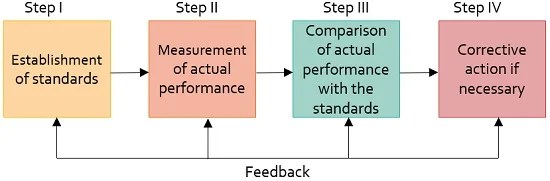
Control in Management refers to the process of monitoring and evaluating performance against established standards and objectives. It involves setting performance benchmarks, measuring actual outcomes, comparing them with targets, and taking corrective actions as needed. The ultimate goal of control is to ensure that organizational activities align with strategic goals, thereby enhancing efficiency and effectiveness.

Control Process involves the following Steps as shown in the figure:

The control process involves several key steps:

  1. Establishing Standards

Standards serve as benchmarks for evaluating performance in business functions and are classified into two categories:

  • Measurable (Tangible) Standards: These standards are quantifiable and expressed in terms of cost, output, time, profit, etc.
  • Non-Measurable (Intangible) Standards: These cannot be quantified monetarily. Examples include manager performance, employee attitudes, and workplace morale.

Establishing these standards simplifies the control process, as control is exercised based on them.

  1. Measurement of Actual Performance

The second step is assessing actual performance levels to identify deviations from established standards. Measuring tangible standards is generally straightforward, as they can be quantified easily. However, evaluating intangible standards, such as managerial performance, can be challenging and may rely on factors like:

  • Employee attitudes
  • Workforce morale
  • Improvements in the work environment
  • Communication with superiors

Performance measurement may also be supported by various reports (weekly, monthly, quarterly, or yearly).

  1. Comparison of Actual Performance with Standards:

Comparing actual performance against planned targets is crucial. A deviation is defined as the gap between actual and planned performance. Managers need to identify two key aspects:

  • Extent of Deviation: Is the deviation positive, negative, or aligned with expectations?
  • Cause of Deviation: Understanding why deviations occurred is vital for effective management.

Managers should focus on critical deviations while overlooking minor ones. For instance, a 5-10% increase in stationery costs may be considered minor, whereas a continuous decline in monthly production signifies a major issue.

Common causes of deviations:

  • Faulty planning
  • Lack of coordination
  • Defective plan implementation
  • Ineffective supervision and communication
  1. Taking Corrective Actions

After identifying the extent and causes of deviations, managers must implement remedial measures. They have two options:

  1. Corrective Measures: Address the deviations that have already occurred.
  2. Revision of Targets: If the corrective actions do not align actual performance with planned targets, managers may choose to adjust the targets.

Controlling, Definition, Importance, Nature, Scope, Elements, Limitations

Controlling is a fundamental management function that involves monitoring organizational performance, comparing it against established standards, and taking corrective actions when necessary. It ensures that the organization’s activities align with its goals and objectives. The controlling process includes setting performance standards, measuring actual performance, and evaluating deviations from the standards. Effective controlling helps identify areas for improvement, ensures resource optimization, and enhances decision-making. By providing feedback on performance, controlling enables managers to make informed adjustments to strategies and operations, fostering efficiency and effectiveness in achieving organizational goals.

Definition of Controlling:

  • Henri Fayol:

Fayol, a pioneer in management theory, defined controlling as “the process of verifying whether everything occurs in conformities with the plan adopted, the instructions issued, and the principles established.” This emphasizes the alignment of actual performance with planned objectives.

  • George R. Terry:

Terry defined controlling as “the measurement of accomplishment against standards and the correction of deviation to ensure achievement of organizational objectives.” This highlights the evaluative aspect of controlling in relation to organizational goals.

  • Harold Koontz and Cyril O’Donnell:

They defined controlling as “the function of management which ensures that everything occurs in accordance with the standards established.” This definition stresses the importance of standards in the controlling process.

  • Peter Drucker:

Drucker defined controlling as “the process of measuring performance and taking corrective actions when necessary.” His focus is on performance measurement and the proactive nature of controlling.

  • Luther Gulick:

Gulick described controlling as “the function of management which ensures that organizational goals are met through appropriate actions.” This definition emphasizes the role of controlling in achieving organizational objectives.

  • American Management Association (AMA):

AMA defines controlling as “the process of establishing standards to achieve organizational goals, measuring actual performance against those standards, and taking corrective action when necessary.” This definition encapsulates the overall purpose of the controlling function.

  • Robert J. Mockler:

Mockler defined controlling as “the process of monitoring performance, comparing it with the established standards, and taking corrective action if necessary to ensure that the organization’s objectives are achieved.” This highlights the cyclical nature of controlling in the management process.

Importance of Controlling:

  • Ensures Goal Achievement:

The primary purpose of controlling is to ensure that organizational goals are met. By setting performance standards and measuring actual performance against these benchmarks, managers can identify deviations and take corrective actions, ensuring that the organization remains on track to achieve its objectives.

  • Enhances Efficiency:

Controlling helps to improve the efficiency of organizational processes. By monitoring operations, managers can identify bottlenecks, redundancies, and areas for improvement. This allows for the optimization of resource utilization, reducing waste and improving overall productivity.

  • Facilitates Decision-Making:

Effective controlling provides managers with relevant and timely information about performance. This information is critical for informed decision-making. Managers can analyze trends, identify problems, and evaluate the effectiveness of different strategies, enabling them to make better decisions that align with organizational goals.

  • Promotes Accountability:

Control systems establish clear expectations and performance standards for employees. This promotes accountability, as individuals are aware of the metrics against which their performance will be evaluated. When employees understand that their work is being monitored, they are more likely to take ownership of their responsibilities and strive to meet performance standards.

  • Encourages Continuous Improvement:

Controlling fosters a culture of continuous improvement within the organization. Regular performance assessments and feedback mechanisms encourage employees to seek ways to enhance their work processes, leading to innovation and higher quality outcomes. This proactive approach contributes to long-term organizational success.

  • Identifies Problems Early:

Through ongoing monitoring and evaluation, controlling enables managers to identify potential issues before they escalate into significant problems. Early detection allows for timely interventions, minimizing the impact on operations and helping to maintain organizational stability.

  • Facilitates Coordination:

Controlling ensures that different departments and teams within the organization are working harmoniously toward common goals. By monitoring interdependencies and ensuring that performance aligns with overall objectives, controlling promotes coordination and cooperation among various organizational units.

  • Provides a Basis for Future Planning:

The information gathered during the controlling process serves as valuable input for future planning. By analyzing performance data, managers can assess the effectiveness of previous strategies, identify trends, and make informed projections for the future. This alignment between past performance and future planning helps organizations remain agile and responsive to changing circumstances.

Nature of Controlling:

  • Goal-Oriented:

Controlling is fundamentally concerned with achieving organizational goals. It involves setting performance standards that align with these goals and continuously monitoring progress toward their attainment. By focusing on objectives, controlling ensures that all activities are directed towards fulfilling the organization’s mission.

  • Continuous Process:

Controlling is an ongoing process that occurs throughout the life of an organization. It involves regular monitoring and evaluation of performance, enabling managers to identify deviations and take corrective actions as needed. This continuous nature ensures that organizations remain adaptable to changes and can maintain effective performance.

  • Feedback Mechanism:

One of the critical functions of controlling is to provide feedback on performance. By comparing actual performance with established standards, managers can assess whether goals are being met. This feedback loop is essential for identifying areas for improvement and making informed decisions regarding resource allocation and operational adjustments.

  • Dynamic Function:

Controlling is not a static function; it evolves with the organization and its environment. As organizations face new challenges and opportunities, the controlling process must adapt to reflect changes in strategies, technologies, and market conditions. This dynamism ensures that controlling remains relevant and effective in guiding organizational performance.

  • Involves Decision-Making:

Controlling is closely linked to decision-making processes. Managers must analyze performance data, interpret results, and make decisions about corrective actions when performance deviates from standards. This aspect highlights the importance of analytical skills and judgment in effective controlling, as managers must be able to determine the best course of action based on performance assessments.

  • Universal Applicability:

The principles of controlling apply to all types of organizations, regardless of size or industry. Whether in manufacturing, services, or non-profit sectors, controlling is essential for ensuring that organizational activities are aligned with strategic objectives. This universality underscores the importance of controlling as a core function of management.

  • Emphasizes Efficiency and Effectiveness:

The primary aim of controlling is to enhance organizational efficiency and effectiveness. By monitoring processes and performance, organizations can optimize resource use and improve productivity. Effective controlling helps identify waste, streamline operations, and ensure that activities are conducted in the most efficient manner possible, ultimately contributing to organizational success.

Scope of Controlling:

  • Performance Measurement:

One of the primary scopes of controlling is to measure the actual performance of employees, departments, and the organization as a whole. This involves establishing performance standards and metrics, collecting data on actual performance, and comparing it with the set standards. Performance measurement provides insights into how well an organization is functioning and identifies areas that require improvement.

  • Deviation Analysis:

Controlling involves analyzing deviations between actual performance and planned performance. When discrepancies arise, managers must determine the causes of these deviations. This analysis helps in understanding whether the deviations are due to external factors, such as market conditions, or internal factors, such as operational inefficiencies. By identifying the root causes, organizations can implement corrective actions to address the issues.

  • Corrective Actions:

Based on the analysis of deviations, controlling encompasses the development and implementation of corrective actions. These actions are designed to realign actual performance with established standards and objectives. Corrective measures may include changes in processes, resource reallocation, or additional training for employees. The goal is to ensure that the organization remains on track to achieve its goals.

  • Resource Management:

Controlling plays a critical role in managing organizational resources effectively. This includes financial resources, human resources, and physical assets. By monitoring resource utilization and efficiency, managers can ensure that resources are allocated appropriately, minimizing waste and maximizing productivity. Effective resource management contributes to the overall effectiveness of the organization.

  • Budgetary Control:

A significant aspect of controlling is budgetary control, which involves monitoring the organization’s financial performance against budgeted figures. Managers use budgetary controls to assess spending, revenue generation, and profitability. By analyzing variances between budgeted and actual figures, managers can make informed financial decisions and adjust budgets as necessary to meet organizational objectives.

  • Quality Control:

Controlling also encompasses quality control measures to ensure that products and services meet established quality standards. This includes implementing processes for inspecting and testing outputs, as well as continuous improvement initiatives. Quality control helps organizations maintain high standards, enhance customer satisfaction, and reduce costs associated with defects and rework.

  • Strategic Control:

Controlling extends to strategic control, which involves monitoring the organization’s progress toward achieving its long-term goals and strategic objectives. This includes assessing the effectiveness of strategies, evaluating competitive positioning, and ensuring that the organization adapts to changing market conditions. Strategic control helps organizations remain proactive and responsive in a dynamic business environment.

Elements of Controlling:

  • Setting Performance Standards

The first step in controlling is setting clear and measurable performance standards. These standards serve as a benchmark for evaluating actual performance. They may be quantitative (e.g., sales targets, production levels) or qualitative (e.g., customer satisfaction, employee engagement). Performance standards should be realistic, achievable, and aligned with organizational goals.

  • Measuring Actual Performance

Once performance standards are set, it is essential to measure actual performance. This involves collecting data, tracking results, and monitoring activities to evaluate whether targets are being met. The methods of measurement can vary, such as financial reports, production logs, or customer feedback, depending on the nature of the performance standards.

  • Comparing Actual Performance with Standards

After measuring actual performance, it is compared with the established performance standards. This step helps identify any variances between planned and actual outcomes. If the actual performance exceeds or meets the standards, it indicates success. If there is a shortfall, corrective actions will be needed to bring performance in line with the targets.

  • Analyzing Deviations

When deviations from the set standards are identified, it is important to analyze the causes. These deviations may occur due to various factors such as external influences (market changes, economic conditions), internal inefficiencies (lack of resources, poor management), or human factors (motivation, skills). A thorough analysis of the reasons behind the deviations helps in deciding the appropriate corrective measures.

  • Taking Corrective Actions

Once the reasons for deviations are analyzed, corrective actions should be taken. These actions aim to eliminate the causes of deviations and bring performance back on track. Corrective actions can involve adjusting strategies, reallocating resources, modifying processes, or enhancing employee training. The effectiveness of corrective actions should also be monitored to ensure continuous improvement.

  • Feedback and Adjustments

The final element of controlling is the feedback loop. After taking corrective actions, it’s crucial to gather feedback to assess their effectiveness. Based on feedback, further adjustments may be needed. Continuous monitoring and adjustment ensure that performance standards are kept relevant and that the organization stays on course to achieve its objectives.

Limitations of Controlling:

  • Inflexibility:

Controlling can lead to rigidity in an organization. Overemphasis on control mechanisms may result in inflexible procedures, stifling creativity and innovation. Employees may feel constrained by strict guidelines and metrics, which can hinder their ability to adapt to changing circumstances or propose new ideas.

  • Costly Process:

Implementing a comprehensive control system can be expensive. The costs associated with setting up control measures, monitoring performance, and conducting audits can strain organizational resources. Small businesses, in particular, may find it challenging to allocate sufficient funds for effective control systems.

  • Time-Consuming:

The controlling process can be time-consuming. Collecting data, analyzing performance, and implementing corrective actions require considerable time and effort from managers and employees. This time investment may distract from other critical activities and delay decision-making processes.

  • Subjectivity in Evaluation:

Controlling often involves subjective judgment in performance evaluation. Managers may rely on their interpretations of data, which can lead to bias and inconsistencies in assessing employee performance. This subjectivity can create misunderstandings, conflicts, and decreased morale among staff.

  • Limited Scope:

Control systems may focus primarily on quantitative measures, neglecting qualitative factors such as employee satisfaction, teamwork, and organizational culture. A narrow focus on numbers can overlook important aspects of performance that contribute to overall success.

  • Resistance to Control:

Employees may resist control measures due to perceived threats to their autonomy and job security. This resistance can result in a lack of cooperation, reduced morale, and a negative organizational climate. Overly strict control measures can lead to disengagement and decreased productivity among staff.

  • Delayed Feedback:

In some cases, feedback from control systems may be delayed, making it challenging to address issues promptly. If performance data is not available in real-time, managers may miss opportunities to make timely corrections, allowing problems to escalate.

  • Overreliance on Control Systems:

Organizations may become overly dependent on control systems, leading to a lack of initiative and accountability among employees. When individuals feel that their work is constantly monitored, they may become less proactive and less willing to take risks, ultimately affecting overall performance.

Management by Exception (MBE), Steps, Advantages and Limitations

Management by Exception (MBE) is a management approach where leaders focus on significant deviations from set standards or expected outcomes, rather than on routine operations. Managers intervene only when performance significantly deviates from targets, either exceeding or falling short of expectations. This allows them to concentrate on critical issues that require attention, while routine matters are handled by subordinates. MBE improves efficiency by reducing the time managers spend on day-to-day activities and encourages employee autonomy. It ensures effective resource allocation and quick response to major problems or opportunities.

Steps of Management by Exception (MBE):

  1. Set Clear Objectives and Performance Standards

The first step in MBE is to establish clear organizational goals and performance standards. These benchmarks provide a basis for evaluating results and identifying exceptions. The standards must be measurable, relevant, and aligned with the company’s strategic objectives. Employees should be well-informed about these expectations to ensure understanding and compliance.

  1. Measure Actual Performance

Once the objectives and standards are set, managers need to continuously monitor and measure actual performance. This involves collecting data from various sources, such as reports, audits, or performance reviews, to ensure accurate and timely measurement of employee or departmental outputs. The performance data should be transparent and easily accessible to facilitate ongoing monitoring.

  1. Compare Performance Against Standards

In this step, managers compare the measured performance against the set standards. The goal is to identify any significant deviations that require attention. This comparison helps determine whether performance is on track or if there are substantial differences that necessitate intervention.

  1. Identify Exceptions

Managers focus only on deviations that are significant enough to be considered exceptions. These exceptions could be positive, such as exceeding sales targets, or negative, such as underperforming in a key area. Identifying exceptions helps managers concentrate on the most critical areas, while routine matters are handled by employees.

  1. Analyze the Cause of Exceptions

Once exceptions are identified, managers analyze the underlying causes of the deviations. This involves investigating whether the exception was caused by internal factors, such as inadequate resources or poor planning, or external factors, such as market changes. Understanding the root cause is essential for developing appropriate corrective actions.

  1. Take Corrective Action

After identifying the cause of exceptions, managers take corrective action to resolve the issue. The nature of the corrective action will depend on the severity and type of deviation. It could involve reallocating resources, providing additional training, revising strategies, or making adjustments to the performance standards.

  1. Monitor Results of Corrective Action

Once corrective measures are implemented, the next step is to monitor the results to ensure the actions have successfully addressed the exception. This continuous monitoring helps prevent future deviations and ensures that the organization remains on track toward achieving its goals.

  1. Review and Adjust Standards (if necessary)

In some cases, the performance standards themselves may need adjustment. If the deviation is not due to employee performance but rather unrealistic or outdated standards, managers may need to revise the objectives or benchmarks to reflect changing circumstances. This step ensures that the standards remain relevant and achievable.

Advantages of Management by Exception (MBE):

  1. Efficient Use of Managerial Time

One of the primary advantages of MBE is that it saves time for managers by allowing them to focus on critical issues instead of routine matters. Managers only step in when performance deviates significantly from the plan, which frees them from constantly micromanaging every aspect of operations. This selective attention helps in better time management and ensures that their focus is directed where it is most needed.

  1. Promotes Employee Autonomy

MBE encourages employees to take responsibility for day-to-day operations, as managers intervene only when necessary. Employees gain autonomy over routine tasks, which can boost their confidence, decision-making abilities, and job satisfaction. This empowerment of employees leads to increased accountability and promotes a sense of ownership over their work.

  1. Encourages Better Decision-Making

Since MBE focuses on exceptions or significant deviations, it ensures that managerial attention is drawn to issues that require immediate decision-making. This system of management helps managers make quicker and more informed decisions about critical matters, leading to timely corrective actions. It also helps in prioritizing the most pressing concerns, thus improving overall decision-making efficiency.

  1. Increased Productivity

By allowing employees to handle regular tasks independently and focusing managerial attention on significant issues, MBE can enhance productivity. Managers are not bogged down by routine matters and can concentrate on strategic activities, which in turn improves overall organizational efficiency. This division of focus also ensures that employees perform their tasks with minimal supervision, leading to a smoother workflow.

  1. Reduction in Information Overload

MBE reduces the burden of information overload for managers. Since they are only required to intervene when performance falls outside established norms, they receive fewer reports and updates about routine activities. This selective information flow allows managers to concentrate on critical reports, reducing unnecessary data handling and simplifying decision-making.

  1. Effective Resource Allocation

By focusing on significant deviations from the norm, MBE ensures that resources—both human and financial—are allocated efficiently. Managers can direct resources towards solving key issues or seizing important opportunities, rather than wasting them on minor adjustments. This strategic allocation of resources helps in optimizing organizational performance.

  1. Improved Control Mechanism

MBE establishes a clear control mechanism by setting performance standards and monitoring outcomes. Managers can quickly identify areas of concern and take corrective actions when deviations occur. This ensures that problems are addressed before they escalate, maintaining better control over operations and ensuring adherence to goals and policies.

  1. Encourages Focus on Strategic Issues

Since MBE directs managerial attention to exceptions, it ensures that managers focus on strategic issues that require intervention. This ability to concentrate on important matters allows for more effective long-term planning, risk management, and opportunity exploitation. It aligns managerial efforts with the organization’s strategic objectives, promoting growth and competitiveness.

Limitations of Management by Exception (MBE):

  1. Overlooking Minor issues

MBE’s focus on significant deviations can lead to the neglect of minor problems that, if left unresolved, may escalate into larger issues. These small discrepancies might seem insignificant but can compound over time, eventually affecting overall performance or creating inefficiencies in processes.

  1. Delayed Managerial Intervention

One of the potential downsides of MBE is that by waiting for deviations to become significant, managers may respond too late. This delay in intervention might cause problems to worsen before they are addressed. Timely management involvement is crucial, but MBE may cause managers to overlook issues until they require immediate attention.

  1. Dependence on Pre-Established Standards

MBE relies heavily on pre-established performance standards or benchmarks. If these standards are outdated or inappropriate, the entire system of exception management may fail. Poorly set benchmarks can lead to either excessive managerial intervention or insufficient control over processes.

  1. Employee Demotivation

Employees may feel demotivated or neglected under MBE, as managers only step in when there are issues. Without consistent feedback and engagement, employees might feel undervalued or ignored. This can reduce motivation and lower job satisfaction, ultimately affecting overall productivity.

  1. Limited Managerial Involvement in Daily Operations

MBE encourages minimal involvement in routine operations. While this can increase efficiency, it also means that managers might lose touch with day-to-day activities. Lack of involvement in operational matters could result in managers being disconnected from the realities faced by employees, leading to ineffective decision-making when intervention is required.

  1. Potential for Over-Reliance on Technology

In many MBE systems, technology is used to monitor performance and detect deviations. This reliance on technology can create issues if the systems fail or produce inaccurate data. Over-reliance on technology may also lead to a reduction in the human element of management, weakening the ability to understand the nuances of workplace dynamics.

  1. Reactive Rather than Proactive Management

MBE is inherently reactive, meaning that managers wait for problems to arise before acting. This reactive approach can hinder the organization’s ability to proactively address potential risks or exploit emerging opportunities. Being proactive is essential for long-term success, but MBE may limit this forward-thinking capability.

  1. Challenges in Defining “Exception”

Determining what constitutes a significant exception can be challenging. Different departments or managers may have varying thresholds for what they consider an exception, leading to inconsistency in when interventions are triggered. This inconsistency can create confusion and reduce the effectiveness of MBE.

  1. Stifling Innovation

MBE’s emphasis on conformity to standards may stifle creativity and innovation. Employees may focus solely on meeting established benchmarks, avoiding risks or new ideas to prevent deviations. This could limit opportunities for improvement and hinder the organization’s ability to innovate and adapt to changing environments.

error: Content is protected !!