Kinds of Management Reports

  1. Classification on the Basis of Object and Purpose:
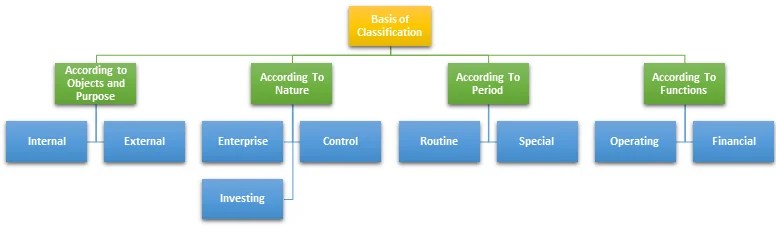
(a) External Reports:

The reports prepared for external users or for the persons outside the business are known as external reports. External users may include shareholders, investors, creditors, suppliers and bankers. Though company may not be answerable to outsiders but still some reports are meant for outsiders.

The company publishes income statement and balance sheet at the end of every financial year and these statements are filed with the Registrar of companies and stock exchanges. Final statements of accounts are expected to conform to certain basic details in India Companies Act 1956 has made it obligatory to disclose some minimum information in final accounts. Following is an instance of Balance

(b) Internal Reports:

Internal reports refers to those reports which are meant for different level of management. Internal reports are not public documents and they are not expected to conform to any standards. These reports are prepared by keeping in view the needs of disposal for scanning them.

These reports may be meant for top level, middle level and lower level. The report meant for different levels of management may be regarded as internal reports. The frequency of these reports vary in accordance with purpose they serve.

Some of the internal reports that are commonly used are! Period report about profit and loss account and financial position, statement of cash flow, changes in working capital, report about cost of production, production trends and utilization of capacity.Labour turnover reports, material utilization reports, periodic reports on sales, credit collection periods and selling and distribution expenses, report on stock position etc.

2. Classification on the Basis of Nature:

According to nature, reports can be classified into three categories:

(a) Enterprise Reports:

These reports are prepared for the concern as a whole. These reports serve as a channel of communication with outsiders. Enterprise reports may concern all activities of the enterprise or may be related to different activities. Enterprise reports may include balance sheet, income statement, income tax returns, employment report, chairman’s report.

These reports contain standardized information and are beneficial to outsiders. The interpretation of financial statement can also be undertaken from these reports. The reports are important from financial analysis point of view. For instance following is chairman’s report presented by ShashiRuia Chairman of Essar Steel Ltd. reproduced for information:

Chairman’s Statement:

Dear Shareholder,

It is now well accepted by economic pundits and studies conducted across the globe that India and China will dominate the world economy in the 21st century. India is today the fourth largest economy in terms of purchasing power parity and is expected to overtake Japan and become third largest economic power after the United States of America and China, before the end of the decade. As India prepares to become an economic super power, it must further quicken the pace of reform and liaberalization by enabling the development of world class infrastructure, competitive manufacturing in scale and technology and sustainable development.

GDP growth of over 6.5% significant investments in infrastructure, a good agricultural output and a spurt in consumer demand across all sectors augurs for industry. If we are able to achieve a GDP growth of 8% annually, India will be the fastest growing free market democracy in the world.

Steel the backbone of Industry:

The steel industry is crucial to a nation’s economic competitiveness and security. Steel is integral to building of bridges, railroads, homes, automobiles, appliances and much more. Today’s steels are radically different than what was available ten years ago. They are lighter, higher in strength and more versatile.

The industry has undergone a major transformation in the last few years with companies investing in new process and product technologies, capacity enhancements and customer service initiatives. Indian steel companies are at the ‘leading edge’ of technology and spend considerable amounts on research and development.

The industry and particularly your company are able to compete internationally on technology, quality and price and have demonstrated that the India of tomorrow belongs to Indian entrepreneurs and Indian consumers. The Government needs to encourage and support the industry with a more realistic iron ore policy that creates level playing field.

Essar Steel- an eventful year:

Essar Steel’s excellent results demonstrate the company’s success in structurally improving its operating performance as a result of strategic actions and timely execution of projects. We have seen some signs of over-supply in international markets, but we do not see this as a long term issue. Your company is also much better prepared to manage cyclically in markets due to its geographic coverage and product portfolio.

Essar Steel is now a fully integrated producer with end-to-end control of all operations related to steel making. The acquisition of Hy-Grade Pellets Ltd. and Steel Corporation of Gujarat Ltd. make your company a totally integrated steel producer. The company has taken a number of initiatives in its manufacturing facilities to fulfill its mission of being one of the most cost efficient producers of steel globally.

From Bailadilla- where the iron ore beneficiation plant is located, close to the iron mines- to the final stage where the end products are dispatched to domestic and international destinations, your company has ensured that every stage of manufacture is seamlessly integrated. This will enable us to offer high quality, customized products for use by wide range of industries such as automobile and auto components, white goods, construction and consumer durables.

We focus on value addition at every stage of manufacture and also direct our efforts to high revenue generating markets. We do this by targeted marketing in specialized customer segments and technical and aftermarket support. We expect these value added products to contribute over 35% of the company’s revenues in the coming year.

Looking Ahead:

Currently we are producing at a capacity of 3 million tonnes and we have planned to augment this to 4.6 million tonnes by June 2006, making us the largest producer of flat steel in the private sector in India. This will involve an incremental investment ofRs 2000 crore, which is much below industry average and will considerably reduce our cost of production. We also plan to increase the pellet making capacity at Visakhapatnam from 4 to 8 million tonnes in this fiscal year.

The acquisitions, capacity expansions, technology upgradation and other productivity improvement measures will give you company a significant competitive edge in domestic and international markets. Our thrust on maintaining cost leadership through integrated manufacturing processes, research and new innovation and high productivity will provide a hedge against cyclically.

Managing Financial Turnaround:

Your company has been able to build a platform for consolidation and sustain the rejuvenation of its performance. In October 2002, at the time of the announcement of the CDR package, the Company had a term debt of? 5371 crore, which has been reduced to Rs 4262 crore as at March 31, 2005, a reduction of over Rs 1100 crore. The significant financial turnaround by the Company in such a short period of time is indeed noteworthy. With all other parameters of financial performance showing considerable improvement, your company is in a much stronger position to plan for more aggressive growth.

Our Driving Force:

Essar Steel is today at a significant point in its history. The past has given us learning’s that we have used to build a platform of security from the future. I must acknowledge the tremendous efforts put in by employees at all levels, who have to admirably risen to the challenges that change inevitably brings. Organizations must continuously change in order to survive and prosper. The Essar family has shown the capability and resilience to manage this change. We look to the future with confidence that arises out of our actions and the achievements of our people, as we prepare to face the “Brave New World”.

I also take this opportunity to thank our customers, vendors, business associates and bankers who have helped us come this far and look forward to their continued support in our journey to globalization.

Thank You.

ShashiRuia Chairman

(b) Control Reports:

Control reports deal with two aspects. One aspect relates to the personal performance and the other aspect deals with the economic performance. The first type of reports are prepared and reported to judge performance of managers and heads of various responsibility centres with what performance should have been under the prevailing circumstances.

The reasons for deviations in performance are also identified. The second type of reports shows how well the responsibility centre has fared as an economic activity. Such analysis is made periodically. This type of analysis requires the use of full cost accounting rather than responsibility accounting.

Control reports should consider the following:

(i) Control reports should be related to personal responsibility.

(ii) They should compare actual performance with the standards.

(iii) They should highlight significant information.

(iv) These reports should be sent at a proper time as to enable taking corrective measures.

(v) If possible various accounting ratios like, capacity, efficiency, activity and calendar ratios may be calculated.

(c) Investigating Reports:

These reports are linked with control reports. In case some serious problem arises then the causes of this situation are studied and analyzed, investigative reports are based on outcome of special solution studies. These reports are intermittent and are prepared only when a situation arises. They are prepared according to the nature of every situation. They are helpful to the management in analyzing the causes of some problem.

Example of Investigating Report:

The following information is available from monthly cost report of M/s Hard Engineering Co.:—

3. Classification on the Basis of Period:

According to the period repots can be classified as under:

(a) Routine Reports:

These reports are prepared about day to day working of the concern. They are periodically sent to various levels of management. These persons may differ according to the nature of information about details to be reported so far as the timing is concerned they may be sent daily, weekly, monthly or quarterly.

Routine reports may relate to sales information, production figures, capital expenditures, purchases of raw materials, market trends etc. There is a tendency to ignore routine reports by all recipients because of their routine nature. Important information in the report should be high-lighted or presented in a different way or may be written in a different ink.

Example of two routine reports are:

  1. Statement of Production
  2. Statement of Expenses

(b) Special Reports:

The management may confront some difficulties and routine report may not give sufficient information to tackle such situations. Under such circumstances, special reports are called for. Special reports are required for special purposes only.

These reports are prepared according to the need of situation. Available accounting information may not be sufficient, so data may have to be specially collected. There may be need to put extra staff for compiling these reports. It may also involve co-ordination of different departments and different levels of management. According to J. Batty33 special reports should be divided into sections each covering the following main purposes: 1. Reason for the report 2. Investigation made 3. Finding a conclusion and recommendations.

Special reports may deal with following topics:

(i) Information about market analysis and methods of distribution of competitors.

(ii) Technological changes in industry.

(iii) Problems about the purchase of materials.

(iv) Reports about change in methods of production and their implications.

(v) Trade association matters.

(vi) Report by secretary on company matters.

(vii) Political development at home and abroad having impact on business.

(ix) Report effect of idle capacity on cost of production.

(x) Make or buy decisions.

(xi) Report most suitable method of raising funds.

(xii) The effect of labour disputes on production and cost of production.

(xiii) Report on general economic forecast.

(xiv) Feasibility study for a project.

(xv) Report on effect of change in Government Policy.

4. Classification of Reports on the Basis of Functions:

According to function the reports may be divided into two categories:

(a) Operating Reports

(b) Financial Reports

(a) Operating Reports:

These reports provide information about operations of the concern.

The operating reports may consist of the following:

(i) Control Reports:

These reports are used for management control purposes. They are intended to spot deviations from budgeted performance without loss of time so that corrective action can be taken. Control reports are also used to assess the performance of individuals.

(ii) Information Reports:

These reports are prepared to provide useful information which will enable planning and policy formation for future. Information reports can take the form of trend reports and analytical reports. Trend reports provide information in comparative form over a period of time. Graphic presentation can be effectively used in trend reports. As opposed to trend reports, analytical reports provide information in a classified manner about composition of certain results so that one can identify specific factors in the overall total.

(b) Financial Reports:

These reports provide information about the financial position of the concern on specific dates or movement of finances during a specific period. The Balance Sheet provides information about a concern on a specific date. On the other hand Cash Flow Statement provides data about the movement of cash during a particular period. These reports can be either static or dynamic. Balance Sheet and other subsidiary reports are examples of static reports; Cash Flow, Fund Flow Statements and other reports showing financial position as compared to the budgeted are examples of dynamic reports.

Limitations of Cash Flow Statement

  • A Cash Flow Statement only reveals the inflow and outflow of cash. The cash balance disclosed by this statement may not depict the true liquid position. There are controversies over a number of items like Cheques, stamps, postal orders etc. to be included in cash.
  • A Cash Flow Statement cannot be equated with the income statement. An income statement takes into account both cash and non-cash items. Hence Cash Fund does not mean net income of the business.
  • Working Capital being a wider concept of funds, a funds flow statement presents a more complete picture than cash flow statement.
  • Fails to Present Net Profit: The cash flow statement fails to present the net income of a firm for the period as it ignores non-cash items which are considered by Profit and Loss Statement. The cash flow statement does not help to assess profitability as it neither considers cost nor revenues. However, it can be used as a supplement to the income statement.
  • Not a substitute to Funds Flow Statement or Income Statement: The functions which are performed by funds flow statement or income statement cannot be done by cash flow statement.
  • Industry Comparison not possible: As the cash flow statement does not measure the efficiency of the firm, intercomparison with other inter-industry is not possible. A firm having less capital investment shall have less cash flow than the firm which more capital investment resulting in higher cash flows.
  • Does not Properly Assess Liquidity position: In a practical scenario, the cash flow statement does not assess liquidity or solvency position of the firm as it presents cash position only on a particular date. It only helps to know what amount of obligation can be met. In nutshell, it does not represent the real liquidity position.
  • It does not give complete picture of the financial position of the business concern.
  • The preparation of cash flow statement is only postmortem analysis. There is no projection of cash in future in this method.
  • It is not a substitute of Income Statement.
  • The accuracy of cash flow statement is based on the balance sheet. If balance sheet is wrong, the cash flow statement is also wrong.
  • It is not prepared on the basic accounting concept of accrual basis. Hence, the accuracy of cash flow statement is questionable.
  • It is not suitable for judging the profitability of a firm as non-cash items are not included in the calculation of cash flow from operating activities.

Uses of Cash Flow Statement

The purpose of the cash flow statement is to show where an entities cash is being generated (cash inflows), and where its cash is being spent (cash outflows), over a specific period of time (usually quarterly and annually). It is important for analyzing the liquidity and long term solvency of a company.

The cash flow statement uses cash basis accounting instead of accrual basis accounting which is used for the balance sheet and income statement by most companies. This is important because a company may accrue accounting revenues but may not actually receive the cash. This could produce profits and taxes payable but not provide the resources to stay solvent.

Cash Flow Statement Components

The cash flow statement components provide a detailed view of cash flow from operations, investing, and financing:

Cash Flow from Operating Activities

The net amount of cash coming in or leaving from the day to day business operations of an entity is called Cash Flow from Operations. Basically it is the operating income plus non-cash items such as depreciation added. Since accounting profits are reduced by non-cash items (i.e. depreciation and amortization) they must be added back to accounting profits to calculate cash flow.

Cash flow from operations is an important measurement because it tells the analyst about the viability of an entities current business plan and operations. In the long run, cash flow from operations must be cash inflows in order for an entity to be solvent and provide for the normal outflows from investing and finance activities.

Cash Flow from Investing Activities

Cash flow from investing activities would include the outflow of cash for long term assets such as land, buildings, equipment, etc., and the inflows from the sale of assets, businesses, securities, etc. Most cash flow investing activities are cash out flows because most entities make long term investments for operations and future growth.

Cash Flow from Finance Activities

Cash flow from finance activities is the cash out flow to the entities investors (i.e. interest to bondholders) and shareholders (i.e. dividends and stock buybacks) and cash inflows from sales of bonds or issuance of stock equity. Most cash flow finance activities are cash outflows since most entities only issue bonds and stocks occasionally.

Main uses of cash flow statement.

  • Since a cash flow statement is based on the cash basis of accounting, it is very useful in the evaluation of cash position of a firm.
  • A projected cash flow statement can be prepared in order to know the future cash position of a concern so as to enable a firm to plan and coordinate its financial operations properly. By preparing this statement, a firm can come to know as to how much cash will be generated into the firm and how much cash will be needed to make various payments and hence the firm can well plan to arrange for the future requirements of cash.
  • A comparison of the historical and projected cash flow statements can be made so as to find the variations and deficiency or otherwise in the performance so as to enable the firm to take immediate and effective action.
  • A series of intra-firm and inter-firm cash flow statements reveals whether the firm’s liquidity (short-term paying capacity) is improving or deteriorating over a period of time and in comparison to other firms over a given period of time.
  • Cash flow statement helps in planning the repayment of loans, replacement of fixed assets and other similar long-term planning of cash. It is also significant for capital budgeting decisions.
  • It better explains the causes for poor cash position in spite of substantial profits in a firm by throwing light on various applications of cash made by the firm. It further helps in answering some intricate questions like -what happened to the net profits? Where did the profits go? Why more dividends could not be paid in spite of sufficient available profit?
  • Cash flow analysis is more useful and appropriate than funds flow analysis for short-term financial analysis as in a very short period it is cash which is more elevant then the working capital for forecasting the ability of the firm to meet its immediate obligations.
  • Cash flow statement prepared according to AS-3 (Revised) is more suitable for making comparisons than the funds flow statement as there is no standard format used for the same.
  • Cash flow statement provides information of all activities classified under operating, investing and financing activities. The funds statement even when prepared on cash basis, did not disclose cash flows from such activities separately. Thus, cash flow statement is more useful than the funds statement.

Provisions of Ind AS-7 (Old AS 3), Objectives, Scope, Classification, Preparation

Ind AS 7 prescribes the principles for presenting information about historical changes in cash and cash equivalents of an entity through a Statement of Cash Flows, classifying cash flows during the period into operating, investing, and financing activities. It is issued under the Companies (Indian Accounting Standards) Rules, 2015, notified by the Ministry of Corporate Affairs (MCA) under Section 133 of the Companies Act, 2013. This statement helps users evaluate an entity’s ability to generate cash and cash equivalents, its liquidity, and its needs to utilize those cash flows. It is a mandatory component of financial statements for entities applying Ind AS, providing crucial information not reflected in the Balance Sheet or Statement of Profit and Loss.

Objective of Ind AS 7:

1. Providing Information About Cash Flows

The primary objective of Ind AS 7, Statement of Cash Flows, is to provide information about the historical changes in cash and cash equivalents of an entity during an accounting period. It helps users understand how cash is generated and utilised by the business. The standard requires cash flows to be classified into operating, investing, and financing activities. This classification provides a clear understanding of the sources and uses of cash. The information helps investors, creditors, management, and other users assess the entity’s liquidity, financial flexibility, and ability to generate cash from its various business activities.

2. Assessing Cash Generating Ability

Ind AS 7 aims to help users assess an entity’s ability to generate cash and cash equivalents from its operations and other activities. Cash generation is important for meeting regular expenses, paying creditors, servicing loans, and making investments. The Cash Flow Statement provides information about actual cash inflows and outflows during the reporting period. By analysing operating cash flows, users can evaluate whether the entity’s core business activities are generating sufficient cash. This information helps investors and creditors assess the entity’s financial strength, liquidity, and ability to meet future financial obligations effectively.

3. Assessing Liquidity and Solvency

An important objective of Ind AS 7 is to provide information useful for assessing an entity’s liquidity and solvency. Liquidity refers to the ability to meet short term obligations, while solvency relates to the ability to meet financial obligations over the longer term. The Cash Flow Statement shows the availability and movement of cash and cash equivalents and provides information about cash generated from operating activities and cash used for financing and investing activities. This enables investors, creditors, and management to assess whether the entity can meet its financial commitments and payment obligations on time.

4. Understanding Changes in Cash and Cash Equivalents

Ind AS 7 aims to explain the changes in an entity’s cash and cash equivalents during an accounting period. The statement reconciles the opening cash position with the closing cash position by presenting cash inflows and outflows from operating, investing, and financing activities. This helps users understand why the cash balance has increased or decreased during the period. Such information is useful for analysing the entity’s cash management and financial activities. Therefore, the standard provides a systematic framework for understanding the sources, uses, and movement of cash and cash equivalents during the reporting period.

5. Evaluating Financial Flexibility

Ind AS 7 provides information that helps users evaluate an entity’s financial flexibility, which refers to its ability to respond effectively to unexpected financial requirements and changing business conditions. Information about cash flows shows whether the entity has sufficient cash generating capacity and access to financing sources. Strong cash flows may enable an entity to undertake investments, repay debt, or meet unexpected obligations. Analysis of operating, investing, and financing cash flows helps users understand the entity’s ability to adapt to changing circumstances. Thus, the standard supports assessment of the entity’s financial flexibility and capacity to manage future financial needs.

Scope of Ind AS 7:

1. Applicability to Cash Flow Statements

Ind AS 7, Statement of Cash Flows, deals with the preparation and presentation of cash flow information by entities that prepare financial statements under Indian Accounting Standards. It requires an entity to prepare a Cash Flow Statement showing changes in cash and cash equivalents during an accounting period. The statement provides information about cash generated and utilised through operating, investing, and financing activities. The standard helps users understand the movement of cash within an entity. Its requirements apply to entities covered by the Ind AS framework, subject to the applicable requirements and exemptions under the relevant regulations.

2. Classification of Cash Flows

The scope of Ind AS 7 covers the classification of cash flows into three major categories: operating activities, investing activities, and financing activities. Operating activities relate to the principal revenue producing activities of an entity. Investing activities generally involve the acquisition and disposal of long term assets and investments. Financing activities result in changes in the size and composition of equity and borrowings. This classification enables users to understand the different sources and uses of cash. Ind AS 7 therefore provides a systematic framework for presenting cash flows and analysing the entity’s cash generation and utilisation.

3. Cash and Cash Equivalents

Ind AS 7 covers information relating to cash and cash equivalents. Cash includes cash on hand and demand deposits, while cash equivalents are short term, highly liquid investments that can be readily converted into known amounts of cash and are subject to an insignificant risk of changes in value. The standard explains how movements in these balances should be presented in the Cash Flow Statement. It also helps users distinguish between cash transactions and other financial transactions. Therefore, the scope of Ind AS 7 is centred on reporting changes in cash and cash equivalents during the accounting period.

4. Operating Activities

The scope of Ind AS 7 includes cash flows arising from operating activities, which are the principal revenue producing activities of an entity. These activities generally include cash receipts from customers and cash payments to suppliers and employees. Operating cash flows provide important information about the entity’s ability to generate sufficient cash from its normal business operations. They are particularly useful for assessing the sustainability of the business and its capacity to meet operating expenses and financial obligations. Thus, Ind AS 7 requires operating cash flows to be separately identified and appropriately presented in the Statement of Cash Flows.

5. Investing Activities

Ind AS 7 also covers cash flows arising from investing activities. These activities relate mainly to the acquisition and disposal of long term assets and investments that are not considered cash equivalents. Examples include payments for purchasing property, plant and equipment and receipts from their sale. Cash payments for acquiring investments and cash receipts from their disposal may also fall under investing activities, subject to the requirements of the standard. Separate presentation of investing cash flows helps users understand the extent to which an entity is using cash for future growth, asset acquisition, and investment activities.

6. Financing Activities

The scope of Ind AS 7 includes cash flows from financing activities, which result in changes in the size and composition of the contributed equity and borrowings of an entity. Examples include proceeds from issuing shares or other equity instruments, proceeds from loans and borrowings, repayment of borrowings, and certain payments to owners. Separate reporting of financing cash flows helps users understand how the entity obtains financial resources and how it repays or distributes those resources. Therefore, Ind AS 7 provides information about changes in the entity’s capital structure and financing arrangements during the accounting period.

7. Disclosure of Cash Flow Information

The scope of Ind AS 7 extends to the presentation and disclosure of relevant information about cash flows. An entity is required to present cash flows in a manner that enables users to understand the movement of cash and cash equivalents during the reporting period. The standard also contains requirements relating to the disclosure of certain financing and investing transactions and other relevant information. Such disclosures improve the transparency and usefulness of financial statements. Investors, creditors, and management can use this information to assess liquidity, financial flexibility, and the entity’s ability to generate and utilise cash effectively.

Classification of Cash and Cash Equivalents:

1. Cash in Hand

Cash in hand refers to physical currency held by an entity for meeting its immediate payment requirements. It includes notes and coins available at the business premises or with authorised personnel. Cash in hand is considered a part of cash and cash equivalents because it is immediately available for use and does not involve any conversion process. It is commonly used for small business expenses, petty cash payments, and other routine transactions. Under Ind AS 7, cash balances form the basis for determining the movement in cash and cash equivalents during an accounting period. Therefore, cash in hand represents the most liquid financial resource of an entity.

2. Cash at Bank

Cash at bank represents funds maintained by an entity in current accounts and other demand deposits with banks. These balances are readily available for making payments, receiving collections, and meeting the entity’s regular financial obligations. Demand deposits can generally be withdrawn whenever required and therefore form part of cash for the purpose of Ind AS 7. Bank balances provide an important source of liquidity for day to day business operations. They are also used to reconcile the opening and closing cash positions in the Cash Flow Statement. Thus, cash at bank represents readily accessible financial resources available to the entity.

3. Cash Equivalents

Cash equivalents are short term, highly liquid investments that can be readily converted into known amounts of cash and are subject to an insignificant risk of changes in value. Under Ind AS 7, an investment normally qualifies as a cash equivalent when it has a short maturity, generally three months or less from the date of acquisition. Examples may include certain short term investments and highly liquid instruments that satisfy the required conditions. Cash equivalents are held primarily for meeting short term cash commitments, rather than for investment or other purposes. Therefore, they are treated together with cash while preparing the Cash Flow Statement.

4. Demand Deposits

Demand deposits are deposits that can be withdrawn from a bank on demand without significant restriction. They provide immediate access to funds and are therefore generally included within cash for purposes of Ind AS 7. Demand deposits are commonly maintained in current or similar bank accounts used for regular business transactions. They help an entity meet short term payment requirements such as payments to suppliers, employees, and other parties. Their high liquidity makes them an important component of the entity’s cash resources. Therefore, demand deposits are considered while determining the opening and closing balances of cash and cash equivalents in the Cash Flow Statement.

5. Short Term Highly Liquid Investments

Short term highly liquid investments may qualify as cash equivalents when they can be readily converted into known amounts of cash and carry an insignificant risk of changes in value. According to Ind AS 7, the investment generally needs to have a short maturity, normally three months or less from the date of acquisition. The purpose of holding such investments should primarily be to meet short term cash commitments, rather than to earn investment returns. Examples may include certain highly liquid short term instruments that satisfy these conditions. Therefore, only investments meeting the prescribed characteristics are classified as cash equivalents under the standard.

Methods of Ind AS 7:

1. Direct Method

The Direct Method presents major classes of gross cash receipts and gross cash payments arising from operating activities. It directly shows cash received from customers, cash paid to suppliers, cash paid to employees, interest paid, taxes paid, and other operating cash transactions, as applicable. This method provides detailed information about the actual sources and uses of operating cash. It is considered useful for understanding the entity’s cash generating ability. Under Ind AS 7, entities are encouraged to report operating cash flows using the Direct Method because it provides information that may be useful in estimating future cash flows.

2. Indirect Method

The Indirect Method starts with profit or loss and adjusts it for non cash items, changes in working capital, and items whose cash effects relate to investing or financing activities. Important adjustments may include depreciation, provisions, changes in inventories, trade receivables, and trade payables. The objective is to arrive at cash generated from operating activities. Unlike the Direct Method, it does not separately show individual cash receipts and payments from operations. The Indirect Method is widely used because it provides a reconciliation between accounting profit and net cash flow from operating activities, helping users understand the difference between profit and cash generation.

Preparation and Presentation of Cash Flow Statement:

1. Determine Opening and Closing Cash Balances

The preparation of a Cash Flow Statement begins with identifying the opening and closing balances of cash and cash equivalents. The opening balance represents cash available at the beginning of the accounting period, while the closing balance represents cash available at the end. These balances are obtained from the relevant Balance Sheet and accounting records. The difference between the opening and closing balances is explained through cash inflows and outflows during the period. This ensures that the Cash Flow Statement properly reconciles the movement in cash and cash equivalents and provides a clear picture of the entity’s cash position.

2. Classify Cash Flows

Under Ind AS 7, cash flows are classified into three major categories: operating activities, investing activities, and financing activities. Operating activities include cash flows arising from the principal revenue producing activities of the business. Investing activities mainly include the acquisition and disposal of long term assets and investments. Financing activities relate to changes in equity and borrowings. Proper classification is essential because it enables users to understand the different sources and uses of cash. This classification also helps management, investors, and creditors assess the entity’s cash generating ability, investment decisions, and financing position.

3. Calculate Cash Flow from Operating Activities

Cash flow from operating activities represents cash generated or used by the principal revenue producing activities of the business. Under Ind AS 7, operating cash flows may be presented using either the Direct Method or the Indirect Method. The Direct Method shows major classes of cash receipts and payments, while the Indirect Method begins with profit or loss and adjusts it for non cash items and changes in working capital. The resulting figure indicates whether the entity’s normal business operations are generating sufficient cash. Operating cash flow is important for assessing liquidity and financial sustainability.

4. Calculate Cash Flow from Investing Activities

Cash flow from investing activities includes cash payments and receipts relating mainly to the acquisition and disposal of property, plant and equipment, investments, and other long term assets. Cash paid for purchasing long term assets is generally shown as an investing cash outflow, while cash received from their sale is shown as an investing cash inflow. These cash flows provide information about the extent to which an entity is using its resources for future growth and investment. Proper identification of investing activities helps users understand the entity’s investment strategy and its effect on the overall cash position.

5. Calculate Cash Flow from Financing Activities

Cash flow from financing activities shows changes in the size and composition of the entity’s equity and borrowings. It generally includes cash received from issuing shares, obtaining loans, and other financing arrangements, as well as cash payments relating to repayment of borrowings and certain distributions to owners. These activities help users understand how the entity obtains financial resources and how those resources are repaid or distributed. Proper presentation of financing cash flows provides useful information about the entity’s capital structure, borrowing position, and financing strategy and helps assess its ability to meet long term financial commitments.

6. Determine Net Increase or Decrease in Cash

After calculating cash flows from operating, investing, and financing activities, the net increase or decrease in cash and cash equivalents is determined. The amount is calculated by adding the cash flows from all three categories. The resulting figure explains the overall change in the entity’s cash position during the accounting period. It may represent either a net increase or a net decrease in cash and cash equivalents. This figure is then added to the opening cash and cash equivalents to determine the closing cash and cash equivalents, ensuring proper reconciliation of the Cash Flow Statement.

7. Present the Cash Flow Statement

The Cash Flow Statement is presented in a systematic format showing cash flows from operating, investing, and financing activities separately. Under Ind AS 7, the statement should clearly disclose the movement in cash and cash equivalents during the reporting period. The final section generally shows the net increase or decrease in cash, opening cash and cash equivalents, and closing cash and cash equivalents. Appropriate disclosures should also be provided for significant non cash transactions and other relevant information as required by the standard. Proper presentation improves the clarity, comparability, and usefulness of cash flow information.

Statement of Funds from Operations

Funds from operations is the cash flows generated by the operations of a business, usually a real estate investment trust (REIT). This measure is commonly used to judge the operational performance of REITs, especially in regard to investing in them. Funds from operations does not include any financing-related cash flows, such as interest income or interest expense. It also does not include any gains or losses from the disposition of assets, or any depreciation or amortization of fixed assets. Thus, the calculation of funds from operations is:

Funds from operations = Net income – Interest income + Interest expense + Depreciation – Gains on asset sales + Losses on asset sales

After preparing the schedule of changes in net working capital, the second step is to determine the amount of funds (loss) from business operations. It refers to the funds or loss, which is generated or suffered in the business as a result of its regular operations during the period. The funds from operation is an important source of fund, while loss from operation is one of the important applications of funds. The funds or loss from operation is determined by adjusting the firm’s net income in a statement called the statement of funds from operations. In this statement, the items such as non-operating incomes and non-cash expenses are adjusted while determining the amount of funds (loss) from operations.

Non-cash expenses such as depreciation and amortization of intangible assets do not result in actual cash outflow. Non-operating expenses are those which are not treated as regular expenses of the business. These expenses matter while ascertaining the business income, but are irrelevant in determining the funds (loss) from operations. Therefore non-operating incomes should be deducted from and non-operating and non-cash expenses should be added back to the business income shown by the income statement.

Non-operating and non-cash expenses

  • Depreciation for the year
  • Amortization of Goodwill, Copyright, Patent, Trademark, Preliminary expenses
  • Discount on issue of share and debenture written off
  • Loss on sale of fixed assets or investment
  • Loss of revaluation of fixed assets
  • Premium on redemption of debentures and preference share

Incomes and gains which are not earned from the normal business operations are called non-operating incomes. These incomes are included while ascertaining the business income, but are excluded while determining the funds (loss)from operations. The following are the examples of non-operating incomes.

  • Gain on sale of fixed assets or investment
  • gain on revaluation of fixed assets
  • Discount on redemption of debentures and preference share
  • Compensation received
  • Interest received
  • Refund of tax
  • Transfer fees received
  • Appreciation on fixed assets

Preparation of Statement Of Funds From Operation

Funds from operations can be determined by using one of the two following methods.

  1. Add Back Method

Under this method,net profit is taken as the base. All the non-operating and non-cash expenses are added to net profit and non-operating incomes are deducted.

Funds from operations = Net profit+Non-operating and non-cash expenses-Non operating Incomes.

  1. Profit And Loss Adjustment Account Method

Funds from operations can also be determined by preparing an account called profit and loss adjustment account begins with opening balance of profit on its credit side and closing balance on the debit side. Instead of opening and closing balance of profit and loss account, only the amount of net profit for the year can also be brought down to the debit side of this account. Then the items of non-operating expenses and non-cash expenses are adjusted to the debit side and the items of non-operating incomes are adjusted to the credit side to determine the amount of funds (loss) from operations.

Statement of Sources and Applications of Funds

Generally, the statement consists of two sections: the source (where the money has come from) and the application (where the money has gone).

The sources of funds originate from:

  • A decrease in liabilities or an increase in assets
  • Net income after tax
  • The disposal or revaluation of fixed assets
  • Proceeds of loans obtained
  • Proceeds of shares that were issued
  • Repayments received on loans previously granted by the company
  • Any increase in net working capital

The application of funds includes:

  • Losses to be met by the company
  • The purchase of fixed assets/investments
  • The full or partial payment of loans
  • Granting of loans
  • Liability for taxes
  • Dividends paid or proposed
  • Any decrease in net working capital

Sources of Funds

Items to be shown under the head Sources of Funds are as follows:

  • Issue of Shares and Debentures for Cash: The total amount received from the Issue of Shares or Debentures is to shown under this head. But, the Issue of bonus Shares or Conversion of Debentures into Equity Shares or Shares issued to vendors shall not be shown here as there is no inflow of Cash
  • Long Term Loans: The Amount received on raising Long Term Loans is shown under this head. Short Term Loans are not to be shown here as their treatment has already been done while preparing the Statement of Changes in Working Capital.
  • Sale of Investments and other Fixed Assets: The Total Amount received on the sale of Investments and other Fixed Assets is to be shown under this head.
  • Funds from Operations: The Funds generated from Operations as computed in Step II are also required to be shown here.
  • Decrease in Working Capital: This would be the Balancing Figure of the Statement and will come from change in Working Capital Statement

Application of Funds

Items to be shown under Application of Funds are as follows:

  • Purchase of Fixed Assets and Investments: The Cash Payment made for purchase of Fixed Assets and Investments is an application of Funds. But if the purchase if made by issue of shares or debentures, such a transaction will not constitute application of funds. Similarly, if the purchases are on credit, these will not constitute fund applications.
  • Redemption of Debentures, Preference Shares and Repayment of Loan: Payment made including Premium (less: Discount) is to be taken as fund application
  • Payment of Dividend & Tax: Payment of Dividend and Tax are to be taken as applications of fund if the provisions are excluded from Current Liabilities and Current Provisions are added back to profit to determine the “Funds from Operations
  • Increase in Working Capital: This would be the Balancing Figure of the Statement and will come from change in Working Capital Statement

Procedure for preparation of Fund Flow Statement

Steps for Preparing Funds Flow Statement:

The steps involved in preparing the statement are as follows:

  1. Determine the change (increase or decrease) in working capital.
  2. Determine the adjustments account to be made to net income.
  3. For each non-current account on the balance sheet, establish the increase or decrease in that account. Analyze the change to decide whether it is a source (increase) or use (decrease) of working capital.
  4. Be sure the total of all sources including those from operations minus the total of all uses equals the change found in working capital in Step 1.

General Rules for Preparing Funds Flow Statement:

The following general rules should be observed while preparing funds flow statement:

  1. Increase in a current asset means increase (plus) in working capital.
  2. Decrease in a current asset means decrease (minus) in working capital.
  3. Increase in a current liability means decrease (minus) in working capital.
  4. Decrease in a current liability means increase (plus) in working capital.
  5. Increase in current asset and increase in current liability does not affect working capital.
  6. Decrease in current asset and decrease in current liability does not affect working capital.
  7. Changes in fixed (non-current) assets and fixed (non-current) liabilities affects working capital.

Format of Funds Flow Statement:

A funds flow statement can be prepared in statement form or ‘T’ form.

Both the formats are given below:

Schedule of Changes in Working Capital:

Many business enterprises prefer to prepare another statement, known as schedule of changes in working capital, while preparing a funds flow statement, on a working capital basis. This schedule of changes in working capital provides information concerning the changes in each individual current assets and current liabilities accounts (items).

This schedule is a part of the funds flow statement and increase (decrease) in working capital indicated by the schedule of changes in working capital will be equal to the amount of changes in working capital as found by funds flow statement. The schedule of changes in working capital can be prepared by comparing the current assets and current liabilities at two periods.

The format of schedule of changes in working capital is as follows:

Statement of changes in Working Capital

In the preparation of funds flow statement, the first step is to find out the net amount of increase or decrease of working capital, as increase in net working capital is a use of funds and decrease in net working capital is a source. Since net working capital is excess of current assets over current liabilities, the increase or decrease in the net working capital can be found out by comparing the current assets and current liabilities contained in the balance sheets of two following dates. For this purpose, a statement is prepared which is called statement or schedule of changes in net working capital. This statement helps to identify the change in position of the working capital. While preparing the statement of changes in working capital, the following points are considered.

* Increase in current assets , increase in net working capital
* Decrease in current assets , decrease in net working capital
* Increase in current liabilities , decrease in net working capital
* Decrease in current liabilities, increase in net working capital

The statement or schedule of changes in net working capital can be prepared by using one of the following forms.

  1. Using only current account

The statement or schedule of changes in net working capital can be prepared by using only current account, viz. account of current assets and current liabilities. While preparing the statement, the current assets and current liabilities of the previous year are compared with those of the current year and changes (increase or decrease) therein are determined. If the total of increase is more than that of decrease, there is an increase in net working capital, or vice versa.

  1. Using both current and non-current accounts

The statement or schedule of changes in net working capital can also be prepared by using both current as well as non-current accounts. Current account is the account of current assets and current liabilities and non-current account of non-current assets and non-current liabilities and owner’s equity. Increase in an item of current assets or decrease in an item of current liabilities from previous year to this year is debited, while increase in an item of current liabilities or decrease in an item of current assets is credited to current account. On other hand, increase in an item of non-current assets or decrease in an item of non-current liabilities from the previous year to this year is debited, while increase in an item of non-current liabilities and owner’s equity and decrease in an item of non-current assets is credited to non-current account.

The preparation of statement of changes in networking capital under this method is advantageous as compared to the previous method as it is easy to prepare funds flow statement there from.

Changes in Net Working Capital = Working Capital (Current Year) – Working Capital (Previous Year)

Or

Change in a Net Working Capital = Change in Current Assets – Change in Current Liabilities

  • Step 1: Find the Current Assets for the current year and previous year

From the point of the current asset of view, we consider the below:

      • Inventory
      • Accounts Receivable
      • Prepaid Expenses
  • Step 2: Find the Current Liability for the Current Year and Previous Year

From the current liabilities, we consider the below:

      • Accounts Payable & Accrued Expenses
      • Interest Payable
      • Deferred Revenue
  • Step 3: Find Working Capital for the Current Year and Previous Year
      • Working Capital (Current Year) = Current Assets (current year) – Current Liabilities (current year)
      • Working Capital (Current Year) = Current Assets (current year) – Current Liabilities (current year)
  • Step 4: Calculate Changes in Net Working Capital using the formula below –
      • Changes in Net Working Capital Formula = Working Capital (Current Year) – Working Capital (Previous Year).

Uses and Limitations of Fund Flow Statement

Uses of Funds Flow Statement:

By highlighting the changes in the distribution of the resources of an undertaking, the funds flow statement enables the financial manager to have a clear perspective of the organization’s financial strengths and weaknesses. It provides answers to a number of difficult questions.

(a) It explains the financial consequences of business operations. For example, a business may be earning huge profits, but its liquidity position would be highly unsatisfactory.

The funds statement will explain the causes for such situation by showing what has become of the profits earned. Further, the statement would explain the direction of flow of funds into productive or non-productive activities.

When a balance sheet presents a distorted picture of an undertaking because of a number of non-fund transactions, the funds statement would be an illuminating document.

(b) Debt capital is very essential for increased profitability of any enterprise. But the creditors may like to ascertain the credit worthiness and the funds generating capacity of the organization.

They may like to know in what way the management has utilized the funds in the past and how the funds would be utilized in future. The funds flow statement would enable the finance manager to answer such questions in a befitting manner.

(c) It acts as an instrument for allocation of the company’s scarce resources. A proposed funds statement will help to find out how the management is going to allocate the resources for meeting future productive programmes of the business.

When the projected funds statement is tied to the capital budget, it will help management to maintain the financial health of the organization.

(d) It is a test for evaluating the effective use of working capital by the management. Information on the adequacy or inadequacy of working capital will enable the management to decide what possible steps it should take for effective use of surplus working capital, or in the case of inadequate working capital to make suitable arrangements to make up the deficiency.

Limitations of Funds Flow Statement:

Despite its multiple managerial uses, the funds flow statements suffer from certain limitations.

  1. As this statement ignores non-fund items, it becomes a crude device compared to the income statement and balance sheet.
  2. The statement does not reveal shifts among the items making up the current assets and current liabilities. It does not tell whether any loss of working capital has unduly weakened the financial position.

Only an examination of the balance sheet at the end of the period will show the end of these changes. Therefore, funds flow statement cannot supplant but only supplement the conventional financial statements, either in whole or in part.

  1. The information used for the preparation of funds flow statement is essentially historical in nature, though attempts are made to project the funds statement for the future period.

Despite these limitations, the information supplied by the funds flow statement is really an invaluable aid to management in planning capital expenditure, devising dividend and other financial policies.

error: Content is protected !!