Capital Market Line

The capital market line (CML) represents portfolios that optimally combine risk and return. Capital asset pricing model (CAPM), depicts the trade-off between risk and return for efficient portfolios. It is a theoretical concept that represents all the portfolios that optimally combine the risk-free rate of return and the market portfolio of risky assets. Under CAPM, all investors will choose a position on the capital market line, in equilibrium, by borrowing or lending at the risk-free rate, since this maximizes return for a given level of risk.

Portfolios that fall on the capital market line (CML), in theory, optimize the risk/return relationship, thereby maximizing performance. The capital allocation line (CAL) makes up the allotment of risk-free assets and risky portfolio for an investor. CML is a special case of the CAL where the risk portfolio is the market portfolio. Thus, the slope of the CML is the sharpe ratio of the market portfolio. As a generalization, buy assets if the sharpe ratio is above the CML and sell if the sharpe ratio is below the CML.

CML differs from the more popular efficient frontier in that it includes risk-free investments. The intercept point of CML and efficient frontier would result in the most efficient portfolio, called the tangency portfolio.

The CAPM, is the line that connects the risk-free rate of return with the tangency point on the efficient frontier of optimal portfolios that offer the highest expected return for a defined level of risk, or the lowest risk for a given level of expected return. The portfolios with the best trade-off between expected returns and variance (risk) lie on this line. The tangency point is the optimal portfolio of risky assets, known as the market portfolio. Under the assumptions of mean-variance analysis that investors seek to maximize their expected return for a given amount of variance risk, and that there is a risk-free rate of return all investors will select portfolios which lie on the CML.

According to Tobin’s separation theorem, finding the market portfolio and the best combination of that market portfolio and the risk-free asset are separate problems. Individual investors will either hold just the risk-free asset or some combination of the risk-free asset and the market portfolio, depending on their risk-aversion. As an investor moves up the CML, the overall portfolio risk and return increases. Risk averse investors will select portfolios close to the risk-free asset, preferring low variance to higher returns. Less risk averse investors will prefer portfolios higher up on the CML, with a higher expected return, but more variance. By borrowing funds at the risk-free rate, they can also invest more than 100% of their investable funds in the risky market portfolio, increasing both the expected return and the risk beyond that offered by the market portfolio.

  • The capital market line (CML) represents portfolios that optimally combine risk and return.
  • CML is a special case of the CAL where the risk portfolio is the market portfolio. Thus, the slope of the CML is the sharpe ratio of the market portfolio.
  • The intercept point of CML and efficient frontier would result in the most efficient portfolio called the tangency portfolio.

As a generalization, buy assets if sharpe ratio is above CML and sell if sharpe ratio is below CML.

The Capital Market Line Equation:

Where:

Rp = Portfolio return

rf = Risk free rate

RT = Market return

σp = Standard deviation of portfolio returns

σT = Standard deviation of market returns

The Capital Market Line and the Security Market Line

The CML is sometimes confused with the security market line (SML). The SML is derived from the CML. While the CML shows the rates of return for a specific portfolio, the SML represents the market’s risk and return at a given time, and shows the expected returns of individual assets. And while the measure of risk in the CML is the standard deviation of returns (total risk), the risk measure in the SML is systematic risk, or beta. Securities that are fairly priced will plot on the CML and the SML. Securities that plot above the CML or the SML are generating returns that are too high for the given risk and are underpriced. Securities that plot below CML or the SML are generating returns that are too low for the given risk and are overpriced.

History of the Capital Market Line

Mean-variance analysis was pioneered by Harry Markowitz and James Tobin. The efficient frontier of optimal portfolios was identified by Markowitz in 1952, and James Tobin included the risk-free rate to modern portfolio theory in 1958. William Sharpe then developed the CAPM in the 1960s, and won a Nobel prize for his work in 1990, along with Markowitz and Merton Miller.

Assumptions of CAPM, CAPM Equation

Investors who have a portfolio of securities may like to add some more securities to the existing portfolio in order to diversify or reduce the risks. So, it is appropriate to study the extent of risks of a security in terms of its contribution to the riskiness of a portfolio.

The Capital Asset Pricing Model (CAPM) measures the risk of a security in relation to the portfolio. It considers the required rate of return of a security in the light of its contribution to total portfolio risk. The CAPM holds that only undiversifiable risk is relevant to the determination of expected return on any asset.

Even though the CAPM is competent to examine the risk and return of any capital asset such as individual security, an investment project or a portfolio asset, we shall be discussing CAPM with reference to risk and return of a security only.

The Capital Asset Pricing Model (CAPM) is a model that describes the relationship between expected return and risk of investing in a security. It shows that the expected return on a security is equal to the risk-free return plus a risk premium, which is based on the beta of that security. Below is an illustration of the CAPM concept.

Assumptions of Capital Asset Pricing Model

The CAPM is based on the following assumptions.

  1. Risk-averse investors

The investors are basically risk averse and diversification is necessary to reduce their risks.

  1. Maximising the utility of terminal wealth

An investor aims at maximizing the utility of his wealth rather than the wealth or return. The term ‘Utility’ describes the differences in individual preferences. Each increment of wealth is enjoyed less than the last as each increment is less important in satisfying the basic needs of the individual. Thus, the diminishing marginal utility is most applicable to wealth.

There are also other forms of utility functions. Some investors showing a preference for larger risks are those who have increasing marginal utility for wealth. In such cases, each increase in wealth prompts the individual to acquire more wealth. For a risk-neutral investor, each increment in wealth is equally attractive.  In other words, each increment would have the same utility for him.

  1. Choice on the basis of risk and return:

Investors make investment decisions on the basis of risk and return. Risk and return are measured by the variance and the mean of the portfolio returns. CAPM assumes that the rational investors put away their diversifiable risk, namely, unsystematic risk. But only the systematic risk remains which varies with the Beta of the security.

Some investors use the beta only to measure the risk while other investors use both beta and variance of returns as the sources of reward. As individuals have varying perceptions towards risk and reward, CAPM gives a series of efficient frontlines.

  1. Similar expectations of risk and return

All investors have similar expectations of risk and return. In other words, all investors’ estimates of risk and return are the same. When the expectations of the investors differ, the estimates of mean and variance lead to different forecasts.

As a result, there will be innumerable efficient frontiers and the efficient portfolio of each will be different from that of the others. Varying preferences also imply that the price of an asset will be different for different investors.

  1. Identical time horizon

The CAPM is based on the assumption that all investors have identical time horizon. The core of this assumption is that investors buy all the assets in their portfolios at one point of time and sell them at some undefined but common point in future. This assumption further implies that investors form portfolios to achieve wealth at a single common terminal rate.

This single common horizon enables one to construct a single period model. This assumption is highly unrealistic as investors are short-term speculators. Further, the horizon is chosen on the basis of the characteristics of an asset. So investors have different time horizons and their estimates of stock value vary even when the estimated earnings remain constant. Instead of single period model, investors generally adopt continuous time models as if they make a series of reinvestments.

  1. Free access to all available information

One of the important assumptions of the CAPM is that investors have free access to all the available information at no cost. Supposing some investors alone are able to have access to special information which is not readily available to all, then the markets would not be regarded efficient. In other words, if the available information has not reached all, it will be difficult to draw a common efficient frontier line.

  1. There is risk-free asset and there is no restriction on borrowing and lending at the risk free rate

This is a very important assumption of the CAPM. The risk free asset is essential to simplify the complex pairwise covariance of Markowitz’s theory. The risk free asset makes the curved efficient frontier of MPT to the linear efficient frontier of the CAPM simple.

As a result, the investors will not concentrate on the characteristics of individual assets. By adding a portion of risk-free assets to the portfolio and borrowing the additional funds needed at a risk free rate, the risk is either decreased or increased.

  1. There are no taxes and transaction costs

According to Roll, there must be either a risk free asset or a portfolio of short sold securities. Then only the capital Market Line (CML) will be straight. When there are no risk free assets, the investor could not create a proxy risk free asset. As a result, the capital market line would not be linear and the direct linear relationship between risk and return would not exist.

  1. Total availability of assets is fixed and assets are marketable and divisible

This assumption holds the view that the total asset quantity is fixed and all assets are marketable. However, models have been developed to include unmarketable assets which are more complex than the basic CAPM.

CAPM Formula and Calculation

CAPM is calculated according to the following formula:

Ra = Rrf + {Ba* (Rm – Rrf)}

Where:

Ra = Expected return on a security=

Rrf = Risk-free rate

Ba = Beta of the security

Rm = Expected return of the market

Note: “Risk Premium” = (Rm – Rrf)

The CAPM formula is used to calculate the expected return on investable asset. It is based on the premise that investors have assumptions of systematic risk (also known as market risk or non-diversifiable risk) and need to be compensated for it in the form of a risk premium an amount of market return greater than the risk-free rate. By investing in a security, investors want a higher return for taking on additional risk.

Expected Return 

The “Ra” notation above represents the expected return of a capital asset over time, given all of the other variables in the equation.  The expected return is a long-term assumption about how an investment will play out over its entire life.

Risk-Free Rate 

The “Rrf” notation is for the risk-free rate, which is typically equal to the yield on a 10-year US government bond.  The risk-free rate should correspond to the country where the investment is being made, and the maturity of the bond should match the time horizon of the investment.  Professional convention, however, is to typically use the 10-year rate no matter what, because it’s the most heavily quoted and most liquid bond.

The beta (denoted as “Ba” in the CAPM formula) is a measure of a stock’s risk (volatility of returns) reflected by measuring the fluctuation of its price changes relative to the overall market. In other words, it is the stock’s sensitivity to market risk. For instance, if a company’s beta is equal to 1.5 the security has 150% of the volatility of returns of the market average. However, if the beta is equal to 1, the expected return on a security is equal to the average market return.  A beta of -1 means security has a perfect negative correlation with the market.

Market Risk Premium

From the above components of CAPM we can simplify the formula to reduce “expected return of the market minus the risk-free rate” to be simply the “market risk premium”.  The market risk premium represents the additional return over and above the risk-free rate, which is required to compensate investors for investing in a riskier asset class. Put another way, the more volatile a market or an asset class is, the higher the market risk premium will be.

Why CAPM is Important

The CAPM formula is widely used in the finance industry by various professions such as investment bankers, financial analysts, and accountants. It is an integral part of the weighted average cost of capital (WACC) as CAPM calculates the cost of equity.

WACC is used extensively in financial modeling.  It can be used to find the net present value (NPV) of the future cash flows of an investment and to further calculate its enterprise value and finally its equity value.

Dow Jones Theory

Dow Theory (Dow Jones Theory) is a trading approach developed by Charles Dow. Theory is the basis of technical analysis of financial markets. The basic idea of Dow Theory is that market price action reflects all available information and the market price movement is comprised of three main trends.

The Averages Discount Everything.

Every knowable factor that may possibly affect both demand and supply is reflected in the market price.

The Market Has Three Trends.

According to Dow an uptrend is consistently rising peaks and troughs. And a downtrend is consistently rising lowering peaks and troughs.

Dow believed that laws of action and reaction apply to the markets just as they do to the physical universe, meaning that each significant movement is followed by a certain pullback.

Dow considered a trend to have three parts:

  1. Primary (compared to tide, reaching further and further inland until the ultimate point is reached).
  2. Secondary (compared to waves and representing corrections in the primary trend, normally retracing between one-third and two-thirds of the previous trend movement and most frequently about half of the previous move)
  3. Minor (ripples) (fluctuations in the secondary trend).

Major Trends Have Three Phases.

Dow mainly paid attention to the primary (major) trends in which he distinguished three phases:

  • Accumulation phase: The most astute investors are entering the market feeling the change in the current market direction.
  • Public participation phase:A majority of technicians begin to join in as the price is rapidly advancing.
  • Distribution phase:A new direction is now commonly recognized and well hiked; economic news are all confirming which all ends up in increasing speculative volume and wide public’s participation.

The Averages Must Confirm Each Other.

Dow used to say that unless both Industrial and Rail Averages exceed a previous peak, there is no confirmation of inception or continuation of a bull market. Signals did no have to occur simultaneously, but the quicker one followed another the stronger the confirmation was.

Volume Must Confirm the Trend. 

Volume increases or diminishes according to whether the price is moving in direction of a trend or in reverse. Dow considered volume a secondary indicator. His buy or sell signals were based on closing prices.

A Trend Is Assumed to Be Contiunous Until Definite Signals of Its Reversal.

The overall technical approach in market analysis is based upon the idea that trends continue in motion until there is an external force causing it to change its direction just like any other physical objects. And of course there are reversal signals to be looking for.

Dow Theory Principles

  • The Averages Discount Everything.
    Every knowable factor that may possibly affect both demand and supply is reflected in the market price.
  • The Market Has Three Trends.
    According to Dow an uptrend is consistently rising peaks and troughs. And a downtrend is consistently rising lowering peaks and troughs. 
    Dow believed that laws of action and reaction apply to the markets just as they do to the physical universe, meaning that each significant movement is followed by a certain pullback.Dow considered a trend to have three parts:

Primary (compared to tide, reaching further and further inland until the ultimate point is reached).

Secondary (compared to waves and representing corrections in the primary trend, normally retracing between one-third and two-thirds of the previous trend movement and most frequently about half of the previous move)

Minor (ripples) (fluctuations in the secondary trend).

  • Major Trends Have Three Phases.

    Dow mainly paid attention to the primary (major) trends in which he distinguished three phases:

  • Accumulation phase:The most astute investors are entering the market feeling the change in the current market direction.
  • Public participation phase:A majority of technicians begin to join in as the price is rapidly advancing.
  • Distribution phase:A new direction is now commonly recognized and well hiked; economic news are all confirming which all ends up in increasing speculative volume and wide public’s participation.

The Averages Must Confirm Each Other.
Dow used to say that unless both Industrial and Rail Averages exceed a previous peak, there is no confirmation of inception or continuation of a bull market. Signals did no have to occur simultaneously, but the quicker one followed another the stronger the confirmation was.

Volume Must Confirm the Trend. 
Volume increases or diminishes according to whether the price is moving in direction of a trend or in reverse. Dow considered volume a secondary indicator. His buy or sell signals were based on closing prices.

A Trend Is Assumed to Be Contiunous Until Definite Signals of Its Reversal.
The overall technical approach in market analysis is based upon the idea that trends continue in motion until there is an external force causing it to change its direction just like any other physical objects. And of course there are reversal signals to be looking for.

Failure Swing.

The failure of the peak at C to overcome A, followed by the violation of the low at B, constitutes a “sell” signal at S.

Nonfailure Swing.

Notice that C exceeds A before D falling below B. Some Dow theorists would see a “sell” signal at S1, while others would need to see a lower high at E before turning bearish at S2.

Dow only took in consideration closing prices. Averages had to close higher than a previous peak or lower than a previous trough to be significant. Intraday penetrations did not count.

Failure Swing Bottom. 

The “buy” signal takes place when point B is exceeded (at Bl).

Nonfailure Swing Bottom.

“Buy” signals occur at points B1 or B2.

Efficient Market Theory

The efficient market hypothesis (EMH), alternatively known as the efficient market theory, is a hypothesis that states that share prices reflect all information and consistent alpha generation is impossible. According to the EMH, stocks always trade at their fair value on exchanges, making it impossible for investors to purchase undervalued stocks or sell stocks for inflated prices. Therefore, it should be impossible to outperform the overall market through expert stock selection or market timing, and the only way an investor can obtain higher returns is by purchasing riskier investments.

The Efficient Market Hypothesis (EMH) is a controversial theory that states that security prices reflect all available information, making it fruitless to pick stocks (this is, to analyze stock in an attempt to select some that may return more than the rest).

Stock picking takes, in the best of cases, a lot of work to be just feebly fruitful, so there are probably better things to do with our resources

The rationale behind this is that the plentiful well-informed motivated professionals that work in the financial markets allegedly form an efficient system for assigning each security the most adequate price, given the available information. Therefore, no individuals can outsmart this fabulous group and beat the marketby regularly buying securities at prices that are lower than what they should be.

Put in other words, the hypothesis is saying that no stock trades too cheaply or too expensively; hence, it would be useless to select which ones to buy or sell. According to the EMH, the reason for this perfect pricing is that, if one stock happens to be trading even just a bit too cheaply (or too costly), then its demand increases (or decreases), rapidly moving the price to its most reasonable value.

This sounds against ordinary wisdom, as we have all heard stories of successful stock picking by keen traders. Sometimes, these traders justify their accomplishments, explaining how they anticipated certain news that produced a change of price, which was unseen for most of the other stock traders. Nevertheless, these cases don’t necessarily contradict the EMH. When some news triggers a change of value, the previous price may have reflected the amount of probability of the news really happening and the price shift it would produce. There was a probability of the news not happening, and if that had been the case, the price would have shifted in opposite direction. If the EMH happens to be right, those who were lucky to select the right outcome this time, may be unlucky the next.

If we are hiring professionals to do stock picking for us, their fees shouldn’t be too high, because the potential benefits aren’t

To decide if investors can beat the market or not, what we need to know is if their predictions are more often right than wrong (actually, that “more often” should be a weighted average that considers the amount of possible profits and losses). On the one hand, people tend to remember and communicate their success stories more than their failures, especially if they are trying to sell a service. Moreover, among the veteran traders in the markets, there are more who won in the past, because those who lost money were more inclined to finding something else to do with their time and remaining assets. So you will hear a lot of success stories about traders supposedly using their knowledge to beat the market, but that doesn’t necessarily prove the EMH to be wrong.

Forms: Weak, Semi-Strong and Strong EMH

There is scientific evidence to support the EMH. According to some it is conclusive (and so they talk about an Efficient Market Theory) and according to others it is not. In part, it depends on the flavor of EMH being under study, as there are three versions of it, which differ in their definition of available information. We said that the hypothesis states that this fabulous team called the market assigns the more adequate price given a certain information. It is key to know what kind of information that is, because if we had more than that data then the EMH wouldn’t say anything about our chances to beat the market.

The EMH version that most interests us (semi-strong) has strong factual support, although it is arguable to say that it is conclusive

The weak version of EMH says that this information is past prices and trading volumes. This type has the strongest support but it is the least significant, as everyone has access to more information than past trading data. For example, company earnings, indebtment, product profile, among other facts (that are called fundamentals). Therefore not much is said about the possibility of investors beating the market or not. Nevertheless, it has an interesting consequence: it would be of no use to perform technical analysis (which is stock price prediction based exclusively on past trading data, in contrast to fundamental analysis, which studies the financial performance of the corporation).

A stronger flavor of EMH, called semi-strong, says that the information in question is all which is publicly available. This version is the most interesting for our case because, as investors, that is exactly the information that we have access to, so if semi-strong EMH is true, then it is useless for us to analyze stock in an attempt to separate winners from losers.

There is a stronger version, or strong EMH, which is based on all information, public or private. This one has evidence against. Therefore, it is illegal to use insider information for trading, as it would mean insiders taking profits from the general public and thus pushing them away from stock trading, something that society doesn’t want. Corporate officers can buy their corporations’ stock, but when they do they have to inform the government, and that information is made public so that their purchase becomes a publicly-known fact.

Implications

The EMH version that most interests us (semi-strong) has strong factual support, although it is arguable to say that it is conclusive. Personally I take it to be not totally true but to a high degree, and that level of acceptance is enough for inferring some important practical conclusions:

  • Stock picking takes, in the best of cases, a lot of work to be just feebly fruitful, so there are probably better things to do with our resources.
  • Instead of picking stocks, it makes sense to buy passively-managed funds with low commissions, such as various ETFs, to obtain the market’s average returns.
  • If we are hiring professionals to do stock picking for us (which happens, for example, when we purchase shares of an actively-managed fund) their fees shouldn’t be too high, because the potential benefits aren’t.
  • Whenever we attempt to beat the market, by performing security picking ourselves or through a professional (fund manager), lets consider the rationale behind the EMH, to identify potential sources of market inefficiency. For example, we better not try to beat the market by analyzing large-cap companies, because lots of people are doing it, with the same information that is available to us. Instead, coming to know a small company and a niche market could put us (or our fund manager) in an advantageous position compared to the rest of the market. Therefore, active management sounds like a better idea for small-cap funds than for large.
  • Don’t feel too bad if you bought a security and then its price fell, you only were as silly (or intelligent) as that fabulous team called the market. There are other better criteria for judging your portfolio-building skills.

Instead of picking stocks, it makes sense to buy passively-managed funds with low commissions, to obtain the market’s average returns

EMH shouldn’t be misinterpreted into thinking that there is no such thing as investment-portfolio design. There are still important decisions to make in order to obtain a portfolio with a risk that suits you; a good (expected) reward for that risk, and the lowest possible costs, meaning commissions and other fees. Modern Portfolio Theory is a set of theories that provide the basis for doing it, with EMH as one of its pillars, and will be treated in subsequent articles. Just as the Efficient-Market Hypothesis, much of the rest of Modern Portfolio Theory is easy to grasp and has immediate practical consequences, even for small investors.

Elliot Wave Theory

The Elliott Wave Theory was developed by Ralph Nelson Elliott to describe price movements in financial markets, in which he observed and identified recurring, fractal wave patterns.

How Elliott Waves Work

The Elliott Wave principle consists of impulse and corrective waves at its core:

Impulse Waves: Impulse waves consist of five sub-waves that make net movement in the same direction as the trend of the next-largest degree.

Corrective Waves: Corrective waves consist of three, or a combination of three, sub-waves that make net movement in the direction opposite to the trend of the next-largest degree.

These impulse and corrective waves are nested in a self-similar fractal to create larger patterns. For example, a one-year chart may be in the midst of a corrective wave, but a 30-day chart may show a developing impulse wave. A trader with this Elliott wave interpretation might therefore have a long-term bearish outlook with a short-term bullish outlook.

Elliott recognized that the Fibonacci sequence denotes the number of waves in impulses and corrections. Wave relationships in price and time also commonly exhibit Fibonacci ratios, such as ~38% and 62%.

Other analysts have developed indicators inspired by the Elliott Wave principle, including the Elliott Wave Oscillator, which is pictured in the image above. The oscillator provides a computerized method of predicting future price direction based on the difference between a five-period and 34-period moving average. Elliott Wave International’s artificial intelligence system, EWAVES, applies all Elliott wave rules and guidelines to data to generate automated Elliott wave analysis.

Elliott’s waves

Elliott saw that there is typically an impulsive wave which moves with the trend, followed by a corrective wave which is counter-trend. He saw that there is typically five waves that make up one larger impulsive wave, before a three-wave corrective phase. The ability to see the first five waves as one impulsive move highlights the fractal nature, given that you are expected to see the same patterns on a smaller and larger timeframe.

The theory

Elliott believed that every action is followed by a reaction. Thus, for every impulsive move, there will be a corrective one.

The first five waves form the impulsive move, moving in the direction of the main trend. The subsequent three waves provide the corrective waves. In total we will have seen one five-wave impulse move, followed by a three-wave corrective move (a 5-3 move). We label the waves within the impulsive wave as 1-5, while the three corrective waves are titled A, B and C.

Once the 5-3 move is complete, we have completed a single cycle.

However, those two moves (5 and 3) can then be taken to form the part of a wider 5-3 wave.

Taking the moves in isolation, the first impulsive move includes 5 waves: 3 with the trend and 2 against it. Meanwhile, the corrective move includes three waves: 2 against the trend and 1 with the trend.

Interestingly, the fact that the corrective wave has three legs can have implications for the wider use of highs and lows for the perception of trends. Thus, while the creation of higher highs and higher lows will typically signal an uptrend, Elliott Wave theory highlights that you can often see the creation of a lower high and lower low as a short-term correction from that trend. This does not necessarily negate the trend, but instead highlights a period of retracement that is stronger than the previous corrections seen within the impulsive move.

Rules

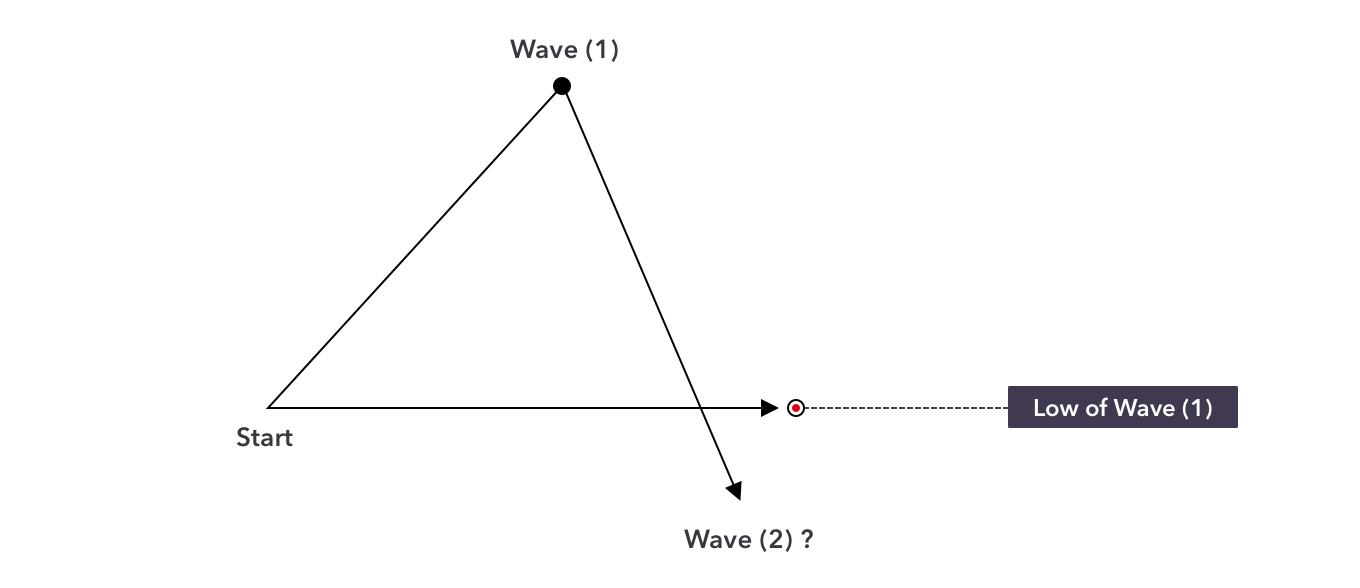
Wave 2 never retraces more than 100% of wave 1.

The image above shows a break below the start point of the wave sequence, thus negating the notion that it is wave1.

Wave 3 cannot be the shortest of the three impulse waves.

The image above highlights the instance when we see a third wave that is too short, thus negating the possibility that this is a correct wave count. Therefore, the subsequent waves remain part of the third wave rather than forming 4 and 5.

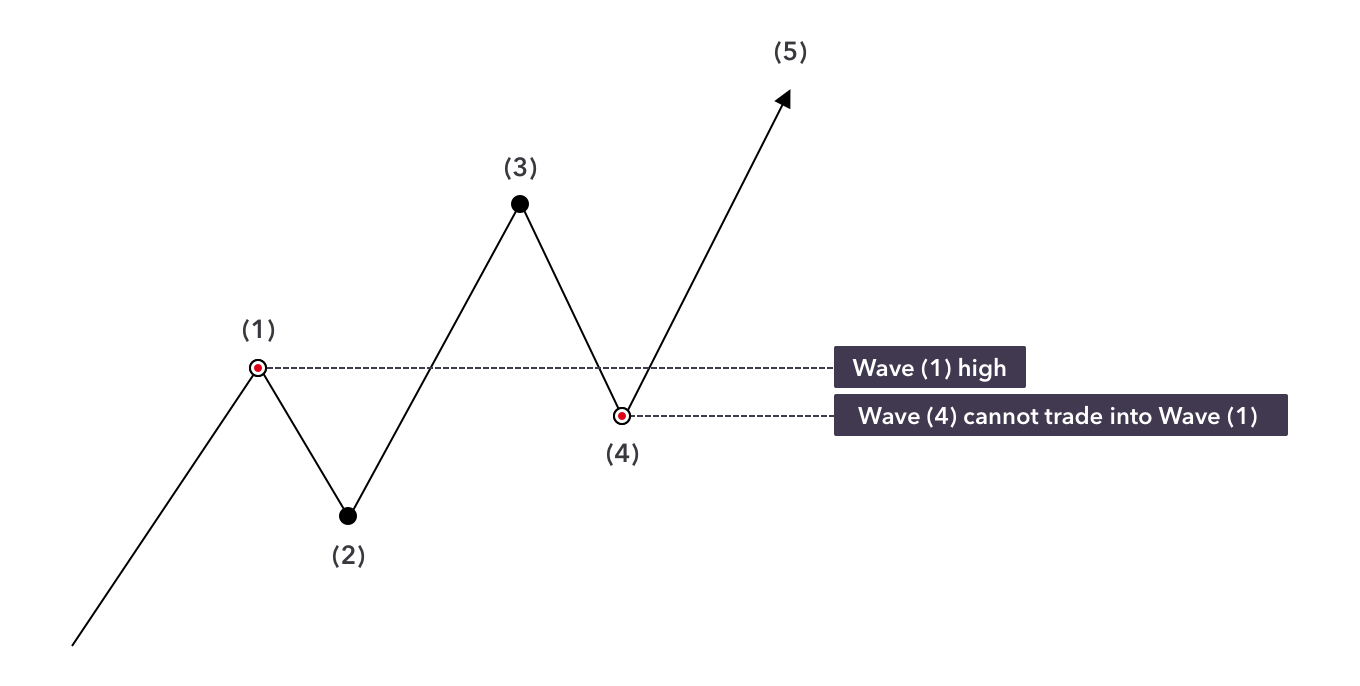
Wave 4 does not cross the final point of wave 1.

The break below the wave 1 point clearly negates the classification of the fourth wave, instead remaining within wave 3.

Cycles

Elliott assigned a series of categories to the waves, which highlight the fact that you will see the same patterns within both long-term and shorter-term charts. The categories are as follows.

  • Grand supercycle: multi-century
    • Supercycle: multi-decade (about 40 to 70 years)
    • Cycle: one year to several years (or even several decades under an Elliott Extension)
    • Primary: a few months to a couple of years
    • Intermediate: weeks to months
    • Minor: weeks
    • Minute: days
    • Minuette: hours
    • Sub-minuette: minutes

Meaning of Portfolio Evaluation

Portfolio evaluating refers to the evaluation of the performance of the investment portfolio. It is essentially the process of comparing the return earned on a portfolio with the return earned on one or more other portfolio or on a benchmark portfolio. Portfolio performance evaluation essentially comprises of two functions, performance measurement and performance evaluation. Performance measurement is an accounting function which measures the return earned on a portfolio during the holding period or investment period. Performance evaluation, on the other hand, address such issues as whether the performance was superior or inferior, whether the performance was due to skill or luck etc.

The ability of the investor depends upon the absorption of latest developments which occurred in the market. The ability of expectations if any, we must able to cope up with the wind immediately. Investment analysts continuously monitor and evaluate the result of the portfolio performance. The expert portfolio constructor shall show superior performance over the market and other factors. The performance also depends upon the timing of investments and superior investment analysts capabilities for selection. The evolution of portfolio always followed by revision and reconstruction. The investor will have to assess the extent to which the objectives are achieved. For evaluation of portfolio, the investor shall keep in mind the secured average returns, average or below average as compared to the market situation. Selection of proper securities is the first requirement.

Portfolio Performance Evaluation Methods

The objective of modern portfolio theory is maximization of return or minimization of risk. In this context the research studies have tried to evolve a composite index to measure risk based return. The credit for evaluating the systematic, unsystematic and residual risk goes to Sharpe, Treynor and Jensen.

The portfolio performance evaluation can be made based on the following methods:

  • Sharpe’s Measure
  • Treynor’s Measure
  • Jensen’s Measure
  1. Sharpe’s Measure

Sharpe’s Index measure total risk by calculating standard deviation. The method adopted by Sharpe is to rank all portfolios on the basis of evaluation measure. Reward is in the numerator as risk premium. Total risk is in the denominator as standard deviation of its return. We will get a measure of portfolio’s total risk and variability of return in relation to the risk premium. The measure of a portfolio can be done by the following formula:

SI = (Rt — Rf)/σf

Where,

  • SI = Sharpe’s Index
  • Rt = Average return on portfolio
  • Rf = Risk free return
  • σf = Standard deviation of the portfolio return.
  1. Treynor’s Measure

The Treynor’s measure related a portfolio’s excess return to non-diversifiable or systematic risk. The Treynor’s measure employs beta. The Treynor based his formula on the concept of characteristic line. It is the risk measure of standard deviation, namely the total risk of the portfolio is replaced by beta. The equation can be presented as follow:

T= (Rn – Rf)/βm

Where,

  • T= Treynor’s measure of performance
  • R= Return on the portfolio
  • Rf = Risk free rate of return
  • βm = Beta of the portfolio ( A measure of systematic risk)

3. Jensen’s Measure

Jensen attempts to construct a measure of absolute performance on a risk adjusted basis. This measure is based on Capital Asset Pricing Model (CAPM) model. It measures the portfolio manager’s predictive ability to achieve higher return than expected for the accepted riskiness. The ability to earn returns through successful prediction of security prices on a standard measurement. The Jensen measure of the performance of portfolio can be calculated by applying the following formula:

Rp = R+ (RMI — Rf) x β

Where,

  • R= Return on portfolio
  • RMI = Return on market index
  • Rf = Risk free rate of return

Security Market Line

Security market line (SML) is the representation of the capital asset pricing model. It displays the expected rate of return of an individual security as a function of systematic, non-diversifiable risk. The risk of an individual risky security reflects the volatility of the return from security rather than the return of the market portfolio. The risk in these individual risky securities reflects the systematic risk.

Formula

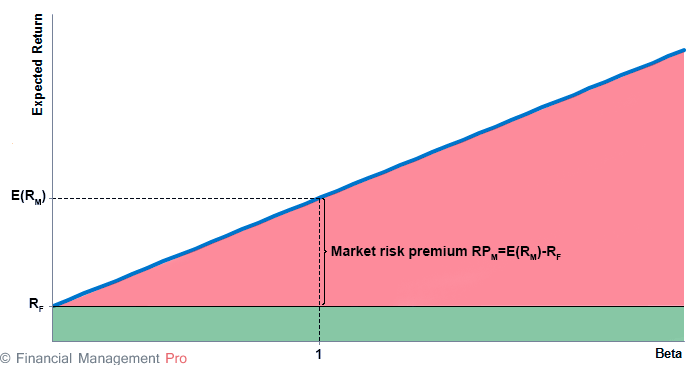
The Y-intercept of the SML is equal to the risk-free interest rate. The slope of the SML is equal to the market risk premium and reflects the risk return tradeoff at a given time:

E(Ri) = RF + βi × (E(RM) – RF)

Where:

E(Ri) is an expected return on security

E(RM) is an expected return on market portfolio M

β is a nondiversifiable or systematic risk

RM is a market rate of return

Rf is a risk-free rate

When used in portfolio management, the SML represents the investment’s opportunity cost (investing in a combination of the market portfolio and the risk-free asset). All the correctly priced securities are plotted on the SML. The assets above the line are undervalued because for a given amount of risk (beta), they yield a higher return. The assets below the line are overvalued because for a given amount of risk, they yield a lower return. In a market in perfect equilibrium, all securities would fall on the SML.

There is a question about what the SML looks like when beta is negative. A rational investor will accept these assets even though they yield sub-risk-free returns, because they will provide “recession insurance” as part of a well-diversified portfolio. Therefore, the SML continues in a straight line whether beta is positive or negative. A different way of thinking about this is that the absolute value of beta represents the amount of risk associated with the asset, while the sign explains when the risk occur.

SML Graph

The x-axis of the SML graph is represented by the beta, and the y-axis is represented by the expected return. The value of the risk-free rate is the beginning of the line.

  • The zero-beta security will have the expected return equal to the risk-free rate. The expected return of zero-beta portfolio also equals the risk-free rate.
  • The slope of the security market line is determined by the market risk premium (RPM), which is the difference between the expected market return and the risk-free rate. The higher the market risk premium, the steeper the slope and vice versa.
  • The SML is not fixed and can change the slope and y-axis intersection over time. It depends on changes in interest rates, risk-return trade-off.
  • If the beta coefficient of the given security changes over time, its position on the line will also change.

The shift of SML can also occur when key economical fundamental factors change, such as a change in the expected inflation rate, GDP, or unemployment rate.

Basic Principles of Portfolio Management

Basic Principles of the portfolio investment process are given below:

  1. It is the portfolio that matters:

Individual securities are important only to the extent that they affect the aggregate portfolio. For example, a security’s risk should not be based on the uncertainty of a single security’s return but, instead, on its contribution to the uncertainty of the total portfolio’s return.

In addition, assets such as a person’s career or home should be considered together with the security portfolio. In short, all decisions should focus on the impact the decision will have on the aggregate portfolio of all assets held.

  1. Larger expected portfolio returns come only with larger portfolio risk:

The most important portfolio decision is the amount of risk which is acceptable, which is determined by the asset allocation within the security portfolio.

This is not an easy decision, since it requires that we have some idea of the risks and expected returns available on many different classes of assets. Nonetheless, the risk/return level of the aggregate portfolio should be the first decision any investor makes.

  1. The risk associated with a security type depends on when the investment will be liquidated:

A person who plans to sell in one year will find equity returns to be more risky than a person who plans to sell in 10 years.

Alternatively, the person who plans to sell in 10 years will find one year maturity bonds to be more risky than the person who plans to sell in one year. Risk is reduced by selecting securities with a payoff close to when the portfolio is to be liquidated.

  1. Diversification works:

Diversification across various securities will reduce a portfolio’s risk. If such broad diversification results in an expected portfolio return or risk level which is lower (or higher) than desired, then borrowing (or lending) can be used to achieve the desired level.

  1. Each portfolio should be tailored to the particular needs of its owner:

People have varying tax rates, knowledge, transaction costs, etc. Individuals who are in a high marginal tax bracket should stress portfolio strategies which increase after-tax returns. Individuals who lack strong knowledge of investment alternatives should hire professionals to provide needed counseling.

Large pension portfolios should pursue strategies which will reduce brokerage fees associated with moving capital between equity and non-equity managers (for example, by using options on futures). In short, portfolio strategy should be molded to the unique needs and characteristics of the portfolio’s owner.

  1. Competition for abnormal returns is extensive:

A large number of people are continuously using a large variety of techniques in an attempt to obtain abnormal returns larger than should be expected given a security’s risk.

Securities which are believed to be undervalued are bought until the price rises to a proper level, and securities which are believed to be overvalued are sold until the price falls to a proper level.

If the actions of these speculators are truly effective, security prices will adjust instantaneously to new information the efficient market theory (EMT) will be correct.

The extent to which EMT is correct as well as the extent to which one has unique information determiners whether a passive “investment” strategy or an active “speculative” strategy should be used.

Factors affecting Investment Decisions in Portfolio Management

Age

Age is a decisive factor as it will define your financial priorities and what are your goals. This will further define the characteristics of the kind of assets you will purchase. For a younger person, assets which can give long-term returns will be preferable as he has that many years left, whereas, for an older person, assets with income features will be most helpful. Most assets such as equities and bonds can be defined as per the age requirement in the form of mutual funds.

Risk tolerance

This is a very important factor as it will determine if and how much you can invest in risk assets. Most assets which give high returns are also highly risks. This creates a need to assess how much of a loss can you bear on an asset. If your capital gets wiped out it should not affect your financial stability and wealth status. That is how you will get started on understanding your risk appetite.

  • Usually, it is found that older people, lower income group people will have lower risk appetite as the earning power is less,
  • There can be exceptions to the above rule when the person has savings earmarked for investment or inheritance allows the person to invest in more risky assets
  • People with a longer working age left should look at equities as it will give a long-term benefit of accumulation and the number of economic cycles will give more benefit of capital appreciation

Time horizon

This aspect is related to fulfilling of specific financial goals and how much time is left for their fulfillment. If a goal has to say 3 years left to arrive, it makes sense to put the capital in bonds or income funds to ensure the capital safety. 3 years might be a short period to earn a substantial return from the equity market. But one might be able to find a diversified mutual fund which can not only sustain the capital in a good market but also give good returns.

The time horizon starts when the investment portfolio is implemented and ends when the investor will need to take the money out. The length of time you will be investing is important because it can directly affect your ability to reduce risk. Longer time horizons allow you to take on greater risks Þ with a greater total return potential Þ because some of that risk can be reduced by investing across different market environments. If the time horizon is short, the investor has greater liquidity needs Þ some attractive opportunities of earning higher return has to be sacrificed and the result is reduced in return. Time horizons tend to vary over the life-cycle. Younger investors who are only accumulating savings for retirement have long time horizons, and no real liquidity needs except for short-term emergencies. However, younger investors who are also saving for a specific event, such as the purchase of a house or a child’s education, may have greater liquidity needs. Similarly, investors who are planning to retire, and those who are in retirement and living on their investment income, have greater liquidity needs.

Return Needs

This refers to whether the investor needs to emphasize growth or income. Younger investors who are accumulating savings will want returns that tend to emphasize growth and higher total returns, which primarily are provided by equity shares. Retirees who depend on their investment portfolio for part of their annual income will want consistent annual payouts, such as those from bonds and dividend-paying stocks. Of course, many individuals may want a blending of the two Þ some current income, but also some growth.

Technical Analysis: Basic Principles of Technical Analysis in investment

In finance, technical analysis is an analysis methodology for forecasting the direction of prices through the study of past market data, primarily price and volume. Behavioral economics and quantitative analysis use many of the same tools of technical analysis, which, being an aspect of active management, stands in contradiction to much of modern portfolio theory. The efficacy of both technical and fundamental analysis is disputed by the efficient-market hypothesis, which states that stock market prices are essentially unpredictable, and research on technical analysis has produced mixed results.

Fundamental analysts examine earnings, dividends, assets, quality, ratio, new products, research and the like. Technicians employ many methods, tools and techniques as well, one of which is the use of charts. Using charts, technical analysts seek to identify price patterns and market trends in financial markets and attempt to exploit those patterns.

Technicians using charts search for archetypal price chart patterns, such as the well-known head and shoulder or double top/bottom reversal patterns, study technical indicators, moving averages and look for forms such as lines of support, resistance, channels and more obscure formations such as flags, pennants, balance days and cup and handle patterns.

Technical analysts also widely use market indicators of many sorts, some of which are mathematical transformations of price, often including up and down volume, advance/decline data and other inputs. These indicators are used to help assess whether an asset is trending, and if it is, the probability of its direction and of continuation. Technicians also look for relationships between price/volume indices and market indicators. Examples include the moving average, relative strength index and MACD. Other avenues of study include correlations between changes in Options (implied volatility) and put/call ratios with price. Also important are sentiment indicators such as Put/Call ratios, bull/bear ratios, short interest, Implied Volatility, etc.

There are many techniques in technical analysis. Adherents of different techniques (for example: Candlestick analysis, the oldest form of technical analysis developed by a Japanese grain trader; Harmonics; Dow theory; and Elliott wave theory) may ignore the other approaches, yet many traders combine elements from more than one technique. Some technical analysts use subjective judgment to decide which pattern(s) a particular instrument reflects at a given time and what the interpretation of that pattern should be. Others employ a strictly mechanical or systematic approach to pattern identification and interpretation.

Contrasting with technical analysis is fundamental analysis, the study of economic factors that influence the way investors price financial markets. Technical analysis holds that prices already reflect all the underlying fundamental factors. Uncovering the trends is what technical indicators are designed to do, although neither technical nor fundamental indicators are perfect. Some traders use technical or fundamental analysis exclusively, while others use both types to make trading decisions.

Principles

A core principle of technical analysis is that a market’s price reflects all relevant information impacting that market. A technical analyst therefore looks at the history of a security or commodity’s trading pattern rather than external drivers such as economic, fundamental and news events. It is believed that price action tends to repeat itself due to the collective, patterned behavior of investors. Hence technical analysis focuses on identifiable price trends and conditions.

Characteristics

Technical analysis employs models and trading rules based on price and volume transformations, such as the relative strength index, moving averages, regressions, inter-market and intra-market price correlations, business cycles, stock market cycles or, classically, through recognition of chart patterns.

Technical analysis stands in contrast to the fundamental analysis approach to security and stock analysis. In the fundamental equation M = P/E technical analysis is the examination of M (multiple). Multiple encompasses the psychology generally abounding, i.e. the extent of willingness to buy/sell. Also in M is the ability to pay as, for instance, a spent-out bull can’t make the market go higher and a well-heeled bear won’t. Technical analysis analyzes price, volume, psychology, money flow and other market information, whereas fundamental analysis looks at the facts of the company, market, currency or commodity. Most large brokerages, trading groups, or financial institutions will typically have both a technical analysis and fundamental analysis team.

In the 1960s and 1970s it was widely dismissed by academics. In a recent review, Irwin and Park reported that 56 of 95 modern studies found that it produces positive results but noted that many of the positive results were rendered dubious by issues such as data snooping, so that the evidence in support of technical analysis was inconclusive; it is still considered by many academics to be pseudoscience. Academics such as Eugene Fama say the evidence for technical analysis is sparse and is inconsistent with the weak form of the efficient-market hypothesis. Users hold that even if technical analysis cannot predict the future, it helps to identify trends, tendencies, and trading opportunities.

While some isolated studies have indicated that technical trading rules might lead to consistent returns in the period prior to 1987, most academic work has focused on the nature of the anomalous position of the foreign exchange market. It is speculated that this anomaly is due to central bank intervention, which obviously technical analysis is not designed to predict. Recent research suggests that combining various trading signals into a Combined Signal Approach may be able to increase profitability and reduce dependence on any single rule.

error: Content is protected !!