Succession Planning, Concepts, Objectives, Types, Process and Benefits

Succession Planning is a process for identifying and developing new leaders who can replace old leaders when they leave, retire or die. Here the planning is usually a close process, so that those who have been selected are not likely to know that they are on a succession list or chat. Succession planning increases the availability of experienced and capable employees that are prepared to assume these roles as they become available. Succession planning is a strategy for passing on leadership roles often the ownership of a company to an employee or group of employees.

Succession planning is a process that ensures an organization has a plan in place to identify and develop internal talent to fill key leadership roles when the current leaders leave their positions. A succession planning program is a formal program that helps organizations identify and develop their future leaders.

Also known as “replacement planning,” it ensures that businesses continue to run smoothly after a company’s most important people move on to new opportunities, retire, or pass away. Succession planning can also provide a liquidity event enabling the transfer of ownership in a going concern to rising employees. Taken narrowly, “replacement planning” for key roles is the heart of succession planning.

  • In dictatorships, succession planning aims for continuity of leadership, preventing a chaotic power struggle by preventing a power vacuum.
  • In monarchies, succession is usually settled by the order of succession.
  • In business, succession planning entails developing internal people with the potential to fill key business leadership positions in the company.

Effective succession or talent-pool management concerns itself with building a series of feeder groups up and down the entire leadership pipeline or progression. In contrast, replacement planning is focused narrowly on identifying specific back-up candidates for given senior management positions. Thought should be given to the retention of key employees, and the consequences that the departure of key employees may have on the business.

Objectives of Succession Planning

  • Ensure Continuity of Leadership

One major objective of succession planning is to ensure continuity of leadership in the organization. When key employees retire, resign, are promoted, or leave unexpectedly, suitable replacements should be available. Succession planning identifies and prepares employees for important positions in advance. This reduces disruption in organizational activities and ensures that important responsibilities continue smoothly. It also helps maintain stability during leadership transitions and allows the organization to remain focused on its goals without facing a sudden shortage of capable leaders.

  • Identify High-Potential Employees

Succession planning aims to identify employees who have the potential to take higher responsibilities in the future. HRD evaluates employees based on their performance, competencies, leadership qualities, knowledge, experience, and ability to handle challenging situations. High-potential employees can then be included in development programmes and prepared for critical positions. Identifying talented employees early helps organizations build a strong internal talent pool. It also ensures that capable employees receive appropriate opportunities for professional growth and advancement within the organization.

  • Develop Future Leaders

Another important objective is to develop future leaders who can effectively manage organizational responsibilities. Selected employees are provided with leadership training, coaching, mentoring, job rotation, challenging assignments, and decision-making opportunities. These development activities improve their managerial, communication, problem-solving, and strategic thinking abilities. Preparing future leaders reduces dependence on external recruitment for senior positions. It also creates employees who understand organizational values, culture, policies, and objectives, making them better prepared to handle leadership responsibilities when opportunities arise.

  • Reduce Leadership Gaps

Succession planning helps organizations reduce the risk of leadership gaps. Important positions may become vacant because of retirement, resignation, promotion, transfer, illness, or unexpected circumstances. Without suitable replacements, organizational performance may suffer. Succession planning identifies potential successors and develops them before vacancies occur. This creates a ready pool of qualified employees who can assume responsibilities when required. Therefore, the organization can respond quickly to changes and maintain effective operations without experiencing prolonged shortages in important managerial and leadership positions.

  • Support Employee Career Development

Succession planning provides employees with clear opportunities for career growth and advancement. Employees can understand what positions may be available in the future and what competencies are required to reach those positions. HRD can provide training, mentoring, coaching, job rotation, and developmental assignments to help employees prepare for advancement. This encourages employees to take responsibility for their professional development. When employees see a clear career path within the organization, they are more motivated to improve their performance and develop their capabilities.

  • Improve Employee Retention and Motivation

An important objective of succession planning is to improve employee motivation and retention. Employees are more likely to remain with an organization when they believe that their contributions are recognized and opportunities for advancement are available. Succession planning demonstrates that the organization is interested in employees’ long-term development. Training and career opportunities increase employee satisfaction and commitment. Recognition as a potential successor can also motivate employees to perform better, acquire new skills, accept greater responsibilities, and contribute more effectively to organizational objectives.

  • Preserve Organizational Knowledge

Succession planning aims to preserve important knowledge, skills, experience, and organizational information when experienced employees leave. Senior employees often possess valuable knowledge about organizational processes, customers, systems, and practices. Through mentoring, coaching, knowledge sharing, and job shadowing, this knowledge can be transferred to potential successors. Effective knowledge transfer reduces the possibility of losing critical organizational knowledge. It also helps new leaders understand their responsibilities more quickly and maintain consistency in organizational practices, decision-making, and performance.

  • Achieve Long-Term Organizational Objectives

Succession planning ultimately aims to support the long-term success and effectiveness of the organization. By developing capable employees for future positions, organizations can build a stable leadership pipeline and strengthen their ability to respond to changing business conditions. It connects employee development with future organizational requirements and strategic objectives. A strong succession plan improves leadership readiness, reduces organizational risks, supports talent management, and strengthens competitiveness. Thus, succession planning ensures that the organization has the right people with the right capabilities for future responsibilities.

Types of Succession Planning

1. Emergency Succession Planning

Emergency succession planning is designed to deal with unexpected vacancies in important positions. It identifies employees who can immediately take over responsibilities when a key employee suddenly resigns, becomes unavailable, or leaves the organization. The main purpose is to maintain business continuity and avoid disruption. Organizations usually prepare backup candidates and define their responsibilities in advance. This type of planning is especially important for critical leadership positions.

Example: If a company’s finance manager suddenly resigns, an experienced assistant manager may temporarily take charge until a permanent replacement is appointed.

2. Strategic Succession Planning

Strategic succession planning is a long-term approach that connects succession decisions with the organization’s future goals and strategy. It identifies important positions and develops employees who can meet future leadership and business requirements. HRD provides training, coaching, mentoring, job rotation, and challenging assignments to prepare potential successors. This approach ensures that leadership development supports organizational growth and change.

Example: A growing technology company may identify software managers with leadership potential and prepare them for future senior management positions through leadership development programmes.

3. Short-Term Succession Planning

Short-term succession planning focuses on preparing employees to fill important positions within a relatively short period. It is useful when an organization expects a vacancy because of retirement, promotion, transfer, or resignation. HRD identifies suitable employees who already possess many of the required skills and provides focused development to make them ready. This approach reduces disruption and ensures a smooth transition.

Example: If a department head is retiring within six months, the organization may prepare the current deputy manager to take over the position.

4. Long-Term Succession Planning

Long-term succession planning focuses on developing employees for important positions several years in advance. It is particularly useful for senior management and leadership roles that require extensive experience and development. Employees with high potential are identified early and provided with continuous training, mentoring, job rotation, and leadership assignments. The objective is to build a strong leadership pipeline for future organizational needs.

Example: A company may identify a young management trainee and gradually develop them over several years to become a future business unit manager.

5. Internal Succession Planning

Internal succession planning involves selecting and developing successors from within the organization. Existing employees are assessed based on their performance, competencies, experience, and leadership potential. Suitable employees are given training, mentoring, promotions, job rotation, and challenging assignments to prepare them for higher positions. This approach motivates employees and helps retain organizational knowledge and experience.

Example: A sales executive who consistently performs well may be developed through leadership training and eventually promoted to sales manager when the position becomes vacant.

6. External Succession Planning

External succession planning involves identifying potential successors from outside the organization. It is used when suitable internal candidates are unavailable or when the organization requires new skills, experience, or perspectives. HRD and recruitment teams may maintain relationships with external talent and professional networks to identify suitable candidates. External succession can introduce new ideas and expertise into the organization.

Example: If a company lacks an experienced Chief Technology Officer internally, it may recruit an experienced technology leader from another organization to fill the position.

7. Leadership Succession Planning

Leadership succession planning focuses specifically on preparing employees for future leadership and managerial positions. It identifies employees with leadership potential and develops their decision-making, communication, strategic thinking, problem-solving, and people-management abilities. HRD may use coaching, mentoring, leadership programmes, job rotation, and special assignments to prepare future leaders. This ensures that capable employees are available to manage the organization in the future.

Example: A company may prepare selected department managers through executive development programmes for future roles as directors or senior executives.

8. Key Position Succession Planning

Key position succession planning focuses on positions that are essential for the successful functioning of an organization. These positions may involve senior managers, technical specialists, financial controllers, or employees possessing critical knowledge. The organization identifies possible successors and prepares them to assume these roles when necessary. This reduces the risk associated with losing employees in critical positions.

Example: A manufacturing company may identify its chief production engineer as a key position and train experienced engineers to take over the role if the current employee leaves.

Process of Succession Planning


Step 1. Identifying Key Positions

The first step in succession planning is identifying positions that are critical to the organization’s success. These may include senior management, department heads, technical specialists, or employees with specialized knowledge. HRD determines which positions would create serious difficulties if they became vacant. The organization then prioritizes these positions for succession planning. This helps management focus development resources on roles that require continuous availability of capable employees. Example: A manufacturing company may identify its Production Manager and Finance Manager as critical positions requiring succession plans.

Step 2. Defining Position Requirements

After identifying key positions, the organization determines the knowledge, skills, competencies, qualifications, experience, and personal qualities required for each position. HRD develops job descriptions and competency profiles to clearly understand the requirements of future roles. These requirements become the basis for identifying suitable successors. Clear position requirements help ensure that employees are developed according to actual organizational needs. Example: A future Sales Manager may require leadership ability, communication skills, sales knowledge, decision-making skills, and several years of sales experience.

Step 3. Identifying Potential Successors

The next step is identifying employees who have the potential to occupy key positions in the future. HRD considers performance, competencies, experience, leadership qualities, career aspirations, and future potential. Performance appraisal and potential appraisal are useful tools for this purpose. Employees may be categorized according to their readiness for higher responsibilities. Example: An organization may identify three high-performing Assistant Managers as potential successors for a Department Manager position based on their performance and leadership capabilities.

Step 4. Assessing Successor Readiness

After identifying potential successors, HRD assesses their readiness to take over future positions. Employees may be classified as immediately ready, ready within a short period, or requiring long-term development. Assessment may include performance records, competency assessments, interviews, assessment centres, and manager feedback. This process helps identify strengths and development gaps among potential successors. Example: An Assistant Manager may have strong technical skills but require leadership and decision-making development before becoming ready for a General Manager position.

Step 5. Identifying Development Needs

HRD identifies the skills and competencies that potential successors need to develop. These may include leadership, communication, strategic thinking, problem-solving, technical knowledge, decision-making, and people-management skills. Identifying development needs helps create individual development plans for employees. This ensures that development activities are targeted toward future job requirements. Example: If an employee selected for future managerial responsibility lacks presentation and leadership skills, HRD may include leadership training and communication workshops in the employee’s development plan.

Step 6. Providing Training and Development

Once development needs are identified, HRD provides appropriate training and development opportunities. These may include coaching, mentoring, job rotation, workshops, e-learning, leadership programmes, challenging assignments, and executive development. Such activities prepare employees for greater responsibilities and improve their confidence and competencies. Development should be continuous rather than limited to a single training programme. Example: A potential department head may receive leadership training, work under a senior manager, and participate in cross-functional projects to gain broader organizational experience.

Step 7. Implementing and Monitoring the Plan

HRD implements the succession plan and regularly monitors the progress of potential successors. Managers provide feedback and assess whether employees are developing the required competencies. Performance reviews, development discussions, and competency assessments help track progress. If an employee’s development needs change, the plan can be modified accordingly. Example: If an employee preparing for a managerial position demonstrates improvement in technical skills but still lacks decision-making ability, HRD may provide additional coaching and challenging assignments.

Step 8. Reviewing and Updating the Succession Plan

Succession planning is a continuous process, so organizations must regularly review and update their plans. Employees may be promoted, leave the organization, develop new skills, or change their career goals. Organizational strategies and position requirements may also change. HRD should therefore reassess potential successors and update development plans periodically. Example: A company expanding into international markets may revise its succession plan and develop future managers with international business knowledge and cross-cultural management skills.

Benefits of Succession Planning

There are several advantages for both employers and employees to having a formalized succession plan in place:

  • Shareholders of publicly traded companies benefit from proper succession planning, such as the case when the next candidate for CEO is involved in business operations and is well respected years before the current CEO retires. Also, if investors observe a well-communicated succession plan, they won’t sell the company’s stock when the CEO retires.
  • With Baby Boomer business owners and leadership retiring in huge numbers, a new generation of leaders will be needed.
  • Employees know that there is a chance for advancement and possibly ownership, which can lead to more empowerment and higher job satisfaction.
  • Management keeps better track of the value of employees so that positions can be filled internally when opportunities arise.
  • Knowing that the company is planning for future opportunities reinforces career development among employees.
  • Management’s commitment to succession planning means that supervisors will mentor employees to transfer knowledge and expertise.
  • With succession planning, leadership and employees are better able to share company values and vision.

Need for Succession Planning

Succession Planning is a part and parcel of the Human Resource Planning, which acknowledges that the employees may or may not work with the organization in the future. And so to be at the safer side, a succession plan is developed to analyse the vacancies which might take place when an employee leaves the organization, the business areas which might be affected, job requirements and the skills of the existing incumbent.

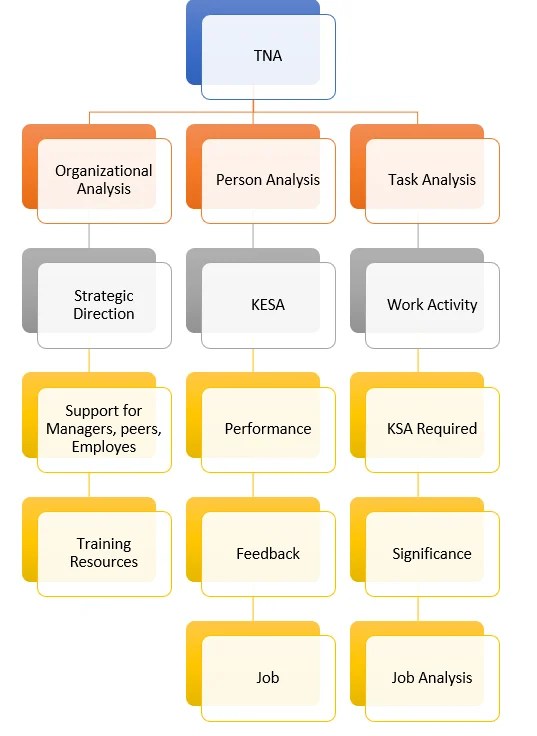
Training Need Analysis, Meaning, Levels, Process and Methods

Training Need Analysis (TNA) is a systematic and diagnostic process of identifying performance gaps, skill deficiencies, and competency requirements within an organisation to determine whether training is the appropriate solution. It involves collecting and analysing data at three distinct levels: organisational analysis examines strategic goals and resource constraints; task analysis identifies specific job duties and performance standards; and person analysis assesses individual employee capabilities against required competencies. TNA helps distinguish between training needs arising from skill deficits and non-training issues such as inadequate resources, faulty systems, or motivational problems. Ultimately, TNA ensures that training investments are targeted, cost-effective, and directly aligned with organisational objectives.

Levels of Training Need Analysis

1. Organisational Level Analysis

Organisational Level Analysis is the highest and broadest level of Training Need Analysis, focusing on the entire organisation’s strategic direction, goals, resources, and external environment. This analysis examines whether training initiatives align with the organisation’s mission, vision, and long-term business objectives. It assesses factors such as organisational climate, culture, technological changes, competitive pressures, and future workforce requirements. Resource availability, including budget, infrastructure, and time, is evaluated to determine the feasibility of proposed training programmes. Organisational analysis also identifies which departments, functions, or units require development interventions. Furthermore, it examines organisational support systems, including reward structures and managerial commitment, which influence training effectiveness. Ultimately, this level ensures that training investments contribute meaningfully to overall organisational performance and strategic success.

2. Task or Operational Level Analysis

Task or Operational Level Analysis focuses on specific jobs, roles, and work processes to determine the knowledge, skills, and abilities required for effective performance. This level involves a detailed examination of job descriptions, duty statements, performance standards, and work procedures to identify the competencies necessary to perform tasks satisfactorily. It analyses critical tasks, frequency of performance, difficulty levels, and consequences of errors to prioritise training needs. Task analysis also examines working conditions, equipment used, safety requirements, and interdependencies with other roles. Data is collected through job observations, interviews with incumbents and supervisors, and reviews of performance documentation. The outcome is a clear specification of what employees must know and do to meet performance expectations.

3. Person or Individual Level Analysis

Person or Individual Level Analysis examines the specific capabilities, knowledge gaps, and developmental needs of each employee against the required performance standards for their role. This analysis identifies which individuals are underperforming and whether the performance deficiency stems from a lack of skills, knowledge, or other factors such as motivation or resource constraints. Various methods are employed, including performance appraisals, supervisor assessments, self-evaluations, psychometric tests, and 360-degree feedback. Person analysis also considers employee readiness for training, including their learning style, willingness to participate, and career aspirations. It distinguishes between employees who need training and those who would benefit from other interventions like coaching or job redesign.

4. Demographic and Competency Analysis

Demographic and Competency Analysis examines workforce composition, diversity factors, and existing competency inventories to identify training requirements across different employee groups. This analysis considers age profiles, educational backgrounds, work experience, and tenure distributions to anticipate knowledge obsolescence or career stage-specific needs. Competency mapping is conducted to assess the current skill inventory against future competency requirements derived from organisational strategy. Critical competencies such as leadership, communication, technical expertise, problem-solving, and adaptability are evaluated for proficiency levels. This analysis identifies competency gaps at group levels, helping prioritise training interventions for specific categories of employees. It also addresses diversity and inclusion training requirements to foster equitable workplace culture. Ultimately, competency-based TNA ensures strategic skill development across the entire workforce.

Process of Training Need Analysis

Step 1. Organisational Analysis

The first step in the training need analysis process involves examining the overall organisation to determine where training efforts are most needed and how they align with strategic goals. This includes reviewing organisational objectives, resource availability, and the broader business environment to identify gaps between current performance and desired outcomes. Organisational analysis also considers factors such as changes in technology, market conditions, or organisational structure that may create new training requirements. By understanding the organisation-wide context first, trainers ensure that subsequent training initiatives are strategically aligned with business priorities rather than developed in isolation, ensuring resources are directed toward areas that will generate maximum organisational value and impact.

Step 2. Task or Job Analysis

Task analysis involves examining specific jobs and roles within the organisation to determine the exact knowledge, skills, and behaviors required for effective performance. This step includes reviewing job descriptions, standard operating procedures, and performance standards to identify the specific competencies employees need to succeed in their roles. Trainers often observe employees performing tasks, consult subject matter experts, or review documented workflows to gain a detailed understanding of job requirements. This analysis helps pinpoint precisely what needs to be taught during training, ensuring content remains relevant and directly applicable to actual job responsibilities rather than generic or loosely related material that fails to address specific role requirements.

Step 3. Person Analysis

Person analysis focuses on evaluating individual employees to identify specific gaps between their current performance levels and the competencies required for their roles. This involves reviewing performance appraisal data, conducting skills assessments, gathering supervisor feedback, and sometimes using self-assessment tools to understand individual strengths and weaknesses. Person analysis helps determine which employees genuinely require training and distinguishes performance issues caused by skill deficiencies from those stemming from other factors such as motivation or resource constraints. By identifying specific individual needs, this step ensures training resources are allocated efficiently, targeting employees who will benefit most, rather than applying generic training uniformly across the entire workforce regardless of actual need.

Step 4. Data Collection Methods

This step involves gathering relevant information through various methods to accurately identify training needs across the organisation. Common techniques include structured interviews, questionnaires, direct observation, performance records review, focus group discussions, and analysis of critical incidents or customer complaints. Combining multiple data collection methods provides a more comprehensive and reliable picture of actual training needs, reducing the risk of relying on a single, potentially biased source of information. Trainers must carefully select methods appropriate to the organisational context, considering factors such as time, cost, and the nature of the roles being analyzed, ensuring the data gathered genuinely reflects real performance gaps requiring targeted training intervention.

Step 5. Identifying Performance Gaps

Based on the data collected, this step involves systematically comparing actual employee performance against desired or expected performance standards to identify specific gaps. These gaps represent the difference between what employees currently know or can do and what they need to know or do to perform effectively. Identifying performance gaps requires careful analysis to distinguish genuine training needs from other underlying issues, such as inadequate resources, poor management, or unclear expectations, which training alone cannot resolve. Clearly defining these gaps ensures that subsequent training interventions are precisely targeted, addressing actual skill or knowledge deficiencies rather than symptoms of unrelated organisational problems.

Step 6. Prioritizing Training Needs

Once performance gaps are identified, organisations must prioritize which needs require immediate attention based on factors such as urgency, potential organisational impact, and available resources. Not all identified gaps can be addressed simultaneously, making prioritization essential for effective resource allocation. This involves considering criteria such as the criticality of the skill gap to business operations, the number of employees affected, and the potential return on investment from addressing specific needs. Prioritization ensures that training budgets and efforts are directed toward areas offering the greatest organisational benefit first, rather than spreading limited resources thinly across all identified needs without strategic consideration of relative importance.

Step 7. Setting Training Objectives

Based on prioritized needs, this step involves translating identified gaps into specific, clear, and measurable training objectives that will guide subsequent programme design. Objectives should specify exactly what participants should know, understand, or be able to do upon completing the training, providing a clear benchmark for evaluating programme success. Well-defined objectives also help in selecting appropriate training methods, content, and evaluation criteria. This step bridges the gap between need identification and actual training design, ensuring that all subsequent programme development remains focused and purposeful, directly addressing the specific gaps identified during earlier stages of the training need analysis process rather than pursuing vague or unfocused developmental outcomes.

Step 8. Documenting and Reporting Findings

The final step involves compiling all findings from the training need analysis into a comprehensive report that clearly communicates identified needs, priorities, and recommended interventions to relevant stakeholders. This documentation serves as a formal record justifying training investments and provides a reference point for measuring future training effectiveness. The report typically includes details on methodology used, specific gaps identified, target audience, and proposed training objectives. Sharing this analysis with management and relevant stakeholders ensures transparency, secures necessary buy-in and resources, and creates accountability for implementing recommended training interventions, ultimately closing the loop between need identification and actual training programme development and delivery.

Methods of Training Need Analysis

1. Observation Method

The observation method involves trainers or supervisors directly watching employees perform their tasks in real work settings to identify skill gaps and areas requiring improvement. This method provides firsthand, objective insight into actual work behavior, allowing observers to notice inefficiencies, errors, or deviations from standard procedures that employees themselves might not recognize or report. Observation can be structured, using predefined checklists and performance criteria, or unstructured, involving general workplace monitoring over time. While this method offers valuable real-time data, it can be time-consuming and may cause employees to alter their behavior when aware of being observed, potentially affecting the accuracy of findings gathered through this approach.

2. Interview Method

The interview method involves conducting structured or semi-structured conversations with employees, supervisors, and managers to gather detailed insights into performance issues and specific training requirements. Interviews allow for in-depth exploration of underlying causes behind performance gaps, providing richer qualitative data compared to simple observation. Trainers can ask targeted follow-up questions, clarifying ambiguous responses and uncovering nuanced perspectives from different organisational levels. This method is particularly effective for identifying tacit knowledge gaps or soft-skill deficiencies that may not be immediately visible through observation alone. However, interviews can be time-intensive and may involve subjective bias, requiring skilled interviewers to ensure balanced and accurate data collection.

3. Questionnaire and Survey Method

This method involves distributing structured questionnaires or surveys to a large number of employees to gather standardized data on perceived training needs, skill gaps, and job-related challenges. Questionnaires can include closed-ended questions for quantitative analysis or open-ended questions capturing qualitative insights, often combined with rating scales measuring competency levels. This method is cost-effective and efficient for collecting data from a large workforce simultaneously, especially across geographically dispersed locations. However, response quality depends heavily on question design and employee honesty, and low response rates or superficial answers can limit the depth and reliability of insights gathered through this widely used training need analysis method.

4. Performance Appraisal Review

This method involves systematically analyzing existing performance appraisal records and evaluation data to identify recurring patterns of underperformance or specific competency gaps across the workforce. Since appraisal data is already documented and formally assessed, this method provides objective, historical evidence of performance trends without requiring additional data collection efforts. Reviewing appraisal records across multiple cycles helps distinguish between isolated performance issues and persistent skill deficiencies requiring structured training intervention. This method is particularly useful for identifying individual and departmental training needs efficiently, though its effectiveness depends heavily on the quality, consistency, and accuracy of the original appraisal process and documentation maintained by the organisation.

5. Focus Group Discussion

Focus group discussions involve bringing together a small group of employees, typically from similar roles or departments, to collaboratively discuss performance challenges and training requirements in a structured group setting. This method leverages group dynamics, allowing participants to build on each other’s insights, leading to richer and more comprehensive identification of training needs than individual methods alone. A skilled facilitator guides the discussion, ensuring balanced participation and extracting meaningful, actionable insights from diverse perspectives. Focus groups are particularly effective for exploring complex or sensitive issues requiring open dialogue. However, this method can be influenced by dominant personalities within the group, potentially overshadowing quieter participants’ genuine perspectives and needs.

6. Critical Incident Technique

The critical incident technique involves analyzing specific instances of particularly effective or ineffective employee behavior to identify underlying skill or knowledge gaps. Trainers gather detailed accounts of critical incidents, such as situations where an employee successfully resolved a difficult customer complaint or, conversely, mishandled a significant task, from supervisors or employees themselves. By examining what specifically contributed to success or failure in these real incidents, trainers can pinpoint precise competencies requiring development. This method provides concrete, contextualized examples rather than abstract generalizations, making identified training needs highly relevant and specific. However, it can be time-consuming to collect sufficient incidents for reliable, generalizable conclusions.

7. Document and Record Analysis

This method involves systematically reviewing existing organisational documents and records, such as job descriptions, production reports, customer complaints, quality control data, and accident reports, to identify patterns indicating potential training needs. Analyzing these existing sources provides objective, quantifiable evidence of performance issues without requiring direct employee involvement or additional data collection processes. For instance, a high rate of product defects might indicate a need for technical skills training, while frequent customer complaints could suggest gaps in service-related competencies. This method is cost-effective and relies on readily available organisational data, though it may not capture underlying reasons behind documented issues without supplementary methods providing additional context.

8. Assessment Centers and Tests

Assessment centers and skill-based tests involve subjecting employees to structured exercises, simulations, or standardized tests designed to measure specific competencies against established benchmarks. This method may include role-plays, case studies, psychometric tests, or technical skill assessments conducted in controlled settings, providing objective, comparable data across employees. Assessment centers are particularly valuable for evaluating managerial or leadership potential, as they simulate real workplace scenarios employees may encounter in future roles. While this method offers rigorous, standardized evaluation, it can be resource-intensive and costly to design and administer effectively, requiring trained assessors and carefully validated tools to ensure the assessment accurately reflects genuine job-related competencies and training needs.

Criteria & Designing, Implementation, An effective training program

Training Program Development

When developing your training plan, there are a number of considerations. Training is something that should be planned and developed in advance.

The considerations for developing a training program are as follows:

  • Needs assessment and learning objectives. This part of the framework development asks you to consider what kind of training is needed in your organization. Once you have determined the training needed, you can set learning objectives to measure at the end of the training.
  • Consideration of learning styles. Making sure to teach to a variety of learning styles is important to development of training programs.
  • Delivery mode. What is the best way to get your message across? Is web-based training more appropriate, or should mentoring be used? Can vestibule training be used for a portion of the training while job shadowing be used for some of the training, too? Most training programs will include a variety of delivery methods.
  • How much money do you have to spend on this training?
  • Delivery style. Will the training be self-paced or instructor led? What kinds of discussions and interactivity can be developed in conjunction with this training?
  • Who will be part of this training? Do you have a mix of roles, such as accounting people and marketing people? What are the job responsibilities of these individuals, and how can you make the training relevant to their individual jobs?
  • What needs to be taught? How will you sequence the information?
  • How long will it take to develop the training? Is there a deadline for training to be completed?
  • How will employees know the training is available to them?
  • Measuring effectiveness of training. How will you know if your training worked? What ways will you use to measure this?

Needs Assessment

The first step in developing a training program is to determine what the organization needs in terms of training. There are three levels of training needs assessment: organizational assessment, occupational (task) assessment, and individual assessment:

  • Organizational assessment. In this type of needs assessment, we can determine the skills, knowledge, and abilities a company needs to meet its strategic objectives. This type of assessment considers things such as changing demographics and technological trends. Overall, this type of assessment looks at how the organization as a whole can handle its weaknesses while promoting strengths.
  • Occupational (task) assessment. This type of assessment looks at the specific tasks, skills knowledge, and abilities required to do jobs within the organization.
  • Individual assessment. An individual assessment looks at the performance of an individual employee and determines what training should be accomplished for that individual.

Types of Training and Delivery

Delivery Method Type of Training Suggested
On-the-job coaching Technical training
Skills training
Managerial training
Safety training
Mentor Technical training
Skills training
Managerial training
Safety training
Brown bag lunch Quality training
Soft skills training
Professional training
Safety training
Web-based Technical training
Quality training
Skills training
Soft skills training
Professional training
Team training
Managerial training
Safety training
Job shadowing Technical training
Quality training
Skills training
Safety training
Job swapping Technical training
Quality training
Skills training
Professional training
Team training
Managerial training
Safety training
Vestibule training Technical training
Quality training
Skills training
Soft skills training
Professional training
Team training
Managerial training
Safety training

Content Development

The content you want to deliver is perhaps one of the most important parts in training and one of the most time consuming to develop. Development of learning objectives or those things you want your learners to know after the training makes for a more focused training. Think of learning objectives as goals what should someone know after completing this training? Here are some sample learning objectives:

  • Be able to define and explain the handling of hazardous materials in the workplace.
  • Be able to utilize the team decision process model.
  • Understand the definition of sexual harassment and be able to recognize sexual harassment in the workplace.
  • Understand and be able to explain the company policies and structure.

Criteria for identifying Training Needs: Personal Analysis, Task Analysis, Organizational Analysis

  1. Organizational analysis

Training Needs Analysis at the organizational level identifies gaps between employees’ actual performance and their maximum potential to attain organizational objectives. This analysis begins with a review of the company’s strategies and operational plans. For this, organizational objectives, efficiency indices, and other factors are analyzed. If a strategic planning process is not in place, you need to conduct a SWOT analysis, i.e. Strengths, Weaknesses, Opportunities and Threats of your organization. Involving employees in key roles will help you to do this better. At this level, you will identify where in the organization training is to be emphasized.

Organizational analysis considers how employee training can help attain organizational goals and where in the organization, training is needed. This analysis finds out the knowledge, skills, and abilities workforce will need for the future, as the organization and the tasks of its personnel evolve and change over time.

For example, let’s take an insurance company organizational analysis identifies the gap between the number of claims actually processed and how those numbers can be maximized to a certain extent or percent.

  1. Task analysis

Task analysis is a process of identifying the purpose of a job and its component parts, and specifying what must be learned in order for there to be effective work performance.

The nature of the tasks to be performed on the job, and the Knowledge, Skills, and Abilities (KSAs) needed to do those tasks are analyzed in this level. This is also known as operations analysis. So, task analysis checks the knowledge and skill needs for each specific job task and correlates these requirements to the workforce’s actual knowledge and skills. The gaps revealed in this analysis will give you the training needs.

Analyzing job descriptions will provide insights on the required competencies to perform the task or job. The gaps between actual performance and required competencies indicate the need for training. Task analysis answers the question of what is the training needed and where it is required.

Insurance Company: Task analysis identifies what should be done to increase the number of claims, such as qualified claims, claims assigned, claims logged in/acknowledged, claim confirmation process, and other jobs.

  1. Individual Analysis

In Individual or person analysis, you can identify who needs to be trained and what training is needed. This helps examine individual performance and training needs.

It analyzes employee performance and compares it with defined standards, to find out the training needs of each individual.

Continuing with the same example: Person analysis verifies what Knowledge, Skills and Abilities (KSAs) each employee must gain, i.e. claim analysis skills, interpreting policies, estimating the extent of loss, calculating the cost of restoration, and other things.

Need Assessment Process

A needs assessment is a process used by organizations to determine priorities, make organizational improvements, or allocate resources. It involves determining the needs, or gaps, between where the organization envisions itself in the future and the organization’s current state. You then develop a plan of action to address the needs (or closing the gaps) to bring the organization closer to its desired future state.

Identification of Job Competencies

Competencies should be identified early in the employee recruitment process. These competencies are drawn from the job description and job specifications, and are then used to develop the employment advertising copy, the interview questions, and the rating and evaluation process that is used to make a hiring decision. By focusing specifically on those critical skills necessary to do the job, the hiring manager and all of those involved in the selection process can increase their chances of success.

  1. Review the job description to identify the knowledge, skills and abilities required to perform the critical functions of the job. The job description should provide an indication of the skills necessary for employees to be successful in a position. In addition to the tasks performed on the job, the background and experience requirements can give an indication of the competencies required. For instance, the job of an editor would require an attention to detail, strong grammar and spelling abilities, and the ability to work well with others, says Lin Grensing-Pophal, author of “Employee Management for Small Business.”
  2. Talk to the job incumbent. The person holding the job can give a real-world perspective on the competencies required for effectiveness. The job holder, if available, should be asked to review the job description to ensure it is accurate and up-to-date, and to provide input on the core competencies required to perform effectively in the job.
  3. Talk to the supervisor or manager for the position. The perspective of the person responsible for managing the position can help to identify key competences. Ask what the current or former employee in the position did exceptionally well that is critical for the job. Then ask what gaps might exist in terms of additional competencies that would improve the value of the position. Make sure that these competencies are included in the job description.
  4. Gather feedback from customers and others in the organization. Cast a wide net for input regarding the important competencies in a position. The more input received from different perspectives, the more likely it is that common competencies will start to emerge and provide an indication of those competencies that are most critical for the position, says Grensing-Pophal.
  5. Check with other companies or online to verify competencies. Many positions are similar across companies and even across industries. Doing some research by contacting other organizations, or searching online can help to identify key core competencies that may have been missed or overlooked.

Using Core Competencies to Guide Interviews

As you begin recruiting, your company may find a focus on core competencies leads to a broader, more diverse candidate pool because the emphasis is on competencies, rather than particular educational or work backgrounds.

Now it’s important to use these competencies to evaluate candidates in the interview process.  Armed with the core competencies for a position, a hiring manager is in a much better position to conduct an interview that evaluates whether a candidate has the skills necessary for the job. Research confirms that structured interviews are much more effective than unstructured interviews. Identifying core competencies provides the basis for structuring effective interviews. Anchor interview questions to the list of competencies for the position. Questions relating to organizational competencies will be relevant for every position, and can form the basis of an interview script for interviews across the company, regardless of the particular position.

Organizational Competencies

While position-specific competencies need to be developed for each role, organizational competencies will be consistent across all roles in a company.

Begin by identifying the norms and behaviors that are expected across the company. Is the management style hierarchical or are decisions taken by consensus? Are employees encouraged to take risks or avoid them? What is the pace of work? Is the work environment traditional or more unconventional? How collegial are employees?

The answers to these questions will tell you which type of people will “fit” in your company. The skills necessary to be successful within the company culture need to be included in your job description to ensure candidates have the organizational competencies required to fit into the company culture.

Many of these organizational competencies will relate to the company’s brand and values. If your organization has codified its brand, values, and culture, refer to these as a starting point to help you identify your organizational competencies.

Position-Specific Competencies

To identify position specific competencies, think about what is required to complete the duties of the job.

Skills. Hard and soft skills such as technical skills, interpersonal skills, accounting skills, writing ability, knowledge of specific statistic, scientific, or project management techniques, etc.

Knowledge/areas of expertise. Often the candidate’s field of study, such as administration, nursing, IT, accounting, history, etc.

Personal qualities and work style. What characteristics does a person need to have in the role? This can include qualities like being organized, analytical, creative, able to meet deadlines, etc.

Need Assessment of Training

Training Needs Analysis (TNA) is the process in which the company identifies training and development needs of its employees so that they can do their job effectively. It involves a complete analysis of training needs required at various levels of the organization.

Technology is changing at a very fast pace and so are the training and development needs of employees. It helps in grooming employees for the next level. It helps the manager to identify key development areas of his/her employees. With proper training and development, the productivity increases manifold.

Various companies have in-house experts who can train employees on various aspects of the business. Normally, a calendar is worked out in advance in which various sessions are listed out and which employees can pick their business requirement to enhance personal development needs.

At times companies also send employees for various training programs outside the organization to train in technical know-how or a course which would be relevant to their job profile. TNA is usually part of the appraisal process and at the end of the year an employee has to complete all the training and development needs identified by the manager.

Training and development, which was at some point in time was not given much weightage, is now a crucial part for any company to meet its broad goals and objectives. There are many aspects when managers are identifying training needs of their team members.

Firstly, the managers need to identify what skill set is required to complete the job or the process. Second, is to assess existing skill levels of the team members, and lastly, determine the training gap.

Training gap is defined as the difference between the skills required to complete the job and existing skill set of any particular team member.

Purpose of TNA

(i) The purpose of Training Need Analysis (TNA) is to help an organization discern the actual needs in training of its employees so that the available resources are directed to training programs that will be most beneficial to the development of the employees and improve the performance of the organization.

(ii) It is always necessary for an organization to carry out Training Need Analysis since it is an avenue of making sure that employees are equipped with the right skills that they need to be effective and competent in their areas of work. When there exists a gap between the expected performance and how the employees are performing presently, the main cause could be lack of the necessary skills or knowledge.

(iii) Training Need Analysis also helps a company to avoid doing training just for the sake of doing it since it is targeted to particular needs. Training is therefore cost effective since the needs are identified and resources channeled to address these needs.

(iv) Training Need Analysis also helps to Increases the chances that the time and money spent on training is spent wisely.

(v) Training Need Analysis also helps to Determines the benchmark for evaluation of training

(vi) Training Need Analysis also helps to Increases the motivation of participants.

(vii) Training Need Analysis also helps to Aligns training activities with the company’s strategic plan.

Methods of TNA

Identifying training needs is a process of information gathering. Data collection is instrumental in understanding how each employee’s knowledge, skills, and abilities can formulate varied performances.

  1. Surveys

You can conduct surveys or polls with a sample pool or all the employees of your organization. Surveys help find out performance deficiencies in specific areas. To conduct a survey, you can prepare a questionnaire and circulate among your employees. The questions in the survey should focus on the specific tasks and needs of the employees and organization. You can use different question formats such as open-ended, closed ended, projective, and priority ranking. Allowing employees to answer anonymously will increase the credibility and you will get genuine answers.

  1. Observations

Training managers watch the work of employees in regular working situations. This observation, in turn, provides enough information on performance gaps. You need to consider technical, functional, and behavioral aspects while observing. This gives qualitative and quantitative feedback on the existing performance.

In a workplace scenario observation is a good way to gather information for the ONA because the employee is able to be observed in their working environment and observing the employee is a good way to gather data.

In observation, it should be done in a manner that should be done in an inconspicuous manner where the person being observed does not see the observer directly observing them for more accurate analysis.

  1. Interviews

Interviews allow you to collect data on performance gaps while talking with each employee or a group of employees. It can be formal or informal. You can conduct interviews in person or by phone, at work locations, or anywhere. Sometimes, you can interview the representative of the work group.

  1. Customer Feedback

You will come to know performance deficiencies with customers’ feedback. They specifically indicate improvement areas. However, you need to formulate each question in the feedback form so that it is directed toward a specific service or performance.

  1. The Delphi Technique

The Delphi technique is a group decision-making technique designed to provide group members with each other’s ideas and feedback, while avoiding some of the problems associated with interacting groups. The members of the group do not have to be face-to-face but are asked to respond to a questionnaire and send their responses to a coordinator. Once all the questionnaires have been received from the members the coordinator then sends them to every member for review. Each member is allowed to comment and analyse the others comments and then participants either vote for the best solution or the coordinator comes up with a consensus of opinion based on all comments received from the participants. This technique is not that easy to administrator and it can be time consuming trying to gather and then resend all the information for review but it is a good qualitative data gathering information which can be used to make relevant decisions with regard to training needed in an organization.

  1. Nominal groups

Nominal groups are a group of individuals who are well versed about a particular subject and with an assistance of a convenor are asked to respond to various questions on a subject. The participants are asked to prioritise the ideas and suggestions by the group in a ranking order. The convenor gathers the information and it allows all answers to represent the group’s preferences and the group is also allowed to vote to rank or rate the responses.

Nominal groups can be asked to give their perspective on problems in an organization, solutions to a given problem, job requirements or tasks, key competencies for a job, or issues facing the target population or organization.

Training Needs Analysis (TNA) examines training needs on three levels, i.e. organizational, tasks, and individual. This analysis provides a way to design training programs that benefit both organizations and employees. Now, let’s come to three levels in Training Needs Analysis.  They are inter-linked and ensure a balanced analysis that takes care of the big picture as well as the specific training needs of individual employees.

The three levels of TNA

  1. Organizational analysis

Training Needs Analysis at the organizational level identifies gaps between employees’ actual performance and their maximum potential to attain organizational objectives. This analysis begins with a review of the company’s strategies and operational plans. For this, organizational objectives, efficiency indices, and other factors are analyzed. If a strategic planning process is not in place, you need to conduct a SWOT analysis, i.e. Strengths, Weaknesses, Opportunities and Threats of your organization. Involving employees in key roles will help you to do this better. At this level, you will identify where in the organization training is to be emphasized.

Organizational analysis considers how employee training can help attain organizational goals and where in the organization, training is needed. This analysis finds out the knowledge, skills, and abilities workforce will need for the future, as the organization and the tasks of its personnel evolve and change over time.

For example, let’s take an insurance company organizational analysis identifies the gap between the number of claims actually processed and how those numbers can be maximized to a certain extent or percent.

  1. Task analysis

Task analysis is a process of identifying the purpose of a job and its component parts, and specifying what must be learned in order for there to be effective work performance.

The nature of the tasks to be performed on the job, and the Knowledge, Skills, and Abilities (KSAs) needed to do those tasks are analyzed in this level. This is also known as operations analysis. So, task analysis checks the knowledge and skill needs for each specific job task and correlates these requirements to the workforce’s actual knowledge and skills. The gaps revealed in this analysis will give you the training needs.

Analyzing job descriptions will provide insights on the required competencies to perform the task or job. The gaps between actual performance and required competencies indicate the need for training. Task analysis answers the question of what is the training needed and where it is required.

Insurance Company: Task analysis identifies what should be done to increase the number of claims, such as qualified claims, claims assigned, claims logged in/acknowledged, claim confirmation process, and other jobs.

  1. Individual Analysis

In Individual or person analysis, you can identify who needs to be trained and what training is needed. This helps examine individual performance and training needs.

It analyzes employee performance and compares it with defined standards, to find out the training needs of each individual.

Continuing with the same example: Person analysis verifies what Knowledge, Skills and Abilities (KSAs) each employee must gain, i.e. claim analysis skills, interpreting policies, estimating the extent of loss, calculating the cost of restoration, and other things.

Need Assessment Process

A needs assessment is a process used by organizations to determine priorities, make organizational improvements, or allocate resources. It involves determining the needs, or gaps, between where the organization envisions itself in the future and the organization’s current state. You then develop a plan of action to address the needs (or closing the gaps) to bring the organization closer to its desired future state.

Importance

At a busy company there are so many things going on, that it is hard to pin down exactly what may be holding it back. Needs assessment is important because it helps an organization determine the gaps that are preventing it from reaching its desired goals. In A Guide to Performing a Needs Assessment and a Gap Analysis, Anthony J. Jannetti says these gaps can exist in either knowledge, practices, or skills. Knowing what is working well and what needs to be changed is crucial to progressing effectively towards those goals and making an organization successful.

Needs assessment addresses these concerns from all levels, starting at the 30,000 foot view and drilling down further and further into the individual organization, to arrive at a plan with specific actions for improvement.

Types of Needs Analyses

Many needs assessments are available for use in different employment contexts. Sources that can help you determine which needs analysis is appropriate for your situation are described below.

  • Organizational Analysis: An analysis of the business needs or other reasons the training is desired. An analysis of the organization’s strategies, goals, and objectives. What is the organization overall trying to accomplish? The important questions being answered by this analysis are who decided that training should be conducted, why a training program is seen as the recommended solution to a business problem, what the history of the organization has been with regard to employee training and other management interventions.
  • Person Analysis: Analysis dealing with potential participants and instructors involved in the process. The important questions being answered by this analysis are who will receive the training and their level of existing knowledge on the subject, what is their learning style, and who will conduct the training. Do the employees have required skills? Are there changes to policies, procedures, software, or equipment that require or necessitate training?
  • Work analysis / Task Analysis: Analysis of the tasks being performed. This is an analysis of the job and the requirements for performing the work. Also known as a task analysis or job analysis, this analysis seeks to specify the main duties and skill level required. This helps ensure that the training which is developed will include relevant links to the content of the job.

Process of Need Assessment

(i) Exploration and identification: During the first phase of the needs assessment, you need to determine what you already know about your organization’s needs, whether it be additional resources, new technologies, or market expansion. It’s about figuring out where you are and where you want to be. You also need to discover other undisclosed needs that may be hindering you from moving from where you are to where you want to be. You will often rank these needs in order of importance. You will then set the scope of your research. In other words, the needs you are going to focus on.

(ii) Data gathering and analysis: At this stage you are collecting the information you need to better understand the gaps (needs) between where you are and where you want to be. Data may be collected from internal company records or externally through market research techniques such as surveys and analysis of secondary data, including statistical data collected by the federal government. After the data is collected, it is organized and analyzed.

(iii) Utilization: This is where the data you analyzed is used to create a plan of action and implement it. You will set priorities, evaluate solutions, apply a cost-benefit analysis to determine which solution is best in light of the relative costs and benefits of each, formulate a plan to implement your solution, and then allocate the resources necessary for implementation. Again, the goal is to develop a plan to close the gaps between the organization’s desired future state and its current state.

(iv) Evaluation: While many organizations will not evaluate the results of their needs assessment, smart organizations do. You will evaluate the results of the action plan against the results: has the action plan placed you closer to where you want to be? Evaluation can help you determine what made an action plan successful or find the errors in your needs assessment.

Output of TNA

Training Needs Analysis (TNA) is used to assess an organization’s training needs. The root of the TNA is the gap analysis. This is an assessment of the gap between the knowledge, skills and attitudes that the people in the organization currently possess and the knowledge, skills and attitudes that they require to meet the organization’s objectives.

The training needs assessment is best conducted up front, before training solutions are budgeted, designed and delivered. The output of the needs analysis will be a document that specifies why, what, who, when, where and how. More specifically, the document will need to answer these questions:

  • Why do people need the training?
  • What skills need imparting?
  • who needs the training?
  • When will they need the new skills?
  • Where the training may be conducted? and
  • How may the new skills be imparted?

There are so many ways for conducting a Training Needs Analysis, depending on your situation. One size does not fit all. Is the purpose of the needs assessment to:

  • Lead in to a design of a specific purpose improvement initiative (e.g., customer complaint reduction)
  • Enable the design of the organization’s training calendar
  • Identify training and development needs of individual staff during the performance appraisal cycle.

In clarifying the purpose of the TNA, consider the scope of the TNA. Is it to determine training needs:

  • At the organization level?
  • At the project level for a specific project? or
  • At the department level for specific employees?

Your answer to these questions will dictate:

  • Who will conduct the TNA
  • How the TNA will be conducted, and
  • What data sources will be used

Overview of Training Concept, Scope, Importance, Objectives, Features, Need

Training is a systematic process of enhancing employees’ skills, knowledge, and abilities to improve job performance. It bridges the gap between existing competencies and organizational requirements. Training can be on-the-job (e.g., apprenticeships, coaching) or off-the-job (e.g., workshops, e-learning). The process involves needs assessment, program design, implementation, and evaluation. Effective training boosts productivity, reduces errors, and increases employee motivation. It also fosters adaptability to technological and procedural changes. Organizations invest in training to ensure workforce readiness, compliance with industry standards, and long-term growth. Continuous learning through training supports career development and helps maintain a competitive edge in the market.

Scope of Training:

  • Skill Development

Training enhances employees’ technical and soft skills, ensuring they perform tasks efficiently. It covers job-specific abilities like operating machinery, software, or customer service techniques. By improving competencies, employees contribute more effectively to organizational goals. Continuous skill upgrades also help workers adapt to industry changes, maintaining competitiveness.

  • Employee Productivity

Well-trained employees work faster and with fewer errors, boosting overall productivity. Training reduces time wastage by teaching best practices and efficient workflows. Higher productivity leads to cost savings and improved profitability, making training a valuable investment for businesses.

  • Career Advancement

Training prepares employees for higher responsibilities, aiding promotions and career growth. Leadership programs groom future managers, ensuring a strong succession pipeline. Employees who receive development opportunities feel valued, increasing retention and job satisfaction.

  • Adaptation to Technology

With rapid technological advancements, training helps employees learn new tools and systems. Digital upskilling (e.g., AI, data analytics) ensures businesses stay ahead. Employees resistant to change can be guided through structured training programs.

  • Compliance & Safety

Training ensures adherence to legal and safety regulations (e.g., OSHA, GDPR). Employees learn workplace safety protocols, reducing accidents. Compliance training minimizes legal risks and penalties for organizations.

  • Organizational Culture & Teamwork

Training fosters a positive work culture by aligning employees with company values. Team-building exercises improve collaboration and communication. A unified workforce enhances morale and reduces conflicts.

  • Customer Satisfaction

Employees trained in customer service deliver better experiences, increasing loyalty. Product knowledge training helps staff address queries effectively. Satisfied customers lead to repeat business and brand reputation growth.

  • Change Management

Training eases transitions during mergers, restructuring, or policy changes. Employees learn to adapt to new processes smoothly. Change management training reduces resistance and ensures business continuity.

  • Innovation & Creativity

Creative problem-solving and innovation workshops encourage new ideas. Employees trained in critical thinking contribute to process improvements. A culture of innovation drives long-term business success.

  • Employee Motivation & Retention

Investing in training shows employees they are valued, boosting engagement. Career development opportunities reduce turnover rates. Motivated employees perform better and stay committed to the organization.

Importance of Training:

  • Enhances Employee Performance

Training equips employees with the necessary skills and knowledge to perform their jobs effectively. It improves efficiency, reduces errors, and ensures tasks are completed correctly. Well-trained employees are more confident and productive, directly contributing to organizational success. Continuous learning keeps them updated with industry trends, maintaining high performance levels.

  • Boosts Employee Morale and Job Satisfaction

When employees receive training, they feel valued and invested in. This increases job satisfaction, motivation, and loyalty. Training provides career growth opportunities, reducing frustration and turnover. Happy employees are more engaged, leading to a positive workplace culture and higher retention rates.

  • Ensures Compliance and Reduces Risks

Training educates employees on legal, safety, and ethical standards, minimizing workplace violations. Compliance training (e.g., anti-harassment, data privacy) prevents costly lawsuits and penalties. Safety training reduces accidents, ensuring a secure work environment. Organizations that prioritize compliance training avoid reputational damage and regulatory fines.

  • Improves Customer Satisfaction

Well-trained employees deliver better customer service, leading to higher satisfaction and loyalty. Product and soft skills training enables staff to handle inquiries professionally. Satisfied customers are more likely to return and recommend the business, driving revenue and brand reputation.

  • Facilitates Adaptation to Technological Changes

With rapid technological advancements, training helps employees stay updated with new tools and systems. Digital upskilling (e.g., AI, automation) ensures businesses remain competitive. Employees resistant to change can adapt faster through structured training, improving overall efficiency.

  • Strengthens Succession Planning and Leadership Development

Training prepares employees for future leadership roles, ensuring smooth transitions. Leadership programs identify and groom high-potential talent, reducing gaps in management. Succession planning through training secures long-term organizational stability and growth.

Objectives of Training:

  • Enhancing Employee Skills and Knowledge

One of the primary objectives of training is to improve the skills and knowledge of employees relevant to their roles. Training equips individuals with updated techniques, tools, and methods that help them perform tasks more efficiently and accurately. By closing the gap between current abilities and job requirements, employees become more competent and confident. This also ensures the organization maintains high standards of performance and productivity while adapting to technological and industry changes.

  • Improving Job Performance

Training aims to improve the overall performance of employees by enhancing their capability to execute tasks effectively. A well-trained workforce understands their responsibilities clearly and can produce quality outcomes consistently. Training programs address individual weaknesses and reinforce strengths, helping employees meet performance targets. As a result, it reduces errors, increases efficiency, and boosts morale. Continuous training and development initiatives also prepare employees to take on more responsibilities and grow within the organization.

  • Ensuring Consistency and Standardization

Training ensures that all employees, especially in similar roles, receive consistent information and operate using standard procedures. This is crucial for maintaining quality and uniformity in services or product output across departments. By adhering to standardized practices, organizations minimize variability and confusion in work processes. Consistency also leads to improved customer satisfaction, as clients receive reliable and predictable service regardless of the employee or location involved.

  • Supporting Organizational Goals

A key objective of training is aligning employee performance with organizational goals and strategies. When employees understand the organization’s mission, vision, and expectations, they can contribute more effectively to its success. Training provides insight into how individual roles support broader business objectives, helping create a more cohesive and purpose-driven workforce. By fostering a culture of continuous improvement and learning, training also enhances adaptability in changing business environments.

  • Enhancing Employee Motivation and Engagement

Training boosts employee morale by showing that the organization is invested in their professional growth. Employees who receive proper training feel valued and more confident in their abilities. This often leads to increased job satisfaction and commitment to the organization. Well-designed training programs can also promote innovation and creativity by encouraging employees to think critically and solve problems, leading to better workplace engagement and reduced turnover rates.

  • Facilitating Career Development

Training plays a critical role in preparing employees for future roles and responsibilities. It equips them with the knowledge and leadership skills necessary for promotions or cross-functional roles. Career development training motivates employees to pursue advancement and long-term employment with the organization. It also helps identify and develop internal talent, reducing dependency on external hiring. By promoting internal mobility and leadership readiness, organizations can build a more stable and competent workforce.

Features of Training:

  • Goal-Oriented Activity

Training is a systematic and goal-driven process aimed at improving an individual’s knowledge, skills, and attitudes to perform specific tasks effectively. It is planned with clear objectives in mind, such as increasing productivity, improving quality, or preparing employees for higher responsibilities. Every training program is designed to meet both organizational needs and employee development goals.

  • Continuous and Dynamic Process

Training is not a one-time event but a continuous and evolving process. As industries, technologies, and job roles change, training programs must adapt to new demands. Continuous training ensures that employees stay updated with current trends, tools, and practices. It enables a culture of lifelong learning, helping organizations remain competitive and employees stay engaged in their roles.

  • Skill and Knowledge Enhancement

A core feature of training is its focus on skill development and knowledge enhancement. It helps employees acquire new competencies or improve existing ones, enabling them to perform their duties more efficiently. Whether technical, managerial, or soft skills, training bridges the gap between current performance levels and desired capabilities, contributing to better job performance and career advancement.

  • Organizational Investment

Training is a strategic investment made by the organization in its human capital. By allocating time, resources, and funds for employee development, organizations demonstrate their commitment to growth and quality. This investment pays off in the form of increased efficiency, higher morale, and reduced turnover. Well-trained employees also contribute to better customer satisfaction and innovation within the company.

  • Employee-Centric and Need-Based

Effective training is always tailored to the specific needs of employees and their job roles. It considers the varying skill levels, learning styles, and professional goals of individuals. Need-based training ensures relevance and maximizes impact by addressing current performance gaps or preparing employees for future challenges. Personalized training leads to greater engagement and better outcomes for both the individual and the organization.

  • Performance-Oriented Outcome

The ultimate aim of training is to produce measurable improvements in employee performance. It is result-oriented, with success often evaluated through metrics such as increased productivity, reduced errors, or improved customer feedback. Post-training assessments and evaluations help track progress and ensure the learning has been effectively applied in the workplace, reinforcing accountability and effectiveness in the training process.

Need of Training:

  • Bridging the Skills Gap

Training is essential to bridge the gap between the skills employees possess and the competencies required to perform their roles effectively. As job requirements evolve with technological and market changes, existing skills may become outdated. Training provides employees with updated knowledge and techniques, ensuring they remain competent and confident in their duties. It helps maintain performance standards and enables employees to meet new challenges effectively. Without regular training, employees may fall behind, resulting in inefficiencies, mistakes, and lowered productivity.

  • Improving Employee Performance

One of the core reasons for providing training is to enhance employee performance. When employees understand their roles better and have the necessary tools and knowledge, their output improves significantly. Training corrects performance deficiencies, increases job accuracy, and builds proficiency. This leads to higher quality work, fewer errors, and improved time management. Additionally, employees who are well-trained are more likely to take initiative, work independently, and contribute innovative ideas, all of which strengthen organizational performance and competitiveness.

  • Enhancing Job Satisfaction and Motivation

Training is a strong motivational tool that enhances job satisfaction. When employees feel that their growth is being supported, they develop a sense of value and loyalty towards the organization. Training fosters a positive work environment, where employees feel competent and empowered. It also reduces stress and confusion that may arise from lack of knowledge or uncertainty. By nurturing employee confidence and helping them achieve their career goals, training significantly boosts morale and motivation levels in the workplace.

  • Facilitating Career Development and Succession Planning

Training supports long-term career development by preparing employees for future roles and responsibilities. It helps individuals identify their strengths and areas for improvement, guiding them on a path to advancement. Training programs designed for leadership and specialized roles also aid in succession planning by developing internal talent. This ensures a smooth transition when key positions become vacant. Investing in internal development reduces reliance on external hiring and helps retain top talent within the organization, promoting stability and growth.

  • Adapting to Technological and Industry Changes

In a fast-changing business environment, staying updated with technological advancements and industry standards is critical. Training enables employees to learn new systems, tools, and methods relevant to their work. This adaptability allows organizations to maintain efficiency and remain competitive. Regular training ensures employees are prepared to use new technologies effectively, which reduces errors, increases speed, and boosts productivity. In industries with rapid innovation, training is not optional—it is a necessity for survival and progress.

  • Ensuring Compliance and Reducing Risk

Organizations are often required to comply with various legal, safety, and industry regulations. Training helps ensure that employees understand and follow these rules, reducing the risk of non-compliance and associated penalties. Safety training, in particular, is critical in industries like manufacturing, construction, and healthcare. It minimizes workplace accidents and protects both employees and the company. Through compliance training, organizations promote a culture of responsibility and accountability, which contributes to a safer, more ethical, and law-abiding work environment.

Process of Training

Training is a systematic process through which employees acquire the knowledge, skills, attitudes and abilities required to perform their jobs effectively. An effective training process begins with identifying training needs and continues through planning, designing, delivering and evaluating training programmes. The process should consider both present job requirements and future organisational needs. Proper training helps employees improve performance, adapt to technological changes and prepare for greater responsibilities. It also supports organisational productivity and employee development. A systematic training process ensures that training resources are used effectively and that learning outcomes contribute to individual performance and overall organisational objectives.

1. Identifying Training Needs

Identifying training needs is the first step in the training process. It involves determining the gap between the knowledge, skills and abilities employees currently possess and those required for effective job performance. Training needs can be identified through performance appraisal, employee feedback, competency assessments, observation and organisational changes. Training needs may exist at organisational, job or individual levels. Accurate identification prevents unnecessary training and ensures that programmes address actual performance requirements. It also helps organisations allocate resources appropriately. Therefore, proper training needs identification provides a strong foundation for designing relevant training programmes that support employee and organisational objectives.

2. Setting Training Objectives

After identifying training needs, clear training objectives are established. Training objectives specify what employees should know, understand or be able to do after completing the programme. Objectives should be specific, measurable, realistic and related to identified performance requirements. They may focus on improving technical skills, communication, leadership, problem solving or knowledge of organisational procedures. Clear objectives help trainers select appropriate content, methods and assessment techniques. They also provide a basis for evaluating whether training has achieved its intended outcomes. Therefore, well defined training objectives provide direction and ensure that training activities remain focused on desired learning results.

3. Designing the Training Programme

Training programme design involves deciding the content, methods, duration, participants, resources and learning activities required to achieve the training objectives. The programme should be suitable for the employees’ existing knowledge, job responsibilities and learning needs. Trainers may select classroom training, workshops, demonstrations, simulations, online learning, case studies or practical exercises. Training materials and schedules should also be prepared carefully. The design should provide opportunities for employees to understand concepts and apply learning in practical situations. Therefore, effective programme design ensures that training activities are relevant, organised and capable of achieving the identified learning objectives.

4. Selecting Training Methods

Selecting appropriate training methods is an important step because different learning objectives require different approaches. Organisations may use lectures, discussions, demonstrations, role plays, simulations, case studies, coaching, mentoring, job rotation and digital learning. The choice depends on factors such as the nature of the job, number of participants, training objectives, available resources and employee learning requirements. Practical skills may require demonstrations or simulations, while knowledge based topics may be suitable for classroom or online learning. Therefore, selecting appropriate methods improves employee participation and helps ensure that the training programme produces meaningful learning outcomes.

5. Conducting the Training

Conducting the training involves implementing the planned programme and delivering learning activities to employees. Trainers explain concepts, demonstrate skills, encourage participation and provide opportunities for practice. Employees should be encouraged to ask questions, discuss problems and apply new knowledge. The trainer should maintain an appropriate learning environment and monitor participant understanding throughout the programme. Training may be conducted within the organisation, externally or through online platforms depending on requirements. Proper scheduling and coordination are also necessary. Therefore, effective training delivery ensures that employees receive the intended knowledge and skills in an organised and engaging manner.

6. Assessing Learning

Assessing learning determines whether employees have acquired the knowledge and skills presented during training. Assessment can be conducted through tests, quizzes, practical demonstrations, assignments, simulations, discussions or observations. The method should match the training objectives and measure the intended learning outcomes. Assessment results help trainers identify areas that employees understand well and areas requiring additional explanation or practice. They also provide evidence about the effectiveness of the training programme. Employees should receive feedback on their performance so that they can correct mistakes. Therefore, learning assessment ensures that training has produced the expected immediate learning outcomes.

7. Applying Training on the Job

The success of training depends greatly on whether employees can apply what they have learned in their actual work. After training, employees should receive opportunities, resources and managerial support to use new knowledge and skills. Managers can provide coaching, feedback and practical assignments to encourage transfer of learning. Workplace conditions should also allow employees to practise new methods without unnecessary barriers. Application of learning can improve job performance, productivity and problem solving. Therefore, transferring training to the workplace is an essential step because it converts learning gained during training into practical improvements in employee performance.

8. Evaluating Training Effectiveness

Training evaluation determines whether the training programme achieved its intended objectives and produced useful results. Organisations may evaluate participant reactions, learning outcomes, changes in workplace behaviour and improvements in job performance. Evaluation can involve feedback forms, assessments, observations, performance indicators and discussions with managers and employees. The results help identify strengths and weaknesses in the training programme and determine whether changes are required. Evaluation also helps management assess whether training resources were used effectively. Therefore, systematic evaluation provides evidence about training effectiveness and supports continuous improvement of future training programmes.

Steps in Training

Training is an activity leading to skilled behavior, the process of teaching employees the basic skills they need to perform their jobs. The heart of a continuous effort designed to improve employee competency and organizational performance.

Training initiatives that stand alone (consisting of one-off events) often fail to meet organizational objectives and participant expectations. The need for effective, on-going training that can be delivered online is especially important with today’s increasingly remote workforce.

Training typically focuses on providing employees with specific skills or helping those correct deficiencies in their performance.

It is a short-term learning process that involves the acquisition of knowledge, sharpening of skills, concepts, rules, or changing of attitudes and behaviors to enhance the performance of employees.

  1. Identifying Training Needs:

Training need is a difference between standard performance and actual performance. Hence, it tries to bridge the gap between standard performance and actual performance. The gap clearly underlines the need for training of employees. Hence, under this phase, the gap is identified in order to assess the training needs.

  1. Establish Specific Objectives:

After the identification of training needs, the most crucial task is to determine the objectives of training. Hence, the primary purpose of training should focus to bridge the gap between standard performance and actual performance. This can be done through setting training objectives. Thus, basic objective of training is to bring proper match between man and the job.

  1. Select Appropriate Methods:

Training methods are desired means of attaining training objectives. After the determination of training needs and specification of objectives, an appropriate training method is to be identified and selected to achieve the stated objectives. There are number of training methods available but their suitability is judged as per the need of organizational training needs.

  1. Implement Programs:

After the selection of an appropriate method, the actual functioning takes place. Under this step, the prepared plans and programs are implemented to get the desired output. Under it, employees are trained to develop for better performance of organizational activities.

  1. Evaluate Program:

It consists of an evaluation of various aspects of training in order to know whether the training program was effective. In other words, it refers to the training utility in terms of effect of training on employees’ performance.

  1. Feedback:

Finally, a feedback mechanism is created in order to identify the weak areas in the training program and improve the same in future. For this purpose, information relating to class room, food, lodging etc., are obtained from participants. The obtained information, then, evaluated, and analyzed in order to mark weak areas of training programs and for future improvements.

Sale & Profit costing

Cost-volume-profit (CVP) analysis is used to determine how changes in costs and volume affect a company’s operating income and net income. In performing this analysis, there are several assumptions made, including:

  • Sales price per unit is constant.
  • Variable costs per unit are constant.
  • Total fixed costs are constant.
  • Everything produced is sold.
  • Costs are only affected because activity changes.
  • If a company sells more than one product, they are sold in the same mix.

In economics, the Cost Analysis refers to the measure of the cost – output relationship, i.e. the economists are concerned with determining the cost incurred in hiring the inputs and how well these can be re-arranged to increase the productivity (output) of the firm.

In other words, the cost analysis is concerned with determining money value of inputs (labor, raw material), called as the overall cost of production which helps in deciding the optimum level of production.

There are several cost concepts relevant to the business operations and decisions and for the convenience of understanding these can be grouped under two overlapping categories:

Cost Concepts Used for Accounting Purposes: Generally, the accountants use these cost concepts to study the financial position of the firm. They are concerned with arranging the finances of the firm and therefore keep a track of the assets and liabilities of the firm. The accounting costs are used for taxation purposes and calculating the profit and loss of the firm. These are:

  • Opportunity Cost
  • Business Cost
  • Full Cost
  • Explicit Cost
  • Implicit Cost
  • Out-of-Pocket Cost
  • Book Cost

Analytical Cost Concepts Used for Economic Analysis of Business Activities: These cost concepts are used by the economists to analyze the likely cost of production in the future. They are concerned with how the cost of production can be managed or how the input and output can be re-arranged such that the overall profitability of the firm gets improved. These costs are:

  • Fixed Cost
  • Variable Cost
  • Total Cost
  • Average Cost
  • Marginal Cost
  • Short-run Cost
  • Long-Run Cost
  • Incremental Cost
  • Sunk Cost
  • Historical Cost
  • Replacement Cost
  • Private Cost
  • Social Cost

In business, the manager must have a clear understanding of the cost-output relation as it helps in cost control, marketing, pricing, profit, production, etc. The cost-output relation can be expressed as:

C = f (S, O, P, T)

Where, C =cost, S = Size of the firm, O = output, P = Price and T = Technology.

With the increase in the size of the firm, the economies of scale also increase and as a result the cost of per unit production comes down. There is a positive relation between the cost and the output, as the output increases the cost also increases and vice-versa. Likewise, the price of inputs is directly related to the price, as the input price increases the cost of production also increases. But however, the technology is inversely related to the cost, i.e. with an improved technology the cost of production decreases.

Thus, the cost analysis is pivotal in business decision-making as the cost incurred in the input and output is to be carefully understood before planning the production capacity of the firm.

Importance of Cost Volume Profit Analysis

CVP analysis helps in determining the level at which all relevant cost is recovered, and there is no profit or loss, which is also called the breakeven point. It is that point at which volume of sales equals total expenses (both fixed and variable). Thus CVP analysis helps decision-makers understand the effect of a change in sales volume, price, and variable cost on the profit of an entity while taking fixed cost as unchangeable.

CVP Analysis helps in understanding the relationship between profits and costs on the one hand and volume on the other. CVP Analysis is useful for setting up flexible budgets that indicate costs at various levels of activity. CVP Analysis also helpful when a business is trying to determine the level of sales to reach a targeted income.

error: Content is protected !!