 by
by Business-level strategy refers to the strategy developed to determine how an organisation or business unit competes within a particular industry or market. It focuses on gaining customers, creating value, responding to competitors, and achieving competitive advantage. While corporate-level strategy determines where an organisation should compete, business-level strategy determines how it should compete. It connects organisational resources and capabilities with customer needs and market opportunities.
Meaning of Business Level Strategy
Business-level strategy is a long-term competitive plan developed for a particular business unit or product-market area. It determines how the business will attract customers and compete successfully against rivals. The strategy considers factors such as customer needs, competitors, costs, product quality, innovation, and market conditions. It provides a framework for making decisions about products, pricing, customer segments, and competitive positioning while supporting the broader objectives established at the corporate level.
Role of Business Level Strategy in SHRM
1. Aligning HR with Competitive Strategy
Business-level strategy helps SHRM align human resource practices with the organisation’s competitive approach. If an organisation follows cost leadership, HR may emphasise productivity and cost efficiency. If it follows differentiation, HR may focus on creativity, innovation, and specialised skills. Such alignment ensures that recruitment, training, compensation, performance management, and employee development directly support the organisation’s competitive objectives.
2. Determining Workforce Requirements
Business-level strategy helps identify the type and number of employees required to achieve strategic objectives. Expansion into new markets may require additional employees, while automation may require fewer employees with advanced technical skills. SHRM uses strategic workforce planning to forecast future human resource requirements. This ensures that the organisation has the right number of employees with appropriate skills, competencies, and experience to execute its business strategy effectively.
3. Developing Employee Competencies
Different competitive strategies require different employee capabilities. Differentiation strategies may require creativity, innovation, technical expertise, and customer-oriented skills, whereas cost leadership may require efficiency and process-management capabilities. SHRM develops these competencies through training, career development, mentoring, job rotation, and learning programmes. By continuously improving employee capabilities, SHRM helps the organisation build the human resources necessary to achieve its chosen competitive position.
4. Guiding Recruitment and Selection
Business-level strategy influences the qualities and competencies sought during employee recruitment and selection. Organisations must hire people whose knowledge, skills, attitudes, and behaviours match their strategic requirements. For example, an innovation-focused organisation may seek employees with creative thinking and problem-solving abilities. SHRM develops recruitment criteria, selection methods, and employer branding approaches based on business strategy, thereby improving the strategic fit between employees and organisational objectives.
5. Supporting Performance Management
Business-level strategy provides the basis for establishing appropriate employee performance standards. SHRM can develop performance indicators that reflect strategic priorities. For example, organisations pursuing customer differentiation may evaluate customer satisfaction and service quality, while cost-focused organisations may emphasise productivity and efficiency. Linking employee performance with business objectives improves accountability and ensures that individual contributions support the organisation’s competitive strategy.
6. Designing Strategic Reward Systems
Business-level strategy influences how employees should be rewarded and motivated. SHRM can design compensation and incentive systems that encourage behaviours required for successful strategy implementation. Innovation-oriented businesses may reward creativity and new ideas, whereas efficiency-focused organisations may emphasise productivity and cost savings. Strategic reward systems strengthen employee motivation and encourage employees to demonstrate behaviours and performance that contribute directly to competitive advantage.
7. Managing Organisational Change
Changes in business-level strategy often require changes in employee roles, skills, structures, and work processes. SHRM supports employees during such strategic changes by providing communication, training, counselling, and development opportunities. Effective change management reduces employee resistance and helps employees understand the reasons for strategic changes. This enables organisations to implement new competitive strategies more smoothly while maintaining employee commitment and organisational effectiveness.
8. Creating Sustainable Competitive Advantage
Business-level strategy and SHRM work together to create sustainable competitive advantage through people and organisational capabilities. Competitors can often imitate products, technologies, or processes, but a highly skilled, committed, and strategically aligned workforce can be more difficult to replicate. SHRM develops human capital, organisational culture, leadership capabilities, and employee commitment that strengthen competitive performance. Thus, effective integration of business strategy and HR strategy can make employees a long-term source of competitive advantage.
Types of Business Level Strategies
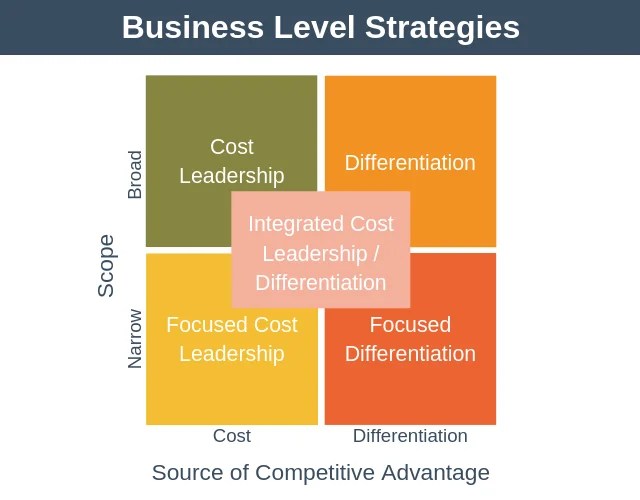
1. Cost Leadership
Cost Leadership is a situation in which market leader sets the price of a product or service, and competitors feel compelled to match that price.
Cost Leadership is perhaps the clearest of the three generic strategies. In it, a firm set out to become the low-cost producer in its industry. The firm has a broad scope and serves many industry segments, and may even operate in related industries, the firm’s breadth is often important to its cost advantage.
The sources of cost advantages are varied and depend on the structure of the industry. They may include the pursuit of economies of scale, proprietary technology, preferential access to raw materials, and other factors. A low-cost product must find and exploit all sources of cost advantage. Low-cost producers typically sell a ‘standard’ or ‘no frills’ product and place considerable emphasis on reaping scale or absolute cost advantages from all sources.
2. Differentiation
The second generic strategy is Differentiation. In a Differentiation Strategy, a firm seeks to be unique in its industry along some dimensions that are widely valued by buyers. It selects one or more attributes that many buyers in an industry perceive as important, and uniquely positions it to meet those needs. It is rewarded for its uniqueness with a premium price.
The means for Differentiation are peculiar to reach industry. Differentiation can be based on the product itself, the delivery system by which it is sold, the marketing approach, and a broad range of other factors. In construction equipment, for example, Caterpillar Tractor’s Differentiation is based on product durability, service, spare parts availability, and an excellent dealer network. In cosmetics, Differentiation tends to be based more on product image and the positioning of counters in the stores.
In a differentiation strategy, a firm seeks to be unique in its industry along some dimensions that are widely valued by buyers. It selects one or more attributes that many buyers in an industry perceive as important, and uniquely positions it to meet those needs. Differentiation will cause buyers to prefer the company’s product/service over the brands of rivals. An organization pursuing such a strategy can expect higher revenues/margins and enhanced economic performance.
The challenge in finding ways to differentiate that creates value for buyers and that are not easily copied or matched by rivals. Anything a company can do to create value for buyers represents a potential basis for differentiation.
Successful differentiation creates lines of defence against the five competitive forces. It provides insulation against competitive rivalry because of brand loyalty of customers and hence lower sensitivity to price. The customer loyalty also provides a disincentive for new entrants who will have to overcome the uniqueness of the product or service.
3. Focus and Niche Strategies
The third generic strategy is focus. This strategy is quite different from the others because it rests on the choice of a narrow competitive scope within an industry. The focuser selects a segment of group of segments in the industry and tailors its strategy to serving them to the exclusion of others. By optimizing this strategy for the target segments, the focuser seeks to achieve a competitive advantage in its target segments even though it does not possess a competitive advantage overall.
The focus strategy has two variants, in cost focus, a firm seeks a cost advantage in its target segment, while in differentiation focus, and a firm seeks differentiation in its target segment. Both variants of the focus strategy rest on differences between a focuser’s target segments and other segments in the industry. The target segments must either have buyers with unusual needs or else the production and delivery system that best serves the target segment must differ from that of other industry segments.
Cost focus exploits differences in cost behaviour in some segments, while differentiation focus exploits the special needs of buyers in certain segment. Such differences imply that the segments are poorly served by broadly targeted competitors who serve them at the same time as they serve others.
The focuser can thus achieve competitive advantage by dedicating itself to the segments exclusively. Breadth of target is clearly a matter of degree, but the essence of focus is the exploitation of a narrow target’s differences from the balance of the industry. Narrow focus in and/or itself is not sufficient for above-average performance.

2 thoughts on “Business Level Strategy in SHRM”