Employee Coaching Meaning, Definitions, Objectives, Types

Employee Coaching is a development process that involves guiding and supporting employees to enhance their skills, performance, and potential in their work environment. It is an interactive process where managers, supervisors, or external coaches help employees identify their goals, overcome challenges, and improve their abilities. The aim is to foster a culture of continuous learning, development, and growth within the organization. Coaching is different from traditional training as it focuses more on individual guidance, personal growth, and real-time feedback, rather than simply imparting information.

Definitions of Employee Coaching:

  • International Coach Federation (ICF):

Coaching is defined as “partnering with clients in a thought-provoking and creative process that inspires them to maximize their personal and professional potential.”

  • Paul J. Meyer:

Coaching is “the process of helping people discover and develop their potential and empower them to become their best selves.”

  • Harvard Business Review:

Coaching is “an interactive process designed to help individuals or groups improve their performance and reach specific goals.”

  • Sir John Whitmore:

Coaching is unlocking a person’s potential to maximize their own performance. It is helping them to learn rather than teaching them.

  • Society for Human Resource Management (SHRM):

Employee coaching is defined as “a means of developing and guiding employees through close, supportive interaction, and real-time feedback to improve their performance.”

Objectives of Employee Coaching:

  • Enhancing Employee Performance:

One of the primary objectives of coaching is to help employees improve their work performance by identifying areas where they can grow and providing the tools, guidance, and support to achieve better results.

  • Developing Skills and Competencies:

Coaching aims to enhance the skills, competencies, and knowledge of employees. By focusing on both technical and soft skills, coaching helps individuals become more proficient in their roles, enabling them to meet job demands more effectively.

  • Building Confidence and Self-Awareness:

Through coaching, employees gain greater self-awareness and confidence. Coaches help individuals understand their strengths and areas for improvement, which leads to enhanced self-esteem and better decision-making.

  • Facilitating Career Development:

Coaching supports employees in mapping out their career paths, identifying opportunities for advancement, and setting actionable goals. It provides guidance on how to achieve long-term career objectives and develop leadership qualities.

  • Increasing Motivation and Engagement:

Effective coaching helps to increase employee engagement by showing them that the organization values their development. By offering personalized guidance and support, coaching enhances employee motivation and commitment to the organization.

  • Improving Problem-Solving Skills:

Coaching encourages employees to think critically and develop solutions to their own problems. It promotes creative problem-solving, empowering employees to handle complex challenges with confidence and independence.

  • Aligning Employee Goals with Organizational Objectives:

Coaching ensures that individual employee goals align with the broader objectives of the organization. It helps bridge the gap between personal aspirations and organizational expectations, creating a sense of shared purpose and commitment.

Types of Employee Coaching:

  • Performance Coaching:

Performance coaching focuses on improving an employee’s current performance in their specific job role. It helps employees meet performance expectations, enhance productivity, and address any areas of concern. The goal is to identify performance gaps and work collaboratively to close them through constructive feedback and actionable plans.

  • Career Coaching:

Career coaching is centered around an employee’s long-term career aspirations. It helps employees explore opportunities for career advancement, identify their strengths, and develop a roadmap for achieving their career goals. Career coaching often includes mentorship and guidance on skill development, leadership preparation, and navigating career transitions.

  • Executive Coaching:

Executive coaching is designed for leaders, managers, and high-potential employees who are being groomed for leadership roles. It helps individuals develop critical leadership competencies, such as decision-making, emotional intelligence, conflict resolution, and strategic thinking. The focus is on enhancing leadership abilities and aligning personal development with the organization’s strategic goals.

  • Team Coaching:

Team coaching involves working with an entire team to improve communication, collaboration, and effectiveness. The coach helps team members understand their roles within the group, resolve conflicts, and work toward shared objectives. The goal of team coaching is to improve overall team performance and foster a cohesive, high-performing unit.

  • Skills Coaching:

Skills coaching focuses on helping employees develop specific technical or soft skills needed for their roles. This could include training in areas such as communication, negotiation, time management, or project management. Skills coaching is often short-term and targets immediate skill gaps that need to be addressed to improve job performance.

  • Behavioral Coaching:

Behavioral coaching addresses an employee’s behavior in the workplace, helping them to improve their interpersonal relationships, adaptability, and emotional intelligence. This type of coaching is often used to correct behaviors that may be hindering an employee’s success or negatively affecting team dynamics, such as poor communication, resistance to feedback, or lack of collaboration.

  • Onboarding Coaching:

Onboarding coaching is aimed at helping new employees acclimate to the organization and their new roles. It provides guidance on company culture, expectations, and processes. Onboarding coaching helps new hires become productive more quickly by offering personalized support during their transition into the organization.

  • Leadership Coaching:

Leadership coaching is designed to help current or aspiring leaders develop the qualities needed to lead teams effectively. It focuses on building leadership skills such as communication, delegation, team building, and strategic thinking. Leadership coaching is often used to prepare high-potential employees for management roles or to enhance the abilities of existing leaders.

  • Personal Development Coaching:

This type of coaching focuses on helping employees grow on a personal level, which can impact their professional lives. Personal development coaching might involve helping employees build resilience, manage stress, or improve work-life balance. The idea is that by improving personal aspects of life, employees will also see improvements in their professional performance.

Identification of Five Dark Qualities in an Individual Before the Selection and Placement Process

In the selection and placement process, identifying potential candidates’ dark qualities or negative traits is crucial for ensuring a positive and productive workplace. Dark qualities can adversely impact team dynamics, organizational culture, and overall performance.

  1. Narcissism

Narcissism refers to an excessive focus on oneself, often manifesting as a grandiose sense of self-importance, a need for admiration, and a lack of empathy for others. Individuals with narcissistic tendencies often display characteristics such as arrogance, entitlement, and a tendency to exploit others for personal gain.

Identification Techniques:

To identify narcissistic traits in candidates, organizations can employ various techniques:

  • Behavioral Interviews: Ask situational questions that reveal how candidates handle teamwork, feedback, and conflict. For example, inquire about a time they faced criticism and how they responded.
  • Psychometric Assessments: Utilize personality tests designed to measure narcissism levels, such as the Narcissistic Personality Inventory (NPI). These assessments provide insight into the candidate’s self-perception and interpersonal dynamics.
  • Reference Checks: Gather feedback from former colleagues or supervisors regarding the candidate’s interpersonal relationships, focusing on any signs of entitlement or manipulation.

Impact on Workplace:

Narcissistic individuals can disrupt team cohesion, foster a toxic work environment, and undermine collaboration. Their self-centeredness may lead to conflicts, poor morale, and high turnover rates.

  1. Machiavellianism

Machiavellianism is characterized by manipulative behavior, deceitfulness, and a focus on self-interest. Individuals displaying this quality often prioritize personal gain over ethical considerations and may use cunning tactics to achieve their goals.

Identification Techniques:

To identify Machiavellian traits, organizations can implement the following methods:

  • Situational Judgment Tests (SJTs): Present candidates with hypothetical scenarios involving ethical dilemmas or conflict resolution. Assess their responses to gauge their propensity for manipulation or unethical behavior.
  • Behavioral Assessments: Inquire about past experiences where candidates had to influence others or navigate complex interpersonal dynamics. Look for indications of deceit or a lack of ethical considerations.
  • Reference Evaluations: Seek insights from references regarding the candidate’s integrity, ability to collaborate, and approach to ethical dilemmas in previous roles.

Impact on Workplace:

Machiavellian individuals can create a culture of distrust, where manipulation and deceit thrive. Their behavior can lead to toxic competition, decreased employee morale, and unethical practices within the organization.

  1. Psychopathy

Psychopathy is characterized by a lack of empathy, remorse, and guilt, often accompanied by impulsivity and antisocial behavior. Individuals with psychopathic traits may exhibit charm and charisma while lacking genuine emotional connections with others.

Identification Techniques:

Identifying psychopathic traits requires careful assessment:

  • Clinical Assessments: Utilize standardized psychological tests, such as the Hare Psychopathy Checklist-Revised (PCL-R), to evaluate psychopathic tendencies.
  • Behavioral Interviews: Ask candidates about their responses to morally ambiguous situations and how they handle interpersonal relationships. Look for signs of emotional detachment or disregard for others’ feelings.
  • Group Exercises: Observe candidates in group settings to assess their interactions and emotional responses. Psychopathic individuals may exhibit manipulative behaviors or lack genuine concern for team dynamics.

Impact on Workplace:

Psychopathic individuals can severely disrupt workplace dynamics, creating an environment marked by fear and distrust. Their manipulative tendencies may lead to unethical behavior, high turnover, and increased conflict among employees.

  1. Authoritarianism

Authoritarianism is characterized by a strong desire for control, a rigid adherence to rules, and a tendency to dominate others. Authoritarian individuals often display traits such as intolerance for dissent, a lack of flexibility, and a need for submission from others.

Identification Techniques:

To identify authoritarian traits, organizations can use the following approaches:

  • Personality Assessments: Utilize tools like the California Psychological Inventory (CPI) to measure authoritarian tendencies and related characteristics, such as dominance and rigidity.
  • Behavioral Interviews: Ask candidates about their leadership style, decision-making processes, and responses to differing opinions. Look for indications of intolerance for dissent or inflexible attitudes.
  • Role-Playing Exercises: Conduct role-playing scenarios that simulate conflict resolution or team collaboration. Observe candidates’ responses to differing viewpoints and their willingness to compromise.

Impact on Workplace:

Authoritarian individuals can stifle creativity, inhibit open communication, and create a culture of fear. Their rigid approach may lead to low employee engagement, high turnover, and decreased innovation.

  1. Resentment and Cynicism

Resentment and cynicism refer to a pervasive negative outlook on life, characterized by distrust, bitterness, and a belief that others act primarily out of self-interest. Individuals displaying these traits often have a pessimistic view of organizations and their leadership.

Identification Techniques:

To identify resentment and cynicism, organizations can employ these methods:

  • Behavioral Interviews: Ask candidates about their perspectives on workplace culture, leadership, and team dynamics. Look for signs of bitterness, negative generalizations, or dismissive attitudes.
  • Group Discussions: Facilitate group discussions or team exercises where candidates express their views on workplace challenges. Observe their responses for indications of cynicism or negativity.
  • Reference Checks: Inquire with references about the candidate’s attitude towards their previous organizations, focusing on any signs of resentment or bitterness.

Impact on Workplace:

Cynical individuals can negatively influence team morale and foster a toxic work environment. Their bitterness may lead to disengagement, decreased collaboration, and a lack of trust in leadership.

Differences between personnel Management and Human Resources Development

Personnel Management is a part of management that deals with the recruitment, hiring, staffing, development, and compensation of the workforce and their relation with the organization to achieve the organizational objectives. The primary functions of the personnel management are divided into two categories:

  • Operative Functions: The activities that are concerned with procurement, development, compensation, job evaluation, employee welfare, utilization, maintenance and collective bargaining.
  • Managerial Function: Planning, Organizing, Directing, Motivation, Control, and Coordination are the basic managerial activities performed by Personnel Management.

Human Resource Development

Human resource development (HRD) is defined as the cultivation of an organization’s employees. It entails providing workers with skills and relevant knowledge that may help them to grow in the workplace. That makes human resource development an integral part of human resource management.

HRD starts with a clear vision for employee development, and most times, it is achieved through organization-wide activities and training. Typically, the HRD team is in charge of developing these initiatives to position employees for career advancement and other related goals.

Roles like instructional coordinators, training specialists, and program developers may involve aspects of human resource development.

HR developers are important members of the HR team as they oversee a variety of areas within the human resources branch of an organization, including training, employee development, executive and leadership development, human performance technology, and organizational learning. On any given day, their responsibilities might involve creating training programs, designing systems to attract and retain talent, and planning organizational development activities, which may be in the form of workshops and more.

A background in human resource development may prepare you for specialized training, instructional design, program development, and general HR positions. For example, training and development specialists are in charge of designing manuals, online learning modules, and course materials for onboarding employee’s External link.

Personnel Management Human Resource Development
Meaning The aspect of management that is concerned with the work force and their relationship with the entity is known as Personnel Management. The branch of management that focuses on the most effective use of the manpower of an entity, to achieve the organizational goals is known as Human Resource Management.
Approach  Traditional Modern
Treatment of manpower Machines or Tools Asset
Type of function  Routine function Strategic function
Basis of Pay Job Evaluation Performance Evaluation
Management Role Transactional Transformational
Communication Indirect Direct 
Labor Management Collective Bargaining Contracts Individual Contracts 
Initiatives Piecemeal Integrated 
Management Actions Procedure Business needs
Decision Making Slow Fast
Job Design Division of Labor Groups/Teams
Focus Primarily on mundane activities like employee hiring, remunerating, training, and harmony. Treat manpower of the organization as valued assets, to be valued, used and preserved.

Systematic approach to change, Client & Consultant relationship

Systematic approach to change

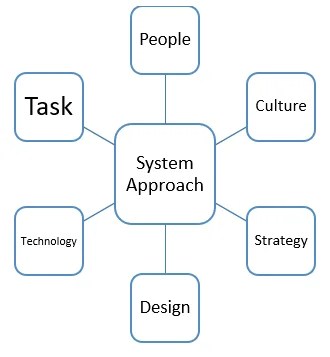
The Systems Model of Change or Organization-Wide Change lays more emphasis on the fact that a change must be implemented organization-wide instead of implementing it in piecemeal.

This model provides a whole new dimension to the concept of organizational change and describes the role played by six interconnected or interdependent variables like people, task, strategy, culture, technology and design. All these 6 variables are the key focus of planned change. The model has been represented in the diagram below:

  1. People: This variable involves the individuals who work in an organization. This would take into consideration the individual differences in the form of personalities, goals, perceptions, attitudes, attributions and their needs/motives.
  2. Task: The task is related to the nature of work which an individual handles in an organization. The nature of the job may be simple or complex, repetitive or novel, unique or standardized.
  3. Design: This variable refers to the organizational structure itself and also the system of communication, authority and control, the delegation of responsibilities and accountabilities.
  4. Strategy: The organizational strategy is the road map of action for realizing the future goals both short term and long term in nature. Strategic Planning involves identification of existing resources, a careful assessment of internal strengths and weaknesses, identifying the opportunities in the environment and threats as well for a competitive advantage.
  5. Technology: It takes into consideration the advancements in the technology in the field of IT, automation, new methods and techniques for enhancing productivity, the introduction of new processes and best practices for remaining ahead in the competition.
  6. Culture: It takes into consideration the shared beliefs, practices, values, norms and expectations of the members of the organization.

Steps to follow:

  • Dedicate time for planning

This may sound silly but you need to actually plan for planning. Always think of things, needs to plan for and to-do lists I need to write but not until recently did I realize that I was leaving the actual planning to the last minute. That’s because one wasn’t dedicating enough time to just sit and plan things out. Set up a recurring event in your calendar to just sit there and put your plans in writing.

  • Batch your time

I’ve tried so many “productivity hacks” and I find this one to be the most useful. It might not work for everyone but it’s worth the shot. Batching your time basically means that you divide your day into time blocks dedicated to only one task or multiple tasks of the same nature. This ensures that you don’t get distracted with doing other tasks and minimizes your tendency to multitask. It also allows you to enter the flow state of diving deep into one task.

  • Create checklists

Make checklists of things you need to get done and keep looking at those checklists. Many of us are guilty of writing down a to-do list, feeling good about it, and then never looking at it again. Put the checklist somewhere accessible like your notes on your phone so that you can pull it out easily. Track your progress and check off things that you’ve completed. Once you finish a checklist you’ll feel so good about yourself, trust me!

  • Prepare for the unexpected

No matter how hard you plan or how much you think you’ve thought ahead, always mentally prepare yourself for things to go wrong. There’s a saying that says “you plan and the universe laughs”, which is so true. That doesn’t mean that you shouldn’t plan, but just make sure you have back-ups and prepare for some crisis management.

Client & Consultant relationship

Consultants are expected to maintain professional and ethical standards when dealing with their clients. This can take the form of maintaining arm’s length relationships, not intervening in the internal affairs and politics of the client’s organizations, keeping confidential information away from interested parties looking for insider knowledge, and reporting any violations in the conduct (financial, operational, and behavioral) by the client’s organization to the regulators. This is the code of conduct that is usually prescribed for consulting firms whenever they take on work from client organizations.

Realities of Consultant-Client Relations

However, this is rarely followed in practice as evidenced by the large numbers of corporate scandals that have emerged in the last decade or so where the consultant was found to be aiding and even abetting the malfeasance conducted by the client. For instance, the Enron scandal manifested itself because the consulting firm was in cahoots with the client in cooking the books. Indeed, in this case, it was found that the consulting firm’s partners went beyond collaboration and were indeed one of the culprits.

Some Examples from the Corporate World

Similarly, the Satyam scandal in India was also found to be a case where the consultants (or some of them) knew about the goings-on in the company and were in breach of the code of conduct and even legal aspects since they did not report the matter to the regulators. However, the saving grace in this case was that when the malfeasance became too big and too hot to handle, it was the new consulting firm that had been roped in for another purpose that blew the whistle on the scam.

Consultants have to Walk a Thin Line between Professional and Personal Obligations

These examples indicate that the consultants have to walk a thin line between fulfilling professional obligations and reporting unethical behavior. Since the client is the one who pays them, it is often the case that the consultants are reluctant to report malfeasance to the regulators. Further, considering the extremely competitive nature of the market wherein there are several consulting firms competing for the same client, money talks and hence, consultants are often found to go along with the client. There are no easy answers when one considers all the aspects and it would be indeed a brave and conscientious consultant who would be the whistleblower.

Some Solutions Which Were Proposed

Having said that, there are some solutions that have emerged in recent years about the course of action to be taken by the consulting firms. For instance, after the Enron scandal, the SEC (Securities and Exchange Commission) and other regulators ensured that new rules separating consulting and investment banking so that the same consulting firm which was also advising the client in financial matters would now be two different firms. While this was intended to reduce the conflict of interest since it was thought that when consultants and investment bankers represent two firms they would automatically be in a position to wink at malfeasance, it is debatable as to how far this law succeeded given the Global Economic Crisis of 2008 wherein several case of malfeasance came to light.

Conflict of Interest is at the Heart of the Problem

Of course, as some experts have mentioned, the real issue here is of conflict of interest. How far would a consultant go in reporting unethical behavior to the regulators which is expected from him or her when such case involve the very clients who are giving them business. Further, the fact that many consultants often are embroiled in the internal politics of the client wherein they take sides in corporate and boardroom battles. This indicates the tricky nature of the problem of consultant client relations wherein the temptation to use confidential and insider information to one’s advantage is motivated by greed and power.

Coaching & Mentoring

Coaching and mentoring serve as learning tools in the workplace that can lead to empowering your employees. The employees who are coached and mentored often receive the greatest benefit, but the coach or mentor also benefits and may feel a sense of empowerment from the relationship. Understanding the dynamics and outcomes of this type of workplace learning strategy helps you evaluate the need for a coaching program in your small business.

Coaching

Coaching at work is designed to help employees learn or enhance specific skills. It focuses on one individual over a defined period of time, helping them to develop effectively. It can be used to:

  • Teach new skills in a focused way
  • improve performance in a particular area of work
  • build ‘soft’ skills like confidence, interpersonal relationships or planning

The objective of coaching at work is to help an employee make a distinct improvement in an agreed area. That improvement might be measurable through KPIs, or it might be a softer target. To achieve it, the employee receives support and constructive feedback from a designated coach.

Coaching is a powerful tool for employees, but your company will also reap the benefits of a specially trained workforce.

The great benefit of coaching is that you are likely to see quick, positive results as an outcome. This is because coaching is participative and people tend to learn and adopt new habits more easily when they are actively engaged in the learning process.

Mentoring

Mentoring involves the use of the same models and skills of questioning, listening, clarifying and reframing associated with coaching.

Traditionally, mentoring in the workplace is usually where a more experienced colleague uses his or her greater knowledge and understanding of the workplace in order to support the development of a less experienced member of staff.

Deciding if coaching is the right approach

How do you know if coaching will work for your company? In truth, it can depend on the context and the people concerned.

Some employees will respond enthusiastically, especially to the right coach, and will come on leaps and bounds. For example, you could use a professional coach to:

  • Bring out the full potential of a gifted employee
  • help technical experts improve interpersonal skills
  • train managers to handle conflict situations

Although coaching at work is normally very effective, it doesn’t suit every situation or every personality. Other options to consider might be external training, mentoring or online learning.

Importance

Coach or Mentor Empowerment

The experienced employee who serves as the coach or mentor is able to show his knowledge and skill in the industry. This added challenge can boost his confidence and give him a sense of empowerment in his own work. In some cases, the employee the mentors push him to learn new skills in the industry. The collaboration between coach and mentor can lead to new ideas and achievements to aid them both in succeeding.

Independence

A mentor provides support for a new employee, but the ultimate goal is to empower the employee to work independently with the skills she has learned. The ability to work successfully on her own brings a sense of empowerment as she gains independence in the workplace. While employees feel confident to work independently, the mentoring program creates a sense of teamwork and often boosts morale for your employees. This positive work environment continues to empower employees in their work.

Goal Setting

Coaching and mentoring often includes goal setting for the employee. The mentor helps the new employee set specific goals related to the job. The two work together to create a plan to reach those goals. Mentors can customize objectives and support that that employee needs for his particular role. The mentor is also available as a resource if the new employee needs support along the way to be successful. Having a set of challenging goals is motivating and empowers the employee to work beyond the minimum requirements.

Hands-On Learning

Coaching and mentoring gives new employees a hands-on training program to learn job expectations. Instead of throwing a new employee right into the position, he gets a support system and an interactive learning situation that may engender more on-the-job confidence. Mentored employees may often feel a greater sense of understanding of what is required of them in their jobs because they get one-on-one job training, support and the advice of an experienced employee. When an employee receives this kind of personalized training, he may feel empowered to fully perform his job duties.

Staffing in HRP Department, issuing orders, resolving conflicts, Communicating

Staffing is the process of hiring eligible candidates in the organization or company for specific positions. In management, the meaning of staffing is an operation of recruiting the employees by evaluating their skills, knowledge and then offering them specific job roles accordingly.

Assess current HR capacity

The first step in the human resource planning process is to assess your current staff. Before making any moves to hire new employees for your organization, it’s important to understand the talent you already have at your disposal. Develop a skills inventory for each of your current employees.

Forecast HR requirements

Once you have a full inventory of the resources you already have at your disposal, it’s time to begin forecasting future needs.

Demand forecasting

Demand forecasting is the detailed process of determining future human resources needs in terms of quantity the number of employees needed and quality the caliber of talent required to meet the company’s current and future needs.

Supply forecasting

Supply forecasting determines the current resources available to meet the demands. With your previous skills inventory, you’ll know which employees in your organization are available to meet your current demand. You’ll also want to look outside of the organization for potential hires that can meet the needs not fulfilled by employees already present in the organization.

Issuing orders

Following points should be observed while issuing orders to the subordinates:

  • Few orders: Issue as few orders as possible. More orders than those that are absolutely necessary, if issued, will result in loss of independence and thus initiatives of subordinates will be suppressed.
  • Clear orders: The orders should be absolutely clear. They create confidence in the mind of the subordinates about the clear understanding by the order given.
  • Brief but complete orders: The orders should be as brief as possible but complete orders to convey fully what is intended to be done.
  • Promptness: Professional form and proper tone in orders. Prompt issuing of order and proper use of technical words and phrases is essential for effective directing. Proper tone in issuing the orders should be observed.
  • Legitimate scope of orders: The manager issuing the order should keep within his own domain. He must not encroach up on the sphere of the receiving executive.
  • Follow up orders: Another important principle of direction is that once orders or instructions are issued, they should be followed up to see that they are executed, orthe instructions should be countermanded or withdrawn.

Resolving conflicts

Workplace conflict is inevitable when employees of various backgrounds and different work styles are brought together for a shared business purpose. Conflict can and should be managed and resolved. With tensions and anxieties at an all-time high due to the current political divide and racial inequity discussions at work, the chances for workplace conflict have increased. This toolkit examines the causes and effects of workplace conflict and the reasons why employers should act to address conflict.

The first steps in handling workplace conflict belong, in most cases, to the employees who are at odds with one another. The employer’s role exercised by managers and HR professionals is significant, however, and is grounded in the development of a workplace culture designed to prevent conflict among employees to the extent possible. The basis for such a culture is strong employee relations, namely, fairness, trust and mutual respect at all levels. This toolkit offers suggestions to create such an organizational climate and includes methods to deal with employee grievances and conflicts.

Experts offer several causes of workplace conflict, including:

  • Personality differences.
  • Workplace behaviors regarded by some co-workers as irritating.
  • Unmet needs in the workplace.
  • Perceived inequities of resources.
  • Unclarified roles in the workplace.
  • Competing job duties or poor implementation of a job description—for example, placing a nonsupervisory employee in an unofficial position of “supervising” another employee.
  • A systemic circumstance such as a workforce slowdown, a merger or acquisition, or a reduction in force.
  • Mismanagement of organizational change and transition.
  • Poor communication, including misunderstood remarks and comments taken out of context.
  • Differences over work methods or goals or differences in perspectives attributable to age, sex or upbringing.

To manage conflict, employers should consider the following:

  • Make certain that policies and communication are clear and consistent, and make the rationale for decisions transparent.
  • Ensure that all employees not just managers are accountable for resolving conflict.
  • Do not ignore conflict, and do not avoid taking steps to prevent it.
  • Seek to understand the underlying emotions of the employees in conflict.
  • Keep in mind that approaches to resolving conflict may depend on the circumstances of the conflict.

Communicating

Communication is a vital management component to any organization. Whether the purpose is to update employees on new policies, to prepare for a weather disaster, to ensure safety throughout the organization or to listen to the attitudes of employees, effective communication is an integral issue in effective management.

The impact of effective communication

Effective communication may contribute to organizational success in many ways. It:

  • Builds employee morale, satisfaction and engagement.
  • Helps employees understand terms and conditions of their employment and drives their commitment and loyalty.
  • Educates employees on the merits of remaining union-free (if that is the organization’s goal).
  • Gives employees a voice an increasingly meaningful component of improving employees’ satisfaction with their employer.
  • Helps to lessen the chances for misunderstandings and potentially reduces grievances and lawsuits.
  • Improves processes and procedures and ultimately creates greater efficiencies and reduces costs.

Effective communication strategies:

  • Safeguard credibility to establish loyalty and build trust.
  • Maintain consistency to establish a strong employment brand.
  • Listen to employees and to members of the leadership team.
  • Seek input from all constituencies.
  • Provide feedback.
  • Prepare managers in their roles as organizational leaders.

Departmentation Meaning, Basis and Significance

Departmentation is the process of dividing an organization into distinct units or departments based on specific functions, products, geographical areas, customer segments, or processes. This division allows for better specialization, coordination, and management of activities within each department. By grouping related tasks, departmentation enables organizations to allocate resources more efficiently, enhance accountability, and improve overall performance. Common types of departmentation include functional (based on activities like marketing, finance), product (based on product lines), geographical (by region), and customer (targeting different customer groups). Effective departmentation enhances operational efficiency and supports organizational growth.

Importance of Departmentation:

  1. Specialization and Expertise

Departmentation enables specialization by grouping employees with similar skills and expertise into departments. This fosters a deeper focus on particular tasks, enhancing the quality and efficiency of work. For example, a finance department can focus solely on financial matters, ensuring better financial management.

  1. Improved Coordination

By organizing activities into separate departments, organizations can improve coordination among tasks and processes. Departments can operate independently but still work towards common organizational goals. Department heads communicate with each other to ensure smooth functioning across the organization.

  1. Accountability and Responsibility

Departmentation assigns clear responsibilities to each department and its managers. This makes it easier to hold specific units accountable for their performance. When roles and responsibilities are well-defined, it is easier to track progress and address issues within each department.

  1. Effective Resource Allocation

With departmentation, resources such as human capital, finances, and materials can be allocated more efficiently. Since each department has specific functions or goals, managers can allocate resources based on the unique needs of that department, ensuring optimal utilization.

  1. Facilitates Growth and Expansion

As organizations grow, departmentation helps manage the increasing complexity by dividing tasks into manageable units. This makes it easier to scale operations. For instance, as a company expands geographically, it can create regional departments to handle specific markets effectively.

  1. Focus on Customer Needs

Customer-based departmentation allows organizations to cater to different customer segments more effectively. Each department focuses on a particular group of customers, improving service delivery and customer satisfaction by addressing specific needs and preferences.

  1. Increased Flexibility

Departmentation allows for more flexible operations. If a new product or service is introduced, the organization can create a dedicated department to focus solely on its development and management, without disrupting other areas of the business.

  1. Improved Communication

Departments promote better communication within specific units. By grouping related activities, employees and managers within a department can communicate more effectively, reducing confusion and ensuring that everyone is aligned with departmental goals.

Basis of Departmentation:

  1. Functional Departmentation:

Functional departmentation is one of the most common methods of structuring organizations. It involves grouping activities based on functions such as marketing, finance, human resources, operations, and research and development. Each department is responsible for a specific function, with employees who specialize in that area.

  • Advantages: It promotes specialization, as employees focus on one functional area. It also enhances efficiency, as similar tasks are grouped together.
  • Disadvantages: Communication between departments may be limited, leading to silos. Also, functional departments may lack a holistic view of the organization.
  1. Product Departmentation:

Product departmentation involves dividing the organization based on its product lines or services. Each department focuses on a specific product or group of products, with functional activities like marketing and production tailored to each product line.

  • Advantages: This structure allows for better focus on specific products, faster decision-making, and greater accountability for product performance. It also encourages product innovation and competitiveness.
  • Disadvantages: It may lead to duplication of resources, as each product department may have its own set of functional activities.
  1. Geographical Departmentation:

Geographical departmentation is used when an organization operates across various regions or countries. It divides operations based on geographic locations, allowing each department to cater to the specific needs and conditions of the region.

  • Advantages: Geographical departmentation helps in managing regional differences, such as cultural, economic, or legal factors. It allows for better customer service and quicker response to local market changes.
  • Disadvantages: There can be coordination challenges between different regional departments, and the organization may face issues of duplicating roles and resources across regions.
  1. Customer Departmentation:

Customer departmentation groups activities based on specific customer segments, such as retail customers, wholesale buyers, or government clients. This approach is often used in organizations with diverse customer needs.

  • Advantages: It allows for a better focus on customer needs, improves customer satisfaction, and enhances the ability to cater to different types of clients.
  • Disadvantages: Similar to product departmentation, it may lead to resource duplication and increased costs due to maintaining separate units for each customer group.
  1. Process Departmentation:

Process departmentation is based on the different stages of a production or operational process. For example, in manufacturing, departments could be organized around fabrication, assembly, and quality control.

  • Advantages: It ensures better coordination and efficiency within each stage of the production process, leading to smoother operations and specialization.
  • Disadvantages: It may result in challenges in coordination between departments handling different stages of the process.
  1. Time-Based Departmentation:

In organizations that operate around the clock, such as hospitals or factories, departmentation may be based on time. Different shifts or work periods are used to structure activities.

  • Advantages: This helps in ensuring continuous operations, and it allows for better management of workforce and resources over extended time periods.
  • Disadvantages: Coordination between different shifts or time-based departments may be challenging.
  1. Matrix Departmentation:

Matrix departmentation combines two or more types of departmentation, such as functional and product-based structures. It creates a more flexible organizational design, particularly useful in project-based environments.

  • Advantages: It promotes collaboration across functions and products, allowing for better resource utilization and flexibility.
  • Disadvantages: The complexity of reporting relationships can lead to confusion and conflicts, especially when employees report to multiple managers.

Change Management, Meaning, Introduction, Components, Forces/Drivers of Change, Importance and Challenges

Managing Change within an organization is a multifaceted process that requires careful planning, effective communication, and strategic implementation. In today’s dynamic business environment, organizations must continuously adapt to evolving market conditions, technological advancements, and internal dynamics to remain competitive and sustainable.

Introduction to Change Management

Change Management is a structured approach to transitioning individuals, teams, and organizations from a current state to a desired future state. It focuses on managing the people side of change to achieve successful outcomes. In business, changes may include adopting new technologies, restructuring processes, or shifting organizational culture. Effective change management ensures that employees understand the need for change, adapt smoothly, and remain motivated during the transition. It combines leadership, communication, training, and support strategies to reduce resistance and build acceptance. By minimizing disruptions and aligning people with organizational goals, change management helps organizations remain competitive, innovative, and resilient in an evolving business environment. It is essential for long-term sustainability and growth.

Components of Change Management

  • Leadership Commitment

Top-level support is essential for driving change and inspiring confidence among employees. Leaders must champion the initiative, articulate a compelling vision, and lead by example to mobilize support and overcome resistance.

  • Stakeholder Engagement

Engaging stakeholders at all levels fosters ownership, generates valuable insights, and builds consensus around the change agenda. It involves transparent communication, active listening, and addressing concerns to ensure broad-based support.

  • Strategic Planning

A well-defined change strategy outlines the objectives, scope, timeline, and resource allocation for the initiative. It involves assessing risks, identifying dependencies, and developing contingency plans to mitigate potential obstacles.

  • Communication Plan

Effective communication is critical for managing expectations, dispelling rumors, and fostering transparency throughout the change process. It requires clear, timely, and consistent messaging through various channels to reach diverse audiences.

  • Training and Development

Equipping employees with the necessary skills and knowledge empowers them to adapt to new roles and responsibilities. Training programs, workshops, and coaching sessions help bridge competency gaps and build confidence in executing change-related tasks.

  • Change Readiness Assessment

Evaluating organizational readiness helps anticipate challenges, assess capabilities, and tailor interventions accordingly. It involves analyzing cultural norms, assessing employee attitudes, and identifying potential barriers to change adoption.

  • Performance Monitoring

Continuous monitoring and feedback mechanisms enable organizations to track progress, identify bottlenecks, and make course corrections as needed. Key performance indicators (KPIs), surveys, and feedback loops provide valuable insights into the effectiveness of change initiatives.

Forces/Drivers of Change

1. Technological Forces

Technological forces refer to changes brought by advancements in technology that influence how organizations operate, produce, and deliver services. In today’s business environment, rapid innovations such as artificial intelligence, automation, robotics, cloud computing, and digital platforms are reshaping business processes. Organizations must continuously adapt to these changes to remain competitive.

Impact

  • Increases productivity and operational efficiency
  • Reduces manual and repetitive work
  • Requires continuous employee training and upskilling
  • Changes job roles and organizational structure
  • Encourages innovation and digital transformation

Technological change also creates challenges such as job displacement in traditional roles, cybersecurity risks, and the need for constant learning. Organizations that fail to adopt technology quickly may lose competitiveness in the market.

Example: Banks in India have adopted mobile banking apps like SBI YONO and Paytm, reducing the need for physical banking. Similarly, companies like Amazon use automation in warehouses to speed up delivery and reduce human effort. This shows how technology forces organizations to change their systems and processes continuously.

2. Market and Competition Forces

Market and competition forces refer to pressures arising from competitors, customer expectations, and changing market trends. In a globalized economy, organizations face intense competition, forcing them to continuously improve products, services, pricing, and quality.

Impact

  • Encourages innovation and creativity
  • Improves product quality and customer service
  • Reduces prices due to competition
  • Forces faster decision-making
  • Increases marketing and branding efforts

Organizations that cannot adapt to competition risk losing customers and market share. This force also pushes companies to adopt customer-centric strategies and improve efficiency in operations.

Example: The launch of Jio in India disrupted the telecom industry by offering low-cost data services. This forced companies like Airtel and Vodafone to reduce prices and improve services. Similarly, Amazon and Flipkart competition has pushed traditional retailers to go digital and adopt e-commerce platforms.

3. Economic Forces

Economic Forces refer to the changes in economic conditions such as inflation, recession, interest rates, unemployment, income levels, and overall economic growth that influence organizational decisions and performance. These forces directly affect the cost of production, demand for goods and services, profitability, and business expansion plans.

Organizations operate in a dynamic economic environment, so they must continuously monitor economic trends and adjust their strategies accordingly. Economic forces can create opportunities during growth periods and serious challenges during downturns.

Impact

  • Affects production cost and pricing strategies
  • Influences hiring, salaries, and workforce size
  • Impacts investment and expansion decisions
  • Leads to cost-cutting during recession periods
  • Affects consumer purchasing power and demand
  • Increases uncertainty in business planning
  • Forces organizations to improve efficiency and productivity
  • Encourages financial risk management and control

During economic growth, organizations expand operations and hire more employees. During economic slowdown, they reduce costs, freeze recruitment, or restructure operations to survive.

Example

During the COVID-19 pandemic, many organizations faced economic slowdown, leading to salary cuts, layoffs, and reduced business activities.

Similarly, rising inflation in India increases raw material costs for manufacturing companies, forcing them to increase product prices or reduce profit margins.

Another example is changes in interest rates by the Reserve Bank of India (RBI), which affect borrowing costs for businesses and influence investment decisions.

4. Social and Cultural Forces

Social and Cultural Forces refer to the changes in society’s values, beliefs, lifestyles, attitudes, education levels, traditions, and behavioural patterns that influence organizations. These forces shape how customers think, what they demand, and how employees behave in the workplace. As society evolves, organizations must also change their products, services, policies, and culture to stay relevant.

In modern times, factors such as digital awareness, environmental concerns, diversity, and changing lifestyles have significantly influenced organizational practices. These forces are very important because they directly affect consumer behaviour and employee expectations.

Impact

  • Changes in customer preferences and buying behaviour
  • Increased demand for ethical and socially responsible business practices
  • Promotion of diversity, equity, and inclusion in workplaces
  • Growing importance of work-life balance for employees
  • Shift towards environmentally friendly and sustainable practices
  • Influence of education and awareness on decision-making
  • Changes in organizational culture and communication style
  • Increased use of social media affecting brand image

Social and cultural forces also push organizations to be more transparent, flexible, and socially responsible. Companies that fail to adapt may lose customer trust and market relevance.

Example

Growing environmental awareness has led companies like Tata Group and ITC to adopt eco-friendly manufacturing practices and sustainable packaging solutions.

Similarly, increasing awareness about gender equality has encouraged organizations to hire more women in leadership positions and promote inclusive workplace policies.

Social media trends also force companies to respond quickly to public opinions and customer feedback, shaping their marketing and branding strategies.

5. Political and Legal Forces

Political and Legal Forces refer to the influence of government policies, political stability, laws, regulations, taxation systems, and legal frameworks on organizational functioning. These forces shape how organizations operate within a country and ensure that business activities are conducted ethically, fairly, and within legal boundaries.

Organizations must continuously monitor political decisions and legal changes because they directly affect business operations, costs, and strategic planning. These forces can create both opportunities and restrictions for organizations.

Impact

  • Ensures compliance with government laws and regulations
  • Influences taxation policies and business costs
  • Protects employee rights and workplace safety
  • Regulates competition and prevents monopolies
  • Affects international trade policies and agreements
  • Requires regular changes in organizational policies
  • Increases administrative and legal responsibilities
  • Impacts investment decisions due to political stability or instability

Political and legal forces create a structured environment for business operations. However, frequent changes in laws may require organizations to quickly adapt their policies and systems.

Example: The introduction of GST (Goods and Services Tax) in India is a major example of a legal force. It changed the entire taxation system, requiring companies to modify their accounting and billing systems.

Another example is labour laws, which ensure minimum wages, employee safety, and working hour regulations. Organizations must follow these laws to avoid legal penalties and maintain ethical standards.

Political stability also plays a role. For example, stable government policies attract foreign investment, while unstable political conditions may discourage business expansion.

6. Globalization Forces

Globalization Forces refer to the increasing integration of economies, markets, businesses, technology, and cultures across the world. It allows organizations to operate beyond national boundaries and compete in the global market. Due to globalization, organizations face international competition, diverse customers, and cross-cultural challenges, which force them to continuously adapt and change.

Globalization has made the business environment highly dynamic. Organizations must adopt global strategies, modern technology, and flexible structures to survive and grow in international markets.

Impact

  • Expansion of business into international markets
  • Increased global competition among organizations
  • Need for cross-cultural management and diversity handling
  • Adoption of international quality standards
  • Outsourcing and offshoring of business processes
  • Pressure to reduce cost and improve efficiency
  • Need for global marketing and branding strategies
  • Increased use of advanced technology and digital platforms

Globalization also forces organizations to become more innovative and customer-focused. It creates opportunities for growth but also increases pressure to perform in a competitive global environment.

Example: Indian IT companies like TCS, Infosys, and Wipro operate globally and provide services to clients in countries like the USA, UK, and Europe. To meet international standards, they adopt advanced technologies, train employees in global communication skills, and follow international business practices.

Another example is McDonald’s, which adapts its menu according to local cultures—for example, offering vegetarian burgers in India due to cultural preferences.

7. Organizational Internal Forces

Organizational Internal Forces refer to the pressures and factors that arise from within the organization itself and lead to changes in structure, strategy, policies, or operations. These forces originate from employees, management, organizational performance, and internal processes. Unlike external forces, internal forces are controlled by the organization and can be managed more directly.

Internal forces are very important because they help organizations identify internal weaknesses, improve efficiency, and adapt to new goals. They often act as a signal that change is required for survival and growth.

Impact

  • Change in leadership or top management
  • Organizational restructuring and redesign of departments
  • Improvement in efficiency and productivity
  • Correction of poor performance or declining profits
  • Resolution of internal conflicts and disputes
  • Changes in organizational policies and procedures
  • Introduction of new work systems or technologies
  • Employee dissatisfaction leading to HR policy changes

Internal forces often lead to planned change within organizations. They help in improving coordination, communication, and overall effectiveness. When organizations ignore internal issues, it can result in low morale, high turnover, and reduced productivity.

Example: When a new CEO joins a company, they may introduce a new vision, restructure departments, and change leadership style to improve performance. For example, when Satya Nadella became CEO of Microsoft, he introduced a more collaborative and innovation-focused culture, changing the company’s internal structure and working style significantly.

Another example is when employees in a company show low productivity or dissatisfaction, management may introduce new HR policies such as better incentives, training programs, or flexible working conditions.

8. Human Resource Forces

Human Resource Forces refer to the employees’ needs, expectations, attitudes, behaviour, skills, and demographics that drive change within an organization. Since employees are the most important asset of any organization, their demands and expectations strongly influence policies, structure, and working systems.

These forces arise from changes in employee mindset, labour market conditions, trade union activities, and workforce diversity. Organizations must respond to these forces to attract, retain, and motivate employees effectively.

Impact

  • Demand for better working conditions and safe workplace
  • Need for continuous training and skill development
  • Expectation of career growth and promotion opportunities
  • Increasing demand for work-life balance and flexibility
  • Rise in employee participation in decision-making
  • Focus on motivation, rewards, and recognition systems
  • Greater importance of employee satisfaction and retention
  • Influence of trade unions and employee associations

Human resource forces also push organizations to adopt modern HR practices such as performance-based appraisal, flexible working hours, employee engagement programs, and diversity management. Failure to respond to these expectations may lead to dissatisfaction, high turnover, and low productivity.

Example: In many IT companies in India such as Infosys and TCS, employees demanded flexible working arrangements and remote work options after the COVID-19 pandemic. This led to the adoption of hybrid work models, where employees can work both from home and office. Similarly, increasing demand for skill development has led companies to invest heavily in training programs and learning platforms.

Best Practices in Change Management

Drawing from industry expertise and academic research, several best practices can enhance the effectiveness of change management efforts:

  • Engage Early and Often

Involve stakeholders from the outset and solicit their input throughout the change process to foster ownership and alignment.

  • Communicate Transparently

Maintain open and honest communication channels to build trust, manage expectations, and address concerns proactively.

  • Empower Change Agents

Identify and empower change champions within the organization to drive momentum, inspire others, and overcome resistance.

  • Manage Resistance

Anticipate resistance and address underlying concerns through active listening, empathy, and targeted interventions to promote acceptance and adoption.

  • Celebrate Milestones

Recognize and celebrate achievements along the change journey to boost morale, reinforce progress, and sustain momentum.

  • Learn and Adapt

Foster a culture of continuous learning and adaptation by soliciting feedback, evaluating outcomes, and applying lessons learned to future initiatives.

  • Sustain Momentum

Embed change into the organizational culture by reinforcing new behaviors, norms, and practices over time to ensure lasting impact and resilience.

Importance of Change Management

  • Smooth Transition

Change management ensures a smooth transition from old processes, systems, or strategies to new ones. Without proper planning, employees may resist or feel overwhelmed, leading to confusion and reduced productivity. By providing structured steps, communication, and support, organizations can minimize disruption and help employees adapt more effectively. A well-managed change process reduces uncertainty and builds confidence among staff, ensuring that new initiatives are accepted and implemented efficiently. Ultimately, smooth transitions enhance stability, maintain workflow continuity, and support organizational growth during periods of transformation.

  • Employee Engagement and Support

Change often creates fear or resistance among employees. Effective change management involves clear communication, training, and involvement of employees at every stage, which fosters trust and engagement. When employees understand the reasons for change and are supported with resources, they are more likely to embrace it positively. Engaged employees contribute ideas, adapt faster, and maintain morale even in uncertain times. By focusing on people as much as processes, change management ensures that employees feel valued and part of the transformation journey, leading to higher cooperation, reduced turnover, and long-term organizational success.

  • Minimizing Resistance

One of the biggest challenges during organizational change is resistance. Employees may resist due to fear of the unknown, job insecurity, or lack of clarity about benefits. Change management plays a vital role in addressing these concerns by providing transparency, listening to feedback, and showing how changes align with personal and organizational goals. Through effective leadership, training, and participation, resistance is minimized, making adoption faster and smoother. By reducing opposition, the organization saves time, cost, and resources while achieving its objectives. Minimizing resistance ensures that changes are welcomed rather than obstructed by employees.

  • Improved Productivity

Unmanaged change often leads to confusion, stress, and inefficiency. Change management ensures employees receive proper training, resources, and guidance, allowing them to adapt quickly and maintain productivity. With clear communication, employees understand their new roles, processes, and expectations, which minimizes downtime and errors. Productivity improves because transitions happen more systematically, and teams remain focused on goals instead of uncertainty. Moreover, by fostering confidence and competence, employees work more efficiently within the new framework. Thus, change management safeguards performance levels, ensuring that organizational output and customer service are not compromised during periods of transformation.

  • LongTerm Success

Change management is not just about short-term adjustments but about ensuring sustainable success. Organizations constantly face evolving technologies, market demands, and competition. Properly managing change allows businesses to remain agile, resilient, and future-ready. By embedding adaptability into the organizational culture, companies can respond quickly to new opportunities and challenges. Long-term success also comes from retaining skilled employees who feel supported during changes. Effective change management ensures that new systems or strategies are fully integrated, delivering lasting benefits. In the long run, it builds a culture of innovation and continuous improvement, securing organizational growth and competitiveness.

Challenges of Change Management

  • Employee Resistance

Resistance is the most common challenge in change management. Employees may fear losing their jobs, increased workload, or lack of control in the new system. Misunderstanding the purpose of change also creates skepticism and reluctance. Resistance slows down implementation and may even lead to active opposition. Overcoming this requires strong communication, transparency, and employee involvement to build trust and acceptance. Managers need to explain the benefits clearly, address concerns, and provide reassurance. Without overcoming resistance, even well-planned changes may fail, making employee mindset the biggest barrier to successful transformation.

  • Lack of Communication

Poor communication is a major hurdle in change management. When employees are not informed about the reasons, benefits, and processes of change, uncertainty and rumors spread. This leads to confusion, mistrust, and resistance. Many change initiatives fail because organizations assume that employees understand without proper explanation. Effective communication should be clear, consistent, and two-way, allowing feedback and addressing doubts. Managers must use multiple channels—meetings, training, newsletters, and digital tools—to ensure clarity. Without effective communication, employees feel disconnected, making it difficult to gain their cooperation and slowing the success of change initiatives.

  • Inadequate Training and Resources

Change often involves new systems, technologies, or workflows that employees are unfamiliar with. Without proper training and adequate resources, they may feel unprepared and stressed, which reduces productivity and increases resistance. A lack of investment in skill development can cause errors, delays, and poor adoption of new processes. Change management must ensure that employees receive the right training, mentoring, and resources to adapt comfortably. Hands-on workshops, continuous support, and access to tools are essential. When employees feel confident and competent in their roles, the transition becomes smoother and more effective for organizational success.

  • Cultural Barriers

Every organization has its own culture, values, and norms that shape employee behavior. Change often challenges these established cultural practices, leading to resistance. For example, if a company values hierarchy, introducing flexible decision-making may face pushback. Employees may be emotionally attached to old ways of working, making cultural transformation difficult. Overcoming this requires time, leadership commitment, and alignment of change with core organizational values. Cultural barriers can cause hidden resistance, low morale, and disengagement if not addressed. Effective change management respects organizational culture while gradually shifting attitudes to support new goals and practices.

  • Leadership Challenges

Leadership plays a critical role in guiding employees through change, but ineffective leadership can become a major obstacle. If leaders fail to model the desired behavior, communicate clearly, or motivate employees, the change effort loses credibility. Poor leadership results in confusion, lack of direction, and low employee confidence. Leaders must be role models, actively engage in the change process, and demonstrate commitment. Strong leadership involves inspiring trust, addressing concerns, and keeping teams focused on long-term benefits. Without effective leadership, employees may resist or lose interest, making change management initiatives unsuccessful.

Total Quality Management, Principles, Components, Advantages, Disadvantages

Total Quality Management (TQM) is a management philosophy and approach that emphasizes the continuous improvement of products, processes, and services to achieve customer satisfaction and organizational effectiveness. TQM is a holistic and comprehensive system that involves the entire organization, from top management to front-line employees, in a collective effort to enhance quality in all aspects of operations.

TQM is not a specific set of tools or techniques but rather a mindset and organizational culture that values quality and continuous improvement. Successful implementation of TQM requires a long-term commitment, cultural change, and the integration of quality principles into the fabric of the organization. When effectively implemented, TQM can lead to improved customer satisfaction, increased efficiency, and sustained competitiveness.

Principles of Total Quality Management:

  • Customer Focus:

TQM places a strong emphasis on understanding and meeting customer needs and expectations. Customer satisfaction is the ultimate goal.

  • Continuous Improvement (Kaizen):

The philosophy of continuous improvement involves making incremental and ongoing enhancements to products, processes, and systems.

  • Employee Involvement:

TQM encourages the active participation and involvement of all employees in quality improvement initiatives. Employees at all levels are considered valuable contributors to the overall success of the organization.

  • Process-Oriented Approach:

TQM emphasizes managing processes as a series of interrelated activities. Understanding, optimizing, and controlling processes are key elements of the TQM approach.

  • Data-Driven Decision Making:

TQM relies on the collection and analysis of data to make informed decisions. Statistical tools and techniques are often used to measure, monitor, and improve processes.

  • Strategic and Systematic Management:

TQM requires a strategic and systematic approach to quality management. It involves the integration of quality principles into the organization’s overall strategic planning and management systems.

  • Supplier Relationships:

TQM recognizes the importance of strong and collaborative relationships with suppliers. Working closely with suppliers to ensure the quality of inputs is essential for delivering high-quality outputs.

  • Leadership Commitment:

TQM requires active and visible commitment from top leadership. Leaders set the tone for quality expectations, provide resources, and create a culture of continuous improvement.

  • Prevention vs. Detection:

The focus is on preventing defects and issues rather than detecting and correcting them. Prevention involves identifying and addressing root causes to avoid recurrence.

  • Training and Development:

TQM emphasizes the importance of training and developing employees to enhance their skills, knowledge, and abilities. Well-trained employees are better equipped to contribute to quality improvement.

  • Benchmarking:

Benchmarking involves comparing an organization’s processes, products, or services with those of industry leaders or best-in-class organizations to identify areas for improvement.

  • Recognition and Reward:

Recognizing and rewarding individuals and teams for their contributions to quality improvement helps create a positive and motivating work environment.

Components of Total Quality Management:

  • Quality Planning:

Defining quality standards, specifications, and objectives to guide processes and activities.

  • Quality Control:

Monitoring and controlling processes to ensure that products or services meet established quality standards.

  • Quality Improvement:

Implementing continuous improvement initiatives to enhance processes and systems.

  • Employee Involvement:

Encouraging and involving employees in quality improvement efforts.

  • Customer Feedback and Satisfaction:

Seeking feedback from customers and using it to improve products and services.

  • Supplier Quality Management:

Collaborating with suppliers to ensure the quality of inputs.

  • Process Management:

Managing processes systematically to achieve consistency and efficiency.

  • Training and Development:

Providing training and development opportunities to enhance employee skills and capabilities.

  • Leadership Commitment:

Demonstrating visible and active commitment to quality principles by top leadership.

  • Continuous Measurement and Monitoring:

Using data and performance metrics to measure and monitor the effectiveness of processes and quality initiatives.

Advantages of Total Quality Management (TQM):

  • Improved Customer Satisfaction:

TQM focuses on meeting and exceeding customer expectations, leading to increased customer satisfaction and loyalty.

  • Enhanced Product and Service Quality:

The continuous improvement philosophy of TQM results in higher quality products and services, reducing defects and errors.

  • Increased Efficiency and Productivity:

TQM emphasizes the optimization of processes, leading to increased efficiency, reduced waste, and improved productivity.

  • Employee Involvement and Empowerment:

TQM encourages the active participation and empowerment of employees, fostering a sense of ownership and accountability.

  • Reduced Costs:

By minimizing defects, errors, and waste, TQM contributes to cost reduction and improved overall financial performance.

  • Strategic Alignment:

TQM integrates quality principles into the overall strategic planning of the organization, aligning quality objectives with business goals.

  • Competitive Advantage:

Organizations that successfully implement TQM often gain a competitive advantage in the market by delivering high-quality products and services.

  • Cultural Improvement:

TQM promotes a culture of continuous improvement, learning, and innovation, creating a positive work environment.

  • Supplier Relationships:

Collaborative relationships with suppliers are fostered, ensuring the quality of inputs and creating a more reliable supply chain.

  • Data-Driven Decision Making:

TQM relies on data and statistical tools for decision-making, promoting informed and objective choices.

Disadvantages of Total Quality Management (TQM):

  • Implementation Challenges:

The implementation of TQM can be challenging and requires a significant investment of time, resources, and effort.

  • Resistance to Change:

Employees and management may resist the cultural and procedural changes associated with TQM, leading to implementation difficulties.

  • Complexity and Overemphasis on Tools:

TQM may become overly complex, with an overemphasis on tools and methodologies that can be difficult for some employees to grasp.

  • High Initial Costs:

The initial costs associated with implementing TQM, including training, technology, and process reengineering, can be substantial.

  • Potential for Overemphasis on Metrics:

Organizations may focus excessively on meeting metrics and targets, potentially neglecting the broader cultural and strategic aspects of TQM.

  • Inconsistent Understanding:

TQM principles may be interpreted inconsistently across different levels of the organization, leading to a lack of alignment in implementation.

  • Resource Intensive:

Successfully implementing and sustaining TQM requires ongoing commitment and resources, which can strain organizational capacity.

  • Not a Quick Fix:

TQM is a long-term philosophy that may not yield immediate results, requiring patience and persistence.

  • Possible Overemphasis on Customer Feedback:

Relying solely on customer feedback may not capture all aspects of quality and may not be a comprehensive indicator of overall performance.

  • Resistance from Traditional Management Approaches:

Organizations accustomed to traditional management approaches may face resistance in transitioning to the collaborative and participatory nature of TQM.

Elements of Direction, Supervision

Directing is that part of the managerial function that allows the organization’s methods to work efficiently to help achieve the organization’s purposes. It has four elements supervision, motivation, leadership, and communication.

Supervision

Supervision is all about immediate and direct guidance and control of subordinates while performing their work. It involves closely observing the subordinates at work and ensuring that they work according to the policies and plans of the organization. George R. Terry and Stephen G. Franklin define it as follows:

“Supervision is guiding and directing efforts of employees and other resources to accomplish stated work outputs”.

It refers to monitor the progress of routine work of one’s subordinates and guiding them properly. Supervision is an important element of the directing function of management. Supervision has an important feature that face-to-face contact between the supervisor and his subordinate is a must.

Communication:

It refers to an art of transferring facts, ideas, feeling, etc. from one person to another and making him understand them. A manager has to continuously tell his subordinates about what to do, how to do, and when to do various things.

Also, it is very essential to know their reactions. To do all this it becomes essential to develop effective telecommunication facilities. Communication by developing mutual understanding inculcates a sense of cooperation which builds an environment of coordination in the organisation.

Leadership:

It refers to influence others in a manner to do what the leader wants them to do. Leadership plays an important role in directing. Only through this quality, a manager can inculcate trust and zeal among his subordinates.

Motivation:

It refers to that process which excites people to work for attainment of the desired objective. Among the various factors of production, it is only the human factor which is dynamic and provides mobility to other physical resources.

If the human resource goes static then other resources automatically turn immobile. Thus, it becomes essential to motivate the human resource to keep them dynamic, aware and eager to perform their duty. Both the monetary and non-monetary incentives are given to the employees for motivation.

Must have following Elements

Abilities and Skills

Regardless of the situation, the range of duties expected from a supervisor calls for specific skills. The skills required are of three types, technical, conceptual, and human relations.

A Leadership Position

A leader can influence the subordinates. This influence can help the manager direct the work of his subordinates for achieving the organization’s goals. However, for effectiveness, the organization must give the manager a proper place and status in the organization. He should also have the requisite authority to exercise leadership over the group and motivate the employees to do better.

The Nature of Supervision

A manager can adopt different types of supervision methods. He must use his intelligence to decide if he wants to opt for let’s say ‘general supervising’ or ‘close supervising’. In most organizations, general supervising tends to have a favorable impact on the productivity and overall morale of the employees.

The Cohesiveness of the Group

Group cohesiveness is all about the degree of attraction that each member has for the group. Groups with high cohesiveness tend to produce better results. This is because each member of the group works hard to achieve the common goals of the organization and are willing to share responsibility for the group work. Therefore, the manager must take the group cohesiveness into consideration for optimum supervisory efficiency.

Better Relations with the Superiors

Usually, problems with supervising arise due to omissions, errors or negligence from the superior managers. Therefore, for better supervisory efficiency, the manager needs to have better relations with his superiors.

Further, a manager must have cordial relations with the senior management allowing him to express his suggestions and views freely. This will allow him to put across the performance of his subordinates across better.

error: Content is protected !!