Variables Research

A variable is, as the name applies, something that varies. Age, sex, export, income and expenses, family size, country of birth, capital expenditure, class grades, blood pressure readings, preoperative anxiety levels, eye color, and vehicle type are all examples of variables because each of these properties varies or differs from one individual to another.

A variable in research simply refers to a person, place, thing, or phenomenon that you are trying to measure in some way. The best way to understand the difference between a dependent and independent variable is that the meaning of each is implied by what the words tell us about the variable you are using.

Types of Variable

Qualitative Variables

An important distinction between variables is between the qualitative variable and the quantitative variable.

Qualitative variables are those that express a qualitative attribute such as hair color, religion, race, gender, social status, method of payment, and so on. The values of a qualitative variable do not imply a meaningful numerical ordering.

The value of the variable ‘religion’ (Muslim, Hindu,  ..,etc.) differs qualitatively; no ordering of religion is implied. Qualitative variables are sometimes referred to as categorical variables.

Categorical variables may again be described as nominal and ordinal.

Ordinal variables are those which can be logically ordered or ranked higher or lower than another but do not necessarily establish a numeric difference between each category, such as examination grades (A+, A, B+, etc., clothing size (Extra-large, large, medium, small).

Nominal variables are those who can neither be ranked nor logically ordered, such as religion, sex, etc.

A qualitative variable is a characteristic that is not capable of being measured but can be categorized to possess or not to possess some characteristics.

Quantitative Variables

Quantitative variables, also called numeric variables, are those variables that are measured in terms of numbers. A simple example of a quantitative variable is a person’s age.

The age can take on different values because a person can be 20 years old, 35 years old, and so on. Likewise, family size is a quantitative variable, because a family might be comprised of one, two, three members, and so on.

That is, each of these properties or characteristics referred to above varies or differs from one individual to another. Note that these variables are expressed in numbers, for which we call them quantitative or sometimes numeric variables.

A quantitative variable is one for which the resulting observations are numeric and thus possesses a natural ordering or ranking.

Discrete and Continuous Variables

Quantitative variables are again of two types: discrete and continuous.

Variables such as some children in a household or number of defective items in a box are discrete variables since the possible scores are discrete on the scale.

Discrete Variable

A discrete variable, restricted to certain values, usually (but not necessarily) consists of whole numbers, such as the family size, number of defective items in a box. They are often the results of enumeration or counting.

Dependent Variable

The variable that is used to describe or measure the problem or outcome under study is called a dependent variable.

In a causal relationship, the cause is the independent variable, and the effect is the dependent variable. If we hypothesize that smoking causes lung cancer, ‘smoking’ is the independent variable and cancer the dependent variable.

Continuous Variable

A continuous variable is one that may take on an infinite number of intermediate values along a specified interval. Examples are:

  • The sugar level in the human body
  • Blood pressure reading
  • Temperature
  • Height or weight of the human body
  • Rate of bank interest
  • Internal rate of return (IRR)

Independent Variable

The variable that is used to describe or measure the factor that is assumed to cause or at least to influence the problem or outcome is called an independent variable.

The definition implies that the experimenter uses the independent variable to describe or explain the influence or effect of it on the dependent variable.

Variability in the dependent variable is presumed to depend on variability in the independent variable.

Dependent and Independent Variables

In many research settings, there are two specific classes of variables that need to be distinguished from one another, independent variable and dependent variable.

Many research studies are aimed at unrevealing and understanding the causes of underlying phenomena or problems with the ultimate goal of establishing a causal relationship between them.

Background Variable

In almost every study, we collect information such as age, sex, educational attainment, socioeconomic status, marital status, religion, place of birth, and the like. These variables are referred to as background variables.

These variables are often related to many independent variables so that they influence the problem indirectly. Hence, they are called background variables.

Extraneous Variable

Most studies concern the identification of a single independent variable and the measurement of its effect on the dependent variable.

But still, several variables might conceivably affect our hypothesized independent-dependent variable relationship, thereby distorting the study. These variables are referred to as extraneous variables.

Moderating Variable

In any statement of relationships of variables, it is normally hypothesized that in some way, the independent variable ’causes’ the dependent variable to occur. In simple relationships, all other variables are extraneous and are ignored. In actual study situations, such a simple one-to-one relationship needs to be revised to take other variables into account to better explain the relationship.

Suppressor Variable

In many cases, we have good reasons to believe that the variables of interest have a relationship within themselves, but our data fail to establish any such relationship. Some hidden factors may be suppressing the true relationship between the two original variables.

Such a factor is referred to as a suppressor variable because it suppresses the actual relationship between the other two variables.

Intervening Variable

Often an apparent relationship between two variables is caused by a third variable.

For example, variables X and Y may be highly correlated, but only because X causes the third variable, Z, which in turn causes Y. In this case, Z is the intervening variable.

Flow of Funds Matrix

The national income accounts do not tell anything about monetary or financial transactions whereby one sector places its savings at the disposal of the other sectors of the economy by means of loans, capital transfers, etc.

In fact, the national income accounts do not take into consideration the financial dimensions of economic activity and they describe product accounts as if they are operated through barter. The flow of funds accounts is meant to supplement national income and product accounts. The flow of funds accounts was developed by Prof. Morris Copeland’ in 1952 to overcome the weaknesses of national income accounting.

The flow of funds accounts lists the sources of all funds received and the uses to which they are put within the economy. They show the financial transactions among different sectors of the economy and the link between saving and investment aggregates with lending and borrowing by them.

The account for each sector reveals all the sources of funds whether from income or borrowing and all the uses to which they are put whether for spending or lending. This way of looking at financial transactions in their entirety has come to be known as the flow of funds approach or of sources and uses of funds.

In the flow of funds accounts, all changes in assets are recorded as uses and all changes in liabilities are recorded as sources. Uses of funds are increases in assets if positive or decreases in assets if negative. They refer to capital expenditures or real investment spending which involve the purchase of real assets.

Sources of funds are increases in liabilities or net worth or saving if positive, and repayment of debt or dissaving if negative. Net worth is equal to a sector’s total assets minus its total liabilities. Therefore, a change in net worth equals any change in total assets less any change in total liabilities.

Flow of Funds Matrix:

The flow of funds accounting system is presented in the form of a matrix by placing sources and uses of funds statements of different sectors side by side. It is an interlocking self-contained system that reveals financial relationships among all sectors of the economy.

For the economy as a whole, total liabilities must equal total financial assets, although for any one sector its liabilities may not equal its financial assets. The consolidated net worth of an economy is consequently identical to the value of its real assets. This implies that saving must equal investment in an economy. Any single sector may save more than it invests or invest more than it saves. But the economy-wise total of saving must equal investment.

Limitations:

  1. The flow of funds accounts are more complicated than the national income accounts because they involve the aggregation of a large number of sectors with their very detailed financial transactions.
  2. There is the problem of valuation of assets. Many assets, claims and obligations have no fixed value. It, therefore, becomes difficult to have their correct valuation.
  3. The problem of inclusion of non-reproducible real assets arises in the flow of funds accounts. Economists have not been able to decide as to the type of reproducible assets which may be included in flow of funds accounts.
  4. Similarly, economists have failed to decide about the inclusion of human wealth in flow of funds accounts.

Despite these problems, the flow of funds accounts supplements the national income accounts and help in understanding social accounts of an economy.

Importance:

The flow of funds accounts presents a comprehensive and systematic analysis of the financial transactions of the economy.

As such, they are useful in a number of ways:

  1. The flow of funds accounts is superior to the national income accounts. Even though the latter are fairly comprehensive, yet they do not reveal the financial transactions of the economy which the flow of funds accounts do.
  2. They provide a useful framework for studying the behaviour of individual financial institutions of the economy.
  3. According of Prof. Goldsmith, they bring “the various financial activities of an economy into explicit statistical relationships with one another and with data on the nonfinancial activities that generate income and production.”
  4. They trace the financial flows that interact with and influence the real saving-investment process. They record the various financial transactions underlying saving and investment.
  5. They are essential raw materials for any comprehensive analysis of capital market behaviour. They help to identify the role of financial institutions in the generation of income, saving and expenditure, and the influence of economic activity on financial markets.
  6. The flow of funds accounts show how the government finances its deficit and surplus budget and acquires financial assets.
  7. They also show the results of transactions in government and corporate securities, net increase in deposits and foreign assets in the economy.
  8. The flow of funds accounts help in analysing the impact of monetary policies on the economy as to whether they bring stability or instability or economic fluctuations.
Capital Accounts (Fixed and Fluctuating)

A Capital Account is a general ledger account which shows some of the special transactions like proprietor’s investment in his own business, the aggregate amount of earning, expenses of companies, etc. There are many more transactions which affect the Capital. Like: Interest on Capital, Interest on Drawings, Salaries to the Partners, Commission for the Partners, etc. These values are put in Profit and Loss Appropriation Account and at the same time credited or debited to their respective Capital Accounts.

In the case of Partnership Capital Account of all partnership maintained mandatory. In sole proprietorship, capital account of the sole proprietor is maintained and net profit or loss is transferred to his/her capital account. But in the case of a partnership firm, capital is contributed by all partners and capital account of every partner is maintained separately. Capital account partnership may be:

(1) Fixed Capital Account

In case of fixed capital account, balance of capital in the beginning of the year, fresh capital introduced during the current year is recorded credit site and permanent withdrawal of excess capital and closing balance of capital are recorded on debit site of the capital account. There is always a credit balance in the capital account of a partner, which is shown on equities site of balance sheet. Following is format of fixed capital account.

Under the fixed nature of capital, the capital of each partner remains constant from the start of partnership till at the end of it. No adjustments like interest on capital, partner’s salary/commission, Drawings and profit or loss earned during the operation is made.

To have record of all such adjustments each partner’s current account is opened, which is debited with Drawings, share of loss sustained during a period and credit is given for partner’s salary/commission, interest on capital and share of profit earned.

After all the adjustments have been made in the current A/c., it is balanced, if it shows debit balance it will be shown in the balance sheet on asset side and if it shows credit balance it will be shown on the liability side.

At the time of dissolution of the partnership, each partner’s current account balance is transferred to capital A/c. The credit balance of current account will be credited to capital account and debit balance of the current account will be debited to respective partners’ capital account.

Format of Fixed Capital Account

Partners’ Capital Account

Description

Amount

Description

Amount
Bank Account $$$$$ Balance b/d $$$$$
(Permanent withdrawl of excess capital) (Capital contributed till last year)
Balance c/d $$$$$ Bank Account $$$$$
(Balance of capital at the end of year) (Fresh Capital introduced by partner)
Total $$$$$ $$$$$$

To record, drawing made by a partner and his share in allocation of profit etc. an account known as Partner’s Current Account is opened. The format of Partner’s Current Account is as follows:

Partners’ Current Account

Description

Amount

Description

Amount
Bank b/d $$$$$ Balance b/d $$$$$
(In case of Debit opening balance) (In case of Credit opening balance)
Drawing Account Salary Account $$$$$
Interest on Drawing Account Interest on Capital Account $$$$$
Profit and Loss Appropriate Account Profit and Loss Appropriate Account $$$$$
(For Share of Loss) (For share of profit)
Balance c/d $$$$$ Balance c/d $$$$$
(In case of Credit closing balance) (In case of Debit closing balance)
Total $$$$$ $$$$$$

The closing balance of a partner’s current account is shown on equities side, in case of credit balance; and in case of debit balance, it is shown on assets side.

It may be noted that in case of fixed capital, the balance of capital account remains unchanged except when either fresh capital is introduced or the excess capital is permanently withdrawn. Moreover, the word ‘fixed’ is not prefixed to capital account of a partner because maintenance of partner’s current account implies that capitals are fixed.

(2) Fluctuating Capital Account

Under this method as is apparent from the name, capital of each partner goes on changing from time to time. Each partner will have his separate capital account, which will be credited by his initial investment and any additional capital introduced during the year will also be credited to his capital account.

All the adjustments, which result decrease in capital will be debited to partner’s capital, such as drawing made by each partner, interest on drawings and share of loss. On the other hand, adjustments resulting increase in capital will be credited to partner’s capital, like interest on capital, partners salary if any, partner’s share of profit etc.

Balance of each partner’s capital account will be shown in the balance sheet. Debit balance of partner’s capital account is shown on the asset side and credit balance is shown on the liability side.

If current accounts of partners are not maintained, the transactions relating to drawings by partners and their share in allocation of profit including interest on capital, interest on drawings, salary payable to partners, commission payable to partners etc. are recorded in partner’s capital account. In that case, the balance of capital account will fluctuate from year to year and capital accounts in the case are known as Fluctuating Capital Account. None-preparation of current accounts implies capital accounts are fluctuating. The Fluctuating Capital Account Format is given below:

Fluctuating Capital Account Format

Partners’ Current Account

Description

Amount

Description

Amount
Balance b/d Balance b/d $$$$$
(In case of Debit opening balance) (In case of Credit opening balance)
Bank Account $$$$$ Bank Account $$$$$
(Permanent withdrawal of excess capital) (Fresh capital introduced by pertner)
Drawing Account Salary Account $$$$$
Interest on Drawing Account Interest on Capital Account $$$$$
Profit and Loss Appropriate Account Profit and Loss Appropriate Account $$$$$
(For Share of Loss) (For share of profit)
Balance c/d $$$$$ Balance c/d $$$$$
(In case of Credit closing balance) (In case of Debit closing balance)
Total $$$$$ $$$$$$

Generally, the closing balance of capital account is Credit and it is recorded on equities site of balance sheet. But if a partner’s capital account reveals a debit closing balance, is appears on asset site of balance sheet.

Partnership Accounts

There are several distinct transactions associated with a partnership that are not found in other types of business organization. These transactions are:

  • Contribution of funds. When a partner invests funds in a partnership, the transaction involves a debit to the cash account and a credit to a separate capital account. A capital account records the balance of the investments from and distributions to a partner. To avoid the commingling of information, it is customary to have a separate capital account for each partner.
  • Contribution of other than funds. When a partner invests some other asset in a partnership, the transaction involves a debit to whatever asset account most closely reflects the nature of the contribution, and a credit to the partner’s capital account. The valuation assigned to this transaction is the market value of the contributed asset.
  • Withdrawal of funds. When a partner extracts funds from a business, it involves a credit to the cash account and a debit to the partner’s capital account.
  • Withdrawal of assets. When a partner extracts asset other than cash from a business, it involves a credit to the account in which the asset was recorded, and a debit to the partner’s capital account.
  • Allocation of profit or loss. When a partnership closes its books for an accounting period, the net profit or loss for the period is summarized in a temporary equity account called the income summary account. This profit or loss is then allocated to the capital accounts of each partner based on their proportional ownership interests in the business. For example, if there is a profit in the income summary account, then the allocation is a debit to the income summary account and a credit to each capital account. Conversely, if there is a loss in the income summary account, then the allocation is a credit to the income summary account and a debit to each capital account.
  • Tax reporting. In the United States, a partnership must issue a Schedule K-1 to each of its partners at the end of its tax year. This schedule contains the amount of profit or loss allocated to each partner, and which the partners use in their reporting of personal income earned.

Capital Accounts of Partners:

A partnership organisation maintains accounts of its transactions in the same manner as a Sole Trader ship. Since partnership has two or more partners, separate capital account for each partner has to be maintained. Usually every partner contributes something in cash or in kind to provide funds for the running of a business. The amount of contribution is mutually settled and need not necessarily be equal.

The sum of the contributions represents the capital of the firm. The partnership deed usually mentions the method of maintaining capital accounts of partners. There are two methods by which capital accounts are maintained i.e., Fixed Capital and Fluctuating Capital.

Fluctuating Capital:

Fluctuating Capital is one which changes from year to year. There is only one account for each partner in case 6of fluctuating capital system. All entries relating to introduction of fresh capital, inter­est on capital, salary, commission, share of profit etc. are credited to the capital account and similarly capital account is debited with drawings, interest on drawing, losses etc.

All entries for all items are passed through his capital accounts; as such, the amounts of his capital at the end of the year will be different from what it was at the beginning of the year. The balance of the capital goes on fluctuating year after year and is known as Fluctuating Capital.

In the absence of the contract to the contrary, capital accounts are fluctuating. Partner’s drawings are, however, recorded in his Drawings Account which will be closed at the end of the year, by transferring to the capital accounts.

Loan Account:

Where advance is made by a partner, credit is given to him by opening his separate Loan Account and not through his capital account. In the absence of agreement to the contrary, the Partnership Act provides that interest at 6% p.a. shall be allowed on such loan, irrespective of profits. Interest on such advance or loan should be credited to Loan Account or Current Account.

Unless the Partnership Deed expressly lays down that the partners Capital Accounts shall be kept fixed, they are treated as fluctuating.

Fixed Capital:

When the partners agree to keep their capital at their original figures, year after year, they are said to have fixed capitals. They continue to appear at their original figures unless contribution is made by way of additional capital or refund is allowed of the surplus capital, if any. Under the fixed capital, separate CURRENT ACCOUNT of each partner is opened.

This current account will be cred­ited at the end of every year with his:

(a) Share of profits,

(b) Interest on capital and

(c) Salary or any other remuneration; and debited with his

(a) Drawings

(b) Interest on Drawings and

(c) Share of loss, if any.

The current account may show credit and debit balance at the end of the year. If they show Credit balances, they appear on the liability side of the Balance Sheet of the firm along with Fixed Capitals. If the Current Accounts show Debit balances, they appear on the asset side of the Balance Sheet.

A Debit Balance of the Current account implies that the concerned member has overdrawn his Current account and owes that amount to the firm. A Credit balance of the Current account represents the amount which a partner is entitled to draw but has not actually drawn.

In some cases, interest is allowed on the credit balance and charged to the debit balance; if so entries are passed through respective partners Current accounts.

Drawings:

The Partnership Deed may allow partners to withdraw money or goods from the business to meet their private requirements. The amount of withdrawals at each interval need not be equal. To avoid congestion entries in Capital or Current Account, in respect of withdrawals, a separate Drawing Ac­count is opened for each partner.

The amount drawn at each time is debited therein. At the closing date, the Drawings Account is closed by transferring it to Capital Account, if Capital Account is fluctuating, or to Current Account, if the Capital Account is fixed. But the Current Account is not transferred to Capital Account.

Interest on Drawings:

Interest on Drawings also depends upon the Partnership Deed. There are many cases, where Capitals bear interest but Drawings are not Chargeable with interest. Generally, Partnership Deed stipulates the maximum amount that each partner is permitted to withdraw, without paying interest.

If any partner exceeds the limit, he has to pay interest on Drawings. Where the withdrawals of the partners are unequal, partner’s accounts are equitably adjusted through the mechanism of interest on drawings.

To the firm it is an income and therefore the Capital or Current Accounts of the partners are debited and Interest on Drawing Account is credited. Interest on Drawings is a loss to the partners. To make calculation of the interest on Drawings, three things must be present – the interest rates the amount and the period. 

Interest on Capital:

Interest on Capital is usually allowed by an agreement between the partners. The Partnership Act is silent on this point that is, no interest on capital is allowed. Interest on capital is generally allowed on capitals so that the partner who contributes more than the proportionate capitals is properly com­pensated.

If partners contribute equal amounts of capital and share profits equally, no need arises for any interest to be allowed on capital. Where capital contributions are equal but the profit sharing ratios are unequal, a partner, with a lower share of profit, stands to lose. Besides, where capitals are unequal but profit sharing ratios are equal, a partner with large capital contribution is affected finan­cially.

Interest on capital tends to balance capital account equitably, without allowing any partner to enjoy an unfair advantage over the others. Interest on capital is a loss or expense to the firm and thus debited to Interest on capital account and finally transferred to Profit and Loss Appropriation Ac­count. And it is an income or gain to the partners and their Capital Account or Current Account is credited with the amount of interest.

Commission to Partners:

Under the partnership law all partners are supposed to devote their time to the affairs of the firm but in practice many partners may not devote any time and some of the partners may have to carry on the entire work of the firm. Thus, a percentage of profit is paid to a partner for the special work or service done. This commission may be payable before charging such commission or after charging such commission.

Profit and Loss Appropriation Account:

The Profit and Losses of the partnership are divisible equally or in any other manner agreed upon by the partners. In case of partnership accounting, it is usual that adjustments relating to Interest on Capital Interest on Drawings, Salary, Commission, Share of profits etc. to be made through the Profit and Loss Appropriation Account.

Foreign Exchange and foreign exchange Market

Foreign Exchange refers to all currencies other than the domestic currency of a given country.

For example, India’s domestic currency is Indian rupee and all other currencies like: US Dollar, Pound, Kuwaiti Dinar etc. are foreign exchange.

The foreign exchange market (also known as forex, FX, or the currency market) is an over-the-counter (OTC) global marketplace that determines the exchange rate for currencies around the world. Participants are able to buy, sell, exchange, and speculate on currencies.

Foreign exchange markets are made up of banks, forex dealers, commercial companies, central banks, investment management firms, hedge funds, retail forex dealers, and investors.

The foreign exchange market (Forex, FX, or currency market) is a global decentralized or over-the-counter (OTC) market for the trading of currencies. This market determines foreign exchange rates for every currency. It includes all aspects of buying, selling and exchanging currencies at current or determined prices. In terms of trading volume, it is by far the largest market in the world, followed by the credit market.

The main participants in this market are the larger international banks. Financial centers around the world function as anchors of trading between a wide range of multiple types of buyers and sellers around the clock, with the exception of weekends. Since currencies are always traded in pairs, the foreign exchange market does not set a currency’s absolute value but rather determines its relative value by setting the market price of one currency if paid for with another. Ex: US$1 is worth X CAD, or CHF, or JPY, etc.

The foreign exchange market works through financial institutions and operates on several levels. Behind the scenes, banks turn to a smaller number of financial firms known as “dealers”, who are involved in large quantities of foreign exchange trading. Most foreign exchange dealers are banks, so this behind-the-scenes market is sometimes called the “interbank market” (although a few insurance companies and other kinds of financial firms are involved). Trades between foreign exchange dealers can be very large, involving hundreds of millions of dollars. Because of the sovereignty issue when involving two currencies, Forex has little (if any) supervisory entity regulating its actions.

The foreign exchange market assists international trade and investments by enabling currency conversion. For example, it permits a business in the United States to import goods from European Union member states, especially Eurozone members, and pay Euros, even though its income is in United States dollars. It also supports direct speculation and evaluation relative to the value of currencies and the carry trade speculation, based on the differential interest rate between two currencies.

In a typical foreign exchange transaction, a party purchases some quantity of one currency by paying with some quantity of another currency.

The modern foreign exchange market began forming during the 1970s. This followed three decades of government restrictions on foreign exchange transactions under the Bretton Woods system of monetary management, which set out the rules for commercial and financial relations among the world’s major industrial states after World War II. Countries gradually switched to floating exchange rates from the previous exchange rate regime, which remained fixed per the Bretton Woods system.

The foreign exchange market is unique because of the following characteristics:

  • Its huge trading volume, representing the largest asset class in the world leading to high liquidity;
  • Its geographical dispersion;
  • Its continuous operation: 24 hours a day except for weekends, i.e., trading from 22:00 gmt on sunday (sydney) until 22:00 gmt friday (new york);
  • the variety of factors that affect exchange rates;
  • the low margins of relative profit compared with other markets of fixed income; and
  • The use of leverage to enhance profit and loss margins and with respect to account size.

Supply of Foreign Exchange

  1. Exports of Goods and Services: Supply of foreign exchange comes through exports of goods and services.
  2. Foreign Investment: The amount, which foreigners invest in the home country, increases the supply of foreign exchange.
  3. Remittance (Unilateral transfers) from abroad: Supply of foreign exchange increase in the form of gifts and other remittances from abroad.
  4. Speculation: Supply of foreign exchange comes from those who want to speculate on the value of foreign exchange.
  5. Foreign tourism in our country.

Fixed and Flexible exchange rate

Functions of Foreign Exchange Market

  1. Transfer Function: Foreign exchange market transfers purchasing power between the countries involved in the transaction.

This function is performed through credit instruments like bills of foreign exchange, bank drafts and telephonic transfers.

  1. Credit Function: Foreign exchange market provides credit for foreign trade.

Bills of exchange, with maturity period of three months, are generally used for international payments.

Thus, credit is required for this period to enable the importer to take possession of goods, sell them and obtain money to pay off the bill.

  1. Hedging Functions: Hedging in an important function of foreign exchange market.

When exporter and importers enter into an agreement to sell and buy gods on some future date at the current prices and exchange rate, it is called hedging.

Fixed exchange rate system:

The system in which the foreign exchange rate is officially fixed by the government/monetary authority and not determined by markets forces.

Under fixed exchange rate system: Each country keeps the value of its currency fixed in terms of some external standard.

This external standard can be gold, silver, other precious metal, another country’s currency, or even some internationally agreed unit of account.

In earlier times, exchange rates of all major countries were fixed according to the Gold Standard.

A fixed exchange rate, sometimes called a pegged exchange rate, is a type of exchange rate regime in which a currency’s value is fixed or pegged by a monetary authority against the value of another currency, a basket of other currencies, or another measure of value, such as gold.

There are benefits and risks to using a fixed exchange rate system. A fixed exchange rate is typically used to stabilize the exchange rate of a currency by directly fixing its value in a predetermined ratio to a different, more stable, or more internationally prevalent currency (or currencies) to which the currency is pegged. In doing so, the exchange rate between the currency and its peg does not change based on market conditions, unlike in a floating (flexible) exchange regime. This makes trade and investments between the two currency areas easier and more predictable and is especially useful for small economies that borrow primarily in foreign currency and in which external trade forms a large part of their GDP.

Merits:

(i) It ensures stability in exchange rate which encourages foreign trade.

(ii) It contributes to the coordination of macro policies of countries in an interdependent world economy.

(iii) Fixed exchange rates prevents capital outflow.

(iv) It prevents speculation in foreign exchange market.

(v) Fixed exchange rates are more conductive to expansion of world trade because it prevents risk and uncertainty in transactions.

Demerits:

(i) There is a fear of devaluation in situation of excess demand.

Central Bank uses its reserves to maintain fixed exchange rate.

But when reserves are exhausted and excess demand still persists, government is compelled to devalue domestic currency.

If speculators believe the exchange rate cannot be held for log, they buy foreign exchange in massive amount causing deficit in BOP. This may lead to larger devaluation.

This is the main flaw of fixed exchange rate system.

(ii) Benefits of free markets are deprived.

(iii) There is always possibility of undervaluation or overvaluation.

Disadvantages of Fixed Exchange Rate

Developing economies commonly use a fixed rate structure to curb inflation and provide a stable system. A secure environment enables importers, exporters, and investors to plan without having to worry about currency movements.

A fixed-rate structure, however, limits the ability of a central bank to change interest rates as required for boosting economic growth. Often, a fixed rate system prevents market fluctuations when a currency is over or undervalued. Effective management of a fixed-rate system also needs a large pool of reserves, when it is under pressure, to support the currency.

An unsustainable official exchange rate can also trigger a parallel, unofficial, or dual exchange rate to grow. A large gap between official and unofficial rates will draw hard currency away from the central bank, which can result in shortages of forex and periodic devaluations. These can be more detrimental for an economy than the daily adjustment of a floating currency regime.

Flexible (fixating) Exchange Rate:

Flexible exchange rate is the rate which is determined by forces of supply and demand in the foreign exchange market. There is no official (govt.) Intervention. Here the value of a currency is left completely free to be determined by market forces of demand and supply of foreign exchange.

In macroeconomics and economic policy, a floating exchange rate (also known as a fluctuating or flexible exchange rate) is a type of exchange rate regime in which a currency’s value is allowed to fluctuate in response to foreign exchange market events. A currency that uses a floating exchange rate is known as a floating currency, in contrast to a fixed currency, the value of which is instead specified in terms of material goods, another currency, or a set of currencies (the idea of the last being to reduce currency fluctuations).

In the modern world, most of the world’s currencies are floating, and include the most widely traded currencies: the United States dollar, the euro, the Swiss franc, the Indian rupee, the pound sterling, the Japanese yen, and the Australian dollar. However, even with floating currencies, central banks often participate in markets to attempt to influence the value of floating exchange rates. The Canadian dollar most closely resembles a pure floating currency because the Canadian national bank has not interfered with its price since it officially stopped doing so during 1998. The US dollar is a close second, with very little change of its foreign reserves. By contrast, Japan and the UK intervene to a greater extent, and India has medium-range intervention by its national bank, the Reserve Bank of India

Merits:

(i) Deficit or surplus in BOP is automatically corrected.

(ii) There is no need for government to hold any foreign reserve.

(iii) It helps in optimum resource allocation.

(iv) It frees the government from problem of balance of payment.

(v) Flexible exchange rate increases the efficiency in the economy by achieving best allocation of resources.

Demerits:

(i) It encourages speculation leading to fluctuation in exchange rate.

(ii) Wide fluctuations in exchange rate can hamper foreign trade and capital movement between countries.

(iii) It generates inflationary pressure when prices of imports go up due to depreciation of the  currency caused by deficit in BOP.

(iv) It discourages investment and international trade.

Determination of Exchange Rate (Flexible Exchange Rate System)

Rate of exchange is determined by the interaction of then force of demand and supply.

let us understand the various sources of demand and supply of foreign exchange.

Demand for Foreign Exchange Demand (outflow) for foreign exchange arises due to the following reasons

  1. Import of Goods and Services: foreign exchange is demanded to make the payment for imports of goods and services.
  2. Tourism: When Indian tourists go abroad, they need to have foreign currency with them to meet their expenditure abroad. So, foreign exchange is needed to undertake foreign tour.
  1. Unilateral Transfers sent abroad: Foreign exchange is required for making unilateral transfers like sending gifts to other countries.
  2. Purchase of Assets in Foreign Countries: Foreign exchange in needed to make payment for the purchase of assets (like land, building, share, bonds etc.) in foreign countries.
  3. Speculation: Demand for foreign exchange arises when people want to make gains from appreciation of the currency.

Managed flexibility in exchange rate

Managed floating rate system refers to a system in which foreign exchange rate is determined by market force and central bank is a key participant to stabilize the currency in case of extreme, appreciation or depreciation.

Under Managed floating rate system, also called dirty floating, central banks to buy and sell foreign currencies in an attempt to moderate exchange rate movement whenever they feel that such actions are appropriate.

Against the two extremes of rigidly fixed and freely flexible exchange rates, a system of controlled or managed flexibility is suggested on practical considerations into the exchange rate regime.

The focus on intermediate regime between fixed and floating exchange rate is desirable for a prudency to eliminate the drawbacks and capture the advantages of both extreme systems.

Under the managed or controlled flexibility of exchange rate system, the scope of the range of flexibility around fixed par values is determined by the country as per its economic need and the prevailing trend in the international monetary system.

Managed floating exchange rate system is essentially based on the par value concept under the IMF guidelines.

Managing or controlling exchange rates requires the country to intervene in the foreign exchange market time to time in view of the emerging BOP disequilibrium.

Categories

  1. Adjustable Peg System:

Under the Bretton Woods System, the exchange rates of different currencies were pegged in terms of gold or the U.S. dollar at the rate of $ 35 per ounce of gold. The nations were allowed to change the par values of their currencies when faced with a ‘fundamental’ disequilibrium.

  1. Crawling Peg System:

The crawling peg system was popularised in mid-sixties by such prominent economists as William Fellner, J.H. Williamson, J. Black, J.E. Meade and C.J. Murphy. This system is a compromise between the extremes of freely fluctuating exchange rates and perfectly stable exchange rates. It was devised in order to avoid the disadvantage of relatively large changes in par values and possibly destabilising speculation associated with the system of adjustable peg.

In case of the Bretton Woods adjustable peg, sudden and large changes in exchange rates have to be made. These are clearly undesirable and should be avoided.

  1. Policy of Managed Floating:

The exchange rates may continue to fluctuate, even if speculation is stabilising, on account of the variations that take place in the real sectors of the economy. The fluctuations in exchange rate tend to have an adverse effect upon the flow of international trade and investments. The Smithsonian Agreement made on December 18, 1971 provided for the widening of margin of fluctuations from 1 percent on each side of the exchange parity to 2.25 percent on each side of the par value of exchange.

Clean and Dirty Float Systems:

In connection with a system of managed float, it may be pointed out that a distinction is sometimes made between a clean float and dirty float.

(i) Clean Float:

In case of clean float, the rate of exchange is allowed to be determined by the free market forces of demand and supply of foreign exchange. The exchange rate is permitted to move up and down. The foreign exchange market itself corrects the excess demand or excess supply conditions without the intervention of monetary authority. Thus, the policy of clean float is identical to the policy of freely fluctuating exchange rates.

(ii) Dirty Float:

In case of a dirty float, the exchange rate is sought to be determined by the market forces of demand and supply for foreign exchange. However, the monetary authority intervenes in the foreign exchange market through the pegging operations either to smoothen or to eliminate the fluctuations altogether. It means even the long term trend in exchange rate is manipulated by the monetary authority. Such a policy of managed float is understood as the policy of ‘dirty float’.

Foreign Investment

Foreign direct investment (FDI) is an investment from a party in one country into a business or corporation in another country with the intention of establishing a lasting interest. Lasting interest differentiates FDI from foreign portfolio investments, where investors passively hold securities from a foreign country. A foreign direct investment can be made by obtaining a lasting interest or by expanding one’s business into a foreign country.

Foreign investment involves capital flows from one country to another, granting the foreign investors extensive ownership stakes in domestic companies and assets. Foreign investment denotes that foreigners have an active role in management as a part of their investment or an equity stake large enough to enable the foreign investor to influence business strategy. A modern trend leans toward globalization, where multinational firms have investments in a variety of countries.

Benefits of Foreign Direct Investment

Foreign direct investment offers advantages to both the investor and the foreign host country. These incentives encourage both parties to engage in and allow FDI.

  • Market diversification
  • Tax incentives
  • Lower labor costs
  • Preferential tariffs
  • Subsidies

Disadvantages of Foreign Direct Investment

  • Displacement of local businesses
  • Profit repatriation

The entry of large firms, such as Walmart, may displace local businesses. Walmart is often criticized for driving out local businesses that cannot compete with its lower prices.

Advantages of Foreign Direct Investment.

  1. Economic Development Stimulation

Foreign direct investment can stimulate the target country’s economic development, creating a more conducive environment for you as the investor and benefits for the local industry.

  1. Easy International Trade

Commonly, a country has its own import tariff, and this is one of the reasons why trading with it is quite difficult. Also, there are industries that usually require their presence in the international markets to ensure their sales and goals will be completely met. With FDI, all these will be made easier.

  1. Employment and Economic Boost

Foreign direct investment creates new jobs, as investors build new companies in the target country, create new opportunities. This leads to an increase in income and more buying power to the people, which in turn leads to an economic boost.

  1. Development of Human Capital Resources

One big advantage brought about by FDI is the development of human capital resources, which is also often understated as it is not immediately apparent. Human capital is the competence and knowledge of those able to perform labor, more known to us as the workforce. The attributes gained by training and sharing experience would increase the education and overall human capital of a country. Its resource is not a tangible asset that is owned by companies, but instead something that is on loan. With this in mind, a country with FDI can benefit greatly by developing its human resources while maintaining ownership.

  1. Tax Incentives

Parent enterprises would also provide foreign direct investment to get additional expertise, technology and products. As the foreign investor, you can receive tax incentives that will be highly useful in your selected field of business.

  1. Resource Transfer

Foreign direct investment will allow resource transfer and other exchanges of knowledge, where various countries are given access to new technologies and skills.

Disadvantages of Foreign Direct Investment

Hindrance to Domestic Investment.

As it focuses its resources elsewhere other than the investor’s home country, foreign direct investment can sometimes hinder domestic investment.

Risk from Political Changes.

Because political issues in other countries can instantly change, foreign direct investment is very risky. Plus, most of the risk factors that you are going to experience are extremely high.

Negative Influence on Exchange Rates.

Foreign direct investments can occasionally affect exchange rates to the advantage of one country and the detriment of another.

Higher Costs.

If you invest in some foreign countries, you might notice that it is more expensive than when you export goods. So, it is very imperative to prepare sufficient money to set up your operations.

Economic Non-Viability.

Considering that foreign direct investments may be capital-intensive from the point of view of the investor, it can sometimes be very risky or economically non-viable.

Expropriation.

Remember that political changes can also lead to expropriation, which is a scenario where the government will have control over your property and assets.

Ricardo’s Theory of Comparative cost advantage, Gain from Trade

In an economic model, agents have a comparative advantage over others in producing a particular good if they can produce that good at a lower relative opportunity cost or autarky price, i.e. at a lower relative marginal cost prior to trade. Comparative advantage describes the economic reality of the work gains from trade for individuals, firms, or nations, which arise from differences in their factor endowments or technological progress. (One should not compare the monetary costs of production or even the resource costs (labor needed per unit of output) of production. Instead, one must compare the opportunity costs of producing goods across countries.

David Ricardo believed that the international trade is governed by the comparative cost advantage rather than the absolute cost advantage. A country will specialise in that line of production in which it has a greater relative or comparative advantage in costs than other countries and will depend upon imports from abroad of all such commodities in which it has relative cost disadvantage.

Suppose India produces computers and rice at a high cost while Japan produces both the commodities at a low cost. It does not mean that Japan will specialise in both rice and computers and India will have nothing to export. If Japan can produce rice at a relatively lesser cost than computers, it will decide to specialise in the production and export of computers and India, which has less comparative cost disadvantage in the production of rice than computers will decide to specialise in the production of rice and export it to Japan in exchange of computers.

David Ricardo developed the classical theory of comparative advantage in 1817 to explain why countries engage in international trade even when one country’s workers are more efficient at producing every single good than workers in other countries. He demonstrated that if two countries capable of producing two commodities engage in the free market, then each country will increase its overall consumption by exporting the good for which it has a comparative advantage while importing the other good, provided that there exist differences in labor productivity between both countries. Widely regarded as one of the most powerful yet counter-intuitive insights in economics, Ricardo’s theory implies that comparative advantage rather than absolute advantage is responsible for much of international trade.

Assumption’s

(i) There is no intervention by the government in economic system.

(ii) Perfect competition exists both in the commodity and factor markets.

(iii) There are static conditions in the economy. It implies that factors supplies, techniques of production and tastes and preferences are given and constant.

(iv) Production function is homogeneous of the first degree. It implies that output changes exactly in the same ratio in which the factor inputs are varied. In other words, production is governed by constant returns to scale.

(v) Labour is the only factor of production and the cost of producing a commodity is expressed in labour units.

(vi) Labour is perfectly mobile within the country but perfectly immobile among different countries.

(vii) Transport costs are absent so that production cost, measured in terms of labour input alone, determines the cost of producing a given commodity.

(viii) There are only two commodities to be exchanged between the two countries.

(ix) Money is non-existent and prices of different goods are measured by their real cost of production.

(x) There is full employment of resources in both the countries.

(xi) Trade between two countries takes place on the basis of barter.

Two-commodity model can be analysed through the Table.

Table Labour cost of Production

Country

Labour cost per unit of commodity in Man-Hours
  Commodity X Commodity Y

A

12

10

B 16

12

The Table indicates that country A has an absolute advantage in producing both the commodities through smaller inputs of labour than in country B. In relative terms, however, country A has comparative advantage in specialising in the production and export of commodity X while country B will specialise in the production and export of commodity Y.

In country A, domestic exchange ratio between X and Y is 12 : 10, i.e., 1 unit of X = 12/10 or 1.20 units of Y. Alternatively, 1 unit of Y= 10/12 or 0.83 units of X.

In country B, the domestic exchange ratio is 16 : 12, i.e., 1 unit of X = 16/12 or 1.33 units of Y. Alternatively, 1 unit of Y = 16/12 or 0.75 unit of X.

From the above cost ratios, it follows that country A has comparative cost advantage in the production of X and B has comparatively lesser cost disadvantage in the production of Y.

In algebraic terms, let labour cost of producing X-commodity in country A is a1 and in country B is a2. The labour cost of producing Y-commodity in countries A and B are respectively a3 and a4.

The absolute differences in costs can be measured as:

a1/a2 < 1 < a3/a4

It shows that country A has absolute advantage in producing X and country B has an absolute advantage in commodity Y.

The comparative differences in costs can be measured as:

a1/a2 < a3/a4 < 1

The Table satisfies the condition specified for comparative difference in costs;

a1/a2 < 1 < a3/a4 < 1

12/16 < 10/12 < 1

In case a1/a2 = a3/a4, there are equal differences in costs and there is no possibility of trade between the two countries.

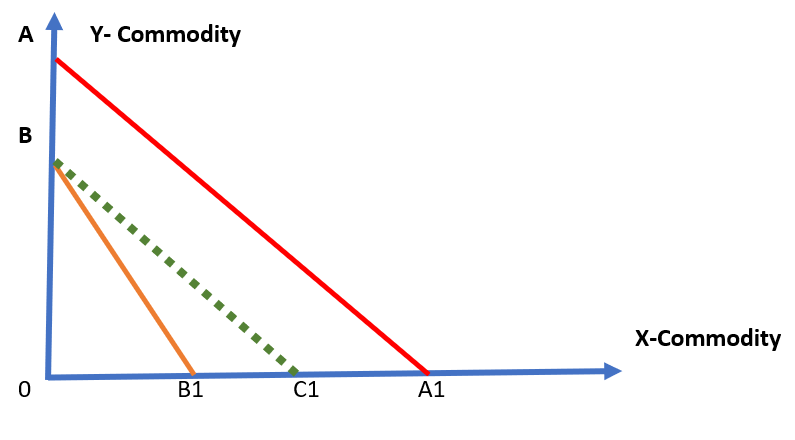
In Fig. 2.2, AA1 and BB1 are the production possibility curves pertaining to countries A and B. Given the same number of productive resources, A can produce larger quantities of both the commodities than the country B. It means country A has absolute cost advantage over B in respect of both the commodities.

If the curve BC1 is drawn parallel to AA1; the curve BC1 can represent the production possibility curve of country A. If country A gives up OB quantity of Y and diverts resources to the production of X, it can produce OC1 quantity of X, which is more than OB1. It means the country A has comparative cost advantage in the production of X-commodity.

From the point of view of B, it can produce the same quantity OB of Y, if it gives up the production of smaller quantity OB1 of X. If signifies that country B has less comparative disadvantage in the production of Y commodity. Accordingly, country A will specialise in the production and export of X commodity, while country B will specialise in the production and export of Y-commodity.

Gain from Trade:

The comparative cost principle underlines the fact that two countries will stand to gain through trade so long as the cost ratios for two countries are not equal. On the basis of Table , country A specialises in the production of X commodity, while country B specialises in the production of Y commodity.

In the absence of international trade, the domestic exchange ratio between X and Y commodities in these two countries are:

Country A: 1 unit of X = 12/10 or 1-20 units of Y

Country B: 1 unit of Y = 12/16 or 0-75 unit of X

If trade takes place and two countries agree to exchange 1 unit of X for 1 unit of Y, the gain from trade for country A amounts to 0.20 units of Y for each unit of X. In case of country B, the gain from trade amounts to 0.25 unit of X for each unit of Y. Thus the comparative costs principle confers gain upon both the countries.

Role of Multinational corporations

A multinational corporation (MNC) is a company that operates in its home country, as well as in other countries around the world. It maintains a central office located in one country, which coordinates the management of all its other offices, such as administrative branches or factories.

Multinational corporations are those large firms which are incorporated in one country but which own, control or manage production and distribution facilities in several countries. Therefore, these multinational corporations are also known as transnational corporations. They transact business in a large number of countries and often operate in diversified business activities. The movements of private foreign capital take place through the medium of these multinational corporations. Thus multinational corporations are important source of foreign direct investment (FDI).

Besides, it is through multinational corporations that modern high technology is transferred to the developing countries. The important question about multinational corporations is why they exist. The multinational corporations exist because they are highly efficient. Their efficiencies in production and distribution of goods and services arise from internalising certain activities rather than contracting them out to other firms. Managing a firm involves which production and distribution activities it will perform itself and which activities it will contract out to other firms and individuals.

In addition to this basic issue, a big firm may decide to set up and operate business units in other countries to benefit from advantages of location. For examples, it has been found that giant American and European firms set up production units to explore and refine oil in Middle East countries because oil is found there. Similarly, to take advantages of lower labour costs, and not strict environmental standards, multinational corporate firms set up production units in developing countries.

  1. Filling Savings Gap: The first important contribution of MNCs is its role in filling the resource gap between targeted or desired investment and domestically mobilized savings. For example, to achieve a 7% growth rate of national output if the required rate of saving is 21% but if the savings that can be domestically mobilised is only 16% then there is a ‘saving gap’ of 5%. If the country can fill this gap with foreign direct investments from the MNCs, it will be in a better position to achieve its target rate of economic growth.
  2. Filling Trade Gap: The second contribution relates to filling the foreign exchange or trade gap. An inflow of foreign capital can reduce or even remove the deficit in the balance of payments if the MNCs can generate a net positive flow of export earnings.
  3. Filling Revenue Gap: The third important role of MNCs is filling the gap between targeted governmental tax revenues and locally raised taxes. By taxing MNC profits, LDC governments are able to mobilize public financial resources for development projects.
  4. Filling Management/Technological Gap: Fourthly, Multinationals not only provide financial resources but they also supply a “package” of needed resources including management experience, entrepreneurial abilities, and technological skills. These can be transferred to their local counterparts by means of training programs and the process of ‘learning by doing’.

Moreover, MNCs bring with them the most sophisticated technological knowledge about production processes while transferring modern machinery and equipment to capital poor LDCs. Such transfers of knowledge, skills, and technology are assumed to be both desirable and productive for the recipient country.

  1. Other Beneficial Roles: The MNCs also bring several other benefits to the host country.

(a) The domestic labour may benefit in the form of higher real wages.

(b) The consumers benefit by way of lower prices and better quality products.

(c) Investments by MNCs will also induce more domestic investment. For example, ancillary units can be set up to ‘feed’ the main industries of the MNCs

(d) MNCs expenditures on research and development(R&D), although limited is bound to benefit the host country.

Apart from these there are indirect gains through the realization of external economies.

Role of a Multinational Corporation

  1. Very high assets and turnover

To become a multinational corporation, the business must be large and must own a huge amount of assets, both physical and financial. The company’s targets are high, and they are able to generate substantial profits.

  1. Network of branches

Multinational companies maintain production and marketing operations in different countries. In each country, the business may oversee multiple offices that function through several branches and subsidiaries.

  1. Control

In relation to the previous point, the management of offices in other countries is controlled by one head office located in the home country. Therefore, the source of command is found in the home country.

  1. Continued growth

Multinational corporations keep growing. Even as they operate in other countries, they strive to grow their economic size by constantly upgrading and by conducting mergers and acquisitions.

  1. Sophisticated technology

When a company goes global, they need to make sure that their investment will grow substantially. In order to achieve substantial growth, they need to make use of capital-intensive technology, especially in their production and marketing activities.

  1. Right skills

Multinational companies aim to employ only the best managers, those who are capable of handling large amounts of funds, using advanced technology, managing workers, and running a huge business entity.

  1. Forceful marketing and advertising

One of the most effective survival strategies of multinational corporations is spending a great deal of money on marketing and advertising. This is how they are able to sell every product or brand they make.

  1. Good quality products

Because they use capital-intensive technology, they are able to produce top-of-the-line products.

error: Content is protected !!