Improving Service Quality

The actual steps required to improve service quality will depend on the specific situation, but they can be grouped into three categories: understanding, performance, and communication.

The best way to improve understanding of customer needs and expectations is to increase the amount of time that members of the organization, including management, spend observing and interacting with customers. This can include customer visits and shadowing those performing front line services. Customer surveys can also be used to collect information, although surveys do not remove the need for observing and interacting with customers directly.

Internally, customer personas can be built to help everyone in the organization try to visualize and understand one or more stereotypical customers. This can include information about the customer’s background, needs and expectations. Exercises can be performed where employees take turns trying to argue from the customer’s point of view.

Improving performance will depend on the specific services being performed. The approaches however fall into two categories. One approach is to invest in creating service quality standards and developing rigurous training so that all employees understand how to properly perform services. It is also important for management to observe how services are being performed in order to identify gaps in service quality standards or additional training opportunities. This is often the approach selected by large organizations and when done properly it can lead to consistent service quality.

The other approach is to hire great people, work hard to retain and motivate them, coach them in areas where they need improvement, and give them the freedom to delight customers. With this approach it is particularly important for management to be intimately familiar with employees and the work they perform in order to be able to properly identify coaching opportunities. This approach can work particularly well for small organizations who may opt to do this instead of investing in standards and training. But relying solely on this approach can be difficult as the size of an organization increases. It is important to find the right balance between these two approaches.

Communication can easily undo all of the hard work put into improving understanding and performance. When it comes to improving communication, as it relates to service quality, it is important to make sure that communication to customers is prompt, that expectations are properly set up front, and that any changes or deviations are communicated as soon as possible. All communications should reflect an understanding of the customer’s needs and expectations and consider the organization’s ability to perform according to those expectations.

Tips for Improving Service Quality Management

When brands seek to refine their customer engagement strategy, a critical aspect is ensuring that contact center customer service operations are running smoothly. To achieve this, it is necessary to assess not only individual agent performance but also the quality management practices in place. Here are seven tips for improving service quality management in the contact center.

  1. Encourage agent feedback

Agents are on the front lines of customer service and have a detailed knowledge of what customer expectations may be. Encouraging agent feedback regarding improved customer service practices is therefore crucial, while peer feedback can also encourage team building and allow agents to learn from peer experiences.

  1. Have agents listen to their calls

During coaching sessions, agents should be given the chance to listen to their calls when discussing which points to improve. By breaking down the process and closely analyzing points such as tone, thoroughness, and ability to achieve first call resolution, agents can get a better sense of what their service looks like and make improvements.

  1. Send post-contact surveys after every interaction

No matter what priorities are set in place in a contact center’s customer service operations, the customer should always come first. This means that customer feedback is just as critical as any peer or supervisor feedback, and quality management demands consistent requests for feedback after each service interaction. Post-contact surveys should include questions that directly address the customer’s needs and preferences with a free-response section for additional comments.

  1. Establish clear KPIs

It is important for all contact center employees to know what KPIs to strive for, so establishing clear goals is necessary. Agents and managers alike should be able to view KPIs alongside their personal achievements, and tools such as gamification can motivate agents to deliver their best and meet their goals.

  1. Evaluate regularly

Agents should be coached and evaluated on a regular basis to consistently aid them in improving their performance. For example, monitoring calls once a week and providing swift feedback allows agents to work on their performance regularly and improve before each subsequent call monitoring session.

  1. Give all agents clear and consistent standards

All agents should have an equal chance for success, so it is important to set clear and consistent standards. Establishing clear points such as whether first call resolution is a top priority or reducing average handling time, which tools should be used and how, and what call scripts should be followed and when to deviate from a script are all steps toward setting clear expectations for agent success.

  1. Take a team approach to eliminate bias

Quality management can be subjective, so taking a team approach to analyzing employee performance is a great way to eliminate bias. Having managers coach agents from another contact center team or exchanging peer feedback across teams are great ways to gain perspective across the contact center in a more objective manner.

Measuring Service Quality

Mystery Shopping

This is a popular technique used for retail stores, hotels, and restaurants, but works for any other service as well. It consists out of hiring an ‘undercover customer’ to test your service quality or putting on a fake moustache and going yourself, of course.

The undercover agent then assesses the service based on a number of criteria, for example those provided by SERVQUAL. This offers more insights than simply observing how your employees work. Which will probably be outstanding as long as their boss is around.

  1. Post Service Rating

This is the practice of asking customers to rate the service right after it’s been delivered.

With User like’s live chat, for example, you can set the chat window to change into a service rating view once it closes. The customers make their rating, perhaps share some explanatory feedback, and close the chat.

Something similar is done with ticket systems like Help Scout, where you can rate the service response from your email inbox.

It’s also done in phone support. The service rep asks whether you’re satisfied with her service delivery, or you’re asked to stay on the line to complete an automatic survey. The latter version is so annoying, though, that it kind of destroys the entire service experience.

Different scales can be used for the post service rating. Many make use of a number-rating from 1 to 10. There’s possible ambiguity here, though, because cultures differ in how they rate their experiences.

  1. Follow-Up Survey

With this method you ask your customers to rate your service quality through an email survey for example via Google Forms. It has a couple advantages over the post-service rating.

For one, it gives your customer the time and space for more detailed responses. You can send a SERVQUAL type of survey, with multiple questions instead of one. That’d be terribly annoying in a post-service rating.

It also provides a more holistic overview of your service. Instead of a case-by-case assessment, the follow-up survey measures your customers’ overall opinion of your service.

It’s also a useful technique if you didn’t have the post service rating in place yet and want a quick overview of the state of your service quality.

  1. In-App Survey

With an in-app survey, the questions are asked while the visitor is on the website or in the app, instead of after the service or via email. It can be one simple question – e.g. ‘how would you rate our service’ or it could be a couple of questions.

Convenience and relevance are the main advantages. Survey Monkey offers some great tools for implementing something like this on your website.

  1. Customer Effort Score (CES)

This metric was proposed in an influential Harvard Business Review article. In it, they argue that while many companies aim to ‘delight’ the customer to exceed service expectations it’s more likely for a customer to punish companies for bad service than it is for them to reward companies for good service.

While the costs of exceeding service expectations are high, they show that the payoffs are marginal. Instead of delighting our customers, so the authors argue, we should make it as easy as possible for them to have their problems solved.

That’s what they found had the biggest positive impact on the customer experience, and what they propose measuring.

  1. Social Media Monitoring

This method has been gaining momentum with the rise of social media. For many people, social media serve as an outlet. A place where they can unleash their frustrations and be heard.

And because of that, they are the perfect place to hear the unfiltered opinions of your customers, if you have the right tools. Facebook and Twitter are obvious choices, but also review platforms like TripAdvisor or Yelp can be very relevant. Buffer suggests to ask your social media followers for feedback on your service quality.

Two great tools to track who’s talking about you are Mention and Google Alerts.

  1. Documentation Analysis

With this qualitative approach you read or listen to your respectively written or recorded service records. You’ll definitely want to go through the documentation of low-rated service deliveries, but it can also be interesting to read through the documentation of service agents that always rank high. What are they doing better than the rest?

The hurdle with the method isn’t in the analysis, but in the documentation. For live chat and email support it’s rather easy, but for phone support it requires an annoying voice at the start of the call: “This call could be recorded for quality measurement”.

  1. Objective Service Metrics

These stats deliver the objective, quantitative analysis of your service. These metrics aren’t enough to judge the quality of your service by themselves, but they play a crucial role in showing you the areas you should improve in.

  • Volume per channel. This tracks the amount of inquiries per channel. When combined with other metrics, like those covering efficiency or customer satisfaction, it allows you to decide which channels to promote or cut down.
  • First response time. This metric tracks how quickly a customer receives a response on her inquiry. This doesn’t mean their issue is solved, but it’s the first sign of life – notifying them that they’ve been heard.
  • Response time. This is the total average of time between responses. So let’s say your email ticket was resolved with 4 responses, with respective response times of 10, 20, 5, and 7 minutes. Your response time is 10.5 minutes. Concerning reply times, most people reaching out via email expect a response within 24 hours; for social channels it’s 60 minutes. Phone and live chat require an immediate response, under 2 minutes.
  • First contact resolution ratio. Divide the number of issues that’s resolved through a single response by the number that required more responses. Forrester research showed that first contact resolutions are an important customer satisfaction factor for 73% of customers.
  • Replies per ticket. This shows how many replies your service team needs on average to close a ticket. It’s a measure of efficiency and customer effort.
  • Backlog Inflow/Outflow. This is the number of cases submitted compared to the number of cases closed. A growing number indicates that you’ll have to expand your service team.
  • Customer Success Ratio. A good service doesn’t mean your customers always finds what they want. But keeping track of the number that found what they looked for versus those that didn’t, can show whether your customers have the right ideas about your offerings.
  • ‘Handovers’ per issue. This tracks how many different service reps are involved per issue. Especially in phone support, where repeating the issue is necessary, customers hate HBR identified it as one of the four most common service complaints.
  • Things Gone Wrong. The number of complaints/failures per customer inquiry. It helps you identify products, departments, or service agents that need some ‘fixing’.
  • Instant Service / Queuing Ratio. Nobody likes to wait. Instant service is the best service. This metric keeps track of the ratio of customers that were served instantly versus those that had to wait. The higher the ratio, the better your service.
  • Average Queueing Waiting Time. The average time that queued customers have to wait to be served.
  • Queueing Hang-ups. How many customers quit the queueing process. These count as a lost service opportunity.
  • Problem Resolution Time. The average time before an issue is resolved.
  • Minutes Spent Per Call. This can give you insight on who are your most efficient operators.

Some of these measures are also financial metrics, such as the minutes spent per call and number of handovers. You can use them to calculate your service costs per service contact. Winning the award for the world’s best service won’t get you anywhere if the costs eat up your profits.

Some service tools keep track of these sort of metrics automatically, like Talkdesk for phone and User like for live chat support. If you make use of communication tools that aren’t dedicated to service, tracking them will be a bit more work.

One word of caution for all above mentioned methods and metrics: beware of averages, they will deceive you. If your dentist delivers a great service 90% of the time, but has a habit of binge drinking and pulling out the wrong teeth the rest of the time, you won’t stick around long.

A more realistic image shapes up if you keep track of the outliers and standard deviation as well. Measure your service, aim for a high average, and improve by diminishing the outliers.

Service Quality – GAP Model

The SERVQUAL Model is an empiric model by Zeithaml, Parasuraman and Berry to compare service quality performance with customer service quality needs. It is used to do a gap analysis of an organization’s service quality performance against the service quality needs of its customers. That’s why it’s also called the GAP model.

It takes into account the perceptions of customers of the relative importance of service attributes. This allows an organization to prioritize.

There are  five core components of service quality:

  • Tangibles: Physical facilities, equipment, staff appearance, etc.
  • Reliability: Ability to perform service dependably and accurately.
  • Responsiveness: Willingness to help and respond to customer need.
  • Assurance: Ability of staff to inspire confidence and trust.
  • Empathy: The extent to which caring individualized service is given.

The four themes that were identified by the SERVQUAL developers were numbered and labelled as:

  1. Consumer expectation – Management perception gap (Gap 1)

Management may have inaccurate perceptions of what consumers (actually) expect. The reason for this gap is lack of proper market/customer focus. The presence of a marketing department does not automatically guarantee market focus. It requires the appropriate management processes, market analysis tools and attitude.

  1. Service Quality Specification gap (Gap 2)

There may be an inability on the part of the management to translate customer expectations into service quality specifications. This gap relates to aspects of service design.

  1. Service delivery gap (Gap 3)

Guidelines for service delivery do not guarantee high-quality service delivery or performance. There are several reasons for this. These include: lack of sufficient support for the frontline staff, process problems, or frontline/contact staff performance variability.

  1. External communication gap (Gap 4)

Consumer expectations are fashioned by the external communications of an organization. A realistic expectation will normally promote a more positive perception of service quality. A service organization must ensure that its marketing and promotion material accurately describes the service offering and the way it is delivered

  1. These four gaps cause a fifth gap (Gap 5)

which is the difference between customer expectations and perceptions of the service actually received Perceived quality of service depends on the size and direction of Gap 5, which in turn depends on the nature of the gaps associated with marketing, design and delivery of services. So,Gap 5 is the product of gaps 1, 2, 3 and 4. If these four gaps, all of which are located below the line that separates the customer from the company, are closed then gap 5 will close.

Branding of Services: Problem and Solution

The basics of branding products and services are similar. Branding your service-based small business, though, poses challenges greater than those faced by product-driven companies. Services are intangible and each customer experience is unique. Even a small number of bad customer experiences can severely damage your brand and service reputation. This is especially true for smaller businesses in smaller communities where word of mouth spreads more easily.

Branding Basics

Branding means using marketing and communication tools to create a perception of value in the minds of your target customers. Your company’s name, logo and symbols typically serve as the centerpieces of branding efforts. Your goal is to create an image that resonates with customers when they see your company’s identifying marks. Differentiating your brand as top quality, most innovative, best value, most wholesome or lowest cost are common objectives of branding.

Problem and Solution of Branding of Services

  1. Treating brands as assets

The ongoing pressure to deliver short-term financial results coupled with the fragmentation of media will tempt organizations to focus on tactics and measurables and neglect the objective of building assets.

  1. Possessing a compelling vision

A brand vision needs to differentiate itself, resonate with customers and inspire employees. It needs to be feasible to implement, work over time in a dynamic marketplace and drive brand-building programs. Visions that work are usually multidimensional and adaptable to different contexts. They employ concepts such as brand personality, organizational values, a higher purpose and in general they simply move beyond functional benefits.

  1. Creating new subcategories

The only way to grow, with rare exceptions, is to develop “must have” innovations that define new subcategories and build barriers to inhibit competitors from gaining relevance. That requires substantial or transformational innovation and a new ability to manage the perceptions of a subcategory so that it wins.

  1. Generating breakthrough brand building

Exceptional ideas and executions that break out of the clutter are necessary in order to bring the brand vision to life. These ideas and the execution of them are more critical than the size of your budget. “Good” is just not good enough. That means making sure you get more ideas from more sources, and that you make sure you have the mechanisms in place to recognize brilliance and bring those ideas to market – quickly.

  1. Achieving integrated marketing communication (IMC)

IMC is more elusive and difficult than ever in light of the various methods you have to choose from such as advertising, sponsorships, digital, mobile, social media and more. These methods tend to compete with each other rather than reinforce because the media scene and options have become so complex, so dynamic, and because product and country silos reflect competition and isolation rather than cooperation and communication.

  1. Building a digital strategy

This arena is complex, dynamic and in need of a different mindset. The reality is, the audience is in control here. New capabilities, creative initiatives and new ways to work with other marketing modalities are required. Adjust the digital marketing focus from the offering and the brand to the customer’s sweet spot, which is to say the activities and opinions in which they are interested or even passionate about. Develop programs around that sweet spot in which the brand is an active partner, such as Pampers did with Pampers Village or what Avon did with their Walk for Breast Cancer.

  1. Building your brand internally

It is hard to achieve successful integrated marketing communications or breakthrough marketing without employees both knowing the vision and caring about it. The brand vision that lacks a higher purpose will find the inspiration challenge almost impossible.

  1. Maintaining brand relevance

Brands face three relevance threats: Fewer customers buying what the brand is offering, emerging reasons not-to-buy, and loss of energy. Detecting and responding to each requires an in-depth knowledge of the market, plus a willingness to invest and change.

  1. Creating a brand-portfolio strategy that yields synergy and clarity

Brands need well-defined roles and visions that support those roles. Strategic brands should be identified and resourced, and branded differentiators and energizers should be created and managed.

  1. Leveraging brand assets to enable growth

A brand portfolio should foster growth by enabling new offerings, extending the brand vertically or extending the brand into another product class. The goal is to apply the brand to new contexts where the brand both adds value and enhances itself.

Flowcharting in Service Marketing

The concept of flowcharting in services, also known as service flow chart, process flow chart or process flow diagram constitutes a picture of the separate steps of a process in a sequential order.  Any major project that you start, will require handling multiple teams in different time frames. Over a period of time, it becomes difficult to manage these teams if you do not have the right process chart in hand. Hence, the usage of flowcharting in services.

Example of flow charting in services

Let’s take for example the construction of a building. Once you have decided upon the idea of constructing a building, the next steps come into the process. You need to think if the location is feasible for the desired construction. You need to think about the materials that you are going to need, who is in charge of buying them and who is in charge of supplying them.

You also need workers to help you with the construction and heavy machines. But imagine that. You take the decision of constructing a building, start the construction and at one point you realize that you don’t have any more material and that your supplier has run out of stock. Who is responsible for restocking the material? It can also happen that one of your employees starts working on a place which was the responsibility of other worker, thus both of them doing the same thing in the same place, making you lose both money and time. Hence, to avoid this confusion, flowcharting in services is done.

Flowcharting in Services

The flowcharting process can be considered as a tool useful for developing an understanding of how a process is done. It can be useful in any phase of business or even in personal life for that matter. The type of process can be anything, such as manufacturing processes, administrative services, project plans, etc. But it is most useful in services and is plotted regularly in services.

As in the previous example with the construction of a building, a flowcharting has to include all the steps  and people involved in the respective process, such as sequence of actions, materials or services entering or leaving the process (inputs and outputs), decisions that must be made, people who become involved at each step and process measurements.

As it can be adapted to a wide range of purposes and project, the flowcharting process is considered to be a generic tool.  The main reason why people decide to use it consists in the fact that the tool itself can provide a holistic overview of the entire project and its components.

When many people are involved in the project, the flowcharting can be used to communicate to the people how the project is going to be done. At the same time, the process is useful for documenting the project making sure that you have all the permits and certificates required, depending on the nature of the project. Moreover, it encourages better communication between people involved in the same process and it avoids confusion regarding responsibilities.

In the flowcharting process, the first step consists in defining the process that needs to be analyzed and write its title at the top of the work surface.

Afterwards, a decision should be made upon the boundaries of the project, in terms of when does it start, when should it finish, as well as the level of detail that should be included in the project. For a flowcharting process to be significantly useful it should include independent sections for brainstorming activities in the project. Once the activities have been decided upon, they should be put in a sequential order to reflect which are going to be the steps of the project and arrows should be drawn to show the flow of the process. Finally, the flowchart should be review with the people involved in the process and ask for their opinions.

Some companies with the necessary resources, usually decide to outsource this process to a specialized company. However, it is has been proven that it is better for people who actually do the process to be the one who are doing also the flowcharting. To be easier for them to create it in a systematic and structured way, nowadays there are computer software programs for drawing the flowcharts.

Another example of flowcharting in services is when you are building a restaurant. How do you get the food to your customer within 20 minutes of his entering the restaurant? Take McDonald’s for example. McDonald’s has a fixed service process for all of its outlets. They need to service a burger, fries, coke as well as any other demands of the customer, to the customer, within a minute or two.

So the backend service process needs to be highly optimized. Similarly, all restaurants have processses in place for when the flow of customers is very high as well as when the flow of customers is slow. Thus, in case of services, the process of flowcharting is important.

Place or Distribution of Service

Distribution

Distribution means the process by which we make the goods or the service available to the end consumer. Generally, the place of production is not the same as the place of consumption. So the goods have to be distributed to overcome the barrier of place.

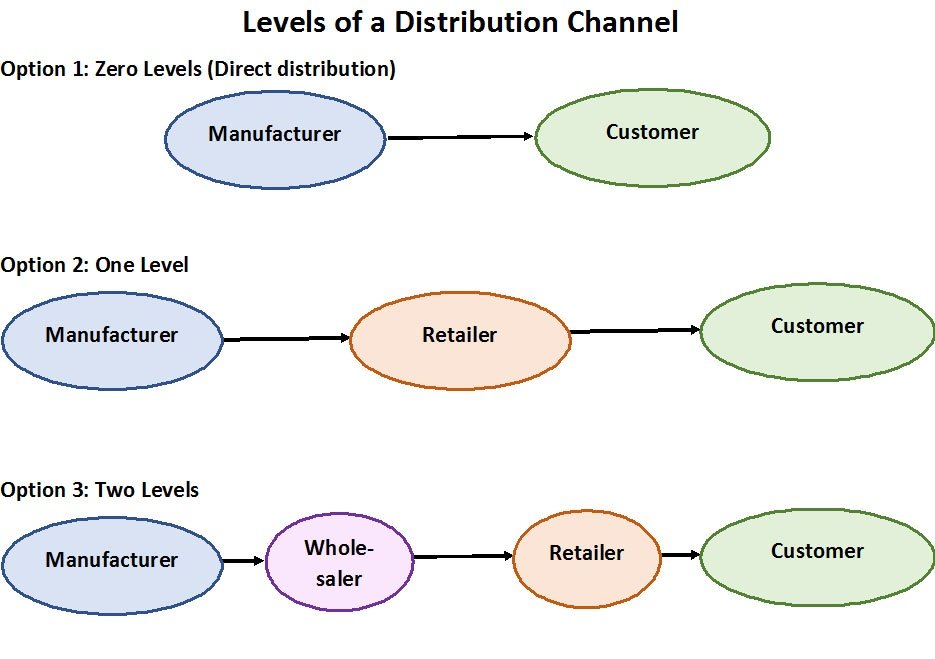
Now the distribution of the products can be done by the organisation itself which is direct distribution. Or it can hire intermediaries and form distributions channel i.e. indirect distributions. The plan will depend on several factors, some of which are

  • Product: Whether the product is perishable or durable will be a factor in deciding its distributions model.
  • Market: The size of the market will be a factor. In a large market, the direct distribution may not be a perfect choice. Also if the markets are scattered indirect channel will be more suitable
  • Company: The size of the company and its product-mix are also deciding factors in the decision about distributions.
  • Marketing Environment: In a slow economy or depression a shorter distributions chain is preferable. In a healthy economy, there is a wider choice for alternatives.
  • Cost: The cost of the channel like transportation, warehousing and storage, tolls etc. are obviously a factor in this decision.

Types of Intermediaries

These are the middlemen that ensure smooth and effective distribution of goods over your chosen geographical market. Middlemen are a very important factor in the distribution process. let us take a look at the types of middlemen we usually find.

  1. Agents

Agents are middlemen who represent the produces to the customer. They are merely an extension of the company but the company is generally bound by the actions of its agents. One thing to keep in mind, the ownership of the goods do not pass to the agent. They only work on fees and commissions.

  1. Wholesalers

Wholesalers buy the goods from the producers directly. One important characteristic of wholesalers is that they buy in bulk at a lower rate than retail price. They store and warehouse huge quantities of the products and sell them to other intermediaries in smaller quantities for a profit.

Wholesalers generally do not sell to the end consumer directly. They sell to other middlemen like retailers or distributors.

  1. Distributors

Distributors are similar to wholesalers in their function. Except they have a contract to carry goods from only one producer or company. They do not stock a variety of products from various brands. They are under contract to deal in particular products of only one parent company

  1. Retailers

Retailers are basically shop owners. Whether it is your local grocery store or the mall in your area they are all retailers. The only difference is in their sizes. Retailers will procure the goods from wholesaler or distributors and sell it to the final consumers. They will sell these products at a profit margin to their customers.

In the reality of the market, all producers rely on the distribution to channel to some extent. Even those who sell directly may rely on at least one of the above intermediary for any purpose. Hence the distribution channel is of paramount importance in our economy.

Pricing Mix

Price mix. is another important element of marketing mix. It is considered as very critical element. Price can be defined as the economic value of product normally expressed in form of money.

The price of product should be set in such a way that buyers can pay and company can earn adequate profits. In case of price-sensitive customers on one hand and the prestige-sensitive customers on the other hand, the pricing decisions become vital in marketing.

Pricing decisions involves:

  • Determining product development costs
  • Determining manufacturing (variable and fixed) costs the product
  • Studying pricing policies and strategies of the close competitors
  • Formulating appropriate pricing policies for the products
  • Deciding on level or margin of profits
  • Deciding on variable v/s fixed pricing, price discrimination, discounts, allowances, and seasonal effect
  • Identifying and analyzing of various relevant factors influencing pricing decisions
  • Pricing policies/strategies in different stages of product life cycle
  • Deciding on price-setting methods
  • Pricing decisions for direct and indirect distribution of products

Pricing Strategy

Price is the amount of money that your customers have to pay in exchange for your product or service. Determining the right price for your product can be a bit tricky.

A common strategy for beginning small businesses is creating a bargain pricing impression by pricing their product lower than their competitors. Although this may boost initial sales, low price usually equates to low quality and this may not be what customers to see in your product.

Your pricing strategy should reflect your product’s positioning in the market and the resulting price should cover the cost per item and the profit margin. The amount should not project your business as timid or greedy.

Low pricing hinders your business’ growth while high pricing kicks you out of the competition.

There are a number of pricing strategies that you can follow. Some strategies may call for complex computation methods and others are intuitive decisions. Select a pricing strategy that’s based on the product itself, competitive environment, customer demand, and other products that you offer.

Cost Plus

Cost Plus is taking the production cost and adding a certain profit percentage. The resulting amount will be the product’s price. You need to consider variable and fixed production costs for this pricing method.

Value Based

Instead of using the production cost as your basis, you consider the customer’s perception of the product’s value. The perception of the buyer is dependent on the product’s quality, the company’s reputation, and healthfulness, aside from the cost factors.

Competitive

You take a survey of the pricing implemented by your competitors on a similar product that you are trying to market and then decide whether to price your product lower, the same, or higher. You should also monitor their prices and be able to respond to changes.

  • Going Rate: This pricing strategy is more common in selling environments where the companies have little to no control of the market price. You price your product according to the going rate of similar products
  • Skimming: You introduce a high quality product, price it high, and target affluent customers. When the market has become saturated, you then lower the price accordingly.
  • Discount: Most commonly used for old product stocks or when you’re clearing up you inventory. You take the advertised price and lower the amount. A good example is a discount coupon.
  • Loss Leader: You take the production cost and price the product even lower. The idea is to attract your customers to your store where they can be convinced to buy your other products.
  • Psychological: You may have noticed that you rarely see pricing rounded off to the nearest whole number.

The actual money you will receive as payment for your product can be complicated by certain pricing factors so you may receive more or less than the advertised price. You need to determine the following in coming up with the appropriate price:

  • Payment Period: This is the length of time before you receive the payment.
  • Allowance: You give part of the advertised price to the retailer in return for promotional activities like in-store display that features your product.
  • Seasonal Allowances: You lower the price of certain products ordered during low sale seasons to attract customers to buy during non-peak times.
  • Product/Services Bundles: You put in similar or dissimilar products together and sell them as a bundle at a discounted price
  • Trade Discounts: You give price discounts as payments to your distribution channels for doing tasks like shelf stocking and warehousing.
  • Price Flexibility: You let the reseller or the sales person modify the price according to an agreed range.
  • Volume Discounts: You give discounts for wholesale buyers.
  • Credit Terms: You allow consumers to pay for your products at a later date.

Base your pricing strategy on the methods mentioned above to come up with the proper price for your product. Remember that Price is the only P in the ‘Four Ps of Marketing’ that actually generates profit for you. The rest are cost incurring factors.

The Service Product

The term ‘service product’ encompasses a myriad of different types of services. The definition proposed is still one of the most effective in capturing the key distinguishing characteristics of different types of service products: ‘A service is an intangible product involving a deed, a performance, or an effort that cannot be physically possessed.’

There is little doubt that both intangibility and non-ownership are key characteristics of service products, although other characteristics are important. Staying with Berry’s definition, if we can see that the product is essentially intangible then the customer does not take physical possession. There are, however, tangible elements to the product of a flight: the aeroplane itself, the seat we occupy, the meals and drinks we are served are tangible aspects of the air travel product. In addition, we do take ‘physical possession’ of certain elements of the product, e.g. the seat, the meals and drinks.

However, the core benefit that the customer is purchasing is essentially intangible. This example shows that most products have a mixture of both tangible and intangible components. If we think of tangibility as a continuum, service products are those where the intangible element is predominant. This idea of a continuum of intangibility is frequently encountered in texts on services marketing and is a useful way of evaluating whether the customer is buying what is essentially a tangible product or a service. An example for business products/services adapted from Shostack2. A list of examples of where the intangible element is dominant, and hence examples of what we define as service products, includes:

  • Fast food;
  • Hotels;
  • Holidays;
  • Travel;
  • Insurance and banking;
  • Education;
  • Health care;
  • Public transport;
  • Legal/financial advice;
  • Consultancy;
  • Personal health and beauty.

There are numerous different service products. An important fact to note is that although they are usually relatively easy for the marketer to classify as being service or non-service products, ultimately it is the customer who decides whether or not a product or service is being purchased, and hence marketed, according to the relative importance attached to the tangible versus intangible elements.

A continuum of tangibility and intangibility: business/product service classifications.

Intangibility is certainly one of the key characteristics that distinguishes service products from tangible products. What about the notion of ‘non-possession’ referred to in Berry’s definition, and what are the other distinguishing or special characteristics of service products? These other suggested special characteristics of service products, including the aspect of non-possession, or non-ownership, are now outlined. As with the characteristic of tangibility these so-called ‘special characteristics’ are a matter of degree and best thought of as a continuum. For each of these characteristics we have outlined the marketing implications and issues to which these characteristics give rise.

Non-ownership

As explained in the air travel example a characteristic of many services is that they are used rather than owned. Another example is a holiday where we simply use the services of the holiday provider as opposed to taking physical possession of a product.

Non-ownership can sometimes make it difficult for a customer to assess and appreciate the advantages of purchasing the service. The marketer therefore needs to pay particular attention in emphasizing benefits of non-ownership, such as no long-term commitment and inexpensive maintenance in promotional programmes.

At one time few private car buyers in the UK would have considered leasing a car on a long-term basis as opposed to purchasing one either outright or on credit. However, partly as a way to help customers finance the use of a car, over the last ten years the majority of the major car manufacturers have introduced what effectively are leasing schemes albeit often under other names. An increasing number of customers not only find this a more convenient way of covering the costs of having access to a new car, but also find there are many benefits to not actually taking ownership of a vehicle.

Sensitivity of Customer’s Reluctance to Change

Sometimes the biggest resistance to innovation comes from the person who should benefit most from it the customer. Customers can be very conservative. When you come along with an unorthodox new product or service they are often initially unimpressed. Why should the buyer take a risk with your unproven new gismo? He knows that new products often have bugs and he does not want to be the guinea pig on which you experiment. He is familiar with the current method, why should he change?

Who would want to be the first customer for a fax machine or indeed for a telephone? It seems ridiculous now but selling the first few telephones must have been really difficult. And how about laser eye treatment? How would you find the first person to try it when there was a safe alternative in a pair of spectacles?

This is understandable and needs careful handling. Your sales people will doubtless be adept at explaining the benefits of your new products but the customer is right to be sceptical. You need to find ways to reassure him and to mitigate his risk.

At the same time you need early adopters so that you can get some traction in the market, customer feedback and positive references for your innovation. So acknowledge the client’s concerns and put offers in place to allay them. You cannot just use your standard terms and conditions for a radical new product. You have to be innovative in your sales approach too. For example you could:

  • Allow them a free trial of the new product
  • Continue to provide the old service so that they can go back to it at any time.
  • Offer a money back guarantee.
  • Provide a special service level that gives them immediate access to your top support experts.
  • Agree joint service level agreements.
  • Stress the payback and benefits they will receive and even make payment dependent on their being achieved.
  • Promise to arrange a positive PR result for them in the trade press if the trial succeeds.

Above all you must choose the right early customers. Some people love new technology and others hate it. Select the best early adopters from among your top clients. Appeal to their sense of pioneering adventure. Stress the prestige that goes with early success for both of you. Make sure that they share in the recognition of a successful launch. If all goes well then ask them for a testimonial. You can help them be seen as an industry leader in trade journal stories and at conferences. You are in it together and it must be a win/win for both parties.

Entrepreneurs and business owners can do to engage customers in the change process, so they feel more like a partner and stakeholder in the changes:

1. Analyze concerns from the customers’ point of view: The buy-in to the change happens in the mind of the other person. While regulatory and legislative changes may seem easy to enforce, most customers aren’t that interested in the reasons why something has to happen a certain way – they just want to have their needs met. Get your customers involved right from the beginning by testing out the changes with them. Walk them through the changes and requirements while discussing benefits.

Most importantly, listen to their concerns. You may not be able to solve all of them, but listening and acknowledging your customers’ concerns will often still move people down the path to accept your changes.

2. Engage your customers in your ecosystem: Quite often, one change within the system will impact other areas of the system. Think of your business as a full ecosystem that is living and breathing. Ask your customers what is their experience at every encounter within this ecosystem.

Also, gather metrics on how, when, where, and why do they use your product. Provide incentives and ask your customers to share their experience online about your new product or service. This helps create a self-sustaining business ecosystem with your customers selling your product for you.

3. Don’t assume connectivity: As technological change increases, those of us in larger urban centres may assume that everyone else has the same level of connectivity. Customers with lower connectivity must be facilitated too.

Be sure to have a technical workaround so consumers who live in an area with lower bandwidth have a great customer experience as well.

4. Build real intelligenceMake sure you are using the right metrics to measure the success of your business. While we might think of sales as a success metric, that alone will not necessarily tell you if your changes are successful. If your customer bought something but never came back, is that a sign of success for your particular business? Tracking continuing customer engagement with your company as well will give you a clearer picture of how successful your change was.

5. Maintain data accuracy: Ask the right questions. Ensure customers have real time access to tracking, shipping information, profile information, and other pieces of information that are relevant to your product or service. Read between the lines of percentages. For example, if 60% of your customers liked the product, but that number only accounts for a small number of people, the data is meaningless.

Also, take both quantitative and qualitative data into account. Anecdotal evidence can be just as strong as hard data and signify trends you should pay attention to.

6. Manage expectationsBe very clear with your customers about what they can expect through every step of their customer journey. Don’t be afraid to make it simple and spell it out for them. People going through all types of changes want to know what the future will hold, what will stay the same, and what will change.

For example, when someone subscribes to your newsletter, tell them what they can expect each month, and express how grateful you are that they are sharing this journey with you. Anticipate and share the challenges. Help the customer predict the future.

7. Develop a strong customer relationshipRemember, buying strategies have changed. Your customers have access to more choices than ever. Develop and maintain a strong relationship with them. Make your customer feel like they are on the same team as you, and not simply a consumer of your products. Tell them what you will be accountable for and what you will provide. Help them create ownership with your product, service, and company.

Type of Contract: High Contact Services and Low Contact Services

The approach towards customer service delivery can play a big role in your business success. There are plenty of ways to handle customer service delivery, but the strategies behind them can be broadly described as high-contact services and low-contact services.

High-Contact Services

In high contact, service entails interactions throughout service delivery between customers and the organization. The customer’s exposure to the service provider takes on physical and tangible nature. When a customer visits the facility where service is delivered, If they enter the service “factory” something that rarely happens in a manufacturing environment. Viewed from this perspective, a motel is a lodging factory, a hospital is a health treatment factory, an airline is a flying transportation factory, and a restaurant is a food service factory. Because these industries mainly focus on “processing” people rather than inanimate the objects, the marketing challenge is to make the experience appealing to customers in the physical environment and their interactions with service executives. During the course of service delivery, customers are usually exposed to many physical clues about the organization the exterior and interior of its building, equipment, furnishings, appearance, and behavior of service personnel and even other customers.

Low-Contact Services

Low-Contact Services are generally the opposite end of the spectrum, low-contact services involve little, if any, physical contact between customers and service providers or executives. In most cases, the contact takes place at arm’s length through the medium of the Internet or physical distribution channels. It is a fast-growing trend in today’s more convenience-oriented society. Many high-contact and medium-contact services are being transformed into low-contact services why? because to more convenient for the customers. Nowadays customers are conducting their insurance or banking transactions by mail, telephone, and the Internet or research and purchase a host of information-based services by visiting web sites rather than bricks-and-mortar facilities (traditional stores).

Difference between High & Low Customer Contact Service

Your approach to customer service can play a big part in the success of your business. There are plenty of ways to handle customer service, but the strategies behind them can be broadly described as high-contact or low-contact. High-contact service means you offer your customers a lot of hand-holding and direct support, while low-contact service means you give them tools to sort things out for themselves. They’re both valid options, so the real question is which approach will work best for you and your clients.

Customer Information Gathering

The level of information you gather to address customer problems will vary, depending on the level of customer service you provide. If you opt for low-contact customer service, you’ll address customer concerns and problems as they come up. This strategy typically doesn’t gather a lot of information to identify specific solutions.

For example, a jewelry store fixes watches as they break. The store does not collect information on the problem to create any kind of problem solving work flow. High-contact customer service, however, analyzes customer complaints to create solutions. For example, if you have a software company you’ll analyze your customers’ problems to find easy solutions for the next time a customer has the same experience.

Customer Access to Employees

The strategy you choose decides how much access a customer has to your employees. Low-contact customer service typically keeps customers at arm’s length, dealing with entry-level service reps and seldom reaching top-level managers or executives when a problem occurs. High-contact customer service offers the customer an opportunity, if needed, to speak to employees higher up the chain of command.

For example, if a customer’s new luxury car continuously breaks down after he purchases it, he potentially can speak to a vice president or owner at the dealership from which he purchased the car to discuss the problem.

Customer Interaction with the Company

The way customers interact with your company differs between high and low touch customer service programs. With low-touch customer service, customers often don’t speak directly with a human at all. For example, you might only offer an email address as your point of contact when a customer needs help with a problem.

High-touch customer service typically offers a call center or a representative to meet the customer and fix the problem. For example, if a customer has problems with his cable television and a service technician is sent to his home, this is high-touch customer service.

Customer Service Availability

Problems with products and services happen at any time of the day, and your choice of high or low contact customer service dictates what kind of response your clients can expect. If you opt for low-contact customer service, customers typically can’t contact a representative outside of business hours. High-contact customer service typically uses 24-hour call centers and help lines for customer problems.

error: Content is protected !!