Promissory Note, Meaning, Characteristics, Types, Procedure

Promissory Note is a financial instrument that contains a written promise by one party (the maker or issuer) to pay another party (the payee) a definite sum of money, either on demand or at a specified future date. Promissory notes are used in many financial transactions, including personal loans, business loans, and various types of financing.

Promissory notes are indispensable tools in the financial landscape, offering a structured and legally binding way to document and manage debt obligations. They facilitate a wide range of financial activities, from personal loans to sophisticated corporate financing, by providing a clear, enforceable record of the terms under which money is borrowed and repaid. Understanding the nuances of promissory notes, from their creation and execution to their enforcement, is crucial for both lenders and borrowers to safeguard their interests and ensure the smooth execution of financial transactions.

Characteristics / Features of Promissory Note

1. Written and Legal Document

A promissory note must always be in writing. It cannot be oral. It should clearly mention the promise to pay money and be signed by the maker. Under the Negotiable Instruments Act, 1881, only written and signed notes are legally valid. This written form acts as proof of debt and can be used in court if needed. It ensures clarity between borrower and lender and avoids future disputes.

2. Unconditional Promise to Pay

The promise to pay must be clear and without any condition. For example, statements like “I will pay after selling goods” are not valid promissory notes. The payment should not depend on any event or situation. It must be a direct commitment to pay money. This makes the instrument reliable and trustworthy in business transactions.

3. Certain and Definite Amount

The amount to be paid must be clearly stated in figures or words. It should not be vague or based on future calculation. For example, “I promise to pay ₹10,000” is valid, but “I will pay what is due” is not valid. Certainty of amount gives legal strength and avoids confusion.

4. Payable in Money Only

A promissory note must be payable only in money and not in goods or services. If it promises payment in rice, gold, or any other thing, it is not a valid promissory note. This ensures uniform value and easy settlement. Money payment makes it acceptable in courts and financial transactions.

5. Signed by the Maker

The person who promises to pay is called the maker, and he must sign the promissory note. Without signature, the document has no legal value. The signature shows intention and agreement to pay the amount. It also helps identify the person responsible for payment.

6. Payable to Certain Person

The promissory note must be payable to a specific person or to his order. The name of the payee should be clearly mentioned. It cannot be payable to bearer on demand as per Indian law. This ensures safety and prevents misuse.

7. Properly Stamped

A promissory note must carry proper stamp duty as per Indian Stamp Act. Without stamp, it cannot be admitted as evidence in court. Stamping makes the document legally enforceable and valid for financial claims.

Types of Promissory Notes

1. Simple Promissory Notes

A simple promissory note outlines a loan’s basic elements: the amount borrowed, the interest rate (if any), and the repayment schedule. These notes do not typically include extensive clauses or conditions and are often used for personal loans between family and friends.

2. Commercial Promissory Notes

Commercial promissory notes are used in business transactions. They are more formal than personal promissory notes and usually involve larger sums of money. These notes may include specific conditions regarding the loan’s use, repayment terms, and what happens in case of default. They are often used by businesses to secure short-term financing.

3. Negotiable Promissory Notes

Negotiable promissory notes meet the requirements set out in the Uniform Commercial Code (UCC) or equivalent legislation in other jurisdictions, making them transferable from one party to another. This transferability allows the holder to use the note as a financial instrument that can be sold or used as collateral.

4. Non-Negotiable Promissory Notes

Non-negotiable promissory notes cannot be transferred from the original payee to another party. These notes are strictly between the borrower and the lender and do not have the features that make a promissory note negotiable under the law, such as being payable to order or bearer.

5. Demand Promissory Notes

Demand promissory notes require the borrower to repay the loan whenever the lender demands repayment. There is no fixed end date, but the lender must give reasonable notice before expecting repayment. These are often used for short-term financing or open-ended borrowing agreements.

6. Time Promissory Notes

Time promissory notes specify a fixed date by which the borrower must repay the loan. The payment date is determined at the time the note is issued, providing both parties with a clear timeline for repayment. This type of note may also outline installment payments leading up to the final due date.

7. Secured Promissory Notes

Secured promissory notes are backed by collateral, meaning the borrower pledges an asset to the lender as security for the loan. If the borrower defaults, the lender has the right to seize the asset to recover the owed amount. Common forms of collateral include real estate, vehicles, or other valuable assets.

8. Unsecured Promissory Notes

Unlike secured notes, unsecured promissory notes do not require the borrower to provide collateral. Because these notes carry a higher risk for the lender, they may come with higher interest rates or more stringent creditworthiness assessments.

9. Interest-Bearing Promissory Notes

Interest-bearing promissory notes include terms for interest payments in addition to the principal amount of the loan. The interest rate must be clearly stated in the note, and these notes outline how and when the interest should be paid.

10. Non-Interest-Bearing Promissory Notes

Non-interest-bearing promissory notes do not require the borrower to pay interest. The borrower is only obligated to repay the principal amount of the loan. Sometimes, to comply with tax laws or regulations, these notes might include an implied interest rate or be discounted to reflect the interest implicitly.

Procedure of Promissory Note

  • Agreement Between Parties

The procedure of a promissory note begins with a mutual agreement between the borrower (maker) and the lender (payee). The borrower agrees to repay a certain sum of money either on demand or on a specified future date. The terms of repayment, interest rate, and maturity are discussed and finalized. This agreement forms the basis for drafting the promissory note. Clear understanding between both parties is essential to avoid disputes later. At this stage, the intention to create a legally enforceable promise to pay is established.

  • Drafting of the Promissory Note

After agreement, the promissory note is drafted in writing. It must contain an unconditional promise to pay a definite sum of money. The name of the payee, amount payable, date of payment, and place of payment should be clearly mentioned. Conditional statements are strictly avoided, as they invalidate the instrument. The wording must clearly show the intention to pay and not merely an acknowledgment of debt. Proper drafting ensures legal validity and enforceability of the promissory note.

  • Use of Proper Stamp

Stamping is a mandatory requirement under the Indian Stamp Act. The promissory note must be written on a properly stamped paper of appropriate value as prescribed by law. An unstamped or insufficiently stamped promissory note is not admissible as evidence in court. Stamping must be done before or at the time of execution of the note. This step is crucial to ensure the legal acceptability of the promissory note in banking and legal proceedings.

  • Signing by the Maker

The promissory note must be signed by the maker, i.e., the borrower who promises to pay the amount. Signature signifies acceptance of the terms and creates legal liability. The signature should match the borrower’s official records maintained by the bank. Without the maker’s signature, the promissory note is invalid. In banking practice, signatures are carefully verified to avoid disputes related to forgery or denial of liability.

  • Mention of Date and Place

The date and place of execution are important components of a promissory note. The date helps determine the maturity period and limitation for legal action. The place indicates jurisdiction in case of disputes. If no date is mentioned, the holder may insert the date as per law. Mentioning correct details ensures clarity in repayment timelines and legal proceedings. Banks ensure this step is properly followed while accepting promissory notes.

  • Delivery of the Promissory Note

Once executed, the promissory note must be delivered to the payee. Delivery may be actual or constructive, but it must indicate the maker’s intention to be bound by the promise. Without delivery, the promissory note is incomplete and unenforceable. In banking, delivery usually occurs at the time of loan disbursement. This step completes the formation of the negotiable instrument.

  • Acceptance and Safe Custody by the Bank

After delivery, the bank accepts the promissory note and keeps it in safe custody. The details are recorded in loan documentation files. The promissory note acts as legal evidence of debt and is used for recovery in case of default. Banks periodically review such documents to ensure enforceability. Proper custody protects the instrument from loss or damage.

  • Enforcement on Maturity or Default

On maturity, the borrower repays the amount as promised. If the borrower defaults, the bank can enforce the promissory note through legal action. The note serves as strong documentary evidence in court. Thus, the procedure concludes with either repayment or recovery action, ensuring protection of bank funds.

Creation and Execution

To create a valid promissory note, certain elements must be included:

  • The names of the payer and payee.
  • The amount to be paid.
  • The date of issuance.
  • The maturity date, if applicable.
  • The payment terms, including interest rates, if any.
  • The signature of the issuer (maker).

Practical Considerations

  • Legal Implications:

he parties should understand the legal obligations and rights associated with promissory notes. Failure to comply with the terms can lead to legal action.

  • Interest and Repayment:

The terms of interest rates, repayment schedules, and any provisions for late payments or defaults should be clearly defined.

  • Security and Collateral:

Some promissory notes are secured by collateral, providing the payee with a claim to specific assets if the payer defaults.

  • Negotiability:

The negotiability aspect allows promissory notes to be transferred, making them a flexible financial instrument for financing.

  • Enforcement:

In case of non-payment, the payee has the right to enforce the note through legal means, which may include filing a lawsuit to recover the debt.

Bill of Exchange, Essentials, Parties, Types, Uses

Bill of Exchange is a written and unconditional order made by one person, called the drawer, directing another person, called the drawee, to pay a specified sum of money to a third person, called the payee, or to the bearer of the instrument on demand or at a future date. It is a negotiable instrument governed by the provisions of the Indian Negotiable Instruments Act, 1881. Bills of exchange are commonly used in business transactions to facilitate credit sales and ensure timely payment. They provide legal evidence of debt and help maintain trust between buyers and sellers.

Essentials of a Valid Bill of Exchange:

ESSENTIAL 1: WRITTEN AND SIGNED BY THE DRAWER

The very first prerequisite for a bill of exchange is that it must be in writing, as oral agreements cannot constitute negotiable instruments under law. This writing can take any form—handwritten, typed, or printed—but it must be clear and legible. Furthermore, the bill must bear the signature of the drawer, who is the creator and original creditor. This signature is not a mere formality; it serves as legal authentication, confirming that the drawer intentionally created the instrument and accepts full responsibility for its validity. Without this signed endorsement, the bill holds no legal standing and cannot be enforced against any party, making it a nullity in the eyes of the law.

ESSENTIAL 2: UNCONDITIONAL ORDER TO PAY

The bill must contain a definitive order to pay, distinguishing it from a mere request, invitation, or polite suggestion. Words like “please pay” are acceptable if they convey command, but phrases such as “I would be grateful if you pay” render it invalid. Crucially, this order must be unconditional, meaning payment cannot be contingent upon the occurrence of any uncertain future event. For instance, an instruction stating “pay after the ship arrives” is void because it introduces a condition. This absolute and unconditional nature is vital, as it ensures the bill functions as a dependable and immediately actionable instrument in commercial transactions, providing certainty to all endorsers and holders.

ESSENTIAL 3: PAYMENT OF A CERTAIN SUM OF MONEY

The monetary amount to be paid must be absolutely certain and definite, leaving no room for ambiguity or estimation. This certainty applies not only to the principal sum but also to any interest component that may be specified. If interest is mentioned, the rate must be clearly stated, or alternatively, a mechanism for calculating it (such as a reference to a bank’s prime lending rate) must be provided. For example, an instruction to “pay ₹10,000 with interest at 12% per annum” is perfectly valid. However, a directive to “pay a fair amount” is invalid due to vagueness. This requirement ensures that the bill’s value is precisely known to all parties involved at any given time.

ESSENTIAL 4: THE PARTIES MUST BE CERTAIN

A valid bill of exchange must clearly identify three distinct parties, all of whom must be reasonably certain and competent to contract. First is the drawer, who creates and signs the bill. Second is the drawee, the person on whom the bill is drawn and who is ordered to make the payment. Third is the payee, the person to whom the payment is to be made. Notably, the drawer and payee can be the same person (e.g., when the drawer draws a bill in their own favor). Crucially, the drawee must accept the bill by signing it before becoming legally liable; until acceptance, the drawee is merely an intended party, not a bound one. All parties must be legally competent (of age, sound mind, and not disqualified by law) for the bill to be enforceable.

ESSENTIAL 5: DATE, STAMP, AND FORMALITIES

While not always a strict legal validity requirement, certain formalities are essential for practical enforceability and admissibility in court. The bill must bear a clear date of drawing, as this determines the maturity date and the calculation of the grace period (3 days, under the Negotiable Instruments Act, unless payable on demand). Additionally, the bill must be properly stamped as per the Indian Stamp Act, and this stamping must occur before or at the time of execution; insufficient or improper stamping renders the instrument invalid and inadmissible as evidence in a court of law. These formalities are technical but critical; failure to comply with them cannot be cured later and will defeat the drawer’s right to recover the amount through legal channels.

Parties to a Bill of Exchange:

  • Drawer

The drawer is the person who prepares and signs the bill of exchange. Usually, the seller or creditor acts as the drawer when goods are sold on credit. The drawer orders the drawee to pay a specified amount of money either to the drawer or to another person on a particular date. After drawing the bill, it is sent to the drawee for acceptance. The drawer has the right to receive payment on the due date and can take legal action if the bill is dishonoured. The drawer plays an important role in initiating and validating the bill of exchange transaction.

  • Drawee

The drawee is the person on whom the bill of exchange is drawn and who is directed to make the payment. Generally, the buyer or debtor becomes the drawee in a credit transaction. The drawee must accept the bill by signing it, thereby agreeing to pay the specified amount on the due date. Once the bill is accepted, the drawee becomes legally responsible for payment. The drawee is expected to honour the bill when it matures. Failure to make payment results in dishonour of the bill, which may lead to legal consequences and damage to business reputation.

  • Payee

The payee is the person who is entitled to receive the amount mentioned in the bill of exchange. The payee may be the drawer himself or another person named in the bill. On the due date, the drawee makes payment to the payee. The payee has the legal right to claim the amount specified in the bill and can transfer this right to another person through endorsement if the bill is negotiable. The role of the payee ensures that the payment reaches the rightful recipient. Thus, the payee is an important party in the bill of exchange transaction.

Types of Bills of Exchange:

1. Trade Bill

A Trade Bill is a bill of exchange drawn and accepted for genuine business transactions involving the sale and purchase of goods or services on credit. It is commonly used by traders and business organizations to facilitate credit sales. The seller draws the bill on the buyer, who accepts it and promises to pay the specified amount on the due date. Trade bills serve as legal evidence of debt and help businesses maintain smooth cash flow. Since they arise from actual commercial transactions, they are considered reliable and are often discounted with banks to obtain immediate funds before maturity.

2. Accommodation Bill

An Accommodation Bill is a bill of exchange drawn and accepted without any actual business transaction between the parties. It is created to provide financial assistance to one or both parties involved. One party accepts the bill merely to help the other obtain funds by discounting the bill with a bank. The party receiving the benefit uses the money and later pays the bill amount on the due date. Accommodation bills are based on mutual trust and cooperation. Unlike trade bills, they do not represent a genuine sale or purchase of goods and are mainly used to meet temporary financial needs.

3. Inland Bill

An Inland Bill is a bill of exchange that is drawn and payable within the same country. According to the Negotiable Instruments Act, a bill is considered inland when both the drawer and drawee are located in the same country and the payment is also made within that country. Inland bills are commonly used in domestic trade transactions. They are governed by the laws of the country in which they are drawn. Since the parties operate within the same legal system, the procedures relating to acceptance, payment, and settlement are generally simple and convenient for business organizations.

4. Foreign Bill

A Foreign Bill is a bill of exchange that involves parties located in different countries. It is commonly used in international trade transactions where the seller and buyer belong to different nations. A foreign bill may be drawn in one country and payable in another. These bills are subject to the laws and regulations of the countries involved in the transaction. Foreign bills usually require multiple copies, known as sets, to ensure safe delivery. They facilitate international trade by providing a secure method of payment and credit. Foreign bills play an important role in promoting global business and commercial relations.

5. Demand Bill

A Demand Bill is a bill of exchange that is payable immediately when it is presented to the drawee. No specific date for payment is mentioned in the bill. The amount becomes due as soon as the holder presents the bill for payment. Demand bills are generally used when immediate payment is expected and no credit period is allowed. Since payment is made on demand, there is no concept of maturity date in such bills.

6. Time Bill

A Time Bill is a bill of exchange payable after a specified period or on a fixed future date. The bill clearly mentions the credit period or maturity date. The drawee is required to make payment only after the stipulated period has expired. Time bills are widely used in business transactions involving credit sales. They provide buyers with time to arrange funds while ensuring future payment to sellers.

7. Documentary Bill

A Documentary Bill is a bill of exchange accompanied by documents relating to the goods sold, such as invoices, railway receipts, bills of lading, or insurance documents. The documents are handed over to the buyer only after acceptance or payment of the bill. Documentary bills provide security to the seller and are frequently used in both domestic and international trade transactions.

8. Clean Bill

A Clean Bill is a bill of exchange that is not accompanied by any supporting commercial documents. Only the bill itself is presented for acceptance or payment. Since there are no documents attached, the seller relies mainly on the creditworthiness of the buyer. Clean bills are generally used when there is a high level of trust between the parties involved.

9. Sight Bill

A Sight Bill is payable immediately when it is presented to the drawee for payment. It is similar to a demand bill and does not provide any credit period. The holder receives payment as soon as the bill is presented and accepted. Sight bills are commonly used when the seller does not wish to extend credit to the buyer.

10. Usance Bill

A Usance Bill is payable after a specified period from the date of acceptance or sight. It allows the buyer a certain credit period before making payment. Such bills are commonly used in trade transactions to facilitate credit sales. The maturity date is calculated after adding the specified usance period and any applicable days of grace.

Uses of Bill of Exchange:

1. Ensures legally binding payment obligation

The primary use of a bill of exchange is that it transforms a simple oral or informal credit arrangement into a legally enforceable written contract. Once the drawee accepts the bill by signing it, they become legally obligated to pay the specified amount on the due date. This legal backing provides immense security to the seller (drawer), as they can now pursue legal recourse through the courts if the acceptor defaults. Unlike a loose verbal promise, the bill leaves no room for denial or ambiguity, as the acceptor’s signature stands as incontrovertible evidence of their debt and commitment to honor the payment at maturity.

2. Facilitates easy access to Short-term finance

A bill of exchange is a highly liquid, negotiable instrument that allows the holder to convert future receivables into immediate cash. The drawer does not have to wait for the maturity date to receive funds; instead, they can approach their bank and get the bill discounted. The bank pays the holder the present value of the bill (face value minus a small discounting charge) and collects the full amount from the acceptor on the due date. This feature is invaluable for businesses facing working capital crunches, as it unlocks cash tied up in credit sales without waiting for long credit periods.

3. Acts as a convenient Negotiable instrument for settlement

One of the greatest uses of a bill is its negotiability, meaning it can be freely transferred from one person to another simply by endorsement and delivery. The holder can use the bill to settle their own outstanding debts by endorsing it in favor of their own creditor. For example, if A owes B money and B owes C money, B can endorse the bill received from A to C, thereby extinguishing B’s liability to C. This chain of endorsements allows the bill to circulate as a substitute for money, reducing the need for multiple cash transactions and simplifying the settlement process among multiple parties in the business ecosystem.

4. Provides certainty regarding payment date

Trade credit often suffers from vague or forgotten payment terms, but a bill of exchange brings absolute certainty to the timeline of payment. The bill explicitly states the date on which it becomes due, whether it is payable on demand or after a fixed period (e.g., “60 days after date”). This definite maturity date allows both the drawer and the drawee to plan their cash flows and financial commitments with precision. The drawer knows exactly when to expect funds, while the drawee gets a clear deadline to arrange for payment, thereby eliminating misunderstandings, reducing disputes, and fostering smoother trading relationships.

5. Serves as evidence of debt and book-keeping tool

A bill of exchange acts as formal, written documentary evidence of the debt existing between the buyer and seller. Should any dispute arise regarding the existence, amount, or terms of the debt, the physical bill serves as conclusive proof in court or arbitration proceedings. Furthermore, from an accounting perspective, the bill provides a clear audit trail. The drawer records it as a “Bills Receivable” (an asset), while the drawee records it as a “Bills Payable” (a liability). This systematic documentation simplifies bookkeeping, aids in accurate financial reporting, and makes the debt verifiable during statutory audits or tax assessments.

6. Builds trust and facilitates longer Credit Periods

In the absence of a bill, sellers are often reluctant to offer extended credit terms to unknown or new buyers due to the high risk of default. By using a bill of exchange, the buyer demonstrates a formal, legally binding commitment to pay on a future date, which significantly enhances their credibility. This increased trust encourages the seller to grant longer credit periods (e.g., 90 or 120 days) that might otherwise be denied. Consequently, bills foster healthier, long-term commercial relationships by balancing the seller’s need for security with the buyer’s need for flexible payment schedules to manage their own inventory turnover and cash cycles.

Crossing of Cheque

Crossing of a cheque is nothing but instructing the banker to pay the specified sum through the banker only, i.e. the amount on the cheque has to be deposited directly to the bank account of the payee.

Hence, it is not instantly encashed by the holder presenting the cheque at the bank counter. If any cheque contains such an instruction, it is called a crossed cheque.

The crossing of a cheque is done by making two transverse parallel lines at the top left corner across the face of the cheque.

Types of Crossing

The way a cheque is crossed specified the banker on how the funds are to be handled, to protect it from fraud and forgery. Primarily, it ensures that the funds must be transferred to the bank account only and not to encash it right away upon the receipt of the cheque. There are several types of crossing

  1. General Crossing

When across the face of a cheque two transverse parallel lines are drawn at the top left corner, along with the words & Co., between the two lines, with or without using the words not negotiable. When a cheque is crossed in this way, it is called a general crossing.

  1. Restrictive Crossing

When in between the two transverse parallel lines, the words ‘A/c payee’ is written across the face of the cheque, then such a crossing is called restrictive crossing or account payee crossing. In this case, the cheque can be credited to the account of the stated person only, making it a non-negotiable instrument.

  1. Special Crossing

A cheque in which the name of the banker is written, across the face of the cheque in between the two transverse parallel lines, with or without using the word ‘not negotiable’. This type of crossing is called a special crossing. In a special crossing, the paying banker will pay the sum only to the banker whose name is stated in the cheque or to his agent. Hence, the cheque will be honoured only when the bank mentioned in the crossing orders the same.

  1. Not Negotiable Crossing

When the words not negotiable is mentioned in between the two transverse parallel lines, indicating that the cheque can be transferred but the transferee will not be able to have a better title to the cheque.

  1. Double Crossing

Double crossing is when a bank to whom the cheque crossed specially, further submits the same to another bank, for the purpose of collection as its agent, in this situation the second crossing should indicate that it is serving as an agent of the prior banker, to whom the cheque was specially crossed.

The crossing of a cheque is done to ensure the safety of payment. It is a well-known mechanism used to protect the parties to the cheque, by making sure that the payment is made to the right payee. Hence, it reduces fraud and wrong payments, as well as it protects the instrument from getting stolen or encashed by any unscrupulous individual.

Endorsement, Meaning, Definition, Objectives, Features, Purpose, Types, Essentials, Importance, Effects and Endorsement of Negotiable Instruments

Endorsement refers to the act of signing one’s name on the back or face of a negotiable instrument for the purpose of transferring the ownership or title of the instrument to another person. It is an essential method by which negotiable instruments such as cheques, bills of exchange, and promissory notes are transferred from one party to another.

In simple terms, endorsement means writing and signing instructions on a negotiable instrument to make it payable to another person. Without endorsement, instruments payable to order cannot be legally transferred. Endorsement thus plays a vital role in the negotiability and circulation of negotiable instruments in business transactions.

Legal Definition of Endorsement

According to Section 15 of the Negotiable Instruments Act, 1881:

“When the maker or holder of a negotiable instrument signs the same, otherwise than as such maker, for the purpose of negotiation, on the back or face thereof or on a slip of paper annexed thereto, or so signs for the same purpose a stamped paper intended to be completed as a negotiable instrument, he is said to endorse the same, and is called the endorser.”

This definition emphasizes that endorsement must be made for the purpose of negotiation, and it can be done on the instrument itself or on an attached slip (allonge).

Meaning of Endorser

An endorser is the person who makes the endorsement by signing the negotiable instrument. He may be the maker, drawer, or holder of the instrument. By endorsing, the endorser transfers his rights in the instrument to another person and may also incur liability in case of dishonour, unless liability is expressly excluded.

Meaning of Endorsee

An endorsee is the person in whose favour the endorsement is made. He becomes the holder of the instrument and is entitled to receive payment. The endorsee may further negotiate the instrument, depending on the type of endorsement made

Objectives of Endorsement

Endorsement is an essential mechanism under the Negotiable Instruments Act, 1881, which enables the lawful transfer and smooth circulation of negotiable instruments. The objectives of endorsement highlight its commercial, legal, and practical significance.

  • Transfer of Ownership

The primary objective of endorsement is to transfer ownership of a negotiable instrument from one person to another. By endorsing and delivering the instrument, the endorser passes his legal rights to the endorsee. This allows the endorsee to become the holder of the instrument and claim payment in his own name, ensuring continuity of commercial transactions.

  • Facilitation of Negotiability

Endorsement facilitates the free negotiability of instruments such as cheques, bills of exchange, and promissory notes. It allows instruments payable to order to be transferred easily from one party to another. This objective enhances the liquidity of negotiable instruments and enables them to function as substitutes for money in business dealings.

  • Promotion of Trade and Commerce

Another important objective of endorsement is to promote trade and commerce. By enabling easy transfer of instruments, endorsement supports credit transactions and smooth flow of payments. Businesses can use endorsed instruments to settle debts, raise finance, and manage working capital, thereby contributing to economic activity and commercial growth.

  • Fixation of Legal Liability

Endorsement aims to fix legal liability on the endorser in case of dishonour of the instrument. Unless liability is expressly excluded, the endorser becomes responsible to the subsequent holder. This objective ensures accountability and builds trust among parties involved in negotiable instrument transactions.

  • Providing Legal Title to the Holder

Endorsement provides the endorsee with a clear and valid legal title to the negotiable instrument. The holder can sue in his own name and enforce payment without proving the entire chain of ownership. This objective strengthens the position of the holder, especially a holder in due course, and reduces legal complications.

  • Ensuring Security in Transactions

Endorsement helps in ensuring security and certainty in financial transactions. By clearly indicating the intention to transfer rights, it minimizes disputes regarding ownership and payment. Different types of endorsements, such as restrictive or conditional endorsements, further enhance control and security as per the needs of the parties.

  • Acting as a Mode of Credit Transfer

Endorsement serves as an effective mode of transferring credit. A person can endorse an instrument instead of paying cash, thereby discharging his liability. This objective supports credit-based transactions and reduces dependence on physical currency, making business operations more efficient and economical.

  • Strengthening Banking Operations

Endorsement plays a vital role in banking operations, especially in collection and clearing of cheques. Banks rely on proper endorsements to verify title and authority. This objective ensures smooth processing of negotiable instruments within the banking system and enhances confidence in financial institutions.

Features of Endorsement

Endorsement is an important concept under the Negotiable Instruments Act, 1881, which enables the transfer of negotiable instruments and fixes the rights and liabilities of parties. The following are the main features of endorsement:

  • Written on the Instrument

A key feature of endorsement is that it must be in writing and made on the negotiable instrument itself or on a separate slip of paper called an allonge attached to it. Oral endorsement has no legal validity. Writing ensures authenticity and provides documentary evidence of transfer.

  • Signature of the Endorser

Endorsement must be signed by the endorser, i.e., the maker, drawer, or holder of the instrument. The signature signifies the intention to transfer rights. Without the signature, endorsement is incomplete and invalid. The signature may appear on the back or face of the instrument.

  • Intention to Negotiate

A valid endorsement must be made with the intention of negotiation, meaning transfer of ownership or rights in the instrument. Mere signing without the intention to transfer does not amount to endorsement. The intention is inferred from the words used and the circumstances of the transaction.

  • Transfer of Entire Interest

Endorsement must transfer the entire interest in the negotiable instrument. Partial transfer of the amount payable is not permitted under law. This feature ensures certainty and avoids confusion regarding ownership, rights, and liabilities of the parties involved.

  • Delivery of the Instrument

Endorsement becomes effective only when it is followed by delivery of the instrument to the endorsee. Mere signing without delivery does not complete negotiation. Delivery may be actual or constructive and is essential to pass title to the endorsee.

  • Creation of Legal Rights

Endorsement creates legal rights in favour of the endorsee. The endorsee becomes the holder of the instrument and is entitled to receive payment or further negotiate it. If the endorsee is a holder in due course, he enjoys additional statutory protection.

  • Fixation of Liability

Another important feature of endorsement is the fixation of liability on the endorser. In case of dishonour, the endorser is liable to compensate the holder, unless liability is expressly excluded through endorsements like “sans recourse.”

  • Enhances Negotiability

Endorsement enhances the negotiability of instruments payable to order. It allows smooth circulation of negotiable instruments in commercial transactions and helps them function as substitutes for money in business dealings.

  • Different Forms Permitted

Endorsement can take various forms, such as blank, full, restrictive, conditional, or sans recourse endorsement. This flexibility allows parties to transfer instruments according to their convenience, risk preference, and commercial needs.

  • Governed by Statutory Provisions

Endorsement is governed by the Negotiable Instruments Act, 1881, which provides legal certainty and uniformity. The Act clearly defines the method, effect, and consequences of endorsement, ensuring enforceability and protection of rights.

Purpose of Endorsement

Endorsement plays a vital role under the Negotiable Instruments Act, 1881 by enabling the lawful transfer and effective use of negotiable instruments in business transactions. The purposes of endorsement explain why endorsement is essential for the smooth functioning of commercial and financial activities.

  • Transfer of Ownership

The primary purpose of endorsement is to transfer ownership of a negotiable instrument from one person to another. By endorsing and delivering the instrument, the endorser passes his rights and title to the endorsee, who becomes entitled to receive the amount mentioned in the instrument in his own name.

  • Facilitation of Negotiability

Endorsement facilitates the free negotiability of instruments payable to order. Without endorsement, such instruments cannot be transferred. This purpose allows negotiable instruments to circulate easily in the market and function as substitutes for money in commercial transactions.

  • Promotion of Trade and Commerce

Endorsement promotes trade and commerce by enabling businesses to make and receive payments conveniently. Instead of cash, endorsed instruments can be used to settle debts and obligations, supporting credit transactions and ensuring continuity of business operations.

  • Fixation of Legal Liability

Another important purpose of endorsement is to fix legal liability on the endorser. In case of dishonour of the instrument, the endorser becomes liable to compensate the holder, unless liability is expressly excluded. This ensures responsibility and trust in negotiable instrument transactions.

  • Providing Legal Title to the Holder

Endorsement provides the endorsee with a valid legal title to the negotiable instrument. The holder can sue in his own name and enforce payment without proving the entire history of ownership. This simplifies legal procedures and strengthens the position of the holder.

  • Acting as a Mode of Payment

Endorsement serves as a mode of payment in business dealings. A person can discharge his liability by endorsing an instrument instead of making cash payment. This purpose reduces cash handling, increases safety, and improves efficiency in commercial transactions.

  • Ensuring Security and Certainty

Endorsement ensures security and certainty in financial transactions by clearly indicating the intention to transfer rights. Different types of endorsements, such as restrictive or conditional endorsements, allow parties to control the use and transfer of instruments as per their requirements.

  • Supporting Banking Operations

Endorsement supports banking operations, especially in cheque collection and clearing. Banks rely on proper endorsements to verify title and authority of the holder. This purpose ensures smooth functioning of the banking system and enhances confidence in negotiable instruments.

Kinds / Types of Endorsement

Endorsement is an important concept under the Negotiable Instruments Act, 1881, which enables the transfer of rights in a negotiable instrument from one person to another. The nature of endorsement determines the extent of rights transferred, the liability of the endorser, and the mode of further negotiation. Based on intention, wording, and effect, endorsement is classified into various types.

1. Blank Endorsement

A blank endorsement is one in which the endorser signs his name only on the back of the instrument without mentioning the name of the endorsee. Once a blank endorsement is made, the instrument becomes payable to bearer, even if it was originally payable to order.

Such an endorsement allows the instrument to be negotiated by mere delivery, making transfer very easy. However, it also increases the risk of misuse if the instrument is lost or stolen. Blank endorsement is commonly used in commercial transactions where quick circulation of negotiable instruments is required.

2. Full Endorsement (Special Endorsement)

A full endorsement, also known as special endorsement, is one in which the endorser writes the name of the person to whom the instrument is endorsed, along with his signature. The instrument becomes payable only to the specified endorsee or his order.

Unlike blank endorsement, a full endorsement restricts negotiation, as the instrument cannot be transferred by mere delivery. The endorsee must further endorse it to transfer rights. This type of endorsement provides greater security and control over the instrument and is commonly used where safety is more important than speed.

3. Restrictive Endorsement

A restrictive endorsement restricts or limits the right of further negotiation of the instrument. It expressly prohibits or restricts the endorsee from transferring the instrument further.

Examples of restrictive endorsement include:

  • “Pay A only”

  • “Pay A for my use”

  • “Pay A for collection”

In such cases, the endorsee can receive payment but cannot transfer the instrument to another person. This type of endorsement is useful where the endorser wants to retain control over the instrument and ensure that it is used only for a specific purpose.

4. Conditional Endorsement

A conditional endorsement is one in which the endorser imposes a condition on the payment of the instrument. The liability of the endorser becomes effective only when the condition is fulfilled.

Examples:

  • “Pay A if he completes the work”

  • “Pay A on delivery of goods”

According to the Negotiable Instruments Act, the paying banker may ignore the condition and make payment to the endorsee. However, the endorser’s liability depends upon fulfillment of the condition. This type of endorsement is used when payment is linked to the occurrence of a future event.

5. Partial Endorsement

A partial endorsement is one that transfers only a part of the amount payable on the negotiable instrument. For example, endorsing ₹5,000 out of a ₹10,000 instrument.

Under the Negotiable Instruments Act, partial endorsement is invalid. An endorsement must transfer the entire amount payable on the instrument. This rule ensures certainty and avoids confusion regarding liability and rights of holders. Therefore, partial endorsement does not operate as a valid negotiation of a negotiable instrument.

6. Sans Recourse Endorsement

A sans recourse endorsement is one in which the endorser excludes or limits his liability by using words such as “without recourse” or “sans recourse”.

Example: “Pay A or order, sans recourse to me”

In this case, the endorser does not incur liability if the instrument is dishonoured. However, he still transfers his rights to the endorsee. This type of endorsement is used when the endorser does not want to be held responsible for non-payment.

7. Facultative Endorsement

A facultative endorsement is one in which the endorser waives one or more of his legal rights, usually the right to receive notice of dishonour.

Example: “Pay A or order, notice of dishonour waived”

In this case, the endorser remains liable even if notice of dishonour is not given to him. This endorsement strengthens the position of the holder and simplifies legal formalities. Facultative endorsement is often used to maintain business goodwill and avoid technical objections.

8. Sans Frais Endorsement

A sans frais endorsement is one in which the endorser excludes liability for expenses incurred in case of dishonour of the instrument.

Example: “Pay A or order, sans frais”

Here, the endorser will not be liable for expenses such as noting and protesting charges. However, he remains liable for payment of the amount. This type of endorsement limits financial burden on the endorser while keeping the instrument negotiable.

9. Conditional Restrictive Endorsement

A conditional restrictive endorsement combines the features of both conditional and restrictive endorsements. It not only imposes a condition on payment but also restricts further negotiation.

Example: “Pay A only on completion of contract”

In such endorsement, payment is subject to fulfillment of the condition, and the instrument cannot be transferred further. This type of endorsement is used in contractual and agency relationships where control and conditional performance are essential.

10. Endorsement in Representative Capacity

An endorsement may be made by a person acting in a representative capacity, such as an agent, executor, trustee, or company director.

Example: “Pay A or order, for XYZ Ltd., (signature)”

In such cases, the liability depends on whether the endorser clearly indicates his representative capacity. If not properly disclosed, personal liability may arise. This type of endorsement is common in corporate and fiduciary transactions.

11. Conditional Sans Recourse Endorsement

This type of endorsement combines conditional endorsement with exclusion of liability.

Example: “Pay A if goods arrive safely, without recourse to me”

Here, payment depends on a condition, and the endorser is not liable if the instrument is dishonoured. Such endorsements are rare but used in high-risk commercial transactions where the endorser wants maximum protection.

12. Endorsement for Collection

An endorsement for collection authorizes the endorsee to collect payment on behalf of the endorser, without transferring ownership.

Example: “Pay A for collection”

The endorsee acts as an agent and cannot negotiate the instrument further. Ownership remains with the endorser. This type of endorsement is commonly used when cheques are deposited with banks for collection.

13. Endorsement in Blank Followed by Full Endorsement

A blank endorsement can later be converted into a full endorsement by the holder by writing the name of the endorsee above the signature.

This flexibility allows the holder to decide the mode of negotiation. It enhances convenience while also allowing security when required. Such endorsement is legally valid and commonly used in commercial practice.

Essentials of Valid endorsement

1. Must be on the Instrument Itself

The endorsement must be written on the instrument itself. It is typically placed on the back of the cheque or promissory note. If the back is full, it may continue on an “allonge”—a separate paper firmly attached to the instrument. An endorsement on a separate, unattached paper or a mere verbal declaration is invalid. The endorsement becomes an integral part of the instrument, and its physical presence on it is mandatory for establishing the chain of title.

2. Must be Made by the Holder or Maker

Only a person who is the rightful holder (the payee or endorsee in possession) or the maker of the instrument can make a valid endorsement. The endorser must have the legal capacity and authority to transfer the title. An endorsement by a minor, an unauthorised agent, a person of unsound mind, or a thief (who is not a holder) is invalid and does not pass a good title. The endorser’s signature acts as a warranty of their legitimacy and capacity to transfer.

3. Must be for the Entire Amount (No Partial Endorsement)

The endorsement must be for the whole value of the instrument. Partial endorsement—where the endorser attempts to transfer only a part of the sum payable (e.g., “Pay B ₹500 out of ₹1000”)—is not valid under the NI Act for the purpose of negotiation. The entire negotiable character of the instrument would be destroyed if it could be split. However, the holder can endorse the full amount to multiple persons jointly, but not in fractions.

4. Must be Signed by the Endorser

The endorser must sign the endorsement. A mere stamped or printed name is insufficient. The signature is the authenticating act that gives legal force to the endorsement. If the instrument is payable to a specific person, their signature must match the specimen available with the bank. For a company, the authorised officer must sign with the company’s seal where required. An endorsement without a proper signature is inoperative and does not transfer any rights.

5. Must Be Completed by Delivery

The legal transfer is not complete by mere writing and signature alone. The final essential step is delivery of the instrument to the endorsee. “Delivery” means voluntary transfer of possession with the intention of transferring ownership. Until delivery, the endorsement is revocable. If a signed cheque is lost or stolen before delivery, the endorsee gets no title. The combination of endorsement and delivery constitutes a valid negotiation, transferring both possession and the right to sue on the instrument.

Importance of Endorsement

  • Transfer of Ownership

Endorsement is important because it enables the lawful transfer of ownership of a negotiable instrument from one person to another. By endorsing and delivering the instrument, the endorser passes all his rights to the endorsee. This allows the endorsee to claim payment in his own name and further negotiate the instrument, ensuring continuity and efficiency in business transactions.

  • Enhances Negotiability

Endorsement enhances the negotiability of instruments payable to order. Without endorsement, such instruments cannot be transferred. This feature allows negotiable instruments to circulate freely in the market and function as substitutes for money. As a result, endorsement supports liquidity and smooth flow of funds in commercial dealings.

  • Promotes Trade and Commerce

Endorsement plays a significant role in promoting trade and commerce by facilitating credit transactions. Businesses can use endorsed instruments instead of cash to settle obligations. This reduces dependence on physical currency and supports large-scale and long-distance commercial transactions efficiently and securely.

  • Provides Legal Protection

Endorsement provides legal protection to the holder of a negotiable instrument. The endorsee, especially a holder in due course, enjoys statutory rights under the Negotiable Instruments Act, 1881. In case of dishonour, the holder can take legal action and recover the amount, ensuring certainty and confidence in financial transactions.

  • Fixes Liability of Parties

Endorsement helps in fixing the liability of the endorser and other parties to the instrument. In case of dishonour, the endorser becomes liable to compensate the holder unless liability is expressly excluded. This ensures accountability and builds trust among parties involved in negotiable instrument transactions.

  • Facilitates Banking Operations

Endorsement is essential for smooth banking operations such as cheque collection and clearing. Banks rely on proper endorsements to verify the title and authority of the holder. This importance ensures efficiency, accuracy, and security in banking transactions and strengthens the financial system.

  • Reduces Risk of Cash Transactions

By replacing cash payments with endorsed instruments, endorsement reduces the risk associated with carrying and handling cash. It enhances safety, minimizes theft or loss, and ensures traceability of transactions. This makes endorsement a preferred mode of payment in modern commercial practices.

Effects of Endorsement

  • Transfer of Ownership

The primary effect of endorsement is the transfer of ownership of the negotiable instrument from the endorser to the endorsee. By signing and delivering the instrument, the endorser passes all his rights to the endorsee. The endorsee becomes the lawful holder and is entitled to receive payment from the drawee. This transfer takes place without any formal contract or registration. It enables negotiable instruments to circulate freely in commercial transactions and facilitates smooth settlement of debts and obligations in business dealings.

  • Right to Sue

After endorsement, the endorsee obtains the legal right to sue all prior parties in case of dishonour of the instrument. If the drawee refuses payment, the endorsee can take legal action against the drawer, acceptor, and endorsers. This legal right strengthens the credibility of negotiable instruments and increases confidence in their use. It provides protection to the holder and ensures that the instrument serves as a reliable substitute for money in trade and commerce.

  • Creation of Liability

Endorsement creates liability for the endorser. When a person endorses an instrument, he guarantees that the instrument will be accepted and paid on due date. If it is dishonoured, the endorsee can hold the endorser responsible for payment unless the endorsement is made “without recourse.” Thus, endorsement acts as a security to the holder and encourages responsible use of negotiable instruments in financial transactions.

  • Negotiability of Instrument

Endorsement enhances the negotiability of the instrument. A negotiable instrument can be transferred multiple times by endorsement and delivery. Each endorsement allows a new holder to obtain rights over the instrument. This characteristic makes negotiable instruments convenient for commercial use as they can easily pass from one person to another in settlement of debts. Therefore, endorsement plays a vital role in maintaining liquidity in business transactions.

  • Better Title to Holder in Due Course

If the instrument reaches a holder in due course through endorsement, he obtains a better title than the previous holders. Even if the instrument had defects in earlier transactions, the holder in due course can claim payment in good faith. This effect increases trust in negotiable instruments and promotes their acceptance in the market. It protects honest holders from losses arising due to previous fraud or irregularities.

  • Completion of Negotiation

Negotiation of an instrument payable to order is completed only by endorsement and delivery. Without endorsement, the transfer is not legally effective. The endorsee becomes the lawful holder only after proper endorsement. Thus, endorsement is essential for transferring the instrument legally. It provides authenticity and confirms the intention of the holder to transfer rights to another person.

  • Presumption of Consideration

An endorsed instrument carries the presumption that it was transferred for valuable consideration. The law assumes that the endorsee has given value for receiving the instrument unless proved otherwise. This presumption simplifies business transactions and reduces disputes. It protects the holder and supports the smooth functioning of credit transactions in commerce.

  • Right to Further Endorse

The endorsee, after receiving the instrument, obtains the right to further endorse and transfer it to another person, unless the endorsement is restrictive. This allows the instrument to circulate multiple times in the market. Continuous transferability makes negotiable instruments act as a substitute for money and facilitates credit expansion in the economy.

Endorsement of Negotiable Instruments

  • Essentials of a Valid Endorsement

A valid endorsement must be made by the lawful holder of the instrument. It should be written on the back of the instrument or on an attached slip known as an allonge. The signature of the endorser must correspond with the name appearing on the instrument. The endorsement must be completed by delivery of the instrument to the endorsee. It should be made before maturity and must not contain illegal or impossible conditions. When these conditions are satisfied, the endorsee obtains legal rights to receive payment and to further negotiate the instrument.

  • Blank Endorsement (General Endorsement)

A blank endorsement occurs when the endorser signs his name only without mentioning the name of the endorsee. After such endorsement, the instrument becomes payable to bearer and can be transferred by mere delivery. Any person who holds the instrument can present it to the bank for payment. This type of endorsement increases negotiability and circulation of the instrument in the market. However, it also increases risk because if the instrument is lost or stolen, the finder may claim payment. Therefore, blank endorsement is less secure.

  • Special Endorsement (Full Endorsement)

In a special endorsement, the endorser writes the name of a specific person to whom the instrument is to be paid and then signs it. The instrument becomes payable only to that named person or his order. Further transfer requires another endorsement and delivery. This endorsement provides greater safety because only the specified endorsee can collect payment. It reduces the risk of misuse and ensures proper identification of the rightful holder. Businesses commonly use this endorsement when security and control over payment are important.

  • Restrictive Endorsement

Restrictive endorsement limits or prohibits further transfer of the instrument. It contains words such as “Pay A only” or “Pay A for my account.” The endorsee can receive payment but cannot negotiate it further to another person. The collecting bank must follow these instructions strictly. This endorsement provides additional protection and ensures that the instrument is used only for the intended purpose. It is frequently used in official transactions, company payments, and institutional banking where strict control over funds is required.

  • Conditional Endorsement

Conditional endorsement includes a condition attached to the payment, for example, “Pay A if goods are delivered” or “Pay A on attaining majority.” The condition binds the endorser and endorsee but the bank may ignore the condition while making payment. The negotiability of the instrument is not affected by such endorsement. However, if the condition is not fulfilled, the endorser may still remain liable. This endorsement introduces a contractual element into the transaction and is used in specific commercial arrangements.

  • Partial Endorsement

Partial endorsement occurs when the endorser transfers only a part of the amount of the instrument to another person. For instance, a cheque of ₹10,000 endorsed for ₹4,000 to another individual. Such endorsement is generally invalid under the Negotiable Instruments Act because a negotiable instrument must be transferred wholly and not in parts. Banks do not honour instruments with partial endorsement. This rule ensures clarity and avoids disputes regarding payment obligations among parties involved in the transaction.

  • Sans Recourse Endorsement

Sans recourse endorsement is made when the endorser excludes his liability by adding words such as “without recourse” or “without liability.” After such endorsement, the endorser is not responsible if the instrument is dishonoured by the drawee. The endorsee cannot take legal action against the endorser for non-payment. This endorsement protects the endorser from future financial obligation while still transferring ownership of the instrument. It is commonly used when a person transfers an instrument but does not want to bear the risk of default.

Absolute and Relative skewness measures, Karl Pearson’s Co-efficient of Skewness, Bowley’s Co-efficient of Skewness

Absolute skewness

This is obtained by finding the difference between any two measures of dispersion viz: Mean, Median and More. Thus, Skewness or

Sk =  X –M or  X – Z or M-Z

Any positive value obtained by any of the above formulae is marked as the extent of the positive skewness. Any negative value obtained by any of the above formulae is marked as the extent of the negative skewness of the distribution. If the result produced is zero, it signifies the absence of skewness in the distribution.

(a)    Co-efficient of skewness

 This is obtained by dividing the Skewness by any measure of dispersion.

Thus,

Karl Pearson’s Skewness

Prof. Karl pearson says that to study the skewness of a series, the difference between the Mean and Mode only should be found out. This is because, Mean is an average which is affected very much by the extreme values of a series and Mode is an average which is least affected by the extreme values of a series. Thus, according to him,

Sk(p) = Mean –Mode

When, Mode is ill defined i.e. when it has different values, Prof. Pearson proposes to find out the skewness by the following formula:

Sk(p) = 3 (Mean –Median)

This formula is based on the empirical relationship between Mean, Median and Mode which is as follows:

Absolute              Mode= 3 Median – 2 Mean

Thus,     Sk(p)      = X¯ – (3M- 2X¯)

                                =  X¯ – 3M +2X¯

                                = 3X¯ – 3M

                                = 3(X¯ -M)

For finding the coefficient of skewness, Prof. Pearson advocates that only standard diviation should be taken as the divisor of the absolute skewness. This is because, standard deviation is the only measure of dispersion which possesses many algebraic properties, and other measures of dispersion are not capable of algebraic treatments. Thus, his coefficient of skewness is given by:

Limits of the results

Prof. Pearson claims that the results of his coefficient of skewness shall lie withing ± 3.

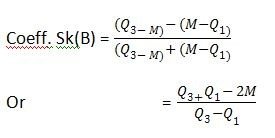
Bowley’s Skewness

According to Prof. A.L. Bowley, the presence, or absence of skewness will be determined on the basis of the distance of the quartiles from the Median. Thus, his skewness is given by

                SK(B) = (Q3 – M) – (M –Q1)

                Or     = Q3 + Q1 -2M

If the above equation results in zero, it will indicate the absence of skewness or symmetricity of the distribution. On the other hand, if the said equation results in some positive, or negative figure, the same will be marked as the extent of the positive, or negative skewness of the series respectively.

Further, the coefficient, the coefficient of skewness of Prof. Bowley is given by:

Symmetrical and Skewed Distributions

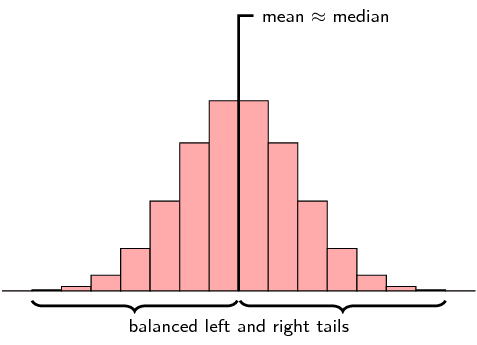
A symmetric distribution is one where the left and right hand sides of the distribution are roughly equally balanced around the mean. The histogram below shows a typical symmetric distribution.

For symmetric distributions, the mean is approximately equal to the median. The tails of the distribution are the parts to the left and to the right, away from the mean. The tail is the part where the counts in the histogram become smaller. For a symmetric distribution, the left and right tails are equally balanced, meaning that they have about the same length.

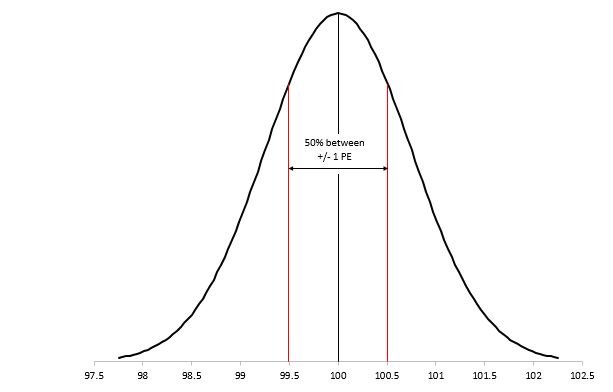
Symmetrical distribution occurs when the values of variables occur at regular frequencies and the mean, median and mode occur at the same point. In graph form, symmetrical distribution often appears as a bell curve. If a line were drawn dissecting the middle of the graph, it would show two sides that mirror each other. Symmetrical distribution is a core concept in technical trading as the price action of an asset is assumed to fit a symmetrical distribution curve over time.

Symmetrical distribution is used by traders to establish the value area for a stock, currency or commodity on a set time frame. This time frame is can be intraday, such as 30 minute intervals, or it can be longer-term using sessions or even weeks and months. A bell curve can be drawn around the price points hit during that time period and it is expected that most of the price action – approximately 68% of price points – will fall within one standard deviation of the centre of the curve. The curve is applied to the y-axis (price) as it is the variable whereas time throughout the period is simply linear. So the area within one standard deviation of the mean is the value area where price and the actual value of the asset are most closely matched.

If the price action takes the asset price out of the value area, then it suggests that price and value are out of alignment. If the breach is to the bottom of the curve, the asset is considered to be undervalued. If it is to the top of the curve, the asset is to be overvalued. The assumption is that the asset will revert to the mean over time.

An Example of How Symmetrical Distribution is Used

Symmetrical distribution is most often used to put price action into context. The further the price action wanders from the value area one standard deviation on each side of the mean, the greater the probability that the underlying asset is being under or overvalued by the market. This observation will suggest potential trades to place based on how far the price action has wandered from the mean for the time period being used. On larger time scales, however, there is a much greater risk of missing the actual entry and exit points.

  • Symmetrical distribution can refer to a bell curve or any curve where a halving line produces mirror images.
  • When traders speak of reversion to the mean, they are referring to the symmetrical distribution of price action overtime.
  • The opposite of symmetrical distribution is asymmetrical distribution, which is a curve that exhibits skewness.

Skewed

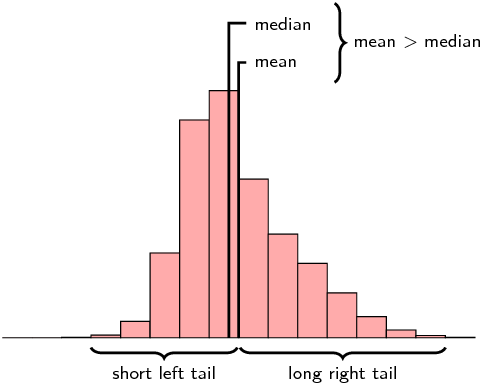
A distribution that is skewed right (also known as positively skewed) is shown below.

Now the picture is not symmetric around the mean anymore. For a right skewed distribution, the mean is typically greater than the median. Also notice that the tail of the distribution on the right hand (positive) side is longer than on the left hand side.

From the box and whisker diagram we can also see that the median is closer to the first quartile than the third quartile. The fact that the right hand side tail of the distribution is longer than the left can also be seen.

A distribution that is skewed left has exactly the opposite characteristics of one that is skewed right:

  • The mean is typically less than the median;
  • The tail of the distribution is longer on the left hand side than on the right hand side; and
  • The median is closer to the third quartile than to the first quartile.

Measures of Dispersion Meaning, Absolute and Relative

Measures of dispersion refer to statistical tools used to describe the spread or variability of a dataset. These measures help in understanding the extent to which data points differ from the central tendency (mean, median, or mode). Common measures of dispersion include:

  • Range: The difference between the highest and lowest values.
  • Variance: The average squared deviation of each data point from the mean.
  • Standard deviation: The square root of variance, providing a more interpretable measure of spread.
  • Interquartile range (IQR): The range between the 25th and 75th percentiles.

Characteristics of Measures of Dispersion:

  • A measure of dispersion should be rigidly defined
  • It must be easy to calculate and understand
  • Not affected much by the fluctuations of observations
  • Based on all observations

Classification of Measures of Dispersion

The measure of dispersion is categorized as:

(i) An absolute measure of dispersion:

  • The measures which express the scattering of observation in terms of distances i.e., range, quartile deviation.
  • The measure which expresses the variations in terms of the average of deviations of observations like mean deviation and standard deviation.

(ii) A relative measure of dispersion:

We use a relative measure of dispersion for comparing distributions of two or more data set and for unit free comparison. They are the coefficient of range, the coefficient of mean deviation, the coefficient of quartile deviation, the coefficient of variation, and the coefficient of standard deviation.

Coefficient of Dispersion

Whenever we want to compare the variability of the two series which differ widely in their averages. Also, when the unit of measurement is different. We need to calculate the coefficients of dispersion along with the measure of dispersion. The coefficients of dispersion (C.D.) based on different measures of dispersion are

  • Based on Range = (X max – X min) ⁄ (X max + X min).
  • C.D. based on quartile deviation = (Q3 – Q1) ⁄ (Q3 + Q1).
  • Based on mean deviation = Mean deviation/average from which it is calculated.
  • For Standard deviation = S.D. ⁄ Mean

Coefficient of Variation

100 times the coefficient of dispersion based on standard deviation is the coefficient of variation (C.V.).

C.V. = 100 × (S.D. / Mean) = (σ/ȳ ) × 100

Probable error

Probable Error is basically the correlation coefficient that is fully responsible for the value of the coefficients and its accuracy.

As mentioned, probable error is the coefficient of correlation that supports in finding out about the accurate values of the coefficients. It also helps in determining the reliability of the coefficient.

The calculation of the correlation coefficient usually takes place from the samples. These samples are in pairs. The pairs generally come from a very large population. It is quite an easy job to find out about the limits and bounds of the correlation coefficient.

The correlation coefficient for a population is usually based on the knowledge and the sample relating to the correlation coefficient. Therefore, probable error is the easy way to find out or obtain the correlation coefficient of any population. Hence, the definition is:

Probable Error = 0.674 ×

Here, r = correlation coefficient of ‘n’ pairs of observations for any random sample and N = Total number of observations.

About the Values

  • There is hardly any correlation between the different variables if the value of ‘r’ turns out to be less than the value of the probable error
  • The value of correlation coefficient is generally certain if and only if the value of ‘r’ is around 6 times more than the value of the error.
  •  The value of the probable error is in the bounds -1 and +1(-1≤r≤1). So, we can express it in the following manner.

Probable Limit

To get the upper limit and the lower limit, all we need to do is respectively add and subtract the value of probable error from the value of ‘r.’ This is exactly where the value of correlation of coefficient lies.

ρ (rho) = r ± P.E.

Here, the value of rho is nothing but the correlation coefficient of a population. This is also the limit of the correlation of coefficient. Alongside,

Probable Error = 2/3 SE

Here, S.E is Standard Error of Correlation Coefficient

Standard Error = (1-r2)/√N

Standard Error is basically the standard deviation of any mean. It is the sampling distribution of the standard deviation. The standard error is generally used to refer to any sort of estimate belonging to the standard deviation. Therefore, we use probable error to calculate and check the reliability associated with the coefficient.

Advantages of Standard Error

  • It helps in finding and reducing the sample errors as well as the measurement errors.
  • The standard error of any mean tells about the accuracy of the estimate clearly enough.

Formulas for Calculating Probable Error

Generally, there are three formulas using which we can calculate the probable error. The very first formula is the most common formula to calculate P.E. We use the Pearson product-moment method for calculating the same. It is:

P.E r  product-moment = 0.6745(1-r2)/√N

The second formula is applicable when we need the probable error for rho. We use the Spearman method to calculate the value. The formula for the same is:

P.E. ρ = 0.6745(1-ρ2)/√N {1 + 1.086ρ+ 0.13ρ+ .002ρ6}

The third formula is applicable to the Pearson coefficient ‘r.’  We calculate it through ρ by using the transmutation formula. The value is r = 2 sin (πρ/6). The formula is given by:

  1. E  rfound from ρ = 0.7063 (1 – r2)√N {1 + 1.042r+ 0.008r+ .002r6}

Note: The formula that we are using to calculate probable error is valid and applicable if the given population is normal.

Conditions to find Probable Error

We can find the probable error if and only if the given below conditions are taken care of.

  • The data that we have must be a bell-shaped curve. This means that the data has to give us a normal frequency curve
  • It is important to take the probable error for measuring the statistics from the sample only
  • It is compulsory that the sample items are taken off in an unbiased manner and must remain independent of each other’s value

Simple Aggregative Method

We use this method of construction for computation of index price. As a result, the total cost of any commodity in any given year to the total cost of any commodity in the base year is in percentage form.

Simple Aggregative Price Index – (∑ Pn/ ∑ P0) * 100

Where

∑Pn = Sum of the price of all the respective commodity in the current time period.
∑P= Sum of the price of all the respective commodity in the base period.

The simple aggregative index is very simple to understand. However, there is a serious defect in this method. The first commodity, here, has more influence than the rest two. This is so because the first commodity has a high price than the rest.

Furthermore, if we anyhow change the units, the index number will also go through a change. This is one of the biggest flaws of this methods. Use of absolute quantities turn the tables around. Therefore, considering independent values for the three years would be a better option.

To construct a simple price index, compute the price relatives and average them. Add the price relatives and divide them by the number of items. Table illustrates the construction of a simple index of wholesale prices.

Commodity Prices in 1970(P0) Base

1970=100

Prices in 1980(P1) = P1/P0xl00 Price Relatives

(R)

A Rs . 20 per kg 100 Rs. 25 125
В 5 per kg 100 10 200
С 15 per metre 100 30 200
D 25 per kg 100 30 120
E 200 per quantal 100 450 225
N = 5 500 ∑R = 870

Price index in 1980 = Prices in 1980 / Prices in 1970 x 100

Or ∑P1/P0 x 100 = 870/500 x 100 = 174

Using arithmetic mean, price index in 1980 = ∑R/N = 870/5 = 174

The preceding table shows that 1970 is the base period and 1980 is the year for which the price index has been constructed on the basis of price relatives. The index of wholesale prices in 1980 comes to 174. This means that the price level rose by 74 per cent in 1980 over 1970.

Constructing Index Numbers

An index number is a statistical tool used to measure changes in the value of money. It indicates the average price level of a selected group of commodities at a specific point in time compared to the average price level of the same group at another time.

It represents the average of various items expressed in different units. Additionally, an index number reflects the overall increase or decrease in the average prices of the group being studied. For example, if the Consumer Price Index rises from 100 in 1980 to 150 in 1982, it indicates a 50 percent rise in the prices of the commodities included. Furthermore, an index number shows the degree of change in the value of money (or the price level) over time, based on a chosen base year. If the base year is 1970, we can evaluate the change in the average price level for both earlier and later years.

Construction of Index Number:

1. Define the Objective and Scope

The first step in constructing an index number is to define its purpose clearly. The objective may be to measure changes in prices, quantities, or values over time or between regions. This determines whether a price index, quantity index, or value index is required. Additionally, the scope must be outlined—whether it’s for a particular sector (like retail or wholesale prices) or a specific group (such as urban consumers). Defining the objective ensures relevance, appropriate selection of items, and accurate interpretation of the index in practical use.

2. Selection of the Base Year

The base year is the reference year against which changes are compared. It is assigned a value of 100, and all subsequent values are calculated in relation to it. The base year should be a “normal” year—free from major economic disruptions like inflation, war, or natural disasters. A poorly chosen base year may distort the index. Additionally, it should be recent enough to reflect current trends but stable enough to serve as a benchmark. Periodic updating of the base year is essential for long-term accuracy.

3. Selection of Commodities

Next, a representative basket of goods and services must be selected. These commodities should reflect the consumption habits or production patterns of the population or sector under study. Items should be commonly used, available throughout the period, and consistent in quality. Too many items can complicate calculations, while too few may result in an unrepresentative index. For example, the Consumer Price Index includes food, clothing, fuel, and transportation. Proper selection ensures the index accurately reflects real economic conditions and consumer behavior.

4. Collection of Price Data

Prices for the selected commodities must be collected for both the base year and the current year. This data should be gathered from reliable sources such as retail shops, wholesale markets, or government reports. Consistency in quality, unit, and location is crucial to ensure accuracy. Prices may vary by region, seller, or time, so care must be taken to eliminate anomalies. Regular and systematic price collection—monthly or quarterly—is often used in official indices. Errors or inconsistencies in this stage can significantly affect the results.

5. Assigning Weights

Weights represent the relative importance of each commodity in the index. Heavier weights are given to items with a larger share in total expenditure or production. For instance, in a household index, food items may carry more weight than luxury goods. Assigning correct weights helps the index reflect real economic behavior. Weights can be based on surveys, national accounts, or expenditure studies. There are unweighted indices (equal importance to all items) and weighted indices (varying importance), with weighted indices offering greater precision and realism.

6. Selection of the Index Formula

Different formulas are used to calculate the index number. The most common are:

  • Laspeyres’ Index: Uses base year quantities as weights.

  • Paasche’s Index: Uses current year quantities.

  • Fisher’s Ideal Index: Geometric mean of Laspeyres and Paasche indices.

Each formula has its pros and cons. Laspeyres is easier to calculate but may overstate inflation, while Paasche may understate it. Fisher’s index balances both but is more complex. The choice depends on available data and desired accuracy. The selected formula must ensure consistency and logical interpretation.

7. Computation and Interpretation

Once the prices, quantities, weights, and formula are determined, the index number is computed. The resulting figure indicates the level of change compared to the base year. If the index is above 100, it shows a price rise; below 100 indicates a fall. The index is then interpreted in the context of economic conditions and published for use by policymakers, businesses, and researchers. Proper interpretation helps in understanding inflation trends, making wage adjustments, or planning fiscal and monetary policies effectively.

error: Content is protected !!