Simple Average or Price Relative Method, Weighted index method

Simple Average or Price Relatives Method

In this method, we find out the price relative of individual items and average out the individual values. Price relative refers to the percentage ratio of the value of a variable in the current year to its value in the year chosen as the base.

Price relative (R) = (P1÷P2) × 100

Here, P1= Current year value of item with respect to the variable and P2= Base year value of the item with respect to the variable. Effectively, the formula for index number according to this method is:

 P = ∑[(P1÷P2) × 100] ÷N

Here, N= Number of goods and P= Index number.

Weighted index method

Weighted Aggregate Method

Here different goods are assigned weight according to the quantity bought. There are three well-known sub-methods based on the different views of economists as mentioned below:

Laspeyre’s Method

Laspeyre was of the view that base year quantities must be chosen as weights. Therefore the formula is :

P = (∑P1Q0÷∑P0Q0)×100

Here,  ∑P1Q0= Summation of prices of current year multiplied by quantities of the base year taken as weights and ∑P0Q0= Summation of, prices of base year multiplied by quantities of the base year taken as weights.

Paasche Index Number

The Paasche Price Index is a consumer price index used to measure the change in the price and quantity of a basket of goods and services relative to a base year price and observation year quantity. Developed by German economist Hermann Paasche, the Paasche Price Index is commonly referred to as the “current weighted index.”

Formula for the Paasche Price Index

The formula for the index is as follows:

Where:

  • Pi,0 is the price of the individual item at the base period and Pi,t is the price of the individual item at the observation period.
  • Qi,t is the quantity of the individual item at the observation period.

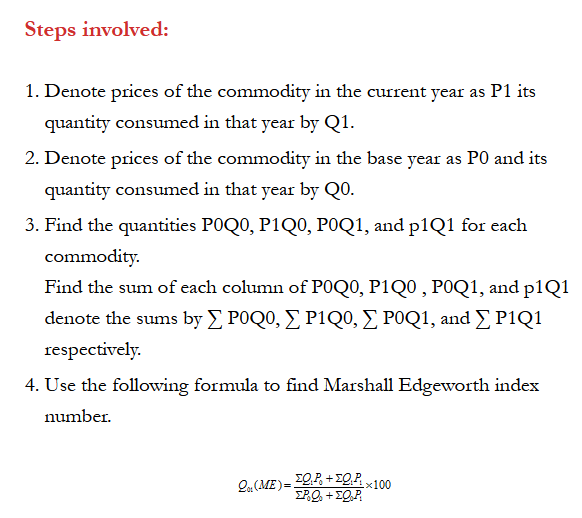
Marshall Edgeworth Index Number

Tests of Adequacy (TRT and FRT)

To ensure the reliability and accuracy of an index number, it must satisfy certain mathematical tests of consistency, known as Tests of Adequacy. The two most important tests are:

Time Reversal Test (TRT):

Time Reversal Test checks the consistency of an index number when time periods are reversed. In other words, if we calculate an index number from year 0 to year 1, and then from year 1 back to year 0, the product of the two indices should be equal to 1 (or 10000 when expressed as percentages).

Mathematical Condition:

P01 × P10 = 1

or

P01 × P10 = 10000

Where:

  • P01 = Price index from base year 0 to current year 1

  • P10 = Price index from current year 1 to base year 0

Interpretation:

This test ensures that the index number gives symmetrical results when the time order of comparison is reversed.

Which Formula Satisfies TRT?

  • Fisher’s Ideal Index satisfies the Time Reversal Test.

  • Laspeyres’ and Paasche’s indices do not satisfy this test.

Factor Reversal Test (FRT):

Factor Reversal Test checks whether the product of the Price Index and the Quantity Index equals the value ratio (i.e., the ratio of total expenditure in the current year to that in the base year).

Mathematical Condition:

P01 × Q01 = ∑P1Q1 / ∑P0Q0

Where:

  • P01 = Price index from base year to current year

  • Q01 = Quantity index from base year to current year

  • ∑P1Q1 = Total value in the current year

  • ∑P0Q0 = Total value in the base year

Interpretation:

This test checks whether the index number captures the combined effect of both price and quantity changes on total value.

Which Formula Satisfies FRT?

  • Fisher’s Ideal Index satisfies the Factor Reversal Test.

  • Laspeyres’ and Paasche’s indices do not satisfy this test.

Consumer Price Index

Consumer Price Index is also known as the cost of living index.

It represents the average change in price over a period of time, paid by a consumer for a fixed basket of goods and services.

Uses of CPI:

  • It indicates the changes in the consumer prices.
  • It evaluates the purchasing power of money.
  • It is also used for comparison purposes.

Limitations of CPI;

  • CPI focuses on a fixed basket, as consumer behaviour cannot be predicted, we can’t be very sure about CPI value to be relevant.
  • Quality is not considered while calculating the CPI.
  • Inflation effects are not taken into consideration as the basket is fixed.

CPI can be computed using 2 methods:

  • Aggregate Expenditure method

CPI = (Total expenditure in current year/Total expenditure in base year)*100; which means;

CPI = Σp1q0/Σp0q0 * 100

  • Family Budget method

CPI =  ΣWP/ ΣW

Where P = p1/p0 * 100

Smoothed frequency curve

The frequency is the number of times an event occurs within a given scenario. Cumulative frequency is defined as the running total of frequencies. It is the sum of all the previous frequencies up to the current point. It is easily understandable through a Cumulative Frequency Table.

Marks Frequency

(No. of Students)

Cumulative Frequency
0 – 5 2 2
5 – 10 10 12
10 – 15 5 17
15 – 20 5 22

Cumulative Frequency is an important tool in Statistics to tabulate data in an organized manner. Whenever you wish to find out the popularity of a certain type of data, or the likelihood that a given event will fall within certain frequency distribution, a cumulative frequency table can be most useful. Say, for example, the Census department has collected data and wants to find out all residents in the city aged below 45. In this given case, a cumulative frequency table will be helpful.

Cumulative Frequency Curve

A curve that represents the cumulative frequency distribution of grouped data on a graph is called a Cumulative Frequency Curve or an Ogive. Representing cumulative frequency data on a graph is the most efficient way to understand the data and derive results.

There are two types of Cumulative Frequency Curves (or Ogives) :

  • More than type Cumulative Frequency Curve
  • Less than type Cumulative Frequency Curve

Frequency Polygon

A frequency polygon is a graphical form of representation of data. It is used to depict the shape of the data and to depict trends. It is usually drawn with the help of a histogram but can be drawn without it as well. A histogram is a series of rectangular bars with no space between them and is used to represent frequency distributions.

Steps to Draw a Frequency Polygon

  • Mark the class intervals for each class on the horizontal axis. We will plot the frequency on the vertical axis.
  • Calculate the classmark for each class interval. The formula for class mark is:

Classmark = (Upper limit + Lower limit) / 2

  • Mark all the class marks on the horizontal axis. It is also known as the mid-value of every class.
  • Corresponding to each class mark, plot the frequency as given to you. The height always depicts the frequency. Make sure that the frequency is plotted against the class mark and not the upper or lower limit of any class.
  • Join all the plotted points using a line segment. The curve obtained will be kinked.
  • This resulting curve is called the frequency polygon.

Note that the above method is used to draw a frequency polygon without drawing a histogram. You can also draw a histogram first by drawing rectangular bars against the given class intervals. After this, you must join the midpoints of the bars to obtain the frequency polygon. Remember that the bars will have no spaces between them in a histogram.

Question 1: Construct a frequency polygon using the data given below:

Test Scores Frequency
49.5-59.5 5
59.5-69.5 10
69.5-79.5 30
79.5-89.5 40
89.5-99.5 15

Answer: We first need to calculate the cumulate frequency from the frequency given.

Test Scores Frequency Cumulative Frequency
49.5-59.5 5 5
59.5-69.5 10 15
69.5-79.5 30 45
79.5-89.5 40 85
89.5-99.5 15 100

We now start by plotting the class marks such as 54.5, 64.5, 74.5 and so on till 94.5. Note that we will also plot the previous and next class marks to start and end the polygon, i.e. we plot 44.5 and 104.5 as well.

Then, the frequencies corresponding to the class marks are plotted against each class mark. Like you can see below, this makes sense as the frequency for class marks 44.5 and 104.5 are zero and touching the x-axis. These plot points are used only to give a closed shape to the polygon. The polygon looks like this:

Provisions under Companies act in related to Dividends

Declaration and payment of dividend under Companies Act 2013

Dividend: Sec 2(35) provides the definition of dividend which states that dividend includes any “interim dividend”. Where in simple terms, dividend can be defined as the sum of money paid by a company, to its shareholders, out of the profits made by a company, in the proportion to the amount paid-up on the shares held by them (Sec-51).

Note: Preference shareholders are always paid dividend in preference to the equity shareholders.

Well, subject to the provisions of Companies Act, 2013, All Companies, except those companies which are registered under sec-8 (i.e. Non-profit organizations) can declare dividend.

Under Companies Act 2013, Chapter VIII containing sections, which deals with the provisions related to declaration and payment of dividend. Section 123 to 127 deals with the provisions related to the declaration and payment of dividend.

Conditions required to be satisfied for declaration of dividend

1) Depreciation: Before the declaration of dividend, a company shall provide depreciation to all its depreciable assets, in accordance with the rates or useful life, as the case may be provided in Schedule – II of Companies Act -2013.

2) Transfer to Reserves: A company may, before the declaration of any dividend in any financial year, transfer such percentage of its profits for that financial year, as it may consider appropriate to the reserves of the company.

3) Set off of previous year losses and depreciation: A company shall not declare dividend unless carried over previous losses and depreciation not provided in previous year or years, are set off against profit of the company for the current year.

4) Free Reserves: A company shall not declare or pay dividend out of its reserves, other than free reserves.

Payment of Dividend

According to the provisions of Companies Act 2013, No dividend shall be payable except by way of cash, where dividend payable in cash can also be paid through cheque, warrant or in any electronic mode, to the shareholder who is entitled to the dividend.

Condition: A company who has committed any default in compliance with the provisions of sec 73 and 74 relating to the acceptance and repayment of deposits would be barred to declare dividend.

Interim Dividend

According to the provisions of section 123(3), Board of directors of a company may declare interim dividend during any financial year, out of the profits made by the company during such financial year or out of previous year undistributed profits (subject to Companies (Declaration and Payment of Dividend) Rules, 2014).

As per Section 2(35) “dividend includes interim dividend” signifies that the provisions of Companies Act 2013, applicable to the final dividend to the extent possible, shall also applicable on interim dividend.

Unpaid Dividend Account (Sec 124)

There are some cases wherein, dividend declared by the company has not been paid or claimed and in case where such dividend remained unpaid or unclaimed within 30 days from the date of declaration; company shall take the following necessary steps:

(a) Open a special account with a scheduled bank to be called “Unpaid dividend account of …………………….(Company Limited/Company( Private) Limited

(b) Transfer the unpaid or unclaimed amount of dividend within a period of 7 days from the expiry of such 30 days, to the special account.

In case of default: If the company committed any default, in transferring such amount to the special account with in the specified time, company shall be liable to pay interest @ 12% p.a. from the date of such default.

Punishment for failure to distribute dividend (Sec 127)

According to the provisions of sec- 127 of the companies act – 2013, if a company fails to pay the dividend, within a period of 30 days from the date of its declaration, to the shareholders who are entitled to the dividend then-

Liability of Imprisonment Fine
Company NA Interest @ 18% p.a. for the period of default
Every director of Company May extend to 2 years Rs. 1000/- for every day, during which such failure continues.

Exceptions to sec- 127: Following are the situation under which, no offence shall be deemed to have been committed, namely:

(a) Where the dividend could not be paid by reason of the operation of any law;

(b) Where a shareholder has given directions to the company regarding the payment of the dividend and those directions cannot be complied with and the same has been communicated to him:

(c) Where there is a dispute regarding the right to receive the dividend

(d) Where the dividend has been lawfully adjusted by the company against any sum due to it from the shareholder

(e) Where, for any other reason, the failure to pay the dividend or to post the warrant within the period under this section was not due to any default on the part of the company.

Retail Marketing Mix

The various communication devices are used to educate, inform and generate awareness about the merchandise and the services offered by the retailer. These efforts also aim at building store image. The most common modes used for promotion are advertising, sales promotion, personal selling, public relations and publicity.

Retailers usually employ a combination of various elements of promotion mix to achieve promotional and business objectives. The degree and the nature of usage of each of the promotion methods depend on the objectives of the retail firm, product, market profile and availability of resources. Small retailers generally depend on point-of-purchase material provided by the companies which provide the merchandise.

Promotion mix employed by the retailers should be compatible with the desired store image, provide scope for modification if need arises and fit within the budget allocation. Therefore, various retail promotion methods can be compared on the basis of degree of control, flexibility, credibility and cost associated with them.

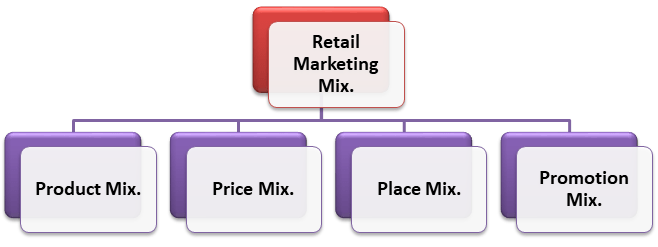
The four important types of retail marketing mix are discussed below:

  1. The ‘Product’ Mix

The basic components of product mix are:

(ii) Packaging

(iii) Brand

(iv) Product Item

(v) Product line

The various product mix strategies are:

(i) Launching new products from time to time

(ii) Alteration of Existing Products

(iii) Eliminate an entire line or reduce assortment within it

(iv) Trading Up

(v) Trading Down

(vi) Product life cycle management

The retail product mix is device so as to develop an appropriate promotion strategy for the store depending on the target market to be reached. Once the target market is identified and positioning strategy defined, the retailers employ various tools of product mix to reach out to consumers. These efforts also aim at building store image.

Retailers usually employ a combination of various elements of product mix to achieve promotional and business objectives. The degree and the nature of usage of each of the promotion methods depend on the objectives of the retail firm, product, market profile, and availability of resources.

  1. The ‘Price’ Mix

Price has always been one of the most important variables in retail buying decision. It is the factor which makes or mars a retail organization. It is also the easiest and quickest element to change. Pricing helps an organization to achieve its objective. This is particularly significant for new market entrants who need to first establish a brand and then enjoy increasing profits as the brand gets market acceptability. For a customer, price is the main reason to visit a particular store.

A pricing strategy must be consistent over a period of time and consider retailer’s overall positioning, profits, sales and appropriate rate of return on investment. Lowest price does not necessarily neet be the best price, but the lowest responsible price is the best right price. The difference between price and cost is the profit, which can be very high when the salesperson wants to exploit an urgent situation.

To survive in the retail business, retailers need to seek cash flow, profitability and overall growth in order to consolidate their market position. But pricing cannot be determined in isolation. Costs and operating expenses are equally important while establishing the retail price.

Servicing pricing pursues the ‘doctrine of pricing of goods’, therefore, they are either cost-based or market based. Within this, these pricing can be profit oriented, government controlled, consumer oriented or competition oriented. Pricing needs certain considerations before actually determining it. The market position of the product, consumer perception and stage of the product life cycle, competitor’s strategy and overall marketing strategy needs to be considered.

The components of price mix are:

(i) Organizational objectives

(ii) Competition

(iii) Cost and profit

(iv) Credit terms

(v) Discount etc.

(vi) Fixed and variable costs

(vii) Pricing options

(viii) Pricing policies

(ix) Proposed positioning strategies

(x) Target group and willingness to pay

  1. The ‘Place’ Mix

The retailer should keep in mind the fact that his ‘product’ should be available near the place of consumption so that the consumers can easily buy it. If the brand preferred by the consumer is not easily available at a convenient location, he may buy some other brand in the same product category.

Hence, the retailer has to ensure that the product is available to the target consumers whenever required. There are two major components of place: marketing channels and physical distribution (logistics management). Channel decisions affect considerably the elements of marketing mix and involve a long term commitment of resources.

Intermediaries involved in channel network are independent (at times contractual) organizations hence their needs must be taken into account while evaluating channel alternatives. The success of marketing efforts, to a large extent depends on the sound distribution network.

Physical distribution involves transportation, warehousing, material handling, bulk packaging etc. Some of these activities are carried out by intermediaries. A considerable coordination is required among various channels to seek maximum results of marketing operations.

Following are the components of a retail price mix:

(i) Distribution channels

(ii) Intermediary

(iii) Distance Factor

(iv) Inventory Level

(v) Transportation

(vi) Warehousing and Storage

  1. The ‘Promotion’ Mix

After deciding upon the budget, retailer should determine the appropriate promotional mix a combination of advertising, public relations, personal selling and sales promotion. Small retailers having limited funds may use store displays, hoardings, direct mail, flyers and publicity methods to attract customer traffic, while on the other hand, retailers having no bar on finance, may use print or television media for their sales promotion activities.

The retail promotion mix varies from retailer to retailer and nation to nation depending upon technological advancement, nature of competition and availability of finance etc. Retailers design a promotional mix in compliance with store’s objectives such as positioning of the organization, attracting customers, increasing sales turnover, clear out seasonal merchandise, announcing special events and educating public about the organization and its offerings.

Retailers generally spend their promotional budget on developing advertisement campaigns and on other sales promotion activities. A retailer has a variety of sales promotion methods to promote its goods and services. Therefore, promotion mix used by the retailer should be compatible with the desired store image, budget allocation and flexible enough to modify whenever need arises.

These various promotional vehicles may by compared on the basis of following issues:

(i) Cost of the method

(ii) Its reach

(iii) Degree of flexibility

(iv) Credibility

(v) Control over media

Product: Decisions Related to Selection of Goods

A product is something that is manufactured for sale in the market. Customer needs are met by the usage of products. Product is one of the main components of marketing all marketing activities revolve around the product. Products can be tangible or intangible. Tangible products are known as goods while intangible products are called services.

The term product can be understood in narrow as well as broad sense. In a narrow sense, it is a set of tangible physical and chemical attributes assembled in an identifiable and readily recognizable form.

In a broader sense, it recognizes each separate brand as a separate product. A product can be defined as- “A good, idea, method, information, object, or service that is the end result of a process and serves as a need or want satisfier. It is usually a bundle of tangible and intangible attributes (benefits, features, functions, uses) that a seller offers to a buyer for purchase.”

Ordinarily speaking, product or goods is a word which means any commodity which can be recognised by its certain shape, quality or quantity e.g., car, book, watch, clothes etc. Actually this meaning of the product is narrow in sense. The word ‘Product’ is taken in wider perspective in marketing. Here, every brand is considered a separate product i.e., Lux and Lifebuoy both are soaps, but are treated as separate products. In narrow sense, these will be considered as merely soaps.

Every business firm undertakes the function of product selling, though it may or may not be visible. A laundry firm provides the clothes-washing service. This function is similar to product selling which a retailer performs. Firms while selling their products, sell services too which are related to their products. A consumer buys a product because he gets psychological and physical satisfaction from that product.

Thus a seller not only sells his products rather he enters into marketing of such psychological and physical satisfaction. For example, a person while purchasing a product does not bother about the inputs by which that product is manufactured. He is rather interested in the fact as to what utility or satisfaction, he will gain by using that product. In this context, the ideas of George Fisk are worth describing. According to him, “Product is a cluster of psychological satisfaction.”

Definition of product in Marketing

A product is what a seller has to sell and what a buyer has to buy it satisfies the needs of customers. Customers purchase products because they are capable of realizing some benefits to the purchaser. A marketer can satisfy the needs and wants of his customers by ‘offering something’ in exchange for money. And this ‘offering’ is basically a product. The product is one of the important elements of the 4Ps of the marketing mix. It consists of a bundle of tangible and intangible attributes that satisfies consumers.

Product is an important component in market­ing-mix. Other elements of marketing-mix i.e. price, promotion and place are complemen­tary to it. A product is central to the marketing operations in an organization. Most of the time prod­uct fails not because of poor quality but because they fail to meet the expectations of the customers.

It is not just a bundle of physical attributes, but a bundle of perceived benefits which satisfy consumer’s needs. Hence, utmost care should be taken to handle product decisions. A bad product not only generates bad name for the firm but also affects negatively the price set for the product, dissuades the channel members and reduces the believability of the promotional measures.

In a narrow sense, “A product is a set of tangible physical attributes in an identifiable form” (W.J. Stanton). But in marketing, product is used in a broader form.

According to W. Alderson “A product is a bundle of utilities consisting of various product features and accompanying services”.

According to Philip Kotler “A product is anything tangible or intangible that can be offered to a market for attention, acquisition use or consumption that might satisfy a need or want”.

According to Cravens, Hills and Woodruff “Product is anything that is potentially valued by a target market for the benefits or satisfactions it provides, including objects, services, organizations, places people and ideas”.

From the above definitions, it is clear that product has the want satisfying attributes which drive a customer to purchase the product. It is nothing but a package of problem solving devices and is something more than a physical product. This is because a product encompasses a number of social and psycho­logical attributes and other intangible factors which provide satisfaction to the consumer.

Products can be anything. It can be physical product (e.g. fan, cycle etc.), service (e.g. haircuts, property deals etc.), place (e.g. Agra, Delhi etc.), person (e.g. Late M.F. Hussain etc.), Organization (e.g. Helpage India, Rajiv Gandhi foundation etc.) and idea (e.g. Family Planning, safe driving etc.).

Alderson defines, “A product is a bundle of utilities consisting of various product features and accompanying services”.

Stanton defines, “A product is a set of tangible and intangible attributes, including packaging, colour, price, manufacturer’s and retailer’s services, which the buyer may accept as offering satisfaction or wants or needs”.

According to Philip Kotler, “A product is anything that can be offered to a market for attention, acquisition, use or consumption that might satisfy a want or need. It includes physical objects, services, persons, places, organization and ideas”.

Concept of Product

Product refers to a good or service that satisfies the needs and wants of customers. It is offered in the market by an organization to earn revenue by meeting the requirements of customers. Product is an asset of an organization and referred as the backbone of marketing mix.

According to Peter Drucker, “Suppliers and especially manufacturers have market power because they have information about a product or a service that the customer does not and cannot have, and does not need if he can trust the brand. This explains the profitability of brands.”

It is very important for an organization to understand the needs of customers. For example, some customers use mobile phones for talking; whereas, some use mobile phones for talking as well as business purposes, such as teleconferencing. Needs of the customers depend on their purchasing power.

For example, a customer whose basic need is surfing over the Internet may opt for a simple computer; whereas, a software engineer may need a high configuration computer. Therefore, when the level of need increases then the level of product also increases.

Features of a Product

(i) Tangibility

Products are tangible in nature, customers can touch, seen or feel a products. For example, car, book, computer etc.

(ii) Intangible Attributes

Service products are intangible in nature, services like, consultancy, banking, insurance etc. The product may be combination of both tangible and intangible attributes like restaurants, transportation, in case of a computer it is a tangible product, but when we will talk of its free service provided by dealer, then the product is not only a tangible item but also an intangible one.

(iii) Associated Attributes

The attributes associated with product may be, brand, packaging, warranty, guarantee, after sales services etc.

(iv) Exchange Value

Irrespective of the fact that whether the product is tangible or intangible, it should be capable of being exchanged between buyer and seller for a mutually agreed price.

(v) Customer Satisfaction

A product satisfies the customer needs and wants of customers, value of products is also determined by the level of satisfaction given by a product after purchase.

Characteristics of Product

  1. It can be a single commodity or a service; a group of commodities or a group of services; a product service combination, or even a combination of several products and services.
  2. Its meaning is determined by the needs and desires of the consumer. The purpose of a product is to satisfy some need of the consumers. The buyers purchase problem-solving and time for creativity when they purchase a computer system.
  3. It may be durable such as those that are expected to deliver a stream of satisfaction over a period of time,
  4. Products may be luxuries which might be needed as a symbol of prestige and status such as car, a well- furnished bungalow in a posh colony or necessities which are needed to keep the body and soul together, such as bread, milk, sugar, etc.
  5. It may be an agricultural, mineral, forest or semi­-manufactured or manufactured product.

Decisions Related to Delivery of Service

Running a successful service company should be synonymous with delivering excelling service. If not, then why consider running a service business at all? Yet, if all companies which perform services effectively compete on providing the service, then the key differentiator lies in the service management model and the ability to execute it. Designing the service delivery system should focus on what creates value to the core organizations and how to engage frontline employees to deliver the ultimate customer experience.

  1. Service Culture

Service Culture is built on elements of leadership principles, norms, work habits and vision, mission and values. Culture is the set of overriding principles according to which management controls, maintains and develops the social process that manifests itself as delivery of service and gives value to customers. Once a superior service delivery system and a realistic service concept have been established, there is no other component so fundamental to the long-term success of a service organization as its culture.

  1. Employee Engagement

Employee Engagement includes employee attitude activities, purpose driven leadership and HR processes. Even the best designed processes and systems will only be effective if carried out by people with higher engagement. Engagement is the moderator between the design and the execution of the service excellence model.

  1. Service Quality includes strategies

Service Quality includes strategies processes and performance management systems. The strategy and process design is fundamental to the design of the overall service management model. Helping the client fulfil their mission and supporting them in the pursuit of their organizational purpose, must be the foundation of any service provider partnership.

  1. Customer Experience

Customer Experience includes elements of customer intelligence, account management and continuous improvements. Perception is king and constantly evaluating how both customer and end-user perceive service delivery is important for continuous collaboration. Successful service delivery works on the basis that the customer is a part of the creation and delivery of the service and then designs processes built on that philosophy this is called co-creation.

Service Delivery Process

  1. Needs Analysis

To provide a service it is important to fully understand the needs of our clients. Theseus Professionals use proven and successful techniques to elicit the needs of clients.

This information gathering step can range from interviews of key staff to the development and performance of a formal survey. The objective is to determine the direction that the organization wants its program to go.

  1. Course of Action

From the information gained during the needs analysis a course of action can be developed. The course of action may include short- and long-term actions. For example, short-term objectives might require the development of a Project Plan that outlines the strategy, steps, and resources needed to achieve management’s objectives. A long-term action might include outlining the level of commitment for a

Theseus Professional to support maintaining and improving the existing management systems. It is expected that a course of action will be proposed at the end of the needs analysis and formalized in a document (e.g., plan, outline, etc.).

  1. Performance

Performance is dependent on the course of action selected. For example, performance may include periodic consulting sessions, where issues are discussed, and interpretations and recommendations are provided. Performance may involve coaching or mentoring an employee who would fill a position on issues related to standards and regulatory compliance or process improvement.

Performance may also include other consulting and training activities, such as setting up a measurement program, performing document reviews for improvement and compliance, participating in management review, conducting internal audits, or conducting training related leading to meeting an organization’s objectives.

  1. Results

A successful relationship with a customer depends on the results that the consulting firm can deliver. Theseus Professionals are results driven, whether delivered results are measurable process improvements, compliance or certification to a standard or regulation, or effective training.

Other results may evolve as the relationship continues and may include internal audits that lead to improvements and business-related recommendations that are comprehensive, unbiased, and provide sufficient information for management to make decisions.

Factors Influencing Pricing

Pricing of a product is influenced by various factors as price involves many variables. Factors can be categorized into two, depending on the variables influencing the price.

An enormous number of factors affect pricing decisions. A marketing manager should identify and study the relevant factors affecting the pricing. Some factors are internal to organization and, hence, controllable while other factors are external or environmental and are uncontrollable.

  1. Internal Factors

Internal factors are internal to organization and, hence, are controllable. These factors play vital role in pricing decisions. They are also known as organizational factors. Manager, who is responsible to set price and formulae pricing policies and strategies, is required to know adequately about these factors.

(i) Top Level Management

Top-level management has a full authority over the issues related to pricing. Marketing manager’s role is administrative. The philosophy of top-level management is reflected in forms of pricing also. How does top management perceive the price?

How far is pricing considered as a tool for earning profits, and what is importance of price for overall performance? In short, overall management philosophy and practice have a direct impact on pricing decision. Price of the product may be high or low; may be fixed or variable; or may be equal or discriminative depends on top-level management.

(ii) Elements of Marketing Mix

Price is one of the important elements of marketing mix. Therefore, it must be integrated to other elements (promotion, product, and distribution) of marketing mix. So, pricing decisions must be linked with these elements so as to consider the effect of price on promotion, product and distribution, and effect of these three elements on price.

For example, high quality product should be sold at a high price. When a company spends heavily on advertising, sales promotion, personal selling and publicity, the selling costs will go up, and consequently, price of the product will be high. In the same way, high distribution costs are also reflected in forms of high selling price.

(iii) Degree of Product Differentiation

Product differentiation is an important guideline in pricing decisions. Product differentiation can be defined as the degree to which company’s product is perceived different as against the products offered by the close competitors, or to what extent the product is superior to that of competitors’ in terms of competitive advantages. The theory is, the higher the product differentiation, the more will be freedom to set the price, and the higher the price will be.

(iv) Costs

Costs and profits are two dominant factors having direct impact on selling price. Here, costs include product development costs, production costs, and marketing costs. It is very simple that costs and price have direct positive correlation. However, production and marketing costs are more important in determining price.

(v) Objectives of Company

Company’s objectives affect price of the product. Price is set in accordance with general and marketing objectives. Pricing policies must the company’s objectives. There are many objectives, and price is set to achieve them.

(vi) Stages of Product Life Cycle

Each stage of product life cycle needs different marketing strategies, including pricing strategies. Pricing depends upon the stage in which company’s product is passing through. Price is kept high or low, allowances or discounts are allowed or not, etc., depend on the stage of product life cycle.

(vii) Product Quality

Quality affects price level. Mostly, a high-quality-product is sold at a high price and vice versa. Customers are also ready to pay high price for a quality product.

(viii) Brand Image and Reputation in Market

Price doesn’t include only costs and profits. Brand image and reputation of the company are also added in the value of product. Generally, the company with reputed and established brand charges high price for its products.

(ix) Category of Product

Over and above costs, profits, brand image, objectives and other variables, the product category must be considered. Product may be imitative, luxury, novel, perishable, fashionable, consumable, durable, etc. Similarly, product may be reflective of status, position, and prestige. Buyers pay price not only for the basic contents, but also for psychological and social implications.

(x) Market Share

Market share is the desired proportion of sales a company wants to achieve from the total sales in an industry. Market share may be absolute or relative. Relative market share can be calculated with reference to close competitors. If company is not satisfied with the current market share, price may be reduced, discounts may be offered, or credit facility may be provided to attract more buyers.

  1. External Factors

External factors are also known as environmental or uncontrollable factors. Compared to internal factors, they are more powerful.

Pricing decisions should be taken after analyzing following external factors:

(i) Demand for the Product

Demand is the single most important factor affecting price of product and pricing policies. Demand creation or demand management is the prime task of marketing management. So, price is set at a level at which there is the desired impact on the product demand. Company must set price according to purchase capacity of its buyers.

Here, there is reciprocal effect between demand and price, i.e., price affects demand and demand affects price level. However, demand is more powerful than price. So, marketer takes decision as per demand. Price is kept high when demand is high, and price is kept low when demand of the product is low. Price is constantly adjusted to create and/or maintain the expected level of demand.

(ii) Competition

A marketer has to work in a competitive situation. To face competitors, defeat them, or prevent their entry by effective marketing strategies is one of the basic objective organizations. Therefore, pricing decision is taken accordingly.

A marketer formulates pricing policies and strategies to respond competitors, or, sometimes, to misguide competitors. When all the marketing decisions are taken with reference to competition, how can price be an exception?

Sometimes, a company follows a strong competitor’s pricing policies assuming that the leader is right. Price level, allowances, discount, credit facility, and other related decisions are largely imitated.

(iii) Price of Raw Materials and other Inputs

The price of raw materials and other inputs affect pricing decisions. Change in price of needed inputs has direct positive effect on the price of finished product. For example, if price of raw materials increases, company has to raise its selling price to offset increased costs.

(iv) Buyers Behaviour

It is essential to consider buyer behaviour while taking pricing decision. Marketer should analyze consumer behaviour to set effective pricing policies. Consumer behaviour includes the study of social, cultural, personal, and economic factors related to consumers. The key characteristics of consumers provide a clue to set an appropriate price for the product.

(v) Government Rules and Restrictions

A company cannot set its pricing policies against rules and regulations prescribed by the governments. Governments have formulated at least 30 Acts to protect the interest of customers. Out of them, certain Acts are directly related to pricing aspects. Marketing manager must set pricing within limit of the legal framework to avoid unnecessary interference from the outside. Adequate knowledge of these legal provisions is considered to be very important for the manager.

(vi) Ethical Consideration or Codes of Conduct

Ethics play a vital role in price determination. Ethics may be said as moral values or ethical code that govern managerial actions. If a company wants to fulfill its social obligations and when it believes to work within limits of the ethics prescribed, it always charges reasonable price for its products. Moral values restrict managerial behaviour.

(vii) Seasonal Effect

Certain products have seasonal demand. In peak season, demand is high; while in slack season, demand reduces considerably. To balance the demand or to minimize the seasonal-demand fluctuations, the company changes its price level and pricing policies. For example, during a peak season, price may be kept high and vice versa. Discount, credit sales, and price allowances are important issues related to seasonal factor.

(viii) Economic Condition

This is an important factor affecting pricing decisions. Inflationary or deflationary condition, depression, recovery or prosperity condition influences the demand to a great extent. The overall health of economy has tremendous impact on price level and degree of variation in price of the product. For example, price is kept high during inflationary conditions. A manager should keep in mind the macro picture of economy while setting price for the product.

error: Content is protected !!