Hire Purchase and Installment Purchase

Hire Purchase (HP) is a popular method of purchasing goods through installment payments over a period of time. Under this system, the buyer takes possession and use of the goods immediately but does not own them outright until all installments, including the final payment, are completed. Essentially, it is a contract between the buyer (hirer) and the seller (owner) where the ownership of the goods is transferred only after the last installment is paid.

In a hire purchase agreement, the buyer pays an initial down payment or deposit, followed by regular installments which include the principal amount and interest. The buyer enjoys the use of the asset during this period but the legal ownership remains with the seller or finance company until the full payment is made.

This system is widely used for purchasing expensive items such as vehicles, machinery, and consumer electronics, making it easier for buyers who may not have the full purchase price upfront. Hire purchase allows buyers to spread the cost over time while benefiting from immediate use.

Features of Hire Purchase

  • Ownership Transfer

In a hire purchase agreement, the ownership of the goods remains with the seller or the finance company until the buyer completes all installment payments. Even though the buyer gains immediate possession and use of the goods, legal ownership is transferred only after the final payment is made. This condition ensures that if the buyer defaults on the payments, the seller has the legal right to repossess the goods, reducing the risk of loss. It differentiates hire purchase from outright purchases or credit sales where ownership transfers immediately.

  • Down Payment Requirement

Hire purchase agreements typically require the buyer to make an initial down payment or deposit. This upfront payment reduces the total amount to be financed and lowers the seller’s risk. The remaining balance is paid over agreed installment periods. The down payment also shows the buyer’s commitment to the purchase and can influence the terms of the contract, such as the interest rate or length of the payment schedule. This initial payment is usually a fixed percentage of the total price, depending on the agreement.

  • Fixed Installments

Under a hire purchase system, the buyer agrees to pay the outstanding amount in fixed, regular installments over a specified period. These installments typically include both the principal repayment and the interest charged on the outstanding balance. The installment schedule is predetermined in the agreement and may be monthly, quarterly, or annually. Fixed installments provide predictability for both the buyer and seller, allowing the buyer to plan finances accordingly and the seller to anticipate regular cash inflows from the arrangement.

  • Right to Use the Asset

A key feature of hire purchase is that the buyer gains the right to use the asset or goods immediately after the agreement is signed and the initial payment is made. This benefit allows individuals and businesses to access and benefit from the goods without having to pay the full purchase price upfront. For example, a business can start using machinery or vehicles in its operations while paying over time. However, since ownership is not transferred immediately, the buyer must comply with the contract terms to retain this right.

  • Repossession on Default

If the buyer fails to make the agreed installment payments, the seller or finance company has the right to repossess the goods. This feature safeguards the seller’s interests and ensures that the asset can be recovered if the buyer defaults. The risk of repossession motivates buyers to fulfill their payment obligations and protects sellers from potential financial loss. However, repossession also involves costs and legal procedures, so sellers often prefer to negotiate or settle before taking this action.

  • Inclusion of Interest Charges

The hire purchase system includes interest on the unpaid balance, which compensates the seller or finance provider for extending credit over time. The interest rate is agreed upon at the start of the contract and is usually calculated on a reducing balance or flat rate basis. The inclusion of interest makes hire purchase slightly more expensive than cash purchases, but it offers the buyer the advantage of spreading payments over time. Understanding the interest component is crucial when comparing hire purchase deals.

  • Contractual Agreement

A hire purchase transaction is governed by a formal contractual agreement that outlines all terms and conditions, including the payment schedule, interest rate, repossession rights, maintenance responsibilities, and other obligations. Both the buyer and the seller must comply with these terms throughout the duration of the agreement. This contract provides legal clarity and protects the rights of both parties, ensuring that disputes can be resolved based on documented terms. It is important that buyers carefully review and understand the agreement before signing.

  • Applicability to Durable Goods

Hire purchase is most commonly used for purchasing durable and high-value goods, such as vehicles, industrial machinery, home appliances, and equipment. These items typically have a long useful life, making it practical for buyers to pay over time while using the goods. Hire purchase allows consumers and businesses to access products that may be otherwise unaffordable upfront, thereby supporting economic activity and enhancing productivity. However, it is generally not used for consumable or perishable goods, as they do not retain value over time.

Advantages of Hire Purchase

  • Easy Access to Expensive Assets

One major advantage of hire purchase is that it allows individuals and businesses to acquire expensive assets without needing to pay the full amount upfront. Instead of waiting to save the entire purchase price, buyers can make a small down payment and spread the remaining cost over time. This is especially useful for small businesses or startups needing essential machinery, equipment, or vehicles to operate effectively. Consumers can also benefit by obtaining household goods like appliances or electronics without financial strain. By reducing the barrier to ownership, hire purchase boosts economic activity and makes products accessible to a broader market segment, enabling users to benefit immediately from the use of the asset.

  • Flexible Payment Options

Hire purchase offers flexible payment options tailored to the buyer’s financial capacity. The installments are usually fixed and can be scheduled monthly, quarterly, or as agreed between the parties, making it easier to manage cash flow. This flexibility helps buyers plan their budgets efficiently, as they know exactly how much needs to be paid and when. Some agreements even allow early settlement, enabling buyers to clear the balance ahead of time and sometimes enjoy interest reductions. This advantage makes hire purchase suitable for both individuals and businesses with fluctuating incomes, ensuring they can meet payment obligations without severe financial strain or cash shortages.

  • Immediate Use of the Asset

Under hire purchase, buyers can use the asset immediately after signing the agreement and paying the initial deposit. They do not need to wait until the entire payment is completed to benefit from the asset’s use. For businesses, this means they can start generating revenue or improving productivity right away, using the machinery, equipment, or vehicles acquired. For individuals, it provides instant access to desired goods like cars or home appliances. This immediate access to resources enhances operational efficiency and consumer satisfaction, making hire purchase an attractive alternative to saving up or seeking large loans for outright purchases.

  • Encourages Business Growth

Hire purchase helps businesses grow by enabling them to acquire the necessary resources for expansion without draining working capital. Rather than using lump-sum funds to buy expensive machinery, vehicles, or equipment, businesses can use hire purchase to spread the cost over several years. This approach frees up funds for other essential activities like marketing, staffing, or product development. As a result, companies can scale operations and improve competitiveness in the market. Additionally, the predictable installment payments make it easier for businesses to manage their financial planning and maintain steady cash flow, supporting long-term growth and sustainability.

  • Easier Credit Access Than Loans

Compared to bank loans or other credit facilities, hire purchase arrangements are often easier to access, especially for individuals or businesses with limited credit history or collateral. The asset itself typically serves as security for the transaction, reducing the need for additional guarantees. This makes hire purchase an appealing financing method for those who may face difficulties securing traditional bank loans. Additionally, since the credit approval process focuses largely on the asset’s value and the buyer’s repayment ability, approvals are generally faster and simpler. As a result, buyers can quickly obtain the goods they need without undergoing complex loan application procedures.

  • Fixed Interest Rates and Predictable Costs

Most hire purchase agreements come with fixed interest rates, ensuring that the buyer’s installment amounts remain consistent throughout the contract term. This predictability makes financial planning easier, as buyers can calculate their monthly expenses without worrying about fluctuating rates or hidden charges. Unlike some variable-rate loans, where interest costs may rise unexpectedly, hire purchase provides stability and transparency. Buyers know upfront the total amount they will pay, including interest, making it easier to assess affordability and avoid surprises. This feature enhances trust in the agreement and supports better financial management for both individuals and businesses.

  • No Additional Collateral Required

In a hire purchase agreement, the purchased asset itself acts as security for the transaction. This means that buyers usually do not need to pledge additional collateral or provide personal guarantees, as is often required in bank loans or other financing methods. This is particularly advantageous for small businesses or individuals who may have limited assets or prefer not to risk other property. Since the seller retains ownership until all installments are paid, the risk to the seller is reduced, and the buyer gains access to goods without putting other valuable assets at stake. This reduces financial pressure on the buyer.

  • Potential Tax Benefits for Businesses

Businesses using hire purchase agreements may enjoy certain tax benefits, depending on local tax laws. The interest portion of the installment payments is often considered an allowable business expense, reducing the company’s taxable income. Additionally, businesses can sometimes claim depreciation on the asset, further lowering their tax liability. These tax advantages help improve the overall cost-effectiveness of hire purchase agreements, making them an attractive option for acquiring capital goods. By reducing tax burdens, businesses can reinvest saved funds into further growth activities, enhance profitability, and improve their financial health over time, leveraging the hire purchase system’s full potential.

Disadvantages of Hire Purchase

  • Higher Overall Cost

One of the main disadvantages of hire purchase is that the total cost of the asset is usually much higher than if it were bought outright. This is because hire purchase agreements include interest charges on the outstanding balance, and over time, these charges accumulate significantly. Even though the buyer pays in smaller installments, the added interest makes the total payment far exceed the original price. Buyers often underestimate this cost and focus only on the monthly payments, but in reality, they may end up paying 20–40% more than the asset’s cash price, making hire purchase an expensive financing method compared to cash purchases or some bank loans.

  • Risk of Repossession

Since ownership of the asset remains with the seller or finance company until the final installment is paid, there is always the risk of repossession if the buyer defaults on payments. If a buyer faces financial hardship or misses several installments, the seller has the legal right to reclaim the goods without refunding the payments already made. This can lead to significant losses for the buyer, who may have paid a large portion of the price but ends up with nothing. The threat of repossession puts pressure on buyers and can result in financial and operational disruptions, especially for businesses relying on the asset.

  • Limited Ownership Rights

During the hire purchase period, the buyer does not have full ownership rights over the asset. Even though they can use the asset, they are limited in making certain decisions, such as selling, modifying, or leasing it out, without the seller’s consent. This limitation can affect how businesses manage their assets or how individuals use purchased goods. Buyers must remember that any breach of contract terms could result in penalties or repossession. Essentially, the asset remains under the seller’s control, reducing the buyer’s freedom compared to full ownership, and restricting some financial or operational decisions.

  • Long-Term Financial Commitment

Hire purchase agreements lock the buyer into a long-term financial commitment, often stretching over several years. While the small monthly installments may seem manageable at the start, unforeseen personal or business financial difficulties can make it hard to keep up with the regular payments. Unlike a one-time purchase, where payment is complete, hire purchase binds the buyer into an ongoing obligation that must be met consistently. Failing to plan for such long-term commitments can lead to cash flow issues, stress, or even defaults. This disadvantage makes hire purchase less suitable for buyers with uncertain or irregular income sources.

  • Depreciation Risk

Assets purchased under hire purchase, especially vehicles or machinery, often depreciate in value rapidly. By the time the buyer completes all installment payments, the market value of the asset may be significantly lower than the total amount paid. This results in a poor return on investment, especially if the buyer intends to resell the item later. Additionally, since the seller retains ownership until the final payment, the buyer carries the burden of maintenance, repairs, and insurance throughout the hire purchase term, even though they do not yet own the asset. This combination of depreciation and cost makes hire purchase financially less attractive.

  • Potential for Over-Borrowing

Because hire purchase makes it easy to acquire goods without a large upfront payment, there’s a risk that individuals or businesses may over-commit financially. Buyers might sign multiple hire purchase agreements, assuming they can handle the monthly installments, but collectively, these obligations can strain cash flow and lead to over-indebtedness. This can create a dangerous financial situation where buyers struggle to meet all their commitments, potentially leading to defaults, damaged credit ratings, and even legal actions. Without careful financial planning, hire purchase can encourage poor borrowing behavior, increasing long-term financial vulnerability.

  • Limited Negotiation on Terms

Hire purchase agreements often come with fixed terms set by the seller or finance company, leaving little room for buyers to negotiate better conditions, such as lower interest rates or flexible repayment schedules. Particularly for individuals or small businesses without strong bargaining power, the terms may be rigid and heavily favor the seller. This disadvantage means buyers must accept standard contract terms, even if they are not the most favorable or cost-effective. Additionally, some contracts impose hefty penalties for early settlement or missed payments, further reducing the buyer’s ability to manage the agreement flexibly.

  • Not Suitable for Short-Term Needs

Hire purchase is generally designed for long-term financing of durable goods and is not ideal for short-term needs. If a buyer only needs an asset temporarily or intends to use it for a short period, hire purchase becomes a costly and inefficient choice. This is because the structure of the agreement assumes full payment over several years, regardless of whether the asset’s usefulness to the buyer decreases over time. For businesses or individuals with short-term projects or seasonal needs, leasing or renting may be more cost-effective, whereas hire purchase could result in paying for an asset long after its use has ended.

Installment Purchase

Some companies will sell you something that costs quite a bit of money and let you make an installment purchase. This kind of purchase lets you pay for the item in several future payments. You get to enjoy the item while you pay for it.

You might see an advertisement for a knife set where you pay just four payments of $59.95. Installment purchases can be simple like that knife set or they can be more complicated. That all depends on the kinds of terms involved. Some installment purchases will have interest included while others won’t.

Terms

The terms are the conditions of the installment purchase. They tell you what kinds of payments to expect and when you need to pay them. For the knife set, our terms are very simple. All we need to do is to make 4 monthly payments of $59.95 and we are done. There is no interest mentioned here. These are simple terms.

More complicated terms may have an interest payment involved. They might say that you need to make monthly payments for 5 years and also pay an annual interest of 5%. These more complicated terms are for much larger purchases, such as a car costing you $20,000.

Formula

Because there is an interest involved in our terms now, our monthly payment won’t be the cost of our car divided by the number of months. We also have to include the interest payment. Good thing for us math learners, we have a formula that allows us to calculate our fixed monthly:

Here, P stands for our fixed monthly payment, L stands for the cost of the item, r stands for the interest rate, and n the total number of payments. To use this formula, we plug in our values for L, r, and n to calculate our P.

Total Creditors Account

A creditor could be a bank, supplier or person that has provided money, goods, or services to a company and expects to be paid at a later date. In other words, the company owes money to its creditors and the amounts should be reported on the company’s balance sheet as either a current liability or a non-current (or long-term) liability.

Examples of Creditors

Some creditors, such as banks and other lenders, have lent money to the company and will require the company to sign a written promissory note for the amount owed. When a promissory note is required, the company borrowing the money will record and report the amount owed as Notes Payable.

If the creditor is a vendor or supplier that did not require the company to sign a promissory note, the amount owed is likely to to be reported as Accounts Payable or Accrued Liabilities.

Other creditors include the company’s employees (who are owed wages and bonuses), governments (who are owed taxes), and customers (who made deposits or other prepayments).

Some creditors are referred to as secured creditors because they have a registered lien on some of the company’s assets. A creditor without a lien (or other legal claim) on the company’s assets is an unsecured creditor.

Preparation of Statement of Affairs

Correct final accounts of a business can be prepared in the records are maintained under the double entry system. How every where the record is incomplete, and it is not all possible to complete it by double entry, in such cases the final accounts can be only approximately prepared by means of a statement of affairs. In appearance the statement of affairs is similar to a balance sheet. For this purpose, two comparative statement of affairs are prepared – one at the commencement of the year and other at the end of the year. The excess of the assets over the liabilities as shown by the statement will represent the capital of the firm. If capital at the end shows an increase as compared to the amount of capital at the start the difference will represent profit and if the capital at the end is less than the capital at the beginning the difference will be loss. In this calculation, however, two more factors should be taken into account.

  1. Where fresh capital has been introduced into the business during the account period, the closing capital may be taken to have been increased to that extent. To arrive at the true profit or loss, therefore, the amount of fresh capital introduced is deducted from the closing assets as determined under such circumstances.
  2. Where drawings have been made by the proprietor during the accounting period, such drawings reduce the amount of capital at the close. In order to calculate net profit, it is necessary, therefore, that amount withdrawal should be added to the capital at the close before deducting from it the capital at the beginning.

FORMULA:

Formula for determining the net profit is put as follows:

(CAPITAL AT THE END + DRAWINGS – ADDITIONAL CAPITAL INTRODUCED) – CAPITAL IN THE BEGINNING

Example: 1

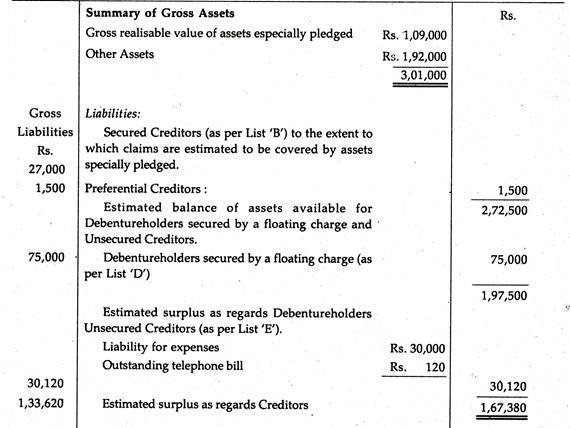
Sri Gobinda Chandra Sadhu khan is appointed liquidator of Sun Co. Ltd in voluntary liquidation on 1st July 1993.

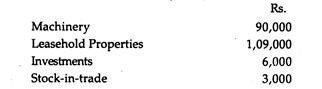
Following balances are extracted from the books on that date:

You are required to prepare a Statement of Affairs to the meeting of Creditors.

The following assets are valued as:

Bad Debts are Rs. 3,000 and the doubtful debts are Rs. 6,000 which are estimated to realize Rs. 3,000. The Bank Overdraft secured by deposit of title deeds of Leasehold Properties. Preferential Creditors are Rs. 1,500. Telephone rent outstanding is Rs. 120.

Example: 2

Bad Debts are Rs. 3,000 and the doubtful debts are Rs. 6,000 which are estimated to realize Rs. 3,000. The Bank Overdraft secured by deposit of title deeds of Leasehold Properties. Preferential Creditors are Rs. 1,500. Telephone rent outstanding is Rs. 120.

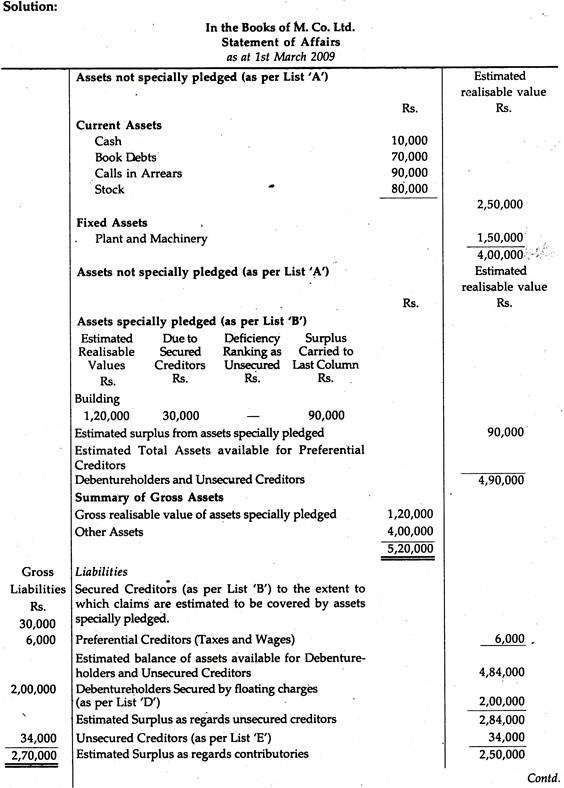
Plant and Machinery and Building are valued at Rs. 1, 50,000, and Rs. 1, 20,000, respectively. On realization, losses of Rs. 15,000 are expected on Stock. Book-Debts will realise Rs. 70,000. Calls-in- arrear are expected to realise 90%. Bank Overdraft is secured against Buildings. Preferential Creditors for taxes and wages are Rs. 6,000 and Miscellaneous Expenses outstanding Rs. 2,000.

Prepare a Statement of Affairs to be submitted to the meeting of creditors.


Conversion into Double Entry System, Need for Conversion

Steps to Convert Single Entry into Double Entry

If, at the end of a trading period, it is desired that the books should be written up so as to give complete information, as is the case under the Double Entry System, the following steps will be necessary:

Step 1. Take up the Statement of Affairs at the end of the previous trading period and open all those accounts which have not already been opened. Generally, under the Single Entry System, cash, bank and personal accounts are maintained. Now, it will be necessary to open/the remaining accounts and debit or credit them with the opening balances as the case may be.

Step 2. From the debit side of the Cash Account, accounts other than the bank account and accounts of customers (on the presumption that such accounts are already maintained) should be credited. For example, if one finds that Rs 5,000 was received by sale of furniture, one should credit Furniture Account with Rs 5,000.

If an entry shows that Rs 4,500 was received from X, no further treatment will be necessary because the account of the customer would already be there and it must have been credited with the amount. A frequent item will be cash sales. Cash Sales Account should be opened and credited with the amounts of case sales.

Step 3. From the credit side of the Cash Account, various accounts (other than the bank account and accounts of creditors) should be debited. On this side of the Cash Account, will be found amounts paid for cash purchases, for various expenses and for various assets acquired. All these accounts will be debited.

Step 4. Treatment similar to (2) and (3) above will be required for Bank Account. Cash paid in or cash drawn for office-use, payment made to suppliers by cheques or receipts from debtors will already have been entered in these accounts; hence, double entry will be required to be completed only in other accounts that may figure. For instance, one will know from Bank Account what bills have been discounted and what discounted bills have been dishonoured, or what the bank charges are.

Step 5. If a Petty Cash Book is maintained, the monthly analysis will have to be posted in the ledger—various accounts for expenses debited and the total credited to Petty Cash Account. The debit to the Petty Cash Account must already have been completed from the Cash or Bank Account.

Step 6. A complete analysis of the customers’ accounts will have to be prepared. This will give vital information regarding credit sales, sales returns, discounts allowed, bills received, bills dishonoured, etc.

Suppose, the following are the various customers’ accounts:

To complete double entry now, what is required is to:

(i) Credit Sales Account with Rs 14,190, Freight (or charges) Account with Rs 140 and Bills Receivable Account with Rs 1,480 and

(ii) Debit Discount Account with Rs 80, Bills Receivable Account with Rs 6,480, Returns Inwards Account with Rs 400, Allowances Account with Rs 50 and Bad Debts Account with Rs 200. No further entry is required regarding cash or bank, as this must already have been completed.

Step 7. A similar analysis of suppliers’ accounts will reveal purchases made, bills payable dishonoured or other charges debited by the suppliers (from the credit side of the accounts) and discounts earned, returns outwards, bills issued to creditors, etc. (from the debit side of the accounts). Accounts other than those relating to cash paid or cheques issued will debit or credited, as the case may be.

Step 8. The proprietor will have to remember other items which require entries in the books. To take an example, if a piece of machinery has been disposed of, any loss or profit resulting from such disposal will have to be brought into the books.

Step 9. A trial balance should then be prepared to see that there is no arithmetical mistake.

Need for Conversion into Double Entry System

  • Ensures Complete and Accurate Records

The double entry system ensures that every financial transaction is recorded with a corresponding debit and credit, providing complete and accurate records. Unlike the single entry system, which often misses important details, double entry guarantees that all aspects of a transaction are captured. This completeness reduces the risk of omissions, mistakes, and inconsistencies. Accurate records are essential not only for internal decision-making but also for satisfying external stakeholders like banks, tax authorities, and investors who require reliable financial information.

  • Enables Preparation of Financial Statements

One major reason for converting to the double entry system is that it allows businesses to prepare full financial statements, including the profit and loss account, balance sheet, and cash flow statement. These statements provide a comprehensive picture of a company’s financial health, showing profitability, asset values, liabilities, and equity. Without these, it’s difficult to evaluate business performance accurately. Financial statements are also required for loan applications, investor presentations, audits, and regulatory compliance, making double entry essential.

  • Facilitates Detection of Errors and Fraud

The double entry system has built-in checks that make it easier to detect errors and prevent fraud. Because each transaction affects two accounts, discrepancies become apparent when the trial balance fails to match. This system offers a clear trail for auditing and verification, discouraging fraudulent activities and reducing the risk of intentional or unintentional mistakes. Businesses relying on incomplete records cannot easily spot such issues, which increases vulnerability to losses or mismanagement over time.

  • Provides Accurate Profit and Loss Determination

Accurately determining profit or loss is difficult under the single entry system because many expenses and revenues are not properly recorded. The double entry system, however, ensures all income and expenses are accounted for, enabling precise profit or loss calculation. This is vital for evaluating whether a business is making progress, where costs can be cut, or where improvements are needed. Without this clarity, businesses may overestimate their profitability or fail to identify financial weaknesses.

  • Enables Better Financial Planning and Control

Double entry accounting provides detailed insights into different components of the business, such as sales, purchases, assets, liabilities, and expenses. This detailed data is essential for effective financial planning, budgeting, and cost control. Business owners can use this information to analyze trends, forecast future performance, and make data-driven decisions. Without such structured records, financial planning becomes guesswork, increasing the risk of poor decisions that can negatively impact growth and sustainability.

  • Assists in Legal and Tax Compliance

Many businesses are legally required to maintain detailed and systematic financial records for tax filings, audits, and regulatory purposes. The double entry system aligns with accounting standards and legal frameworks, making it easier to comply with such requirements. Without it, businesses may struggle to produce necessary documentation or risk penalties due to incomplete or inaccurate reporting. Conversion to double entry ensures that all statutory obligations are met smoothly, reducing legal complications and enhancing business reputation.

  • Enhances Credibility with Stakeholders

Lenders, investors, suppliers, and even customers often assess a business’s credibility based on its financial transparency. Using the double entry system demonstrates professionalism and commitment to accurate reporting, enhancing trust with external parties. In contrast, incomplete records from a single entry system may raise doubts about the reliability of financial information, discouraging partnerships or financing opportunities. Converting to double entry can improve a business’s image and open up more opportunities for growth and collaboration.

  • Allows Systematic Tracking of Assets and Liabilities

Under the double entry system, businesses maintain detailed records of all assets and liabilities, including depreciation, outstanding loans, inventories, and fixed assets. This enables systematic tracking and helps businesses manage their resources effectively. In the single entry system, such tracking is either absent or poorly maintained, leading to mismanagement or underutilization of resources. Conversion ensures businesses know exactly what they own and owe, supporting better decision-making regarding investments, debt repayments, and asset usage.

  • Provides a Basis for Internal and External Audits

Audit processes require clear, complete, and verifiable records, which are best provided by the double entry system. Auditors need to trace transactions across accounts, verify balances, and ensure financial integrity. Without proper books, businesses may fail audits or face difficulties during financial reviews. Conversion to double entry establishes a formal structure for internal checks and external audits, enhancing accountability and ensuring that financial operations can withstand scrutiny from regulators and stakeholders.

  • Prepares Business for Future Growth

As businesses grow, their transactions become more complex, involving credit sales, multiple bank accounts, inventories, fixed assets, and varied expense categories. The single entry system cannot handle such complexity, making double entry essential for scalable operations. Converting to the double entry system prepares businesses for expansion, ensuring they can manage larger volumes of transactions, comply with higher reporting standards, and attract larger investors or partners. It builds a strong financial foundation for sustainable long-term success.

Types of Banking and Constitution

Constitution

The banking in India was originated only at 18th century. During the last decades, Bank of Hindustan should be first banks which were established in 1770 and liquated in 1829-32. And also The General Bank of India was established in 1786. The largest bank, and the oldest still in existence is the State Bank of India (S.B.I). It was originated as the Bank of Calcutta in 1806. In 1809, it was renamed as the Bank of Bengal. This was one of the three banks funded by a presidency government, the other two were the Bank of Bombay in 1840 and the Bank of Madras in 1843. These three banks were merged in 1921 to form the Imperial Bank of India and later it would become the State Bank of India in 1955. For many years the presidency banks had acted as quasi-central banks, as did their successors, until the Reserve Bank of India was established in 1935, under the Reserve Bank of India Act, 1934.

In 1960, the state bank of India had given control to their eight state associated banks under the state bank of India act 1959. These banks were now called as its associate banks. In 1969, The Indian government had nationalized 14 major private banks in India. In 1969, 6 more private banks were nationalized. These nationalized were majority lenders in Indian economy even now. They had dominated the banking sectors because of their large size and their networks. The Indian banking sector was broadly classified into scheduled and non-scheduled banks.

In the early 1990s, at the time of liberalization, the government had licensed a small number of private banks known as new generation tech-savvy banks and included global trust bank which later amalgamated with the oriental bank of commerce, UTI Bank, ICICI Bank and HDFC Bank. This would become along with the rapid growth in the economy of India revitalized the banking sector in India, which has seen rapid growth with strong contribution from the government banks, private banks and foreign banks. All foreign investors in banks might be given voting rights that could exceed the present capital of 10% at present. It has gone up to 74% with some restrictions. Bankers were used the 4–6–4 method (borrow at 4%; lend at 6%; go home at 4%) of functioning. This new wave ushered in a modern outlook and tech-savvy methods of working for traditional banks. All this led to the retail boom in India. People demanded more from their banks and received more.

Banking Financial Institutions

There is lot more to banking term than what most of the people recognize. Not all banks are shaped in equal manner or to operate for the same reason with same fundamentals. Since individuals or corporate have diversified needs of finance. “Different types of banking and financial institutions are operated to classify services based on distinctive types”. Name banks subject to large entity they are further divided into types based on universal arrangement of capital principles. Bank is an financial institution or intermediary institution for various financial necessities and dealing either directly or indirectly with financial system of nation’s economy. Due to this important factors banks are highly regulated by nation’s government or central bank of country. Banking industry is divided into different types based on client requirements for products and services.

Types of Banking Institutions and Financial Institutions:

  • Retail Banking
  • Commercial Banking
  • Private Banking
  • Investment Banking
  • Specialized financing
  • Central Banks
  1. Retail Banking

Retail banking is the procurement of administrations by a bank to individual rather than to organizations, corporate or other banks. Administrations offered services like savings, money transfers, loans, cheques, cards, etc. The term retail banking mostly recognize as financial institutions for managing an account administrations for individuals or managing retail clients which distinguish it from other banking types. To further understand retail banking refer to tutorial links.

Commercial banks provide administrations services such as making business advances, offering fundamental investment schemes, encouraging saving deposits, fixed deposits, Issuing bank drafts and bank cheques,  giving overdraft facilities, bond investment schemes, cash management, mortgage loans, debit cards, credit cards, etc.

There are two types of commercial banks, Public Commercial Banks and Private Commercial Banks. Public commercial banks refers to bank in which government holds major stake usually to emphasize on social objectives than on profitability. Whereas Private Commercial Banks are fully owned, managed and controlled by private supporter and they are free to operate without any government interference. For more details refer to the tutorial links.

  1. Private Banking

The expression “private” refers to administration services more on personal basis rather than mass population (Retail Banking). Private Banks refer as financial institutions for managing accounts, investments and other services offered by banks to high-net worth individuals (HNI) who are categories as high income professionals or large investors. Private banks subject to an essential part of wealth management for high income groups. They provide services like: assets management, tax advisory, financial brokers, offered solitary relationship manger.

  1. Investment Banking

An investment bank refers as a consultant or assisting institution for individuals, organizations and governments in raising capital by underwriting assets. And/or performing broker in issuing securities. An investment bank likewise assist organizations in simplifying acquisitions and mergers, trading in derivatives, equities, currencies, commodities by providing auxiliary services. Investment bank does not provide deposit services like commercial banks or retail banks.

Investment bank can likewise be divided into private and public based on information capacities and data obstruction. The private ranges deals with private insider data that cannot be freely disclosed, while public range such as stock examination deals with public data. For more details refer to tutorial course links.

  1. Specialized Financing

Specialized Banks offers various specialized services away from traditional banking. Specialized banks are financial institutions referred as foreign exchange banks, development banks, industry and mine banks, farms and agriculture banks, aboriginal banks (providing financial products and services to aboriginal communities), export-import banks with unique needs.

Some specialized banks are governed and regulated by state or central governments or both for re-structuring, planning and development of the country. Specialized banks and financial institutions are broadly categories into three types of specialized banks, they are:

  • Export Import Banks (EXIM Banks)
  • Small Industries Development Banks
  • Agricultural and Rural Development Banks
  1. Central Banks

A reserve bank, central bank, or monetary authority refers to a financial institution that manages a states or country. In term of currency, interest rates, currency valuation. Central bank holds monopoly in increasing monetary base also by prints the national currency. Central bank functions mostly include managing foreign exchange and gold reserves, implementing monetary policy, acting as a banker’s bank at time of crisis, making official policies regarding interest rates. Central bank holds superior power to protect country man by punishing banks or institutions for performing any reckless or fraudulent behaviour. Central banks are mostly designed and recognised as an independent and politically free entity. Examples: Reserve Bank of India (RBI) is the central bank of India, Bank of England, European Central Bank (ECB), People’s Bank of China, Federal Reserve of the United States of America, etc.

Objectives & Functions of SIDCs

The State Industrial Development Corporations have been set up by the State Governments as companies wholly owned by them. At present, 22 such SIDCs are functioning in India. SIDCs are not merely financing agencies, but are intended to act as instruments for accelerating the pace of industrialization in the respective States.

Besides providing financial assistance to industrial concerns by way of loans, guarantees and underwriting of or direct subscriptions to shares and debentures, the SIDCs undertake various promotional activities such as conducting techno-economic surveys, project identification, preparation of feasibility studies, selection and training of entrepreneurs. They also promote joint sector projects in association with private promoters. In such projects SIDCs take 26% private co-promoter takes 25% of the equity, and the rest is offered to the investing public.

SIDCs also undertake the development of industrial areas, construction of sheds and provision of infrastructural facilities .and also the development of new growth centers. They also administer various State Government incentive schemes.

The main functions of SIDCs are as follows:

Objectives & Functions of LIC

The Life Insurance Corporation was incorporated and started on 19th January 1956. This was done by a merger of 16 insurance company and 75 provident societies on that day. The LIC Act was passed by the Parliament on 18th June 1956, which then came into effect from 1st July 1956.

Life Insurance Corporation has started its journey as a corporate firm from 1st September 1956. Its all working is governed by the LIC Act.

One of the core functions of LIC is an investment. It is an investment institution. Its main function is to gather money from the people and invest it into the different securities and financial markets in India and abroad.

As a rule, LIC is required to invest at least 75% of the funds in Central and State Government securities. Thus LIC is the largest investment institution in India as on date.

It gathers the funds from the people by issuing insurance policies and invest that funds into financial markets in India. It also provides term loan and bonds to gather money from the market.

Not only that, the LIC has become the world’s largest insurance company in terms of a number of policies issued. As of 2019, the total coverage of policies including individual, group and other social schemes has crossed 13 crores.

Objectives of LIC of India

  • Spread Life Insurance widely and in particular to the rural areas and to the socially and economically backward classes with a view to reaching all insurable persons in the country and providing them adequate financial cover against death at a reasonable cost.
  • Maximize the mobilization of people’s savings by making insurance-linked savings adequately attractive.
  • Bear in mind, in the investment of funds, the primary obligation to its policyholders, whose money it holds in trust, without losing sight of the interest of the community as a whole; the funds to be deployed to the best advantage of the investors as well as the community as a whole, keeping in view national priorities and obligations of attractive return.
  • Conduct business with utmost economy and with the full realization that the money belongs to the policyholders.
  • Act as trustees of the insured public in their individual and collective capacities.
  • Meet the various life insurance needs of the community that would arise in the changing social and economic environment.
  • Involve all people working in the Corporation to the best of their capability in furthering the interests of the insured public by providing efficient service with courtesy.
  • Promote amongst all agents and employees of the Corporation a sense of participation, pride and job satisfaction through discharge of their duties with dedication towards achievement of Corporate Objective.

Functions of LIC

  • The main function of LIC is to collect the savings of the people through a life insurance policy and invest that money in various financial markets.
  • One of the main functions of LIC is to invest fund into government securities so as to protect the capital of the people who have given their money to LIC.
  • LIC has to issue an insurance policy at affordable rates to people.
  • LIC provides direct loans to industries at lower interest rates. The rate of interest is as low as 12% for the entire tenure.
  • It is one of the major stakeholders in many of the blue-chip companies in the Indian stock market.
  • It also provides refinancing activities through SFCs in different states and cities.
  • It also invests in the various corporates via bonds and securities, thus supports corporate funding in an indirect way.
  • It also gives loan to the various national projects which are important for economic growth.
  • It provides financial supports to socially-oriented projects like electrification, sewage, and water channelizing, etc
  • It also gives a housing loan at reasonable rates.
  • It is the main channel between savings and investment for the people in India.

Activities of LIC

The LIC subscribes to and underwrites the shares, bonds and debentures of several financial corporations and companies and grants term-loans. It maintains a relationship with other financial institutions such as IDBI, UTI, IFCI, etc. for coordination of its investment.

The LIC is a powerful factor in the securities market in India. It subscribes to the share capital of companies, both preference and equity and also to debentures and bonds. Its shareholding extends to a majority of large and medium sized non-financial companies and is significant in size.

It is no doubt to say that the LIC acts as a kind of downward stabilizer of the share market, as the continuous inflow of fresh funds enables it to buy even when the share market is weak.

Investment Policy

The investment policy of the LIC of India should bring a fair return to policy holders consistent with safety. Since the funds at the disposal of the LIC are in the nature of the trust money, they should be invested in such securities which do not diminish in value and give the highest possible return.

In other words, principles of safety, yield, liquidity and distribution should be taken into consideration while investing insurance funds. The way in which these funds are invested is a great significance not only to policy holders but also to the entire economy.

Types of Financial Services

India’s diverse and comprehensive financial services industry is growing rapidly, owing to demand drivers (higher disposable incomes, customized financial solutions, etc.) and supply drivers (new service providers in existing markets, new financial solutions and products, etc.). The Indian financial services industry comprises several key subsegments. These include, but are not limited to- mutual funds, pension funds, insurance companies, stock-brokers, wealth managers, financial advisory companies, and commercial banks- ranging from small domestic players to large multinational companies. The services are provided to a diverse client base- including individuals, private businesses and public organizations.

10 Types of Financial Services:

  • Banking
  • Professional Advisory
  • Wealth Management
  • Mutual Funds
  • Insurance
  • Stock Market
  • Treasury/Debt Instruments
  • Tax/Audit Consulting
  • Capital Restructuring
  • Portfolio Management

These financial services are explained below:

  1. Banking

The banking industry is the backbone of India’s financial services industry. The country has several public sector (27), private sector (21), foreign (49), regional rural (56) and urban/rural cooperative (95,000+) banks. The financial services offered in this segment include:

  • Individual Banking (checking accounts, savings accounts, debit/credit cards, etc.)
  • Business Banking (merchant services, checking accounts and savings accounts for businesses, treasury services, etc.)
  • Loans (business loans, personal loans, home loans, automobile loans, working-capital loans, etc.)

The banking sector is regulated by the Reserve Bank of India (RBI), which monitors and maintains the segment’s liquidity, capitalization, and financial health.

  1. Professional Advisory

India has a strong presence of professional financial advisory service providers, which offer individuals and businesses a wide portfolio of services, including investment due diligence, M&A advisory, valuation, real-estate consulting, risk consulting, taxation consulting. These offerings are made by a range of providers, including individual domestic consultants to large multi-national organizations.

  1. Wealth Management

Financial services offered within this segment include managing and investing customers’ wealth across various financial instruments- including debt, equity, mutual funds, insurance products, derivatives, structured products, commodities, and real estate, based on the clients’ financial goals, risk profile and time horizons.

  1. Mutual Funds

Mutual fund service providers offer professional investment services across funds that are composed of different asset classes, primarily debt and equity-linked assets. The buy-in for mutual fund solutions is generally lower compared to the stock market and debt products. These products are very popular in India as they generally have lower risks, tax benefits, stable returns and properties of diversification. The mutual funds segment has witnessed double-digit growth in assets under management over the last five years, owing to its popularity as a low-risk wealth multiplier.

  1. Insurance

Financial services offerings in this segment are primarily offered across two categories:

  • General Insurance (automotive, home, medical, fire, travel, etc.)
  • Life Insurance (term-life, money-back, unit-linked, pension plans, etc.)

Insurance solutions enable individuals and organizations to safeguard against unforeseen circumstances and accidents. Payouts for these products vary across the nature of the product, time horizons, customer risk assessment, premiums, and several other key qualitative and quantitative aspects. In India, there is a strong presence of insurance providers across life insurance (24) and general insurance (39) categories. The insurance market is regulated by the Insurance Regulatory and Development Authority of India (IRDAI).

  1. Stock Market

The stock market segment includes investment solutions for customers in Indian stock markets (National Stock Exchange and Bombay Stock Exchange), across various equity-linked products. The returns for customers are based on capital appreciation growth in the value of the equity solution and/or dividends and payouts made by companies to its investors.

  1. Treasury/Debt Instruments

Services offered in this segment include investments into government and private organization bonds (debt). The issuer of the bonds (borrower) offers fixed payments (interest) and principal repayment to the investor at the end of the investment period. The types of instruments in this segment include listed bonds, non-convertible debentures, capital-gain bonds, GoI savings bonds, tax-free bonds, etc.

  1. Tax/Audit Consulting

This segment includes a large portfolio of financial services within the tax and auditing domain. This services domain can be segmented based on individual and business clients. They include:

  • Tax: Individual (determining tax liability, filing tax-returns, tax-savings advisory, etc.)
  • Tax: Business (determining tax liability, transfer pricing analysis and structuring, GST registrations, tax compliance advisory, etc.)

In the auditing segment, service providers offer solutions including statutory audits, internal audits, service tax audits, tax audits, process/transaction audits, risk audits, stock audits, etc. These services are essential to ensure the smooth operation of business entities from a qualitative and quantitative perspective, as well as to mitigate risk. You can read more about taxation in India.

  1. Capital Restructuring

These services are offered primarily to organizations and involve the restructuring of capital structure (debt and equity) to bolster profitability or respond to crises such as bankruptcy, volatile markets, liquidity crunch or hostile takeovers. The types of financial solutions in this segment typically include structured transactions, lender negotiations, accelerated M&A and capital raising.

  1. Portfolio Management

This segment includes a highly specialized and customized range of solutions that enables clients to reach their financial goals through portfolio managers who analyze and optimize investments for clients across a wide range of assets (debt, equity, insurance, real estate, etc.). These services are broadly targeted at HNIs and are discretionary (investment only at the discretion of fund manager with no client intervention) and non-discretionary (decisions made with client intervention).

Importance

It is the presence of financial services that enables a country to improve its economic condition whereby there is more production in all the sectors leading to economic growth.

The benefit of economic growth is reflected on the people in the form of economic prosperity wherein the individual enjoys higher standard of living. It is here the financial services enable an individual to acquire or obtain various consumer products through hire purchase. In the process, there are a number of financial institutions which also earn profits. The presence of these financial institutions promote investment, production, saving etc.

Hence, we can bring out the importance of financial services in the following points:

Importance of Financial Services

  • Vibrant Capital Market.
  • Expands activities of financial markets.
  • Benefits of Government.
  • Economic Development.
  • Economic Growth.
  • Ensures Greater Yield.
  • Maximizes Returns.
  • Minimizes Risks.
  • Promotes Savings.
  • Promotes Investments.
  • Balanced Regional Development.
  • Promotion of Domestic & Foreign Trade.

Ensures greater Yield

As seen already, there is a subtle difference between return and yield. It is the yield which attracts more producers to enter the market and increase their production to meet the demands of the consumer. The financial services enable the producer to not only earn more profits but also maximize their wealth.

Financial services enhance their goodwill and induce them to go in for diversification. The stock market and the different types of derivative market provide ample opportunities to get a higher yield for the investor.

Maximizing the Returns

The presence of financial services enables businessmen to maximize their returns. This is possible due to the availability of credit at a reasonable rate. Producers can avail various types of credit facilities for acquiring assets. In certain cases, they can even go for leasing of certain assets of very high value.

Factoring companies enable the seller as well as producer to increase their turnover which also increases the profit. Even under stiff competition, the producers will be in a position to sell their products at a low margin. With a higher turnover of stocks, they are able to maximize their return.

Minimizing the risks

The risks of both financial services as well as producers are minimized by the presence of insurance companies. Various types of risks are covered which not only offer protection from the fluctuating business conditions but also from risks caused by natural calamities.

Insurance is not only a source of finance but also a source of savings, besides minimizing the risks. Taking this aspect into account, the government has not only privatized the life insurance but also set up a regulatory authority for the insurance companies known as IRDA, 1999 (Insurance Regulatory and Development Authority).

Promoting savings

Financial services such as mutual funds provide ample opportunity for different types of saving. In fact, different types of investment options are made available for the convenience of pensioners as well as aged people so that they can be assured of a reasonable return on investment without much risks.

Promoting investment

The presence of financial services creates more demand for products and the producer, in order to meet the demand from the consumer goes for more investment. At this stage, the financial services comes to the rescue of the investor such as merchant banker through the new issue market, enabling the producer to raise capital.

The stock market helps in mobilizing more funds by the investor. Investments from abroad is attracted. Factoring and leasing companies, both domestic and foreign enable the producer not only to sell the products but also to acquire modern machinery/technology for further production.

Expands activities of Financial Institutions

The presence of financial services enables financial institutions to not only raise finance but also get an opportunity to disburse their funds in the most profitable manner. Mutual funds, factoring, credit cards, hire purchase finance are some of the services which get financed by financial institutions.

The financial institutions are in a position to expand their activities and thus diversify the use of their funds for various activities. This ensures economic dynamism.

Benefit to Government

The presence of financial services enables the government to raise both short-term and long-term funds to meet both revenue and capital expenditure. Through the money market, government raises short term funds by the issue of Treasury Bills. These are purchased by commercial banks from out of their depositors’ money.

In addition to this, the government is able to raise long-term funds by the sale of government securities in the securities market which forms apart of financial market. Even foreign exchange requirements of the government can be met in the foreign exchange market.

Economic development

Financial services enable the consumers to obtain different types of products and services by which they can improve their standard of living. Purchase of car, house and other essential as well as luxurious items is made possible through hire purchase, leasing and housing finance companies.

Consumer Finance

According to E.R.A. Seligman, “The term consumer credit refers to a transfer of wealth, the payment of which is deferred in whole or in part, to future, and is liquidated piecemeal or in successive fractions under a plan agreed upon at the time of the transfer”.

According to Reavis Cox, consumer credit is ‘”a business procedure through which the consumers purchase semi-durables and durables other than real estate, in order to obtain from them a series of payments extending over a period of three months to five years, and obtain possession of them when only a fraction of the total price has been paid”.

Introduction to Consumer Finance

During earlier times the trend of people was to save first and spend later. But today it has been changed to spend today and pay later. The culture, life style, spending pattern, priority of needs etc. have been changed far and wide. Earlier people used to borrow money for construction of a house, to start a business or to purchase some land, or needs of that order. But today people need money for acquiring consumer durables also.

It is felt sometimes that people give more emphasis to amenities than for permanent assets like land, house etc. A stylish house in a posh area, a car, computer, television, stereo system, a cooking range, washing machine, grinder, mobile phone etc. which only a minority used 10 years back have become part of life (or ambition) of an average civilian. As they need money for satisfying these needs naturally facilities to finance also emerge.

The branch of banking which facilitate finance for purchasing consumer durables is called ‘consumer finance’ or ‘consumer credit’. Today it has become part of life of an average Indian as they need credit in large quantity to meet their needs of various kinds. This emerging set of wants and consequent need for funds multiplies the scope and role of consumer finance.

Considering the busy nature of borrowers, fanciers provide customer friendly products and services at their doorstep on easy terms. As India is a country with billions of spend thrift untapped population, who are competing each other in acquiring newer and newer consumer durables and as an element of prestige is linked in owning these assets, it is sure that, without any set back, ‘Consumer Finance’ will have brighter future and will hit better targets in the forthcoming era of consumerism.

Meaning and Concept of Consumer Finance

Consumer finance refers to the raising of finance by individuals for meeting their personal expenditure or for the acquisition of durable consumer goods. It is an important asset based financial service in India. This include credit merchandising, deferred payments, installment buying, hire purchase, pay-out of income scheme, pay-as-you earn scheme, easy payment, credit buying, installment credit plan, credit cards, etc.

Consumer durables include Cars, Two Wheelers, LCD TVs, Refrigerators, Washing Machines, Home Appliances, Personal Computers, Cooking Ranges, and Food Processors etc. Under consumer finance scheme, the consumer or buyer pays a part of the purchase price in cash at the time of the delivery of the asset, the balance with interest over a pre­determined period of time.

The objective of consumer finance is to provide credit easily to the consumer at his door steps. Both private and public sector finance companies provide consumer finance to purchase ‘consumer goods and construction of such goods (building materials, iron rods, cement etc.). Multinational finance companies are also engaged in consumer finance in India. Usually the credit/finance is extended for a period of 2 to 5 years.

Features of Consumer Credit

  1. Consumer credit is a method of financing semi-durables and durables.
  2. It assists consumers to acquire assets.
  3. Consumers get possession of the assets immediately when a fraction of the price is paid.
  4. The balance payment is payable in installments over an agreed span of time.
  5. The duration of the finance normally ranges between three months to five years,
  6. It is an agreement between parties to the contract.
  7. When there are only two parties to the contract, it is called a Bipartite Agreement (the customer and the dealer cum financier) and where there are three parties, such agreements are called Tripartite Agreements (the customer, the dealer and the financier.)
  8. The structure of financing may by way of hire-purchase, conditional sale or credit sale. In the case of both hire purchase and conditional sale, ownership of the asset is transferred only on completion of all the terms of agreement. But in the case of credit sale ownership is transferred immediately on payment of first installment.
  9. Generally advances are made on the security of the asset itself and
  10. It involves down payment normally ranging from 20 to 25% of the asset price.

Forms/Types of Consumer Credit

Following are the different forms for financing consumers:

  1. Revolving Credit

It is an ongoing credit arrangement. It is similar to overdraft facility. Here a credit limit will be sanctioned to the customer and the customer can avail credit to the extent of credit limit sanctioned by the financier. Credit Card facility is an excellent example of revolving credit.

  1. Cash Loan

In this form, the buyer consumer gets loan amount from bank or non- banking financial institutions for purchasing the required goods from seller. Banker acts as lender. Lender and seller are different. Lender does not have the responsibilities of a seller

  1. Secured Credit

In this form, the financier advances money on the security of appropriate collateral. The collateral may be in the form of personal or real assets. If the customer makes default in payments, the financier has the right to appropriate the collateral. This kind of consumer credit is called secured consumer credit.

  1. Unsecured Credit

When financier advances fund without any security, such advances are called unsecured consumer credit. This type of credit is granted only to reputed customers.

  1. Fixed Credit

In this form of financing, finance is made available to the customer as term loan for a fixed period of time i.e., for a period of one to five years. Monthly installment loan, hire purchase etc. are the examples.

Advantages of Consumer Finance

  1. Compulsory Savings

Consumer credit promotes compulsory savings habit among the people. To make periodical installments knowingly or unknowingly, people cut short their other expenditures and save. These savings ultimately fetch them ownership of an asset in course of time. Thus consumer credit adds to the savings habit of people.

  1. Convenience

Considering the nature and type of customers, consumer credit facility offers schemes to the convenience and satisfaction of the customers. Walk in and drive out, pay as you earn, everything at the door step, one time processing etc. are examples.

  1. Emergencies

Consumer credit facility is available to meet personal requirements like family requirements, festival requirements, emergencies etc. The credit facility is not strictly restricted to purchasing of consumer durables alone. In ordinary course of life people come across number of urgent financial requirements, for which consumer credit offers a better solution.

  1. Assists to Meet Targets

In all business activities, there will be targets to be achieved by the executives. Most people abstain/ postpone purchasing for want of sufficient fund. When the dealer themselves arrange for fund people get attracted and purchase take place in large quantity. Thus it assists to meet sales targets and profit targets.

  1. Assists to Make Dreams to Reality

A car, a TV, a washing machine, a computer, a laptop, a mobile phone, etc. is undoubtedly a dream of an average human being. But people may not purchase because of fund problem. In those cases consumer credit facilitates an opportunity to possess and own those dreams on convenient terms.

  1. Enhances Living Standard

Consumer credit enhances living standard of the people by providing latest articles and amenities at reasonable and affordable terms.

  1. Accelerates Industrial Investments

Demand for consumer durables enhances further investment in the consumer durables industry. Thus provides more and more employment opportunities in the country.

  1. Promotes Economic Development

Demand for consumer durables, further investments in consumer durables industry, increased living standard of people, improved employment opportunities and income etc. improves economic development of the country.

  1. Economies of Large Scale Production

Increased demand leads to large scale production. Large scale operations lead to the economies of large scale operation. This in turn leads to lower prices.

  1. National Importance

Consumer credit is of national importance in India. Unless there is such a convenient mode of financing, total demand for consumer durables will be far lesser. Poor demand lead to lower production, which in turn lead to poor employment opportunity and lower income level. All these finally land the economy in trouble.

Disadvantages of Consumer Finance

Following are the disadvantages of consumer finance:

  1. Promotes Blind Buying

Facility to purchase at somebody else’s money tempts people to buy and buy goods blindly. This may land these people to debt trap within a short while.

  1. Leads to Insolvency

Blind buying of goods make these people insolvent/bankrupt within a shorter span of time. This ultimately spoils their life in the long run.

  1. Consumer Credit is Costlier

Along with the convenience that it offers it charge the customer for all these conveniences offered. Thus it becomes costlier when compared to other forms of finance.

  1. Artificial Boom

The economic development posed by the impact of consumer credit is not real but artificial. Economy will take years to stabilize the artificial boom claimed by the proponents of consumer credit.

  1. Bad Debts Risk

By whatever name called credit is always risky so is the case with consumer credit as well. Defaults are a major threat to consumer credit. Once there is a default, repossession and other legal formalities are difficult.

  1. Causes Economic Instability

Artificial boom and depression leads to economic instability and causes chaos in the economic progress. It will be difficult for the real ordinary business man to identify real progress and artificial progress.

Bangalore University B.Com Notes

Latest SEP Syllabus Notes

1st Semester

Financial Accounting (Updated) VIEW
Corporate Law (Updated) VIEW
Modern Marketing (Updated) VIEW
Quantitative Analysis for Business Decisions (Updated) VIEW
Business Quantitative Analysis (Updated) VIEW
Environmental Studies (Updated) VIEW

2nd Semester

Advanced Financial Accounting (Updated) VIEW
Modern Banking (Updated) VIEW
Banking Operations (Updated) VIEW
Human Capital Management (Updated) VIEW
Human Resource Management (Updated) VIEW
Business Data Analysis (Updated) VIEW
Quantitative Techniques for Business Decisions VIEW
Computer Accounting Tally Prime VIEW

3rd Semester

Corporate Accounting (Updated) VIEW
Financial Management (Updated) VIEW
Fundamentals of Costing (Updated) VIEW
Digital Entrepreneurship (Updated) VIEW
India Constitution (Updated) VIEW

4th Semester

Advanced Corporate Accounting (Updated) VIEW
Costing Methods (Updated) VIEW
Stock and Commodity Markets (Updated) VIEW
Business Research Methodology (Updated) VIEW
Soft Skills for Business (Updated) VIEW

NEP Syllabus Notes

1st Semester

Financial Accountancy (Updated) VIEW
Business Management & Startups (Updated) VIEW
Principles of Marketing (Updated) VIEW
Digital Fluency (Updated) VIEW
Spreadsheet for Business (Updated) VIEW
Financial Literacy (Updated) VIEW
Business Documents (Updated) VIEW

2nd Semester

Advanced Financial Accounting (Updated) VIEW
Business Ethics (Updated) VIEW
Banking Innovations (Updated) VIEW
E-Business (Updated) VIEW
Fundamentals of Investments in Capital Market (Updated) VIEW
Digital Fluency (Updated) VIEW

3rd Semester

Corporate Accounting (Updated) VIEW
Business Mathematics & Statistics (Updated) VIEW
Indian Financial Services (Updated) VIEW
Company Law & Administration (Updated) VIEW
Constitution of India (Updated) VIEW
Entrepreneurship Skills (Updated) VIEW
Investments in Stock Market (Updated) VIEW

4th Semester

Advanced Corporate Accounting (Updated) VIEW
Cost Accounting (Updated) VIEW
Business Regulations (Updated) VIEW
Artificial Intelligence (No Update) VIEW
Corporate Governance (Updated) VIEW
Investments in Commodity Markets (Updated) VIEW

5th Semester

Financial Management (Updated) VIEW
Income Tax Law and Practice-I (Updated) VIEW
Principles and Practice of Auditing (Updated) VIEW
A1 Indian Accounting Standards-I (Updated) VIEW
F1 Financial Institutions and Markets (Updated) VIEW
M1 Retail Management (Updated) VIEW
H1 Human Resources Development (Updated) VIEW
I1 Basics of Business Analytics (Updated) VIEW
GST Law & Practice (Updated) VIEW
Digital Marketing VIEW
Cyber Security (Updated) VIEW
Employability Skills VIEW

6th Semester

Advanced Financial Management (Updated) VIEW
Income Tax Law and PracticeII (Updated) VIEW
Management Accounting (Updated) VIEW
A2 Indian Accounting Standards2 (Updated) VIEW
F2 Investment Management (Updated) VIEW
M2 Customer Relationship Management (Updated) VIEW
H2 Cultural Diversity at Work Place (Updated) VIEW
I2 HR Analytics (Updated) VIEW
Assessment of Persons other than Individuals and Filing of ITRs (Updated) VIEW
ECommerce (Updated) VIEW

CBCS 2020-21 Syllabus

1st Semester

Financial Accounting (Updated) VIEW
Fundamentals of Management and Life Skills (Updated) VIEW
Business Organization & Market Dynamics (Updated) VIEW
Business Mathematics (No Updated) VIEW

2nd Semester

Advanced Financial Accounting (Updated) VIEW
Marketing & Event Management (Updated) VIEW
Human Capital Management (Updated) VIEW
Quantitative Analysis for Business Decision (Updated) VIEW

3rd Semester

Corporate Accounting (Updated) VIEW
Financial Management (Updated) VIEW
Elements of Costing (Updated) VIEW
Indian Financial System (Updated) VIEW

4th Semester

Advanced Corporate Accounting (Updated) VIEW
Costing Methods (Updated) VIEW
E-Business & Computerized Accounting (Updated) VIEW
Business Regulations (Updated) VIEW

5th Semester

Subjects
Income Tax I (Updated) VIEW
Cost Management (Updated) VIEW
Indian Accounting Standards (Updated) VIEW
Auditing and Reporting (Updated) VIEW
Accounting & Taxation Group  
AC5.5 Advanced Accounting (Updated) VIEW
AC5.6 Accounting for Government and Local Bodies (Updated) VIEW
Finance Group  
FN5.5 Corporate Financial Management (Updated) VIEW
FN5.6 Strategic Financial management (Updated) VIEW
Marketing Group  
MK5.5 Consumer Behaviour & Market Research (Updated) VIEW
MK5.6 Advertising & Media Management (Updated) VIEW
HR Group
HR5.5 Performance Management (Updated) VIEW
HR5.6 Strategic Human Resource Management (Updated) VIEW

6th Semester

Subjects
Income Tax II (Updated) VIEW
Management Accounting (Updated) VIEW
Goods & Services Tax VIEW
Entrepreneurship and Ethics (Updated) VIEW
Accounting & Taxation Group
AC6.5 Business Taxation (Updated) VIEW
AC6.6 Financial Reporting and Corporate Disclosures (Updated) VIEW
Finance Group
FN6.5 Derivatives and Risk Management (Updated) VIEW
FN6.6 International Financial Management (Updated) VIEW
Marketing Group
MK6.5 Retail Management (Updated) VIEW
MK6.6 International Marketing Management (Updated) VIEW
HR Group
HR6.5 Labour Welfare and Social security (Updated) VIEW
HR6.6 International Human Resource Management VIEW


error: Content is protected !!