Employee Attrition and Retrenchment

Employee Attrition

Attrition in business describes a gradual but deliberate reduction in staff numbers that occurs as employees retire or resign and are not replaced. The term is also sometimes used to describe the loss of customers or clients as they mature beyond a product or company’s target market without being replaced by a younger generation.

How Attrition Works?

This type of reduction in staff is called a hiring freeze. It is one way a company can decrease labor costs without the disruption of layoffs.

Reducing staff by attrition naturally is less devastating to company morale. However, it can still have a negative impact on the remaining employees if it leads to an increase in their workload. It also can limit promotional opportunities and movement within the company, resulting in an unhappier workplace or more attrition than was intended.

About Customer Attrition

Attrition can also refer to a shrinking customer base. This, of course, is not deliberate. The word is most pertinent when used to describe a product whose customer base is shrinking because its loyal customers are aging and younger consumers are not taking their place.

Customer attrition is usually found when a company has failed to adapt its product to changing trends. The Sears department store chain and the Oldsmobile car brand might be examples of products that failed to capture a younger generation of customers.

 Because attrition is voluntary, as opposed to layoffs, it is seen as a less disruptive way for a company to decrease labor costs.

Attrition versus Layoffs

Changes in management, company structure, or other aspects of a company’s operations can cause employees to leave voluntarily, resulting in a higher attrition rate.

Laying off employees results in attrition as long as the company doesn’t immediately hire as many new employees as it laid off. For example, a company might reduce its administrative staff by six in order to create a new internet team of six.

Turnover occurs in a company for many reasons. It can only be called attrition if the company decides not to fill the vacated position.

When a company is faced with a financial crisis, it must make tough calls and cut back its workforce in order to stay afloat. In these cases, the company might implement a layoff with no intention of filling those positions again.

In less drastic cases, such as changes in the company structure or business model or a merger, certain departments are trimmed or eliminated. This usually requires layoffs rather than attrition.

Unlike layoffs, a reduction in staff due to attrition is voluntary. The employee has decided to take a new job, retire, or move to another new city. An attrition policy takes advantage of this inevitable changeover to reduce overall staff.

Employee Retrenchment

Retrenchment is a form of dismissal due to no fault of the employee, it is a process whereby the employer reviews its business needs in order to increase profits or limit losses, which leads to reducing its employees.

The employer must give fair reasons for making the decision to retrench and follow a fair procedure when making such a decision or the retrenchment may be considered unfair.

How retrenchment laws work in India?

The original legislation of 1947 does not have the definition of the word retrenchment; it was in 1953 that with an amendment Act this definition was inserted. It would also be interesting to know that till 1983 the courts of law used to consider termination of service due to nonrenewal of the agreement of employment as the act of retrenchment in pronouncements like of Hindustan Aluminium Corporation v. State of Orissa. later, the judgment was held to be a bad one and with the Amendment 49 of 1984 the provision of (bb) was inserted in the definition of retrenchment declaring such kind of termination not to be included within the ambit of retrenchment.

Retrenchment refers to discharge of surplus labour by the employer. It may be due to inevitable reasons including rationalization or installation of new labour-saving machinery. Retrenchment may also be said as the right of an employer. An employer has a right to organize his business in any lawful manner he considers best and courts cannot question its proprietary. If reorganization results in surplus employees, no employer is expected to carry their burden. There is a consensus of judicial opinion in deciding retrenchment on the facts and circumstances of each case. Courts have decided that termination of services is due to loss.

In the landmark case of State Bank of India v. Sundara Money, the Supreme Court adopted the literal meaning of retrenchment, which is exhaustive and comprehensive, and held that the expression “for any reason whatsoever” was very wide and admitted almost no exceptions to it. Therefore, the word retrenchment means termination of a worker’s services for any reason whatsoever other than those specified in section 2(oo) of the Industrial Dispute Act (IDA), 1947.

 Chapter V-A of the IDA requires an establishment employing 50 or more workers, in case of valid retrenchment to provide the workers with 30 days’ notice and 15 days’ pay for every year of continuous work by the workmen at the firm. In case of closure or sale, it must fulfil the same conditions unless the successor takes on these obligations. For an establishment employing 100 or more workers, the IDA, under Chapter V-B, requires prior permission from the Government before the firm’s closure or retrenchment.

The procedure of retrenchment has been given under Section 25G. It is when any workman in an industrial establishment, who is a citizen of India, is to be retrenched and he belongs to a particular category of workmen in that establishment, than in the absence of any such agreement between the employer and the workman in this behalf, the employer shall ordinarily retrench the workman who was the last person to be employed in that category, unless for reasons to be recorded the employer retrenches any other workman. Section 25F of the IDA provides mandatory conditions for retrenchment of workers. It prescribes conditions to be obeyed for terminating services without conferring any right on the worker for permanent absorption. Any employee working in a firm for 240 days or more in the previous 12 months can in principle claim retrenchment compensation.

The employers in India have responded to the restrictive retrenchment laws in several ways including the greater use of contract, temporary and/or casual labour, the use of golden handshakes and setting up of production in the States where labour is not organized. The Government is pursuing privatization and disinvestment. Any anomaly in retrenchment laws, which addresses the basic functioning of companies, needs the immediate attention of lawmakers.

The legal requirements with respect to termination of services are more onerous once a company employs more than 100 employees. In terms of the IDA, if an industrial establishment employs more than 100 employees, it may not retrench, that is, terminate the services of any employee who has been in continuous service for not less than one year unless the (i) the employee has been given three months’ notice indicating the reason for retrenchment and the period of notice, and (ii) the prior permission of the concerned State Government has been obtained for the retrenchment (Section 25N of the IDA).

Moreover, if the permission is not obtained, the retrenchment will be deemed to be illegal from the date on which the notice was given and the employee will be entitled to all the benefits under law as if no notice had been given to him. From a practical standpoint, obtaining the State Government’s approval for retrenchment is considered nearly impossible due to the implications of the resulting unemployment. Therefore, companies rarely apply to the State Government for permission for retrenchment. Penalty for contravening the aforesaid provisions on retrenchment is imprisonment up to one month or fine which may extend to Rs 1,000, or with both. Assuming that the State Government’s approval is obtained, the services of the employees can be terminated upon provision of three months’ prior notice and payment of 15 days’ average pay for each completed year of service in excess of six months.
Strategies of HRM

HRM stands for Human Resource Management, and human resource management strategies are the plans that lead to implementing different functions in the human resources department of an organization. Typically, these strategies are guided by the overall strategies of the business and serve to help the business attain its long-term goals via its staff. These strategies can be divided into four key areas:

  1. Talent and Human Capital

Talent represents the human capital of an organization and is crucial to the success of that business. It is an important asset that the business should strive to maintain. How does the human resources management system help with these? By having a comprehensive staffing blueprint. The human resources department should forecast the staffing needs of the business in the future while also recruiting, hiring, and keeping the best talent in the organization. The most successful businesses in the world pride themselves in hiring the best talent in the world.

In order to do this effectively, the HRM department needs to identify the various competencies required for each job, such as the skills, abilities, and knowledge required to perform various tasks effectively. This will allow them to draw detailed job descriptions that will ultimately guide them to find the best people for the job.

  1. Leadership of an Organization

The leadership of the organization is likened to what the head is to a body. It is through leadership that a business succeeds or fails in its endeavors. The HRM department plays a key role in the leadership of the organization because it is tasked with finding the best executives to steer the business in the right direction.

An HRM department that can boast past success in choosing the right executives will generally find it easier to convince the board of its recruits the next time an executive is required. In order to do this job effectively, HR managers need to be active in an advisory capacity when engaging with other organizational leaders so as to give their input on what is best for the company’s future.

  1. Human Resources Planning

The HRM department plays an important role in helping the business to plan for the future. Take employees, for example: by conducting regular surveys of the employees to determine employee satisfaction, the HRM department can give important insights to business leaders on what needs to be done in the future to contribute to a happier workplace.

  1. Performance Metrics and Corporate Culture

An organization with well-defined performance metrics is an organization with high potential for success. The HRM department plays a role in this, as well. Through developing well-defined performance metrics, regular performance evaluations, and schemes to reward employees for high performance and creativity in accomplishing their tasks, the HRM department will create a high-performance culture where the interests of the employees are aligned with those of the business, and they are genuinely motivated to do their best. Employees who feel appreciated by their companies and receive recognition for their achievements in the workplace are likely to want to do more.

Global HR Strategies

As a result of the scarcity of qualified managers which can lead to constraints on global office expansion for businesses, an effective global human resources strategy can be vital in building and securing a sustainable advantage over their competition. Good HR management requires an integrated approach, which begins to merge into career management. A cohesive network will ensure that the right people are in the right jobs, and that all costs are attributed appropriately. This can ultimately allow the business to identify good ideas on a global scale. Ultimately, the building of this network comes down to an effective global human resources strategy, and here, we’re taking a look at the ten steps businesses can take to ensure this is in place.

  1. Ending favouritism

One of the fundamental steps towards building a global human resources strategy should be to end favouritism towards managers that are nationals of the country in which they are based. Whilst many companies consider nationals of their headquarters country as potential expatriates and refer to everyone else as ‘local nationals’, this should be reconsidered for numerous reasons. Ethnocentric companies put the most confidence in nationals of their headquarters’ country, and thus this is the reason why these nationals receive the better assignments and climb the ladder much faster. Most surprisingly, big contrasts can be found between expatriate and local national pay, including the bonuses and benefits they receive. In order to create an effective global human resources strategy, businesses must weigh up the advantages and disadvantages of using expatriates and local nationals to determine the best solution according to the desired outcome.

  1. Identify activities that achieve success

The next step towards an effective global human resources strategy is identifying activities that best achieve success across the globe and identify the positions that held responsibility for ensuring their success. The positions that hold the responsibility for performing these good acts represent the ‘lifeline’ of a company. Once the activities that achieve success have been identified, businesses can then revisit the lifeline and role descriptions on a regular basis to ensure they accurately represent the business strategy.

  1. Finding who & where your talent is

Once a company has identified the activities that achieve success, they can find who and where their talent is via a global database, focusing on more than just the top of the organization and considering middle managers in the country markets and potential stars leaping through the ranks. Organizations seeking to build a useful global human resources database must start with an array of personal-profile templates that ask questions that go beyond each manager’s experience to determine cultural ties, language skills, hobbies and interests. For overseas assignments, especially, Human Resources Directors must consider these skills and adaptability to be as important as functional skills if not more so!

  1. The mobility pyramid

Another way for businesses to build an effective global human resources strategy is by constructing a mobility pyramid to easily evaluate managers regarding their willingness to move to a new location to gain experience. Whilst many human resources departments refuse to look at mobility beyond ‘movable’ and ‘not movable’, it is paramount that there is more behind the decision to transfer an employee abroad should they need to relocate, and even more so because managers can move up or down the mobility pyramid at various stages during their career. By constructing a mobility pyramid, businesses can find different ways to effectively use available in-house talent and encourage an increased number of managers to consider saying yes to an overseas assignment.

  1. Leadership capital

The next step businesses need to take to create an effective global human resources strategy is to identify their leadership capital. One of the best ways for businesses to identify their leadership capital is by building a database of their company’s mix of managerial skills by requiring people to provide more information on their CV’s regarding their experience in management and skills they possess. This way, HR departments can kick-start the process by holding senior meetings and those in lifeline posts to complete the form first, prior to adding others from across the globe with the potential to progress in their career.

  1. Bench strength & skills gap

The following step businesses must take towards an effective global human resources strategy is to assess their bench strength and skills gap. To do this, businesses must ask each executive to compare their skills and characteristics against the requirements identified for the executive’s current position. Not only is this an effective way to compare skills with ease, but it can also help close personal skills gaps through in-house training or by participating in outside courses to heighten global success.

  1. Regular recruitment

In order to construct an effective global human resources strategy, businesses must search for new recruits on a regular basis in the local market, as well as in the headquarters’ country. Whilst this can be challenging from time to time, one of the best ways to attract national recruits is by demonstrating how far they can climb up within the organization, as this is one of the most appealing aspects job seekers look for. Recruitment and selection not only helps to ensure that the business has the necessary knowledge and skills required to fulfill objectives, but it also forms part of the strategic management of human resources.

  1. Advertising internally

As mentioned previously, regular recruitment is a great way to attract new talent, but when a business advertises their posts internally, it allows a competitive internal job market to work across nationalities and genders alike, and proves to employees that they can in fact broaden their horizon and make a future in the company. Moreover, advertising internally helps attract those that may be in the process of finding an alternative job, and thus reduces employee retention and creates a positive work environment.

  1. Succession planning

In regard to regular recruitment in order to construct an effective global human resources strategy, managers in a lifeline role should nominate at least three candidates who could take over that position in the upcoming week, three months down the line or within the next year. Whilst this will not resolve all succession questions, it will certainly go a long way and significantly help everyone involved to identify potential future leaders with ease. Moreover, succession planning provides businesses with the bigger picture and is paramount to sustain income and support expenses should a disaster occur.

  1. Challenging & retaining talent

Lastly, another step to an effective global human resources strategy is to challenge employees in order to retain talent. The need to retain talented employees is increasing every day, and for good reason. Retention of talent is crucial for the continued growth and success of any business, which is why is it paramount that colleagues are provided with consistent and regular communication about what needs to be done, and feedback to ensure the business moves with the market. One of the most effective ways to retain talent is by being open to employees about their potential and future within the future, paying well and not pondering over promoting people who have shown rock-solid ability.

Businesses often struggle to construct an effective global human resources strategy because they are unaware of what an effective global human resources strategy should include, but with these ten steps, businesses can create a beneficial global human resources strategy with ease and confidence.

Functions of Human Resource Development (HRD)

An efficiently run human resources department can provide your organization with structure and the ability to meet business needs through managing your company’s most valuable resources its employees. There are several HR disciplines, but HR practitioners in each discipline may perform more than one of the more than six essential functions. In small businesses without a dedicated HR department, it’s possible to achieve the same level of efficiency and workforce management through outsourcing HR functions or joining a professional employer organization.

The six main function of HR are recruitment, workplace safety, employee relations, compensation planning, labor law compliance and training.

  1. Recruiting the Right People for the Right Job

The success of recruiters and employment specialists generally is measured by the number of positions they fill and the time it takes to fill those positions. Recruiters who work in-house as opposed to companies that provide recruiting and staffing services play a key role in developing the employer’s workforce. They advertise job postings, source candidates, screen applicants, conduct preliminary interviews and coordinate hiring efforts with managers responsible for making the final selection of candidates.

  1. Maintaining a Safe Environment

Workplace safety is an important factor. Under the Occupational Safety and Health Act of 1970, employers have an obligation to provide a safe working environment for employees. One of the main functions of HR is to support workplace safety training and maintain federally mandated logs for workplace injury and fatality reporting. In addition, HR safety and risk specialists often work closely with HR benefits specialists to manage the company’s workers compensation issues.

  1. Employer-Employee Relations

In a unionized work environment, the employee and labor relations functions of HR may be combined and handled by one specialist or be entirely separate functions managed by two HR specialists with specific expertise in each area. Employee relations is the HR discipline concerned with strengthening the employer-employee relationship through measuring job satisfaction, employee engagement and resolving workplace conflict. Labor relations functions may include developing management response to union organizing campaigns, negotiating collective bargaining agreements and rendering interpretations of labor union contract issues.

  1. Compensation and Benefits

Like employee and labor relations, the compensation and benefits functions of HR often can be handled by one HR specialist with dual expertise. On the compensation side, the HR functions include setting compensation structures and evaluating competitive pay practices. A comp and benefits specialist also may negotiate group health coverage rates with insurers and coordinate activities with the retirement savings fund administrator. Payroll can be a component of the compensation and benefits section of HR; however, in many cases, employers outsource such administrative functions as payroll.

  1. Labor Law Compliance

Compliance with labor and employment laws is a critical HR function. Noncompliance can result in workplace complaints based on unfair employment practices, unsafe working conditions and general dissatisfaction with working conditions that can affect productivity and ultimately, profitability. HR staff must be aware of federal and state employment laws such as Title VII of the Civil Rights Act, the Fair Labor Standards Act, the National Labor Relations Act and many other rules and regulations.

  1. Training and Development

Employers must provide employees with the tools necessary for their success which, in many cases, means giving new employees extensive orientation training to help them transition into a new organizational culture. Many HR departments also provide leadership training and professional development. Leadership training may be required of newly hired and promoted supervisors and managers on topics such as performance management and how to handle employee relations matters at the department level.

Professional development opportunities are for employees looking for promotional opportunities or employees who want to achieve personal goals such as finishing a college degree. Programs such as tuition assistance and tuition reimbursement programs often are within the purview of the HR training and development area.

Problems of Performance Appraisal

Performance appraisal is a process that needs to be undertaken meticulously if obtaining desirable results is anything to go by. Many managers conduct this kind of evaluation on their employees from time to time majorly because it is an organizational tradition or requirement but not necessarily because of its impact on the future.

However, there are those who do it for a purpose but in some instances tend to face a myriad of challenges along the process. There are various problems with performance appraisal that managers often face. These problems include;

Some of the Problems with Performance Appraisal

  1. Compare/contrast error

When appraising employees, it is important never to compare their abilities and using it to make a judgment.

Each employee is gifted in their unique way and thus has different strengths and weaknesses. When you try to compare or contrast their abilities, it means that you will not get a fair review because high performers will certainly make relatively low performers for particular tasks to look below average, which on some occasions is never the case.

Of essence is to ensure that you appraise every worker by their performance against established standards and criteria, individually.

  1. Similarity error

In every organization, some employees have a resemblance of different aspects with the manager. Now some managers usually find it easy to reward such employees highly compared to those who portray contrasting behaviour or opinion.

As a manager, it would be significant to ensure that you perform your employee appraisal objectively and considering that diversity should be respected, try to carry out the appraisal process based on performance and results that they provide and not primarily by similarity/dissimilarity that you have.

  1. Bias

Bias is also one of the problems with performance appraisal managers often encounter. As a matter of fact, everyone has some biases towards someone or something irrespective of how we portray them. However, as a manager, it is imperative not to let the biases hinder the manner in which you approach performance evaluation process.

Your biases can manipulate the objectivity of appraisal hence it is important to ensure that you keep it off as much as possible to make sure that you do not compromise the results of your findings. Biases may also lead to inconsistencies among different employees bearing in mind that the key element for attaining best results from appraisal is consistency.

If you do not like someone it will not be right to use that feeling in making review judgment, it is unprofessional.

  1. Stereotyping

Stereotyping is closely related to biases only that in this case, you tend to make your judgment by your predetermined mindset towards a particular employee’s race, gender, political affiliation, religious background, culture and other characteristics.

Stereotyping is problematic when assessing employees’ performance because it implies that you will only be able to provide judgment based on what you label the group similar to one that the particular employee belongs to.

What you need to know is that stereotyping can also be positive or negative and thus can significantly influence your judgment respectively. It is only ideal to look beyond the labels and evaluate the employee by set standards and performance.

  1. The Halo effect

This is also known as the horns effect. It is a situation where you let your positive or negative feelings towards an employee to influence your evaluation easily. It is necessary to judge each criterion independently without compromising what you feel for the employee.

You should also be careful when doing appraisal evaluations so that in the event you realize that most criterions are coming out with similar appraisals, you should halt and check yourself for the halo effect. It is a fact that each employee will always portray certain areas as their weakness and others as their strengths.  What you need to do is to ensure that you do not colour the entire evaluation with a particular impression

  1. Recency effect

This is majorly about carrying out an appraisal for a short period before it takes place. As stated earlier, an appraisal is an activity that takes place continuously, which means that the focus should not only be for the short period before it happens but rather the entire time of the year.

In many organizations, problems with performance appraisal usually arise when a manager decides to determine results by basing their evaluation on what an employee has achieved just before the assessment. In this case, it sounds unfair to employees who have been outstanding throughout but later faulted few days to assessment and vice versa because the appraisal will not be able to reveal the actual reality.

  1. Attribution error

This is one of the trickiest problems with performance appraisal. It involves making your independent belief on possible causes of some behaviours or outcome and letting that influence your judgment.

It is never a good idea to develop an assumption of what transpired or made the employee behave in the manner that he or she did and later use it as a basis for reviewing the appraisal process. It is only essential if you stick by the stipulated standards and criterion and how the performance of each employee compares to such standards. It only becomes a fair when the employee is judged on their performance in line with the set standards rather than preconceived notion.

  1. Leniency and Severity tendencies

These mistakes usually arise as a result of distribution errors, which imply that the overall dissemination of appraisal does not stand firm to the classic bell. This means that some managers are too lenient and will end up appraising all employees above average, others will give average whereas others would provide below average.

In the typical occasion, the results need to reflect the classic bell curve where some employees are graded as high performers; others average while other poor performers. But in the unlikely event that all appraisal results come out as similar, you need to ensure that entire performance measures are given sufficient consideration. It helps in a great way of making sure that fair appraisal has been carried out.

Key Result Areas (KRA’S)

Definition: Key result areas or KRAs refer to the general metrics or parameters which the organization has fixed for a specific role.

Key Result Area can be understood as the fundamental areas of the outcome, for which a department is accountable. It is the strategic factor, implicit or explicit to the firm, from where favourable outcomes can be attained, to reach the final goal and take a step ahead towards the organization’s vision.

In human resource management, KRA implies the metrics set by the organization for a specific role. Therefore, it highlights the scope of the job profile. It helps the employees in understanding the role and responsibilities, in a better way. So, it needed to be clearly determined and quantified, so that the employee can line up their role with that of the aim of the firm.

Description: Key result areas (KRAs) broadly define the job profile for the employee and enable them to have better clarity of their role. KRAs should be well-defined, quantifiable, and easy to measure. It also helps employees to align their role with that of the organization.

KRAs are broad categories or topics on which the employee has to concentrate during the year. For example, an employee who is working at a managerial level in a manufacturing company would have a different KRA than somebody who is in a technology firm.

A manager who is working in a manufacturing firm would have to focus on maintaining the budget of the department, safety of the employees, coordination with different departments, training, reporting as well as introducing new technologies to improve productivity.

The next step is to define objectives and standards for each KRA which should be easily quantifiable. The employee should have a clear understanding of his/her KRAs to perform his/her tasks efficiently.

Key result areas are those areas in which you have to take complete ownership. The first step is to list out daily activities which could be part of the KRAs. In some organization even a team meeting everyday is part of a manager’s KRA.

So, KRAs could be vary from organization to organization and from one work profile to another. There are no set rules to define KRAs, but broadly they sum up the job profile as well as the key impact areas on which the employee is expected to deliver.

Definition of KPI

Key Performance Indicator, as the name signifies, is the financial and non-financial metric used by the firms to gauge and fortify the success, towards the goals of the organization. After the ascertainment of the organization’s mission, identification of stakeholders and determination of goals, the progress towards the goal is evaluated through key performance indicator.

The key performance indicator is used at different levels by an enterprise to track the progress of the firm in the realization of targets. It plays the role of a compass that helps in understanding whether the company has chosen the right way to reach the final aim or not.

Different types of organization have different performance indicators, such as the KPI of a business entity can be income percent. Likewise, the pass out rates of the students is the key performance indicator of a school. Therefore, it can be anything like profit, cost, turnover, consumer satisfaction, customer base, customer attrition, employee turnover ratio, employee satisfaction and so forth.

Key Differences  between KPI and KRA

The points given below are substantial, so far as the difference between KPI and KRA is concerned:

  1. Key Result Area can be described as the essential areas of business that requires excellent performance to obtain the favourable result, to survive and grow in the industry. On the other hand, Key Performance Indicator, or otherwise called as KPI is a performance metric, used by the organization to ascertain how effectively the firm is performing.
  2. Key result area is a strategic business unit, wherein great efforts are needed to achieve success. As against, the key performance indicator is a metric that gauges the level to which business goals are achieved.
  3. KPI is a quantifiable measure, meaning that it gauges the performance of a product, service or the business unit in the market, in quantitative terms. On the contrary, KRA is qualitative in nature, in the sense that it determines the areas that can help in attaining high value for the organization.
  4. The key result area is used to find out the scope of a particular product or unit. In contrast, key performance indicator measures the success of the organization towards goals at various levels.

By and large, the business entities work continuously for the achievement its mission. However, it is difficult to ascertain that how far the business has worked towards the realization of goals. Key Performance Indicator acts as a tool to determine the achievement of an objective, while KRAs are those areas that require a high level of performance to gain a competitive position in the market.

Incentives and Employee Benefits

In a perfect world, employees would arrive at work each day with bright smiles on their faces, eager to be productive and engaged with their colleagues. But, the sad truth is that a vast number of employees are either disengaged or on their way out of the organization. According to Gallup Poll, nearly 66 percent of all employees are disengaged, leaving only about one-third of the workforce actively participating in their jobs at full production. This averages out to hundreds of billions of dollars a year in lost production.

Employees Become Disengaged

The reasons for employee disengagement vary from one workplace to another, but most of the time it stems from:

  • Poor working conditions or jobs that place too much strain on employees’ physical and mental well-being
  • Low salaries and limited employee benefit programs that don’t offer much in terms of compensation
  • The inability to provide meaningful tasks, rewarding projects or upward mobility in careers
  • Long-term problems with poor management practices and other negative corporate culture norms

Incentives and Benefits for Engagement

Fortunately, employers can use targeted incentives and benefits to vastly improve employee happiness and engagement in most workplaces. Along with programs to reduce tension and poor management practices, incentives and benefits can be used to boost employee morale and engagement at work. A Towers and Watson report advises that companies should place their focus on sustainable engagement in order to see the best results over the long term. The three critical elements of sustainable engagement include:

  • Engagement: Determining how committed employees are to the company and creating measures to increase the intensity levels of individuals to see the connection between their actions and the company objectives.
  • Enablement: Creating the opportunity for employees to work up to their full capacity while experiencing the appreciation of management, even if there are limits on budgets and human resources.
  • Energy: Developing a corporate culture where employee well-being is promoted and practiced on a regular basis. Building programs for reducing stress and improving work-life balance.

Therefore, when a company wants to develop more employee engagement, they must first start by examining the above elements and making positive changes at the operations management level. Only then can incentives and benefits alter employee performance and happiness.

Some examples of employee benefits and incentives that can positively impact the organization, and employee engagement, include the following:

Paid and Unpaid Time Off

Everyone can benefit from taking a little time off once in a while. Organizations that want to support a happier workforce understand this, therefore they provide flexible time off policies that add to the overall work-life balance. Want to take it up a notch? Provide travel discounts, working vacations and group day outings to allow employees to blow off steam.

Company Ownership and Profit Sharing

When employees can experience the rewards of business profitability, this can be a powerful incentive for them to hustle at work. Therefore, adding a company stock ownership or profit sharing program can be a big benefit.

Retirement Savings Plans

With thousands of Baby Boomers leaving the workforce daily, the need for strong retirement savings plans is high on the list of priorities for many employees. This is also true for those who are in their 30s and 40s, as they will be busy earning as much money as possible to boost retirement plans. Companies can set up an automatic retirement savings plan and match 50 cents on every dollar that employees contribute to help boost retirement savings.

Training and Development

The learning and professional development market has exploded since the evolution of online and remote classes. In addition, there are still many working adults who are reinventing themselves as a result of the recession which took away many jobs. Having a program that provides on-the-job training at no cost to employees can be a major boost to employee engagement and productivity. Make sure that there are many ways for employees to learn both on and off the job, such as support for college tuition, industry certifications and community events.

Flexible Scheduling, Remote Work Arrangements

There are millions of adults working from home at least a few days a week. Even those who work full time on business campuses are less likely to sit at desks all day because of the use of mobile technology. A workplace that creates mobile-friendly work options, such as telecommuting, holding meetings offsite and offering flexible work hours can be a great way to improve employee productivity and happiness.

Mentorship and Advanced Skill Building

A company that wants to inspire its workforce understands the need to transfer skills and knowledge from one generation to the next. Create a legacy learning and coaching program that matches seasoned leaders up with mid-level employees who will be ready to take that next step in their careers. Mentors can boost morale and they can also give the business an edge by deepening the core values that the company has developed. Set up mentorship meet-and-greet programs often.

Wellness Benefits and Programs

Employers are continually recognizing how critical the wellness and mind connection is for employees. When employees are healthy, they are happier and can work up to their full abilities. Wellness programs can be rolled out for a small investment and can include simple programs such as on-site nutritional support, walking programs and health fairs.

Improved Working Environment

Today’s employees are looking for the entire package when it comes to their work experience. They are no longer willing to work in stifling cubicle farms with no windows or anything pleasant to look at. Companies that take the time to improve the work environment with soft seating arrangements, collaborative workstations, pleasant artwork, lighting and live plants are going to find that this translates to happier employees. Making some changes in the workplace can help a company see an almost immediate boost in employee mood.

Financial Wellness Benefits

An overwhelming amount of debt stemming from credit cards, student loans, housing costs and more weigh on many employees. Many people just don’t know how to manage the money they earn. A company that invests in the financial education and well-being of its workforce can help employees to experience the freedom of getting out of debt and living within their means.

Company Celebrations and Events

Along with being connected to the profitability and success of a business, employees often look forward to celebrations. And why not celebrate their hard work and contributions? Have at least an annual celebration that includes all employees, including those that are family friendly. For example, there could be a week-long celebration with a fun theme, so employees can dress up for a costume contest, decorate their workspaces or participate in a chili cook-off.

Employee Surveys and Brainstorming Sessions

The greatest perk you can give your employees is the chance to have a voice. Employee engagement surveys, pulse surveys, and brainstorming sessions allow employees to speak up in an environment where they can feel safe and validated. Use a third party employee survey firm to handle the details and keep things confidential. Hold brief staff meetings with participants asking them to come up with workplace improvement ideas.

Special Spotlight Projects and Community Causes

Many employees enjoy the chance to gain professional and personal recognition for a project of their choosing. These can be community-based projects or initiatives that are industry related and promote the company in a positive light. Find out what causes employees are participating in and how the company can get behind them. Introduce the concept of employee social journalism into the day to day activities of the company to create culture and engagement.

The above perks and benefits can be excellent incentives to get employees excited about their work again. Set up bonus and recognition programs to foster employee well-being even more. A little can go a long way, with the right effort from the company.

Career Stages and Career Planning

The proper way to analyze and discuss careers is to look at them as made up of stages. We can identify five career stages that most people will go through during their adult years, regardless of the type of work they do. These stages are exploration, establishment, mid-career, late career and decline.

  1. Exploration

Many of the critical choices individuals make about their careers are made prior to entering the workforce on a paid basis. Very early in our lives, our parents and teachers begin to narrow our alternatives and lead us in certain directions.

The careers of our parents, their aspirations for their children and their financial sources are crucial factors in determining our perception of what careers are open to us.

The exploration period ends for most of us in our mid-twenties as we make the transition from college to work. From an organizational standpoint this stage has little relevance since it occurs prior to employment.

However, this period is not irrelevant because it is a time when a number of expectations about one’s career are developed, many of which are unrealistic. Such expectations may lie dormant for years and then pop up later to frustrate both the employee and the employer.

  1. Establishment

The establishment period begins with the search for work and includes our First job, being accepted by our peers, learning the job and gaining the first tangible evidence of success or failure in the real world. It is a time which begins with uncertainties, anxieties and risks.

It is also marked by making mistakes and learning from these mistakes and the gradual assumption of increased responsibilities. However, the individual in this stage has yet to reach his peak productivity and rarely gets the job that carries great power or high status.

  1. Mid-career

Most people do not face their first severe dilemmas until they reach their mid-career stage. This is a time when individuals may continue their prior improvements in performance or begin to deteriorate. At this point in a career, one is expected to have moved beyond apprenticeship to worker-status.

Those who make a successful transition assume greater responsibilities and get rewards. For others, it may be a time for reassessment, job changes, adjustment of priorities or the pursuit of alternative lifestyles.

  1. Late career

For those who continue to grow through the mid- career stage, the late career usually is a pleasant time when one is allowed the luxury to relax a bit. It is the time when one can enjoy the respect given to him by younger employees. During the late career, individuals are no longer learning, they teach others on the basis of the knowledge they have gained.

To those who have stagnated during the previous stage, the late career brings the reality that they cannot change the world as they had once thought.

It is a time when individuals have decreased work mobility and may be locked into their current job. One starts looking forward to retirement and the opportunities of doing something different.

  1. Decline

The final stage in one’s career is difficult for everyone but it is hardest for those who have had continued successes in the earlier stages. After several decades of continuous achievements and high levels of performance, the time has come for retirement.

Managers should be more concerned with the match for new employees and those just beginning their employment careers. Successful placement at this stage should provide significant advantages to both the organization and the individual.

Many employees lack proper information about career options. As managers identify career-paths that successful employees follow within the organization, they should publish this information. To provide information to all employees about job openings, managers can use job posting.

Job posting provides a channel by which the organization lets employees know what jobs are available and what requirements they will have to fulfill to achieve the promotions to which they may aspire.

One of the most logical parts of a career development programme is career counseling. This can be made part of an individual’s annual performance review. The career counseling process should contain the following elements:-

  • The employee’s goals, aspirations and expectations with regard to his own career for the next five or six years;
  • The manager’s view of the opportunities available and the degree to which the employee’s aspirations are realistic and match with the opportunities available;
  • Identification of what the employee would have to do in the way of further self-development to qualify for new opportunities;
  • New job assignments that would prepare the employee for further career growth.

Training and educational development activities reduce the possibilities that employees will find themselves with obsolete skills. When these development activities are properly aligned with an individual’s aspirations and organizational needs, they become an essential element in an employee’s career growth.

In addition to encouraging employees to continue their education and training so as to prevent obsolescence and stimulate career growth, managers should be aware that periodic job changes can achieve similar ends.

Job changes can take the form of vertical promotions, lateral transfers or assignments organized around new tasks.

Available evidence suggests that employees who receive challenging job assignments early in their careers do better on their jobs. The degree of stimulation and challenge in a person’s initial job assignment tends to be significantly related to later career success and retention in the organization.

Initial challenges, if they are successfully met, stimulate a person to perform well in later years. There are definite benefits for managers who correctly fill positions with individuals who have the ability and interest to satisfy the job’s demands.

Innovation: Concept and Features

Innovation in its modern meaning is “a new idea, creative thoughts, new imaginations in form of device or method”. Innovation is often also viewed as the application of better solutions that meet new requirements, unarticulated needs, or existing market needs. Such innovation takes place through the provision of more-effective products, processes, services, technologies, or business models that are made available to markets, governments and society. An innovation is something original and more effective and, as a consequence, new, that “breaks into” the market or society. Innovation is related to, but not the same as, invention, as innovation is more apt to involve the practical implementation of an invention (ie new / improved ability) to make a meaningful impact in the market or society, and not all innovations require an invention. Innovation often manifests itself via the engineering process, when the problem being solved is of a technical or scientific nature. The opposite of innovation is exnovation.

While a novel device is often described as an innovation, in economics, management science, and other fields of practice and analysis, innovation is generally considered to be the result of a process that brings together various novel ideas in such a way that they affect society. In industrial economics, innovations are created and found empirically from services to meet growing consumer demand.

Innovation also has an older historical meaning which is quite different. From the 1400s through the 1600s, prior to early American settlement, the concept of “innovation” was pejorative. It was an early modern synonym for rebellion, revolt and heresy.

Features of Innovation

  1. Unique and Relevant Strategy

Arguably, the most defining characteristic of a truly innovative company is having a unique and relevant strategy. We all know what companies like Apple, Facebook and Google do. That’s because they make their strategies clear and relentless follow them. An innovative smaller player may not be recognised globally, but its leaders, employees, business partners and customers all will have a clear idea of the company’s strategy. If a business does not have definable, unique strategy, it will not be innovative. Bland strategies, such as “to be the best”, do not provide a path to innovation in the same way clearer strategies, such as “to be on the cutting edge of mobile communications technology,” “to build the world’s safest cars”or “to deliver anything anywhere” do. If your strategy is vague or fails to differentiate your company from the competition, you should change this situation as quickly as possible!

  1. Innovation Is a Means to Achieve Strategic Goals

Highly innovative companies do not see innovation as an end, but rather as a means to achieving strategic goals. Just as a good camera is an essential tool that enables the photographer to take professional images and the saw is an essential tool for the carpenter, innovation is an essential tool for visionary companies intent on achieving their strategic goals. Indeed, if you look at the web sites of the world’s most innovative companies, they tend not to trumpet innovation, but rather corporate vision.

  1. Innovators Are Leaders

The one thing innovation provides more than anything else is market leadership. When companies use innovation to achieve strategic goals, they inevitably take the lead in their markets. Unfortunately, this does not always translate to being the most successful or profitable. Amazon has been an innovator from the beginning, setting many of the standards for e-commerce. Nevertheless, it took some years for the company to become profitable. Cord was one of the world’s most innovative car companies, launching cutting edge innovations such as front wheel drive and pop-up headlights in the 1920s and 30s. However the company was never very successful financially and went out of business in 1938. On the other hand, innovators like Apple and Google have been financially successful as a result of their innovation. In short, innovators are leaders, but not always profitable leaders!

  1. Innovators Implement

Most businesses have a lot of creative employees with a lot of ideas. Some of those ideas are even relevant to companies’ needs. However, one thing that differentiates innovators from wannabe innovators is that innovators implement ideas. Less innovative companies talk more about ideas than implementing them!

  1. Failure Is an Option

I would argue the the most critical element of business culture, for an innovative company, is giving employees freedom and encouragement to fail. If employees know that they can fail without endangering their careers, they are more willing to take on risky, innovative projects that offer huge potential rewards to their companies. On the other hand, if employees believe that being part of a failed project will have professional consequences, they will avoid risk – and hence innovation – like the plague. More importantly, if senior managers reward early failure, employees are far more likely to evaluate projects regularly and kill those projects that are failing before that failure becomes too expensive. This frees up resources and budget for new innovative endeavours. However, in businesses where failure is not an option, employees will often stick with failing projects, investing ever more resources in hopes that the project will eventually succeed. When it does not, losses are greater and reputations are ruined. As a result, companies that reward failure often fail less than those that discourage it.

  1. Environment of Trust

The Innovative company provides its employees with an environment of trust. There is a lot of risk involved in innovation. Highly creative ideas often initially sound stupid. If employees fear ridicule for sharing outrageous ideas, they will not share such ideas. Likewise, if employees fear reprimand for participating in unsuccessful projects, they will not participate (see item 5 above). If employees do not trust each other, they will be watching their backs all the time. If they fear managers will steal their ideas and claim them as their own, employees will not share ideas. On the other hand, if employees know they can take reasonable risks without fear, if they know outrageous ideas are welcome, if they know that their managers will champion their ideas and credit them for those ideas, these employees can be creative, implement ideas and drive the company’s innovation. In short, creativity and innovation thrive when people in an organization trust each other and their organization.

  1. Autonomy

Along with trust, individual and team autonomy is a key component of innovation. If you give individuals and teams clear goals together with the freedom to find their own paths for achieving those goals, you create fertile ground for innovation. But, if managers watch over their subordinates’ shoulders, micro-managing their every move, you stifle the creativity and individual thought that is necessary for innovation. Of course giving employees autonomy means they may make mistakes. They may choose inefficient routes to achieving goals. But at worst, they will learn from their mistakes and inefficiencies. At best, they will discover new and better ways of accomplishing objectives. Most importantly, if you hire intelligent, capable, creative people and give them the freedom to solve problems, they will do so. And, in so doing, they well help innovation to thrive throughout the company.

Measures of Innovation

Measuring innovation is inherently difficult as it implies commensurability so that comparisons can be made in quantitative terms. Innovation, however, is by definition novelty. Comparisons are thus often meaningless across products or service. Nevertheless, Edison et al. in their review of literature on innovation management found 232 innovation metrics. They categorized these measures along five dimensions; ie. inputs to the innovation process, output from the innovation process, effect of the innovation output, measures to access the activities in an innovation process and availability of factors that facilitate such a process.

There are two different types of measures for innovation: the organizational level and the political level.

  1. Organizational level

The measure of innovation at the organizational level relates to individuals, team-level assessments, and private companies from the smallest to the largest company. Measure of innovation for organizations can be conducted by surveys, workshops, consultants, or internal benchmarking. There is today no established general way to measure organizational innovation. Corporate measurements are generally structured around balanced scorecards which cover several aspects of innovation such as business measures related to finances, innovation process efficiency, employees’ contribution and motivation, as well benefits for customers. Measured values will vary widely between businesses, covering for example new product revenue, spending in R&D, time to market, customer and employee perception & satisfaction, number of patents, additional sales resulting from past innovations.

  1. Political Level

For the political level, measures of innovation are more focused on a country or region competitive advantage through innovation. In this context, organizational capabilities can be evaluated through various evaluation frameworks, such as those of the European Foundation for Quality Management. The OECD Oslo Manual (1992) suggests standard guidelines on measuring technological product and process innovation. Some people consider the Oslo Manual complementary to the Frascati Manual from 1963. The new Oslo Manual from 2018 takes a wider perspective to innovation, and includes marketing and organizational innovation. These standards are used for example in the European Community Innovation Surveys.

Other ways of measuring innovation have traditionally been expenditure, for example, investment in R&D (Research and Development) as percentage of GNP (Gross National Product). Whether this is a good measurement of innovation has been widely discussed and the Oslo Manual has incorporated some of the critique against earlier methods of measuring. The traditional methods of measuring still inform many policy decisions. The EU Lisbon Strategy has set as a goal that their average expenditure on R&D should be 3% of GDP.

Types of Innovation

It is remarkable how many people are under the false assumption that companies are either innovative or not.  This is a very polarizing and simplistic perspective that does not take into account the different types of innovations that companies can and do pursue.

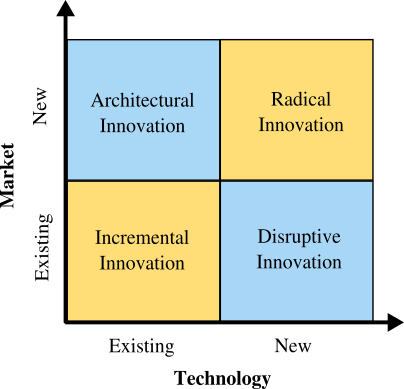
For this post, let’s break down innovation into two dimensions:  Technology and Market, which gives us the following 4 types of innovation:

  1. Incremental Innovation

Incremental Innovation is the most common form of innovation. It utilizes your existing technology and increases value to the customer (features, design changes, etc.) within your existing market. Almost all companies engage in incremental innovation in one form or another.

Examples include adding new features to existing products or services or even removing features (value through simplification). Even small updates to user experience can add value, for example below is an older version of Constant Contact’s email schedule page.

  1. Disruptive Innovation

Disruptive innovation, also known as stealth innovation, involves applying new technology or processes to your company’s current market. It is stealthy in nature since newer tech will often be inferior to existing market technology.   This newer technology is often more expensive, has fewer features, is harder to use, and is not as aesthetically pleasing. It is only after a few iterations that the newer tech surpasses the old and disrupts all existing companies. By then, it might be too late for the established companies to quickly compete with the newer technology.

There are quite a few examples of disruptive innovation, one of the more prominent being Apple’s iPhone disruption of the mobile phone market. Prior to the iPhone, most popular phones relied on buttons, keypads or scroll wheels for user input. The iPhone was the result of a technological movement that was years in making, mostly iterated by Palm Treo phones and personal digital assistants (PDAs). Frequently you will find that it is not the first mover who ends up disrupting the existing market.  In order to disrupt the mobile phone market, Apple had to cobble together an amazing touch screen that had a simple to use interface, and provide users access to a large assortment of built-in and third-party mobile applications.

  1. Architectural Innovation

Architectural innovation is simply taking the lessons, skills and overall technology and applying them within a different market. This innovation is amazing at increasing new customers as long as the new market is receptive. Most of the time, the risk involved in architectural innovation is low due to the reliance and reintroduction of proven technology.   Though most of the time it requires tweaking to match the requirements of the new market.

In 1966, NASA’s Ames Research Center attempted to improve the safety of aircraft cushions. They succeeded by creating a new type of foam, which reacts to the pressure applied to it, yet magically forms back to its original shape.    Originally it was commercially marketed as medical equipment table pads and sports equipment, before having larger success as use in mattresses. This “slow spring back foam” technology falls under architectural innovation. It is commonly known as memory foam.

  1. Radical Innovation

Radical innovation is what we think of mostly when considering innovation. It gives birth to new industries (or swallows existing ones) and involves creating revolutionary technology. The airplane, for example, was not the first mode of transportation, but it is revolutionary as it allowed commercialized air travel to develop and prosper.

The four different types of innovation mentioned here – Incremental, Disruptive, Architectural and Radical – help illustrate the various ways that companies can innovate. There are more ways to innovate than these four. The important thing is to find the type(s) that suit your company and turn those into success.

Innovation Strategies

  1. Proactive

Companies with proactive innovation strategies tend to have strong research orientation and first-mover advantage, and be a technology market leader. They access knowledge from a broad range of sources and take big bets/high risks. Examples include: Dupont, Apple and Singapore Airlines.

The types of technological innovation used in a proactive innovation strategy are:

  • Radical: Breakthroughs that change the nature of products and services
  • Incremental: The constant technological or process changes that lead to improved performance of products and services.
  1. Active

Active innovation strategies involve defending existing technologies and markets while being prepared to respond quickly once markets and technologies are proven. Companies using this approach also have broad sources of knowledge and medium-to-low risk exposure; they tend to hedge their bets. Examples include Microsoft, Dell and British Airways.

These companies use mainly incremental innovation with in-house applied research and development.

  1. Reactive

The reactive innovation strategy is used by companies:

  • Which are followers
  • Have a focus on operations
  • Take a wait-and-see approach
  • Look for low-risk opportunities.

They copy proven innovation and use entirely incremental innovators. An example is Ryanair, a budget airline which has successfully copied the no-frills service model of Southwest Airlines.

  1. Passive

Companies with passive innovation strategies wait until their customers demand a change in their products or services. Examples include automotive supply companies as they wait for their customers to demand changes to specification before implementing these.

error: Content is protected !!