Ethical Decision Making, Basis, Process, Principles

Ethical decision-making is the process of evaluating and choosing actions that align with moral principles, values, and societal norms. It involves considering the consequences of decisions on stakeholders, upholding fairness, and respecting rights and responsibilities. Key steps include identifying the ethical dilemma, gathering relevant information, evaluating alternatives, and choosing the most morally justifiable option. Transparency, integrity, and accountability are essential to ensure trust and credibility. Ethical decision-making fosters a positive organizational culture, enhances reputation, and promotes long-term success. It requires balancing competing interests while adhering to legal and ethical standards. By prioritizing ethical considerations, individuals and organizations can build sustainable relationships, mitigate risks, and contribute to the greater good of society.

Basis for Ethical decisions Making:

  • Moral Principles and Values

Ethical decision-making begins with moral principles and values that define what is considered right or wrong. These include honesty, fairness, justice, integrity, and respect. Decisions guided by these values help ensure that actions align with ethical expectations and promote the well-being of individuals and society. A decision rooted in core moral values is more likely to be universally accepted and respected. These principles act as moral compasses, helping individuals evaluate choices and choose those that reflect responsible and principled conduct, even in difficult or complex situations.

  • Consequences of Actions (Utilitarian Approach)

One of the key bases for ethical decision-making is evaluating the consequences of actions, known as the utilitarian approach. This method focuses on choosing actions that result in the greatest good for the greatest number of people. It emphasizes outcomes—maximizing benefits and minimizing harm. Decision-makers consider how their choices will affect stakeholders and aim for solutions that generate the most overall happiness or value. While practical and widely used, this approach can sometimes overlook the rights of minorities or justify questionable means for achieving positive results.

  • Rights of Individuals

Respecting the rights of individuals is another crucial basis for ethical decisions. This approach emphasizes that certain rights—such as the right to privacy, freedom, equality, and safety—must never be violated, regardless of the outcome. Ethical decisions must honor these rights and avoid using people as means to an end. This foundation helps ensure that each person is treated with dignity and protected from injustice. Even if violating rights benefits the majority, it is still considered unethical under this principle. It aligns closely with legal standards and universal human rights.

  • Duty and Obligation (Deontological Approach)

The duty-based or deontological approach to ethical decision-making focuses on what one ought to do, based on rules, roles, or moral obligations, regardless of the outcomes. It asserts that certain actions are inherently right or wrong. For example, telling the truth is considered a moral duty, even if it leads to uncomfortable consequences. This approach is grounded in the belief that ethical decisions must be consistent, principled, and respectful of moral law. It is especially relevant in professions where ethical codes mandate specific responsibilities and standards of conduct.

  • Justice and Fairness

Justice and fairness serve as an essential basis for ethical decision-making by promoting equality, impartiality, and fair treatment. This approach ensures that individuals are treated consistently and without bias, and that resources, rewards, and punishments are distributed equitably. Ethical decisions should not favor one group over another without valid justification. In business and governance, fairness in hiring, promotion, and customer service are key indicators of ethical behavior. Upholding justice helps build trust, reduce discrimination, and foster a more inclusive and ethical environment.

  • Virtue and Character (Virtue Ethics)

Virtue ethics focuses on the character and moral integrity of the person making the decision rather than rules or outcomes. It asks, “What would a good or virtuous person do?” Virtues like honesty, courage, compassion, and humility guide behavior that is not only legally right but morally admirable. This approach encourages people to develop good habits and moral character over time. Decisions are judged based on whether they reflect and reinforce virtuous behavior. Virtue ethics emphasizes long-term moral growth and ethical consistency in both personal and professional life.

Process for Ethical decisions Making:

Ethical decision-making requires a structured approach to ensure fairness, accountability, and moral responsibility. By following a clear process, individuals and organizations can navigate complex dilemmas while upholding ethical standards.

1. Identify the Ethical Issue

The first step is recognizing that a decision has ethical implications. This involves distinguishing between personal preferences and genuine moral concerns. Ask: Does this situation involve fairness, rights, honesty, or potential harm? For example, a manager must identify whether favoring a friend for promotion over a more qualified candidate is an ethical issue or just a personal choice. Clarity at this stage prevents overlooking critical moral dimensions.

2. Gather Relevant Information

Before making a decision, collect all necessary facts, including legal requirements, organizational policies, and stakeholder perspectives. Missing information can lead to biased or uninformed choices. For instance, a doctor deciding on patient treatment must review medical history, risks, and patient preferences. Consulting experts or ethical guidelines (like corporate codes of conduct) ensures well-rounded understanding.

3. Evaluate Alternatives

Consider all possible courses of action and assess their ethical implications using principles like fairness, honesty, and consequences. Weigh the pros and cons of each option. For example, a company facing environmental concerns might evaluate alternatives like reducing waste, switching suppliers, or ignoring the issue. Tools like cost-benefit analysis or stakeholder impact assessment can help compare choices objectively.

4. Apply Ethical Principles

Use established ethical frameworks (such as utilitarianism, deontology, or virtue ethics) to analyze options. Ask:

  • Which choice does the most good for the most people? (Utilitarianism)

  • Does this action respect everyone’s rights? (Deontology)

  • Would a morally upright person choose this? (Virtue Ethics)
    For instance, a journalist deciding whether to publish sensitive information might balance public interest (beneficence) against privacy rights (autonomy).

5. Make a Decision and Act

After thorough analysis, choose the most ethically justifiable option and implement it. Ensure the decision aligns with core values like integrity and accountability. For example, a business discovering a product defect should recall it despite financial losses, prioritizing consumer safety over profits. Acting decisively demonstrates commitment to ethical principles.

6. Reflect on the Outcome

After implementation, evaluate the results. Did the decision achieve its ethical goals? Were there unintended consequences? Reflection helps improve future decision-making. For instance, a nonprofit reviewing a fundraising campaign’s transparency can adjust strategies to avoid donor mistrust. Continuous learning refines ethical judgment over time.

Principles of Ethical decisions Making:

  • Respect for Autonomy

Autonomy emphasizes respecting individuals’ rights to make their own informed decisions. Ethical decision-making requires acknowledging people’s freedom to choose without coercion. In professional settings, this means obtaining informed consent, maintaining confidentiality, and allowing individuals to exercise their judgment. For example, in healthcare, doctors must respect patients’ choices regarding treatment options while providing necessary information for informed decisions.

  • Beneficence (Doing Good)

Beneficence involves acting in ways that promote the well-being of others. Ethical decisions should aim to maximize positive outcomes while minimizing harm. This principle is crucial in fields like medicine, education, and business, where decisions directly affect people’s lives. For instance, a company may implement workplace safety measures to protect employees, demonstrating a commitment to their welfare beyond legal requirements.

  • Non-Maleficence (Avoiding Harm)

Closely related to beneficence, non-maleficence requires avoiding actions that cause unnecessary harm. Ethical decisions must assess potential risks and prevent damage to individuals or society. In business, this could mean rejecting exploitative labor practices, while in technology, it involves ensuring data privacy to protect users from misuse. The principle underscores the ethical duty to prevent harm proactively.

  • Justice and Fairness

Justice demands equitable treatment and fair distribution of benefits and burdens. Ethical decisions should avoid discrimination and ensure impartiality. In legal systems, justice requires unbiased rulings, while in organizations, it means fair hiring practices and equal opportunities. Social justice extends this principle to addressing systemic inequalities, ensuring marginalized groups receive fair consideration in policies and decisions.

  • Transparency and Accountability

Transparency involves openness in decision-making processes, ensuring stakeholders understand how and why decisions are made. Accountability means taking responsibility for outcomes, whether positive or negative. In corporate governance, transparency builds trust with shareholders, while accountability ensures leaders answer for ethical lapses. Ethical cultures encourage whistleblowing mechanisms to uphold these principles.

  • Integrity and Honesty

Integrity requires consistency between actions and ethical values, while honesty demands truthfulness in communication. Ethical decision-makers must avoid deceit, conflicts of interest, and corruption. For example, financial advisors must disclose potential investment risks honestly, and journalists should report facts without bias. Upholding integrity strengthens credibility and fosters long-term trust.

Ethical Leadership, Legal compliance

Ethical Leadership

Ethical leadership is leadership that is directed by respect for ethical beliefs and values and for the dignity and rights of others. It is thus related to concepts such as trust, honesty, consideration, charisma, and fairness.

Ethics is concerned with the kinds of values and morals an individual or a society finds desirable or appropriate. Furthermore, ethics is concerned with the virtuousness of individuals and their motives. A leader’s choices are also influenced by their moral development.

Theory

Social exchange theory

In social exchange theory the effect of ethical leadership on followers is explained by transactional exchanges between the leader and their followers. The leader’s fairness and caring for followers activates a reciprocatory process, in which the followers act in the same manner towards the leader.

Social learning theory

According to social learning theory ethical leaders acts as role models for their followers. Behavior, such as following ethical practices and taking ethical decisions, are observed, and consequently followed. Rewards and punishments given out by the leader create a second social learning opportunity, that teaches which behavior is acceptably and which is not.

Importance

Leadership that is ethical is important for a variety of reasons, for customers, employees, and the company as a whole. Leadership skills are crucial to help create a positive ethical culture in a company. Leaders can help investors feel that the organization is a good, trustworthy one. Customers are more likely to feel loyal when they see leaders in place in an organization. Good press is likely to come when there are ethical leaders in an organization. Partners and vendors will similarly feel they can trust and work well with an organization when they see leadership that is ethical displayed.

In the short-term, ethical leaders can help boost employee morale and help them feel excited about their management and their work. It can increase positivity and collaboration in your organization and make everyone feel happier to be at work.

In the long-term, ethical leadership can prevent company scandals, ethical dilemmas, and ethical issues. It can also help organizations gain more partnerships and customers, which can lead to more money at the end of the day. Loyal employees are also a crucial element of long-term success for a business.

An effective and ethical leader has the following traits / characteristics:

  • Serving others: He serves others. An ethical leader should place his follower’s interests ahead of his interests. He should be humane. He must act in a manner that is always fruitful for his followers.
  • Dignity and respectfulness: He respects others. An ethical leader should not use his followers as a medium to achieve his personal goals. He should respect their feelings, decision and values. Respecting the followers implies listening effectively to them, being compassionate to them, as well as being liberal in hearing opposing viewpoints. In short, it implies treating the followers in a manner that authenticate their values and beliefs.
  • Justice: He is fair and just. An ethical leader must treat all his followers equally. There should be no personal bias. Wherever some followers are treated differently, the ground for differential treatment should be fair, clear, and built on morality.
  • Honesty: He is loyal and honest. Honesty is essential to be an ethical and effective leader. Honest leaders can be always relied upon and depended upon. They always earn respect of their followers. An honest leader presents the fact and circumstances truly and completely, no matter how critical and harmful the fact may be. He does not misrepresent any fact.
  • Community building: He develops community. An ethical leader considers his own purpose as well as his followers’ purpose, while making efforts to achieve the goals suitable to both of them. He is considerate to the community interests. He does not overlook the followers’ intentions. He works harder for the community goals.

Legal compliance

Legal Governance, Risk Management, and Compliance or “LGRC“, refers to the complex set of processes, rules, tools and systems used by corporate legal departments to adopt, implement and monitor an integrated approach to business problems. While Governance, Risk Management, and Compliance refers to a generalized set of tools for managing a corporation or company, Legal GRC, or LGRC, refers to a specialized but similar set of tools utilized by attorneys, corporate legal departments, general counsel and law firms to govern themselves and their corporations, especially but not exclusively in relation to the law. Other specializations within the realm of governance, risk management and compliance include IT GRC and financial GRC. Within these three realms, there is a great deal of overlap, particularly in large corporations that have legal and IT departments, as well as financial departments.

Legal compliance is the process or procedure to ensure that an organization follows relevant laws, regulations and business rules. The definition of legal compliance, especially in the context of corporate legal departments, has recently been expanded to include understanding and adhering to ethical codes within entire professions, as well. There are two requirements for an enterprise to be compliant with the law, first its policies need to be consistent with the law. Second, its policies need to be complete with respect to the law. The role of legal compliance has also been expanded to include self-monitoring the non-governed behavior with industries and corporations that could lead to workplace indiscretions. Within the LGRC realm, it is important to keep in mind that if a strong legal governance component is in place, risk can be accurately assessed and the monitoring of legal compliance be carried out efficiently. It is also important to realize that within the LGRC framework, legal teams work closely with executive teams and other business departments to align their goals and ensure proper communication.

Legal consistency

Legal consistency is a property that declares enterprise policies to be free of contradictions with the law. Legal consistency has been defined as not having multiple verdicts for the same case. The antonym Legal inconsistency is defined as having two rule that contradict each other. Other common definitions of consistency refer to “treating similar cases alike”. In the enterprise context, legal consistency refers to “obedience to the law”. In the context of legal requirements validation, legal consistency is defined as, ” Enterprise requirements are legally consistent if they adhere to the legal requirements and include no contradictions.”

Legal completeness

Legal completeness is a property that declares enterprise policies to cover all scenarios included or suggested by the law. Completeness suggests that there are no scenarios covered by the law that cannot be implemented in the enterprise. In addition, it implies that all scenarios not allowed by the law are not allowed by the enterprise.

Enterprise policies are said to be legally complete if they contain no gaps in the legal sense. Completeness can be thought of in two ways: Some scholars make use of a concept of ‘obligational’ completeness such as Ayres and Gertner. According to this usage, a system or a contract is ‘obligationally’ complete if it specifies what each party is to do in every situation, even if this is not the optimal action to take under some circumstances. Others discuss ‘enforceability’ completeness in the sense that failing to specify key terms can lead a court to characterize a system as being too uncertain to enforce, and hence a system may be complete with respect to enforceability. This leads to the following definition: enterprise regulations or requirements are legally complete if it specifies what each party is to do in each situation while covering all gaps in the legal sense.

Marginal Costing for Decision Making

Marginal costing system is not a method of costing like job or batch costing or process costing or contract costing or operating costing which are used for the purpose of calculating the cost of products or services.

Marginal costing is very helpful in managerial decision making. Management’s production and cost and sales decisions may be easily affected from marginal costing. That is the reason, it is the part of cost control method of costing accounting. Before explaining the application of marginal costing in managerial decision making, we are providing little introduction to those who are new for understanding this important concept.

Marginal costing is used for managerial decision-making. It can be used in conjunction with any method of costing, such as job costing or process costing. It can also be used with other techniques of costing like standard costing and budgetary control. In this, only variable cost are considered.

Marginal cost is change in total cost due to increase or decrease one unit or output. It is technique to show the effect on net profit if we classified total cost in variable cost and fixed cost. The ascertainment of marginal costs and of the effect on profit of changes in volume or type of output by differentiating between fixed costs and variable costs. In marginal costing, marginal cost is always equal to variable cost or cost of goods sold. We must know following formulae

a) Contribution ( Per unit) = Sale per unit – Variable Cost per unit

b) Total profit or loss = Total Contribution – Total Fixed Costs

or  Contribution = Fixed Cost + Profit

or  Profit = Contribution – Fixed Cost

c) Profit Volume Ratio = Contribution/ Sale X 100 (It means if we sell Rs. 100 product, what will be our contribution margin, more contribution margin means more profit)

d) Break Even Point is a point where Total sale = Total Cost

e) Break Even Point (In unit) = Total Fixed expenses / Contribution

f) Break Even Point (In Sales Value) = Breakeven point (in units) X Selling price per unit

g) Break Even Point at earning of specific net profit margin = Total Contribution / Contribution per unit

or = fixed cost + profit / selling price – variable cost per unit

Profits Planning:

The process of profit planning involves the calculation of expected costs and revenues arising out of operations at different levels of plant capacity for the production of different types of goods during a given period of time. The cost and revenues at different level of operating are different and a concern has to choose one level at which its profits are maximum.

Pricing in Home and Foreign Markets:

Pricing of a product is governed primarily by its cost of production and the nature of competition being faced by the production unit. Once a price is fixed by market forces, it remains stable at least in the short period. During short period when selling period, marginal cost and fixed costs remain the same, an entrepreneur is in a position to establish relationship between them.

On the basis of such a relationship, it is very easy to fix the volume of sales and selling price during normal and abnormal times in the home market. How far the prices can be cut in case of foreign buyer to effect additional sales is a problem which is realistically answered by the marginal costing technique.

Pricing in Foreign Markets:

A foreign market can be kept separate from the domestic market due to many legal and other restrictions imposed on imports and exports and as such a different price can be charged from foreign buyers. Any company which enjoys surplus production capacity can increase its production to sell in the foreign market at lower price if its full fixed cost already stands recovered from the production from home market.

Price under Recession/Depression:

Recession is an economic condition under which demand is declining. During depression the demand is at its lowest ebb, and the firms are confronted with the problem of price reduction and closure of production. Under such conditions, the marginal costing technique suggests that prices can be reduced to a level of marginal cost. In that case, the firm will lose profits and also suffer loss to the extent of fixed costs. This loss will also be borne even if the production is suspended altogether. Selling below marginal cost is advisable only under very special circumstances.

Determining Profitability of Alternative Product-Mix:

Since the objective of an enterprise to maximise profits, the management would prefer that product-mix which is ideal one in the sense that it yields maximum profits. Products-mix means combination of products which is intended for production and sales. A firm producing more than one product has to ascertain the profitability of alternative combinations of units or values of products and select the one which maximises profits.

Production with Limiting Factor:

Sometimes, production has to be carried with certain limiting factor. A limiting factor is the factor the supply of which is not unlimited or freely available to the manufacturing enterprise. In case of labour shortages, the labour becomes limiting factor. Raw material or plant capacity may be a limiting factor during budget period.

The consideration of limiting factors is essential for the success of any production plan because the manufacturing firm cannot increase the production to the level it desire when a limiting factor is combined with other factors of production. The limiting factor is also called by the name of ‘scarce factor’ or ‘key factor,’ ‘principal budget factor’ or ‘governing factor.’

Make or Buy Decision (When Plant is not Fully Utilised):

If the similar product or component is available outside, then a manufacturing firm compares its unit cost of manufacture with the price at which it can be purchased from the market. The marginal cost analysis suggests that it is profitable to the total manufacturing cost. In other words the firm should prefer to buy if the marginal cost is more than the Bought-out price and Make when the marginal cost is lesser than the purchase price. However, the available plant capacity will exert its own influence in such a decision-making.

Equation:

Firm should buy when PP+FC is lesser than total cost of manufacture

Firm should manufacture when PP+FC is greater than total cost of manufacture

Expand or Buy Decision:

In case unused capacity is limited or does not exist, then an alternative to buying is to make by purchasing additional plant and other equipment. The firm should evaluate the capital expenditure proposal resulting out of expansion programme in terms of cash flows and cost of capital. If the installed capacity of the existing plant is partially being used, then it can be utilised by producing more internally. The additional production may necessitate purchase of some specialised equipment and thus involve interest and depreciation cost. It is advisable to expand and produce if the enterprise is able to save some costs by doing so.

Ascertaining Relative Profitability of Products:

A manufacturing concern engaged in the production of various products is interested in the study of the relative profitability of its products so that it may suitably change its production and sales policies in case of those products which it considers less profitable or unproductive. The concept of P/V Ratio provided by the marginal costing technique is much helpful in understanding the relative profit/ability of products. It is always profitable to encourage the production of that product which shows a higher P/V ratio.

Sometimes, the management is confronted with a problem of loss and it has to decide whether to continue or abandon the production of a particular product which has resulted in a net loss. Marginal costing technique properly guides the management in such a situation. If a product or department shows loss, the Absorption Costing method would hastily conclude that it is of no use of produce and run the department and it should be close down.

Sometimes this type of conclusion will mislead the management. The marginal costing technique would suggest that it would be profitable to continue the production of a product if it is able to recover the full marginal cost and a part of the fixed cost.

Micro Economics, Meaning, Objectives, Scope, Limitations, Microeconomic Issues in Business

The wordmicro is derived from the Greek word ‘mickros’ meaning small.

Microeconomics is a branch of economics that studies the behavior and decision-making processes of individual economic units such as consumers, households, firms, and industries. It focuses on how these units interact within markets to allocate scarce resources and determine prices, output levels, and the distribution of goods and services. The term “micro” means small; thus, microeconomics analyzes the economy at a smaller, more detailed level.

One of the key objectives of microeconomics is to understand how individuals and firms respond to changes in prices, incomes, and market conditions. It examines demand and supply, consumer preferences, utility maximization, cost of production, and profit maximization. These concepts help in understanding how equilibrium is achieved in various markets and how resources are efficiently distributed among alternative uses.

Microeconomics also studies various types of market structures such as perfect competition, monopoly, monopolistic competition, and oligopoly. Each structure has different implications for pricing, output, and consumer welfare. It also covers the theory of factor pricing, explaining how wages, rent, interest, and profits are determined in factor markets.

This field of economics is essential for business decision-making as it provides tools to analyze market trends, forecast consumer behavior, set competitive prices, and maximize profits. Microeconomic principles are also applied in public policy, especially in areas like taxation, subsidy design, and regulation.

In summary, microeconomics provides a detailed understanding of the functioning of individual parts of the economy and is fundamental for making informed and rational economic decisions.

Objectives of Microeconomics:

  • Understanding Consumer Behavior

One of the primary objectives of microeconomics is to understand how consumers make choices based on their income, preferences, and prices of goods. It analyzes how individuals maximize their satisfaction or utility within budget constraints. Microeconomics uses concepts like the law of demand, indifference curves, and marginal utility to explain consumption patterns. This understanding helps businesses in demand forecasting and pricing, and assists policymakers in crafting policies related to subsidies, taxation, and welfare programs.

  • Analyzing Production Decisions

Microeconomics studies how firms decide what to produce, how much to produce, and the methods of production. It focuses on cost structures, production functions, and input-output relationships to understand the optimal utilization of resources. The goal is to minimize cost and maximize output and profit. This analysis helps managers make decisions regarding resource allocation, process improvement, and investment in technology. It also helps determine economies of scale and efficiency in production systems.

  • Price Determination in Markets

A key objective of microeconomics is to analyze how prices are determined in different types of markets. It explains how the forces of demand and supply interact to reach equilibrium price and quantity. Microeconomics also studies how prices change in response to shifts in market conditions. Understanding price determination is essential for business strategy, as it impacts revenue, market competition, and consumer behavior. It also guides policy on price controls and subsidies.

  • Allocation of Resources

Efficient allocation of scarce resources is central to microeconomic theory. It seeks to understand how limited resources can be distributed optimally among competing uses to maximize output and welfare. Microeconomics examines how households and firms allocate resources based on prices, costs, and preferences. It helps in evaluating market efficiency and the role of price signals in guiding production and consumption. Proper resource allocation leads to increased productivity and economic growth.

  • Understanding Market Structures

Microeconomics analyzes different market structures—perfect competition, monopoly, monopolistic competition, and oligopoly—to understand how they influence prices, output, and efficiency. Each structure affects the degree of competition and consumer welfare differently. Studying these structures helps in assessing market performance and the behavior of firms under varying competitive pressures. It is vital for regulatory bodies to identify anti-competitive practices and ensure a fair marketplace through policy and legal measures.

  • Distribution of Income and Wealth

Microeconomics explores how income and wealth are distributed among the factors of production—land, labor, capital, and entrepreneurship. It studies the pricing of these factors through rent, wages, interest, and profit. The objective is to understand economic inequalities and suggest ways to ensure fair distribution. This helps governments in formulating labor laws, wage policies, and social welfare programs. It also informs debates on income taxation and economic justice.

  • Welfare and Efficiency Analysis

Microeconomics aims to maximize social welfare by studying economic efficiency. It analyzes conditions for achieving allocative efficiency (optimal allocation of resources) and productive efficiency (maximum output with minimum cost). Concepts like consumer surplus, producer surplus, and Pareto efficiency are used to evaluate welfare. It helps identify market failures and the need for government intervention in case of externalities, public goods, or monopolistic exploitation.

  • Business Decision-Making

Microeconomics provides a framework for rational business decision-making. Firms use microeconomic tools to determine pricing strategies, production levels, input combinations, and market entry or exit. Understanding cost curves, demand elasticity, and competitive dynamics allows firms to optimize profit and market share. Microeconomics also supports risk analysis and forecasting, making it essential for strategic planning, budgeting, and resource management in businesses of all sizes.

Scope of Microeconomics

  • Theory of Consumer Behavior

The theory of consumer behavior studies how individuals make purchasing decisions based on income, preferences, and prices of goods. It aims to understand how consumers maximize their satisfaction (utility) with limited resources. Tools such as utility analysis, indifference curves, and budget constraints are used in this study. Understanding this behavior is crucial for businesses in product positioning, pricing strategies, and demand forecasting. It also guides policymakers in framing subsidies and welfare programs.

  • Theory of Production

The theory of production focuses on how businesses convert inputs like labor, capital, and raw materials into outputs (goods and services). It analyzes production functions, input-output relationships, and cost structures. The aim is to achieve maximum output at minimum cost. It also explains the laws of variable proportions and returns to scale. This helps firms optimize resource use, select the best production techniques, and improve efficiency for better profitability and competitiveness.

  • Theory of Cost

The cost theory in microeconomics explores how the cost of production changes with varying levels of output. It includes concepts such as fixed cost, variable cost, marginal cost, and average cost. The theory helps firms understand cost behavior, manage expenses, and plan pricing strategies. Cost analysis is essential for break-even analysis, budgeting, and profitability assessment. It allows businesses to control costs and increase operational efficiency by identifying wastage and improving productivity.

  • Price Theory and Market Structures

Price theory explains how the prices of goods and services are determined in different types of markets such as perfect competition, monopoly, monopolistic competition, and oligopoly. It examines the interaction of demand and supply forces and how equilibrium is reached. This part of microeconomics is critical for understanding pricing policies, consumer choices, and firm behavior. It helps both businesses and regulators identify competitive practices and set strategic pricing for market survival.

  • Theory of Factor Pricing

Factor pricing refers to the determination of rewards for the factors of production—land, labor, capital, and entrepreneurship. Microeconomics studies how wages, rent, interest, and profits are set in the factor markets. These prices influence income distribution in an economy. This theory is important for understanding labor markets, investment decisions, and resource allocation. It helps firms design compensation strategies and governments formulate fair wage and interest policies for economic balance.

  • Welfare Economics

Welfare economics is a branch of microeconomics that evaluates how resource allocation affects overall economic well-being and social welfare. It uses concepts like consumer surplus, producer surplus, and Pareto efficiency to measure welfare. This study helps identify whether markets are delivering maximum benefit to society and when government intervention is needed. It is particularly relevant in analyzing public goods, externalities, and economic inequality, and supports policies aimed at improving quality of life and equity.

  • Theory of Demand and Supply

The theory of demand and supply is foundational in microeconomics. It explains how the quantity of a good demanded and supplied varies with its price, and how equilibrium is achieved in markets. Demand theory includes the law of demand, elasticity, and consumer preferences. Supply theory focuses on production capabilities and costs. This theory is used for price setting, inventory management, and production planning, making it crucial for both private businesses and public policy.

  • Microeconomic Policy Application

Microeconomics provides the basis for several policy applications, such as taxation, price control, market regulation, and subsidy design. Policymakers use microeconomic principles to address market failures, ensure competitive practices, and correct income inequalities. It also aids in creating sector-specific strategies—for agriculture, labor markets, small businesses, etc. For businesses, it helps in strategic planning, resource optimization, and market analysis. Thus, microeconomics offers a practical toolkit for decision-making in both private and public sectors.

Limitations of Micro-economics:

  • Ignores the Broader Economic Picture

Microeconomics focuses on individual units like consumers and firms, but it does not consider the economy as a whole. It cannot explain large-scale economic problems such as inflation, unemployment, and national income. For instance, even if individual industries perform efficiently, the overall economy may still face a recession. Therefore, microeconomics is insufficient for understanding macroeconomic challenges and requires supplementation with macroeconomic perspectives to form a comprehensive analysis of an economy.

  • Unrealistic Assumptions

Microeconomic theories often rely on unrealistic assumptions such as rational behavior, perfect competition, and full employment. In reality, markets are imperfect, information is limited, and people often act irrationally. These assumptions may simplify analysis but limit the applicability of theories to real-world situations. For example, the assumption that consumers always make utility-maximizing decisions does not hold in many behavioral situations, reducing the practical relevance of some microeconomic models.

  • Neglect of Social and Ethical Factors

Microeconomics mainly emphasizes efficiency and profit maximization, often ignoring social justice, ethical concerns, and income inequality. It does not adequately address the needs of marginalized sections of society or the ethical implications of business decisions. For example, a firm may maximize profits by paying low wages, which may be economically efficient but socially unjust. Thus, microeconomics may not provide solutions aligned with fairness or equity.

  • Limited Role in Policy Formulation

While microeconomics provides tools for business decisions, its usefulness in formulating wide-ranging economic policies is limited. Issues like monetary policy, fiscal policy, and national development strategies fall under macroeconomics. Microeconomics does not adequately address the complexities involved in these areas. For example, while it can explain the pricing of a single commodity, it cannot guide decisions about national investment or inflation control, which require macroeconomic insights.

  • Static in Nature

Microeconomics is often criticized for being static. Many of its models do not consider the dynamic nature of economies where preferences, technology, and market conditions constantly change. For example, classical microeconomic models assume fixed tastes and production functions, which are not true in evolving economies. This static nature limits its ability to predict long-term trends or respond to economic disruptions, technological advances, and changing social behavior.

  • No Solution to Aggregate Problems

Microeconomics cannot address problems like economic growth, business cycles, or trade imbalances, as it does not deal with aggregate economic variables. For instance, analyzing a single firm’s output cannot help understand a country’s GDP growth. It also does not account for aggregate demand and supply forces that drive national income and employment levels. Hence, microeconomics is inadequate for solving broad economic problems affecting the entire nation or global markets.

  • Overemphasis on Individual Decisions

Microeconomics places too much importance on individual choices and neglects collective behavior and institutional influence. It fails to capture the role of governments, trade unions, multinational corporations, and other institutions in shaping economic outcomes. This overemphasis makes it less effective in analyzing complex economic systems where collective actions and regulations play a crucial role in determining outcomes like wage levels, labor rights, and social security.

  • Difficulty in Measuring Utility and Satisfaction

Microeconomic theories are heavily based on the idea of utility maximization. However, utility and satisfaction are subjective and cannot be measured accurately. While tools like indifference curves offer graphical representation, they cannot quantify individual satisfaction precisely. This makes it difficult to apply microeconomic concepts reliably in real-world decision-making. The abstract nature of such concepts reduces their effectiveness in analyzing and improving actual consumer behavior or welfare.

Microeconomic Issues in Business:

  • Pricing Strategy

One of the most critical microeconomic issues for businesses is setting the right price for their products or services. Pricing depends on demand, cost of production, competitor behavior, and perceived customer value. Firms must understand price elasticity, marginal cost, and consumer preferences to make informed decisions. Incorrect pricing can lead to reduced demand, loss of competitiveness, or reduced profits. Microeconomics provides tools like demand-supply analysis and marginal analysis to set optimal pricing strategies.

  • Demand Forecasting

Demand forecasting helps businesses predict future customer demand to plan production, inventory, and marketing strategies. It is influenced by factors like income levels, consumer preferences, market trends, and price changes. Microeconomics analyzes consumer behavior and demand curves to make accurate forecasts. Errors in forecasting can lead to overproduction or stockouts, affecting profitability. Thus, understanding the determinants of demand is crucial for efficient resource planning and market success.

  • Cost and Production Decisions

Microeconomics assists businesses in understanding how costs behave with changes in production levels. It helps distinguish between fixed and variable costs, calculate marginal and average costs, and determine the most cost-effective production level. Businesses use this information for budgeting, pricing, and profit planning. Efficient cost management leads to higher profitability, while poor cost control can erode competitive advantage. Microeconomic tools help firms optimize input combinations and production methods.

  • Market Competition and Structure

Understanding the type of market a business operates in—perfect competition, monopoly, monopolistic competition, or oligopoly—is crucial. Each market structure has different rules for pricing, entry, product differentiation, and consumer behavior. Microeconomics provides insights into competitive strategies, pricing power, and market behavior. For example, in an oligopoly, businesses must consider the actions of rivals when making decisions. Knowing the market structure helps in strategic planning and long-term positioning.

  • Resource Allocation

Businesses must allocate limited resources—labor, capital, time—efficiently to various functions like production, marketing, and R&D. Microeconomics helps determine the optimal allocation of these resources to maximize output or profit. Concepts such as opportunity cost and marginal productivity guide decision-making. Inefficient resource use leads to higher costs and lower productivity. Understanding microeconomic principles enables managers to make informed choices that align with the company’s goals and market demands.

  • Labor and Wage Issues

Labor is a key factor of production, and wage determination is a critical issue for businesses. Microeconomics studies the labor market, supply and demand for workers, and factors influencing wage rates. Businesses must decide wage levels, incentives, and employee benefits by considering productivity, labor laws, and market wage trends. Overpaying or underpaying affects profitability and employee morale. Understanding labor economics helps businesses design effective human resource policies and manage costs efficiently.

  • Profit Maximization

The primary objective of most businesses is to maximize profit. Microeconomics provides the tools to determine the output level where marginal cost equals marginal revenue, the point of maximum profit. It also helps analyze how changes in cost, output, and demand affect profitability. Profit maximization strategies include cost control, efficient pricing, and market expansion. Using microeconomic analysis, firms can identify profit leakages and develop long-term strategies for financial sustainability.

  • Government Regulations and Taxation

Microeconomic decisions are also influenced by government policies such as taxes, price controls, subsidies, and regulations. Businesses must understand how these factors affect costs, pricing, and profitability. For instance, an increase in GST may reduce consumer demand, or a subsidy may lower production costs. Microeconomic analysis helps businesses assess the impact of policy changes and respond proactively. It also assists in compliance and strategic planning within the regulatory framework.

Types of Business Law

Tax Law

In terms of business law, taxation refers to taxes charged upon companies in the commercial sector. It is the obligation of all companies (except a few tax-exempted small-time companies) to pay their taxes on time, failure to follow through which will be a violation of corporate tax laws.

Securities Law

Securities refer to assets like shares in the stock market and other sources of capital growth and accumulation. Securities law prohibits businesspersons from conducting fraudulent activities from taking place in the securities market. This is the business law section which penalises securities fraud, such as insider trading. It is, thus, also called Capital Markets Law.

Intellectual property Tax

Intellectual property refers to the intangible products of the working of the human mind or intellect, which are under the sole ownership of a single entity, such as an individual or company. The validation of this ownership is provided by intellectual property law, which incorporates trademarks, patents, trade secrets and copyrights.

Contract Law

A contract is any document which creates a sort of legal obligation between the parties that sign it. Contracts refer to those employee contracts, sale of goods contracts, lease contracts, etc.

Companies Act,2013

With an unprecedented change in the domestic and international economic landscape, India’s Government decided to replace the Companies Act, 1956, with the new legislation. The Companies Act, 2013, endeavors to make the corporate regulations in India more contemporary. In this article, we will focus on the meaning and features of a Company.

The Companies Act, 2013, completely revolutionized India’s corporate laws by introducing several new concepts that did not exist previously. One such game-changer was the introduction of the One Person Company concept. This led to the recognition of an entirely new way of starting businesses that accorded flexibility which a company form of entity can offer, while also providing the protection of limited liability that sole proprietorship or partnerships lacked.

Thus, as we can see, commercial contracts are a very essential part of the business world. Any business during its operation needs to follow all these laws, whether willfully or not. Thus, a person with any venture needs very substantial legal assistance so that any clash in legal matters won’t harm your endeavors.

The Limited Liability Partnership Act, 2008

LLP stands for a Limited Liability Partnership. Limited liability partnership definition is an alternative corporate business form that offers the benefits of limited liability to the partners at low compliance costs. It also allows the partners to organize their internal structure like a traditional partnership. A limited liability partnership is a legal body liable for the full extent of its assets. The liability of the partners, however, is limited. Hence, LLP is a hybrid between a company and a partnership. It is not the same as a limited liability company LLC.

The Indian Partnership Act,1932

The Indian Partnership Act 1932 defines a partnership as a relation between two or more parties to agree to share a business’s profits, either all or only one or more persons acting for them all. A partnership is contractual in nature. As the definition states, a partnership is an association of two or more persons. So a partnership results from a contract or an agreement between two or more persons. A partnership does not arise from the operation of law. Neither can it be inherited. It has to be a voluntary agreement between partners. A partnership agreement can be written or oral. Sometimes such an arrangement is even implied by the continued actions and mutual understanding of the partners.

The Sale of Goods Act,1930

Contracts and agreements regarding the sale of goods and services are governed under the Sale of Goods ACT, 1930. The sale of commodities constitutes one of the essential types of contracts under the law in India. India is one of the largest economies and a great country where and thus has adequate checks and measures to ensure its business and commerce community’s safety and prosperity. Here we shall explain The Sale of Goods Act, 1930, which defines and states terms related to the sale of goods and exchange of commodities.

The Indian Contract Act, 1872

It is the most prominent business law to exist in our country. It came into effect on 1st September 1872 and applied to the whole of India, with the exception of Jammu and Kashmir. It constitutes 266 sections. The Indian Contracts Act,1872 defines the essentials through various judgments in the Indian judiciary. Specific points for valid contracts are Free consent, consideration, competency, eligibility, etc. A valid contract must include at least two parties, or it will be deemed as null and void.

Employee Coaching Meaning, Definitions, Objectives, Types

Employee Coaching is a development process that involves guiding and supporting employees to enhance their skills, performance, and potential in their work environment. It is an interactive process where managers, supervisors, or external coaches help employees identify their goals, overcome challenges, and improve their abilities. The aim is to foster a culture of continuous learning, development, and growth within the organization. Coaching is different from traditional training as it focuses more on individual guidance, personal growth, and real-time feedback, rather than simply imparting information.

Definitions of Employee Coaching:

  • International Coach Federation (ICF):

Coaching is defined as “partnering with clients in a thought-provoking and creative process that inspires them to maximize their personal and professional potential.”

  • Paul J. Meyer:

Coaching is “the process of helping people discover and develop their potential and empower them to become their best selves.”

  • Harvard Business Review:

Coaching is “an interactive process designed to help individuals or groups improve their performance and reach specific goals.”

  • Sir John Whitmore:

Coaching is unlocking a person’s potential to maximize their own performance. It is helping them to learn rather than teaching them.

  • Society for Human Resource Management (SHRM):

Employee coaching is defined as “a means of developing and guiding employees through close, supportive interaction, and real-time feedback to improve their performance.”

Objectives of Employee Coaching:

  • Enhancing Employee Performance:

One of the primary objectives of coaching is to help employees improve their work performance by identifying areas where they can grow and providing the tools, guidance, and support to achieve better results.

  • Developing Skills and Competencies:

Coaching aims to enhance the skills, competencies, and knowledge of employees. By focusing on both technical and soft skills, coaching helps individuals become more proficient in their roles, enabling them to meet job demands more effectively.

  • Building Confidence and Self-Awareness:

Through coaching, employees gain greater self-awareness and confidence. Coaches help individuals understand their strengths and areas for improvement, which leads to enhanced self-esteem and better decision-making.

  • Facilitating Career Development:

Coaching supports employees in mapping out their career paths, identifying opportunities for advancement, and setting actionable goals. It provides guidance on how to achieve long-term career objectives and develop leadership qualities.

  • Increasing Motivation and Engagement:

Effective coaching helps to increase employee engagement by showing them that the organization values their development. By offering personalized guidance and support, coaching enhances employee motivation and commitment to the organization.

  • Improving Problem-Solving Skills:

Coaching encourages employees to think critically and develop solutions to their own problems. It promotes creative problem-solving, empowering employees to handle complex challenges with confidence and independence.

  • Aligning Employee Goals with Organizational Objectives:

Coaching ensures that individual employee goals align with the broader objectives of the organization. It helps bridge the gap between personal aspirations and organizational expectations, creating a sense of shared purpose and commitment.

Types of Employee Coaching:

  • Performance Coaching:

Performance coaching focuses on improving an employee’s current performance in their specific job role. It helps employees meet performance expectations, enhance productivity, and address any areas of concern. The goal is to identify performance gaps and work collaboratively to close them through constructive feedback and actionable plans.

  • Career Coaching:

Career coaching is centered around an employee’s long-term career aspirations. It helps employees explore opportunities for career advancement, identify their strengths, and develop a roadmap for achieving their career goals. Career coaching often includes mentorship and guidance on skill development, leadership preparation, and navigating career transitions.

  • Executive Coaching:

Executive coaching is designed for leaders, managers, and high-potential employees who are being groomed for leadership roles. It helps individuals develop critical leadership competencies, such as decision-making, emotional intelligence, conflict resolution, and strategic thinking. The focus is on enhancing leadership abilities and aligning personal development with the organization’s strategic goals.

  • Team Coaching:

Team coaching involves working with an entire team to improve communication, collaboration, and effectiveness. The coach helps team members understand their roles within the group, resolve conflicts, and work toward shared objectives. The goal of team coaching is to improve overall team performance and foster a cohesive, high-performing unit.

  • Skills Coaching:

Skills coaching focuses on helping employees develop specific technical or soft skills needed for their roles. This could include training in areas such as communication, negotiation, time management, or project management. Skills coaching is often short-term and targets immediate skill gaps that need to be addressed to improve job performance.

  • Behavioral Coaching:

Behavioral coaching addresses an employee’s behavior in the workplace, helping them to improve their interpersonal relationships, adaptability, and emotional intelligence. This type of coaching is often used to correct behaviors that may be hindering an employee’s success or negatively affecting team dynamics, such as poor communication, resistance to feedback, or lack of collaboration.

  • Onboarding Coaching:

Onboarding coaching is aimed at helping new employees acclimate to the organization and their new roles. It provides guidance on company culture, expectations, and processes. Onboarding coaching helps new hires become productive more quickly by offering personalized support during their transition into the organization.

  • Leadership Coaching:

Leadership coaching is designed to help current or aspiring leaders develop the qualities needed to lead teams effectively. It focuses on building leadership skills such as communication, delegation, team building, and strategic thinking. Leadership coaching is often used to prepare high-potential employees for management roles or to enhance the abilities of existing leaders.

  • Personal Development Coaching:

This type of coaching focuses on helping employees grow on a personal level, which can impact their professional lives. Personal development coaching might involve helping employees build resilience, manage stress, or improve work-life balance. The idea is that by improving personal aspects of life, employees will also see improvements in their professional performance.

Identification of Five Dark Qualities in an Individual Before the Selection and Placement Process

In the selection and placement process, identifying potential candidates’ dark qualities or negative traits is crucial for ensuring a positive and productive workplace. Dark qualities can adversely impact team dynamics, organizational culture, and overall performance.

  1. Narcissism

Narcissism refers to an excessive focus on oneself, often manifesting as a grandiose sense of self-importance, a need for admiration, and a lack of empathy for others. Individuals with narcissistic tendencies often display characteristics such as arrogance, entitlement, and a tendency to exploit others for personal gain.

Identification Techniques:

To identify narcissistic traits in candidates, organizations can employ various techniques:

  • Behavioral Interviews: Ask situational questions that reveal how candidates handle teamwork, feedback, and conflict. For example, inquire about a time they faced criticism and how they responded.
  • Psychometric Assessments: Utilize personality tests designed to measure narcissism levels, such as the Narcissistic Personality Inventory (NPI). These assessments provide insight into the candidate’s self-perception and interpersonal dynamics.
  • Reference Checks: Gather feedback from former colleagues or supervisors regarding the candidate’s interpersonal relationships, focusing on any signs of entitlement or manipulation.

Impact on Workplace:

Narcissistic individuals can disrupt team cohesion, foster a toxic work environment, and undermine collaboration. Their self-centeredness may lead to conflicts, poor morale, and high turnover rates.

  1. Machiavellianism

Machiavellianism is characterized by manipulative behavior, deceitfulness, and a focus on self-interest. Individuals displaying this quality often prioritize personal gain over ethical considerations and may use cunning tactics to achieve their goals.

Identification Techniques:

To identify Machiavellian traits, organizations can implement the following methods:

  • Situational Judgment Tests (SJTs): Present candidates with hypothetical scenarios involving ethical dilemmas or conflict resolution. Assess their responses to gauge their propensity for manipulation or unethical behavior.
  • Behavioral Assessments: Inquire about past experiences where candidates had to influence others or navigate complex interpersonal dynamics. Look for indications of deceit or a lack of ethical considerations.
  • Reference Evaluations: Seek insights from references regarding the candidate’s integrity, ability to collaborate, and approach to ethical dilemmas in previous roles.

Impact on Workplace:

Machiavellian individuals can create a culture of distrust, where manipulation and deceit thrive. Their behavior can lead to toxic competition, decreased employee morale, and unethical practices within the organization.

  1. Psychopathy

Psychopathy is characterized by a lack of empathy, remorse, and guilt, often accompanied by impulsivity and antisocial behavior. Individuals with psychopathic traits may exhibit charm and charisma while lacking genuine emotional connections with others.

Identification Techniques:

Identifying psychopathic traits requires careful assessment:

  • Clinical Assessments: Utilize standardized psychological tests, such as the Hare Psychopathy Checklist-Revised (PCL-R), to evaluate psychopathic tendencies.
  • Behavioral Interviews: Ask candidates about their responses to morally ambiguous situations and how they handle interpersonal relationships. Look for signs of emotional detachment or disregard for others’ feelings.
  • Group Exercises: Observe candidates in group settings to assess their interactions and emotional responses. Psychopathic individuals may exhibit manipulative behaviors or lack genuine concern for team dynamics.

Impact on Workplace:

Psychopathic individuals can severely disrupt workplace dynamics, creating an environment marked by fear and distrust. Their manipulative tendencies may lead to unethical behavior, high turnover, and increased conflict among employees.

  1. Authoritarianism

Authoritarianism is characterized by a strong desire for control, a rigid adherence to rules, and a tendency to dominate others. Authoritarian individuals often display traits such as intolerance for dissent, a lack of flexibility, and a need for submission from others.

Identification Techniques:

To identify authoritarian traits, organizations can use the following approaches:

  • Personality Assessments: Utilize tools like the California Psychological Inventory (CPI) to measure authoritarian tendencies and related characteristics, such as dominance and rigidity.
  • Behavioral Interviews: Ask candidates about their leadership style, decision-making processes, and responses to differing opinions. Look for indications of intolerance for dissent or inflexible attitudes.
  • Role-Playing Exercises: Conduct role-playing scenarios that simulate conflict resolution or team collaboration. Observe candidates’ responses to differing viewpoints and their willingness to compromise.

Impact on Workplace:

Authoritarian individuals can stifle creativity, inhibit open communication, and create a culture of fear. Their rigid approach may lead to low employee engagement, high turnover, and decreased innovation.

  1. Resentment and Cynicism

Resentment and cynicism refer to a pervasive negative outlook on life, characterized by distrust, bitterness, and a belief that others act primarily out of self-interest. Individuals displaying these traits often have a pessimistic view of organizations and their leadership.

Identification Techniques:

To identify resentment and cynicism, organizations can employ these methods:

  • Behavioral Interviews: Ask candidates about their perspectives on workplace culture, leadership, and team dynamics. Look for signs of bitterness, negative generalizations, or dismissive attitudes.
  • Group Discussions: Facilitate group discussions or team exercises where candidates express their views on workplace challenges. Observe their responses for indications of cynicism or negativity.
  • Reference Checks: Inquire with references about the candidate’s attitude towards their previous organizations, focusing on any signs of resentment or bitterness.

Impact on Workplace:

Cynical individuals can negatively influence team morale and foster a toxic work environment. Their bitterness may lead to disengagement, decreased collaboration, and a lack of trust in leadership.

Differences between personnel Management and Human Resources Development

Personnel Management is a part of management that deals with the recruitment, hiring, staffing, development, and compensation of the workforce and their relation with the organization to achieve the organizational objectives. The primary functions of the personnel management are divided into two categories:

  • Operative Functions: The activities that are concerned with procurement, development, compensation, job evaluation, employee welfare, utilization, maintenance and collective bargaining.
  • Managerial Function: Planning, Organizing, Directing, Motivation, Control, and Coordination are the basic managerial activities performed by Personnel Management.

Human Resource Development

Human resource development (HRD) is defined as the cultivation of an organization’s employees. It entails providing workers with skills and relevant knowledge that may help them to grow in the workplace. That makes human resource development an integral part of human resource management.

HRD starts with a clear vision for employee development, and most times, it is achieved through organization-wide activities and training. Typically, the HRD team is in charge of developing these initiatives to position employees for career advancement and other related goals.

Roles like instructional coordinators, training specialists, and program developers may involve aspects of human resource development.

HR developers are important members of the HR team as they oversee a variety of areas within the human resources branch of an organization, including training, employee development, executive and leadership development, human performance technology, and organizational learning. On any given day, their responsibilities might involve creating training programs, designing systems to attract and retain talent, and planning organizational development activities, which may be in the form of workshops and more.

A background in human resource development may prepare you for specialized training, instructional design, program development, and general HR positions. For example, training and development specialists are in charge of designing manuals, online learning modules, and course materials for onboarding employee’s External link.

Personnel Management Human Resource Development
Meaning The aspect of management that is concerned with the work force and their relationship with the entity is known as Personnel Management. The branch of management that focuses on the most effective use of the manpower of an entity, to achieve the organizational goals is known as Human Resource Management.
Approach  Traditional Modern
Treatment of manpower Machines or Tools Asset
Type of function  Routine function Strategic function
Basis of Pay Job Evaluation Performance Evaluation
Management Role Transactional Transformational
Communication Indirect Direct 
Labor Management Collective Bargaining Contracts Individual Contracts 
Initiatives Piecemeal Integrated 
Management Actions Procedure Business needs
Decision Making Slow Fast
Job Design Division of Labor Groups/Teams
Focus Primarily on mundane activities like employee hiring, remunerating, training, and harmony. Treat manpower of the organization as valued assets, to be valued, used and preserved.

Systematic approach to change, Client & Consultant relationship

Systematic approach to change

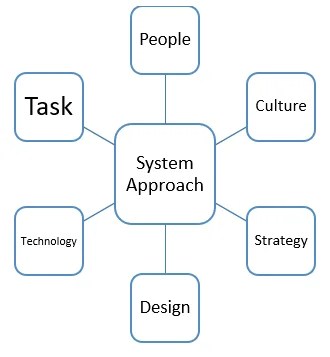
The Systems Model of Change or Organization-Wide Change lays more emphasis on the fact that a change must be implemented organization-wide instead of implementing it in piecemeal.

This model provides a whole new dimension to the concept of organizational change and describes the role played by six interconnected or interdependent variables like people, task, strategy, culture, technology and design. All these 6 variables are the key focus of planned change. The model has been represented in the diagram below:

  1. People: This variable involves the individuals who work in an organization. This would take into consideration the individual differences in the form of personalities, goals, perceptions, attitudes, attributions and their needs/motives.
  2. Task: The task is related to the nature of work which an individual handles in an organization. The nature of the job may be simple or complex, repetitive or novel, unique or standardized.
  3. Design: This variable refers to the organizational structure itself and also the system of communication, authority and control, the delegation of responsibilities and accountabilities.
  4. Strategy: The organizational strategy is the road map of action for realizing the future goals both short term and long term in nature. Strategic Planning involves identification of existing resources, a careful assessment of internal strengths and weaknesses, identifying the opportunities in the environment and threats as well for a competitive advantage.
  5. Technology: It takes into consideration the advancements in the technology in the field of IT, automation, new methods and techniques for enhancing productivity, the introduction of new processes and best practices for remaining ahead in the competition.
  6. Culture: It takes into consideration the shared beliefs, practices, values, norms and expectations of the members of the organization.

Steps to follow:

  • Dedicate time for planning

This may sound silly but you need to actually plan for planning. Always think of things, needs to plan for and to-do lists I need to write but not until recently did I realize that I was leaving the actual planning to the last minute. That’s because one wasn’t dedicating enough time to just sit and plan things out. Set up a recurring event in your calendar to just sit there and put your plans in writing.

  • Batch your time

I’ve tried so many “productivity hacks” and I find this one to be the most useful. It might not work for everyone but it’s worth the shot. Batching your time basically means that you divide your day into time blocks dedicated to only one task or multiple tasks of the same nature. This ensures that you don’t get distracted with doing other tasks and minimizes your tendency to multitask. It also allows you to enter the flow state of diving deep into one task.

  • Create checklists

Make checklists of things you need to get done and keep looking at those checklists. Many of us are guilty of writing down a to-do list, feeling good about it, and then never looking at it again. Put the checklist somewhere accessible like your notes on your phone so that you can pull it out easily. Track your progress and check off things that you’ve completed. Once you finish a checklist you’ll feel so good about yourself, trust me!

  • Prepare for the unexpected

No matter how hard you plan or how much you think you’ve thought ahead, always mentally prepare yourself for things to go wrong. There’s a saying that says “you plan and the universe laughs”, which is so true. That doesn’t mean that you shouldn’t plan, but just make sure you have back-ups and prepare for some crisis management.

Client & Consultant relationship

Consultants are expected to maintain professional and ethical standards when dealing with their clients. This can take the form of maintaining arm’s length relationships, not intervening in the internal affairs and politics of the client’s organizations, keeping confidential information away from interested parties looking for insider knowledge, and reporting any violations in the conduct (financial, operational, and behavioral) by the client’s organization to the regulators. This is the code of conduct that is usually prescribed for consulting firms whenever they take on work from client organizations.

Realities of Consultant-Client Relations

However, this is rarely followed in practice as evidenced by the large numbers of corporate scandals that have emerged in the last decade or so where the consultant was found to be aiding and even abetting the malfeasance conducted by the client. For instance, the Enron scandal manifested itself because the consulting firm was in cahoots with the client in cooking the books. Indeed, in this case, it was found that the consulting firm’s partners went beyond collaboration and were indeed one of the culprits.

Some Examples from the Corporate World

Similarly, the Satyam scandal in India was also found to be a case where the consultants (or some of them) knew about the goings-on in the company and were in breach of the code of conduct and even legal aspects since they did not report the matter to the regulators. However, the saving grace in this case was that when the malfeasance became too big and too hot to handle, it was the new consulting firm that had been roped in for another purpose that blew the whistle on the scam.

Consultants have to Walk a Thin Line between Professional and Personal Obligations

These examples indicate that the consultants have to walk a thin line between fulfilling professional obligations and reporting unethical behavior. Since the client is the one who pays them, it is often the case that the consultants are reluctant to report malfeasance to the regulators. Further, considering the extremely competitive nature of the market wherein there are several consulting firms competing for the same client, money talks and hence, consultants are often found to go along with the client. There are no easy answers when one considers all the aspects and it would be indeed a brave and conscientious consultant who would be the whistleblower.

Some Solutions Which Were Proposed

Having said that, there are some solutions that have emerged in recent years about the course of action to be taken by the consulting firms. For instance, after the Enron scandal, the SEC (Securities and Exchange Commission) and other regulators ensured that new rules separating consulting and investment banking so that the same consulting firm which was also advising the client in financial matters would now be two different firms. While this was intended to reduce the conflict of interest since it was thought that when consultants and investment bankers represent two firms they would automatically be in a position to wink at malfeasance, it is debatable as to how far this law succeeded given the Global Economic Crisis of 2008 wherein several case of malfeasance came to light.

Conflict of Interest is at the Heart of the Problem

Of course, as some experts have mentioned, the real issue here is of conflict of interest. How far would a consultant go in reporting unethical behavior to the regulators which is expected from him or her when such case involve the very clients who are giving them business. Further, the fact that many consultants often are embroiled in the internal politics of the client wherein they take sides in corporate and boardroom battles. This indicates the tricky nature of the problem of consultant client relations wherein the temptation to use confidential and insider information to one’s advantage is motivated by greed and power.

Coaching & Mentoring

Coaching and mentoring serve as learning tools in the workplace that can lead to empowering your employees. The employees who are coached and mentored often receive the greatest benefit, but the coach or mentor also benefits and may feel a sense of empowerment from the relationship. Understanding the dynamics and outcomes of this type of workplace learning strategy helps you evaluate the need for a coaching program in your small business.

Coaching

Coaching at work is designed to help employees learn or enhance specific skills. It focuses on one individual over a defined period of time, helping them to develop effectively. It can be used to:

  • Teach new skills in a focused way
  • improve performance in a particular area of work
  • build ‘soft’ skills like confidence, interpersonal relationships or planning

The objective of coaching at work is to help an employee make a distinct improvement in an agreed area. That improvement might be measurable through KPIs, or it might be a softer target. To achieve it, the employee receives support and constructive feedback from a designated coach.

Coaching is a powerful tool for employees, but your company will also reap the benefits of a specially trained workforce.

The great benefit of coaching is that you are likely to see quick, positive results as an outcome. This is because coaching is participative and people tend to learn and adopt new habits more easily when they are actively engaged in the learning process.

Mentoring

Mentoring involves the use of the same models and skills of questioning, listening, clarifying and reframing associated with coaching.

Traditionally, mentoring in the workplace is usually where a more experienced colleague uses his or her greater knowledge and understanding of the workplace in order to support the development of a less experienced member of staff.

Deciding if coaching is the right approach

How do you know if coaching will work for your company? In truth, it can depend on the context and the people concerned.

Some employees will respond enthusiastically, especially to the right coach, and will come on leaps and bounds. For example, you could use a professional coach to:

  • Bring out the full potential of a gifted employee
  • help technical experts improve interpersonal skills
  • train managers to handle conflict situations

Although coaching at work is normally very effective, it doesn’t suit every situation or every personality. Other options to consider might be external training, mentoring or online learning.

Importance

Coach or Mentor Empowerment

The experienced employee who serves as the coach or mentor is able to show his knowledge and skill in the industry. This added challenge can boost his confidence and give him a sense of empowerment in his own work. In some cases, the employee the mentors push him to learn new skills in the industry. The collaboration between coach and mentor can lead to new ideas and achievements to aid them both in succeeding.

Independence

A mentor provides support for a new employee, but the ultimate goal is to empower the employee to work independently with the skills she has learned. The ability to work successfully on her own brings a sense of empowerment as she gains independence in the workplace. While employees feel confident to work independently, the mentoring program creates a sense of teamwork and often boosts morale for your employees. This positive work environment continues to empower employees in their work.

Goal Setting

Coaching and mentoring often includes goal setting for the employee. The mentor helps the new employee set specific goals related to the job. The two work together to create a plan to reach those goals. Mentors can customize objectives and support that that employee needs for his particular role. The mentor is also available as a resource if the new employee needs support along the way to be successful. Having a set of challenging goals is motivating and empowers the employee to work beyond the minimum requirements.

Hands-On Learning

Coaching and mentoring gives new employees a hands-on training program to learn job expectations. Instead of throwing a new employee right into the position, he gets a support system and an interactive learning situation that may engender more on-the-job confidence. Mentored employees may often feel a greater sense of understanding of what is required of them in their jobs because they get one-on-one job training, support and the advice of an experienced employee. When an employee receives this kind of personalized training, he may feel empowered to fully perform his job duties.

error: Content is protected !!