Environmental influences on cost Management practices

Environmental cost management enables your business to control the costs associated with the environmental impact of your company’s business operations. Your company may impact the environment in a number of ways, including air pollution, manufacturing emissions, wet land impact and waste disposal.

Environmental costs include current and future environmental impacts your company is responsible for and labor costs associated with accounting for environmental costs. Effective control of environmental costs and promotion of environmental benefits will increase your business’s overall profitability.

Management information included:

  • Identifying and estimating the costs of environment-related activities
  • Identifying and monitoring the use and cost of resources such as water, electricity and fuel, so costs can be reduced
  • Making sure environmental considerations form part of capital investment decisions
  • Assessing the likelihood and impact of environmental risks
  • Including environment-related indicators as part of routine performance monitoring
  • Benchmarking activities against environmental best practice.

Benefits provided:

  • Improving sales or reducing sales erosion: consumer awareness of products and services’ environmental impact is increasingly influencing their preferences and buying behaviours.
  • Reducing costs: reducing wasteful consumption of input resources has a direct positive impact on reducing costs. Also, improvements to processes can bear down on costs.
  • Reducing the cost of failure: investing in processes that reduce the likelihood and cost impact of failure, such as the need to process waste or clean up environmental impacts.
  • Improving the image of the organisation: this can enable it to attract better talent, reduce talent attrition and charge higher prices.

Environmental Planning

Trying to manage environmental costs on the spur of the moment will eventually lead to a serious mistake that will cause significant damage to the environment. Effective planning is best accomplished through the efforts of well-designed teams that have the resources available to research all of the possible ramifications of every action the company may take over the next year, and maybe over the next five years.

Environmental planning includes making assessments, studies, evaluating safety features and cost evaluations. Once all of the possible environmental ramifications have been considered, you can make an accurate determination of how much your company’s environmental impact will cost. For example, a new construction project may cause excessive run-off and potential flooding which is easier and less expensive to correct with proper drainage in advance.

Preventing Environmental Damage

When business operations cause significant environmental damage, the costs of recovery may be great enough to cause your company to fail and may bring about lawsuits that may take years to close. Preventing environmental damage is a matter of educating everyone in the company on how to do their job without harming the environment.

Establish policies that clearly outline how you expect the job to be done, while at the same time protecting the environment. This can be as simple as establishing guidelines on proper disposal of chemicals and other waste products. When you achieve these goals, you will increase the potential value of your company.

Environmental Priorities

Begin by evaluating all of your internal and external operations. If protecting the environment is a company priority or subject of regulations, you will need to make sure that business operations that negatively impact the environment are eliminated or mitigated. Engage your employees in the environmental priorities you have set for the company.

As an example, if your company has an impact on water resources, it is important for your employees to ensure every action the company takes does not allow toxins to leave your facility and enter nearby streams and aquifers. Remember, there are significant costs associated with environmental cleanup if toxins are inadvertently released into the environment.

Integrated Accounting Activities

Controlling environmental impact costs is best accomplished by integrating all of your accounting activities. Costs you need to control include labor costs related to your environmental impact, material costs, cost related to administration activities and costs related to manufacturing activities. All of these costs should be brought together into a single accounting system that produces reports that allow you to consider and manage all of your environmental costs through understandable graphs and metrics.

Environmental costs can be categorised as follows:

  • Prevention costs: costs associated with preventing adverse environmental impacts.
  • Appraisal costs: costs of assessing compliance with environmental policies.
  • Internal failure costs: costs of eliminating environmental impacts that have been created by the organisation.
  • External failure costs: costs incurred after environmental damage has been caused outside the organisation.

Wastage Control, Total productive Maintenance, Energy Audit

The management and control of the resources used in most commercial organisations leaves a great deal to be desired. Waste is growing at such an enormous rate that it has spawned a new industry for recycling and extracting useful materials.

Materials are wasted in a number of ways such as effluents, breakage, contamination, inefficient storage, poor workmanship, low quality, pilfering and obsolescence. All these contribute to significantly increased material costs and all can be controlled by efficient working methods and effective control.

Total productive Maintenance

Total Productive Maintenance (TPM) was developed by Seiichi Nakajima in Japan between 1950 and 1970. This experience led to the recognition that a leadership mindset engaging front line teams in small group improvement activity is an essential element of effective operation. The outcome of his work was the application of the TPM process in 1971.

Total Productive Maintenance (TPM) started as a method of physical asset management focused on maintaining and improving manufacturing machinery, in order to reduce the operating cost to an organization. After the PM award was created and awarded to Nippon Denso in 1971, the JIPM (Japanese Institute of Plant Maintenance), expanded it to include 8 pillars of TPM that required involvement from all areas of manufacturing in the concepts of lean Manufacturing.

Total productive maintenance (TPM) is the process of using machines, equipment, employees and supporting processes to maintain and improve the integrity of production and the quality of systems. Put simply, it’s the process of getting employees involved in maintaining their own equipment while emphasizing proactive and preventive maintenance techniques. Total productive maintenance strives for perfect production. That is:

  • No breakdowns
  • No stops or running slowly
  • No defects
  • No accidents

TPM is designed to disseminate the responsibility for maintenance and machine performance, improving employee engagement and teamwork within management, engineering, maintenance, and operations.

Principles

The eight pillars of TPM are mostly focused on proactive and preventive techniques for improving equipment reliability:

  • Autonomous Maintenance: Operators who use all of their senses to help identify causes for losses
  • Focused Improvement: Scientific approach to problem solving to eliminate losses from the factory
  • Planned Maintenance: Professional maintenance activities performed by trained mechanics and engineers
  • Quality management: Scientific and statistical approach to identifying defects and eliminating the cause of them
  • Early/equipment management: Scientific introduction of equipment and design concepts that eliminate losses and make it easier to make defect free production efficienly.
  • Education and Training: Support to continuous improvement of knowledge of all workers and management
  • Administrative & office TPM: Using TPM tools to improve all the support aspects of a manufacturing plant including production scheduling, materials management and information flow, As well as increasing moral of individuals and offering awards to well deserving employees for increasing their morals.
  • Safety Health Environmental condition’s

The main objective of TPM is to increase the Overall Equipment Effectiveness (OEE) of plant equipment. TPM addresses the causes for accelerated deterioration and production losses while creating the correct environment between operators and equipment to create ownership.

OEE has three factors which are multiplied to give one measure called OEE

Performance x Availability x Quality = OEE

Each factor has two associated losses making 6 in total, these 6 losses are as follows:

Performance = (1) running at reduced speed – (2) Minor Stops

Availability = (3) Breakdowns – (4) Product changeover

Quality = (5) Startup rejects – (6) Running rejects

Implementation

Following are the steps involved by the implementation of TPM in an organization:

  • Initial evaluation of TPM level,
  • Introductory Education and Propaganda (IEP) for TPM,
  • Formation of TPM committee,
  • Development of a master plan for TPM implementation,
  • Stage by stage training to the employees and stakeholders on all eight pillars of TPM,
  • Implementation preparation process,
  • Establishing the TPM policies and goals and development of a road map for TPM implementation.
Benefits of Total Productive Maintenance
Direct Benefits Indirect Benefits
Less unplanned downtime resulting in an increase in OEE Increase in employee confidence levels
Reduction in customer complaints Produces a clean, orderly workplace
Reduction in workplace accidents Increase in positive attitudes among employees through a sense of ownership
Reduction in manufacturing costs Pollution control measures are followed
Increase in product quality Cross-departmental shared knowledge and experience

Pillars of TPM

TPM in administration: A good TPM program is only as good as the sum of its parts. Total productive maintenance should look beyond the plant floor by addressing and eliminating areas of waste in administrative functions. This means supporting production by improving things like order processing, procurement and scheduling. Administrative functions are often the first step in the entire manufacturing process, so it’s important they are streamlined and waste-free. For example, if order-processing procedures become more streamlined, then material gets to the plant floor quicker and with fewer errors, eliminating potential downtime while missing parts are tracked down.

Safety, health and environment: Maintaining a safe working environment means employees can perform their tasks in a safe place without health risks. It’s important to produce an environment that makes production more efficient, but it should not be at the risk of an employee’s safety and health. To achieve this, any solutions introduced in the TPM process should always consider safety, health and the environment.

Training and education: Lack of knowledge about equipment can derail a TPM program. Training and education applies to operators, managers and maintenance personnel. They are intended to ensure everyone is on the same page with the TPM process and to address any knowledge gaps so TPM goals are achievable. This is where operators learn skills to proactively maintain equipment and identify emerging problems. The maintenance team learns how to implement a proactive and preventive maintenance schedule, and managers become well-versed in TPM principles, employee development and coaching.

Early equipment management: The TPM pillar of early equipment management takes the practical knowledge and overall understanding of manufacturing equipment acquired through total productive maintenance and uses it to improve the design of new equipment. Designing equipment with the input of people who use it most allows suppliers to improve maintainability and the way in which the machine operates in future designs.

Quality maintenance: All the maintenance planning and strategizing in the world is all for naught if the quality of the maintenance being performed is inadequate. The quality maintenance pillar focuses on working design error detection and prevention into the production process.

Planned maintenance: Planned maintenance involves studying metrics like failure rates and historical downtime and then scheduling maintenance tasks based around these predicted or measured failure rates or downtime periods. In other words, since there is a specific time to perform maintenance on equipment, you can schedule maintenance around the time when equipment is idle or producing at low capacity, rarely interrupting production.

Focused improvement: Focused improvement is based around the Japanese term “kaizen,” meaning “improvement.” In manufacturing, kaizen requires improving functions and processes continually. Focused improvement looks at the process as a whole and brainstorms idea for how to improve it. Getting small teams in the mindset of proactively working together to implement regular, incremental improvements to processes pertaining to equipment operation is key for TPM. Diversifying team members allows for the identification of recurring problems through cross-functional brainstorming. It also combines input from across the company so teams can see how processes affect different departments.

Autonomous maintenance: Autonomous maintenance means ensuring your operators are fully trained on routine maintenance like cleaning, lubricating and inspecting, as well as placing that responsibility solely in their hands. This gives machine operators a feeling of ownership of their equipment and increases their knowledge of the particular piece of equipment. It also guarantees the machinery is always clean and lubricated, helps identify issues before they become failures, and frees up maintenance staff for higher-level tasks.

Energy Audit

An energy audit is an inspection survey and an analysis of energy flows for energy conservation in a building. It may include a process or system to reduce the amount of energy input into the system without negatively affecting the output. In commercial and industrial real estate, an energy audit is the first step in identifying opportunities to reduce energy expense and carbon footprint.

When looking to the existing audit methodologies developed in IEA EBC Annex 11, by ASHRAE and by Krarti (2000), it appears that the main issues of an audit process are:

  • The analysis of building and utility data, including study of the installed equipment and analysis of energy bills;
  • The survey of the real operating conditions;
  • The understanding of the building behaviour and of the interactions with weather, occupancy and operating schedules;
  • The selection and the evaluation of energy conservation measures;
  • The estimation of energy saving potential;
  • The identification of customer concerns and needs.

Generally, four levels of analysis can be outlined (ASHRAE):

  • Level 0: Benchmarking: This first analysis consists in a preliminary Whole Building Energy Use (WBEU) analysis based on the analysis of the historic utility use and costs and the comparison of the performances of the buildings to those of similar buildings. This benchmarking of the studied installation allows determining if further analysis is required.
  • Level I: Walk-through audit: Preliminary analysis made to assess building energy efficiency to identify not only simple and low-cost improvements but also a list of energy conservation measures (ECMs, or energy conservation opportunities, ECOs) to orient the future detailed audit. This inspection is based on visual verifications, study of installed equipment and operating data and detailed analysis of recorded energy consumption collected during the benchmarking phase;
  • Level II: Detailed/General energy audit: Based on the results of the pre-audit, this type of energy audit consists in energy use survey in order to provide a comprehensive analysis of the studied installation, a more detailed analysis of the facility, a breakdown of the energy use and a first quantitative evaluation of the ECOs/ECMs selected to correct the defects or improve the existing installation. This level of analysis can involve advanced on-site measurements and sophisticated computer-based simulation tools to evaluate precisely the selected energy retrofits;
  • Level III: Investment-Grade audit: Detailed Analysis of Capital-Intensive Modifications focusing on potential costly ECOs requiring rigorous engineering study.

Key elements in Strategic cost Management

There are three important components of strategic cost management:

  1. Strategic Positioning Analysis: It determines the company’s comparative position in the industry in terms of performance.

Strategic positioning analysis is an approach for researching what future environments might be like in your internal corporate structure as well as your external environment and determining how you can use the choice of business strategies to get from your current situation to these desirable goals.

Analysis of the status-quo often involves using some fairly standard strategic management tools such as:

  • SWOT analysis: Strengths and weaknesses within your firm; opportunities and threats within the external competitive market.
  • Product/market matrix: Establishing what new markets, product changes, product lines or market variations could prove profitable.
  • Portfolio analysis: Establishing which of your projects are potential cash cows, stars, wildcats or dogs.

2. Cost Driver Analysis: Cost is driven by different interrelated factors. In strategic cost management, the cost driver is divided into two categories, i.e. structural cost drivers and executional cost drivers. It examines, measures and explains the financial effect of the cost driver concerned with the activity.

Cost driver analysis is concerned with determining what the actual drivers of activity costs are within your operations. The most popular type of analysis for this is activity-based costing (ABC) which aims to establish what indirect causes can be related to specific activities.

This has a bearing on strategic cost management since cost drivers can actually be determined by both structural cost drivers and executional cost drivers.

  • Structural cost drivers relate to strategic management choices the company undertakes in relation to actual structure of their operations (scale and scope) as well as the complexity of their products and technologies used. A more complex working environment (products, technologies and production) leads to higher structural costs.
  • Executional cost drivers relate to the actual operational processes and norms within operation. The effective use of staff, process layouts, just-in-time processes, etc. all have a bearing on the cost of executing activities within the firm.

3. Value Chain Analysis: The process in which a firm recognizes and analyses, all the activities and functions that contribute to the final product. It was propounded by Michael Porter (1985), to show the way a customer value assembles along the activity chain that results in the final product or service.

Value chain analysis is an approach used to determine the series of activities involved in creating and building value within your operations. It requires a systematic approach to examining each different element in your primary activities as well as support activities.

The operations of the organization may actually be split out into both primary as well as support activities.

  • Primary activities: Inbound logistics, operations, outbound logistics, marketing & sales and service.
  • Support activities: Procurement, technology development, human resources management and firm infrastructure.

Different aspects of Strategic cost Management

Strategic cost management initiative is taken at the top and a dedicated team should be involved in the whole process of formulation, implementation and monitoring process.

A control standard is a target against which subsequent performance will be compared. Standards are the criteria that enable managers to evaluate future, current, or past actions. They are measured in a variety of ways, including physical, quantitative, and qualitative terms. Five aspects of the performance can be managed and controlled: quantity, quality, time, cost, and behavior.

Organization should have its own policy regarding recording and reporting of following information:

  • Choice of strategic positioning, cost leadership or product differentiation;
  • Choice of cost drivers, structural or executional;
  • Cost reduction strategies with reference to value analysis;
  • Value chain related activities;
  • Periodic evaluation report;
  • Strategic cost management framework for the firm
  • List of tools applied by the firm as a part of strategic cost management.
  • Any other types of reporting as required.

Effective control systems tend to have certain qualities in common. These can be stated thus:

  1. Suitable: The control system must be suitable to the needs of an organisation. It must conform to the nature and needs of the job and the area to be controlled. For example, the control system used in production department will be different from that used in sales department.
  2. Simple: The control system should be easy to understand and operate. A complicated control system will cause unnecessary mistakes, confusion and frustration among employees. When the control system is understood properly, employees can interpret the same in a right way and ensure its implementation.
  3. Selective: To be useful, the control system must focus attention on key, strategic and important factors which are critical to performance. Insignificant deviations need not be looked into. By concentrating attention on important aspects, managers can save their time and meet problems head-on in an effective manner.
  4. Sound and economical: The system of control should be economical and easy to maintain. Any system of control has to justify the benefits that it gives in relation to the costs it incurs. To minimize costs, management should try to impose the least amount of control that is necessary to produce the desired results.
  5. Flexible: Competitive, technological and other environmental changes force organizations to change their plans. As a result, control should be necessarily flexible. It must be flexible enough to adjust to adverse changes or to take advantage of new opportunities.
  6. Forward-looking: An effective control system should be forward-looking. It must provide timely information on deviations. Any departure from the standard should be caught as soon as possible. This helps managers to take remedial steps immediately before things go out of gear.
  7. Reasonable: According to Robbins, controls must be reasonable. They must be attainable. If they are too high or unreasonable, they no longer motivate employees. On the other hand, when controls are set at low levels, they do not pose any challenge to employees. They do not stretch their talents. Therefore, control standards should be reasonable they should challenge and stretch people to reach higher performance without being demotivating.
  8. Objective: A control system would be effective only when it is objective and impersonal. It should not be subjective and arbitrary. When standards are set in clear terms, it is easy to evaluate performance. Vague standards are not easily understood and hence, not achieved in a right way. Controls should be accurate and unbiased. If they are unreliable and subjective, people will resent them.
  9. Responsibility for failures: An effective control system must indicate responsibility for failures.

Detecting deviations would be meaningless unless one knows where in the organisation they are occurring and who is responsible for them. The control system should also point out what corrective actions are needed to keep actual performance in line with planned performance.

  1. Acceptable: Controls will not work unless people want them to. They should be acceptable to chose to whom they apply, controls will be acceptable when they are:
  • Quantified
  • Objective
  • Attainable
  • Understood by everyone

Features

Allows for Risk Management

Risk management can be considered as a subset or a specific form of strategic management. Risk is the probability of a future loss and risk management involves formulating various strategies to combat the risks making risk management a form or variety of strategic management.

Strategic management in this form allows for identifying and eliminating the risks posed by various hazards to the business.

Conscious Process

Strategies are a product of the developed conscience and intellect that we humans proudly possess and employ. Strategic management implies the usage of the brain and the heart and is not a routine ever-continuing process. It requires great skill and experience to be carried out effectively and requires a full application of one’s conscience.

Requires Foresight

The future is uncertain. We cannot predict what will happen. However, on the basis of the information that is available to us, we will be able to presume certain things about the future.

For instance, a discovery that the item XYZ causes cancer can allow us to make a very reasonable presumption that the item XYZ will be banned in the near future. This presumption thus allows us to not make any investment in anything directly related to XYZ.

Drives Innovation

The development of strategy is not a simple process and requires making the best out of often very restrictive situations. This drives innovations and allows managers to approach problems from different angles and solve problems more efficiently. After all, necessity is the mother of all inventions.

Strategic Management as a process is quite complicated and requires years of experience and inherent skills to be carried out efficiently. The process is pervasive and is central to any business. It is a discipline in itself and requires more study for enthusiasts wanting to pursue management.

Goal-Oriented Process

The process of Strategic Management is a goal-oriented process. The process is done with the intention and goal of analyzing the various elements through SWOT analysis and other tools and to develop a plan or strategy that effectively allows the business to maneuver itself around every hurdle and make use of its strength.

This process also plays the role of making all other functions of the business goal-oriented as well.

Facilitates decision making

Strategic Management plays an integral role in making important decisions. Whenever a manager has to make a decision he has to think about the bearing of such a decision on the overall strategy and the business’ trajectory.

Thus, the strategies developed to act as a guide to making efficient and accurate decisions.

Primary Process

Strategic Management is the primary process in any business. The strategies that the business has to apply in its activities is developed at the initial stage itself and only after the creation of the strategy that other processes commence by making the strategy as its basis.

Pervasive Process

Strategic Management is a pervasive process seen in all levels of the business.

The core strategies are formulated for the entire business by the top-level management and strategies to efficiently achieve the overall goal so laid down by the top-level management is developed through the various lower business units.

Dependent on Personal Qualities

The above two considerations make it amply clear that Strategic Management is heavily dependent on the personal qualities of the managers occupying the top-level positions.

These personal qualities including skills and experience obtained over years of employment and observation cannot be imparted by training or coaching classes and require practical exposure for extended periods of time unless the person is born with the talent of strategizing (which is rare).

Control of Total Distribution cost & Supply cost

Distribution Cost or the Distribution expenses are the costs that a company incurs to make its goods or services available to the end-users or resellers. It is a broad accounting term that covers several types of expenses.

Total distribution cost (TDC) analysis requires some assumptions. These include current observed rates and transit times for standard air freight, full containerload (FCL), and less-than containerload (LCL) service.

For any company which is involved in distribution, distribution cost is a major bottleneck. There are many different distribution expenses which must be taken care of. Furthermore, these expenses are not consistent and may change from time to time thereby changing the distribution cost as well.

If the shipper is a distributor and it further sells to the retailer and the retailer sells to the end user then all the separate distribution costs at each stage would be included in the total distribution cost. Moreover, in some cases the manufacturer has a production unit at one place and the “product pick up place” by the forwarder at another place. The cost of moving the product from the place of production to the pickup point is also included in distribution cost.

There are other types of costs as well that that are included in the distribution’s costs. Handling cost of inventory at all points for example production place, storehouse, sales point is part of distribution cost. Packing costs are also part of distribution costs. Distribution managerial cost such as the salary expense of distribution manager and his/her office expenses are also part of distribution costs.

Freight cost is usually the most important component of distribution costs. If the product is manufactured and sold in same country then freight cost refers to the “Trucking” or such transport fare to deliver the product.

If the product is sold internationally then it may include “Air Freight, Less than container load (LCL), Day-Definite LCL or Full container load (FCL).” In case the product is transported by air the cost would be higher and if it is transported through LCL the cost would be lower but there is one further point to contemplate i.e. “Transit Time”. The transit time for LCL is longer and the transit time for moving by air is smaller. Covering all ends there is a need for comparative analysis between the product demand urgency and transport cost. If the product is urgently needed and the shipper is losing sales revenue then it is optimum to reduce transit time and increase the freight expense.

Distribution expenses: The individual expenses made by the company for various reasons is known as Distribution expenses. These are individual or repeated transactions happening over time. An example may include; Rent, Salaries, Administrative expenses etc. All these are individual transactions or repeat transactions and these transactions can be called distribution expenses.

Distribution cost: The combination of all distribution expenses made by a company is known as Distribution cost. So, continuing the above example; the total of rent, salaries, and administrative expenses will be considered as distribution cost. In terms of Formula

[The sum of all Distribution Expenses] = Distribution cost

1) Sales returns

If a dealer or a retailer rejects a material, then the material comes back to the manufacturer provided it is in the returns policy of the company. This returned material may have come back due to cosmetic conditions (it was damaged or dented) or it may have come back due to performance issues. In any condition, the returned product is a cost to the company.

2) Direct Selling Expenses

Any expense made towards selling the product to the target customer is a direct selling. Many manufacturers, wholesalers, and distributors carry out direct selling in the regions that they want to expand. They also would like to know the distribution cost of that region. Thus, they consider all direct selling expenses as the primary expense made by the firm.

3) Commercials & Accountancy

It is a government requirement to present all your sales and purchases as well as balance and profit sheets to the government to determine profit earned by your firm. Furthermore, these statements are also important for the firm itself to note the growth year on year as well as to determine the performance and future potential. Thus, commercials and accounts are documented precisely in any firm.

4) Advertising & Sales promotion expenses

If a company wants to establish itself in a new region, it needs to have OOH advertising, it needs to run in-store branding, it needs to run ads in local newspapers or local channels. Thus, the company will be spending a lot towards advertising and promotions which are various forms of distribution expenses.

5) Product and Packaging expenses

The product packaging was good but was not strong. As a result, the packaging suffered a huge wear and tear by the time it reached the customer and the customers returned the product.

6) Shipping and Delivery

With the rise of E-commerce, delivery is a huge focus area for all manufacturers. The stock must be in the market, whether it is on an E-commerce portal or in a retail outlet or with the distributor. Everyone knows that if there is no stock on display, the sale will not happen and this creates friction between the different distribution channels.

7) Trade discounts

Besides sales promotion exercises like advertising and marketing, a company launches several trade promotional exercises as well. This includes giving discounts to retailers, distributors, and suppliers on achieving certain targets.

8) Market research

When reputed companies like Samsung, LG or Sony want to establish themselves in a new market, they buy market research reports from the likes of IMRB or Nielson. These reports may cost hundreds or thousands of dollars. Not only in a new market, even in an old market, a company might want to conduct a satisfaction survey or a survey of new ideas regarding distribution.

9) Credit, Outstanding and Overdue

A distributor who operates in a regional market needs the huge amount of money to conduct business. To arrange this money, the distributor takes a loan from the banks. This is known as an Overdue account. Hypothetically, If the distributor takes 1 lakh from the bank, within 30 days he should give back 1 lakh + 1% interest. Thus, a dealer suffers a loss when his money does not come back from the market in time.

10) Warehousing and handling within warehouse

Warehousing is a major cost of distribution. When a company expands to newer markets, it needs to have new warehouses in each new territory. Domino’s or McDonald’s practically have warehouses for every 3-4 towns so that they can supply to local retail outlets very fast. Because of Domino’s and McDonald’s handle frozen goods (burgers or fries), their expenses are even higher because they need cold rooms and cold chains to deliver the products.

NOTE: Warehousing cost is different from transportation and delivery cost which is calculated separately.

Under these assumptions, the analysis shows:

  • Standard LCL would minimize transport-related costs, but would incur by far the highest inventory-related expenses due to long and highly variable transit times.
  • Using full containerload (FCL) rather than LCL reduces inventory-related costs but to do so would spend more than the inventory-related savings on transport-related costs due to the wasted space in 20-ft. containers occupied by only 2,500 metric tons of freight.
  • Switching to air freight to minimize inventory-related costs would incur the highest transport-related expenses, leading to the highest overall total distribution costs.
  • Day-definite LCL could minimize total distribution costs (sum of transport and inventory related costs). Compared to LCL, the shipper would spend about $600,000 more on transportation to use day-definite LCL service ($1.8 million vs. $1.2 million per year) but would capture approximately $825,000 in inventory related cost savings ($1.3 million vs. $2.2 million per year).
Data information needs for HR Manager: Contents and Usage of Data

The Human Resource Information System (HRIS) is a software or online solution for the data entry, data tracking, and data information needs of the Human Resources, payroll, management, and accounting functions within a business. It is useful for all processes that you want to track and from which you hope to gather useful and purposeful data.

Normally packaged as a database, hundreds of companies sell some form of HRIS and every HRIS has different capabilities. Pick your HRIS carefully based on the capabilities you need in your company. As HRIS has become increasingly sophisticated, the choice among the various systems has become enough to practically paralyze an HR department.

Content to consider as you select your HRIS.

Number of Employees

Remember that even if your company is only a few people today, it may have twice that many or even 10 times that many employees in the future, so pick a system that can grow with your business.

System Capabilities

Another key factor that you must consider is that many HRIS are able to accomplish only part of what you need automation to accomplish. In these cases, you will want to make certain that the components of any add-ons or additional systems work together flawlessly. Again, don’t take the salesperson’s word about the systems working together. Do your research to ascertain that they do.

Performance development plans:

It’s not just enough to have plans if they are recorded in a central system, then they can easily follow the employee from position to position. Senior leadership can run reports to see where people are and what their individual managers are planning in terms of succession planning for their futures.

Disciplinary Actions:

It’s important to keep track of who has been suspended, demoted, or had other negative actions taken against them noted even after the employee leaves your organization. When a company calls and asks for a former employee reference, it’s easy for an admin in the HR department to look up and report back whether or not the person is eligible for rehire.

Training records:

This is especially critical in a company where certifications and licenses are required. In other companies, training records may not have that level of importance, but you may still find that having the information is useful as you develop your employees, a key factor that they want from work.

Training and Support

Check also to see what kinds of training and ongoing support are available for your staff. You should also ensure that the sales consultant’s promises about training and follow-up following the purchase are written right into your contract to purchase the HRIS. And, check with other organizations to make certain that your selected company has a track record of ongoing, helpful support.

Expected Functionality of Better HRIS Choices

Typically, the better Human Resource Information Systems (HRIS) provide overall:

Management of all employee information:

Data such as names, titles, addresses, and salaries are a basic start. Salary and position history, reporting structures, performance appraisal histories, and other critical employee information.

Company-related documents:

This includes such items as employee handbooks, emergency evacuation procedures, and safety guidelines.

Benefits administration:

You will want benefits administration including enrollment, status changes, and personal information updating. In an ideal system, you can allow employees to look up and review their own information, including vacation tracking.

Complete integration with payroll:

This integration will also include other company financial software and accounting systems. When these are connected, you can ensure that paychecks are correct. There is never a disconnect between what the official pay rate is and the information that payroll has. If the systems don’t integrate, it’s easy to update a salary in one system and not in the other.

Applicant tracking and resume management: 

When your system is seamless, the recruiter can click a hired button and all of the information from the applicant is transferred to the employee side of things. This saves so much time because your data entry and paperwork practically disappear.

Data used for

  • Attendance and PTO use
  • Pay raises and history
  • Pay grades and positions held
  • Performance development plans
  • Training received
  • Disciplinary action received
  • Personal employee information, and occasionally
  • Management and key employee succession plans
  • High potential employee identification
  • Applicant tracking, interviewing, and selection

Materials Management, Scope, Methods, Importance, Challenges

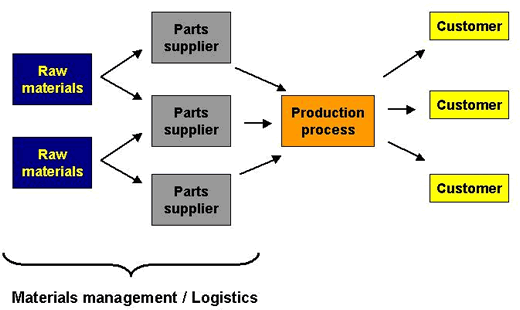
Materials Management refers to the planning, organizing, and controlling of the flow of materials and resources in an organization. It involves overseeing the procurement, storage, and distribution of raw materials, components, and finished goods. The primary goal is to ensure that the right materials are available in the right quantity, at the right time, and at the right cost to meet production and operational needs. Effective materials management helps optimize inventory levels, reduce wastage, minimize costs, and improve overall production efficiency, ultimately contributing to enhanced organizational performance and customer satisfaction.

Scope of Materials Management:

  • Procurement of Materials

One of the primary functions within materials management is the procurement of raw materials, components, and supplies required for production. This includes identifying suppliers, negotiating contracts, and ensuring timely delivery of materials. Procurement also involves selecting reliable vendors and ensuring that purchased materials meet the required quality standards. Strategic sourcing helps businesses reduce material costs and ensure a consistent supply chain.

  • Inventory Management

Effective inventory management is a critical component of materials management. This function involves maintaining optimal stock levels to meet production demands while avoiding overstocking or stockouts. Proper inventory control helps reduce costs associated with storage and minimizes the risk of obsolete or expired inventory. Techniques like Just-in-Time (JIT) and Economic Order Quantity (EOQ) are employed to maintain balanced inventory levels.

  • Storage and Warehousing

Materials management also involves the organization and storage of materials in warehouses or storage facilities. Efficient storage systems, such as proper labeling, categorization, and shelving, help in quick retrieval of materials when needed. The warehouse layout should be optimized for minimizing movement, preventing damage, and improving material handling processes. Proper storage practices also reduce the risk of materials being spoiled, lost, or misplaced.

  • Material Handling

Material handling involves the physical movement, protection, storage, and control of materials throughout the production process. This includes the use of forklifts, conveyors, and automated systems to move raw materials, work-in-progress, and finished goods. Efficient material handling systems reduce labor costs, minimize damage, and improve the overall speed of production processes.

  • Production Planning and Control

Materials management is closely linked to production planning and control. This function ensures that materials are available when needed for production without causing delays. It involves coordinating with the production department to align material procurement with production schedules. Effective planning ensures that there is no interruption in production due to material shortages, and production targets are met on time.

  • Quality Control

Quality control is a crucial part of materials management to ensure that the materials received meet the required quality standards. This includes inspecting and testing incoming materials, monitoring suppliers for consistent quality, and ensuring that defective materials are identified and rejected. Proper quality control ensures that materials used in production do not compromise the final product’s quality.

  • Supplier Relationship Management

Building and maintaining strong relationships with suppliers is a key aspect of materials management. This includes regular communication, performance monitoring, and resolving any issues that may arise. Supplier relationship management ensures that materials are sourced from reliable vendors who provide quality materials on time. A good relationship with suppliers can also help negotiate better prices, terms, and conditions.

  • Waste Management and Disposal

An often-overlooked aspect of materials management is the proper management of waste. This involves minimizing material wastage through efficient planning and use, recycling excess materials, and disposing of waste in an environmentally responsible manner. Managing waste not only helps reduce costs but also ensures compliance with environmental regulations and contributes to the organization’s sustainability goals.

Methods of Material Management:

Material management involves the strategic planning, acquisition, storage, and distribution of materials needed for production or operations. To ensure efficiency and minimize costs, organizations employ various methods to manage materials effectively.

1. Economic Order Quantity (EOQ)

EOQ is a quantitative method used to determine the optimal order quantity that minimizes the total cost of ordering and holding inventory. This method balances ordering costs (e.g., administrative expenses) and carrying costs (e.g., storage and insurance). EOQ is particularly effective in ensuring efficient stock levels and avoiding overstocking or stockouts.

2. Just-in-Time (JIT)

JIT method focuses on minimizing inventory levels by receiving materials only when they are needed in the production process. This reduces carrying costs and waste, but it requires precise coordination with suppliers. JIT is highly effective in lean manufacturing environments where inventory flexibility is critical.

3. ABC Analysis

ABC analysis categorizes materials into three groups based on their value and usage frequency:

  • A items: High value, low volume (require tight control).
  • B items: Moderate value and volume (require periodic review).
  • C items: Low value, high volume (require less stringent control).

    This method helps prioritize inventory management efforts and focus on the most critical materials.

4. Material Requirement Planning (MRP)

MRP is a computer-based system used for planning material requirements in manufacturing. It ensures the availability of raw materials by aligning procurement with production schedules. MRP uses data such as sales forecasts, production plans, and inventory records to determine the timing and quantity of material orders.

5. Vendor-Managed Inventory (VMI)

In VMI, the supplier is responsible for managing and replenishing inventory based on pre-agreed levels. This reduces the administrative burden on the organization and ensures a steady supply of materials. VMI fosters strong supplier relationships and enhances supply chain efficiency.

6. FIFO and LIFO Methods

  • FIFO (First In, First Out) ensures that older materials are used first, minimizing the risk of obsolescence.
  • LIFO (Last In, First Out) prioritizes the use of the most recently acquired materials.

    These methods are particularly useful in industries with perishable goods or fluctuating material costs.

7. Perpetual Inventory System

This method involves continuous tracking of inventory levels using technology such as barcoding, RFID, or ERP systems. It provides real-time updates on stock levels, improving accuracy and enabling prompt decision-making.

8. Kaizen and Lean Practices

Kaizen (continuous improvement) and lean manufacturing practices focus on reducing waste and improving efficiency. These methods emphasize collaboration among teams to identify and eliminate inefficiencies in material management processes.

Importance of Material Management:

  • Cost Control

Effective material management helps control costs associated with purchasing, storing, and handling materials. By maintaining optimal inventory levels, companies can minimize storage costs and reduce the risk of obsolescence or overstocking. Furthermore, strategic procurement practices enable businesses to negotiate better prices with suppliers, helping reduce overall material costs. Cost control in material management is critical to maintaining profitability.

  • Optimized Inventory Levels

Material management ensures that the right quantity of materials is available when needed, which prevents stockouts or excess inventory. Proper inventory management minimizes carrying costs, such as storage and insurance, while preventing delays in production caused by material shortages. By utilizing techniques such as Just-in-Time (JIT), Economic Order Quantity (EOQ), and Demand Forecasting, businesses can balance supply with demand effectively, thereby optimizing inventory levels.

  • Enhanced Production Efficiency

When materials are properly managed, production runs more efficiently. Material management ensures that raw materials are available at the right time and in the right quality, which helps prevent production delays. A smooth supply of materials also reduces idle time and downtime in the production process, leading to increased output. Efficient material management also aids in streamlining the workflow within the production process, resulting in higher overall productivity.

  • Improved Quality Control

By ensuring that only high-quality materials are procured and used, material management directly impacts product quality. Quality control measures are implemented at various stages, including the inspection of incoming materials, monitoring supplier performance, and maintaining stringent standards for materials used in production. By ensuring that materials meet required specifications, companies can avoid defects and produce high-quality products that meet customer expectations.

  • Reduced Wastage

An important aspect of material management is minimizing waste in the production process. Through careful planning and monitoring, businesses can reduce material wastage caused by improper handling, overproduction, or defects. Material management helps in ensuring efficient material use and identifying opportunities for recycling or reusing materials. Reducing wastage not only cuts costs but also contributes to sustainability goals by minimizing environmental impact.

  • Supplier Relationship Management

Material management helps build strong, collaborative relationships with suppliers. Regular communication and performance monitoring ensure that suppliers meet delivery schedules and quality standards. By establishing reliable and mutually beneficial partnerships, organizations can ensure a consistent supply of materials, mitigate the risks of shortages, and secure favorable pricing terms. Strong supplier relationships contribute to a smoother, more reliable supply chain.

  • Strategic Decision Making

Material management plays a key role in informed decision-making by providing critical data on inventory levels, procurement practices, and material usage. This data allows managers to forecast demand, plan production schedules, and make strategic decisions regarding procurement and inventory control. By using accurate and timely information, businesses can adapt to changes in demand, market conditions, or supply chain disruptions, thereby enhancing operational flexibility and long-term competitiveness.

Challenges of Material Management:

  • Demand Forecasting

One of the most significant challenges in material management is accurately predicting future demand. Inaccurate forecasts can lead to either overstocking or stockouts. Overstocking increases carrying costs and risks material obsolescence, while stockouts can disrupt production and damage customer relationships. The unpredictability of market trends and customer preferences makes demand forecasting a complex task.

  • Supplier Reliability

Dependence on suppliers for timely delivery of materials is another major challenge. Delays, poor quality materials, or inconsistent supply from vendors can disrupt production schedules. Building and maintaining a reliable supplier network requires continuous communication, evaluation, and collaboration, which can be resource-intensive and time-consuming.

  • Inventory Management

Maintaining optimal inventory levels is a constant balancing act. Excess inventory ties up capital and incurs storage costs, while insufficient inventory leads to production halts and missed delivery deadlines. Achieving this balance requires effective monitoring, accurate data, and the implementation of advanced inventory management techniques like Just-in-Time (JIT) or Economic Order Quantity (EOQ).

  • Technological Integration

The integration of modern technologies such as Enterprise Resource Planning (ERP) systems and automation tools poses a challenge for many organizations. Implementing and managing these systems requires substantial investment, training, and ongoing support. Additionally, resistance to change from employees can further complicate the process, delaying adoption and reducing effectiveness.

  • Quality Control

Ensuring that materials meet quality standards is a persistent challenge in material management. Poor-quality materials can compromise production and lead to defective products, resulting in customer dissatisfaction and increased costs. Establishing robust quality control measures, inspecting incoming materials, and monitoring supplier performance are essential but resource-intensive activities.

  • Cost Management

Material costs are a significant portion of overall operational expenses. Fluctuating raw material prices, rising transportation costs, and tariffs or taxes add to the challenge of controlling costs. Effective cost management requires constant market analysis, strategic sourcing, and efficient material handling to minimize waste and optimize spending.

  • Supply Chain Disruptions

Unforeseen events such as natural disasters, geopolitical conflicts, pandemics, or transportation strikes can disrupt supply chains. These disruptions can lead to material shortages, production delays, and increased costs. Managing such risks requires contingency planning, diversification of suppliers, and a robust supply chain strategy.

error: Content is protected !!