Theory of interest

1. Productivity Theory:

According to productivity theory, interest can be defined as a reward for availing the services of capital for the production purpose.

Labor that is having good amount of capital produces more as compared to the labor who is not assisted by good amount of capital.

For example, farmer having tractor to plough the field produces more as compared to the farmer who does not have it. Thus, interest is the payment for the productivity of capital.

However, the productivity theory is criticized on the following grounds:

  1. Focuses only on the causes for what the interest is paid, not on the determination of interest rates.
  2. Assumes that interest is paid due to the productivity of capital. In such a case, pure interest should vary as per the productivity of the capital. However, pure interest is the same in money market during the same period of time.
  3. Lays emphasis on the demand of interest, but ignores the supply side of capital.
  4. Fails to explain how the interest is paid for the loan borrowed for consumption purposes.

2. Abstinence or Waiting Theory:

The abstinence theory was propounded by Senior. According to him, interest is a reward for abstinence. When an individual saves money out of his/her income and lends it to other individual, he/she makes sacrifice. The term sacrifice implies that the individual refrains from consuming his/her whole income that he/she could spent easily. Senior advocated that abstaining from consumption is unpleasant. Therefore, the lender must be rewarded for this. Thus, as per Senior, interest can be regarded as the reward for refraining from the use of capital.

Abstinence theory was also criticized by a number of economists. According to the theory, an individual feels unpleasant when they save as it reduces his/her consumption. However, rich people do not feel unpleasant while saving because they are able to meet their requirements.

Therefore, Marshall has replaced the term abstinence with waiting and described saving in terms of waiting. He states that saving is done by transferring the present requirement to the future and the person needs to wait for meeting those requirements. However, people do not want to wait rather they are motivated to save money by providing a certain amount of interest.

3. Austrian or Agio Theory:

Austrian theory is also termed as psychological theory of interest. This theory was advocated by John Rae and Bohm Bawerk in an Austrian school. According to Austrian theory, interest came into existence because present goods are preferred over future goods. Therefore, the present goods have premium with them in the form of interest. In other words, present satisfaction is of greater concern as compared to future satisfaction.

Therefore, future satisfaction has certain type of discount if compared with present satisfaction. The interest is the discounted amount that is required to be paid for motivating people to invest or transfer their present requirements to future. For example, an individual has to make a choice between two options.

He/she can either have Rs. 500 now or the same amount after a year. In such a case, he/she would prefer to have Rs. 500 in present. However, in case, the individual has a choice of getting Rs. 500 in present and Rs. 600 after one year.

In such a case, he/she would be more inclined toward getting Rs. 600 after a year. Thus, the extra payment of Rs. 100 would compensate the sacrifice involved in delaying his/her present satisfaction. The extra payment of Rs. 100 in the given case is considered as interest.

Agio theory’ has been criticized by various economists on the following grounds:

  1. Lays too much emphasis on the supply aspect and ignores the demand aspect
  2. Does not focus on the determination of rate of interest

4. Classical or Real Theory:

Classical theory helps in the determination of rate of interest with the help of demand and supply forces. Demand refers to the demand of investment and supply refers to the supply of savings. According to this theory, rate of interest refers to the amount paid for saving.

Therefore, the rate of interest can be determined with the help of demand for saving money to be invested in the capital goods and the supply of savings. Let us understand the concept of demand of investment. Capital goods are used for the production of consumer goods and provide returns continuously for many years.

However, a certain degree of uncertainty is associated with capital goods due to their future use. In addition, operation and maintenance costs are involved in using capital goods. This makes organizations to calculate the net expected return on the marginal cost that is represented as the percentage of cost of capital good.

In case, an organization has similar type of capital goods, then the increase in one more capital good would not yield them high revenue. The increase in the rate of interest would result in the fall of demand of capital goods.

Figure-18 shows the demand for capital investment:

4.1

In Figure-18, MRP represents the marginal revenue productivity curve. When the demand of capital is OM, then the rate of interest is Or. The net rate of return becomes equal to the current rate of interest (Or) at the OM demand of capital.

In case, the rate of interest decreases to Or’, then the demand of capital increases to OM’. The net rate of return is equal to Or’ when the amount of capital demanded is OM’. The demand for capital goods increases with a decrease in the rate of interest.

On the other hand, the supply of capital increases by the amount saved by an individual and the saving is done by transferring the present requirement to the future requirement. The rate of interest would increase with the increase in the amount of saving by an individual.

The rate of interest can be determined with the help of demand of investment and supply of savings. It would be the point of equilibrium where demand and supply intersects each other or get equal.

Figure-19 shows the determination of rate of interest with the help of demand and supply curves:

4.2

In Figure-19, SS is the supply curve of saving and II is the demand curve of investment that intersect each other at Or rate of interest with quantity of saving and investment is OM. OM represents the amount that is lent, borrowed and used for investment. The rate of interest can be changed by changing the demand and supply of savings and investment.

The classical theory is criticized by Keynes due to various reasons, which are as follows:

  1. Assumes the full employment of resources, which is not true in reality. This is because if one resource is reduced from one production process, then it would be utilized for other production process. On the contrary, if resources are available in abundant, then there is no need to save them.
  2. Assumes that investment can be increased only when individuals reduce their consumption. This is because if the consumption is less, then the saving would increase, which would lead to the increase in investment. However, if the demand of capital goods decreases, then the incentive to produce capital goods would also decrease. This would result in the decrease of investment.
  3. Assumes that there is no change in the income level of an individual. Thus, according to classical theory, saving and investment become equal due to change in rate of interest. However, according to Keynes theory, savings and investment become equal because of changes occur in the income level of an individual.

5. Loanable Fund Theory:

Loanable fund theory agrees with the view that time preference plays an important role in determining the occurrence of interest. This theory is also termed as neo-classical theory of interest. According to neo-classical economists, interest is the amount paid for loanable funds. It focuses on the determination of rate of interest with the help of demand and supply of loanable funds in the credit market. Let us understand the concept of supply of loanable funds.

The supply of loanable funds depends on the following factors:

  1. Savings:

Act as one of the sources of loanable funds. The loanable funds in the form of saving are classified as ex-ante saving and Robertsonian sense. Ex-ante saving refers to the saving that an individual plans according to his/her expected income and expenditure in the starting of a year or financial year or for a month.

On the other hand, Robertsonian sense refers to the saving that is produced by taking the difference of previous period income and present period consumption. In both the types of savings, the savings are different at different rate of interest. Savings are dependent on the income level that vanes with the rate of interest. The increase in the rate of interest would result in the increase of the level of saving and vice versa.

In the context of organizations, the amount left after distributing the profit in the form of dividends is termed as the saving of an organization. The savings of an organization depends on the rate of interest prevailing in the market. Increased rate of interest would encourage organizations to increase savings instead of borrowing money from loan market.

2. Dishoarding:

Involves reduction in the money stock of an organization. Therefore, in the previous money stock, the liquidity of money is high that can be utilized in the present time as loanable funds. The higher the rate of interest, the more would be the money dishoarded and vice versa.

3. Credit by bank:

Refers to the loan provided by bank to the organizations. Banks can increase or decrease the money lend to an organization on the basis of certain criteria. The supply of loanable funds increases with the increase in the money created by banks. The supply curve is interest elastic for loanable funds. The higher the rate of interest, the more the bank would lend money and vice versa.

4. Disinvestment:

Refers to the situation when the existing capital goods of an organization are reduced or the stock of the organization is less than the previous stock. In such a condition, the fund that is used for the replacement purposes are used as loanable funds.

According to Bober, ”Disinvestment is encouraged by the somewhat by a high rate of interest on loanable funds. When the rate is high, some of the current capital may not produce a marginal revenue product to match this rate of interest. The firm may decide to let this capital run down and to put the depreciation finds in the ban market”

After determining the factors that influence the supply of loanable funds, let us study the demand for loanable funds. The demand for loanable funds depends on investment, consumption, and hoarding of income. Organizations require loanable funds to a greater extent for expanding the stock of capital goods, such as machines and buildings.

The demand for loanable funds depends on the extent to which organizations require loanable funds. Interest is the price at which the loanable funds can be bought. Organizations require loanable funds at which the net rate of return on capital goods is equal to the rate of interest.

The higher rate of interest demotivates organizations to buy capital goods or expand their stock of capital goods. Therefore, the demand of loanable funds is interest elastic for organizations; therefore, the demand curve would slope downwards.

Another major constituent of demand for loanable funds is the requirement of funds b) individuals for consumption. Generally, individuals require loanable fund when they desire to purchase something out of their budget or the consumer goods that they cannot afford from their present income. The lower the rate of interest, the higher would be the demand for loanable goods. Therefore, the demand for loanable funds is interest elastic for individuals; thus the demand curve slopes downward.

Along with organizations and individuals, there are some people who require loanable goods for hoarding purposes. Hoarding refers to the holding of some part of income by the individuals for future use. In hoarding, the supplier and buyer of loanable funds is the same person.

A person may want to hold funds when the rate of interest is low. On the contrary, he/she may use his/her funds by investing in new projects, when the rate of interest is high. Therefore, the demand of loanable funds is interest elastic for hoarding purpose; thus, the demand curve slopes downward.

Figure-20 shows the interaction between the demand and supply curve of loanable funds to reach at equilibrium position:

4.3

In Figure-20, DH represents dishoarding curve, BM is bank credit curve, S represents saving curve, and DI is disinvestment curve. LS represent the supply of loanable funds, which is produced by summing up the DH, BM, S, and DI curve. Similarly, H represents hoarding, C is consumption, and I is investment, which together form LD.

In Figure-20, LD is the demand for loanable funds. The point at which the demand and supply curve of loanable funds intersect each other is termed as equilibrium point (E). At point E, the rate of interest is OR with ON loanable funds. Therefore, OR would be the equilibrium rate of interest in the credit market.

Consumer’s Surplus

Consumer Surplus is the difference between the price that consumers pay and the price that they are willing to pay. On a supply and demand curve, it is the area between the equilibrium price and the demand curve

For example, if you would pay 76p for a cup of tea, but can buy it for 50p; your consumer surplus is 26p

Diagram of Consumer Surplus

Producer Surplus

  • This is the difference between the price a firm receives and the price it would be willing to sell it at.
  • Therefore it is the difference between the supply curve and the market price.

Consumer Surplus and Marginal Utility

The demand curve is derived from our marginal utility. If the marginal utility of a good is greater than the price, then that is our consumer surplus.

  1. Firms can reduce consumer surplus if they have market power. This enables them to raise prices above the competitive equilibrium.
  2. In a monopoly, a firm will maximise profits by reducing consumer surplus.
  3. Another way to reduce consumer surplus is to engage in price discrimination. Charging different prices to different groups of consumers. Those with inelastic demand will see their consumer surplus reduced. More on Price discrimination. To completely eliminate consumer surplus, a firm would need to engage in first-degree price discrimination this means charging the consumer the highest price they are willing to pay.
  4. To gain market power, a firm could advertise to create brand loyalty, this will make demand more inelastic

Significance of consumer surplus

  • In competitive markets, firms have to keep prices relatively low, enabling consumers to gain consumer surplus. If markets were not competitive, the consumer surplus would be less and there would be greater inequality.
  • A lower consumer surplus leads to higher producer surplus and greater inequality.
  • Consumer surplus enables consumers to purchase a wider choice of goods.

Factors affecting Consumer Behaviour

Consumer behaviour refers to the study of how individuals, groups, or organizations select, buy, use, and dispose of goods, services, ideas, or experiences to satisfy their needs and wants. It involves understanding the decision-making process of consumers, including psychological, social, and economic influences. Businesses analyze consumer behaviour to identify patterns and preferences, enabling them to develop effective marketing strategies. Factors such as cultural background, personal preferences, lifestyle, and economic conditions shape consumer behaviour. By gaining insights into consumer actions and motivations, marketers can better meet customer expectations and enhance customer satisfaction.

1. Cultural Factors

Consumer behavior is deeply influenced by cultural factors such as: buyer culture, subculture, and social class.

(a) Culture

Basically, culture is the part of every society and is the important cause of person wants and behavior. The influence of culture on buying behavior varies from country to country therefore marketers have to be very careful in analyzing the culture of different groups, regions or even countries.

(b) Subculture

Each culture contains different subcultures such as religions, nationalities, geographic regions, racial groups etc. Marketers can use these groups by segmenting the market into various small portions. For example marketers can design products according to the needs of a particular geographic group.

(c) Social Class

Every society possesses some form of social class which is important to the marketers because the buying behavior of people in a given social class is similar. In this way marketing activities could be tailored according to different social classes. Here we should note that social class is not only determined by income but there are various other factors as well such as: wealth, education, occupation etc.

2. Social Factors

Social factors also impact the buying behavior of consumers. The important social factors are: reference groups, family, role and status.

(a) Reference Groups

Reference groups have potential in forming a person attitude or behavior. The impact of reference groups varies across products and brands. For example if the product is visible such as dress, shoes, car etc then the influence of reference groups will be high. Reference groups also include opinion leader (a person who influences other because of his special skill, knowledge or other characteristics).

(b) Family

Buyer behavior is strongly influenced by the member of a family. Therefore marketers are trying to find the roles and influence of the husband, wife and children. If the buying decision of a particular product is influenced by wife then the marketers will try to target the women in their advertisement. Here we should note that buying roles change with change in consumer lifestyles.

(c) Roles and Status

Each person possesses different roles and status in the society depending upon the groups, clubs, family, organization etc. to which he belongs. For example a woman is working in an organization as finance manager. Now she is playing two roles, one of finance manager and other of mother. Therefore her buying decisions will be influenced by her role and status.

3. Personal Factors

Personal factors can also affect the consumer behavior. Some of the important personal factors that influence the buying behavior are: lifestyle, economic situation, occupation, age, personality and self concept.

(a) Age

Age and life-cycle have potential impact on the consumer buying behavior. It is obvious that the consumers change the purchase of goods and services with the passage of time. Family life-cycle consists of different stages such young singles, married couples, unmarried couples etc which help marketers to develop appropriate products for each stage.

(b) Occupation

The occupation of a person has significant impact on his buying behavior. For example a marketing manager of an organization will try to purchase business suits, whereas a low level worker in the same organization will purchase rugged work clothes.

(c) Economic Situation

Consumer economic situation has great influence on his buying behavior. If the income and savings of a customer is high then he will purchase more expensive products. On the other hand, a person with low income and savings will purchase inexpensive products.

(d) Lifestyle

Lifestyle of customers is another import factor affecting the consumer buying behavior. Lifestyle refers to the way a person lives in a society and is expressed by the things in his/her surroundings. It is determined by customer interests, opinions, activities etc and shapes his whole pattern of acting and interacting in the world.

(e) Personality

Personality changes from person to person, time to time and place to place. Therefore it can greatly influence the buying behavior of customers. Actually, Personality is not what one wears; rather it is the totality of behavior of a man in different circumstances. It has different characteristics such as: dominance, aggressiveness, self-confidence etc which can be useful to determine the consumer behavior for particular product or service.

4. Psychological Factors

There are four important psychological factors affecting the consumer buying behavior. These are: perception, motivation, learning, beliefs and attitudes.

(a) Motivation

The level of motivation also affects the buying behavior of customers. Every person has different needs such as physiological needs, biological needs, social needs etc. The nature of the needs is that, some of them are most pressing while others are least pressing. Therefore a need becomes a motive when it is more pressing to direct the person to seek satisfaction.

(b) Perception

Selecting, organizing and interpreting information in a way to produce a meaningful experience of the world is called perception. There are three different perceptual processes which are selective attention, selective distortion and selective retention. In case of selective attention, marketers try to attract the customer attention. Whereas, in case of selective distortion, customers try to interpret the information in a way that will support what the customers already believe. Similarly, in case of selective retention, marketers try to retain information that supports their beliefs.

(c) Beliefs and Attitudes

Customer possesses specific belief and attitude towards various products. Since such beliefs and attitudes make up brand image and affect consumer buying behavior therefore marketers are interested in them. Marketers can change the beliefs and attitudes of customers by launching special campaigns in this regard.

Meaning of Correlation, Importance

Correlation, in the finance and investment industries, is a statistic that measures the degree to which two securities move in relation to each other. Correlations are used in advanced portfolio management, computed as the correlation coefficient, which has a value that must fall between -1.0 and +1.0

A perfect positive correlation means that the correlation coefficient is exactly 1. This implies that as one security moves, either up or down, the other security moves in lockstep, in the same direction. A perfect negative correlation means that two assets move in opposite directions, while a zero correlation implies no relationship at all.

For example, large-cap mutual funds generally have a high positive correlation to the Standard and Poor’s (S&P) 500 Index – very close to 1. Small-cap stocks have a positive correlation to that same index, but it is not as high – generally around 0.8.

However, put option prices and their underlying stock prices will tend to have a negative correlation. As the stock price increases, the put option prices go down. This is a direct and high-magnitude negative correlation.

  • Correlation is a statistic that measures the degree to which two variables move in relation to each other.
  • In finance, the correlation can measure the movement of a stock with that of a benchmark index, such as the Beta.
  • Correlation measures association, but does not tell you if x causes y or vice versa, or if the association is caused by some third (perhaps unseen) factor.

Importance of correlation Analysis

Correlation is very important in the field of Psychology and Education as a measure of relationship between test scores and other measures of performance. With the help of correlation, it is possible to have a correct idea of the working capacity of a person. With the help of it, it is also possible to have a knowledge of the various qualities of an individual.

After finding the correlation between the two qualities or different qualities of an individual, it is also possible to provide his vocational guidance. In order to provide educational guidance to a student in selection of his subjects of study, correlation is also helpful and necessary.

Correlation Statistics and Investing

The correlation between two variables is particularly helpful when investing in the financial markets. For example, a correlation can be helpful in determining how well a mutual fund performs relative to its benchmark index, or another fund or asset class. By adding a low or negatively correlated mutual fund to an existing portfolio, the investor gains diversification benefits.

In other words, investors can use negatively-correlated assets or securities to hedge their portfolio and reduce market risk due to volatility or wild price fluctuations. Many investors hedge the price risk of a portfolio, which effectively reduces any capital gains or losses because they want the dividend income or yield from the stock or security.

Correlation statistics also allows investors to determine when the correlation between two variables changes. For example, bank stocks typically have a highly-positive correlation to interest rates since loan rates are often calculated based on market interest rates. If the stock price of a bank is falling while interest rates are rising, investors can glean that something’s askew. If the stock prices of similar banks in the sector are also rising, investors can conclude that the declining bank stock is not due to interest rates. Instead, the poorly-performing bank is likely dealing with an internal, fundamental issue.

Degrees of Price Discrimination

Price discrimination means charging different prices from different customers or for different units of the same product. In the words of Joan Robinson: “The act of selling the same article, produced under single control at different prices to different buyers is known as price discrimination.” Price discrimination is possible when the monopolist sells in different markets in such a way that it is not possible to transfer any unit of the commodity from the cheap market to the dearer market.

Degrees of price discrimination

Prof. Pigou in his Economics of Welfare describes three degrees of discriminating power which a monopolist may wield. The type of discrimination discussed above is called discrimination of the third degree. We explain below discrimination of the first degree and the second degree.

Discrimination of the First Degree (1st) or Perfect Discrimination

Discrimination of the first degree occurs when a monopolist charges “a different price against all the different units of commodity in. such wise that the price exacted for each was equal to the demand price for it and no consumer’s surplus was left to the buyers.”

Joan Robinson calls it perfect discrimi­nation when the monopolist sells each unit of the product at a separate price. Such discrimination is possible only when consumers are sold the units for which they are prepared to pay the highest price and thus they are not left with any consumer’s surplus.

For perfect price discrimination, two conditions are required

(1) To keep the buyers separate from each other, and

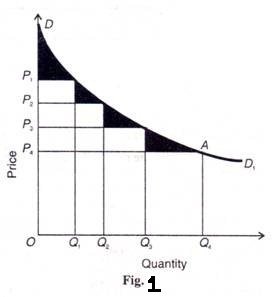
(2) To deal with each buyer on a take-it-or-leave-it basis. When the discriminator of first degree is able to deal with his customers on the above basis, he can transfer the whole of consumers’ surplus to himself. Consider Figure 1. Where DD1 is the demand curve faced by the monopolist. Each buyer is assumed as a price-taker. Suppose the discriminating monopolist sells four units of his product at four different prices:

OQ1 unit at OP1price, Q1Q2 unit at OPprice, Q2Q3 unit at OP3 price and Q3Q4 unit at OP4 price. The total revenue (or price) obtained by him would be OQ4 AD. This area is the maximum expenditure that the consumers are willing to incur to buy all four units of the product under the first-degree discriminator’s all-or-nothing offer. But with no price discrimination under simple monopoly, the monopolist would sell all four units at the uniform price OP4 and thus obtain the total revenue of OQ4AP4.

This area represents the total expenditure that consumers would actually pay for the four units. Thus the difference between what Quantity the consumers were willing to pay (OQ4 AD) under Fig. 1 the take-it-or-leave-it offer of the first degree discrimi­nator and what they actually pay (OQ4AP4) to the simple monopolist, is consumers’ surplus. This is equal to the area of the triangle DAP4.

Thus under the first-degree price discrimination, the entire consumers’ surplus is pocketed by the monopolist when he charges a separate price for each unit of the product. Price discrimination of the first degree is rare and is to be found in such rare products as diamonds, jewels, precious stones, etc. But a monopolist must have full knowledge of the demand curve faced by him and he should know the maximum price that the consumers are willing to pay for each unit of the product he wants to sell.

Discrimination of the Second Degree (2nd) or Multi-part Pricing

In discrimination of the second degree, the monopolist divides the consumers in different slabs or groups or blocks and charges different prices for different slabs of the same product. Since the earlier units of the product have more utility for the consumers than the later ones, the monopolist charges a higher price for the former units and reduces the price for the later units in the respective slabs.

Such discrimination is only possible if the demand of each consumer below a certain maximum price is perfectly inelastic. Electric supply companies in developed countries practice discrimination of the second degree when they charge a high rate for the first slab of kilowatts of electricity consumed. As more electricity is used, the rate falls with subsequent slabs.

Figure 2 illustrates the second degree discrimination, where DD1is the demand curve for electric­ity on the part of domestic consumers in a town. CP3 represents the cost of generating electricity, so that the electricity company charges M1P1 rate per kw. up to OM1 units. For consuming the next M1 to М2 units, the rate is lowered to M2P2. The lowest rate charged is M3P3 for M2 to M3 units. M3P3 is, however, the lowest rate which will be charged even if a con­sumer consumes more than M3 units of electricity.

If the electricity company were to charge only one rate throughout, say M3P3the total revenue would not be maximized. It would be OCP3 M3But by charg­ing different rates for different unit slabs, it gets the total revenue equal to OM3 x P1M1 + OM2 x P2M2 + OM3x P3M3 Thus the second degree discriminator would take away a part of consumers’ surplus covered by the rectangles ABEP1and BCFP2 .The shaded area in three triangles DAP1 Р1ЕР2, and P2FP3 still remains with consumers as their surplus.

The second degree price discrimination is practised by telephone companies, railways, companies supplying water, electricity and gas in developed countries where these services are available in plenty. But it is not found in developing countries like India where such services are scarce.

The differences between the first and second degree price discrimination may be noted. In the first degree discrimination, the monopolist charges a different price for each different unit of the prod­uct. But in second degree discrimination, a number of units in one slab (or group or block) are sold at the lowest price and as the slabs increase, the prices charged by the monopolist are lowered. In the case of the former the monopolist takes away the whole of consumers’ surplus. But in the latter case, the monopolist takes away only a portion of the consumers’ surplus and the other portion is left with the buyer.

Conditions under which Price Discrimination is Possible

Price discrimination is possible under following conditions:

  1. Nature of Commodity

In the first place it is said that price discrimination is possible when the nature of the commodity or service is such that there is no possibility of transference from one market to the other.

That is, the goods sold in the cheaper market cannot be resold in the dearer market; otherwise the monopolist’s purpose will be defeated.

  1. Distance of Two Markets

Price discrimination is possible when the two markets or markets are separated by large distance or tariff barriers, so that it is not possible to transfer goods from a cheaper market to dearer markets. For instance, a monopolist may sell the same product at a higher price in Bombay and lower price in Meerut.

  1. Ignorance of the Consumers

Price discrimination is possible when the consumers are ignorant about price discrimination, they are not aware that in one part of the market prices are lower than in the other part. Thus, he purchases in dearer market, than in cheaper market since he is ignorant of the prices that are prevailing in different markets.

  1. Government Regulation

Price discrimination occurs when the government rules and regulations permit. For instance, according to rules, electricity rates are fixed at higher level for industrial purposes and lower for domestic uses. Similarly, railways charge by law higher fares from first class passengers than from the second class passengers. Hence, price discrimination is possible because of legal sanction.

  1. Geographical Discrimination

Price discrimination may be possible on account of geographical situations. The monopolist may discriminate between home and foreign buyers by selling at lower price in the foreign market than in the domestic market. Geographical discrimination is possible because no unit of the commodity sold in one market can be transferred to another.

  1. Difference in Elasticity of Demand

A commodity may have different elasticity of demand in different markets. Thus, the market of a commodity can be separated on the basis of its elasticity of demand.

Hence, a monopolist can charge different prices in different markets classified on the basis of elasticity of demand, low price is charged where demand is more elastic and high price in the market with the less elastic demand or inelastic demand.

  1. Artificial Difference between Goods

A monopolist may create artificial differences by presenting the same commodity under different names and labels, one for the rich and snobbish buyers and the other for the ordinary customers. For instance, a biscuit manufacturer may wrap small quantity of the biscuits, give it separate name and charge a higher price. Thus, he may charge different price for substantially the same product. He may charge Rs. 2/- for 100 gram wrapped biscuits and Rs. 1.50 for unwrapped biscuits.

Physical Distribution Channels, Role, Factors, Importance, Types

Physical Distribution Channels refer to the path or route through which goods and services travel from the producer or manufacturer to the final consumer. These channels include intermediaries such as wholesalers, retailers, agents, or distributors, who play an essential role in making the product available to the target market. The goal of distribution channels is to ensure that products reach the right place, at the right time, and in the right condition. Effective distribution channel management helps companies expand market reach, enhance product availability, and optimize costs, contributing to overall business success.

Role of Physical Distribution Channels:

(i) Distribution channels provide time, place, and ownership utility

They make the product available when, where, and in which quantities the customer wants. But other than these transactional functions, marketing channels are also responsible to carry out the following functions:

(ii) Logistics and Physical Distribution

Marketing channels are responsible for assembly, storage, sorting, and transportation of goods from manufacturers to customers.

(iii) Facilitation

Channels of distribution even provide pre-sale and post-purchase services like financing, maintenance, information dissemination and channel coordination.

(iv) Creating Efficiencies

This is done in two ways: bulk breaking and creating assortments. Wholesalers and retailers purchase large quantities of goods from manufacturers but break the bulk by selling few at a time to many other channels or customers. They also offer different types of products at a single place which is a huge benefit to customers as they don’t have to visit different retailers for different products.

(v) Sharing Risks

Since most of the channels buy the products beforehand, they also share the risk with the manufacturers and do everything possible to sell it.

(vi) Marketing

Distribution channels are also called marketing channels because they are among the core touch points where many marketing strategies are executed. They are in direct contact with the end customers and help the manufacturers in propagating the brand message and product benefits and other benefits to the customers.

Role Determining the Choice of Distribution Channels:

Selection of the perfect marketing channel is tough. It is among those few strategic decisions which either make or break your company.

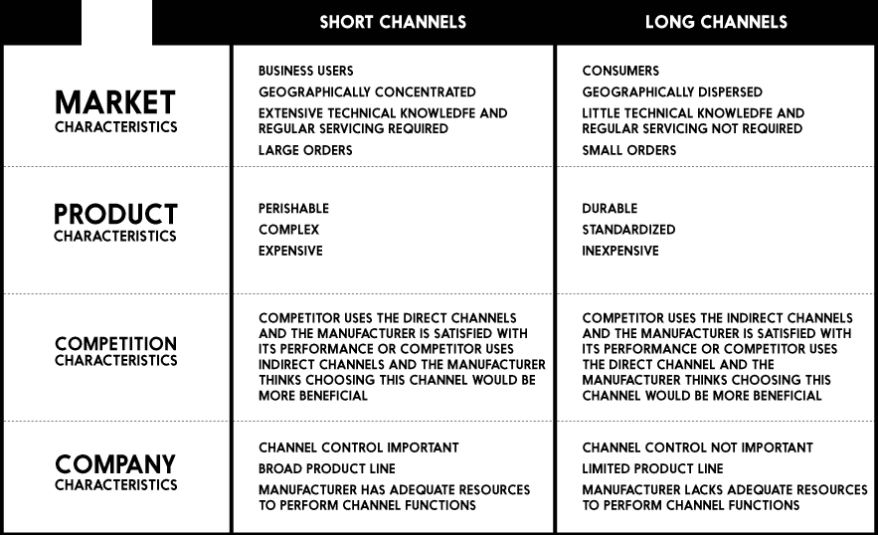
Even though direct selling eliminates the intermediary expenses and gives more control in the hands of the manufacturer, it adds up to the internal workload and raises the fulfilment costs. Hence these four factors should be considered before deciding whether to opt for the direct or indirect distribution channel.
Importance of Physical Distribution Channels:

  • Ensures Product Availability

Physical distribution channels ensure products are available to customers at the right place and time. They bridge the gap between production and consumption, making goods accessible in various markets. Efficient distribution minimizes stockouts and ensures continuous supply. By strategically placing products where demand exists, businesses can serve customers promptly, increase satisfaction, and build loyalty. This availability directly influences purchase decisions and repeat sales, especially in competitive markets. Without effective physical distribution, even high-quality products may fail to reach intended customers, resulting in lost opportunities and reduced profitability.

  • Reduces Transportation and Storage Costs

Efficient physical distribution channels optimize transportation routes, load capacity, and storage facilities to minimize costs. By consolidating shipments and using appropriate warehousing strategies, businesses can lower expenses while maintaining timely deliveries. Cost reduction also improves pricing competitiveness in the market. Advanced logistics systems, such as just-in-time (JIT) inventory management, help reduce the need for large storage facilities, saving rent and maintenance costs. Moreover, bulk transportation through well-managed channels reduces per-unit freight charges. These cost efficiencies ultimately increase profitability and allow companies to offer competitive prices to customers without compromising service quality.

  • Expands Market Reach

Physical distribution channels help businesses reach diverse geographic areas, including rural, urban, and international markets. Well-established networks of wholesalers, distributors, and retailers ensure products penetrate deeper into different customer segments. This expansion enables companies to serve untapped markets, increasing overall sales volume and market share. Global brands often rely on sophisticated distribution systems to ensure consistent product availability across countries. Additionally, local adaptation of distribution strategies allows businesses to cater to specific market needs. By extending reach effectively, companies can strengthen their brand presence and establish dominance over competitors in multiple regions simultaneously.

  • Enhances Customer Satisfaction

An efficient physical distribution channel ensures fast, reliable, and damage-free delivery of products, directly contributing to customer satisfaction. Customers value convenience and timely service, and a strong distribution network fulfills these expectations. Quick product availability enhances trust in the brand and encourages repeat purchases. In industries like FMCG, electronics, and e-commerce, seamless delivery is a major factor in customer retention. Furthermore, prompt handling of returns and exchanges through distribution networks adds to a positive buying experience. Overall, smooth distribution strengthens customer relationships and boosts long-term loyalty, which is crucial for business sustainability.

  • Improves Competitiveness

A strong distribution system gives companies a competitive edge by ensuring products reach markets faster than competitors. Businesses that can deliver products promptly gain an advantage in customer preference and loyalty. Efficient logistics also allow companies to respond quickly to changing market demands or seasonal fluctuations. By maintaining a wide and reliable network, businesses can secure better shelf space in retail outlets and negotiate favorable terms with distributors. This operational strength often translates into a dominant market position, higher sales volumes, and stronger brand visibility, making it harder for competitors to match performance.

  • Facilitates Smooth Supply Chain Management

Physical distribution channels are a crucial link in the supply chain, ensuring smooth movement of goods from manufacturers to end-users. Well-coordinated channels improve communication between producers, wholesalers, retailers, and customers, leading to better inventory control and demand forecasting. This reduces delays, stock imbalances, and wastage. Integration with technology like GPS tracking and warehouse management systems further enhances efficiency. By aligning supply with demand in real-time, companies can avoid overproduction or shortages. Smooth supply chain operations also improve overall productivity and operational efficiency, which directly benefits profitability and customer satisfaction.

  • Supports Sales Growth

Effective physical distribution channels directly contribute to higher sales by ensuring wide product availability and convenience for customers. Products that are easy to find and purchase naturally sell more, leading to increased revenue. Distributors and retailers often promote products within their networks, providing additional marketing support. Furthermore, consistent supply to high-demand areas maximizes sales potential and minimizes lost opportunities. Seasonal products, in particular, benefit from quick and efficient distribution to capture peak demand. Ultimately, a robust distribution network is a strategic driver for sustainable business growth and long-term market expansion.

Types of Distribution Channels:

Distribution channels refer to the pathways through which products move from the producer to the final consumer. The choice of distribution channel impacts the product’s availability, cost, and customer experience. There are several types of distribution channels, each suited to different business models and customer needs.

  • Direct Distribution Channel

In a direct distribution channel, the producer sells the product directly to the consumer without involving intermediaries. This can be done through physical stores, company-owned retail outlets, or online platforms. Direct channels allow businesses to have full control over the pricing, branding, and customer experience. They are commonly used for high-value, customized products, or when a business wants to establish direct relationships with customers, as seen in industries like luxury goods, technology, and exclusive services.

  • Indirect Distribution Channel

Indirect distribution channels involve intermediaries between the producer and the consumer. These intermediaries can be wholesalers, distributors, or retailers who help move the product through the market. Indirect channels are common for mass-market products where reaching a larger audience efficiently is crucial. For example, a manufacturer of consumer electronics may sell its products to wholesalers, who then distribute them to various retailers, making the product available in multiple locations.

  • Dual Distribution Channel

A dual distribution channel, also known as a hybrid channel, combines both direct and indirect methods. A company uses direct sales to reach some customers while also using intermediaries to sell through other channels. This type of distribution is useful for companies that want to diversify their sales efforts or reach different market segments. For example, a company might sell directly to large corporate clients but rely on retailers to reach individual consumers. This approach increases market coverage and flexibility.

  • Intensive Distribution

Intensive distribution aims to make the product available in as many locations as possible. This type of channel is used for products with high demand, low unit cost, and frequent purchases, such as consumer packaged goods, snacks, or toiletries. The goal is to saturate the market and make the product widely accessible. The product is sold through multiple retailers, wholesalers, and other outlets to ensure it is readily available for customers.

  • Selective Distribution

Selective distribution involves using a limited number of outlets or intermediaries to distribute products. The company selectively chooses the intermediaries based on their ability to provide quality service, reach specific customer segments, or meet certain brand standards. This approach is often used for moderately priced products such as electronics or appliances. It allows the producer to maintain some control over the product’s distribution while still reaching a broad audience.

  • Exclusive Distribution

Exclusive distribution channels are characterized by a highly selective approach where the producer only sells the product through a few specific intermediaries. This type of channel is often used for luxury or high-end products, where exclusivity and prestige are critical. By limiting the number of distributors or retailers, the brand can control its image and ensure that the product is positioned correctly in the market. For example, a high-end automobile manufacturer may only sell its cars through a select network of authorized dealerships.

Choosing the Right Distribution Channel:

Choosing the right distribution channel is a crucial decision that can significantly impact a company’s success in reaching its target market. The process involves evaluating various options based on the product type, target customer preferences, cost considerations, and competitive environment.

  • Product Type

The nature of the product plays a vital role in determining the best distribution channel. For example, perishable goods like fresh food products may require direct distribution to maintain freshness, while durable goods can be sold through wholesalers or retailers. Similarly, high-end, luxury products may be best suited for exclusive distribution channels, while mass-market items benefit from extensive channel networks.

  • Market Coverage

The level of market coverage needed for the product influences the choice of distribution channel. If the goal is to achieve intensive distribution (wide availability in as many outlets as possible), using intermediaries like wholesalers or retailers is essential. On the other hand, exclusive distribution may require fewer intermediaries to maintain control and exclusivity, which works well for high-end products.

  • Customer Preferences

Understanding how customers prefer to buy products is critical when selecting a distribution channel. In the digital age, many customers prefer purchasing products online, while others prefer a traditional in-store experience. Businesses need to assess the purchasing behavior and preferences of their target market to choose a channel that aligns with their customers’ expectations.

  • Cost Considerations

The cost of using a particular distribution channel is an important factor. Direct distribution, such as selling through a company-owned retail outlet or an e-commerce platform, may involve higher operational costs but provides more control. Indirect channels like wholesalers and retailers may reduce operational costs but may result in lower profit margins due to commissions and markups. Companies need to balance cost considerations with revenue goals to make the most cost-effective choice.

  • Control and Flexibility

When a company chooses a distribution channel, it also determines the level of control it will have over its products and brand. Direct distribution allows a company to maintain more control over product presentation, pricing, and customer experience. However, indirect channels offer less control, as they rely on intermediaries to sell the product. If maintaining control over branding and customer experience is a priority, a company may opt for a direct distribution channel.

  • Competition

The distribution strategy should also consider competitors’ actions. If competitors are using particular distribution channels, entering the same channels could help a company maintain its competitive edge. Alternatively, choosing unique or innovative channels can provide differentiation in the marketplace.

  • Market Reach

The geographical scope of the target market also affects the choice of distribution channels. If a company plans to reach international or distant markets, using a distribution network that includes international agents or global e-commerce platforms might be necessary. Alternatively, for a local or regional target market, a more localized approach with regional wholesalers or retailers may be sufficient.

  • Speed and Efficiency

The time it takes for products to reach customers is another consideration. If the market demands fast delivery, a direct distribution channel, such as e-commerce with quick fulfillment services or direct sales through retail stores, may be ideal. In contrast, some customers may be willing to wait for their products, in which case a slower, but more cost-effective, channel may suffice.

error: Content is protected !!