Differences between personnel Management and Human Resources Development

Personnel Management is a part of management that deals with the recruitment, hiring, staffing, development, and compensation of the workforce and their relation with the organization to achieve the organizational objectives. The primary functions of the personnel management are divided into two categories:

  • Operative Functions: The activities that are concerned with procurement, development, compensation, job evaluation, employee welfare, utilization, maintenance and collective bargaining.
  • Managerial Function: Planning, Organizing, Directing, Motivation, Control, and Coordination are the basic managerial activities performed by Personnel Management.

Human Resource Development

Human resource development (HRD) is defined as the cultivation of an organization’s employees. It entails providing workers with skills and relevant knowledge that may help them to grow in the workplace. That makes human resource development an integral part of human resource management.

HRD starts with a clear vision for employee development, and most times, it is achieved through organization-wide activities and training. Typically, the HRD team is in charge of developing these initiatives to position employees for career advancement and other related goals.

Roles like instructional coordinators, training specialists, and program developers may involve aspects of human resource development.

HR developers are important members of the HR team as they oversee a variety of areas within the human resources branch of an organization, including training, employee development, executive and leadership development, human performance technology, and organizational learning. On any given day, their responsibilities might involve creating training programs, designing systems to attract and retain talent, and planning organizational development activities, which may be in the form of workshops and more.

A background in human resource development may prepare you for specialized training, instructional design, program development, and general HR positions. For example, training and development specialists are in charge of designing manuals, online learning modules, and course materials for onboarding employee’s External link.

Personnel Management Human Resource Development
Meaning The aspect of management that is concerned with the work force and their relationship with the entity is known as Personnel Management. The branch of management that focuses on the most effective use of the manpower of an entity, to achieve the organizational goals is known as Human Resource Management.
Approach  Traditional Modern
Treatment of manpower Machines or Tools Asset
Type of function  Routine function Strategic function
Basis of Pay Job Evaluation Performance Evaluation
Management Role Transactional Transformational
Communication Indirect Direct 
Labor Management Collective Bargaining Contracts Individual Contracts 
Initiatives Piecemeal Integrated 
Management Actions Procedure Business needs
Decision Making Slow Fast
Job Design Division of Labor Groups/Teams
Focus Primarily on mundane activities like employee hiring, remunerating, training, and harmony. Treat manpower of the organization as valued assets, to be valued, used and preserved.

Systematic approach to change, Client & Consultant relationship

Systematic approach to change

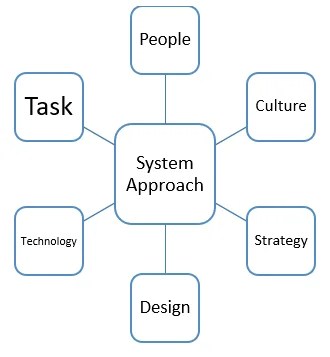
The Systems Model of Change or Organization-Wide Change lays more emphasis on the fact that a change must be implemented organization-wide instead of implementing it in piecemeal.

This model provides a whole new dimension to the concept of organizational change and describes the role played by six interconnected or interdependent variables like people, task, strategy, culture, technology and design. All these 6 variables are the key focus of planned change. The model has been represented in the diagram below:

  1. People: This variable involves the individuals who work in an organization. This would take into consideration the individual differences in the form of personalities, goals, perceptions, attitudes, attributions and their needs/motives.
  2. Task: The task is related to the nature of work which an individual handles in an organization. The nature of the job may be simple or complex, repetitive or novel, unique or standardized.
  3. Design: This variable refers to the organizational structure itself and also the system of communication, authority and control, the delegation of responsibilities and accountabilities.
  4. Strategy: The organizational strategy is the road map of action for realizing the future goals both short term and long term in nature. Strategic Planning involves identification of existing resources, a careful assessment of internal strengths and weaknesses, identifying the opportunities in the environment and threats as well for a competitive advantage.
  5. Technology: It takes into consideration the advancements in the technology in the field of IT, automation, new methods and techniques for enhancing productivity, the introduction of new processes and best practices for remaining ahead in the competition.
  6. Culture: It takes into consideration the shared beliefs, practices, values, norms and expectations of the members of the organization.

Steps to follow:

  • Dedicate time for planning

This may sound silly but you need to actually plan for planning. Always think of things, needs to plan for and to-do lists I need to write but not until recently did I realize that I was leaving the actual planning to the last minute. That’s because one wasn’t dedicating enough time to just sit and plan things out. Set up a recurring event in your calendar to just sit there and put your plans in writing.

  • Batch your time

I’ve tried so many “productivity hacks” and I find this one to be the most useful. It might not work for everyone but it’s worth the shot. Batching your time basically means that you divide your day into time blocks dedicated to only one task or multiple tasks of the same nature. This ensures that you don’t get distracted with doing other tasks and minimizes your tendency to multitask. It also allows you to enter the flow state of diving deep into one task.

  • Create checklists

Make checklists of things you need to get done and keep looking at those checklists. Many of us are guilty of writing down a to-do list, feeling good about it, and then never looking at it again. Put the checklist somewhere accessible like your notes on your phone so that you can pull it out easily. Track your progress and check off things that you’ve completed. Once you finish a checklist you’ll feel so good about yourself, trust me!

  • Prepare for the unexpected

No matter how hard you plan or how much you think you’ve thought ahead, always mentally prepare yourself for things to go wrong. There’s a saying that says “you plan and the universe laughs”, which is so true. That doesn’t mean that you shouldn’t plan, but just make sure you have back-ups and prepare for some crisis management.

Client & Consultant relationship

Consultants are expected to maintain professional and ethical standards when dealing with their clients. This can take the form of maintaining arm’s length relationships, not intervening in the internal affairs and politics of the client’s organizations, keeping confidential information away from interested parties looking for insider knowledge, and reporting any violations in the conduct (financial, operational, and behavioral) by the client’s organization to the regulators. This is the code of conduct that is usually prescribed for consulting firms whenever they take on work from client organizations.

Realities of Consultant-Client Relations

However, this is rarely followed in practice as evidenced by the large numbers of corporate scandals that have emerged in the last decade or so where the consultant was found to be aiding and even abetting the malfeasance conducted by the client. For instance, the Enron scandal manifested itself because the consulting firm was in cahoots with the client in cooking the books. Indeed, in this case, it was found that the consulting firm’s partners went beyond collaboration and were indeed one of the culprits.

Some Examples from the Corporate World

Similarly, the Satyam scandal in India was also found to be a case where the consultants (or some of them) knew about the goings-on in the company and were in breach of the code of conduct and even legal aspects since they did not report the matter to the regulators. However, the saving grace in this case was that when the malfeasance became too big and too hot to handle, it was the new consulting firm that had been roped in for another purpose that blew the whistle on the scam.

Consultants have to Walk a Thin Line between Professional and Personal Obligations

These examples indicate that the consultants have to walk a thin line between fulfilling professional obligations and reporting unethical behavior. Since the client is the one who pays them, it is often the case that the consultants are reluctant to report malfeasance to the regulators. Further, considering the extremely competitive nature of the market wherein there are several consulting firms competing for the same client, money talks and hence, consultants are often found to go along with the client. There are no easy answers when one considers all the aspects and it would be indeed a brave and conscientious consultant who would be the whistleblower.

Some Solutions Which Were Proposed

Having said that, there are some solutions that have emerged in recent years about the course of action to be taken by the consulting firms. For instance, after the Enron scandal, the SEC (Securities and Exchange Commission) and other regulators ensured that new rules separating consulting and investment banking so that the same consulting firm which was also advising the client in financial matters would now be two different firms. While this was intended to reduce the conflict of interest since it was thought that when consultants and investment bankers represent two firms they would automatically be in a position to wink at malfeasance, it is debatable as to how far this law succeeded given the Global Economic Crisis of 2008 wherein several case of malfeasance came to light.

Conflict of Interest is at the Heart of the Problem

Of course, as some experts have mentioned, the real issue here is of conflict of interest. How far would a consultant go in reporting unethical behavior to the regulators which is expected from him or her when such case involve the very clients who are giving them business. Further, the fact that many consultants often are embroiled in the internal politics of the client wherein they take sides in corporate and boardroom battles. This indicates the tricky nature of the problem of consultant client relations wherein the temptation to use confidential and insider information to one’s advantage is motivated by greed and power.

Coaching & Mentoring

Coaching and mentoring serve as learning tools in the workplace that can lead to empowering your employees. The employees who are coached and mentored often receive the greatest benefit, but the coach or mentor also benefits and may feel a sense of empowerment from the relationship. Understanding the dynamics and outcomes of this type of workplace learning strategy helps you evaluate the need for a coaching program in your small business.

Coaching

Coaching at work is designed to help employees learn or enhance specific skills. It focuses on one individual over a defined period of time, helping them to develop effectively. It can be used to:

  • Teach new skills in a focused way
  • improve performance in a particular area of work
  • build ‘soft’ skills like confidence, interpersonal relationships or planning

The objective of coaching at work is to help an employee make a distinct improvement in an agreed area. That improvement might be measurable through KPIs, or it might be a softer target. To achieve it, the employee receives support and constructive feedback from a designated coach.

Coaching is a powerful tool for employees, but your company will also reap the benefits of a specially trained workforce.

The great benefit of coaching is that you are likely to see quick, positive results as an outcome. This is because coaching is participative and people tend to learn and adopt new habits more easily when they are actively engaged in the learning process.

Mentoring

Mentoring involves the use of the same models and skills of questioning, listening, clarifying and reframing associated with coaching.

Traditionally, mentoring in the workplace is usually where a more experienced colleague uses his or her greater knowledge and understanding of the workplace in order to support the development of a less experienced member of staff.

Deciding if coaching is the right approach

How do you know if coaching will work for your company? In truth, it can depend on the context and the people concerned.

Some employees will respond enthusiastically, especially to the right coach, and will come on leaps and bounds. For example, you could use a professional coach to:

  • Bring out the full potential of a gifted employee
  • help technical experts improve interpersonal skills
  • train managers to handle conflict situations

Although coaching at work is normally very effective, it doesn’t suit every situation or every personality. Other options to consider might be external training, mentoring or online learning.

Importance

Coach or Mentor Empowerment

The experienced employee who serves as the coach or mentor is able to show his knowledge and skill in the industry. This added challenge can boost his confidence and give him a sense of empowerment in his own work. In some cases, the employee the mentors push him to learn new skills in the industry. The collaboration between coach and mentor can lead to new ideas and achievements to aid them both in succeeding.

Independence

A mentor provides support for a new employee, but the ultimate goal is to empower the employee to work independently with the skills she has learned. The ability to work successfully on her own brings a sense of empowerment as she gains independence in the workplace. While employees feel confident to work independently, the mentoring program creates a sense of teamwork and often boosts morale for your employees. This positive work environment continues to empower employees in their work.

Goal Setting

Coaching and mentoring often includes goal setting for the employee. The mentor helps the new employee set specific goals related to the job. The two work together to create a plan to reach those goals. Mentors can customize objectives and support that that employee needs for his particular role. The mentor is also available as a resource if the new employee needs support along the way to be successful. Having a set of challenging goals is motivating and empowers the employee to work beyond the minimum requirements.

Hands-On Learning

Coaching and mentoring gives new employees a hands-on training program to learn job expectations. Instead of throwing a new employee right into the position, he gets a support system and an interactive learning situation that may engender more on-the-job confidence. Mentored employees may often feel a greater sense of understanding of what is required of them in their jobs because they get one-on-one job training, support and the advice of an experienced employee. When an employee receives this kind of personalized training, he may feel empowered to fully perform his job duties.

Staffing in HRP Department, issuing orders, resolving conflicts, Communicating

Staffing is the process of hiring eligible candidates in the organization or company for specific positions. In management, the meaning of staffing is an operation of recruiting the employees by evaluating their skills, knowledge and then offering them specific job roles accordingly.

Assess current HR capacity

The first step in the human resource planning process is to assess your current staff. Before making any moves to hire new employees for your organization, it’s important to understand the talent you already have at your disposal. Develop a skills inventory for each of your current employees.

Forecast HR requirements

Once you have a full inventory of the resources you already have at your disposal, it’s time to begin forecasting future needs.

Demand forecasting

Demand forecasting is the detailed process of determining future human resources needs in terms of quantity the number of employees needed and quality the caliber of talent required to meet the company’s current and future needs.

Supply forecasting

Supply forecasting determines the current resources available to meet the demands. With your previous skills inventory, you’ll know which employees in your organization are available to meet your current demand. You’ll also want to look outside of the organization for potential hires that can meet the needs not fulfilled by employees already present in the organization.

Issuing orders

Following points should be observed while issuing orders to the subordinates:

  • Few orders: Issue as few orders as possible. More orders than those that are absolutely necessary, if issued, will result in loss of independence and thus initiatives of subordinates will be suppressed.
  • Clear orders: The orders should be absolutely clear. They create confidence in the mind of the subordinates about the clear understanding by the order given.
  • Brief but complete orders: The orders should be as brief as possible but complete orders to convey fully what is intended to be done.
  • Promptness: Professional form and proper tone in orders. Prompt issuing of order and proper use of technical words and phrases is essential for effective directing. Proper tone in issuing the orders should be observed.
  • Legitimate scope of orders: The manager issuing the order should keep within his own domain. He must not encroach up on the sphere of the receiving executive.
  • Follow up orders: Another important principle of direction is that once orders or instructions are issued, they should be followed up to see that they are executed, orthe instructions should be countermanded or withdrawn.

Resolving conflicts

Workplace conflict is inevitable when employees of various backgrounds and different work styles are brought together for a shared business purpose. Conflict can and should be managed and resolved. With tensions and anxieties at an all-time high due to the current political divide and racial inequity discussions at work, the chances for workplace conflict have increased. This toolkit examines the causes and effects of workplace conflict and the reasons why employers should act to address conflict.

The first steps in handling workplace conflict belong, in most cases, to the employees who are at odds with one another. The employer’s role exercised by managers and HR professionals is significant, however, and is grounded in the development of a workplace culture designed to prevent conflict among employees to the extent possible. The basis for such a culture is strong employee relations, namely, fairness, trust and mutual respect at all levels. This toolkit offers suggestions to create such an organizational climate and includes methods to deal with employee grievances and conflicts.

Experts offer several causes of workplace conflict, including:

  • Personality differences.
  • Workplace behaviors regarded by some co-workers as irritating.
  • Unmet needs in the workplace.
  • Perceived inequities of resources.
  • Unclarified roles in the workplace.
  • Competing job duties or poor implementation of a job description—for example, placing a nonsupervisory employee in an unofficial position of “supervising” another employee.
  • A systemic circumstance such as a workforce slowdown, a merger or acquisition, or a reduction in force.
  • Mismanagement of organizational change and transition.
  • Poor communication, including misunderstood remarks and comments taken out of context.
  • Differences over work methods or goals or differences in perspectives attributable to age, sex or upbringing.

To manage conflict, employers should consider the following:

  • Make certain that policies and communication are clear and consistent, and make the rationale for decisions transparent.
  • Ensure that all employees not just managers are accountable for resolving conflict.
  • Do not ignore conflict, and do not avoid taking steps to prevent it.
  • Seek to understand the underlying emotions of the employees in conflict.
  • Keep in mind that approaches to resolving conflict may depend on the circumstances of the conflict.

Communicating

Communication is a vital management component to any organization. Whether the purpose is to update employees on new policies, to prepare for a weather disaster, to ensure safety throughout the organization or to listen to the attitudes of employees, effective communication is an integral issue in effective management.

The impact of effective communication

Effective communication may contribute to organizational success in many ways. It:

  • Builds employee morale, satisfaction and engagement.
  • Helps employees understand terms and conditions of their employment and drives their commitment and loyalty.
  • Educates employees on the merits of remaining union-free (if that is the organization’s goal).
  • Gives employees a voice an increasingly meaningful component of improving employees’ satisfaction with their employer.
  • Helps to lessen the chances for misunderstandings and potentially reduces grievances and lawsuits.
  • Improves processes and procedures and ultimately creates greater efficiencies and reduces costs.

Effective communication strategies:

  • Safeguard credibility to establish loyalty and build trust.
  • Maintain consistency to establish a strong employment brand.
  • Listen to employees and to members of the leadership team.
  • Seek input from all constituencies.
  • Provide feedback.
  • Prepare managers in their roles as organizational leaders.

Stakeholder Conflict and Managing Conflict

Stakeholders are individuals or groups who have an interest in the operations and decisions of a business. These include employees, customers, shareholders, suppliers, the government, community members, and environmental groups. Since each stakeholder group has different priorities, expectations, and values, conflicts among them are common in organizational settings.

Stakeholder conflict occurs when the interests, values, or goals of different stakeholders clash. For example, shareholders may want higher profits, while employees may demand better wages; customers may expect low prices, while suppliers seek higher payments.

These conflicts pose ethical challenges and must be managed carefully to maintain trust, integrity, and long-term success.

Causes of Stakeholder Conflicts

  • Competing Interests:

One of the most common causes of conflict is differing priorities. Shareholders may seek cost-cutting for higher returns, while employees demand job security and fair compensation. Similarly, the company may want to expand operations, while the community may worry about environmental impact.

  • Resource Allocation:

Disputes often arise over the distribution of limited resources—time, money, labor, or materials. For example, should more budget be allocated to marketing for sales or to safety upgrades for workers?

  • Ethical Values and Beliefs:

Conflicts may emerge due to differing ethical standpoints. For instance, a company may operate legally in one country but face criticism from international human rights organizations for labor practices that are viewed as unethical.

  • Lack of Communication:

Poor communication between stakeholders can lead to misunderstandings and mistrust. Without clear, transparent dialogue, stakeholders may feel excluded or undervalued.

  • Power Imbalances:

Powerful stakeholders, such as major investors, may dominate decision-making, leading to resentment or marginalization of less influential stakeholders like local communities or employees.

Examples of Stakeholder Conflicts

  • Environmental vs. Economic Goals:

A company plans to build a new manufacturing plant. Shareholders and management are excited about potential profits, but environmental groups and local residents oppose it due to pollution concerns.

  • Profit vs. People:

To maximize quarterly profits, a firm may consider layoffs or reducing employee benefits. This creates tension between shareholder interests and employee welfare.

  • Transparency vs. Privacy:

Customers demand data privacy, while the marketing department seeks more data analytics to boost sales. This results in ethical conflicts between consumer rights and business growth strategies.

Impacts of Stakeholder Conflict:

  • Reputational Damage: Conflicts aired in public can harm a company’s image.

  • Loss of Trust: Employees or customers may lose faith in the company’s fairness.

  • Reduced Productivity: Internal conflicts lower morale and increase turnover.

  • Legal Consequences: Violations of stakeholder rights can result in litigation.

  • Financial Losses: Boycotts, strikes, or fines may impact profitability.

Effective conflict management is essential to avoid these negative consequences.

Managing Stakeholder Conflict: Ethical Approaches:

  • Stakeholder Engagement and Dialogue

Actively involving stakeholders in discussions and decisions fosters mutual respect and understanding. This includes surveys, meetings, feedback forums, and transparent reporting. When stakeholders feel heard, they are more likely to support decisions, even if their demands aren’t fully met.

  • Prioritization with Justification

Sometimes, not all interests can be satisfied. In such cases, businesses must prioritize ethically—balancing economic, social, and environmental concerns. Decisions should be based on fairness, necessity, and long-term impact, with clear communication of the rationale.

  • Conflict Resolution Mechanisms

Companies should have formal procedures for resolving conflicts, such as grievance redressal systems, arbitration panels, or ethics committees. These mechanisms offer impartial evaluation and help address stakeholder concerns in a structured and timely manner.

  • Adopting Corporate Social Responsibility (CSR)

CSR initiatives can proactively address stakeholder concerns by investing in community welfare, environmental protection, and ethical labor practices. These actions reduce potential conflicts and improve relationships with external stakeholders.

  • Ethical Leadership

Leaders must model ethical behavior and make decisions that consider stakeholder fairness. Ethical leadership involves integrity, empathy, and accountability, which are essential for building stakeholder trust and managing competing interests with transparency.

  • Balancing Short-Term and Long-Term Goals

Ethical conflict management involves evaluating decisions not just for immediate benefits but for long-term stakeholder relationships and sustainability. Sacrificing short-term profits for long-term trust and stability often leads to stronger, more ethical businesses.

  • Legal and Ethical Compliance

Organizations must comply with laws and regulations while also striving to meet higher ethical standards. Ensuring that policies respect human rights, labor laws, consumer protections, and environmental norms reduces stakeholder conflicts.

Tools and Frameworks for Conflict Management:

  • Stakeholder Mapping: Identifies stakeholders based on power and interest, helping companies understand whose interests need more attention.

  • Triple Bottom Line (TBL): Encourages businesses to focus on people, planet, and profit equally, helping to balance stakeholder needs.

  • ISO 26000 Guidelines: Provide international guidance on social responsibility and stakeholder engagement.

  • Ethical Decision-Making Models: Such as utilitarianism (greatest good), rights-based, and justice-based approaches can help in evaluating options fairly.

FPO (follow-on public offering)

A follow-on public offering (FPO) is the issuance of shares to investors by a company listed on a stock exchange. A follow-on offering is an issuance of additional shares made by a company after an initial public offering (IPO). Follow-on offerings are also known as secondary offerings.

FPO is an abbreviation of a Follow-On Public Offer. The process of FPO starts after an IPO. FPO is a public issue of shares to investors at large by a publicly listed company. In FPO, the company goes for a further issue of shares to the general public with a view to diversifying its equity base. A prospectus is offered by the company.

There are two types of FPO:

  • Dilutive offering: In dilutive FPO, the company issues an additional number of shares in the market for the public to buy however the value of the company remains the same. This reduces the price of shares and automatically reduces the earnings per share also.
  • Non-Dilutive offering: Non-dilutive IPO takes place when the larger shareholders of the company like the board of directors or founders sell their privately held shares in the market. This technique does not increase the number of shares for the company, just the number of shares available for the public increases. Unlike dilutive FPO, since this method is not doing anything to the number of shares of the company, it does not do anything to the company’s EPS.

How follow-on Public offering is different from initial public offering.

  • IPO is made when company seeks to raise capital via public investment while FPO is subsequent public contribution.
  • First issue of shares by the company is made through IPO when company first becoming a publicly traded company on a national exchange while Follow on Public Offering is the public issue of shares for an already listed company.

IPO vs FPO


IPO

FPO

1. Meaning The first issue of shares by a company Issuance of shares by a company to raise additional capital after IPO
2. Price Fixed or variable price range Price is market-driven and dependent on number of shares increasing or decreasing
3. Share capital Increases because the company issues fresh capital to the public for listing. Number of shares increases in dilutive FPO and remains the same in non-dilutive FPO
4. Value Expensive Cheaper in most cases because the value of the company is getting further diluted.
5. Risk Riskier Comparatively less risky
6. Status of the company An unlisted company issues an IPO An already listed company issues an FPO


Issue of Shares at Par, Premium and Discount

Companies raise capital by issuing shares, and the method of issuance determines how these shares are distributed among investors. The three main types of share issues are Initial Public Offering (IPO), Follow-on Public Offering (FPO), and Private Placement.

  1. Initial Public Offering (IPO): An IPO is when a private company offers its shares to the public for the first time, transitioning into a publicly traded company. This method helps businesses raise funds for expansion, debt repayment, or operational growth. IPOs can be priced either through a fixed-price method, where a pre-determined price is set, or a book-building process, where investors bid for shares within a price range. Once issued, shares are listed on stock exchanges for trading. Regulatory authorities such as SEBI (in India) oversee IPOs to ensure transparency.

  2. Follow-on Public Offering (FPO): After an IPO, companies may issue additional shares through an FPO to raise more capital. This can be dilutive, where new shares are created, reducing the ownership percentage of existing shareholders, or non-dilutive, where existing shareholders sell their shares to new investors. Companies use FPOs to fund expansion, acquisitions, or improve financial stability.

  3. Private Placement: Instead of offering shares to the general public, companies may issue them to specific investors such as venture capitalists, institutional investors, or high-net-worth individuals. This method is quicker and avoids regulatory complexities, making it a preferred option for raising capital efficiently.

Issue of Shares at Par

When shares are issued at par, they are sold at their nominal value (also called face value). The nominal value is the price printed on the share certificate, typically set at ₹10, ₹100, or another standard amount. This means investors pay exactly the face value of the share without any additional premium or discount.

For example, if a company issues 1,000 shares with a face value of ₹10 each, the total capital raised will be ₹10,000.

Features of Shares Issued at Par:

  1. Fair Valuation: The share price is neither inflated nor reduced, reflecting its actual worth as per the company’s books.

  2. Common for New Companies: Startups and newly established firms often issue shares at par because they do not have a market reputation to justify a premium.

  3. No Capital Gains for the Company: Since shares are issued at their face value, the company does not earn any extra capital beyond the nominal value.

  4. Lower Investor Risk: Investors do not overpay, reducing risks associated with stock market volatility.

  5. Transparency in Pricing: The fixed price prevents speculation and manipulation.

Shares issued at par are considered a straightforward and risk-free way to raise capital, especially for companies that are just entering the market.

Issue of Shares at Premium

When shares are issued at a premium, they are sold at a price higher than their nominal value. This happens when a company has strong financial performance, a good reputation, or high demand for its shares. The extra amount over the face value is called the securities premium and is credited to the company’s Securities Premium Account.

For example, if a company issues shares with a face value of ₹10 at ₹50 per share, the ₹40 excess is the premium.

Reasons for Issuing Shares at a Premium:

  1. Strong Market Reputation: Companies with good earnings history can charge a premium due to high investor confidence.

  2. Demand Exceeds Supply: If many investors want the shares, companies set higher prices.

  3. Profitability and Growth Prospects: Companies with consistent profits and expansion plans attract investors willing to pay a premium.

  4. Reserves for Future Needs: The premium amount can be used for writing off expenses, issuing bonus shares, or funding business expansion.

  5. Enhances Market Perception: A higher issue price reflects strong company fundamentals, boosting investor trust.

Issuing shares at a premium benefits both the company (by raising more capital) and investors (who gain ownership in a promising business). However, it also carries risks, as the stock price may fluctuate post-issue, affecting investor returns.

Issue of Shares at Discount

When shares are issued at a discount, they are sold at a price lower than their nominal value. Companies generally avoid this method, as issuing shares below face value indicates financial instability. However, in special cases, businesses may offer discounted shares to attract investors.

For example, if a company issues shares with a face value of ₹10 at ₹8 per share, the ₹2 difference is the discount.

Reasons for Issuing Shares at a Discount:

  1. Financial Difficulties: Companies struggling to raise funds may offer discounts to attract investors.

  2. Encouraging Subscription: If there is low demand, a discount helps ensure the shares are fully subscribed.

  3. Compensating Initial Investors: Sometimes, early investors or employees are given discounted shares as incentives.

  4. Clearing Unsold Shares: Companies that fail to sell shares in an IPO or FPO may offer discounts to encourage purchases.

  5. Special Approvals Required: In many countries, issuing shares at a discount requires regulatory approval to prevent misuse.

Pro-rata basis Allotment of Share

Pro-rata Allotment of Shares refers to the proportional distribution of shares among applicants when the number of shares applied for exceeds the shares available for issuance, typically in cases of oversubscription. Under this system, each applicant receives shares in proportion to the amount they applied for. For example, if an investor applies for 1,000 shares in an issue that is oversubscribed by 200%, they may receive only 500 shares (i.e., half of their application). Pro-rata allotment ensures a fair and equitable distribution of shares to all applicants.

Reasons of Pro-rata basis Allotment of Shares:

  1. Fair Distribution:

Pro-rata allotment ensures a fair and equitable distribution of shares among applicants. When demand exceeds supply, this method allows each applicant to receive shares in proportion to their applications, minimizing feelings of unfairness among investors.

  1. Equity Among Investors:

By allotting shares on a pro-rata basis, companies uphold the principle of equity. Each applicant receives an opportunity to invest in proportion to their interest, regardless of the size of their application, thus maintaining investor confidence in the fairness of the process.

  1. Mitigation of Oversubscription issues:

In cases where a public offering is oversubscribed, pro-rata allotment provides a structured way to address the excess demand. This method simplifies the allocation process and helps manage investor expectations, as they know they will receive a portion of their requested shares.

  1. Transparency:

Pro-rata allotment promotes transparency in the share allocation process. The method is straightforward, and investors can easily understand how many shares they will receive based on their application size, enhancing trust in the company’s operations.

  1. Encourages Participation:

Knowing that shares will be allotted fairly encourages more investors to participate in future offerings. This can lead to a more extensive shareholder base, which can be beneficial for companies in terms of stability and market presence.

  1. Simplified Accounting:

From an accounting perspective, pro-rata allotment simplifies the share issuance process. Companies can easily calculate the number of shares to be allotted to each applicant based on the total number of shares applied for, streamlining record-keeping and reporting.

  1. Reduced Administrative Burden:

By adopting a pro-rata approach, companies can reduce the administrative burden associated with managing oversubscriptions. Instead of handling individual requests and conducting lotteries or other complex allocation methods, a pro-rata system simplifies the process.

  1. Legal Compliance:

Pro-rata allotment can help companies comply with regulatory requirements. Many jurisdictions have guidelines regarding fair allotment processes, and adhering to a pro-rata system can help ensure compliance with these rules, minimizing legal risks.

Accounting of Pro-rata basis Allotment of Shares:

Accounting for pro-rata allotment of shares involves recording the applications, allotment, and any refund due to oversubscription.

Example Scenario:

  • A company issued 10,000 shares at ₹10 each.
  • Applications were received for 15,000 shares, resulting in oversubscription.
  • The company refunds 5,000 shares and allots the remaining 10,000 shares on a pro-rata basis.

Accounting Entries for Pro-rata Allotment:

Transaction Journal Entry

Amount (₹)

1. On receipt of application Money: Bank A/c Dr. 1,50,000
To Share Application A/c 1,50,000
(Being application money received for 15,000 shares @ ₹10 per share)
2. On transfer of application money to share Capital: Share Application A/c Dr. 1,00,000
To Share Capital A/c 1,00,000
(Being application money for 10,000 shares transferred to share capital)
3. On refund of excess application Money: Share Application A/c Dr. 50,000
To Bank A/c 50,000
(Being refund made to applicants for 5,000 shares on pro-rata basis)
4. On allotment of Shares: Share Allotment A/c Dr. 50,000
To Share Capital A/c 50,000
(Being allotment of 10,000 shares at ₹10 each)

Re-issue of Shares

Requirements of Companies Act

The following are the requirements of the Companies Act regarding the reissue of forfeited shares:

  1. The forfeited shares are generally issued at a price lesser than their face value. But the discount so allowed to the new buyers should not exceed the amount already paid by the defaulting member.
  2. A resolution sanctioning the reissue must be passed in the Board Meeting.
  3. The forfeited shares are to be transferred in the name of the buyer and his name should be entered in the Register of Members.
  4. A public notice in newspapers should be given stating that such and such shares have been forfeited due to the non-payment of calls.

Re-issue of Forfeited Shares

Forfeited shares are available with the company for sale. After the forfeiture of shares, the company is under an obligation to dispose off the forfeited shares.

The company requires to pass a resolution in its Board Meeting for the re-issue of forfeited shares. Re-issue of forfeited shares is a mere sale of shares for the company. A company does not make allotment of these shares.

The company auctions the forfeited shares and disposes them off. A company can re-issue these shares at any price but the total amount received on these shares should not be less than the amount in arrears on these shares. Here, total amount refers to the amount received from the original allottee and the second purchaser.

Notes:

  • We show the Forfeited shares A/c under the heading ‘Share Capital’.
  • When a company re-issues only a part of the forfeited shares, then it will transfer only the profit relating to this part to the capital reserve.
  • When a company re-issues shares at a price more than their face value, it needs to transfer the excess amount to the Securities Premium A/c.

(a) Reissue of forfeited Share Originally Issued at Par:

When the forfeited shares are reissued at a discount, the amount of discount should not exceed the amount credited to Share Forfeited Account. If the discount allowed on reissue of shares is less than the forfeited amount, there will be some balance left in the Forfeited Account, which should be transferred to capital reserve, because it is a profit of capital nature.

Accounting entries:

On reissue of shares at discount:

Bank A/c … Dr. (With reissue price)

Share Forfeited A/c …Dr. (With the discount allowed on reissue)

To Share Capital A/c (With the amount called up)

Transfer to Capital Reserve:

The balance remaining in share forfeited account is in the nature of capital gain and would be closed by transfer to the capital reserve account.

The necessary journal entry will be:

Share forfeited a/c Dr. (with credit balance left in share forfeited account after reissue)

To Capital reserve a/c

(Being share forfeited account transferred)

(b) Reissue of forfeited shares originally issued at discount:

If the shares which were originally issued at a discount are forfeited and reissued, then on reissue the new allottee would get the advantage of discount, besides getting some additional discount from share forfeited account.

The requisite entry in this case will be:

Bank a/c Dr. (with amount received on reissue)

Discount on issue of shares a/c Dr. (with normal discount)

Share forfeited a/c Dr. (with extra discount on reissue)

To Share capital a/c Dr. (with total amount)

(Being forfeited shares reissued, originally issued at discount)

Journal Entries for Re-issue of Forfeited Shares:

Date Particulars   Amount (Dr.) Amount (Cr.)
1. On re-issue of shares Bank A/c (Actual amount received) Dr.  XXX
Forfeited Shares A/c (loss on re-issue) Dr.  XXX
     To Share Capital A/c Cr.  XXX
(Being ….. forfeited shares re-issued @ ₹…each as per the Board’s Resolution no… dated….)
2. On transfer of profit on re-issue Forfeited Shares A/c Dr.  XXX
     To Capital Reserve A/c Cr.  XXX
(Being profit on re-issue of the shares transferred to capital reserve)  

Auditor’s Duty regarding reissue of forfeited shares

  1. The auditor should ascertain whether the Articles authorize the Board of Directors to reissue the forfeited shares.
  2. He should examine the resolution passed by the Board of Directors at their meeting under which the forfeited shares have been re-allotted.
  3. He should vouch the entries made for re-allotment in the Cash Book.
  4. He should see that the balance remaining in the forfeited shares account has been transferred to the Capital Reserve Account.
  5. In case the shares were reissued at a price above par value, he should see that the excess has been transferred to the Share Premium Account.
  6. He should vouch the copy of the return of allotment filed with the Registrar of Joint Stock Companies.

Accounting of Bonus Shares

Section 81 of the Companies Act requires that a public limited company, whenever it proposes to increase its subscribed capital after the expiry of two years from the date of its incorporation or after the expiry of one year from the date of allotment of shares in that company, made for the first time after its formation, whichever is earlier, shall be required to offer those shares to the existing equity shareholders in the proportion of paid-up capital as nearly as possible. Such shares are known as rights shares.

From an accounting perspective, a bonus issue is a simple reclassification of reserves which causes an increase in the share capital of the company on the one hand and an equal decrease in other reserves. The total equity of the company therefore remains the same although its composition is changed.

The price at which these shares are offered to the existing shareholders is normally below the market price of the shares. The existing shareholders thus have a specific advantage in the sense that market price of the shares offered is more than its issue price. This specific advantage has a money value called as value of the right.

The value of the right can be calculated as follows:

  1. Ascertain the total market value of the shares which a shareholder is required to possess in order to get additional shares from of the fresh issue.
  2. Add to the above market price, the amount to be paid to the company for additional shares of the fresh issue.
  3. Find average price. This can be calculated by dividing the total prices calculated under step 2 by the total number of shares.
  4. Deduct average price from market price. This difference is called value of the right.

The accounting entries in each of these cases would be as follows:

(A) For converting partly paid shares into fully paid shares

(i) Equity share final call a/c Dr.

  To equity capital a/c

(Being call money due on … shares)

(ii) P&L a/c Dr.

Securities Premium a/c

Reserve a/c Dr.

  To bonus to shareholders a/c

(Being bonus declared)

(iii) Bonus to shareholders a/c Dr.

  To equity share final call a/c

(Conversion of partly paid equity shares into fully paid equity shares)

(B) For fully paid bonus shares

(i) P&L a/c

Securities Premium a/c

Reserve a/c Dr.

  To bonus to shareholders a/c

(ii) Bonus to shareholders a/c Dr.

  To equity share capital a/c

(Being bonus utilised to issue fully paid up bonus shares)

Following journal entries are required to account for a bonus issue:

Debit Undistributed Profit Reserves / Share Premium Reserve / or Other reserves Number of bonus shares × nominal value of 1 share
Credit Share Capital Account Number of bonus shares × nominal value of 1 share

Advantages

  • Cash-starved companies can issue bonus shares instead of cash dividends to provide temporary relief to shareholders.
  • Issuing bonus shares improves the perception of company’s size by increasing the issued share capital of the company.
  • When distributable reserves (e.g. un-appropriated profits) are used to account for a bonus issue, it decreases the risk to creditors as it reduces the amount of reserves available for distribution to the shareholders of the company.

Disadvantages

  • It is not a meaningful alternative to cash dividends for shareholders as selling the bonus shares to meet liquidity requirements would lower their percentage stake in the company.
  • Bonus issue does not generate cash for the company.
  • As bonus shares increase the issued share capital of the company without any cash consideration to the company, it could cause a decline in the dividends per share in the future which may not be interpreted rationally by all market participants.

Case 1

When new fully paid up bonus shares are issued

a) for providing amount of bonus

Capital reserve account debit xxxx

share premium account debit xxxx

Capital redemption reserve account debit xxxx

Other general reserve account debit xxxx

Profit and loss account debit xxxx

Bonus to shareholder account credit xxxx

b) for issue of bonus

Bonus to equity shareholder account debit

Equity share capital account credit

error: Content is protected !!