Independent Branches and Foreign Branches

Independent Branches

Independent Branches are those which make purchases from outside, get goods from Head Office, supply goods to Head Office and fix the selling price by itself Thus an independent Branch enjoys a good amount of freedom like an American Son.

Characteristics of an Independent Branch:

  1. Independent Branch keeps a complete set of books. Such Branch gets goods from Head Office and from outside parties. It has its own Bank Account. Thus, the Branch keeps frill system of accounting.
  2. It prepares its own Trial Balance, Trading and Profit and Loss Account and Balance Sheet. Copies of these statements are sent to Head Office for incorporating in the Head Office Books.
  3. The books contain an Account called “Head Office Account” or “Head Office Current Account” which is credited with everything received from the Head Office and debited with everything sent to Head Office. That is, all transactions relating to Head Office are recorded in this Account. The Head Office Current Account is thus a Proprietorship Account (i.e. Capital Account).

In-spite of the independent status, the Branch cannot function without resources, and the resources, specially at the initial stage, are provided by the Head Office. Thus, the investments made by the Head Office seen from the Head Office Account are a personal Account in nature.

Similarly, the Head Office in its books opens an Account “Branch Current” Account, which is also a running account between the Branch and the Head Office and incorporates all the transactions between Branch and the Head Office.

A special feature is that the Head Office Current Account in the books of Branch and Branch Current Account in the books of Head Office are maintained on a reciprocal basis.

The balance of these Accounts on any date will be equal to the difference between the assets and liabilities at the Branch on that date. The Branch Current Account in the Head Office books and Head Office Current Account in the Branch books show the same but opposite balance on a particular date.

  1. There may be inter-branch transactions. That is, goods transferred by one Branch to another Branch of the same Head Office. Such entries have been explained later.
  2. On receipt of the accounts and statements by the Head Office, the Head Office reconciles the balances, which is shown in Head Office Account in the Branch books with the Branch Account in Head Office books. Differences are reconciled. This is dealt with separately.
Accounting entries, in the book of Branch, for normal Transactions
1 Purchases made at branch Purchase Account

  To cash/Creditors Account

Dr.
2 Sales affected at Branch Cash/Creditors Account

  To Sales Account

Dr.
3 Payment of expenses at Branch Expanses Account

   To cash Account

Dr.
4 Any income received at Branch Cash/Bank Account

   To concerned income Account

Dr.
  1. For goods supplied by head office to branch:

Branch book:

Goods supplied by head office A/C………Dr.

To Head office A/C

(Being receipt of goods)

Head office book:

Branch A/C…………..Dr.

To goods supplied to branch A/C

(Being goods sent to branch)

  1. For cash remitted by head office to branch:

Branch book:

Cash A/C…………..Dr.

To head office A/C

( Being cash received)

Head office book:

Branch A/C ……………..Dr.

To cash A/C

(Being cash sent to branch)

  1. For goods returned by branch:

Branch book:

Head office A/C…………Dr.

To goods supplied to head office A/C

(Being goods return to head office)

Head office book:

Goods supplied from branch A/C…………Dr.

To Branch A/C

(Being goods returned from branch)

  1. For cash remitted by branch to head office:

Branch book:

Head office A/C………….Dr.

To cash

(Being cash sent to head office)

Head office book:

Cash A/C……………..Dr.

To Branch A/C

(Being cash received from branch)

  1. For assets purchased by branch on behalf of head office:

Branch book:

Head office A/C ………………Dr.

To cash A/C

(Being purchase of assets)

Head office book:

Branch assets A/C………….Dr.

To branch A/C

(Being assets purchased by branch)

  1. For depreciation charged:

Branch book:

Depreciation A/C ……………Dr.

To Head office A/C

(Being depreciation on branch fixed assets)

Head Office book:

Branch A/C……………….Dr.

To branch assets A/C

(Being depreciation of branch fixed assets)

  1. For expenses incurred by head office

Branch book

Expenses A/C…………..Dr.

To head office A/C

(Being expenses incurred by head office)

Head office book:

Branch A/C………………….Dr.

To profit and loss A/C

(Being expenses incurred for branch)

Foreign Branches

Foreign branches are independent branches which are operating in foreign countries.

Accounting in respect of Foreign Branches:

Accounting in respect of foreign branches is done in the books of the branch as well as in the books of the Head Office.

Accounting at Branch:

As the foreign branch is an independent branch, it keeps a complete set of books on the double entry system, prepares all the necessary accounts including the account of the Head Office, prepares its own trial balance, Trading and Profit and Loss Account and Balance Sheet. In short, the accounting procedure adopted at a foreign branch is exactly the same as that adopted at an independent domestic branch.

Accounting at the Head Office:

The trial balance received by the Head Office from the foreign branch is in foreign currency. Therefore, before incorporating the items in the trial balance of the foreign branch, the Head Office is required to convert the various items in the trial balance into the currency of the Head Office. Thereafter, it has to incorporate the items in the Converted Branch Trial Balance in its books, prepare the Branch Trading and Profit and Loss account and Balance Sheet and Branch Account.

Rates at which the items in the trial balance of a foreign branch should be converted:

It is true that the items in the trial balance of a foreign branch should be converted into the currency of the Head Office. But the question is at what rates the various items in the trial balance of a foreign branch should be converted. The following points should be borne in mind while converting the items in the Trial Balance of a foreign branch:

  1. If the rate of exchange is not subject to wide and frequent fluctuations, all the items in the trial balance (other than remittances and Head Office Account) can be converted at a fixed rate of exchange.
  2. If the rate of exchange is subject to wide and frequent fluctuations, then, different rates should be adopted for different items. They are:
  3. Opening stock should be converted at the opening rate of exchange (i.e, the rate of exchange prevailing at the beginning of the accounting year).
  4. Closing stock should be converted at the closing rate of exchange (i.e., the rate of exchange prevailing on the last day of the accounting year).
  5. All the other revenue items (i.e., expenses and incomes, except depreciation on fixed assets and reserve for bad debts, should be converted at the average rate for the year. (In this context, it may be noted that according to the recommendation of the Institute of Chartered Accountants, in the year in which the local currency is devalued, the revenue items should be converted at the closing rate, and not at the average rate.)

Depreciation on fixed assets should be converted at the same rate at which the converted fixed asset is converted

  1. Fixed assets should be taken at the same figure at which they (i.e., branch fixed asset) appear in the books of Head Office.

If that figure is not given, the fixed assets should be converted at the rate of exchange prevailing on the date on which the fixed assets were acquired. If that rate is not given, then, the fixed assets should be converted at the opening rate of exchange.

If additions to fixed assets are made on various dates, average date of exchange for the period should be adopted.

  1. Fixed liabilities should be converted at the rate of exchange prevailing on the date on which they were contracted. If that rate is not given, then, they should be converted at the opening rate of exchange.
  2. All current assets and current liabilities should be converted at the closing rate of exchange.
  3. Remittances appearing in the branch trial balance are converted at the actual rates at which they were effected. If they are not given, they should be converted, i.e., taken, at the same figure at which they appear in the Head Office books.
  4. Head Office account is converted, i.e., taken at the same figure at which Branch Account appears in the Head Office books,
  5. Goods received from Head Office should be converted, i.e., taken, at the same figure at which goods sent to branch appear in the head office books. If that figure is not given, then, the goods received from Head Office should be converted at the average rate of exchange, as it is a revenue item.

However, it should be noted that the converted Trial Balance, generally, does not tally. This is because the different items in the branch trial balance are converted at different rates. The difference in tial balance is taken as Difference in Exchange and is entered in the Profit and Loss Account, either on the debit side or on the credit side.depending upon its nature, if the difference is small. On the other hand, if the difference is fairly large, it is taken as Exchange Fluctuations Account or Exchange Suspense Account and is shown in the Balance Sheet either as an asset or as a liability, depending upon the nature, and is carried forward to be set off against future differences.

After having converted the Branch Trial Balance into head office currency, the Head Office will incorporte the items in the branch trial balance in its books and prepare the Branch Trading and Profit and Loss Account and Balance Sheet and the Combined Trading and Profit and Loss Account and the Balance Sheet, as required.
Meaning of Head Office, Branch

It is the primary aim of all business enterprises to increase their volume of sales. For this purpose, many firms open their shops in different parts of the locality/country. (The parent establishment is known as ‘Head Office’ and its offshoots are termed as ‘Branch’.)

Besides, if branches are opened, particularly in developed regions, both the local consumers and the firms are benefited.

Practically, it is an extension of an existing firm. It should be remembered that a branch has its separate existence but does not possess any separate legal entity. That is why, it is said that it is nearly an extension and a profit centre of an existing firm. Needless to say that all activities of the branches are controlled by the Head Office.

According to Sec. 2 (a) of the Companies Act, 1958, a branch (office) is defined as:

(a) Any establishment described as a branch by the Company, or,

(b) Any establishment carrying on either the same or substantially the same activity as that carried on by the head office of the company, or

(c) Any establishment engaged in any production, processing or manufacture, but does not include any establishment specified in any order made by the Central Govt., u/s-8.

As the foreign branch is an independent branch, it keeps a complete set of books on the double entry system, prepares all the necessary accounts including the account of the Head Office, prepares its own trial balance, Trading and Profit and Loss Account and Balance Sheet. In short, the accounting procedure adopted at a foreign branch is exactly the same as that adopted at an independent domestic branch.

Accounting at the Head Office:

The trial balance received by the Head Office from the foreign branch is in foreign currency. Therefore, before incorporating the items in the trial balance of the foreign branch, the Head Office is required to convert the various items in the trial balance into the currency of the Head Office. Thereafter, it has to incorporate the items in the Converted Branch Trial Balance in its books, prepare the Branch Trading and Profit and Loss account and Balance Sheet and Branch Account.

Problems on preparation of Branch A/c in the books of Head Office under Cost Price Method and Invoice Price Method

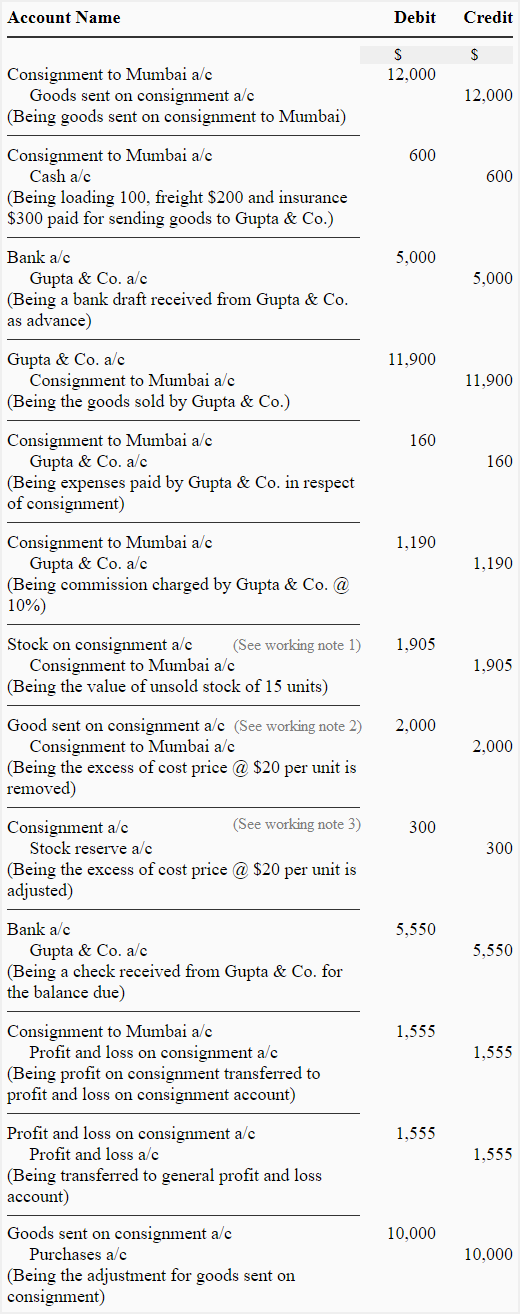
Atif & Co. of Delhi consigned 100 units of goods, costing $100 per unit, to their agent Gupta & Co. in Mumbai at a proforma invoice of 20% on cost. Atif & Co. paid the following expenses:

  • Loading charges: $100
  • Freight: $200
  • Insurance: $300

Gupta & Co. took delivery of goods and, on the same day, they sent a bank draft of $5,000 to Atif & Co. as advance against consignment.

Gupta & Co. forwarded an account sales revealing that 75 units were sold @ $140 per unit. Their expenses in respect of the consignment were as follows:

  • Unloading charges: $75
  • Carriage: $25
  • Godown rent: $60

Gupta & Co. was allowed a commission of 10% on gross sale proceeds.

Required: Prepare journal eateries and draw up consignment account in the books of Atif & Co.

Solution

  • Journal entries in the books of Atif & Co:

  • Consignment to Mumbai account

Notice that the loading on goods sent on consignment has been credited and the loading on closing stock has been been debited to the Consignment to Mumbai Account. This action removes the excess price that was added to the original cost of goods and is necessary to calculate the correct profit on consignment.

Working note 1: Calculation of stock on consignment:

Working note 2: Calculation of excess price or loading on goods sent:

The goods were consigned at cost plus 20%. The cost of 100 units @ $100 is $10,000 and the excess price or loading can be computed as follows:

= ($12,000/120) × 20
= $2,000

or

100 units × $20
= $2,000

Working note 3: Calculation of excess price or loading on closing stock:

= (1,800/120) × 20
= $300

Or

15 units × $20
= $300

Wholesale Branch System and Final Account System

Wholesale Branch System

Under this system, the goods are invoiced at the wholesale price to a retail branch. Opening stock and closing stock of branch will be shown at the wholesale price and unrealized profits in closing stock will be debited as stock reserve to profit and loss account of head office. Similarly, the stock reserve of opening stock will be credited to profit and loss account of head office.

There are many producers, now-a-days, who have their own retail shop (Branch). It deals in both retail and wholesale transactions. The profit rates earned by Branches differ between the retail sale and wholesale. Here, it is necessary to account the additional profit made by a Branch through retail trading over the wholesale trading. Wholesale price is always less than retail price.

For instance, the cost of a product is Rs 100, the wholesale price is Rs 140 and the retail price is Rs 160. If the Branch sells the product, the profit will be Rs 60; but the real profit earned by the Branch is Rs 20 (Rs 160 – 140), which is the contribution of Branch. The profit of Rs 40 (Rs 140 – Rs 100) would have been made by the Head Office by selling on wholesale basis to others.

Under this situation, to find out the real profit earned by a Branch, the Head Office charges the Branch with wholesale price. This facili­tates the Head Office to know the retail profit earned by a Branch. In other words, the difference between the wholesale price and selling price is the pure profit on retailing.

The Head Office sends the goods to Branch at wholesale price and in case all the goods have been sold, there is no problem. If not, the unsold goods lying with the Branch will be at invoice price and in such case adjustment for the unrealized profit of the Head Office Trading Account must be made through Branch Stock Reserve Account in order to find out true profit of the concern as a whole.

Ascertain the profit that you consider as having been earned by the Delhi Branch of Jaipur Industries Ltd. from the following:

(a) For Branch Trading:

(i) Branch Trading account is debited with the opening Stock at invoice price (i.e., wholesale price) and is credited with the Closing Stock at invoice price (i.e., wholesale price).

(ii) Branch Trading Account is debited with the goods sent to Branch at invoice price (i.e., wholesale price) and is credited with the retail price of goods sold.

(b) For Head Office Trading:

The Head Office Trading Account will be debited with opening stock, purchase of goods and the same is credited with Goods sent to Branch at invoice price, direct sales (at wholesale price) and along with the Closing Stock (at Cost).

If there is any closing stock in the hand of Branch, a Stock Reserve Account is to be opened by debiting Profit & Loss Account and crediting Stock Reserve Account. In the case of opening stock, the entry will be reversed.

At Cost Price/Invoice Price Basis (i.e.):

Where Branch Trading and Profit and Loss Account are Opened:

Branch Trading and Profit and Loss Account method is an alternative approach for ascertaining Branch Gross Profit and Net Profit. Branch Trading Account is debited by crediting Opening Stock; Goods sent to Branch etc. and is credited by debiting sales and closing stock.

The difference between the two sides represents Gross Profit or Gross Loss which will ultimately be transferred to Branch Profit and Loss Account Similarly, Branch Profit and Loss Account is debited by crediting all branch expenses account and is credited by debiting all branch incomes account, i.e., the principles of closing entries are to be followed.

The difference between the two sides of Branch P & L A/C represents Net Profit or Net Loss which will be transferred to General Profit and Loss Account.

Difference between Salary and Wages

Salary

Salary is a fixed regular payment, typically paid on a monthly basis, for the performance of work or services. Unlike wages, which are often calculated on an hourly or weekly basis, salaries provide employees with a consistent and predetermined amount of compensation, regardless of the number of hours worked.

Components:

  1. Base Salary:

The core, fixed amount of money paid to an employee on a regular basis, forming the foundation of the overall salary. Reflects the employee’s role, responsibilities, and experience.

  1. Bonuses:

Additional monetary rewards provided to employees, often based on performance, company profits, or specific achievements. Motivates employees and aligns their efforts with organizational goals.

  1. Allowances:

Supplementary payments intended to cover specific expenses or costs related to the job, such as housing, transportation, or meals. Addresses the financial impact of job-related requirements.

  1. Benefits:

Non-monetary compensation, including healthcare, retirement plans, and other perks, provided to enhance employees’ overall well-being. Contributes to employee satisfaction and work-life balance.

  1. Overtime Pay:

Additional compensation for hours worked beyond the standard workweek, often calculated at a higher rate than the regular hourly pay. Compensates employees for extra effort and time invested in work.

  1. PerformanceBased Incentives:

Variable payments linked to individual or team performance, encouraging employees to achieve specific goals or targets. Aligns compensation with results and fosters a performance-driven culture.

  1. Profit Sharing:

Sharing company profits with employees, providing them with a stake in the organization’s financial success. Aligns the interests of employees with the overall success of the business.

  1. Commissions:

Payments based on sales or revenue generated by an employee, common in roles with direct sales responsibilities. Rewards employees for their contribution to revenue generation.

  1. Retirement Benefits:

Contributions made by the employer to retirement plans, such as 401(k) or pension schemes. Supports employees in building financial security for their post-work years.

  • Stock Options:

The right to purchase company stock at a predetermined price, offering employees a share in the company’s ownership. Aligns employees’ interests with the company’s long-term success.

  • Education and Training Support:

Financial assistance provided by the employer for the education and skill development of employees. Promotes continuous learning and professional growth.

  • Health and Wellness Programs:

Initiatives and benefits aimed at promoting employees’ physical and mental well-being. Enhances employee health, productivity, and job satisfaction.

  • Vacation and Leave Benefits:

Paid time off from work, including vacation days, holidays, and other types of leave. Supports work-life balance and employee well-being.

  • Severance Pay:

Compensation provided to employees upon termination of employment, often based on factors like length of service. Offers financial support during transitions and provides a safety net for employees.

  • Other Perquisites (Perks):

Additional benefits or privileges provided to employees, such as company cars, memberships, or flexible work arrangements. Enhances the overall employment experience and contributes to employee satisfaction.

Wages

Wages refer to the compensation paid to an employee for the hours worked or services rendered, often calculated on an hourly, daily, or weekly basis. Unlike salaries, which provide a fixed amount irrespective of hours worked, wages are directly tied to the time spent on the job.

Components:

  1. Hourly Rate:

The amount paid for each hour worked by an employee. Forms the basic unit for calculating wages based on time.

  1. Overtime Pay:

Additional compensation provided for hours worked beyond the standard workweek or regular working hours. Compensates employees for extra effort and time beyond the standard working hours.

  1. Piece-Rate Pay:

Compensation based on the number of units produced or tasks completed. Directly links pay to productivity and output.

  1. Commission:

A percentage of sales or revenue earned by an employee, common in sales roles. Rewards employees based on their contribution to generating business.

  1. Tips and Gratuities:

Additional payments received by employees, often in service industries, as a form of appreciation from customers. Augments income and is often based on customer satisfaction.

  1. Holiday Pay:

Compensation for hours worked on recognized holidays. Encourages employees to work during holiday periods and compensates for the disruption to personal time.

  1. Shift Differentials:

Additional pay for working shifts that fall outside regular daytime hours. Compensates for inconveniences associated with non-standard working hours.

  1. Bonuses (Variable):

Additional payments beyond regular wages, often tied to performance, project completion, or other achievements. Acts as an incentive and recognition for exceptional contributions.

  1. Piecework Bonuses:

Additional payments for meeting or exceeding production targets in piecework arrangements.  Motivates employees to achieve or surpass production goals.

  • Travel Allowances:

Compensation for work-related travel expenses, such as mileage or transportation costs. Addresses additional costs incurred while traveling for work.

  • Uniform or Tool Allowances:

Payments provided to cover the cost of uniforms, tools, or equipment required for the job. Supports employees in meeting job-specific requirements.

  • Incentive Pay:

Additional compensation tied to achieving specific targets, often related to productivity or efficiency. Encourages employees to meet or exceed performance expectations.

  • Danger Pay:

Additional compensation for employees working in hazardous conditions or environments. Recognizes the risks associated with certain jobs.

  • Call-out Pay:

Compensation for employees called in to work outside their regular schedule, often applicable to on-call positions. Compensates for the inconvenience of being available on short notice.

  • Benefits (Limited):

Some wage-related benefits, such as health insurance or retirement contributions, may be provided, but to a lesser extent compared to salary packages. Enhances the overall compensation package, albeit on a more limited scale compared to salaried positions.

Difference between Salary and Wages

Basis of Comparison

Salary

Wages

Payment Frequency Monthly Hourly or Weekly
Consistency Fixed, stable Variable, fluctuates
Calculation Basis Annual rate / 12 Hourly rate x Hours worked
Overtime Compensation Typically included Paid separately
Employment Level Often for salaried employees Common for hourly workers
Work Hours Impact Irrelevant to pay Directly affects earnings
Benefits Often includes benefits Limited or no benefits
Professional Positions Common for white-collar jobs Common for blue-collar jobs
Skill-Based Reflects skills and qualifications Often skill-independent
Administrative Work Common for managerial roles Common for administrative roles
Unionization Less common for unionized jobs Common in unionized settings
Job Complexity Reflects job responsibilities May not directly reflect complexity
Job Stability Generally perceived as stable Can be influenced by job market
Performance Impact Less direct impact on pay Directly impacts pay through hours
Perception in Society Often associated with higher status May not carry the same status

Basis for Compensation Fixation

Compensation refers to compensating any damage, loss or mental harassments, wages or salaries as reward for physical and/or mental efforts to perform any agreed task or job. But the concept of equity in remunerating any work or task has forced us to perceive wages and salaries as compensation, because people work efficiently only when they are paid according to their worth or feel satisfied with the remunerations. Besides basic salaries or wages, companies are forced to view the benefits and services to justify the positional and esteem needs of employees and to provide adequate cushion for inflations. Though the cost of human resources is estimated at between 2% to 20% of the operating cost (depending upon the type of industry), to retain the employees or to avoid job-hopping, some of the industries are even forced to adopt varying scales and benefits.

Compensation is the reward that the employees receive in return for the work performed and services rendered by them to the organization. Compensation includes monetary payments like bonuses, profit sharing, overtime pay, recognition rewards and sales commission, etc., as well as non­monetary perks like a company-paid car, company-paid housing and stock opportunities and so on.

Apart from the basic financial pay the employees receive paid vacations, sick leave, holidays and medical insurance, maternity leave, free travel facility, retirement benefits, etc., and these are called benefits.

The Fixation or determination of compensation involves considering various factors and elements to arrive at a fair and competitive remuneration package for employees. The basis for compensation fixation may vary across industries, organizations, and job roles. The Combination of these factors, tailored to the specific needs and priorities of the organization, forms the basis for the fixation of compensation. Organizations often develop a comprehensive compensation strategy that integrates these elements to attract, retain, and motivate a talented and satisfied workforce.

  • Market Conditions:

Aligning compensation with prevailing market rates for similar positions in the industry or geographic location. Ensures competitiveness in attracting and retaining talent.

  • Job Evaluation:

Systematically assessing the relative value of different jobs within the organization based on factors like skills, responsibilities, and complexity. Establishes internal equity and aids in determining appropriate compensation levels.

  • Industry Standards:

Considering compensation benchmarks and practices established within a specific industry. Helps organizations stay competitive and in line with industry norms.

  • Organization’s Financial Health:

Evaluating the financial capacity of the organization to sustain and afford the proposed compensation structure. Ensures that compensation is aligned with the organization’s financial resources.

  • Employee Performance:

Linking compensation to individual or team performance, often through performance appraisals and merit-based systems. Rewards and motivates high-performing employees, fostering a performance-driven culture.

  • Cost of Living:

Adjusting compensation based on the cost of living in a particular region or country. Accounts for variations in living expenses and ensures fair compensation.

  • Skill and Experience:

Recognizing the level of skills and experience possessed by an employee. Differentiates between entry-level and experienced employees, reflecting their contributions.

  • Legal Compliance:

Ensuring compliance with local, state, and national labor laws and regulations related to minimum wage, overtime, and other compensation standards. Mitigates legal risks and ensures ethical employment practices.

  • Union Agreements:

Adhering to terms negotiated and agreed upon in collective bargaining agreements with labor unions. Reflects the terms and conditions established through negotiations with employee representatives.

  • Market Positioning:

Positioning the organization’s compensation strategy relative to competitors in the talent market. Influences the organization’s attractiveness to potential employees and helps in talent acquisition.

  • Employee Benefits:

Including non-monetary benefits, such as health insurance, retirement plans, and other perks, in the overall compensation package. Enhances the total rewards offered to employees, contributing to their overall well-being.

  • Job Complexity and Risk:

Recognizing the complexity and level of risk associated with specific job roles. Reflects the nature of the job and the skills required, influencing compensation levels.

  • Retention and Succession Planning:

Considering the organization’s long-term talent strategy, including the retention of key employees and planning for future leadership needs. Aligns compensation with strategic workforce planning goals.

  • Employee Value Proposition (EVP):

Evaluating the overall value proposition offered to employees beyond monetary compensation, including career development opportunities, work-life balance, and organizational culture. Considers factors that contribute to employee satisfaction and engagement.

  • Global Considerations:

Adapting compensation practices to account for variations in economic conditions, cultural norms, and legal requirements in different countries for multinational organizations. Ensures consistency and compliance across diverse geographic locations.

Effect of Various Labour Laws on Wages

Labour laws play a pivotal role in shaping the employment landscape and influencing wage structures within a country. These laws are designed to regulate the relationship between employers and employees, ensuring fair treatment, safe working conditions, and just compensation. The impact of labour laws on wages is multifaceted, encompassing aspects such as minimum wage regulations, overtime pay, equal pay for equal work, and various other provisions aimed at protecting workers’ rights. Labour laws wield substantial influence over wage structures, seeking to establish a balance between the interests of employers and the rights of workers. While these laws are crafted with the intention of promoting fairness, equity, and worker protection, their impact is subject to various challenges. Striking the right balance between regulation and flexibility, addressing regional disparities, and adapting to evolving workforce dynamics are ongoing challenges for policymakers and businesses alike. Nevertheless, a well-crafted and effectively enforced legal framework is essential for fostering a work environment where wages are just, working conditions are safe, and the rights of workers are upheld.

Minimum Wage Regulations:

Intended Benefits:

  • Fair Compensation:

Minimum wage laws are enacted to ensure that workers receive a baseline level of compensation deemed necessary for a decent standard of living. This promotes economic justice by preventing the exploitation of vulnerable workers.

  • Poverty Alleviation:

Setting a minimum wage helps lift workers out of poverty, providing them with the means to cover essential living expenses. This has broader societal implications, contributing to poverty reduction.

Challenges:

  • Impact on Small Businesses:

Critics argue that higher minimum wages can impose financial burdens on small businesses, potentially leading to job cuts or increased prices for goods and services.

  • Regional Disparities:

Minimum wage regulations may not adequately account for regional variations in living costs, creating challenges in finding a one-size-fits-all solution that addresses the diverse economic landscapes within a country.

Equal Pay for Equal Work:

Intended Benefits:

  • Gender Pay Equity:

Labour laws promoting equal pay for equal work aim to eliminate gender-based wage disparities. This contributes to gender equality in the workplace, fostering a fair and inclusive environment.

  • Fair Treatment:

The principle of equal pay extends to all forms of discrimination, ensuring that employees are not subjected to wage disparities based on race, ethnicity, or other protected characteristics.

Challenges:

  • Data Accuracy and Transparency:

Implementing equal pay measures requires accurate and transparent data on employees’ roles, responsibilities, and compensation. Some organizations may face challenges in collecting and disclosing this information.

  • Subjectivity in Job Evaluation:

Determining what constitutes “equal work” can be subjective, and variations in job roles may complicate efforts to ensure equal pay. Standardizing job evaluation methodologies is a complex task.

Overtime Pay and Working Hours:

Intended Benefits:

  • Fair Compensation for Extra Effort:

Overtime pay regulations are intended to compensate employees for working beyond standard hours. This ensures that employees are fairly rewarded for their additional efforts.

  • Limiting Exploitative Practices:

Labour laws prescribing limits on working hours and overtime seek to prevent exploitative practices and promote a healthy work-life balance. This contributes to employee well-being and job satisfaction.

Challenges:

  • Operational Constraints:

Industries with fluctuating workloads may face challenges in accommodating strict working hour regulations. Flexibility in working hours may be crucial for certain sectors.

  • Compliance Monitoring:

Ensuring compliance with overtime regulations requires effective monitoring mechanisms, which can be resource-intensive for regulatory authorities.

Collective Bargaining and Trade Union Laws:

Intended Benefits:

  • Negotiating Power for Workers:

Collective bargaining laws empower workers to negotiate wages and working conditions collectively. This enhances their bargaining power, leading to more equitable agreements with employers.

  • Labour Market Stability:

By providing a structured framework for negotiations, collective bargaining laws contribute to labour market stability, reducing the likelihood of widespread strikes or industrial unrest.

Challenges:

  • Power Imbalances:

In situations where there is a significant power imbalance between employers and workers, collective bargaining may be challenging. This is particularly relevant in industries with limited unionization.

  • Potential for Disruption:

While collective bargaining aims for mutually beneficial agreements, disputes can arise, leading to work stoppages and disruptions that impact both workers and employers.

Social Security and Benefits:

Intended Benefits:

  • Worker Well-being:

Labour laws pertaining to social security and benefits, such as healthcare, retirement plans, and disability insurance, aim to enhance the overall well-being of workers.

  • Attracting and Retaining Talent:

Competitive benefit packages can attract skilled workers and contribute to employee retention. Labour laws often prescribe minimum standards for these benefits.

Challenges:

  • Financial Strain on Employers:

Mandating certain benefits can place a financial burden on employers, especially smaller businesses. Striking a balance between worker welfare and business viability is crucial.

  • Changing Workforce Dynamics:

The rise of the gig economy and non-traditional employment arrangements poses challenges in adapting social security and benefit regulations to accommodate diverse work structures.

Child Labour and Forced Labour Laws:

Intended Benefits:

  • Protecting Vulnerable Populations:

Laws prohibiting child labour and forced labour are designed to protect vulnerable populations from exploitation. These regulations prioritize the well-being of children and individuals subjected to coercion.

  • Ethical Business Practices:

Compliance with child labour and forced labour laws is integral to promoting ethical business practices. Organizations adhering to these regulations contribute to global efforts against human rights abuses.

Challenges:

  • Enforcement and Monitoring:

Effectively enforcing laws against child labour and forced labour requires robust monitoring systems, especially in industries where such practices may be prevalent.

  • Global Supply Chain Complexity:

Addressing child labour and forced labour becomes complex in global supply chains, where products may pass through multiple jurisdictions with varying regulations and enforcement capacities.

The Impact of Information Technology in Retailing

Information technology (IT) has had a profound impact on the retail industry, transforming various aspects of the business from operations and customer interactions to supply chain management and overall strategic decision-making. The integration of IT in retailing has led to increased efficiency, improved customer experiences, and enhanced competitiveness.

Technology has always played a major role, creating a massive impact in reviving the retail industry, bringing it reknown and repute. It is assisting retailers to become highly-equipped and advanced in the way they enhance the experience for consumers.

The Industry Growth

As per Euromonitor International’s recent retailing research, the market size of Modern Grocery Retailers in retail value sales at current prices (including inflation) was Rs 603 billion in 2017. Modern Grocery Retailers grew at 13.2 percent in 2016- 17. The category is forecast to grow by CAGR 9.2 percent through 2017-22.

The search for a one-stop shopping destination keeps making consumers shift from traditional to modern retailing stores. Modern retail stores attract footfalls in their physical store in Tier I and Tier II equally, albeit for different reasons. Aspirational Tier II consumers look at modern retailers as places to experience the new age retail. Equally Tier II & III cities have lucrative geographies for expansion of modern retail.

Retailers are tapping on to this new market of aspirational consumers increasingly. The lack of presence of most of the international and a major portion of national brands in these areas, have led consumers to resort to online channels in Tier II cities.

IT in Retail Importance

  • To collect and analyze customer data while enhancing differentiation.
  • To increase the company’s ability to respond to the evolving marketplace through enhanced speed and flexibility.
  • To work effectively; retailers need one system working across stores (or even across national borders) to make sure the most effective use of stock and improve business processes.

Helpful for Retailer:

  • Transparency and tracking

Retailers must increase transparency between systems, as well as obtain better tracking to integrate systems from manufacturer through to the consumer while obtaining customer and sales information.

  • Customer data

Many retailers struggle with information overload because they’re required to collect and sift through mass amounts of data, then convert it into useful information in a customer-centric industry.

  • PCI Security Compliance

PCI Security Compliance addresses the retailer’s internal security setup and practices, in order to mitigate payment security risks. Every business engaged in credit card payment processing is required to comply with PCI Security Standards. If a retailer collects or stores credit card information that becomes compromised, the retailer may lose the ability to accept credit card payments. Other possible consequences include lawsuits, insurance claims, cancelled accounts, and government fines.

  • Global data synchronization

Due to radio frequency identification/electronic product coding, the entire supply chain has become more intelligent. Retailers must enable the use of real-time data to watch inventory levels. In addition, radio frequency identification tagging positions the company to be able to safeguard its shipments by allowing products to be tracked from manufacturer through the entire supply chain.

Advantages of Information Technology in Retailing

  • Automating processes

Automating a process render many advantages to the retailers. It reduces costs, increases accuracy, reduces processing times, enables quick decision and speeds up customer service.

For example, EPOS (electronic point of sales) uses scanning systems. It ensures accurate prices, enables checkout staff to work faster, and it eliminates the need to fix price label to goods. All these factors reduce the cost considerably.

  • Collecting data about the customer

The purchase details of individual shoppers are collected and analyzed. Product extensions and promotions are based on the analysis of purchasing patterns of different types of shoppers.

Demographic information about the customers is known from a loyalty card database. The entries in the loyalty card are related to transactions data furnished by EPOS. These data can be further used to profile a customer base. This facilitates specific offers to be made to certain types of customers.

A retailer may send mail order catalogue to all loyalty card holders who have bought in the previous year. Moreover, internet and e-commerce sites use previous transactions information to personalize their sites for each shopper by offering them product items that have been related to their last few transactions. They automatically greet them by name when they enter the site.

  • Feedback on marketing decisions

Analysis of EPOS data helps the retailer in knowing the effect of promotion, prices, new products and packaging changes. Retailers can assess the impact of changes in layout or merchandising of stores in terms of category sales, competitor brands, gross profit and sales in the store. Innovative product ideas may be tested against the realities prevailing in the market. In short, the EPOS data analysis helps the company in

  • Evaluating its promotions
  • Calculating customer price responsiveness for core and seasonal products.
  • Predicting the outcome of its newly adopted policies.
  • Planning its promotional measures.


  • Communication

The stores manager indulges in effective communication with his suppliers. He sends documents such as purchase orders, stock and sales information over third party communication networks. This is electronic commerce. This method works fast and costs less. It is sufficient for stores to place their orders one or two days and in advance against seven days earlier in the traditional paper based method.

Store computers transmit EPOS data to the head office on daily basis. So, the senior manager is able to assess the performance of every store and product group.

Stock replenishment is done automatically. The computer system receives daily EPOS data from each store and next day’s stock requirements are known.

The system automatically sends the requirement electronically overnight to the distribution centre. So, delivery of merchandise is possible the very next day.

Effective communication reduces the lead time. It is the time taken between sending an order and receiving the merchandise.

Tools for Planning the business

(i) With the use of sophisticated computer software packages, retailers are able to

  • Plan, budget and forecast,
  • Choose the most successful location; and
  • Control their business.

(ii) Model decision making, statistical packages of sales forecast and data mining tools are available for retailers.

(iii) Retailers can also use geographic information systems (GIS).

(iv) Socio demographic data along with company transactions data and intelligent analytical tools are used to forecast sales in different stores.

  • Adding value to the retail transaction

Customers prefer IT assisted transactions to traditional retailing because IT assisted transactions provide speed, accuracy and convenience. For example, ATMs are used at any time of day. Thus, use of IT adds value to retailing.

  • Technology enabled shopping

Selling goods over the internet is becoming popular. Electronic means of selling include the following.

  • Products: Grocery, clothing, footwear, music, books, videos, cameras, photographic goods, computer hardware and software, pharmacy goods etc.
  • Services: Retail banking, personal insurance, financial service, real estate, stocks and shares, Tourism, florists, entertainment tickets, virtual education, information services, etc.

Thus, IT is transforming the nature of products, processes, companies, industries and even competition itself. The spectacular reach of IT is widely accepted today.

Components

  • E-commerce and Online Retailing:

Information technology has fueled the growth of e-commerce, enabling retailers to establish online platforms for buying and selling products. E-commerce platforms provide a convenient and accessible way for customers to browse, shop, and make transactions.

  • Point-of-Sale (POS) Systems:

POS systems, powered by IT, have replaced traditional cash registers. These systems streamline transactions, track sales, manage inventory, and provide valuable data for decision-making.

  • Supply Chain Management:

IT has revolutionized supply chain management in retail. Technologies like RFID (Radio-Frequency Identification), barcoding, and advanced analytics help in real-time tracking of inventory, reducing stockouts and overstock situations.

  • Customer Relationship Management (CRM):

CRM systems leverage IT to manage and analyze customer data. Retailers can personalize marketing efforts, track customer interactions, and enhance customer loyalty through targeted promotions and communication.

  • Data Analytics and Business Intelligence:

Retailers use data analytics and business intelligence tools to gain insights into consumer behavior, market trends, and operational efficiency. This data-driven approach supports informed decision-making and strategy formulation.

  • Mobile Commerce (mcommerce):

The rise of smartphones and mobile apps has given birth to mobile commerce. Retailers leverage IT to create mobile-friendly platforms, enabling customers to shop, compare prices, and make transactions using their mobile devices.

  • Augmented Reality (AR) and Virtual Reality (VR):

AR and VR technologies enhance the shopping experience. Retailers use these technologies for virtual try-ons, interactive product displays, and creating immersive environments that engage customers.

  • Social Media Integration:

IT facilitates the integration of social media platforms into retail strategies. Retailers use social media for marketing, customer engagement, and gathering insights into consumer preferences.

  • Automated Checkout Systems:

Self-checkout systems and automated kiosks, driven by IT, offer an efficient and convenient alternative for customers. These systems reduce wait times and enhance the overall shopping experience.

  • Personalized Marketing:

IT enables retailers to implement personalized marketing strategies. Through data analysis, retailers can create targeted promotions, personalized recommendations, and individualized communication based on customer preferences.

  • Cloud Computing:

Cloud computing technologies have streamlined data storage, processing, and collaboration. Retailers use cloud-based solutions for inventory management, data analytics, and overall business operations.

  • Artificial Intelligence (AI) and Machine Learning (ML):

AI and ML technologies are used for predictive analytics, demand forecasting, chatbots for customer service, and enhancing the overall efficiency of retail operations.

  • Voice Commerce:

 Voice-activated technologies, such as virtual assistants, have introduced new ways of shopping. Customers can use voice commands to search for products, place orders, and receive personalized recommendations.

  • Cybersecurity:

As retail operations become more digitized, the importance of cybersecurity has grown. IT is crucial in implementing robust security measures to protect customer data and secure online transactions.

  • Internet of Things (IoT):

IoT devices, such as smart shelves and connected devices in stores, contribute to real-time monitoring of inventory, temperature control, and other operational aspects, improving overall efficiency.

  • Feedback and Reviews Platforms:

IT facilitates the collection and analysis of customer feedback and reviews.

Limitations of Using Information Technology in Retailing

  • Originally IT was used by retailers to automate control services such as finance, pay roll, and management accounts. Electronic point of sales systems can be afford only by a very few department stores. Basically, retailing is a highly dispersed business. Retailers have to incur enormous amount of expenditure on installation of IT equipment in their retail business.

  • Retailing involves a wide array of products. So, a complex system is required to handle a large number of product lines.
  •  In retail stores, staff may have limited knowledge about computers. So, computer specialists are to be employed to deal with the automation process. Only the largest retailers can afford to employ technically qualified people.
  • The costs of routine investment in automation process is very high.
  • Many IT projects fail and the risk of such failure is too high for retailers.
  • According to Prof. John Sawson, many retailers concentrate on operational improvement rather than transformational ones. The expected pay off from IT has not been fully realized. Retailers devote only a small amount of their budgets to IT.
  • Getting the full benefits of IT may actually take a longer time. Retailers should learn how best to exploit the new systems. Many U.K. grocers invested in EPOS in the 1980s. But only a few made effective use of information about customer’s shopping behavior. Only after making heavy investments and learning from experience, retailers could create IT based stock replenishment system.
  • IT alone has not produced performance advantage in the retail industry.

Inspite of the above limitations in using Information Technology for competitive advantages, firms have gained advantages such as flexible culture, strategic planning and improved supplier relationships. Advantage lies in people and systems rather than systems alone. To derive full competitive advantage of IT requires long-term investment.

Social Issues in Retailing in India

Retailing in India, like in many other countries, is influenced by a variety of social issues that impact both the industry and consumers. These issues often reflect the broader social and cultural context of the country.

Addressing these social issues requires a holistic approach from retailers, encompassing ethical business practices, cultural sensitivity, and responsiveness to changing consumer dynamics. By aligning their strategies with the social fabric of India, retailers can build stronger connections with their customer base and contribute positively to society. This involves not only understanding the diverse needs of consumers but also actively participating in social initiatives that align with the values of the community.

  • Diversity and Cultural Sensitivity:

India is a diverse country with multiple languages, cultures, and traditions. Retailers need to be sensitive to this diversity in their marketing strategies, product offerings, and customer interactions. Cultural insensitivity can lead to backlash and negatively impact a brand’s image.

  • Consumer Behavior and Preferences:

Consumer preferences in India can vary significantly across regions and demographic segments. Retailers must stay attuned to evolving consumer trends, preferences, and purchasing behaviors to tailor their offerings and marketing strategies effectively.

  • Gender Sensitivity:

Gender plays a significant role in shaping consumer behavior. Retailers need to be aware of gender-related social issues and promote inclusivity in their marketing and advertising. Creating gender-neutral spaces and products can be essential for attracting a diverse customer base.

  • Economic Disparities:

India faces economic disparities, with a significant portion of the population belonging to lower-income segments. Retailers need to balance their product offerings to cater to diverse economic groups. Strategies like affordable pricing, value for money, and inclusive marketing are crucial.

  • Ethical Sourcing and Fair Trade:

There is an increasing awareness among Indian consumers about the ethical sourcing of products and fair trade practices. Retailers are under scrutiny to ensure that their supply chains adhere to ethical standards, and they are expected to be transparent about their sourcing practices.

  • Digital Divide:

While there is a growing trend of digitalization in urban areas, rural parts of India may still face challenges related to digital access and literacy. Retailers need to adopt strategies that cater to diverse digital maturity levels among consumers.

  • Changing Lifestyle and Aspirations:

India is experiencing a significant shift in lifestyle and aspirations, especially among the younger population. Retailers must keep pace with changing consumer expectations, including a demand for international brands, experiential shopping, and lifestyle products.

  • Health and Wellness Trends:

There is an increasing awareness of health and wellness in India, leading to a growing demand for organic, sustainable, and health-conscious products. Retailers need to adapt to these trends by offering healthier options and providing transparent information about product ingredients.

  • Social Media Influence:

Social media plays a substantial role in shaping consumer opinions and trends. Retailers need to have a robust social media strategy to engage with consumers, manage brand perception, and stay connected with the younger demographic.

  • Sustainability and Environmental Concerns:

Environmental consciousness is on the rise, and consumers are increasingly looking for sustainable and eco-friendly products. Retailers need to incorporate sustainable practices in their operations, such as reducing packaging waste and promoting environmentally friendly products.

  • Inclusivity and Accessibility:

Retail spaces and services need to be inclusive and accessible to people with disabilities. Ensuring that stores are wheelchair-friendly, providing assistance for visually impaired individuals, and offering inclusive product ranges are important considerations.

  • Rural-Urban Dynamics:

Retailers need to recognize the unique dynamics between rural and urban consumers. While urban consumers may seek convenience and a wide range of products, rural consumers may have different preferences and purchasing patterns.

Ethical Issues in Retailing in India

Ethical issues in retailing are critical considerations that impact the relationships between businesses, consumers, and the broader society. Maintaining ethical standards is not only a legal requirement but also essential for building trust, ensuring fair practices, and sustaining a positive reputation.

Ethics in business have become an essential topic of discussion. In retailing, retailers want to earn maximum profit by providing satisfaction to their customers with ethical means. Some certain laws and regulations govern the retail sector.

Following these laws are important and beneficial for the organizations. In this article, you will learn about ethical behavior in the retail sector and its importance.

Ethics can be defined as the moral principles for the behavior of a person or an organization to conduct activities. Business ethics tell the difference between right and wrong activities. However, ethical conduct in business is not as simple as it seems. There are various complexities when It comes to ethical conduct.

Ethical order ensures a sense of order and justice in an organization. The concepts like Corporate Social Responsibility is introduced in the retailing sector. The CSR is related to the ethical expression to conduct business. Retailing is the end unit of the Supply chain.

Customers directly interact with retailers. Therefore, it is important that retailers act ethically as they impact the lives of many people. Ethical practices are not only moral responsibility of a retailer, but it has great importance for the retail business. Let us learn about them one by one.

Adopting an ethical approach in retailing is not only a legal obligation but also a strategic imperative. Ethical behavior builds trust with consumers, fosters a positive workplace culture, and contributes to the long-term sustainability and success of a retail business. By addressing these ethical issues, retailers can demonstrate a commitment to integrity, responsibility, and the well-being of both consumers and the broader community.

Fair Pricing and Transparency:

Deceptive pricing practices, hidden fees, and misleading discounts can erode consumer trust.

  • Ethical Approach: Retailers should ensure transparency in pricing, avoid misleading promotions, and provide clear information about product costs.

Product Quality and Safety:

Selling substandard or unsafe products can harm consumers and damage a retailer’s reputation.

  • Ethical Approach: Retailers must adhere to quality standards, conduct product testing, and promptly recall defective items.

Supply Chain Ethics:

Unethical practices within the supply chain, such as exploitation of labor, child labor, or environmental violations, can tarnish a retailer’s reputation.

  • Ethical Approach: Retailers should implement ethical sourcing policies, ensure fair labor practices, and promote sustainable and responsible supply chain management.

Employee Treatment and Fair Labor Practices:

Unfair wages, poor working conditions, and lack of employee benefits can lead to ethical concerns.

  • Ethical Approach: Retailers should prioritize fair wages, provide a safe and healthy work environment, and offer employee benefits to promote overall well-being.

Customer Privacy and Data Security:

Mishandling customer data, privacy breaches, and unauthorized use of personal information can lead to ethical violations.

  • Ethical Approach: Retailers must prioritize customer privacy, implement robust data security measures, and adhere to data protection laws.

Truth in Advertising:

False or misleading advertising can deceive consumers and harm a retailer’s credibility.

  • Ethical Approach: Retailers should ensure that advertising is truthful, accurate, and does not exaggerate product capabilities.

Inclusivity and Diversity:

Discrimination or lack of inclusivity in hiring practices or product representation can be ethically problematic.

  • Ethical Approach: Retailers should foster diversity and inclusion, both in their workforce and in the representation of various demographics in marketing and product offerings.

Environmental Sustainability:

Irresponsible environmental practices, such as excessive packaging or contributing to pollution, raise ethical concerns.

  • Ethical Approach: Retailers should adopt sustainable practices, reduce environmental impact, and promote eco-friendly products.

Social Responsibility:

Neglecting social responsibility, such as community engagement or charitable initiatives, can be viewed as ethically irresponsible.

  • Ethical Approach: Retailers should actively engage in socially responsible activities, supporting community initiatives and contributing to social causes.

Ethical Marketing:

Manipulative marketing tactics, such as false scarcity or exploiting emotional triggers, can be ethically questionable.

  • Ethical Approach: Retailers should prioritize honesty, integrity, and authenticity in marketing, avoiding manipulative practices.

Fair Competition:

Unfair business practices, such as price fixing or collusion, can harm competition and violate ethical standards.

  • Ethical Approach: Retailers should compete fairly, adhere to antitrust laws, and avoid engaging in anti-competitive behavior.

Product Endorsements and Reviews:

Deceptive product endorsements or fake reviews can mislead consumers.

  • Ethical Approach: Retailers should encourage genuine customer reviews, avoid deceptive endorsements, and maintain the integrity of product recommendations.

Importance of Ethics in Retail

  • Build a Positive Image in society

People who have not much knowledge about the business ethics and rules of business conduct usually prefer to associate with those organizations which have a positive image in society.

Take the example of an IT company Infosys. Infosys is known for its charitable work, good corporate governance, and social responsibility initiatives such as providing scholarship to deserving children and providing medical help to poor elderly people.

People, when learning all about this they built a positive perception about the company.

  1. Ethics helps in satisfying human needs

People, whether they are employee or customers, want to associate with an organization which works with honesty and in a fair manner.

Therefore, the following ethical practices are important if you want to retain customers as well as employees for a long period of time.

  1. Ethics plays an important role in decision making

In everyday life, retailers need to take important decisions for the well-being of the organization. If an organization believe in ethical practices, it tends to make decisions which are in favor of the organization, its employees as well as customers.

A retailer can take fierce decisions in the absence of ethical practices. For example, an organization which does not follow ethical practice can take fierce decisions to tackle competition.

  1. Bringing People together

Employees love and respect organization whose actions are influenced by ethical practices. The organization which practices ethics will never only think about its own but also think about its employees and customers. In this way, a healthy relationship establishes between employees and the owner.

A healthy relationship is important for the well-being of the organization. A happy employee will never betray his organization and consistently take actions to make his organization successful.

  1. Makes society a better place to live

Society will become a better place to live if everyone follows ethical practices. A society where everyone thinks about themselves and take selfish decisions is not a suitable place for people to live. There will always be contradictions between the people.

However, we know very well that no two people can be the same. There will always be people who will indulge in unethical practices. At that time, ethical laws come into action and restrict unethical practices.

  1. Long-term profits

Organizations which practices malice activities might get profit for short period of time, but can’t retain that success for longer period of time and, on the other hand, Organizations which are driven by values and ethics are expected to be profitable for a long time though they might lose money in a short time.

For example, the Tata group faced a great loss of business in the initial 1990s,’ but soon it turns into one of the most profitable organization by not indulging into unethical practices. The company is one of the most successful companies in India and also known for its ethical conduct in business.

In simple words, it can be said that ethics shows the path of right doing to the organization and let it make decisions which are both in favor of its employees as well as customers.

error: Content is protected !!