Theory of Profit by Knight

The Knight’s Theory of Profit was proposed by Frank. H. Knight, who believed profit as a reward for uncertainty-bearing, not to risk bearing. Simply, profit is the residual return to the entrepreneur for bearing the uncertainty in business.

Knight had made a clear distinction between the risk and uncertainty. The risk can be classified as a calculable and non-calculable risk. The calculable risks are those whose probability of occurrence can be anticipated through a statistical data. Such as risks due to the fire, theft, or accident are calculable and hence can be insured in exchange for a premium. Such amount of premium can be added to the total cost of production.

While the non-calculable risks are those whose probability of occurrence cannot be determined. Such as the strategies of a competitor cannot be accurately assessed as well as the cost of eliminating the completion cannot be precisely calculated. Thus, the risk element of such events is not insurable. This incalculable area of risk is the uncertainty.

Due to the uncertainty of events, the decision-making becomes a crucial function of an entrepreneur or manager. If the decisions prove to be correct by the subsequent events, an entrepreneur makes a profit and vice-versa. Thus, the Knight’s theory of profit is based on the premise that profit arises out of the decisions made under the conditions of uncertainty.

Knight believes that profit might arise out of the decisions made concerning the state of the market, such as decisions with respect to increasing the degree of monopoly in the market, decisions regarding holding stocks that might result in the windfall gains, decisions taken to introduce new product and technique, etc.

The major criticism of the knight’s theory of profit is, the total profit of an entrepreneur cannot be completely attributed to uncertainty alone. There are several functions that also contribute to the total profit such as innovation, bargaining, coordination of business activities, etc.

There are certain risks that are measurable and the probability of such risk can be statistically estimated and hence such risks can be insured. Example of insurable risks include theft of commodities, fire in the enterprise, accidental death etc. On the other hand, there are certain risks which cannot be calculated.

The probability of their occurrence cannot be statistically ascertained. Such risks include risks associated to changes in prices, demand and supply. These risks are non-insurable. Prof. Knight opined that the profit is the reward for bearing the non-insurable risks and uncertainties.

Uncertainty-bearing is one of the most vital functions in a dynamic economy. The entrepreneur bears the uncertainty involved in the enterprise. The expectation of profit is the supply price of the entrepreneurial uncertainty bearing exercise. In a state of economy (competitive) where there is no risk, every entrepreneur will have a minimum supply price.

If the reward allocated to the entrepreneur is below it, the entrepreneurs will abstain from providing their entrepreneurial services. The existence of uncertainty tends to raise the minimum supply price. The entrepreneurs expect a level of profit for bearing the uncertainty.

The salient points of Knight’s theory include:

  1. According to the theory, the entrepreneur earns pure profits for bearing the uncertainty.
  2. The probability of uncertainty or non-insurable risks cannot be statistically estimated.
  3. Entrepreneurs undertake risks of varying degrees according to their ability ad inclination. The theory suggests that the more risky the nature of enterprise, the higher level of profit earned by the entrepreneurs.
  4. Profit is the reward of the entrepreneur for bearing uncertainties and risks. Hence, it should be a part of the normal cost.
  5. The reward of the entrepreneur is uncertain. Entrepreneur guarantees interest to lender of capital, wages to workers and rent to the landlord.
  6. The level of uncertainty in business can be reduced by applying the technique of consolidation. The total level of uncertainty can be reduced by pooling individual instances.

Criticisms:

F.H. Knight’s theory is one of the most sophisticated theories to explain supply of entrepreneurship based on profit. But, the theory suffers from certain drawbacks as pointed by the critics.

  1. The role of an entrepreneur has not been elaborately provided by the theory. The entrepreneur’s activity has been restricted to uncertainty bearing. Modern business activities are different. Often, there is a dichotomy between ownership and management. These factors have not been taken into consideration.
  2. The uncertainty-bearing theory discussed the concept of profit in a vague way. The exact estimation of profit for the entrepreneur has not been provided in the theory.
  3. Profit as a residual income of the entrepreneur has been criticized.
  4. Critics feel that uncertainty-bearing should not be treated like other factors of production like land, labour and capital. It is a psychological concept and should be treated in a different manner.

Theory of Social change by Everett Hagen

Hagen in his theory had accredited the withdrawal of status respect of a group as the starting point for entrepreneurship development process. Before we discuss the concept of withdrawal of status respect let us try to consider the various crucial facets of the theory.

The theory is based on a general model of the society. His theory viewed the entrepreneur as a trouble shooter who contributes to economic development. The creativity of the entrepreneur brings about social transformation and economic development. Economic growth is associated with the social and political changes. He didn’t encourage the entrepreneurs to imitate other’s technology.

Hagen had ascribed the genesis of entrepreneurship to withdrawal of status respect of a group. The social group that experiences the withdrawal of status respect engulfs itself into aggressive entrepreneurism. In such a situation the status loosing group and the members of status loosing group endeavour to regain their status by undertaking rigorous entrepreneurial drive.

Hagen had suggested the events that could create as well as indicate withdrawal of status respect of a social group. First, dislodgment of a traditional elite group from its prior status, Second, defamation of valued symbols through some change in the attitude of the superior group. Third, Unpredictability of status symbols in the changed allocation of economic power. Fourth, when social group doesn’t enjoy the expected status when it migrates to a new society.

There four possible reactions to the withdrawal of status respect which relates to four different personality types:

(i) The retreatist: An individual who works in the society but is indifferent to the work and position.

(ii) The ritualist: An individual who works in the manner accepted and approved by the society but has no hopes of improving his/her position.

(iii) The reformist: An individual who fights against the injustice and tries to rebels against the established society in order to form a new society.

(iv) The innovator: An individual who endeavours to bring about new changes and utilizes all opportunities. This personality reflects the personality of an entrepreneur.

Criticisms:

  1. The theory lacks general application. It is not always true that all the social groups have behaved in the manner as advocated in the theory.
  2. The theory ignores the various other factors accountable for development of entrepreneurship.

X-Efficiency Theory by Leibenstein

X-inefficiency is the difference between efficient behaviour of firms assumed or implied by economic theory and their observed behaviour in practice. It occurs when technical-efficiency is not being achieved due to a lack of competitive pressure. The concepts of x-inefficiency were introduced by Harvey Leibenstein

The degree of efficiency maintained by individuals and firms under conditions of imperfect competition. According to the neoclassical theory of economics, under perfect competition individuals and firms must maximize efficiency in order to succeed and make a profit; those who do not will fail and be forced to exit the market. However, x-efficiency theory asserts that under conditions of less-than-perfect competition, inefficiency may persist.

Economic theory assumes that the management of firms act to maximize economic profits which is accomplished by adjusting the inputs used or the output produced. In perfect competition, the free entry and exit of firms tends toward firms producing at the point where price equals long run average costs and long run average costs are minimized. Thus firms earn zero economic profits and consumers pay a price equal to the marginal cost of producing the good. This result defines economic efficiency or, more precisely, allocative economic efficiency.

X-inefficiency is not the only type of inefficiency in economics. X-inefficiency only looks at the outputs that are produced with given inputs. It doesn’t take account of whether the inputs are the best ones to be using, or whether the outputs are the best ones to be producing, which is referred to as allocative efficiency. For example, a firm that employs brain surgeons to dig ditches might still be x-efficient, even though reallocating the brain surgeons to curing the sick would be more efficient for society overall.

Leibenstein regards entrepreneurship as a creative response to X-efficiency. Other people’s lack of effort and the consequent inefficiency of the organizations that employ them, create opportunities for entrepreneurs. Entrepreneurial activities pose a competitive threat to inefficient organizations.

Leibenstein identifies two main roles for entrepreneurs. The first role is the ‘input completion’ involves making available inputs which improve efficiency of existing production methods or facilitates the introduction of new ones. It is normally effected by intermediation in factor markets, in particular the markets for venture capital and management skills. The role of entrepreneur is to improve the flow of information in these markets.

The second role ‘gap filling’ is closely related to arbitrage function emphasized by Kirzner. Leibenstein provides a very vivid description of gap filling, visualizing the economy as a net made up of nodes and pathways.

The nodes represent industries or households that receive inputs (or consumer goods) along the pathway and send outputs (final goods and inputs for the other commodities) to the other nodes. The perfect competition model would be represented by a net that is complete: one that has pathways that are well marked and well defined, one that has well-marked and well-defined nodes, and one in which each element (that is firm or household) of each node deals with every other node along the pathways on equal terms for the same commodity.

The concept of X-efficiency was introduced by Harvey Leibenstein a noted economist in1966 in his article titled “Allocative efficiency vs. X-efficiency”. This is also referred to as X-inefficiency. In general X-inefficiency refers to the difference between the optimal efficient behaviour of business in theory and the observed behaviour is practice which occurs owing to different factors.

X-efficiency refers to the effectiveness with which a given set of inputs are used to produce outputs. If a particular firm is producing the maximum output it can, given the resources it employs with the best available technology, it is said to be technical-efficient. X-inefficiency occurs when technical-efficiency is not achieved. Whenever an input is not used effectively the difference between the actual output and the maximum output attributable to that input is a measure of the degree of X-efficiency.

Harvey Leibenstein had mentioned that for allocative efficiency the whole economy was considered whereas in case of X-efficiency just specific companies and industries are to be considered.

X-efficiency arises either because the firm’s resources are used in the wrong way or because they are wasted, that is, not used at all.

The entrepreneur has been entrusted two roles; first the role of a gap filler and second an input completer. The production function usually has certain deficiencies. These deficiencies and gap arise because all the factors of production function cannot be marketed. The entrepreneur has been entrusted the job to fill the gaps in the market. The second role of the entrepreneur is input completion. The entrepreneur has to mobilize all the available inputs in order to improve the efficiency of existing production methods.

Leibenstein advocated two types of entrepreneurship. First type is the ‘Routine entrepreneurship’ which involves the important functions of management of business. Second type is that of the ‘New entrepreneurship’ which involves innovative entrepreneurship.

Criticisms:

The Leibenstein’s theory has been often compared with the neoclassical views.

The theory has many novel contributions but has been criticized on following counts:

  1. The exact influence which the X-efficiency has on output of an organisation cannot be determined.
  2. The theory is less predictable as compared to normal theories.

Basis & Basis Risk

Basis risk in finance is the risk associated with imperfect hedging due to the variables or characteristics that affect the difference between the futures contract and the underlying “cash” position.

Basis risk is the financial risk that offsetting investments in a hedging strategy will not experience price changes in entirely opposite directions from each other. This imperfect correlation between the two investments creates the potential for excess gains or losses in a hedging strategy, thus adding risk to the position.

It arises because of the difference between the price of the asset to be hedged and the price of the asset serving as the hedge namely b = S – F, before expiration, any difference at expiration will be offset by arbitrage. Other examples of aspects that may cause basis risk to arise:

a) Quality: the hedge in place may have a different grade (which may not be perfectly correlated with the basis)

b) Timing: A mismatch between the expiration date of the hedge asset and the actual selling date of the asset

c) Location/Transportation Costs: Due to the difference in the location of the asset to be hedged and the asset serving as the hedge, an unforeseen rise in transportation costs may cost the producer who hedges more money.

  • Basis risk is the potential risk that arises from mismatches in a hedged position.
  • Basis risk occurs when a hedge is imperfect, so that losses in an investment are not exactly offset by the hedge.
  • Certain investments do not have good hedging instruments, making basis risk more of a concern than with others assets.

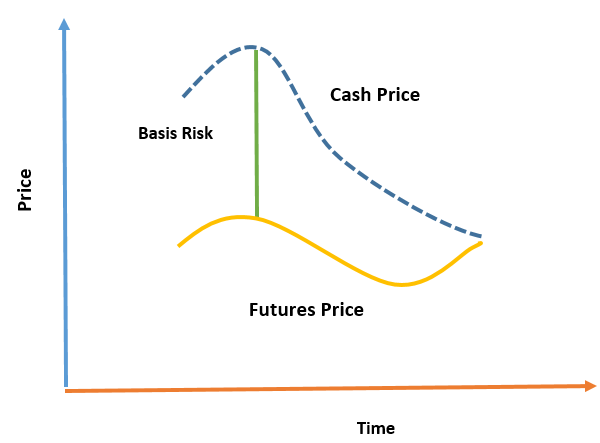
Under these conditions, the spot price of the asset, and the futures price, do not converge on the expiration date of the future. The amount by which the two quantities differ measures the value of the basis risk. That is,

Basis = Futures price of contract − Spot price of hedged asset.

Basis risk is not to be confused with another type of risk known as price risk.

Some examples of basis risks are:

  • Treasury bill future being hedged by two year Bond, there lies the risk of not fluctuating as desired.
  • Foreign currency exchange rate (FX) hedge using a non-deliverable forward contract (NDF): the NDF fixing might vary substantially from the actual available spot rate on the market on fixing date.
  • Over-the-counter (OTC) derivatives can help minimize basis risk by creating a perfect hedge. This is because OTC derivatives can be tailored to fit the exact risk needs of a hedger.

Components of Basis Risk

Risk can never be altogether eliminated in investments. However, risk can be at least somewhat mitigated. Thus, when a trader enters into a futures contract to hedge against possible price fluctuations, they are at least partly changing the inherent “price risk” into another form of risk, known as “basis risk”. Basis risk is considered a systematic, or market, risk. Systematic risk is the risk arising from the inherent uncertainty of the markets. Unsystematic, or non-systematic, risk, which is the risk associated with a specific investment. The risk of a general economic turndown, or depression, is an example of systematic risk. The risk that Apple may lose market share to a competitor is unsystematic risk.

Between the time a futures position is initiated and closed out, the spread between the futures price and the spot price may widen or narrow. As the visual representation below shows, the normal tendency is for the basis spread to narrow. As the futures contract nears expiration, the futures price usually converges toward the spot price. This logically happens as the futures contract becomes less and less “future” in nature. However, this common narrowing of the basis spread is not guaranteed to occur.
Different Types of Basis Risk

  • Price basis risk: The risk that occurs when the prices of the asset and its futures contract do not move in tandem with each other.
  • Location basis risk: The risk that arises when the underlying asset is in a different location from the where the futures contract is traded. For example, the basis between actual crude oil sold in Mumbai and crude oil futures traded on a Dubai futures exchange may differ from the basis between Mumbai crude oil and Mumbai-traded crude oil futures.
  • Calendar basis risk: The selling date of the spot market position may be different from the expiry date of a futures market contract.
  • Product quality basis risk: When the properties or qualities of the asset are different from that of the asset as represented by the futures contract.

Perfect & Imperfect Hedge

A perfect hedge is a position undertaken by an investor that would eliminate the risk of an existing position, or a position that eliminates all market risk from a portfolio. In order to be a perfect hedge, a position would need to have a 100% inverse correlation to the initial position. As such, the perfect hedge is rarely found.

A common example of a near-perfect hedge would be an investor using a combination of held stock and opposing options positions to self-insure against any loss in the stock position. The downside of this strategy is that it also limits the upside potential of the stock position. Moreover, there is a cost to maintaining a hedge that grows over time. So even when a perfect hedge can be constructed using options, futures and other derivatives, investors use them for defined periods of time rather than as ongoing protection.

When the term perfect hedge is thrown about in the world of finance, it usually means an ideal hedge as judged by the speaker’s own risk tolerance. There is really no reason to completely remove all the risk out of an investment, as neutering risk has a similar impact on rewards. Instead, investors and traders look to establish a range of probability where the worst and best outcomes are both acceptable.

Traders do this by establishing a trading band for the underlying they are trading. The band can be fixed or can move up and down with the underlying. However, the more complex the hedging strategy, the more likely it is that hedging costs themselves can impact overall profit.

The same is true of investors in traditional securities. There are many strategies to hedge owned stocks involving futures, call and put options, convertible bonds and so on, but they all incur some cost to implement. Investors also try to create “perfect” hedges through diversification. By finding assets with low correlation or inverse correlation, investors can ensure smoother overall portfolio returns. Here again, the cost of hedging comes into play in that an investor ties up capital and pays transaction fees throughout the process of diversification.

Perfect hedges do exist in theory, but they are rarely worth the costs for any period of time except in the most volatile markets. There are several types of assets, however, that are often referred to as the perfect hedge. In this context, the perfect hedge is referring to a safe haven for capital in volatile markets. This list includes liquid assets like cash and short-term notes and less liquid investments like gold and real estate. It takes very little research to find issues with all of these perfect hedges, but the idea is that they are less correlated with financial markets than other places you can park your money.

Imperfect Hedge

The hedger’s gain and loss in the spot and futures market are not fully offset and the hedger will end up with some gain or loss. This is called imperfect hedge. Note that the gain or loss of hedging will be much less than not utilizing hedge.

Seller’s hedge or short hedge

Following the example from the previous page, assume the price has gone down between the time of selling the futures contract and November 1st and the basis has changed a bit (imperfect hedge). Let’s explore two cases:

  • On November 1st, the spot market prices are $59.5/bbl and the December futures contract would be $60.60/bbl.
  • On November 1st, the spot market prices are $59.60/bbl and the December futures contract would be $60.40/bbl.

Buyer’s hedge or long hedge

Following the example from the previous page, assume prices have gone down from the time the refinery buys the future contracts until November 1st. Let’s consider the above cases:

  • On November 1st, the spot market prices are $59.50/bbl and the December futures contract would be $60.60/bbl.
  • On November 1st, the spot market prices are $59.60/bbl and the December futures contract would be $60.40/bbl.

Reasons for Investing in Commodities

Inflation hedging

Commodity returns have tended to pick up when inflation has been rising and decline when inflation has been falling, in contrast to both equities and bonds.

Other asset classes which are typically considered inflation hedges, such as real estate and inflation-linked bonds, currently trade on historically very expensive valuations, unlike commodities.

While deflationary pressures exist, there are signs that inflation is building.

Labour markets are tight and the 12-month core inflation rate, which excludes commodity prices, has been running above 2% since last November. It would be complacent to ignore the dangers of inflation.

All the more so given the sums that have been pumped into the financial system and the policy bias towards generating inflation.

Commodities diversify equity risk

Commodities diversify equity risk but, given their intrinsic link with economic growth, it would be unrealistic to expect them to hedge so-called tail risks such as the economic downturn resulting from the financial crisis of 2008-09.

In reality, the relationship between commodities and equities varies considerably. At times there is a negative correlation, but on average they show a low but positive correlation.

Nonetheless, so long as commodities are not perfectly correlated with equities, even a small allocation to an equity-heavy portfolio can result in a reduction in overall volatility.

Assuming a 0.2 correlation between equities and commodities, reasonable given historic experience, we estimate that commodities only have to generate returns of around 2% a year to improve portfolio risk-adjusted returns.

Potential for more attractive risk-adjusted returns

So far we have argued that there is a case for a strategic allocation to commodities even if returns are relatively muted. In fact, however, current conditions suggest that they could actually be much better than that.

Certainly, commodities look cheap compared with their history, particularly against equities.

Furthermore, many commodities are trading below their costs of production, a key valuation anchor. They are one of the few global asset classes that can lay a claim to being cheap.

So, we would argue, there has rarely been a better time to buy commodities. However, effective implementation is key.

Passive investors tracking well known benchmarks are exposed to a host of undesirable costs and consequences which active managers can avoid or even profit from.

With prices low and many commodities poorly-researched, this should be an excellent environment in which active managers could add value.

Trading in Commodities in India (Cash & Derivative Segment)

A tradable commodity can be bought and sold, just like you trade in equity/shares. You buy a commodity, expecting future Price appreciation. When the future price hits the target, you sell it. This is the modus operandi. On the other side, sellers of a commodity sell it when they think there is no room for appreciation for future price. Open a demat account today.

Even today in villages, farmers exchange commodities among themselves. In the organized commodity trading world, things are a little different. Commodity trading is regaining its importance among investors. This trading happens on a commodities exchange, where various commodities and their derivatives products are bought/sold. The most commonly traded items are agricultural products and contracts based on them. But, increasing non-agro commodities are also being traded like diamonds, steel, energy items etc.

There are two sides to the same coin. Commodity trading has its own advantages and disadvantages.

The advantages include commodity futures are highly leveraged investments, which means with a relatively small amount of money you can take a bigger bet. Commodity future markets generally are very liquid, which means entry and exit are easy. Commodity futures can potentially give huge profits, if traded carefully and smartly

The disadvantages of commodity futures trading are that markets are volatile, which means risk is higher. Direct investment in the commodity markets is of high-risk, especially for new investors. So, be careful. Gains and losses are magnified by leverage, which means you win big or lose big.

Cash commodities or “actuals” refer to the physical goods, e.g., wheat, corn, soybeans, crude oil, gold, silver that someone is buying/selling/trading as distinguished from derivatives.

Cash Market

Derivative Market

Purchase even one share In case of futures and options, the minimum lots are fixed
Tangible assets are traded In derivatives contracts based on tangible and intangible assets are traded
Cash markets are used for investment Derivatives are used for hedging, arbitrage or speculation
Customer must open for trading account For futures, a customer must open a future trading account with a derivative broker
Entire amount is put upfront In case of futures, only the margin money needs to be put up
The owner of shares is entitled to the dividends The derivative holder is not entitled to dividends

Participants in Commodities Market

Players of commodities market have been classified into three broad categories. They are Hedgers, Speculators and Arbitrageurs.

Hedgers: Hedging is an investment strategy used for minimising a risk and hedgers are the practitioners of this strategy. Generally, hedgers are producers or consumers who want to transfer the price-risk on to the market. Commodities derivatives market provide them an effective hedging mechanism against adverse price movements. They protect themselves from risk associated with the price of commodity by using derivatives.

For example, an airline company faces the risk is price rise of fuel. So they will go for a long position (buy an oil futures contract) to hedge, just to cover the amount of fuel they expect to buy.

Similarly, gold is the best hedge against inflation.

Speculators: Speculators are sophisticated leading players in commodities futures market. They are basically risk takers and are never associated with any commodity. They generally bet against the price movement in the hope of making gains.

They undertake speculative position with respect to anticipating future price movements with a small margin and square-off anytime during trading hours. They do either by going long or going short positions.

Buying a futures contract in anticipation of price increase is known as ‘going long”. Selling a futures contract in anticipation of a price decrease is known as ‘going short”.

Arbitrageurs: Arbitrageurs are investors who earn from discrepancy in prices between the two exchanges or between different maturities of the same commodity.

A simple example of arbitraging is simultaneously buying a gold at lower price from one exchange and selling it on another exchange for higher price. So they make profit from price difference.

Margin Traders: In the finance industry, the margin is the collateral deposited by an investor investing in a financial instrument to the counterparty to cover the credit risk associated with the investment.

Structure of Commodities Market in India

The commodities market exists in two distinct forms:

  • Over-the-counter (OTC) market
  • Exchange based market

Similar to equities, there exists the spot and the derivatives segments. Spot markets are essentially OTC markets and participation is restricted to people who are involved with that commodity, such as the farmer, processor, wholesaler, etc.

A majority of the derivatives trading takes place through the exchange-based markets with standardized contracts, settlements, etc. The exchange-based markets are essentially derivative markets and are similar to equity derivatives in their working, that is, everything is standardized and a person can purchase a contract by paying only a percentage of the contract value.

A person can also go short on these exchanges. Moreover, even though there is a provision for delivery, most contracts are squared-off before expiry and are settled in cash. As a result, one can see an active participation by people who are not associated with the commodity. The typical structure of commodity futures markets in India is as follows.

Structure of commodity market in india

Ministry of Consumer Affairs, Food and Public Distribution

The Department pertaining to consumer affairs is responsible for the formulation of policies for:

  • Monitoring Prices
  • Consumer Movement in the country
  • Controlling of statutory bodies (Bureau of Indian Standards (BIS) and Weights and Measures)
  • Internal Trade
  • Inter-State Trade- The Spirituous Preparations (Inter-State Trade and Commerce) Control Act, 1955 (39 of 1955).
  • Control of Futures Trading- the Forward Contracts (Regulations) Act, 1952 (74 of 1952)

The Department for food and public distribution is responsible for the formulation of policies for:

  • Ensuring food security for the country through timely and efficient procurement and distribution of food grains.
  • Building up and maintenance of food stocks, their storage, movement and delivery to the distributing agencies and monitoring of production, stock and price levels of food grains.
  • Incentivizing farmers through fair value of their produce by way of Minimum Support Price mechanism, distribution of food grains to Below Poverty Line (BPL) families.
  • Covering poor households at the risk of hunger under Antyodaya Anna Yojna (AAY).
  • Establishing grain banks in food scarce areas and involvement of Panchayati Raj Institutions in Public Distribution System (PDS).
  • Concerns for the sugar sector such as fixing of Fair and Remunerative Price (FRP) of sugarcane payable by Sugar factories, development and  regulation of sugar industry (including training in sugar technology), fixation of levy price of sugar and its supply for PDS and regulation of supply of free sale sugar.
  • Export and import of food grains, sugar and edible oils.

Forward Market Commission

The Commission functions under the control of the Ministry of Consumer Affairs, Food & Public Distribution, Department of Consumer Affairs, Government of India. The functions of the Forward Markets Commission are:

  • To advise the Central Government in respect of the recognition or the withdrawal of recognition from any association or in respect of any other matter arising out of the administration of the Forward Contracts (Regulation) Act 1952.
  • To keep forward markets under observation and to take such action in relation to them, as it may consider necessary, in exercise of the powers assigned to it by or under the Act.
  • To collect and whenever the Commission thinks it necessary, to publish information regarding the trading conditions in respect of goods to which any of the provisions of the Act is made applicable, including information regarding supply, demand and prices, and to submit to the Central Government, periodical reports on the working of forward markets relating to such goods.
  • To make recommendations generally with a view to improving the organization and working of forward markets.
  • To undertake the inspection of the accounts and other documents of any recognized association or registered association or any member of such association whenever it considers it necessary.

Types of Commodities Traded

A commodity is a group of assets or goods that are important in everyday life, such as food, energy or metals. A commodity is alternate and exchangeable by nature. It can be categorized as every kind of movable good that can be bought and sold, except for actionable claims and money.

Hard and soft commodities are traded on the exchanges. Metals, crude oil, etc. fall under the category of hard commodities whereas agricultural commodities like corn, wheat, cotton, soybean, and guar are soft commodities as they have a limited shelf life. Let us concentrate on the types of commodity market in India and list of commodities traded on commodity market.

Commodity trading in India started way back in time, even before it did in many other countries. But, foreign invasions and ruling, natural calamities, and many government policies and their amendments were significant reasons for the diminishing of commodity trading. Today, even though there are various other forms of stock market and share market traders, commodity trading has regained its importance.

Commodity trading is where various commodities and their derivatives products are bought and sold. A commodity is any raw material or primary agricultural product that can be bought or sold, whether wheat, gold, or crude oil, among many others. When you engage in commodity trading, such commodities can diversify your asset portfolio.

Types of Commodities Traded

Commodities that are traded are typically sorted into four categories broad categories: metal, energy, livestock and meat, and agricultural.

  1. Metals

Metals commodities include gold, silver, platinum, and copper. During periods of market volatility or bear markets, some investors may decide to invest in precious metals–particularly gold–because of its status as a reliable, dependable metal with real, conveyable value. Investors may also decide to invest in precious metals as a hedge against periods of high inflation or currency devaluation.

  1. Energy

Energy commodities include crude oil, heating oil, natural gas, and gasoline. Global economic developments and reduced oil outputs from established oil wells around the world have historically led to rising oil prices, as demand for energy-related products has gone up at the same time that oil supplies have dwindled.

Investors who are interested in entering the commodities market in the energy sector should also be aware of how economic downturns, any shifts in production enforced by the Organization of the Petroleum Exporting Countries (OPEC), and new technological advances in alternative energy sources (wind power, solar energy, biofuel, etc.) that aim to replace crude oil as a primary source of energy, can all have a huge impact on the market prices for commodities in the energy sector.

  1. Livestock and Meat

Livestock and meat commodities include lean hogs, pork bellies, live cattle, and feeder cattle.

  1. Agriculture

Agricultural commodities include corn, soybeans, wheat, rice, cocoa, coffee, cotton, and sugar. In the agricultural sector, grains can be very volatile during the summer months or during any period of weather-related transitions. For investors interested in the agricultural sector, population growth–combined with limited agricultural supply–can provide opportunities for profiting from rising agricultural commodity prices.

error: Content is protected !!