Duties & Liabilities & Powers of Directors of the Company

Duties

The position of Director of a Private Limited Company or Limited Company or One Person Company comes with certain duties and responsibilities. Many Directors of a Company are unaware of these duties and responsibilities expected of them and hold the position just as a namesake. Our intention with this article is to change that mindset and create awareness about the duties and responsibilities of a Director of a Company. This will in turn help create companies that have a strong and ethical Board of Directors, thereby benefitting all the stakeholders of a company.

Duty to act in the best interests of the Company

Directors are in a fiduciary position in relation to the company. So the Director must exercise his/her power for the benefit of the company or in the best interest of the company. A Director must also consider the interests of the company supreme and, in any case, above their personal interest. Therefore, a Director acting honestly but not in the best interests of the company is in breach of duty.

Fiduciary: A fiduciary is a person who holds a legal or ethical relationship of trust. Typically, a fiduciary prudently takes care of money for another person.

Duty NOT to misapply company assets

Directors do not have legal ownership of the company’s assets. They only have effective control of them, and they must use them and employe them for the proper purposes of the company, and in the best interests of the company.

Duty NOT to make secret profits

A Director holds a key position in relation to the company. Therefore, in the course of management of the business, the Director may get confidential and sensitive information concerning the company’s business and affairs, or trade secrets. This privileged information cannot be used by the Director for his/her personal benefit and gain to the detriment of the company.

Duty of confidentiality

Directors would have access to all the relevant information about the operations and financials of a company. However, a Director has a duty to ensure that such information is not, directly or indirectly, divulged. A Director must not disclose or make use of that confidential information for any purpose other than for the benefit of the company.

Duty to NOT permit conflict of interest

A Director of a company has a duty to not enter into any arrangement which will possibly impair the Director’s interest and cause conflict of interest with the Company. A conflict of interest arises when a person is in a position to derive personal benefit from actions or decisions made in their official capacity.

Duty to attend meetings

A Director of a company must make best efforts to attend as many board meetings as circumstances permit. In India, if a Director is absent from three consecutive meetings of the Board, or from all meetings held in three months, whichever is longer, without obtaining leave of absence from the Board, then the Director could lose his/her Directorship in the Company.

Duty NOT to exceed powers

The Memorandum of Association (MOA) of a Company states what the company is authorized to do. Whereas, the Articles of Association (AOA) of the Company state what powers are given to the Directors of the Company. It is the duty of the Directors to ensure that not only do they keep within the company’s powers but also that hey keep within the powers actually given to them in the Articles of Association.

Liability of directors:

The liabilities of directors may be discussed under three heads:

  1. Liability to outsiders:

The directors are not personally liable to outsiders if they act within the scope of powers vested in them. The general rule in this regard in that wherever an agent is liable, those directors would be liable, but where the liability would attach to the principal only, the liability is the liability of the company. The directors are personally liable to third parties of contracts in the following cases:

  1. They contract with outsiders in their personal capacity
  2. They contract as agents of an undisclosed principal
  3. They enter into a contract on behalf of a prospective company.
  4. When the contract is ultra-vires the company.

In default of statutory duties, the directors shall be personally liable to third parties in the following cases:

  1. Mis-statement in prospectus.
  2. Irregular allotment.
  3. Failure to repay application money if the minimum subscription is not subscribed.
  4. Failure to repay application money if allotment of shares and debentures is not dealt in on the stock exchange as provided in the prospectus.

Liability to company:

The directors shall be liable to the company for the following:

(a) Where they have acted ultra-vires the company.

It is not necessary to prove fraud in such cases or that they acted bonafide. For example, where they apply the funds of the company to objects not specified in the memorandum of association or when they pay dividends out of capital.

(b) When they have acted negligently.

Negligence may give rise to liability; there need not be fraud. But they will not be liable where they have acted bonafide and for the benefit of the company.

(c) Where there is a breach of trust.

Directors being the trusted of the company, they should discharge their duties in the best interest of the company; they should discharge their duties in the best interest of the company. Where they commit a breach of trust resulting in a loss to the company. Where they commit a breach of trust resulting in a loss to the company, they are bound to make god the loss. For example, where the directors apply company property of their own benefit they are guilty of breach of trust.

(d) Misfeasance:

Directors are liable to the company for misfeasance. The word misfeasance covers willful negligence. Mere failure on the part of the director to take necessary steps for recovery of debts due to the company does not constitute misfeasance. If the company is in the course of winding up, the court may, on the application of the liquidator, creditor or contributory examine in to the conduct of a director for any misfeasance or breach of trust in relation to the company.

  1. Criminal liabilities of directors:

So far we have dealt with the civil liability of directors. For act of fraud, default in discharging their duties and misdemeanor, the act provides penalties by way of fine or imprisonment. Section 75, 95, 113,115, 143, 162, 168, 303, etc. impose penalties upon the directors for omitting to company with or contravening certain provisions of the act.

Power

The directors are considered as the head and brain of a company. When the brain functions, the company is said to function. For the proper functioning, the directors should be properly entrusted with some powers. The directors generally acquire their powers from the provisions of the Articles of Association and then from the Companies Act.

  1. General Powers of a Company Director

As per Sec. 291 of the Act, the Board is entitled to exercise all such powers and to do all such acts and things as the company is authorized to do. The exceptions are the acts, which can be done by the company only in the general meetings of the members as required by law.

Specific Powers of a Company Director

  1. A) As per Sec. 262, in the case of a public company or a private company, which is a subsidiary of a public company, the power to fill a casual vacancy of directors is to be exercised at a Board meeting.
  2. B) As per Sec. 292, the following powers of the company shall be exercised by the Board by means of resolution passed at the meeting of the Board:
  • To make calls,
  • To issue debentures,
  • To borrow moneys by other means,
  • To invest the funds of the company, and
  • To make loans.

The last three powers cannot be delegated to the Manager or to a Committee of Directors but must be exercised only at a Board meeting.

  1. Powers of Director subject to the Consent of the Company

The directors of a public company or of a private company can exercise the following powers, which is a subsidiary of a public company only with the consent of the company in the general meeting:

  • To sell, lease or otherwise dispose of the undertaking of the company.
  • To remit or give time for repayment of any debt due to the company by a director.
  • To invest the sale proceeds of any property of the company in securities other than trust securities.
  • To borrow moneys where the moneys already borrowed (other than temporary) exceeds the total of the paid-up capital and free reserves of the company.
  • To contribute to charities and other funds not directly relating to the business of the company or to the welfare of the employees in any year in excess of Rs.50,000 or 5% of the average net profits of the three preceding financial years whichever is greater.
  1. Powers of Director subject to the Consent of the Central Government

A) As per Sec. 268, any provision relating to the appointment or reappointment of a Managing Director can be altered by the Board with the consent of the Central Government.

B) As per Sec. 295, the Board, subject to the Central Government’s consent, has the power to appoint a person for the first time as a Managing Director.

C) As per Sec. 295, the Board, only with the previous approval of the Central Government, can make any loan or give any guarantee or provide any security in connection with a loan made by any other person to:

  • Any of its directors or any director of its holding company, or
  • Any partner or relative of such director, or
  • Any firm in which any such director or relative is a partner, or
  • Any private company of which any such director is a member or director, or
  • Anybody corporate, 25% or more of whose total voting power may be exercised or controlled by any such director or two or more directors together, or
  • Anybody corporate, whose Board or Managing director or Manager is accustomed to act in accordance with the directions or instructions of any director or directors of the leading company.

Subject to the approval of the Government, the Board has the power to invest in the shares of another company in excess of the limits specified in Sec. 372.
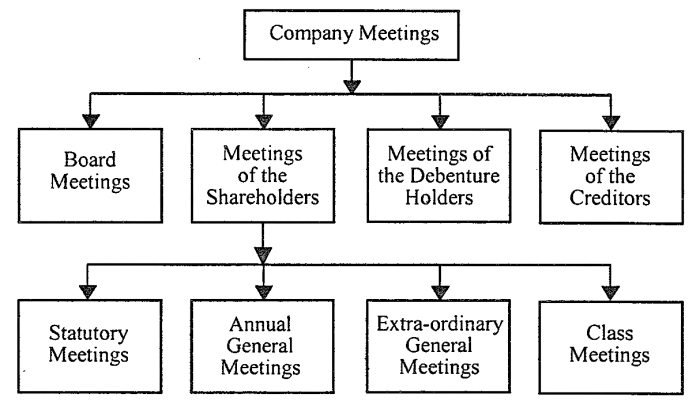
Company Meetings: Statutory, Annual general meeting, Extraordinary Meeting

Statutory Meeting

Statutory Meeting is the first meeting of the shareholders of a public company. It must be held within a period of not less than one month nor more than 6 months from the date at which the company is entitled to commence business. It is held only once in the lifetime of a company. A private company and a company limited by guarantee and not having a share capital need not hold such a meeting.

The purpose of the statutory meeting with its statutory report is to put the shareholders of the company in the possession of all the important facts relating to the new company, what shares have been taken up, what the moneys received etc. This also provides an opportunity to the shareholders of meeting to discuss the whole situation, the management and prospects of the company.

The Board of Directors must, atleast 21 days before the day on which the meeting is to be held, A forward a report, called the ‘statutory report’ to every member of the company. This report contains all the necessary information relating to formational aspects of the company for the information of the shareholders.

Contents of Statutory Report

  1. The total number of shares allotted, distinguishing those allotted as fully or partly paid up otherwise than in cash, the extent to which they are partly paid up, the consideration for which they have been allotted and total amount received in cash;
  2. An abstract of the receipts and payments under distinctive heads upto a date within seven days of the date of report;
  3. An account of estimate of the preliminary expenses of the company.
  4. The names, addresses and occupations of the managing director, director, and also its secretary and auditors of the company;
  5. The particulars of any contract which, and the modification or proposed modification of which, are to be submitted to the meeting for approval;
  6. The extent to which underwriting contracts, if any, have not been carried out and the reason therefor;
  7. The arrears, if any, due on calls from directors, managing director or manager; and
  8. The particulars of any commission or brokerage paid, or to be paid, in connection with the issue or sale of shares to any director, managing director or manager.

Annual General meeting

Annual General Meeting (AGM) is a yearly meeting of stockholders or shareholders, members of company, firm and organizations. Annual General Meeting is held every financial year and it is mandatory for everyone. In AGM functions like reviewing company account, approving audited accounts, elections, fiscal records of the past year are discussed.

As per Companies Act, an annual general meeting must be held by every company once a year without fail. There cannot be a gap of more than 15 months between two AGMs.

However, the first AGM of a company can be held at any date, within a period of 18 months, since the date of incorporation of the company. Annual general meetings help members understand the company’s rate of growth and potential for improvement.

An AGM gives insights into what steps made the company more successful and which steps caused loss. it helps the members and the board to decide the future course of action. An AGM must be held on a working day.

If the Government declares a public holiday on the day of the meeting, it will be considered a working day by the members attending the meeting. The annual general meeting can be held at the registered office of the company.

Legal Requirements for holding an Annual General Meeting

Legally, a notice period of 21 days must be given to all the members before the meeting. However, there is an exception to this rule. If all the voting members consent, the meeting may be held at an earlier date. Further, the following documents are also to be sent with the notice. Articles of Association, company bylaws, and jurisdiction specifies the rules that govern annual general meeting.

  • Copy of annual accounts of the company
  • Director’s report on the company’s position for the given year
  • Report by the Auditor of the annual accounts.

Members are allowed to use proxies in their absence. The proxy does not need to be a member of the company. However, the proxy forms have to be submitted to the company at least 48 hours before the meeting.

Quorum for Annual General Meeting

Unless the articles of the company state otherwise, the quorum for an Annual General Meeting is as follows

  • Public companies: At least 5 members must be present.
  • Other companies:At least 2 members must be present within half an hour of the commencement of the meeting.

Issues Undertaken at Annual General Meeting

The functions of business undertaken at a typical annual general meeting are listed as follows:

  • The declaration of dividend among shareholders
  • Consideration of annual accounts
  • Discussion of the director’s report and the auditor’s report
  • Appointment and fixing of the remuneration of the statutory auditors
  • Appointing replacement directors in place of existing directors retiring

Extraordinary meeting

An Extraordinary General Meeting (an EGM) can be defined as a meeting of shareholders which is not an Annual General Meeting (an AGM). It is held when some urgent issue becomes about the company arises or any situation of crisis and it requires the input of all senior executives and the Board.

As we know, an EGM is held in case of emergency situations and requires the attention of senors execs and the Board. Members, shareholders, and execs must be instructed on the purpose of the meeting so they have time to prepare their valuable input and then, collectively decide further course of action.

Who can Call for an EGM

The members/shareholders of a company can call for an extraordinary general meeting. However, only certain members with a significant stake in the company are allowed to call for an EGM. They are listed in the Companies Act,2013 as follows.

  • In the case of a company having a share capital, members holding not less than one-tenth of such paid-up capital of the company that carry voting rights in regard to that matter as on the date of depositing the requisition;
  • In the case of a company not having a share capital, members holding not less than one-tenth of the total voting power in regard to that matter as at the date of deposit of the requisition.
  • EGM called by Board.  Upon the receival of a valid requisition, the Board has a period of 21 days to call for an EGM. The EGM must be then held with 45 days from the day of the EGM being called.
  • EGM called by the requisitionists: In case the Board fails to call for an EGM, it can be called for by the requisitionists themselves during a period of 3 months from the day the requisition was deposited. If the EGM is held within this specified period of 3 months, it can be adjourned to any day in the future after the 3 months.

Essentials of a Valid Requisition

  1. Specify the issue for which the meeting is called
  2. Signed by requisitionists
  3. Must be deposited at the company’s registered office.

Requirements for holding an EGM

A notice period of 21 days must be given to the members. However, there is an exception to this rule. Where if 95% of the voting members consent, the EGM can be held at a shorter notice.

Quorum Required for EGM

Unless the company’s Articles state otherwise, the following number of members are required for a quorum.

  • In the case of a public company: Five(5) members personally present
  • In the case of any other company: Two (2) members personally present

Meeting of Board of Directors

Director’s meetings, commonly referred to as Board Meetings, are formal gatherings of a company’s board of directors to deliberate and decide upon matters concerning the company’s governance, strategy, policies, financial performance, and regulatory compliance. These meetings are a legal and administrative requirement for companies under the Companies Act, 2013 in India and similar corporate laws globally.

The primary objective of a director’s meeting is to ensure that directors fulfill their fiduciary duties by participating in key decision-making processes. Typical agenda items include approval of financial statements, declaration of dividends, appointment or removal of key managerial personnel, policy formulation, reviewing compliance reports, and evaluating the company’s performance. The board also approves mergers, acquisitions, and major investments.

As per legal requirements, the first board meeting of a company must be held within 30 days of incorporation, and thereafter, at least four board meetings must be conducted every financial year, with not more than 120 days gap between two meetings. A quorum—usually one-third of the total number of directors or two directors, whichever is higher—is necessary for a meeting to be valid.

Proper notice of at least 7 days is to be given to all directors, and minutes of the meeting are recorded for future reference and legal compliance. Decisions made are documented in resolutions, which become binding on the company. These meetings enhance corporate governance by promoting accountability, transparency, and collective decision-making among directors.

Objectives of Director’s Meetings:

  • Strategic Planning and Policy Formulation

One of the key objectives of director’s meetings is to formulate the company’s strategic direction and develop effective policies. The board reviews internal and external business environments to make informed long-term decisions. Directors collaborate to set goals, define performance standards, and ensure the company’s vision aligns with current market conditions. This strategic oversight enables the business to maintain competitiveness and adaptability. By regularly revisiting policies and strategic goals, directors ensure the company moves forward efficiently and sustainably in a dynamic business environment.

  • Monitoring Financial Performance

Director’s meetings are held to evaluate and monitor the company’s financial performance regularly. The board examines financial reports, income statements, balance sheets, and cash flow statements to assess profitability, liquidity, and solvency. Financial review helps in identifying discrepancies, controlling expenditures, and ensuring proper fund allocation. These discussions enable directors to maintain fiscal discipline and make decisions based on accurate data. Ensuring transparency in financial matters also fosters investor confidence and compliance with statutory obligations, thus promoting long-term financial health and sustainability of the organization.

  • Ensuring Legal and Regulatory Compliance

A vital objective of director’s meetings is to ensure that the company operates within the legal and regulatory framework. Directors review and verify compliance with the Companies Act, taxation laws, labor laws, environmental regulations, and other applicable legislation. Non-compliance can lead to penalties and reputational damage. Hence, the board evaluates reports from the compliance officer, legal advisors, and auditors. Regular updates on changes in regulations are discussed to keep the company aligned with legal standards. These meetings act as checkpoints to ensure corporate accountability and ethical governance.

  • Decision-Making on Major Corporate Actions

Director’s meetings facilitate decision-making on significant corporate matters like mergers, acquisitions, capital restructuring, or launching new ventures. These decisions typically involve high risk and long-term implications, requiring thorough deliberation and consensus. The board discusses pros and cons, consults experts if needed, and ensures that such actions align with shareholder interests and the company’s mission. These meetings offer a structured platform for collaborative decision-making, balancing opportunity with responsibility. Final decisions are passed as board resolutions and implemented through appropriate managerial channels, reflecting corporate prudence and planning.

  • Risk Management and Crisis Handling

Another objective is to identify, assess, and mitigate business risks. Directors discuss potential operational, financial, legal, and reputational risks that may affect the company. Risk management strategies such as diversification, insurance, and internal controls are formulated and periodically reviewed. In times of crisis—like economic downturns, cyberattacks, or regulatory issues—the board meets to evaluate the situation and design appropriate response mechanisms. These meetings help in establishing robust contingency plans and resilience frameworks to safeguard the organization’s interests and minimize disruptions to business operations.

  • Reviewing Performance of Top Management

Director’s meetings provide an opportunity to assess the performance of the CEO and other key managerial personnel. The board evaluates leadership effectiveness, goal achievement, and decision-making capabilities. Constructive feedback and necessary course corrections are provided to improve efficiency. In some cases, decisions related to promotions, compensation, or replacements are made based on performance appraisals. This oversight ensures accountability and aligns management’s performance with organizational goals. It also promotes meritocracy and motivates senior executives to perform effectively, thus enhancing overall corporate performance.

  • Enhancing Corporate Governance

A fundamental objective of director’s meetings is to strengthen corporate governance practices. The board ensures transparency, fairness, and accountability in all decisions and actions taken by the company. Ethical conduct, shareholder engagement, and stakeholder welfare are emphasized during discussions. The board formulates governance policies, monitors their implementation, and ensures adherence to ethical standards. These meetings help build a strong governance framework that fosters trust among investors, regulators, and the public. Enhanced governance leads to sustainable growth, risk reduction, and long-term success of the organization.

Board Meetings

Board Meetings are formal gatherings of a company’s Board of Directors, convened to discuss, deliberate, and decide upon key matters affecting the organization. These meetings are fundamental to corporate governance and serve as the primary platform through which directors exercise their powers and fulfill their responsibilities. Board meetings are legally mandated under corporate laws such as the Companies Act, 2013 in India, and must follow a structured process, including issuance of notice, preparation of an agenda, and recording of minutes.

The primary purpose of board meetings is to make collective decisions on strategic, financial, legal, and operational matters. Topics often discussed include approval of budgets, review of financial statements, declaration of dividends, appointment or removal of key personnel, corporate restructuring, compliance updates, and risk management. These meetings help ensure transparency, accountability, and alignment of the company’s actions with its goals and legal obligations.

Board meetings must meet quorum requirements, typically involving at least one-third of the total directors or two directors, whichever is higher. The frequency of board meetings is also regulated; for instance, at least four board meetings must be held every financial year, with no more than 120 days between any two meetings.

Committee Meetings

Committee meetings are formal gatherings of a specific subset of members from a larger governing body, such as the Board of Directors, formed to focus on particular areas of concern or responsibility within an organization. These committees are established to improve efficiency by allowing detailed examination of specific issues like audit, finance, remuneration, risk management, or corporate social responsibility (CSR). Committee meetings enable more specialized, informed, and focused discussions than would be possible in full board meetings.

Each committee is typically composed of directors or officers with relevant expertise or interest, and it operates under a defined charter or terms of reference. Committee meetings are held regularly or as needed to review performance, compliance, or ongoing issues, and they recommend actions to the main board for final approval. For example, an audit committee meeting may examine internal financial controls and auditor reports before advising the board on financial disclosures.

These meetings follow formal procedures, including circulation of agendas, maintaining minutes, and complying with regulatory standards. The outcomes of committee meetings are critical in shaping board decisions, ensuring better governance, transparency, and risk oversight.

Notice of Board Meeting

The notice of Board Meeting refers to a document that is sent to all directors of the company. This document informs the members about the venue, date, time, and agenda of the meeting. All types of companies are required to give notice at least 7 days before the actual day of the meeting.

Quorum for the Board Meeting

The quorum for the Board Meeting refers to the minimum number of members of the Board to conduct a valid Board Meeting. According to Section 174 of Companies Act, 2013, the minimum number of members of the board required for a meeting is 1/3rd of a total number of directors.

At any rate, a minimum of two directors must be present. However, in the case of One Person Company, the rules of Section 174, do not apply.

Participation in Board Meeting

All directors are encouraged to actively attend board meetings and in case that’s not possible at least attend the meetings through a video conference. This is so that all directors can take part in the decision-making process.

Requirements for Conducting a Valid Board Meeting:

  • Right Convening Authority 

The board meeting must be held under the direction of proper authority. Usually, the company secretary (CS) is there to authorize the board meeting. In case the company secretary is unavailable, the predetermined authorized person shall act as the authority to conduct the board meeting.

  • Adequate Quorum 

The proper requirements of the quorum or the minimum number of Directors required to conduct a Board meeting must be present for it to be considered a valid board meeting.

  • Proper Notice 

Proper notice is one of the major requirements to be fulfilled when planning a board meeting. Formal notice has to be served to all members before conducting a board meeting.

  • Proper Presiding Officer 

The meeting must always be conducted in the presence of a chairman of the board.

  • Proper Agenda

Every board meeting has a set agenda that must be followed. The agenda refers to the topic of discussion of the board meeting. No other business, which is not mentioned in the meeting must be considered.

Guidelines for Managerial Remuneration

‘Remuneration’ means any money or its equivalent given to any person for services rendered by him and includes the perquisites mentioned in the Income-tax Act, 1961.

Managerial remuneration in simple words is the remuneration paid to managerial personals. Here, managerial personals mean directors including managing director and whole-time director, and manager.

Permissible managerial remuneration payable under the Companies Act 2013

  • Total managerial remuneration payable by a public company, to its directors, managing director and whole-time director and its manager in respect of any financial year:

Condition

Max Remuneration in any financial year

Company with one Managing director/whole time director/manager 5% of the net profits of the company
Company with more than one Managing director/whole time director/manager 10% of the net profits of the company
Overall Limit on Managerial Remuneration 11% of the net profits of the company
Remuneration payable to directors who are neither managing directors nor whole-time directors

For directors who are neither managing director or whole-time directors

1% of the net profits of the company if there is a managing director/whole time director

If there is a director who is neither a Managing director/whole time director

3% of the net profits of the company if there is no managing director/whole time director

The percentages displayed above shall be exclusive of any fees payable under section 197(5).

Until now, any managerial remuneration in excess of 11% required government approval. However, now a public company can pay its managerial personnel remuneration in excess of 11% without prior approval of the Central Government. A special resolution approved by the shareholders will be sufficient.

In case a company has defaulted in paying its dues or failed to pay its dues, permission from the lenders will be necessary.

  • When the company has inadequate profits/no profits: In case a company has inadequate profits/no profits in any financial year, no amount shall be payable by way of remuneration except if these provisions are followed.
Where the effective capital is: Limits of yearly remuneration
Negative or less than 5 Crores 60 Lakhs
5 crores and above but less than 100 Crores 84 Lakhs
100 Crores and above but less than 250 Crores 120 Lakhs
250 Crores and above 120 Lakhs plus 0.01% of the effective capital in excess of 250 Crores


Quorum of Meeting, Importance, Legal Provisions, Types, Consequences

A quorum is the minimum number of members or directors required to be present for a meeting to be legally constituted and to transact valid business. It ensures that decisions are taken with adequate participation and representation rather than by a very small number of persons. Under Section 103 of the Companies Act, 2013, the quorum for a general meeting depends on the number of members in the company, while the quorum for a Board meeting is provided under Section 174. If the required quorum is not present, the meeting cannot proceed and is generally adjourned or dissolved as provided by law. Quorum is therefore an essential requirement for the validity of company meetings.

Importance of Quorum:

1. Ensures Validity of the Meeting

A quorum is essential for the legal validity of a meeting. Under Section 103 of the Companies Act, 2013, business can be transacted only when the prescribed minimum number of members is present. If quorum is absent, the meeting cannot proceed, and any resolutions passed may be invalid. This requirement ensures that company decisions are made in accordance with the law and that the meeting is legally constituted before any business is conducted.

2. Ensures Adequate Representation

Quorum ensures that a sufficient number of members or directors are present to represent the interests of the company. Decisions affecting the company should not be made by only a few individuals. Adequate representation encourages broader participation and ensures that different viewpoints are considered before resolutions are passed. This strengthens fairness and democratic decision making within the company.

3. Promotes Fair Decision Making

The presence of a quorum promotes fair and balanced decision making by ensuring that important matters are discussed by an adequate number of participants. Members can express their opinions, ask questions, and debate proposals before voting. This reduces the possibility of biased or one sided decisions and improves the quality of corporate governance and management.

4. Protects Members’ Rights

Quorum protects the rights of members by preventing a small group from taking important decisions without sufficient participation. It ensures that shareholders have a reasonable opportunity to be represented in company meetings. This safeguards the interests of minority shareholders and promotes equal participation in corporate affairs, thereby enhancing confidence in the company’s governance system.

5. Prevents Misuse of Power

Quorum prevents directors or a small group of members from exercising excessive control over company decisions. By requiring the presence of the prescribed minimum number of participants, the law reduces the possibility of arbitrary or self serving decisions. This promotes transparency, accountability, and responsible management while protecting the interests of the company and its stakeholders.

6. Ensures Compliance with Law

Maintaining the required quorum is a statutory requirement under the Companies Act, 2013. Compliance with quorum provisions ensures that meetings are conducted lawfully and that the resolutions passed are legally enforceable. Observing this requirement protects the company from legal disputes, challenges to decisions, and possible penalties arising from procedural irregularities.

7. Encourages Active Participation

Quorum encourages members and directors to attend meetings regularly because their presence is necessary for conducting business. Active participation improves discussions, allows valuable suggestions to be considered, and enhances the quality of decisions. Regular attendance also strengthens communication between management and shareholders, contributing to effective corporate governance.

8. Strengthens Corporate Governance

Quorum is an important element of good corporate governance. It ensures transparency, accountability, and collective decision making by requiring adequate participation in meetings. Proper quorum helps maintain confidence among shareholders, investors, and regulators that company decisions are taken fairly and in accordance with legal procedures. This strengthens the credibility and effective management of the company.

Legal Provisions for Quorum:

1. Quorum for General Meetings – Section 103

Section 103 of the Companies Act, 2013 prescribes the quorum for general meetings of a company. In the case of a public company, the quorum depends on the total number of members. If the company has up to 1,000 members, at least 5 members personally present are required. If the company has more than 1,000 but up to 5,000 members, the quorum is 15 members personally present. Where the company has more than 5,000 members, the quorum is 30 members personally present. For a private company, the quorum is 2 members personally present, unless the Articles of Association provide for a higher number.

2. Quorum for Board Meetings – Section 174

Under Section 174 of the Companies Act, 2013, the quorum for a Board Meeting is one third of the total strength of the Board or two directors, whichever is higher. Any fraction is rounded off to the next whole number. The quorum must be present throughout the meeting for valid transaction of business. If the quorum is lost during the meeting, no further business can be conducted until the required quorum is restored. This provision ensures adequate participation of directors in corporate decision making.

3. Absence of Quorum

If the required quorum is not present within half an hour from the scheduled time of the meeting, the meeting cannot proceed. Under Section 103 of the Companies Act, 2013, if the meeting was called on the requisition of members, it stands dissolved. In any other case, the meeting is generally adjourned to the same day, time, and place in the following week or to another date, time, and place as decided by the Board. This provision prevents invalid meetings and ensures that business is conducted only with adequate participation.

4. Quorum Throughout the Meeting

The quorum must be present not only at the commencement but throughout the duration of the meeting. If members or directors leave during the meeting and the number falls below the prescribed quorum, no further business can legally be transacted. Any resolution passed after the quorum is lost may be invalid. This requirement under the Companies Act, 2013 ensures that all decisions are made with the minimum level of participation required by law and strengthens the legitimacy of corporate decision making.

5. Articles of Association and Quorum

The Articles of Association (AOA) of a company may prescribe a higher quorum than the minimum specified under the Companies Act, 2013, but they cannot prescribe a lower quorum than that provided by law. Companies may adopt stricter quorum requirements to ensure greater participation in important decisions. Where the Articles contain such provisions, they become binding on the company and its members. This flexibility allows companies to strengthen their governance practices while remaining compliant with the statutory minimum quorum requirements.

Types of Quorum:

1. Statutory Quorum

A Statutory Quorum is the minimum number of members or directors required by the Companies Act, 2013 for a meeting to be legally valid. The quorum for a general meeting is prescribed under Section 103, while the quorum for a Board meeting is provided under Section 174. No business can be transacted unless the prescribed statutory quorum is present throughout the meeting. This type of quorum ensures compliance with the law, prevents unauthorized decision making, and guarantees that important corporate decisions are taken with adequate participation.

2. Articles of Association (AOA) Quorum

The Articles of Association (AOA) may prescribe a quorum that is higher than the statutory minimum provided under the Companies Act, 2013. Companies may adopt stricter quorum requirements to encourage greater participation and strengthen corporate governance. However, the Articles cannot prescribe a quorum lower than the statutory requirement. Where the AOA provides for a higher quorum, the company must comply with that requirement. This type of quorum allows companies to customize their governance framework while remaining within the limits of the law.

3. General Meeting Quorum

The General Meeting Quorum refers to the minimum number of members personally present for conducting an Annual General Meeting (AGM) or an Extraordinary General Meeting (EGM). Under Section 103 of the Companies Act, 2013, the quorum varies according to the type of company and the number of members. If the required quorum is absent, the meeting cannot validly transact business and may be adjourned or dissolved as provided by law. This quorum ensures proper representation of shareholders in company decisions.

4. Board Meeting Quorum

The Board Meeting Quorum is the minimum number of directors required to be present for a valid meeting of the Board of Directors. Under Section 174 of the Companies Act, 2013, the quorum is one third of the total strength of the Board or two directors, whichever is higher. The quorum must continue throughout the meeting. This requirement ensures that Board decisions are made collectively, promotes accountability, and prevents a small number of directors from exercising undue control over the company’s management.

Consequences of Lack of Quorum:

1. Meeting Cannot Proceed

If the required quorum is not present, the meeting cannot legally commence or continue. Under Section 103 of the Companies Act, 2013, no business can be transacted without the prescribed minimum number of members. The Chairperson must wait for the specified period, and if the quorum is still absent, the meeting cannot proceed. This requirement ensures that company decisions are taken only with adequate participation and representation of members or directors.

2. Adjournment of the Meeting

When the quorum is not present within 30 minutes from the scheduled time, the meeting is generally adjourned in accordance with Section 103 of the Companies Act, 2013. The adjourned meeting is usually held on the same day, time, and place in the following week or on another date decided by the Board. This gives members another opportunity to attend and ensures that important business can be transacted after achieving the required quorum.

3. Dissolution of Requisitioned Meeting

If a meeting called on the requisition of members does not have the required quorum within the prescribed time, it stands dissolved under Section 103 of the Companies Act, 2013. Unlike other meetings, it is not automatically adjourned. Members who requested the meeting must initiate the process again if they wish to discuss the proposed business. This provision prevents repeated inconvenience where the requisitionists themselves fail to ensure adequate attendance.

4. Invalid Resolutions

Any resolution passed in the absence of the prescribed quorum is generally invalid and unenforceable. Since the meeting is not legally constituted, the decisions taken have no legal effect and may be challenged by members or other stakeholders. Compliance with quorum requirements is therefore essential for the validity of corporate decisions. This protects the company from disputes and ensures that resolutions are passed only through properly constituted meetings.

5. Delay in Business Decisions

The absence of quorum results in the postponement of important company matters such as approval of financial statements, appointment of directors, declaration of dividends, or other business decisions. Such delays may affect the company’s operations, compliance, and strategic planning. Timely attendance by members and directors is therefore essential to ensure smooth functioning of the company and uninterrupted decision making.

6. Legal and Governance Issues

Repeated failure to achieve quorum may indicate poor participation and weak corporate governance. It can lead to delays in statutory compliance, increased administrative costs, and possible legal complications if mandatory meetings are not conducted within the prescribed time. Maintaining the required quorum reflects responsible management, strengthens stakeholder confidence, and ensures compliance with the Companies Act, 2013.

Kinds of Resolutions under Company Act.

A Company being an artificial person, any decision taken by it shall be in the form of a Resolution. Accordingly, a resolution may be defined as an agreement or decision made by the directors or members (or a class of members) of a company. A proposed resolution is a motion. When a resolution is passed a company is bound by it. The resolutions could be on just about any subject in case of Board meetings since they are ultimately responsible for running the Company. The Act generally specifies the matters in respect of which resolutions are required to be passed by the members in general meetings.

Basically, there are three types of resolutions: Ordinary Resolution, Special Resolution and Unanimous Resolution.

In case of Board Meetings, there is no concept of Special Resolutions and also unanimous resolutions are required in very few cases. However, in case of general meetings, all three are covered.

Section 114 of the Companies Act, 2013 defines an Ordinary and Special Resolutions. It states:

“(1) A resolution shall be an ordinary resolution if the notice required under this Act has been duly given and it is required to be passed by the votes cast, whether on a show of hands, or electronically or on a poll, as the case may be, in favour of the resolution, including the casting vote, if any, of the Chairman, by members who, being entitled so to do, vote in person, or where proxies are allowed, by proxy or by postal ballot, exceed the votes, if any, cast against the resolution by members, so entitled and voting.

(2) A resolution shall be a special resolution when:

(a) the intention to propose the resolution as a special resolution has been duly specified in the notice calling the general meeting or other intimation given to the members of the resolution;

(b) the notice required under this Act has been duly given; and

(c) the votes cast in favour of the resolution, whether on a show of hands, or electronically or on a poll, as the case may be, by members who, being entitled so to do, vote in person or by proxy or by postal ballot, are required to be not less than three times the number of the votes, if any, cast against the resolution by members so entitled and voting.”

Other than these two, there is also a concept of a unanimous resolution implying approval of all the members present and voting, without a single vote cast against it. Initially, as per Companies Act 1956 only one resolution required unanimous approval in the general meeting and the same has also been covered under section 162 (1) of the Companies Act 2013 which states that:

“At a general meeting of a company, a motion for the appointment of two or more persons as directors of the company by a single resolution shall not be moved unless a proposal to move such a motion has first been agreed to at the meeting without any vote being cast against it.”

However, in addition to above, for private companies, the Companies Act 2013 also inserts one more resolution which requires unanimous approval of all the members. As per sub-section 4 of section 5 for inclusion of “entrenchment provision” in the Articles of Association of an already existing Company, it should be “agreed to by all the members of the company in the case of a private company and by a special resolution in the case of a public company.” Other than these all-other specified matters require either an ordinary or a special resolution. Let us further take a look into the maters which require ordinary and/or special resolutions as per the Companies Act, 2013.

3Types of Resolutions recognized by Companies Act

Type 1. Ordinary Resolution:

An ordinary resolution is that which is passed by a simple majority at any general meeting of the shareholders. The resolution may be passed by a show of hands or by a poll. A 21 days notice must have been given for the meeting in which such a resolution is passed. Any matters can be decided through an ordinary resolution unless the Companies Act or the Articles of the company provide otherwise.

Objects:

Following are some of the matters which can be decided by an ordinary resolution:

  1. Approval of statutory report.
  2. Approval of directors report.
  3. Approval of final accounts.
  4. Declaration of dividend.
  5. Appointment of directors.
  6. Election of directors.
  7. Issue of shares at discount.
  8. Appointment of auditors and their remuneration.
  9. Alteration of share capital.
  10. Change in the rights of shareholders of any class.
  11. Creation of reserve fund.
  12. Conversion of fully paid-up shares into stock.
  13. Sale of the whole or part of the company’s undertaking or business.

Specimen of Ordinary Resolutions:

  1. Issue of shares at discount (Sec. 79). “RESOLVED that the Directors of the Company be and are hereby authorised, subject to the sanction of the court, to issue 10,000 shares of Rs. 10 each in the capital of the Company at a discount of not exceeding Rupee one per share.”
  2. Increase in the number of directors (Sec. 258). “RESOLVED that (subject to the approval of Central Government) the number of existing directors be increased from……………………….. to…………………… and Mr………….. and Mr…………. be and they are hereby appointed as additional directors.”
  3. Removal of director (Sec. 284) “RESOLVED that Mr…………………… Director of the Company regarding whose removal special notice has been received and has been duly heard as required by Section 284(3) of the Companies Act, 1956, be and is hereby removed from his office of director of the company.”

Type 2. Special Resolution:

A special resolution is one which is passed by at least 3/4th majority of the members voting on it at the General Meeting. A 21 days notice must have been given for the meeting in which such a resolution is passed. Notice calling the meeting should indicate that the resolution is intended to be proposed as a special resolution.

The main feature of special resolution is that the number of votes cast in favour of the resolution should be three times the number of votes against it.

Objects:

The following are some of the matters which can be decided by a special resolution:

(1) Alteration of the name of company.

(2) Alteration of the objects of the company.

(3) Alteration of articles of association.

(4) Change of registered office from one state to another state.

(5) Reduction of share capital.

(6) Creation of reserve capital.

(7) Payment of interest out of capital.

(8) Fixing directors’ remuneration.

(9) Voluntary winding up of a company.

(10) Making the liability of directors unlimited.

(11) Application to the court to wind up the company.

(12) Appointment of inspectors to investigate the affairs of the company.

(13) To bind the company by an arrangement or compromise made.

Specimen of Special Resolution:

  1. Alteration of name of the company. RESOLVED that the name of the company be and is hereby altered from…………………. Limited to………………………… Limited and the Central Government be officially informed for the purpose of securing their consent of such alteration.
  2. Voluntary winding up of the company. “RESOLVED that the company be wound up voluntarily and that Mr……………………….. of………. be and is hereby appointed liquidator for the purpose and that this be and is hereby passed as a special resolution pursuant to Sec. 484 of the Companies Act, 1956.
  3. Alteration of articles of association. “RESOLVED that clause……………………………. of the Articles of Association of the Company be altered by omitting the following words therefore

“………………………….”

and substituting instead of the following words:

“………………………….”

Type 3. Resolution Requiring Special Notice:

The Indian Companies Act, 1956 has introduced a new type of resolution for the passing of which special notice has to be given. Some matters specified in the Act cannot be moved for discussion at 3 General Meeting unless a special notice is given to the company.

A notice containing the intention to move the resolution had to be given in such cases at least 14 days before convening the meeting in which it is proposed to be moved. The company in turn should give members the notice of that resolution at least seven days before the holding of the meeting. Such resolution may be ordinary or special resolution.

Following are some of the resolutions requiring special notice:

(1) Resolution to remove a director.

(2) Resolution to fill up a casual vacancy of the director.

(3) Resolution to appoint as Auditor a person other than the retiring person.

(4) Resolution to appoint as Director a person in place of removed director.

Issue of Debentures

Company debenture is one of the important sources of finance for large companies, in addition to equity stocks, bank loans, and bonds. Companies need to follow certain procedures for issue of debentures to raise money. There are several ways of issuing a debenture viz. at a par, premium or discount and even for consideration other than cash.

Issue of Debentures

The procedure of issuing debentures by a company is similar to the one followed while issuing equity stocks. The company starts by releasing a prospectus declaring the debenture issuance. The interested investors, then, apply for the same. The company may need the entire amount while applying for the debentures or may ask for installments to be paid while submitting the application, on allotment of debentures or on various calls by the company. The company can issue debentures at a par, at a premium or at a discount as explained below.

Different ways for issuing of Debenture

Once the company invites the applications and the investors apply for the debentures, the company can issue debentures in one of the following ways:

Issue of Debenture at par

When the issue price of the debenture is equal to its face value, the debenture is said to be issued at par. When a debenture is issued at par, the long-term borrowings in the liabilities section of the balance sheet equals the cash in the assets side of the balance sheet. Thus, no further adjustment is required to balance the assets and the liabilities of the company. The company can collect the whole amount in one installment i.e on an application or in two installments i.e. on an application and subsequent allotment. However, there might be a scenario in which money is collected in more than two installments i.e. on an application, on an allotment and at various calls by the company.

Issue of debenture at discount

The debenture is said to be issued at a discount when the issue price is below its nominal value. Let us take an example – a Rs. 100 debenture is issued at Rs. 90, then Rs.10 is the discount amount. In such a scenario, the liabilities and the assets sides of the balance sheet do not match. Thus, the discount on debentures’ issuance is noted as a capital loss and is charged to ‘Securities Premium Account’ and is reflected as an asset. The discount can be written off later.

Issue of Debenture At Premium

When the price of the debenture is more than its nominal value, it is said to be issued at a premium. For example, a Rs. 100 debenture is issued for Rs.105 and Rs.5 is the premium amount. Again, assets and liabilities do not match in such situation. Therefore, the premium amount is credited to Securities Premium Account and is reflected under ‘Reserves and Surpluses’ on the liabilities side of the balance sheet.

The Issue of Debenture as Collateral

The debentures can be issued as a collateral security to the lenders. This happens when the lenders insist on additional assets as security in addition to the primary security. The additional assets may be used if the complete amount of loan cannot be realized from the sale of the primary security. Therefore, the companies tend to issue debentures to the lenders in addition to some other physical assets already pledged. The lenders may redeem or sell the debentures on the open market if the primary assets do not pay for the complete loan.

Issue of Debenture for Consideration Other Than Cash

Debentures can also be issued for consideration other than cash. Generally, companies follow this route with their vendors. So, instead of paying the cash for the assets purchased from the vendor, the companies issue debentures for consideration other than cash. In this case, also, the debentures can be issued at a par, premium or discount and are accounted for in the similar fashion.

Over Subscription

The company invites the investors to subscribe to its debenture issue. However, it may happen that the applications received for the debentures may be more than the original number of debentures offered. This scenario is referred to as oversubscription. In the case of over-subscription, a company cannot allocate more debentures than it had originally planned to issue. So, the company refunds the money to the applicants to whom debentures are not allotted. However, the excess money received from applicants who are allocated debentures is not refunded. The same money is used towards allotment adjustment and the subsequent calls to be made.

Winding Up, Introduction, Meaning and Modes of Winding up

Winding up refers to the process of closing a company’s operations, settling its debts, and distributing its remaining assets to shareholders or creditors. It marks the end of a company’s existence. The process involves liquidating the company’s assets, paying off liabilities, and distributing any surplus to the owners. Winding up can be voluntary, initiated by the shareholders or creditors, or compulsory, ordered by the court. The goal is to dissolve the company, ensuring that all financial obligations are met, and any remaining funds are fairly distributed to the stakeholders.

Modes of Winding up of a Company

1. Voluntary Winding Up

  • Shareholders’ Voluntary Winding Up: Initiated by the shareholders when the company is solvent (able to pay its debts). A special resolution is passed, and a liquidator is appointed to wind up the company’s affairs. The company’s assets are sold, and the proceeds are used to settle liabilities. Any surplus is distributed among the shareholders.
  • Creditors’ Voluntary Winding Up: This occurs when the company is insolvent (unable to pay its debts). The shareholders pass a resolution to wind up the company, and a meeting of creditors is called to appoint a liquidator. The liquidator’s responsibility is to pay off the company’s debts with the available assets.

2. Compulsory Winding Up (Court-ordered)

This type of winding up is ordered by a court when a petition is filed, usually by creditors, shareholders, or the company itself. Grounds for compulsory winding up include insolvency, inability to pay debts, or the company being inactive. The court appoints a liquidator to manage the process, and all assets are liquidated to pay creditors.

3. Winding Up Subject to Supervision by Court

Winding up subject to supervision by court is a special mode of liquidation in which a company is first wound up voluntarily, but later the court (now NCLT) places the process under its supervision. In this method, the winding up proceedings continue as a voluntary winding up, yet the Tribunal monitors and controls the activities of the liquidator to protect the interests of creditors and shareholders.

This method is adopted when the Tribunal feels that voluntary winding up alone is not sufficient to safeguard stakeholders, or when disputes, mismanagement, or irregularities arise during voluntary liquidation.

The Tribunal may order supervision when creditors or contributories (shareholders) file a petition stating that their interests are not properly protected in voluntary winding up. It may also intervene when the liquidator is suspected of negligence, fraud, or improper handling of company assets.

Thus, instead of completely cancelling voluntary winding up, the Tribunal allows it to continue but under legal monitoring and authority.

4. Winding Up under the Insolvency and Bankruptcy Code (IBC), 2016

For companies that are facing financial distress and are unable to pay their debts, the IBC provides a framework for insolvency resolution. If the company cannot be rescued through a resolution plan, the company may be wound up. The resolution process under IBC aims to maximize the value of assets and ensure an equitable distribution to creditors.

Procedure for Voluntary Winding Up

The procedure for voluntary winding up of a company involves several steps, depending on whether the company is solvent (Shareholders’ Voluntary Winding Up) or insolvent (Creditors’ Voluntary Winding Up).

1. Board Meeting

The first step involves the board of directors calling a meeting to pass a resolution for the winding up of the company. This decision must be based on the company’s solvency. The board must prepare and sign a declaration stating that the company has no debts or is able to pay its debts in full within a specified period (usually 12 months).

2. Passing a Special Resolution

A general meeting (usually the Annual General Meeting) is called to pass a special resolution for winding up the company. This resolution must be approved by at least 75% of the shareholders present at the meeting.

3. Appointment of Liquidator

The company appoints a liquidator to oversee the winding-up process. The liquidator may be a chartered accountant, a company secretary, or a licensed insolvency professional. The liquidator’s primary responsibilities include liquidating the company’s assets, settling debts, and distributing the remaining assets to the shareholders.

4. Filing with the Registrar of Companies (RoC)

  • Once the special resolution is passed, the company must file a notice of the resolution along with the declaration of solvency with the Registrar of Companies (RoC) within 30 days.
  • The filing should also include the minutes of the meeting and the names of the appointed liquidators.
  • A copy of the resolution must also be sent to the creditors within 14 days.

5. Public Notice

A public notice is published in a widely circulated newspaper and in the Official Gazette to inform the creditors and the public about the winding-up process. This is intended to allow any creditor who may have a claim against the company to come forward.

6. Liquidation Process

The liquidator proceeds with the liquidation of the company’s assets, settles all the company’s liabilities, and distributes any remaining funds among the shareholders. The liquidator must also notify the creditors and shareholders about the status of the liquidation process.

7. Final Meeting of the Company

After the liquidation is completed, a final general meeting is called by the liquidator to present the final accounts of the winding up process. The liquidator submits a final report on the liquidation process, including the distribution of assets, settlements with creditors, and any remaining surplus.

8. Filing of Final Documents with RoC

  • Once the final meeting is held and the final accounts are approved, the liquidator must submit the following documents to the Registrar of Companies (RoC):
    • A copy of the final accounts approved by the shareholders.
    • A declaration that the company has been fully wound up and its affairs are closed.
  • The RoC will then issue a certificate confirming that the company has been officially dissolved.

9. Dissolution

Once the Registrar of Companies is satisfied with the completion of all formalities, it will strike off the company’s name from the register of companies, effectively dissolving the company. The company is considered legally dissolved after the RoC issues the certificate of dissolution.

Collective Bargaining: Policies and Practices

Theories of Collective Bargaining:

There are three important concepts on collective bargaining which have been discussed as follows:

  1. The Marketing Concept and the Agreement as a Contract:

The marketing concept views collective bargaining as a contract for the sale of labour. It is a market or exchange relationship and is justified on the ground that it gives assurance of voice on the part of the organised workers in the matter of sale. The same objective rules which apply to the construction of all commercial contracts are invoked since the union-management relationship is concerned as a commercial one.

According to this theory, employees sell their individual labour only on terms collectively determined on the basis of contract which has been made through the process of collective bargaining.

The uncertainty of trade cycles, the spirit of mass production and competition for jobs make bargain a necessity. The trade union’s collective action provided strength to the individual labourer.

It enabled him to resist the pressure of circumstances in which he was placed and to face an unbalanced and disadvantageous situation created by the employer. The object of trade union policy through all the maze of conflicting and obscure regulations has been to give to each individual worker something of the indispensability of labour as a whole.

It cannot be said whether the workers attained a bargaining equality with employers. But, collective bargaining had given a new- relationship under which it is difficult for the employer to dispense without facing the relatively bigger collective strength.

  1. The Governmental Concept and the Agreement as Law:

The Governmental Concept views collective bargaining as a constitutional system in industry. It is a political relationship. The union shares sovereignty with management over the workers and, as their representative, uses that power in their interests. The application of the agreement is governed by a weighing of the relation of the provisions of the agreement to the needs and ethics of the particular case.

The contract is viewed as a constitution, written by the point conference of union and management representative in the form of a compromise or trade agreement. The agreement lays down the machinery for making executing and interpreting the laws for the industry. The right of initiative is circumscribed within a framework of legislation.

Whenever, management fails to conform to the agreement of constitutional requirements, judicial machinery is provided by the grievance procedure and arbitration.

This creates a joint Industrial Government where the union share sovereignty with management over the workers and defend their group affairs and joint autonomy from external interference.

  1. The Industrial Relations (Managerial) Concept as Jointly Decided Directives:

The industrial relations concept views collective bargaining as a system of industrial governance. It is a functional relationship. Group Government substitutes the State Government. The union representative gets a hand in the managerial role. Discussions take place in good faith and agreements are arrived at. The union joins with company officials in reaching decisions on matters in which both have vital interests. Thus, union representatives and the management meet each other to arrive at a mutual agreement which they cannot do alone.

To some extent, these approaches represent stage of development of the bargaining process itself. Early negotiations were a matter of simple contracting for the terms of sale of labour. Developments of the latter period led to the emergence of the Government theory. The industrial relations approach can be traced to the Industrial Disputes Act of 1947 in our country, which established a legal basis for union participation in the management.

Importance of Collective Bargaining:

The collective bargaining advances the mutual understanding between the two parties i.e., employees and employers.

The role of collective bargaining may be evaluated from the following point of view:

(1) From Management Point of View:

The main object of the organisation is to get the work done by the employees at work at minimum cost and thus earn a high rate of profits. Maximum utilization of workers is a must for the effective management. For this purpose co-operation is required from the side of the employees and collective bargaining is a device to get and promote co-operation. The labour disputes are mostly attributable to certain direct or indirect causes and based on rumors, and misconceptions. Collective bargaining is the best remedial measure for maintaining the cordial relations.

(2) From Labour and Trade Union Point of View:

Labour has poor bargaining power. Individually a worker has no existence because labour is perishable and therefore, the employers succeed in exploiting the labourers.

The working class in united form becomes a power to protect its interests against the exploitation of the employers through the process of collective bargaining.

The collective bargaining imposes certain restrictions upon the employer. Unilateral action is prevented. All employees are treated on equal footings. The conditions of employment and rates of wages as specified in the agreement can be changed only through negotiations with labour. Employer is not free to make and enforce decisions at his will.

Collective bargaining can be made only through the trade unions. Trade unions are the bargaining agents for the workers. The main function of the trade unions is to protect the economic and non- economic interests of workers through constructive programmes and collective bargaining is one of the devices to attain that objective through negotiations with the employers, Trade unions may negotiate with the employer for better employment opportunities and job security through collective bargaining.

(3) From Government Point of View:

Government is also concerned with the process of collective bargaining. Government passes and implements several labour legislations and desires it to be implemented in their true sense. If any person violates the rules and laws, it enforces them by force.

Collective bargaining prevents the Government from using the force because an amicable agreement can be reached between employer and employees for implementing the legislative provisions. Labour problems shall be minimised through collective bargaining and industrial peace shall be promoted in the country without any force.

Collective bargaining is a peaceful settlement of any dispute between worker and employers and therefore it promotes industrial peace and higher productivity resulting an increase in the Gross National Product or the national income of the country.

Main Hindrances for Collective Bargaining:

The main objective of developing collective bargaining technique is to improve the workers-management relations and thus maintain peace in industries. The technique has developed in India only after India got independence and got momentum since then.

The success of collective bargaining lies in the attitude of both management and workers which is actually not consistent with the spirit of collective bargaining in India. There are certain problems which hinder the growth of collective bargaining in India.

The following factors or activities act as hindrances to effective collective bargaining:

(1) Competitive Process:

Collective bargaining is generally becoming a competitive process, i.e., labour and management compete each other at negotiation table. A situation arises where the attainment of one party’s goal appears to be in conflict with the basic objectives of the other party.

(2) Not Well-Equipped:

Both the parties—management and workers—come to the negotiation table without doing their homework. Both the parties start negotiations without being fully equipped with the information, which can easily be collected from company’s records. To start with, there is often a kind of ritual, that of charges and counter charges, generally initiated by the trade union representatives. In the absence of requisite information, nothing concrete is achieved.

(3) Time to Protest:

The immediate objective of the workers’ representatives is always some kind of monetary or other gains, accrue when the economy is buoyant and the employer has capacity to pay. But in a period of recession, when demand of the product and the profits are falling, it is very difficult for the employer to meet the demands of the workers, he might even resort to retrenchment or even closure collective bargaining is no answer to such a situation.

(4) Where Prices are Fixed by the Government:

In industries, where the prices of products are fixed by the Government, it becomes very difficult for the employer to meet the demands of workers which would inevitably lead to a rise in cost of the products produced. Whereas the supply price to the consumers cannot be increased. It will either reduce the profits of the firm or increase the loss. In other words, it will lead to closure of the works, which again is not in the interest of the workers.

(5) Outside Leadership:

Most of the Indian trade unions are led by outsiders who are not the employees of the concerned organisations. Leader’s interests are not necessarily to be identical with that of the workers. Even when his bonafides are beyond doubt, between him and the workers he leads, there cannot be the degree of understanding and communication as would enable him to speak on behalf of the workers with full confidence. Briefly, in the present situation, without strong political backing, a workers’ organisation cannot often bargain successfully with a strong employer.

(6) Multiplicity of Trade Unions:

One great weakness of collective bargaining is the multiplicity of trade unions. In a multiple trade union situation, even a well recognised, union with long standing, stable and generally positive relationship with the management, adopts a militant attitude as its deliberate strategy.

In Indian situation, inter-union rivalries are also present. Even if the unions combine, as at times they do for the purpose of bargaining with the employer they make conflicting demands, which actually confuse employer and the employees.

(7) Appointment of Low-Status Executive:

One of the weaknesses of collective bargaining in India is that the management deputes a low-status executive for bargaining with the employees. Such executive has no authority to commit anything on behalf of the management. It clearly indicates that the management is not at all serious and the union leaders adopt other ways of settling disputes.

(8) Statutory Provisions:

The constraints are also imposed by the regulatory and participative provisions as contained in the Payment of Wages Act, the Minimum Wages Act, and Payment of Bonus Act etc. Such provisions are statutory and are not negotiable.

(9) Fresh Demands at the Time of Fresh Agreement:

At the time when the old agreement is near expiry or well before that, workers representatives come up with fresh demands. Such demands are pressed even when the industry is running into loss or even during the period of depression. If management accepts the demand of higher wages and other benefits, it would prefer to close down the works.

(10) Agreements in Other Industrial Units:

A prosperous industrial unit in the same region may agree with the trade unions to a substantial increase in wages and other benefits whereas a losing industry cannot do that. There is always pressure on the losing industries to grant wages and benefits similar to those granted in other (relatively prosperous) units in the same region.

Advantages of Collective Bargaining

Perhaps the biggest advantage of this system is that, by reaching a formal agreement, both sides come to know exactly what to expect from each other and are aware of the rights they have. This can decrease the number of conflicts that happen later on. It also can make operations more efficient.

Employees who enter collective bargaining know they have some degree of protection from employer retaliation or being let go from the job. If the employer were dealing with just a handful of individuals, he might be able to afford to lose them. When he is dealing with the entire workforce, however, operations are at risk and he no longer can easily turn a deaf ear to what his employees are saying.

Even though employers might need to back down a little, this strategy gives them the benefit of being able to deal with just a small number of people at a time. This is very practical in larger companies where the employer might have dozens, hundreds or even thousands of workers on his payroll. Working with just a few representatives also can make the issues at hand seem more personal.

Agreements reached through these negotiations usually cover a period of at least a few years. People therefore have some consistency in their work environment and policies. This typically benefits the company’s finance department because it knows that fewer items related to the budget might change.

On a broad scale, using this method well can result in more ethical way of doing business. It promotes ideas such as fairness and equality, for example. These concepts can spill over into other areas of a person’s life, inspiring better general behavior towards others.

Disadvantages of Collective Bargaining

A major drawback to using this type of negotiation system is that, even though everyone gets a say in what happens, ultimately, the majority rules, with only a few people determining what happens too many. This means that a large number of people, particularly in the general workforce, can be overshadowed and feel like their opinion doesn’t really matter. In the worst case scenario, this can cause severe division and hostility in the group.

Secondly, it always requires at least two parties. Even though the system is supposed to pull both parties together, during the process of trying to reach an agreement, people can adopt us-versus-them mentality. When the negotiations are over, this way of looking at each other can be hard to set aside, and unity in the company can suffer.

Collective bargaining can also be costly, both in terms of time and money. Representatives have to discuss everything twice—once at the small representative meetings, and again when they relay information to the larger group. Paying outside arbitrators or other professionals quickly can run up a fairly big bill, and when someone else is brought in, things often get slower and more complex because even more people are involved.

Some people point out that these techniques have a tendency to restrict the power of employers. Employees often see this as a good thing, but from the company’s perspective, it can make even basic processes difficult. It can make it a challenge to deal with individual workers, for example.

The goal of the system is always to reach a collaborative agreement, but sometimes tensions boil over. As a result, one or both parties might feel they have no choice but to muscle the other side into giving up. Workers might do this by going on strike, which hurts operations and cuts into profits. Businesses might do this by staging lockouts, which prevents members’ of the workforce from doing their jobs and getting paid, negatively effecting income and overall quality of living.

Lastly, union dues are sometimes an issue. They reduce the amount of take-home pay a person has, because they usually are deducted right from his paycheck. When things are good in a company and people don’t feel like they’re getting anything from paying the dues, they usually become unhappier about the rates.

The idea of collective bargaining emerged as a result of industrial conflict and growth of trade union movement and was first given currency in the United States by Samuel Crompers. In India the first collective bargaining agreement was conducted in 1920 at the instance of Mahatma Gandhi to regulate labour management relation between a group of employers and their workers in the textile industry in Ahmadabad.

Compensation Planning

Compensation management is the practice of the organization that involves giving monetary as well as non-monetary rewards to the employees, in order to compensate for the time they allocate to their job. The use of compensation management is increasing as organizations have started to realize the need for leveraging its human capital in order to gain a competitive edge in the industry. Compensation management involves “maximizing the return on human capital.”

Benefits of Compensation Management

  • One of the most significant benefits associated with compensation management is that it helps the organization achieve employee satisfaction. A happy employee will be more productive, while contributing to the overall profit of the business. This makes employees realize that they are getting equal returns for the time and effort they are dedicating to the organization. The practice of compensation management exerts a positive impact in the employees by influencing them to perform better and increasing their overall efficiency.
  • This stabilizes the labor turnover rate as employees get compensated for their work at a competitive market rate.  They do not feel the need of leaving the organization. It can then be concluded that compensation management helps increase the loyalty of the employees towards the organization.
  • Compensation management is an important aspect of the job evaluation process. It augments the whole process by setting up standards for the company that are realistic as well as achievable, as far as the compensation practices of the organization are concerned.
  • It is a practice which helps to improve the relationship of the company with the labor union, as it allows the compliance of different labor laws and acts. If the organization is following the compensation practices same as that of the market, there will be no dispute to settle between them and the labor union.
  • It helps the professional growth of employees, as their efficiency increases, when there is a reward present for achieving a certain level of production. This also means that the deserving employees are fairly compensated for the efforts they are putting into their work, thus helping the organization to retain the best talent.
  • Compensation Management is the practice that if followed properly, will turn the organization into a hub of talent. This means that more human capital will get attracted to the company, when they will view the compensation package that it will be offering. Also, the organization must keep in mind that monetary rewards are not something that only derives the motivation of the workforce. The overall compensation package must also include the non-monetary rewards, where the employees should be appreciated for the effort they are putting in their work. Therefore, the organization must ensure that its compensation package is based on monetary as well as non-monetary rewards.

Objectives of Compensation Management

  1. To Attract Top Talent

Rai University states that one of the primary goals of compensation should be to recruit qualified talent. When you have a competitive compensation plan in place, you’ll be better able to attract top industry talent.

  1. To Retain & Reward Personnel

Don’t lose your top talent to your competitors because employees believe that the grass will be greener elsewhere. Find out market values for your employees and pay accordingly. You can also set up pay-for-performance models to drive performance by encouraging associates to reach new goals and push farther.

  1. To Boost Motivation

When structured effectively, your compensation plan can drive motivation across your teams. Employees who know that they’re being fairly compensated for their work feel appreciated and are therefore more likely to stay engaged, committed, and productive.

  1. To Be Compliant

Compensation isn’t just about being fair within the industry; it must also comply with federal regulations, such as the Fair Labor Standards Act. While adhering to standards can complicate your compensation management, it will help protect your company against litigation and ensure fairness across the board for your personnel.

  1. To Maximize ROI

It requires some fine tuning, but compensation management is most effective when you get the biggest bang for your buck. In other words, if you can create a compensation plan that stays within budget while also driving productivity through pay-for-performance and other motivational tactics, you’re creating a plan that’s both equitable for the company and advantageous for hardworking employees.

Principles

(i) There should be definite plan to ensure that differences in pay for jobs are based upon variations in job requirements, such as skill, effort, responsibility, working conditions, mental and physical requirements.

(ii) The general level of wages and salaries should be reasonably in line with that prevailing in the labour market. The labour market criterion is most commonly used.

(iii) The plan should carefully distinguish between jobs and employees. A job carries a certain wage rate, and a person is assigned to fill it at that rate. Exceptions sometimes occur in very high level jobs in which the job holder may make the job large or small, depending upon his ability and contribution.

(iv) Equal pay for equal work, i.e., if two jobs have equal difficulty requirements, the pay should be the same, regardless of who fills them.

(v) An equitable practice should be adopted for the recognition of individual differences in ability and contribution.

(vi) There should be a clearly established procedure for hearing and adjusting wage complaints. This may be integrated with the regular grievance procedure, if it exists.

(vii) The employees and the trade union should be informed about the procedure used to establish wage rates. Every employee should be informed of his own position, and of the wage and salary structure. Secrecy in wage matters should not be used as a cover up for haphazard and unreasonable wage programme.

(viii) The wage should be sufficient to ensure for the worker and his family reasonable standard of living. Workers should receive a guaranteed minimum wage to protect them against conditions beyond their control.

(ix) The wage and salary structure should be flexible so that changing conditions can be easily met.

(x) Prompt and correct payments of the dues of the employees must be ensured and arrears of payment should not accumulate.

(xi) For revision of wages, a wage committee should always be preferred to the individual judgement.

(xii) The wage and salary payment must fulfill a wide variety of human needs, including the need for self-actualization. It has been recognized that money is the only form of incentive which is wholly negotiable, appealing to the widest possible range of seekers. Monetary payment often acts as motivation and satisfies interdependently of other job factors.

error: Content is protected !!