Retail business in India

Most Profitable Retail Business in India For 2020

If you are looking for the most profitable retail business in India for 2020 and beyond, you are on the right page. We have identified 10 retail businesses that are extremely profitable as well as easy to start with. So, stay tuned.

Retail business generally refers to the items that are required for daily consumption or daily use. Hence retail outlets are needed for every company. However, on an initial basis, it is not possible to spend a lot of money or invest a lot of money to set up a retail business. This can hence be started with low investment, with the objective to earn some good profit.

Top 10 Most Profitable Retail Business in India

Out of all the forms of businesses, the retail business is one of the most profitable ideas of business in a metropolitan city like that of India. People require commodities on a daily basis and they search for shops located nearby.

So, retail companies would best help to employ a large number of people under the outlets and they would really be able to work and seek service better. In such a scenario, it will help the market segment to seek profits better.

On the other hand, the employees get happy to work and provide efficient services by working next to their doorstep. India also has an agrarian economy. So, many of the retail businesses are best suitable here.

Based on these criteria, this article will mainly focus on some of the most profitable forms of retail businesses in India. Some of the most profitable retail business in India is the distribution of fertilizers, Setting up a car washing zone, Setting up a fuel station or pump station for servicing of vehicles or servicing, Setting up of a blouse shop for women, Setting up of laundry, to name a few.

Apart from this, they should think about Setting up of convenience store or a book store for students to procure school, college books, Setting up a tuition center, Setting up a nursing training center are yet again very important.

  1. Setting up of medicine store

An important retail business is that of a medicine shop. People often do not live near a doctor’s residence and hence a medicine shop is required for people so as to help them during any emergency or illness.

On average, the profit earned by selling important medicines can stand as 60000-80000 profit by investing in around 3-4 lacs in medicines, hence there can be overall earnings of 20-30 percent of the overall value.

So, a medicine company can earn huge profits if it is earned in the right way. However, it entirely depends upon the kind of drugs being sold by a particular medical store upon how much profit it can earn.

This is no doubt one of the most profitable retail business that you can start right now.

  1. Setting up of seed store

The second most important retail business can be set up a seed store. This is important for a large number of farmers as farmers require seeds to grow plants and earn money. On an average basis, one can earn an average profit of at least 8-10 percent of the overall business.

However in this case too, the overall profit deeds upon the quality of seeds that one is using for business. Obviously, if the quality of seeds is good, and then there would be more demand to buy such seeds. This will raise profit further. Hence one can expect a minimum of 10-20,000 INR profit to start with.

  1. Setting up of fertilizer store

The third is the utilization and sale of fertilizers. Farmers can buy fertilizers from outlets at a convenient price and prevent the plants’ groom pesticides, insecticides and other harmful things.

In recent days, there are more than 300-400 dealers selling fertilizers in various rural areas. People need to decide on how they can invest in Organic fertilizers. Currently fertilizer business is popular in over 160 countries and hence India can even proper by investing in this area.

  1. Setting up of car washing zone

The fourth retail business is that of the car washing zone. The car washing zone is a very popular retail business in areas like Australia, New Zealand and other parts of the world. In India also, with growing numbers of private cars, the necessity of washing cars daily has become a common scenario.

Under such a situation, people are constantly in a lookout where cars can be washed instantly without having to cost much. So the automobile industry is growing in large numbers in India and people are constantly buying new cars.

They are constantly searching for some trustworthy outlets where they can wash their cars are get their cars checked. For each car wash, one can earn an average of 500 INR  to 1500 INR and hence, more than a number of cars, more than the number of profits earned by that washing zone.

  1. Setting up of ladies garment store

The fifth entity in the retail business in India is that of the ladies’ garments store. Women are completely fascinated to buy new dresses for themselves almost. They can wear these dresses in their workplaces, colleges, and universities or for other professional or personal parties. So a retail business can be a help to them.

A garment store in the form of a retail business can be a necessity for every woman. Men and women living in India are culturally bound to each other and in such a situation, a retail-based garment store can be a source of connecting people and their culture together.

If one decides to set up a retail outlet in India, then it would definitely be much profitable. Next to a ladies’ garment store, the next is that of a leather fashion store. In cities, towns as well as in villages, people are constantly in search of leather items, and leather jackets, leather belts, for leather bags.

These are in fashion. One can also think of developing a retail outlet that consists of several items like that of a leather jacket, leather gloves, leather bags and other items that men and women require every day. One can step inside and select some of the best leather-based utility items for his/her family partner.

In such cases, people also do not think of the price criteria as they are ready to buy leather items that are unique and that is a specialty of the country. A number of reports suggest that this business can earn from 4-5 percent to 14-15th percent of the overall income.

  1. Setting up of perfume store

The sixth important unit in the retail segment is that of a perfume shop. This can offer excellent smell for the shop owner of this kind of retail shop. For customers too, it is an interesting thing to buy and start a day fresh.

So perfume again a very important area and a perfume retailing business can work quite well in this country. However, business managers have to first understand the requirements of people and then develop their market segment accordingly. If a perfume store can work well, then it can earn at least 3-4 lacs per month.

  1. Setting up of mobile store

The seventh important retail business is that of setting up a shop equipped with mobile phone-based accessories. The mobile phone is a requirement of each and every people and hence setting up a mobile phone-based shop would be highly profitable.

By selling mobile phones to customers by being located in some well-populated urban place, a mobile store can earn around one-two lakh per month out of the total sale. However, this might reach crores, depending upon the products being sold and other factors.

  1. Setting up of laundry store

The eighth important retail business is that of a laundry. This is a basic requirement of a city, village or town. Every civilized person requires laundry where their dresses can be cleaned. People also do not have time to clean their dresses regularly.

So a laundry can be set up in prime areas where the population is high. So people can give their clothes and get them washed.

  1. Setting up of furniture store

The ninth important retail business is that of a furniture shop. Furniture is quite important for housing, and people need furniture for personal spaces as well as workspaces in order to decorate their flats or offices. The recent rates for profit earned in the furniture sector are around forty-five percent in India.

This shows that there have been fewer opportunities for furniture and demand is also moderate. Hence under such a scenario, furniture owners should take this as a challenge and develop this area for more profit. They would face much less competition from other competitors.

  1. Setting up a convenience store

This kind of store is extremely useful for a country like India, where people want to get useful things under the same shelter. They can acquire things from a convenience store.

These stores can easily earn a profit of around 2-4 lakh per month if the owner of the convenience store can handle the store well. This is also based on the location of the store and urban places will earn more people to purchase.

So you can buy coffee, snacks, groceries or anything that you require for your monthly consumption from a convenience store placed near your residence.

Retail Theories

Retail theories encompass a wide range of concepts and models that help explain the dynamics, strategies, and challenges within the retail industry. These theories are developed to provide insights into consumer behavior, market trends, and effective retail management.

Retail theories provide valuable frameworks for understanding and navigating the complex dynamics of the retail industry. From consumer behavior and store location to marketing strategies and the impact of technology, these theories guide retailers in making informed decisions and staying competitive in an ever-evolving marketplace. The retail landscape continues to transform, and the application of these theories allows retailers to adapt, innovate, and meet the evolving needs of consumers.

This session deals with the following theories namely:

  • Wheel of Retailing
  • Retail Accordian Theory
  • Theory of Natural Selection
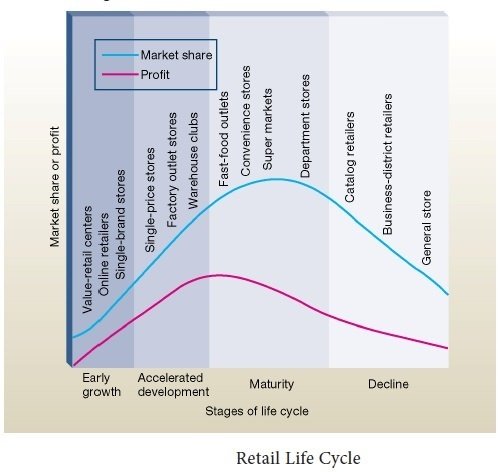
  • Retail life cycle
  1. Wheel of Retailing

This theory talks about the structural changes in retailing. The theory was proposed by Malcomb McNair and according to this theory it describes how retail institutions change during their life cycle. In the first stage when new retail institutions start business they enter as low status, low price and low margin operations. As the retail firms achieve success they look in for increasing their customer base.

They begin to upgrade their stores, add merchandise and new services are introduced. Prices are increased and margins are raised to support the higher costs. New retailers enter the market place to fill the vacuum, while this continues to move ahead as a result of the success. A new format emerges when the store reaches the final stage of the life cycle. When the retail store started it started low but when markets grew their margins and price changed. The theory has been criticized because they do not advocate all the changes that happen in the retail sector and in the present scenario not all firms start low to enter the market

  1. Retail Accordian Theory

This theory describes how general stores move to specialized stores and then again become more of a general store. Hollander borrowed the analogy ‘accordian’ from the orchestra. He suggested that players either have open accordion representing the general stores or closed accordions representing narrow range of products focusing on specialized products. This theory was also known as the general-specific-general theory. The wheel of retailing and the accordion theory are known as the cyclical theories of retail revolution

  1. Theory of Natural selection

According to this theory retail stores evolve to meet change in the microenvironment. The retailers that successfully adapt to the technological, economic, demographic and political and legal changes are the ones who are more likely to grow and prosper. This theory is considered as a better one to wheel of retailing because it talks about the macro environmental variables as well, but the drawback of this theory is that if fails to address the issues of customer taste, expectations and desires

  1. Retail Life cycle

Like products, brands retail organizations pass through identifiable stages of innovation, accelerated development, maturity and decline. This is commonly known as the retail life cycle. Any organization when in the innovation stage is nascent and has few competitors. They try to create a distinctive advantage to the final customers. Since the concepts are new at this stage organizations try to grow rapidly and the management tries to experiment. Profits will be moderate and the stage may last for a couple of years. When we talk about our country e-buying or online shopping is in the innovation stage.

In the accelerated growth phase the organizations face rapid increase in sales, competitors begin to emerge and the organizations begin to use leadership and their presence as a tool in stabilizing their position. The investment level will be high as there are others who will be creating a lot of competition. This level may go up to eight years. Hypermarkets, Dollar stores are in this stage. In the maturity stage as competition intensifies newer forms of retailing begin to emerge, the growth rate starts to decline. At this stage firms should start work on strategies and reposition techniques to be in the market place. Supermarkets, cooperative stores are in this stage. In the final stage of the retail life cycle is the declining phase where firms begin to loose their competitive advantage. Profitability starts to decline further and the overheads starts to rise. Thus we see that organizations needs to adopt different strategies at each level in order to sustain in the marketplace.

  1. Consumer Behavior Theories:

  • Wheel of Retailing:

The Wheel of Retailing theory, proposed by Malcolm P. McNair in the 1950s, suggests that retail firms evolve through predictable stages. Retailers initially enter the market with low-status, low-margin operations and gradually add services and amenities as they succeed. Over time, this process may lead to higher prices and increased competition, eventually prompting the entry of new low-status retailers. The cycle continues.

  • Retail Life Cycle:

Building on the Wheel of Retailing, the Retail Life Cycle theory posits that retail formats go through distinct life stages, including introduction, growth, maturity, and decline. Each stage is associated with specific challenges and opportunities. Understanding the life cycle helps retailers adapt strategies based on their position in the market.

  • Customer Decision-Making Process:

The Consumer Decision-Making Process theory outlines the steps consumers go through when making purchasing decisions. These steps include problem recognition, information search, evaluation of alternatives, purchase decision, and post-purchase evaluation. Retailers use this theory to tailor marketing strategies to influence consumers at each stage.

  1. Store Location Theories:

  • Central Place Theory:

The Central Place Theory, developed by Walter Christaller, explores the optimal spatial arrangement of retail centers within a geographic area. It posits that consumers will travel to the nearest central place (retail center) to fulfill their shopping needs. Larger retail centers offering a broader range of goods and services are located less frequently but serve a larger population.

  • Huff’s Gravity Model:

The Huff’s Gravity Model predicts the probability of a consumer choosing a particular store based on its attractiveness (size, offerings) and distance. This model is valuable for retailers in understanding consumer behavior related to store choice and optimizing their location strategies.

  1. Retail Marketing Theories:

  • Retail Mix:

The Retail Mix theory, also known as the 6 Ps of retailing (Product, Price, Place, Promotion, Presentation, and Personnel), emphasizes the interconnected elements that retailers must consider when creating a marketing strategy. Balancing these elements is essential for a cohesive and effective retail marketing approach.

  • STP Marketing:

STP stands for Segmentation, Targeting, and Positioning. In retail, this theory involves identifying market segments, selecting target segments that align with the retailer’s strengths, and positioning the store to meet the specific needs and preferences of those target customers.

  • Retail Atmospherics:

Retail Atmospherics theory explores how the physical environment of a store, including lighting, colors, scents, and layout, affects consumer perceptions and behavior. Creating a pleasant and engaging atmosphere enhances the overall shopping experience and influences purchasing decisions.

  1. Retail Evolution Theories:

  • Wheel of Retailing Evolution:

The Wheel of Retailing Evolution theory builds on the Wheel of Retailing, proposing that retailers evolve through stages of innovation, growth, maturity, and decline. New retailers often introduce innovative formats, challenging existing structures and leading to a continuous cycle of evolution in the retail industry.

  • Retail Life Cycle Evolution:

Similar to the Retail Life Cycle, this theory suggests that retail formats evolve through stages of introduction, growth, maturity, and decline. The evolution may involve changes in format, strategies, and consumer offerings to adapt to market conditions and competition.

  1. Technology and Omnichannel Retailing Theories:

  • Technology Adoption Curve:

The Technology Adoption Curve, developed by Everett Rogers, categorizes consumers into innovators, early adopters, early majority, late majority, and laggards based on their readiness to adopt new technologies. Retailers use this theory to guide their adoption of technology and innovation strategies.

  • Omnichannel Retailing:

Omnichannel Retailing theory emphasizes the integration of various channels (online, offline, mobile, etc.) to provide a seamless and unified shopping experience for consumers. It recognizes that consumers may engage with retailers through multiple channels and aims to create a cohesive brand experience across all touchpoints.

  1. Retail Strategy Theories:

  • Porter’s Generic Strategies:

Developed by Michael Porter, this theory outlines three generic strategies for competitive advantage: cost leadership, differentiation, and focus. Retailers can pursue one of these strategies to position themselves in the market and gain a competitive edge.

  • Wheel of Retailing Strategy:

The Wheel of Retailing Strategy theory suggests that retailers should strategically choose their positioning within the Wheel’s evolution stages. For example, a retailer may opt for a low-cost strategy as a low-status entrant or differentiate through innovation as a higher-status player.

  1. Sustainability in Retailing:

  • Green Retailing:

With a growing emphasis on sustainability, Green Retailing theory focuses on environmentally friendly retail practices. This includes sustainable sourcing, energy-efficient operations, waste reduction, and efforts to appeal to environmentally conscious consumers.

  • Circular Economy in Retailing:

The Circular Economy theory promotes a regenerative approach where products, materials, and resources are kept in use for as long as possible. Retailers adopting circular economy principles aim to reduce waste, recycle materials, and create more sustainable product life cycles.

Forms of Retail Business Ownership

The term ‘retail sales by ownership’ refers to the basic system or basic format of doing business. In India, around 12 million retail outlets are covered under this format. Under this format, proprietor is responsible for the success and failure of the store. It is a type of format, which legally has no separate existence from its owner. Opportunities in retail ownership are in plenty. From market positioning and operating perspectives, each ownership format serves a particular market and has its own advantages and disadvantages.

Over Ninety percent retail firms / outlets in India are independent and hence unorganized. With the globalization and borderless economies, this percentage is coming down but still unorganized stores (mom and pop stores) are in plenty. This number may be because of ease of entry. Ownership pattern has its own competitive advantages and disadvantages. Among independent competitive advantages, main are flexibility, low investments, less interference, quick decisions, direct strategic control, image, consistency, personal attention and entrepreneurial spirit.

Among disadvantages, common are limited finance, less bargaining power, labor intensity, reduced media access, few economies of scale, less expertise, over-dependence on the owner, excess workload and limited planning and supervision due to individual’s limitations.

The retail sale by ownership is classified as under:

  • Independent Retailer
  • Chain stores
  • Franchising
  • Leased department stores
  • Vertical Marketing system
  • Consumer co-operatives
  1. Independent Retailer

An Independent Retailer usually is a small retailer (always not true) and is found in all lines of trade and in all communities. He may be a young man, fresh graduate just starting his own business or he may be a man of advanced years with many of them spent in the field of retailing. In India, many of the independent stores tend to be passed on from one generation to another. In either case he has a business of his own. He is independent in-fact as well as in name. The high numbers of independent retailers is associated with the ‘ease of entry’ into the market place. The entry and growth of independent retailers in India is a big reason in the high rate of new retail outlets failure.

Merits of Independent Retailer

  • The independent retailer has no restrictions on who, how or where the business to be set up. He is free to do what he wants and to select a convenient location.
  • The independent retailer takes all decisions related to the store functioning. It drastically saves the time that usually exist between decision-making and the implementation process. Therefore, an independent retailer can respond quickly to the environmental changes and adopt proper strategies.
  • The independent retailer can concentrate on a local area to achieve its business goals.
  • To serve the local demand, a retailer can decide the trading hours, merchandise to be sold / removed and prices as and when desired.
  • It avoids duplication of work, ambiguity of role and excess stock due to clarity of role, thus resulting in increased productivity and time utilization.
  • To start an independent store is comparatively an easy task as it requires low investment, modest fixtures and merchandise.
  • The independent store by providing limited but deep merchandise can act as a specialized store to serve a particular consumer segment.

Demerits of Independent Retailer

  • Due to limited exposure and small investments, in most of the cases, they don’t stand in competition with the emergence of giant retailers and international store outlets.
  • As independent stores are dependent on labor intensive techniques, they find themselves difficult to improve store-productivity when it comes to stock-keeping, ordering, merchandising, displays, accounting and dispatching.
  • Undoubtedly, the bargaining power of independent retailers is comparatively less as they offer limited merchandise. On the other hand, big retailers (like supermarkets, hypermarkets and chain stores) due to bulk buying, negotiate vendors effectively and offer less prices, better quality goods and great service at short notice or in small lots create problem for independent stores.
  • Due to limited operations, less working capital, improper logistic arrangements, retailers are not able to have benefits of economies of scale.
  • Independent retailers due to limited funds cannot go for mass sales promotion programs resulting in limited target market and geographical coverage.
  1. Chain Store/Chain Retailer

A chain retailer or a chain store is a group of two or more outlets carrying the same sort of merchandise assortment, owned and controlled jointly and usually supplied from one or more central warehouses. The main advantage of such a retail format is to make retailer enable to bargain well with the suppliers. Another advantage is cost effectiveness in advertising and sales promotions. Thus, a very small number of stores constitute a chain-store system.

Merits of Chain stores

  • Good bargaining power with suppliers
  • Cost effectiveness due to centralized operations
  • Ease of managing store operations
  • Use of advanced technology increases their working efficiency

Demerits of Chain stores

  • The establishment cost to set up such chain of outlets requires huge money and expertise.
  • Difficulty in managerial control due to geographically dispersed branches/outlets
  • Due to centralized decision-making, some outlets may have difficulty in adapting to local needs.
  • Due to huge network of outlets, it is difficult for management to monitor their day to day activities resulting in communication gap, inefficiencies, and delay in decision making.
  • Expense on safety stock remains high.
  1. Franchising

A Franchise is a contractual agreement between the franchiser and the franchisee that allows the franchisee the right to supply its brand (goods and services) exclusively within a defined area, as per a particular format for a specified period of time. In return, franchisee pays a fixed fee in advance and a monthly percentage of gross sales made by him under franchiser name and fame in the form of royalty. In India, franchising business is becoming very popular and growing rapidly.

The small businesses find it convenient by being a part of large, multinational firm because franchiser provides great assistance to franchisee for locating and constructing the retail store (including interiors, and exteriors), developing the goods and services for selling, hiring employees, training, advertising and administering the store effectively.

Types of Franchising

In commerce, franchising structure can vary according to the goods and services provided. In most of the agreements, the franchisee is prohibited from selling goods and/ or services of other brands from the same retail outlet in any circumstances.

The franchising may be of three categories:

(i) Product or a trademark franchising

In this sort of franchising, a franchisee with mutual consent acquires the name and identity of the franchiser by agreeing to sell the franchiser’s goods and services exclusively made and supplied by him under his name. In actual, under such an arrangement, franchisee use the franchiser’s business methods, selling techniques, standardized product lines and advertising on co-operative basis.

Although, franchisee adheres to certain operating rules and regulations, but still is independent in their day-to-day operations. In consultation with the franchiser, franchisee can decide the store hours according to the locality needs. Archie’s Gallery, Hallmark stores, which are spread all over India, is the best suitable examples of a product/ trademark franchisee.

(ii) Business Format Franchising

In business format franchising, there is a more synergetic relationship between a franchiser and the franchisee. The franchisee receives assistance on the issue of site location, building the store, quality control, accounting practices, training to store employees, and the problems faced in conducting the store.

Besides these services, a franchisee enjoys the benefits of prototype stores, standardized product lines, selling and presenting skills and co-operative advertising. McDonald’s outlets, Domino’s, Pizza Hut are the best suited examples of business format franchising. In India, since 2000, most growth has been observed under this type of franchising format.

(iii) Area Development Franchising System

In an area development franchisee system, the franchiser grants development rights of a particular area to the franchisee in turn for a front-end development fee. The franchisee on his part is responsible for developing a certain number of units within a given period of time. Excel InfoTech EIIT has adopted this unique mode of franchising.

  1. Leased Department Stores

A leased department which is also known as shop-in-shops or store-in-store, is a section of a department in a retail store in the form of specialty/discount store given to any outside party on monthly rental basis. The person who provides the store space to outside party is known as lessor, and the person who takes the shop/store space is known as lessee.

The payment made by lessee to lessor for the use of store space is decided in a contract in the form of monthly rent. The lessee (the proprietor) is usually responsible for all aspects of business such as managing fixtures and furniture. In order to maintain the overall consistency and co-ordination, the store has some operating and administrative restrictions for each lessee in a uniform manner. For a lessee (retailer), the main reason to have rented premises is the property price that usually is so high that buying the premises is beyond the reach of the retailer.

Leased Departments in India:

In India, leased departments are an emerging trend in the field of retail business. Most of the renowned retail chain stores set up their outlets or extension counters in commercial complexes of residential areas, malls, PVR multiplexes, public places like bus terminals, railway stations, metro stations, airports and on national highways. The reason behind their popularity is the business and marketing philosophy of the retail chains that insures the availability of their brands to the consumers near their place of work or home.

Advantages of leased departments

  • Following are the advantages of having leased departments from stores’ point of view:
  • It provides one-stop shopping experience.
  • Leased stores pay for property, personnel and other expenses resulting in fewer burdens on lessor.
  • Lessor gets regular monthly income in the form of rent.
  • Employees’ management, merchandise displays and arrangement, reordering of items, complaint handling and so on are handled by individual lessees.

Disadvantages of leased departments

  • Operating hours may vary from store to store on the basis of goods and /or services sold.
  • Items sold /business lines are restricted.
  • If lessees are performing well, the store owner may increase the rent or lessees themselves can create problems by changing /not obeying agreements’ rules and regulations.
  • The bad image of one lessee can spoil the image of entire store.
  1. Vertical Marketing System

A Vertical Marketing System (VMS) is a system in which almost all the members of distribution channel such as manufacturers, wholesalers and retailers work together to satisfy human needs and wants by facilitating the smooth flow of goods and services from manufacturer to ultimate consumer.

In traditional marketing system, manufacturers, wholesalers and retailers are separate entities that try to maximize their own profits. The philosophy behind developing vertical marketing system is that when one member of distribution channel tries to maximize its profits on the expense of rest of the members, it will create conflicts resulting in decline in profits for the whole channel of distribution. To avoid these conflicts, now retail firms have started forming vertical marketing systems. Three types of VMS are in existence through which goods and services are usually distributed to customers.

These are:

  • Independent firm VMS
  • Partially integrated VMS
  • Fully integrated VMS
  1. Consumer Cooperatives

Consumer Cooperatives are retail outlets owned and managed by its customer members. A group of interested customers (members) start retail operations by investing money, receive stock certificates, elect members to run day to day activities and share the profits on the basis of investment made or certificates held.

The reason to setup consumer cooperative is that local retailers are not able to satisfy consumers’ needs (whatever the reason may be). Therefore, consumers are left with no option but to open their own store. Examples of cooperatives in India are the ‘Kendriya Bhandaars’, owned and managed by government, ‘Apna Bazaar’ shops in Mumbai and ‘Super Bazaar’ stores in Delhi. In some cases, these stores are run by the local residents of society/colony/apartment residents.

Functions of Retailing

A retailer is a person who has set up a commercial establishment to sell goods and services in smaller quantities to the end consumers for their personal use. He sells these goods at a markup or profit margin considerably higher than that of the wholesaler.

Functions of Retailing

Retail trade performs many valuable functions for the trade and commerce as a whole. Some of them are as follows:

  1. Delivery of the goods to the end consumer

This makes shopping for all requirements quite hassle-free for the consumers. This also facilitates consumption and maximizes consumer satisfaction. Because the company cannot take responsibility of delivery to every single customer, it appoints retailers. One of the functions of retailing is immediate delivery.

  1. Is an essential part of the distribution chain

Because the retailer takes over the cumbersome task of distribution of goods manufactured to the target market, the manufacturer is relieved of this responsibility and can divert his resources to manufacturing activities.

  1. Finances the wholesaler

While booking his order of goods with the wholesaler, the retailer pays some percentage or the whole of the order price in advance. This helps the wholesaler to carry on with his operations seamlessly. In some industries, it is the retailer who pays cash to maintain stock and in others the wholesaler has to carry the stock as paid capital. Nonetheless, financing is one of the major functions of retailing. A retailer who does not contribute to financing will bring down the effectiveness of the supply chain.

  1. Stores the goods according to market requirement

The retailer invests his working capital in building a gamut of inventory reflecting market requirements. He also sells the requisite quantity, however small or big, to the final consumers satisfying their needs. The retailers know the complete demand and supply potential due to their years of experience. Hence it is one of the functions of retailing to balance the demand and supply as per external market conditions.

  1. Lends a hand in manufacturer’s marketing initiative

Retailer plans and executes many advertising and promotion activities at the point of purchase i.e. right in his store. This leads to gain in popularity of and favorable market conditions for the product of the manufacturer.

  1. Assumes storage and credit risks

When the retailer orders and stores a large quantity of goods from the manufacturer, he makes sufficient provisions to store it safely for some days. This involves costs. Also, there is also a risk of loss of these goods on account of destruction, theft, spoilage etc. The retailer assumes these risks while storing goods.

  1. Extends credit facilities to the consumers and assumes credit risk

The retailer does so to encourage shopping. This adds to the vigor of commercial activities in the economy. But there is also a risk that the customers won’t pay for the goods bought or may return damaged goods to the retailer. This inherent risk in trade is assumed by the retailer.

  1. Offers wide variety of customers and enticing price range in a product line

In order to attract more customers, a retailer offers a wide range of merchandise at attractive prices. This results in higher consumer satisfaction and higher standards of living in any economy.

  1. Provides convenience in shopping

Retailers try to set up their shops nearby housing areas or near parks, schools the areas where the customer finds it very convenient to shop. This enhances the consumer welfare.

  1. Offers after sale services, differentiated packaging, giving more information about the use of the product

All these activities add value to the retail transaction and cater to various requirements of the consumers suitably.

  1. Hears the voice of the market

The retailer measures the pulse of the market by listening to the consumer feedback, expectations, complaints, and by observing a shift in the tastes and preferences of the consumers. This arms him with very critical market intelligence enabling the entire commercial fraternity to gear up for the changing economic scenario.

  1. Generating employment for masses

Retail trade, especially the brick-and-mortar models, are human resource-centric establishments. They require many employees for numerous functions such as stock taking, over the counter selling, packaging, after sales services, floor management etc. Thus, retail sector thrives with lots of lucrative employment opportunities for all the talented job aspirants.

General principles of Stress Management

  1. Self-knowledge

    Self-knowledge appears as the first principle, because most of the others build on it. It involves knowing your capabilities and your limits, your personal temperament and typical coping style, and your values and goals.
    Aspects of self-knowledge
    Are you what Hans Selye calls a racehorse, or are you a turtle?. Racehorses thrive on stress and are only happy with a vigorous, fast-paced lifestyle. Turtles require peace, quiet, and a generally tranquil environment. These are of course extremes – people are usually somewhere in between.

    What are your values, what matters to you? Though many aspects will be shared with others in your social group, every person has a unique system of values and goals.
    Everyone has certain abilities – and limits. Do you recognise your abilities and make the most of them? Do you also acknowledge your limits and know when to stop?

    Why knowing yourself is important to stress management
    You may feel comfortable with some of your characteristics, less happy with others. In either case, to effectively manage stress you need to be aware of your own optimum stress level and coping style, as well as the goals and values that guide your reactions.
    Everyone has their own temperament, style of managing stress, and value system. You need to develop strategies relevant to your personal style and compatible with your personal values, otherwise you are not likely to use them.
    Developing self-knowledge
    How can you become more aware of your coping style and optimum stress level? Here are some suggestions.
    Identify your typical stress triggers. What situations do you typically react to? Keep a log for a few weeks.

    You are the best intuitive judge of your optimum stress level. Observe what your body is doing – note your typical stress signs.

    Observe how you typically cope with problems. What works for you? What do you tend to do that is unhelpful?

    There are some strategies to help you identify your values and goals in Chapter Nine of GoodStress. Use these to check out your preferences, values and standards. Are they realistic and appropriate? Have you thought them through for yourself?
    Completing rational self-analyses will help you identify the underlying values that guide your reactions to specific events and circumstances.

    2. Self-acceptance and confidence

    Self-acceptance and confidence are closely related concepts. One builds on the other. Being able to accept yourself as you are, free of any demand that you be different, provides the basis for confidence in your abilities. Confidence, in turn, will enable you to take risks, try new things, and direct your own life.
    Accepting yourself
    To accept yourself is to acknowledge three things: (1) you exist, (2) there is no reason why you should be any different from how you are, and (3) you are neither worthy nor unworthy.

    Acknowledgment that you exist is probably straightforward. It is the other two parts that most people find hard to grasp.
    Self-acceptance involves rejection of any demand that you be different. You may sensibly prefer to be different. You may decide it is in your interests to change some things. But keep the desire to change as a preference. Instead of believing that you have to change, see change as a choice.
    Do not attempt to measure your selfor set some kind of valueon yourself. Self-acceptance is radically different to self-esteem. Self-esteem is based on the idea that you are a goodor worthwhileperson. Worthwhileness requires some criteria, like how well you perform, or the idea that you are worthwhile simply because you exist. Self-acceptance, on the other hand, is based on the idea that you dont have to be goodor worthwhile. In fact, there is no need to evaluate yourself at all! Instead of evaluating your self, you use your energy and time to evaluate (1) your behaviour, and (2) the quality of your existence.
    Evaluating your behaviour is a good idea. You can check whether it helps you enjoy your life and achieve your goals. It is also a good idea to evaluate the quality of your existence. Your enjoyment of life is surely important – more important than worrying about whether you are a worthwhileperson.
    Having confidence in your abilities
    Self-knowledge and self-acceptance are preconditions for confidence. To have confidence in your abilities involves three things. First, you know what you can and cant do. Second, you are prepared to try things to the limit of your ability. And third, you regularly work at extending your capabilities.
    Having confidence in your abilities is different to having confidence in your self. Self-confidence implies perfection – that you, as a total person, are able to do everything well. This is unrealistic and grandiose.

    Having confidence in your abilities is more realistic. Instead of talking about self-confidence, follow the advice of Paul Hauck and talk about social confidence, work confidence, driving confidence, house-care confidence, examination confidence, relationship confidence, and so on. In other words, develop confidence in specific abilities rather than in your total self.
    In practice, ability-confidence would involve behaviours like the following:
    Doing things without demanding you succeed, and viewing mistakes as opportunities for learning. Confidence grows out of the attempt, the doing, rather than from the result.
    Evaluating your actions and performances in terms of how they help you reach your goals – not what they prove about you as a person.
    Taking calculated risks with important activities such as choosing a career, changing jobs, or starting a new relationship.
    Persevering – not giving up when you do less well than you want; rejecting any belief that everything should come easy; and accepting that many good things involve overcoming obstacles, setbacks, and persisting over a period of time.
    Learning from your experiences – trying something, analysing your experience, seeing where you went wrong and working out what you can do to improve your abilities.
    Why these are important to stress management

    If you are prone to rating your total self, you may want to avoid looking closely at your actions because to do so may lead to self-downing. Paradoxically, self-acceptance is more likely than self-evaluation to lead to constructive change. Confidence in your abilities will free you to take risks, try new experiences and learn new lessons.
    If you can accept yourself with your unique characteristics and preferences, you will be less likely to live your life to suit other people.
    As Martin Seligman has pointed out, there are limits to how much we can change ourselves. Human beings are not perfectible. If you can accept imperfection in yourself, you are less likely to engage in dangerous behaviour striving for the unattainable.
    Developing self-acceptance and confidence
    Self-acceptance as an alternative to self-evaluation is not an easy concept to grasp. The tendency to self-evaluation seems to be built in to human beings, and the self-esteem concept is pervasive in our thinking and culture.
    Think through the philosophy of self-acceptance. Read about it. Write down your thoughts on it. Talk about it with others (many people will argue against the concept, which will give you the opportunity to hone your thinking!).

    Finally, and most important, behave like a self-accepting and confident person. As far as possible, practice living in accordance with your preferences, values and standards. Say what you believe, be open and honest as to who you are (but do this appropriately with people significant to you, and take into account their preferences and feelings). Treat yourself to things you used to think you did not deserve. Try things you used to be afraid to do – without any demand that you succeed.

    3. Enlightened self-interest

    The ability to act in your own interests follows on from self-acceptance and confidence. As we shall see, it is also important to take into account the interests of others. The principle of enlightened self-interest takes into account both parts:
    You place your own interests first.
    You keep in mind that your own interests will be best served if you take into account the interests of others.
    Human beings are fundamentally self-interested
    Notwithstanding any precepts that say we shouldbe otherwise, human beings appear to be intrinsically concerned first with their own welfare.

    Hans Selye has argued that the desire to maintain oneself and stay happy is the most ancient – and one of the most important – impulses that motivates living beings. All living beings protect their own interests first of all. Selye points out that this begins with our basic biological make-up, in that the various cells in our bodies only cooperate with each other to ensure their own survival.

    Human beings are also motivated by social interest
    Selye has pointed out, though, that we are also strongly motivated by altruistic feelings. As well as self-interest, we also possess social interest – the wish to ensure that the social system as a whole survives and develops.
    How is that two apparently contradictory tendencies can co-exist? The answer is that we help others in order to help ourselves. In other words, our self-interest is enlightened.
    It appears that like self-interest, social interest is also inherent within human beings – both have biological roots. Collaboration between body cells promotes the survival of each individual cell and enables the total organism to function.
    In effect, individual interests are best served by mutual cooperation. Accordingly, self-interest without social interest is misguided. So is social interest without self-interest. Always putting others first leads to resentment or a martyr attitude. People who believe they are acting purely in the interests of others are dangerous. By denying (to themselves) that their own self-interest is involved, such people may justify all types of manipulative and controlling behaviour toward others.

    You are both self-interested and socially-interested. This dual tendency is built in to your very being and begins with your basic biology. By accepting this about yourself, you will be able to do a better job of acting in your own interests – in an enlightened manner.
    What is it to be enlightened?
    The word enlightenedhas several related meanings. It is humanitarian – charitable, liberal, and idealistic; and at the same time utilitarian – useful, beneficial, and practical.
    Can you see how merging an enlightened attitude with innate self-interest can apply at all levels – to yourself, to your family, to your town or city, to your country, and to the world as a whole? Consider the effect on this planet if every person acknowledged their self-interest and then practiced it in an enlightened manner. What if every country based its external and foreign policies on the humanitarian and practical principle of enlightened self-interest?
    Why enlightened self-interest is important to stress management
    If human beings did not have an inherent will to protect themselves and further their own interests, they would not survive. If you dont attend to your own interests, who will? Knowing what is in your interests will help you get what is best for you and avoid what is harmful. It will keep you moving toward your goals – and ensure that your goals are the right ones for you.

    But you had better simultaneously take into account the interests of others. Getting people to have positive feelings toward you is a good idea. They will be more likely to treat you well and less likely to harm you. Contributing to their welfare will encourage them to contribute to yours. And contributing to the development and survival of the society in which you live will mean a better environment in which to pursue your interests.
    If you acknowledge that self-interest is inherent in your nature, you will feel less guilty about looking after yourself. If you acknowledge that altruistic behaviour is in your interests, you will be more likely to cooperate with others. If you do both, everyone gains.
    Developing enlightened self-interest
    Begin by practicing enlightened behaviours. Here are some ideas to get you started now:

  • Go out of your way to show positive feelings towards others – gratitude, respect, trust – which in turn will arouse goodwill from them.
  • Choose some new activities in various life areas – work, family, leisure – that will bring goodwill.
  • At the same time, act assertively. Ask for what you want, say Noto what you dont, and tell others (when appropriate) what you think and how you feel.
    Make a point of doing something just for yourself each day for a while.
  • Until enlightened self-interest becomes part of you, consciously seek to get more of what you want while facilitating the interests of the other people in your world.
  1. Tolerance for frustration and discomfort

    The ability to tolerate frustration and discomfort is central to stress management. High tolerance will keep you from overreacting to things you dislike. It will help you tackle problems and issues rather than avoid them. It will enable you to take risks and try new experiences.
    What is high tolerance?
    As we shown in Chapter Four of GoodStress, low tolerance for frustration and discomfort is a key cause of unnecessary distress. It arises from beliefs like: Life should not be hard, it is awful and I cant stand it when it is hard; so I must avoid pain, difficulties and frustrations.
    High tolerance, on the other hand, means accepting the reality of frustration and discomfort, and keeping their badness in perspective.
    To accept frustration and discomfort is to acknowledge that, while you may dislike them, they are realities. They exist, and there is no Law of the Universe says they shouldnot exist (though you may prefer they not). You expect to experience appropriate negative emotions like concern, remorse, regret, sadness, annoyance, and disappointment. But you avoid exaggerating these emotions (by telling yourself you cant stand them) into anxiety, guilt, shame, depression, hostile anger, hurt, or self-pity.
    To keep frustration and discomfort in perspective is to regard them as unpleasant rather than awful. You dislike rejection, pain, bad health, financial insecurity and other unwanted circumstances – but you believe that you can cope with the discomfort when they happen to you.
    Why is high tolerance important to stress management?
    Low tolerance creates distress by causing you to overreact to discomfort. It may lead to secondary problems (having a problem about having a problem) where you react to your own symptoms and end up with additional symptoms. You might for example, get angry and then feel guilty, or become depressed because you feel anxious. Low tolerance also gets in the way of using stress management strategies like changing your diet, exercising, managing your time or acting assertively.
    High tolerance, on the other hand, will help you in many ways. You will be:
    Less likely to create secondary problems by overreacting to unwanted events and circumstances.
    More willing to experience present discomfort to achieve long-term goals and enjoyment.
    Prepared to take reasonable risks.
    More able to assert yourself appropriately with other people.
    Less likely to put off difficult tasks and issues, including personal change.
    How to raise your tolerance for discomfort and frustration
    Know when you are engaging in low-tolerance behaviour designed to avoid discomfort or frustration. Keep a log of such behaviour for several weeks or longer. Watch for things like:

  • avoiding uncomfortable situations;
  • overusing drugs or alcohol;
  • compulsive gambling, shopping, exercising, or bingeing on food;
  • losing your temper;
  • putting off difficult tasks.

The technique of exposure is the best way to increase your tolerance. Make a list of things you typically avoid – situations, events, thoughts, risks and so on. Commit yourself to face at least one of these each day. Actively confront discomfort by going into uncomfortable situations. Instead of trying to get away from the frustration or discomfort as you normally would, stay with the discomfort until it diminishes of its own accord.
You can prepare yourself to cope with the discomfort by using rational self-analysis, imagery, and the blow-up technique. Afterwards, do a catastrophe scale to get your reaction to the discomfort into perspective. (These techniques are described in GoodStress and in many other REBT books).

  1. Long-range enjoyment

    Like most people, you probably want to enjoy life. As well as avoid distress, you want to experience pleasure. And you probably want to get your pleasure now, not tomorrow. As Alice said in Through the Looking Glass: It must come sometimes to jam today. But there are times when it is in our interests to forgo immediate pleasure in order to have greater enjoyment in the longer term.
    What is long-range enjoyment?
    There are two parts to this principle. You seek to get enjoyment from each of your present moments, rather than always putting off pleasure till tomorrow, or dwelling on things that have happened in the past.
    However, to keep on enjoying your present moments you will sometimes choose to postpone pleasure. You may wish to drink more alcohol – but you restrict your intake now so your body will still let you drink in ten years time. Or you wish to buy a new stereo, but instead you save the money for an overseas trip. This is the long-termpart.
    The principle can be summed up as follows: live for the present with an eye to the future. In other words, seek to get as much pleasure and enjoyment as you can in the present – while taking into account the desirability of enjoying your life in the long term.
    The concept is not new
    The underlying thinking behind long-range enjoyment has been around for a long time. The Greek philosopher Epicurus (341270 BC) proposed the idea that pleasure is the supreme good and main goal of life – and that only through self-restraint and moderation can people achieve true happiness.
    John Stuart Mill, British philosopher and economist, argued that an act is right if it brings pleasure, and wrong if it brings pain. But he introduced the caveat that the ultimate value is the good of society, and the guiding principle of individual conduct is the welfare of the greatest number of people.
    Developing long-range enjoyment
    Learn to calculate gains and losses. Weigh the short-term pleasurable effects of an action against its possible longer-term negative effects. Make sure that immediate gain doesn’t set you up for future pain – as with overindulgence in alcohol. If in doubt, do a benefits calculation.
    Weigh short-term discomfort and frustration against the prospect of greater and more enduring comfort in the long term. To start exercising will be more uncomfortable than watching television – but later you will not only feel the health benefits, you will even begin to enjoy the exercise itself.
    The strategy of paradoxical behaviour will help you put the philosophical change into action. Practice deliberately postponing gratification in order to increase your tolerance for frustration. List a few things you could go without and earmark the money you save for something you would really like. Reduce your intake of alcohol, caffeine or fatty foods, and reward yourself with an occasional special treat you would otherwise see as an indulgence. Be creative – what other ideas for practicing long-range enjoyment can you come up with?
    By now you will probably see that many of the twelve principles are interdependent. To delay gratification involves tolerating frustration. Sensible long-range enjoyment involves enlightened self-interest and moderation.
    To sum up
    If you always postponed your enjoyment till tomorrow, you would never enjoy yourself. But, if you always lived just for the present moment, your happiness and stress management in the future would eventually be compromised. Live your life with the goal of getting as much enjoyment as possible both now and in the future.
    1993.

    6. Risk-taking

    Human beings, by nature, seek safety, predictability, and freedom from fear. But humans also pursue risk. A totally secure life would be a boring one. To grow as a person and improve your quality of life means being prepared to take some chances.
    The principle

    What we are talking about is a willingness to take sensible risks in order to get more out of life and avoid the distress of boredom, listlessness and dissatisfaction. Here are some important areas of risk-taking that relate to stress management:

  • Learning new things which may challenge existing beliefs.
  • Tackling tasks which have no guarantee of success.
  • Trying new relationships.

Doing things that risk the disapproval of other people.
How is risk-taking relevant to stress management?
Risk-taking is necessary for self-knowledge. To discover your limits, you need to take some risks and try yourself out. You can open up fresh opportunities to increase pleasure and avoid boredom.
Problem-solving means risking solutions that may backfire. To act assertively is to risk disapproval or rejection. Maintaining a support system involves trusting and opening up to other people.
Finally, experimenting with different activities to discover what you like and dislike will increase your self-knowledge and help you clarify your goals and values.
Increasing your willingness to take risks
Exposure is a key technique for practicing risk-taking. Develop a list of things you would like to try, such as:

  • Asking someone for something – like a date or favour – where there is a chance of rejection.
  • Doing something where there is a chance others will disapprove – for example, speaking up and telling a group of people what you think.
  • Trying something where there is no guarantee of success.
  • Put one item a day into practice. As you do so, remind yourself that the discomfort involved is not intolerable, and that staying with it will gradually increase your tolerance.

The benefits calculation can help you make rational decisions about the usefulness of risks you are considering.
You can prepare yourself for taking risks and cope with the discomfort involved using rational self-analysis, coping rehearsal, the blow-up technique, and role-playing.

7. Moderation

Sensible risk-taking recognises the innate human desire for safety and security. The principle of moderation will help you avoid extremes in thinking, feeling, and behaving.
Why moderation is important to stress management
Extreme expectations – too high or too low, will set you up for either constant failure or a life of boredom.
Addictive or obsessional behaviour can take control of you, creating new distress. Unrestrained eating, drinking or exercising will stress your body and lead to long term health complications.
Obsessive habits in areas as diverse as your work or your sexual behaviour can damage relationships as well as stress your body.
The principle of moderation
Taking a moderate approach to your life starts with your ultimate goals and ranges through to your daily activities.

You need to develop long-term goals, short-term objectives, and tasks that will challenge and move you on. But it is equally important they are potentially achievable and do not set you up for failure and disillusionment.

If your goal, for example, is to maintain your weight at a certain level, ensure you set that level appropriate for your age and other personal factors. Avoid any tasks and activities that are extreme – like a diet that provides massive weight loss in a short time. Otherwise, not only will you damage your health, but eventually the weight is likely to go back on (probably worse than it was before), leaving you with a feeling of hopelessness. The best way to keep to an appropriate weight without stressing the body is not to go on a radical diet, but rather to moderate eating and drinking in the long-term.
This applies in most areas of life. Throw yourself into your work, play, exercise and sexual life – but avoid the stress of over-involvement. Moderate, too, your self-help work – commit yourself to personal change, but without obsessiveness.
Note that moderation does not exclude risk-taking. In fact, moderation will help you avoid taking security too far. But you can take risks without being foolhardy.
Developing a moderate approach to life

Identify any areas of your life where you tend to behave excessively – eating, exercising, sexual activity, using your computer, and so on. Note when you are demanding full satisfaction of your urges, or catastrophising about the frustration involved in restraint. Keeping a log will help you do this.

Use the strategies of exposure and paradoxical behaviour to get into action. Set up a list of tasks, sorted according to difficulty, which will give you practice in behaving moderately. In advance, set limits in each of these areas, and commit yourself to keeping within those limits.
Handle your frustration using rational self-analysis. The benefits calculation will help you decide what areas of your life you are best to moderate. Finally, if you are unable to change behaviour which has become addictive, seek professional help.

8. Emotional and behavioural responsibility

As we saw in Part One, people who see their emotions and behaviours as under their control are less prone to distress than people who see themselves as controlled by external forces. The principle of responsibility can help you take charge of your emotions, your actions, and in turn your life. It involves taking responsibility for (1) what you feel, and (2) how you act.
To be emotionally responsible is to believe that you create your own feelings in reaction to what life throws at you. You avoid blaming other people – your parents, partner, boss, or anyone else – for how you feel.
Behavioural responsibility means accepting that you cause your own actions and behaviours, and are not compelled to behave in any particular way.

The inner-controlled person
An inner-controlled person can be identified by characteristics like the following:

  • Uses language – I think that or I would like you to rather than Everyone knows that or You should.
  • Tends to be assertive when relating to other people, rather than passive or aggressive.
  • Gets on with life now – rather than dwelling in the past or dreaming about the future but doing nothing.
  • Takes setbacks in their stride – rather than catastrophising or bemoaning fate.
  • Has a problem-solving approach – when things go wrong, looks for possible solutions.
  • Does not believe in luck- believes that action and the application of skill is what makes things happen, rather than luck or fate.
  • Limits to emotional and behavioural responsibility

While your emotions are mainly caused by what you believe, there are some exceptions. Biochemical changes, for example, can lead to emotional changes. (How you react to biochemical changes, though, will still depend on how you view what is happening in your body).
While you can, largely, control your thoughts, it is unlikely that anyone could do so perfectly. Expecting flawlessness will only lead to discouragement and self-downing.
While you are largely responsible for the consequences of your actions, some outcomes will be outside your control. If, for example, you say Noto a request, the other person may be disappointed – an appropriate reaction. You would be somewhat responsible, in that your Nowas the trigger. But what if they became clinically depressed – an inappropriate over-reaction? That would be their responsibility, not yours. You have no control over whether people choose to view your actions in ways that are rational or self-defeating.

Finally, an important point. Dont fall into the trap of blaming yourself because you are responsible for what you feel and do. Blame and responsibility are not the same thing. Blameis moralistic. It seeks not only to identify who may be the cause of a problem, but also to damn and condemn them.
Responsibility, on the other hand, is practical. It seeks either to identify a cause so it can be dealt with; or to identify who needs to take action for the problem to get solved – irrespective of who or what causedit. Responsibility is concerned not with moralising, but with finding solutions.
Why responsibility is important to stress management
Suzanne Kobasa has conducted research on, as she calls them, hardypeople – people who thrive on stress rather than become sick. A key characteristic of such people is their belief that they are in control of their lives. Hardy people generally have better physical and mental health – they are less affected by the ageing process, recover faster from medical episodes such as a heart attack or surgery, and are less likely to suffer from depression and anxiety.

If you take responsibility for your feelings and behaviours, you will avoid making yourself a victim or over-reacting to what other people say or do. You will be able to change your own feelings even though the world does not change to suit you. Finally, you will have confidence in your ability to handle your feelings, whatever happens – freeing you to take risks and try new experiences.

Developing responsibility
Use rational self-analysis to identify and dispute any irresponsible thinking.
Make a list of things you do that show irresponsibility – unassertiveness, dwelling in the past, catastrophising, drifting with problems hoping something will come along. Use the technique of paradoxical behaviour to act differently in these areas, taking responsibility for how you feel and behave.

9. Self-direction and commitment

Emotional and behavioural responsibility lay the basis for taking control over your life and committing yourself to action and involvement.

Self-direction
Taking responsibility for the direction of your life involves:

  • Choosing your goals, making sure they are your own.
  • Actively pursuing your goals, rather than waiting and dreaming.
  • Making your own decisions, even though you may seek opinions from others.
  • Choosing to work at managing stress, developing your potential, and changing things you dislike, rather than just drifting along or expecting a miracle to occur.
  • Not condemning any person (including yourself) when things go wrong in your life, even though you or someone else may be responsible; but rather identifying any causes and looking for solutions.

Self-direction does not mean open opposition and non-cooperation with others. You can keep your self-direction on the right track by balancing it with other principles such as enlightened self-interest, long-range enjoyment, moderation, and flexibility.
There are several prerequisites for self-direction. First, you need to see what happens to you as influenced (though not totally controlled) by what you do. As we saw earlier, inner-controlled people tend to be assertive, get on with life, and do not see themselves as victims. Second, to direct your own life you need to know what you want to do with it. Have you clarified your goals and values? Chapter Nine will show you how to do this.

Commitment
Commitment follows on from self-direction. There are two elements:
Perseverance. The ability to bind yourself emotionally and intellectually to courses of action. This involves a willingness to do the necessary work (and tolerate the discomfort involved) in personal change and goal-achievement.
Deep involvement. The ability to enjoy and become absorbed in (but not addicted to) other people, activities and interests as ends in themselves – where you get pleasure from the doing, irrespective of the final result. This may include such areas as work, sports, hobbies, creative activities, and the world of ideas.

Limits to self-direction and commitment
Some of what happens to you will be out of your control, and this will place limits on how much you can influence them. Remember, though, that how you react is your responsibility.
Further, while self-direction implies independence, it recognises some limits in the interests of mutual support and cooperation with others.
If carried too far, commitment can become obsession. Dont get so involved with one or a few things that other areas of your life suffer. Avoid, for example, allowing work to stop you from any recreational activity, or recreation to leave no time for relationships.
Why self-direction and commitment are important to stress management
Avoiding decisions or action creates tension and leaves problems unsolved. Action and persistence are needed to break unwanted patterns of behaviour and achieve personal change. A life of superficial involvements would lead to boredom and dissatisfaction.
Commitment is required for confidence to develop. You dont, for example, develop confidence in playing a musical instrument unless you commit yourself to practicing with it.

Self-direction can affect your health. Salvatore Maddi, from the University of Chicago, ran courses for men and women in management aimed at increasing their sense of control. These led to lower anxiety, depression, obsessiveness, headaches, insomnia, and blood pressure, as well as more job satisfaction – results which lasted well beyond the end of the courses.

Aiming for your own goals rather than having others direct your life will affect how you implement many of the strategies in Part Three of Good Stress. It will determine how you manage your time. It will help you assert yourself. You will also maintain more stimulation and variety in your life by doing the things you want.
Developing self-direction and commitment
Make a list of things you do that indicate lack of self-direction. Watch for behaviours like asking for permission, avoidance due to fear of disapproval, unnecessarily seeking other peoples opinions, and the like. Select one item each week and deliberately act differently, in line with what you would rather be doing.
Use rational self-analysis and imagery to cope with the discomfort involved.
Make a decision now to develop one new interest in your life in which you will get absorbed. Commit yourself to taking some steps toward it over the next week or so.

10. Flexibility
Flexible people can bend with the storm rather than be broken by it. They know how to adapt and adjust to new circumstances that call for new ways of thinking and behaving. They have resilience – the ability to bounce back from adversity.

The principle of flexibility
To be flexible is to be open to change in yourself and in the world. As circumstances alter, you are able to modify your plans and behaviours. You are able to adopt new ways of thinking that help you cope with a changing world. You are able to let others hold their own beliefs and do things in ways appropriate to them while you do what is right for you.
Flexibility in thinking means:

  • Your values are preferences rather than rigid, unvarying rules.
  • You are open to changing ways of thinking in the light of new information and evidence.
  • You view change as a challenge rather than a threat.

Flexibility in behaviour means:

  • You are able to change direction when it is in your interests.
  • You are willing to try new ways of dealing with problems and frustrations.
  • You can let others do things their way.
  • You avoid distressing yourself when others think or act in ways you dislike.

Why flexibility is important to stress management
Flexibility aids survival in a changing world. The world, as it always has, continues to change – but the pace of change is increasing. If there is not a corresponding change in attitudes there will be distress. We see this in the so-called generation gap. Parents who are inflexible find it harder to cope when their children behave in ways unthinkable in their generation. We can cope better when we see change as a challenge rather than a threat. As Suzanne Kubosa has found, this attitude is one of the characteristics of hardiness.
Flexibility leads to better problem-solving. As Roger Von Oech states, there are times we need to step outside what we know or usually do and look at a problem from new angles in order to find new solutions. Even negative events like being made redundant – can create opportunities to step outside.
Flexibility will make it easier to change your goals to suit new circumstances. Getting older or sustaining a disability, for example, usually requires one to adapt to significant lifestyle changes.
Flexibility will help you break out of boring routines and maintain stimulation and variety in your life. It will also help you manage your time better, by enabling you to change your plans to suit changing situations.
Developing flexibility
Use rational self-analysis to identify and change inflexible thinking. Watch especially for any demanding shouldsand musts.
Expose yourself to new ways of looking at things. Read books that adopt positions other than yours, talk to people with differing views, watch movies you would normally not bother with.
Practice flexibility by rearranging your office or home furniture, hanging some new pictures, visiting places you have never been.
Get into the habit of pausing before you take action on a problem and look at ways of solving it different to what you would normally do. In other words, attempt to act out of character on a regular basis.

11. Objective thinking

Flexibility and openness, as well as the other principles, require freedom from ways of thinking that are narrow-minded, sectarian, bigoted and fanatical; or that rely on uncritical acceptance of dogmatic beliefs or magicalexplanations for the world and what happens in it.
Objective thinking is scientific in nature. There are four aspects – it is (1) empirical, (2) logical, (3) pragmatic, and (4) flexible.
Objective thinking is empirical
It is based on evidence gained from observation and experience rather than on subjective feelings or uncritical belief. It seeks to avoid distortions of reality.
Objective thinking is logical
It reaches conclusions that validly follow from the evidence. It is possible, as the example below demonstrates, to have the right evidence but draw the wrong conclusions:
Evidence: My supervisor has criticised me, I don’t like being criticised
Conclusion: I can’t stand this, it shouldn’t happen to me, and it shows that my supervisor is a rotten person.
Even though the two pieces of evidence are correct, this does not make the conclusion correct. It does not logically follow that because I have been criticized and I don’t like this (both of which are true), that my supervisor is rotten, I cant stand it, and it shouldn’t happen (beliefs which go beyond the evidence).
More logical conclusions could be: My supervisor has done something I dislike; This is unpleasant; and I prefer this not to happen to me.
Illogical beliefs are often overgeneralizations, like, for example:
Something that is unpleasant becomes terrifying (awfulising);
Something that is hard to bear, becomes intolerable (discomfort intolerance);
Because I prefer to avoid discomfort, therefore I absolutely must avoid it (demandingness);
Because I behaved stupidly, therefore I as a person am stupid (self-rating).
To check the logical validity of your conclusions, ask yourself questions like:
Do my conclusions logically follow from the evidence?
What other conclusions may be possible?
Am I catastrophising, demanding, or self/other-rating?
Objective thinking is pragmatic
Science evaluates an idea not just on its evidence or logical validity, but also on its usefulness to human beings. In other words, we need to be concerned with the effects, both short- and long-term, of what we believe. Questions to ask might be:
What effect does believing this have on how I feel and behave?
Does this belief help or hinder me in achieving my goals?
Objective thinking is open-minded and flexible
Nothing is seen as absolute or the last word. Beliefs are seen as theories that are subject to change as new evidence comes along and existing ideas are proved false. Objectivity encourages us to continually search for explanations that are more accurate and useful than the ones we have now.
Why objective thinking is important to stress management
Objective thinking is a necessary component of the other attitudes. For example, increasing your tolerance for frustration and discomfort means keeping their badness in perspective, rather than overgeneralising them into awful or intolerable.
Unscientific thinking can itself create distress. This can happen when you view criticism as unbearable, demand that you succeed, or rate yourself as a total person because you fail at something.
Believing you are controlled by outside forces, like fate or luck, can lead to feelings of anxiety, powerlessness and hopelessness; and cause you to take a passive approach to life and its problems.
Erroneous thinking, as we shall see later, can also make it hard to practice the coping strategies in Part Three.
Developing objective thinking
Use rational self-analysis to challenge erroneous thinking
Use essays to critically examine magical thinking.
Read up on rational thinking.
Developing many of the other principles will also move you toward more objective ways of thinking (especially emotional and behavioural responsibility, self-direction, and flexibility).

12. Acceptance of reality

It makes sense, wherever possible, to change things you dislike. But there will be some things you will not be able to change. You then have two choices – you can rail against fate and stay distressed; or you can accept reality and move on.
The principle of acceptance
To accept something is to (1) acknowledge that it exists, (2) believe there is no reason it should not exist, and (3) see it as bearable. Lets examine these three aspects of acceptance in more detail:
Acknowledgment of reality. This involves admitting that reality – including unpleasant reality – exists. You see it as inevitable that many things will not be to your liking. You view uncertainty, frustration and disappointment as aspects of normal life.
Absence of any demand that reality not exist. This means that although you may prefer yourself, other people, things, or circumstances to be different from how they are (and you may even work at changing them), you know there is no Law of the Universe which says they should or must be different.
Keeping unwanted realities in perspective. You dislike some things, and find them unpleasant – but you avoid catastrophising them into horribleor unbearable.
Acceptance of reality includes many things
There are many realities people are called upon to accept. Here are some that are especially relevant to stress management:
Uncertainty. In the real world there are no certainties. The outcomes of our actions can never be guaranteed. It is helpful to anticipate the future, but we can never know for sure what it holds.
Utopia is unlikely. You and I will almost certainly never get everything we want. This includes total happiness or personal perfection. We will probably always experience some pain, anxiety, or depression.
There are limitations to personal change. There are many things we can change, like anxiety and depression. But there are some things that will not change no matter how much we try, as Martin Seligman points out in his book What You Can Change and What You Cant. Accepting this reality can help people avoid much unnecessary distress.
We cannot change others. One thing we can never change is other people. Only they can change themselves. Accepting this reality may save a lot of pain.
What acceptance is not
Many people have trouble with the idea of acceptance. They think that to accept something means they have to like it, agree with it, justify it, be indifferent to it, or resign themselves to it.
Acceptance is none of these things. You can dislike something, see it as unjustified and continue to prefer that it not exist. You can be concerned about it. You can take action to change it, if change is possible. But you can still accept it by rejecting the idea that it should not exist and that it absolutely must be changed.
Why acceptance is important to stress management
Hurting yourself does not change what you dislike, and will only take away energy better used to confront and solve problems. By reducing the intensity of your bad feelings, you will be less disabled by them. Acceptance can, paradoxically, increase your chances of changing what you dislike!
Acceptance will help you tolerate what you cannot change, and avoid adding unnecessary emotional pain to the unpleasantness of the situation itself.
Acceptance, finally, will help you avoid wasting time and energy and risking your emotional or physical health by striving for what is unattainable.
Developing acceptance of reality
Take note of non-accepting thoughts and behaviour. Watch out for:
Believing that people or things should be different to how they are; that it is awful and intolerable when things are not as they should be; that the world should be a fair place; that one should always be treated fairly.
Feeling angry but unable to do anything.
Needing to get other people to admit they are wrong, or avoiding acceptance because it might mean giving away a sense of self-rightness.
Keep reality in perspective. When facing an unpleasant development in your life:
Use the time-projection technique.
Ask Is this situation, event or possibility really so bad for me?
Develop a catastrophe scale.
Query yourself: How much do I really need to upset myself over this?
Challenge your demands that reality not be as it is. Ask yourself:
Can I really change (this person, this situation, etc.)?
Though I would prefer that be different to how it is, where is it written that it should be?
Why must this not happen?
Is demanding that this person change going to make them change – or would I be better to try and understand how they see things and then attempt to talk with them?
Practice acceptance:
Regularly remind yourself that human beings are fallible and not perfectible.
Don’t retaliate when people do things you dislike.
See the world for what it really is (and always has been) – imperfect.
Practice being satisfied with compromises and less than perfect solutions to problems.
To sum up
We can sum up our discussion of acceptance – and in fact all the rational principles – with a paraphrase of a well-known saying. It suggests that to achieve happiness, there are three things to strive for: the courage to change the things we can, the serenity to accept the things we cant – and the wisdom to know the difference.
One last thing. Dont make these principles into demands. They are ideals. Probably no-one could practice them all consistently. Rather than see them as absolute mustsfor managing your stress, use them as guidelines to a better life.

Importance of Goal Setting

Goal setting does not have to be boring. There are many benefits and advantages to having a set of goals to work towards.

Setting goals helps trigger new behaviors, helps guides your focus and helps you sustain that momentum in life.

Goals also help align your focus and promote a sense of self-mastery. In the end, you can’t manage what you don’t measure and you can’t improve upon something that you don’t properly manage. Setting goals can help you do all of that and more.

The Importance and Value of Goal Setting

Up until 2001, goals were divided into three types or groups (Elliot and McGregor (2001):

  1. Mastery goals
  2. Performance-approach goals
  3. Performance-avoidance goals

A mastery goal is a goal someone sets to accomplish or master something such as “I will score higher in this event next time.”

A performance-approach goal is a goal where someone tries to do better than his or her peers. This type of goal could be a goal to look better by losing 5 pounds or getting a better performance review.

A performance-avoidance goal is a goal where someone tries to avoid doing worse that there peers such as a goal to avoid negative feedback.

Research done by Elliot and McGregor in 2001 changed these assumptions. Until this study was published, it was assumed that mastery goals were the best and performance-approach goals were at times good, and other times bad. Performance-avoidance goals were deemed the worst, and, in fact, bad.

The implied assumption, as a result of this, was that there were no bad mastery goals or mastery-avoidance goals.

Elliot and McGregor’s study challenged those assumptions by proving that master-avoidance goals do exist and proving that each type of goal can, in fact, be useful depending on the circumstances.

Elliot and McGregor’s research utilized a 2 x 2 achievement goal framework comprised of:

  1. Mastery-approach
  2. Mastery-avoidance
  3. Performance-approach
  4. Performance-avoidance

These variables were tested in 3 studies. In experiments one and two, explanatory factor analysis was used to break down 12 goal-setting questions into 4 factors, as seen in the diagram below.

Confirmatory factor analysis was used at a later date to show that mastery-avoidance and mastery-approach fit the data better than mastery alone.

Why Set Goals in Life?

The truth is that some goals are achieved while others are not and it’s important to understand why.

Mark Murphy the founder and CEO of LeadershipIQ.com and author of the book “Hard Goals: The Secret to Getting from Where You Are to Where You Want to Be,” has gone through years of research in science and how the brain works and how we are wired as a human being as it pertains to goal setting.

Murphy’s book “Hard Goals: The Secret to Getting from Where You Are to Where You Want to Be” combines the latest research in psychology and brain science on goal-setting as well as the law of attraction to help fine-tune the process.

A HARD goal is an achieved goal, according to Murphy. Murphy tells us to put our present cost into the future and our future benefit into the present.

What this really means is don’t put off until tomorrow what you could do today. We tend to value things in the present moment much more than we value things in the future.

Setting goals is a process that changes over time. The goals you set in your twenties will most likely be very different from the goals you set in your forties.

Whatever your age doesn’t really matter in the end, as long as you continually revisit your life goals and work to update them.

Benefits of Goal Setting

Edward Locke and Gary Latham (1990) are leaders in goal-setting theory. According to their research, goals not only affect behavior as well as job performance, but they also help mobilize energy which leads to a higher effort overall. Higher effort leads to an increase in persistent effort.

Goals help motivate us to develop strategies that will enable us to perform at the required goal level.

Accomplishing the goal can either lead to satisfaction and further motivation or frustration and lower motivation if the goal is not accomplished.

Goal setting can be a very powerful technique, under the right conditions according to the research. (Locke and Latham).

According to Lunenburg (2011), the motivational impact of goals may, in fact, be affected by moderators such as self-efficacy and ability as well.

5 Proven Ways Goal Setting is Effective

Locke and Latham’s research have shown us that goal setting is indeed very effective.

In the 1968 article “Toward a Theory of Task Motivation” Locke showed us that clear goals and appropriate feedback served as a good motivator for employees (Locke, 2004).

Locke’s research also revealed that working toward a goal is a major source of motivation, which, in turn, improves performance.

Locke reviewed over a decade of research of laboratory and field studies on the effects of goal setting and performance. Locke found that over 90% of the time, goals that were specific and challenging, but not overly challenging, led to higher performance when compared to easy goals or goals that were too generic such as a goal to do your best.

Dr. Gary Latham also studied the effects of goal setting in the workplace. Latham’s results supported Locke’s findings and showed there is indeed a link that is inseparable between goal setting and workplace performance.

Locke and Latham published work together in 1990 with their work “A Theory of Goal Setting & Task Performance” stressing the importance of setting goals that were both specific and difficult.

Locke and Latham also stated that there are five goal-setting principles that can help improve your chances of success.

  1. Clarity
  2. Challenge
  3. Commitment
  4. Feedback
  5. Task Complexity

Clarity is important when it comes to goals. Setting goals that are clear and specific eliminate the confusion that occurs when a goal is set in a more generic manner.

Challenging goals stretch your mind and cause you to think bigger. This helps you accomplish more. Each success you achieve helps you build a winning mindset.

Commitment is also important. If you don’t commit to your goal with everything you have it is less likely you will achieve it.

Feedback helps you know what you are doing right and how you are doing. This allows you to adjust your expectations and your plan of action going forward.

Task Complexity is the final factor. It’s important to set goals that are aligned with the goal’s complexity.

Goal Setting Improve Performance

Goal setting and task performance were studied by Locke & Latham, (1991). Goal setting theory is based upon the simplest of introspective observations, specifically, that conscious human behavior is purposeful.

This behavior is regulated by one’s goals. The directedness of those goals characterizes the actions of all living organisms including things like plants.

Goal-setting theory, according to the research, states that the simplest and most direct motivational explanation on why some people perform better than others is because they have different performance goals.

Two attributes have been studied in relation to performance:

  1. Content
  2. Intensity

In regard to content, the two aspects that have been focused on include specificity and difficulty. Goal content can range from vague to very specific as well as difficult or not as difficult.

Difficulty depends upon the relationship someone has to the task. The same task or goal can be easy for one person, and more challenging for the next, so it’s all relative.

On average though the higher the absolute level is of a goal, the more difficult it is to achieve. According to research, there have been more than 400 studies that have examined the relationship of goal attributes to task performance.

According to Locke & Latham, (1991), it has been consistently found that performance is a linear function of a goal’s difficulty.

Given an adequate level of ability and commitment, the harder a goal, the higher the performance.

What the researchers discovered was that people normally adjust their level of effort to the difficulty of the goal. As a result, they try harder for difficult goals when compared to easier goals.

The principle of goal-directed action is not restricted to conscious action, according to the research.

Goal-directed action is defined by three attributes, according to Lock & Latham.

  1. Self-generation
  2. Value-significance
  3. Goal-causation

Self-generation refers to the source of energy integral to the organism. Value-significance refers to the idea that the actions not only make it possible but necessary to the organism’s survival. Goal-causation means the resulting action is caused by a goal.

While we can see that all living organisms experience some kind of goal-related action, humans are the only organisms that possess a higher form of consciousness, at least according to what we know at this point in time.

When humans take purposeful action, they set goals in order to achieve them.

Periodicity in Goal Setting: Short, Medium, Long-Term

Goal Setting is an activity that many coaches undertaken with their teams to try to set a point in the horizon for individuals and the team to work towards. Setting targets if completed properly can lead to increased performance and the ability to monitor and evaluate a program on a number of different levels.

When undertaking this type of exercise it is important to realize there are three categories goals, targets or Keep Performance Indicators (KPI’s) can be utilized within. These are short, medium, and long-term goals. The exact length of time for each target depends on the overall length of time a program is in operation for. For example, if a program ran for six months, then the long-term goals would be built around a six-month period. Medium term goals could be up to a month in length with short-term goal being based on weekly stages.

Short-term targets or KPI’s should build up to achieving what the desire medium term goals are. These medium term goals once cumulated, should then attain the long-term objectives. By structuring the ambitions of an individual or team in this way, they will link together and make often complicated or significantly larger goals more manageable and easier to plan in achieving.

Short Term Goals should be developed with a finite amount of time in mind. These goals should be the easiest to achieve in regards to minimal time allocated to the task. This may include for instance an individual player aiming to improve their road running time over three kilometres by five seconds each week. This goal during seasonal competition can then be aimed for each week and achieved within this time.

Medium Term Goals should be the result of an individual/team achieving or completing a task because of consistently satisfying the requirements of their short-term goals. An example of a medium term goal for the individual in our earlier referenced running scenario might be that the player increases the distance to four kilometres at the end of the first months training.

Like with the cumulative effect of the short-term goals leading to the completion of a medium-term goal, so too when a series of medium-term goals are completed then a Long Term Goal should be satisfied. Continuing with our example of the players running efforts, by the end of the season the player will be aiming to be running a total distance of eight kilometres.

Goals’ setting is a valuable tool once it is implemented properly and with purpose. By building goal setting into your team’s activities players will be able to better identify what is expected of them from the team. Additionally as a coach, you will also be able to remind players or teams of their responsibility and commitment to the team goals and hold the individual/team accountable to these.

Setting and achieving goals

Have you thought about what you want to be doing in five years’ time? Are you clear about what your main objective at work is at the moment? Do you know what you want to have achieved by the end of today?

If you want to succeed, you need to set goals. Without goals you lack focus and direction. Goal setting not only allows you to take control of your life’s direction; it also provides you a benchmark for determining whether you are actually succeeding. Think about it: having a million dollars in the bank is only proof of success if one of your goals is to amass riches. If your goal is to practice acts of charity, then keeping the money for yourself is suddenly contrary to how you would define success.

To accomplish your goals, however, you need to know how to set them. You can’t simply say, “I want” and expect it to happen. Goal setting is a process that starts with careful consideration of what you want to achieve, and ends with a lot of hard work to actually do it. In between, there are some very well-defined steps that transcend the specifics of each goal. Knowing these steps will allow you to formulate goals that you can accomplish.

The Five Golden Rules

  1. Set Goals That Motivate You

When you set goals for yourself, it is important that they motivate you: this means making sure that they are important to you, and that there is value in achieving them. If you have little interest in the outcome, or they are irrelevant given the larger picture, then the chances of you putting in the work to make them happen are slim. Motivation is key to achieving goals.

Set goals that relate to the high priorities in your life. Without this type of focus, you can end up with far too many goals, leaving you too little time to devote to each one. Goal achievement requires commitment, so to maximize the likelihood of success, you need to feel a sense of urgency and have an “I must do this” attitude. When you don’t have this, you risk putting off what you need to do to make the goal a reality. This in turn leaves you feeling disappointed and frustrated with yourself, both of which are de-motivating. And you can end up in a very destructive “I can’t do anything or be successful at anything” frame of mind.\

  1. Set SMART Goals

You have probably heard of SMART goals  already. But do you always apply the rule? The simple fact is that for goals to be powerful, they should be designed to be SMART. There are many variations of what SMART stands for, but the essence is this – goals should be:

  • S
  • M
  • A
  • R
  • Time Bound.

Set Specific Goals

Your goal must be clear and well defined. Vague or generalized goals are unhelpful because they don’t provide sufficient direction. Remember, you need goals to show you the way. Make it as easy as you can to get where you want to go by defining precisely where you want to end up.

Set Measurable Goals

Include precise amounts, dates, and so on in your goals so you can measure your degree of success. If your goal is simply defined as “To reduce expenses” how will you know when you have been successful? In one month’s time if you have a 1 percent reduction or in two years’ time when you have a 10 percent reduction? Without a way to measure your success you miss out on the celebration that comes with knowing you have actually achieved something.

Set Attainable Goals

Make sure that it’s possible to achieve the goals you set. If you set a goal that you have no hope of achieving, you will only demoralize yourself and erode your confidence.

However, resist the urge to set goals that are too easy. Accomplishing a goal that you didn’t have to work hard for can be anticlimactic at best, and can also make you fear setting future goals that carry a risk of non-achievement. By setting realistic yet challenging goals, you hit the balance you need. These are the types of goals that require you to “raise the bar” and they bring the greatest personal satisfaction.

Set Relevant Goals

Goals should be relevant to the direction you want your life and career to take. By keeping goals aligned with this, you’ll develop the focus you need to get ahead and do what you want. Set widely scattered and inconsistent goals, and you’ll fritter your time and your life away.

Set Time-Bound Goals

Your goals must have a deadline. Again, this means that you know when you can celebrate success. When you are working on a deadline, your sense of urgency increases and achievement will come that much quicker.

3. Set Goals in Writing

The physical act of writing down a goal makes it real and tangible. You have no excuse for forgetting about it. As you write, use the word “will” instead of “would like to” or “might.” For example, “I will reduce my operating expenses by 10 percent this year,” not “I would like to reduce my operating expenses by 10 percent this year.” The first goal statement has power and you can “see” yourself reducing expenses, the second lacks passion and gives you an excuse if you get sidetracked.

  1. Make an Action Plan

This step is often missed in the process of goal setting. You get so focused on the outcome that you forget to plan all of the steps that are needed along the way. By writing out the individual steps, and then crossing each one off as you complete it, you’ll realize that you are making progress towards your ultimate goal. This is especially important if your goal is big and demanding, or long-term. Read our article on Action Plans  for more on how to do this.

  1. Stick With It!

Remember, goal setting is an ongoing activity, not just a means to an end. Build in reminders to keep yourself on track, and make regular time-slots available to review your goals. Your end destination may remain quite similar over the long term, but the action plan you set for yourself along the way can change significantly. Make sure the relevance, value, and necessity remain high.

General principles of Time Management

Time management is the process of planning and exercising conscious control of time spent on specific activities, especially to increase effectiveness, efficiency, and productivity. It involves a juggling act of various demands upon a person relating to work, social life, family, hobbies, personal interests and commitments with the finiteness of time. Using time effectively gives the person “choice” on spending/managing activities at their own time and expediency. Time management may be aided by a range of skills, tools, and techniques used to manage time when accomplishing specific tasks, projects, and goals complying with a due date. Initially, time management referred to just business or work activities, but eventually the term broadened to include personal activities as well. A time management system is a designed combination of processes, tools, techniques, and methods. Time management is usually a necessity in any project development as it determines the project completion time and scope. It is also important to understand that both technical and structural differences in time management exist due to variations in cultural concepts of time.

The major themes arising from the literature on time management include the following:

  • Creating an environment conducive to effectiveness
  • Setting of priorities
  • The related process of reduction of time spent on non-priorities
  • Implementation of goals

Time management is related to different concepts such as:

  • Project management: Time management can be considered to be a project management subset and is more commonly known as project planning and project scheduling. Time management has also been identified as one of the core functions identified in project management.
  • Attention management relates to the management of cognitive resources, and in particular the time that humans allocate their mind (and organize the minds of their employees) to conduct some activities.

Organizational time management is the science of identifying, valuing and reducing time cost wastage within organizations. It identifies, reports and financially values sustainable time, wasted time and effective time within an organization and develops the business case to convert wasted time into productive time through the funding of products, services, projects or initiatives at a positive return on investment.

Analysis

ABCD analysis

A technique that has been used in business management for a long time is the categorization of large data into groups. These groups are often marked A, B, and C—hence the name. Activities are ranked by these general criteria:

A – Tasks that are perceived as being urgent and important,

B – Tasks that are important but not urgent,

C – Tasks that are unimportant but urgent,

D – Tasks that are unimportant and not urgent.

Each group is then rank-ordered by priority. To further refine the prioritization, some individuals choose to then force-rank all “B” items as either “A” or “C”. ABC analysis can incorporate more than three groups.

ABC analysis is frequently combined with Pareto analysis.

Pareto analysis

The Pareto Principle is the idea that 80% of tasks can be completed in 20% of the given time, and the remaining 20% of tasks will take up 80% of the time. This principle is used to sort tasks into two parts. According to this form of Pareto analysis it is recommended that tasks that fall into the first category be assigned a higher priority

The 80-20-rule can also be applied to increase productivity: it is assumed that 80% of the productivity can be achieved by doing 20% of the tasks. Similarly, 80% of results can be attributed to 20% of activity. If productivity is the aim of time management, then these tasks should be prioritized higher.

The 7 Principles of Time Management

1. Have a clear vision

  • Ask yourself “What am I actually trying to achieve?”
  • The clearer you are about your vision, the more likely you are to achieve it.
  • It’s as much about what you’re not going to to do as it is about what you are, you are establishing limits. For example, “I will process my emails for no more than 20 minutes.”

2. Do one thing at a time

  • Successful people don’t take on too much. They concentrate on doing and finishing one thing at a time as far as possible.
  • Little and often: The human mind works best when we apply this principle.

3. Define your limits

  • The best way to be creative is not to try to think without limits, but to carefully define what those limits should be. Limitations actually encourage creativity.
  • If you feel you can’t get going or you’re getting nowhere, it’s probably due to poorly defined limits. For instance, if you have a limited amount of time you will be able to concentrate your efforts better than if you have unlimited time.

4. Use closed lists

  • Any list that has a line drawn at the end of it can’t be added to. This enables you to deal with all the items on it without the distraction of new work being added. 
  • Once defined, it can only stay the same or get smaller. 
  • It doesn’t matter which order you do things, provided you are going to clear the whole list.  
  • If you have a backlog of work to deal with, use the closed list principle.

5. Isolate your backlog don’t add to it

  • Get the system for new stuff right. You need to be able to process a day’s work.
  • Get rid of the backlog if you’ve got steps 1 and 2 right you can chip away at the backlog. It will only get smaller, until it disappears altogether.

6. Reduced random factors

  • These are things that stop us from completing our planned actions and can never be eliminated. Your day starts to run you rather than you running it.
  • We tend to react to random elements; that is, we use the reactive part of our brain to react to who, or whatever, makes the most ‘noise’. 
  • We tend to prioritize by this noise.

7. Commitment v Interest

  • Compare ‘I’m interested in writing’ to ‘I’m committed to getting a regular column into the local newspaper’. Nothing is likely to come of it unless interest is turned into commitment.
  • What are you prepared to commit to? Commitments are limited. Knowing your commitments is an essential part of making decisions and therefore one of the key principles of time management that can be called effective. They are what make the real difference in your life and work.
  • Often, our rational and reactive minds pull in opposite directions. For example, “I want to be slim, but I also want some cake”. The question to ask is “How will you feel when you’ve done it?” This is where commitment counts.
  • If you’re considering a commitment, ask yourself three questions: (1) What would I need to start doing in order to commit myself fully to this? (2) What would I need to stop doing in order to commit myself fully to this? (3) Would I be prepared to pay the price for full commitment to this?

Elements of Creativity Influence and Flexibility

Creativity is something that you can turn on at will just like a light switch.

All you need are the four essential elements of Creativity: Focus, People, Tools and Time.

  • Focus: Find an area of general or specific focus finish this sentence: “I want to generate ideas in the that will help me”
  • People: The number of people only depends on who is around you can do it with Numero Uno, 15, 50 or more. Try to get a few mavericks to attend more formal planning sessions to help you see a different picture.
  • Tools: Thinking tools are essential you can use simple tools such as SCAMPER to generate ideas (divergent thinking) and harvest those ideas (convergent thinking) are easily grasped and applied.
  • Time: Taking time out to think in a deliberate manner will allow you to have creativity on demand. Use that time to take walks, meditate, muse over things will give you those.

Creative thinkers try to play with the fundamental concepts of all established facts using different analogies and metaphors and through the usage of unique symbolisms. They try to find as much similarity of their idea with the present situation so that the listeners do not get alienated and then pitch in their individual thoughts. This saves them from premature judgement and filtering.

Creative thinkers take caution that they don’t sound too extreme in their ideas. They always opt for the intermediate approach while building imaginative and ideal situations. They also share techniques in which their vision can become a feasible reality and they do it by relating their ideas with previously mentioned processes and find links with them, which makes the listeners think about the idea in a different light.

The most effective methods to increase creativity in a team are:

  • To be happy and cheerful
  • Encourage transparent communication
  • Trust people and accept failures
  • Be in contact with external information
  • Be independent of apprehensions
  • Support participation in decision making
  • Encourage new ideas

While innate creativity doesn’t need to be particularly nurtured, training the management staff in creativity should be done by experts on how to stimulate creativity in their team members and how to provide motivation. The management should also encourage people for the use of creative techniques and initiate their team mates towards them.

Application of Creativity

Creativity uses a generation of ideas with value to combine various features from them and create a new path to solve concrete problems. This helps people in adapting to change, while still improving the performance of the organization. Creative thinking encourages participation in crucial decisions which immediately changes the attitude of the staff of the organization in a positive direction.

Some expected results of the creativity process are as follows:

  • Innovation through new product and processes
  • Improvement of existing products or services
  • Increase in employee productivity
  • Increase in work efficiency
  • Increase in flexibility
  • Increase in quality

Characteristics of Providers

The implementation of creative techniques in an organization needs the assistance of external consultants and experts who undertake such projects and are well acquainted with the implementation of such processes within the boundaries of the organization.

Their job description revolves around presenting different techniques, teaching their application, profiling people based on their job requirements and providing them with focused training methods. They also define the problems and initiate the changes as per the needs of the process.

error: Content is protected !!