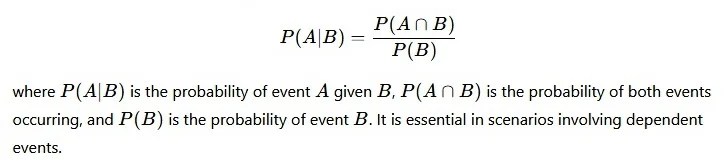
- Customer Purchase Analysis
Conditional probability is widely used to analyze customer purchasing behavior. Businesses calculate the probability that a customer will buy a product given that they have already purchased another related product. For example, a customer who buys a smartphone may also be likely to purchase accessories such as earphones or phone cases. This information helps companies design cross-selling and upselling strategies. By understanding these purchasing relationships, businesses can improve customer experience, increase sales revenue, and develop targeted promotional campaigns. As a result, conditional probability plays a significant role in consumer behavior analysis and marketing decisions.
Banks and financial institutions use conditional probability to evaluate the likelihood of loan repayment or default under specific conditions. For example, they may calculate the probability that a borrower will default given a low credit score or unstable income. This analysis helps lenders assess creditworthiness and make informed lending decisions. By understanding the relationship between borrower characteristics and repayment behavior, financial institutions can reduce lending risks and improve profitability. Conditional probability therefore serves as an essential tool in credit risk management and financial decision-making.
Insurance companies apply conditional probability to estimate risks associated with policyholders. For example, they may calculate the probability of an accident occurring given a driver’s age, driving history, or vehicle type. These probability estimates help insurers determine premium rates and policy terms. By considering specific conditions, insurance companies can accurately assess risk and avoid financial losses. Conditional probability enables insurers to create fair pricing structures and maintain financial stability. Consequently, it is a critical component of insurance underwriting and risk evaluation processes.
- Marketing Campaign Evaluation
Businesses use conditional probability to assess the effectiveness of marketing campaigns. They may calculate the probability that a customer makes a purchase after receiving an advertisement or promotional offer. This analysis helps marketers determine which campaigns generate the highest customer response rates. By understanding how promotional activities influence buying behavior, companies can optimize marketing strategies and allocate resources efficiently. Conditional probability also supports customer segmentation and personalized marketing efforts. Therefore, it contributes significantly to improving marketing performance and maximizing returns on investment.
Conditional probability plays an important role in demand forecasting by considering specific market conditions. Businesses estimate the probability of future product demand given factors such as seasonal trends, economic conditions, or consumer preferences. This approach provides more accurate demand forecasts than relying solely on historical data. Improved forecasting helps organizations manage inventory, plan production schedules, and allocate resources effectively. By incorporating relevant conditions into predictions, conditional probability reduces uncertainty and enhances operational efficiency. As a result, businesses can better meet customer demand and improve profitability.
- Quality Control and Production Management
Manufacturing companies use conditional probability to monitor product quality and production efficiency. For example, they may calculate the probability of a product defect occurring given a machine malfunction or a specific production condition. This information helps identify the causes of quality problems and implement corrective measures. By understanding the relationship between production factors and defects, organizations can improve quality standards and reduce waste. Conditional probability therefore supports continuous improvement initiatives and enhances overall manufacturing performance. It is an essential tool for maintaining product reliability and customer satisfaction.
- Supply Chain and Logistics Management
Conditional probability is valuable in supply chain management because it helps evaluate risks and uncertainties. Businesses may estimate the probability of delayed deliveries given adverse weather conditions, supplier issues, or transportation disruptions. Understanding these probabilities allows organizations to develop contingency plans and improve supply chain resilience. By anticipating potential problems, businesses can reduce operational disruptions and maintain customer service levels. Conditional probability also supports inventory planning and supplier selection. Consequently, it contributes to more efficient and reliable supply chain operations.
- Investment and Financial Decision-Making
Investors and financial managers use conditional probability to evaluate investment opportunities under specific market conditions. For example, they may calculate the probability of a stock price increase given favorable economic indicators or industry growth. This analysis helps assess investment risks and expected returns. By considering relevant conditions, investors can make more informed decisions and develop effective portfolio strategies. Conditional probability also supports financial forecasting and risk management. Therefore, it plays a crucial role in achieving investment objectives and improving financial performance.
Advantages of Conditional Probability
- Improves Accuracy of Predictions
One of the major advantages of conditional probability is that it improves the accuracy of predictions by considering additional information. Instead of relying only on general probabilities, it takes into account specific conditions that affect outcomes. For example, a business can estimate future sales based on current market trends and customer behavior. This approach produces more realistic and reliable forecasts. Accurate predictions help organizations reduce uncertainty and make better strategic decisions. As a result, conditional probability is widely used in forecasting, planning, and analytical processes where precise estimates are essential.
- Supports Better Decision-Making
Conditional probability provides decision-makers with more relevant information by incorporating existing conditions into probability calculations. Managers can evaluate various alternatives and assess the likelihood of different outcomes before making important decisions. For example, a company may determine the probability of a successful product launch given favorable market conditions. This helps in selecting the most effective strategy. By providing a clearer understanding of possible outcomes, conditional probability enables businesses to make informed choices, improve efficiency, and achieve organizational objectives more effectively.
Businesses often face risks that depend on specific circumstances. Conditional probability helps assess these risks by measuring the likelihood of an event occurring under particular conditions. For example, banks estimate the probability of loan default based on a borrower’s credit history. This analysis helps organizations identify potential threats and develop risk management strategies. By understanding conditional risks, businesses can take preventive actions and reduce potential losses. Therefore, conditional probability is an important tool for improving risk assessment and ensuring organizational stability.
- Useful in Customer Behavior Analysis
Conditional probability helps businesses understand customer behavior more effectively. It allows companies to determine the likelihood of a customer taking a specific action given a previous action. For example, a retailer can calculate the probability that a customer purchases accessories after buying a smartphone. Such insights support targeted marketing, personalized recommendations, and cross-selling strategies. Understanding customer behavior enables organizations to improve customer satisfaction and increase sales revenue. Consequently, conditional probability contributes significantly to customer relationship management and marketing effectiveness.
- Assists in Financial and Investment Planning
Financial institutions and investors use conditional probability to evaluate investment opportunities and financial risks. It helps estimate the probability of favorable returns under specific market conditions. Investors can analyze how economic indicators, interest rates, or industry trends influence investment outcomes. This information supports better portfolio management and resource allocation. By considering relevant conditions, conditional probability improves financial forecasting and investment decision-making. As a result, organizations can maximize returns while minimizing risks, making it an essential tool in financial planning and analysis.
- Improves Demand Forecasting
Demand forecasting becomes more accurate when businesses consider factors that influence customer demand. Conditional probability allows organizations to estimate future demand based on conditions such as seasonal changes, promotional campaigns, or economic trends. This helps businesses prepare for fluctuations in customer requirements and adjust production accordingly. Accurate demand forecasts reduce inventory costs, prevent stock shortages, and improve operational efficiency. By incorporating relevant information into predictions, conditional probability enhances the reliability of forecasting models and supports effective business planning.
- Supports Quality Control and Process Improvement
Manufacturing organizations use conditional probability to analyze production quality and identify factors associated with defects. For example, managers can calculate the probability of product defects given specific machine conditions or production processes. This information helps identify root causes of quality issues and implement corrective measures. Improved quality control reduces waste, lowers production costs, and increases customer satisfaction. By supporting continuous process improvement, conditional probability contributes to higher operational efficiency and better product reliability. Therefore, it plays an important role in manufacturing and production management.
- Widely Applicable Across Different Industries
A significant advantage of conditional probability is its broad applicability. It is used in business, finance, insurance, healthcare, engineering, marketing, and many other fields. Organizations apply it to solve diverse problems involving uncertainty and decision-making. Whether assessing risks, forecasting demand, evaluating investments, or analyzing customer behavior, conditional probability provides valuable insights. Its versatility makes it one of the most important tools in probability and statistics. Because it can be adapted to various situations, conditional probability remains highly relevant in modern business and research environments.
Limitations of Conditional Probability
- Requires Accurate and Reliable Data
One of the major limitations of conditional probability is its dependence on accurate and reliable data. The probability estimates are only as good as the information used in the calculations. If the data is incomplete, outdated, or incorrect, the resulting probabilities may be misleading. Businesses often face challenges in collecting high-quality data from customers, markets, or operational activities. Poor data quality can lead to inaccurate forecasts and ineffective decisions. Therefore, organizations must invest significant effort in data collection and verification to ensure meaningful and reliable conditional probability analysis.
Conditional probability calculations can become complicated, especially when multiple variables and conditions are involved. While simple examples are easy to understand, real-world business situations often require advanced statistical methods and large datasets. The complexity increases when there are numerous interrelated events or changing conditions. Managers without statistical expertise may find it difficult to perform or interpret these calculations. As a result, businesses may need specialized software or trained analysts to handle complex probability problems. This complexity can limit the practical application of conditional probability in some situations.
Many conditional probability models rely on assumptions about the relationships between events. If these assumptions are incorrect, the probability estimates may not accurately reflect reality. For example, analysts may assume that certain factors influence customer behavior in a particular way, even though market conditions may differ. Such assumptions can affect the reliability of the results. In dynamic business environments, relationships between variables may change over time, making earlier assumptions invalid. Therefore, dependence on assumptions is a significant limitation that users must consider when interpreting conditional probability outcomes.
Conditional probability results can sometimes be difficult to interpret, particularly for individuals without a background in statistics. Understanding how one event influences another requires careful analysis and logical reasoning. In complex situations, the meaning of probability values may not be immediately obvious to managers or stakeholders. Misinterpretation can lead to poor decisions and incorrect conclusions. Businesses often need experts to explain and communicate the results effectively. This limitation reduces the accessibility of conditional probability and may create challenges in applying it to everyday business decision-making.
- Time-Consuming Data Collection
Calculating conditional probability often requires large amounts of detailed information about related events and conditions. Collecting, organizing, and analyzing this data can be time-consuming and resource-intensive. Businesses may need to conduct surveys, monitor transactions, or gather historical records over long periods. This process can delay decision-making and increase operational costs. Small organizations with limited resources may find it particularly challenging to obtain the required information. Consequently, the time and effort involved in data collection can be a significant limitation of conditional probability analysis.
- Sensitive to Changes in Data
Conditional probability estimates can change significantly when the underlying data changes. Even small variations in the probability of one event may affect the final conditional probability. In rapidly changing business environments, customer preferences, market conditions, and economic factors can alter probability estimates frequently. As a result, previously calculated probabilities may become outdated or less reliable. Businesses must continuously update their data and recalculate probabilities to maintain accuracy. This sensitivity to changing information can increase the complexity and cost of using conditional probability effectively.
- Limited Predictive Power in Uncertain Situations
Although conditional probability improves prediction accuracy, it cannot guarantee future outcomes. Unexpected events such as economic crises, natural disasters, technological disruptions, or sudden changes in consumer behavior may occur without warning. These unforeseen factors can significantly affect actual results. Conditional probability is based on available information and known relationships, but it cannot account for every possible circumstance. Therefore, its predictive power is limited in highly uncertain or rapidly changing environments. Businesses should use conditional probability as a support tool rather than relying on it exclusively.
- Cannot Eliminate Uncertainty Completely
Conditional probability helps measure uncertainty, but it cannot remove it entirely. Probability values represent likelihoods rather than certainties. Even when a conditional probability is very high, there is still a chance that the expected event will not occur. Business decisions based solely on probability estimates may overlook qualitative factors such as managerial judgment, market sentiment, or unforeseen opportunities. Therefore, conditional probability should be combined with experience, expertise, and other analytical tools. This limitation reminds decision-makers that uncertainty remains a part of all business activities despite statistical analysis.
 by
by