Equilibrium of a Firm under Monopolistic Competition

Short Run Equilibrium

Equilibrium of a firm under monopolistic competition is often couched in terms of short period and long period. In the short run, Chamberlin’s model of monopolistic competition comes closer to monopoly.

That is to say, there is virtually no difference between monopolistic competition and monopoly in the short run. Thus, Chamberlin’s firm may earn supernormal profit, normal profit, or incur loss in the short run—since entry and exit are not allowed during this time period.

In Fig. 1, the short run marginal cost curve, SMC, is equal to MR at point E. Thus E is the equilibrium point. Corresponding to this equilibrium point, the firm produces OQ output and sells it at a price OP. Thus, the firm earns pure profit to the extent of PARB since total revenue (OPAQ) exceeds total cost of production (OBRQ).

A firm, in the short run, may earn only normal profit if MC = MR < AR = AC occurs. A loss may result in the short run if MC = MR < AR < AC happens

Long Run Equilibrium

In the long run, monopolistic competition comes closer to perfect competition because the freedom of entry and exit allows firms to enjoy only normal profit.

Whenever some firms earn pure profit in the long run some other firms may be attracted to join this product group, thereby shifting the demand curve or AR curve downward and to the left. Thus, entry of new firms would cause decline in market share by reducing the demand for its product.

Consequently, excess profit will be reduced to zero. Further, if the existing firm experiences losses then the exit of firms will bring about an opposite effect and the process will continue until normal profit is earned driving excess profit to zero. Seeing losses for a long time, losing firms may be induced to leave the product group thereby eliminating losses. Thus all firms in the long run earn only normal profit.

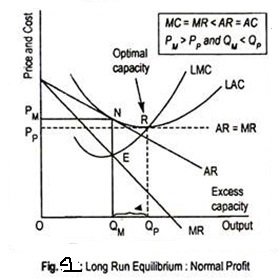
Long run equilibrium is achieved at point E where LMC equals MR (Fig. 2). The equilibrium output thus determined is OQM. At this output, AR equals AC. The firm gets normal profit by selling OQM output at the price OPM. Note that a monopolistically competitive firm always operates somewhere to the left of the minimum point of its AC curve.

In other words, as the demand curve is not perfectly elastic, or, as the demand curve is negative sloping, the AR curve becomes tangent to the left of the lowest point of the AC curve (say, point N). Each firm thus produces at a cost higher than the minimum and gets only normal profit.

Under perfect competition, long run equilibrium is achieved at that point where MC = MR = AR = AC. Because of the perfectly elastic AR curve, a tangency occurs between AR and AC at the latter’s lowest point. In Fig. 2 the dotted AR = MR curve is the demand curve faced by a competitive firm.

Equilibrium is attained at point R where LMC = MR = AR = lowest point of LAC. The competitive output thus determined is OQP which will be sold at the price OPP. So, we can conclude that monopolistically competitive output (OPM) is less than the perfectly competitive output (OQP), and monopolistically competitive price (OPM) is larger than competitive price (OPP).

Thus, the difference in output — QMQP— measures excess capacity or unused capacity faced by monopolistically competitive firms. Production at a higher cost implies wastage of resources or underutilization of resources.

Since production takes place at the lowest point of AC curve under perfect competition, there does not occur any wastage of resources. Hence a perfectly competitive market is ‘efficient’ in the sense that resources are allocated efficiently. Society gets larger output and consumers get output at a low price. Thus, as perfect competition maximizes social welfare, it is an ideal market.

But as the monopolistically competitive firm operates to the left of the minimum point of its AC curve, this market is considered as an ‘inefficient’ one. As a result, social welfare is not maximized under monopolistic competition since society gets lower output compared to perfectly competitive output and buyers buy the differentiated products at a high price.

Dominick Salvatore argues:

“Excess capacity permits more firms to exit (i.e., it leads to overcrowding) in monopolis­tically competitive markets as compared with perfect competition. Consumers, however, seem to prefer that firms selling some services operate with same unused capacity (i.e., they are willing to pay a slightly higher price…) so as to avoid waiting in long lines.”

However, Chamberlin’s notion of excess capacity does not fall with the arguments advanced here.

Role of Advertising under Monopolistic Competition

Advertising is information provided by a company about its product or operation, usually through media such as television, radio, newspapers, magazines, and the Internet, to promote or maintain sales, revenue, and/or profit.

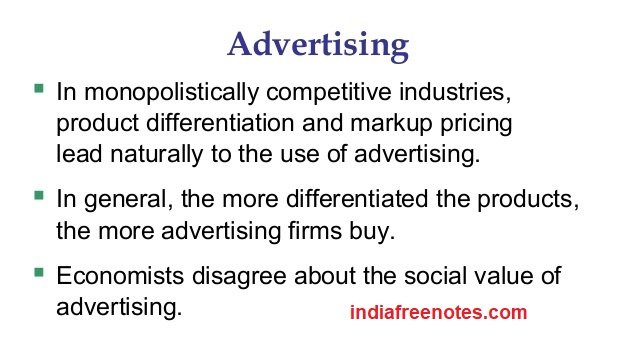
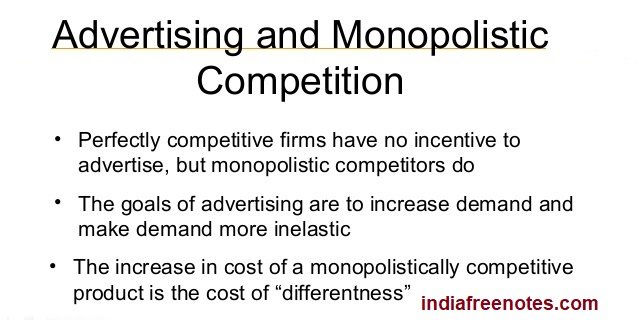
Advertising is frequently used by monopolistic competition to accomplish two related goals product differentiation and market control. To the extent that a firm can inform buyers about physical differences or create the perception of such differences, then product differentiation increases.

Moreover, with product differentiation comes market control. If advertising convinces buyers that a good is different (and better) than comparable products, then a firm can charge a higher price.

The exhibit to the right can be used to illustrate how advertising can affect the demand facing a monopolistically competitive firm. This particular situation is that facing Manny Mustard’s House of Sandwich for the production of his famous Deluxe Club Sandwich. Manny suspects that he can enhance his sales and profitability through advertising.

Perfect competition arises from the equilibrium state of supply and demand. A firm in perfect competition is selling the same undifferentiated product as other firms, and their demand is directly based on market equilibrium factors. Because of this, there is no need for marketing, because the business will exist and the demand will continue as long as the market dictates it.

For monopolistic competition, everyone is trying to gain market share, and all firms have differentiated products. Because of this, firms have to advertise their particular strengths to drive more traffic to their business. For instance, a fast food restaurant will advertise their expansive breakfast menu to capitalize on those customers who desire breakfast food quick, as opposed to another firm exclusively advertising their low prices. A firm in monopolistic competition will have to sell its benefits in order to increase demand for its product.

Oligopolistic Competition

An oligopoly is a market structure in which a few firms dominate. When a market is shared between a few firms, it is said to be highly concentrated. Although only a few firms dominate, it is possible that many small firms may also operate in the market. Considering the market for air travel,  major airlines like British Airways (BA) and Air France often operate their routes with only a few close competitors, but there are also many small airlines catering for the holidaymaker or offering specialist services.

Characteristics of Oligopoly

Now that the Oligopoly definition is clear, it’s time to look at the characteristics of Oligopoly:

  1. Few firms

Under Oligopoly, there are a few large firms although the exact number of firms is undefined. Also, there is severe competition since each firm produces a significant portion of the total output.

  1. Barriers to Entry

Under Oligopoly, a firm can earn super-normal profits in the long run as there are barriers to entry like patents, licenses, control over crucial raw materials, etc. These barriers prevent the entry of new firms into the industry.

  1. Non-Price Competition

Firms try to avoid price competition due to the fear of price wars in Oligopoly and hence depend on non-price methods like advertising, after sales services, warranties, etc. This ensures that firms can influence demand and build brand recognition.

  1. Interdependence

Under Oligopoly, since a few firms hold a significant share in the total output of the industry, each firm is affected by the price and output decisions of rival firms. Therefore, there is a lot of interdependence among firms in an oligopoly. Hence, a firm takes into account the action and reaction of its competing firms while determining its price and output levels.

  1. Nature of the Product

Under oligopoly, the products of the firms are either homogeneous or differentiated.

  1. Selling Costs

Since firms try to avoid price competition and there is a huge interdependence among firms, selling costs are highly important for competing against rival firms for a larger market share.

  1. No unique pattern of pricing behavior

Under Oligopoly, firms want to act independently and earn maximum profits on one hand and cooperate with rivals to remove uncertainty on the other hand.

Depending on their motives, situations in real-life can vary making predicting the pattern of pricing behavior among firms impossible. The firms can compete or collude with other firms which can lead to different pricing situations.

  1. Indeterminateness of the Demand Curve

Unlike other market structures, under Oligopoly, it is not possible to determine the demand curve of a firm. This is because on one hand, there is a huge interdependence among rivals. And on the other hand there is uncertainty regarding the reaction of the rivals. The rivals can react in different ways when a firm changes its price and that makes the demand curve indeterminate.

Firms behaviour under Oligopoly

Based on the objectives of the firms, the magnitude of barriers to entry and the nature of government regulation, there are different possible outcomes in relation to a firm’s behavior under Oligopoly. These are:

  • Stable prices
  • Price wars
  • Collusion for higher prices

Further, Oligopoly can either be collusive or non-collusive. Collusive oligopoly is a market situation wherein the firms cooperate with each other in determining price or output or both. A non-collusive oligopoly refers to a market situation where the firms compete with each other rather than cooperating.

Non-Collusive Oligopoly-Sweezy’s Kinked Demand Curve Model (Price-Rigidity)

Usually, in Oligopolistic markets, there are many price rigidities. In 1939, Paul Sweezy used an unconventional demand curve the kinked demand curve to explain these rigidities.

Reason for the kink in the demand curve

It is assumed that firms behave in a two-fold manner in reaction to a price change by a rival firm. In simple words, firms follow price cuts by a rival company but not price increases. So, if a seller increases the price of his product, his rivals do not follow the price increase.

Therefore, the market share of the firm reduces significantly as a result of the price rise. On the other hand, if a seller reduces the price of his product, then the rivals also reduce their price to bring it at par with the price reduction of the firm.

This ensures that they prevent their market share from falling. Once the rivals react, the firm lowering the price first cannot gain from the price cut.

Key Attributes of Oligopoly

  1. Interdependence

The foremost characteristic of oligopoly is interdependence of the various firms in the decision making.

This fact is recognized by all the firms in an oligopolistic industry. If a small number of sizeable firms constitute an industry and one of these firms starts advertising campaign on a big scale or designs a new model of the product which immediately captures the market, it will surely provoke countermoves on the part of rival firms in the industry.

Thus different firms are closely inter dependent on each other.

  1. Advertising

Under oligopoly a major policy change on the part of a firm is likely to have immediate effects on other firms in the industry. Therefore, the rival firms remain all the time vigilant about the moves of the firm which takes initiative and makes policy changes. Thus, advertising is a powerful instrument in the hands of an oligopolist. A firm under oligopoly can start an aggressive advertising campaign with the intention of capturing a large part of the market. Other firms in the industry will obviously resist its defensive advertising.

Under perfect competition advertising is unnecessary while a monopolist may find some advertising to be profitable when his product is new or when there exist a large number of potential consumers who have never tried his product earlier. But according to Prof. Baumol, “under oligopoly, advertising can become a life-and-death matter where a firm which fails to keep up with the advertising budget of its competitors may find its customers drifting off to rival products.”

  1. Group Behaviour

In oligopoly, the most relevant aspect is the behaviour of the group. There can be two firms in the group, or three or five or even fifteen, but not a few hundred. Whatever the number, it is quite small so that each firm knows that its actions will have some effect on other firms in the group. In contrast, under perfect competition there are a large number of firms each attempting to maximise its profits.

Similar is the situation under monopolistic competition. Under monopoly, there is just one profit maximising firm. Whether one considers monopoly or a competitive market, the behaviour of a firm is generally predictable.

In oligopoly, however, this is not possible due to various reasons:

  • The firms constituting the group may not have a common goal
  • The group may or may not have a formal or informal organization with accepted rules of conduct
  • The group may be dominated by a leader but other firms in the group may not follow him in a uniform manner.
  1. Competition

This leads to another feature of the oligopolistic market, the presence of competition. Since under oligopoly, there are a few sellers, a move by one seller immediately affects the rivals. So each seller is always on the alert and keeps a close watch over the moves of its rivals in order to have a counter-move. This is true competition, “True competition consists of the life of constant struggle, rival against rival, whom one can only find under oligopoly.”

  1. Barriers to Entry of Firms

As there is keen competition in an oligopolistic industry, there are no barriers to entry into or exit from it. However, in the long-run, there are some types of barriers to entry which tend to restrain new firms from entering the industry.

These may be:

  • Economics of scale enjoyed by a few large firms;
  • Control over essential and specialized inputs;
  • High capital requirements due to plant costs, advertising costs, etc.
  • Exclusive patents; and licenses; and
  • The existence of unused capacity which makes the industry unattractive.

When entry is restricted or blocked by such natural and artificial barriers the oligopolistic industry can earn long-run supernormal profits.

  1. Lack of Uniformity

Another feature of oligopoly market is the lack of uniformity in the size of firms. Firms differ considerably in size. Some may be small, others very large. Such a situation is asymmetrical. This is very common in the American economy. A symmetrical situation with firms of a uniform size is rare.

  1. Existence of Price Rigidity

In oligopoly situation, each firm has to stick to its price. If any firm tries to reduce its price, the rival firms will retaliate by a higher reduction in their prices. This will lead to a situation of price war which benefits none. On the other hand, if any firm increases its price with a view to increase its profits; the other rival firms will not follow the same. Hence, no firm would like to reduce the price or to increase the price. The price rigidity will take place.

  1. No Unique Pattern of Pricing Behaviour

The rivalry arising from interdependence among the oligopolists leads to two conflicting motives. Each wants to remain independent and to get the maxmium possible profit. Towards this end, they act and react on the price-output movements of one another which are a continuous element of uncertainty.

On the other hand, again motivated by profit maximisation each seller wishes to cooperate with his rivals to reduce or eliminate the element of uncertainty. All rivals enter into tacit or formal agreement with regard to price-output changes.

It leads to a sort of monopoly within oligopoly. They may even recognize one seller as a leader at whose initiative all the other sellers raise or lower the price. In this case, the individual seller’s demand curve is a part of the industry demand curve, having the elasticity of the latter. Given these conflicting attitudes, it is not possible to predict any unique pattern of pricing behaviour in oligopoly markets.

  1. Indeterminateness of Demand Curve

In market structures other than oligopolistic, demand curve faced by a firm is determinate. The interdependence of the oligopolists, however, makes it impossible to draw a demand curve for such sellers except for the situations where the form of interdependence is well defined. In real business operations, the demand curve remains indeterminate. Under oligopoly a firm can expect at least three different reactions of the other sellers when it lowers its prices.

Collusive and Non Collusive Oligopoly

Collusive Oligopoly Model: Price Leadership Model

Non-collusive oligopoly model (Sweezy’s model) presented in the earlier section is based on the assumption that oligopoly firms act independently even though firms are interdependent in the market. A vigorous price competition may result in uncertainty.

The question that arises now is: how do oligopoly firms remove uncertainty? In fact, firms enter into pricing agreements with each other instead of adopting competition or price war with each other. Such agreement both explicitly (or formal) and implicit (or informal)—may be called collusion.

Always, every firm has the inclination to achieve more strength and power over the rival firms. As a result, in the oligopolist industry, one finds the emergence of a few powerful competitors who cannot be eliminated easily by other powerful firms.

Under the circumstance, some of these firms act together or collude with each other to reap maximum advantage. In fact, in oligopolist industry, there is a natural tendency for collusion. The most important forms of collusion are: price leadership cartel and merger and acquisition.

When a formal collusive agreement becomes difficult to launch, oligopolists sometimes operate on informal tacit collusive agreements. One of the most common form of informal collusion is price leadership. Price leadership arises when one firm may be a large as well as dominant firm initiates price changes while other firms follow.

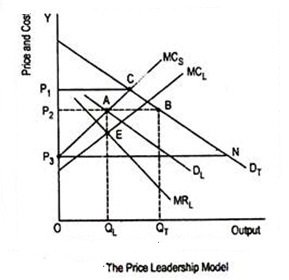
An example of dominant firm price leadership is shown in Fig.  where DT is the industry demand curve. Since small firms follow the leader the dominant firm they behave as “price-takers”. MCs is the horizontal summation of the MC curves of all small firms.

Suppose, the dominant firm sets the price at OP1 (where DT and MCs intersect each other at point C). The small firms meet the entire demand P1C at the price OP1. Thus, the dominant firm has nothing to sell in the market. At a price of OP3, the small firm will supply nothing. It is obvious that price will be set in between OP1 and OPby the leader.

The demand curve faced by the leader firm of the oligopoly industry is determined for any price it is the horizontal distance between industry demand curve, DT, and the marginal cost curves of all small firms, MCS. In Fig. , DL is the leader’s demand curve and the corresponding MR curve is MRL.

Being a leader in the industry, the dominant firm’s supply curve is represented by the MCL curve. Since it enjoys a cost advantage, its MC curve lies below the MCcurve.

A dominant firm maximizes profit at point E where its MCL and MRL intersect each other. The corresponding output of the price leader is OQL. Price thus determined is OP2. Small firms accept this price OP2 and sell QLQT (=AB) amount – industry demand the OQT output.

In actual practice, the analysis of price leadership is complicated, particularly when new firms enter the industry and try to become the leader or dominant.

Collusive Oligopoly—Merger and Acquisition

Another method to remove price war among oligopoly firms is merger. Merger may be defined as the consolidation of two or more independent firms under single ownership. When a firm purchases assets of another firm, acquisition takes place. Merger and acquisition take place because the management comes to a conclusion that a consolidated firm is powerful than the sum of individual firms.

Since basically the difference between cartel and merger is a legal one, we won’t consider mergers and acquisitions. The marginalistic principle applied in the case of profit maximizing cartel is also applicable in the case of merger.

Non-Collusive Oligopoly: Sweezy’s Kinked Demand Curve Model:

One of the important features of oligopoly market is price rigidity. And to explain the price rigidity in this market, conventional demand curve is not used. The idea of using a non-conventional demand curve to represent non-collusive oligopoly (i.e., where sellers compete with their rivals) was best explained by Paul Sweezy in 1939. Sweezy uses kinked demand curve to describe price rigidity in oligopoly market structure.

The kink in the demand curve stems from the asymmetric behavioural pattern of sellers. If a seller increases the price of his product, the rival sellers will not follow him so that the first seller loses a considerable amount of sales. In other words, every price increase will go unnoticed by rivals.

On the other hand, if one firm reduces the price of its product other firms will follow the first firm so that they must not lose customers. In other words, every price will be matched by an equivalent price cut. As a result, the benefit of price cut by the first firm will be inconsiderable. As a result of this behavioural pattern, the demand curve will be kinked at the ruling market price.

Suppose, the prevailing price of an oligopoly product in the market is QE or OP of Fig. If one seller increases the price above OP, rival sellers will keep the prices of their products at OP. As a result of high price charged by the firm, buyers will shift to products of other sellers who have kept their prices at the old level. Consequently, sales of the first seller will drop considerably.

That is why demand curve in this zone (dE) is relatively elastic. On the other hand, if a seller reduces the price of his product below QE, others will follow him so that demand for their products does not decline. Thus, demand curve in this region (i.e., ED) is relatively inelastic. This behavioural pattern thus explains why prices are inflexible in the oligopoly market even if demand and costs change.

The kink in the demand curve at point E results in a discontinuous MR curve.

The MR curve has two segments

At output less than OQ the MR curve (i.e., dA) will correspond to DE portion of AR curve, and, for output larger than OQ, the MR curve (i.e., BMR) will correspond to the demand curve ED. Thus, discontinuity in MR curve occurs between points A and B. In other words, between these two points, MR curve is vertical.

Equilibrium is achieved when MC curve passes through the discontinuous portion of the MR curve. Thus the equilibrium output is OQ, to be sold at a price OP.

Suppose, costs rise. As a result, MC curve will shift up from MC1 to MC2. The resulting price and output remain unchanged at OP and OQ, respectively. This fact explains stickiness of prices. In other words, in oligopolistic industries price is more stable than costs.

At first sight, the model seems to be attractive since it explains the behaviour of firms realistically. But the model has certain limitations. Firstly, it does not explain how the ruling price is determined. It explains that the demand curve has a kink at the ruling price.

In this sense, it is not a theory of pricing. Secondly, price rigidity conclusion is not always tenable. Empirical evidence suggests that higher costs force a further price rise above the kink. Despite these limitations, the model is popular among textbook authors.

Conclusion

Can we make some definite conclusions from the oligopolistic market structure? Though one can make unambiguous predictions about perfect competition as well as monopoly, no such predictive element of an oligopolistic competition exists. It is, thus, a perplexing market structure. One important characteristic of an oligopoly market is interdependence among sellers.

Each seller’s price-output decision is influenced by the perceptions of countermoves of rival sellers.

Given the large number of possible reactions, we come up with different models based on different assumptions about the behaviour of the rival sellers, the extent and form of exit and entry, the likelihood of collusion between firms. ‘Unfortunately, economic theory does not suggest which assumptions to use. In any event, each of these theories must ultimately stand or fall on its predictive powers’.

Price Rigidity, Cartels and Price Leadership Model

Price Rigidity

In oligopoly, price rigidity means: Once equilibrium price is determined by sellers (which are few in numbers and are interdependent in their behavior). After that! no one, wants to change for simple reasons:

  • If one is going to increase the price then others will grab the market share without doing the same.
  • If one is going to decrease the price then every one will follow the same
  • Ultimately, in both cases the profit maximization condition will not be satisfied.
  • So, in oligopoly price becomes rigid nobody want to change it.

Cartels and Price Leadership Model

In order to avoid uncertainty arising out of interdependence and to avoid price wars and cut throat competition, firms working under oligopolistic conditions often enter into agreement regard­ing a uniform price-output policy to be pursued by them.

The agreement may be either formal (open) or tacit (secret). But since formal or open agreements to form monopolies are illegal in most countries, agreements reached between oligopolists are generally tacit or secret. When the firms enter into such collusive agreements formally or secretly, collusive oligopoly prevails.

But collusions are of two main types:

(a) Cartels and

(b) Price leadership.

In a cartel type of collusive oligopoly, firms jointly fix a price and output policy through agreements. But under price leadership one firm sets the price and others follow it. The one which sets the price is a price leader and the others who follow it are its followers.

The follower firms adopt the price of the leader, even though they have to depart from their profit-maximising position, as they think that it is to their advantage not to compete with their leader and between themselves.

Originally, the term ‘cartel’ was used for the agreement in which there existed a common sales agency which alone undertook the selling operations of all the firms that were party to the agree­ment. But now-a-days all types of formal or informal and tacit agreements reached among the oligopolistic firms of an industry are known as cartels.

Since these cartels restrain competition among the member firms, their formations have been made illegal in some countries by the Govern­ments passing laws against them. For instance, the formation of a cartel is illegal in U.S.A. under the Anti-Trust Laws passed there. However, in spite of the illegality of cartels they are still formed in U.S.A. through secret devices and by adopting some means or the other shrewd businessmen are able to evade the anti-monopoly laws.

Formal collusion or agreement among the oligopolists may itself take various forms. An extreme form of collusion is found when the member firms agree to surrender completely their rights of price and output determination to a ‘Central Administrative Agency’ so to secure maximum joint profits for them.

Formation of such a formal collusion is generally designated as perfect cartel. Thus under perfect cartel type of collusive oligopoly, the price and output determination of the whole industry as well as of each member firm is determined by the common administrative authority so as to achieve maximum joint profits for the member firms.

The total profits are distributed among the member firms in a way already agreed between them. The share from total profits of each member firm is not necessarily in proportion to the output quota it has to supply and the cost it incurs on it.

The output quota to be produced by each firm is decided by the central administrative authority in such a way that the total costs of the total output produced is minimum. In fact, under perfect cartel, the central authority determines the separate outputs to be produced by the various members and the price they have to charge in the same way as a monopolist operating multiple plants would do.

Now, the question arises as to what outputs different firms in a cartel will be asked to produce so that the total cost is made minimum. Total cost will be minimised when the various firms in the cartel produce such separate outputs so that their marginal costs are equal.

This is because if the marginal costs of the member firms are not equal, then the marginal units of output could be produced at a smaller cost by the firms with a lower marginal cost than by those with a higher marginal cost.

Let us now see how the cartel works and determines its price and output. Let us assume that two firms have formed a cartel by entering into an agreement. We assume that the cartel will aim at maximizing joint profits for the member firms.

First of all, the cartel will estimate the demand curve of the industry’s product. As the demand curve facing a cartel will be the aggregate demand curve of the consumers of the product, it will be sloping downward as is shown by the curve DD in Fig. 1(c) Marginal revenue curve MR showing the addition to cartel’s revenue for successive additions to its output and sales will lie below the demand curve DD.

Cartel’s marginal cost curve (MCc) will be given by the horizontal addition of the marginal cost curves of the two firms. This has been done in Fig. 1(c) where MCc curve has been obtained by adding horizontally marginal cost curves MCa and MCb of firms A and B respectively.

It should be noted that cartel’s marginal cost curve MCc, obtained as it is by horizontal addition of marginal cost curves of the two firms, will indicate the minimum possible total cost of producing each industry output on it; each industry output being distributed among the two firms in such a way that their marginal costs are equal.

Now, the cartel will maximize its profits by fixing the industry’s output at the level at which MR and MC curves of the cartel intersect each other. It will be seen in Fig. 1 (c) that MR and MC curves cut each other at point R or output OQ. It will also be seen from the demand curve DD that the output OQ will determine price equal to QL or OP.

Having decided the total output OQ to be produced, the cartel will allot output quota to be produced by each firm so that the marginal cost of each firm is the same. This can be known by drawing a horizontal straight line from point R towards the Y-axis.

It will be seen from the figure that when firm A produces OQ1 and firm B produces OQ1 the marginal costs of the two firms are equal. The output quota of firm A will be OQ1 and of firm B will be OQ1. It is worth noting that the total output OQ will be equal to the sum of OQ1 and OQ2.

Thus, the determination of output OQ and price OP and the outputs OQand OQ2 by the two firms A and B will ensure the maximum joint profits for the member firms constituting the cartel. It will be seen from Fig. 1 (a) that with output OQ and cartel price OP. the profits made in firm A are equal to PFTK and with output OQ, and cartel price OP the profits made in firm B are equal to PEGH.

The sum of the profits, that is, the joint profits made by the cartel will be maximum under the given demand and cost conditions as they have been arrived at as a result of equating combined marginal cost (MCc) with the combined marginal revenue (MRc).

The allocation of output quota to each of them is made on the grounds of minimizing cost and not as a basis for determining profit distribu­tion. Prof. J.S. Bain rightly says, “There is no particular reason for believing that the operating firms will retain just the profits resulting from the sale of their quotas, which are determined on cost grounds alone. Relative bargaining strengths will presumably determine the division of profits.”

Market -Sharing Cartels

The formation of perfect cartels, as described above, has been quite rare in the real world even where their formation is not illegal. In a perfect cartel not only the price but also the output to be produced by each member of a cartel is decided by a central management authority and profits made in all of them are pooled together and distributed among the members according to the terms of a prior agreement.

But when cartels are loose, instead of being perfect, the distribution of profits and fixation of outputs of individual firms are not determined in a manner perfect cartel does. In a loose type of cartel the market-sharing by the firms occurs. Further, there are two methods of market sharing: non-price competition and quotas.

Market-Sharing by Non-Price Competition

Under market sharing by non-price competition, only a uniform price is set and, the member firms are free to produce and sell the amount of outputs which will maximize their individual profits. Though the firms agree not to sell at a price below the fixed price they are free to vary the style of their product and the advertising expenditure and to promote sales in other ways.

That is, the price being a fixed datum, the firms compete on non-price basis. If the different member firms have identical costs, then the agreed uniform price will be the monopoly price which will ensure maximization of joint profits. But when there are cost differences between the firms as is generally the case, the cartel price will be fixed by bargaining between the firms. The level of this price will be such as will ensure some profits to high-cost firms.

But with cost differences such loose cartels are quite unstable. This is because the low cost firms will have an incentive to cut price to increase their profits and therefore they will tend to break away from the cartel. However, they may not openly charge lower price than the fixed one and instead cheat the other firms by giving secret price concessions to the buyers. However, as the rivals gradually loose their customers, the cheating by the low-cost firms will be ultimately discovered and consequently open price war may commence and cartel breaks down.

Market-Sharing by Output Quota

The second type of market-sharing cartel is the agreement reached between the oligopolistic firms regarding quota of output to be produced and sold by each of them at the agreed price. If all firms are producing homogeneous product and have same costs, the monopoly solution (that is, the maximization of joint profits) will emerge with the market being equally shared by them.

However, when costs of member-firms are different, the different quotas for various firms will be fixed and therefore their market shares will differ. The quotas and market shares in case of cost differences are decided through bargaining between the firms. During the bargaining process, two criteria are usually adopted to fix the quotas of the firms.

One is the past level of sales of the various firms and the second is the productive capacity of the firms. However, the past-period sales’ and ‘productive capacity’ of various firms are not very firm criteria as they can be easily manipulated. Ultimately the quotas fixed for various firms depend upon their bargaining power and skill.

The second common basis for the quota system and market sharing is the division of market region-wise, that is, the geographical division of the market between the cartel firms. In this arrange­ment, price and also style of the product of cartel firms may vary.

It is worth noting that all types of cartels are unstable when there exists cost differences between firms. The low cost firms always have a tendency to-reduce price of the product to maximise their profits which ultimately results in the collapse of the collusive agreement.

Further, if the entry of firms in the oligopolistic industry is free, the instability of the cartel is intensified. The new entrants may not join the cartel and may fix a lower price of the product to sell a large quantity. This may start a price war between the cartel firms and the new entrants. We thus see that the stability of the cartel arrangement is always in danger.

Cost Oriented Pricing Method

An organization has various options for selecting a pricing method. Prices are based on three dimensions that are cost, demand, and competition.

The organization can use any of the dimensions or combination of dimensions to set the price of a product.

  1. Cost-based Pricing

Cost-based pricing refers to a pricing method in which some percentage of desired profit margins is added to the cost of the product to obtain the final price. In other words, cost-based pricing can be defined as a pricing method in which a certain percentage of the total cost of production is added to the cost of the product to determine its selling price. Cost-based pricing can be of two types, namely, cost-plus pricing and markup pricing.

These two types of cost-based pricing are as follows:

(a) Cost-plus Pricing

Refers to the simplest method of determining the price of a product. In cost-plus pricing method, a fixed percentage, also called mark-up percentage, of the total cost (as a profit) is added to the total cost to set the price. For example, XYZ organization bears the total cost of Rs. 100 per unit for producing a product. It adds Rs. 50 per unit to the price of product as’ profit. In such a case, the final price of a product of the organization would be Rs. 150.

Cost-plus pricing is also known as average cost pricing. This is the most commonly used method in manufacturing organizations.

In economics, the general formula given for setting price in case of cost-plus pricing is as follows:

P = AVC + AVC (M)

AVC= Average Variable Cost

M = Mark-up percentage

AVC (m) = Gross profit margin

Mark-up percentage (M) is fixed in which AFC and net profit margin (NPM) are covered.

AVC (m) = AFC+ NPM

For determining average variable cost, the first step is to fix prices. This is done by estimating the volume of the output for a given period of time. The planned output or normal level of production is taken into account to estimate the output.

The second step is to calculate Total Variable Cost (TVC) of the output. TVC includes direct costs, such as cost incurred in labor, electricity, and transportation. Once TVC is calculated, AVC is obtained by dividing TVC by output, Q. [AVC= TVC/Q]. The price is then fixed by adding the mark-up of some percentage of AVC to the profit [P = AVC + AVC (m)].

Advantages of cost-plus pricing method are as follows

  • Requires minimum information
  • Involves simplicity of calculation
  • Insures sellers against the unexpected changes in costs

Disadvantages of cost-plus pricing method are as follows:

  • Ignores price strategies of competitors
  • Ignores the role of customers

(b) Markup Pricing

Refers to a pricing method in which the fixed amount or the percentage of cost of the product is added to product’s price to get the selling price of the product. Markup pricing is more common in retailing in which a retailer sells the product to earn profit. For example, if a retailer has taken a product from the wholesaler for Rs. 100, then he/she might add up a markup of Rs. 20 to gain profit.

It is mostly expressed by the following formulae:

  • Markup as the percentage of cost= (Markup/Cost) *100
  • Markup as the percentage of selling price= (Markup/ Selling Price)*100

For example, the product is sold for Rs. 500 whose cost was Rs. 400. The mark up as a percentage to cost is equal to (100/400)*100 =25. The mark up as a percentage of the selling price equals (100/500)*100= 20.

  1. Demand-based Pricing

Demand-based pricing refers to a pricing method in which the price of a product is finalized according to its demand. If the demand of a product is more, an organization prefers to set high prices for products to gain profit; whereas, if the demand of a product is less, the low prices are charged to attract the customers.

The success of demand-based pricing depends on the ability of marketers to analyze the demand. This type of pricing can be seen in the hospitality and travel industries. For instance, airlines during the period of low demand charge less rates as compared to the period of high demand. Demand-based pricing helps the organization to earn more profit if the customers accept the product at the price more than its cost.

  1. Competition-based Pricing

Competition-based pricing refers to a method in which an organization considers the prices of competitors’ products to set the prices of its own products. The organization may charge higher, lower, or equal prices as compared to the prices of its competitors.

The aviation industry is the best example of competition-based pricing where airlines charge the same or fewer prices for same routes as charged by their competitors. In addition, the introductory prices charged by publishing organizations for textbooks are determined according to the competitors’ prices.

  1. Other Pricing Methods

In addition to the pricing methods, there are other methods that are discussed as follows:

(a) Value Pricing

Implies a method in which an organization tries to win loyal customers by charging low prices for their high- quality products. The organization aims to become a low cost producer without sacrificing the quality. It can deliver high- quality products at low prices by improving its research and development process. Value pricing is also called value-optimized pricing.

(b) Target Return Pricing

Helps in achieving the required rate of return on investment done for a product. In other words, the price of a product is fixed on the basis of expected profit.

(c) Going Rate Pricing

Implies a method in which an organization sets the price of a product according to the prevailing price trends in the market. Thus, the pricing strategy adopted by the organization can be same or similar to other organizations. However, in this type of pricing, the prices set by the market leaders are followed by all the organizations in the industry.

(d) Transfer Pricing

Involves selling of goods and services within the departments of the organization. It is done to manage the profit and loss ratios of different departments within the organization. One department of an organization can sell its products to other departments at low prices. Sometimes, transfer pricing is used to show higher profits in the organization by showing fake sales of products within departments.

Marginal Cost Pricing

Marginal cost pricing is the practice of setting the price of a product at or slightly above the variable cost to produce it. This approach typically relates to short-term price setting situations. This situation usually arises in either of the following circumstances:

  • A company has a small amount of remaining unused production capacity available that it wishes to use.
  • A company is unable to sell at a higher price.

The first scenario is one in which a company is more likely to be financially healthy – it simply wishes to maximize its profitability with a few more unit sales. The second scenario is one of desperation, where a company can achieve sales by no other means. In either case, the sales are intended to be on an incremental basis; they are not intended to be a long-term pricing strategy, since prices set this low cannot be expected to offset the fixed costs of a business.

The variable cost of a product is usually only the direct materials required to build it. Direct labor is rarely completely variable, since a minimum number of people are required to crew a production line, irrespective of the number of units produced.

The Marginal Cost Calculation

ABC International has designed a product that contains $5.00 of variable expenses and $3.50 of allocated overhead expenses. ABC has sold all possible units at its normal price point of $10.00, and still has residual production capacity available. A customer offers to buy 6,000 units at the company’s best price. To obtain the sale, the sales manager sets the price of $6.00, which will generate an incremental profit of $1.00 on each unit sold, or $6,000 in total. The sales manager ignores the allocated overhead of $3.50 per unit, since it is not a variable cost.

Advantages of Marginal Cost Pricing

The following are advantages to using the marginal cost pricing method:

(i) Adds profits

There will be customers who are extremely sensitive to prices. This group might not otherwise buy from a company unless it were willing to engage in marginal cost pricing. If so, a company can earn some incremental profits from these customers.

(ii) Market entrance

If a company is willing to forego profits in the short term, it can use marginal cost pricing to gain entry into a market. However, it is more likely to acquire the more price-sensitive customers by doing so, who are more inclined to leave it if price points increase.

(iii) Accessory sales

If customers are willing to buy product accessories or services at a robust margin, it may make sense to use marginal cost pricing to sell a product on an ongoing basis, and then earn profits from these later sales.

Disadvantages of Marginal Cost Pricing

The following are disadvantages of using the marginal cost pricing method:

(i) Long-term pricing

The method is completely unacceptable for long-term price setting, since it will result in prices that do not capture a company’s fixed costs.

(ii) Ignores market prices

Marginal cost pricing sets prices at their absolute minimum. Any company routinely using this methodology to determine its prices may be giving away an enormous amount of margin that it could have earned if it had instead set prices at or near the market rate.

(iii) Customer loss

If a company routinely engages in marginal cost pricing and then attempts to raise its prices, it may find that it was selling to customers who are extremely sensitive to price changes, and who will abandon it at once.

(iv) Cost focus

A company that routinely engages in this pricing strategy will find that it must continually hold down costs in order to generate a profit, which does not work well if the company wants to transition into a high-service, higher-quality market niche.

Evaluation of Marginal Cost Pricing

This method is useful only in a specific situation where a company can earn additional profits from using up excess production capacity. It is not a method to be used for normal pricing activities, since it sets a minimum price from which a company will earn only minimal (if any) profits. It is generally better to set prices based on market prices.

Discriminatory Pricing

Price discrimination is a selling strategy that charges customers different prices for the same product or service based on what the seller thinks they can get the customer to agree to. In pure price discrimination, the seller charges each customer the maximum price he or she will pay. In more common forms of price discrimination, the seller places customers in groups based on certain attributes and charges each group a different price.

Price discrimination is practiced based on the seller’s belief that customers in certain groups can be asked to pay more or less based on certain demographics or on how they value the product or service in question.

Price discrimination is most valuable when the profit that is earned as a result of separating the markets is greater than the profit that is earned as a result of keeping the markets combined. Whether price discrimination works and for how long the various groups are willing to pay different prices for the same product depends on the relative elasticities of demand in the sub-markets. Consumers in a relatively inelastic submarket pay a higher price, while those in a relatively elastic sub-market pay a lower price.

With price discrimination, the company looking to make the sales identifies different market segments, such as domestic and industrial users, with different price elasticities. Markets must be kept separate by time, physical distance, and nature of use.

For example, Microsoft Office Schools edition is available for a lower price to educational institutions than to other users. The markets cannot overlap so that consumers who purchase at a lower price in the elastic sub-market could resell at a higher price in the inelastic sub-market. The company must also have monopoly power to make price discrimination more effective.

Types of Price Discrimination

There are three types of price discrimination: first-degree or perfect price discrimination, second-degree, and third-degree. These degrees of price discrimination are also known as personalized pricing (1st-degree pricing), product versioning or menu pricing (2nd-degree pricing), and group pricing (3rd-degree pricing).

  1. First-degree Price Discrimination

First-degree discrimination, or perfect price discrimination, occurs when a business charges the maximum possible price for each unit consumed. Because prices vary among units, the firm captures all available consumer surplus for itself, or the economic surplus. Many industries involving client services practice first-degree price discrimination, where a company charges a different price for every good or service sold.

  1. Second-degree Price Discrimination

Second-degree price discrimination occurs when a company charges a different price for different quantities consumed, such as quantity discounts on bulk purchases.

  1. Third-degree Price Discrimination

Third-degree price discrimination occurs when a company charges a different price to different consumer groups. For example, a theater may divide moviegoers into seniors, adults, and children, each paying a different price when seeing the same movie. This discrimination is the most common.

Examples of Price Discrimination

Many industries, such as the airline industry, the arts and entertainment industry, and the pharmaceutical industry, use price discrimination strategies. Examples of price discrimination include issuing coupons, applying specific discounts (e.g., age discounts), and creating loyalty programs. One example of price discrimination can be seen in the airline industry. Consumers buying airline tickets several months in advance typically pay less than consumers purchasing at the last minute. When demand for a particular flight is high, airlines raise ticket prices in response.

By contrast, when tickets for a flight are not selling well, the airline reduces the cost of available tickets to try to generate sales. Because many passengers prefer flying home late on Sunday, those flights tend to be more expensive than flights leaving early Sunday morning. Airline passengers typically pay more for additional legroom too.

  • With price discrimination, a seller charges customers a different fee for the same product or service.
  • With first-degree discrimination, the company charges the maximum possible price for each unit consumed.
  • Second-degree discrimination involves discounts for products or services bought in bulk, while third-degree discrimination reflects different prices for different consumer groups.

Accounting in Computerized Environment: Introduction, features, Applications in various areas of Accounting

Computerised accounting system is a software that helps businesses to manage the big financial transactions, data, reports, and statements with high efficiency, speed, and better accuracy. Better quality work, lower operating costs, better efficiency, greater accuracy, minimum errors are some of the advantages of Computerized Accounting. Let us learn more about Computerized accounting environment.

Need for Computerised Accounting

Its need arises from the benefits of speed, accuracy and lower cost of handling the business transactions. Also, it has the capability to record a large number of transactions with speed and accuracy. It allows quick and quality reporting because of its speed and accuracy.

Manual accounting system requires large storage to keep accounting records, and vouchers. The requirement of books and stationery and books of accounts along with vouchers and documents is dependent on the volume of transactions.

There is a need to reduce the paperwork and dispense with a large volume of books of account. This can be achieved working with the help of computerized accounting system.

Features of Computerised Accounting Environment

This Accounting System and its awareness among entities have become a necessity in the present environment. Businesses of whatever field and size are shifting from the practice of maintaining accounts manually. The manual process is more time-consuming and exposed to human error.

Storage and retrieval of data and generation of a report cannot be ensured in real time in the traditional system. There is a need to shift to computerized accounting systems.  They have empowered business to project accurate information of financial performance.

  1. Simple and Integrated: It helps all businesses by automating and integrating all the business activities. Such activities may be sales, finance, purchase, inventory, and manufacturing etc. It also facilitates the arrangement of accurate and up-to-date business information in a readily usable form.
  2. Accuracy & Speed: Computerised accounting has customized templates for users which allows fast and accurate data entry. Thus, after recording the transactions it generates the information and reports automatically.
  3. Scalability: It has the flexibility to record the transactions with the changing volume of business.
  4. Instant Reporting: It can generate a quality report in real time because of high speed and accuracy.
  5. Security: Secured data and information can be kept confidential as compared to the traditional accounting system.
  6. Quick Decision Making: This system Generates real-time, comprehensive MIS reports and ensures access to complete and critical information, instantly.
  7. Reliability: It generates the report with consistency and accuracy. Minimization of errors makes the system more reliable.

Advantages of Computerised Accounting

  1. Better Quality Work: The accounts prepared with the use of computerized accounting system are usually uniform, neat, accurate, and more legible than a manual job.
  2. Lower Operating Costs: Computer is a reliable and time-saving device. The volume of job handled with the help of computerized system results in economy and lower operating costs. The overall operating cost of this system is low in comparison to the traditional system.
  3. Improves Efficiency:This system is more efficient in comparison to the traditional system. The computer makes sure speed and accuracy in preparing the records and accounts and thus, increases the efficiency of employees.
  4. Facilitates Better Control: From the management point of view, there is greater control possible and more information may be available with the use of the computer in accounting. It ensures efficient performance in accounting records.
  5. Greater Accuracy: Computerized accounting make sure accuracy in accounting records and statements. It prevents clerical errors and omissions in records.
  6. Relieve Monotony: Computerized accounting reduces the monotony of doing repetitive accounting jobs. Which are tiresome and time-consuming.
  7. Facilitates Standardization: Computerised accounting provides standardization of accounting routines and procedures. Therefore, it ensures standardization in the accounting records.
  8. Minimizes Mathematical Errors: While doing mathematical work with computers, errors are virtually eliminated unless the data is entered improperly in the system.

Need for Computerized Accounting:

The need for computerized accounting arises from advantages of speed, accuracy and lower cost of handling the business transactions.

Numerous Transactions:

The computerized accounting system is capable of large number of transactions with speed and accuracy.

Instant Reporting:

It is capable of offering quick and quality reporting because of its speed and accuracy.

Reduction in Paper Work:

Manual accounting system requires large storage space to keep accounting records/books, and vouchers/documents. The requirement of books and stationery and books of accounts along with vouchers and documents is directly dependent on the volume of transactions beyond certain point.

There is a dire need to reduce the paper work and dispense with large volume of books of account. This can be achieved with the help of computerized accounting system.

Flexible Reporting:

The reporting is flexible in computerized accounting system. It is capable of generating reports of any balance as when required and for any duration which is within the accounting period.

Accounting Queries:

There are accounting queries, which are based on some external parameters. For example, a query relating to overdue customers’ accounts can be easily answered by using the structured query language [SQL] support of database technology in the computerized accounting system. Such an exercise would be quite difficult and expensive in manual accounting system.

Online Facility:

Computerized accounting system offers online facility to store and process transaction data so as to retrieve information to generate and view financial reports.

Accuracy:

The information and reports generated are accurate and quite reliable for decision-making. In manual accounting system, as many people do the job and the volume of transactions is quite large, such information and reports are likely to be distorted and unreliable and inaccurate.

Security:

This system is highly secured and the data and information can be kept confidential, when compared to manual accounting system.

Scalability:

The system can cope easily with the increase in the volume of business. It requires only additional data operators for storing additional vouchers.

Special Features of Computerized Accounting System:

  1. It leads to quick preparation of accounts and makes available the accounting statements and records on time.
  2. It ensures control over accounting work and records.
  3. Errors and mistakes would be at minimum in computerized accounting.
  4. Maintenance of uniform accounting statements and records is possible.
  5. Easy access and reference of accounting information is possible.
  6. Flexibility in maintaining accounts is possible.
  7. It involves less clerical work and is very neat and more accurate.
  8. It adapts to the current and future needs of the business.
  9. It generates real-time comprehensive MIS reports and ensures access to complete and critical information instantly.

Requirements of the Computerized Accounting System:

Accounting Framework:

A good accounting framework in terms of accounting principles, coding and grouping structure is a pre-condition. It is the application environment of the computer­ized accounting system.

Operating Procedure:

A well-conceived and designed operating procedure blended with suitable operating environment is necessary to work with the computerized accounting system. The computer accounting is one of the database-oriented applications, wherein the transaction data is stored in well-organized database.

The user operates on such database using the required interface. And he takes the required reports by suitable transformations of stored data into information. Hence, it includes all the basic requirements of any database-oriented application in computers.

Advantages of Computerized Accounting:

1. Better Quality Work:

The accounts prepared with the use of computers are usually uniform, neat, accurate, and more legible than manual job.

2. Lower Operating Costs:

Computer is a labor and time saving devise. Hence, the volume of job handled with the help of computers results in economy and lower operating costs.

3. Improved Efficiency:

Computer brings speed and accuracy in preparing the records and accounts and thus, increases the efficiency of employees.

4. Facilitates Better Control:

From the management point of view, greater control is possible and more information may be available with the use of computer in accounting. It ensures efficient performance in accounting work.

5. Greater Accuracy:

Computerized accounting ensures accuracy in accounting records and statements. It prevents clerical errors and omissions.

6. Relieve Monotony:

Computerized accounting reduces the monotony of doing repetitive accounting jobs, which are tiresome and time consuming.

7. Facilitates Standardization:

Computerized accounting facilitates standardization of accounting routines and procedures. Therefore, standardization in accounting is ensured.

8. Minimizing Mathematical Errors:

While doing mathematics with computers, errors are virtually eliminated unless the data is entered improperly in the first instance.

Disadvantages of Computerized Accounting:

1. Reduction of Manpower:

The introduction of computers in accounting work reduces the number of employees in an organization. Thus, it leads to greater amount of unemployment.

2. High Cost:

A small firm cannot install a computer accounting system because of its high installation and maintenance cost. To be more economical there should be large volume of work. If the system is not used to its full capacity, then it would be highly uneconomical.

3. Require Special Skills:

Computer system calls for highly specialized operators. The availability of such skilled personnel is very scarce and very costly.

4. Other Problems:

Frequent repair and power failure may affect the accounting work very much. Computers are prone to viruses. Often time’s people will assume the computer is doing things correctly and problems will go unchecked for long period of time.

Problems Faced In Computerized Accounting System:

1. User Training:

The user, for using computer accounting software, needs to understand the concepts of the software. Hence, he should undergo proper training. A computer operator must learn the basics of computer, concepts of software, working with the operating system software [such as Windows/DOS] and the accounting software.

2. System Dependency:

Using a computer solution makes the user to depend fully on the com­puter system and necessitates the availability of computer at all times. If the system is not available [due to hardware failure or power cut], it would be difficult to verify the accounts.

3. Hardware Requirements:

A full-fledged computer system with a printer is required to operate the computerized accounting system. Most small organizations may not afford to have such facility with necessary software.

4. System Failure:

When there is a system crash [hard disk crash], there is high risk of losing the data available on the hard disk drive at any point of time. It would be highly painful, if the problem occurs at end of the financial year, when the financial statements should be ready.

5. Backups and Prints:

Backups of the data should be done regularly so that, when the data is lost, it can be restored from floppies [backups]. Regular print outs of the system information would be useful as manual records.

6. Voucher Management:

Accounting software allows easy alteration of data. If a voucher is wrongly placed in a wrong head, it would be very difficult to sort out and bring back the voucher. A good voucher management is very essential.

7. Security:

Additional security has to be provided because improper handling of the system [hardware/software] could be dangerous. Passwords, locks, etc., have to be set so that no unauthor­ized person can handle the system.

error: Content is protected !!