Cross cultural issues in ethics

There are tons, but most can be resolved straight forwardly by encouraging people to share information with each other about their cultures. We used to do monthly pot luck lunches where people would each bring a native dish and take turns explaining them. In the process, you’d get a lot of non-food insight into their lifestyles. Toronto, where I worked for many years is the most mixed city and workforce in the world. In one business they hung everyone’s flags in the cafeteria – about 80. In my admin assistant’s church, some 40 languages were spoken. This mixing makes it much easier to overcome culture differences on the job, because everyone gets used to them pretty well everywhere.

The problematic issues were sometimes quite odd. A group of women from the same culture ran a lottery inside a few departments and anyone who didn’t buy a ticket was shunned and punished in various other ways a blackmail scheme really, since those who ran it kept about half the proceeds. Apparently this was common in their culture ‘back home.’

Occasionally we’d find a theft ring taking our products, usually to sell at flee markets and they’d reasonably often be based around family or culture members working in different locations, supported by others of the same from outside – gangs really.

Sometimes we’d find bosses or even work groups where promotions were given almost always to people of one culture. Of course, this is rampant all around the world with respect to the biggest culture divide of all – men versus women – where women are most often offered fewer promotions and paid less nearly everywhere and men are given the advantages. People can see and disagree with some ‘culture differences’ and can’t see or try to correct others.

Studies all prove that the best, most creative teams are mixed ones, but they take a bit more skill to manage, so you certainly find many, many bosses who assemble teams who are like themselves. In hiring it is a given that if there are two candidates the boss, if left to themselves, will almost always find a rationale for taking the one most like themselves. For that reason some companies now use hiring teams, sometimes even excluding the boss. Not sure if that fixes the problem.

Communication is one of the biggest issues in cross-cultural teams. While some people are more direct in their communication ( they say what they mean), people from some other cultures can be very indirect in their communication, especially in the presence of seniors. You need to watch out not only for what is said, but also the way it is said – the tone is as important as the words.

Time Management is another challenge in cross-cultural teams. Countries like Germany, Switzerland etc. are very time conscious and punctual, whereas Spain, Italy, India etc. are more relaxed in their attitude towards time. Long lunches, unplanned/sudden long coffee breaks are fairly common in these countries, where unplanned breaks might be frowned upon in Germany. Meetings, deadlines etc. need to be clearly communicated, and late coming needs to be appropriately dealt with early in the process.

Individual vs group cultures also clash in multi-cultural teams. While some people are comfortable saying”I will own this / I will do it” , many group cultures find the use of “I” uncomfortable, and use the plural form “we” a lot more even while addressing one-on-one messages. For example, “ we shall complete the process” is fairly common in mails from India to their British colleagues, who are left wondering who the “we” refers to, when the mail is addressed only to one individual. This can lead to problems in fixing accountability, and needs to be addressed in team meetings.

Hierarchy is a huge challenge in multi-cultural teams. In some places your value is derived from who you are, like your status, your family background, your seniority, your education etc. like India and in some others, like USA, the structure is more flat and you are valued for what you have accomplished. When such cultures interact, issues can open over openly challenging your manager, expressing opinions freely in meetings, saying ‘no’ to seniors/ clients, decision making and involvement of team members in the process etc. This can be addressed by openly discussing hierarchy in teams, and encouraging a flat operating model.

Cadbury Committee

The Cadbury Report, titled Financial Aspects of Corporate Governance, is a report issued by “The Committee on the Financial Aspects of Corporate Governance” chaired by Adrian Cadbury that sets out recommendations on the arrangement of company boards and accounting systems to mitigate corporate governance risks and failures. The report was published in draft version in May 1992. Its revised and final version was issued in December of the same year. The report’s recommendations have been used to varying degrees to establish other codes such as those of the OECD, the European Union, the United States, the World Bank etc.

Background

Sridhar Arcot and Valentina Bruno in their article called “In Letter but not in Spirit: An Analysis of Corporate Governance in the UK” explain the background to the Cadbury Committee. Although wrong on the historical facts, as Robert Maxwell died on 5 November 1991 and “The Committee on the Financial Aspects of Corporate Governance” known as “The Cadbury Committee” was set up in May 1991 for other reasons than the Maxwell case, it gives an interesting reading of the situation at the time:

Robert Maxwell’s death while cruising on the Canary Islands in 1990 shone a spotlight on his company’s affairs. A series of risky acquisitions in the mid-eighties had led Maxwell Communications into high debts, which was being financed by diverting resources from the pension funds of his companies. After his disappearance, it emerged that the Mirror Group’s debts (one of Maxwell’s companies) vastly outweighed its assets, while £440 millions (GBP) were missing from the company’s pension funds. Despite the suspicion of manipulation of the pension schemes, there was a widespread feeling in the City of London that no action was taken by UK or US regulators against the Maxwell Communications Corp. Eventually, in 1992 Maxwell’s companies filed for bankruptcy protection in the UK and US. At around the same time the Bank of Credit and Commerce International (BCCI) went bust and lost billions of dollars for its depositors, shareholders and employees. Another company, Polly Peck, reported healthy profits one year while declaring bankruptcy the next. Following the raft of governance failures, Sir Adrian Cadbury chaired a committee whose aims were to investigate the British corporate governance system and to suggest improvements to restore investor confidence in the system. The Committee was set up in May 1991 by the Financial Reporting Council, the London Stock Exchange, and the accountancy profession. The report embodied recommendations based on practical experiences and with an eye on the US experience, further elaborated after a process of consultation and widely accepted. The final report was released in December 1992 and then applied to listed companies reporting their accounts after 30th June 1993.

Summary of recommendations

The boards of all listed companies should comply with the code of best practice set out by the committee.

As many companies as possible should aim at meeting its requirements.

The listed companies reporting in respect of years ending on or after 31 December, 1992, should make a statement about their compliance with the code in the report and accounts and give reasons for any areas of non-compliance.

Companies should publish their statement of compliance only after they have been the subject of review by the auditors.

The Auditing Practices Board should consider the extent and form that an endorsement by the auditors could take.

Limitations of Corporate Governance

Corporations are separate legal entities, wholly distinct from their shareholders. Shareholders elect the board of directors which, in turn, manages the business. Usually the board employs officers and managers to run the daily operations of the corporation. However, in small corporations, all of these shareholders, board, officers and managers may be one and the same. The related governance requirements have several disadvantages.

Corporations Governed by Statutes

Corporations are governed by federal and state statutes. One major reason business owners form corporations is to limit the owners’ liability to the amount of their investments. Another reason founders form corporations is because corporations are permitted to raise capital by selling stock to investors and have a long legal and case history to support this. With this corporate structure comes certain requirements.

Fiduciary Duty of Board

Officers and the board of directors have fiduciary duties to act in the best interest of the corporation. If they breach those duties by not exercising honest and prudent care, they can be held liable. This is why companies where shareholders elect non-shareholder directors often provide directors and officers, or D&O, insurance. D&O insurance does not protect against outright fraud, but it does protect against fallout from bad business decisions.

Increased Costs

Corporations have higher administrative costs because of greater administrative requirements than those required of LLCs and limited partnerships. Corporate boards must either meet or create resolutions to enter into financial arrangements or contractual arrangements. Corporations must maintain corporate documentation, including stock purchases and sales, legal compliance and annual registration.

Maintenance of Separation

Corporations, shareholders and board directors and officers must follow all the corporate formalities, including keeping annual meeting minutes for both shareholders’ meeting and board of directors’ meetings, documenting major decisions as board-approved. Even corporations owned and governed by one shareholder in multiple director roles must adhere to all formalities. Shareholder-owners must sign all documents as their position, for example, “John Smith, President, ABC Company.” Failure to adhere to these rules could result in a creditor getting a judge to pierce the corporate veil. When a court or judge “pierces the corporate veil,” the court sets aside the corporate protection and allows the creditors to go after the personal assets of the shareholders.

Principal Agent Conflict

Conflicts arise when a corporation’s shareholders do not actively participate in the business and instead hire professional management to run the business. The manager represents the shareholders but often has different goals and perspectives. The manager acts in his best interest as an employee but not in the best interest of the shareholders. For example, a manager may make decisions that help him keep his job and a nice salary but that reduce the amount of profits that go to the shareholders. Shareholders must structure employment agreements to reduce or eliminate this conflict.

Capital Budgeting Techniques

Capital budgeting is set of techniques used to decide which investments to make in projects. There are a number of capital budgeting techniques available, which include the following:

Discounted cash flows. Estimate the amount of all cash inflows and outflows associated with a project through its estimated useful life, and then apply a discount rate to these cash flows to determine their present value. If the present value is positive, accept the funding proposal.

Internal rate of return. Determine the discount rate at which the cash flows from a project net to zero. The project with the highest internal rate of return is selected.

Constraint analysis. Examine the impact of a proposed project on the bottleneck operation of the business. If the proposal either increases the capacity of the bottleneck or routes work around the bottleneck, thereby increasing throughput, then accept the funding proposal.

Breakeven analysis. Determine the required sales level at which a proposal will result in positive cash flow. If the sales level is low enough to be reasonably attainable, then accept the funding proposal.

Discounted payback. Determine the amount of time it will take for the discounted cash flows from a proposal to earn back the initial investment. If the period is sufficiently short, then accept the proposal.

Accounting rate of return. This is the ratio of an investment’s average annual profits to the amount invested in it. If the outcome exceeds a threshold value, then an investment is approved.

 Real options. Focus on the range of profits and losses that may be encountered over the course of the investment period. The analysis begins with a review of the risks to which a project will be subjected, and then models for each of these risks or combinations of risks. The result may be greater care in placing large bets on a single likelihood of probability.

When analyzing a possible investment, it is useful to also analyze the system into which the investment will be inserted. If the system is unusually complex, it is likely to take longer for the new asset to function as expected within the system. The reason for the delay is that there may be unintended consequences that ripple through the system, requiring adjustments in multiple areas that must be addressed before any gains from the initial investment can be achieved.

Optimum Capital Structure, Meaning, Features, Constraints

Optimum Capital Structure is the ideal mix of debt and equity that minimizes a company’s cost of capital while maximizing its market value. It balances financial risk and return, ensuring stability and profitability. A well-structured mix reduces financing costs, improves earnings per share (EPS), and enhances shareholder wealth. Too much debt increases financial risk, while excessive equity may dilute ownership. Factors like profitability, business risk, tax benefits, and industry norms influence the capital structure. Achieving an optimal balance allows a firm to operate efficiently, maintain liquidity, and sustain long-term growth.

Features of an Optimum Capital Structure

  • Minimization of Cost of Capital

An optimum capital structure ensures the lowest possible weighted average cost of capital (WACC) by balancing debt and equity financing. Debt financing offers tax benefits through interest deductions, reducing the cost of capital. However, excessive debt increases financial risk, while too much equity dilutes ownership. A well-structured capital mix helps the firm achieve financial efficiency, maximize profitability, and enhance shareholder returns. The right balance lowers borrowing costs, increases investment appeal, and maintains financial flexibility for future business expansions.

  • Financial Stability and Flexibility

A good capital structure ensures financial stability, allowing the company to manage economic fluctuations and market uncertainties. It should provide flexibility for raising funds without significantly increasing financial risk. Businesses must maintain a balance between long-term and short-term funding sources, ensuring they can respond to growth opportunities or economic downturns. Flexibility allows the company to adjust leverage levels, issue new shares, or retain earnings as needed. This adaptability ensures the company maintains solvency and supports sustainable growth.

  • Maximization of Shareholder Value

An optimal capital structure aims to increase shareholder wealth by maximizing returns while minimizing financial risk. Properly balancing debt and equity enhances earnings per share (EPS) and improves stock performance. When a company maintains an ideal mix, it boosts investor confidence, leading to higher stock prices and market valuation. Efficient capital structuring reduces financial distress, ensuring steady dividends and returns for investors. This approach attracts potential investors, increases market credibility, and supports long-term profitability and business growth.

  • Proper Utilization of Resources

An optimum capital structure ensures that the company effectively utilizes its financial resources. Efficient allocation of capital avoids excessive reliance on debt, which can lead to financial distress, or too much equity, which can dilute earnings per share. Proper resource management allows businesses to fund operations, invest in expansion, and improve productivity without unnecessary financial strain. By maintaining an optimal balance, firms can sustain long-term stability and profitability while avoiding underutilization or overleveraging of financial resources.

  • Risk Management and Control

An ideal capital structure maintains a balance between risk and return by managing financial leverage effectively. While debt financing is cost-effective due to tax benefits, excessive reliance on debt can lead to higher interest payments and financial distress. A well-balanced structure ensures the company can meet its financial obligations without burdening its cash flow. Managing debt-to-equity ratio efficiently helps in maintaining liquidity, reducing insolvency risks, and ensuring steady financial performance, even during economic downturns.

  • Sufficient Liquidity for Operations

An optimal capital structure ensures that the company has enough liquidity to meet short-term and long-term obligations. While leveraging debt helps reduce capital costs, excessive debt can lead to cash flow constraints and insolvency risks. The right balance allows businesses to maintain operational efficiency, meet working capital needs, and fund business expansion without financial stress. Companies with a well-managed capital structure can also attract investors and creditors, as they demonstrate financial stability and the ability to meet commitments.

  • Adaptability to Market Conditions

An effective capital structure must be flexible enough to adapt to changing market conditions and business needs. Economic fluctuations, interest rate changes, and industry-specific risks can impact financial planning. A company with an adaptable capital structure can restructure debt, raise equity, or retain earnings based on financial needs. This flexibility ensures the firm remains competitive, maintains solvency, and seizes growth opportunities without overburdening itself with financial liabilities.

  • Legal and Regulatory Compliance

An optimum capital structure adheres to legal and regulatory frameworks governing financial management. Companies must comply with tax regulations, financial disclosure requirements, and debt-equity ratio guidelines. Ensuring legal compliance reduces the risk of penalties, litigation, or regulatory scrutiny. A well-structured financial plan aligns with corporate governance principles, enhances transparency, and builds trust with investors and stakeholders. Proper adherence to financial regulations also improves the company’s reputation and long-term sustainability in the market.

Constraints in Designing Optimal Capital Structure

  • Business Risk and Industry Characteristics

The level of business risk varies across industries, affecting capital structure decisions. Industries with unstable revenue streams (such as technology or startups) may prefer equity financing to avoid fixed debt obligations, while stable industries (such as utilities) can handle higher debt. Companies must assess market demand, economic cycles, and operational risks before deciding on an ideal mix of debt and equity. Business risk influences financial leverage, as excessive debt can increase financial distress and bankruptcy risks.

  • Cost of Capital Considerations

Every company aims to minimize its weighted average cost of capital (WACC) while maximizing returns. However, achieving the right balance is challenging. Debt financing is cheaper due to tax benefits, but excessive debt increases interest burden and bankruptcy risk. Equity financing does not have repayment obligations but leads to ownership dilution and higher cost of issuing shares. Striking the perfect balance between debt and equity depends on market conditions, investor expectations, and financial health.

  • Availability of Financing Options

Not all businesses have access to the same financing options. Established firms with strong credit ratings can raise capital through debt at favorable interest rates, while startups and SMEs may struggle to secure bank loans and rely more on equity financing. The availability of funds depends on factors like financial performance, collateral, creditworthiness, and market conditions. Limited access to external finance restricts capital structure flexibility, forcing businesses to depend on retained earnings or high-cost financing sources.

  • Market Conditions and Investor Sentiments

Capital structure choices are influenced by prevailing market conditions, investor confidence, and economic stability. In a booming economy, investors are more willing to fund businesses through equity, while debt financing is easier with lower interest rates. During economic downturns, raising capital becomes difficult, and companies must rely on retained earnings or restructuring existing debt. Market perceptions also affect stock prices, making equity financing more or less attractive depending on the financial health of the company.

  • Regulatory and Legal Constraints

Government regulations and financial laws impose restrictions on borrowing limits, debt-equity ratios, and corporate governance policies. Companies must comply with rules related to taxation, financial disclosures, and industry-specific debt norms. Regulatory requirements may also affect dividend policies, capital reserve maintenance, and foreign investment restrictions. Violating these constraints can lead to penalties, legal liabilities, or loss of investor confidence, making it crucial to design a compliant capital structure that aligns with legal obligations.

  • Taxation Policies and Incentives

Tax implications play a crucial role in capital structure decisions. Debt financing provides tax shields through interest expense deductions, reducing overall tax liabilities. However, excessive debt can increase financial risks and expose firms to higher default probabilities. On the other hand, equity financing does not provide tax benefits, but dividends are subject to double taxation (at corporate and investor levels). Government policies and changes in corporate tax rates impact the attractiveness of debt vs. equity financing strategies.

  • Cash Flow Stability and Earnings Volatility

Companies with stable cash flows can afford to take on more debt, as they can meet interest payments without financial strain. However, businesses with volatile earnings and irregular cash flows may struggle with debt obligations, increasing the risk of default and bankruptcy. An optimal capital structure must consider future revenue predictability, ensuring that financial commitments remain manageable under different economic conditions. Firms experiencing fluctuating income levels prefer lower debt reliance and a higher proportion of retained earnings.

  • Ownership and Control Considerations

Equity financing leads to ownership dilution, where existing shareholders lose some control over decision-making. In contrast, debt financing allows business owners to retain ownership but increases financial liabilities and repayment obligations. Companies must decide between raising funds through debt (which adds financial risk) or issuing shares (which affects control and earnings per share). In closely held businesses or family-owned enterprises, maintaining control and decision-making authority is a crucial factor in capital structure planning.

  • Interest Rate Fluctuations and Inflation

Changes in interest rates and inflation levels impact borrowing costs and financial planning. High interest rates make debt financing expensive, discouraging excessive leverage. Inflation reduces the purchasing power of cash flows, affecting a company’s ability to service debt obligations. Companies must consider future economic conditions and monetary policies while deciding on the proportion of debt and equity financing. A flexible capital structure allows businesses to adapt to changing interest rate environments and manage risks effectively.

  • Growth Opportunities and Business Expansion

Companies with high growth potential require substantial funding for expansion, acquisitions, and new projects. While debt financing offers a lower cost of capital, excessive leverage may restrict financial flexibility and future borrowing capacity. Equity financing provides long-term funds but dilutes shareholder value. An optimal capital structure should support business expansion plans while maintaining financial stability, profitability, and investment attractiveness. Companies must align financing strategies with long-term growth objectives to sustain competitiveness and market leadership.

Organization Structure of Finance Department

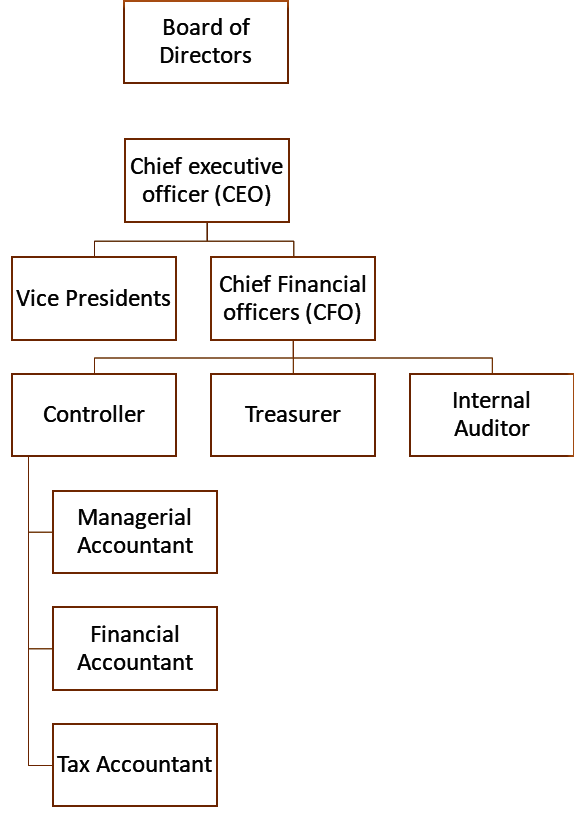
“A Typical Organization Chart” is a typical organization chart; it shows how accounting and finance personnel fit within most companies. The personnel at the bottom of the chart report to those above them. For example, the managerial accountant reports to the controller. At the top of the chart are those who control the company, typically the board of directors (who are elected by the owners or shareholders). Review Figure 1.1 “A Typical Organization Chart” before moving on to the detailed discussion of each important finance and accounting position.

Represents vice presidents of various departments outside of accounting and finance such as production, personnel, and research and development.

In addition to reporting to the chief financial officer, the internal auditor typically reports independently to the board of directors and/or the audit committee (made up of select members of the board of directors).

Chief Financial Officer

The chief financial officer (CFO) is in charge of all the organization’s finance and accounting functions and typically reports to the chief executive officer.

Controller

The controller is responsible for managing the accounting staff that provides managerial accounting information used for internal decision making, financial accounting information for external reporting purposes, and tax accounting information to meet tax filing requirements. The three accountants the controller manages are as follows:

  • Managerial accountant. The managerial accountant reports directly to the controller and assists in preparing information used for decision making within the organization. Reports prepared by managerial accountants include operational budgets, cost estimates for existing products, budgets for new product lines, and profit and loss reports by division. (Note that some people use the term cost accountant interchangeably with managerial accountant. Others consider cost accounting a specific function of managerial accounting that focuses on measuring costs. In this text, we use the term managerial accountant and assume that cost accountants focus on measuring costs.)
  • Financial accountant. The financial accountant reports directly to the controller and assists in preparing financial information, in accordance with U.S. GAAP, for those outside the company. Reports prepared by financial accountants include a quarterly report filed with the Securities and Exchange Commission (SEC) that is called a 10Q and an annual report filed with the SEC that is called a 10K.
  • Tax accountant. The tax accountant reports directly to the controller and assists in preparing tax reports for governmental agencies, including the Internal Revenue Service.

Treasurer

The treasurer reports directly to the CFO. A treasurer’s primary duties include obtaining sources of financing for the organization (e.g., from banks and shareholders), projecting cash flow needs, and managing cash and short-term investments.

Internal Auditor

An internal auditor reports to the CFO and is responsible for confirming that the company has controls that ensure accurate financial data. The internal auditor often verifies the financial information provided by the managerial, financial, and tax accountants (all of whom report to the controller and ultimately to the CFO). If conflicts arise with the CFO, an internal auditor can report directly to the board of directors or to the audit committee, which consists of select board members.

Note: Not All Organization follow the Same Hierarchy

Arithmetic Progression: Finding the “n”th term of AP and Sum to “n”th term of AP

An arithmetic progression is a sequence of numbers in which each term is derived from the preceding term by adding or subtracting a fixed number called the common difference “d”

For example, the sequence 9, 6, 3, 0,-3, …. is an arithmetic progression with -3 as the common difference. The progression -3, 0, 3, 6, 9 is an Arithmetic Progression (AP) with 3 as the common difference.

The general form of an Arithmetic Progression is a, a + d, a + 2d, a + 3d and so on. Thus nth term of an AP series is Tn = a + (n – 1) d, where Tn = nth term and a = first term. Here d = common difference = Tn – Tn-1.

Sum of first n terms of an AP: S =(n/2)[2a + (n- 1)d]

The sum of n terms is also equal to the formula S(n) = n/2(a+1) where l is the last term.

Tn = Sn – Sn-1 , where Tn = nth term

When three quantities are in AP, the middle one is called as the arithmetic mean of the other two. If a, b and c are three terms in AP then b = (a+c)/2

Geometric Progression Finding the “n”th term of GP and insertion of Geometric Mean

A geometric progression is a sequence in which each term is derived by multiplying or dividing the preceding term by a fixed number called the common ratio. For example, the sequence 4, -2, 1, – 1/2,…. is a Geometric Progression (GP) for which – 1/2 is the common ratio.

The general form of a GP is a, ar, ar2, ar3 and so on.

The nth term of a GP series is Tn = arn-1, where a = first term and r = common ratio = Tn/Tn-1) .

The formula applied to calculate sum of first n terms of a GP: S(n) = a ( r^n-1) / r-1

When three quantities are in GP, the middle one is called as the geometric mean of the other two. If a, b and c are three quantities in GP and b is the geometric mean of a and c i.e. b =√ac

The sum of infinite terms of a GP series S= a/(1-r) where 0< r<1.

If a is the first term, r is the common ratio of a finite G.P. consisting of m terms, then the nth term from the end will be = arm-n.

The nth term from the end of the G.P. with the last term l and common ratio r is l/(r(n-1)) .

Insertion of Arithmetic Mean

Let A₁, A₂, …, An, n arithmetic means are inserted between two numbers ‘a’ and ‘b’ such that a, A₁, A₂, …, An, b from an AP.

Here, total number of terms are (n + 2) and common difference be d

b = (n + 2)th term = a + (n + 2 – 1) d

d = (b – a)/ (n + 1)

Insertion of Geometric Mean

Let A1, G2, G3, G4……Gn be N geometric Means between two given numbers A and B . Then A, G1, G2 ….. Gn, B will be in Geometric Progression .

So B = (N+2)th term of the Geometric progression.

Then Here R is the common ratio
B = A*RN+1
RN+1 = B/A
R = (B/A)1/(N+1)

Now we have the value of R
And also we have the value of the first term A
G1 = AR1 = A * (B/A)1/(N+1)
G2 = AR2 = A * (B/A)2/(N+1)
G3 = AR3 = A * (B/A)3/(N+1)

error: Content is protected !!