Spirituality

The meaning of spirituality has developed and expanded over time, and various connotations can be found alongside each other.

Traditionally, spirituality referred to a religious process of re-formation which “aims to recover the original shape of man”, oriented at “the image of God” as exemplified by the founders and sacred texts of the religions of the world. The term was used within early Christianity to refer to a life oriented toward the Holy Spirit and broadened during the Late Middle Ages to include mental aspects of life.

In modern times, the term both spread to other religious traditions and broadened to refer to a wider range of experience, including a range of esoteric traditions and religious traditions. Modern usages tend to refer to a subjective experience of a sacred dimension and the “deepest values and meanings by which people live”, often in a context separate from organized religious institutions, such as a belief in a supernatural (beyond the known and observable) realm, personal growth, a quest for an ultimate or sacred meaning, religious experience, or an encounter with one’s own “inner dimension”

Spirituality is a broad concept with room for many perspectives. In general, it includes a sense of connection to something bigger than ourselves, and it typically involves a search for meaning in life. As such, it is a universal human experience something that touches us all. People may describe a spiritual experience as sacred or transcendent or simply a deep sense of aliveness and interconnectedness.

Some may find that their spiritual life is intricately linked to their association with a church, temple, mosque, or synagogue. Others may pray or find comfort in a personal relationship with God or a higher power. Still others seek meaning through their connections to nature or art. Like your sense of purpose, your personal definition of spirituality may change throughout your life, adapting to your own experiences and relationships.

Experts’ definitions of spirituality

Christina Puchalski, MD, Director of the George Washington Institute for Spirituality and Health, contends that “spirituality is the aspect of humanity that refers to the way individuals seek and express meaning and purpose and the way they experience their connectedness to the moment, to self, to others, to nature, and to the significant or sacred.”

According to Mario Beauregard and Denyse O’Leary, researchers and authors of The Spiritual Brain, “spirituality means any experience that is thought to bring the experiencer into contact with the divine (in other words, not just any experience that feels meaningful).”

Nurses Ruth Beckmann Murray and Judith Proctor Zenter write that “the spiritual dimension tries to be in harmony with the universe, and strives for answers about the infinite, and comes into focus when the person faces emotional stress, physical illness, or death.”

Relationship between Religion and Spirituality

While spirituality may incorporate elements of religion, it is generally a broader concept. Religion and spirituality are not the same thing, nor are they entirely distinct from one another. The best way to understand this is to think of two overlapping circles like this:

Venn diagram of religion and spirituality

In spirituality, the questions are: where do I personally find meaning, connection, and value?

In religion, the questions are: what is true and right?

Where the circles overlap is the individual experience, which affects the way you think, feel, and behave.

Global Operations

Traditionally ‘production’ or ‘manufacturing’ management has been used to imply production of physical goods, which are tangible in nature, such as automobiles, computers, televisions, camera, furniture, equipment, etc. During recent decades, ‘services’ that are ‘intangible’ in nature but also satisfy needs of a customer have grown rapidly.

Service providers like educational institutes, banks, insurance companies, amusement parks, etc., form a part of services.

A combination of goods and services may also form a product. For instance, meals served in a restaurant comprise both the tangible physical core product and intangible services aspects, such as cleanliness, ambience, delivery, etc.

Operations management refers to planning, organizing, and controlling all resources and activities to provide goods and services, which applies equally to manufacturing and services in the private and public sectors and even governments.

Operations management refers to the process which transforms inputs such as materials, machines, labour, capital and management, into outputs (i.e., goods and services).

The transformation process in ‘operations’ can have different forms, such as:

Globalization of Operations Management

The forces of globalization, such as reduction in trade barriers, cheaper and easier means of international transportation and communication, wage differential, and market saturation in the home markets on one hand and rapidly growing marketing opportunities overseas, especially in emerging economies on the other, have led to expansion of operations on a global scale.

Globalization of operations includes:

  • Global sourcing of inputs
  • Global production of goods and services
  • Global transportation of products
  • Global management of entire supply chain

An MNE headquartered in New York, New Delhi, or London may have production operations in a few countries and warehousing and marketing across the world.

For instance, Exxon Mobil, the world’s largest integrated oil company has its upstream drilling activities in about 50 countries; Siemens, the leading manufacturer of high technology industrial and consumer equipment, operates in over 190 countries with about 500,000 employees, and Boeing, the world’s largest manufacturer of commercial aircraft has operations in 26 countries with customers in over 100 countries.

Off-shoring

Relocation of business processes to a low-cost location by shifting the task overseas is termed as ‘off-shoring’. Capital assets may be shifted to a new production location by relocating the business processes to a new country within the company or by being sold to others.

Such assets include business processes, such as production, manufacturing, or services from high-cost locations (for example, the US or Europe) to low-cost locations, such as India, China, or Latin America. With digitization, the Internet, and high-speed data networks as the driving forces, all kinds of knowledge related work can now be performed almost anywhere in the world.

Activities which are particularly suitable for off-shore sourcing are discussed as follows:

(i) Products at the maturity stage of their product life cycle where technology has become standardized and widespread, requiring long-production runs making labour costs crucial to achieve competitiveness, are suited for off-shoring.

(ii) In case of technology: and capital-intensive industries, such as electronics, telecommunication, and software, certain parts of the production process are labour-intensive and need to be off-shored to low-cost locations.

Relocating the business processes for quality reasons at higher costs to another country are not considered off-shoring, for instance, shifting a costume-design centre from an East European or a South Asian country to Italy or France.

China and India, besides other developing countries, have become the most sought after off-shoring locations. Exhibit 16.1 illustrates the emergence of China as a global manufacturing hub, primarily due to low-cost large-scale production facilities whereas India, as a result of abundance of highly-skilled and knowledge-intensive manpower, has become the virtual, service centre for the world.

Types of off-shoring

(i) Captive off-shoring

Relocating business processes to a low-cost location and delivering from a shared service centre owned by the company itself is known as captive off-shoring.

(ii) Third party off-shoring

Also known as outsourcing, third party off-shoring involves relocation of business process from within the client country to an outside vendor operating at low-cost location. For the client company, the ‘outsourced’ services are performed by the outside vendor.

(iii) Near-Shoring

Relocation of a business process to a country within the same geographical region is referred to as near-shoring. For instance, shifting business processes from the US to Mexico or from Western to Eastern Europe.

International Human Resource Management

International human resource management (IHRM) is the process of procuring, allocating, and effectively utilizing human resources in a multinational corporation. If the MNC is simply exporting its products, with only a few small offices in foreign locations, then the task of the international HR manager is relatively simple.

However, in global firms human resource managers must achieve two somewhat conflicting strategic objectives. First, they must integrate human resource policies and practices across a number of subsidiaries in different countries so that overall corporate objectives can be achieved.

Pulapa Subba Rao defines international human resource management as, performing HRM and its related activities and arranging for related and necessary immigration facilities for prospective and current expatriate employees, by organizations operating in domestic and/or foreign countries.

Need of International Human Resource Management

HRM activities are performed in a particular context. It implies that either different HRM activities may be required in a global firm as compared to the domestic firm or even if the HRM activities remain the same, there may be difference in the way of performing these activities.

There are four major contextual variables because of which HRM activities in a global firm differ from a domestic firm, hence the need for international HRM. These are cultural diversity, workforce diversity, language diversity, and economic diversity. Let us go through these variables and see how they affect HRM practices.

  1. Cultural Diversity

Culture of a country is one of the key factors which affect people-oriented processes, and HRM is a people-oriented process. Therefore, culture of a country has very significant impact on HRM practices. When we consider global perspective of HRM, we find cultural diversity along the globe, that is, cultures of two countries are not alike.

Cultural diversity exists on five dimensions- individualism versus collectivism, power orientation, uncertainty avoidance, masculinity versus femininity, and time orientation. Let us see how these dimensions affect human behaviour and, consequently, work practices.

(a) Individualism versus Collectivism

People differ in terms of individualism and collectivism. Individualism is the extent to which people place value on themselves; they define themselves by referring themselves as singular persons rather than as part of a group or organization. For them, individual tasks are more important than relationships. Collectivism is the extent to which people emphasize the good of the group or society.

They tend to base their identity on the group or organization to which they belong. Countries that value individualism are USA, Great Britain, Australia, Canada, Netherlands, and New Zealand. Countries that value collectivism are Japan, Columbia, Pakistan, Singapore, Venezuela, and Philippines.’ India may be placed near to collectivism.

(b) Power Orientation

Power orientation, also known as orientation to authority, is the extent to which less powerful people accept the unequal distribution of power; people prefer to be in a situation where the authority is clearly understood and lines of authority are never bypassed. On the other hand, in a culture with less orientation to power, authority is not as highly respected and employees are quite comfortable circumventing lines of authority to accomplish jobs.

(c) Uncertainty Avoidance

Uncertainty avoidance, also known as preference for stability, is the extent to which people feel threatened by unknown situations and prefer to be in clear and unambiguous situations. In many countries, people prefer unambiguity while in many other countries, people can tolerate ambiguity.

(d) Masculinity versus Femininity

Masculinity or femininity, also known as degree of assertiveness or materialism, is the extent to which the dominant values in a society emphasize aggressiveness and the acquisition of money and material goods, rather than concern for people and overall quality of life. In societies having masculinity characteristics, more emphasis is placed on ego goals such as career, money, etc., while in societies having femininity characteristics, more emphasis is placed on social goals such as relationships, helping others, etc.

(e) Time Orientation

Time orientation dimension divides people into two categories- long- term orientation and short-term orientation. People having long-term orientation focus on future, prefer to work on projects having a distant payoff, and have persistence and thrift. People having short-term orientation are more oriented towards past and present and have respect for traditions and social obligations.

The basic implication of cultural diversity is that same set of HRM practices is not suitable for all cultures; consideration has to be given about matching HRM practices with cultural characteristics of the countries concerned.

  1. Workforce Diversity

Workforce diversity is increasingly becoming common for large organizations even for domestic ones. However, in a global firm, additional workforce diversity emerges because of hiring personnel from different countries.

A typical global firm may draw its employees from three types of countries — home country (PCNs), host country (HCNs), and third country (TCNs). In a global firm, workforce diversity can also be seen in the context of employee mobility from one country to another country for performing jobs.

On this basis, an employee can be put in one of the following categories:

  • Expatriate: A parent country national sent on a long-term assignment to the host country operations.
  • Inpatriate: A host country national or third country national assigned to the home country of the company where it is headquartered.
  • Repatriate: An expatriate coming back to the home country at the end of a foreign assignment.

Workforce diversity implies that various categories of employees not only bring their skills and expertise but also their attitudes, motivation to work or not to work, feelings, and other personal characteristics. Managing such employees with pre-determined HRM practices may not be effective but contingency approach has to be adopted so that HRM practices become tailor-made.

  1. Language Diversity

Language is a medium of expression but employees coming from different countries have different languages. Though English is a very common language, it does not serve the purpose adequately as it does not cover the entire world. While employees coming from different countries may be encouraged to learn the language of the host country for better dissemination of the information, it does not become feasible in many cases.

An alternative to this is to send multilingual communications. It implies that anything transmitted to employees should appear in more than one language to help the message get through. While there are no hard- and-fast rules in sending such messages, it appears safe to say that such a message should be transmitted in the languages the employees understand to ensure adequate coverage.

  1. Economic Diversity

Economic diversity is expressed in terms of per capita income of different countries where a global company operates. Economic diversity is directly related to compensation management, that is, paying wages/salaries and other financial compensation to employees located in different countries.

One of the basic principles of paying to employees is that “there should be equity in paying to employees.” However, putting this principle in practice is difficult for a global company because its operations are located in different countries having different economic status. In such a situation, some kind of parity should be established based on the cost of living of host countries.

Diversity of various types in a global firm suggests that HRM practices have to be tailor- made to suit the local conditions.

Recruitment Policy of International Human Resource Management

Companies operating outside their home countries, essentially, follow three ways of hiring executives:

  1. Ethnocentrism

It is a cultural attitude marked by the tendency to regard one’s own culture as superior to others. Sending home country executives abroad – thinking that they will be able to deliver the goods – may be an appropriate strategy in the initial stages of expanding company operations worldwide as these officials know what to do immediately. At Royal Dutch Shell, for instance virtually all financial controllers around the world are Dutch nationals.

Often the other reasons advanced for ethnocentric staffing policies include- lack of qualified host country managerial talent, a desire to have a unified corporate culture, tight control and the keenness to transfer the parent company’s core competencies (say, a specialised design skill) to a foreign subsidiary more expeditiously.

However, a policy of ethnocentrism is too narrow in its focus and may evoke strong negative reactions from local executives whose upward mobility is blocked.

There is also no guarantee that the expats will win over the hearts of local employees and offer positive contributions. In fact, failures of US expats range from 10% to 15%. European and Japanese expat failures are equally alarming, the costs of each such failure running to several thousands of dollars.

Too often expats are selected on the strength of their domestic track record. They are posted abroad without requisite cross-cultural training. The family factors stand completely discounted in the selection process. The rate of failures could be drastically reduced if these issues are properly addressed.

  1. Polycentrism

In the polycentric corporation, there is a conscious belief that only host country managers can ever really understand the culture and behaviour of the host country market; therefore, the foreign subsidiary should be managed by local people. The home-office headquarters, of course, is staffed by parent-country nationals.

Hiring nationals has many advantages. It eliminates language barriers, expensive training periods, cross-cultural adjustment problems of managers and their families.It also permits the firms to attract talented locals by offering an attractive compensation package. Many western MNCs have found that the key to success on foreign soil is to employ local people.

Analog Devices Inc. has achieved global success in a highly technical field by picking up local managers, training them extensively and then empowering them to hire and manage more local talent. Likewise, global sales of Bausch & Lomb improved dramatically after putting the local managerial talent to good use.

  1. Geocentrism

Geocentrism assumes that management candidates must be searched on a global basis, without favouring anyone. The best manager for any specific position anywhere on the globe may be found in any of the countries in which the firm operates. Such a staffing policy seeks the best people for important jobs throughout the organisation, regardless of nationality. It helps to build a stronger and more consistent culture and set of values among the entire global management team.

‘Team members here are always interacting, networking and building bonds with each other, as they move from assignment to assignment, around the globe and participate in global development activities’. Colgate-Palmolive is an example of a company that hires the best person for the job regardless of nationality. It has been operating globally for more than 55 years, and its products are household names in more than 175 countries.

Fully 60 per cent of the company’s expatriates are from countries other than the Unites States and two of its last four CEOs were not US nationals. Moreover, all the top executives speak at least two languages and important meetings routinely take place all over the globe.

Challenges of International Human Resource Management

According to P. V. Morgan, International HRM is the result of an interplay among the three dimensions human resource activities, types of employees and countries of operation. The complexities of operating in various countries and employing different national categories of workers is an important variable that differentiates domestic and international HRM, rather than any major differences between HRM activities performed.

Broadly stated, IHRM is “the process of procuring, allocating and effectively utilising human resources in a multinational corporation “. When compared to domestic human resources management, the scope of IHRM is very wide.

For example, while compensating people in India, the American MNC must keep in mind the expectations of locals, the competitor’s compensation structure, taxation problems of repatriates, TCN’s aspirations and a host of other issues that have a bearing on the psyche of employees possessing different skills and having different cultural backgrounds (both within and outside the country).

IHRM, thus, requires a much broader perspective, encompasses a greater scope of activities and is subject to much greater challenges than is domestic HRM.

International Trade Procedures and Documentation

Export

Export of goods take place when there is a change of proprietorship from a resident to a non-resident; this does not essentially infer that the goods in question physically crosses the border. However, in specific cases national accounts credit changes of ownership even though in legal terms no change of ownership takes place such as cross border financial leasing, cross border deliveries between affiliates of the same enterprise, goods crossing the border for significant processing to order or repair. Also smuggled goods must be included in the export measurement. Exporter has to submit ‘shipping bill’ for export by sea or air and ‘bill of export’ for export by road. Relevant documents i.e. copies of packing list, invoices, export contract, letter of credit are also to be succumbed.

For many companies, export begins in the sale or marketing department. That department may develop leads or identity clients located in other countries. Inquiries or orders may come from potential customers through company website where the destination is not identified. When such orders come in, sales person need to determine what steps are different from its domestic sale in order to fill those export orders?

Basic Export Procedures

  1. Market Research and Setting Objectives of Distribution: Selecting target markets, methods of exportation and channels, setting foreign market objectives on pricing and terms
  2. Trade Regulations
  • Export regulations and requirements
  • Overseas import regulations and requirements
  • Patent, trademark and copyright
  1. Making Contacts
  • Investigations from interested overseas buyers
  • Checking buyer’s background from ECIC and / or banks
  1. Quotation and Terms
  • Making offers and quotation for potential buyers
  • Costs, quotations and pro forma invoices, and terms of sale
  1. Sales Contract
  • Confirming the sales contract and terms of transaction such as payment terms.
  1. Contract Execution
  • Producing or sourcing goods
  • Packing and labelling
  • Arranging shipment
  • Preparing exports documentation
  • Arranging insurance, if necessary
  1. Customs Clearance

Arranging export declaration and applying for export licence when necessary.

  1. Getting paid

Subject to the payment terms specified in the sales contract, the exporter should present the required documents to the relevant parties for payment.

Import

Import is explained as bringing products into own country from a place outside national border. It can be said that Import trade refers to the purchase of goods from a foreign country. The procedure for import trade varies from country to country depending upon the import policy, statutory requirements and customs policies of different countries. In almost all countries of the world import trade is controlled by the government. The aims of these controls are appropriate use of foreign exchange restrictions, protection of indigenous industries etc. The imports of goods have to follow a procedure.

A manufacturer’s import department often grows out of the purchase department, whose personnel have been assigned the responsibility of procuring raw material or components for the manufacturing process. For importers or trading companies that deal in finished goods, the import department may begin as a result of being appointed as the distributor for a foreign manufacture.

In Indian context, the import and export of goods is ruled by the Foreign Trade (Development & Regulation) Act, 1992 and India’s Export Import (EXIM) Policy. India’s Directorate General of Foreign Trade (DGFT) is the major governing body and responsible for all issues associated with EXIM Policy. Importers are essential to register with the DGFT to obtain an Importer Exporter Code Number (IEC) issued against their Permanent Account Number (PAN), before engaging in EXIM activities. After an IEC has been obtained, the source of items for import must be identified and declared. The Indian Trade Classification – Harmonized System (ITC-HS) allows for the free import of most goods without a special import license.

Basic Import Procedures

  1. Setting Market Objectives

Setting market objectives on pricing and terms

  1. Sourcing Products
  • Identifying potential suppliers
  • Sourcing channels of distribution
  1. Trade Regulations
  • Import regulations and requirements, and checking whether import licence is required
  • Patent, trademark and copyright
  1. Making Contacts

Sending enquiries to suitable suppliers

  1. Settling Quotation and Terms
  • Analysing the supplier’s quotation and offers
  • Costs and terms of sale
  1. Financing the Purchase
  • Preparing for working capital
  • Types of bank financing and application, such as exporter credit or other bank facilities
  1. Sales Contract

Confirming the sales contract and terms of transaction such as payment terms.

  1. Preparing Payment and Insurance
  • Preparing payments and insurance specified in sales contract (eg. when payment term is D/C, submit D/C application to the issuing bank; when trade term is FOB, arrange cover note with an insurance company).
  • Preparing insurance, cover note, when necessary
  1. Acquiring Goods
  • Receiving shipping advice and arrival notice
  • Receiving export documents from the exporter
  • Collecting goods from the specified shipping company or forwarder
  1. Customs Clearance

Arranging customs clearance and import declaration.

Import Procedure

All importers must have to follow detailed customs clearance formalities when importing goods into India. A complete overview of EXIM procedures can be found on the Indian Directorate of General Valuation’s website.

It is established in finance literature that smooth, efficient and compliance oriented exporting, importing needs specialized knowledge of personnel. In many companies some or all functions of export and import department are combined in some way. In smaller companies, where the volume of export and import does not justify more personnel one or two person may have responsibility for both export and import documentation and procedures. In giant companies, these functions tend to be separated into export department and import department.

It is beneficial for companies to have export and import manual of procedures and documentation. These manuals serve as an effective tool for smooth operations and as a training tool for new employees. Exporters and importers must maintain record relating to their international trade transaction. Many companies offer software program for managing the export process such as order taking, generating of export documentations compliance with export control regulation, calculation of transportation charges and duties. On import side, many companies offer supply chain management software.

Global e–business

Communication technologies have become advanced since last decade of the twentieth century that accelerated the process of globalization. Presently most of the nations are ready for the electronic economy and to build e-business infrastructure. It is necessary for different countries to develop specialized e-business strategies that exploit their unique capabilities and resources, and even geographic positions. There is also a need for a variety of models for building e-business infrastructure and participating in global e-commerce. Global e-business is growing speedily and several trillion dollars are being exchanged annually over the web. Companies must assess global markets and broaden online in developed countries as well as in the emerging economies of other nations like China, Brazil, and India to exploit the technology of global e-business. Companies may proactively utilize global e-business opportunities and take benefits of e-commerce, or may implement a protective approach to new global competition that intimidates their business. Domestic businesses will progressively feel more pressure of international competition as e-business will offer companies a platform to fight at universal level.
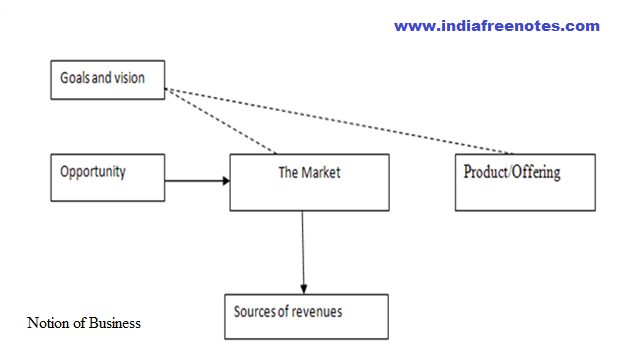
The combination of telecommunications and computer technology has initiated business organizational system known as the internet that offered example of ecological business development. The internet symbolizes a new and important technology that has received more attention from academicians, entrepreneurs, business and investors (Sawhney and Zabin, 2002). The expansion of e-commerce, facilitated through the internet as a channel, suggests both the emergence of a new business environment, and the likelihood of catastrophic change within the previous environment. The emergence of the information age and the initiation of the internet have resulted in transformations and these outcomes forced companies to review their organizational models used to explain business management. Hannan and Freeman (1977) developed the basis of organizational ecology in an attempt to describe the existence of organizations. Since then, organizational ecologists have theorized that environmental pressures considerably impact the triumph of an organization with regard to its form, function, and overall strategy.

A critical assessment of the growth of e-commerce on the internet gives a distinctive opportunity to scrutinize the natural development of a business sector that was created and colonized over a relatively short time period. Clearly, the internet technology and its different manifestations such as e-commerce provide better opportunities for companies around the world to establish unique strategic advantages (Varadarajan and Yadav, 2002). Global e-commerce is basically about leveraging electronic networks to capture global markets, and it includes all transactions taking place in the worldwide electronic market space. Transactions between global purchaser and sellers can take the form of business-to business (B2B), business-to-consumer (B2C), consumer-to-consumer (C2C), business to-government (B2G), and other hybrid forms of transactions.

Global E-Enabled Business Process Transformations and Challenges

Integration of digital technology into the business processes has considerably transformed the traditional ways of doing business.

Some of the changes brought about by e-business are summarized below:

(i) Physical marketplace to virtual market-space

The Internet has transformed the traditional ways of buying and selling of goods at physical marketplaces into virtual market-space enabling almost unlimited movements beyond physical borders.

(ii) Physical products to digital products

Breakthroughs in ICT have made possible to sell and buy some products online. For instance, computer software, music, movies, video games, drawings, designs, research papers, reports, and even books can be accessed, evaluated, bought, and downloaded over the net.

(iii) Mass production of standardized products to mass customization

Consequent to industrial revolution in the eighteenth century, the large-scale production of standardized products was used as the most significant tool to achieve scale economies and competitiveness.

Advent of electronic technology and Internet facilitated real-time interaction and information-sharing between the businesses and their various stakeholders, especially the customers and suppliers that made it possible to integrate manufacturing systems to produce customized products for different customers.

(iv) Fixed pricing to dynamic pricing

E-business models offer flexibility in price determination in several ways, such as buyer-determined customized pricing, dynamic pricing by way of online auctions, unlike the traditional fixed-pricing approach.

(v) Mass marketing techniques to customized marketing

Traditional marketing heavily relied upon mass marketing techniques with some adaptations for different market segments. Advent of ICT has facilitated businesses to gather information about individual customers’ tastes and preferences, their buying behaviour and customized marketing strategy to cater to each of the customers.

(vi) Hierarchical organizations to network organizations

The traditional ‘hierarchical organizational structures’ are transforming into ‘network organizational structures’ so as to take benefit of emerging e-business opportunities and meet the potential challenges.

However, businesses going online face several challenges, including:

  • As most businesses are making their online presence, the market competition has grown multi-fold from local to global level.
  • Online buying and selling of goods often results in elimination of market intermediaries; the process is frequently referred to as ‘disintermediation’, and leads to channel conflict.
  • Increase in availability of information online on the public domain augments the chances of its copying by the competitors who make its use for their own benefits.
  • Since the Internet can be accessed from across the world, there is no single binding legal framework.
  • Most businesses and customers often fear breach of security in terms of both the theft and misuse of classified and personal information over the Internet.
  • A large segment of customers is resistant to carrying out business transactions over the Internet.
  • Viability of carrying out business transactions differs across firms, depending upon their nature of business and resource availability.

Global E-Business Applications

Integration of ICT finds wide applications in a range of business activities, including the following:
  1. E-auctions

In traditional auctions, buyers and sellers gather at an agreed place, often the auction house, at a pre-determined time. Bids are usually placed over and above the reserved price set by the seller until the biding stops at a higher offer rate and the final bidder makes claims to the goods. Using a similar approach, electronic auction sites allow Internet users either to sell or bid for the products offered.

Auction sites generally serve as a forum of buying and selling and charge a commission on sales made. Sellers may post an item they wish to sell along with a minimum price and the deadline to close the auction. Moreover, some site also allows addition of conditions of sales and product photographs.

On the other hand, bidders may explore the site to check its availability and place a bid, usually in designated increments. EBay allows people to buy and sell almost anything.

In some sites, such as liquid price(dot)com, the ‘reverse-auction’ model is used which allows buyers to set the price that sellers compete to match or even beat. A reverse price is the lowest price a seller is willing to accept.

  1. E-banking

The banking industry is a pioneer in using EDI for intra-bank transfer of funds using the SWIFT network. E-banking allows its customers to access their accounts using the Internet and make online transactions with no extra charge.

Besides, banks compete with each other to offer a variety of value-added services to their customers, such as checking their balances, account statements, fund transfers, bill payment, transactions in the stock and commodity markets, customer service, etc.

As a result, customers have access to banking services 24 hours a day and seven days in a week. E-banking has transformed the business processes and its relationship with customers in the banking industry.

  1. E-directories

Telephone directories, the so-called ‘white pages’ containing private telephone numbers and the ‘yellow pages’ for businesses have widely been used to locate a person or a company. Conversion of traditional directories from paper to electronic form and integrating them with the Internet has facilitated their online access round the clock from any part of the world.

Besides, a large number of online directories allow users to update their entries any time they wish, irrespective of their geographical locations. Thus the information which could earlier be updated only at the time of printing a new or revised directory has become dynamic in nature.

Moreover, electronic directories are often user-friendly. Users may online access detailed information upon entering the desired fields. For instance, one can get the name and complete address of a person or a company by entering only the telephone number.

  1. E-manufacturing

Integration of technology has facilitated sharing real-time information with a firm’s customers and trading partners, leading to the use of such information for making collaborative production decisions.

As a result, businesses are increasingly adopting e-manufacturing using real-time information on customer needs and preferences and productive capacity across the entire supply-chain so as to speedily deliver customized products directly to the customers rather than huge volumes of mass production to fulfil anticipated demands.

An automated manufacturing system integrated through computer technology is known as computer integrated manufacturing (CIM). With globalization of markets and production and with the advent of the Internet, CIM has evolved into a web- centric collaborative venture, termed as e-manufacturing.

E-manufacturing involves Computer-Added Designs (CAD), robots, automated guided vehicles. Computer Numerical Control (CNC) machines, Automated Storage and Retrieval Systems (ASRS), and Flexible Manufacturing Systems (FMS).

  1. E-business Research

The uses of electronic surveys for business research have increased tremendously in the last decade. Due to variation in the extent of availability of personal computers and Internet penetration, mass electronic surveys are possible only in a few developed countries while stratified sampling for select market segments can even be carried out in developing countries.

With the intensification of cyber cafes in India and other emerging economies, the Internet has the reach of far greater population than that captured in most multilateral surveys and publications. Hence, business and institutional surveys are gaining popularity even in the developing countries.

Although electronic surveys are cost-effective and quick, the sample surveyed may not be representative of the population and may lead to faulty inferences. Therefore, due care is to be taken while selecting samples for electronic surveys.

  1. E-governance

Governments across the world are using the Internet to augment their communication systems with their citizens. Government websites often provide a wealth of information which is extensively used by various stakeholders, such as foreign and multilateral agencies, officials, researchers, and most importantly by their own citizens.

In addition to information provided, governments across the world are evolving new systems to integrate technology for providing value-added services.

Integration of technology with a system of governance has made it possible to make online queries, file complaints, make applications for various statutory approvals, receive approvals online, and track online interactions. E-governance has significantly contributed to transparency and efficiency in public administration.

Ethics and Social Responsibility

International Business Ethics

International business ethics emerged quite late globally compared to the business ethics that came up in 1970’s. It was only in late 1990’s that the international business ethics came to the fore especially so after the economic developments that occurred on a global scale.

In 1990’s many businesses from the developing countries expanded their operations and became multinational. The transactions between businesses and the governments increased as a result, which gave rise to many practical issues. Culture and its relativity was one factor more prominent than the others. Other ethical issues in the context of international business are generally dealt with the laws of the land; although all of them fall within the ambit of international business ethics.

Globalization diminished the barriers between countries on the globe and also called for universalization of values for trade to occur smoothly. Universal values were perceived to control the behaviour in the commercial space. This lead to ethical issues in the international business perspective, those that were unknown till date.

Other theoretical issues arise from the diversity of business ethical traditions in various countries across the globe. In addition, comparisons made on the basis of corruption rankings of a certain state or on the basis of gross domestic product of a certain economy also lead to ethical issues in the international arena.

Since religion brings in a wholly different perspective to the way we look upon things; the comparison of ethical traditions from the perspective of the latter also gives birth to ethical problems. For example, trade in Christian dominated countries is different from the trade in Islamic countries. Again depending upon how strong or profound the impact of the religion is, business practices are influenced proportionally.

In the international business arena, ethical problems also arise out mere international business transactions. Fair trade movement, transfer pricing, bioprospecting and biopiracy are examples of transactions that fall within the ambit of international business ethics. Similarly issues like child labor and cultural imperialism are controversial enough to call upon the attention of international business ethics.

Yet another arena for strong requirement of ethics would be when multinationals bargain to take advantage of international differences; For example when rich nations outsource their services to poor and developing nations at cheaper cost. Western nations were up till recently outsourcing many of services to third world nations where they could hire manpower for the cheapest prices. This led to a severe competition between developing nations with each one offering cheaper labour than the other.

Dumping is yet another way by which large companies are trying to kill the domestic players. Foreign players often sell goods and services at a cheaper price making it hard for the small players to survive the competition. Consumer durables and FMCG are biggest examples of such practices. The bigger threat here is the resulting monopoly which places the customer in a losing position. The international trade commission began for its search of its anti dumping laws from the year 2009.

All these are ways in which business at the international level can lead to ethical dilemmas. In absence of international business ethics it may become almost impossible to regulate business and create winning situations for people in the market place.

Ethical issues in Business

Business ethics is both part of the prescriptive (normative) ethics establishing standards of conduct, recommending certain behaviours, as well as descriptive ethics, describing the moral attitudes and behaviours of entrepreneurs. In principle, the practical goal of business ethics is to solve ethics problems in business.

Ethical factor in area of business communication

  • Proper marketing techniques, telling truth about products and services,
  • Informing customers, employees and partners about company’s mission statement and goals,
  • Respecting religious and social values of employees, customers and partners,
  • Negligence in informing shareholders about company’s situation, managerial ethics
  • Insider trading, hiding information about mergers, acquisitions, investments, etc.

Ethical factors concerning production processes

  • Eliminating unsafe working conditions,
  • Avoiding processes and technologies that jeopardize the safety of the employees and public,
  • Producing product safe for customers,
  • Waste product utilization and recycling,
  • Profiting from products bad for health (drugs, cigarettes, alcohol) and people (gambling),

Social Responsibility

Social responsibility is a form of management that considers ethical issues in all aspects of the business. Strategic decisions of a company have both social and economic consequences. Social responsibility of a company is a main element of the strategy formulation process. There is a misconception that corporate social responsibility is less relevant to small businesses; however, there is growing recognition of the importance of social responsibility for smaller firms.

Integrating social responsibility in strategic management requires sound knowledge of the types of social responsibilities a company deals with. Economic responsibilities are the most basic type of social responsibilities. The company is expected to provide goods to the society at reasonable prices, create jobs and pay due taxes.

Legal responsibilities reflect the obligation to comply with the laws that regulate business activities; ethical responsibilities mirror the company’s notion of the right business behavior. Some actions might not be illegal but can be unethical. Making and selling cigarettes is a case in point.

Finally, discretionary responsibilities are those that are voluntarily adopted by the business. For example, companies that adopt the good citizenship approach, actively support charities, public service advertising campaigns and other public interest issues

Corporate social responsibility is self-regulation by a company with the objective of embracing responsibility for the company’s actions and creating a positive impact through its activities on its customers, employees, communities and the environment. A company may build into its mission, strategy and everyday operations elements that serve to promote specific goals, for example, using recycled paper or organic hand soap in the offices to help save the environment.

Benefits for the Company

Although direct effects haven’t been proved and much criticism has risen around CSR, companies identify some obvious benefits. Implementing the values and goals of CSR improve the judgment and reputation of the business among customers. In a strong, competitive market it also makes the business stand out from its rivals. CSR may also prompt current and potential employees to commit themselves to the company and promote its values in their private lives.

Good Example

The Body Shop is the most cited example of establishing CSR early in an exceptional way. The natural-cosmetics company promotes social and environmental issues. It implemented a shared campaign with Greenpeace to save the whales; a campaign against overly skinny models to avoid perpetuating bulimia and anorexia; and an initiative called Community Fair Trade to help people sell their products in developing countries. It also regularly sponsors local charity and community events.

Cautionary Example

H&M, the clothing store implemented the CSR strategy of producing clothing items from organic cotton. The organic-clothing line gave consumers a positive image towards H&M for years. But this image was easily destroyed when three different reports in one year accused the company of using genetically modified cotton from India in its products. Today, H&M’s new line represents only low prices but not organic clothing.

Forms of International Organizations

  1. Expo-documents against acceptance Department

Exports are often looked after by a company’s marketing or sales department in the initial stages when the volume of exports sales is low. However, with increase in exports turnover, an independent exports department is often setup and separated from domestic marketing, as shown in Fig.1

Exports activities are controlled by a company’s home-based office through a designated head of export department, i.e. Vice President, Director, or Manager (Exports). The role of the HR department is primarily confined to planning and recruiting staff for exports, training and development, and compensation.

Sometimes, some HR activities, such as recruiting foreign sales or agency personnel are carried out by the exports or marketing department with or without consultation with the HR department.

  1. International division structure

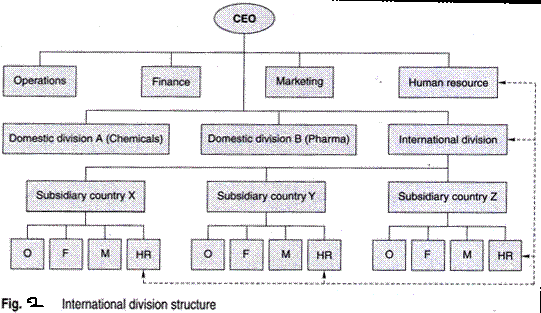
As the foreign operations of a company grow, businesses often realize the overseas growth opportunities and an independent international division is created which handles all of a company’s international operations (Fig. 2). The head of international division, who directly reports to the chief executive officer, coordinates and monitors all foreign activities.

The in-charge of subsidiaries reports to the head of the international division. Some parallel but less formal reporting also takes place directly to various functional heads at the corporate headquarters.

The corporate human resource department coordinates and implements staffing, expatriate management, and training and development at the corporate level for international assignments. Further, it also interacts with the HR divisions of individual subsidiaries.

The international structure ensures the attention of the top management towards developing a holistic and unified approach to international operations. Such a structure facilitates cross-product and cross-geographic co-ordination, and reduces resource duplication.

Although an international structure provides much greater autonomy in decision-making, it is often used during the early stages of internationalization with relatively low ratio of foreign to domestic sales, and limited foreign product and geographic diversity.

  1. Global Organizational Structures

Rise in a company’s overseas operations necessitates integration of its activities across the world and building up a worldwide organizational structure.

While conceptualizing organizational structure, the internationalizing firm often has to resolve the following conflicting issues:

  • Extent or type of control exerted by the parent company headquarters over subsidiaries.
  • Extent of autonomy in making key decisions to be provided by the parent company headquarters to subsidiaries (centralization vs. decentralization)

It leads to re-organization and amalgamation of hitherto fragmented organizational interests into a globally integrated organizational structure which may either be based on functional, geographic, or product divisions. Depending upon the firm strategy and demands of the external business environment, it may further be graduated to a global matrix or trans-national network structure.

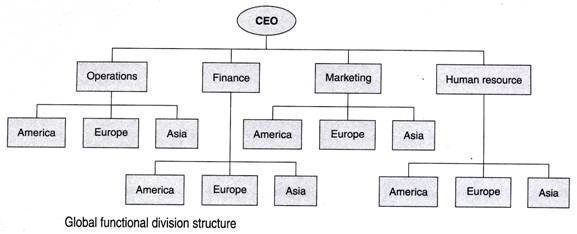
(a) Global functional division structure

It aims to focus the attention of key functions of a firm, as shown in Fig. 3, wherein each functional department or division is responsible for its activities around the world. For instance, the operations department controls and monitors all production and operational activities; similarly, marketing, finance, and human resource divisions co-ordinate and control their respective activities across the world.

Such an organiza­tional structure takes advantage of the expertise of each functional division and facili­tates centralized control. MNEs with narrow and integrated product lines, such as Caterpillar, usually adopt the functional organizational structure.

Such organizational structures were also adopted by automobile MNEs but have now been replaced by geographic and product structures during recent years due to their global expansion.

The major advantages of global functional division structure include:

  • Greater emphasis on functional expertise
  • Relatively lean managerial staff
  • High level of centralized control
  • Higher international orientation of all functional managers

The disadvantages of such divisional structure include:

  • Difficulty in cross-functional coordination
  • Challenge in managing multiple product lines due to separation of operations and marketing in different departments
  • Since only the chief executive officer is responsible for profits, such a structure is favoured only when centralized coordination and control of various activities is required.

(b) Global product structure

Under global product structure, the corporate product division, as depicted in Fig. , is given worldwide responsibility for the product growth.

The heads of product divisions do receive internal functional support associated with the product from all other divisions, such as operations, finance, marketing, and human resources. They also enjoy considerable autonomy with authority to take important decisions and operate as profit centres.

The global product structure is effective in managing diversified product lines.

Such a structure is extremely effective in carrying out product modifications so as to meet rapidly changing customer needs in diverse markets. It enables close coordination between the technological and marketing aspects of various markets in view of the differences in product life cycles in these markets, for instance, in case of consumer electronics, such as TV, music players, etc.

However, creating exclusive product divisions tends to replicate various functional activities and multiplicity of staff. Besides, little attention is paid to worldwide market demand and strategy. Lack of cooperation among various product lines may also result into sales loss. Product managers often pursue currently attractive markets neglecting those with better long-term potential.

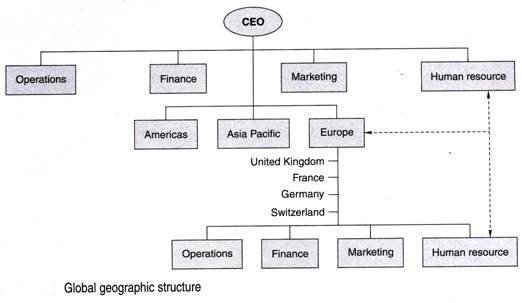
(c) Global geographic structure

Under the global geographic structure, a firm’s global operations are organized on the basis of geographic regions, as depicted in Fig. It is generally used by companies with mature businesses and narrow product lines. It allows the independent heads of various geographical subsidiaries to focus on the local market requirements, monitor environmental changes, and respond quickly and effectively.

The corporate headquarter is responsible for transferring excess resources from one country to another, as and when required. The corporate human resource division also coordinates and provides synergy to achieve company’s overall strategic goals between various subsidiaries based in different countries.

Such structure is effective when the product lines are not too diverse and resources can be shared. Under such organizational structure, subsidiaries in each country are deeply embedded with nationalistic biases that prohibit them from cooperating among each other.

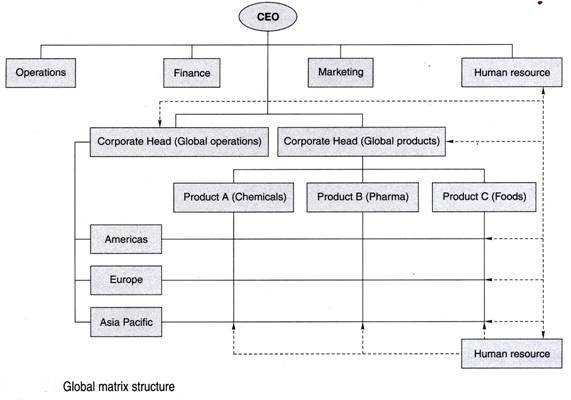
(d) Global matrix structure

It is an integrated organizational structure, which super-imposes on each other more than one dimension. The global matrix structure might consist of product divisions intersecting with various geographical areas or functional divisions. Unlike functional, geographical, or product division structures, the matrix structure shares joint control over firm’s various functional activities.

Such an integrated organizational structure facilitates greater interaction and flow of information throughout the organization. Since the matrix structure has an in-built concept of interaction between intersecting perspectives, it tends to balance the MNE’s prospective, taking cross-functional aspects into consideration.

It facilitates ease of technology transfer to foreign operations and of new products to different markets leading to higher economies of scale and better foreign sales performance. Matrix structure is used successfully by a large number of MNEs, such as Royal Dutch/Shell, Dow Chemical, etc.

In an effort to bring together divergent perspectives within the organization, the matrix structure may also lead to conflicting situations. It inhibits a firm’s ability to respond quickly to environmental changes in case an effective conflict resolution mechanism is not in place.

Since the structure requires most managers to report to two or multiple bosses, Fayol’s basic principle of unity of command is violated and conflicting directives from multiple authorities may compel employees to compromise with sub-optimal alternatives so as to avoid conflict which may not be the most appropriate strategy for an organization as a whole.

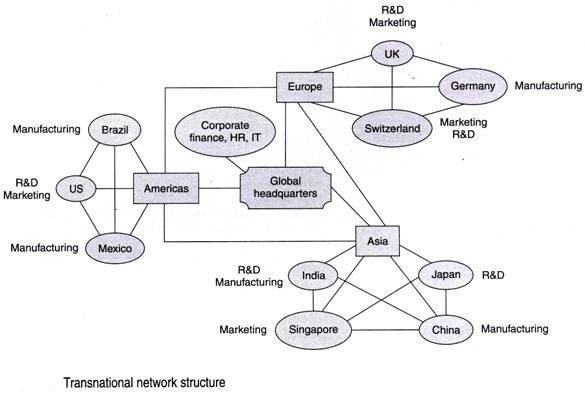
(e) Transnational network structure

Such a globally integrated structure represents the ultimate form of an earth-spanning organization, which eliminates the meaning of two or three matrix dimensions. It encompasses elements of function, product, and geographic designs while relying upon a network arrangement to link worldwide subsidiaries.

This form of organization is not defined by its formal structure but by how its processes are linked with each other, which may be characterized by an overall integrated system of various inter-related sub-systems.

The trans-national network structure is designed around ‘nodes’, which are the units responsible for coordinating with product, functional and geographic aspects of an MNE. Thus, trans-national network structures build-up multi­dimensional organizations which are fully networked.

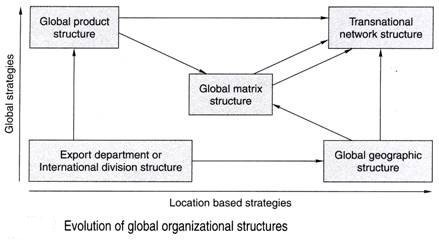
  1. Evolution of Global Organizational Structures

Organizational structures often exhibit evolutionary patterns, as shown in Fig., depending upon their strategic globalization. The historical evolution of organizational patterns indicates that in the early phase of internationalization, most firms separate their exports departments from domestic marketing or have separate international divisions.

Companies with emphasis on global business strategies move towards global product structures whereas those with emphasis on location base strategies move towards global geographic structures.

Subsequently, a large number of companies graduate to a matrix or trans-national network structure due to dual demands of local adaptations pressures and globalization. In practice, most companies hardly adopt either pure matrix or trans-national structures; rather they opt for hybrid structures incorporating both.

International Business Organizations

International Business conducts business transactions all over the world. These transactions include the transfer of goods, services, technology, managerial knowledge, and capital to other countries. International business involves exports and imports.

International Business is also known, called or referred as a Global Business or an International Marketing.

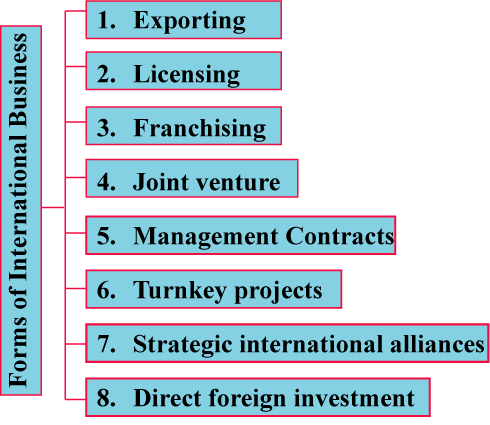
An international business has many options for doing business, it includes,

  • Exporting goods and services.
  • Giving license to produce goods in the host country.
  • Starting a joint venture with a company.
  • Opening a branch for producing & distributing goods in the host country.
  • Providing managerial services to companies in the host country.

International Business Organizations

The exciting world of international business beckons the brightest minds and sharpest business performers to excel in relationships, governance, and financial acuity in order to create a better future for all people. World changers need spaces in which to gather to share ideas, spur one another on, create relational opportunism, mingle with industry and governmental leaders, and dream of advanced systems to enhance our daily lives. Many such venues exist but it’s not always easy to know which ones with which to associate. This article discusses key places for the entrepreneur to consider.

A plethora of international business organizations exist to promote education and facilitate business transactions around the world. The following organizations are among the most active and well known. Whether you are a business person transacting international business or a student looking to learn and eventually get in on the action, these organizations will open the door to your forward-looking international worldview.

  1. World Trade Organization

The World Trade Organization (WTO) is the premier worldwide group geared toward the politics of international trade. Government officials meet together within the WTO context to negotiate trade agreements and negotiate the politics of international business. The WTO receives significant media attention while also proactively publishing data related to accessing international markets. Check out their annual World Trade Report for research, analysis, and featured member nation stories.

The WTO’s student-friendly approach contributes internships, a youth ambassador program, and essay awards for young economists in the hope of promoting business and friendship for young international professionals. The newly created Youth Ambassador Programme gives young leaders a voice at the international trade table to offer their unique opinions and perspectives. The internship program for post-graduate university students develops knowledge, understanding, and experience in global trade policy and compliance. Internships can last up to 24 weeks and take place exclusively in beautiful Geneva, Switzerland. Interns also receive a stipend.

  1. International Chamber of Commerce

The International Chamber of Commerce (ICC) promotes world business by providing forums, leadership development, and advocacy for nations who desire for their citizens to enjoy a higher global standard of living while living in a world of peace. The ICC conducts training events, arbitration conferences, financial summits and numerous other programs to promote their agenda of building peace and prosperity on earth.

ICC online training modules expose students and business professionals to certification level expertise developed as ICC constituents intermingle on the world stage at G20 Summits and United Nations forums. The ICC maintains policy commissions in the areas of the digital economy, competition, the environment and energy policy, intellectual property, and taxation, among other topics. Dispute resolution, antitrust compliance, international sales contracts, arbitration provision and anti-crime initiatives are just a sampling of the services proffered by the International Chamber of Commerce.

Students can benefit specifically with the Young Arbitrators Forum (YAF). YAF is a place for young professionals to learn from seasoned international practitioners about issues related to arbitration and arbitration career development. Events are held regularly all around the world.

  1. International Association of Business Communicators

The International Association of Business Communicators (IABC) is a networking association for communication professionals. The IABC promotes professional development and communication standards worldwide. They tout a membership of 15,000 professionals in over 80 countries.

  1. International Business Organization

The International Business Organization (IBO) is a group that serves the international community who wants to do business in or immigrate to the United States of America with a special purview related to the state of Florida. The IBO can assist with real estate information, immigration services, health insurance, and unique networking contacts.

  1. The Federation of International Trade Associations

The Federation of International Trade Associations (FITA) is an online clearinghouse of 8,000 international trade Web sites. FITA is comprised of 450 association members and 450,000 linked company members. FITA brings together trade agents, distributors, and service providers that contribute toward import and export activities. Their market research tools and leads increase the capacity of members to conduct international trade ethically and legally.

Check out their Web site tools of the trade including customs and tariffs, intellectual property rights, trade barriers, logistics, and more. This fully-orbed research driven site will help you to determine, among other things, how to import horses into China, how to franchise overseas, how to fight against fraudulent individuals in Nigeria, and how to invest in Afghanistan.

The IBO Web site provides country profiles for more than half of the nations of the world. Profiles contain demographics, country overview, currency and communications information, and basic economic data.

  1. The World Technology Network

The World Technology Network (WTN) brings innovative individuals together from the science and technology communities to share ideas, discover synergies, and create momentum within the realm of emerging technologies. Add in financiers and futurists and the organization builds capacity for creating roadmaps into the rest of the 21st Century. The community also includes marketers, writers, entrepreneurs, government officials, and policy analysts – people who are bent on creating dynamic systems to enhance world productivity and efficiencies.

WTN’s headline event, The World Technology Summit & Awards ceremony, has taken place annually for twelve years. Awards are presented in the following categories: arts, biotechnology, communication technology, design, education, energy, entertainment, environment, ethics, finance, health and medicine, IT hardware, IT software, law, marketing communications, materials, media and journalism, policy, social entrepreneurship, and space. Awards are presented in these categories to both individuals and corporations who best represent WTN goals and ideologies.

  1. International Assembly for Collegiate Business Education

The International Assembly for Collegiate Business Education (IACBE) is a professional accrediting organization related to business education. They promote business educational standards and opportunities for students and the professional educational community. Members include colleges and universities who are committed to strengthening business educational capacities worldwide.

IACBE member services range from mentoring and consulting platforms to the Journal for Excellence in Business Education. The International Business Education Consortium enables members to share curriculum ideas, provide fresh experiences for business students, create international teaching opportunities for faculty, and establish new revenue tuition streams for member institutions.

  1. International Executives Association

The International Executives Association is an elite type networking group for companies and their respective top level employees. Their focus on inspiration and camaraderie refreshes business executives enabling them to prosper as they share business leads and referrals with one another. Most local chapters are located in Canada and the United States.

  1. Business Council for International Understanding

Started in 1955 as an initiative by President Dwight Eisenhower, the Business Council for International Understanding (BCIU) exists to foster dialogue among world business and political leaders. The BCIU organizes trade mission tours for cross-fertilization of business opportunities both internationally and domestically-hosted, roundtables for senior executives and politicians, and private meetings for high level officials of influence. A commercial training program geared toward embassy personnel and diplomats-in-training shows the diplomatic community how to promote business interests wherever they serve in the world by understanding the local business conditions and applying international standards for success. BCIU meets annually in New York for an awards gala.

BCIU provides fascinating internship opportunities for college juniors and seniors to obtain experience in both private sector and governmental contexts. Responsibilities include database management, research, writing, and communications. A key benefit is networking with interns from different cultural backgrounds.

  1. Coalition of Services Industries

The Coalition of Services Industries (CSI) represents the needs for the service industries in the United States, industries such as banking, hospitality, logistics, telecommunications, and insurance. They also promote international policies that will benefit these industries seeking to develop business worldwide. Special working groups have developed around the themes of financial services, insurance, telecommunications, media, and information technology. In addition, groups focus on the emerging economies of China and India.

Take the time to explore these organizations and you’ll see a world that contains unlimited possibilities. Determine what it is that you are looking for and then narrow down your search based upon geography, association fees, personal and professional goals, membership opportunities and requirements, and the capacity for association members to influence you to influence your sphere of the world.

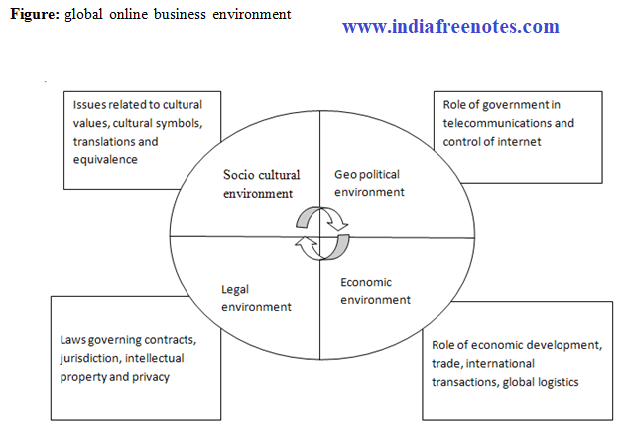
International Business Environment: Political Environment, Economic Environment, Technological Environment, Cultural Environment, Competitive Environment, Legal and Financial Environment

Political Environment

The political environment refers to the type of the government, the government relationship with a business, & the political risk in the country. Doing business internationally, therefore, implies dealing with a different type of government, relationships, & levels of risk.

There are many different types of political systems, for example, multi-party democracies, one-party states, constitutional monarchies, dictatorships (military & non-military). Therefore, in analyzing the political-legal environment, an organization may broadly consider the following aspects:

  • The Political system of the business
  • Approaches to the Government towards business i.e. Restrictive or facilitating
  • Facilities & incentives offered by the Government
  • Legal restrictions for instance licensing requirement, reservation to a specific sector like the public sector, private or small-scale sector
  • The Restrictions on importing technical know-how, capital goods & raw materials
  • The Restrictions on exporting products & services
  • Restrictions on pricing & distribution of goods
  • Procedural formalities required in setting the business

Economic Environment

The economic environment relates to all the factors that contribute to a country’s attractiveness for foreign businesses. The economic environment can be very different from one nation to another. Countries are often divided into three main categories: the more developed or industrialized, the less developed or third world, & the newly industrializing or emerging economies.

Within each category, there are major variations, but overall the more developed countries are the rich countries, the less developed the poor ones, & the newly industrializing (those moving from poorer to richer). These distinctions are generally made on the basis of the gross domestic product per capita (GDP/capita). Better education, infrastructure, & technology, healthcare, & so on are also often associated with higher levels of economic development.

Clearly, the level of economic activity combined with education, infrastructure, & so on, as well as the degree of government control of the economy, affect virtually all facets of doing business, & a firm needs to recognize this environment if it is to operate successfully internationally. While analyzing the economic environment, the organization intending to enter a particular business sector may consider the following aspects:

  • An Economic system to enter the business sector.
  • Stage of economic growth & the pace of growth.
  • Level of national & per capita income.
  • Incidents of taxes, both direct & indirect tax.
  • Infrastructure facilities available & the difficulties thereof.
  • Availability of raw materials & components & the cost thereof.
  • Sources of financial resources & their costs.
  • Availability of manpower-managerial, technical & workers available & their salary & wage structures.

Technological Environment

The technological environment comprises factors related to the materials & machines used in manufacturing goods & services. Receptivity of organizations to new technology & adoption of new technology by consumers influence decisions made in an organization.

As firms do not have any control over the external environment, their success depends on how well they adapt to the external environment. An important aspect of the international business environment is the level, & acceptance, of technological innovation in different countries.

The last decades of the twentieth century saw major advances in technology, & this is continuing in the twenty-first century. Technology often is seen as giving firms a competitive advantage; hence, firms compete for access to the newest in technology, & international firms transfer technology to be globally competitive.

It is easier than ever for even small business plan to have a global presence thanks to the internet, which greatly grows their exposure, their market, & their potential customer base. For the economic, political, & cultural reasons, some countries are more accepting of technological innovations, others less accepting. In analyzing the technological environment, the organization may consider the following aspects:

  • Level of technological development in the country as a whole & specific business sector.
  • The pace of technological changes & technological obsolescence.
  • Sources of technology.
  • Restrictions & facilities for technology transfer & time taken for the absorption of technology.

Cultural Environment

The cultural environment is one of the critical components of the international business environment & one of the most difficult to understand. This is because the cultural environment is essentially unseen; it has been described as a shared, commonly held body of general beliefs & values that determine what is right for one group, according to Kluckhohn & Strodtbeck.

National culture is described as the body of general beliefs & the values that are shared by the nation. Beliefs & the values are generally seen as formed by factors such as the history, language, religion, geographic location, government, & education; thus firms begin a cultural analysis by seeking to understand these factors. The most well-known is that developed by Hofstede in1980.

His model proposes four dimensions of cultural values including individualism, uncertainty avoidance, power distance & masculinity.

Individualism is the degree to which a nation values & encourages individual action & decision making.

Uncertainty avoidance is the degree to which a nation is willing to accept & deal with uncertainty.

Power distance is the degree to which a national accepts & sanctions differences in power.

This model of cultural values has been used extensively because it provides data for a wide array of countries. Many academics & the managers found that this model helpful in exploring management approaches that would be appropriate in different cultures.

For example, in a nation that is high on individualism one expects individual goals, individual tasks, & individual reward systems to be effective, whereas the reverse would be the case in a nation that is low on individualism.

  • While analyzing social & cultural factors, the organization may consider the following aspects:
  • Approaches to society towards business in general & in specific areas;
  • Influence of social, cultural & religious factors on the acceptability of the product;
  • The lifestyle of people & the products used for them;
  • Level of acceptance of, or resistance to change;
  • Values attached to a particular product i.e. the possessive value or the functional value of the product;
  • Demand for the specific products for specific occasions;
  • The propensity to consume & to save.

Competitive Environment

The competitive environment also changes from country to country. This is partly because of the economic, political, & cultural environments; these environmental factors help determine the type & degree of competition that exists in a given country. Competition can come from a variety of sources. It can be a public or a private sector, come from the large or the small organizations, be domestic or global, & stem from traditional or new competitors, GST registration. For a domestic firm, the most likely sources of competition might be well understood. The same isn’t the case when a person moves to compete in the new environment.

International Legal Environment

Firms operating internationally face major challenges in conforming to different laws, regulations, and legal systems in different countries. The legal framework to protect small and medium enterprises (SMEs), mainly to achieve social objectives, adversely influences the expansion of manufacturing capacities and achieving economies of scale in certain countries.

International managers need to develop basic understanding of the types of legal systems followed in the countries of their operations before entering into legal contracts.

Major Participants of International Business

Four Major Participants of International Business

  1. Exporting

Exporting is often the first choice when manufacturers decide to expand abroad. Simply stating, exporting means selling abroad, either directly to target customers or indirectly by retaining foreign sales agents or/and distributors. Either case, going abroad through exporting has minimal impact on the firm’s human resource management because only a few, if at all, of its employees are expected to be posted abroad.

  1. Licensing

Licensing is another way to expand one’s operations internationally. In case of international licensing, there is an agreement whereby a firm, called licensor, grants a foreign firm the right to use intangible (intellectual) property for a specific period of time, usually in return for a royalty. Licensing of intellectual property such as patents, copyrights, manufacturing processes, or trade names abound across the nations. The Indian basmati (rice) is one such example.

  1. Franchising

Closely related to licensing is franchising. Franchising is an option in which a parent company grants another company/firm the right to do business in a prescribed manner. Franchising differs from licensing in the sense that it usually requires the franchisee to follow much stricter guidelines in running the business than does licensing. Further, licensing tends to be confined to manufacturers, whereas franchising is more popular with service firms such as restaurants, hotels, and rental services.

One does not have to look very far to see how important franchising business is to companies here and abroad. At present, the prominent examples of the franchise agreements in India are Pepsi Food Ltd., Coca-Cola, Wimpy’s Damino, McDonald, and Nirula. In USA, one in 12 business establishments is a franchise.

However, exporting, licensing and franchising make companies get them only so far in international business. Companies aspiring to take full advantage of opportunities offered by foreign markets decide to make a substantial direct investment of their own funds in another country. This is popularly known as Foreign Direct Investment (FDI). Here, by international business means foreign direct investment mainly. Let us discuss some more about foreign direct investment.

  1. Foreign Direct Investment (FDI)

Foreign direct investment refers to operations in one country that ire controlled by entities in a foreign country. In a sense, this FDI means building new facilities in other country. In India, a foreign direct investment means acquiring control by more than 74% of the operation. This limit was 50% till the financial year 2001-2002.

There are two forms of direct foreign investment: joint ventures and wholly-owned subsidiaries. A joint venture is defined as “the participation of two or more companies jointly in an enterprise in which each party contributes assets, owns the entity to some degree, and shares risk”. In contrast, a wholly-owned subsidiary is owned 100% by the foreign firm.

An international business is any firm that engages in international trade or investment. International trade refers to export or import of goods or services to customers/consumers in another country. On the other hand, international investment refers to the investment of resources in business activities outside a firm’s home country.

error: Content is protected !!