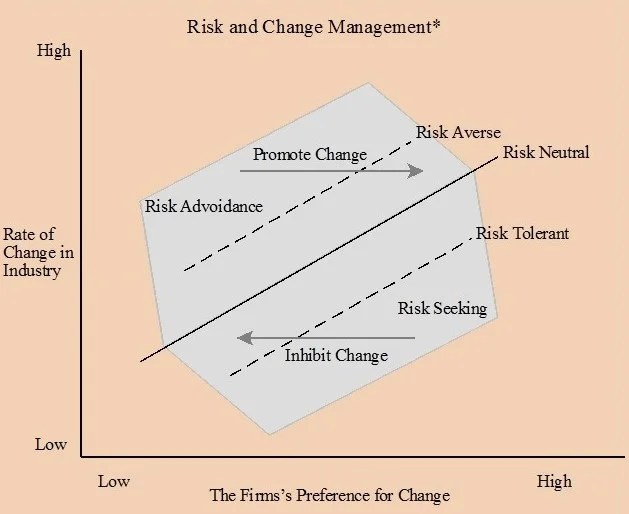
VUCA is an acronym first used in 1987, drawing on the leadership theories of Warren Bennis and Burt Nanus to describe or to reflect on the volatility, uncertainty, complexity and ambiguity of general conditions and situations. The U.S. Army War College introduced the concept of VUCA to describe the more volatile, uncertain, complex and ambiguous multilateral world perceived as resulting from the end of the Cold War. More frequent use and discussion of the term “VUCA” began from 2002 and derives from this acronym from military education. It has subsequently taken root in emerging ideas in strategic leadership that apply in a wide range of organizations, from for-profit corporations to education.
- V = Volatility: the nature and dynamics of change, and the nature and speed of change forces and change catalysts.
- U = Uncertainty: the lack of predictability, the prospects for surprise, and the sense of awareness and understanding of issues and events.
- C = Complexity: the multiplex of forces, the confounding of issues, no cause-and-effect chain and confusion that surrounds organization.
- A = Ambiguity: the haziness of reality, the potential for misreads, and the mixed meanings of conditions; cause-and-effect confusion.
These elements present the context in which organizations view their current and future state. They present boundaries for planning and policy management. They come together in ways that either confound decisions or sharpen the capacity to look ahead, plan ahead and move ahead. VUCA sets the stage for managing and leading.
The particular meaning and relevance of VUCA often relates to how people view the conditions under which they make decisions, plan forward, manage risks, foster change and solve problems. In general, the premises of VUCA tend to shape an organization’s capacity to:
- Anticipate the Issues that Shape
- Understand the Consequences of Issues and Actions
- Appreciate the Interdependence of Variables
- Prepare for Alternative Realities and Challenges
- Interpret and Address Relevant Opportunities
For most contemporary organizations business, the military, education, government and others VUCA is a practical code for awareness and readiness. Beyond the simple acronym is a body of knowledge that deals with learning models for VUCA preparedness, anticipation, evolution and intervention.
Volatility
Volatility is the V component of VUCA. This refers to the different situational social-categorization of people due to specific traits or reactions that stand out during that particular situation. When people react/act based on a specific situation, there is a possibility that the public categorizes them into a different group than they were in a previous situation. These people might respond differently to individual situations due to social or environmental cues. The idea that situational occurrences cause certain social categorization is known as volatility and is one of the main aspects of the self-categorization theory.
Sociologists use volatility to understand better how stereotypes and social-categorization is impacted based on the situation at hand as well as any outside forces that may lead people to perceive others differently. Volatility is the changing dynamic of social-categorization in a set of environmental situations. The dynamic can change due to any shift in a situation, whether it is social, technical, biological or anything of the like. Studies have been conducted, but it has proven difficult to find the specific component that causes the change in situational social-categorization.
Uncertainty
Uncertainty in the VUCA framework is almost just as it sounds: when the availability or predictability of information in events is unknown. Uncertainty often occurs in volatile environments that are complex in structure involving unanticipated interactions that are significant in uncertainty. Uncertainty may occur in the intention to imply causation or correlation between the events of a social perceiver and a target. Situations where there is either a lack of information to prove why a perception is in occurrence or informational availability but lack of causation are where uncertainty is salient.
The uncertainty component of the framework serves as a grey area and is compensated by the use of social categorization and/or stereotypes. Social categorization can be described as a collection of people that have no interaction but tend to share similar characteristics with one another. People have a tendency to engage in social categorization, especially when there is a lack of information surrounding the event. Literature suggests that there are default categories that tend to be assumed in the absence of any clear data when referring to someone’s gender or race in the essence of a discussion.
Complexity
Complexity is the “C” component of VUCA, that refers to the interconnectivity and interdependence of multiple components in a system. When conducting research, complexity is a component that scholars have to keep in mind. The results of a deliberately controlled environment are unexpected because of the non-linear interaction and interdependencies within different groups and categories.
In a sociological aspect, the VUCA framework is utilized in research to understand social perception in the real world and how that plays into social categorization as well as stereotypes. Galen V Bodenhausen and Destiny Peery’s article Social Categorization and Stereotyping In vivo: The VUCA Challenge, focused on researching how social categories impacted the process of social cognition and perception. The strategy used to conduct the research is to manipulate or isolate a single identity of a target while keeping all other identities constant. This method creates clear results of how a specific identity in a social category can change one’s perception of other identities, thus creating stereotypes.
There are problems with categorizing an individual’s social identity due to the complexity of an individual’s background. This research fails to address the complexity of the real-world and the results from this highlighted an even great picture about social categorization and stereotyping. Complexity adds many layers of different components to an individual’s identity and creates challenges for sociologists trying to examine social categories. In the real world, people are far more complex compared to a modified social environment. Individuals identify with more than one social category, which opens the door to a deeper discovery about stereotyping. Results from research conducted by Bodenhausen reveals that there are certain identities that are more dominant than others. Perceivers who recognize these specific identities latch on to it and associate their preconceived notion of such identity and make initial assumptions about the individuals and hence stereotypes are created.
Ambiguity
Ambiguity is the “A” component of VUCA. This refers to when the general meaning of something is unclear even when an appropriate amount of information is provided. Many get confused about the meaning of ambiguity. It is similar to the idea of uncertainty but they have different factors. Uncertainty is when relevant information is unavailable and unknown, and ambiguity where relevant information is available but the overall meaning is still unknown. Both uncertainty and ambiguity exist in our culture today. Sociologists use ambiguity to determine how and why an answer has been developed. Sociologists focus on details such as if there was enough information present, and did the subject have the full amount of knowledge necessary to make a decision. and why did he/she come to their specific answer.
Ambiguity leads to people assuming an answer, and many times this leads assuming ones race, gender, and can even lead to class stereotypes. If a person has some information but still doesn’t have the overall answer, the person starts to assume his/her own answer based on the relevant information he/she already possesses. For example, as mentioned by Bodenhausen we may occasionally encounter people who are sufficiently androgynous to make it difficult to ascertain their gender, and at least one study suggests that with brief exposure, androgynous individuals can sometimes be miscategorized on the basis of gender-atypical features (very long hair, for a man, or very short hair, for a woman. Overall, ambiguity leads to the categorization of many. For example, it may lead to assuming one’s sexual orientation. Unless a person is open about their own sexual orientation, people will automatically assume that they are heterosexual. But if a man possesses feminine qualities or a female possesses masculine qualities then they might be portrayed as either gay or lesbian. Ambiguity leads to the categorization of people without further important details that could lead to untrue conclusions.
Uses:
Dealing with Complexity and Situations that Confuse and Muddle Decision Making
The next aspect of uncertainty is closely tied with the points made in the previous paragraph. Therefore, the next feature that is discussed here is complexity, which means that business leaders have to adopt a non-linear approach to solving problems and must think out of the box. Further, they would have to ensure that they not only solve the problems but the business dilemmas brought on due to too much complexity which means that they would have to choose between several competing alternatives that are all attractive but cannot be actualized together.
The world has become so complex even for the layperson that the complexity in the business world is of much higher magnitude and is multilayered meaning that the landscape is now no longer a simple equation where profits mean success. In other words, the business leaders would have to ensure that they take into account the laws, regulations, and policies as well as social and environmental costs of doing business in an increasingly interconnected world where conditions in one region are markedly different from conditions in other regions.
Ambiguity and Out of Box Thinking
The fourth and the final aspect that business leaders must confront is ambiguity, which means that the business landscape presents problems and dilemmas that cannot be reduced to simple yes and no type of solutions and black and white approach to problem solving. Instead, most of the problems that business leaders face now are of the type where the complete information is lacking, where there are no clear solutions in sight, and where the reality of the marketplace is multilayered and multidimensional meaning that leaders would have to resort to unconventional ways of solving problems and confronting situations. Ambiguity also manifests in conjunction with the other features like uncertainty and complexity and as discussed next, each of these features feed into each other creating a mélange that is tough to handle for many firms.
 by
by