Quantitative Techniques introduction

Decision making is one of the most fundamental functions of management professionals. Every manager has to take decisions pertaining to his field of work. Hence, it is an all-pervasive function of basic management. The process of decision making contains various methods. Quantitative techniques of decision making help make these methods simpler and more efficient.

The following are six such important quantitative techniques of decision making:

  1. Linear programming

This technique basically helps in maximizing an objective under limited resources. The objective can be either optimization of a utility or minimization of a disutility. In other words, it helps in utilizing a resource or constraint to its maximum potential.

Managers generally use this technique only under conditions involving certainty. Hence, it might not be very useful when circumstances are uncertain or unpredictable.

  1. Probability decision theory

This technique lies in the premise that we can only predict the probability of an outcome. In other words, we cannot always accurately predict the exact outcome of any course of action.

Managers use this approach to first determine the probabilities of an outcome using available information. They can even rely on their subjective judgment for this purpose. Next, they use this data of probabilities to make their decisions. They often use ‘decision trees’ or pay-off matrices for this purpose.

  1. Game theory

Sometimes, managers use certain quantitative techniques only while taking decisions pertaining to their business rivals. The game theory approach is one such technique.

This technique basically simulates rivalries or conflicts between businesses as a game. The aim of managers under this technique is to find ways of gaining at the expense of their rivals. In order to do this, they can use 2-person, 3-person or n-person games.

  1. Queuing theory

Every business often suffers waiting for periods or queues pertaining to personnel, equipment, resources or services.

For example, sometimes a manufacturing company might gather a stock of unsold goods due to irregular demands. This theory basically aims to solve such problems.

The aim of this theory is to minimize such waiting periods and also reduce investments on such expenses.

For example, departmental stores often have to find a balance between unsold stock and purchasing fresh goods. Managers in such examples can employ the queuing theory to minimize their expenses.

  1. Simulation

As the name suggests, the simulation technique observes various outcomes under hypothetical or artificial settings. Managers try to understand how their decisions will work out under diverse circumstances.

Accordingly, they finalize on the decision that is likely to be the most beneficial to them. Understanding outcomes under such simulated environments instead of natural settings reduces risks drastically.

  1. Network techniques

Complex activities often require concentrated efforts by personnel in order to avoid wastage of time, energy and money. This technique aims to solve this by creating strong network structures for work.

There are two very important quantitative techniques under this approach. These include the Critical Path Method and the Programme Evaluation & Review Technique. These techniques are effective because they segregate work efficiently under networks. They even drastically reduce time and money.

Scope

The scope of statistics was primarily limited in the sense that the ruling kings used to collect data so as to frame suitable military and fiscal policies only. Hence they heavily depended upon statistics. As time went on, statistics came to be regarded as a method of handling and analyzing the numerical facts and figures.

In recent years, the activities of the state have increased tremendously. Statistical facts and figures are of immense help in promoting human welfare. Today, the scope of statistics is so vast and ever expanding. It influences everybody’s life. Even an entry into the world and exit are systematically recorded.

There is no branch of human activity that can escape the attention of statistics. It is a tool of all sciences. It is indispensable for research and intelligent judgment. It has become a recognized discipline in its own right. A few specific areas of application are mentioned below.

  • Finance and Accounting: Cash flow analysis, Capital budgeting, Dividend and Portfolio management, Financial planning.
  • Marketing Management: Selection of product mix, Sales resources allocation and Assignments.
  • Production Management: Facilities planning, Manufacturing, Aggregate planning, Inventory control, Quality control, Work scheduling, Job sequencing, Maintenance and Project planning and scheduling.
  • Personnel Management: Manpower planning, Resource allocation, Staffing, Scheduling of training programs.
  • General Management: Decision Support System and Management of Information Systems, MIS, Organizational design and control, Software Process Management and Knowledge Management.

Operations Research Techniques

(i) Inventory Control Models:

Operation Research study involves balancing inventory costs against one or more of the following costs:

  1. Shortage costs.
  2. Ordering costs.
  3. Storage costs.
  4. Interest costs.

This study helps in taking decisions about:

  1. How much to purchase.
  2. When to order.
  3. Whether to manufacture or to purchase i.e., make and buy decisions.

The most well-known use is in the form of Economic Order Quantity equation for finding economic lot size.

(ii) Waiting Line Models:

These models are used for minimising the waiting time and idle time together with the costs associated therewith.

Waiting line models are of two types:

(a) Queuing theory, which is applicable for determining the number of service facilities and/or the timing of arrivals for servicing.

(b) Sequencing theory which is applicable for determining the sequence of the servicing.

(iii) Replacement Models:

These models are used for determining the time of replacement or maintenance of item, which may either:

(i) Become obsolete, or

(ii) Become inefficient for use, and

(iii) Become beyond economical to repair or maintain.

(iv) Allocation Models:

(a) There are number of activities which are to be performed and there are number of alternative ways of doing them,

(b) The resources or facilities are limited, which do not allow each activity to be performed in best possible way. Thus these models help to combine activities and available resources so as to optimise and get a solution to obtain an overall effectiveness.

(v) Competitive Strategies:

Such type of strategies are adopted where, efficiency of deci­sion of one agency is dependent on the decision of another agency. Examples of such strategies are game of cards or chess, fixing of prices in a competitive market where these strategies are termed as “theory”.

(vi) Linear Programming Technique:

These techniques are used for solving operation problems having many variables subject to certain restrictions. In such problems, objectives are profit, costs, quantities manufactured etc. whereas restrictions may be e.g. policies of government, capacity of the plant, demand of the product, availability of raw materials, water or power and storage capacity etc.

(vii) Sequencing Models:

These are concerned with the selection of an appropriate sequence of performing a series of jobs to be done on a service facility or machine so as to optimise some efficiency measure of performance of the system.

(viii) Simulation Models:

Simulation is an experimental method used to study behaviour over time.

(ix) Network Models:

This is an approach to planning, scheduling and controlling complex projects.

Applications of Operation Research:

These techniques are applied to a very wide range of problems.

(i) Distribution or Transportation Problems:

In such problems, various centres with their demands are given and various warehouses with their stock positions are also known, then by using linear programming technique, we can find out most economical distribution of the products to various centres from various warehouses.

(ii) Product Mix:

These techniques can be applied to determine best mix of the products for a plant with available resources, so as to get maximum profit or minimum cost of produc­tion.

(iii) Production Planning:

These techniques can also be applied to allocate various jobs to different machines so as to get maximum profit or to maximise production or to minimise total production time.

(iv) Assignment of Personnel:

Similarly, this technique can be applied for assignment of different personnel with different aptitude to different jobs so as to complete the task within a minimum time.

(v) Agricultural Production:

We can also apply this technique to maximise cultivator’s profit, involving cultivation of number of items with different returns and cropping time in different type of lands having variable fertility.

(vi) Financial Applications:

Many financial decision making problems can be solved by using linear programming technique.

Some of them are:

(i) To select best portfolio in order to maximise return on investment out of alternative investment opportunities like bonds, stocks etc. Such problems are generally faced by the managers of mutual funds, banks and insurance companies.

(ii) In deciding financial mix strategies, involving the selection of means for financing firm, projects, inventories etc.

Limitations of Operations Research:

  1. These do not take into account qualitative and emotional factors.
  2. These are applicable to only specific categories of decision-making problems.
  3. These are required to be interpreted correctly.
  4. Due to conventional thinking, changes face lot of resistance from workers and some­times even from employer.
  5. Models are only idealised representation of reality and not be regarded as absolute.

Scientific approach in Decision Making and their Limitations

In order to evaluate the alternatives, certain quantitative techniques have been developed which facilitate in making objective decisions.

Important decision-making techniques are four and they have been discussed as under:

(1) Marginal Analysis:

This technique is also known as ‘marginal costing’. In this technique the additional revenues from additional costs are compared. The profits are considered maximum at the point where marginal revenues and marginal costs are equal.” This technique can also be used in comparing factors other than costs and revenues.

For Example – If we try to find out the optimum output of a machine, we have to vary inputs against output until the additional inputs equal the additional output. This will be the point of maximum efficiency of the machine. Modern analysis is the ‘Break-Even Point’ (BEP) which tells the management the point of production where there is no profit and no loss.

(2) Co-Effectiveness Analysis:

This analysis may be used for choosing among alternatives to identify a preferred choice when objectives are far less specific than those expressed by such clear quantities as sales, costs or profits. Koontz, O’Donnell and Weihrich have written that “Cost models may be developed do show cost estimates for each alternative and its effectiveness. Social objective may be to reduce pollution of air and water which lacks precision. Further, he has emphasised for synthesizing model i.e., combining these results, may be made to show the relationships of costs and effectiveness for each alternative.”

(3) Operations Research:

This is a scientific method of analysis of decision problems to provide the executive the needed quantitative information in making these decisions. The important purpose of this is to provide the managers with scientific basis for solving organisational problems involving the interaction of components of the organisation. This seeks to replace the process by an analytic, objective and quantitative basis based on information supplied by the system in operation and possibly without disturbing the operation.

This is widely used in modern business organisations. For Example – (a) Inventory models are used to control the level of inventory, (b) Linear Programming for allocation of work among individuals in the organisation.

Further, some theories have also been propounded by eminent writers of management to analyse the problems and to take decisions. Sequencing theory helps the management to determine the sequence of particular operations. Queuing theory, Games theory, Reliability theory and Marketing theory are also important tools of operations research which can be used by the management to analyse the problems and take decisions.

(4) Linear Programming:

It is a technique applicable in areas like production planning, transportation, warehouse location and utilisation of production and warehousing facilities at an overall minimum cost. It is based on the assumption that there exists a linear relationship between variables and that the limits of variations can be ascertained.

It is a method used for determining the optimum combination of limited resources to achieve a given objective. It involves maximisation or maximisation of a linear function of various primary variables known as objective function subject to a set of some real or assumed restrictions known as constraints.

Models represent the behaviour and perception of decision-makers in the decision-making environment. There are two models that guide the decision-making behaviour of managers.

These are:

  1. Rational/Normative Model-Economic Man
  2. Non-Rational/Administrative Model
  3. Rational/Normative Model:

These models believe that decision-maker is an economic man as defined in the classical theory of management. He is guided by economic motives and self-interest. He aims to maximise organisational profits. Behavioural or social aspects are ignored in making business decisions.

These models presume that decision-makers are perfect information assimilators and handlers. They can collect complete and reliable information about the problem area, generate all possible alternatives, know the outcome of each alternative, rank them in the best order of priority and choose the best solution. They follow a rational decision-­making process and, therefore, make optimum decisions.

This model is based on the following assumptions:

  1. Managers have clearly defined goals. They know what they want to achieve.
  2. They can collect complete and reliable information from the environment to achieve the objectives.
  3. They are creative, systematic and reasoned in their thinking. They can identify all alternatives and outcome of each alternative related to the problem area.
  4. They can analyse all the alternatives and rank them in the order of priority.
  5. They are not constrained by time, cost and information in making decisions.
  6. They can choose the best alternative to make maximum returns at minimum cost.

Group decision-making suffers from the following limitations:

(a) It is costly and more time consuming than individual decision-making.

(b) Some members accept group decisions even when they do not agree with them to avoid conflicts.

(c) Sometimes, groups do not arrive at any decision. Disagreement and disharmony amongst group members leads to interpersonal conflicts.

(d) Some group members dominate others to agree to their viewpoint. Social pressures lead to acceptance of alternatives which all group members do not unanimously agree to.

(e) If there is conflict between group goals and organisational goals, group decisions generally promote group goals even if they are against the interest of the organisation.

Though cost of group decision-making is more than individual decision-making, its benefits far outweigh the costs and enable the managers to make better decisions.

Mathematical expectations

Mathematical expectation, also known as the expected value, which is the summation of all possible values from a random variable.

It is also known as the product of the probability of an event occurring, denoted by P(x), and the value corresponding with the actually observed occurrence of the event.

For a random variable expected value is a useful property. E(X) is the expected value and can be computed by the summation of the overall distinct values that is the random variable. The mathematical expectation is denoted by the formula:

E(X)= Σ (x1p1, x2p2, …, xnpn),

where, x is a random variable with the probability function, f(x),

p is the probability of the occurrence,

and n is the number of all possible values.

The mathematical expectation of an indicator variable can be 0 if there is no occurrence of an event A, and the mathematical expectation of an indicator variable can be 1 if there is an occurrence of an event A.

For example, a dice is thrown, the set of possible outcomes is { 1,2,3,4,5,6} and each of this outcome has the same probability 1/6. Thus, the expected value of the experiment will be 1/6*(1+2+3+4+5+6) = 21/6 = 3.5. It is important to know that “expected value” is not the same as “most probable value” and, it is not necessary that it will be one of the probable values.

Properties of Expectation

  1. If X and Y are the two variables, then the mathematical expectation of the sum of the two variables is equal to the sum of the mathematical expectation of X and the mathematical expectation of Y.

Or

E(X+Y)=E(X)+E(Y)

  1. The mathematical expectation of the product of the two random variables will be the product of the mathematical expectation of those two variables, but the condition is that the two variables are independent in nature. In other words, the mathematical expectation of the product of the nnumber of independent random variables is equal to the product of the mathematical expectation of the independent random variables

Or

E(XY)=E(X)E(Y)

  1. The mathematical expectation of the sum of a constant and the function of a random variable is equal to the sum of the constant and the mathematical expectation of the function of that random variable.

Or,

E(a+f(X))=a+E(f(X)),

where, a is a constant and f(X) is the function.

  1. The mathematical expectation of the sum of product between a constant and function of a random variable and the other constant is equal to the sum of the product of the constant and the mathematical expectation of the function of that random variable and the other constant.

Or,

E(aX+b)=aE(X)+b,

where, a and b are constants.

  1. The mathematical expectation of a linear combination of the random variables and constant is equal to the sum of the product of  ‘n’ constant and the mathematical expectation of the ‘n’ number of variables.

Or

E(∑aiXi)=∑ aE(Xi)

Where, ai, (i=1…n) are constants.

Scope and Applications of Quantitative Techniques

The scope of statistics was primarily limited in the sense that the ruling kings used to collect data so as to frame suitable military and fiscal policies only. Hence they heavily depended upon statistics. As time went on, statistics came to be regarded as a method of handling and analyzing the numerical facts and figures.

In recent years, the activities of the state have increased tremendously. Statistical facts and figures are of immense help in promoting human welfare. Today, the scope of statistics is so vast and ever expanding. It influences everybody’s life. Even an entry into the world and exit are systematically recorded.

There is no branch of human activity that can escape the attention of statistics. It is a tool of all sciences. It is indispensable for research and intelligent judgment. It has become a recognized discipline in its own right. A few specific areas of application are mentioned below.

  • Finance and Accounting: Cash flow analysis, Capital budgeting, Dividend and Portfolio management, Financial planning.
  • Marketing Management: Selection of product mix, Sales resources allocation and Assignments.
  • Production Management: Facilities planning, Manufacturing, Aggregate planning, Inventory control, Quality control, Work scheduling, Job sequencing, Maintenance and Project planning and scheduling.
  • Personnel Management: Manpower planning, Resource allocation, Staffing, Scheduling of training programs.
  • General Management: Decision Support System and Management of Information Systems, MIS, Organizational design and control, Software Process Management and Knowledge Management.

Applications

Applications of Quantitative Analysis in the Business Sector

Business owners are often forced to make decisions under conditions of uncertainty. Luckily, quantitative techniques enable them to make the best estimates and thus minimize the risks associated with a particular decision. Ideally, quantitative models provide company owners with a better understanding of information, to enable them to make the best possible decisions.

Project Management

One area where quantitative analysis is considered an indispensable tool is in project management. As mentioned earlier, quantitative methods are used to find the best ways of allocating resources, especially if these resources are scarce. Projects are then scheduled based on the availability of certain resources.

Production Planning

Quantitative analysis also helps individuals to make informed product-planning decisions. Let’s say a company is finding it challenging to estimate the size and location of a new production facility. Quantitative analysis can be employed to assess different proposals for costs, timing, and location. With effective product planning and scheduling, companies will be more able to meet their customers’ needs while also maximizing their profits.

Marketing

Every business needs a proper marketing strategy. However, setting a budget for the marketing department can be tricky, especially if its objectives are not set. With the right quantitative method, marketers can find an easy way of setting the required budget and allocating media purchases. The decisions can be based on data obtained from marketing campaigns.

Finance

The accounting department of a business also relies heavily on quantitative analysis. Accounting personnel use different quantitative data and methods such as the discounted cash flow model to estimate the value of an investment. Products can also be evaluated, based on the costs of producing them and the profits they generate.

Purchase and Inventory

One of the greatest challenges that businesses face is being able to predict the demand for a product or service. However, with quantitative techniques, companies can be guided on just how many materials they need to purchase, the level of inventory to maintain, and the costs they’re likely to incur when shipping and storing finished goods.

The Bottom Line

Quantitative analysis is the use of mathematical and statistical techniques to assess the performance of a business. Before the advent of quantitative analysis, many company directors based their decisions on experience and gut. Business owners can now use quantitative methods to predict trends, determine the allocation of resources, and manage projects.

Baye’s Theorem

Bayes’ Theorem is a way to figure out conditional probability. Conditional probability is the probability of an event happening, given that it has some relationship to one or more other events. For example, your probability of getting a parking space is connected to the time of day you park, where you park, and what conventions are going on at any time. Bayes’ theorem is slightly more nuanced. In a nutshell, it gives you the actual probability of an event given information about tests.

“Events” Are different from “tests.” For example, there is a test for liver disease, but that’s separate from the event of actually having liver disease.

Tests are flawed:

Just because you have a positive test does not mean you actually have the disease. Many tests have a high false positive rate. Rare events tend to have higher false positive rates than more common events. We’re not just talking about medical tests here. For example, spam filtering can have high false positive rates. Bayes’ theorem takes the test results and calculates your real probability that the test has identified the event.

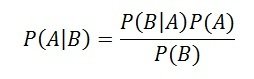
Bayes’ Theorem (also known as Bayes’ rule) is a deceptively simple formula used to calculate conditional probability. The Theorem was named after English mathematician Thomas Bayes (1701-1761). The formal definition for the rule is:

In most cases, you can’t just plug numbers into an equation; You have to figure out what your “tests” and “events” are first. For two events, A and B, Bayes’ theorem allows you to figure out p(A|B) (the probability that event A happened, given that test B was positive) from p(B|A) (the probability that test B happened, given that event A happened). It can be a little tricky to wrap your head around as technically you’re working backwards; you may have to switch your tests and events around, which can get confusing. An example should clarify what I mean by “switch the tests and events around.”

Bayes’ Theorem Example

You might be interested in finding out a patient’s probability of having liver disease if they are an alcoholic. “Being an alcoholic” is the test (kind of like a litmus test) for liver disease.

A could mean the event “Patient has liver disease.” Past data tells you that 10% of patients entering your clinic have liver disease. P(A) = 0.10.

B could mean the litmus test that “Patient is an alcoholic.” Five percent of the clinic’s patients are alcoholics. P(B) = 0.05.

You might also know that among those patients diagnosed with liver disease, 7% are alcoholics. This is your B|A: the probability that a patient is alcoholic, given that they have liver disease, is 7%.

Bayes’ theorem tells you:

P(A|B) = (0.07 * 0.1)/0.05 = 0.14

In other words, if the patient is an alcoholic, their chances of having liver disease is 0.14 (14%). This is a large increase from the 10% suggested by past data. But it’s still unlikely that any particular patient has liver disease.

Statistical Research Techniques

Data Analysis can be defined as the process of reviewing and evaluating the data that is gathered from different sources.  Data cleaning is very important as this will help in eliminating the redundant information and reaching to the accurate conclusions. Data analysis is the systematic process of cleaning, inspecting and transforming data with the help of various tools and techniques. The objective of data analysis is to identify the useful information which will support the decision-making process. There are various methods for data analysis which includes data mining, data visualization and Business Intelligence. Analysis of data will help in summarizing the results through examination and interpretation of the useful information. Data analysis helps in determining the quality of data and developing the answers to the questions which are of use to the researcher.

In order to discover the solution of the problem and to reach to the specific and quality results, various statistical techniques can be applied. These techniques will help the researcher to get accurate results by drawing relationships between different variables. The statistical techniques can mainly be divided into two

A) Parametric Test

B) Non-Parametric Test

Parametric Test

Parametric statistics considers that the sample data relies on certain fixed parameters. It takes into consideration the properties of the population. It assumes that the sample data is collected from the population and population is normally distributed. There are equal chances of occurrence of all the data present in the population. The parametric test is based on various assumptions which are needed to be holding good. Various parametric tests are Analysis of Variance (ANOVA), Z test, T test, Chi Square test, Pearson’s coefficient of correlation, Regression analysis.

T- Test

T- test can be defined as the test which helps in identifying the significant level of difference in a sample mean or between the means of two samples. It is also called as a T- Distribution. The t-test is conducted when the sample size of the population is small, and variance of the population is not known. The t-test is used when the population (n) is not larger than 30. There are two types of T-Test:

  1. Dependent mean T Test- It is used when same variables or groups are experimented.
  2. Independent mean T Test-It is used when two different groups experimented. The two different groups have faced different conditions.

The formula for T-Test is:

Z Test

This test is used when the population is normally distributed. The sample size of the population is large or small, but the variance of the population is known. It is used for comparing the means of the population or for identifying the significance level of difference between the means of two independent samples. Z test is based on the single critical value which makes the test more convenient.

The formula for z test is:

X- Main value

µ – Sample Mean

σ – Standard Deviation

Analysis of Variance (ANOVA)

When there are two or more categorical data, then Analysis of Variance is used. Analysis of variance can be mainly of two types a) one-way ANOVA, b) Two-way ANOVA. One way ANOVA is used when the mean of three or more than three groups are compared. The variables in each group are same. Two-way ANOVA is used to discover if there is any relationship between two independent variables and dependent variables. Analysis of Variance is based on many assumptions. ANOVA assumes that there is a dependent variable which can be measured at continuous intervals. There are independent variables which are categorical, and there should be at least two categories. It also assumes that the population is normally distributed and there is no unusual element is present.

Chi Square Test

This test is also known as Pearson’s chi-square test. This test is used to find a relationship between two or more independent categorical variables. The two variables should be measured at the categorical level and should consist of two or more independent groups.

Coefficient of Correlation

Pearson’s coefficient of correlation is used to draw an association between two variables. It is denoted by ‘r’. The value of r ranges between +1 to -1. The coefficient of correlation is used to identify whether there is a positive association, negative association or no association between two variables. When the value is 0, it indicates that there is no association between two variables. When it is less than 0, it indicates a negative association, and when the value is more than 0, then it indicates a positive association.

Regression Analysis

This is used to measure the value of one variable which is based on the value of another variable. The variable whose value is predicted is the dependent variable, and the variable which is used to predict the value of another variable is called independent variable. The assumptions of regression analysis are that the variables should be measured at the continuous level and there should be a linear relationship between two variables.

Non-Parametric Tests

Non-Parametric Statistics does not take into account any assumption relating to the parameters of the population. It explains that data is ordinal and is not necessary to be normally distributed. The non-parametric test is also known as a distribution-free test. These tests are comparatively simpler than the parametric test. Various non-parametric tests include Fisher- Irwin Test, Wilcoxon Matched –Pairs Test (Signed rank test), Wilcoxon rank-sum test, Kruskal- Wallis Test, Spearman’s Rank Correlation test.

Probability Distribution

Probability theory is the foundation for statistical inference.  A probability distribution is a device for indicating the values that a random variable may have.  There are two categories of random variables.  These are discrete random variables and continuous random variables.

Discrete random variable

The probability distribution of a discrete random variable specifies all possible values of a discrete random variable along with their respective probabilities.

Examples can be

  • Frequency distribution
  • Probability distribution (relative frequency distribution)
  • Cumulative frequency

Examples of discrete probability distributions are the binomial distribution and the Poisson distribution.

Binomial Distribution

A binomial experiment is a probability experiment with the following properties.

  1. Each trial can have only two outcomes which can be considered success or failure.
  2. There must be a fixed number of trials.
  3. The outcomes of each trial must be independent of each other.
  4. The probability of success must remain the same in each trial.

The outcomes of a binomial experiment are called a binomial distribution.

Poisson Distribution

The Poisson distribution is based on the Poisson process.  

  1. The occurrences of the events are independent in an interval.
  2. An infinite number of occurrences of the event are possible in the interval.
  3. The probability of a single event in the interval is proportional to the length of the interval.
  4. In an infinitely small portion of the interval, the probability of more than one occurrence of the event is negligible.

Continuous probability distributions

A continuous variable can assume any value within a specified interval of values assumed by the variable.  In a general case, with a large number of class intervals, the frequency polygon begins to resemble a smooth curve.

A continuous probability distribution is a probability density function.  The area under the smooth curve is equal to 1 and the frequency of occurrence of values between any two points equals the total area under the curve between the two points and the x-axis.

The Normal Distribution

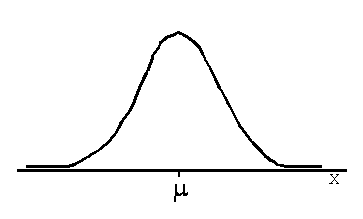
The normal distribution is the most important distribution in biostatistics.  It is frequently called the Gaussian distribution.  The two parameters of the normal distribution are the mean (m) and the standard deviation (s).  The graph has a familiar bell-shaped curve.

Graph of a Normal Distribution

Characteristics of the normal distribution

  1. It is symmetrical about m.
  2. The mean, median and mode are all equal.
  3. The total area under the curve above the x-axis is 1 square unit.  Therefore 50% is to the right of m and 50% is to the left of m.
  4. Perpendiculars of:
     ± s contain about 68%; 
        ±2 s contain about 95%;
        ±3 s contain about 99.7%
    of the area under the curve.

The standard normal distribution

A normal distribution is determined by m and s.  This creates a family of distributions depending on whatever the values of m and s are.  The standard normal distribution has m =0 and s =1.

 Finding normal curve areas

  1. The table gives areas between – and the value of .  
  2. Find the z value in tenths in the column at left margin and locate its row.  Find the hundredths place in the appropriate column.
  3. Read the value of the area (P) from the body of the table where the row and column intersect.  Note that P is the probability that a given value of z is as large as it is in its location.  Values of P are in the form of a decimal point and four places.  This constitutes a decimal percent.

Finding probabilities

We find probabilities using the table and a four-step procedure as illustrated below.

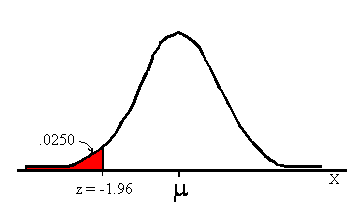
a) What is the probability that z < -1.96?

    (1) Sketch a normal curve
    (2) Draw a line for z = -1.96
    (3) Find the area in the table
    (4) The answer is the area to the left of the line P(z < -1.96) = .0250

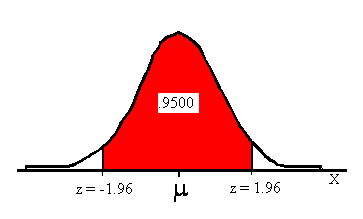
b)  What is the probability that -1.96 < z < 1.96?

    (1) Sketch a normal curve
    (2) Draw lines for lower z = -1.96, and upper z = 1.96
    (3) Find the area in the table corresponding to each value
    (4) The answer is the area between the values–subtract lower from upper P(-1.96 < z < 1.96) = .9750 – .0250 = .9500

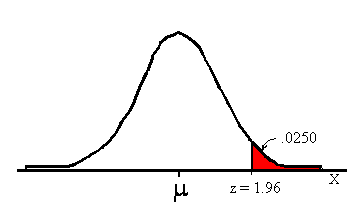
c)  What is the probability that z > 1.96?

    (1) Sketch a normal curve
    (2) Draw a line for z = 1.96
    (3) Find the area in the table
    (4) The answer is the area to the right of the line; found by subtracting table value from 1.0000; P(z > 1.96) =1.0000 – .9750 = .0250

Applications of the Normal distribution

The normal distribution is used as a model to study many different variables.  We can use the normal distribution to answer probability questions about random variables.  Some examples of variables that are normally distributed are human height and intelligence.

Solving normal distribution application problems

In this explanation we add an additional step.  Following the model of the normal distribution, a given value of x must be converted to a z score before it can be looked up in the z table.

(1) Write the given information
(2) Sketch a normal curve
(3) Convert x to a z score
(4) Find the appropriate value(s) in the table
(5) Complete the answer

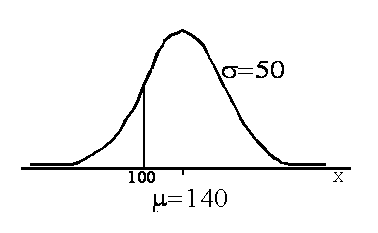
Illustrative Example:  Total fingerprint ridge count in humans is approximately normally distributed with mean of 140 and standard deviation of 50.  Find the probability that an individual picked at random will have a ridge count less than 100.  We follow the steps to find the solution.

(1) Write the given information

m = 140
s = 50
x = 100

(3) Convert x to a z score


(4) Find the appropriate value(s) in the table

    A value of z = -0.8 gives an area of .2119 which corresponds to the probability P (z < -0.8)

(5) Complete the answer

    The probability that x is less than 100 is .2119.

Business Finance, Features, Scope, Challenges

Business finance is the art and science of managing a company’s money to achieve its objectives and maximize shareholder value. Its core principle is the time value of money, which states that a dollar today is worth more than a dollar in the future. Key functions include making strategic investment decisions (capital budgeting), determining the optimal mix of debt and equity financing (capital structure), and managing day-to-day operational cash flows (working capital management). The overarching goal is to ensure the firm has the necessary funds to operate, grow, and generate profits while carefully balancing risk against potential returns. Sound financial management is thus fundamental to the survival, stability, and long-term success of any business.

Features of Business Finance:

  • Essential for Business Operations

Finance is the lifeblood of any business, as it ensures smooth functioning of day-to-day operations. Businesses need funds to purchase raw materials, pay wages, cover overhead expenses, and manage working capital requirements. Without adequate finance, even profitable businesses may face liquidity crises and operational difficulties. Proper financial planning helps in timely availability of funds, avoiding disruptions in production and services. Hence, finance acts as the foundation upon which all other business activities—such as production, marketing, and distribution—are built. Inadequate finance can restrict growth, while efficient financial management ensures stability and continuity of business operations.

  • Wide Scope

Business finance covers a broad range of activities, extending beyond just arranging funds. It includes estimating financial requirements, determining the sources of funds, allocating them efficiently, managing working capital, and ensuring proper utilization of financial resources. The scope also involves investment decisions, financing decisions, and dividend policies that impact the long-term growth and profitability of the enterprise. Additionally, it covers risk management, cost control, and compliance with financial regulations. Thus, business finance is not confined to raising money but also ensures that funds are used effectively to maximize returns, reduce risks, and enhance the overall value of the firm.

  • Involves Raising and Using Funds

One of the key features of business finance is that it deals with both raising funds and their effective utilization. Businesses raise finance from various sources such as equity, debt, retained earnings, or external borrowings. Once funds are raised, financial managers must allocate them in the most productive areas, ensuring maximum return at minimum risk. Merely raising funds is not enough; their proper utilization is critical to avoid wasteful expenditure and achieve financial goals. Therefore, business finance emphasizes not only mobilization of resources but also their efficient management to ensure profitability, liquidity, and long-term sustainability of the business.

  • Involves Risk and Uncertainty

Business finance is always associated with risk and uncertainty, as future returns on investments cannot be predicted with absolute certainty. Market fluctuations, changing interest rates, inflation, and unforeseen events like economic slowdowns or policy changes affect financial decisions. Investment in projects may or may not yield expected returns, and sources of finance may carry risks such as repayment obligations or shareholder pressure. Financial managers must evaluate risk factors before making decisions to balance profitability and safety. Effective risk analysis and planning are therefore essential in business finance to minimize potential losses and maximize long-term wealth creation for stakeholders.

  • Continuous Process

Finance in business is not a one-time activity but a continuous and ongoing process. From the inception of a business, funds are required for setup, and as the business grows, additional finance is needed for expansion, modernization, and diversification. Similarly, businesses need to manage working capital requirements daily to pay salaries, purchase raw materials, and meet routine expenses. Financial planning, raising funds, allocation, monitoring, and reinvestment continue throughout the life of the business. Since financial needs evolve with changing business conditions, business finance remains a dynamic and continuous function, crucial for maintaining growth and sustainability over time.

Scope of Business Finance:

  • Investment Decision (Capital Budgeting)

This involves the long-term allocation of a firm’s capital to viable projects and assets. It encompasses identifying, evaluating, and selecting investment opportunities that are expected to yield returns greater than the company’s cost of capital. Techniques like Net Present Value (NPV) and Internal Rate of Return (IRR) are used to assess the profitability and risk of proposals such as new machinery, plants, or product lines. This decision is crucial as it shapes the company’s future earning potential and strategic direction, committing large funds for long periods.

  • Financing Decision (Capital Structure)

This scope deals with procuring the necessary funds for investments and operations. It involves determining the optimal mix of debt and equity—known as the capital structure—to finance the firm’s assets. The goal is to minimize the overall cost of capital (WACC) while balancing the risk of bankruptcy associated with debt against the dilution of ownership from equity. Decisions include choosing between short-term and long-term financing, public issues, loans, and retained earnings to ensure funds are available at the right time and cost.

  • Dividend Decision (Profit Allocation)

This area focuses on determining the proportion of a company’s earnings to distribute to shareholders as dividends versus the amount retained within the business for reinvestment. The decision directly impacts shareholder wealth and the firm’s internal financing capacity (retained earnings). Management must strike a balance between providing immediate returns to investors and funding future growth opportunities, all while considering the “dividend policy” that signals financial health and prospects to the market.

  • Working Capital Management (Liquidity Decision)

This involves managing the firm’s short-term assets and liabilities to ensure smooth day-to-day operations. It includes managing cash, inventory, and receivables (current assets) against payables and short-term debt (current liabilities). The primary goal is to maintain sufficient liquidity to meet operational expenses and short-term obligations without tying up excessive capital in unproductive assets. Effective management ensures operational efficiency and protects the company from the risk of insolvency.

  • Risk Management

This scope involves identifying, analyzing, and mitigating various financial risks that threaten the firm’s profitability and survival. Key risks include market risk (from price fluctuations), credit risk (from customer non-payment), operational risk (from internal failures), and liquidity risk. Firms use tools like hedging with derivatives, insurance, diversification, and internal controls to manage these exposures. The objective is not to eliminate all risk but to understand it, ensure it is appropriately compensated, and protect the company’s assets and earnings from unforeseen events.

  • Financial Analysis and Planning

This is the foundational scope that involves analyzing historical performance and forecasting future financial needs. It includes interpreting financial statements through ratio analysis (profitability, liquidity, leverage), creating budgets, and formulating proforma financial statements. This analytical process is essential for setting financial goals, evaluating past decisions, and creating a roadmap for future growth. It ensures that the firm’s strategic objectives are translated into concrete financial targets and that resources are allocated efficiently to achieve them.

  • Corporate Restructuring and Governance

This area deals with major strategic financial actions that alter a company’s structure or ownership to enhance value. It includes activities like mergers and acquisitions (M&A), divestitures, spin-offs, and leveraged buyouts. Furthermore, it encompasses corporate governance—the system of rules and practices by which a company is directed and controlled. This ensures that management acts in the best interests of shareholders, maintains ethical standards, and provides accurate financial disclosure, which is crucial for maintaining investor confidence and access to capital.

Challenges of Business Finance:

  • Maintaining adequate cash flow

The paramount challenge is ensuring sufficient cash is available to meet immediate obligations like payroll, supplier payments, and rent. Profitability on paper does not guarantee liquidity. Late customer payments, high inventory levels, and unexpected expenses can quickly create a cash crunch, even for thriving businesses. Meticulous cash flow forecasting and active working capital management are essential to avoid insolvency, where a company fails not from lack of potential but from a lack of accessible funds.

  • Managing Financial Risks

Businesses face a multitude of financial risks, including fluctuating interest rates on debt, foreign exchange movements for importers/exporters, customer defaults (credit risk), and changing commodity prices. A significant challenge is identifying these exposures and implementing effective, cost-efficient strategies to hedge against them. Failure to manage these risks can lead to devastating losses, eroding profit margins and jeopardizing financial stability, requiring constant vigilance and sophisticated financial tools.

  • Accessing Capital and Funding

Securing affordable financing for operations and growth is a persistent hurdle. The challenge is choosing the right source (debt vs. equity) and convincing lenders or investors of the business’s viability. New ventures and SMEs often struggle with this, facing high interest rates or demanding repayment terms. The cost of capital must be low enough to allow for profitable investment, making this a critical barrier to expansion and innovation for many firms.

  • Navigating Economic Uncertainty

Macroeconomic factors like inflation, recession, changing government policies, and geopolitical events create an unpredictable environment. These conditions make accurate financial planning, forecasting, and budgeting extremely difficult. Inflation erodes purchasing power and can increase costs faster than prices can be adjusted. A challenge is building financial resilience and flexibility into the business model to withstand economic shocks and volatility beyond the company’s control.

  • Making Optimal Investment Decisions (Capital Budgeting)

Choosing which long-term projects to invest in is fraught with challenge. It requires accurately forecasting future cash flows, assessing project-specific risks, and selecting the correct hurdle rate. There is always the risk of over-investing in a failing project or under-investing and missing a key opportunity. The complexity of evaluating intangible benefits and the potential for biased projections make this a critical test of strategic financial management.

  • Achieving Optimal Capital Structure

Striking the perfect balance between debt and equity financing is a complex challenge. Too much debt increases financial risk and interest burdens, potentially leading to bankruptcy. Too much equity dilutes ownership and can be more expensive. The challenge is to find the mix that minimizes the overall cost of capital while maintaining financial flexibility and acceptable risk, a balance that shifts with market conditions and the business’s life cycle stage.

  • Compliance and Regulatory Adherence

The financial landscape is governed by a complex web of ever-changing laws, accounting standards (like IFRS or GAAP), and tax regulations. The challenge is twofold: the cost of ensuring compliance (hiring experts, implementing systems) and the risk of severe penalties, legal issues, and reputational damage for non-compliance. This burden is particularly heavy for businesses operating across multiple jurisdictions, each with its own unique regulatory framework.

Finance, Introduction, Meaning, Definitions, Objectives, Types and Source of Finance

Finance is the management of money, investments, and other financial instruments. It involves acquiring, allocating, and utilizing funds efficiently to achieve financial stability and growth. Finance plays a crucial role in both personal and business decision-making, ensuring optimal resource allocation. It is broadly classified into Public Finance, Corporate Finance, and Personal Finance. Financial management involves planning, budgeting, investing, risk assessment, and financial control to maximize profitability and minimize risks. With globalization and technological advancements, finance has evolved into a dynamic field, integrating digital payments, fintech, and blockchain. Effective financial management is essential for economic stability and sustainable development.

Meaning of Finance

Finance refers to the study and management of money, investments, and other financial instruments. It encompasses the processes of acquiring funds, allocating resources, and ensuring their optimal use to achieve organizational or personal objectives. Finance is not limited to handling money alone; it also involves planning, controlling, and monitoring the financial activities of a business or individual to maintain liquidity, solvency, and profitability. In simple terms, finance is the art and science of managing money effectively.

Definitions of Finance

  • According to Solomon Ezra: “Finance is the function of providing funds for the business and managing the flow of money in and out of the business.”Explanation: This definition emphasizes finance as a source of funds and its utilization in business operations.
  • According to Weston and Brigham: “Finance is the activity concerned with the procurement, allocation, and control of financial resources.”Explanation: This highlights three key aspects: raising funds, using them efficiently, and controlling their flow.
  • According to I.M. Pandey: “Finance is the art and science of managing money.”Explanation: This concise definition captures the dual nature of finance – as a skill (art) and as a systematic discipline (science).
  • According to George R. Terry: “Finance is the process of acquiring and using funds.”Explanation: This definition stresses the two main functions of finance: acquisition of funds and their application.

Objectives of Finance:

  • Profit Maximization

The primary objective of finance is to maximize profit by ensuring efficient utilization of financial resources. Businesses aim to increase revenue while minimizing costs to achieve higher profitability. This is crucial for business survival, growth, and investor confidence. However, focusing solely on profit may overlook risks, sustainability, and ethical considerations. A balanced approach, including long-term financial planning and risk assessment, ensures sustainable profit generation. Companies must maintain operational efficiency, cost control, and revenue growth while adhering to ethical financial practices for consistent success.

  • Wealth Maximization

Wealth maximization focuses on increasing shareholder value by maximizing the market price of shares. Unlike profit maximization, which emphasizes short-term gains, wealth maximization considers long-term benefits by accounting for investment risks and returns. It ensures financial stability by prioritizing sustainable growth, risk diversification, and strategic decision-making. This approach attracts investors, boosts market credibility, and enhances financial health. By integrating financial planning, asset allocation, and risk management, organizations can optimize resources to increase shareholders’ wealth, leading to long-term business expansion and economic sustainability.

  • Efficient Fund Utilization

Finance aims to allocate and utilize funds efficiently to maximize returns while minimizing waste. Effective fund utilization ensures that financial resources are directed towards profitable investments, operational efficiency, and business expansion. It involves capital budgeting, working capital management, and cost control to optimize financial performance. Mismanagement of funds can lead to financial distress, liquidity crises, and operational inefficiencies. Proper financial planning, strategic investment, and budgetary controls help organizations maintain a balance between revenue generation and expenditure, ensuring long-term financial stability and growth.

  • Liquidity Management

Maintaining sufficient liquidity is essential for meeting short-term obligations and ensuring smooth business operations. Liquidity management involves balancing cash inflows and outflows to prevent financial crises and avoid excessive idle cash. Companies must manage working capital, monitor cash reserves, and optimize credit policies to ensure operational efficiency. Insufficient liquidity can lead to financial distress, while excessive liquidity may result in underutilized resources. By maintaining an optimal cash balance and investing in liquid assets, businesses can meet their obligations while enhancing financial flexibility and stability.

  • Risk Management

Risk is inherent in financial activities, making risk management a crucial financial objective. Businesses must identify, assess, and mitigate financial risks such as market fluctuations, credit defaults, operational failures, and economic downturns. Risk management strategies include diversification, hedging, insurance, and financial derivatives to minimize potential losses. Proper risk assessment ensures business continuity, protects investments, and enhances decision-making. A proactive approach to financial risk management helps organizations adapt to uncertainties, maintain financial stability, and achieve long-term growth by securing assets and minimizing unforeseen financial disruptions.

  • Capital Structure Optimization

A well-balanced capital structure ensures financial stability by maintaining an optimal mix of debt and equity. The right capital structure minimizes the cost of capital, enhances profitability, and reduces financial risk. Businesses must assess their financial needs and select appropriate funding sources to support operations and expansion. Excessive debt increases financial risk, while excessive equity dilutes ownership. By optimizing the capital structure, companies can maintain financial health, improve creditworthiness, and maximize shareholder returns while ensuring business sustainability and operational efficiency.

  • Cost Reduction and Control

Controlling and reducing costs is vital for financial sustainability and profitability. Financial management involves budgeting, expense monitoring, and cost-cutting measures to optimize operations. Effective cost management ensures competitive pricing, improves profit margins, and enhances overall financial efficiency. Businesses implement lean practices, automation, and process improvements to minimize wastage and maximize resource utilization. By maintaining financial discipline and continuously evaluating expenses, organizations can reduce unnecessary expenditures, enhance financial performance, and achieve long-term success without compromising on quality or productivity.

  • Economic Growth and Sustainability

Finance plays a crucial role in economic development by supporting business expansion, job creation, and wealth generation. Sustainable financial practices ensure long-term growth while minimizing environmental and social risks. Companies must integrate ethical finance, corporate social responsibility (CSR), and green investments into their financial strategies. Responsible financial management promotes stability, attracts socially responsible investors, and enhances brand reputation. By aligning financial goals with sustainability initiatives, businesses contribute to overall economic progress, environmental conservation, and long-term societal well-being while ensuring financial security and resilience.

Types of Finance:

  • Personal Finance

Personal finance involves managing an individual’s financial activities, including income, expenses, savings, investments, and debt management. It focuses on financial planning for short-term needs and long-term goals like retirement, education, and homeownership. Key elements include budgeting, tax planning, insurance, and investment in assets like stocks, bonds, and real estate. Proper personal finance management ensures financial stability, reduces financial stress, and helps individuals achieve financial independence. With the rise of digital banking and fintech, managing personal finances has become more accessible through mobile apps and online financial tools.

  • Corporate Finance

Corporate finance deals with the financial activities of businesses, focusing on capital investment, funding, financial planning, and risk management. It involves decisions related to capital structure, working capital management, and investment strategies to maximize profitability and shareholder value. Companies raise funds through equity, debt, or hybrid instruments to support growth and expansion. Corporate finance also includes mergers, acquisitions, and dividend policies. Effective corporate finance management ensures financial stability, operational efficiency, and competitive advantage, allowing businesses to thrive in dynamic market conditions and achieve sustainable long-term growth.

  • Public Finance

Public finance refers to the management of a government’s revenue, expenditures, and debt. It involves taxation, government spending, budget formulation, and fiscal policies aimed at promoting economic growth and stability. Public finance ensures the provision of essential public services such as healthcare, education, infrastructure, and social security. Governments use various financial tools, including bonds, grants, and subsidies, to manage public resources effectively. Sound public finance management is crucial for maintaining economic stability, reducing income inequality, and ensuring long-term national development by balancing public expenditures with revenue generation.

  • International Finance

International finance focuses on financial transactions and capital movements across countries. It deals with foreign exchange markets, global investments, international trade finance, and cross-border financial regulations. Key aspects include exchange rate fluctuations, foreign direct investment (FDI), balance of payments, and multinational corporate finance. International financial institutions like the International Monetary Fund (IMF) and the World Bank play a crucial role in maintaining global financial stability. With globalization, international finance has become essential for businesses and governments in managing foreign currency risks and expanding into global markets.

  • Development Finance

Development finance focuses on funding projects that promote economic and social development, particularly in underdeveloped and developing countries. It includes financial support for infrastructure, healthcare, education, and poverty alleviation programs. Development finance institutions (DFIs) and international organizations provide loans, grants, and technical assistance to support sustainable growth. Governments, NGOs, and private investors collaborate to finance projects that enhance living standards and economic stability. Effective development finance strategies help bridge financial gaps, stimulate entrepreneurship, and create employment opportunities, ultimately fostering long-term economic progress and reducing inequality.

  • Investment Finance

Investment finance involves managing funds for wealth creation through various financial instruments such as stocks, bonds, mutual funds, and real estate. It includes portfolio management, risk assessment, and asset allocation to maximize returns. Investment finance plays a key role in capital markets, providing liquidity and funding for businesses. Individual and institutional investors use investment finance strategies to diversify risks and achieve financial goals. With advancements in technology, digital investment platforms and robo-advisors have made investment finance more accessible, enabling informed decision-making and efficient management of financial assets.

  • Microfinance

Microfinance provides small financial services, including loans, savings, and insurance, to low-income individuals and small businesses that lack access to traditional banking. It plays a crucial role in poverty alleviation by enabling entrepreneurs to start and expand businesses. Microfinance institutions (MFIs) offer credit without collateral, empowering financially excluded communities. It promotes financial inclusion, women’s empowerment, and economic development. Despite challenges like high-interest rates and repayment risks, microfinance continues to support self-sufficiency and social progress, bridging financial gaps and fostering entrepreneurship in rural and underserved regions.

  • Green Finance

Green finance focuses on funding environmentally sustainable projects and businesses that promote climate resilience and clean energy. It includes investments in renewable energy, energy efficiency, waste management, and sustainable agriculture. Financial instruments like green bonds, carbon credits, and ESG (Environmental, Social, and Governance) funds support eco-friendly initiatives. Green finance helps combat climate change by encouraging businesses and governments to adopt sustainable practices. By integrating environmental considerations into financial decisions, green finance promotes responsible investments, enhances sustainability, and contributes to a greener, more resilient global economy.

Source of Finance

  • Equity Capital

Equity capital refers to funds raised by a company by issuing shares to the public or private investors. Shareholders who provide equity capital become part-owners of the business and are entitled to dividends and voting rights. It is a permanent source of finance and does not require repayment, making it suitable for long-term investments. However, it may dilute control of the original owners.

  • Preference Shares

Preference shares are a hybrid form of finance that provides shareholders with a fixed dividend before equity shareholders. They usually do not carry voting rights but are less risky for investors because dividends are prioritized. Companies use preference shares to raise funds without giving up significant control while ensuring a steady financial inflow for long-term or medium-term projects.

  • Retained Earnings

Retained earnings are profits that a company retains instead of distributing them as dividends. This internal source of finance is cost-free and strengthens the company’s financial base. It is ideal for expansion, modernization, or working capital requirements. Relying on retained earnings reduces dependence on external financing, but excessive retention may dissatisfy shareholders expecting higher dividends.

  • Debentures

Debentures are long-term debt instruments issued by companies to borrow money from the public or institutions. They carry a fixed interest rate and must be repaid after a specified period. Debentures do not dilute ownership but create a fixed financial obligation. They are useful for raising large sums for long-term projects while maintaining managerial control.

  • Bank Loans

Bank loans are a common external source of finance where funds are borrowed for a fixed period at a predetermined interest rate. Loans can be short-term, medium-term, or long-term, depending on the need. Banks may require collateral or guarantees. Loans provide quick access to funds but involve interest payments and financial discipline to meet repayment schedules.

  • Trade Credit

Trade credit is a short-term source of finance offered by suppliers, allowing businesses to purchase goods or services and pay later. It helps maintain liquidity and manage working capital efficiently. Trade credit is interest-free if paid within the agreed period. It is widely used in day-to-day operations but excessive reliance may strain supplier relationships or creditworthiness.

  • Lease Financing

Lease financing involves acquiring assets through leasing rather than purchasing them outright. It provides access to modern equipment without heavy initial investment. Lease payments are considered an operating expense, which may offer tax benefits. This source is useful for companies with limited capital but may cost more in the long run compared to outright purchase.

  • Public Deposits

Companies can raise finance by accepting deposits from the public, which are repayable after a fixed period along with interest. It is a cheaper source compared to bank loans and does not dilute ownership. Public deposits are regulated by government guidelines, and trustworthiness of the company is crucial to attract investors. They are commonly used for short-term working capital needs.

  • Venture Capital

Venture capital is financing provided by investors to startups or small businesses with high growth potential. Investors take an equity stake in return for funding. It is suitable for innovative projects that may not qualify for traditional financing. Venture capitalists also offer managerial expertise but expect high returns and exit strategies within a stipulated time.

  • Government Grants and Subsidies

Governments provide grants, subsidies, or soft loans to promote certain industries or sectors. This non-repayable or low-cost finance encourages business growth and reduces financial burden. It is especially helpful for new enterprises, research, and infrastructure development. Eligibility conditions and compliance with government regulations are mandatory, limiting unrestricted use.

error: Content is protected !!