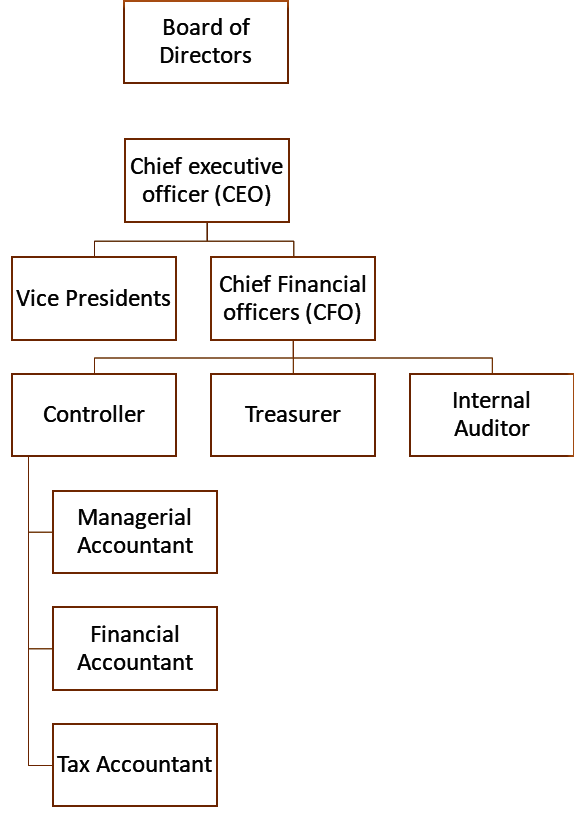
Organization Structure of Finance Department

“A Typical Organization Chart” is a typical organization chart; it shows how accounting and finance personnel fit within most companies. The personnel at the bottom of the chart report to those above them. For example, the managerial accountant reports to the controller. At the top of the chart are those who control the company, typically the board of directors (who are elected by the owners or shareholders). Review Figure 1.1 “A Typical Organization Chart” before moving on to the detailed discussion of each important finance and accounting position.

Represents vice presidents of various departments outside of accounting and finance such as production, personnel, and research and development.

In addition to reporting to the chief financial officer, the internal auditor typically reports independently to the board of directors and/or the audit committee (made up of select members of the board of directors).

Chief Financial Officer

The chief financial officer (CFO) is in charge of all the organization’s finance and accounting functions and typically reports to the chief executive officer.

Controller

The controller is responsible for managing the accounting staff that provides managerial accounting information used for internal decision making, financial accounting information for external reporting purposes, and tax accounting information to meet tax filing requirements. The three accountants the controller manages are as follows:

  • Managerial accountant. The managerial accountant reports directly to the controller and assists in preparing information used for decision making within the organization. Reports prepared by managerial accountants include operational budgets, cost estimates for existing products, budgets for new product lines, and profit and loss reports by division. (Note that some people use the term cost accountant interchangeably with managerial accountant. Others consider cost accounting a specific function of managerial accounting that focuses on measuring costs. In this text, we use the term managerial accountant and assume that cost accountants focus on measuring costs.)
  • Financial accountant. The financial accountant reports directly to the controller and assists in preparing financial information, in accordance with U.S. GAAP, for those outside the company. Reports prepared by financial accountants include a quarterly report filed with the Securities and Exchange Commission (SEC) that is called a 10Q and an annual report filed with the SEC that is called a 10K.
  • Tax accountant. The tax accountant reports directly to the controller and assists in preparing tax reports for governmental agencies, including the Internal Revenue Service.

Treasurer

The treasurer reports directly to the CFO. A treasurer’s primary duties include obtaining sources of financing for the organization (e.g., from banks and shareholders), projecting cash flow needs, and managing cash and short-term investments.

Internal Auditor

An internal auditor reports to the CFO and is responsible for confirming that the company has controls that ensure accurate financial data. The internal auditor often verifies the financial information provided by the managerial, financial, and tax accountants (all of whom report to the controller and ultimately to the CFO). If conflicts arise with the CFO, an internal auditor can report directly to the board of directors or to the audit committee, which consists of select board members.

Note: Not All Organization follow the Same Hierarchy

Factors influencing a Sound Financial plan

Financial Plan is a strategic blueprint that outlines an organization’s financial goals, resource allocation, investment strategies, and risk management measures. It ensures optimal fund utilization, profitability, and long-term stability. A well-structured financial plan includes budgeting, capital structure planning, cash flow management, and financial forecasting. It helps businesses make informed decisions, achieve financial sustainability, and adapt to changing economic conditions while maintaining liquidity and operational efficiency.

Factors Influencing a Sound Financial Plan:

  • Business Goals and Objectives

A sound financial plan must align with an organization’s short-term and long-term goals. Clear financial objectives help in resource allocation, investment planning, and risk management. Whether a company aims for expansion, market diversification, or profitability, the financial plan should support these goals. Without well-defined objectives, financial decisions may lack direction, leading to inefficiencies. Businesses must regularly evaluate and adjust their financial strategies to remain aligned with evolving objectives and market conditions, ensuring sustained growth and stability.

  • Economic Conditions

The overall economic environment significantly impacts financial planning. Inflation, interest rates, GDP growth, and economic cycles influence investment decisions, borrowing costs, and financial stability. During economic booms, businesses may adopt aggressive expansion strategies, whereas during recessions, they may focus on cost-cutting and liquidity management. A sound financial plan incorporates economic forecasts and market trends to mitigate risks and capitalize on opportunities. Monitoring macroeconomic indicators helps businesses adapt to changing conditions and maintain financial resilience.

  • Capital Structure

A balanced capital structure ensures financial stability and growth. The right mix of debt and equity financing impacts a company’s profitability, risk exposure, and cost of capital. Excessive reliance on debt increases financial risk due to high-interest obligations, while over-dependence on equity can dilute ownership and reduce returns. A sound financial plan carefully evaluates financing options to optimize capital costs. Businesses should maintain a capital structure that supports operational efficiency, investment capacity, and long-term sustainability.

  • Liquidity and Cash Flow Management

Maintaining adequate liquidity is essential for meeting financial obligations, operational expenses, and unforeseen contingencies. A sound financial plan ensures a steady cash flow through effective revenue management, timely payments, and efficient working capital control. Poor liquidity management can lead to financial distress, delayed payments, and operational disruptions. Businesses must forecast cash flows, maintain contingency reserves, and optimize fund utilization to avoid liquidity crises. Proper cash flow management ensures smooth business operations and financial stability.

  • Risk Management

Financial risks, including market volatility, credit risks, and economic uncertainties, must be addressed in financial planning. A sound financial plan incorporates risk assessment techniques such as diversification, hedging, and insurance to mitigate potential financial losses. Identifying and analyzing risks helps businesses develop contingency strategies to safeguard financial health. Without effective risk management, businesses may face financial instability, reduced profitability, and potential losses. A proactive risk management approach ensures long-term resilience and business sustainability.

  • Regulatory and Tax Compliance

Adhering to financial regulations and tax laws is crucial for a sound financial plan. Non-compliance can result in penalties, legal issues, and reputational damage. Businesses must consider corporate tax structures, GST regulations, financial reporting standards, and legal obligations while planning finances. Staying updated on regulatory changes ensures smooth financial operations and avoids legal risks. A well-planned tax strategy helps minimize liabilities and optimize profits while ensuring compliance with government policies and industry norms.

  • Investment Decisions

Strategic investment planning is a key component of a sound financial plan. Businesses must carefully analyze investment opportunities, expected returns, and associated risks. Investment decisions should align with long-term business objectives and financial capacity. A well-diversified investment portfolio minimizes risks and enhances financial security. Poor investment choices can lead to financial instability and losses. Evaluating investment feasibility, return on investment (ROI), and market trends ensures effective capital allocation and wealth maximization.

  • Market Competition and Industry Trends

Competitive market conditions and industry trends influence financial planning. Businesses must analyze competitors’ financial strategies, pricing models, and market positioning to remain competitive. A sound financial plan considers industry growth, technological advancements, and consumer preferences to make informed financial decisions. Adapting to market trends ensures business sustainability and profitability. Ignoring industry dynamics can lead to outdated financial strategies, loss of market share, and reduced profitability. Staying informed about market changes is essential for financial success.

  • Cost Control and Profitability

Efficient cost management enhances profitability and financial health. A sound financial plan focuses on reducing unnecessary expenses while maintaining quality and productivity. Businesses must analyze cost structures, implement cost-cutting measures, and optimize operational efficiency. Strategic budgeting and expense tracking ensure financial stability. Poor cost management can lead to reduced profitability, cash flow issues, and financial instability. Regular financial audits and performance reviews help businesses maintain a balance between cost efficiency and revenue generation.

  • Technological Advancements

Technology plays a crucial role in financial planning by improving efficiency, accuracy, and decision-making. Businesses use financial software, AI-driven analytics, and automated systems for budgeting, forecasting, and risk assessment. A sound financial plan incorporates technological advancements to streamline financial processes and enhance productivity. Ignoring technology can lead to inefficiencies and competitive disadvantages. Implementing modern financial tools ensures better data analysis, improved cash flow management, and enhanced financial decision-making.

  • Stakeholder Expectations

Financial planning must consider the expectations of stakeholders, including investors, shareholders, employees, and customers. A sound financial plan ensures transparency, accountability, and ethical financial management. Investors seek profitability and return on investment, while employees expect job security and growth opportunities. Aligning financial strategies with stakeholder interests fosters trust and long-term relationships. Failure to meet stakeholder expectations can result in decreased investor confidence, employee dissatisfaction, and reputational risks. Managing stakeholder expectations is essential for financial success.

  • Globalization and International Markets

Businesses operating in global markets must consider exchange rates, trade policies, and international financial regulations in their financial planning. Fluctuations in currency values, global economic trends, and geopolitical risks impact financial decisions. A sound financial plan includes strategies to manage foreign exchange risks, international investments, and cross-border transactions. Globalization offers growth opportunities, but financial planning must address associated risks. Ignoring international financial factors can lead to financial losses and instability in global operations.

Role of a Financial Manager

The role of a finance manager in India involves financial planning, capital structure management, investment decisions, risk management, and ensuring regulatory compliance. They oversee working capital, optimize resource allocation, and implement financial strategies to enhance profitability. Finance managers also handle mergers, acquisitions, and corporate finance activities to drive business growth. They ensure accurate financial reporting, maintain investor confidence, and align financial goals with business objectives. By managing financial risks and adhering to SEBI, RBI, and taxation regulations, they contribute to a company’s stability and expansion. Their role is critical in ensuring financial sustainability and long-term business success.

Role of a Finance Manager in India:

  • Financial Planning and Strategy

A finance manager in India plays a crucial role in financial planning by setting short-term and long-term financial goals for the organization. They prepare budgets, forecast future financial needs, and align financial strategies with business objectives. By analyzing market trends, economic conditions, and company performance, they ensure optimal resource allocation. Financial planning helps businesses maintain liquidity, achieve growth, and minimize financial risks. Effective financial strategies contribute to organizational success, ensuring sustainable development and maximizing shareholder value in a dynamic economic environment.

  • Capital Structure Management

The finance manager is responsible for deciding the appropriate mix of debt and equity to finance business operations. They evaluate factors like interest rates, risk tolerance, and funding requirements to determine the optimal capital structure. Proper capital management ensures financial stability, reduces the cost of capital, and enhances profitability. In India, where businesses rely on a mix of bank loans, equity funding, and bonds, finance managers must make strategic decisions to balance financial risks and returns, ensuring business expansion and investor confidence.

  • Investment and Capital Budgeting Decisions

Finance managers assess investment opportunities and allocate funds to projects that yield maximum returns. They use capital budgeting techniques like Net Present Value (NPV), Internal Rate of Return (IRR), and Payback Period to evaluate long-term investments. Investment decisions impact the company’s growth and profitability, requiring careful risk assessment. In India, finance managers play a key role in funding infrastructure projects, business expansions, and technology upgrades. By making sound investment decisions, they ensure efficient capital utilization and long-term financial sustainability.

  • Working Capital Management

Effective working capital management ensures smooth business operations by maintaining an optimal balance between current assets and liabilities. Finance managers oversee cash flow, accounts receivable, inventory, and accounts payable to avoid liquidity crises. In India, businesses often face challenges like delayed payments and credit constraints. Finance managers implement strategies like just-in-time inventory management and credit control policies to optimize working capital. Proper management reduces financial stress, improves operational efficiency, and ensures uninterrupted business activities, contributing to overall organizational success.

  • Risk Management and Compliance

Finance managers in India identify, assess, and mitigate financial risks such as market volatility, credit risks, and regulatory changes. They implement strategies like diversification, hedging, and insurance to protect the company’s financial health. Compliance with financial regulations, including taxation, corporate governance, and SEBI guidelines, is essential. By ensuring adherence to legal and regulatory frameworks, finance managers prevent penalties and reputational risks. Strong risk management practices enhance business stability, investor trust, and long-term financial security in the ever-evolving Indian economic landscape.

  • Profit Allocation and Dividend Policy

Finance managers decide how to allocate profits between reinvestment and dividend distribution to shareholders. In India, companies follow different dividend policies based on profitability, growth prospects, and shareholder expectations. A well-planned dividend strategy enhances investor confidence and maintains stock market stability. Finance managers ensure a balance between rewarding investors and reinvesting in business expansion. Proper profit allocation contributes to financial sustainability, shareholder satisfaction, and the company’s long-term growth, making it a critical function of financial management in India.

  • Financial Reporting and Analysis

Finance managers are responsible for preparing and analyzing financial statements, including balance sheets, income statements, and cash flow statements. They ensure transparency, accuracy, and compliance with accounting standards like the Indian Accounting Standards (Ind AS). Financial analysis techniques such as ratio analysis and trend analysis help in assessing profitability, liquidity, and financial stability. In India, finance managers play a crucial role in presenting financial reports to stakeholders, regulators, and investors. Effective financial reporting enhances decision-making, investor confidence, and corporate governance.

  • Corporate Finance and Mergers & Acquisitions

Finance managers in India oversee corporate finance activities, including mergers, acquisitions, and fundraising. They evaluate potential mergers and acquisitions to enhance business expansion and competitive advantage. Managing financial restructuring, negotiating deals, and assessing the financial viability of partnerships are key responsibilities. With India’s growing startup ecosystem and increasing foreign investments, finance managers play a vital role in securing funding, facilitating corporate restructuring, and ensuring strategic financial growth. Their expertise in corporate finance decisions directly impacts business success and market positioning.

Time Value of Money, Introduction, Meaning, Definition, Need, Features and Importance

Time Value of Money (TVM) is a financial principle stating that money available today is worth more than the same amount in the future due to its earning potential. This is because money can be invested to generate returns over time. TVM considers factors like interest rates, inflation, and opportunity cost, which influence the value of money. It is essential in investment decisions, loan calculations, and retirement planning. Key TVM concepts include present value (PV), future value (FV), annuities, and discounting cash flows, helping businesses and individuals make informed financial choices.

There is no reason for any rational person to delay taking an amount owed to him or her. More than financial principles, this is basic instinct. The money you have in hand at the moment is worth more than the same amount you ‘may’ get in future. One reason for this is inflation and another is possible earning capacity. The fundamental code of finance maintains that, given money can generate interest, the value of a certain sum is more if you receive it sooner. This is why it is called as the present value.

Meaning of Time Value of Money

The Time Value of Money means that money available today has greater purchasing power and earning capacity compared to the same amount received later. This happens because money can be invested to earn interest or returns over time. Inflation, risk, and opportunity cost further influence this value. Thus, when money is delayed, its potential to earn returns is lost, decreasing its present worth. TVM allows evaluation of how money’s value changes across different time periods.

Definition of Time Value of Money

The Time Value of Money is defined as the concept that the value of a sum of money changes over time due to its earning potential, interest, risk, and inflation. It states that “a rupee today is worth more than a rupee tomorrow” because today’s money can be invested to generate future income. TVM is used to determine present value, future value, annuities, and discounting calculations essential for financial decisions.

Basic TVM Formula:

Depending on the exact situation in question, the TVM formula may change slightly. For example, in the case of annuity or perpetuity payments, the generalized formula has additional or less factors. But in general, the most fundamental TVM formula takes into account the following variables:

FV = PV x [ 1 + (i / n) ] (n x t)

  • FV = Future value of money
  • PV = Present value of money
  • i = interest rate
  • n = number of compounding periods per year
  • t = number of years

Need of Time Value of Money:

  • Investment Decision-Making

Time Value of Money (TVM) helps investors evaluate whether an investment today will yield better returns in the future. Since money can earn interest over time, understanding TVM ensures that funds are allocated to the most profitable opportunities. It helps in comparing different investment options by calculating their present value (PV) and future value (FV), enabling businesses and individuals to make informed financial decisions that maximize wealth over time.

  • Loan and Mortgage Calculations

TVM is crucial in determining the repayment structure for loans and mortgages. Lenders use interest rates and discounting principles to set loan terms, ensuring that future payments account for the decrease in money’s value over time. Borrowers can use TVM to assess the real cost of a loan and compare different financing options. Understanding TVM helps individuals choose the best repayment strategy and avoid overpaying due to high-interest rates.

  • Retirement and Financial Planning

TVM plays a key role in financial and retirement planning. Individuals must determine how much to save and invest today to meet future financial goals. By calculating future value, they can estimate the amount required for retirement and adjust contributions accordingly. TVM ensures that people consider inflation and interest rates when planning for long-term financial stability, ensuring a comfortable future.

  • Business Valuation and Capital Budgeting

Companies use TVM to assess investment projects, capital budgeting, and business valuation. It helps in determining whether an investment will generate higher returns than the cost of capital. Businesses apply TVM to calculate net present value (NPV), internal rate of return (IRR), and payback period, allowing them to make sound financial decisions. Proper application of TVM ensures efficient allocation of resources to maximize profitability.

  • Inflation and Purchasing Power Considerations

Inflation reduces the value of money over time, making TVM essential for maintaining purchasing power. Individuals and businesses must consider inflation-adjusted returns when making long-term financial decisions. Without accounting for TVM, savings and investments may lose value, leading to financial instability. Understanding TVM helps in preserving wealth by ensuring money grows at a rate higher than inflation.

Features of Time Value of Money

  • Money Has Earning Capacity

A key feature of the Time Value of Money is that money has the ability to earn returns when invested. A sum received today can be placed in a savings account, fixed deposit, mutual fund, or business venture to generate additional income. This earning capacity makes present money more valuable than future money. The higher the potential return, the greater the difference between current and future value. This feature forms the foundation for interest calculations, investment decisions, and long-term financial planning.

  • Present Value Is Greater Than Future Value

TVM emphasises that the present value of money is always higher than its future value. This difference arises because future money cannot earn returns until it is received. Additionally, inflation gradually reduces the purchasing power of money over time. Therefore, ₹1,000 today can buy more goods and services than ₹1,000 in the future. This feature helps financial managers evaluate delayed payments, investment options, and cost–benefit decisions by appropriately discounting future cash flows to the present.

  • Based on Interest and Discounting Concepts

The Time Value of Money operates on two core financial principles: interest and discounting. Interest refers to the return earned on invested money over time, while discounting reduces future cash flows to their present worth. Both processes rely on a rate—interest rate for compounding and discount rate for calculating present value. These calculations help determine future value (FV), present value (PV), annuities, and loan amortisation schedules. Understanding these principles is essential for accurate financial analysis.

  • Affected by Inflation and Purchasing Power

Inflation plays a major role in determining the time value of money. As prices rise over time, the actual purchasing power of money declines. Therefore, money held idle loses value when inflation is high. TVM incorporates the impact of inflation while comparing cash flows across time. Financial managers must consider both nominal and real interest rates to evaluate the true value of money. This feature ensures that long-term investment decisions reflect realistic future purchasing power.

  • Time Period Influences Value Strongly

The length of the time period significantly impacts how money grows or depreciates. The longer the time duration, the greater the effect of compounding or discounting. Even small changes in time can lead to large differences in future or present value. For example, investments held for 10 years will grow substantially more than those held for 2 years due to compounding. This feature helps businesses plan long-term finance, assess project viability, and determine loan repayment schedules accurately.

  • Risk and Uncertainty Affect Value

Risk and uncertainty also influence the time value of money. Future cash flows are uncertain due to market fluctuations, business risks, economic instability, and interest rate changes. Because of this uncertainty, future money is considered riskier and therefore less valuable. Higher risk typically requires a higher discount rate to determine present value. This feature ensures that risk-adjusted returns are calculated properly and that investments are evaluated in a realistic and cautious manner.

  • Essential for Comparing Future Cash Flows

TVM is crucial for comparing cash flows that occur at different points in time. Since money changes in value, financial managers cannot directly compare cash inflows and outflows from different years. TVM techniques like discounting and compounding standardize cash flows into the same time frame, enabling accurate comparison. This feature is widely used in capital budgeting, loan decisions, bond valuation, and retirement planning. It ensures that all financial choices are based on realistic and consistent value estimates.

  • Fundamental to Investment and Financial Decisions

Time Value of Money is the backbone of financial decision-making. Whether it is evaluating investment alternatives, determining loan instalments, estimating cost of capital, or planning long-term finances, TVM provides the necessary quantitative framework. It helps investors understand how money grows, how risks affect value, and how different options compare over time. This feature makes TVM indispensable in financial management, ensuring that decisions maximise returns, minimise costs, and support sound financial planning for individuals and organisations.

Importance of Time Value of Money

  • Helps in Making Rational Financial Decisions

The Time Value of Money is essential for making logical and informed financial decisions. Since the value of money changes over time, financial managers must evaluate the present worth and future worth of cash flows before choosing an option. TVM helps compare today’s cash inflow with future benefits, ensuring decisions are not based merely on nominal amounts. By understanding how money grows or depreciates, individuals and businesses make rational choices that maximise returns and minimise risks.

  • Basis for Investment Evaluation and Capital Budgeting

TVM is the foundation of investment appraisal techniques such as Net Present Value (NPV), Internal Rate of Return (IRR), Payback Period, and Profitability Index. These techniques rely on discounting future cash flows to determine the viability of long-term projects. Without TVM, managers cannot accurately assess whether a project will generate value over time. Therefore, TVM ensures resources are allocated to profitable and sustainable investments, supporting efficient capital budgeting and long-term business growth.

  • Essential for Loan and Mortgage Calculations

Financial institutions use TVM concepts to calculate loan EMIs, interest payments, and amortisation schedules. Borrowers must understand TVM to analyse the true cost of borrowing and compare loan alternatives. TVM helps determine how interest accumulates over time and how much of the instalment goes toward principal repayment. This knowledge ensures borrowers choose affordable loans, avoid excessive interest costs, and manage personal finances effectively. For banks, TVM ensures fair and accurate lending practices.

  • Useful in Retirement and Long-Term Financial Planning

TVM plays a crucial role in planning for retirement, education funds, insurance needs, and future financial goals. Individuals use TVM to calculate how much money must be saved today to achieve a desired future amount. It helps estimate future corpus requirements by accounting for inflation, interest rates, and time period. By understanding TVM, people can plan systematically, invest regularly, and ensure financial security in later years. Thus, TVM supports disciplined long-term wealth creation.

  • Helps Measure Opportunity Cost of Money

The Time Value of Money highlights the opportunity cost associated with holding or spending money today. If money is not invested, its earning potential is lost over time. TVM helps quantify this opportunity cost by comparing returns from different investment alternatives. Financial managers use TVM to evaluate whether funds should be spent now, saved, or invested for higher future returns. This ensures money is used in the most productive way, maximising financial efficiency.

  • Facilitates Better Comparison of Financial Alternatives

Since cash flows often occur at different times, TVM enables fair comparison between financial options. For example, comparing two investment projects with different cash flow timings requires converting them to present or future values using TVM concepts. Without this standardisation, comparisons would be misleading. TVM ensures accurate evaluation by accounting for time-based value differences. This is essential not only in investment decisions but also in analysing savings plans, lease agreements, and business proposals.

  • Supports Valuation of Financial Assets and Securities

TVM is fundamental in valuing bonds, shares, annuities, and other financial instruments. Bond valuation requires discounting future coupon payments, while stock valuation uses expected dividends and growth models. TVM helps determine the intrinsic value of these assets, ensuring investors make informed decisions. Understanding TVM prevents overpayment for securities and assists in identifying undervalued investment opportunities. Thus, TVM strengthens financial markets by improving valuation accuracy and investor confidence.

  • Strengthens Risk Management and Future Forecasting

TVM helps assess risk by adjusting future cash flows to reflect uncertainty, inflation, and changing interest rates. Higher risk requires a higher discount rate, reducing the present value of uncertain future returns. This ensures managers do not overestimate the value of risky investments. TVM also supports forecasting by analysing how financial values change over time under different scenarios. By integrating risk and time, TVM improves financial planning, capital structuring, and overall decision-making accuracy.

Doubling Period: Rule 69 and 72

The Rule of 72 is a simple mathematical formula used to estimate how long an investment will take to double, given a fixed annual rate of return. The formula is:

Doubling Period = 72 / Rate of Return

For example, if an investment earns 8% per year, the doubling time is:

72 / 8 = 9 years

The Rule of 72 is most accurate for interest rates between 6% and 10%. It is widely used by investors and financial planners to make quick estimations about the growth of investments and the effects of compound interest over time.

Rule of 69

The Rule of 69 is another method for estimating the doubling time of an investment, often used for continuous compounding interest rather than discrete annual compounding. The formula is:

Doubling Period = 69 / Rate of Return + 0.35

For example, with a 10% return, the doubling time is:

6910 + 0.35 = 6.9 + 0.35 = 7.25 years

Since the Rule of 69 is more accurate for continuously compounding investments, it is often preferred in advanced financial calculations and banking applications where interest is compounded frequently.

Comparison of Rule of 72 and Rule of 69

  • Rule of 72 is simpler and works well for most practical applications with annual compounding.

  • Rule of 69 is more precise for continuously compounding interest, making it ideal for theoretical financial models.

  • The Rule of 72 is widely used by investors for quick estimates, while the Rule of 69 is preferred in professional financial analysis.

Importance of Doubling Period Calculation:

  • Helps in investment planning by predicting when money will double.

  • Aids in retirement savings decisions to achieve financial goals.

  • Allows businesses to estimate capital growth over time.

  • Helps in understanding inflation impact on money over long periods.

Arithmetic Progression: Finding the “n”th term of AP and Sum to “n”th term of AP

An arithmetic progression is a sequence of numbers in which each term is derived from the preceding term by adding or subtracting a fixed number called the common difference “d”

For example, the sequence 9, 6, 3, 0,-3, …. is an arithmetic progression with -3 as the common difference. The progression -3, 0, 3, 6, 9 is an Arithmetic Progression (AP) with 3 as the common difference.

The general form of an Arithmetic Progression is a, a + d, a + 2d, a + 3d and so on. Thus nth term of an AP series is Tn = a + (n – 1) d, where Tn = nth term and a = first term. Here d = common difference = Tn – Tn-1.

Sum of first n terms of an AP: S =(n/2)[2a + (n- 1)d]

The sum of n terms is also equal to the formula S(n) = n/2(a+1) where l is the last term.

Tn = Sn – Sn-1 , where Tn = nth term

When three quantities are in AP, the middle one is called as the arithmetic mean of the other two. If a, b and c are three terms in AP then b = (a+c)/2

Geometric Progression Finding the “n”th term of GP and insertion of Geometric Mean

A geometric progression is a sequence in which each term is derived by multiplying or dividing the preceding term by a fixed number called the common ratio. For example, the sequence 4, -2, 1, – 1/2,…. is a Geometric Progression (GP) for which – 1/2 is the common ratio.

The general form of a GP is a, ar, ar2, ar3 and so on.

The nth term of a GP series is Tn = arn-1, where a = first term and r = common ratio = Tn/Tn-1) .

The formula applied to calculate sum of first n terms of a GP: S(n) = a ( r^n-1) / r-1

When three quantities are in GP, the middle one is called as the geometric mean of the other two. If a, b and c are three quantities in GP and b is the geometric mean of a and c i.e. b =√ac

The sum of infinite terms of a GP series S= a/(1-r) where 0< r<1.

If a is the first term, r is the common ratio of a finite G.P. consisting of m terms, then the nth term from the end will be = arm-n.

The nth term from the end of the G.P. with the last term l and common ratio r is l/(r(n-1)) .

Insertion of Arithmetic Mean

Let A₁, A₂, …, An, n arithmetic means are inserted between two numbers ‘a’ and ‘b’ such that a, A₁, A₂, …, An, b from an AP.

Here, total number of terms are (n + 2) and common difference be d

b = (n + 2)th term = a + (n + 2 – 1) d

d = (b – a)/ (n + 1)

Insertion of Geometric Mean

Let A1, G2, G3, G4……Gn be N geometric Means between two given numbers A and B . Then A, G1, G2 ….. Gn, B will be in Geometric Progression .

So B = (N+2)th term of the Geometric progression.

Then Here R is the common ratio
B = A*RN+1
RN+1 = B/A
R = (B/A)1/(N+1)

Now we have the value of R
And also we have the value of the first term A
G1 = AR1 = A * (B/A)1/(N+1)
G2 = AR2 = A * (B/A)2/(N+1)
G3 = AR3 = A * (B/A)3/(N+1)

Third, Fourth and inverse proportion

The equality of any two ratios is called a proportion. For example, if we have any four numbers or quantities that we represent as ‘a’, ‘b’, ‘c’, and ‘d’ respectively, then we may write the proportion of these four quantities as:

16 : 9

a:b = c:d or a:b :: c:d. From this, we will now define the proportionals. Let us begin by defining the fourth proportional.

Similar to the f=definition of the fourth proportional, we define the term known as the third proportional. The third proportional of a proportion is the second term of the mean terms. For example, if we have a:b = c:d, then the term ‘c’ is the third proportional to ‘a’ and ‘b’.

Fourth Proportional

If a : b :: c:d or in other words a:b = c: d, then the quantity ‘d’ is what we call the fourth proportional to a, b and c.

For example, if we have 2, 3 and 4, 5 are in the proportion such that 2 and 5 are the extremes, then 5 is the fourth proportional to 2, 3, and 4.

Inversely Proportional

Inversely Proportional: when one value decreases at the same rate that the other increases.

Example: speed and travel time

Speed and travel time are Inversely Proportional because the faster we go the shorter the time.

  • As speed goes up, travel time goes down
  • And as speed goes down, travel time goes up

This: y is inversely proportional to x

Is the same thing as: y is directly proportional to 1/x

Which can be written:

y = k / x

error: Content is protected !!