Open Source Software

Open-source software (OSS) is a type of computer software in which source code is released under a license in which the copyright holder grants users the rights to use, study, change, and distribute the software to anyone and for any purpose. Open-source software may be developed in a collaborative public manner. Open-source software is a prominent example of open collaboration.

Open-source software development can bring in diverse perspectives beyond those of a single company. A 2008 report by the Standish Group stated that adoption of open-source software models has resulted in savings of about $60 billion (£48 billion) per year for consumers.

Open source software is released through a specific kind of license that makes its source code legally available to end-users. There are many such licenses, but typically software is considered open source if:

  • It is available in source code form without additional cost, meaning users can view the code that comprises the software and make any kind of changes to it they want.
  • The source code can be repurposed into other new software, meaning anyone can take the source code and distribute their own program from it.

In the early days of computing, programmers and developers shared software in order to learn from each other and evolve the field of computing. Eventually, the open-source notion moved to the way side of commercialization of software in the years 1970–1980. However, academics still often developed software collaboratively. For example, Donald Knuth in 1979 with the TeX typesetting system or Richard Stallman in 1983 with the GNU operating system. In 1997, Eric Raymond published The Cathedral and the Bazaar, a reflective analysis of the hacker community and free-software principles. The paper received significant attention in early 1998, and was one factor in motivating Netscape Communications Corporation to release their popular Netscape Communicator Internet suite as free software. This source code subsequently became the basis behind SeaMonkey, Mozilla Firefox, Thunderbird and KompoZer.

Netscape’s act prompted Raymond and others to look into how to bring the Free Software Foundation’s free software ideas and perceived benefits to the commercial software industry. They concluded that FSF’s social activism was not appealing to companies like Netscape, and looked for a way to rebrand the free software movement to emphasize the business potential of sharing and collaborating on software source code. The new term they chose was “open source”, which was soon adopted by Bruce Perens, publisher Tim O’Reilly, Linus Torvalds, and others. The Open Source Initiative was founded in February 1998 to encourage use of the new term and evangelize open-source principles.

While the Open Source Initiative sought to encourage the use of the new term and evangelize the principles it adhered to, commercial software vendors found themselves increasingly threatened by the concept of freely distributed software and universal access to an application’s source code. A Microsoft executive publicly stated in 2001 that “open source is an intellectual property destroyer. I can’t imagine something that could be worse than this for the software business and the intellectual-property business.” However, while Free and open-source software has historically played a role outside of the mainstream of private software development, companies as large as Microsoft have begun to develop official open-source presences on the Internet. IBM, Oracle, Google, and State Farm are just a few of the companies with a serious public stake in today’s competitive open-source market. There has been a significant shift in the corporate philosophy concerning the development of FOSS.

The free-software movement was launched in 1983. In 1998, a group of individuals advocated that the term free software should be replaced by open-source software (OSS) as an expression which is less ambiguous and more comfortable for the corporate world. Software developers may want to publish their software with an open-source license, so that anybody may also develop the same software or understand its internal functioning. With open-source software, generally, anyone is allowed to create modifications of it, port it to new operating systems and instruction set architectures, share it with others or, in some cases, market it. Scholars Casson and Ryan have pointed out several policy-based reasons for adoption of open source – in particular, the heightened value proposition from open source (when compared to most proprietary formats) in the following categories:

  • Security
  • Affordability
  • Transparency
  • Perpetuity
  • Interoperability
  • Flexibility
  • Localization: Particularly in the context of local governments (who make software decisions). Casson and Ryan argue that “governments have an inherent responsibility and fiduciary duty to taxpayers” which includes the careful analysis of these factors when deciding to purchase proprietary software or implement an open-source option.

IT Resources

Information is generated by processing facts. These facts may be represented by symbols, such as alphabets, digits, diagrams, graphs, pictures, etc. and they are popularly know as data. For the purpose of developing services for generation of information, one would need data processing resources or IT resources.

These resources may be broadly classified into four categories, namely, hardware, soft­ware, data and human resources. It is essential for a manager to be aware of the features and significance of each of these resources. Such awareness will not only help the manager to plan the IT infrastructure but also to assess the cost of the IT infrastructure.

  1. Computer hardware

Computer hardware refers to computer sys­tems and other associated equipment including the communica­tion links that a modern IT installation may need. With the rapid advancement in computer hardware technology, a large variety of computer. Systems with varying sizes, speeds and functional fea­tures are available.

To be able to determine the hardware resource requirements, it is necessary to properly assess the nature of IT needs, the volume of data to be processed, sources of data, complex­ity of data analysis and impact of other related factors. Such an assessment should also make provision for expected changes in these factors in the Future.

In fact, demands from IT infrastructure in­crease as the-IT infrastructure matures in any enterprise. As the IT infrastructure is used, people in the enterprise get familiar with the system, its applications and benefits. Similarly, with the in­creased use of IT infrastructure, new applications are developed and existing applications are improved upon in the light of the feed­back received.

This results in increased demand from the IT infra­structure. It is, therefore, advisable to make sufficient provision for such increase in the demands from the infrastructure. Due to very high rate of obsolescence in the computer industry and downward trends in prices of hardware, it is advisable to keep the plan period for computational needs as short as possible. These and other re­lated issues regarding the design of IT infrastructure shall be taken up later in the book.

  1. Software

Putting it simply, sets of inter-related computer pro­grams are collectively called computer software. Software is life­line of the IT infrastructure and it makes the computer hardware function. Software determines what the hardware does and makes the hardware perform.

Software, thus, is a very important IT resource and must be carefully selected and properly maintained. Software, being intangible, sometimes gets a back seat in planning for an IT infrastructure. In fact, improper selection of software may become a major cause of failure of an IT infrastructure in achiev­ing its objectives.

Unlike computer hardware, software acquisition is a slow proc­ess involving persistent effort for acquisition, maintenance and im­provement. A rich library of well-tested software packages to meet information needs of an enterprise is a valuable resource for any IT infrastructure.

Computer software can, in fact, protect the IT infrastructure against the potential dangers/faults in the other three basic IT re­sources.

  1. Data

Data are collections of facts or events represented in the form of symbols, such as digits, alphabets, pictures, graphs, etc. Captur­ing, processing and storage of data are the essential functions of any IT infrastructure. Data are the basic raw materials in the proc­ess of generation of information. Data may be collected from inter­nal sources as well as external sources.

Data are, thus, generally available in diverse formats using varying methods of ascertain­ment and valuation for each data item. Most of the internal data are well structured, clearly defined and complete. But, external data is fraught with a variety of weaknesses with regard to these char­acteristics.

Proper integration of internal and external data is es­sential for generation of quality information. Data as an IT resource are peculiar in the sense that most of the data are acquired over a period of time. Although a variety of sources of external data offer it off the shelf (e.g. Internet, Commercial Databases), a major part of data used is internally captured and therefore, it takes a long time to acquire it.

Unfortunately, data recorded on magnetic media are more prone to risks of physical security and privacy. High density of recording on these media and its exposure to computer hardware accidents make it imperative to take necessary steps to ensure security.

High density of recording and quick transferability of computer read­able data poses dangers to the confidentiality of data. Unauthorised access to data can result in major injury to the interest of a busi­ness enterprise. It is necessary to carefully preserve and protect this resource.

  1. Human resources

The effectiveness of an IT infrastructure is a function of the type of IT personnel available to it. In fact, best of computer hardware, software and data may be spoiled and may cause havoc if the human resources are not competent, hon­est or reliable.

Qualities like competence, honesty and reliability are critical to any work environment. But in IT infrastructure it is all the more important. Hardware is very sensitive equipment, and software and data are intangible and fragile.

Since the in­formation generated with the help of IT infrastructure is meant for guiding action in the enterprise, any flaw in generation of information can prove costly. Since human resources are cata­lysts in process of generation of information, their role becomes vital in its effectiveness.

There is a wide gap between the demand and supply of com­puter professionals and as a result, turnover of IT employees is perhaps the highest. According to a survey conducted by ‘Dataquest’ magazine, in India the average stay of computer pro­fessionals is 3.9 years and the average manpower turnover in the computer industry is 16% per annum.

Another survey puts the average turnover rate at 14%. It adds that 60% of the com­panies surveyed were planning to increase their hiring of IT professionals. The major factors that are driving the increased hiring of information technology professionals include techno­logical trends and high rate of growth in the IT industry.

Sub­stantial jumps in pay and opportunity in updating and upgrad­ing knowledge keep enticing the computer professionals change their jobs. It is, therefore, essential to impart requisite skills among the users of information systems as well. This reduces the dependence on computer professionals for day-to-day use of the system.

  1. Elements of Information System

As the quality of information generated through the IT infrastruc­ture depends, to a great extent, on the IT resources, they are also sometimes termed as elements of information systems. Some au­thors add one more element to this list – that is procedures.

These procedures include the operational and control procedures for the use of IT infrastructure. The procedures play an important role in the smooth and effective utilization of information resource. They also protect the information resource and maintain its quality.

Thus, the procedures as element of information system refer to the in­structions to users regarding the use of IT infrastructure for nor­mal day-to-day activity and also for handling special situations such as systems failures and crashes. They include user access permissions and disaster recovery procedures as well. These element of information system are represented in.

Digital Organization

For a company to be digital, it needs to rethink its business strategy, organization model and culture. As we are seeing in the market, digital disruption is occurring across every industry. Who would have thought of Uber as a competitor to FedEx? But now Uber aims to deliver packages and they most certainly are a major disruptor.

Organizations that don’t start at that point will continue to face disruption. Once your business strategy is redefined in the context of the digital age, then you can start to build the organization model, culture and capabilities required to not only survive, but to become a digital disruptor yourself.

The capabilities to succeed as a Digital Business are:

  1. Extreme Customer Centricity

Every product and process has to be reviewed with customer’s lens. Customers can interact with your products & systems from anywhere they walk in the door, access you via mobile, the Internet, or through your call center and more. Customers can connect through one channel and continue their transaction through another. They still expect you to understand them completely and customize their journey by understanding the context on a real-time basis.

  1. Thinking Big, Scaling Incrementally

Today an organization can start operating and quickly scale to become a global business. Many traditional barriers to becoming globally competitive have disappeared. This forces large, global enterprises which were built in an age when those barriers were high, to retool themselves into agile competitors themselves. This requires a new “digitized” operating model, built to be able to respond to individual customer journeys.

  1. Being Empowered By Data

You have the means to access all the data you want. You can not only collect data online at every point of interaction, but physical experiences through IoT can now generate data as well. For example, sensor-fitted objects and machines can provide new types of data previously unavailable. A supply chain manager can know where their inventory or finished goods are going, how much time they take to deliver, if they are optimizing the best routes, and be able to respond to new information in real time. At Wipro Digital, we understand that this machine-generated data can power new ways of working and create a competitive advantage for our clients.

So what does it take to become digital? Organizations need to go back to their core business strategies and embed them with “Digital DNA.” It may sound daunting to enact such deep change, but Digital DNA can be developed.

There are 3 tenets that define the DNA of a Digital Business:

  1. Agility

You must be agile. Customers expect greater responsiveness, so organizations need to be fast, agile and collaborative. You must be able to make quick decisions, come together in small groups and work collaboratively because silos can’t exist in digital. Marketing, sales and R&D must work together in order to respond to customers at speed. Organizations also need to reexamine rigid policies and procedures that were created years ago to industrialize and standardize operations.

  1. External Orientation

Organizations with a higher degree of external orientation are the need of the hour. There’s a lot of innovation outside the enterprise, so if you’re not able to tap into this innovation and these different ways of thinking, then your organization will become extinct.

  1. Risk Taking

Be willing to take calculated risks and be comfortable experimenting. You don’t need to invest billions of dollars before you know whether it will work or not. In the Digital age, you can experiment. For example, Google can launch a new product in beta to a micro-segment, gather feedback and data, and see what works and what doesn’t, to further refine and better the product. After this, they can fully launch and be more certain of the investment and outcome.

For some larger, traditional businesses, this kind of ground level change may seem intimidating or just plain impossible. But there are three paths larger organizations can take to transition:

The first path is to create small subsidiaries and incubate them outside the existing structure. Walmart, for instance, created labs headquartered in the Bay Area rather than at Walmart headquarters in Arkansas.

A second path to quickly ramp up digital is to acquire start-ups and bring Digital DNA in-house quickly. BBVA acquired the Internet bank startup Simple for $117 million and that upped their digital capability very rapidly.

Finally, the third path is to organically build within an existing organizational structure but provide freedom to operate differently.

Different types of organizations and businesses will transform differently. Some enterprises and industries are getting disrupted faster than others.

The less regulated and more consumer facing the industry is, the less time it will have to shift to a digital ready business before its disrupted. On the other hand, highly regulated industries, such as pharmaceuticals and healthcare may have a little more time to make the shift. Certain areas in banking could also take two to three years before they can get truly disrupted but certain products that are less regulated are already getting disrupted by new fintech players. If you look at it through a 2 x 2 matrix – how regulated versus how consumer facing the industry is you get an idea of the amount of headroom available before one must complete their digital transition.

Digital Economy

Digital economy is one collective term for all economic transactions that occur on the internet. It is also known as the Web Economy or the Internet Economy. With the advent of technology and the process of globalization, the digital and traditional economies are merging into one.

Digital economy is defined as an economy that focuses on digital technologies, i.e. it is based on digital and computing technologies. It essentially covers all business, economic, social, cultural etc. activities that are supported by the web and other digital communication technologies.

The term was first coined in a book “The Digital Economy: Promise and Peril in the Age of Networked Intelligence” by author Don Tapscott in 1995.

There are three main components of this economy, namely,

  • e-business
  • e-business infrastructure
  • e-commerce

In the last 15 years, we have seen the tremendous growth of digital platforms and their influence on our lives. Now consumers are influenced by things they see on social media (Facebook, Twitter, Instagram) and other such popular websites (youtube. Etc.).

So this economy is a way to exploit this opportunity. Now it is integrated into every aspect of the user’s life healthcare, education, banking, entertainment etc.

Merits of Digital Economy

Digital economy has given rise to many new trends and start-up ideas. Almost all of the biggest companies in the world (Google, Apple, Microsoft, Amazon) are from the digital world. Let us look at some important merits of the digital economy.

  1. Promotes Use of the Internet

If you think about it, most of your daily work can today be done on the internet. The massive growth of technology and the internet that began in the USA is now a worldwide network. So there is a dramatic rise in the investment on all things related hardware, technological research, software, services, digital communication etc. And so this economy has ensured that the internet is here to stay and so are web-based businesses.

  1. Rise in E-Commerce

The businesses that adapted and adopted the internet and embraced online business in the last decade have flourished. The digital economy has pushed the e-commerce sector into overdrive. Not just direct selling but buying, distribution, marketing, creating, selling have all become easier due to the digital economy.

  1. Digital Goods and Services

Gone are the days of Movie DVD and Music CD’s or records. Now, these goods are available to us digitally. There is no need for any tangible products anymore. Same is true for services like banking, insurance etc. There is no need to visit your bank if you can do every transaction online. So certain goods and services have been completely digitized in this digital economy.

  1. Transparency

Most transactions and their payment in the digital economy happen online. Cash transactions are becoming rare. This helps reduce the black money and corruption in the market and make the economy more transparent. In fact, during the demonetization, the government made a push for online transactions to promote the web economy.

Demerits of Digital Economy

  1. Loss in Employment

The more we depend on technology, the less we depend on human resources. The advancement of the digital economy may lead to the loss of many jobs. As the processes get more automated, the requirement for human resources reduces. Take the example of online banking itself.

  1. Lack of Experts

Digital economy requires complex processes and technologies. To build the platforms and their upkeep require experts and trained professionals. These are not readily available, especially in rural and semi-rural areas.

  1. Heavy Investment

Digital economy requires a strong infrastructure, high functioning Internet, strong mobile networks and telecommunication. All of this is a time consuming and investment heavy process. In a developing country like ours, development of the infrastructure and network is a very slow, tedious and costly process.

Major Areas of Information Technology Applications in Management

With more innovation in technology, new businesses are created. With more business, technology comes to the rescue by making things easier. The two exist in something of a symbiotic relationship that ensures they will always coexist.

Business has been around since prehistoric times. It may have begun with nothing more than barter trade, if the history books are to be believed, but it has since morphed into something far more complex, and none of that would have been possible without technology. The major industries of the world would collapse, if the existence and use of information technology were to be snatched suddenly from businesses. That’s because most business transactions and operations cannot be conducted in the 21st century without technology.

Technology Is Necessary in Business

Over the years, technology has caused an explosion in commerce and trade. Because of technology, many traditional business models and concepts were revolutionized. Technology gave us the opportunity to see things from a new perspective, and to approach what we were already doing from a new perspective. Technology also gave us greater efficiency for conducting business.

Some of the areas in which technology is crucial to business include point of sales systems, the use of ICT in management, accounting systems, and other complex aspects of every day business activities. Even something as simple as the calculator, which was revolutionary in its time, came about because of technology. It is tough to imagine going back to performing tasks manually. It would take us back about 100 or so years.

Technology as a Source of Support and Security

Technology enables us to automate numerous processes, which thereby increases our productivity. This is possible because it enables us to use fewer resources, thereby enabling us to improve on quality at a low cost and to improve the speed with which we can deliver to customers. In the process, it has become possible to serve even more clients.

Technology also makes it easy to store more information while maintaining the integrity of that information. We are better able to store sensitive and confidential information in a way that makes it less vulnerable to a data breach. The information can be retrieved instantly when needed, and it can be analyzed not only to study past trends but also to forecast the future. In turn, this can help with the decision-making process.

Technology as a Link to the World

Communication is a part of business. So, transportation and processes make business a web of complicated processes that interplay with each other. With technology, it has been possible to globalize business operations. Now, just about anyone can do business practically anywhere, from any room in their house.

Technology has made it possible for businesses to have a wider reach in the world. The best example of this is the internet and the World Wide Web. The internet is now a crucial part of any businesses’ marketing campaign, as it enables the business to attract customers world wide.

Technology, when well-integrated with business, has made life itself worth living. It would be foolish to deny, however, that there are also threats to business brought about by technology. These include malicious activities by activities and organizations, such as hacking. Because of this, it is important for businesses to exercise responsibility when using technology to conduct business. With the good that technology brings, there is some bad that must also be dealt with. All the same, it is something that’s worth all of the baggage, and we must acknowledge and responsibly utilize it to make our businesses better.

How Does Information Technology Affect Business?

The Industrial Revolution changed things in the business world, making a lot of processes more efficient and increasing productivity a hundred-fold. However, the business world remained somewhat stagnant for a century after. With the technological revolution, and the use of technology in business, however, things changed even more disruptively than during the Industrial Revolution and it would be safe to say that things will never be the same again. The rate at which technology is evolving and adapting is exponential to the point where all businesses are being swept by the wave, whether they are ready for it or not. It might not seem like we’ve made that much progress, but even just 5 years ago, social media did not have any consumerism, mobile phones weren’t used for business, cloud-based solutions did not exist, the App Generation was not born yet, and omni-channel marketing was taking its baby steps.

Technology has just about changed every aspect of business in a big way and this has never happened this fast before in history. To be more specific, here are a few ways in which information technology has affected business:

The Advent of Mobile Solutions

Mobility is seen by many as the next great frontier for businesses. Google’s algorithms reflect this, as they make mobile websites a priority. Your business, and every aspect of it can be handled, using nothing more than a tablet or smartphone. From content marketing to customer relations, to sales, the back-end stuff like invoicing and shipping, all of that power is in your hands.

But mobile solutions aren’t just about businesses; they are also about consumers. The millennial generation uses their phones to do everything from buying and selling to sharing their experiences with their friends and finding local businesses.

The Phenomenon of Cloud Computing

Cloud computing has made it possible for businesses to outsource many of their functions to third parties using the internet. It makes it possible for variable data packages to be handled but also makes it possible for businesses to expand rapidly and embrace mobility without having to worry about such things as crashes, downtime, and lost data. This has enabled small and medium-sized businesses to gain access to resources that would have cost them a fortune only a few years ago. In effect, the playing field has been leveled.

Increased Customer Segmentation

Since more and more data is flowing, it is now much easier to analyze and gain deep insight into the things that customers are looking for. Analytics services are expanding by the day and are allowing businesses to segment their prospects into more and more specific groups, making it much easier to target them and get more value for their advertising money. Something as simple as having a Google account can let a business know where a user is from, the kind of browser they’re using, how they stumbled upon a website, What they do on that website, how long they are likely to stay and at what point they decide to leave. There are even more advanced analytics services that allow businesses to become even more refined with this segmentation in order to improve their conversions drastically.

Increased Connectivity

Technology has made it easier for people to stay in touch. Whether you’re looking to communicate with your employees and colleagues via video chat or sending email blasts to leads, mobile technology and the constant innovation that takes place within the space has made it possible for communication to take on a new level of hyper-realism.

Decreasing Costs and Increasing Utility

There are two main things that have come together to make what is called a “buyer’s market” possible. These are the fact that both hardware and software that are needed in creating the necessary software solutions have become more affordable and the fact that more and more entrepreneurs who are also tech-savvy are appearing by the day to make use of these technologies. There was a time when it would take a large company about a year to build a back-end inventory system. Now it takes a few college graduates a matter of weeks to build the same thing. Since the solutions are offered affordably and very easy to use, businesses do not have to invest too much money into them and that has made business easier.

A Changing Consumer Base

Millennials have come of age and they are now the force driving the modern economy. Pretty soon, over half the American workforce will consist of millennials and pretty soon they will also be coming into their peak affluence, where they will have a lot of money to spend and very few financial obligations, give them a lot of disposable income. They are greater in number than the baby boomers and are a lot more liberal with their wallets. They are also all about instant gratification. They have also been raised with the internet. They are connected, tech-savvy, and ready to spend. Businesses have to adapt to this new customer base if they are going to thrive.

Greater Consideration for the Social Impact of Business

You can’t just assume your business operates in a vacuum anymore. Social networking has made the world a smaller place where users can connect regardless of who they are, where they’re from, and how wealthy they are. Only a few years ago you could have gotten by if your customer service was just okay. Now you have to put in the extra effort if you don’t want unfavorable ratings on review sites and people going on rants on social media about your service. Businesses, therefore, need to be careful about their online reputation and need to work on their digital footprint.

The End of Downtime

This is actually a negative effect of technology. With increased connectivity, individuals have less and less time to themselves now. Vacation seems to have all but become a thing of the past, with most people working even when they’re on vacation. Since we can always access our emails, texts, and social media through our phones and laptops, it is harder and harder to just disconnect and wind down.

Why Is Information Technology Important to an Organization?

It might be a little difficult to fathom the importance of information technology to an organization if you’re not an IT professional. However, there are numerous ways in which information technology is crucial to an organization.

  1. Business

The business world changed forever when computers were introduced onto the scene. Businesses can utilize information technology through the use of computers and different software to run their operations in a smoother fashion. They use it in different departments, including finance, manufacturing, human resources, and security.

  1. Education

Education is one of the frontiers of technology and is growing with technology every day. It’s important that education be able to keep up with the progress happening in technology by reaching students in a way that adequately helps them to prepare for the future. The students in our classrooms today are meant to be the thought leaders, business people, teachers, and investors of tomorrow, so technology should be used to prepare them. This includes the use of gadgets in teaching, such as computers, mobile phones, and tablets, as well as the use of the internet as a medium of learning.

  1. Finance

With an increasing number of transactions happening online, it is important that financial and security institutions work together to make the internet a safe place. As more transactions are done on the internet, there will be a need for more networks and greater security, making it possible for banks to keep purchases and sales secure.

  1. Health

With improvements in information technology, it is becoming easier to reform the health sector. Medical offices are now able to share medical information with each other, and they can get your health data from your previous doctors. This makes it possible for timely care to be delivered, as well as for costs to be reduced.

  1. Security

With an increasing number of transactions being done online, there is an ever-increasing need for safety. Information technology is what makes it possible to keep your data and information safe and only accessible by you. Through the use of encryption and passwords, your digital data is safely hidden away and can only be accessed by those who have your permission.

How Can I use Technology to Work More Efficiently?

As a business owner, you’re probably wondering how you can use technology to its maximum potential for your business.

First, use technology to integrate communication within your organization. Let your employees be on the same page with each other, using such things as collaboration platforms and social media to keep everyone updated about what is going on in the business and where it is headed. That way, they will be in sync with the goals of the business, and their productivity will be significantly improved.

You can also use technology to improve the service you deliver to your customers, by enabling them to give you feedback on your products and services, as well as suggestions on what you can improve.

With improving security standards, you could also do away with passwords altogether and try biometric security systems, which do not require you to remember a dozen passwords at once.

IT Development Trends

Technology is an ever-changing playing field and those wanting to remain at the helm of innovation have to adapt. The consumer journey is charting a new course and customers and companies alike are embracing emerging technologies. As the IT industry trends such as cloud computing and SaaS become more pervasive, the world will look to brands who can deliver with accuracy and real-time efficiency.

To help meet the demands of a technology-enabled consumer base, businesses and solution providers must also turn toward the latest trends and possibilities provided by emerging innovations to realize their full potential.

  1. AI

Artificial intelligence holds significant potential for businesses. While we have yet to achieve the full spectrum of capabilities frequently at the center of futuristic cinema, AI is poised as a tool of choice for businesses and solution providers. As is often seen with social media, AI, combined with machine learning, can be a powerful combination. Businesses can use AI to achieve cost-saving benefits, streamline workflows, enable more efficient communications, improve customer satisfaction, and provide insight into purchasing behavior.

Additionally, machine learning can analyze large datasets and provide scaled insight. We are currently just scratching the surface of how machine learning and artificial intelligence can work together to enable businesses. (Think of IT-industry giants such as Google and Amazon.) Current applications provide huge growth potential for solution providers who can fully understand the capabilities of AI and tailor solutions to meet business demands. Businesses can also employ AI to identify new product and service opportunities.

  1. Blockchain

Past discussions of blockchain are often hinged on cryptocurrency, but the real power lies in the immutability and transparency of a blockchain. Due to the fixed and highly visible nature of blockchains, this trend has been widely accepted to have financial applications, and often informs discussions of bitcoin. However, the business benefits are much more far reaching.

The blockchain is an information system that holds promise for supply chain management, enabling transparency into the origin and journey of materials from origin to product. Blockchain technology will also allow for better record management, providing a snapshot of any record from its origination. This could be used to verify orders, purchases, returns, receipt of product, you name it.

Another cryptocurrency utilizing blockchain technology is Ethereum. This cryptocurrency uses smart contracts to ensure delivery of conditions. Smart contracts release data when both participants have met the criteria of an agreement. Smart contracts offer endless capabilities for ensuring agreements are carried out and therefor can help position you as a trusted brand.

  1. Cybersecurity as Critical Business Function

Cybersecurity will no longer operate as an addendum in the world of information technology. As companies leverage emerging trends and move more toward cloud computing, cybersecurity will become a critical business functionality and will be an integral business process.

Data protections and PII are real-world concerns that are steadily creeping to the forefront as media coverage of data breaches affect our trust in brands. Making information security an operational necessity will position a business as a trusted entity and ensure smooth delivery of products and services.

  1. Drones

Drones are helping to transform certain verticals, giving an edge over competitors and offering a technologically powered physical connection between businesses and end users. The remote capabilities of drones coupled with AI applications are transforming business in the industrial, public safety, construction, and insurance sectors, just to name a few.

As the drone industry continues to mature, more and more applications are coming to light and businesses are embracing the possibilities. Gartner predicts that drone shipments will increase 50 percent in 2020. Drones offer a unique opportunity to identify actionable tasks with much less leg work. Businesses and solution providers can offer enhanced support and real-time services. As best practices are developed and proper protocols put in place, drones offer real-potential for businesses.

  1. Edge Computing

Edge computing is a decentralized model which places computing nodes closer to the source of interaction. Gartner defines edge computing as a model where “information processing and content collection and delivery are placed closer to the sources, repositories and consumers of this information.” This model optimizes technological interactions and reduces latency at the point of origin to enable more effective and real-time data consumption. Edge computing is quickly becoming the most efficient path for localized interactions.

  1. IoT

As the world becomes more and more digitized, informed business is the key to success and internet of things provides greater clarity into consumer behavior. The Internet of Things is increasingly offering business opportunities in the form of data collection and analysis. In fact, IoT is the most widely adopted technology in CompTIA’s emerging tech track.

Unlike traditional data collection methods of the past, the Internet of Things is a conglomeration of devices that interact, providing substantially greater insight into how products and services are being applied for everyday tasks. As more devices become IoT enabled, businesses will be able to design products with a greater understanding of pain points.

  1. Quantum Computing

Quantum computing offers unique opportunities for predictive analysis that extend beyond the capacity of conventional computing. Quantum computers leverage the principles of superposition and entanglement to process information on an exponential scale. While Google came on the scene in 2017 with a promise of the largest quantum computer, IBM has actually made it possible for businesses to leverage this technology.

Quantum computing offers businesses a powerful tool for predictive analytics and big data analysis. As we encounter new problems, quantum computing will help predict viable solutions, though it may not be on the radar for many solution providers or channel partners just yet.

  1. Virtual Reality/Augmented Reality

When we think of virtual reality and augmented reality technologies (now referred to as XR), we often drift to possibilities in gaming. While those should not be overlooked, there is real potential for businesses and solution providers as well.

XR helps provide context to possibility. Consumers and businesses may know that they need a solution but have difficulty visualizing how a product or service will enable a particular outcome. Businesses can use XR to enhance their offerings and inform effective decision making.

  1. 3D Printing

The business applications for 3D printing are endless. The ability to customize a product according to personalized specifications will allow businesses to provide nearly limitless possibilities. In recent years, providing this kind of customization required either significant reprogramming or manual intervention. With 3D printing, personalization is now one more task that can be automated. 3D printing also enables the use of various materials that offer cost-saving and environmentally sustainable benefits.

  1. 5G

The speeds accomplished with 5G greatly outpace those seen with previous networks. 5G offers the supporting foundation that businesses can leverage to embrace emerging technologies. When unencumbered by latency issues, businesses can provide greater capabilities and service. Reaching consumer bases via mobile devices and smartphones will soar to new heights as the IT infrastructure for 5G expands and becomes more pervasive.

Knowledge Based System (KBS)

A knowledge-based system (KBS) is a computer system which generates and utilizes knowledge from different sources, data and information. These systems aid in solving problems, especially complex ones, by utilizing artificial intelligence concepts. These systems are mostly used in problem-solving procedures and to support human learning, decision making and actions.

A knowledge-based system (KBS) is a program that captures and uses knowledge from a variety of sources. A KBS assists with solving problems, particularly complex issues, by artificial intelligence. These systems are primarily used to support human decision making, learning, and other activities.

A knowledge-based system is a major area of artificial intelligence. These systems can make decisions based on the data and information that resides in their database. In addition, they can comprehend the context of the data being processed.

A knowledge-based system is comprised of a knowledge base and an interface engine. The knowledge base functions as the knowledge repository, while the interface engine functions as the search engine. Learning is a key element to a knowledge-based system, and learning simulation improves the system over time. Knowledge-based systems are categorized as expert systems, intelligent tutoring systems, hypertext manipulations systems, CASE-based systems, and databases having an intelligent user interface.

Knowledge-based systems are considered to be a major branch of artificial intelligence. They are capable of making decisions based on the knowledge residing in them, and can understand the context of the data that is being processed.

Knowledge-based systems broadly consist of an interface engine and knowledge base. The interface engine acts as the search engine, and the knowledge base acts as the knowledge repository. Learning is an essential component of knowledge-based systems and simulation of learning helps in the betterment of the systems. Knowledge-based systems can be broadly classified as CASE-based systems, intelligent tutoring systems, expert systems, hypertext manipulation systems and databases with intelligent user interface.

Compared to traditional computer-based information systems, knowledge-based systems have many advantages. They can provide efficient documentation and also handle large amounts of unstructured data in an intelligent fashion. Knowledge-based systems can aid in expert decision making and allow users to work at a higher level of expertise and promote productivity and consistency. These systems are considered very useful when expertise is unavailable, or when data needs to be stored for future usage or needs to be grouped with different expertise at a common platform, thus providing large-scale integration of knowledge. Finally, knowledge-based systems are capable of creating new knowledge by referring to the stored content.

The limitations of knowledge-based systems are the abstract nature of the concerned knowledge, acquiring and manipulating large volumes of information or data, and the limitations of cognitive and other scientific techniques.

Knowledge-Based Systems and Artificial Intelligence

While these systems are a subcategory of artificial intelligence, traditional knowledge-based systems are different in certain ways from AI. In some ways, AI is organized in a top-down, know everything system to capture and utilize statistical pattern detection methods, big data, deep learning, and data-mining. Examples of AI include approaches that involve neural network systems, which are a category of deep learning technology concentrated on pattern recognition and signal processing.

In contrast to conventional computer-based information systems, a KBS has several advantages. They provide excellent documentation while handling large quantities of unstructured data in an intelligent way. A KBS helps improve decision making and enables users to work at greater levels of expertise, productivity, and consistency. In addition, a KBS is useful when expertise is not available, or when information must be stored effectively for future use. It also provides a common platform for integrating knowledge on a large scale. Finally, a KBS is capable of generating new knowledge by using the stored data.

The architecture of a knowledge-based system is its inference engine and knowledge base. The knowledge base holds a collection of data, and the inference engine can deduce insights from the data stored in the knowledge base.

Knowledge-based systems work across a number of applications. For instance, in the medical field, a KBS can help doctors more accurately diagnose diseases. These systems are called clinical decision-support systems in the health industry. A KBS can also be used in areas as diverse as industrial equipment fault diagnosis, avalanche path analysis, and cash management.

Transaction Processing System (TPS)

Transaction Process System (TPS) is an information processing system for business transactions involving the collection, modification and retrieval of all transaction data. Characteristics of a TPS include performance, reliability and consistency.

TPS is also known as transaction processing or real-time processing.

A transaction process system and transaction processing are often contrasted with a batch process system and batch processing, where many requests are all executed at one time. The former requires the interaction of a user, whereas batch processing does not require user involvement. In batch processing the results of each transaction are not immediately available. Additionally, there is a delay while the many requests are being organized, stored and eventually executed. In transaction processing there is no delay and the results of each transaction are immediately available. During the delay time for batch processing, errors can occur. Although errors can occur in transaction processing, they are infrequent and tolerated, but do not warrant shutting down the entire system.

To achieve performance, reliability and consistency, data must be readily accessible in a data warehouse, backup procedures must be in place and the recovery process must be in place to deal with system failure, human failure, computer viruses, software applications or natural disasters.

Features of Transaction Processing System

There are several features involved in a good transaction processing system. A few of these critical features are described below.

  1. Performance

The concept behind the use of TPS is to efficiently generate timely results for transactions. Effectiveness is based on the number of transactions they can process at a particular time.

  1. Continuous availability

The transaction processing system should be a very stable and reliable system that must not crash easily. Disruption of TPS in an organization can lead to work disturbance and financial loss.

  1. Data integrity

The TPS must maintain the same method for all transactions processed, the system must be designed to effectively protect data and overcome any hardware/ software issues.

  1. Ease of use

The TPS should be user-friendly in order to encourage the use and also decrease errors from inputting data. It should be structured in such a way that it makes it easy to understand as well as guarding users against making errors during data-entry.

  1. Modular growth

The TPS hardware and software components should be able to be upgraded individually without requiring a complete overhaul.

  1. Controlled processing

Only authorized personnel, staff members, or employees should be able to access the system at a time.

Types of Transaction Processing Systems

  1. Batch processing

Batch processing is when clusters of transactions are refined simultaneously using a computer system.

This method, although designed to be efficient for breaking down bulky series of programs, has a drawback as there is a delay in the transaction result.

  1. Real-time Processing

Real-time processing carries out its transactions exclusively; this method ensures a swift reply on the condition of the transaction result. It is an ideal technique for dealing with singular transactions.

How does a Transaction Processing System Work?

  1. Processing in a batch

Processing batch transactions requires data collection and batch grouping. Data collected are stored in the form of batches and may be processed anytime.  This long-established technique was used widely in the absence of infotech.

  1. Processing in real-time

Recent technology innovations gave rise to real-time processing. RTP ensures instant data processing with the aim of providing a quick verification of the transaction. It is highly versatile as it can work effectively as a multi-user interface and can also be accessed anywhere there is an online network.

Components of Transaction Processing System

Below are some of the components involved in a TPS:

  • Inputs: These are source documents gotten from transactions which serve as inputs into the computer’s accounting system examples are invoices, and customer orders.
  • Processing: This requires the breaking down of information provided by the inputs.
  • Storage: This is saved information in TPS memory, it may be in the form of ledgers.
  • Output: Any generated record may serve as the output

Examples of Transaction Processing System

  • TPS accumulates data about transactions and also initiates processing that transforms stored data. Examples include order processing, employee records, and hotel reservation systems.
  • Batch transaction process examples include bill generation and check clearances.
  • Examples of real-time transaction processes are the point of sale terminals (P.O.S) and microfinance loan systems.

Limitations of Transaction Processing Systems

  • Managing operations with the TPS can be complicated if the company is not big enough to efficiently use the transaction processing system.
  • TPS needs both hardware and software components to efficiently manage high data volume. This capacity makes TPSs susceptible to software security breaches in the form of the virus and faulty hardware issues such as power outage can disrupt the whole system.
  • Effective integration of a TPS in a company operation requires skilled personnel, it also requires a link with associate company branches to maintain a secure flow of information. This high requirement can create instability and flux in the company’s daily operations.

Functions of Transaction Processing System

Transaction Processing Systems can execute input, output, storage, and processing functions.

(i) Input functions

This includes the securing of data on the source document, entering of input data in the system and also validate data.

(ii) Output functions

This includes the production of the report of the transaction via monitor or paper, examples are exception reports, detail reports, and summary reports.

(iii) Storage functions

This is the process by which data is stored. It entails the storage of information, accessing, sorting, and updating stored data.

(iv) Processing functions

This entails the transformation of data, it includes calculation, computation, and apt result.

Types of Recovery

  • Backup Recovery: this can be used to reverse required changes to a record.
  • Forward Recovery: this can be used to save transactions made between the last backup and the up to date time.it works by backing up a copy of the database and it is more proficient because it does not need to save each transaction.

A Transaction Processing System (TPS) is an infotech used to accumulate, store, modify and retrieve data transactions. Transaction processing systems present a unique response to user requirements, although planning to choose the most appropriate method relies heavily on the quantity of data and the type of business.

Office Automation System (OAS)

Office automation systems (OAS) are configurations of networked computer hardware and software. A variety of office automation systems are now applied to business and communication functions that used to be performed manually or in multiple locations of a company, such as preparing written communications and strategic planning. In addition, functions that once required coordinating the expertise of outside specialists in typesetting, printing, or electronic recording can now be integrated into the everyday work of an organization, saving both time and money.

At the heart of these systems is often a local area network (LAN). The LAN allows users to transmit data, voice, mail, and images across the network to any destination, whether that destination is in the local office on the LAN, or in another country or continent, through a connecting network. An OAS makes office work more efficient and increases productivity.

Types of functions integrated by office automation systems include:-

  1. Electronic Publishing

Electronic publishing systems include word processing and desktop publishing. Word processing software, (e.g., Microsoft Word, Corel Word-Perfect) allows users to create, edit, revise, store, and print documents such as letters, memos, reports, and manuscripts. Desktop publishing software (e.g., Adobe Pagemaker, Corel VENTURA, Microsoft Publisher) enables users to integrate text, images, photographs, and graphics to produce high-quality printable output. Desktop publishing software is used on a microcomputer with a mouse, scanner, and printer to create professional-looking publications. These may be newsletters, brochures, magazines, or books.

  1. Electronic Communication

Electronic communication systems include electronic mail (e-mail), voice mail, facsimile (fax), and desktop videoconferencing.

  • Electronic Mail: E-mail is software that allows users, via their computer keyboards, to create, send, and receive messages and files to or from anywhere in the world. Most e-mail systems let the user do other sophisticated tasks such as filter, prioritize, or file messages; forward copies of messages to other users; create and save drafts of messages; send “carbon copies”; and request automatic confirmation of the delivery of a message. E-mail is very popular because it is easy to use, offers fast delivery, and is inexpensive. Examples of e-mail software are Eudora, Lotus Notes, and Microsoft Outlook.
  • Voice Mail: Voice mail is a sophisticated telephone answering machine. It digitizes incoming voice messages and stores them on disk. When the recipient is ready to listen, the message is converted from its digitized version back to audio, or sound. Recipients may save messages for future use, delete them, or forward them to other people.
  • Facsimile: A facsimile or facsimile transmission machine (FAX) scans a document containing both text and graphics and sends it as electronic signals over ordinary telephone lines to a receiving fax machine. This receiving fax recreates the image on paper. A fax can also scan and send a document to a fax modem (circuit board) inside a remote computer. The fax can then be displayed on the computer screen and stored or printed out by the computer’s printer.
  • Desktop Videoconferencing: Desktop videoconferencing is one of the fastest growing forms of videoconferencing. Desktop videoconferencing requires a network and a desktop computer with special application software (e.g., CUSeeMe) as well as a small camera installed on top of the monitor. Images of a computer user from the desktop computer are captured and sent across the network to the other computers and users that are participating in the conference. This type of videoconferencing simulates face-to-face meetings of individuals.
  1. Electronic Collaboration

Electronic collaboration is made possible through electronic meeting and collaborative work systems and teleconferencing. Electronic meeting and collaborative work systems allow teams of coworkers to use networks of microcomputers to share information, update schedules and plans, and cooperate on projects regardless of geographic distance. Special software called groupware is needed to allow two or more people to edit or otherwise work on the same files simultaneously.

Teleconferencing is also known as videoconferencing. As was mentioned in the discussion of desktop videoconferencing earlier, this technology allows people in multiple locations to interact and work collaboratively using real-time sound and images. Full teleconferencing, as compared to the desktop version, requires special-purpose meeting rooms with cameras, video display monitors, and audio microphones and speakers.

  1. Image Processing

Image processing systems include electronic document management, presentation graphics, and multimedia systems. Imaging systems convert text, drawings, and photographs into digital form that can be stored in a computer system. This digital form can be manipulated, stored, printed, or sent via a modem to another computer. Imaging systems may use scanners, digital cameras, video capture cards , or advanced graphic computers. Companies use imaging systems for a variety of documents such as insurance forms, medical records, dental records, and mortgage applications.

Presentation graphics software uses graphics and data from other software tools to create and display presentations. The graphics include charts, bullet lists, text, sound, photos, animation, and video clips. Examples of such software are Microsoft Power Point, Lotus Freelance Graphics, and SPC Harvard Graphics.

Multimedia systems are technologies that integrate two or more types of media such as text, graphic, sound, voice, full-motion video, or animation into a computer-based application. Multimedia is used for electronic books and newspapers, video conferencing, imaging, presentations, and web sites.

  1. Office Management

Office management systems include electronic office accessories, electronic scheduling, and task management. These systems provide an electronic means of organizing people, projects, and data. Business dates, appointments, notes, and client contact information can be created, edited, stored, and retrieved. Additionally, automatic reminders about crucial dates and appointments can be programmed. Projects and tasks can be allocated, subdivided, and planned. All of these actions can either be done individually or for an entire group. Computerized systems that automate these office functions can dramatically increase productivity and improve communication within an organization.

Benefits of Implementing Office Automation System

  1. Data Storage and Manipulation

Data storage includes important and confidential office documents and records. Office automation system includes data applications, which are used to create or edit a document, file, spreadsheet or an image. There are various types of word processing and desktop presentation packages available, which allow creating or editing textual data. Similarly, you can find dedicated applications for editing spreadsheets and images.

  1. Data Management

Data management is one of the major components of office automation system that offers strategic advantages by simplifying the management of stored data and information. Large business organizations can monitor and control various projects and activities within the office through an electronic management system. Program schedules, tickler systems or reminder systems, and task management are some of the features, which empower businesses to have an eye on all business processes without any hassle.

  1. Data Exchange

Exchange of stored or manipulated data and information is also an important component of an office automation system. Sending files or exchanging data or information between one or more than one member of an organization has become possible with an electronic transfer application. Through a network connection, all data and information, including text documents, presentations, spreadsheets, images, and videos can be sent in real-time within a few seconds. Illustrating the collaborative nature of an office automation system, this would allow your employees to collaborate in real-time and enhance their productivity.

  1. Accuracy

Yes, it’s true! Computer systems and other machines are as effective as a human brain. Once the bugs are removed from a program or an application, it can help you in getting 100% accuracy in the day-to-day business processes. The software programs are more reliable than the human, who actually made it. Implementing an advanced business automation software reduces the probability of errors.

  1. Save Time and Resources

Office automation empowers businesses to save both time and money. It simplifies and automates those complex tasks, which earlier required a dedicated resource and a great amount of time. For example, with the introduction of the latest computer technologies and network communications, businesses are now not constricted by geographical limitations. And hence, they can easily save both time and money spent on traveling. Another great example is the digital storage, which eliminates the need of preserving hard copies and hence, saving paper and nature as well.

  1. Reduced Costs

Since every business process is now automated, you don’t need to invest much on hiring new resources for taking care of those tasks, which can be easily executed using an office automation system. As we know that time saved is money saved, your business enterprise can easily save huge by automating various complex business processes. With saving large on the overall expenditure and investment on other resources, your profit margins are surely going to improve.

Types of Computer Based Information System

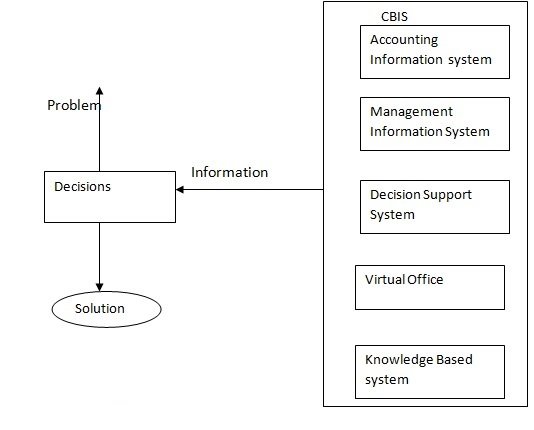
Information is one main resource factor that is available to the manager. As the business market is becoming more complex nowadays and also the computer has improved its capabilities, the information should be managed properly.

Initially, the first major computer application was the processing of accounting data. After sometime, the four system also included this computer application, they were management information system, decision support system, the virtual office and knowledge based system. All of these application composed the computer based information systems.


  1. Accounting information system

Accounting information system performs the firm accounting application. It is a data oriented application, so it should produce some information. A firm data processing  tasks  are performed  by it that  collects   data describing  the firm  activities  converts the data into  information  and makes the  information available  to users both  inside  and outside the firm.

Advantage of accounting information system

  • Adheres to relatively standardized methods
  • Handles detailed data
  • Has a good historical focus
  1. Management Information System

System management information is a combination of the various information systems. It makes information available with similar needs to the user needs. An MIS deals with the information that can be collected regularly and systematically according to the predefined rules. To do the tasks, such systems should operate in the real time, so they can process the information as early as received.

Advantage of Management Information System

  • It can handle inquiries and towards result oriented.
  • It is suitable for analysis.
  • It helps to build the decisions and for the basis of management activities like planning controlling etc.
  1. Decision support system

Decision support system enhances the capabilities of MIS. The origin of the terms. Decision forces on the  decision  making  in problem  solving  support requires computer aided decisions with enough  structure and system integrate all the  subsystems and suggesting  a combined man  machine  and decision  environment.

Advantage of Decision support system

  • Better decisions are taken
  • Only one manager is required
  • It saves the cost and time
  1. Virtual Office

In virtual office  the  office work  can be done  virtually at any  geographical area as long  as the work site is linked  to one  or more  of the  firms fixed areas by some type of electronic communication  capability.

 Advantage of Virtual Office

  • Reduced equipment and facility cost
  • Formal communication work
  • Social contribution
  • Reduced work stoppages
  1. Knowledge Based System

The CBIS subsystem which is attracting the greatest attention from computer scientists and information specialists is knowledge based system a subset of artificial intelligence or AI.

A popular form of knowledge based system is the expert system. It is the activity of providing such machines as computer with the ability to display behaviour that would be regarded as intelligent of it were observed in humans.

Advantage of Knowledge Based System

  • Improved output and expertise
  • Flexibility
  • Output is selected with the opinion of many experts.
  • Effective manipulation of large knowledge base.
error: Content is protected !!