Ratio analysis and interpretation: Conventional and Functional classification

Traditional (Conventional) Classification

Traditional Classification has three types of ratios, namely

  • Balance Sheet Ratios
  • Profit and Loss Ratios
  • Composite Ratios

Profit and Loss Ratios

When both figures are derived from the statement of Profit and Loss A/c we will call it a Profit and Loss Ratio. It can also be known as Income Statement Ratio or Revenue Statement Ratio. One such example is the Gross Profit ratio, which is the ratio of Gross Profit to Sales or Revenue. As you will notice, both these amounts will be derived from the Profit and Loss A/c. Other examples include Operating ratio, Net Profit ratio, Stock Turnover Ratio etc.

Balance Sheet Ratios

Just as above, if both the variables are obtained from the balance sheets, it is known as a balance sheet ratio. When such a ratio expresses the relation between two accounts of the balance sheet, we also call them financial ratios (other than accounting ratios).

Take for example Current ratio that compares current assets to current liabilities, both derived from the balance sheet. Other examples include Quick Ratio, Capital Gearing Ratio, Debt-Equity ratio etc.

Composite Ratios

A composite ratio or combined ratio compares two variables from two different accounts. One is taken from the Profit and Loss A/c and the other from the Balance Sheet. For example the ratio of Return on Capital Employed. The profit (return) figure will be obtained from the Income Statement and the Capital Employed is seen in the Balance Sheet. A few other examples are Debtors Turnover Ratio, Creditors Turnover ratio, Earnings Per Share etc.

Functional Classification

Then we move onto the functional classification. These help us group the ratios according to the functions they perform in our understanding and analysis of financial statements. This is a more accurate and useful classification of ratios, and hence more commonly used as well. The types of ratios according to the functional classification are

  • Liquidity Ratio
  • Leverage Ratios
  • Activity Ratios
  • Profitability Ratios
  • Coverage Ratios

Liquidity Ratios

A firm needs to keep some level of liquidity, so stakeholders can be paid when they are due. All assets of the firm cannot be tied up, a firm must look after its short-term liquidity. These ratios help determine such liquidity, so the firm may rectify any problems. The two main liquidity ratios are Current ratio and Quick Ratio (or liquid ratio).

Leverage Ratios

These ratios determine the company’s ability to pay off its long-term debt. So they show the relationship between the owner’s fund and the debt of the company. They actually show the long-term solvency of a firm, whether it has enough assets to pay of all its stakeholders, as well as all debt on the Balance Sheet. This is why they are also called Solvency ratios. Some examples are Debt Ratio, Debt-Equity Ratio, Capital Gearing ratio etc.

Activity Ratios

Activity ratios help measure the efficiency of the organization. They help quantify the effectiveness of the utilization of the resources that a company has. They show the relationship between sales and assets of the company. These types of ratios are alternatively known as performance ratios or turnover ratios. Some ratios like Stock Turnover, Debtors turnover, Stock to Working Capital ratio etc measure the performance of a company.

Profitability Ratios

These ratios analyze the profits earned by an entity. They compare the profits to revenue or funds employed or assets of an entity. These ratios reflect on the entity’s ability to earn reasonable returns with respect to the capital employed. They even check the soundness of the investment policies and decisions. Examples will include Operating Profit ratio, Gross Profit Ratio, Return on Equity Ratio etc.

Coverage Ratios

Shows the equation between profit in hand and the claims of outside stakeholders. These are stakeholders that are required by the law to be paid, even in case of liquidation. So these types of ratios ensure that there is enough to cover these payments to such outsiders. Some examples of coverage ratios are Dividend Payout Ratio, Debt Service ratio etc.

Return on capital employed (including long-term Borrowing)

Return on capital employed or ROCE is a profitability ratio that measures how efficiently a company can generate profits from its capital employed by comparing net operating profit to capital employed. In other words, return on capital employed shows investors how many dollars in profits each dollar of capital employed generates.

ROCE is a long-term profitability ratio because it shows how effectively assets are performing while taking into consideration long-term financing. This is why ROCE is a more useful ratio than return on equity to evaluate the longevity of a company.

This ratio is based on two important calculations: operating profit and capital employed. Net operating profit is often called EBIT or earnings before interest and taxes. EBIT is often reported on the income statement because it shows the company profits generated from operations. EBIT can be calculated by adding interest and taxes back into net income if need be.

Capital employed is a fairly convoluted term because it can be used to refer to many different financial ratios. Most often capital employed refers to the total assets of a company less all current liabilities. This could also be looked at as stockholders’ equity less long-term liabilities. Both equal the same figure.

Formula

Return on capital employed formula is calculated by dividing net operating profit or EBIT by the employed capital.

Return on Capital Employed = Net Operating Profit / Employed Capital

If employed capital is not given in a problem or in the financial statement notes, you can calculate it by subtracting current liabilities from total assets. In this case the ROCE formula would look like this:

Return on Capital Employed = Net Operating Profit / Total Assets – Current Liabilities

Where:

  • Fixed Assets, also known as capital assets, are assets that are purchased for long-term use and are vital to the operations of the company. Examples are property, plant, and equipment (PP&E).
  • Working Capital is the capital available for daily operations and is calculated as current assets minus current liabilities.

It isn’t uncommon for investors to use averages instead of year-end figures for this ratio, but it isn’t necessary.

Analysis

The return on capital employed ratio shows how much profit each dollar of employed capital generates. Obviously, a higher ratio would be more favorable because it means that more dollars of profits are generated by each dollar of capital employed.

For instance, a return of .2 indicates that for every dollar invested in capital employed, the company made 20 cents of profits.

Return on equity capital

The return on equity ratio or ROE is a profitability ratio that measures the ability of a firm to generate profits from its shareholders investments in the company. In other words, the return on equity ratio shows how much profit each dollar of common stockholders’ equity generates.

So, a return on 1 means that every dollar of common stockholders’ equity generates 1 dollar of net income. This is an important measurement for potential investors because they want to see how efficiently a company will use their money to generate net income.

ROE is also an indicator of how effective management is at using equity financing to fund operations and grow the company.

Formula

The return on equity ratio formula is calculated by dividing net income by shareholder’s equity.

Return on Equity Ratio = Net income / Shareholder’s Equity

Most of the time, ROE is computed for common shareholders. In this case, preferred dividends are not included in the calculation because these profits are not available to common stockholders. Preferred dividends are then taken out of net income for the calculation.

Also, average common stockholder’s equity is usually used, so an average of beginning and ending equity is calculated.

Analysis

Return on equity measures how efficiently a firm can use the money from shareholders to generate profits and grow the company. Unlike other return on investment ratios, ROE is a profitability ratio from the investor’s point of view not the company. In other words, this ratio calculates how much money is made based on the investors’ investment in the company, not the company’s investment in assets or something else.

That being said, investors want to see a high return on equity ratio because this indicates that the company is using its investors’ funds effectively. Higher ratios are almost always better than lower ratios, but have to be compared to other companies’ ratios in the industry. Since every industry has different levels of investors and income, ROE can’t be used to compare companies outside of their industries very effectively.

Interpreting the Return on Equity

The return on equity is similar to the “return on assets”. Assets come from two sources: debt and equity. The ROE focuses on the latter. Return on equity measures profitability using resources provided by investors and company earnings.

A high return on assets shows than the business was able to successfully utilize the resources provided by its equity investors and the company’s accumulated profits in generating income. Nonetheless, just like any other financial ratio, the ROE is more useful if it is compared to a benchmark such as the average ROE in the industry where the company operates or the company’s ROE in the past years.

Stock (Inventory) to Working capital Ratio

The amount of current assets that a company has on hand at any given time, in excess of its current liabilities, is known as its net working capital (NWC).

These funds are what allow a business to run its daily operations. One of the short-term assets held by many companies is the cash invested in its inventory. But if this inventory amount is relatively large compared to other assets, it can skew the perception of just how readily available a firm’s cash truly is for paying off short-term debts. Sometimes a company’s inventory can suffer from extremely low turn-over, or simply becomes outdated and difficult to sell.

The inventory to net working capital ratio allows you to calculate exactly what proportion of a business’s working capital is tied up in its inventory, giving you a more accurate picture of its liquidity position.

Stock (Inventory) to Working capital Ratio = Inventory / (Accounts Receivables+ inventory – Accounts Payable)

Cautions & Further Explanation

Analyzing a company’s inventory to net working capital ratio is best done over a number of periods to accurately identify trends in the use of a firm’s working capital.

Such trends can help to reveal any problems in a company’s regular operations, including the rising ratio values associated with heavy quantities of outdated stock, inferior purchasing control, and inefficient sales forecasts.

Ideally, you should use the inventory to NWC ratio at the same time as you examine a company’s inventory turnover rate, since stock that consistently turns over quickly will contribute far more positively to an organization’s level of liquidity.

Interpretation & Analysis

In general, the lower a company’s inventory to working capital ratio is, the higher its liquidity.

This will be particularly true for those businesses that hold large quantities of inventory and that require certain levels of cash to fund their operations.

While some analysts consider ratio values of less than 100% to be sufficient proof of a company’s liquidity, this value often proves to be too generic for every situation.

Inventory to WC ratios vary widely between industries and companies, and you’ll glean more meaningful information by using industry averages as a benchmark in your analyses.

Stock (Inventory) Turnover Ratio, Formula, Uses

The Stock (Inventory) Turnover Ratio is a key financial metric that measures how many times a company sells and replaces its inventory during a specific period, typically a year. It is calculated by dividing the Cost of Goods Sold (COGS) by the average inventory held during that time. A higher ratio indicates that inventory is being sold and replenished quickly, reflecting strong sales performance and efficient inventory management. Conversely, a low turnover ratio may suggest overstocking, weak sales, or slow-moving products, leading to increased storage costs and potential losses due to obsolescence. This ratio is vital for evaluating the liquidity and operational efficiency of a business. It helps companies optimize inventory levels, plan purchases, and improve cash flow by minimizing capital locked in unsold goods. Regular monitoring and analysis of this ratio support better decision-making in supply chain, procurement, and financial planning, making it essential for both managers and investors.

Formula

The inventory turnover ratio is calculated by dividing the cost of goods sold for a period by the average inventory for that period.

Stock (Inventory) Turnover ratio = Cost of Goods Sold / Average inventory

Uses of Stock (Inventory) Turnover Ratio:

  • Evaluating Inventory Efficiency

The stock turnover ratio helps assess how efficiently a company is managing its inventory. A higher ratio indicates that goods are sold quickly, minimizing holding costs and reducing the risk of obsolescence. This efficiency reflects good demand forecasting and effective inventory control practices. Conversely, a low ratio might suggest overstocking, slow-moving items, or poor sales. By evaluating this metric, businesses can make informed decisions about purchasing, production planning, and inventory optimization, leading to better cash flow and higher profitability.

  • Assessing Sales Performance

The stock turnover ratio is a critical tool in evaluating the relationship between inventory levels and sales performance. A high turnover rate suggests strong demand and effective sales strategies, while a low rate may indicate weak sales or inventory issues. This helps managers identify slow-moving items and take corrective actions such as promotions, discounts, or re-strategizing the sales approach. Regular analysis ensures that inventory aligns with market demand, enabling the company to respond quickly to changing consumer preferences and maintain competitiveness.

  • Improving Working Capital Management

Effective inventory turnover supports better working capital management by reducing funds tied up in unsold goods. The faster inventory is converted into sales, the more liquidity a business has to meet operational expenses or reinvest in growth. Monitoring this ratio ensures that inventory levels are optimized—not too high to drain cash flow, nor too low to miss sales opportunities. Thus, it helps companies maintain financial health and operational agility by ensuring that capital is used efficiently throughout the supply chain.

  • Benchmarking Industry Performance

The inventory turnover ratio is often used to benchmark a company’s performance against industry standards or competitors. A ratio significantly above or below the average may indicate exceptional performance or potential issues. Comparing turnover ratios helps identify strengths and weaknesses in inventory and sales strategies, guiding improvements. It also provides insights for investors and analysts to assess a company’s operational efficiency, profitability, and competitiveness in the market. Industry benchmarking using this ratio supports strategic planning and continuous performance improvement.

Preparation of Cash flow Statement (Accounting Standard-3)

AS3 revised in 1997 has recommended revised Cash Flow Statement [CFS] for listed companies and other industrial, commercial, and business undertakings in the private and public sector. It is at present recommendatory in character.

According to revised AS 3, CFS should be prepared in such a way as to report the cash flows during the period separately for operating, investing, and financing activities.

1. Cash Flows from Operating Activities.

Examples are as follows:

(a) Cash receipts from sale of goods and services;

(b) Cash receipts from royalties, fees, commission, and other revenue;

(c) Cash payments to suppliers of goods and services;

(d) Cash payments to employees;

(e) In the case of insurance companies, cash receipts and payments for premium received and claims and other benefits to policy holders;

(f) Payment and refund of income tax;

(g) Cash receipts and payments relating to futures and options contracts taken up for trading purposes.

2. Cash Flows from investing activities.

Examples of such activities are as follows:

(a) Purchase of fixed assets including intangibles and payments relating to capitalized research and development cost and self-constructed fixed assets.

(b) Cash receipts from sale of fixed assets including intangibles.

(c) Purchase of securities for cash such as shares, warrants, and debt instruments of other enterprises.

(d) Sale of securities for cash

(e) Loans and advances given to third parties

(f) Loans and advances collected from third parties

(g) Cash receipts and payments relating to futures and options contracts entered into for investment purposes.

3. Cash Flows from financing activities.

Examples of such activities are as follows:

(a) Cash receipts from the issue of shares and other similar instruments,

(b) Cash receipts from the issue of debentures, bonds, long or other short-term borrowing,

(c) Redemption of shares and repayment of amounts borrowed.

The following illustrations would make clear the preparation of CFS under AS 3 method and Traditional method.

Illustration 1:

Balance sheets of X and Y on 1-1-2001 and 31.12-2001 were as follows:

Balance Sheet
Liabilities 2000

Rs.

2001

Rs.

Assets 2000

Rs.

2001

Rs.

Creditors 40,000 44,000 Cash 10,000 7,000
Mrs X’s loan 25,000 Debtors 30,000 50,000
Loan from Bank 40,000 50,000 Stock 35,000 25,000
Capital 1,25,000 1,53,000 Machinery 80,000 55,000
Land 40,000 50,000
Building 35,000 60,000
2,30,000 2,47,000 2,30,000 2,47,000

During the year, a machine costing Rs. 10,000 (accumulated depreciation Rs.3,000) was sold for Rs.5,000.

The provision for depreciation against machinery as on 1-1-2001, was Rs.25,000, and on 31-12-2001 it was Rs.40,000. Net profit for the year 2001 amounted to Rs.45,000. You are required to prepare cash flow statement.

You are required to prepare CFS under AS 3 [Revised] method.

Solution:

I Cash flow from Operating Activities: Rs. Rs.
  Net profit made during the Year 45,000  
  Adjustment from depreciation 18,000  
  Loan on sale of machinery 2,000  
  Operating Profit before working capital changes 65,000  
  Decrease in stock 10,000  
  Increase in Creditors 4,000  
  Increase in Debtors [20,000]  
  Net Cash flow from operating Activities   59,000
II Cash flows from Investing Activities:    
  Sale of machinery 5,000  
  Purchase of land (10,000)  
  Purchase of building (25,000)  
  Net cash flow from investing activities   (30,000)
III Cash flows from Financing activities    
  Loans from Bank 10,000  
  Mrs. X’s loans repaid (25,000)  
  Drawings (17,000)  
  Net Cash flows from Financing activities   [32,000]
  Net increase or decrease in cash and cash equivalent   [3,000]
  Cash and cash equivalent opening balance   10,000
  Cash and cash equivalent closing balance   7,000

Notes:

  1. Cash and cash equivalents include cash and bank balances and risk less short-term investments.
  2. Cash flow from operations is computed in the statement itself instead of preparing a separate statement showing cash from operations as in the case of traditional method.
  3. Figures given within brackets represent cash outflows.

Working Capital, Concepts, Introductions, Meaning, Definitions, Need, Types, Importance and Determinants

Working Capital refers to the difference between a company’s current assets (such as cash, accounts receivable, and inventory) and its current liabilities (such as accounts payable and short-term debts). It represents the funds available for day-to-day operations, ensuring smooth business functioning. Adequate working capital is essential for meeting short-term obligations, maintaining liquidity, and supporting operational efficiency. A positive working capital indicates the company can cover its short-term liabilities, while a negative working capital signals potential financial strain. Effective management of working capital ensures optimal utilization of resources, enhances profitability, and minimizes the risk of liquidity crises.

Meaning of Working Capital

Working capital refers to the funds required by a business for its day-to-day operations. It represents the capital used to finance current assets such as cash, inventory, accounts receivable, and short-term investments. Adequate working capital ensures smooth functioning of business activities like purchasing raw materials, paying wages, meeting short-term liabilities, and managing operating expenses. Insufficient working capital may lead to operational disruptions, while excessive working capital results in inefficient use of funds. Thus, effective working capital management is essential for maintaining liquidity, profitability, and overall financial stability of a firm.

Definitions of Working Capital

J.S. Mill

“Working capital is the sum of current assets of a business.”

Gerstenberg

“Working capital is the excess of current assets over current liabilities.”

Weston and Brigham

“Working capital refers to a firm’s investment in short-term assets such as cash, marketable securities, accounts receivable, and inventories.”

Hoagland

“Working capital is the difference between current assets and current liabilities.”

Shubin

“Working capital is the amount of funds necessary to cover the cost of operating the enterprise.”

Concepts in respect of Working Capital:

(i) Gross working capital and

(ii) Networking capital.

Gross Working Capital:

The sum total of all current assets of a business concern is termed as gross working capital. So,

Gross working capital = Stock + Debtors + Receivables + Cash.

Net Working Capital:

The difference between current assets and current liabilities of a business con­cern is termed as the Net working capital.

Hence,

Net Working Capital = Stock + Debtors + Receivables + Cash – Creditors – Payables.

Need for Working Capital:

  • Ensuring Smooth Operations

Working capital is vital for the seamless execution of day-to-day activities, such as purchasing raw materials, paying wages, and meeting other operating expenses. It acts as the financial backbone for sustaining operational efficiency and continuity.

  • Meeting Short-Term Obligations

Businesses must regularly settle short-term liabilities like accounts payable, taxes, and utility bills. Adequate working capital ensures timely payment of these obligations, protecting the company’s creditworthiness and reputation.

  • Maintaining Inventory Levels

A proper working capital ensures that a company can maintain optimal inventory levels. This helps in avoiding stockouts that could disrupt production or sales and ensures timely fulfillment of customer demands.

  • Managing Cash Flow

Working capital ensures that a business has sufficient liquidity to bridge the gap between cash inflows and outflows. This is especially important for industries with seasonal demand, where revenues may fluctuate.

  • Supporting Credit Sales

Businesses often extend credit to customers to maintain competitiveness. Working capital is needed to finance these credit sales until payments are received, preventing cash flow issues.

  • Tackling Unexpected Expenses

Unforeseen expenses, such as repairs, penalties, or market fluctuations, can disrupt business operations. Adequate working capital acts as a buffer to manage such contingencies without jeopardizing the company’s stability.

  • Financing Growth and Expansion

For businesses aiming to expand or explore new markets, working capital is necessary to fund increased operational demands, such as additional inventory, labor, or marketing expenses, without disrupting current operations.

  • Ensuring Financial Stability

A healthy working capital position reflects a company’s financial health and enhances its ability to secure loans or attract investors. It reassures stakeholders of the business’s ability to meet obligations and pursue growth opportunities.

Types of working Capital

Working capital can be categorized based on its purpose, time frame, or sources. These classifications help businesses better understand and manage their financial requirements.

1. Permanent Working Capital

This refers to the minimum level of current assets required to maintain the day-to-day operations of a business. It remains constant over time, regardless of fluctuations in sales or production levels.

  • Fixed Permanent Working Capital: The portion of working capital that remains unchanged even during seasonal variations or changes in business cycles.
  • Variable Permanent Working Capital: The additional working capital required due to growth in production and operations over time.

2. Temporary Working Capital

Temporary working capital is required to meet short-term or seasonal demands. It fluctuates depending on the level of business activity and market conditions.

  • Seasonal Working Capital: Needed to manage increased demand during peak seasons.
  • Special Working Capital: Required for non-recurring or special needs, such as promotional campaigns or sudden bulk orders.

3. Gross Working Capital

Gross working capital represents the total investment in current assets, such as cash, accounts receivable, and inventory. It emphasizes the importance of efficiently managing current assets to maintain liquidity.

4. Net Working Capital

Net working capital is the difference between current assets and current liabilities. It indicates the surplus or deficiency of current assets over liabilities and reflects the business’s ability to meet short-term obligations.

5. Positive and Negative Working Capital

  • Positive Working Capital: Occurs when current assets exceed current liabilities, indicating good liquidity and financial health.
  • Negative Working Capital: Happens when current liabilities exceed current assets, signaling potential financial strain and risk of insolvency.

6. Reserve Working Capital

Reserve working capital refers to the extra funds kept aside to handle unexpected emergencies or contingencies, such as economic downturns or sudden increases in costs.

7. Regular Working Capital

This type of working capital is used to meet routine business operations, including the purchase of raw materials, payment of wages, and covering operational expenses.

8. Special Working Capital

Special working capital is required for one-time projects or events, such as launching a new product, entering a new market, or undertaking a merger or acquisition.

Importance of Working Capital

  • Ensures Business Continuity

Adequate working capital ensures that a business can meet its day-to-day operational expenses, such as paying wages, purchasing raw materials, and covering overhead costs. This continuity is critical to prevent operational disruptions and maintain productivity.

  • Enhances Liquidity

Working capital reflects a company’s short-term financial health and liquidity. It ensures that the organization has sufficient funds to meet immediate obligations, avoiding situations like delayed payments, penalties, or defaulting on liabilities.

  • Supports Customer Credit

Offering credit to customers is a common business practice to boost sales and customer satisfaction. Proper working capital allows a business to manage the time gap between extending credit and receiving payment without compromising liquidity.

  • Facilitates Inventory Management

A well-managed working capital ensures that the business can maintain an optimal inventory level, avoiding stockouts or overstocking. This is crucial for meeting customer demands promptly and efficiently.

  • Prepares for Contingencies

Businesses often face unexpected challenges, such as economic downturns, sudden market changes, or equipment breakdowns. Adequate working capital acts as a financial cushion, enabling companies to handle such contingencies without significant setbacks.

  • Improves Creditworthiness

A business with strong working capital is viewed as financially stable and reliable by creditors and investors. This improved creditworthiness makes it easier to secure loans, negotiate better terms, and attract investments for growth and expansion.

  • Boosts Profitability

Efficient working capital management helps minimize costs, such as interest on short-term borrowings or penalties for delayed payments. It also optimizes resource utilization, enhancing overall profitability.

  • Supports Business Growth

For a company aiming to expand, working capital is crucial to fund increased operational needs like additional inventory, higher production costs, or expanded marketing efforts. It ensures that growth initiatives are supported without causing financial strain.

Determinants of Working Capital:

  • Nature of Business

The type of business significantly determines its working capital requirements. Manufacturing firms require substantial working capital due to the need for raw materials, work-in-progress, and finished goods inventory. Conversely, service-oriented businesses, like consulting or IT firms, require minimal working capital as they primarily focus on delivering services and do not maintain significant inventory. Similarly, trading firms require moderate working capital to manage goods for resale. Understanding the nature of the business helps identify whether large, small, or minimal funds are needed to support day-to-day operations.

  • Business Size and Scale

The size and scale of a business directly impact its working capital needs. Larger businesses with extensive operations require more working capital to finance inventory, receivables, and other operational expenses. These organizations typically handle large volumes of transactions, necessitating higher funds. In contrast, smaller businesses with limited operations and simpler processes have lower working capital requirements. However, as businesses expand, they need to adjust their working capital to sustain growth, ensuring that financial resources align with their scale.

  • Production Cycle

The production cycle, which measures the time required to convert raw materials into finished goods, affects working capital requirements. A longer production cycle increases the need for funds to cover costs such as raw materials, labor, and overheads during the production process. Conversely, businesses with shorter production cycles require less working capital as they can quickly convert inventory into cash. Efficient production processes help minimize the length of the cycle, reducing working capital requirements while improving overall financial stability.

  • Credit Policy

A company’s credit policy for customers and suppliers significantly influences its working capital. Liberal credit terms for customers increase accounts receivable, raising the need for additional working capital to manage delayed cash inflows. Conversely, strict credit terms reduce the amount tied up in receivables. On the supplier side, favorable credit terms reduce immediate cash outflows, lowering working capital requirements. Balancing credit policies ensures that businesses maintain adequate liquidity while fostering strong customer and supplier relationships.

  • Economic Conditions

Economic factors like inflation, interest rates, and market conditions impact working capital requirements. During inflationary periods, businesses require more working capital to handle rising costs of raw materials, wages, and utilities. Unstable economic conditions may also prompt companies to maintain higher reserves to tackle uncertainties. Conversely, during periods of economic stability, businesses can optimize their working capital levels, focusing on investments and growth. Adapting to economic trends is crucial for maintaining financial stability and operational efficiency.

Estimation of requirements in case of Trading & Manufacturing Organizations

The two components of working capital are current assets and current liabilities. The estimation of the amount of current assets and current liabilities to maintain a particular level of operation is not an easy task.

Inadequate working capital leads to disruption in the smooth production process while excess working capital increases the cost.

The estimation of working capital in case of trading and manufactur­ing concern is discussed here.

Manufacturing Concern:

The estimation of working capital for a manufacturing concern requires adoption of following steps:

(a) Determination of expected production per week or per month.

(b) Determination of cost for each element, i.e. Material, Labour and Overhead as well as Profit per unit.

(c) Calculation of amount blocked in each week/month for each element of Cost and Profit.

(d) Determination of operating cycle by estimating the Raw materials holding period. Processing time, finished goods storage period. Debt collection period. Creditor’s payment period. Time lag in payment of wages and overheads.

(e) Determination of Net block period. It is the period for which each element of cost remains blocked. For example, if Raw materials remain in stores for 2 weeks after purchase; Processing time is 2 weeks; Finished goods remain in stock for 3 weeks; Credit period extended to debtors is 4 weeks; and Payment for materials is made 2 weeks after purchase then, the Net block period will be:

[(2+ 2 + 3 + 4) – (2)] = 9 weeks.

(f) By multiplying Net block period as calculated in step (e) and the amount blocked for each element of cost as per step (c) we get the working capital requirement for each element of cost.

(g) By totalling all amounts as calculated for each element of cost and desired cash, if any, we get the total amount of working capital.

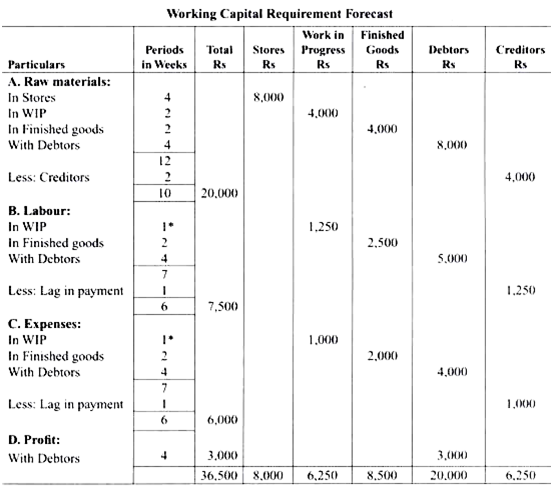
Example 7.1:

Determine the Working Capital requirement from the following information:

  1. Expected Sales 13,000 units
  2. Analysis of selling price:

Rs (per unit)

Raw Materials

8.00

Labour

5.00

Expenses

4.00

Profit

3.00

Selling Price

20.00

  1. Raw materials in store: 1 month
  2. Processing time: 2 weeks
  3. Finished product in store: 2 weeks
  4. Credit allowed to debtors: 4 weeks
  5. Credit allowed by creditors: 2 weeks
  6. Lag in payment for wages and expenses: 1 week
  7. Production is carried on evenly during the year and wages and expenses accrue in the same way.

Solution:

(a) Weekly Sales = 13,000/52 = 250 units

(b) Weekly Blockage:

Raw materials: 250 x Rs 8 = Rs 2,000

Labour: 250 x Rs 5 = Rs 1,250

Expenses: 250 x Rs 4 = Rs 1,000

Profit: 250 x Rs 3 = Rs 750

Receivables Management: Meaning & Importance

Accounts receivable is the amount owed to a company resulting from the company providing goods and/or services on credit. The term trade receivable is also used in place of accounts receivable.

The amount that the company is owed is recorded in its general ledger account entitled Accounts Receivable. The unpaid balance in this account is reported as part of the current assets listed on the company’s balance sheet.

When goods are sold on credit, the seller is likely to be an unsecured creditor of its customer. Therefore, the seller should be cautious when selling goods on credit.

Good accounting requires that an estimate should be made for any amount in Accounts Receivable that is unlikely to be collected. The estimated amount is reported as a credit balance in a contra-receivable account such as Allowance for Doubtful Accounts. This credit balance will cause the amount of accounts receivable reported on the balance sheet to be reduced. Any adjustment to the Allowance account will also affect Uncollectible Accounts Expense, which is reported on the income statement.

Example of Accounts Receivable

A manufacturer will record an account receivable when it delivers a truckload of goods to a customer on June 1 and the customer is allowed to pay in 30 days. From June 1 until the company receives the money, the company will have an account receivable (and the customer will have an account payable).

Cost of Maintaining Receivables

Maintaining receivables bears cost. It includes cost of investment in receivables, bad debt losses, collection expenses and cash discount. Costs related with receivables and their calculation are as follows:

1. Cost Of Investment In Receivables

This is the opportunity cost of funds being tied up in receivables, which would otherwise have not been incurred if all sales were in cash. The cost of investment in receivable is calculated as:

Cost of receivables = Investment in receivables X Opportunity costs

Here,

investment in receivables = (FC+ VC)/Days in year) X DSO

Where, FC = Fixed Cost, VC = Variable Cost and DSO = Days sales outstanding.

2. Bad Debt Losses

This is the loss due to default customers. Extension of credit to low quality-rate customers results into increase in bad debt losses. Bad debt losses are calculated as a percentage on sales as shown in equation below:

Bad debt losses = Annual credit sales X Percentage default customer

3. Collection Expenses

This is the cost incurred for operating and managing the collection and credit department of a firm. This includes the administrative cost of credit department, salary and commission paid to collection staff, cost paid for telephone and communication and so on.

4. Cash Discount

It is the cost incurred to induce the customer for early payments of their accounts. A firm can offer cash discount to its customers to reduce the average collection period, bad debt losses, and the cost of investment in receivables. The discount cost is calculated as cash discount percentage multiplied by sales to discount customers as given below:

Discount Cost = Annual credit sales X Percentage discount customer X Percentage cash discount

Objectives of Receivables Management

Following are the objectives of receivables management which will help us to understand the purpose of receivables:

  1. To optimize the amount of sales
    2. To minimize cost of credit
    3. To optimize investment in receivables.
    4. To increase credit sales.

Therefore, the main objective of receivable management is to create a balance between profitability and cost.

Accounts receivable recorded in the financial statements

Usually, the businesses expect to receive money in the future, so it is to be added to the assets in the financial statement of the business. The accurate record keeping of this money that is receivable (accounts receivable) in the books of accounts are required to avoid any default in the payment due.

Few pointers connected to recording accounts receivable are as follows :

a. Establishing the practice of credit transactions:

The business may establish a practice of providing a credit policy to its buyers. This credit can be extended for a specified time period and any default in this payment usually attracts penalty. This practice of credit facility requires two parties to come to an agreement on the terms and conditions for such credit transactions. The provider of this facility should also verify the paying ability of the customer before agreeing to any terms and conditions.to prevent loss of cash inflow.

b. Generating invoices for the customer:

The businesses are required to generate invoices of the sales made or services delivered. The invoice should have details of the cost of goods and services sold to the customers. This generating of invoice ensures the recording of the credit transaction clearly in the accounts of the business. Further, a copy of the invoice is given to the customer to make the payment as per the agreed terms.

c. Tracking the payments received and the payment that is due to be received:

An accountant is required to track the payments received or due from the customers. The details of the method of payment and date of receiving payment have to be recorded in the customer’s ledger account. This ensures correctness of accounting of the credit amount. The businesses shall also generate timely reminders for dues pending to the customers.

d. Accounting for the accounts receivable

The accountant or the person responsible for taking due care of the account’s receivables must record all the due dates of the payments to be received. The timely and prompt recording of the accounts receivable leads to receiving the payments on time from the customers. Once the account receivable is recorded and payment is received, the account for the said party can be settled for good.

Credit policy Variables

The important dimensions of a firm’s credit policy are credit standards, credit period, cash discount and collection effort. These variables are related and have a bearing on the level of sales, bad debt loss, discounts taken by customers, and collection expenses.

i) Credit standards:

A firm has a wide range of choice in this respect. At one and of the spectrum, it may decide not to extend credit to any customer, however strong his credit rating may be. At the other end, it may decide to grand credit to all customers irrespective of their credit rating. Between these two extreme positions lie several positions, often the more practical ones.

In general, liberal credit standards tend to push sales up by attracting more customers. This is, however, accompanied by a higher incidence of bad debt loss, a larger investment in receivables, and a higher cost of collection. Stiff-credit standards have opposite effects. They tend to depress sales, reduce the incidence of bad debt loss, decrease the investment in receivables, and lower the collection cost.

ii) Credit period:

The credit period refers to the length of time customers are allowed to pay for their purchases. It generally varies from 15 days to 60 days. When a firm does not extend any credit, the credit period would obviously be zero. If a firm allows 30 days, say, of credit, with no discount to induce early payments, its credit terms are stated as “net 30”.

Lengthening of the credit period pushes sales up by inducing existing customers to purchase more and attracting additional customers. This is, however, accompanied by a larger investment in receivables and a higher incidence of bad debt loss. Shortening of the credit period would have opposite influences: It tends to lower sales, decrease investment in receivables, and reduce the incidence of bad debt loss.

iii) Cash discount:

Firms generally offer cash discounts to induce customers to made prompt payments. The percentage discount and the period during which it is available are reflected in the credit terms. For example, credit terms of 2/10, net 30 mean that a discount of 2 per cent is offered if the payment is made by the tenth day; otherwise the full payment is due by the thirtieth day.

Liberalizing the cash discount policy may mean that the discount percentage is increased and/or the discount period are lengthened. Such an action tends to enhance sales (because the discount is regarded as price reduction), reduce the average collection period (as customers pay promptly), and increase the cost of discount.

iv) Collection Effort:

The collection programmed of the firm, aimed at timely collection of receivables consisting of monitoring the state of receivables, dispatch of letters to customers whose due date is approaching, telegraphic and telephonic advice to customers around the due date, threat of legal action to overdue accounts and legal action against overdue accounts.

error: Content is protected !!