Rights of Customers in Supply Chain

  1. Right Product

A company who offers this kind of service must first know the kind of products that they are going to handle and transport. Having the right knowledge will give you an advantage to properly and efficiently manage both your time and resources.

  1. Right Place

The right product must be delivered to the right place. Courier services provided by an LMS company must have knowledgeable drivers as well as a systematic delivery system and tracking. Both customer and the provider must have a synchronized location tracking to ensure that the products are delivered to the right place.

  1. Right Price

Pricing is very essential and all products and services. They must have an appropriate price value in order to track the company income and expenses. A good system for storing and updating the right prices ensures success in  LMS.

  1. Right Customer

Every LMS Provider must know their target market to identify the right customers. If they will offer their services to the right market, they have more chances of gaining leads and customers that will most likely to avail them. Some uses the traditional marketing while others use digital marketing to reach more customers around the globe.

  1. Right Condition

Every product or goods that are to be entrusted by the customers to LMS providers must be stored and delivered with the right condition. This is where the specifications must be referred to in order to place it on required facilities to maintain its quality.

  1. Right Time

Time is very important when it comes to logistics, clients are more concern on the time of delivery. That is why every service provider must know the right time to deliver the products and in a very efficient way. Every system has a tracking functionality to monitor all deliveries and making sure that they arrive on time.

  1. Right Quantity

Knowing and specifying the right quantity is also one of the key in a successful LMS. Since most of the providers are third party, companies that relies on their service must be careful in sending the right amount or quantity of goods to be delivered. Thanks to our modern technological developments that 3PLs can now manage all quantities of goods to ship/deliver.

Role of Logistics in Supply Chain

Logistics is a critical concept in supply chain management as it ensures the efficient movement and storage of goods from suppliers to customers. One key concept is smooth flow of materials, which connects procurement, production, and distribution to prevent delays and production stoppages. Another important concept is inventory optimization, where logistics maintains the right stock levels to avoid overstocking or shortages, improving cash flow and operational efficiency.

Cost efficiency is also central, as logistics reduces transportation, warehousing, and handling costs through route planning, mode selection, and effective warehouse management. Logistics enhances customer service by ensuring timely delivery, accurate orders, and product availability, directly impacting customer satisfaction and loyalty.

Role of Logistics in Supply Chain

  • Ensuring Smooth Flow of Goods

Logistics ensures the continuous movement of raw materials, components, and finished goods across the supply chain. It coordinates inbound and outbound transportation, warehousing, and material handling to prevent delays. Efficient logistics guarantees that production inputs reach the manufacturer on time and finished products reach distributors and customers promptly. By managing the flow of goods effectively, logistics reduces bottlenecks, minimizes idle time, and ensures operational continuity. Smooth goods flow supports production schedules, enhances responsiveness to market demand, and strengthens overall supply chain reliability, forming the backbone of supply chain performance.

  • Inventory Management and Control

Logistics plays a key role in managing inventory throughout the supply chain. By maintaining optimal stock levels, logistics prevents overstocking and stockouts, which can disrupt operations. Tools like demand forecasting, just-in-time (JIT) inventory, and safety stock calculation help maintain balance. Efficient inventory control reduces carrying costs, avoids wastage, and improves cash flow. Logistics ensures that the right quantity of goods is available at the right time, supporting smooth production, timely order fulfillment, and better customer service. Effective inventory management increases supply chain efficiency and reduces unnecessary expenditure.

  • Cost Optimization

A major role of logistics in supply chain management is controlling costs. By optimizing transportation routes, selecting cost-effective modes, and consolidating shipments, logistics reduces fuel and freight expenses. Efficient warehouse management and material handling also lower storage and operational costs. Proper planning minimizes delays, errors, and redundant activities, leading to better resource utilization. Cost-optimized logistics enables companies to reduce overall supply chain expenses while maintaining service quality. Lower costs improve profitability, allow competitive pricing, and provide flexibility to invest in growth initiatives, making logistics a strategic tool for financial efficiency.

  • Customer Service and Satisfaction

Logistics is directly linked to customer satisfaction. Timely delivery, accurate order fulfillment, and product availability ensure a positive customer experience. Efficient logistics tracks orders, manages last-mile delivery, and handles returns or reverse logistics, addressing customer concerns promptly. High service levels strengthen customer loyalty, encourage repeat purchases, and enhance brand reputation. Supply chains that integrate logistics effectively can respond faster to market demand and emergencies, providing a competitive advantage. Logistics ensures that customers receive the right products, in the right condition, at the right time, building long-term trust and sustaining business growth.

  • Integration and Coordination

Logistics integrates various supply chain functions, linking procurement, production, distribution, and sales. It ensures seamless communication and coordination among suppliers, manufacturers, distributors, and customers. By connecting different nodes, logistics enables information flow, efficient planning, and resource allocation. Proper integration reduces delays, prevents duplication of efforts, and improves responsiveness. Logistics supports collaborative relationships with partners through real-time data sharing and tracking systems. Coordinated logistics enhances supply chain visibility, operational efficiency, and decision-making. It allows firms to synchronize activities across the network, respond to market changes, and maintain consistency in service quality.

  • Risk Management and Reliability

Logistics plays a crucial role in identifying and mitigating risks within the supply chain. It ensures safe handling of materials, reduces damage, prevents loss, and maintains compliance with regulations. Contingency planning, backup routes, and alternative suppliers improve supply chain resilience. Effective logistics also provides tracking and monitoring systems that allow early detection of potential disruptions. By reducing uncertainties and enhancing reliability, logistics ensures that supply chain operations remain uninterrupted even during unforeseen events. Reliable logistics strengthens business continuity, protects investments, and maintains customer confidence.

  • Support for Global Supply Chains

In global supply chains, logistics is essential for managing international transportation, customs clearance, and compliance with trade regulations. It coordinates with freight forwarders, customs agents, and international carriers to ensure timely delivery across borders. Efficient global logistics reduces lead times, minimizes delays, and manages currency, taxation, and documentation challenges. It enables companies to source raw materials worldwide and deliver products to international markets efficiently. By facilitating cross-border trade, logistics supports business expansion, global competitiveness, and integration into international supply chain networks.

  • Technology Integration

Modern logistics leverages technology to enhance supply chain performance. Tools such as ERP systems, warehouse management systems, GPS tracking, and data analytics improve visibility, accuracy, and efficiency. Technology enables real-time monitoring of shipments, predictive maintenance of transport, and optimized warehouse operations. It also supports automated order processing, demand forecasting, and inventory control. Technology-driven logistics improves decision-making, reduces errors, and allows supply chains to respond dynamically to changes in demand or disruptions. Effective integration of logistics technology strengthens overall supply chain agility and competitiveness.

  • Sustainability and Environmental Efficiency

Logistics contributes to sustainable supply chain practices by optimizing transportation, reducing energy consumption, and minimizing waste. Efficient route planning, load consolidation, and use of eco-friendly packaging reduce carbon footprint. Sustainable logistics practices support corporate social responsibility initiatives, regulatory compliance, and environmental stewardship. By adopting green logistics, companies enhance their brand reputation and appeal to environmentally conscious consumers. Sustainable logistics not only reduces environmental impact but also improves operational efficiency and cost-effectiveness, aligning profitability with social responsibility.

  • Strategic Support

Beyond operational functions, logistics provides strategic support to supply chain management. Decisions about warehouse locations, distribution networks, transportation modes, and inventory policies influence overall supply chain design. Logistics data and insights assist in strategic planning, supplier selection, and customer service improvement. By aligning logistics with business goals, organizations can enhance competitiveness, responsiveness, and value creation. Strategic logistics ensures that supply chain activities contribute to long-term objectives, including market expansion, profitability, and customer satisfaction, making it an indispensable component of modern supply chain management.

Home Currency, foreign Currency

The domestic currency is that which is legal tender in the economy and issued by the monetary authority for that economy, or for the common currency area to which the economy belongs.

Legal tender issued by the monetary authority of a country. The domestic currency is the accepted form of money in the economy, but not necessarily the exclusive currency. Opposite of foreign currency.

A currency printed in a different country. Generally speaking, a foreign currency may not be used to buy goods and services in any country other than the one in which it is printed, unless the government of that country agrees to use it.

In a currency pair, the first currency is called the base currency, and the second is called the quote currency. Currency pairs can also be separated into two types, direct and indirect. In a direct quote, the domestic currency is the base currency, while the foreign currency is the quote currency. An indirect quote is just the opposite: the foreign currency is the base currency, and the domestic currency is the quote currency.

Innovation in Foreign Securities

Financial innovation can be defined as the act of creating and then popularizing new financial instruments. This implies advances over time in the financial instruments and payment systems used in the lending and borrowing of funds as well as innovations in the payment mechanisms and systems in the economy.

Financial systems provide vital services: they evaluate, screen and allocate capital, monitor the use of that capital, and facilitate transactions and risk management. If financial systems provide these services well, capital will flow to the most promising and deserving firms, promoting and sustaining economic growth. Financial innovation, which is the creation of new securities, markets and institutions, can improve the financial services sector and thereby accelerate economic growth.

These advances include innovations in technology, risk transfer and credit and equity generation. A number of innovations have taken place over time among them; the development of Automated Teller Machines (ATMs); the expansion of credit card usage; Debit cards; Money market funds; Basic forms of securitization; Venture capital funds and interest rate and currency swaps amongst many others.

Advantages of Financial Innovation

Financial innovation has been shown to increase the material wellbeing of economic players. Positive innovation has helped individuals and businesses to attain their economic goals more efficiently, enlarging their possibilities for mutually advantageous exchanges of goods and services.

Financial innovation, by increasing the variety of products available and facilitating intermediation, has promoted savings and channeled these resources to the most productive uses. It has also assisted to widen the availability of credit, help refinance obligations and allow for better allocation of risk, matching the supply of risk instruments to the demand of investors willing to bear it.

Innovation is also at the centre stage of encouraging technological progress when the requirements for information technology generate new technological projects, and induce their funding as in the case of venture capital.

Financial innovation lowers the cost of capital, promotes greater efficiency, and facilitates the smoothing of consumption and investment decisions with considerable benefits for households and corporations. As the new products contribute to the deepening of financial markets, innovation, in turn, fosters economic development.

Financial innovation may also help to moderate business cycle fluctuations. Innovations such as credit cards and home equity loans allow households to keep their consumption smooth, even when their incomes are not. The increased availability of credit to businesses allows them to smooth their spending across short periods when revenues do not cover costs.

The success of any innovation depends on three things. The first is how good the product is to begin with. Some financial products are poorly conceived or designed. Next is the appropriate use of the product: Is the product meant for a particular market or type of risk? And finally, the value of an innovation hinges on the competence of the person implementing it.

Disadvantages of financial innovation

The World financial crisis of 2007‐09 is a sharp reminder that financial innovations can bring substantial costs along with the benefits described above. However, sometimes the costs may outweigh any benefits making such financial innovations negative. Many households lost their homes when falling house prices made it impossible to refinance their subprime mortgages. Many intermediaries underestimated the risks of new financial products and were compelled to deleverage in the crisis. The resulting uncertainty contributed to the seizing up of key markets for liquidity, such as the interbank lending market

Rapid financial innovation can be a source of systemic risk as evidenced during the financial crisis. When financial products without a track record expand rapidly in a buoyant economic environment, investors tend to underestimate the risks that only occur in periods of economic stress. Separately, innovations that help conceal concentrations of risk can make the financial system more vulnerable to a shock. In both cases, the problem is that investors do not obtain adequate compensation for the risks that they take because they do not understand the risks or because the risks are invisible.

Globalization of Capital Markets

The increasing integration of global capital markets now makes it easier for firms to access capital outside of their home countries. Firms access international capital markets through a variety of means such as initial public offerings (IPO), seasoned equity offerings (SEO), cross-listings, depository receipts, special purpose acquisition companies (SPACS), shelf offerings, private equity and other informal equity capital channels. Firms can also access debt resources outside their market through bank loans, and foreign bond issues. Finally, cross border flows of venture capital (VC) continue to increase rapidly. The objective of this Special Issue will be to explore the challenges firms face in capital markets beyond their domestic boundaries, be it equity, debt, or VC markets.

While IB research continues to evaluate the challenges facing firms in foreign product markets, IB scholars have yet to adequately address the underlying reasons why firms face challenges in foreign equity markets. These include underpricing, higher underwriting and professional fees, higher listing fees, audit fees, and greater risk of lawsuits, and home bias on the part of investors (French and Poterba, 1991). Further, research suggests the existence of a “foreign firm discount” relative to host market firms.

Venture capital and private equity have truly become global phenomena and take many forms such as cross-border investment, foreign acquisitions, VC firms opening offices overseas, and influencing their portfolio firms to enter and exit international stock exchanges. Foreign firms raise significantly more debt than equity in the U.S. Indeed, the largest component of the international capital market is the bond market.

Research on the motivation, the processes, the supporting mechanisms, and the range of outcomes that firms experience as a result of entering international capital markets is extremely limited so far. We believe such research can draw from a variety of theoretical perspectives and research traditions in international business. The choice of whether to access financial resources outside of the firm’s home market, how to select the appropriate foreign market, and the manner in which to raise resources are all relevant questions that parallel prior IB research market and entry mode choice. IB scholars consider LOF as the “fundamental assumption driving theories of the multinational enterprise”. Yet, the conceptualization and research on LOF solely based upon product market may be inadequate today given the increasing integration of capital markets.

The Functions of a Generic Capital Market

Commercial banks perform an indirect connection function. They take cash deposits from corporations and individuals and pay them a rate of interest in return. They then lend that money to borrowers at a higher rate of interest, making a profit from the difference in interest rates .Investment banks perform a direct connection function. They bring investors and  borrowers together and charge commissions for doing so.

Capital market loans to corporations are either equity loans or debt loans. An equity loan is made when a corporation sells stock to investors. The money the corporation receives in return for its stock can be used to purchase plants and equipment, fund R&D projects, pay wages, and so on. A share of stock gives its holder a claim to a firm’s profit stream. The corporation honors this claim by paying dividends to the stockholders. The amount of the dividends is not fixed in advance. Rather, it is determined by management based on how much profit the corporation is making. Investors purchase stock both for their dividend yield and in anticipation of gains in the price of the stock. Stock prices increase when a corporation is projected to have greater earnings in the future, which increases the probability that it will raise future dividend payments.

Attractions of the Global Capital Market

The Borrower’s Perspective: A Lower Cost of Capital

In a purely domestic capital market, the pool of investors is limited to residents of the country. This places an upper limit on the supply of funds available to borrowers. In other words, the liquidity of the market is limited. A global capital market, with its much larger pool of investors, provides a larger supply of funds for borrowers to draw on.

Perhaps the most important drawback of the limited liquidity of a purely domestic capital market is that the cost of capital tends to be higher than it is in an international market. The cost of capital is the rate of return that borrowers must pay investors. This is the interest rate on debt loans and the dividend yield and expected capital gains on equity loans. In a purely domestic market, the limited pool of investors implies that borrowers must pay more to persuade investors to lend them their money. The larger pool of investors in an international market implies that borrowers will be able to pay less.

Problems of limited liquidity are not restricted to less developed nations, which naturally tend to have smaller domestic capital markets. As illustrated in the opening case and discussed in the introduction, in recent years even very large enterprises based in some of the world’s most advanced industrialized nations have tapped the international capital markets in their search for greater liquidity and a lower cost of capital.

The Investor’s Perspective: Portfolio Diversification

By using the global capital market, investors have a much wider range of investment opportunities than in a purely domestic capital market. The most significant consequence of this choice is that investors can diversify their portfolios internationally, thereby reducing their risk to below what could be achieved in a purely domestic capital market. We will consider how this works in the case of stock holdings, although the same argument could be made for bond holdings.

Consider an investor who buys stock in a biotech firm that has not yet produced a new product. Imagine the price of the stock is very volatile–investors are buying and selling the stock in large numbers in response to information about the firm’s prospects. Such stocks are risky investments; investors may win big if the firm  produces a marketable product, but investors may also lose all their money if the firm fails to come up with a product that sells. Investors can guard against the risk associated with holding this stock by buying other firms’ stocks, particularly those weakly or negatively correlated with the biotech stock. By holding a variety of stocks in a diversified portfolio, the losses incurred when some stocks fail to live up to their promises are offset by the gains enjoyed when other stocks exceed their promise.

As an investor increases the number of stocks in her portfolio, the portfolio’s risk declines. At first this decline is rapid. Soon, however, the rate of decline falls off and asymptotically approaches the systematic risk of the market. Systematic risk refers to movements in a stock portfolio’s value that are attributable to macroeconomic forces affecting all firms in an economy, rather than factors specific to an individual firm. The systematic risk is the level of nondiversifiable risk in an economye.

Information Technology

Financial services is an information-intensive industry. It draws on large volumes of information about markets, risks, exchange rates, interest rates, creditworthiness, and so on. It uses this information to make decisions about what to invest where, how much to charge borrowers, how much interest to pay to depositors, and the value and riskiness of a range of financial assets including corporate bonds, stocks, government securities, and currencies.

Such developments have facilitated the emergence of an integrated international capital market. It is now technologically possible for financial services companies to engage in 24-hour-a-day trading, whether it is in stocks, bonds, foreign exchange, or any other financial asset. Due to advances in communications and data processing technology, the international capital market never sleeps. The integration facilitated by technology has a dark side. “Shocks” that occur in one financial center now spread around the globe very quickly.

Deregulation

In country after country, financial services have been the most tightly regulated of all industries. Governments around the world have traditionally kept other countries’ financial service firms from entering their capital markets. In some cases, they have also restricted the overseas expansion of their domestic financial services firms. In many countries, the law has also segmented the domestic financial services industry. It has also been a response to pressure from financial services companies, which have long wanted to operate in a less regulated environment. Increasing acceptance of the free market ideology associated with an individualistic political philosophy also has a lot to do with the global trend toward the deregulation of financial markets.

Global Capital Market Risks

Some analysts are concerned that due to deregulation and reduced controls on cross-border capital flows, individual nations are becoming more vulnerable to speculative capital flows. They see this as having a destabilizing effect on national economies.14 Harvard economist Martin Feldstein, for example, has argued that most of the capital that moves internationally is pursuing temporary gains, and it shifts in and out of countries as quickly as conditions change. He distinguishes between this short-term capital, or “hot money,” and “patient money” that would support long-term cross-border capital flows. To Feldstein, patient money is still relatively rare, primarily because although capital is free to move internationally, its owners and managers still prefer to keep most of it at home.

A lack of information about the fundamental quality of foreign investments may encourage speculative flows in the global capital market. Faced with a lack of quality information, investors may react to dramatic news events in foreign nations and pull their money out too quickly. Despite advances in information technology, it is still difficult for an investor to get access to the same quantity and quality of information about foreign investment opportunities that he can get about domestic investment opportunities. This information gap is exacerbated by different accounting conventions in different countries, which makes the direct comparison of cross-border  investment opportunities difficult for all but the most sophisticated investor.

Efficiency of the Exchange Market

The latest global financial crisis has proved that the financial markets are not very efficient and their deregulation has caused serious risk and wealth redistribution problems. The international monetary system had to accommodate extraordinarily large oil-related shocks, monetary shocks, trade deficits, privatizations (sell-offs of State Own Enterprises), Foreign Direct Investments, outsourcings, globalization, and public and private debts that affect capital flows among nations, and risk. Surpluses had to be recycled (invested) by buying financial assets from the deficit countries, which are at a low market price (undervalued) and the benefits to the sellers are insignificant. The continuous financial and debt crises have increased uncertainty and the deregulation of our financial institutions has increased the gap (“brain spread”) between the market and liberal politicians and deteriorated the agency problem between people (the principals) and government-market (the agents). Labor has lost some its rights and it is exploited in many countries, as Chomsky (2014) says. The increased interdependence among nations, due to globalization, and the realization that economic policies by strong nations exert pressure on other weaker economies, has to induce legal responses and cooperation among all nations.

An understanding of efficiency, expectations, risk, and risk premium in the foreign exchange market is important to government and central bank policymakers, international financial managers, and of course, to investors and to everyone interested in international finance. The government policymakers need to design macro-policies for achieving the goal of maximization of their social welfare through efficient resource allocation. Central banks have to be public and responsible for the wellbeing of the citizens of their own country.

International investors and financial managers need to assess foreign asset returns, risks, and their correlations in order to make optimal portfolio decisions. The foreign exchange market efficiency hypothesis is the proposition that prices (exchange rate movements) fully reflect information available to market participants. There are no opportunities for hedgers or speculators to make super-normal profits; thus, both speculative efficiency and arbitraging efficiency exist. Numerous studies have been tested for speculative efficiency and arbitraging efficiency by testing the following three hypotheses respectively:

(1) The forward discount or premium is a good predictor of the change in the future spot rate, implying covered interest parity (CIP), uncovered interest parity (UIP), and rational expectations to hold.

(2) The forward discount tends to be equal to the interest differential, implying that CIP holds.

(3) The expected risk premium is zero

Multilateral Investment Guarantee Agency

The Multilateral Investment Guarantee Agency (MIGA) is an international financial institution which offers political risk insurance and credit enhancement guarantees. These guarantees help investors protect foreign direct investments against political and non-commercial risks in developing countries. MIGA is a member of the World Bank Group and is headquartered in Washington, D.C. in the United States.

MIGA was established in 1988 as an investment insurance facility to encourage confident investment in developing countries. MIGA is owned and governed by its member states, but has its own executive leadership and staff which carry out its daily operations. Its shareholders are member governments that provide paid-in capital and have the right to vote on its matters. It insures long-term debt and equity investments as well as other assets and contracts with long-term periods. The agency is assessed by the World Bank’s Independent Evaluation Group each year.

A Brief History of MIGA

The agency was created to complement both public and private investment insurance sources against non-commercial risks in developing countries. Its multilateral character and sponsorship by advanced and developing nations were seen as bolstering confidence among people going across borders to invest their money.

In September 1985, the World Bank endorsed the idea of a multilateral political risk insurance provider and established MIGA in April 1988. The agency started out with $1 billion worth of capital among its initial 29 member states. These nations included Bahrain, Bangladesh, Barbados, Canada, Chile, Cyprus, Denmark, Ecuador, Egypt, Germany, Grenada, Indonesia, Jamaica, Japan, Jordan, Korea, Kuwait, Lesotho, Malawi, Netherlands, Nigeria, Pakistan, Samoa, Saudi Arabia, Senegal, Sweden, Switzerland, United Kingdom, and the United States.

In 1991, the number of member states of MIGA topped 100. Eight years later, guarantees issued by the agency reached a total of $1.3 billion, topping the $1 billion dollar mark for the first time ever. The agency also provided guarantees worth $1.2 billion in 2009 to support the economies in Europe and Central Asia following the global financial crisis.

MIGA offers a variety of services in order to encourage foreign direct investment. These include risk insurance against foreign exchange restrictions, an outbreak of conflicts or wars, imposed spending limits, and related restrictions on company assets.

In addition to providing political risk insurance to corporations that want to invest in developing countries, MIGA offers advisory services to developing country governments. The organization advises on the policies and procedures these governments should follow and the best ways these countries can attract foreign investment. Other services by MIGA include licensing arrangements, franchising, and technology support.

To help ease the flow of foreign investment dollars into certain regions, the agency supports and runs a number of international projects. One of those is the Afghanistan Investment Guarantee Facility, launched in 2005. The agency’s aim was to help the country in its reconstruction efforts while the country was embroiled in the war by opening up the doors to direct foreign investment.

MIGA’s Current Leadership Team

According to MIGA, the people in its group have experience in political risk insurance and are well versed in banking and capital markets, environmental and social sustainability, project finance and sector specialties, and international law and dispute settlement.

The group’s current management team consists of Hiroshi Matano, executive vice president and CEO, and S. Vijay Iyer, senior vice president and COO.

  • The Multilateral Investment Guarantee Agency (MIGA) is an international institution that promotes investment in developing countries by offering political and economic risk insurance.
  • The agency aims to support economic growth, reduce poverty, and improve people’s lives through foreign direct investment into developing countries.
  • MIGA is a member of the World Bank Group and has 181 member states as of March 2020.

International Development Association

The International Development Association (IDA) is one of the largest and most effective platforms for fighting extreme poverty in the world’s poorest countries.

IDA is the single largest source of concessional finance for the poorest countries in the world. There are currently 76 such countries, home to about two thirds of the extreme poor almost 500 million people. IDA19 replenishment will support 74 countries, as two countries are expected to graduate at the end of this fiscal year.

IDA focuses on providing development financing and cross-sector support that responds to complex global challenges and helps countries improve their development outcomes, making it a valued partner for the global community.

IDA funded

IDA partners and representatives from borrower countries come together every three years to replenish IDA funds and review IDA’s policies.

  • Since its founding in 1960, IDA has had 18 regular replenishments.
  • A total $75 billion was made available for the current three-year cycle, known as IDA18 (covering fiscal years 2018-2020). Of that total, $27 billion comes from grant contributions by IDA partners and the remainder from IDA’s internal resources and funds raised through capital markets.

IDA’s impact

The IDA program has delivered strong progress on its commitments and supported development results where they are most needed.

In the first two years of IDA18, IDA committed more than $45 billion, $29.6 billion to Africa. We are on track to deliver $45 billion to Africa by the end of IDA18. IDA also committed $12.9 billion to fragile and conflict-affected situations over the past two years (more than double compared to the same period in IDA17).

During this time, IDA has helped millions of poor people around the world, including 19.2 million people who now have access to improved sanitation and 24.1 million people who now have access to improved water sources. IDA has also immunized 73.6 million children; offered social safety net programs to 35 million people; and provided essential health, nutrition, and population’s services to more than 172 million people.

IDA19 Importance

IDA19 offers comprehensive support to development and responds to the evolving demands of IDA’s country partners. Key features in IDA19 include a sharper focus on:

  • Sustainable and inclusive economic transformation, including private sector investment, and skills development for employment and job creation.
  • An incentive-based, fair approach to help countries enhance debt sustainability.
  • Scaled up support for regional integration, such as investments in infrastructure for greater regional connectivity, trade facilitation, and digital economy.
  • Increased and more tailored support to address the drivers of fragility, conflict, and violence, particularly in the Sahel, Lake Chad region, and the Horn of Africa.
  • Crisis preparedness, resilience building, and earlier responses to slow-onset crises such as disease outbreaks and food insecurity.

IDA’s Regional Development Support

  1. Sub-Saharan Africa

IDA is active in 38 countries in Sub-Saharan Africa. Over the past decade, IDA provided $99.3 billion in financing for more than 1,100 projects for countries there, including $14.2 billion in fiscal year 2019. In Central African Republic, 4.6 million women benefited through better utilization of maternal and child health services from 2012–18. From 2014–18, in Burkina Faso, 27,994 people accessed new or improved electricity after installation of more efficient equipment, while 16,498 solar lanterns were installed in public schools. In Ethiopia, 448,885 people benefited from a safety net project that generated 2.2 million days of work from 2016–18.

  1. East Asia and Pacific

IDA is active in 17 countries in East Asia and the Pacific. Over the past decade, IDA provided $17.9 billion in financing for nearly 300 projects for countries there, including nearly $1.3 billion in fiscal year 2019. In 2018, in Cambodia, 13.2 million people received essential health, nutrition, and population services, of whom 7.8 million were women. From 2014–18, in Vanuatu, 30,198 people living in remote areas were provided with new or improved electricity service through off-grid or mini-grid renewable sources. Mongolia will graduate from IDA assistance at end-June 2020 but will have access to transitional support.

  1. Europe and Central Asia

IDA is active in 10 countries in Europe and Central Asia. Over the past decade, IDA provided $6.2 billion in financing for more than 170 projects for countries there, including $600 million in fiscal year 2019. In Kosovo, 4,358 health personnel were trained on a newly developed health insurance program from 2014-18, which benefitted 349,711 patients with improved financial protections and quality of care for women and children. In Tajikistan, 1.4 million people benefited from an improved irrigation and drainage services project from 2013–18. Moldova will graduate from IDA assistance at end-June 2020 but will have access to transitional support.

  1. Latin America and the Caribbean

IDA is active in 10 countries in Latin America and the Caribbean. Over the past decade, IDA provided $3.9 billion in financing for more than 130 projects for countries there, including $400 million in fiscal year 2019. In Haiti, 437,000 children under two years old were fully immunized from 2015-17 and the medical cold chain for the entire southern region in the wake of Hurricane Matthew was reestablished. In Dominica, 26,098 people were provided with resilient infrastructure to reduce vulnerability to natural hazards and climate change impacts from 2014-19.

  1. Middle East and North Africa

IDA is active in 4 countries in the Middle East and North Africa region (Djibouti, Jordan, Lebanon, and Yemen). Over the past decade, IDA provided $3.1 billion in financing for 60 projects for countries in the region, including $600 million in fiscal year 2019 as support to Yemen was stepped up. In Djibouti, 1.9 million people benefitted from a project to deliver essential health services from 2014–18. In Yemen, IDA helped train nearly 12,000 health personnel and immunize 6.9 million children (five million of them under 5 years old). Through an emergency program, IDA also helped ensure around 9 million vulnerable Yemenis have access to food and other basic necessities. In Lebanon and Jordan, IDA is helping to support Syrian refugees and the communities that are hosting them.  

  1. South Asia

IDA is active in 8 countries in South Asia. Over the past decade, IDA provided $54.2 billion in financing for more than 360 projects for countries there, including $4.8 billion in fiscal year 2019. In Nepal, 6.8 million people benefited from a community-driven project that improved water supply and sanitation, rural roads, irrigation, power, health, and education from 2012 to 2018. In 2018, 11.4 million women in Pakistan’s Punjab province received essential health, nutrition, and population services, up from 3.2 million in 2015.

Cross Currency Rates

A cross rate is the currency exchange rate between two currencies when neither are the official currencies of the country in which the exchange rate quote is given. Foreign exchange traders often use the term to refer to currency quotes that do not involve the U.S. dollar, regardless of what country the quote is provided in.

An exchange rate between the euro and the Japanese yen is considered to be a cross rate in the market sense because it does not include the U.S. dollar. In the pure sense of the definition, it is considered a cross rate if it is referenced by a speaker or writer who is not in Japan or one of the countries that uses the euro. While the pure definition of a cross rate requires it be referenced in a place where neither currency is used, the term is primarily used to reference a trade or quote that does not include the U.S. dollar.

How to Calculate Cross Currency Rates (With and Without a Cross Rate Calculator)

With this background, we can now go to the calculation of the cross exchange rate. This will involve deriving it from the exchange rate of the non-USD currency and the USD. However, this is not always necessary as some rates are usually quoted on various forex platforms. A classic example is of the GBP/JPY.

Cross rate calculators can be a great tool but before you start using it you should understand the process involved in calculating it. In order to understand the process you first have to know about currency pairing conventions. This involves quoting conventions for currency pairs, especially in the spot forex market. For every currency pair, there is the base currency (on the left) and the quote currency (on the right).

Traditionally, the bigger of the two currencies was assumed as the base currency. The Euro and the British Pound are always considered as the base currencies in all pairs that they are part of except where the Euro has been paired with the British pound. The following is a list of the order of priorities for base currency:

  • Euro-EUR
  • British Pound GBP
  • Australian Dollar-AUD
  • New Zealand Dollar-NZD
  • US Dollar-USD
  • Canadian Dollar-CAD
  • Canadian Dollar-CHF
  • Japanese Yen-JPY

To calculate the cross exchange rate, you need the bid prices of both currencies involved when paired with the USD. It’s quite easy when the USD is the base currency in one pairing and the quote currency in the other pairings. You just have to multiply the two bid prices with your cross rate calculator to get the cross rate.

For example: In the case of the GBP/CHF. The bid prices are as follows: GBP/USD=1.5700, USD/CHF=0.9300.

Thus the cross rate (GBP/CHF) will be 1.5700*0.9300=1.4601.

At times, the USD might be the base or quote currency of both pairings. When this is the case, reciprocal paring is done where one of the currencies is flipped.

For example: When the bid price for EUR-GBP is 1.2440, and the bid price for USD-GBP is 1.8146, to get the cross rate we simply multiply with our cross rate calculator, the EUR-USD rate and the USD- GBP rate, that is, 1/1.2440*1.8146=1.4587

In conclusion, the above-mentioned way is the simplest way to calculate cross currency rates when dealing with non-USD currencies.

Valuation of Options

The value of an option can be estimated using a variety of quantitative techniques based on the concept of risk neutral pricing and using stochastic calculus. In general, standard option valuation models depend on the following factors:

  • The current market price of the underlying security
  • The strike price of the option, particularly in relation to the current market price of the underlying asset (in the money vs. out of the money)
  • The cost of holding a position in the underlying security, including interest and dividends
  • The time to expiration together with any restrictions on when exercise may occur, and
  • An estimate of the future volatility of the underlying security’s price over the life of the option.

The Valuation of Options

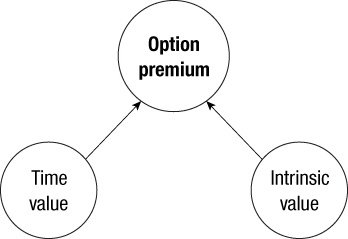
As we said before, options themselves have a value. Remember that options are totally separate entities to the underlying assets from which they are derived (hence, the term derivative). But in themselves they do have a value, which can be split into two parts: intrinsic value and time value.

In general:

  • Intrinsic value is that part of the option’s value that is in-the-money (ITM).
  • Time value is the remainder of the option’s value. Out-of-the-money (OTM) options will have no intrinsic value, and their price will solely be based on time value. Time value is another way of saying hope value. This hope is based on the amount of time left until expiration and the price of the underlying asset.
  • A call is ITM when the underlying asset price is greater than the strike price.
  • A call is OTM when the underlying asset price is less than the strike price.
  • A call is at-the-money (ATM) when the underlying asset price is the same as the strike price.

Put options work the opposite way:

  • A put is ITM when the underlying asset price is less than the strike price.
  • A put is OTM when the underlying asset price is greater than the strike price.
  • A put is ATM when the underlying asset price is the same as the strike price.

Trade Options

The main reason for trading options is that for a smaller amount of money you can control a large amount of stock, particularly with call options. Call options are always cheaper than the underlying asset and put options usually are. Options are generally more volatile than their underlying instruments; therefore, investors get “more bang for their buck” or more action. Clearly this can lead to danger, but as you’ll see, it also can lead to more safety and security. You’ll also see that it can mean much greater flexibility in your trading and even give you the ability to make profit when you don’t know the direction in which the stock will move.

Options are generally more volatile than their underlying instruments; therefore, investors get “more bang for their buck” or more action.

Those investors with portfolios can set up protective measures in the event of a market downturn. It is also quite possible to set up a position whereby you can only make profit. Perhaps not a hugely exciting profit in triple digits, but a certain profit nevertheless. Options make this type of scenario possible.

In short, options give the investor added flexibility, potentially much greater gains for a given movement in the stock price, and protection against risk. On the flip side, used in the wrong way, options can lead people to serious losses. You will be learning safe strategies only and the simple rules governing those types of trade.

error: Content is protected !!