Need for Creative Organization

Organizations today operate in a highly competitive, global environment, making creativity crucial. Creativity is what fuels big ideas, challenges employees’ way of thinking, and opens the door to new business opportunities. “Creativity” and “innovation” are often used interchangeably for that reason, but are two separate concepts.

“There are a lot of competencies that go into realizing an innovation. Creativity is different because creativity is a mechanism to being innovative. You can have great ideas, but not be innovative.”

Creativity in business is a crucial first step that needs to be prioritized by senior leadership. A survey by IBM of more than 1,500 chief executive officers shows consensus: Creativity was ranked as the number one factor for future business success—above management discipline, integrity, and even vision.

One reason for that is: Creative leaders are more comfortable with ambiguity. And as industries continue to evolve, business goals and priorities will need to change. Eight in 10 surveyed CEOs said they expect their industry to become significantly more complex. Only 49 percent, however, are confident their organizations are equipped to deal with the transformation.

Several retailers, like Apple, are trying to rise to the challenge by creating “experiences.” Take Starbucks, for example. Customers visit for more than the seasonal beverages; they go for the ambiance. From the warm, welcoming interior color scheme to the alternative music and, often, neighborhood-inspired furniture or art, there’s more to the brand than what it’s selling behind the counter.

Target is another example. The chain recently announced plans for how it’s reimagining its more than 1,800 stores. One change is that shoppers will be able to “choose their own adventure” by picking from one of two store entrances. The first will lead customers to a grab-and-go food and wine and beer shop, featuring self-checkout lanes and the option to pick up any online orders. The second entrance will bring customers to the store’s other beauty, fashion, home, and electronics displays.

How to Foster Creativity within Your Organization?

There are several smaller steps leaders can take to make a big change on their organization. Here are five ways you can foster creativity within your own team:

  1. Reward Creativity

Not every idea will be a success, but big breakthroughs won’t occur if the company plays it safe. Executives need to be comfortable with failure, and give employees the freedom and flexibility to experiment with and explore new opportunities.

Global conglomerate Tata gives out a “Dare to Try” award to employees with the “most novel, daring, and seriously attempted ideas that did not achieve the desired results,” while Google’s innovation lab, X, offers bonuses to each team member who worked on a project the company ultimately decided to kill as soon as evidence suggested it wouldn’t scale.

Companies that reward creativity show they value it, inspiring individuals within the organization to pursue untested theories and concepts.

  1. Hire the Right People

The “right” people in this context aren’t solely creatives. Organizations should instead focus on diversity, bringing in a variety of viewpoints, cultural backgrounds, and skill sets. Tom Kelley, partner at global design firm IDEO, established “The Ten Faces of Innovation,” describing how each type of person—such as “The Hurdler,” who tackles problem-solving head-on, or “The Caregiver,” who works to understand and form relationships with each individual customer—adds to the overall creativeness of a project.

“Not everyone is going to be creative, but most people can learn the tools and techniques for being innovative,” Marion says. “It helps to look at things from a different vantage point.”

It is also worth considering building an innovation team within your organization, whose role is to tap into creative energies to develop new products, services, or processes within an organization.

  1. Try the “Yes, And…” Approach

One method for spurring creative brainstorming is trying a technique used in improvisational theater: “Yes, and…” The approach encourages colleagues to build off their peers’ thoughts by first agreeing and then adding something to the discussion. Taking “no” off the table ensures all ideas are heard.

Employees could test this approach by simply putting a paperclip in the middle of the table and thinking up as many use cases for it as possible. The activity might sound silly, but it could help inspire creativity.

  1. Try Flexible Work Hours

Not everyone is suited for the traditional nine-to-five schedule. Offering flexible arrangements, such as the ability to work from home, is known to make employees healthier, happier, and more productive. As long as employees are clear about expectations, complete their work on time, and coordinate appropriately with their team, it’s an easy strategy to test and enables everyone to work when they’re feeling most creative, as opposed to a set time during the day.

  1. Give Employees Time to Recharge

With creativity can also come burnout. Employees need time to step back and hit the refresh button.

“Companies do need to take burnout into consideration,” Marion says, “and maybe take some time between projects or offer sabbaticals to recharge their employees.”

The only thing companies can’t do is ignore creativity altogether, or hope the problem will solve itself. Creativity needs to be prioritized And for good reason, reminds Marion.

“Creativity lends itself to unique solutions to problems,” he says, “and to unique features on products, or unique business models and sources of revenue.”
Characteristics for Creative Organization

  1. Thoughtful Persons

The first and most important characteristics of a creative organization are that it has persons with the aptitude to think, who have their own ideas and have the capacity to think and understand and who also have a broader understanding about almost all spheres.

  1. Adequate Recognition

The creative organization gives adequate recognition to the creative persons and the contributions made by them.

Besides, they are also motivated by rewarding or promoting them for the challenging jobs performed by them, so that they may provide better contributions to the organization in the future also.

  1. Impartial and Objective Approach

In the creative organization, the entrepreneur has an impartial and objective approach towards his employees.

The ideas of the employees are evaluated on the basis of their utility and not on the basis of the position of Ideas providers.

  1. Open Communication

In such organizations, the provision is for open communication, like two-way communication, the free exchange of ideas, the use of proper communication methods and regular communication.

Besides it, the secrecy in such an organization is very limited.

  1. Autonomy at all Levels of Organization

Autonomy in the creative organization may be observed at all levels.

Hence, the members of the organization present modern ideas, in place of old and obsolete ideas and execution is also accordingly.

Besides, the members and the persons have also full freedom to making initiations and selections in their functions, so that decisions may be taken in accordance with the prevailing circumstances.

So, the creative organization structure is very Autonomy.

  1. Adopting Additional Dimensions

In the creative organization, additional dimensions and techniques, like suggestions system, brainstorming, problem-solving methods, etc. are also adopted, besides the methods and techniques used till now.

  1. To Bear Failures with Ease

The creative organization’s beer failures, if any, with ease.

Besides, such organizations give due respect to the ideas expressed by various persons and relations do not reject them outrightly by treating them as impractical and worthless, so that even more ideas may be presented in the future.

  1. Encouragement for Contacts and Relations

Creative organizations provide encouragement to their, employees, managers and officers to develop and establish contacts and relations with the executives of external organizations and competing institutions.

So that useful ideas of outsiders may also be known as suitably executed.

Examples of Creative Organizations

  1. Full Acceptance of Changes

The employees of the creative organizations are not only ready to adopt new changes, but also give them full acceptance.

  1. Adoption of Heterogeneous Personnel Policy

Creative organizations adopt a heterogeneous personal policy like:

  • There is not binding to adopt the existing traditions, past decisions and set working methods.
  • Efforts are made to solve solutions to the problem of the organization with non-specific methods.
  • This policy particularly encourages fun, enjoyments, and initiatives.
  1. Decentralized Organizational Framework

A decentralized organizational Framework is adopted in the creative organization.

For that, the employees do not have the freedom only to plan their activities, but they also have wide and sufficient opportunities for creative behaviour and participation.

  1. Basis of Promotion

Normally, there are two bases for selection and promotion of persons in the organizations: seniority and merit or quality.

But, in creative organizations, selections and promotions are based only on merit or qualities.

Creating Creative Organization

  1. Enable real-time, dynamic collaboration to integrate knowledge

Innovation is about combining different bodies of knowledge. When knowledge is integrated, it creates the conditions that stimulate creative people to make the unusual connections that lead to breakthrough ideas. That’s why you need cross-functional teams: to collaborate on a daily basis and ensure that their knowledge is integrated.  If you have a dispersed team, then you need to ensure that your social networks are enabled by technology.

  1. Broaden your range of inspiration

The best business ideas often occur at the intersection of market, customer and technology intelligence. Teams that create the best ideas take the conscious step of carefully selecting the sources of inspiration before they go digging for information. For example, food companies source inspiration from culinary trends, consumer good companies immerse themselves in the consumer experience, and B2B companies spend days in technology scenario planning. Open innovation extends this network of knowledge to the outside world, quickly multiplying the sources of inspiration.

  1. Remove the fuzziness from the process

To ensure that everyone can contribute, establish a clear process and clarify how the front end of innovation (FEI) process fits with the broader end-to-end innovation cycle.  A strong FEI process should include the following steps: clarify the brief, dig for inspiration, create ideas, develop the ideas and, finally, make a decision. The secret to success is to require that the process is followed, but to avoid creating hurdles, gates and governance in the earlier stages.

  1. Link ideation to corporate strategy

Figure 1Creativity can produce a lot of ideas, but business value increases when creativity is channeled to priority areas. A lot of patents are traded or sold every year because they represent relevant customer solutions that could not be supported by the company’s business model.  Establish your strategic arenas and innovation requirements early.

  1. Transform business requirements into innovation requirements

After clarifying the strategic arenas, translate them into requirements specific to innovation. This leads to innovation domains, which reside at the intersection between mega-trends and unmet consumer needs relevant to the strategic arena. Adding your technical competencies and complementary assets leads to the development of innovation platforms.

  1. Fully develop ideas

The best product launches are the ones that deliver against several of the domain benefits and across all of the touch-points of the customer experience. Conversely, rapidly scaled, “half cooked” ideas generally fail, no matter how brilliant they are.  Make sure your organization takes the time to develop and combine complementary ideas.

  1. Support the process with great leadership

The innovation leader’s role is pivotal. Generate enthusiasm and creative people will feel respected and valued. Rewarding desired behaviors, like collaboration, teamwork and building on other’s ideas, ensures that change is sustainable. At the same time, your words alone are not enough. To support a successful FEI process, companies must create a leadership team that monitors progress and removes organizational barriers and independent teams responsible for breakthrough innovation.

Companies with a strong number of creative people and the ability to connect them via open innovation are certainly off to a strong start. But good ideas are not created in a vacuum, and mastering the front end of innovation requires more than just creativity. As the philosopher Norman Podhoretz wrote: “Innovation represents a miraculous coming together of the uninhibited energy of the child with its apparent opposite, the sense of order imposed on the disciplined adult intelligence.” Mastering the front end of innovation requires a combination of creativity and discipline.

Fostering Innovation Climate and Culture

The last recession taught smart companies a valuable lesson while poorly managed companies bunkered down in survival mode, innovative companies seized the opportunity and took the hibernating companies’ market share.

Consumers are pushing small and large companies to deliver more affordable, better, and exciting products and services. There is no more room for mediocrity in our globalized market place.

Here are seven simple steps to foster a culture of innovation in your organization climate and culture.

  1. Lead from the front

Innovation starts with the leadership qualities of the founder or CEO. Founders and CEOs of innovative organizations have to be passionate about their work, display a positive and optimistic outlook, have a real drive and clear vision, be forward thinking, and above all embrace change.

Leaders have to be bold thinkers and from the top-down or across the board, they play a primary role in fostering innovative organizations. Innovation is the high-performance mantra of business leaders.

  1. Create a culture of innovation

People perform best when they are driven by inspiration and encouraged to push their boundaries and think outside the box. But employees cannot do this when they are being micromanaged. Employees need to feel independent enough to own their innovative thinking and to pursue the ideas they are passionate about. In fact, if management effectively fosters a creative and open environment, innovation will happen naturally.

A single value creating idea might require hundreds of dud ideas. When the entire organization brainstorms, the process of refining suggestions towards a single idea happens phenomenally quicker versus when only key staff is involved in the process. By creating a strong organizational culture, you devolve power down to every employee to innovate.

  1. Build effective teams

The super-performing team has become the holy grail of the business world. Various key requirements need to be in place. Some of these include dependability between team members, effective structure and clarity of objectives; real meaning in the work the team does, as well believing in the long term results of the team’s efforts.

Teams also need to create a real sense of psychological safety where open and honest communication can prevail.

  1. Reward failure

One of the most powerful tools for promoting employee creativity and innovation is recognition. People want to be recognized and rewarded for their ideas and initiatives, and it is a practice that can have tremendous payoff for the organization.

One reason employees often don’t express their ideas is that they don’t want to rock the boat. They don’t want to be a failure if something doesn’t work out. Tolerate mistakes and expect failure, and reward lessons learned. Ideas don’t always work the first time.

  1. Take ownership of client problems

Innovative organizations encourage staff to take ownership of problems presented by clients. So often client problems are seen as a headache left in the hands of “customer service.”  The truth is that every customer problem or complaint presents the organization with a phenomenal opportunity to showcase real customer service and highlight vast improvements in product or service design and delivery.

Lessons learnt from customer problems should be shared with each employee in the organization in order to get the maximum learning value from the exercise.

  1. Benchmark against the best

How do entrepreneurs know they are innovative? Your business does not trade in a vacuum– you and your organization are part of a larger business eco system consisting of other competitor, clients, and industry partners.

If you are not the leader within your industry or niche market, it’s important to determine who the leader is and ensure that your strategies and tactics will enable you to take the top spot. Refrain from vanity metrics that create a feel good factor instead of real organization value.

  1. Flat management structure

The management structures of innovative companies tend to be flat, enabling opportunities for open communication and encouraging confidence.

However, if a flat structure does not fit in with your geographic or company culture, then the alternative is to have an “Innovation Champion” who can bring management’s attention to great ideas. Whatever method you follow, ensure that you create genuine pathways for ideas to become reality within your organization.

Adopting the above seven strategies will enable your organization to map, systematize, manage, measure, and improve innovation and subsequently produce a steady stream of innovations- and the occasional game changer.

Product Innovation

Product innovation is the creation and subsequent introduction of a good or service that is either new, or an improved version of previous goods or services. This is broader than the normally accepted definition of innovation that includes the invention of new products which, in this context, are still considered innovative.

Product innovation is defined as:

The development of new products, changes in design of established products, or use of new materials or components in the manufacture of established products.

Numerous examples of product innovation include introducing new products, enhanced quality and improving its overall performance. Product innovation, alongside cost-cutting innovation and process innovation, are three different classifications of innovation which aim to develop a company’s production methods.

Thus product innovation can be divided into two categories of innovation: radical innovation which aims at developing a new product, and incremental innovation which aims at improving existing products.

Advantages of product innovation

(i) Growth, expansion and gaining a competitive advantage

A business that is capable of differentiating their product from other businesses in the same industry to large extent will be able to reap profits. This can be applied to how smaller businesses can use product innovation to better differentiate their product from others. Product differentiation can be defined as “A marketing process that showcases the differences between products. Differentiation looks to make a product more attractive by contrasting its unique qualities with other competing products. Successful product differentiation creates a competitive advantage for the seller, as customers view these products as unique or superior.” Therefore, small businesses that are able to utilize product innovation effectively will be able to expand and grow into larger businesses, while gaining a competitive advantage over its remaining competitors.

(ii) Brand switching

Businesses that once again are able to successfully utilize product innovation will thus entice customers from rival brands to buy its product instead as it becomes more attractive to the customer. One example of successful product innovation that have led to brand switching are the introduction of the iPhone to the mobile phone industry (which has caused mobile phone users to switch from Nokia, Motorola, Sony Ericsson,etc. to the Apple iPhone).

Disadvantages of product innovation

(i) Counter effect of product innovation

Not all businesses/competitors do not always create products/resources from scratch, but rather substitute different resources to create productive innovation and this could have an opposite effect of what the business/ competitor is trying to do. Thus, some of these businesses/ competitors could be driven out of the industry and will not last long enough to enhance their product during their time in the industry.

(ii) High costs and high risk of failure

When a business attempts to innovate its product, it will inject lots of capital and time into it, which requires severe experimentation. Constant experimentation could result in failure for the business and will also cause the business to incur significantly higher costs. Furthermore, it could take years for a business to successfully innovate a product, thus resulting in an uncertain return.

(iii) Disrupting the outside world

For product innovation to occur, the business will have to change the way it runs, and this could lead to the breaking down of relationships between the business and its customers, suppliers and business partners. In addition, changing too much of a business’s product could lead to the business gaining a less reputable image due to a loss of credibility and consistency.

Stages

These are the few stages that a business has to undergo when introducing a new product line into the market:

  1. Market research

This can be done in the form of primary and secondary market research where the business will gather as much information as possible about the present tastes and preferences of its potential consumers, and the gaps filled in the business’s particular industry. Secondary market research involves gathering data that has already been collected by another party, and is primarily based on information that has been founded from previous studies. One advantage of secondary market research over primary market research is that it is low-cost, thus enabling the business to be able to invest its time into other more important matters and new potential business ventures. Primary market research involves the business gathering data individually, and this can be done via various sampling methods. Other forms of primary market research include focus groups, interviews, questionnaires, etc. One advantage of primary market research over secondary market research is that it delivers much more specific results than secondary market research, and is only available to the business itself, rather than secondary research which is made globally available, as data has already been collected.

  1. Product development and testing

This stage involves creating a test product called a prototype. The prototype ensures the business that its product is functioning properly, and all the necessary arrangements are made to enhance the product as much as possible. After the prototype has been devised, the business can now use test marketing where the business introduces a product to a small group of individuals to give the company insight into the effectiveness of the product from the views of their potential customers.

  1. Feasibility study

The business will now look at the legal and financial restrictions of launching the product into the market. This is where the business will create sales forecasts, establish the price of the product, the overall costs of production and profitability estimates. The business also has to consider legal aspects in terms of safety and Intellectual Property Rights (IPR).

After all these stages have been successfully run through, then the business can officially launch the product.

Types of New Product

The term new product can mean different things. Six different categories of new products can be identified that are all quite different from each other. Still, they are all called new products. Let’s investigate the different categories of new products and what the term new product may actually mean.

The six categories of new products range from new-to-the-world products (sometimes called really new products), as well as a range of minor repositionings and cost reductions. The list containing the six categories of new products may include things you would exclude. For instance, can we have a new item just by repositioning an old one (telling customer it is something else)? Yes, we can have a new product then. You might consider this to be only a new use, but the firm still went through a process of discovery and development. And a new use may occur in a completely separate division. For example, the Dove soap name has, by now, been extended to almost two dozen box soaps and almost as many liquid body washes.

The Six Categories of New Products

As you see, we have to broaden our definition of new products to include the following six categories of new products.

  1. New-to-the-world Products (really new Products)

The alternative expression for new-to-the-world products (really new products) already indicates that this is what most people would define as a new product. These products are inventions that create a whole new market. Examples: Polaroid camera, the iPod and iPad, the laser printer and so on.

  1. New-to-the-firm Products (new Product Lines)

Products that take a firm into a category new to it. The products are not new to the world, but are new to the firm. The new product line raises the issue of the imitation product: a “me-too”. Examples: P&G’s first shampoo or coffee, Hallmark gift items, AT&T’s Universal credit card and so on.

  1. Additions to existing Product Lines

These are simple line extensions, designed to flesh out the product line as offered to the firm’s current markets. Examples: P&G’s Tide Liquid detergent, Bud Light, Special K line extensions (drinks, snack bars, and cereals).

  1. Improvements and Revisions to existing Products

Current products made better. Examples: P&G’s Ivory Soap and Tide power laundry detergent have been revised numerous times throughout their history,  and there are countless other examples.

  1. Repositionings

As we already discussed before, you may have an argument about whether repositions are actually new products. Yet, they can be considered as new products, as the firm undertakes a new products process. Repositionings are products that are retargeted for a new use or application. Examples: Arm & Hammer baking soda repositioned as a drain or refrigerator deodorant; aspirin repositioned as a safeguard against heart attacks. Also includes products retargeted to new users or new target markets. Marlboro cigarettes were repositioned from a woman’s cigarette to a man’s cigarette years ago.

  1. Cost Reductions

Finally, cost reductions complete the six categories of new products. Cost reductions refer to new products that simply replace existing products in the line, providing the customer similar performance but at a lower cost. May be more of a “new product” in terms of design or production than marketing.

Differences between the Categories of New Products

All the categories of new products are considered new products, but it is clear to see that the risks and uncertainties greatly differ, and the categories need to be managed differently.

In general, if a product is new to the world or new to the firm (the first two categories of new products), the risks and uncertainties faced by the firm are higher, as are the associated costs of development and launch. For instance, it costs Gillette far more to launch its newest shaving system (the Fusion Flexball for example) than to do upgrades to the earlier Mach 3 system (such as developing the women’s version, named Venus, which used the same blade technology).

A greater commitment of human and financial resources is clearly often required to bring the most innovative new products to market successfully.

Technology Strategy for Product Innovation

Companies realize innovations through a combination of market research, internal idea generation, customer requests and a variety of other factors. They also frequently discover innovative solutions by chance.

Manufacturers typically maintain a balance between market and customer-driven innovation efforts. Market research will identify broad market needs or specific market demand that will drive innovation, and resources will be devoted to support organizational goals for product and technology development. Customers bring specific problems to be solved sometimes without understanding what the problem is or realizing a solution is possible.

Customer requests represent an external force driving innovation. Succeeding in customer-driven product innovation can be made easier if companies follow a set of four best practices centering on clear and open communication between the parties. Following this disciplined process is the second strategy in creating product innovation that delivers results.

  1. Gather all the facts

Creating a solution for a customer challenge begins with a deep understanding of the customer’s needs the real needs, not just the stated needs. Developers should not simply respond to the request. They need to first ask a series of in-depth questions to clarify the context, which may include: Why do you need the requested product or technology? How does it fit into a complete system? What processes affect its performance? What alternatives have worked and/or failed? Gaining comprehensive insight may reveal that a more complete solution exists rather than one that simply fulfills the customer’s initial request.

  1. Get the right parties together and on the same page

Open communication is vital to arriving at the best possible solution for customer-centric development challenges. Often, customers share their initial requests with marketing and sales contacts. It is important for these parties to facilitate collaboration between technical groups on both sides to ensure the proper handoff of information and encourage peer-to-peer communication, which adds richness to the relationship and helps to ensure the most relevant solutions.

Engineers from both organizations need to share detailed application information and explore technical challenges together as early in the design cycle as possible. Bringing people together who speak the same technical language encourages information sharing, brainstorming and efficiency, while enabling the parties to gain as in-depth an understanding of the project as possible.

  1. Stay ahead of the curve

Technology developers have a greater chance of successfully meeting future customer requests when they proactively explore potential market opportunities and applications. As discussed earlier, one way to structure these proactive efforts is to set up a technology development track operating separately from but parallel to product development. Developing solutions for specific problems within emerging technologies in advance of customer demands ensures that developers can properly apply those solutions when needed to meet application requirements. In doing so, developers will be able to respond more quickly and effectively to customer needs.

  1. Prototype early and often

Developing early prototypes even for individual components enables developers to test and refine parts before moving too far down the product development path. Techniques can include virtual prototyping and virtual design analysis. Developers should test concepts and engage in continuous feasibility studies throughout a project to determine the potential for success or failure. Then, as development proceeds, opportunities exist to make adjustments without requiring major overhauls. Such early prototypes are often less expensive than complete systems and can be made more rapidly, decreasing costs and shortening development time.

In collaboration with the customer, it is wise to test those parts that present the highest risk or biggest challenges first. In doing so, companies and their customers are better able to determine if any barriers are insurmountable and would necessitate putting the brakes on a project prior to substantive investments in time, energy or dollars. Even if a project does not meet its initial goals, it can still be considered a success. The collaborative process strengthens customer-developer relationships and gives each party a better idea of the other’s needs and capabilities, which can help facilitate the next project.

Technology Strategy for Product Innovation development framework based on their observations of top-performing businesses.

  1. Define goals and objectives

Developing an innovation and technology strategy begins by setting and clearly articulating innovation goals. Importantly, these must tie into the broader business goals and also translate into specific and concrete objectives, e.g. in terms of expected sales or profits.

  1. Select strategic arenas

Identifying, at a strategic level, the market opportunities to attack and profitably operate in, or the technologies which the business would focus its new product efforts on is central to a new strategy. Cooper and Edgett provide a set of dimensions and questions to help businesses select their areas of strategic thrust (or arenas) that provide new and profitable prospects.

  1. Develop attack and entry strategies

The authors explain that a business may choose to attack its chosen strategic arenas as an industry innovator or a fast follower, a low-cost provider, differentiator or a niche player. These attack strategies guide the policies, activities and the businesses initiatives, and whatever is chosen should align with the business’s unique strengths and the knowledge of industry success drivers.

  1. Resource commitments and deployment decisions

Determining strategic priorities and allocating resources to them is a key part of a technology strategy. This translates as effective portfolio selection and management that ensures projects and other initiatives are aligned with the business objectives and are balanced against one another.

  1. Define a strategic roadmap

A roadmap helps senior management understand and communicate how they intend to achieve their innovation and technology strategy objectives. Using roadmaps, they are able to map out timings of their initiatives, including indications of where technology development or acquisition is necessary, as well as when product platforms would be crucial.

New Product Development Process

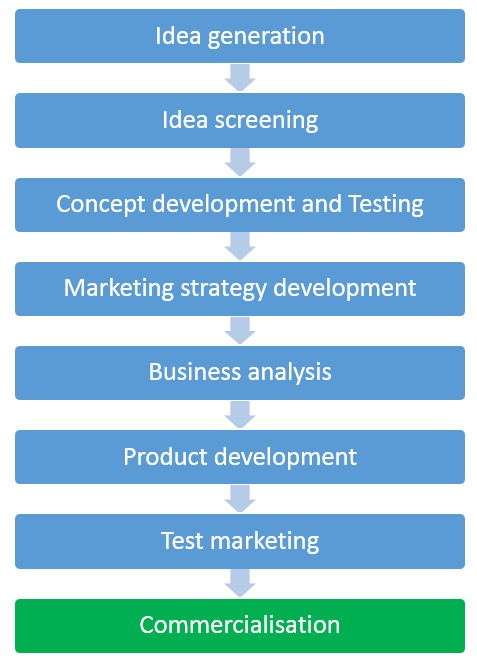
In order to stay successful in the face of maturing products, companies have to obtain new ones by a carefully executed new product development process. But they face a problem: although they must develop new products, the odds weigh heavily against success. Of thousands of products entering the process, only a handful reach the market. Therefore, it is of crucial importance to understand consumers, markets, and competitors in order to develop products that deliver superior value to customers. In other words, there is no way around a systematic, customer-driven new product development process for finding and growing new products. We will go into the eight major steps in the new product development process.

The New Product Development Process are

  1. Idea Generation

The new product development process starts with idea generation. Idea generation refers to the systematic search for new-product ideas. Typically, a company generates hundreds of ideas, maybe even thousands, to find a handful of good ones in the end. Two sources of new ideas can be identified:

  • Internal idea sources: The Company finds new ideas internally. That means R&D, but also contributions from employees.
  • External idea sources: The Company finds new ideas externally. This refers to all kinds of external sources, e.g. distributors and suppliers, but also competitors. The most important external source are customers, because the new product development process should focus on creating customer value.
  1. Idea Screening

The next step in the new product development process is idea screening. Idea screening means nothing else than filtering the ideas to pick out good ones. In other words, all ideas generated are screened to spot good ones and drop poor ones as soon as possible. While the purpose of idea generation was to create a large number of ideas, the purpose of the succeeding stages is to reduce that number. The reason is that product development costs rise greatly in later stages. Therefore, the company would like to go ahead only with those product ideas that will turn into profitable products. Dropping the poor ideas as soon as possible is, consequently, of crucial importance.

  1. Concept Development and Testing

To go on in the new product development process, attractive ideas must be developed into a product concept. A product concept is a detailed version of the new-product idea stated in meaningful consumer terms. You should distinguish

  • A product idea is an idea for a possible product
  • A product concept is a detailed version of the idea stated in meaningful consumer terms
  • A product image is the way consumers perceive an actual or potential product.

Let’s investigate the two parts of this stage in more detail.

Concept Development: Imagine a car manufacturer that has developed an all-electric car. The idea has passed the idea screening and must now be developed into a concept. The marketer’s task is to develop this new product into alternative product concepts. Then, the company can find out how attractive each concept is to customers and choose the best one. Possible product concepts for this electric car could be:

  • Concept 1: An affordably priced mid-size car designed as a second family car to be used around town for visiting friends and doing shopping.
  • Concept 2: A mid-priced sporty compact car appealing to young singles and couples.
  • Concept 3: A high-end midsize utility vehicle appealing to those who like the space SUVs provide but also want an economical car.

As you can see, these concepts need to be quite precise in order to be meaningful. In the next sub-stage, each concept is tested.

Concept Testing: New product concepts, such as those given above, need to be tested with groups of target consumers. The concepts can be presented to consumers either symbolically or physically. The question is always: does the particular concept have strong consumer appeal? For some concept tests, a word or picture description might be sufficient. However, to increase the reliability of the test, a more concrete and physical presentation of the product concept may be needed. After exposing the concept to the group of target consumers, they will be asked to answer questions in order to find out the consumer appeal and customer value of each concept.

  1. Marketing Strategy Development

The next step in the new product development process is the marketing strategy development. When a promising concept has been developed and tested, it is time to design an initial marketing strategy for the new product based on the product concept for introducing this new product to the market.

The marketing strategy statement consists of three parts and should be formulated carefully:

  • A description of the target market, the planned value proposition, and the sales, market share and profit goals for the first few years
  • An outline of the product’s planned price, distribution and marketing budget for the first year
  • The planned long-term sales, profit goals and the marketing mix strategy.
  1. Business Analysis

Once decided upon a product concept and marketing strategy, management can evaluate the business attractiveness of the proposed new product. The fifth step in the new product development process involves a review of the sales, costs and profit projections for the new product to find out whether these factors satisfy the company’s objectives. If they do, the product can be moved on to the product development stage.

In order to estimate sales, the company could look at the sales history of similar products and conduct market surveys. Then, it should be able to estimate minimum and maximum sales to assess the range of risk. When the sales forecast is prepared, the firm can estimate the expected costs and profits for a product, including marketing, R&D, operations etc. All the sales and costs figures together can eventually be used to analyses the new product’s financial attractiveness.

  1. Product Development

The new product development process goes on with the actual product development. Up to this point, for many new product concepts, there may exist only a word description, a drawing or perhaps a rough prototype. But if the product concept passes the business test, it must be developed into a physical product to ensure that the product idea can be turned into a workable market offering. The problem is, though, that at this stage, R&D and engineering costs cause a huge jump in investment.

The R&D department will develop and test one or more physical versions of the product concept. Developing a successful prototype, however, can take days, weeks, months or even years, depending on the product and prototype methods.

Also, products often undergo tests to make sure they perform safely and effectively. This can be done by the firm itself or outsourced.

In many cases, marketers involve actual customers in product testing. Consumers can evaluate prototypes and work with pre-release products. Their experiences may be very useful in the product development stage.

  1. Test Marketing

The last stage before commercialization in the new product development process is test marketing. In this stage of the new product development process, the product and its proposed marketing programme are tested in realistic market settings. Therefore, test marketing gives the marketer experience with marketing the product before going to the great expense of full introduction. In fact, it allows the company to test the product and its entire marketing programme, including targeting and positioning strategy, advertising, distributions, packaging etc. before the full investment is made.

The amount of test marketing necessary varies with each new product. Especially when introducing a new product requiring a large investment, when the risks are high, or when the firm is not sure of the product or its marketing programme, a lot of test marketing may be carried out.

  1. Commercialization

Test marketing has given management the information needed to make the final decision: launch or do not launch the new product. The final stage in the new product development process is commercialization. Commercialization means nothing else than introducing a new product into the market. At this point, the highest costs are incurred: the company may need to build or rent a manufacturing facility. Large amounts may be spent on advertising, sales promotion and other marketing efforts in the first year.

Some factors should be considered before the product is commercialized:

  • Introduction timing. For instance, if the economy is down, it might be wise to wait until the following year to launch the product. However, if competitors are ready to introduce their own products, the company should push to introduce the new product sooner.
  • Introduction place. Where to launch the new product? Should it be launched in a single location, a region, the national market, or the international market? Normally, companies don’t have the confidence, capital and capacity to launch new products into full national or international distribution from the start. Instead, they usually develop a planned market rollout over time.

In all of these steps of the new product development process, the most important focus is on creating superior customer value. Only then, the product can become a success in the market. Only very few products actually get the chance to become a success. The risks and costs are simply too high to allow every product to pass every stage of the new product development process.

Packaging Innovations

Production Packaging Innovations (PPI) is geared towards providing solutions for your packaging needs. Innovation is not just in our name, it’s in our nature. PPI focuses on meeting customer needs and offering solutions in efficient and affordable ways.

With roots stretching back 140 years, we know our trade inside and out. Our commitment to innovation is also apparent in our past, as during the 1950s we were Australia’s first to perform flexographic printing on poly bags.

Packaging Innovation in Consumer Trends

  1. Smart Packaging

Customer-centric brand marketing holds the key to creating and sustaining long-lasting product value. There’s little arguing about what happens when companies know how to solve customers’ problems– they earn greater brand loyalty and broader market share. That’s why every consumer product goods (CPG) maker across every conceivable industry segment focuses on optimizing customer experiences, starting with product packaging. Digitization, experience seekers and a growing base of tech-savvy consumers who are willing to engage with companies on a digital level are driving this packaging innovation.

Also known as active packaging or intelligent packaging, smart packaging refers to solutions with two-level interaction for greater consumer engagement through the use of digital technologies.

Traditional product brands and startups both have the opportunity to take advantage of smart packaging for differentiated offerings, loyalty and rich streams of consumer data that can lead to entirely new business models. 

The ability to align brands more closely and constantly with consumer lifestyles, smart devices and the Internet of Things is transforming how customers choose and interact with consumer devices, consumer packaged goods (CPG), consumer healthcare products as well as food and beverages.    

Think about baby formula, for instance. In response to consumers’ need for safety and authenticity, baby formula producers are looking to smart labels, which can sense first opening and provide information to consumers and companies about authenticity, integrity and freshness. In this data exchange, consumers can use the product knowing that it is safe to do so, while the producers could track information such as the time between purchase and consumption, getting better insight into consumer behaviors.  

  1. Sustainable Packaging

As discussions about the environmental impact we make as a society come into question, consumers are becoming more environmentally conscious, which require new packaging innovations. The adoption of sustainable packaging requires a holistic approach. Opportunities must be found to connect people, places and partnerships to make positive impacts on society and the environment while overcoming myriad challenges. Historically, plastics were based on non-renewal resources, so they didn’t convert or breakdown to basic molecules. The broad variations of resin types used also created numerous separation and recycling impediments. 

To overcome these barriers and drive sustainable packaging innovations, industry stakeholders must unite in advancing design improvements that increase the use of recyclable and compostable materials. Equally important is encouraging greater investment in reprocessing technologies that can forever change how plastic packaging is designed, made and re-used.

Organizations of all sizes can put circular economy principles to work and they can start by rethinking the design and development of products and packaging so they can be recycled or repurposed easily and affordably. 

A leader in specialty coffee and innovative, single-service brewing systems, Keurig Green Mountain (Keurig) is committed to delivering exceptional coffee as well as using the power of business to build resilient supply chains, sustainable products and thriving communities. To that end, the company has pledged to make 100 percent of its iconic K-Cup pods recyclable by 2020. 

  1. E-Commerce Packaging

Consumers are increasingly willing to shop on alternative channels outside of the physical brick-and-mortar stores. Today it’s hard to remember the days before Amazon, Paypal and SSL encryption. The e-commerce phenomenon has ushered in an extreme shift in consumer experience over the past two decades. Although it started with easily shippable objects including books, CDs and DVDs, it is now possible to buy almost anything you can think of – from razors to Riesling – while sitting in front of a screen.

Brands and their packaging partners are in the midst of a significant transition away from a world where packages primarily sit on store shelves waiting to entice potential buyers to one where packages sit in warehouses awaiting a “ready to buy” webpage click. This requires a different type of packaging innovation to meet e-commerce needs. 

As a result, the brand and packaging professionals responsible for the final product must evolve their e-commerce packaging solutions to support the new retail reality. Adapting to a whole new world of e-commerce potentially means shipping considerations and device-to-consumer platforms designed to support repeat purchases to a wide variety of new technologies, innovations and bottling options.

When detergent pods were introduced into the market a few years prior, they took the industry by storm – entering a market with 100 percent penetration and increasing customer dissatisfaction levels. It was risky, but the right move to make for P&G. 

In 2016, the company trialed an online, direct-to-consumer, subscription business for its Tide Pods: Tide Wash Club. The model was to offer free shipping on Tide Pods and deliver them to the consumer at regular intervals. Since the formula of the product in the pods have significantly less water than the liquid form, they are lighter. The design also makes them less prone to breakage and leakage during shipping. 

  1. Devicification

Devicification is the opportunity to create a physical packaging platform that interlocks with smart devices. The physical platform may have various benefits such as smart materials that extend shelf life. It could also utilize the Internet of Things (IoT) as a means of communicating with a mobile device or computer, with most of the intelligence built into a smart device.  

Devicification offers convenience that elevates the consumer experience. The capabilities of existing devices like coffee makers, paper towel dispensers and water filters can be amplified with connected solutions. 

Opportunities for packaging innovation can be driven by shifts in consumer behavior and interests, as well as other macro trends in the marketplace. But true innovation comes from the intersection of people (desirability + usability), technical feasibility and business viability.

New Product Failures

Innovation vs New Product (NP)

Innovation drives New Product introduction into markets. Innovation represent a total package of features, forms and functions which marketing program converts into benefits for satisfying the needs and wants of the customer.

Continuous innovations represent minor modifications to existing products, whereas, discontinuous innovations help introduce new products that may change the market and consumer lifestyles and in some cases, rendering existing technologies obsolete.

New Product (NP)

Any product that users consider as a new addition to the current market offerings qualifies as a new product with newness implying change and absence of consumer experience.

Organizations need to replace existing products by NP’s to be competitive in the market. NP’s help in garnering higher margins and hence have a big role to play in growth and survival of an Organization.

New Product could be made available by:

  • Reduction in Cost
  • Product Improvements to improve form or function.
  • Line Extensions which are copies of existing product with unique features.
  • Market Extensions which are original products positioned differently in new markets.
  • New Category products which are new to the company but not new to the customers.
  • New-to-the world products which are technological innovations that create new market that did not exist earlier.

New Product Development (NPD) Process Involves

  • Idea generation
  • Idea screening
  • Concept development and testing
  • Marketing strategy development
  • Business Analysis
  • Product development
  • Market testing
  • Commercialization

The seeds of failure are sown at the initial stages of development. Using a stage gate method, the NPD process could be developed to reduce failures. Faster feedback and prompt corrective actions could improve success rate.

An NP is declared a failure When

  1. It is withdrawn from the market for any reason.
  2. The required market share in a desired time period is not realized.
  3. The anticipated life cycle as defined by the organization is not achieved.
  4. The desired profitability is not realized.

Why New Products Fail?

Reasons could be any one or more than one of the following:

  • The product was not new to the customer /market.
  • The product offered no tangible benefit.
  • The product was not positioned properly.
  • Poor support from channel partners.
  • High forecast variance.
  • Strong competitors’ response.
  • Change in customers preferences Environmental constraints.
  • Poor after sales service.
  • Inadequate return on investment
  • Lack of coordination among various departments
  • Poor diffusion of innovation
  • Conflict of personalities at higher echelons.
  • NP not meeting the claims made or creating a new category product necessitating customer education.
  • Lack of product distinctiveness.
  • High research and/or product development costs and ignoring marketing research findings.
  • Consumers not being informed of the applications, and new technologies not addressing market opportunity correctly.

Examples of New Product Failures

Global Products

  • Ford Edsel
  • Betamax
  • Laser Disc

Indian Products

  • Tata Nano (Failures due to wrong positioning)
  • Tata Estate (Failures due to wrong positioning)
  • Bajaj Geared Scooter (Failures due to new technology)
  • 2- Stroke Bikes (Failures due to new technology)
error: Content is protected !!