Industrial Design

Industrial design is a process of design applied to products that are to be manufactured through techniques of mass production. A key characteristic is that design precedes manufacture: the creative act of determining and defining a product’s form and features takes place in advance of the physical act of making a product, which consists purely of repeated, often automated, replication. This distinguishes industrial design from craft-based design, where the form of the product is determined by the product’s creator largely concurrent with the act of its creation.

All manufactured products are the result of a design process, but the nature of this process can take many forms. It can be conducted by an individual or a team, and such a team could include people with varied expertise (e.g. industrial designers, engineers, business experts, etc.). It can emphasize intuitive creativity or calculated scientific decision-making, and often emphasizes both. It can be influenced by factors as varied as materials, production processes, business strategy, and prevailing social, commercial, or aesthetic attitudes. Industrial design, as an applied art, most often focuses on a combination of aesthetics and user-focused considerations, but also often provides solutions for problems of form, function, physical ergonomics, marketing, brand development, sustainability, and sales.

Industrial Design (ID) is the professional practice of designing products, devices, objects, and services used by millions of people around the world every day.

Industrial designers typically focus on the physical appearance, functionality and manufacturability of a product, though they are often involved in far more during a development cycle. All of this ultimately extends to the overall lasting value and experience a product or service provides for end-users.

Every object that you interact with on a daily basis in your home, office, school, or public setting is the result of a design process. During this process, myriad decisions are made by an industrial designer (and their team) that are aimed at improving your life through well-executed design.

Why should companies go for Industrial Design Protection?

Most of the businesses often think whether it is worthwhile to go for design protection. Below are some of the advantages of design protection which will help them figure out its importance.

Imparts Value to Product

Industrial designs add a commercial value to a product. An organization increases the value of a product by introducing new features, improving the quality or making them easier to use which in turn makes them a whole lot easier to sell. Hence, the marketability increases.

Generates Profit

Industrial design protection helps to ensure a fair return on investment. The main purpose of building a new design is to gain some sort of a benefit. The inventors receive a considerable amount of monetary benefit on selling their new and innovative industrial products in the market. 

Promotes Healthy Competition

It promotes fair competition and honest trade practices. Industrial design leads to health competition among various organizations which in turn fosters more innovation and results in more new products.

Economic Development

The Industrial Design protection helps in the economic development and fosters creativity in the industrial and manufacturing sector. Industrial design protection provides assurance to the designers throughout the country and motivates them in bringing out more new designs. This leads to the growth of a country economically.

Trade Secrets

Trade secrets are a type of intellectual property that comprise formulas, practices, processes, designs, instruments, patterns, or compilations of information that have inherent economic value because they are not generally known or readily ascertainable by others, and which the owner takes reasonable measures to keep secret. In some jurisdictions, such secrets are referred to as confidential information.

The precise language by which a trade secret is defined varies by jurisdiction, as do the particular types of information that are subject to trade secret protection. Three factors are common to all such definitions:

A trade secret is information that

  • Is not generally known to the public;
  • Confers economic benefit on its holder because the information is not publicly known; and
  • Where the holder makes reasonable efforts to maintain its secrecy.

In international law, these three factors define a trade secret under article 39 of the Agreement on Trade-Related Aspects of Intellectual Property Rights, commonly referred to as the TRIPS Agreement.

Similarly, in the United States Economic Espionage Act of 1996, “A trade secret, as defined under 18 U.S.C. § 1839(3)(A),(B) (1996), has three parts:

  • Information
  • Reasonable measures taken to protect the information
  • Which derives independent economic value from not being publicly known.”

Value of Trade Secrets

Trade secrets are an important, but invisible component of a company’s intellectual property (IP). Their contribution to a company’s value, measured as its market capitalization, can be major. Being invisible, that contribution is hard to measure. Patents are a visible contribution, but delayed, and unsuitable for internal innovations. Having an internal scoreboard provides insight into the cost of risks of employees leaving to serve or start competing ventures.

Protection of Trade Secrets

In contrast to registered intellectual property, trade secrets are, by definition, not disclosed to the world at large. Instead, owners of trade secrets seek to protect trade secret information from competitors by instituting special procedures for handling it, as well as technological and legal security measures. Legal protections include non-disclosure agreements (NDAs), and work-for-hire and non-compete clauses. In other words, in exchange for an opportunity to be employed by the holder of secrets, an employee may sign agreements to not reveal their prospective employer’s proprietary information, to surrender or assign to their employer ownership rights to intellectual work and work-products produced during the course (or as a condition) of employment, and to not work for a competitor for a given period of time (sometimes within a given geographic region). Violation of the agreement generally carries the possibility of heavy financial penalties which operate as a disincentive to reveal trade secrets. However, proving a breach of an NDA by a former stakeholder who is legally working for a competitor or prevailing in a lawsuit for breaching a non-compete clause can be very difficult. A holder of a trade secret may also require similar agreements from other parties he or she deals with, such as vendors, licensees, and board members.

As a company can protect its confidential information through NDA, work-for-hire, and non-compete contracts with its stakeholders (within the constraints of employment law, including only restraint that is reasonable in geographic- and time-scope), these protective contractual measures effectively create a perpetual monopoly on secret information that does not expire as would a patent or copyright. The lack of formal protection associated with registered intellectual property rights, however, means that a third party not bound by a signed agreement is not prevented from independently duplicating and using the secret information once it is discovered, such as through reverse engineering.

Therefore, trade secrets such as secret formulae are often protected by restricting the key information to a few trusted individuals. Famous examples of products protected by trade secrets are Chartreuse liqueur and Coca-Cola.

Because protection of trade secrets can, in principle, extend indefinitely, it therefore may provide an advantage over patent protection and other registered intellectual property rights, which last only for a specific duration. The Coca-Cola company, for example, has no patent for the formula of Coca-Cola and has been effective in protecting it for many more years than the 20 years of protection that a patent would have provided. In fact, Coca-Cola refused to reveal its trade secret under at least two judges’ orders.

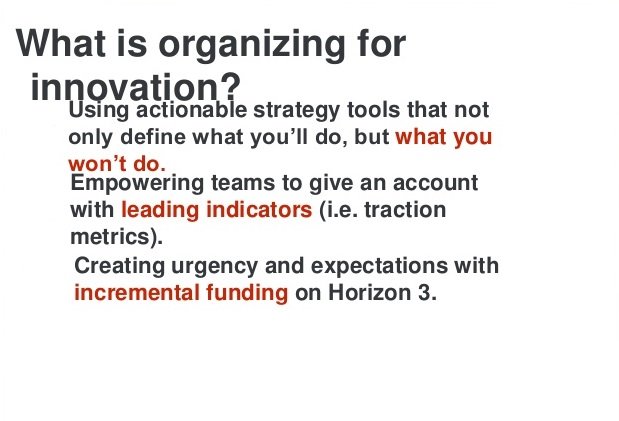
Organizing for Innovation

The ten most innovative companies are ranked by their innovation premium. This is the difference between their market capitalization and a net present value of cash flow from existing businesses. The difference between them is the bonus given by equity investors on the educated hunch that the company will continue to come up with profitable new growth. By this measurement are shareholders involved.

A disruptive company is a business whose innovations force other businesses to alter their strategic course. They are changing the market.

Traditional technology can manage that, until a new technology is made. After some time, the disruptive innovation is able to easily meet the customer’s demand for performance.

Radical innovations replace existing products, technologies and markets.

Reasons for a company to do innovation:

  • A successful new product does more good to an organization than anything else that can happen.
  • Growth
  • Companies need always innovations to stay alive.

Innovation product life cycle:

  • Introduction
  • Growth
  • Maturity
  • Decline

The new things are happening before the introduction stage. But although it is on the beginning of the life cycle, the company should already know what is going to happen in the next stages.

Innovation is the process from idea to product. Innovation is depending on creativity of individuals, firm’s operating functions and activities and firm’s architecture and external linkages.

There are push and pull innovations. Push innovations are based on the latest science and technology advances in society. Pull innovations are based on the needs in society and the marketplace.

Invention: creation of a unique, hopefully patentable, device/configuration/process. An invention is only an innovation if it is marketable.

Innovation: transforming an invention into a commercial product that can be sold profitably.

Innovation management: the management of all activities involved in the process of idea generations, technology development, manufacturing and marketing of a new product or manufacturing process or equipment.

Product development/product design product planning: the complete process of transforming an opportunity into a new product and introducing it successfully in the market.

Product design: industrial design (art, science and technology)

There are some spectrums of design activities: engineering, product/use, fashion/trends, engineering solutions, form concepts and design trends.

There are two main business processes:

  • The process of repeatedly making a product/service and delivering that to the customer. It focuses on the buy-make-distribute-sell-service, the supply chain and on operational value stream.
  • The process of designing a new product/service that is profitable in the market. It focuses on design, development, innovation chain and development value stream.

The operational value stream consists of activities that converting raw material to products in the hand of the customers and activities that are value creating because customers pay for the changed materials.

The operational value stream has the following characteristics: material flow, it is repeated and there is process control.

The development value stream consists of activities that create profitable operational value streams and activities that create useable knowledge, which involves learning.

The development value stream has the following characteristics: information flow, it is a one time stream and there is a disciplined process.

The state has different roles in innovation:

  • Purchaser
  • Financing R&D
  • Educational and other societal effects
  • Competition regulator
  • Environment and safety regulator
  • Infrastructure
  • Macroeconomic conditions
  • Information and decision center, create political stability

The industry attractiveness can be determined by Porters model, which identifies five factors: threat of new entrants, bargaining power of suppliers, bargaining power of buyers, rivalry among existing firms and the threat of substitute products and services.

Innovativeness can be measured on different levels. On national/regional level a scoreboard can be used. On industry level the innovation index is a way to measure innovativeness. At the firm level, the percentage of sales of new products, the value of patents or the Net Promotor Score.

The Net Promotor Score is a measurement, which is based on the question if a costumer would recommend this product/service/organization to a friend or colleague. The Net Promotor Score is calculated by the percentage promotes minus the percentage detractors. 

Frugal innovation is an innovation strategy of a large market, which implies that private companies can make significant profits by selling to the poor. By selling to the poor, private companies can bring prosperity to the poor and thus can help eradicate poverty. 

The diffusion of innovations is divided into five categories: the innovators, early adopters, early majority, late majority and the laggards. 

Factors that are influencing adoption:

  • Relative advantage: The degree to which an innovation is perceived as being better than its precursors
  • Compatibility: The degree to which an innovation is perceived as being consistent with the existing values, needs, and past experiences of potential adopters.
  • Complexity: The degree to which an innovation is perceived as being difficult to use.
  • Observability: The degree to which the results of an innovation are observable to others.
  • Trialability: The degree to which an innovation may be experimented with before adoption.

Traits of Innovative Organization

Innovation is nothing more than a tool that enables companies to achieve unique, strategic goals. It should not simply be a slogan, nor an end unto itself, argues Jeffrey Baumgartner. To be truly innovative, an organization should have seven essential characteristics.

What makes for an innovative company? An innovation initiative is not enough. Having the word “innovation” in your company slogan or all over your web site is not enough. Indeed, I would argue that any kind of focus on innovation as an end is detrimental to innovation. Innovation is nothing more than a tool that enables companies to achieve unique, strategic goals. Here are seven essential characteristics of innovative companies. How well does your organization do?

  1. Unique and Relevant Strategy

Arguably, the most defining characteristic of a truly innovative company is having a unique and relevant strategy. We all know what companies like Apple, Facebook and Google do. That’s because they make their strategies clear and relentless follow them. An innovative smaller player may not be recognised globally, but its leaders, employees, business partners and customers all will have a clear idea of the company’s strategy. If a business does not have definable, unique strategy, it will not be innovative. Bland strategies, such as “to be the best”, do not provide a path to innovation in the same way clearer strategies, such as “to be on the cutting edge of mobile communications technology,” “to build the world’s safest cars”or “to deliver anything anywhere” do. If your strategy is vague or fails to differentiate your company from the competition, you should change this situation as quickly as possible!

  1. Innovation Is a Means to Achieve Strategic Goals

Highly innovative companies do not see innovation as an end, but rather as a means to achieving strategic goals. Just as a good camera is an essential tool that enables the photographer to take professional images and the saw is an essential tool for the carpenter, innovation is an essential tool for visionary companies intent on achieving their strategic goals. Indeed, if you look at the web sites of the world’s most innovative companies, they tend not to trumpet innovation, but rather corporate vision.

  1. Innovators Are Leaders

The one thing innovation provides more than anything else is market leadership. When companies use innovation to achieve strategic goals, they inevitably take the lead in their markets. Unfortunately, this does not always translate to being the most successful or profitable. Amazon has been an innovator from the beginning, setting many of the standards for e-commerce. Nevertheless, it took some years for the company to become profitable. Cord was one of the world’s most innovative car companies, launching cutting edge innovations such as front wheel drive and pop-up headlights in the 1920s and 30s. However the company was never very successful financially and went out of business in 1938. On the other hand, innovators like Apple and Google have been financially successful as a result of their innovation. In short, innovators are leaders, but not always profitable leaders!

  1. Innovators Implement

Most businesses have a lot of creative employees with a lot of ideas. Some of those ideas are even relevant to companies’ needs. However, one thing that differentiates innovators from wannabe innovators is that innovators implement ideas. Less innovative companies talk more about ideas than implementing them!

  1. Failure Is an Option

We would argue the the most critical element of business culture, for an innovative company, is giving employees freedom and encouragement to fail. If employees know that they can fail without endangering their careers, they are more willing to take on risky, innovative projects that offer huge potential rewards to their companies. On the other hand, if employees believe that being part of a failed project will have professional consequences, they will avoid risk and hence innovation like the plague. More importantly, if senior managers reward early failure, employees are far more likely to evaluate projects regularly and kill those projects that are failing before that failure becomes too expensive. This frees up resources and budget for new innovative endeavours. However, in businesses where failure is not an option, employees will often stick with failing projects, investing ever more resources in hopes that the project will eventually succeed. When it does not, losses are greater and reputations are ruined. As a result, companies that reward failure often fail less than those that discourage it.

  1. Environment of Trust

The Innovative company provides its employees with an environment of trust. There is a lot of risk involved in innovation. Highly creative ideas often initially sound stupid. If employees fear ridicule for sharing outrageous ideas, they will not share such ideas. Likewise, if employees fear reprimand for participating in unsuccessful projects, they will not participate. If employees do not trust each other, they will be watching their backs all the time. If they fear managers will steal their ideas and claim them as their own, employees will not share ideas. On the other hand, if employees know they can take reasonable risks without fear, if they know outrageous ideas are welcome, if they know that their managers will champion their ideas and credit them for those ideas, these employees can be creative, implement ideas and drive the company’s innovation. In short, creativity and innovation thrive when people in an organization trust each other and their organization.

  1. Autonomy

Along with trust, individual and team autonomy is a key component of innovation. If you give individuals and teams clear goals together with the freedom to find their own paths for achieving those goals, you create fertile ground for innovation. But, if managers watch over their subordinates’ shoulders, micro-managing their every move, you stifle the creativity and individual thought that is necessary for innovation. Of course giving employees autonomy means they may make mistakes. They may choose inefficient routes to achieving goals. But at worst, they will learn from their mistakes and inefficiencies. At best, they will discover new and better ways of accomplishing objectives. Most importantly, if you hire intelligent, capable, creative people and give them the freedom to solve problems, they will do so. And, in so doing, they well help innovation to thrive throughout the company.

Factors influencing the Organization Structure (Environment, Strategy, Technology, Size, People)

Organization Structure refers to the formal framework that defines how activities like task allocation, coordination, and supervision are directed toward achieving organizational goals. It outlines reporting relationships (hierarchy), departmentalization, communication channels, and spans of control. Common structures include functional, divisional, matrix, and network designs. A well-defined structure clarifies roles, enhances efficiency, and facilitates decision-making by establishing clear lines of authority and responsibility. While rigid structures ensure stability, flexible designs (e.g., flat or hybrid) promote adaptability. The choice of structure depends on factors like size, strategy, and environment.

  • Environment

The external environment significantly shapes the structure of an organization. Factors like economic conditions, competition, market trends, legal regulations, and technological changes force organizations to adapt their structures to stay relevant. A stable environment may allow for a centralized and formal structure, while a dynamic or uncertain environment requires flexibility and decentralization. For example, a company in a rapidly changing industry like technology or fashion might opt for a flat, adaptive structure to respond quickly to market demands. Environmental complexity also influences how many layers of decision-making are needed. The organization must remain agile to handle uncertainties, customer needs, and evolving regulations. Therefore, understanding the environment is crucial to designing a structure that supports survival and growth.

  • Strategy

Organizational strategy defines the long-term direction and goals of the business, and it directly influences how the structure is set up. A growth-oriented strategy may require a decentralized structure to empower regional units, while a cost-leadership strategy might demand centralization for efficiency and control. Similarly, a company focused on innovation may favor a flexible, team-based structure to promote creativity and fast decision-making. Structure must align with strategy to ensure that resources, responsibilities, and communication flows are geared toward achieving strategic objectives. If strategy and structure are misaligned, it leads to confusion, delays, and failure to execute plans. Thus, structure serves as the skeleton that supports strategic execution effectively.

  • Technology

The type and complexity of technology used in an organization greatly impact its structure. Organizations using routine technologies (like mass production) often adopt a mechanistic structure—formal, hierarchical, and rule-bound. In contrast, firms using non-routine, innovative technologies (such as software development or R&D) require more organic structures—flexible, decentralized, and collaborative. Technology also affects communication flow, coordination, and decision-making processes. Advanced information systems may reduce the need for middle managers by streamlining reporting and data analysis. Automation and digital tools can redefine roles and eliminate certain job functions. Therefore, structure must evolve with technological advancements to maximize efficiency and innovation. Ignoring this alignment can result in operational disconnects and underperformance.

  • Size

The size of the organization—measured in terms of employees, production, geographic spread, or revenue—plays a crucial role in determining its structure. Small organizations usually have simple, flat structures with direct supervision and informal communication. As an organization grows, it requires more specialization, departments, layers of management, and formal processes. Larger firms often adopt complex, hierarchical structures to manage diverse activities and large workforces efficiently. With size, the need for coordination, delegation, and standardized procedures increases to avoid confusion and inefficiencies. However, very large structures may become bureaucratic, slowing down decision-making and reducing adaptability. Therefore, as an organization scales, its structure must be carefully redesigned to balance control with responsiveness.

  • People

Human resources—both in terms of quantity and quality—have a profound impact on organizational structure. The skills, attitudes, experience, and behavioral patterns of employees influence how roles are designed and how authority is distributed. Highly skilled and motivated employees thrive in decentralized, autonomous structures, whereas less experienced workers may require more supervision and structured processes. Leadership style, employee expectations, and organizational culture also shape structural design. For example, a collaborative culture may support team-based structures, while a traditional mindset may lean toward hierarchical forms. Additionally, the willingness of people to accept change affects how flexible or rigid the structure can be. Thus, the structure must reflect and support the capabilities and aspirations of its people.

Strategizing Innovation

Innovation is about creating new value people are willing to use and pay for, whereas strategy is the plan for harnessing for example marketing, operations, finance and R&D to support achieving the competitive goal.

To clarify, innovation strategy isn’t about innovation tactics, such as setting up an idea challenge, but more about mapping organization’s mission, vision and value proposition for defined customer markets. It sets boundaries to your innovation performance expectations by simplifying and structuring your innovation work to achieve the best possible outcome.

Before moving forward, it’s important to mention that your innovation goals shouldn’t be separated from your overall business objectives as having a unified vision and common goals for innovation will help fight the silo effect and increase your operational efficiency.

If you think about marketing, for example, you wouldn’t want to separate your marketing strategy from your overall business objectives but rather make sure your marketing strategy and initiatives help contributing to your overall business plan and vision.

The same goes for innovation. There’s no point of innovating just for the sake of it, as it has to contribute to your bigger plan. So, before starting to develop an innovation strategy, make sure you’re aware of how innovation helps you to achieve your goals.

5 Steps for Developing Your Innovation Strategy

  1. Determine objectives and strategic approach to innovation

The first step in the strategy choice cascade is to define your winning aspiration. In other words, your innovation objectives and the why behind your innovation strategy.

As any other strategy, the planning process of your innovation strategy starts with defining your objectives: What do you want to achieve with innovation?

If we take a step back, think about your long-term business goals and the things that are most likely to drive your business forward even after some time. As already mentioned, your innovation strategy should help supporting your business objectives and vice versa.

An example of a good strategic approach introduced in Playing to Win is Olay. Olay’s winning aspiration is to become a leading skincare brand that wins convincingly in their chosen markets and channels. Along with hair care, it will help establish a key pillar in the Procter & Gamble beauty-care business.

It’s likely that your approach to innovation will be something different. Typically, there are two different approaches to innovation strategy: business model innovation and leveraging existing business model.

  1. Know Your Market: Customers and Competitors

The second step in the strategy choice cascade is defining the right playing field, as in, the market you’re operating in and the customer segment you’re offering value for.

To be able to innovate and to respond to your customers’ needs, you should listen and understand what your customers really want and remove the rest. To be able to do that, knowing what happens in the market is essential.

However, because competitive needs are individual and often very specific, a strategy that worked for another player in your field shouldn’t be copied but learned from. Although defining your playing field is important, your unique value proposition is what will make or break your innovation strategy.

  1. Define Your Value Proposition

Next, and probably the most important step is to define that unique value proposition. How will you win? What type of innovations allow the company to capture that value and achieve competitive advantage?

Because the purpose of innovation is to create competitive advantage, you should focus on creating value that either saves your customers money and time or makes them willing to pay more for your offering, provides larger societal benefit, makes your product perform better or more convenient to use, or becomes more durable and affordable compared to the previous product and the ones in the market.

To be able to create a unique value proposition, the ability to identify and exploit new uncontested markets is recommended. This can be done through value innovation.

  1. Assess and Develop Your Core Capabilities

The first three steps in the strategy choice cascade really come down to one thing; your fundamental capabilities required for winning.

When assessing your set of capabilities that need to be in place, consider the following:

  • Culture
  • R&D
  • Behaviors
  • Values
  • Knowledge
  • Skills

For example, if you want to win at delivering breakthrough technology, you must have internal skills and knowledge to be able to build that. The ability to connect and develop these capabilities is key to innovation.

  1. Establish Your Innovation Techniques and Systems

Last but not least, to be able to execute your innovation strategy in a scalable and integrated manner, you should find out what systems need to be in place.

Define: which innovation techniques and systems do we need in to be able to link our innovation infrastructure elements together? What are the most important systems that support and help measuring the results of our innovation strategy?

According to a recent study, Christopher Freeman defines the system of innovation as ‘the network of institutions in the public and private sectors whose activities and interactions initiate, import, modify and diffuse new technologies’.

This includes the following elements:

  • The role of company R&D, especially in relation to technology
  • The role of education and training related to innovations
  • The conglomerate structure of industry
  • The production, marketing and finance systems

Developing Innovation Strategy

  1. Review your market research

When you start to develop your innovation strategy it’s a good idea to review your market research to help you identify:

  • Key gaps in the market which are opportunities for you to be innovative
  • How other organisations are being innovative

You may also like to:

  • Ask your customers for feedback to gain insights to improve your processes, products or services
  • Ask your employees for ideas based on their experience with customers
  1. Understand your opportunities

Opportunities for innovation occur in 2 ways:

  • Internal business opportunities through changes to processes.
  • External business opportunities through collaborations and product or service offerings.
  1. Decide on open or closed innovation

Once you understand your opportunities for innovation, you must decide if you will use an open or closed innovation model.

Open innovation means that you:

  • Actively seek collaboration with external partners
  • Recognise that no business has all the expertise nor owns all the best ideas
  • Understand that solutions may already exist in other industries

Closed innovation allows you to:

  • Control all intellectual property and profit within your organization
  • Maintain strong boundaries of a project
  1. Find support and guidance

You may like to connect with a business adviser or find a grant or assistance program to help drive innovation in your business.

  1. Update your business plan

An innovation strategy is just one part of your business plan. Make sure you update your business plan to reflect your innovative ideas and processes.

Market Standing Based Strategies

Market share speaks of the extent each unit has its share in the total sales turnover in a given industry. It is the total demand for the goods and services in a given industry shared by firms. This share is expressed in value, in turn expressed in terms of percentage of the proportion.

In a way, the market share of a company is based on its competitive ability as against the competitive advantage it has. It is because many firms have competitive advantage but fail to take full advantage of it that is why, ‘market share’ and competitive ability are closely linked.

Customer Value Analysis

Managers are keen on conducting customer value analysis to reveal the company’s strengths and weaknesses relatives to various competitors.

The major steps involved in such analysis are:

  1. Identifying the Major Attributes of Customer Value

The customers are asked to specify as to what attributes and performance levels they are looking for in choosing a product and the sellers.

  1. Assessing the Quantitative Importance of the Different Attributes

Here, the customers are asked to rate the importance of the different attributes. If the customers diverge too much in their ratings, they should be clustered into different customer segments.

  1. Assessing the Company’s and the Competitors Performances

This assessing shall be on the different customer values against their rated importance. Customers describe where they see the company’s and competitor’s performances on each attribute.

  1. Attribute buys Attribute Examination

Examine how the customers in a specific segment rate the company’s performance against a specific major competitor on an attribute by attribute basis. In case the company’s offer exceeds the competitor’s offer on all important attributes, the company can charge higher price or it can charge the same price and gain more market share instead of higher profits in first case.

  1. Monitoring Customer Values over the Time

The company must periodically redo its studies of customer. Values and competitors’ standings as the economy, technology and features change.

Focus of Attack

Once the company has conducted its customer value analysis, it can focus its attack on the competitors who are classed as “strong versus weak”, “close versus distant” and “good versus bad”.

Most of the companies aim their shots at weak competitors because this warrants fewer resources per share point gained. In attacking weak competitor the firm achieves in the way of improved capabilities.

The firm cannot brush aside strong competitors because they gain much. What is more important to note is that even the strong competitors have some weaknesses on which it can capitalize.

Majority of the companies compete with their competitors who resemble them most. The distant competition can be handled easily without underestimating, after all he or the firm is a competitor. At the same time, the company should avoid trying to destroy the closest competitor, for there is danger of benefits going to others.

In every industry, one comes across ‘good’ and ‘bad’ competitors. A wise company in one which supports its good competitors and attack its bad competitors. It is so because, ‘good’ competitors play by the industry’s rules; they make realistic assumption about industry’s growth potential, they set prices which are in consonance with costs: they favour healthy industry; they limit themselves to a position or a segment of the industry; they motivate others to lower costs or improve differentiation.

As opposed to these, bad competitors they invest than earning; they take huge risks; they invest in over-capacity and upset the industrial balance or equilibrium.

It is worth noting that the market leader has to be alert because challengers are there to topple their leadership; again followers try to move up one step to be the challengers. Even nichers might improve their position. That is nothing is certain and a unit which soars high has to come down sooner or later as per Newtons Law.

However, point lies in maintaining the existing position and if opportunities strike improve-upon the existing position. This takes as to the study of strategies of each player as leader, challenger, follower and nicher.

Market Leader Strategies:

Each industry has a company or firm which is accepted as industry leader. It goes without saying that such a market leader has largest market share in the relevant product market. Because of its superior position it dominates others or leads other firms in price changes, new-product introductions, distribution coverage and promotional intensity.

Take world leaders, Kodak in photography, Microsoft in computer software, Xerox is copying, P and G in consumer packaged goods, Caterpillar in earth-moving equipments, Coca-Cola in soft drinks, Mc Donald’s in fast food items, Gillette in razor blades, Casio in calculators and watches, Sony in sound Gadgets and so on. What is true, is also true in national market of which we already taken practical market shares.

The Strategies Open to Market Leader

A company which wants to maintain TOP POSITION as a LEADER has three options or fronts.

These are:

  1. Expanding the Total Market

Any dominant firm normally gains the most when the total market expands. The Colgate Company gains by expanding its market as already it has 53 percent share in dental cream market.

In case the Colgate Company convenes the Indians more and Indians will buy and Colgate Company stands to gain. As a part of expanding the total market, the company should look for new users, new users and more usage of its products.

Tap New Users

Every product class has the potential of attracting buyers who are unaware of the product or those who resist it because of price or lack of certain features.

A company can search for new users among three groups:

  • Those who might use it but do not by using market penetration strategy.
  • Those who have never used it by market segment strategy.
  • Those who live elsewhere by geographical expansion strategy.

Find New Uses

Markets can be extended by discovering and promoting new uses of the product. Take the case of dental cream. It not only makes gleam the teeth, stops ba4 breath, solidifies gums, but can be a best silver ware cleaver.

The poultry eggs can be put to variety of uses and it can be a product that can change total food habits. Many a times, the customers only discover new uses may be by trial and error. Take the case of petroleum jelly was introduced first as a lubricant, later it was accepted as ointment, healing agent, as a hair gel.

In case of baking soda was used in bakeries, but later it became a very powerful fridge deodorant and used as a grease fires in Kitchen fighter or quelled.

Make Them Use More

The consumers can be convened to use more of a product per use. Gillette razor blades were with single blade with adjustability, later twin blades as to how it saves time and changing blades or cartridges. Now it has three blades popularly known as 3 “Mach 3” which gives so with shave within no time instead of wasting valuable time.

Tea companies speak of more cups of tea a day those who are brain workers. Even in case of shampoo users, they are concerned to use daily instead of attentive days or by giving “instructions for better results” “as lather, revise and repeat”.

  1. Defending the Market Share

The dominant firm or the leader must continuously defend its current status of business performance against rivals while trying to expand the total market size. Leader is like a mighty elephant being attacked by swarm of bees. Thus in soft-drinks, Coca-Cola must guard against Pepsi-Coca; in shaving razor system Gillete against BIC; in Jeans Herty against Avis; in fast food, McDonald’s against their challengers namely Burger King; in case of Cars General Motors against Ford, in case of cameras and films Kodak against Fuji.

In case India, Colgate against HLL, in case of detergents HLL against Procter and Gamble, in case of masala Everest against MDH and Badshaha Masala, Dettol makers against Salon and so on. What then the market leader do to maintain the position NUMBER ONE. In this regard the most constructive response is continuous innovation.

The leader leads the industry by developing new product and customer services, distribution, effectiveness and Cost Cutting. Leader keeps on increasing his competitive strength and value to customers. True leader applies the military principle of the offensive. That is the commander exercises initiative, sets the pace and exploits enemy weaknesses. The best possible defence is a good offence.

The market leader must consider, carefully which territory or territories are important to defend even at loss which can be surrendered. The aim of defence or defensive strategy is to reduce the probability of attack, divert attacks to less threatening areas and lessen their intensity.

One thing is sure that any attack is likely to hurt the profits. However, the defender’s speed of response and effectiveness can make a significant difference in the profit impact.

Managing Innovation Function

According to Gartner, innovation management is a structured process of generating, capturing, discussing and improving, organizing, evaluating and prioritizing valuable insight or alternative thinking that would otherwise not have emerged through normal processes.

Capturing innovative ideas from employees at various levels, building an active and collaborative workforce, recognizing employees effort and communicating effectively with all stakeholders are the vital building blocks of innovation management.

According to the recent study by Accenture, over 90% of executives think innovation is key to their business success.

Organizations are often driven by committee-vet ideas developed from a holistic perspective. This gives only a one-dimensional lookout for a specific business challenge. However, crowdsourcing innovation from employees can harness your organization’s creative ability besides your business growth.

Four functions of innovation management

The four functions agreed by most scholars and innovation experts can be summarised roughly as:

  1. Searching and scanning

Searching and scanning for new ideas and technologies, both within and beyond the organization. This includes looking at technologies that could affect the clients of the organization, and technologies that could disrupt markets and industries.

  1. Comparing, selecting and imagining

Comparing, selecting and imagining how different technologies could impact the organization, its markets and its own innovation agenda.

  1. Integrating

Next comes integrating or deploying the technology or innovation into the organization. This includes adjusting processes and systems, scaling up implementation, and project managing the whole change process.

  1. Exploiting

The last step is often overlooked, but new technology and innovation often make new ideas, innovations and improvements possible. I call this last step exploiting the benefits of a new technology or idea. This could involve leveraging some of the additional benefits or features of a technology, perhaps by creating a new business unit focused on an adjacent market or particular offering.

Ideas for Successful Innovation Management

  1. Involve Everyone and Create Conversations

To make your innovation culture efficacious, involving every employee remains crucial. Innovation isn’t effective in isolation. Bringing employees together, in the beginning, may stir a better chance for success. As mentioned above, crowdsourcing can be one of the best techniques to involve employees in innovation and generate a pool of ideas within the organization.

The best way to inspire innovative thinking isn’t to force a brainstorming session, it’s to create an ongoing conversation. The quality of conversation is an important determinant impacting the quality of creativity and innovation.

It provides an interactive platform to bridge the gap between senior management and employees during their ideation sessions.

  1. Do Not Push Employees, Pull Them In

Nurturing the internal side of open innovation amplifies participation. Forcing or mandating involvement may lead to frailties in due course of time.

To involve employees in ideation: make them understand how their ideas will contribute to the organization’s success. Explain the significance of innovation, describe the potential they have in improving the organization’s productivity, individual growth, rewards & recognition, overall purpose and values they get.

Employees might get motivated by recognizing these values and participate in innovation.

  1. Run Awareness Campaigns

Creating innovative ideas that drive business growth don’t just happen, it requires a strategic orientation to adopt the culture and generate new ideas. It is a proven way to encourage the widest range of participants in innovating.

Creating awareness by running campaigns is a proven way to generate interest to use the ideation space. This has a direct influence on capturing creative ideas stirring enhanced productivity, cut down operational costs and drive improvements from the bottom up in a short time period.

This campaign can be within your organization’s social network via emails, news and events, announcements, posts etc.

  1. Introduce a Common Space for Innovation With an Innovation Management Tool

Employees might not have a separate place and time to meet to discuss ideas addressing a common challenge. Introducing an innovation management platform can create a digital workplace environment in which employees can interact, collaborate & contribute ideas, and evaluate, select and provide the best innovative strategies across the organization from anywhere anytime.

Did you know? MarketsandMarkets Research predicts that the Innovation Management market is projected to grow from an estimated USD 421.6 Million in 2017 to USD 1,519.2 Million by 2022, at a Compound Annual Growth Rate (CAGR) of 29.2% during 2017–2022.

Incorporating innovation management software or tools like Wave can play a major role in fostering employee engagement and involvement in innovation using techniques like gamification.

  1. Transparency

Transparency boosts the culture of innovation. It is essential that employees should know what the buzz is around the ideas shared, challenges posed by the organization, etc. Often employees are left in the dark having no clue on further steps on the ideas posted. This may create chaos and trust issues in the entire innovation initiative.

In such instances, social collaboration tools can provide a platform to employees where they can collaborate, communicate, engage and share the selection process updates in real time.

According to The Deloitte Millennial Survey 2017, Millennials want to work in places where they feel empowered and accountable – where they feel they can make a difference and have an impact.

  1. Rewards and Recognition

Building an effective reward and recognition system is a key aspect of maintaining and encouraging innovation. Appreciation and recognition are essential to an outstanding workplace.

Employees want to be respected and valued by others for their contribution. When employees and their work are valued, they seem happy, loyal, satisfied with the organization.

Therefore developing an effective tool for rewards and recognition can encourage and keep employees continue to post their ideas to get recognized and rewarded their effort.

Elements of gamification in innovation management tools can help in streamlining rewards mechanism. Awarding badges/ points to the highest contributor or bestowing the winning idea can fuel competitive spirits and active participation.

As organizations strive to develop an innovative culture in the organization, it is necessary to consider implementing the right strategies to bring about the transformation from the ground up.  We suggest integrating an effective idea management software or tools into the digital workplace which can collaborate, capture, evaluate and pick innovative ideas that can help in business growth.

Looking to transform your ideas into powerful business outcomes? Check out Wave – A SharePoint based idea management tool.

Examples:

(i) Google: Google was the first company to create a business based on innovation. Google founders Larry Page and Sergey Brin addressed in their 2004 IPO letter that “We support our employees to contribute 20% of their time to work on the innovation that will benefit organization”.

Employees having an idea not related to their work will focus 5-10% of their time on their innovation until they demonstrate the impact of the idea. This helped Google to generate some of the most successful applications and tools including Gmail, GoogleTalk and AdSense.

(ii) General Electric: In the early 1900s, GE developed the renowned industrial research laboratory. Innovation bought GE to the uncontrolled process of scientific discovery and, over the next 50 years, won more patents than any other company in America.

Much of GE competitive prowess was an outcome of innovations in the best way – nurturing a culture of ideation. They provide a healthy environment where employees share their ideas openly and get recognised to their efforts in innovation.

They also seek external voices with unique opinions and ideas on everything from the cloud, robotics and manufacturing to public policy and the global economy.

There are many other organizations like DuPont, Procter & Gamble, Visa, Linux who owe their success to organizational innovation.

Characteristics of Good Management

Developing a good management team is a critical component of running a successful organization. Managers not only supervise employees but must make important decisions that directly affect the company. Employers desiring to hire managers must understand the qualities that make up good management. Understanding these characteristics allows companies to make good hiring decisions and helps managers understand what is required of them.

Good managers respect and appreciate their employees, provide necessary resources, share knowledge, listen and delegate tasks effectively.

  1. Appreciation of Employees

Companies with good management teams understand the importance of respecting and appreciating their employees. Appreciation can come in many forms, such as saying thank you, monetary bonuses, paid-time off and other valuable rewards. When managers appreciate their employees, it results in a boost in employee morale. Satisfied employees value their jobs, are rarely absent from work and perform their duties with enthusiasm. Completing employee evaluations and rewarding employees based on their performances is another way management can show their appreciation.

  1. Provide Necessary Resources

Good management provides employees with the resources necessary to accomplish their tasks. Employees can suffer from a lack of motivation when they are asked to complete duties and meet goals without receiving the proper resources. Companies with good management properly train their employees in the latest technology, ethical issues and teamwork. Good organizational management believes in equipping their employees with the necessary skills and knowledge needed to grow and maintain success for the business.

  1. Being Generous with Knowledge

Management must possess the necessary knowledge to effectively compete in their industry. Knowledge managers possess comes from the ability to learn relevant information. Therefore, managers must stay current on issues regarding their industry and organization. Managers must also be generous in sharing their knowledge with employees and other managers.

  1. Listens and Makes Good Decisions

Managers should take time to listen to their employees. At times, management is willing to listen to the suggestions of valuable employees, but can brush off employee complaints. Effective managers understand the importance of listening to its employees. One reason is that it causes employees to feel as if their opinion is valued. Another reason is that management can consider employee suggestions, concerns and complaints when making decisions. The decisions made within an organization should benefit the company and its employees.

  1. Lead Employees and Delegate Tasks

Good management knows how to develop employees by focusing on their strengths. In most cases, employees need to hear what they are doing right instead of constantly hearing what they are doing wrong or their weak areas.

Also, an organization with good managers employs professionals who know how to delegate tasks to subordinates. Successful organizations utilize teams and individual contributions. A manager that delegates duties to employees shows that workers are perceived as responsible and capable of fulfilling duties. Delegation also allows managers to focus on more pressing issues that require a greater expertise than what employees possess.

Five Characteristics of Good Managers

Many of us have worked for a manager who may have lacked the qualities of a confident, capable leader. For some, the desire to escape such an environment and be one’s own boss was a main motivator for starting a small business.

At some point, however, most successful small business owners are likely to find themselves bringing in one or more employees. When that happens, you aren’t just your own boss anymore; you’re also the boss of whomever you’ve hired to help your business grow. In smaller office environments, it’s especially hard to withstand clashes and personality conflicts with your staff, so it’s important to lead effectively.

In order to avoid becoming the boss you always resented, make sure you understand and take every opportunity to adopt these five characteristics that make good managers.

  1. A positive attitude and the ability to motivate

Cynicism and negativity are the enemy of business success, especially when projected by someone in a senior position. They’re the easy way out whenever problems or roadblocks appear. Think of them as an infectious virus that saps your staff of their collective energy, excitement and desire.

A good manager rejects these damaging emotions in the face of difficulty and adversity, choosing instead to project a positive attitude and maintain their passion for the job at hand. Such behaviour will also infect your employees in a viral way, but with belief, hope and confidence. By refusing to let stress, failure and frustration get the better of you, you’ll be helping to foster an environment where morale is high and people are happy and productive.

  1. Excellent communication skills

No one likes a manager who’s unapproachable or won’t listen. Bosses who wall themselves off behind a communication barrier become distant from their staff, unable to connect. And while a manager who claims to have an ‘open door policy’ has become something of a cliche, those who follow this approach tend to be viewed more favourably. These days, of course, it’s about more than opening the door you’ll need to answer your phone and stay on top of any emails and text messages sent by your employees.

The best managers are active listeners who indicate through their replies and resulting actions that they’ve heard the concerns and comments voiced by their employees and are willing to do something about them.

Of course, listening is only half of the equation. Just as important is the ability to clearly and honestly express yourself in a variety of situations, whether it’s a one-on-one meeting, a group address, a phone call, or an email. Good managers are able to clearly express guidelines, responsibilities and expectations. They won’t sugarcoat bad news, but can be diplomatic and discerning when the situation requires it.

Finally, don’t forget about non-verbal communication. Even if you don’t say something, your staff will pick up on visual cues, whether it’s slumped shoulder or raised eyebrows. Practice your poker face in order to prevent your body language from undercutting the message you’re trying to deliver.

  1. A willingness to delegate and the ability to prioritize

A frequent complaint about bad bosses is that they ‘micromanage’ their employees, meddling with work in progress or taking over tasks entirely. Not only is this a poor use of the manager’s vital time, it robs employees of the freedom they need to fulfill their responsibilities and makes them feel undervalued.

Most managers are busy people with lots to juggle. Monitoring the minute-by-minute actions of their staff is neither necessary nor helpful. More often than not, it’s important to let people work through their problems without outside interference they’ll learn from their mistakes, develop skills more quickly, and will eventually be able to handle a broader range of responsibilities.

Of course, a little direction here and there isn’t such a bad thing. That’s where decision-making skills, strategic vision and prioritization come into play. It’s incumbent on good managers to keep the bigger picture in mind, to understand what’s important and what can wait, and to allocate resources as required, all without making decisions under pressure whenever possible. Practice good planning and organization skills to avoid wasting anyone’s valuable time while keeping your business on track.

  1. Flexibility and adaptability

While routines can often be helpful in a business setting, no one wants to be bound by them, either. That’s why the best managers are flexible enough to encourage change and accept new ideas. Just as every situation needs to be handled differently, different people also need to handled as individuals, not with a one-size-fits-all approach.

In the same vein, good managers know they need to adapt and remain current to stay successful. Whether that means being aware of technological advances and other industry trends, or just being open to new attitudes and changing cultural perspectives, it’s important to avoid being labelled a ‘dinosaur’ it’s the first step toward business extinction.

  1. Empathy and humanity

Your employees are not robots. They all have lives outside the office, some of them full of family problems or other pressures. No matter what’s happening in their personal lives, your employees won’t always be at their best and will inevitably make the odd mistake. Rather than ruling like a tyrant when such things happen, remember to express some empathy. Don’t miss an opportunity to deliver the message that you care more about people than the bottom line. Express understanding and concern if someone has a problem that requires them to miss time or adjust their hours. Be willing, and able, to make light of a situation, as long as nothing serious has gone wrong. Show your human side, be caring and considerate, and your staff will pay you back many times over with their loyalty and productivity.

error: Content is protected !!