Learning Organization

Learning organizational is the process of creating, retaining, and transferring knowledge within an organization. An organization improves over time as it gains experience. From this experience, it is able to create knowledge. This knowledge is broad, covering any topic that could better an organization. Examples may include ways to increase production efficiency or to develop beneficial investor relations. Knowledge is created at four different units: individual, group, organizational, and inter organizational.

The most common way to measure organizational learning is a learning curve. Learning curves are a relationship showing how as an organization produces more of a product or service, it increases its productivity, efficiency, reliability and/or quality of production with diminishing returns. Learning curves vary due to organizational learning rates. Organizational learning rates are affected by individual proficiency, improvements in an organization’s technology, and improvements in the structures, routines and methods of coordination.

Learning organizations develop as a result of the pressures facing modern organizations; this enables them to remain competitive in the business environment.

Benefits of Learning Organization

  • Maintaining levels of innovation and remaining competitive.
  • Improved efficiency.
  • Having the knowledge to better link resources to customer needs.
  • Improving quality of outputs at all levels.
  • Improving corporate image by becoming more people oriented.
  • Increasing the pace of change within the organization.
  • Strengthening sense of community in the organization.
  • Improving long term decision making.
  • Improving knowledge sharing.

Characteristics of Learning Organization

  1. Systems thinking

The idea of the learning organization developed from a body of work called systems thinking. This is a conceptual framework that allows people to study businesses as bounded objects. Learning organizations use this method of thinking when assessing their company and have information systems that measure the performance of the organization as a whole and of its various components. Systems thinking states that all the characteristics must be apparent at once in an organization for it to be a learning organization. If some of these characteristics are missing then the organization will fall short of its goal.

  1. Personal mastery

The commitment by an individual to the process of learning is known as personal mastery. There is a competitive advantage for an organization whose workforce can learn more quickly than the workforce of other organizations. Learning is considered to be more than just acquiring information; it is expanding the ability to be more productive by learning how to apply our skills to our work in the most valuable way. Personal mastery appears also in a spiritual way as, for example, clarification of focus, personal vision and ability to see and interpret reality objectively. Individual learning is acquired through staff training, development and continuous self-improvement; however, learning cannot be forced upon an individual who is not receptive to learning. Research shows that most learning in the workplace is incidental, rather than the product of formal training, therefore it is important to develop a culture where personal mastery is practiced in daily life. A learning organization has been described as the sum of individual learning, but there must be mechanisms for individual learning to be transferred into organizational learning. Personal mastery makes possible many positive outcomes such as individual performance, self-efficacy, self-motivation, sense of responsibility, commitment, patience and focus on relevant matters as well as work-life balance and well-being.

  1. Mental Models

Assumptions and generalizations held by individuals and organizations are called mental models. Personal mental models describe what people can or cannot detect. Due to selective observation, mental models might limit peoples’ observations. To become a learning organization, these models must be identified and challenged. Individuals tend to espouse theories, which are what they intend to follow, and theories-in-use, which are what they actually do. Similarly, organizations tend to have ‘memories’ which preserve certain behaviours, norms and values. In creating a learning environment it is important to replace confrontational attitudes with an open culture that promotes inquiry and trust. To achieve this, the learning organization needs mechanisms for locating and assessing organizational theories of action.

  1. Shared vision

The development of a shared vision is important in motivating the staff to learn, as it creates a common identity that provides focus and energy for learning. The most successful visions build on the individual visions of the employees at all levels of the organization, thus the creation of a shared vision can be hindered by traditional structures where the company vision is imposed from above. Therefore, learning organizations tend to have flat, decentralized organizational structures.

  1. Team learning

The accumulation of individual learning constitutes team learning. The benefit of team or shared learning is that staff grow more quickly and the problem solving capacity of the organization is improved through better access to knowledge and expertise. Learning organizations have structures that facilitate team learning with features such as boundary crossing and openness. In team meetings members can learn better from each other by concentrating on listening, avoiding interruption, being interested in and responding. As a result of development, people don’t have to hide or overlook their disagreements. By those they make their collective understanding richer. Team learning is at its best: The ability to think insightfully about complex issues, the ability to take innovative, coordinated action and the ability to create a network that will allow other teams to take action as well. Team’s focus is on transferring both quiet and explicit information across the group and creating an environment where creativity can flourish. Team learn how to think together. Team learning is process of adapting and developing the team capacity to create the results that its members really want. Team learning requires individuals to engage in dialogue and discussion; therefore team members must develop open communication, shared meaning, and shared understanding. Learning organizations typically have excellent knowledge management structures, allowing creation, acquisition, dissemination, and implementation of this knowledge in the organization.

Organizational Learning Theory: The Three Types of Learning

Argrys and Schon (1996) identify three levels of learning which may be present in the organization:
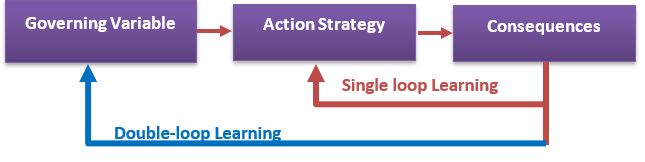
Single loop learning: Consists of one feedback loop when strategy is modified in response to an unexpected result (error correction). E.g. when sales are down, marketing managers inquire into the cause, and tweak the strategy to try to bring sales back on track.

  • Double loop learning: Learning that results in a change in theory-in-use. The values, strategies, and assumptions that govern action are changed to create a more efficient environment. In the above example, managers might rethink the entire marketing or sales process so that there will be no (or fewer) such fluctuations in the future.
  • Deutero learning: Learning about improving the learning system itself. This is composed of structural and behavioral components which determine how learning takes place. Essentially deuterolearning is therefore “learning how to learn.”

This can be closely linked to Senge’s concept of the learning organization, particularly in regards to improving learning processes and understanding/modifying mental models.

Effective learning must therefore include all three, continuously improving the organization at all levels. However, while any organization will employ single loop learning, double loop and particularly deutero learning are a far greater challenge.

Rewards and Punishment

Motivated and disciplined employees are often the result of punishment or reward. A workplace is collective place of various individuals with different personality types. Some individuals might perform better under good rewards whereas, the others might perform better to a fear of punishment.

In workplace, the manager attempts to motivate staffs, promote them in the workplace by promising rewards. Likewise, they warn the staffs about the pain of punishments as well.

A boss or manager always wants his/her employees to do better and ideally the best. Managers get confused whether to punish or reward the staffs for the times they get things right.

Rewarding good performance and punishing problematic or undesired behaviors are the basis terms of motivation in any organizations. However, companies over time have found that rewards often reinforces positive behavior and motivate repetition. Likewise, punishment temporarily motivates compliance, but often leads to lower morale and less productivity in long run.

A workplace has a collection of different personality types, some of which respond to incentives while others respond to a fear of punishment. A good manager understands the dynamics of individual employees and creates an environment that recognizes exceptional performance. He or she will also take note of substandard performance and deal with it in an appropriate manner. While many incentives are geared toward earnings, also consider incentives for non-sales staffers.

Rewards

Rewarding behaviors draw the attention to the fact that an employee accomplished something or acted in a certain way that the company or the manager desires.

Rewarding the employees with promotions, and positive feedback is an effective way to motivate them.

For instance, an employee works in the company for the reward of an attractive monthly salary. Till the time it is very valuable for him/her, he/she will continue to strive for productivity and optimize performance to achieve maximum rewards.

There are certainly more than one way to do something right. But, when employees get rewarded, they don’t wonder what to do next time. It means that he/she can repeat or do the same thing again and again. Rewards somehow limits the employee’s ability to think in a creative manner and get better solutions of a problem.

For example, your company may develop a policy of rewarding employees every year based on a regularly scheduled annual review. The problem arises when the employees become conditioned to work hard prior to the reviews only.

An incentive is a promise of a reward that can be attained by achieving a certain outcome. Incentives are often used to generate sales, encourage timely project completion or maintenance of a budget. Rewards may be given to individuals or be dependent on collaborative group performance. You may have ongoing incentives. It is also common to have incentives to reach bi-annual and annual goals. To be effective, incentives must be worthwhile, clearly defined and attainable.

Types of Rewards

Savvy managers ask their employees what kinds of rewards will motivate them and accordingly tailor incentive plans. Some staffers prefer cash rewards, while others appreciate paid time off, flexible scheduling or deep discounts on the purchase of the company’s products and services. Rewards can be based on the size of the company’s budget. For example, a large company might host an annual cruise if staffers collectively reach a corporate goal, whereas a smaller business might distribute gourmet coffee gift cards to top performers at the end of each month.

Punishments

Punishment in the workplace includes nagging an employee to complete the given tasks, making threats or hovering, verbal or written reprimands, pay cuts, demotions or suspensions for the work.

Punishment can be demotivating and mental torture for the employees as well. No matter how hard they work, if they still get negative feedback from their bosses or supervisors, they might lose the enthusiasm to work.

In most of the cases, people tempt to think “You have learned a lesson” means you got certain type of punishment. People often turn the word lesson into a negative term called punishment.

If punishment is applied before all of the facts are accounted for, then employees will develop a sense of rebellion in response to punishment rather than seeing it as a warning to a particular activity.

However, punishment is not inherently bad either. It is a concept that implies the application of values. Generally in workplace, some team members or individuals might find public recognition or rewards for something they have done. But for some being recognized in front of their peers might not be as cheerful as it sounds.

Sometimes, making mistakes can also be a better part of learning. If you have a good boss or a manager, he/she might teach or explain you not to make the same mistakes again.

Likewise, sometimes you make have to work extra hours as a result of your punishment. At that time, you get opportunity to learn lot more than the employees getting the rewards couldn’t. Everything is not about winning, sometimes it is also about learning.

Workplace punishment is more accurately defined as “disciplinary action.” To be effective, employees must have a clear understanding of workplace policies and guidelines so that they are aware of the penalty for breaching rules or failing to meet performance standards. If employees are unfamiliar with what constitutes a violation of company rules, it can be difficult to enforce standards or take disciplinary measures without facing backlash. Have a written policy that details expectations and the resulting intervention and action that’s taken if rules are violated.

Conclusion

In every workplace there may occur some behaviors that simply is unacceptable. Some of the examples could be failure of safety equipment, sexual harassment or abusive behavior that we deem are unacceptable. In these sort of cases, we cannot have a workplace without the existence of threat of punishments.

Rewards as well as punishments can both be rendered useless if the timing is bad or extremely worth when the timing is good. It totally depends on the kind of rewards or punishment. For both the employees and the manager or the boss, you need to be able to critically analyses the situations and decide what can be better.

Employee Termination and Layoffs

Employee Termination

Termination of employment refers to the end of an employee’s work with a company. An employee may be terminated from a job of their own free will or following a decision made by the employer.

An employee who is not actively working because of an illness, leave of absence, or temporary layoff is still considered employed if the relationship with the employer has not been terminated formally with a notice of termination.

Termination of employment is an employee’s departure from a job and the end of an employee’s duration with an employer. Termination may be voluntary on the employee’s part, or it may be at the hands of the employer, often in the form of dismissal (firing) or a layoff. Dismissal or firing is usually thought to be the fault of the employee, whereas a layoff is usually done for business reasons (for instance a business slowdown or an economic downturn) outside the employee’s performance.

Firing carries a stigma in many cultures, and may hinder the jobseeker’s chances of finding new employment, particularly if they have been terminated from a previous job. Jobseekers sometimes do not mention jobs from which they were fired on their resumes; accordingly, unexplained gaps in employment, and refusal or failure to contact previous employers are often regarded as “red flags”.

How Voluntary Termination Works?

An employee may voluntarily terminate their employment with a company. An employee who decides to terminate employment with a company usually does so when they find a better job with another company, retire from the labor force, resign to start their own business, or take a break from working.

Voluntary termination of employment could also be a result of constructive dismissal, also called constructive discharge. This means that the employee left the company because they had no other choice. They could have been working under significant duress and difficult working conditions at the employer—which could include a too-low salary, harassment, a new work location that is farther than the employee can reasonably commute, increased work hours, and so forth.

A forced discharge of an employee, whereby they are given an ultimatum to quit or be fired, also falls under constructive dismissal. In these cases, if the employee can prove that the employer’s actions during the worker’s tenure with the company were unlawful, they may be entitled to some form of compensation or benefits.

An employee who voluntarily leaves an employer may be required to give advance notice to the employer, either verbally or in written form. Most industries usually require a two-week advance notice of an employee’s termination. In some cases, the employee gives notice at the time that they terminate, or they give no notice at all, such as when an employee abandons the job or fails to return to work.

How Involuntary Termination Works?

Involuntary termination of employment occurs when an employer lays off, dismisses, or fires an employee.

(i) Layoffs and downsizing

Companies decide to lay off workers or downsize their organizations to lower their operating costs, restructure their organizations, or because they no longer need an employee’s skill set. In a layoff, employees are usually let go through no fault of their own, unlike workers who are fired.

(ii) Getting fired

An employee is usually fired from a job as a result of unsatisfactory work performance, poor behavior or attitude that does not fit with the corporation’s culture, or unethical conduct that violates the company’s policies. According to at-will employment laws recognized in some states, a company may dismiss without warning any employee who is performing poorly or violating some form of the company’s rules. In fact, the company does not need to give a reason for the employee’s termination.

(iii) Illegal dismissals

Although employment-at-will contracts do not require an employer to warn or give a reason for a dismissal, an employer cannot fire a worker for certain reasons. An employee who refuses to work more than the hours specified in the contract who takes a leave of absence, reports an incident or a person to the Human Resources department, or whistleblows to industry regulators cannot be fired for these reasons. An employer who discharges an employee for exercising their legal rights has done so unlawfully and may be liable for wrongful termination in the courts.

Other illegal dismissals occur when an employer lets an employee go for discriminatory reasons such as religion, race, age, gender, disability, or nationality. An employer who has been found guilty of wrongful termination may be required to compensate the wronged employee and/or reinstate them into the company.

(iv) Termination for cause

Other than at-will conditions of employment, an employer could fire an employee for a specific cause. A termination-for-cause clause may require the employer to put the employee on an improvement schedule, of 60 or 90 days, during which the employee is expected to improve their work ethic. If the employee has not improved by the end of the probationary period, they could be terminated for cause and dismissed with prejudice.

In some cases, an employer may dismiss an employee without prejudice. This indicates that the employee was let go for reasons other than incompetence, insubordination, or misconduct in the workplace. In such situations, the employee may be rehired for a similar job in the future.

Termination Compensation

In most cases where an employee who has worked with a given company for at least three months and has their employment involuntarily terminated, the employer may provide them with a notice of termination and/or termination pay (or severance pay). A company that offers severance does so following an agreement made privately with the employee or because severance is specified in its employee handbook.

 Under the Fair Labor Standards Act (FLSA), a company is not mandated to provide severance packages.

Also, employers are not required by federal law to give the terminated employee a final paycheck immediately. However, state laws may operate differently in this regard and may mandate that the employer must not only immediately provide the affected employee with a final paycheck, but also include accrued and unused vacation days.

Special Considerations: the Coronavirus

As of April 2020, millions of workers have been laid off as businesses struggle with government-ordered stay-at-home orders during the coronavirus pandemic. Some companies have furloughed workers, a move that is meant to be a temporary arrangement until the company can reopen. The CARES Act makes unemployment compensation available not just to those who have been laid off, but to furloughed employees as well as part-time workers, freelancers, independent contractors, and the self-employed—workers not usually eligible for unemployment benefits.

Employee Layoff

A less severe form of involuntary termination is often referred to as a layoff (also redundancy or being made redundant in British English). A layoff is usually not strictly related to personal performance, but instead due to economic cycles or the company’s need to restructure itself, the firm itself going out of business or a change in the function of the employer (for example, a certain type of product or service is no longer offered by the company and therefore jobs related to that product or service are no longer needed). One type of layoff is the aggressive layoff; in such a situation, the employee is laid off, but not replaced as the job is eliminated.

In an economy based on at-will employment, such as that of the United States, a large proportion of workers may be laid off at some time in their life, and often for reasons unrelated to performance or ethics. Employment termination can also result from a probational period, in which both the employee and the employer reach an agreement that the employer is allowed to lay off the employee if the probational period is not satisfied.

Often, layoffs occur as a result of “downsizing“, reduction in force or “redundancy“. These are not technically classified as firings; laid-off employees’ positions are terminated and not refilled, because either the company wishes to reduce its size or operations or otherwise lacks the economic stability to retain the position. In some cases, a laid-off employee may eventually be offered their old position again by their respective company, though by this time they may have found a new job.

Some companies resort to attrition (voluntary redundancy) as a means to reduce their workforce. Under such a plan, no employees are forced to leave their jobs. However, those who do depart voluntarily are not replaced. Additionally, employees are given the option to resign in exchange for a fixed amount of money, frequently a few years of their salary. Such plans have been carried out by the United States Federal Government under President Bill Clinton during the 1990s, and by the Ford Motor Company in 2005.

However, “layoff” may be specifically addressed and defined differently in the articles of a contract in the case of unionised work.

Employee Attrition and Retrenchment

Employee Attrition

Attrition in business describes a gradual but deliberate reduction in staff numbers that occurs as employees retire or resign and are not replaced. The term is also sometimes used to describe the loss of customers or clients as they mature beyond a product or company’s target market without being replaced by a younger generation.

How Attrition Works?

This type of reduction in staff is called a hiring freeze. It is one way a company can decrease labor costs without the disruption of layoffs.

Reducing staff by attrition naturally is less devastating to company morale. However, it can still have a negative impact on the remaining employees if it leads to an increase in their workload. It also can limit promotional opportunities and movement within the company, resulting in an unhappier workplace or more attrition than was intended.

About Customer Attrition

Attrition can also refer to a shrinking customer base. This, of course, is not deliberate. The word is most pertinent when used to describe a product whose customer base is shrinking because its loyal customers are aging and younger consumers are not taking their place.

Customer attrition is usually found when a company has failed to adapt its product to changing trends. The Sears department store chain and the Oldsmobile car brand might be examples of products that failed to capture a younger generation of customers.

 Because attrition is voluntary, as opposed to layoffs, it is seen as a less disruptive way for a company to decrease labor costs.

Attrition versus Layoffs

Changes in management, company structure, or other aspects of a company’s operations can cause employees to leave voluntarily, resulting in a higher attrition rate.

Laying off employees results in attrition as long as the company doesn’t immediately hire as many new employees as it laid off. For example, a company might reduce its administrative staff by six in order to create a new internet team of six.

Turnover occurs in a company for many reasons. It can only be called attrition if the company decides not to fill the vacated position.

When a company is faced with a financial crisis, it must make tough calls and cut back its workforce in order to stay afloat. In these cases, the company might implement a layoff with no intention of filling those positions again.

In less drastic cases, such as changes in the company structure or business model or a merger, certain departments are trimmed or eliminated. This usually requires layoffs rather than attrition.

Unlike layoffs, a reduction in staff due to attrition is voluntary. The employee has decided to take a new job, retire, or move to another new city. An attrition policy takes advantage of this inevitable changeover to reduce overall staff.

Employee Retrenchment

Retrenchment is a form of dismissal due to no fault of the employee, it is a process whereby the employer reviews its business needs in order to increase profits or limit losses, which leads to reducing its employees.

The employer must give fair reasons for making the decision to retrench and follow a fair procedure when making such a decision or the retrenchment may be considered unfair.

How retrenchment laws work in India?

The original legislation of 1947 does not have the definition of the word retrenchment; it was in 1953 that with an amendment Act this definition was inserted. It would also be interesting to know that till 1983 the courts of law used to consider termination of service due to nonrenewal of the agreement of employment as the act of retrenchment in pronouncements like of Hindustan Aluminium Corporation v. State of Orissa. later, the judgment was held to be a bad one and with the Amendment 49 of 1984 the provision of (bb) was inserted in the definition of retrenchment declaring such kind of termination not to be included within the ambit of retrenchment.

Retrenchment refers to discharge of surplus labour by the employer. It may be due to inevitable reasons including rationalization or installation of new labour-saving machinery. Retrenchment may also be said as the right of an employer. An employer has a right to organize his business in any lawful manner he considers best and courts cannot question its proprietary. If reorganization results in surplus employees, no employer is expected to carry their burden. There is a consensus of judicial opinion in deciding retrenchment on the facts and circumstances of each case. Courts have decided that termination of services is due to loss.

In the landmark case of State Bank of India v. Sundara Money, the Supreme Court adopted the literal meaning of retrenchment, which is exhaustive and comprehensive, and held that the expression “for any reason whatsoever” was very wide and admitted almost no exceptions to it. Therefore, the word retrenchment means termination of a worker’s services for any reason whatsoever other than those specified in section 2(oo) of the Industrial Dispute Act (IDA), 1947.

 Chapter V-A of the IDA requires an establishment employing 50 or more workers, in case of valid retrenchment to provide the workers with 30 days’ notice and 15 days’ pay for every year of continuous work by the workmen at the firm. In case of closure or sale, it must fulfil the same conditions unless the successor takes on these obligations. For an establishment employing 100 or more workers, the IDA, under Chapter V-B, requires prior permission from the Government before the firm’s closure or retrenchment.

The procedure of retrenchment has been given under Section 25G. It is when any workman in an industrial establishment, who is a citizen of India, is to be retrenched and he belongs to a particular category of workmen in that establishment, than in the absence of any such agreement between the employer and the workman in this behalf, the employer shall ordinarily retrench the workman who was the last person to be employed in that category, unless for reasons to be recorded the employer retrenches any other workman. Section 25F of the IDA provides mandatory conditions for retrenchment of workers. It prescribes conditions to be obeyed for terminating services without conferring any right on the worker for permanent absorption. Any employee working in a firm for 240 days or more in the previous 12 months can in principle claim retrenchment compensation.

The employers in India have responded to the restrictive retrenchment laws in several ways including the greater use of contract, temporary and/or casual labour, the use of golden handshakes and setting up of production in the States where labour is not organized. The Government is pursuing privatization and disinvestment. Any anomaly in retrenchment laws, which addresses the basic functioning of companies, needs the immediate attention of lawmakers.

The legal requirements with respect to termination of services are more onerous once a company employs more than 100 employees. In terms of the IDA, if an industrial establishment employs more than 100 employees, it may not retrench, that is, terminate the services of any employee who has been in continuous service for not less than one year unless the (i) the employee has been given three months’ notice indicating the reason for retrenchment and the period of notice, and (ii) the prior permission of the concerned State Government has been obtained for the retrenchment (Section 25N of the IDA).

Moreover, if the permission is not obtained, the retrenchment will be deemed to be illegal from the date on which the notice was given and the employee will be entitled to all the benefits under law as if no notice had been given to him. From a practical standpoint, obtaining the State Government’s approval for retrenchment is considered nearly impossible due to the implications of the resulting unemployment. Therefore, companies rarely apply to the State Government for permission for retrenchment. Penalty for contravening the aforesaid provisions on retrenchment is imprisonment up to one month or fine which may extend to Rs 1,000, or with both. Assuming that the State Government’s approval is obtained, the services of the employees can be terminated upon provision of three months’ prior notice and payment of 15 days’ average pay for each completed year of service in excess of six months.

Employee Downsizing, Reasons

Employee downsizing refers to the intentional reduction of a company’s workforce, typically as a cost-cutting measure, to improve efficiency, productivity, or profitability. It involves eliminating jobs through layoffs, early retirements, voluntary redundancy, or attrition. Downsizing is often implemented during periods of financial difficulty, mergers, restructuring, or to streamline operations. While it can lead to immediate cost savings, downsizing can also have negative effects on employee morale, organizational culture, and productivity in the long run. Companies must carefully manage the process to minimize disruption and maintain the remaining workforce’s engagement and effectiveness.

Reasons of Employee Downsizing:

  • Cost Reduction:

One of the most common reasons for downsizing is to reduce operational costs. Companies facing financial difficulties or those seeking to improve profitability often reduce their workforce as a means of cutting expenses, especially labor costs, which can be a significant portion of the budget.

  • Economic Downturn:

During times of economic recession or downturns, businesses may experience lower demand for products or services. Downsizing helps organizations adapt to market conditions by reducing overhead costs and aligning staffing levels with lower sales volumes or slower business activity.

  • Mergers and Acquisitions:

When companies merge or one company acquires another, there are often redundant positions, such as duplicated departments or roles. Downsizing is a way to eliminate these overlaps and streamline the organization to avoid inefficiencies.

  • Technological Advancements:

The adoption of new technologies, such as automation or artificial intelligence, can reduce the need for certain manual tasks or roles. Downsizing is often a consequence of technological advancements, as companies look to cut down on staff in favor of more efficient systems or processes.

  • Restructuring and Reorganization:

Companies may downsize as part of a larger organizational restructuring or reorganization. When management decides to streamline operations, shift business priorities, or change the business model, redundancies are created, leading to job cuts to align the workforce with the new organizational structure.

  • Globalization and Competition:

With the rise of globalization and the increasing competition from global markets, companies may be forced to downsize to remain competitive. This could involve relocating operations to lower-cost countries, reducing the workforce in high-cost regions, or cutting down on non-essential staff.

  • Outsourcing:

Organizations may downsize when they choose to outsource certain functions to external service providers who can perform the same tasks more cost-effectively. This is commonly seen in industries like customer service, IT, and manufacturing, where outsourcing labor to cheaper markets becomes a competitive advantage.

  • Underperformance:

Companies that are underperforming or struggling to meet financial targets may resort to downsizing to help reduce inefficiencies and improve the overall performance of the business. By cutting underperforming departments or individuals, organizations hope to regain focus on more profitable areas of operation.

Benefits of Employee Downsizing:

  • Cost Savings:

One of the most significant benefits of downsizing is the reduction in labor costs. By eliminating jobs, companies can reduce expenses related to salaries, benefits, and other employee-related costs. This is particularly beneficial for organizations facing financial difficulties or aiming to improve profitability by lowering operational costs.

  • Increased Efficiency:

Downsizing can lead to a more streamlined organization. By reducing redundancies and focusing on core activities, businesses can eliminate inefficiencies. A leaner workforce often results in faster decision-making and improved processes, as fewer employees may lead to less bureaucracy and clearer communication channels.

  • Improved Competitiveness:

Downsizing helps organizations become more agile and competitive in their industry. By trimming excess, companies can reallocate resources, focus on innovation, and shift strategies to better meet market demands. With fewer employees to manage, organizations can be more responsive to changes in the business environment and adjust quickly to stay ahead of competitors.

  • Focus on Core Competencies:

Downsizing provides companies with an opportunity to refocus on their core strengths and areas of expertise. By cutting non-essential roles or departments, companies can channel their resources toward activities that directly contribute to business growth and long-term success. This may lead to stronger market positioning and a more targeted business strategy.

  • Enhanced Productivity:

In some cases, downsizing can lead to an increase in productivity. Remaining employees may feel more accountable and motivated to perform at their best as they are aware of the need to adapt to a leaner workforce. This can also foster a culture of higher performance, where employees focus on delivering results with fewer resources.

  • Better Organizational Focus:

Downsizing can lead to a clearer organizational structure and sharper focus on strategic goals. With fewer staff, companies can prioritize key projects and initiatives, and ensure that leadership and resources are allocated efficiently. The reduction in staff can also simplify reporting structures, enabling quicker decision-making and a more unified organizational direction.

  • Improved Employee Morale (for Remaining Staff):

While downsizing can lead to short-term uncertainty, it can ultimately boost morale among the remaining staff. Employees who survive downsizing may feel a renewed sense of security and purpose, especially if they are given opportunities for growth, training, and advancement. Furthermore, the elimination of underperforming employees or inefficient teams can contribute to a more cohesive and focused workforce.

Factors affecting Human Resource Planning (HRP)

Human Resource Planning (HRP) is a strategic process aimed at ensuring an organization has the right number and type of employees to meet its current and future goals. It involves forecasting future workforce needs, analyzing current human resources, and developing strategies to bridge any gaps. Several factors influence the effectiveness of HRP, which can be broadly categorized into external and internal factors. HR professionals must consider these factors to design an effective and adaptable HR strategy.

External Factors Affecting HRP:

  • Economic Conditions

The state of the economy significantly impacts HR planning. During periods of economic growth, organizations expand and require more employees, leading to increased recruitment efforts. Conversely, during a downturn, companies may focus on downsizing or redeployment of existing staff. HR professionals need to stay updated on economic trends to make informed workforce decisions.

  • Technological Advancements

Rapid technological changes can affect the demand for specific skills and roles. Automation and artificial intelligence (AI) are transforming job roles, leading to a need for upskilling and reskilling employees. HRP must account for these changes to ensure that the workforce remains relevant and competitive.

  • Legal and Regulatory Environment

Labor laws and regulations influence HR planning by setting standards for hiring, working conditions, compensation, and termination. Compliance with laws related to equal employment opportunity, minimum wages, and employee rights is crucial in HRP. HR professionals must remain aware of legal requirements in different jurisdictions.

  • Demographic Changes

Changes in the demographic composition of the workforce, such as age, gender, and educational background, affect HR planning. An aging workforce may require succession planning and health-related benefits, while younger employees may expect flexible work environments and career development opportunities.

  • Competition

The level of competition in an industry influences HRP, especially in the context of talent acquisition. In highly competitive industries, companies must develop attractive compensation packages, benefits, and work environments to attract and retain top talent. HRP should consider competitive pressures and create strategies to maintain an edge.

Internal Factors Affecting HRP:

  • Organizational Goals and Strategies

HR planning is closely linked to an organization’s overall goals and strategies. For instance, if a company plans to expand into new markets, HRP must include strategies for hiring employees with the necessary skills and expertise. Similarly, if the organization plans to introduce new products, HRP should focus on training and development.

  • Workforce Availability

The existing workforce’s skills, experience, and potential influence HR planning. HR professionals need to conduct a thorough analysis of the current human resources, including their strengths and weaknesses, to determine whether the organization has the necessary capabilities or requires additional hiring.

  • Employee Turnover and Retention

High employee turnover can disrupt operations and increase recruitment and training costs. HRP must include strategies to improve employee retention by addressing factors such as job satisfaction, compensation, and career growth opportunities. Understanding historical turnover rates can help predict future workforce needs.

  • Organizational Culture

The organization’s culture, values, and management style play a significant role in HR planning. A positive organizational culture can enhance employee engagement and attract potential candidates. HRP must align with the cultural environment to ensure a cohesive and motivated workforce.

  • Financial Resources

The availability of financial resources affects HR planning by determining the organization’s capacity to recruit, train, and retain employees. Budget constraints may limit HR activities such as hiring, salary increments, and employee welfare programs. HR professionals must balance financial limitations with workforce requirements.

Process of Human Resource Planning (HRP)

Human Resource Planning (HRP) is a strategic process that ensures an organization has the right number of people, with the right skills, in the right positions, at the right time. The main objective of HRP is to align the workforce with organizational goals and future demands. It involves forecasting future human resource needs, analyzing current workforce capabilities, identifying skill gaps, and developing strategies to bridge those gaps. HRP helps organizations manage talent effectively, reduce labor costs, and prepare for changes such as retirements, resignations, or expansion. It also supports succession planning and training programs to enhance employee performance. Effective HRP minimizes workforce imbalances—such as shortages or surpluses—and enhances productivity and competitiveness. It is a continuous process that requires coordination between HR and other departments. In today’s dynamic business environment, HRP plays a vital role in ensuring the sustainability and success of an organization by proactively managing human capital.

Process of Human Resource Planning (HRP):

  • Analyzing Organizational Objectives

The first step in Human Resource Planning is to thoroughly understand the organization’s mission, vision, strategic goals, and objectives. HR plans must align with the short-term and long-term objectives of the business. For instance, if an organization plans to expand into new markets, HR must plan to recruit or train personnel accordingly. This step involves collaboration between HR managers and top executives to ensure alignment between the workforce and the company’s direction. Understanding future plans like launching new products, automating operations, or entering new geographies helps determine the kind of talent and skills needed. It sets the foundation for all subsequent HRP activities.

  • Assessing Current Human Resources

This step involves analyzing the current workforce in terms of quantity (how many employees) and quality (skills, experience, and performance levels). HR professionals conduct a Human Resource Inventory or Skill Inventory to identify the capabilities of existing staff. It includes reviewing performance appraisals, job descriptions, qualifications, and competencies. This assessment helps in understanding the strengths and weaknesses of the current human resources and determining who is promotable, who may retire soon, or who needs training. The objective is to get a clear picture of the internal talent pool and to identify which employees can be reallocated or upskilled to meet future demands.

  • Forecasting Demand for Human Resources

In this step, HR managers predict the number and types of employees the organization will need in the future. Demand forecasting considers various factors such as business growth, technological changes, market trends, expansion plans, and changes in organizational structure. Techniques like trend analysis, managerial judgment, workload analysis, and statistical models are used to estimate future HR requirements. It’s not just about numbers; it also involves identifying future job roles, required skill sets, and possible changes in job content. Accurate forecasting helps avoid shortages or excesses in manpower and ensures that the right talent is available when needed.

  • Forecasting Supply of Human Resources

This step involves estimating the availability of talent both internally (within the organization) and externally (from the labor market). Internal supply forecasting includes promotions, transfers, retirements, and resignations. It also considers absenteeism and productivity trends. External supply forecasting depends on factors like labor market conditions, educational institutions’ output, economic conditions, and demographic trends. HR professionals also assess availability through job portals, recruitment agencies, and professional networks. This step is critical to identifying how much of the demand can be met internally and how much needs to be fulfilled through external hiring. It forms the basis for gap analysis in the next step.

  • Identifying HR Gaps

Once the demand and supply forecasts are complete, HR managers compare them to identify gaps—both in numbers and in skillsets. If demand exceeds supply, there will be a shortage, requiring recruitment, training, or upskilling. If supply exceeds demand, the organization may have surplus staff, leading to issues like redundancy or layoffs. HR gap analysis helps in planning for succession, minimizing overstaffing or understaffing, and ensuring optimal workforce utilization. The goal is to maintain a balance between the number of employees and the work requirements of the organization. This step ensures proactive rather than reactive human resource management.

  • Developing HR Strategies to Bridge Gaps

Based on the gap analysis, HR develops strategies to match human resource supply with demand. These may include recruitment drives, internal promotions, employee development programs, retention strategies, outsourcing, or downsizing. Training and development programs are planned to upskill existing employees. If there is a talent shortage, external hiring strategies are implemented. On the other hand, in case of surplus, strategies like retraining, redeployment, voluntary retirement schemes, or layoffs are considered. The aim is to create a flexible, skilled, and motivated workforce that supports organizational objectives. These strategies must also comply with labor laws, budget constraints, and organizational culture.

  • Monitoring, Control, and Evaluation

HR Planning is an ongoing process, and this final step ensures that the plan is working effectively. Regular monitoring involves checking whether HR strategies are achieving desired results—such as meeting staffing levels, improving productivity, and reducing turnover. Evaluation tools include KPIs, feedback, audits, and workforce analytics. If the plan is not meeting objectives, corrective actions are taken. For example, if recruitment targets are not being met, sourcing strategies may be revised. This step ensures adaptability in the face of changing business environments, technological developments, and workforce dynamics. Continuous monitoring helps in maintaining alignment with business goals and improving future HR plans.

Strategies of HRM

HRM stands for Human Resource Management, and human resource management strategies are the plans that lead to implementing different functions in the human resources department of an organization. Typically, these strategies are guided by the overall strategies of the business and serve to help the business attain its long-term goals via its staff. These strategies can be divided into four key areas:

  1. Talent and Human Capital

Talent represents the human capital of an organization and is crucial to the success of that business. It is an important asset that the business should strive to maintain. How does the human resources management system help with these? By having a comprehensive staffing blueprint. The human resources department should forecast the staffing needs of the business in the future while also recruiting, hiring, and keeping the best talent in the organization. The most successful businesses in the world pride themselves in hiring the best talent in the world.

In order to do this effectively, the HRM department needs to identify the various competencies required for each job, such as the skills, abilities, and knowledge required to perform various tasks effectively. This will allow them to draw detailed job descriptions that will ultimately guide them to find the best people for the job.

  1. Leadership of an Organization

The leadership of the organization is likened to what the head is to a body. It is through leadership that a business succeeds or fails in its endeavors. The HRM department plays a key role in the leadership of the organization because it is tasked with finding the best executives to steer the business in the right direction.

An HRM department that can boast past success in choosing the right executives will generally find it easier to convince the board of its recruits the next time an executive is required. In order to do this job effectively, HR managers need to be active in an advisory capacity when engaging with other organizational leaders so as to give their input on what is best for the company’s future.

  1. Human Resources Planning

The HRM department plays an important role in helping the business to plan for the future. Take employees, for example: by conducting regular surveys of the employees to determine employee satisfaction, the HRM department can give important insights to business leaders on what needs to be done in the future to contribute to a happier workplace.

  1. Performance Metrics and Corporate Culture

An organization with well-defined performance metrics is an organization with high potential for success. The HRM department plays a role in this, as well. Through developing well-defined performance metrics, regular performance evaluations, and schemes to reward employees for high performance and creativity in accomplishing their tasks, the HRM department will create a high-performance culture where the interests of the employees are aligned with those of the business, and they are genuinely motivated to do their best. Employees who feel appreciated by their companies and receive recognition for their achievements in the workplace are likely to want to do more.

Global HR Strategies

As a result of the scarcity of qualified managers which can lead to constraints on global office expansion for businesses, an effective global human resources strategy can be vital in building and securing a sustainable advantage over their competition. Good HR management requires an integrated approach, which begins to merge into career management. A cohesive network will ensure that the right people are in the right jobs, and that all costs are attributed appropriately. This can ultimately allow the business to identify good ideas on a global scale. Ultimately, the building of this network comes down to an effective global human resources strategy, and here, we’re taking a look at the ten steps businesses can take to ensure this is in place.

  1. Ending favouritism

One of the fundamental steps towards building a global human resources strategy should be to end favouritism towards managers that are nationals of the country in which they are based. Whilst many companies consider nationals of their headquarters country as potential expatriates and refer to everyone else as ‘local nationals’, this should be reconsidered for numerous reasons. Ethnocentric companies put the most confidence in nationals of their headquarters’ country, and thus this is the reason why these nationals receive the better assignments and climb the ladder much faster. Most surprisingly, big contrasts can be found between expatriate and local national pay, including the bonuses and benefits they receive. In order to create an effective global human resources strategy, businesses must weigh up the advantages and disadvantages of using expatriates and local nationals to determine the best solution according to the desired outcome.

  1. Identify activities that achieve success

The next step towards an effective global human resources strategy is identifying activities that best achieve success across the globe and identify the positions that held responsibility for ensuring their success. The positions that hold the responsibility for performing these good acts represent the ‘lifeline’ of a company. Once the activities that achieve success have been identified, businesses can then revisit the lifeline and role descriptions on a regular basis to ensure they accurately represent the business strategy.

  1. Finding who & where your talent is

Once a company has identified the activities that achieve success, they can find who and where their talent is via a global database, focusing on more than just the top of the organization and considering middle managers in the country markets and potential stars leaping through the ranks. Organizations seeking to build a useful global human resources database must start with an array of personal-profile templates that ask questions that go beyond each manager’s experience to determine cultural ties, language skills, hobbies and interests. For overseas assignments, especially, Human Resources Directors must consider these skills and adaptability to be as important as functional skills if not more so!

  1. The mobility pyramid

Another way for businesses to build an effective global human resources strategy is by constructing a mobility pyramid to easily evaluate managers regarding their willingness to move to a new location to gain experience. Whilst many human resources departments refuse to look at mobility beyond ‘movable’ and ‘not movable’, it is paramount that there is more behind the decision to transfer an employee abroad should they need to relocate, and even more so because managers can move up or down the mobility pyramid at various stages during their career. By constructing a mobility pyramid, businesses can find different ways to effectively use available in-house talent and encourage an increased number of managers to consider saying yes to an overseas assignment.

  1. Leadership capital

The next step businesses need to take to create an effective global human resources strategy is to identify their leadership capital. One of the best ways for businesses to identify their leadership capital is by building a database of their company’s mix of managerial skills by requiring people to provide more information on their CV’s regarding their experience in management and skills they possess. This way, HR departments can kick-start the process by holding senior meetings and those in lifeline posts to complete the form first, prior to adding others from across the globe with the potential to progress in their career.

  1. Bench strength & skills gap

The following step businesses must take towards an effective global human resources strategy is to assess their bench strength and skills gap. To do this, businesses must ask each executive to compare their skills and characteristics against the requirements identified for the executive’s current position. Not only is this an effective way to compare skills with ease, but it can also help close personal skills gaps through in-house training or by participating in outside courses to heighten global success.

  1. Regular recruitment

In order to construct an effective global human resources strategy, businesses must search for new recruits on a regular basis in the local market, as well as in the headquarters’ country. Whilst this can be challenging from time to time, one of the best ways to attract national recruits is by demonstrating how far they can climb up within the organization, as this is one of the most appealing aspects job seekers look for. Recruitment and selection not only helps to ensure that the business has the necessary knowledge and skills required to fulfill objectives, but it also forms part of the strategic management of human resources.

  1. Advertising internally

As mentioned previously, regular recruitment is a great way to attract new talent, but when a business advertises their posts internally, it allows a competitive internal job market to work across nationalities and genders alike, and proves to employees that they can in fact broaden their horizon and make a future in the company. Moreover, advertising internally helps attract those that may be in the process of finding an alternative job, and thus reduces employee retention and creates a positive work environment.

  1. Succession planning

In regard to regular recruitment in order to construct an effective global human resources strategy, managers in a lifeline role should nominate at least three candidates who could take over that position in the upcoming week, three months down the line or within the next year. Whilst this will not resolve all succession questions, it will certainly go a long way and significantly help everyone involved to identify potential future leaders with ease. Moreover, succession planning provides businesses with the bigger picture and is paramount to sustain income and support expenses should a disaster occur.

  1. Challenging & retaining talent

Lastly, another step to an effective global human resources strategy is to challenge employees in order to retain talent. The need to retain talented employees is increasing every day, and for good reason. Retention of talent is crucial for the continued growth and success of any business, which is why is it paramount that colleagues are provided with consistent and regular communication about what needs to be done, and feedback to ensure the business moves with the market. One of the most effective ways to retain talent is by being open to employees about their potential and future within the future, paying well and not pondering over promoting people who have shown rock-solid ability.

Businesses often struggle to construct an effective global human resources strategy because they are unaware of what an effective global human resources strategy should include, but with these ten steps, businesses can create a beneficial global human resources strategy with ease and confidence.

Human Resource Development (HRD): Meaning, Concept and Objectives

With increasing global competition, organizations are under tremendous pressure to improve their performance through reduction of cost and in quality up gradation. Indian business organizations too have now realised that they are now in a more open, highly competitive, and market-oriented environment.

The three challenges for Indian business organizations are:

  • How to maximize return on investments?
  • How to be more innovative and customer driven?
  • How to renew and revitalise an organization?

In this context, the most important steps are- effective management; holistic development; and optimum utilization of human resources.

In the past decade something quite different was happening in many Indian organizations, calling for a second look at traditional personnel functions and their integration with organizational objectives. Several steps were taken, such as, conceptualization of employees as resources; strategic role of personnel functions; greater partnership to line managers in managing human resources; dovetailing of training with other personnel functions; synthesis of different personnel functions, etc.

It is difficult to categorise these activities under a single label. Rather, they can be brought under the umbrella of Human Resource Development (HRD).

The human resource development in India is of recent origin, and the terms gained currency only in the early seventies. The term “HRD” was first applied in 1968 in George Washington University. It was used in Miami at the conference of American Society for Training and Development in 1969.

The term was gaining more acceptances during the mid-1970, but many used it as a more alternative term than “Training and Development”. In the opinion of some management professionals, Japan is the first country to begin with HRD practices. “Better People”, not merely better technology, is the surest way to a “Better Society”, is the most popular belief in Japan.

It is often said that an organization is only as good as its people. Organizations of all types and sizes, including schools, retail stores, government agencies, restaurants, and manufacturers, have at least one thing in common they must employ competent and motivated workers.

This need has become even stronger as organizations grapple with the challenges presented by a fast-paced, highly dynamic, and increasingly global economy. To compete and thrive, many organizations are including employee education, training, and development as an important and effective part of their organizational strategy.

HRD activities should begin when an employee joins an organization and continue throughout his or her career, regardless of whether that employee is an executive or a worker on an assembly line. HRD programmes must respond to job changes and integrate the long-term plans and strategies of the organization to ensure the efficient and effective use of resources.

Concept of Human Resource Development

A number of definitions of Training and HRD have been given by the pioneers of Management Training and Human Resource Development.

Milton Hall defines ‘Employee Training’ as the process of aiding employees to gain effectiveness in their present and future work through development of appropriate habits of thought and action, skill, knowledge and attitudes. Training aims at increasing the effectiveness with which the functions of an organization are carried, out by increasing the effectiveness of its personnel.

The definition given by Milton Hall stresses development of knowledge, skill and attitude. As far as knowledge and skills are concerned, it is possible with planned effort on part of HRD executive.

In respect of attitudes, improvements are possible only with long range efforts and planned efforts by HRD executive and success in this area cannot be much predicted or ensured as it would largely depend on the willingness and readiness of the person, or persons whose attitude is to be improved.

With regard to development of attitudes the following factors are to be given due importance and consideration, before HRD effort is planned:

  1. The desired change in attitude should be positive in nature.
  2. Before an effort to improve the attitude of a person is tried or envisaged, the person concerned should agree and have conviction that he requires a change in his attitude and this is going to prove to his benefit, with respect of his career development and success in his working life.
  3. The working conditions and the culture of the organization should offer to induce the employees to adopt positive attitude and aptitude which works to motivate a person to do things to meet the desired standard of behaviour and output to achieve the desired targets of production and services assigned to his area of working.

Human Resource Development at Macro and Micro Level

HRD is applicable to both at macro level (national level) as well as micro level (organizational level). At the macro level, HRD is concerned with the development of people of country as a whole. For example, HRD ministry of Government of India is concerned with developing people in whole of country.

At micro level, each organization is concerned with developing its human resources. While HRD at macro level has uniformity, it differs at micro level because each organization may have distinct approach for developing human resources.

There is close relationship between HRD at macro level and micro level. Macro level HRD provides human resources to organizations. Therefore, efforts at micro level HRD is influenced by macro level HRD. For example, overall quality of human resources of a country determines the type of efforts that individual organizations make in developing its human resources. If this quality is high, lower organizational efforts are required. In the alternative case, higher organizational efforts are required.

HRD in Indian Context

Some specific features of HRD in India are as follows:

  1. At the macro level, there are plenty of educational institutions in India producing large number of educated people every year. However, quality of majority of such people is very low. Therefore, they are not employable.

According to National Employability Report, 2014, only 18.33 per cent engineering graduates are employable. Similar is the case with management graduates. So far as other educational disciplines are concerned, the situation is even worse except some professional disciplines.

  1. At the micro level, HRD efforts of individual organizations differ widely. There are many organizations which pay very high attention to HRD. They spend lot of money in developing their human resources. Such organizations believe in developing competitive advantage through their human resources. As against this pattern, there are plenty of organizations which give very low importance to HRD. Such organizations treat HRD expenses as waste.

Objectives of Human Resource Development (HRD)

  • To maximize the utilization of human resources for the achievement of individual and organizational goals.
  • To provide an opportunity and comprehensive framework for the development of human resources in an organization for full expression of their talent and manifest potentials.
  • To develop the constructive mind and an overall personality of the employee;
  • To develop the sense of team spirit, team work and inter-team collaborations.
  • To develop the organizational health, culture and effectiveness.
  • To generate systematic information about human resources.

Sub Systems of HRD are:

  1. Training and Development
  2. Career planning and Succession planning
  3. Performance Appraisal and Potential Appraisal.

Process of Human Resources Development

HRD Process and HRD Climate Variables

  • Role Clarity.
  • Planning of Development by Every Employee.
  • Awareness of Competencies Required for Job Performance.
  • Proactive Orientation.
  • More Trust.
  • Collaboration and Team Work.
  • Risk-taking.
  • Value Generation.
  • Clarification of Norms and Standards.
  • Increased Communication.
  • More Objective Rewards.
  • Generation of Objective, Data on Employees etc.

HRD Outcomes Variables

  • More Competent People.
  • Higher Work Commitment and Job Involvement.
  • More Problem Solving.
  • Better Utilization of Human.
  • Higher Job Satisfaction and Work Motivation.
  • Better Generation of Internal Resources.
  • Better Organizational Health.
  • More Team Work, Synergy and Respect for Each Other.

Organizational Effectiveness Dimensions

  • Higher Productivity.
  • Growth and Diversification.
  • Cost Reduction.
  • More Profits.
  • Better Image

Organizational effectiveness is a step closer to HRD outcomes variables than the process variables. For example, better communication, role clarity, performance planning, trust, collaboration, openness can be considered as more remotely related to organization effectiveness than variables like having competent, dynamic, satisfied and committed employees.

It is the adequacy of the HRD processes in the organization which is questioned if the HRD outcomes are not present in an organization at a satisfactory level.

The linkages between organizational effectiveness and HRD outcomes are not easily demonstrable due to the influence of several other variables in determining productivity. The Chief Executives, unit heads, line managers and HRD managers interested in HRD have to make efforts to promote HRD processes and culture in their organizations as a matter of ‘faith’ or ‘philosophy’ and not look for demonstrable outcomes in terms of organizational effectiveness.

There exists another kind of relationships which needs attention. This is the relationship between HRD mechanisms and HRD processes. Only introduction of HRD mechanisms and HRD departments do not automatically result in the development of HRD processes, It is possible to have a HRD culture without having a HRD department or without using any HRD systems. That requires good leadership at the top, vision and building of HRD values froth the very beginning of an organization.

The concept of human resources in HRD is not value-free. Broadly speaking, there are three meanings attached to the concept of HRD. In the first place, persons working in organisations are regarded as a valuable resource, implying that there is a need to invest time and effort in their development. Second, they are human resources, which means that they have their own special characteristics and, therefore, cannot be treated like material resources. The approach focuses on the need to humanise organisational life and introduce human values in the organisation. Third, human resource development does not merely focus on employees as individuals, but also on other social units and processes in the organisation. These include the role or the job a person has in the organisation, the dyadic unit (consisting of the person and his supervisor), the various teams in which people work, inter-team processes, and the total organisation. Therefore, six distinguishable human units are included in human resources, namely, persons, jobs or roles, dyads, teams, inter-teams and the organisation.

error: Content is protected !!