Organizational Constraints

The four constraints are:

  • Business model and strategy
  • Processes and organizational structure
  • Leadership
  • Culture

When we started Leaderonomics a few years ago, I decided to see if these four constraints worked even in a start-up. Surprisingly, it does.

  1. Business model

This is simple. If you have a wrong business model, you will fail. If you have a wrong strategy in place, you will ultimately be doomed.

For years, despite the advent of the smartphones and with Apple and Samsung ripping up their mobile phone market dominance, Nokia refused to relook at its business model. By the time it did, it was too late.

The same happened to Eastman Kodak who refused to budge from their “film” business model. Likewise Polaroid and many others that refused to pivot their business model when they needed to change or scale. Your business model and strategy is the cornerstone of your success.

If you are having issues scaling your business, the first place to start examining is your business model as an organizational constraint.

  1. Processes and organizational structure

One of the biggest mistakes organizations make is to focus on people. Yes, you read that right! The problem with solely focusing on people is that we end up pampering our people.

The key to successfully getting your employees to achieve high performance is to focus on “process.” You can still care and love them, but your emphasis must be on building institutional processes.

One of the biggest mistakes Enron and its leadership made was to rely on their “top talent”. They hired really smart people and focused entirely on these “special” people making the organization great.

Initially, Enron had stellar performance. But ultimately, it blew up. Structures and processes dictate behaviour.

If we do not spend time intentionally creating structures and processes that drive the behaviours and performance that we want, we will continually lament the actions of our employees.

  1. Leadership

When we talk about leadership being a constraint, it not only means the quality of leadership at the top of the organization but also the quality of leaders across all the different levels.

It’s said that people don’t leave companies, they leave bosses, and we have had employees who made the decision to leave due to dissatisfaction with their leaders.

This shows that it is not only the senior leadership team who are important, but also the middle managers who play an equally important part in talent retention and growth.

If you look at all the top organisations in the world, a key part of their success is leadership. In fact, many problems of the world and even in our country are related to the lack of leadership.

  1. Culture

Culture is the cumulative beliefs or mindsets of an organization, manifested in actions. These actions ultimately drive a result. But the “mindset” each of us has is deep-seated. So are organizational beliefs. Martin Seligman at the University of Pennsylvania believes that our mindset dictates our actions.

For example, if you believe that your failures are produced by personal deficits beyond your control, you will make no effort to try to change.

Components of Creativity and Innovation

Main Components of Creativity and Innovation

  1. Originality

The method or idea must be new and unique. It should not be the extension of something, which already exists. However, one can take inspiration from the already existent methods and ideas to fabricate something new and unique.

  1. Functionality

Another important component of creativity is its functionality. A creative idea must work and produce results, otherwise, the whole effort will be in vain.

Most of the times, people wonder how does creativity happen. It has been seen that creativity become another nature of some people whereas others have to spend hours on road or on a mountain to think of a tiny idea. In the following paragraph, you will learn about when does creativity happen and what kind of people called creative?

People who are thought-provoking, curious and have a variety of uncommon thoughts are known to be creative people. Sometimes these people don’t even know what they are doing and how much importance does that innovation holds. Therefore, they usually fabricate new ideas, which leave people flabbergasted.

People who had important self- discoveries, who view the world with a fresh perspective and have insightful ideas. These people make unique discoveries which they don’t share with the outer world.

People who make great achievements which are known to the world. Inventors and artists fall under this category.

Creative people have numerous traits that influence their creative thinking. Followings are the few personality traits of creative people.

Qualities of Creative People

  1. They are Energetic

Creative people tend to have a great amount of physical as well as mental energy. They utilize their energy to invent new ideas. These people spend a great deal of time in solitude to introspect and think.

  1. They are intelligent

It is believed that intelligence plays a key role in creativity. According to a study high IQ is important for creativity. However, not all people with high IQ are creative. To become creative, people should be smart and they should also have a child-like attitude to view things.

  1. Discipline

Most of the people have the wrong notion that creativity happens unexpectedly. Therefore, they usually spend their time sitting around and to wait for the creativity to happen to them.

Aren Dietrich has classified creativity in four domains using four discrete processing modes such as emotional, cognitive, deliberate and spontaneous. He created a quadrant of creative types using these four characteristics.

In the following paragraphs, four types of creativities are discussed and explained.

4 Types of Creativity

  1. Deliberate and Cognitive creativity

People who possess deliberate and cognitive characteristics are purposeful. They have a great amount of knowledge about a particular subject and combine their skills and capabilities to prepare a course of action to achieve something. This type of creativity built when people work for a very long time in a particular area.

People who fall under this type of category of creativity are usually proficient at research, problem- solving, investigation and experimentation. This type of creativity is located in the brain’s prefrontal cortex, which is at the front part of the brain. These types of creative people spend a great deal of time every single day testing to develop new solutions.

Thomas Alva Edison is one prominent example of this type of creative people. He ran experiment after experiment before inventing electricity, the light bulb, and telecommunication. Hence, deliberate and cognitive creativity requires a great deal of time, dedication and abundance of knowledge about a particular subject.

2) Deliberate And Emotional Creativity

People who are categorized as deliberate and emotional let their work influenced by their state of emotions. These types of creative people are very emotional and sensitive in nature. These individuals prefer relatively quiet and personal time to reflect and they usually have a habit of diary writing. However, they are equally logical and rational in decision making.

Their creativity is always a balanced product of deliberate emotional thinking and logical actions. This type of creativity is found in the amygdala and cingulate cortex parts of the human brain. Amygdala is responsible for human emotions whereas cingulate cortex helps in learning and information processing. This type of creativity happens to people at random moments. Those moments are usually referred to as “a-ha!” moments when someone suddenly thinks of a solution to some problem or think of some innovative idea.

For example, there are situations when you feel low and emotional which distracts you from your work. In those kinds of situations, you should take 5 minutes and point out the things which are making you sad and keep them aside and focus on the work in hand. It will help you to get improvised results and you will get work done easily. One should seek “quiet time” for deliberate and emotional creativity to happen to them.

  1. Spontaneous and Cognitive creativity

There are times when you spend a long time to crack a problem but can’t think of any solution. For example, when you want to make a schedule for a month to get a job done, but you can’t seem to think of any possible way and when you are watching television and having your relaxed time and suddenly you think of a solution and everything falls in place. The same case happened with the great scientist Isaac Newton. He got the idea about the law of gravity when an apple hit his head while he was sitting under a tree and relaxing.

This is the “Eureka!” moments for Newton and an excellent example of a spontaneous and cognitive person. This type of creativity happens when one has the knowledge to get a particular job done, but he requires inspiration and a hint to walk towards the right path. This type of creativity usually happens at the most inconvenient time, such as, when you are in bed with your partner or having a shower. Spontaneous and cognitive creativity takes place when the conscious mind stops working and go to relax and unconscious mind gets a chance to work.

Mostly, this type of creative person stops conscious thinking when they need to do “out of the box” thinking. By indulging in different and unrelated activities, the unconscious mind gets a chance to connect information in new ways which provide solutions to the problems. Therefore, to let this type of creativity happen one should take a break from the problem and get away to let conscious mind overtake.

  1. Spontaneous and Emotional Creativity

Spontaneous and emotional creativity takes place in the “amygdala” part of the human brain. Amygdala is responsible for all emotional type of thinking in the human brain. Spontaneous ideas and creativity happen when conscious and Prefrontal brain is resting. This type of creativity is mostly found in a great artist such as musicians, painters, and writers etc. This type of creativity is also related to “epiphanies”.

Epiphany is a sudden realization of something. Spontaneous and emotional creativity is responsible for a scientific breakthrough, religious and also philosophical discoveries. This allows the enlightened person to look at a problem or situation with a different and deeper viewpoint.

Those moments are defined as rare moments when great discoveries take place. There is no need to have specific knowledge for “spontaneous and emotional” creativity to happen but there should be a skill such as writing, musical or artistic. This type of creativity can’t be obtained by working on it.

Creativity and Innovation: Meaning and Need

Creativity

As the word suggests, creativity is about creation. It’s about harnessing the power of the mind to conceive new ideas, products plans, thought experiments, tastes, sensations or art. Creativity can be a form of expression or a way of solving problems. Anyone can be creative, and in any context. There’s creativity in the marketing department, just as there can be creativity on a football pitch.

Creativity has traditionally been left to those ‘wacky’ companies that are deliberately trying to do things differently, with the majority of businesses tending to favor a traditional and monotone approach to running their organizations. However, the changing business landscape means that companies are beginning to consider a more creative approach to working.

Need of creativity

Creativity can help a company manage tasks, improve staff performance and create quality products. It is also vital in fostering a likeable and aspirational company image. With consumers now able to get a snapshot of what company life is like, businesses need to be able to depict their inner culture in a way that makes it seem appealing.

As new technologies continue to develop and become available, companies have to be flexible and able to keep up to date. Creativity allows them to easily identify new ways in which technology can be applied to help their businesses. Likewise, with social media and other interactive forms of marketing now available, it’s never been more important for companies to be able to be creative.

Allowing employees to be more creative can inspire them to come up with more interesting ideas as well as improve their overall output. Many of the world’s leading companies have started to adopt unorthodox methods of encouraging maximum creativity from their employees, such as sleeping pods and flexible working areas.

Innovation

Innovation, on the other hand, needs stability and establishment. It’s about changing a common or long-standing process by improving it. It’s only by having a status quo in existence, that you can develop it in order to innovate. So, while creativity and innovation share strong links, the processes are entirely different.

Innovation is about taking newly created ideas and developing them into something useful and practical. In many ways, innovation is the process of converting theory into action.

The most common type of innovation is evolutionary, which means finding ways of making incremental improvements to your products and services. This type of innovation carries fewer risks, as it’s generally easier to establish demand for these improvements and to calculate the likely return on investment. However, it still requires a strategic, targeted approach – there’s little point in improving a product in a way that customers don’t value.

The best way to identify opportunities for evolutionary innovation is to talk to existing customers and find out what they value most about your products and services, and what aspects they’d like to see improved. If longer battery life is their number one priority, then it probably should be your number one target for innovation. However, if they also value the product’s easy portability, it’s probably not a good idea for your new version to be much larger or heavier.

Need of innovation

Innovation is important because it’s the only way that you can differentiate your products and services from those of your competitors. For customers and clients to choose your business, your offer needs to be distinctive and valuable, and the only way to achieve this is through innovation.

It can be tempting to let your rivals do all the heavy lifting of creativity and innovation, with all the investment, experimentation and risks that this entails. Then, when they come up with a dazzling new product or improvement, you can simply copy what they’ve done at a fraction of the effort. However, there are several pitfalls to this approach.

Most importantly, you’ll always be playing catch-up. However quickly you get your version to market, your rivals will always have the lead on you and they’ll already be planning their next move. This means customers will go to your rivals first, who will maintain a reputation for leading the pack. Your business won’t stand out because there’ll always be someone else who’s already met the needs and desires of your customers. You’ll harm your own brand, and could also risk infringing on your competitor’s intellectual property rights.

However, innovation doesn’t have to be focused on changing a product or service. If you can find an innovative new process that enables you to create a product more efficiently without compromising on quality, you’ll be able to stand out from your rivals by undercutting their prices. Similarly, your innovation could come in the form of a new distribution system, enabling you to stand out by offering the fastest delivery to customers.

Creativity and innovation in the workplace

Exploiting both creativity and innovation in business can boost performance and the bottom line. But first, you need to make space for both to happen.

Encouraging creativity can involve lots of different strategies, from enabling employees to work outside the office to letting people come into and leave the office when they feel ready to, not when they’re expected to. The office itself needs to be creativity-friendly and there are ways you can adapt the working environment to support employees’ talents.

It’s important to let staff feel free when exploring new ideas – whether it’s tweaking your existing product or developing a whole new concept. Involve the team, share accountability, reward good work and be ready to respond to market feedback. Remember, your ideas and innovation, no matter how amazing, still need to fulfil a need among customers.

There’s no guaranteed source of great ideas, but they do tend to be generated by the most engaged, positive employees. They don’t come from staff who are bored or stressed. Great ideas sometimes come from brainstorming sessions, but trying to force out ideas can be counterproductive. In reality, great ideas are equally likely to occur when a particular problem occurs that requires a solution, or even when an employee is on their way home, thinking about their day.

The key is to use your business’s culture and processes to capture these ideas when they happen, wherever they come from. Staff suggestion boxes and allocated creative time can work well, but sometimes all that’s required is a clear message from the boss that all ideas are welcome.

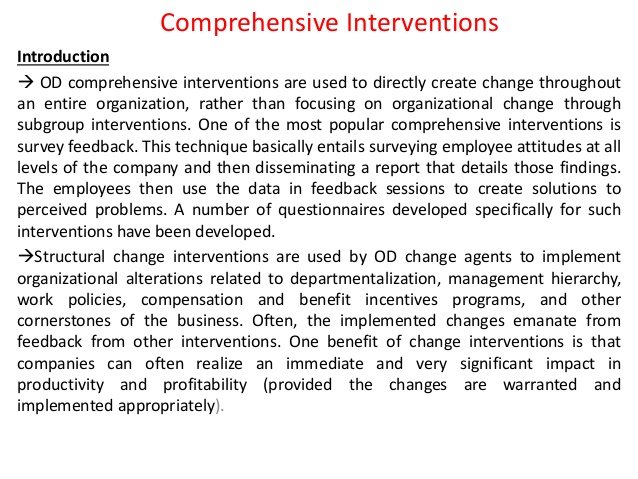
Comprehensive Intervention

The Comprehensive Intervention Model is a response to intervention approach. In 1991, Linda Dorn implemented the small-group model to support Reading Recovery teachers who worked with small groups of struggling readers in kindergarten and first grade. Dorn’s work is secured in several years of solid research and proven data.

The success of CIM is grounded in three critical areas: the specialized knowledge and expertise of reading teachers, the training and ongoing professional development that focuses on sensitive observation and flexible decision making, and the collaborative relationship between university trainers and reading teachers in the refinement of the literacy components. 

The Comprehensive Intervention Model includes individual and small-group interventions that align with classroom curriculum. These include: Reading Recovery, Emergent Language and Literacy Groups, Guided Reading Plus Groups, Assisted Writing Groups, Writing Process Groups, Comprehension Focus Groups, and Comprehension Focus Groups in Content.

CIM is designed as a System Intervention in that it provides a seamless comprehensive approach to student achievement. It provides teachers with a framework for aligning and managing interventions across the school system.  CIM uses a problem-solving, data-driven process for increasing literacy achievement across the school. It is based on five core principles:

  • Intervene early
  • Use a seamless approach
  • Provide layered interventions
  • Make ethical and informed decisions
  • Employ a collaborative, problem-solving method.

The heartbeat of the CIM is the responsive teacher, one who understands change over time in literacy processing and is able to adjust instruction to accommodate student learning.

Structural Interventions

Techno-structural interventions focus on improving the organizational effectiveness and human performance by focusing on technology and structure. These interventions are rooted in the fields of engineering, sociology, and psychology, combined with socio-technical systems, job analysis and design.

These types of interventions rely on an improvement-based approach; the idea is to shape the organizational techno-structural elements to get a best fit to the current situation and future development of the company.

The two main focus points of techno-structural intervention approaches are the improvement of an organization’s technology, for example, task methods and job design, and structure, for example division of labour and hierarchy. The following interventions are included in techno-structural interventions: 

  • Organizational structure
  • Organization systems
  • Innovation and design thinking
  • Socio-technical systems
  • Change management  
  • Job design / enrichment
  • Competency-based management
  • Knowledge management
  • Organizational learning
  • Work design

Job Enrichment, Functions, Scope, Challenges

Job enrichment is a motivational strategy focused on enhancing a job’s depth by giving employees greater autonomy, responsibility, and control over their work. Unlike job enlargement, which adds tasks at the same level, enrichment vertically loads a role by incorporating planning, decision-making, and managerial functions traditionally held by supervisors. Core techniques include empowering employees to schedule their tasks, make decisions, and solve problems independently, while also providing opportunities for skill development and direct feedback. The goal, rooted in Herzberg’s Two-Factor Theory, is to create intrinsically satisfying work by fulfilling achievement, recognition, and growth needs, thereby boosting engagement, reducing turnover, and improving performance.

Functions of Job Enrichment:

  • Enhances Employee Motivation

A key function of job enrichment is to increase employee motivation by making jobs more meaningful and challenging. It involves adding responsibilities, autonomy, and opportunities for personal growth. Employees feel valued when they are trusted with decision-making or problem-solving tasks, leading to higher job satisfaction. Motivated employees are more productive, committed, and engaged in their work. Unlike job enlargement, which only adds tasks, job enrichment focuses on making the job more fulfilling. This intrinsic motivation encourages creativity, responsibility, and loyalty, reducing turnover and improving overall organizational effectiveness by aligning personal satisfaction with organizational goals.

  • Improves Skill Utilization

Job enrichment ensures the better utilization of employee skills and talents by giving them opportunities to take on challenging tasks beyond routine work. When employees are encouraged to handle planning, decision-making, and problem-solving activities, they apply their knowledge and competencies more effectively. This not only develops new skills but also ensures existing abilities are not underutilized. Skill utilization leads to personal growth and boosts employee confidence, making them more resourceful and versatile. For organizations, it means having a capable workforce ready for higher responsibilities, succession planning, and leadership roles, ultimately strengthening long-term growth and competitiveness.

  • Promotes Employee Responsibility

Another important function of job enrichment is that it increases employee responsibility. By delegating greater decision-making power and control over work, employees develop a stronger sense of ownership. They are accountable for the quality, efficiency, and outcomes of their tasks, which enhances discipline and commitment. Greater responsibility encourages employees to focus on problem-solving and continuous improvement rather than just completing assigned duties. This sense of accountability also builds leadership qualities and prepares employees for managerial positions. Thus, job enrichment fosters responsibility, maturity, and reliability among employees, leading to higher productivity and organizational success.

  • Facilitates Employee Growth and Development

Job enrichment functions as a tool for employee growth and development by providing opportunities to handle diverse and challenging roles. Employees learn new skills, improve decision-making, and enhance problem-solving abilities, which help in personal as well as professional advancement. Exposure to higher-level responsibilities prepares them for promotions and career progression. From an organizational perspective, it ensures succession planning and reduces dependency on external hiring for leadership roles. By enriching jobs, employees remain engaged, ambitious, and future-ready, while organizations benefit from a skilled, motivated, and growth-oriented workforce capable of adapting to changing business environments.

Scope of Job Enrichment:

  • Granting Greater Autonomy

A fundamental scope of job enrichment is increasing employee autonomy. This involves empowering individuals with the freedom and authority to make decisions related to their work, such as setting their own schedules, choosing work methods, or prioritizing tasks. This trust and independence boost feelings of personal responsibility and ownership over outcomes. Employees transition from being passive executors of orders to active decision-makers, which significantly enhances intrinsic motivation, job satisfaction, and accountability for the results they produce.

  • Providing Direct Feedback Channels

Enrichment involves creating systems for providing employees with direct, timely, and constructive feedback on their performance. Instead of receiving assessment only through a formal supervisor, they might have access to performance data or interact directly with clients. This allows them to independently monitor, evaluate, and correct their work. Direct feedback helps employees understand the impact of their efforts immediately, fostering a sense of achievement and enabling continuous self-improvement without always waiting for managerial input.

  • Designing Complete Natural Work Units

This scope aims to make a job more meaningful by ensuring an employee is responsible for a complete, identifiable piece of work. Instead of performing a fragmented, repetitive task (e.g., just one step on an assembly line), they handle a whole project or a logical module from start to finish. This provides a clearer view of how their contribution fits into the bigger picture, fostering a sense of completion, pride in the final product, and a stronger connection between their effort and the tangible outcome.

  • Introducing New and More Difficult Tasks

Job enrichment expands a role vertically by introducing more challenging and complex responsibilities that require higher-level skills and problem-solving. This moves beyond adding similar tasks and instead incorporates duties that stimulate intellectual growth, such as planning, budgeting, or quality control. By constantly challenging employees, the organization addresses their need for growth and learning, prevents skill obsolescence, and helps them build a more robust and valuable skill set, preparing them for future advancement.

  • Assigning Specific Responsibility

A core element is assigning clear ownership of a specific task, project, or outcome to an individual. This makes them personally accountable for the success or failure of that endeavor. Specific responsibility clarifies expectations and eliminates ambiguity about who is answerable for results. This accountability fosters a deep sense of personal investment, diligence, and commitment to maintaining high standards, as the employee’s reputation and sense of achievement are directly tied to the performance of their assigned responsibility.

  • Resource Control and Authority

This scope grants employees greater control over the resources needed to do their jobs effectively. This could include authority over a budget, discretion in selecting tools or contractors, or influence over workflow processes. Having control reduces frustration caused by dependency on others and enables employees to execute their responsibilities more efficiently and innovatively. It is a powerful form of trust that signals the organization values their judgment, thereby enhancing their sense of empowerment and professional status.

Challenges of Job Enrichment:

  • Increased Workload and Employee Stress

While intended to motivate, adding complex responsibilities like planning and control can significantly increase an employee’s cognitive and emotional workload. Without proper support or relief from routine tasks, this vertical loading can lead to overwhelming pressure, stress, and potential burnout. Employees may feel that enrichment is merely a disguised way of demanding more without adequate compensation, leading to anxiety and decreased job satisfaction instead of the intended engagement and motivation.

  • Resistance from Employees

Not all employees desire enriched jobs. Some may prefer structured, predictable tasks with clear instructions and minimal responsibility due to personality, confidence levels, or work-life balance preferences. Being pushed into roles requiring autonomy, decision-making, and problem-solving can cause discomfort, fear of failure, and active resistance. Forcing enrichment on unwilling staff can demotivate them, lower morale, and increase turnover, defeating the purpose of the initiative.

  • Resistance from Middle Management

Managers may perceive job enrichment as a threat to their authority and traditional role. When employees are empowered to make their own decisions, managers might feel their control is diminished, leading to insecurity and resistance. They may hesitate to delegate meaningful authority or undermine the process, consciously or unconsciously. Successful enrichment requires buy-in from management and a shift in their role from controller to coach, which can be a significant cultural and personal challenge.

  • Lack of Proper Training and Skills

Enriched roles require higher-level competencies such as problem-solving, decision-making, time management, and analytical thinking. A major challenge is ensuring employees possess or can develop these skills. Without comprehensive training and ongoing coaching, employees placed in enriched roles may feel unprepared, leading to poor performance, mistakes, and heightened frustration. The organization must invest significant resources in capability development, which can be time-consuming and costly.

  • Inadequate Compensation and Recognition

With greater responsibility and complexity should come appropriate reward. A significant challenge is fairly compensating enriched jobs. If employees take on higher-level duties without a corresponding increase in pay, benefits, or recognition, they will likely feel exploited and undervalued. This perceived inequity can breed resentment, decrease motivation, and negate any positive impacts of enrichment, ultimately affecting retention and organizational trust.

  • Potential for Organizational Disequilibrium

Job enrichment can disrupt established workflows and power structures. If not implemented uniformly, it can create inequities between enriched and non-enriched roles, leading to jealousy, perceived unfairness, and internal conflict. Additionally, poor decisions by newly empowered employees—due to lack of experience—could impact quality, costs, or customer relationships. Managing this transition requires careful change management to maintain organizational balance and ensure that increased autonomy does not lead to operational chaos.

Conditions for Optimal Success of OD

Organizational Development has come a long way from languishing in the shadows of HR to being widely recognized as the primary driver of core organizational competencies through targeted interventions. It traverses the delicate path of progressive transition to a better state by employing the services of Change Management that embodies the systematic approach to managing risk in reaching desired goals and objectives.

However, too many promising initiatives fail due to lack of foresight in instilling and institutionalizing certain principles that are critical to ensuring a high probability of success.

These keys are:

  1. The Irrefutable Need

This refers to the timely realization of the significance of development and change that is required to ensure the survival/competitiveness of the organization. It normally stems from the organizational analysis (PESTLE, SWOT, Balanced Scorecard, Weisbord’s 6 Box Model, Mckinsey 7S, etc.). It generally indicates the stagnating business growth, commoditized core competencies, misalignment of strategic priorities with tactical measures and precarious financial situation. It is imperative in nature and demands the undivided attention on the part of top/senior management.

  1. The Burning Desire

This refers to coaxing of the passion that simmers in an enlightened top/senior management to excel beyond the conventional and foreseeable horizon. It is manifested as an intrinsic motivation within the primary decision makers to engage their ambitions in taking calculated risks from a position of relative comfort. It requires the courage to question the status quo and the willingness to initiate appropriate actions for shining within the constellation of relevant industry competitors without extinguishing the fire of innovation by dousing it with impending complacency.

  1. The Optimized Decisiveness

This refers to the knack for taking balanced decisions that are warranted in view of the indubitable need and the infectious desire for the long-term survival/competitiveness of the organization. It takes into account the available evidence in the form of analytical reports, employee/client feedback and the stated vision for scaling new heights by a certain time frame in the future. The respective decision should be deliberated between the senior management in a democratic fashion, however, the final conclusion should be drawn by the person gracing the top position with a clear idea, acceptance, preparedness, and accountability for the positive and negative consequences of ensuing actions.

  1. The Transcendent Message

This refers to creating, designing and communicating the message that inspires a passionate following/buy-in within the organization to the call for progressive change and development. The respective message needs to embody an optimum mix of both fluidity and viscosity. Fluidity to ensure that it flows at all levels of the organization and can funnel/seep through functional silos/questioning mindsets/grapevine gropers without any hindrance. Viscosity to ensure that it sticks in the reflective minds/thoughts/attitudes of employees long after the initial communication has taken place for providing a safe house to keep doubts/inhibitions/fears at bay.

  1. The Wise Selection

This refers to indulging in an inspired selection of the team that can get the job done. It has to be led by a person who is comfortable in his/her own skin with an intellectual and technical acumen that is able to demand attention at the very top and carry enough charisma to charm all parts of the organization. The real challenge is to become the beacon of hope in the “dark places” of the organization, where fear and doubt breed profusely. The associated team members should be bundles of infectious energy, enthusiasm and drive coupled with a delightful disposition as interactive sources of information, facilitation and application.

  1. The Insightful Plan

The inception and development of an astute plan, peppered with strategic and operational objectives, is essential in order to proceed forward with OD initiatives in a systematic manner. It is an ode to action that needs to be firm in its intent, unambiguous in its direction and accommodating in its application to safeguard against elevation to such a “sacrosanct” status that it breeds massive alienation and incentivizes a buy-out situation. It should bolster the confidence of key stakeholders and neutralize the active/passive resistance from pessimistic quarters.

  1. The Keen Acceptance

The embrace of the OD plan by the employees whose desire for expediency has been emboldened by the transcendent message is crucial to success. It should be evident by the “reverberating chatter” permeating throughout the organization and manifested in the invigorated emphasis on going beyond the routine. This also serves as a timely reminder to all the conniving forces lurking within the “dark alleys” of the organization that the time for Machiavellianism is over and “crossing the picket lines” would be a more productive option.

  1. The Religious Application

This refers to the devout realization of the OD plan through the blissful harmonization of comprehensive planning with practical rendition. It should be knitted with the reflective process of “action research” and provide an opportunity for the dedicated implementers to raise the flag for personal competence as a foreword to subsequent reward and recognition. The momentum for effective execution should be robustly maintained with visible support from the top/senior management to sustain/reinforce the psychological contract with key stakeholders.

  1. The Dogged Engagement

 This refers to the unwavering deployment of the organizational citizenship behavior that is entrenched in the intrinsically motivated employees and sparkles during the performance of their duties and responsibilities.

It should be actively coveted and encouraged by elevating its status to a “core value” for the progressive organization. Great examples of its application should become a part of the “corporate folklore” and case studies preserved within the knowledge bank for onboarding/imbuing new inductees with the finer aspects of the espoused organizational culture.

  1. The Stimulating Review

This refers to the invigorating process of formal analysis done at defined intervals to gauge the effectiveness of actions taken to meet the strategic and operational objectives. It should be meticulously planned, smoothly conducted, actively participated and resolutely followed up to avoid detachment from reaching the ultimate destination of competitive nirvana. Records of such reviews should become an important ingredient to the development of case studies and for the replenishment of the knowledge bank.

  1. The Honest Affirmation

This refers to the diligent completion of corrective/preventive actions (CA/PA) that emanate from the stimulating review. It requires an intrinsic pledge of sincerity and industriousness on behalf of the employees tasked with the efficient completion and effective closure of CA/PA, since sedentary/rudimentary/disingenuous efforts will only exacerbate the situation and compromise the noble intent of the whole exercise. Records of such CA/PA should be deposited in the knowledge bank.

  1. The Fair Remuneration

This refers to the inducement of intrinsic and extrinsic motivation through the allocation of appropriate rewards and recognition for services rendered by employees involved in the successful OD initiatives. It should have a high “felt fairness” perception among the beneficiaries and their peers by upholding the best tenets of organizational justice.

Personal Intervention

A wide range of interventions exist that address a variety of problems. Many of these interventions target symptomatology in caregivers, most commonly depression. Others address training caregivers in skills related to managing caregiver problems, such as disruptive behaviors in dementia, or pain in patients with cancer. Careful assessment of the caregiver needs to be completed before implementing any of these interventions because the focus of the intervention needs to address the particular needs of the caregiver.

For many of these clinical approaches, building skills in coping, problem-solving, increasing the rate of pleasant activity for the caregiver and/or care recipient are either the explicit goal of interventions or are the active ingredient in the interventions prescribed. Stress reduction through environmental modification is also a common focus of individual interventions.

Personal development interventions

There are many ways in which you can develop leadership skills, although individuals and organizations often struggle to identify ways to do so. This post looks at providing an overview of possible key interventions for personal development.

For each type of intervention, the following four questions need to be asked:

  • Is this readily available to me?
  • Is this of interest to me?
  • Will it benefit me directly?
  • Will it benefit the projects I work on and the organisation?

Below is a list of key interventions that can be implemented and it has been adapted from Project Leadership 3rd Edition, where this information is featured in more detail.

  • Self-reflection: Creating space and time to reflect on your actions and reactions to events, so that you can understand what you can learn and increase self-awareness. This distinguishes high performers and requires commitment until it becomes habit. Mainstream examples include meditation and mindfulness.
  • Reflective journal: Documenting your reflections in note form, diagrams or mind-maps. It helps to increase critical thought, understanding and follow-up.
  • Personal performance management: Gaining insight into your own performance, as a result of appraisals, discussions with peers, seniors, mentors or coaches, or informal discussions. It should be used as a basis to plan further development to improve personal performance.
  • Project experience: Working on projects is a necessary environment and support for learning to take place, as an opportunity to apply what has been learnt and gain critical experience.
  • Self-study: Learning topics of interest and value. The internet has made available a vast array of materials which makes self-study easier.
  • Feedback: Requesting and obtaining insight on personal performance from different perspectives. Be sure you want to receive feedback but note that often it is the negative and challenging feedback that helps us most.
  • Coaching: Working through particular problems, on a one-to-one basis, provided by an internal or external coach. This helps to develop individuals to achieve the best performance possible.
  • Mentoring: Providing advice and support, which typically comes from someone who has had similar experiences or responsibilities. This can help you work through your own issue or situation and can be done one to one, or one to many.
  • Buddying: Informally supportive relationship, which is an opportunity to share and compare approaches and experiences with others. Typically this is to provide mutual support through a close association.
  • Shadowing: Gaining insight from observing others, usually on a temporary basis. It is effective for individuals moving into a new role, who need to develop particular expertise.
  • Secondment: Gaining experience in new environments, where an individual temporarily transfers to another role for a defined period of time.
  • Training: Gaining knowledge and skills through a multiplicity of options; face to face, classroom based, distance and e-learning, simulation and gamification.
  • Storytelling: Actively seeking out opportunities to listen to others who have specific insights, which may be beneficial to your own position.
  • Communities of interest: Joining and participating in communities or groups of people who share a common interest, and who share their experience, knowledge, skills and learning.
  • Professional body membership: Participating in the wider profession by belonging to a professional body. This provides access to policy makers, researchers and a network of contacts. Membership also provides recognition of your knowledge.
  • Professional body qualification: Gaining formal qualifications or accreditations demonstrates your skill and commitment, increases your value and enhances your career prospects.
  • Community investment initiative: Contributing to the wider society are opportunities for personal development, typically under the headings of ‘Corporate Social Responsibility’ or ‘Business in the Community’.
  • Organizational investment task: Investing time and energy to contribute to initiatives outside your immediate area and remit, are opportunities for networking and contributing to the wider organization.
  • Networking: Interacting with others to exchange information and develop professional contacts. This broadens your horizons, and increases your exposure to different experiences, people and ways of working.
  • Academic qualification: Obtaining knowledge and skills provides specialised development.
  • Conferences and seminars: Attending events exposes you to new offerings and thinking. You can hear a variety of practitioners and researchers, as well as taking the opportunity to present your own experiences.

This list is neither mutually exclusive nor collectively exhaustive. Some people may value certain activities more than others and personal development should be about finding the best approach for each individual. In our experience, self-reflection is one of the most powerful but underrated activities.

Inter-group Interventions

Inter-group interventions are integrated into OD programs to facilitate cooperation and efficiency between different groups within an organization. For instance, departmental interaction often deteriorates in larger organizations as different units battle for limited resources or become detached from the needs of other units.

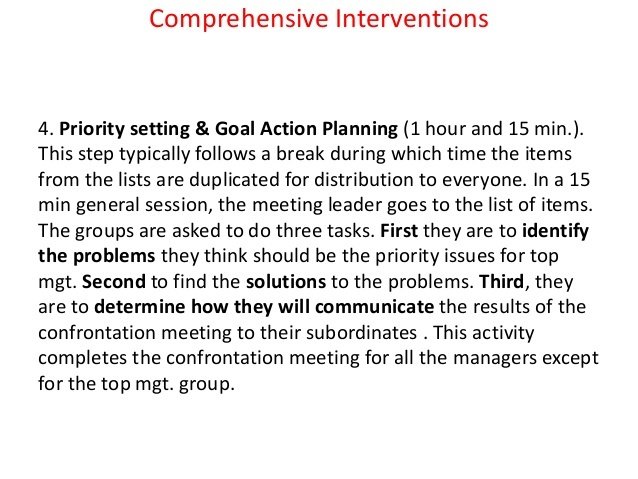
Conflict resolution meetings are one common inter-group intervention. First, different group leaders are brought together to secure their commitment to the intervention. Next, the teams meet separately to make a list of their feelings about the other group(s). Then the groups meet and share their lists. Finally, the teams meet to discuss the problems and to try to develop solutions that will help both parties. This type of intervention, say supporters, helps to gradually diffuse tension between groups that has arisen because of faulty communication.

OD joint activity interventions involve melding members of different groups to work together toward a common goal. Similarly, common enemy interventions achieve the same results by finding an adversary common to two or more groups and then getting members of the groups to work together to overcome the threat. Examples of common enemies targeted in such programs include competitors, government regulation, and economic conditions.

Inter-group team building intervention intends to increase communications and interactions between work related groups to reduce the amount of dysfunctional competition and to replace a parochial independent point of view with an awareness of the necessity for interdependence of action calling on the best efforts of both the groups. Inter-group interventions are integrated into Organizational Development programs to facilitate cooperation and efficiency between different groups within an organization. For instance, departmental interaction often deteriorates in larger organizations as different divisions battle for limited resources or become detached from the needs of other departments. Conflict resolution meetings are one common inter-group intervention. First, different group leaders are brought together to get their commitment to the intervention. Next, the teams meet separately to make a list of their feelings about the other group(s). Then the groups meet and share their lists. Finally, the teams meet to discuss the problems and to try to develop solutions that will help both parties. This type of intervention helps to gradually diffuse tension between groups caused by lack of communication and misunderstanding.

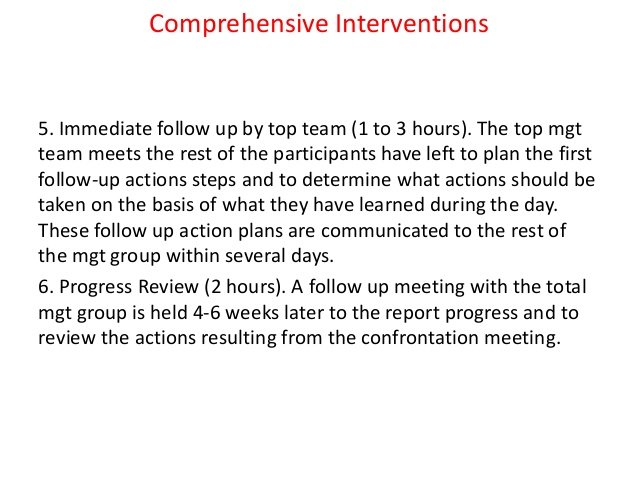
Blake, Shepard and Mouton came up with a method which is used between groups that are strained and overly hostile. The process is to obtain commitment from the leaders of each group on their willingness to find procedures that will improve inter group relations. Groups are put in different rooms. The task of each group is to generate two lists. They should put down thoughts, attitudes, perceptions and feelings about the other group, predict what the other group will say about them. The groups come together and share their lists. No comments or discussions, only clarity. The groups reconvene to discuss their reactions to what they have learned about themselves from what the other group has said identify issues that still need to be resolved between the two groups. The two groups come together and share their lists, they set priorities, and they generate action steps and assign responsibilities. A follow up meeting is convened to ensure that the action steps have been taken. The method can be used with more than two groups where the hostility between the groups may not be extreme or severe. In this method, each group, separately compiles two types of lists namely a positive feedback list, a bug list and an empathy list. The two groups come together and share the lists; there is no discussion, except for seeking clarification. The total group generates a list of major problems and unresolved issues between the two groups. These issues are ranked in terms of importance. Sub groups are formed with members from each group, who then discuss and work through each item. The sub-groups report to the larger group. On the basis of the report back and all the other information gathered, the group proceeds to: generate action steps for resolving the conflict, assign responsibilities for each step and record a date by which the steps ought to have been carried out. With this method the two groups work together effectively.

Rotating membership

Such interventions are used by Organizational Development change agents to minimize the negative effects of inter-group rivalry that result from employee allegiances to groups or divisions. The intervention basically entails temporarily putting group members into their rival groups. As more people interact in the different groups, greater understanding results.  Organizational Development joint activity interventions serve the same basic function as the rotating membership approach, but it involves getting members of different groups to work together toward a common goal. Similarly, common enemy interventions achieve the same results by finding an adversary common to two or more groups and then getting members of the groups to work together to overcome the threat. Examples of common enemies include competitors, government regulation, and economic conditions.

Characteristics of inter-group conflict

Inter group conflicts are characterized by perception of the other as the “enemy”, stereotyping, constipated, distorted and inaccurate communication and stoppage of feedback and data input. Each group begins to praise itself and its products more positively and believes that it can do no wrong and the other can do no right. There might even be acts of sabotage against the other group. Using the idea of a common enemy outside the group that both groups dislike to bring them closer, increasing interaction and communication under favorable conditions and finding a super – ordinate goal that both groups desire. Rotating members of the group, training, etc are helpful strategies that have been used to deal with inter-group conflict

Walton’s approach to third party peace making interventions

Walton’s approach to third party peace making interventions has a lot in common with group interventions but it is directed more towards, interpersonal conflict. Third party interventions involve confrontation and Walton outlines confrontation mechanisms. A major feature of these mechanisms is the ability to diagnose the problem accurately. The diagnostic model is based on four elements namely the conflict issues, precipitating circumstances, conflict-related acts and the consequences of the conflict. It is also important to know the source of the conflict. Sources could be substantive issues, which is conflict related to practices, scarce resources, and differing conceptions of roles and responsibilities. Sources of conflicts could also be emotional issues, involve feelings between the parties, such as anger, hurt, fear, resentment, etc. The former require bargaining and problem solving. The latter require restructuring perceptions and working through negative feelings. Ingredients of a productive confrontation include the following. Mutual positive motivation, which refers to the willingness on both parties resolve the conflict; Balance of power without any power differentials between the parties involved in a confrontation; Synchronization of confrontation efforts wherein the two parties address the conflict simultaneously; and Differentiation and integration of different phases of the intervention must be well paced. The intervention involves working through negative feelings and ambivalent positive feeling. The intervention must allow sufficient time for this process to take place. Conditions that promote openness should be created. This could be done through setting appropriate norms and creating a structure that encourages openness. Reliable communicative signal refers to using language that is understood by the parties involved in the confrontation. Optimum tension in the situation means that the stress experienced by both parties ought to be sufficient to motivate them but not too excessive. General principles on negotiation involve approaches to people, interests, options and criteria. People have different feelings and perceptions therefore it is important to separate people from feelings. Interest. Looking at party interests provide a vehicle for resolving conflict rather sticking to inflexible positions that entrench the conflict. Options ought to be generated in order to come up with best option for resolving conflict. Criteria for evaluating the success of the intervention ought to be clear and objective.

Team Interventions

Almost everyone wants to build teams at work. But, the process of building teams and having them function successfully takes work. Teamwork requires a commitment to understanding yourself, understanding others, and developing teamwork skills.

  • To understand yourself means that you are aware of emotions, personal needs, strengths, and weaknesses. Plus, you need to examine how you communicate and the roles you play within the team.
  • To understand others involves a willingness to give and receive sensitive and constructive feedback.
  • To develop teamwork skills, focus on supporting and listening to others, negotiating differences, and offering constructive feedback. These requirements are often unheard or only given lip service.

Teamwork is not something that develops spontaneously or easily. Team-based interventions provide an avenue for success. The Highlands Ability Battery (THAB) assessment measures natural abilities through work samples. The value of having an understanding of your hard-wired strengths, while developing a common team understanding, is immeasurable.

The assessment should be followed by individual feedback consultations. This provides a clear understanding to the team member about how they contribute, from the perspective of both strengths and challenges.

Types of Team Building Intervention

No team is “born” fully effective; it develops over time with ups and downs, successes and failures. Effective teamwork is essential to project, department and organizational success. It requires hard work, persistence and a committed team leader. Baseball Hall of Fame pitcher Nolan Ryan said, “My job is to give my team a chance to win.” This is also the job of a committed team leader. But sometimes, committed leaders need help addressing team dynamics.

  1. Teamwork Effectiveness Problems

In his book “The Five Dysfunctions of a Team,” management consultant Patrick Lencioni identifies several “natural pitfalls” that can prevent a team from being effective. These pitfalls include a lack of trust among team members; destructive rather than constructive conflict; lack of commitment to the team; lack of accountability – the willingness of team members to accept responsibility for their behavior; and the failure of the team to produce results.

Team building intervention strategies may help teams avoid or recover from these pitfalls. The type of team building intervention used depends on the team’s composition and history, along with the nature and the severity of the problem. For an intervention to be effective, there must be ongoing follow-up to incorporate the lessons learned to the team’s daily work.

  1. Skill-Based Team Intervention Strategies

Sometimes a team has problems because its members do not have the basic knowledge or skills they need to work together. Skill building interventions give members the opportunity to learn and practice team skills, such as leading a team meeting, reaching group consensus, improving team communications, constructively giving and receiving feedback, resolving conflicts, listening effectively and sharing information. These team building interventions are presented as a course in which all members participate and during which they develop action plans for practicing the needed skills.

  1. Problem Solving Interventions

Problem solving interventions are most effective with a team that has a specific project problem or barrier to teamwork that is blocking progress. In these interventions, all team members meet at an off-site location with an outside facilitator and without the distraction of daily work. The facilitator’s job is to help the team explore and understand the problem in order to find a solution. Problem solving retreats are the most common form of team building intervention because the activity is immediately applied to the team’s daily work.

  1. Personality-Based Interventions

Personality-based interventions focus in improving interpersonal skills among the team members. Members take personality or psychometric tests such as the Myers-Briggs Personality Type, Insights Team Dynamics, Enneagram or DISC assessments. The results are communicated to each team member and, in some instances, the entire team to help members understand and appreciate their own and their teammates’ personalities and interpersonal styles. Ideally, this understanding leads to better communication and improved team effectiveness.

  1. Activity-Based Interventions

In activity-based interventions, team members participate in physical challenges, such as playing games, canoeing or hiking. The interventions focus on teamwork, problem solving, trust and risk taking. The activity addresses specific problems facing a team with the goal that the success achieved by working together in the activity will carry over into the team’s work.

error: Content is protected !!