Global Depository Receipts

Global Depository Receipt (GDR) is an instrument in which a company located in domestic country issues one or more of its shares or convertibles bonds outside the domestic country. In GDR, an overseas depository bank i.e. bank outside the domestic territory of a company, issues shares of the company to residents outside the domestic territory. Such shares are in the form of depository receipt or certificate created by overseas the depository bank.

Issue of Global Depository Receipt is one of the most popular ways to tap the global equity markets. A company can raise foreign currency funds by issuing equity shares in a foreign country.

Global Depository Receipt Example

A company based in USA, willing to get its stock listed on German stock exchange can do so with the help of GDR. The US based company shall enter into an agreement with the German depository bank, who shall issue shares to residents based in Germany after getting instructions from the domestic custodian of the company. The shares are issued after compliance of law in both the countries.

Global Depository Receipt Mechanism

  • The domestic company enters into an agreement with the overseas depository bank for the purpose of issue of GDR.
  • The overseas depository bank then enters into a custodian agreement with the domestic custodian of such company.
  • The domestic custodian holds the equity shares of the company.
  • On the instruction of domestic custodian, the overseas depository bank issues shares to foreign investors.
  • The whole process is carried out under strict guidelines.
  • GDRs are usually denominated in U.S. dollars

Let’s now look at the advantages and disadvantages of Global Depository Receipt.

Advantages of GDR

The following are the advantages of Global Depository Receipts:

  • GDR provides access to foreign capital markets.
  • A company can get itself registered on an overseas stock exchange or over the counter and its shares can be traded in more than one currency.
  • GDR expands the global presence of the company which helps in getting international attention and coverage.
  • GDR are liquid in nature as they are based on demand and supply which can be regulated.
  • The valuation of shares in the domestic market increase, on listing in the international market.
  • With GDR, the non-residents can invest in shares of the foreign company.
  • GDR can be freely transferred.
  • Foreign Institutional investors can buy the shares of company issuing GDR in their country even if they are restricted to buy shares of foreign company.
  • GDR increases the shareholders base of the company.
  • GDR saves the taxes of an investor. An investor would need to pay tax if he purchases shares in the foreign company, whereas in GDR same is not the case.

 Disadvantages

 The following are the disadvantages of Global Depository Receipts:

  • Violating any regulation can lead to serious consequences against the company.
  • Dividends are paid in domestic country’s currency which is subject to volatility in the forex market.
  • It is mostly beneficial to High Net-Worth Individual (HNI) investors due to their capacity to invest high amount in GDR.
  • GDR is one of the expensive sources of finance.

Protection of Depositors

Deposit Insurance and Credit Guarantee Corporation (DICGC) is a wholly owned subsidiary of Reserve Bank of India. It was established on 15 July 1978 under the Deposit Insurance and Credit Guarantee Corporation Act, 1961 for the purpose of providing insurance of deposits and guaranteeing of credit facilities.

DICGC insures all bank deposits, such as saving, fixed, current, recurring deposit for up to the limit of Rs. 500,000 of each deposits in a bank.

Legal Framework/Objective

The functions of the subsidiary are governed by the provisions of ‘The Deposit Insurance and Credit Guarantee Corporation Act, 1961’ (DICGC Act) and ‘The Deposit Insurance and Credit Guarantee Corporation General Regulations, 1961’ framed by the Reserve Bank of India in exercise of the powers conferred by sub-section (3) of Section 50 of the Act.

A maximum of ₹5,00,000 (after the budget of 2020-21) is insured for each user for both principal and interest amount. If the customer has accounts in different banks, all of those accounts are insured to a maximum of ₹5,00,000 each.

However, if there are more accounts in same bank, all of those are treated as a single account. The insurance premium is paid by the insured banks itself. This means that the benefit of deposit insurance protection is made available to the depositors or customers of banks free of cost.

The Corporation has the power to cancel the registration of an insured bank if it fails to pay the premium for three consecutive half-year periods. The Corporation may restore the registration of the bank if the bank makes a request and pays all the amounts due by way of premium from the date of default together with interest.

Reforms

The Financial Sector Legislative Reforms Commission (FSLRC) was a body set up by the Government of India, Ministry of Finance, on 24 March 2011, to review and rewrite the legal-institutional architecture of the Indian financial sector. In its report the FSLRC recommended a regulatory structure consisting of seven agencies including a deposit insurance-cum regulatory agency (which was named as Resolution Corporation). The present DICGC will be subsumed into the Resolution Corporation (RC) which will work across the financial system.

Drawing on the best international practice, the FSLRC proposal involved a unified resolution corporation that will deal with an array of financial firms such as banks and insurance companies; it will not just be a bank deposit insurance corporation. It will concern itself with all financial firms which make highly intense promises to consumers, such as banks, insurance companies, defined benefit pension funds, and payment systems.

It will also take responsibility for the graceful resolution of systemically important financial firms, even if they have no direct links to consumers.

The Government of India introduced the Financial Resolution and Deposit Insurance bill, 2017 (FRDI bill) in Lok Sabha in the Monsoon session of 2017 to bring forth these reforms. There have been many concerns with regards to the new bill such as:

  1. Presently the banks have to pay a sum to the DICGC as insurance premium which insures all kinds of bank deposits up to a limit of ₹5,00,000. In case a stressed bank had to be liquidated, the depositors would be paid through DICGC. Though the bill proposes the banks to pay a sum to the Resolution Corporation, it neither specifies the insured amount nor the amount a depositor would be paid. It is thus unclear how much a depositor would be paid in case of liquidation.
  2. The bail in clause which largely worked against the interests of the depositors (as in Cyprus).

Security Exchange Board of India, History, Role, Reform

Securities and Exchange Board of India (SEBI) is the regulatory body responsible for overseeing and regulating the securities and commodity market in India. Established in 1988 and given statutory powers on January 30, 1992, through the SEBI Act of 1992, its primary functions include protecting investor interests, promoting the development of the securities market, and regulating its participants. SEBI’s activities are focused on ensuring transparent and fair dealings in the market, preventing malpractices, and enhancing investor education. It formulates rules and regulations, conducts audits and inspections, and takes enforcement actions to fulfill its objectives. Headquartered in Mumbai, SEBI is pivotal in shaping the growth and stability of India’s financial markets.

Security Exchange Board of India History:

  • Pre-SEBI Era

Before SEBI’s establishment, the regulatory oversight of the securities market in India was fragmented and lacked the teeth necessary for effective enforcement. The Capital Issues (Control) Act of 1947 was the primary regulatory framework, which primarily controlled the issuance of securities and capital raising but did not effectively regulate market practices or protect investor interests.

  • Establishment of SEBI

Recognizing the need for a dedicated regulatory body to manage an expanding market, the Government of India established the Securities and Exchange Board of India (SEBI) on April 12, 1988, through an executive resolution. Initially, SEBI had no statutory power.

  • SEBI Act, 1992

The real transformation came with the SEBI Act of 1992, which was passed by the Indian Parliament in January 1992. This act granted SEBI statutory powers, making it the primary regulator with comprehensive authority over securities markets in India. This was a crucial step in bringing transparency, accountability, and efficiency to the markets.

Role of SEBI:

  • Investor Protection

SEBI’s primary role is to protect the interests of investors in securities and promote their education, ensuring fair play and transparency in financial transactions.

  • Regulation and Development of the Market

SEBI regulates the securities market and works towards its development. It frames rules and regulations to ensure the smooth functioning of the securities market, facilitating the growth of this sector.

  • Regulation of Intermediaries

It regulates the activities and certification of various market intermediaries, including brokers, merchant bankers, mutual funds, and others, ensuring they adhere to best practices and ethical standards.

  • Prohibition of Fraudulent and Unfair Trade Practices

SEBI has the power to investigate and take action against fraudulent and unfair trade practices, such as market manipulation, insider trading, and violation of rules.

Powers of SEBI:

  • Quasi-Legislative Powers

SEBI has the authority to draft regulations, rules, and guidelines for the protection of investors and the orderly functioning of the securities market. These regulations are binding on all parties involved in the market.

  • Quasi-Judicial Powers

SEBI can conduct hearings and adjudication proceedings to settle disputes and impose penalties on violators of the securities law. This includes the power to issue orders such as cease-and-desist orders, disgorgement orders, and suspension or cancellation of licenses.

  • Quasi-Executive Powers

It possesses the power to enforce its regulations and directives. This includes conducting investigations into market malpractices, carrying out inspections and audits of market intermediaries, and taking enforcement action against violators.

  • Regulatory Powers

SEBI oversees and approves by-laws of stock exchanges, regulates the business in stock exchanges and any other securities markets, and registers and regulates the working of stock brokers, sub-brokers, share transfer agents, bankers to an issue, trustees of trust deeds, registrars to an issue, merchant bankers, underwriters, portfolio managers, investment advisers and such other intermediaries who may be associated with securities markets in any manner.

  • Developmental Powers

SEBI has powers to conduct research and publish information useful to investors, thus promoting the education and training of intermediaries of the securities market. It also has a role in promoting and developing self-regulatory organizations within the industry.

Market Reforms and Developments

Since its inception, SEBI has introduced a series of reforms to enhance market integrity and efficiency.

  • The introduction of dematerialization to reduce paper-based transactions.
  • The establishment of clearing corporations to provide a secure and efficient settlement system.
  • The introduction of corporate governance norms to improve transparency and accountability in companies.
  • Implementation of strict norms for mutual funds and other collective investment schemes to protect investor interests.
  • Introduction of derivative trading, which provided new financial instruments for risk management.

Sources of Short-term finance

Bank overdraft

Bank overdraft is a temporary arrangement with the bank that allows the organization to overdraw from its current deposit account with the bank up to a certain limit. The overdraft facility is granted against securities, such as promissory notes, goods in stock, or marketable securities. The rate of interest charged on overdraft and cash credit is comparatively much higher than the rate of interest on bank deposits.

Commercial Paper:

Commercial paper is a form of financing which consists of short-term promissory notes which are unsecured and are sold in the money market. They are issued by large companies and pri­marily sold to other business firms, insurance companies, pension funds, and banks. Because they are unsecured and are sold in the money market, they are restricted in use to the most credit-worthy of the large companies.

Though the commercial paper market has a long history, much of its tremendous growth has occurred in recent years with increases in the installment financing of automo­biles and other consumer durable goods.

As credit tightens in terms of the banks’ ability to make loans, the commercial paper market increases. Many of the companies that issue these notes now look at this market as an alternative source of financing.

The Commercial Paper Market:

The commercial paper market includes a dealer distribution system and a system of direct placement. Most industrial firms, utilities, and medium-size finance companies utilize the dealer market to place their commercial paper.

Five major dealers com­prise the market, which purchases the paper from firms and then sells it to investors. Denominations of commercial paper range from Rs.25,000 to several rupees, and maturity runs from about two to six months, with an average of five months.

The cost of this paper is from 0.5 to 1 per cent below the prime lending rate. Considering that there are no compensating balance require­ments, the rate differential is still more significant. The commis­sion on the sale of paper runs from 0.125 of 1 per cent. Many firms are looking at this source of financing more in terms of a perma­nent source than as the traditional seasonal instrument.

Appraisal of the Commercial Paper Market:

Commercial paper is a much cheaper source of financing than short-term bank financing, as we have noted. Many companies are considering commercial paper as a supplement to bank credit. A company could make use of the paper market when the interest rate differential was large and borrow from the bank when the gap narrowed. This would result in the lowest borrowing cost to the firm in the short term.

Evidence has indicated that it is imperative for a firm not to impair its relations with a bank by using its services only during periods of extremely tight money, however. It is often suggested that a firm should have a backup line of credit with a bank to cover its borrowing position in the commercial paper market.

One factor which has helped the growth of the commercial paper market is a regulation that the maximum loan a national bank can make to a single borrower is 10 per cent of the bank’s capital and surplus. It is the perpetual need of short-term capital that has helped the commercial paper market to boom.

Factoring Accounts Receivable:

When a firm factors its account receivable, it actually sells them to a factor who actually buys the receivables. This may be done with or without recourse. With recourse, the factor can look to the seller of receivables for payment if there is a default on the pay­ment of the receivable. Without recourse, the factor cannot look to the seller of the receivables for collection in case of default.

The factor maintains a credit department which can undertake a credit check of a customer. If a firm sells without recourse, utilization of this service can allow it to forego the cost of main­taining a credit department of its own.

In this case, the factor assumes risk and bad-debt losses and all expenses associated with collecting slow accounts. The customer of the firm who is factor­ing the receivables may or may not be told of the factor agreement; this decision is made between the lender and the seller of the receivables.

Associated with the assumption of risk and servicing of the receivables is an added cost to the seller. Usually a fee is attached which runs from 1 to 3 per cent of the face value of the receivables. In addition, there will be interest charges for funds that are advanced before collection by the factor.

The cost of using a factor can be illustrated with the following example. A firm factors on the average Rs.100,000 per month for a year. The factor will lend 80 per cent of the face value of the receivables and will charge a factoring fee of 1 per cent of that face value.

In addition, the factor charges 1 per cent interest per month on the amount borrowed. The interest cost and the factoring fee are taken out in advance of all funds given to the firm. Assume that the firm borrows the full amount each month.

We can calcu­late the annual cost to the firm of utilizing the factoring service as shown in following equation:

Actual Cost Interest cost + Factoring fee / Actual rupees received

Inventory Financing:

Inventory is another asset that has considerable merit as collat­eral for short-term financing. The lender usually will advance only a specified percentage against the face value of the inventory. This loanable value is based on the type of inventory being consid­ered and the ability of the lender to dispose of it in case of default.

The more specialized the inventory and the market for the prod­uct, the more unwilling is the lender to advance a large percentage of the face value.

The more standard and salable the inventory, the higher the loan percentage. Frequently lenders will loan 90 per cent of the face value when they feel the inventory is standard and has a ready market, apart from the marketing organization of the borrower.

Lenders usually consider such items as marketability, perish­ability, market price stability, and difficulty in liquidating the inventory in determining the percentage value that they are will­ing to advance on an inventory loan.

The most important aspect of a lender’s analysis is to substantiate that there is enough liquidat­ing value in the inventory to cover the loan and accrued interest in case of default on the part of the borrower.

In addition, the lender must determine the ability of the borrower to service the debt by examining the cash flow structure of the firm. There are several ways in which inventory can be collateralized.

These methods are discussed below:

  1. Floating Lien:

A feature of the Uniform Commercial Code permits a borrower to pledge inventory “in general” as collateral against a loan, with­out specifying the inventory involved. This allows the lender to obtain a floating lien or claim against all of the borrower’s inven­tory. This type of arrangement is very difficult to police, and in general it is made only to provide extra security for a loan.

A floating lien can cover both receivables and inventory; thus it allows a lender to obtain a lien on the major part of the current assets of a firm. The floating lien also can cover both present and future inventory.

2. Chattel Mortgage:

A chattel mortgage provides for the borrower’s inventory to be identified specifically by a serial number or some other means. The borrower still holds title to the goods, but the lender has a lien or claim on the inventory. Under this arrangement, the lender has to give his consent before the inventory can be sold.

Any inven­tory that has a rapid turnover or is not readily identifiable would not be suited for this type of lien arrangement. Capital asset items such as machine tools and other heavy equipment are well suited for a chattel mortgage.

3. Trust Receptions:

With a trust receipt loan, the borrower holds both the inventory and the proceeds from the sale of inventory in trust for the lender. Consumer durable goods, automobiles, and equipment are good examples of the types of inventory that are well suited to serve as this form of collateral.

The automobile dealership system is an excellent example of how a trust receipt collateral system works. When automobiles are shipped to the dealer from the manufacturer, the lending institu­tion will pay the manufacturer under an arrangement made with the dealer. The dealer in turn signs a trust receipt agreement which specifies the handling of the inventory.

The dealer is allowed to sell the cars and must turn the proceeds over to the lender. Under the trust receipt arrangement, the inventory is serialized and is periodically audited by the lender. The purpose of the audit is to determine if any cars have been sold without the proceeds of the sale being remitted to the lender.

Each time a new batch of cars is acquired from the manufac­turer, a new trust receipt agreement is signed to take account of the new inventory. Though this method provides a wider margin of safety than a floating lien arrangement, there is always the possibility that a dealer will sell cars and not remit the proceeds to the lender in payment of the funds advanced.

4. Terminal Warehouse Receipt Loans:

Under another arrangement for using inventory as collateral for a loan, the borrower’s inventory is housed in a public, or terminal, Warehouse Company. A warehouse receipt which speci­fies the inventory located there provides the lender with a security interest in the inventory.

Because the goods in inventory can only be released on authorization by the lender, it can maintain strict control over the inflow and outflow of inventory. In addition, an insurance policy is usually issued which contains a loss-payable clause for the benefit of the lender.

The warehouse receipt can be in a negotiable or nonnegotiable form. If it is negotiable, the receipt can be transferred from one party to another by endorsement, but before the goods can be released the receipt must be presented to the warehouse man.

A nonnegotiable warehouse receipt is issued in favour of the lender, which has title to the goods and is the only one that can release them. The nonnegotiable receipt arrangement provides that the release of goods must be authorized in writing. Most arrange­ments are of the nonnegotiable form.

5. Field Warehouse Receipt Loans:

With the form of collateralization known as the field warehouse receipt loan, the inventory remains on the property of the bor­rower. A field warehouse company sets off a specific part of the borrower’s storage area in which to locate the inventory being used as collateral. Often this area is physically fenced off and only the field warehouse company has access to it.

Once the collateral value of the inventory is verified by the field warehouse company, the lender advances the funds. This arrangement is desirable when there is great expense involved in locating the inventory elsewhere, especially true when the borrower has a high inventory turnover ratio.

There is no question that the cost of this form of collateral financing is very high. This is primarily due to the cost of the warehouse company which acts as a third party in this arrange­ment.

The evidence of collateral is only as good as the warehouse company issuing the receipt. Historically there has been evidence indicating fraud in terms of the validity of the inventory actually being stored in a particular spot.

Internal Rate of Return, Advantages, Disadvantages, Calculation, Formula

The Internal Rate of Return (IRR) is the discount rate at which the Net Present Value (NPV) of a project becomes zero. It represents the expected annual return on an investment, helping businesses evaluate the profitability of potential projects. A higher IRR indicates a more attractive investment opportunity. IRR is widely used in capital budgeting decisions, comparing it with the cost of capital to determine project feasibility. However, IRR has limitations, such as multiple values for projects with non-conventional cash flows. Despite this, it remains a key tool for financial analysis and decision-making in corporate finance.

Advantages Of IRR:

  • Considers the Time Value of Money

IRR method takes into account the time value of money, ensuring that future cash flows are discounted appropriately. Unlike simple return calculations, IRR recognizes that a rupee today is worth more than a rupee in the future. This makes IRR a more accurate tool for evaluating long-term investment projects. By discounting cash flows, it provides a clearer picture of a project’s true profitability, making it easier for businesses to make informed financial decisions.

  • Provides a Clear Investment Decision Rule

IRR offers a straightforward decision-making rule: if the IRR is higher than the cost of capital, the project is considered financially viable. This simplifies comparisons between different investment opportunities. Businesses can easily determine whether a project will generate returns exceeding their required rate of return. This clear and intuitive approach helps managers and investors assess the attractiveness of various investment options without needing complex calculations.

  • Facilitates Easy Comparisons Between Projects

Since IRR expresses profitability as a percentage, it allows companies to compare multiple investment opportunities regardless of size. This makes IRR particularly useful when selecting projects with different initial investment amounts. By ranking projects based on IRR, businesses can prioritize those with the highest potential returns. This comparative approach simplifies capital allocation and ensures that resources are invested in the most profitable ventures.

  • Does Not Require a Predetermined Discount Rate

IRR is independent of external assumptions. This is beneficial because determining an accurate discount rate can be challenging. By calculating the inherent rate of return, IRR allows businesses to assess profitability without relying on uncertain external factors. This self-sufficiency makes IRR a flexible tool for evaluating investment decisions.

  • Works Well for Projects with Conventional Cash Flows

IRR is particularly effective for projects with standard cash flow patterns—an initial outflow followed by a series of inflows. In such cases, IRR provides a single, clear rate of return that accurately reflects the project’s profitability. This makes it a practical method for evaluating straightforward investments such as factory expansions, equipment purchases, and infrastructure developments.

  • Useful for Capital Rationing Decisions

When companies face budget constraints, IRR helps prioritize investments by ranking projects based on their profitability. Businesses with limited capital can select projects with the highest IRRs to maximize returns. This ensures that financial resources are allocated efficiently, improving overall investment performance. By considering both return potential and capital constraints, IRR serves as a valuable tool in strategic financial planning.

Disadvantages Of IRR:

  • Ignores the Scale of Investment

One major drawback of IRR is that it does not consider the size of the investment. A project with a high IRR may have a much smaller total return compared to a project with a lower IRR but a larger overall profit. This can mislead decision-makers into selecting smaller, high-IRR projects over larger, more profitable ones. The Net Present Value (NPV) method is often preferred because it accounts for the absolute value of profits rather than just the percentage return.

  • Assumes Cash Flow Reinvestment at IRR

IRR assumes that all future cash flows are reinvested at the same rate as the IRR itself. In reality, companies may not always be able to reinvest funds at such a high rate. This can lead to overestimating the actual profitability of the project. The Modified Internal Rate of Return (MIRR) is sometimes used to address this issue by assuming reinvestment at a more realistic rate, such as the cost of capital.

  • Multiple IRRs in Non-Conventional Cash Flows

Projects with unconventional cash flows—where cash inflows and outflows occur more than once—can result in multiple IRRs. This happens when a project has cash flow reversals, such as an outflow followed by an inflow, then another outflow. In such cases, the IRR formula produces more than one valid percentage, making it difficult to determine the actual rate of return. This creates confusion and reduces the reliability of IRR as a decision-making tool.

  • Fails to Consider the Cost of Capital

IRR does not explicitly take the cost of financing into account. A high IRR does not necessarily mean a project is profitable if the company’s cost of capital is also high. This limitation makes IRR less reliable for firms with fluctuating or high financing costs. Decision-makers must always compare IRR with the cost of capital to make sound investment choices.

  • Not Ideal for Mutually Exclusive Projects

When comparing mutually exclusive projects (where selecting one project eliminates the possibility of choosing another), IRR may lead to incorrect decisions. A project with a higher IRR but lower NPV might be chosen over a project with a lower IRR but significantly higher total value. Since NPV directly measures value addition, it is a better metric in such cases. Relying solely on IRR for mutually exclusive projects can result in suboptimal investment decisions.

  • Complexity in Calculation

Calculating IRR can be complicated, especially for projects with irregular cash flows. Unlike NPV, which uses a simple discounting formula, IRR requires iterative trial-and-error methods or financial software to determine the correct rate. This complexity can make it difficult for managers without strong financial expertise to interpret results. Additionally, IRR does not work well when projects have delayed or highly unpredictable cash flows.

Calculation Of IRR:

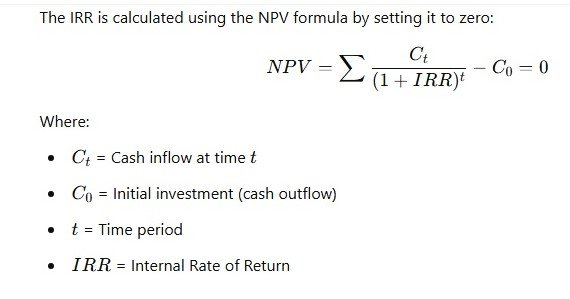
The Internal Rate of Return (IRR) is the discount rate that makes the Net Present Value (NPV) of a project equal to zero. It is the rate at which the present value of future cash inflows equals the present value of cash outflows.

Formula for IRR:

The IRR is calculated using the NPV formula by setting it to zero:

Decision Rules Of IRR:

If projects are independent

* Accept the project which has higher IRR than cost of capital(IRR> k).

* Reject the project which has lower IRR than cost of capital(IRR

If projects are mutually exclusive

* Accept the project which has higher IRR

* Reject other projects

For the acceptance of the project, IRR must be greater than cost of capital. Higher IRR is accepted among different alternatives.

Net Present Value (NPV), Formula, Advantages, Disadvantages

Net Present Value (NPV) method is a capital budgeting technique used to evaluate investment projects by calculating the present value of expected future cash flows. It discounts future cash inflows and outflows to their present value using a predetermined discount rate (usually the cost of capital). A positive NPV indicates that a project is expected to generate more value than its cost, making it a worthwhile investment, while a negative NPV suggests potential losses. NPV considers the time value of money (TVM) and provides a clear profitability measure, making it one of the most reliable investment appraisal methods.

Formula:

Net Present Value (NPV) = Total present valueNet cash outlay

Calculation Of Net Present Value (NPV)

Suppose,

The net investment = $ 50,000

Cash flow per year = $ 16,000

Period(No. of years)= 5 years

minimum required rate of return = 10%

Required: Net present value (NPV) 

Solution,

Net present value (NPV) = Total present value – Net investment = (16000 x 3.972) – 50000 = $ 10,656

Decision Rules Of Net Present Value

  • If projects are independent

    Accept the project with positive NPV.

    Reject the project with negative NPV.

  • If projects are mutually exclusive

    Accept the project with high NPV.

    Reject other projects.

Advantages of Net Present Value (NPV):

  • Considers the Time Value of Money (TVM)

NPV method accounts for the time value of money, recognizing that a rupee received today is more valuable than a rupee received in the future. It discounts future cash flows to their present value, ensuring a more accurate assessment of an investment’s profitability. This makes NPV superior to non-discounting techniques like the Payback Period or Accounting Rate of Return (ARR), as it factors in the depreciation of money’s purchasing power over time, providing a realistic estimate of expected returns.

  • Evaluates Total Profitability

NPV considers the entire lifespan of a project. It evaluates all expected cash inflows and outflows over the investment period, ensuring a comprehensive financial analysis. This long-term perspective helps businesses make better investment decisions by giving a complete picture of the project’s financial viability, ensuring that projects generating higher total returns are prioritized over those with short-term gains.

  • Helps in Comparing Investment Options

NPV is a reliable tool for comparing multiple investment opportunities by assessing their expected profitability. Investors and companies can use NPV to rank projects based on their net present values, selecting the option that maximizes wealth. Since it quantifies returns in absolute terms, it eliminates subjectivity in decision-making and ensures that capital is allocated efficiently, especially when there are constraints on available resources.

  • Considers Risk and Required Rate of Return

The discount rate used in NPV calculations often reflects the cost of capital, incorporating the risk associated with the investment. Higher risk projects are assigned a higher discount rate, ensuring that future cash flows are adjusted accordingly. This helps businesses assess whether the project’s returns are sufficient to compensate for the risks undertaken, making NPV a risk-sensitive measure that provides a realistic estimate of financial performance.

  • Indicates Value Addition to Shareholders

Since NPV measures the present value of net cash flows, a positive NPV implies that the project is expected to enhance shareholder wealth. This makes it particularly useful for businesses aiming to maximize firm value. NPV directly reflects the financial benefits that a project can generate for investors, ensuring that corporate financial decisions align with the goal of wealth maximization.

  • Works Well for Mutually Exclusive Projects

When choosing between mutually exclusive projects (where only one project can be selected), NPV helps determine the most beneficial investment. Since it provides a direct measure of absolute profitability, it allows businesses to select the option that generates the highest value. This ensures that companies invest in projects that yield the best long-term financial returns, leading to better capital allocation and sustainable business growth.

Disadvantages Net Present Value (NPV):

  • Complexity in Calculation

NPV method requires accurate estimation of cash flows, discount rates, and project duration, making it more complex than simpler methods like the Payback Period. It demands detailed financial forecasting, which may not always be precise. Small changes in discount rates or future cash flow estimates can significantly impact the results, making the decision-making process more challenging. Businesses with limited financial expertise may find it difficult to apply NPV effectively, leading to potential miscalculations and incorrect investment decisions.

  • Difficulty in Determining the Discount Rate

Choosing the appropriate discount rate is a major challenge in NPV calculations. The discount rate usually represents the company’s cost of capital, but estimating this rate accurately can be difficult due to market fluctuations, risk factors, and economic conditions. If the discount rate is set too high, it may incorrectly reject profitable projects, whereas a low discount rate may lead to poor investment choices. Since different stakeholders may have varying opinions on the appropriate rate, this can lead to inconsistency in project evaluations.

  • Ignores Project Size Differences

NPV evaluates the total absolute profitability of a project but does not consider the size of the investment required. A larger project with a higher NPV may seem more attractive, even if a smaller project with a lower NPV offers better returns in percentage terms. This limitation makes it difficult to compare projects of different scales, especially when capital is limited. Decision-makers may need to use additional methods like Profitability Index (PI) to assess relative investment efficiency.

  • Requires Accurate Cash Flow Estimations

NPV is highly dependent on accurate future cash flow projections, which can be difficult to predict. Unexpected market changes, inflation, interest rate fluctuations, and economic downturns can make initial projections unreliable. If actual cash flows deviate significantly from estimates, the calculated NPV may become misleading, resulting in incorrect investment decisions. Over-optimistic or conservative estimates can skew the analysis, leading businesses to accept or reject projects based on inaccurate financial expectations.

  • Does Not Consider Liquidity and Short-Term Gains

NPV focuses on long-term profitability, potentially overlooking a company’s short-term financial needs. Some projects with a high NPV may take several years to generate positive cash flows, which could strain a company’s working capital. Businesses needing quick liquidity might prefer investments with faster payback, even if they have a lower NPV. Thus, companies may need to use additional financial tools to ensure short-term stability while planning for long-term growth.

  • Difficult to Compare Projects with Unequal Lifespans

When comparing projects with different durations, NPV may not provide a fair evaluation. A longer project may show a higher total NPV simply because it runs for a longer period, even if a shorter project offers better value in a shorter time frame. This makes it challenging for decision-makers to compare investment opportunities fairly. To address this, businesses often use Equivalent Annual Annuity (EAA) to normalize NPVs across different time horizons for better comparisons.

Importance of Risk and Return analysis in Corporate finance

Concept of Risk

A person making an investment expects to get some returns from the investment in the future. However, as future is uncertain, the future expected returns too are uncertain. It is the uncertainty associated with the returns from an investment that introduces a risk into a project. The expected return is the uncertain future return that a firm expects to get from its project. The realized return, on the contrary, is the certain return that a firm has actually earned.

The realized return from the project may not correspond to the expected return. This possibility of variation of the actual return from the expected return is termed as risk. Risk is the variability in the expected return from a project. In other words, it is the degree of deviation from expected return. Risk is associated with the possibility that realized returns will be less than the returns that were expected. So, when realizations correspond to expectations exactly, there would be no risk.

Elements of Risk

Various components cause the variability in expected returns, which are known as elements of risk. There are broadly two groups of elements classified as systematic risk and unsystematic risk.

(i) Systematic Risk

Business organizations are part of society that is dynamic. Various changes occur in a society like economic, political and social systems that have influence on the performance of companies and thereby on their expected returns. These changes affect all organizations to varying degrees. Hence the impact of these changes is system-wide and the portion of total variability in returns caused by such across the board factors is referred to as systematic risk. These risks are further subdivided into interest rate risk, market risk, and purchasing power risk.

(ii) Unsystematic Risk

The returns of a company may vary due to certain factors that affect only that company. Examples of such factors are raw material scarcity, labour strike, management ineffi­ciency, etc. When the variability in returns occurs due to such firm-specific factors it is known as unsystematic risk. This risk is unique or peculiar to a specific organization and affects it in addition to the systematic risk. These risks are subdivided into business risk and financial risk.

Measurement of Risk

Quantification of risk is known as measurement of risk.

Two approaches are followed in measurement of risk:

(i) Mean-variance approach, and

(ii) Correlation or regression approach.

Concept of Return

Return can be defined as the actual income from a project as well as appreciation in the value of capital. Thus there are two components in return the basic component or the periodic cash flows from the investment, either in the form of interest or dividends; and the change in the price of the asset, com­monly called as the capital gain or loss.

The term yield is often used in connection to return, which refers to the income component in relation to some price for the asset. The total return of an asset for the holding period relates to all the cash flows received by an investor during any designated time period to the amount of money invested in the asset.

It is measured as:

Total Return = Cash payments received + Price change in assets over the period /Purchase price of the asset.

In connection with return we use two terms realized return and expected or predicted return. Realized return is the return that was earned by the firm, so it is historic. Expected or predicted return is the return the firm anticipates to earn from an asset over some future period.

Social Marketing v/s Commercial Marketing


Commercial Marketing

Social Marketing

Type of Product

Selling goods and services Selling behavior change

Motivation

Organizational goals (Usually financial gains) Behavior change (Social good)

Competition

Other organizations offering similar goods and services Audience’s current of preferred behavior and associated benefits

Driver

Creation and exchange of products that people want or need Convince someone that a particular behavior is bad/unhealthy/undesirable and to do something that he/she may not originally want to do.

Social Marketing

Social marketing is the systematic application of marketing along with other concepts and techniques to achieve specific behavioural goals for a social good. For example, this may include asking people not to smoke in public areas, asking them to use seat belts or prompting to make them follow speed limits.

Social marketing is marketing designed to create social change, not to directly benefit a brand. Using traditional marketing techniques, it raises awareness of a given problem or cause, and aims to convince an audience to change their behaviors.

So, instead of selling a product, social marketing “sells” a behavior or lifestyle that benefits society, in order to create the desired change. This benefit to the public good is always the primary focus. And instead of showing how a product is better than competing products, social marketing “competes” against undesirable thoughts, behaviors, or actions.

Social marketing is commonly used for causes like

Health and safety, including:

  • Anti-smoking
  • Anti-drug
  • Promoting exercise and healthy eating
  • Safe driving
  • Railroad station safety

Environmental causes, including:

  • Anti-deforestation
  • Anti-littering
  • Endangered species awareness

Social activism, including:

  • Illuminating struggles that people of color, people with disabilities, etc. face, then inspiring people to fight against mechanisms that create inequality
  • Anti-bullying
  • Fighting gender stereotypes

Who initiates these social marketing campaigns? Nonprofit organizations and charities run the majority of social marketing campaigns. Government organizations, highway safety coalitions, and emergency services (police, fire, ambulance) run them as well. But social marketing is not out of the question if you’re a commercial business. Commercial brands will sometimes run social marketing campaigns for causes they are passionate about.

The primary aim of social marketing is ‘social good’, whereas in commercial marketing the aim is primarily ‘financial’. This does not mean that commercial marketers cannot contribute to achievement of social good.

Applications of Social Marketing

  1. Health promotion campaigns in India, especially in Kerala and AIDS awareness programmes are largely using social marketing, and social workers are largely working for it. Most of the social workers are professionally trained for this particular task.
  2. Anti-tobacco campaigns
  3. Anti-drug campaigns
  4. Anti-pollution campaigns
  5. Road safety campaigns
  6. Anti-dowry campaigns
  7. Protection of girl child campaign
  8. Campaign against the use of plastic bags
  9. Green marketing campaign

Social marketing applies a customer-oriented approach, and uses the concepts and tools used by com­mercial marketers in pursuit of social goals such as anti-smoking campaigns or fund raising for NGOs.

Advantages of Social Marketing

Social marketing a new marketing tool can be a great asset if used properly. The beneficial effects of social marketing for a business can be tremendous, but one must remember that it must be used in the most efficient possible way.

Social marketing allows businesses and web sites to gain popularity over the Internet by using different types of social media available, such as blogs, video and photo sharing sites, social networking sites and social bookmarking web sites.

There are six distinct advantages of social marketing that make it a vital tool to any marketing campaign:

  1. Promotes consumption of socially desirable products.
  2. Promotes health consciousness in people and helps them adopt a healthier lifestyle.
  3. It helps in green marketing initiatives.
  4. It helps to eradicate social evils that affect the society and quality of life.
  5. Social marketing is one of the cheapest ways of marketing.
  6. One of the best advantages of social marketing is that anyone can take advantage of it, even from their own home.

What is NOT social marketing?

Often, people get confused about what social marketing is and isn’t. So, before we keep going, let’s break down 3 types of marketing that do NOT count as social marketing.

  1. Social Media Marketing

Many people think social marketing is the same thing as social media marketing: marketing on social networks like Facebook, Twitter, Instagram, and YouTube. Well, that’s not true. Sometimes, social media will be used to spread, and generate buzz around, social marketing campaigns. However, most marketing on social media is oriented towards promoting a product or service. Those viral tweets by Wendy’s, and that influencer’s promotion of Fashion Nova on Instagram, are definitely not social marketing!

  1. Self-Serving Donations

If a company publicizes a donation they make to a charity or cause, that isn’t social marketing, because their aim is partially to boost their own reputation.

  1. Marketing “green” or “charity tie-in” products

If a company is marketing its own line of eco-friendly water bottles, hybrid cars, reusable lunch containers, or other “green” products, this doesn’t count as social marketing. The marketing of products with a charitable donation tie-in (such as TOMS) doesn’t count either. In both of these examples, the primary focus is on selling a product. Meanwhile, with social marketing, the focus is solely on changing behaviors for the public good.

Here’s an example:

  • An ad with alarming stats on the number of disposable water bottles thrown out per year, which promotes Hydro Flask reusable bottles as environmentally friendly, and that is made by Hydro Flask to sell its own bottles, is not social marketing.
  • Meanwhile, a general campaign to promote reusable water bottles, made by an environmental organization, that does not promote a specific brand of reusable bottle, is social marketing.

Features of Social Marketing

Social media networks are mode of social interaction. It is a platform of sharing and discussing information among human beings. Social media can include text, audio, video, images, podcasts and other multimedia communication elements. Social media sites are nothing but a group of special and user friendly websites.

Social marketing is a very broad term. Social marketing is a technique of building a business using various social media networks. For instance, videos and blogs that gives exposure to your company.

When someone talks about social media marketing people often think that they may be talking about Facebook and Twitter. But social media networks also offer effective marketing tools that can bring more traffic to your website and improve your online popularity. Social media marketing has many characteristics. To attain a good marketing strategy, you need to have a look at the following SMM characteristics.

  1. Participation

Social marketing encourages contributions and feedback from everyone. Social marketing includes delivery of ideas at the time of online conversation. It tries to bridge the gap between companies and audience. With all the new channels of social media, people are enjoying this process of participation.

  1. Openness

Social marketing success requires honesty, transparency and authenticity. You should maintain a trust worthy relationship with your customers in your SMM (social marketing) strategy. One fake or negative comment can destroy your online reputation.

  1. Build relationships

Social marketing is a two-way communication channel. It requires participation from both companies and customers. As a business owner, it is very important to make good connections with your target audience. Online conversation through various social media tools happen in real time with real people. You get a chance to interact with your target audience and you can answer to their queries. Answering to their queries is a good way to build relationship with customers.

  1. Reliability

To make your profile reliable, you need to consistently show your online presence. Effective social media marketer visits their targeted sites regularly. They also get involved with new users and promote their products. They talk to their target audience on a regular basis.

  1. Build communities

Social marketing sites allow you to build communities quickly, this helps you communicate more effectively. Communities share common interests, such as a love of photography, a political issue or a favorite TV show. These communities help you to know about your target audience. You can also support other communities which you think are good for your business.

  1. Customer service

It is very essential to take care of your customers. Social media networks are all about helping each others. It’s about providing value to your customers, not just promotion.

  1. Avoid spamming

Don’t give importance only to promoting your links. Also share insightful content about your company. Do not send the same message to your community again and again, it works as a spam and it may irritate your customers.

Social marketing is the most powerful platform for small businesses. An effective social media marketing campaign grows your business and brings more traffic to your website. Social media marketing is the best marketing strategy allows you to promote your company at the same time build relationships.

error: Content is protected !!