Understanding cultural and Sub-cultural influences on individual, norms and their roles, customs, Traditions and Value Systems

Culture is that complex whole which includes knowledge, belief, art, law, morals, customs and any other capabilities and habits acquired by humans as members of society.

Culture influences the pattern of living, of consumption, of decision-making by individuals. Culture is acquired. It can be acquired from the family, from the region or from all that has been around us while we were growing up and learning the ways of the world. Culture forms a boundary within which an individual thinks and acts. When one thinks and acts beyond these boundaries, he is adopting a cross-cultural behaviour and there are cross-cultural influences as well.

The nature of cultural influences is such that we are seldom aware of them. One feels, behaves, and thinks like the other members of the same culture. It is all pervasive and is present everywhere. Material culture influences technology and how it brings cultural changes like use of telephones, mobile phones, clothing styles and fashions, gives the marketers a chance to improve the product, packing, etc. to meet the needs of the customers.

Norms are the boundaries that culture sets on the behaviour. Norms are derived from cultural values, which are widely told beliefs that specify what is desirable and what is not. Most individuals obey norms because it is natural to obey them. Culture outlines many business norms, family norms, behaviour norms, etc. How we greet people, how close one should stand to others while conducting business, the dress we wear and any other patterns of behaviour.

Culture keeps changing slowly over time; and is not static. Changes take place due to rapid technologies. In case of emergency, war, or natural calamities, marketers and managers must understand the existing culture as well as the changing culture and culture of the country where the goods are to be marketed. Major companies have adapted themselves to international culture and are accepted globally.

Coca Cola is sold allover the world. Procter & Gamble and other companies give cross-cultural training to their employees. By making cross-cultural mistakes, many companies have difficulty in pushing their products for example,

(i) Coca Cola had to withdraw its 2 litres bottle from Spain, because it did not fit in the local refrigerator; (ii) Many countries are very traditional and do not like women displayed on the products. This acts as a detriment to business in those countries.

Variation in Cultural Values

This shows the relationship between individuals and the society. The relationship influences marketing practices. If the society values collective activity, decisions will be taken in a group. It gives rise to following questions which affect consumer behaviour.

Individual/ collective: Whether individual initiation has more value than collective activity?

Romantic orientation: This depicts whether the communication is more effective which emphasises courtship or otherwise. In many countries a romantic theme is more successful.

Adult/ child theme: Is family life concentrated round children or adults? What role do children play in decision-making?

Masculine/ Feminine: Whether the society is male dominant or women dominant or balanced.

Competitive/ Cooperation: Whether competition leads to success. This is achieved by forming alliances with others.

Youth/ age: Are prestige roles assigned to younger or older members of the society. American society is youth oriented and Korean is age oriented. Decisions are taken by mature people in Korea.

  1. Environment Oriented Values

Cleanliness: If a culture lays too much stress on cleanliness. There is scope for the sale of beauty creams, soaps, deodorants, insecticides, washing powder, vacuum cleaner, etc. In western countries, a lot of emphasis is placed on this aspect and perfumes and deodorants are widely used.

Performance/ status: A status oriented society cares for higher standards of living, and chooses quality goods and established brand names and high prices items. This is true for the United States, Japan, Singapore, Malaysia, Indonesia, Thailand and most Arabic countries.

In performance oriented societies, where rewards and prestige is based on an individual’s performance, less importance is given to brand names. Products which function equally well and may not be big brand names are used. Germans do not give the same amount of emphasis to brand names. The marketers adopt strategies accordingly.

Tradition/ change: Traditional oriented societies stick to the old product and resist innovation or new techniques. In traditional societies, there is less scope for new products, and old traditional products are in greater demand. In some societies which are upwardly mobile, consumers are looking for modern methods, new products, new models and new techniques.

Risk taking/ security: An individual who is in a secure position and takes a risk can be either considered venturesome or foolhardy. This depends on the culture

of the society. For developing new entrepreneurs risk taking is a must. It leads to new product development, new advertising themes and new channels of distribution. Security oriented societies have little chances of development and innovation.

Problem solving/fatalist: A society can be optimistic and have a problem solving attitude or, be inactive and depend on fate. This has marketing implications on the registering of complaints when consumers are dissatisfied with the purchase of the products. Advertising plays an important part and gives guidance to the consumer, and removes these doubts to a great extent.

Nature: There are differences in attitude over nature and its preservation. Consumers stress on packing materials that are recyclable and environment friendly. Some countries give great importance to stop environmental pollution and to recycling of products.

Companies like P&G, Colgate-Palmolive captured a great extent of the market by offering products which are less harmful to the environment. They also use ingredients in the products which are not harmful in any way.

2. Self-Oriented Values

Active/passive: Whether a physically active approach to life is valued more highly than a less active orientation. An active approach leads to taking action all the time and not doing anything. In many countries, women are also taking an active part in all activities. This makes the society a highly active one, where everybody is involved in work.

Material/ non-material: In many societies money is given more importance, and a lot of emphasis is on being material minded. While in many societies things like comfort, leisure and relationships get precedence over being materialistic. Materialism can be of two types.

  • Instrumental materialism, which is the acquisition of things to enable one to do something or achieve something. Cars are used for transportation.

People like to possess things of material value which would help them to bring efficiency.

  • Terminal materialism, is the requisition of materialism for the sake of owing it rather than for use-Art is acquired for owing it. Cultural differences play art important role in this type of materialism. Instrumental materialism is common in the United States of America, where as Japanese advertisements are mostly dominating terminal materialism.

Hard work/leisure: This has marketing implications on labour saving products and instant foods. Some societies value hard work and consider it as a fuller life. Others adopt labour saving devices and instant foods to have more leisure time at their disposal.

Postponed gratification/ immediate gratification: Should one save for the rainy day or live for the day? Sacrifice the present for the future, or live only for the day? Some countries like The Netherlands and Germany consider buying against credit cards as living beyond one’s means, whereas credit cards are very popular in America and other countries having a different cultural orientation, some prefer cash to debt. Some societies save for tomorrow; others enjoy the present and spend lavishly.

Sexual gratification/Abstinence: Some traditional societies curb their desires, food, drinks or sex, beyond a certain requirement. Muslim cultures are very conservative, and do not want their women to be seen in public or be exposed, so the Polaroid camera which gives instant photographs can be purchased and pictures can be taken by the family members without their women being exposed to the developers in a photo lab.

Humour/ serious: Should we take life lightly and laugh it off on certain issues or, take everything seriously? This is an- other aspect of culture. Advertising

personnel selling techniques and promotion may revolve around these themes and the way the appeal for a product is to be made in various cultures.

SUBCULTURES AND CONSUMER BEHAVIOUR

Culture can be divided into subcultures. A subculture is an identifiable distinct, cultural group, which, while following the dominant cultural values of the overall society also has its own belief, values and customs that set them apart from other members of the same society.

Sub-culture categories are:

(i) Nationality: Indian, Srilanka, Pakistan , (ii) Religion: Hinduism, Islam

(iii) Race: Asian, black, white (iv)Age: young, middle aged, elderly

(v) Sex: Male, Female (vi)Occupation: Farmer, teacher, business

(vii) Social class: upper, middle, lower (viii) Geographic regions: South

India, North-eastern India

  1. Regional, Ethnic, and Religious Influences on Consumer Behavior

The three major aspects of culture that have important effects on consumer behavior are regional, ethnic, and religious differences. Firstly, consumption patterns may differ in various regions of India and the world, and marketing strategy can sometimes be tailored specifically to these regions.

Secondly, our country has a number of different ethnic groups, and population trends will dramatically alter the demographic profile of the country in the next 50 years. The very diverse Asian American subculture is described as young and having higher socioeconomic status, placing strong value on the family and the group, and being strongly brand loyal. In spite of its diversity, marketing strategies can be developed for this group.

Finally, religious beliefs and values can influence consumer. Many marketers are now becoming multicultural in their marketing activities by trying to appeal to a variety of cultures at the same time. Although the diversity of the Indian melting pot may be unique, there are many important ethnic groups in other

areas of the world.

  1. Age, Gender, and Household Influences on Consumer Behavior

Among the four major age groups, Teens, who need to establish an identity, are the consumers of tomorrow and have an increasing influence on family decisions. The somewhat disillusioned Generation X consists of smart and cynical consumers who can easily see through obvious marketing attempts. Baby boomers grew up in a very dynamic and fast-changing world, and this has affected their values for individualism and freedom. The 50 and older segment can be divided into two groups-the young again and the gray market. Neither group likes to be thought of as old. The affect of gender differences on consumer behavior is examined next. Sex roles are changing. Women are becoming more professional and independent, and men are becoming more sensitive and caring. Also, men and women can differ in terms of traits, information processing, decision styles, and consumption patterns.

Gender is consistent throughout lifetime, influencing customer values and preferences. Gender shows different consumption patterns and perceptions of consumption situations –E.g. the wedding ceremony.

Households play a key role in consumer behavior. The proportion of nontraditional households has increased due to factors such as

(1) later marriages, (2) Cohabitation, (3) Dual-career families,

(4)Increased divorce, and (5) Fewer children

Households also exert an important influence on acquisition and consumption patterns. First, household members can play different roles in the decision process (gatekeeper, influencer, decider, buyer, and user). Second, husbands and wives vary in their influence in the decision process, depending on the situation-husband-dominant, wife-dominant, autonomic, or syncratic.

  1. Psychographics: Values, Personality, and Lifestyles

The roles of psychographics in affecting consumer behaviour are

detailed below.

Values are enduring beliefs about things that are important. They are learned through the processes of socialization and acculturation. Our values exist in an organized value system, with some values being viewed as more important than others. Some are regarded as terminal values and reflect desired end states that guide behavior across many different situations. Instrumental values are those needed to achieve these desired end states. Domain-specific values are those that are relevant within a given sphere of activity. Western cultures tend to place a relatively high value on material goods, youth, the home, family and children, work and play, health, hedonism, and technology. Marketers use tools like value segmentation to identify consumer groups with common values.

Personality consists of the distinctive patterns of behaviors, tendencies, qualities, and personal dispositions that make people different from one another. Approaches to the study of personality include

1. The psychoanalytic approach, which sees personality arising from unconscious internal struggles within the mind at key stages of development;

2. Trait theories, which attempt to identify a set of personality characteristics that describe and differentiate individuals, such as introversion, extroversion, and stability;

3. Phenomenological approaches, which propose that personality is shaped by an individual‘s interpretation of life events

4. Social-psychological theories, which focus on how individuals act in social situations (e.g., compliant, detached, or aggressive); and

5. Behavioral approaches, which view an individual‘s personality in terms of past rewards and punishments.

Marketers also measure lifestyles, which are patterns of behavior (or activities, interests, and opinions). These lifestyles can provide some additional insight into consumers‘ consumption patterns. Finally, some marketing researchers use

Psychographic techniques that involve all of these factors to predict consumer behavior. One of the most well known Psychographic tools is the Values and Lifestyle Survey (VALS). The newer VALS2 identifies eight segments of consumers who are similar in their resources and self-orientations.

Japanese Culture Traits

American Culture traits

  • Homogenous
  • Harmony to be valid and  preserved
  • Group, not individual, important
  • Ambiguous
  • General
  • Hold back emotions in public
  • Process-oriented
  • Make a long story short
  • Nonverbal communication  important
  • Interested in who is speaking
  • Diverse
  • Fight for one‘s beliefs/positions
  • Individualistic
  • Clear-cut
  • Specific
  • Display emotions in public
  • Result oriented
  • Make a short story long
  • Verbal communication important
  • Interested in what is spoken

Product Strategy

Standardized Communications

Localized Communications

Standardized Product Global strategy: Uniform product/ Uniform Message Mixed strategy: Uniform Product/ Customized message
Localized Product Mixed Strategy: Customized Product/ Uniform Message Local strategy: Customized Product/ Customized Message

e-Buying Behaviour

With the evolution of online communication through internet, customers now see online advertisements of various brands. It is fast catching up with the buying behavior of consumers and is a major source of publicity for niche segments and also for established brands. This is the new way of digital revolution and businesses worldwide have realized their worth.

Examples: Online catalogues, Websites, or Search engines. When customers have sufficient information, they will need to compare with the choices of products or services.

Online Customer Behavior Process

According to the above figure, in the search stage, they might look for the product reviews or customer comments. They will find out which brand or company offers them the best fit to their expectation.

During this stage, well-organized web site structure and attractive design are important things to persuade consumers to be interested in buying product or service.

Stage 1

The most useful characteristic of internet is that it supports the pre-purchase stage as it helps customers compare different options.

Stage 2

During the purchasing stage, product assortment, sale services and information quality seem to be the most important point to help consumers decide what product they should select, or what seller they should buy from.

Stage 3

Post-purchase behavior will become more important after their online purchase. Consumers sometimes have a difficulty or concern about the product, or they might want to change or return the product that they have bought. Thus, return and exchange services become more important at this stage.

Factors of Online Customer Behavior

The first elements to identify are factors that motivate customers to buy products or services online. They are divided into two categories external factors and internal factors.

  • The External Factors are the ones beyond the control of the customers. They can divide into five sectors namely demographic, socio-economic, technology and public policy; culture; sub-culture; reference groups; and marketing.
  • Internal Factors are the personal traits or behaviors which include attitudes, learning, perception, motivation, self image.
  • The Functional Motives is related to the consumer needs and include things like time, convenience of shopping online, price, the environment of shopping place, selection of products etc.
  • The Non-Functional Motives related to the culture or social values like the brand of the store or product.

Filtering Elements

Customers use these three factors to filter their buying choices and decide on the final selection of stores they are willing to purchase from. They use the knowledge to filter their purchase options by three factors:

  • Security
  • Privacy
  • Trust and Trustworthiness

e-Buyer Vs. The brick and Mortar buyer

Brick and click business

Brick and mortar businesses have been around since society’s existence and offer many advantages against an online business, as well as some drawbacks.

Location Based Marketing

One of the biggest advantages of owning a brick and mortar business is your physical location actually serves as marketing in and of itself. In other words, if you pick a good location, people will drive or walk by your store or business. For many businesses, the location of the business combined with good word of mouth is all the marketing they need.

The two big questions you need to ask yourself is (1) what location would be good for my business and (2) how can I make my products or services appealing enough to customers so that they will spread the word.

Cheaper rates can be found for locations that have less traffic, so you will have to determine whether or not your business will benefit enough from a good location to justify the cost.

Legitimacy

Having a physical presence increase the legitimacy of the business. People are more willing to trust businesses that have a physical place that they can walk into. Additionally, being able to speak with your potential customers face to face can be helpful as well.

Higher Startup Cost

Rent and employees can lead to much higher startup costs for brick and mortar businesses. If you are just starting out, the perhaps you should consider trying out lower cost alternatives to test the market.

For example, if you are offering dance lessons, rent out a space within another facility. One successful dance instructor in Philadelphia rents out space at a fitness center, which is less expensive than renting out a dedicated studio.

For physical products, consider starting out with a kiosk or a flea market.

Long Hours

Another disadvantage is that brick and mortar business owners usually work super long hours, at least at the beginning. The key to avoiding this is to be able to hand off responsibilities to your employees and trust them to make the necessary decisions.

Web Based Businesses

I love web based businesses because of their lower start up cost and the ability to reach tons of people around the world. You can shop at Leading e-commerce website click here.

Lower Startup costs

Low startup cost is a good reason to get into online business. You can get a simple website up for a few hundred dollars. In fact, you don’t even need a website to get started.

Elance, Ebay, and Amazon are just some websites where you can sell products or services without any large upfront investment. They are inexpensive to try and if you fail, then you didn’t risk that much upfront to begin with.

Work at Home

Working at home is another great perk of owning a web based business. Not having to commute saves a lot of time. Even if your commute is short, it usually takes you an hour or two to prepare and then go to work and back. Working at home offers conveniences and freedoms that you don’t get from running a brick and mortar business.

Marketing Intensive

One of the biggest drawbacks is that you cannot benefit from people finding out about you through a physical location. You need to market your services, products, or website or else no one will know you exist.

This will require you to learn about things like SEO, pay per click advertising, affiliate marketing, and various other methods of online promotion. Forming relationships with other people online is also beneficial.

Influences on e-buying

Online Reviews

Nearly 90 percent of people say online reviews both positive and negative influence their buying decisions, according to Marketing Land. Most people as many as 6 out of 10 global consumers point to their friends’ social media posts as one of the biggest influences on their purchase choices. Aside from Facebook and other social media, online review sites are the most common resource for finding out what others think about a company. Hoping to score some positive reviews? Include a call to action encouraging your happy customers to leave a positive review on the site of their choice!

Positive User Experience on a Site

So what exactly influences a purchase decision online? Putting aside product specific factors (e.g., quality, multiple product options, special sizes, new products) an analysis by Big Commerce found the top influencers in order of importance are:

  • free shipping
  • easy returns
  • customer reviews
  • visual search
  • excellent navigation
  • easy checkout

Since free shipping and easy returns have a big impact, if you offer them make sure to prominently display such on the site. Half of all shoppers use smart phones to look up companies, product reviews and price comparisons while they’re actually in the store shopping. That means your site had better be responsively designed for all mobile devices so customers can get to the information they need quickly. Anything that can make the purchasing process easier or more affordable for consumers is a step in the right direction.

Analyzing Your Customers’ Buying Decisions

There are steps you can take learn about your particular customers buying decisions and in turn positively influence them. First off, there are many online tools and resources available to assist you in tracking who visits your site, where they came from and what they bought or didn’t buy. Google’s Universal Analytics offers a new and enhanced in-depth ecommerce reporting tool that allows you to delve deeper into learning about Ecommerce shopping behavior and merchandising. You can access charts that detail revenues and conversion rates, key financials, products per transaction, sales by affiliate, top revenue-producing sources and much more.

Stay Active on Social Media

There are other things you can do on your end to positively influence buying decisions. Because many people listen to what their friends say about products and companies on social media, it’s important to not only get on social media, but to be active on social media.

See what people are saying about your business and make a habit of responding to them. Research keywords being used to talk about your product, then get in on the conversation to find out more and give consumers what they want. Get knowledgeable about your business and write thoughtful, engaging blogs that show consumers you not only sell stuff, but you know all about the industry, too. Become an information powerhouse and educate potential buyers to help them form early purchase decisions, advises the Small Business Administration.

Previous research showed that purchasing behavior is also affected by demographics, channel knowledge, and shopping orientation. However, there are many factors that are observable which can lend to having higher transaction rates and having a glimpse into shopping behaviors.

Financial Risk

Financial risk is always the number one concern of individuals who are shopping online.  Financial risk is defined as the perception that a certain amount of money could be lost while purchasing or making a product work properly from an online purchase. Certain age groups are more concerned with their security and privacy of their bank account information.  Millennials are more likely to be less concerned than older generations who behave more skeptical in making online purchases. Furthermore, the potential to have your personal financial information disclosed from a transaction online is a very real concern. Shoppers are experiencing perceived risks for the potential loss they may experience while shopping online.

Product Risk

The bonus of shopping in a traditional brick and mortar store is being able to have the product in front of the customer. This gives the opportunity to manage the expectations that a customer has when they are purchasing a product. When an ecommerce business gives accurate descriptions of products and the ability to zoom in on the product pictures to give the client an accurate expectation of the product. Due to the limited information that is sometimes presented to consumers they lose the inability to evaluate the quality of the product.

Convenience Risk

Convenience is the best aspect of online shopping.  This is the major reason why individuals feel that online shopping is a major benefit in their lives because it saves them time throughout the day. Instead of having to go out and take extra time shopping for a product individuals are able to save their time and spend it doing things they actually want to be doing. With such a high variety of different types of stores there is just about every type of product available online.

Non-delivery

Although this isn’t a common occurrence while shopping online not receiving their products after purchasing them online is a common fear shoppers share.  Potential loss of a delivery is where goods are lost or damaged and create a fear in customers that they would not receive their goods on the agreed time frame that the business stated. There are many factors that affect whether or not the customer receives their delivery for example improper shipping and handling during transportation. With the variety of possibilities that can go wrong the consumer may not complete a transaction based on delivery promises. Easing customer’s minds on shipping and non-delivery is by giving accurate updates on when they should expect the product they ordered.

Return Policy

Lastly, the ultimate “get out of the purchase card” is the infamous return policy. The return policy is the most important thing that gives customers the ability to return an unwanted item or purchase that doesn’t measure up to their expectations or needs. Without a proper return policy, a customer’s shopping behavior is severely stunted because they are forced to put too much faith into the ecommerce business, which is hard to achieve due to deception and falsely described products. There is nothing worse for the consumer than receiving a product and feeling like their money was wasted because the product doesn’t measure up to expectations.

Cultural Differences

Cultural differences and biases toward online shopping are prevalent with online stores being present in many countries around the world. Each societies value system is different, but it is the ecommerce company’s responsibility to provide an atmosphere that gives confidence to the buyer. With 43% of buyers coming from non-English speaking countries there are many different cultural differences that need to be accounted for. Understanding the relationship that the consumer has with online shopping and the Internet in particular can affect consumer behavior.

Individual shopping behaviors are hard to predict, but providing the rudimentary needs of a customer and communicating properly all of the products information can minimize the behavior of not purchasing products. By eliminating the obvious risks and concerns that the average consumer has on a social-technical platform it reduces unnecessary hindrances that aren’t personal.

Consumer Learning Theory

According to Kotler’s Definition, learning involves changes in an individual’s behavior arising out of the experience. Most of the human behavior is learned over time, out of the experience.

Following are the features of consumer learning

  • Consumer learning is a process. A process which continually changes and acquires new knowledge.
  • This knowledge can be obtained from reading, discussing, observing, thinking, etc.
  • Newly acquired knowledge or personal experience, both serve as feedback.

Elements of Consumer Learning

Motivation is the driving force of all important things to be learnt. Motives allow individuals to increase their readiness to respond to learning. It also helps in activating the energy to do so. Thus the degree of involvement usually determines the motivation to search information about a product.

For example, showing advertisements for summer products just before summer season or for winter clothes before winters.

Motives encourage learning and cues stimulate the direction to these motives. 

Cues are not strong as motives, but their influence in which the consumer responds to these motives.

For example, in a market, the styling, packaging, the store display, prices all serve as cues to help consumers to decide on a particular product, but this can happen only if the consumer has the motive to buy. Thus, marketers need to be careful while providing cues, especially to consumers who have expectations driven by motives.

Response signifies how a consumer reacts to the motives or even cues. The response can be shown or hidden, but in either of the cases learning takes place. Often marketers may not succeed in stimulating a purchase but the learning takes place over a period of time and then they may succeed in forming a particular image of the brand or product in the consumer’s mind.

Reinforcement is very important as it increases the probability of a particular response in the future driven by motives and cues.

Consumer Behavioral Learning Theories

There are various theories which are developed to explain the learning theories. The below are the major theories related to consumer behavior.

Classical Conditioning theory refers to learning through repetition. This is referred to as a spontaneous response to particular situation achieved by repetitive exposure. It is such a kind of a behavioral theory which says, when a stimulus is connected to or paired with another stimulus, it serves to produce the same response even when used alone.

For example, if you usually listen news at 9 pm and have dinner too at 9 pm while watching the news then eventually the sound of news at 9pm may make you hungry even though you are not actually hungry or even if the dinner is not ready.

Instrumental Theory is developed by B F SKINNER, an American psychologist, he was the first to develop this model of learning. Instrumental theory suggests that human beings learn by trial and error method and then find out a particular stimulus that can yield best results. Then, this is subsequently formed as a habit

This theory is very important and applies to many common situations in the context of consumer behavior. It suggests that consumers learn by means of trial-and-error method in which some purchase behaviors result in a more favorable outcome.

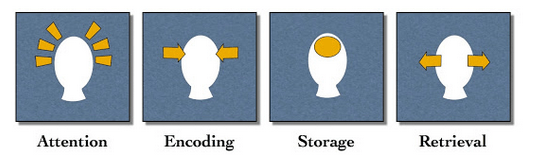
Consumer memory

Memory is the process of storing and retrieving knowledge.

  • Encoding is what happens when information is interpreted and placed in memory.
  • Storage is the retaining of information in memory.
  • Retrieval is what you do when you locate a stored memory.

Memory Systems

There are three distinct memory systems:

Sensory memory

The briefest memories are formed from sensory stimuli. If the individual finds the sensory experience significant enough to warrant further investigation, it may pass into short-term memory.

Short-term memory

We process selected bits of information and store it for a limited time. We store this information by combining small pieces into larger ones in a process called chunking.

Long-term memory

This is the permanent storage of information, which can be recalled at will. This occurs when we consider the meaning of a stimulus and relate it to other information already in memory.

Marketers attempt to engage our existing memories and experiences in order to get their brand message into our long-term memory. They also make use of repetition and redundancy in advertising in order to present us with many opportunities to commit them to long-term memory.

Types of Behavioral Learning

There are three types of behavioral learning:

  1. Classical Conditioning
  2. Operant Conditioning
  3. Observational Learning

About the Three Types of Behavioral Learning

Both classical and operant conditioning are forms of associative learning; meaning associations are made between events that occur together. Observational learning is learning by observing others. Although rooted in behaviorism, the observational learning theory is considered to be a bridge between behaviorism and cognitive learning theories.

Classical Conditioning: Learning through association  

Operant Conditioning: Learning through consequences

Observational Learning: Learning through observation

Behaviorism

Behaviorism is the school of thought that seeks to measure only observable behaviors. Hence, it only examines outward behavior when trying to understand if learning occurred.

Behaviorism stems from the work of John Watson, B.F. Skinner, and Ivan Pavlov. These Behaviorism theorists believe that knowledge exists independently and outside of people. They view the learner as a blank slate who must be provided the experience. Behaviorists believe that learning actually occurs when new behaviors or changes in behaviors are acquired through associations between stimuli and responses. Thus, association leads to a change in behavior.

There are two core theories that stem from Behaviorism;

Classical Conditioning – Ivan Pavlov

Operant Conditioning – B.F. Skinner

As indicted above, observational learning is a bridge between behaviorism and cognitive learning.

The Three Types of Behavioral Learning

Classical Conditioning

Classical conditioning is a learning process in which an association is made between two stimuli. With classical conditioning, two stimuli are linked together to produce a new learned response. One stimulus is a neutral and the other evokes a natural response. After learning the association, the neutral stimulus elicits the conditioned response.

The theory of classical conditioning was introduced by Russian physiologist, Ivan Pavlov. Pavlov conducted his classic experiment involving dogs. In his experiment, he conditioned the dogs to associate the sound of a bell with the presence of food. He paired the smell of food which was the naturally occurring stimulus with the neutral stimulus of a ringing bell. Once an association had been made between the two, the sound of the bell alone could elicit a response. The dogs responded to the sound of the bell by salivating.

In his experiment, the bell was neutral stimulus since the bell itself did not produce the dogs’ salivation. However, by pairing the bell with the stimulus of the smell of the food, which did produce the salivation response, eventually, the bell by itself was able to trigger the salivation response. Thus, the “conditioning” was achieved when the sound of the bell on its own was able to make the dogs salivate in anticipation for the food.

Operant Conditioning

Operant conditioning is a learning process in which responses are controlled by consequences. The likelihood of a certain response occurring is either increased or decreased due to either a reinforcement or a punishment consequence. A reinforcement helps to increase a behavior, while a punishment helps to decrease a behavior.

The term operant conditioning was coined by a behaviorist B.F. Skinner. Skinner conducted experiments with rats using a device called the Skinner box. The box was a cage set up so the rats could automatically get a food reward if they stepped on a lever. The lever caused food to be released. From these experiments, Skinner observed how reinforcement could lead to increases in behaviors where punishment would result in decreases in behaviors.

Reinforcement

Reinforcement is a consequence that increases the likelihood a response will occur. If you are using reinforcement, you are trying to increase a behavior.

There are two types of reinforcement.

  • Positive reinforcement
  • Negative reinforcement

Positive means adding a stimulus, while negative means removing a stimulus. Thus, positive reinforcement is the addition of a good stimulus after a response in order to encourage the response to continue. An example of this would be giving someone praise after a desired behavior is displayed.

In contrast, negative reinforcement is the removal of an undesirable stimulus after a response so that the response will occur more often. An example of this would be fastening your seatbelt in a car so the beeping sound will stop. Since the undesirable stimulus is removed when you fasten your seatbelt, you are encourage to fasten your seatbelt.

Negative reinforcement is often confused with punishment because of its name. However, negative reinforcement involves removing a negative consequence to increase a behavior, while punishment seeks to decrease a behavior.

Punishment

Punishment is a consequence that decreases the likelihood a response will occur. If you are using punishment, you are trying to decrease a behavior.

There are two types of punishment:

  • Positive punishment
  • Negative punishment

Positive punishment is the addition of an undesirable stimulus after a response so that the response will occur less or stop. An example would be to give someone extra work for misbehaving.

Negative punishment is the removal of a pleasing stimulus after a response so that the response will occur less or stop. An example would be taking away television or video games from a child for misbehaving so he or she will stop misbehaving.

Observational Learning

Observational learning or modeling is a process in which learning occurs through observing the behaviors of others and then imitating those behaviors. Observational learning allows for learning without any direct change to behavior. This is why it is not considered strict behaviorism. It is more of a link between behaviorism and cognitive learning.

Observational learning is associated with the work of Albert Bandura and his social learning theory. The social learning theory suggests that learning occurs through observation and interaction with other people.

Bandura first demonstrated observational learning in his famous “Bobo-doll” experiment. In this experiment, children imitated the actions of adults.   After seeing adults hit a doll, children would assault the Bobo-doll. The experiment showed that children learned the aggressive behavior by observing it.

Product Personality

Consumers tend to assign various descriptive “personality like” traits or characteristics to different brands in a wide variety of product categories. This is one of the most effective use of the concept of personality in marketing applications. Consumers have consistent patterns that guide their decisions to all brands or consumption situations.

Brand Personality is a portion of the brand’s overall image, understood perhaps by many consumers but more attractive to some consumers than to others. We can define brand personality as the communication goals related to the attributes inherent in a product as well as the profile of the perceptions received by consumers about specific brands.

Brands basically have three dimensions:

(1) Physical attributes: Such as color, price, ingredients, and so forth.

(2) Functional attributes: This means how the brand is functioning or we can say the consequences of using a brand.

(3) Brands characterization: This means brands personality as perceived by consumers. Brands may be characterized as modern or old–fashioned, or lively or exotic, just the same way as people are characterized.

The brand or product personalities can further be understood by focusing on the emotional responses that are evoked among consumers. This means consumers buy products but want more than the functional or tangible attributes provided by the product. Along with functional attributes they want good experience, good emotional response from using the product. These are also called as “hedonic” benefits.

Consumers not only ascribe personality traits to products or services; they also tend to associate personality factors with specific colors. For example, yellow is associated with “novelty” and black means “sophistication. Therefore, brands wishing to create a sophisticated personal or a premium image use labelling or packaging that is primarily black.

In some cases, various products or even brands are associated with a specific color with personality like connotations. For instance, Coco- cola is associated with red, which connotes excitement. Mc Donalds logo is of yellow and red.

Personal Values i.e. Self Concept or Self Images:

Why do some people make their consumption decisions differently than others? Personality can be one reason and another can be personal values. Personal values answer the question, “Is this product for me”? These are particularly important in the need-recognition stage of consumer decision making. Values are also used by consumers while evaluating brands as “Is this brand for me?

Values are basically “ends” people seek in their lives. Marketing often provides the “means” to reach these ends. Rokeach has defined values as an enduring belief that a specific mode of conduct or end-state of existence is personally or socially preferable to an opposite or converse mode of conduct or end state of existence. Values are relatively stable but not completely static beliefs about what a person should do. Values are concerned with the goals and the ways of behaving to obtain goals.

Self Concept theory says that individuals have a concept of self based on who they are that means actual self. And also the concept of who they think they would like to be that is the ideal self. Consumers are asked to describe how they see themselves or how they would like to see themselves on attributes like:

  • Happy
  • Serious
  • Dependable
  • Practical
  • Sensitive
  • Aggressive
  • Energetic

Self-controlled

Self-Concept means the desire to attain self–consistency and the desire to enhance one’s self–esteem. Attaining self-consistency means that individuals will act in accordance with their concept of actual self. According to the marketer actual self means consumers purchases are influenced by the image they have of themselves.

They buy products which they perceive as similar to their self- concept. For example: beer, cigarettes, soap, toothpaste, car, clothes etc. all are purchased keeping in mind his/her self-concept. Ideal self s concept is related to one’s self – esteem.

According to the marketer, a person who is dissatisfied with oneself will try and purchase products that could enhance their self esteem. For example, a woman who would like to be confident, efficient, modern may buy a different type of perfume or shop at different stores than a woman who would like to be more warm and attractive.

It is not always like this that our self image influences the products we choose but also the products we choose frequently influences our self–image. The products purchased with symbolic (badge) value say something about us and also what we feel about ourselves. Extended self in simple terms means, we are what we wear, and we are what we use, this is also known as symbolic interactionism.

This means it emphasizes the interaction between individuals and the symbols in their environment. This shows that consumers buy products for their symbolic value in enhancing their self concept. For example, products like Rolex watches. Omega watches, Sony CD system, Nike, Reebok shoes, BMW, Hyundai Accent etc., all have symbolic value.

Advertises have understood the symbolic role of products in influencing self-image, therefore, they are using this concept successfully in their ads. Life style Concept.

Consumer Needs

Needs, Goals and Motives:

Motivation can also be described as the driving force within individuals that impels them to action. This driving force is the result of tension, which in turn is because of unfulfilled needs. To reduce tension, every individual strives for fulfilling their needs. This basi­cally, depends on each individual how they fulfill their needs i.e. individual thinking and learning (experiences). Therefore, marketers try to influence the consumer’s cognitive processes.

Needs:

Every individual has needs, they are innate and acquired. Innate needs are also called physiological needs or primary needs which include food, water, air, shelter or sex, etc. Acquired needs are those needs that we learn from our surroundings / environment or culture. These may include need for power, for affection, for prestige, etc. These are psychological in nature; therefore they are also called as secondary needs.

Goals:

Goals are the end result of motivated behaviour.

From marketer point of view, there are four types of goals:

(a) Generic goals

General classes of goals that consumers select to fulfill their needs. For example, need for washing hands.

(b) Product specific goals

For washing hands what kind of product is used. For example, use soap, liquids etc.

(c) Brand specific goals

For example, which soap: Lux, Pears etc., to be purchased.

(d) Store specific goals

From where that product must be purchased.

Goal Selection

The goals selected by individuals depend on their personal experiences, physi­cal capacity, goal’s accessibility in the physical and social environment and above all the individual’s cultural norms and values. For example, if a person has a strong hunger need, his/her goal will depend on what is available at that moment, in which country he is i.e., if in India cannot eat steak, as it is against his values and beliefs. He will have to select a substitute goal which is more appropriate to the social environment.

An individual’s own perception of his/her also influence the selection of the goal. The products a person owns, would like to own, or would not like to own are often perceived in terms of how closely they are congruent with the person’s self image. It is seen that usually that product is selected by an individual which has a greater possibility of being selected than one that is not.

Needs and goals are interdependent, existence of one is impossible without the other. For example, sometimes people join a club but is not consciously aware of his social needs, a woman may not be aware of her achievement needs but may strive to have the most successful boutique in town. One reason for this can be that individuals are more aware of their physiological needs than they are of their psychological needs.

Motives

Consumer researchers have given two types of motives-rational motives and irrational (emotional) motives. They say, that consumers behave rationally when they consider all alternatives and choose those that give them the greatest utility. This is also known as economic man theory.

Marketers meaning of rationality is when consumers select goals based on totally objective criteria such as size, weight or price, etc. Emotional motives imply the selection of goals according to personal or subjective criteria. For example, desire for status, individuality, fear of owning the product (from society), pride, affection, etc.

It is assumed that consumers always attempt to select alternatives that in their view, serve to maximize satisfaction. The measurement of satisfaction is a very personal process, based on the individual’s own needs structure as well as on past behavioural and social experiences.

It is seen that what may appear irrational to others may be perfectly rational in consumer’s opinion. For example, if an individual purchases a product to enhance self-image and considers this to be a rational decision and if behaviour does not appear rational to the person at the time of purchasing then he would have not purchased. Therefore, it is very difficult to distinguish between rational and emotional consumption motives.

Can Needs be Created?

This is a very ancient question about marketing and motivational research can help us provide an answer to it. Like the products ‘Hit’ spray for cockroaches and ‘Hit’ for mosquitoes. The consumers decided for themselves that the psychological satisfaction obtained from using the cockroach spray was more important to them than the need for a cleaner and more efficient product.

People say that needs are created for them by the marketer through subliminal method. To some extent one can influence the consumer through subliminal percep­tion; the effects are probably not very great or very specific. So, there is no evidence whatsoever that anyone can create a need in a consumer. Marketers and advertisers can only try to stimulate an existing need or can channel consumers need in a certain direction towards one product or brand rather than another, but the results are unpredictable.

Freudian, Non-Freudian Theory

The Psychoanalytic Theory of Freud

Sigmund Freud, the father of psychology, became famous with his psychoanalytic theory of personality. In fact, the theory is regarded as the cornerstone of modern psychology. Sigmund based his theory on certain assumptions which is as follows:

Unconscious needs or drives lie at the heart of human motivation and personality.

The socialization process that takes place within people in a social set up has a huge impact on individual behavior. Freud explained much of how the psyche or the mind operates, and proposed that, human psyche is composed of parts within our awareness and beyond our awareness.

He said that all behavior within an individual cannot be explained, much lies in the subconscious.

  • Id: According to Freud’s psychoanalytic theory of personality, the id operates based on the pleasure principle, which stresses on immediate fulfillment of needs. The id is the personality component made up of unconscious psychic energy which satisfies basic urges, needs, and desires.
  • Ego: Ego is that state of awareness which thinks of you as separate from the other. It always thinks of the glories of the past and hopes of the future and focuses on guiltiness. It always thinks of what was and what could be.
  • Super Ego: The superego provides guidelines for making judgments. It is the aspect of personality that holds all our moral standards and ideals that we acquire from both parents and society.

Neo-Freudian Theory

There were a group of psychologists who believed that social interaction and resultant relationships formed the basis for the growth and development of personality. Here, they disagreed with their contemporary, Freud, who believed that personality was:

  • Biological and rooted in genetics, and
  • Was groomed as a result of early childhood experiences. This group of researchers who laid emphasis on the process of socialization came to be known as the Neo. To form a personality, social relationships are very important.

Based on this, consumers are classified into three personality types:

  • Complaint Personalities: They prefer love and affection and so they move towards them and so they prefer known brands.
  • Aggressive Personalities: They tend to move against others and they show off their need for power, success etc which is quite manipulative.
  • Detached Personalities: They are not much aware of brands and are more self-reliant and independent.

Marketers also tend to use Neo-Freudian theories while segmenting markets and positioning their products.

Nature of Consumer Attitudes

Consumer attitude may be defined as a feeling of favourableness or unfavourableness that an individual has towards an object. As we, all know that an individual with a positive attitude is more likely to buy a product and this results in the possibility of liking or disliking a product.

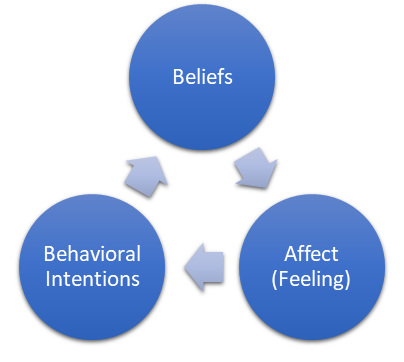
Consumer attitude basically comprises of beliefs towards, feelings towards and behavioral intentions towards some objects.

Belief plays a vital role for consumers because, it can be either positive or negative towards an object. For example, some may say tea is good and relieves tension, others may say too much of tea is not good for health. Human beliefs are not accurate and can change according to situations.

Consumers have certain specific feelings towards some products or brands. Sometimes these feelings are based on certain beliefs and sometimes they are not. For example, an individual feels uneasy when he thinks about cheese burst pizza, because of the tremendous amount of cheese or fat it has.

Behavioural intentions show the plans of consumers with respect to the products. This is sometimes a logical result of beliefs or feelings, but not always. For example, an individual personally might not like a restaurant, but may visit it because it is the hangout place for his friends.

Functions of Attitudes

The following are the functions of attitudes

  • Adjustment Function: Attitudes helps people to adjust to different situations and circumstances.
  • Ego Defensive Function: Attitudes are formed to protect the ego. We all are bothered about our self-esteem and image so the product boosting our ego is the target of such a kind of attitude.
  • Value Expression Function: Attitudes usually represent the values the individual possesses. We gain values, though our upbringing and training. Our value system encourages or discourages us to buy certain products. For example, our value system allows or disallows us to purchase products such as cigarettes, alcohol, drugs, etc.
  • Knowledge Function: Individuals’ continuously seeks knowledge and information. When an individual gets information about a particular product, he creates and modifies his attitude towards that product.

Models of Attitude

The following are the models of attitude

  • Tri-component Model: According to tri-component model, attitude consists of the following three components.
  • Cognitive Component: The first component is cognitive component. It consists of an individual’s knowledge or perception towards few products or services through personal experience or related information from various sources. This knowledge, usually results in beliefs, which a consumer has, and specific behavior.
  • Affective Component: The second part is the affective component. This consists of a person’s feelings, sentiments, and emotions for a particular brand or product. They treat them as the primary criteria for the purpose of evaluation. The state of mind also plays a major role, like the sadness, happiness, anger, or stress, which also affects the attitude of a consumer.
  • Conative Component: The last component is conative component, which consists of a person’s intention or likelihood towards a particular product. It usually means the actual behavior of the person or his intention.

Properties of Attitudes:

Attitudes can vary along a number of dimensions or properties. They are:

(i) Favourability:

A person may like Coke or Pepsi and dislike others like Fanta, Mirinda, Canada Dry etc.

(ii) Intensity:

This means, the strength of liking or disliking. For example, consumer may be liking two brands at a time but he/she may be more positive towards one.

(iii) Confidence:

This means, attitude is the confidence with which they are held. Intercity and confidence differ slightly. For example, a person may be equally confident that he/she really likes Pepsi but may be slightly favourable toward Coke.

It is important for a marketer to study the degree of confidence associated with an attitude because:

(a) It can affect the strength of the relationship between attitudes and behaviour.

(b) It can affect an attitudes susceptibility to change. That means, more strongly held attitude is more resistant to change.

(iv) Stability:

Some attitudes are stable over an extended period of time, others will change. This dynamic nature of attitudes is largely responsible for the changes in consumers lifestyles. For exam­ple, people attitude towards fashion is changing. Also they are changing in health attitudes this means, it is a great news for fitness clubs, sporting equipment and clothing companies.

Attitude can vary in terms of whether it is based on the perceived utilitarian Vs. hedonic properties of the attitude object. For example, consumers attitude towards toothpaste will be more in knowing their functional benefits. For other products/services like amusement parks, movies, ballets, music etc. are valued for their ability to influence consumers emotions. These properties help in developing effective advertising appeals.

How Attitude is Developed?

To understand the role of attitudes in consumer behaviour, we must understand how they develop and what are the functions they perform. The attitudes that consumers hold are, a result of their prior experiences. Attitudes develop over time through a learning process and are affected and also formed by family influences, peer group influences, personality, experience and information (from environment). Environmental factors have a strong influence on attitudes formation by shaping the type, amount, and quality of information and experience available to consumers.

Family Influences:

Family is an important influence on purchase decisions. Bennet and Kassarjian say, “Attitudes toward personal hygiene, preferences for food items etc. are acquired from parents.”

Peer Group Influences:

Researches say that peer groups are much more likely than advertising to influence attitudes and purchasing behaviour.

Personality:

Personality also affects consumer’s attitudes. Traits such as aggression, extrover­sion, submissiveness or authoritarianism may influence attitudes toward brands and products.

Information and experience:

According to learning theory, consumer’s past experiences influ­ence their brand attitude and condition their future behaviour. It is seen that band loyalty will quickly end if the brand does not perform well. Therefore, information and experience also determines attitude.

Role of Direct or Indirect Experience:

Attitudes are formed as a result of direct contact with the object. Products that fails to perform as expected can easily lead to negative attitudes. Sometimes, even in absence of actual experience with an object one can form attitude. For example, many consum­ers have never driven Mercedes – Benz or vacationed in Switzerland but then also form positive attitude for this. Similarly, the consumers can form an attitude by just seeing the ad that means, they can form the product attitudes.

Attitudes based on direct experience are held with more confidence. This means consumers form stronger convictions about the product if had an actual direct experience with it.

These processes that govern attitude formation are very important in order to develop strategies and activities that will create, reinforce, or modify consumer attitudes.

Functions of Attitude:

Daniel Katz has proposed four functions of attitudes that explains how they serve the individu­als.

(a) Utilitarian Function:

This helps the consumers in achieving desired benefits. For example, in small car segments, marketers usually reflects the utilitarian function of attitudes in the ad. likeby featuring performance characteristics, mileage etc. Similarly, in the ad. of toothbrushes, they reflect utility of cleaning the teeth and giving them whiter look etc.

(b) Value – Expressive Function:

Attitudes can express consumers self – images and value systems. This specially holds true for high involvement products that is, costly products. Advertisers usually try to appeal to the value – expressive nature of attitudes by implying that use or purchase of a certain item will lead to self-enhancement. In this way, they appeal to large segment who value these self expressive traits.

The self – image of an individual purchasing a motorbike, for example, may be of strong, domineering and hard – driving person who likes to gain the upper hand. Like for Kinetic Honda & Kawasaki Bajaj two different types of self images are attached. In the former, the person with strong built up will be best suited and in the later, the person with not so good physique.

Another example can be Revlon Cologne ad. that suggests user is a confident, self-award, warm individual.

(c) Ego – Defensive Function:

Attitudes protect the ego from anxieties and threats. Consumers purchase many products, like mouthwashes to avoid bad breath or dandruff shampoo etc. these are basically anxiety – producing situations. This means consumers develop positive attitudes towards brands associated with social acceptance, confidence etc. For example. Head & Shoulders avoid embarrassment of flaking from dry scalp.

(d) Knowledge Function:

Consumers are exposed to the environment full of information. Consumers sort all of the messages, ignoring the less – relevant information. They have confusion and uncertainty while purchasing any product (Specially high involvement) but this function reduces all the uncertainties. Advertisements provide the valuable information about new brands or new charac­teristics of existing brands.

From the above functions, we have learnt that they affect the individual’s overall evaluation of an object. For example, two individuals having equally favourable attitudes toward mouthwash will vary in the nature of these attitudes. This will depend on whether they purchase because of utilitarian function (i.e. for freshness) or an ego – defensive function (i,e., to avoid bad breath). So both the individuals should be approached in the similar manner.

Models of Attitudes:

Psychologists have constructed these models to understand the relationship between attitudes and behaviour, and to capture the underlying dimensions of an attitude. There are three important attitude models: the tricomponent attitude model, multi – attribute models, the trying – to – consume model, and attitude – toward – the – ad models. Tricomponent attitude model, we have already explained in the beginning while explaining the nature of consumer attitudes.

Multi – Attribute Attitude Model:

Multi – attribute attitude model examines attitudes in terms of selected product attributes or beliefs. There are many variations of this model but Martin Fishbein and his associates has done great amount of research on it.

It is important for businesses to know whether consumers have favourable or unfavourable attitudes toward their products, it is also important to understand the reason for these attitudes. Traditionally, to understand this, the cognitive component of attitude is studied.

Now, more emphasis is aid upon the important beliefs a person holds about the attitude object. This is explained by Fishbein in the various models, we will study attitude toward – object model, the attitude – toward – behaviour model and the theory – of – reasoned – action model.

Attitude – toward – Object – Model:

Attitude – toward – object model helps in measuring attitudes toward a product category or specific brands – Model can be explained as the attitude toward a given object (product) is based on the summed set of beliefs about the object’s attributes weighted by the evaluation of these attributes.

Attitude – toward – Behaviour Model:

The focus of Fishbein’s attitude – toward – behaviour model is the individuals attitude toward behaving or acting with respect to an object rather than the attitude toward the object itself.

Theory of Reasoned – Action Model:

In this model, a comprehensive integration of attitude components are represented into a structure that is designed, so that, it is explained in a better manner and prediction of behaviour is also better. Here also three components are used as in tricomponent model like cognitive component, affective component and a conative component. But in this model, arrangement of these components are different.

If we examine critically, the best predictor of behaviour is the intention to act. Thus, if researchers are interested in predicting behaviour (i.e., the act of purchasing a particular service, product or brand), they would directly measure intention. If the researchers further are interested in knowing the underlying factors that lead a consumer to act in a particular situation, they will find two factors that is, consumer’s attitudes toward the behaviour and the subjective norm.

The consumer’s attitude toward the behaviour can be directly measured as affect. This means consumers overall favourability toward the purchase is measured. But to understand intention we also need to measure the subjective norm that can be measured directly by assessing a consumer’s feelings as to what others would think of the action being contemplated, (i.e., whether they are favourable or unfavourable).

For example, if a college going girl wants to purchase a dress for herself and then she thinks what her boyfriend or other friends would think of such behaviours (i.e., would appreciate or not). Such a reflection is considered as subjective norm. The factors underlying the subjective norms are the normative beliefs that the individual attributes to others, as well as the individual’s motivation to comply with each one who matters to him/her. So, we can say that the theory of reasoned action is a series of interrelated attitude components.

Now, the question arise why study attitudes, as in this model it is stated clearly that intention is linked to behaviour more strongly than attitude. Reason being that intention is unable to provide an adequate explanation of behaviour. Marketers sometimes are interested in knowing why consumers act as they do, for this more than a mechanical measure is required as to what consumers expect to do i.e.,g. their buying intentions).

Attitude-Toward-the-Ad Models:

In today’s scenario, where half of the business is fetched alone through advertising, the need for understanding the impact of advertising on consumer attitudes toward particular products or brands has increased. Advertisers have paid a considerable attention in developing attitude – toward – the – ad models.

The consumers form various judgments and feelings as and when exposed to an ad. These judgments and feelings in turn affect the consumer’s attitude toward the ad and beliefs about the brand acquired from exposure to the ad. Finally, consumer’s attitude toward the ad and beliefs about the brand for his/her attitude toward the brand.

This model says that to assess consumers attitudes toward an ad it is important to distinguish between cognitive evaluations of the ad (i.e., whether it is informative or humorous) and affective responses toward the ad (feelings like sense of fear, or smile or laughter etc.) and also measures them separately.

According to this model, researcher suggests that the feelings conveyed by an ad not only influences the attitude toward the ad but also affect the consumers evaluations of the brand and also the attitude towards the brand.

However, if the gap appears after exposure of an ad (around one weak) the positive effect of a liked ad on the attitude towards a brand may change. This usually happens when the purchase action is postponed or delayed by the consumer after an exposure of ad.

Researchers say that both negative and positive feelings toward ad tend to exist side by side where both affect attitude uniquely. So, in this wide variety of feelings (both positive and negative) are to be assessed to study the influence of ad exposure.

It is also seen and tested through research that the consumer’s attitude toward the ad for a novel product (new one) will have a stronger impact on brand attitude and purchase intention than for a familiar product. Researcher also found that beliefs about a brand that result from ad. exposure play a much stronger role in determining attitudes towards the brand for a familiar product. So, in this research nature of attitude – object is used in assessing the potential impact of advertising exposure.

It is observed that attitude toward a specific type of advertising (eg. comparative) may have some impact on the attitude toward a specific ad. (eg. liking or distiking it). But attitudes toward ads in general seem to have little impact on the attitude toward a specific ad.

Brand Personification/Personality

Brand personality is the way a brand speaks and behaves. It means assigning human personality traits/characteristics to a brand so as to achieve differentiation. These characteristics signify brand behaviour through both individuals representing the brand (i.e. it’s employees) as well as through advertising, packaging, etc. When brand image or brand identity is expressed in terms of human traits, it is called brand personality. For instance Allen Solley brand speaks the personality and makes the individual who wears it stand apart from the crowd. Infosys represents uniqueness, value, and intellectualism.

Brand personality is nothing but personification of brand. A brand is expressed either as a personality who embodies these personality traits (For instance Shahrukh Khan and Airtel, John Abraham and Castrol) or distinct personality traits (For instance Dove as honest, feminist and optimist; Hewlett Packard brand represents accomplishment, competency and influence). Brand personality is the result of all the consumer’s experiences with the brand. It is unique and long lasting.

Brand personality must be differentiated from brand image, in sense that, while brand image denote the tangible (physical and functional) benefits and attributes of a brand, brand personality indicates emotional associations of the brand. If brand image is comprehensive brand according to consumers’ opinion, brand personality is that aspect of comprehensive brand which generates it’s emotional character and associations in consumers’ mind.

Brand personality develops brand equity. It sets the brand attitude. It is a key input into the look and feel of any communication or marketing activity by the brand. It helps in gaining thorough knowledge of customers feelings about the brand. Brand personality differentiates among brands specifically when they are alike in many attributes. For instance; Sony versus Panasonic. Brand personality is used to make the brand strategy lively, i.e, to implement brand strategy. Brand personality indicates the kind of relationship a customer has with the brand. It is a means by which a customer communicates his own identity.

Brand personality and celebrity should supplement each other. Trustworthy celebrity ensures immediate awareness, acceptability and optimism towards the brand. This will influence consumers’ purchase decision and also create brand loyalty. For instance – Bollywood actress Priyanka Chopra is brand ambassador for J.Hampstead, international line of premium shirts.

Brand personality not only includes the personality features/characteristics, but also the demographic features like age, gender or class and psychographic features. Personality traits are what the brand exists for.

Character:

Excitement: Often targeted at youthful demographics, brands in the excitement dimension have traits like daring, energetic, imaginative, and cutting-edge.

Sincerity: Sincerity is a goal of every brand of course, but as a dimension of brand personality, sincerity is reserved for brands that are wholesome, honest, cheerful, and down-to-earth.

Competence: A competent brand is reliable, intelligent, and successful. Brands within this personality dimension are confident thought leaders and responsible stalwarts of trust.

Ruggedness: Rugged brand traits include adventurous, outdoorsy, and tough. These are brands that are built to last and seen to be hard-working, strong, muscular, and authentic.

Sophistication: Brands in the sophistication dimension are characterized by traits like refined, luxurious, and charming. These are premium brands aimed at a discerning, status-conscious audience.

Process:

Brand summary

This first step is where you identify the brand’s/business’ core values. For example, your core values may include: honesty, integrity, excellent communication and client satisfaction. Serious consideration should be given to these values, as they become the cornerstone for developing your Brand Promise (see below).

Brand audit

This is an internal and external evaluation process to determine how prospects, customers and employees perceive your brand.

Develop your brand architecture

This is an evaluation of your brand’s features, plus its functional and emotional benefits, resulting in a singular idea of what your brand ‘means’. Brand architecture also defines your ‘value proposition’. There are three core types of value that a company can deliver: operational efficiency (the lowest price), product leadership (the best product), or customer intimacy (the best solution & service). This step will determine which one your company is best equipped to deliver.

Create your brand personality traits

Next you will select the personality traits you wish your brand to display to the market. Brand personality traits are conveyed in everything you do and create, including how your employees interact with prospects and customers.

Develop a Brand Promise

This is a clear, engaging, unique, and relevant statement which is aligned with your core, brand values. A brand promise states that if clients use your services, they are assured certain things will occur.

Write your brand story

This is a short paragraph about what/who your company is, how it got to where it is today and its vision for the future. As no company has the same story, this forms part of your USP or point of difference. It has an underlying theme which conveys your brand values, tells clients why they should care and importantly makes them feel something. This can be used in many ways (as a mission statement, in your company profile brochure or in the ‘about us’ section of your website). It also forms a starting point for creating your positioning statements and other key elements of marketing material.

Create brand positioning statements

Part one of this step is creating a one or two sentence statement that explains what you do, for whom you do it and how you uniquely solve a need. It gives clients a compelling reason to do business with you and will be found on many elements of your marketing collateral. The second part of this step is developing a tagline. The best taglines tell a story (e.g. American Express: Don’t leave home without it) or are aspirational (Nike: Just Do It) and if possible, also emphasize the brand name (Red Bull: Red Bull Gives You Wings).

Select brand visual requirements

This is where you match colors, typestyles and logo characteristics to visually reinforce your brand. If you already have a logo, match recommendations to the existing artwork to determine effectiveness, or create recommendations to define a new corporate logo.

Define brand operational requirements

This step ties all previous work together, by defining how you will deliver your brand promise through its daily operations. It is during this step that procedures and processes are designed to ensure the company delivers what it promises it will. (For example, to implement brand visual requirements of the previous step, you might like to develop a style guide to ensure consistent visual branding).

error: Content is protected !!