Accumulated value of an Annuity

Annuities are investment contracts sold by financial institutions like insurance companies and banks (generally referred to as the annuity issuer). When you purchase an annuity, you invest your money in a lump sum or gradually during an “accumulation period.” At a specified time the issuer must start making regular cash payments to you for a specified period of time. The future value of an annuity is an analytical tool an annuity issuer uses to estimate the total cost of making the required cash payments to you.

Identification

When you purchase an annuity, the issuer invests your money to produce income. Annuity issuers make their money by keeping a part of the investment income, which is referred to as the discount rate. However, as each payment is made to you, the income the annuity issuer makes decreases. For the issuer, the total cost of making the annuity payments is the sum of the cash payments made to you plus the total reduction of income the issuer incurs as the payments are made. Issuers calculate the future value of annuities to help them decide how to schedule payments and how large their share (the discount rate) must be to cover expenses and make a profit.

Types

The formula for the future value of an annuity varies slightly depending on the type of annuity. Ordinary annuities are paid at the end of each time period. Annuities paid at the start of each period are called annuities due. Many annuities are paid yearly. However, some annuities make payments on a semiannual, quarterly or monthly schedule.

Formula

The basic equation for the future value of an annuity is for an ordinary annuity paid once each year. The formula is F = P * ([1 + I]^N – 1 )/I. P is the payment amount. I is equal to the interest (discount) rate. N is the number of payments (the “^” means N is an exponent). F is the future value of the annuity. For example, if the annuity pays $500 annually for 10 years and the discount rate is 6 percent, you have $500 * ([1 + 0.06]^10 – 1 )/0.06. The future value works out to $6,590.40. This means that, at the end of 10 years, the issuer’s total cost is equal to $6,590.40 ($5,000 in payments plus $1,590.40 in interest not earned).

Payment Periods

In order to use the formula for the future value of an annuity when the payment interval is less than one year, you must make two adjustments. First, divide the discount rate (I) by the number of payments per year to find the rate of interest paid each month. Use this monthly rate as your value for I. Second, multiply the number of annual payments (N) by the number of payments each year to find the total number of payments and use this value for N.

Annuity Due

Because payments for an annuity due are made at the beginning of the payment period, the future value of the annuity is increased by the interest earned for one time period. Start by calculating the future value using the equation for an ordinary annuity for the appropriate time period. Then multiply the result by 1 + I where I is equal to the discount rate for the period.

Basic Concepts, Simple and Compound Interest

Interest rates are very powerful and intriguing mathematical concepts. Our banking and finance sector revolves around these interest rates. One minor change in these rates could have tremendous and astonishing impacts over the economy.

Interest is the amount charged by the lender from the borrower on the principal loan sum. It is basically the cost of renting money. And, the rate at which interest is charged on the principal sum is known as the interest rate.

These concepts are categorized into type of interests

  • Simple Interest
  • Compound Interest

Simple Interest

Simple Interest because as the name suggests it is simple and comparatively easy to comprehend.

Simple interest is that type of interest which once credited does not earn interest on itself. It remains fixed over time.

The formula to calculate Simple Interest is

SI = {(P x R x T)/ 100}   

Where,

P = Principal Sum (the original loan/ deposited amount)

R = rate of interest (at which the loan is charged)

T = time period (the duration for which money is borrowed/ deposited)

So, if P amount is borrowed at the rate of interest R for T years then the amount to be repaid to the lender will be

A = P + SI

Compound Interest:

This the most usual type of interest that is used in the banking system and economics. In this kind of interest along with one principal further earns interest on it after the completion of 1-time period. Suppose an amount P is deposited in an account or lent to the borrower that pays compound interest at the rate of R% p.a. Then after n years the deposit or loan will accumulate to:

P ( 1 + R/100)n

Compound Interest when Compounded Half Yearly

Example 2:

Find the compound interest on Rs 8000 for 3/2 years at 10% per annum, interest is payable half-yearly.

Solution: Rate of interest = 10% per annum = 5% per half –year. Time = 3/2 years = 3 half-years

Original principal = Rs 8000.

Amount at the end of the first half-year = Rs 8000 +Rs 400 = Rs 8400

Principal for the second half-year = Rs 8400

Amount at the end of the second half year = Rs 8400 +Rs 420 = Rs 8820

Amount at the end of third half year = Rs 8820 + Rs 441= Rs 9261.

Therefore, compound interest= Rs 9261- Rs 8000 = Rs 1261.

Therefore,

Effective Rate of interest

The Effective Annual Rate (EAR) is the interest rate that is adjusted for compounding over a given period. Simply put, the effective annual interest rate is the rate of interest that an investor can earn (or pay) in a year after taking into consideration compounding.

The Effective Annual Interest Rate is also known as the effective interest rate, effective rate, or the annual equivalent rate. Compare it to the Annual Percentage Rate (APR) which is based on simple interest.

The EAR formula for Effective Annual Interest Rate:

Where:

i = stated annual interest rate

n = number of compounding periods

Importance of Effective Annual Rate

The Effective Annual Interest Rate is an important tool that allows the evaluation of the true return on an investment or true interest rate on a loan.

The stated annual interest rate and the effective interest rate can be significantly different, due to compounding. The effective interest rate is important in figuring out the best loan or determining which investment offers the highest rate of return.

In the case of compounding, the EAR is always higher than the stated annual interest rate.

Nominal Rate of interest

Nominal Interest rate refers to the interest rate without the adjustment of inflation. It is basically the rate “as stated”, “as advertised” and so on which does not take inflation, compounding effect of interest, tax or any fees in the account.

It is also known as Annualized Percent Rate. This is the interest compounded or calculated once in a year.

Mathematically, it can be calculated using the below formula is represented as below

Nominal interest rate formula = [(1 + Real interest rate) * (1 + Inflation rate)] – 1

  • Real Interest Rate is the interest rate that takes inflation, compounding effect and other charges into account.
  • Inflation is the most important factor that impacts the nominal interest rate. It increases with inflation and decreases with deflation.

Applications

It is widely used in banks to describe interest on various loans.

It is widely used in the investment field to suggest investors for various investment avenues present in the market.

For example, Car loan available at 10% of interest rate. This face an interest rate of 10% is the nominal rate. It does not take fees or other charges in an account.

Bond available at 8% is a coupon rate as it does not consider current inflation. This face interest of 8% is the nominal rate.

Force of interest

Force of interest refers to a nominal interest rate or a discount rate compounded infinite number of times (or continuously) per time period.

Consider a nominal interest rate(or even a discount rate) compounded half-yearly and another rate compounded quarterly, another rate compounded monthly, compounded weekly, compounded daily, compounded every second and so on until you can imagine an interest rate that is compounded every smallest fraction of a second(continuously). This interest rate compounded continuously is the force of interest.

If i^p  is the interest rate compounded p times a year, then the limit of i^(p)  as p tends to infinity, would be the force of interest.

Mathematically:

Relationship between Effective and Nominal rate of interest

Whether effective and nominal rates can ever be the same depends on whether interest calculations involve simple or compound interest. While in a simple interest calculation effective and nominal rates can be the same, effective and nominal rates will never be the same in a compound interest calculation. Although short-term notes generally use simple interest, the majority of interest is calculated using compound interest. To a small-business owner, this means that except when taking out a short-term note, such as loan to fund working capital, effective and nominal rates can be the same for most every other credit purchase or cash investment.

Nominal Vs. Effective Rate

Nominal rates are quoted, published or stated rates for loans, credit cards, savings accounts or other short-term investments. Effective rates are what borrowers or investors actually pay or receive, depending on whether or how frequently interest is compounded. When interest is calculated and added only once, such as in a simple interest calculation, the nominal rate and effective interest rates are equal. With compounding, a calculation in which interest is charged on the loan or investment principal plus any accrued interest up to the point at which interest is being calculated, however, the difference between nominal and effective increases exponentially according to the number of compounding periods. Compounding can take place daily, monthly, quarterly or semi-annually, depending on the account and financial institution regulations.

Simple Interest

The formula for calculating simple interest is “P x I x T” or principle multiplied by the interest rate per period multiplied by the time the money is being borrowed or invested. This formula illustrates that because interest is always being calculated on the principal amount, regardless of the time period involved, the nominal and effective rates will always be equal . If a small-business owner takes out a $5,000 simple interest loan at a nominal rate of 10 percent, $500 of interest will be added to the loan will each year, regardless of the number of years. To illustrate, just as $5,000 x 0.10 x 1 equals $500, $5,000 x 0.10 x 5 equals $2,500 or $500 per year. The nominal and effective rates of 10 percent in both calculations are equal.

Compound Interest

The formula for calculating compound interest shows how nominal and effective rates will never be equal. The formula is “P x (1 + i)n – P” where “n” is the number of compounding periods. In a compound interest calculation, the only time interest is charged or added to the principal is in the first compounding period. The base for each subsequent compounding period is the principal plus any accrued interest. If a small-business owner takes out a one-year $5,000 compound-interest loan at a nominal interest rate of 10 percent, where interest is compounded monthly, total interest that accumulates over the year is $5,000 x (1 + .10)5 – $5,000 or $550. The nominal rate of 10 percent and the effective rate of 11 percent clearly aren’t the same.

Effect On Small Business Owners

It’s crucial that whether the intent is to borrow or invest, small-business owners pay close attention to effective and nominal rates as well as the number of compounding periods. Compounding interest not only creates distance between nominal and effective rates but also works in favor of lenders. For example, a bank, credit card company or auto dealership might advertise a low nominal rate, but compound interest monthly. This in effect significantly increases the total amount owed. This is one reason why lenders advertise or quote nominal rather than effective rates in lending situations.

Present Value and Discount rate

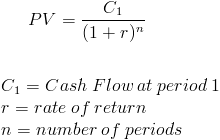
Present value, also known as discounted value, is a financial calculation that measures the worth of a future amount of money or stream of payments in today’s dollars adjusted for interest and inflation. In other words, it compares the buying power of one future dollar to purchasing power of one today

It’s an indication of whether the money an investor receives today can earn a return in the future. PV is widely used in finance in the stock valuation, bond pricing, and financial modeling.

Investors calculate the present value of a firm’s expected cash flows to decide if the stock is worth investing in today. The firm’s expected cash flows are discounted at a discount rate that is actually the expected return. The discount rate is inversely correlated to the future cash flows. The higher the discount rate, the lower the present value of the expected cash flows.

Use of Present Value Formula

The Present Value formula has a broad range of uses and may be applied to various areas of finance including corporate finance, banking finance, and investment finance. Apart from the various areas of finance that present value analysis is used, the formula is also used as a component of other financial formulas.

Effective and Nominal Rate of discount

The effective annual interest rate is the interest rate that is actually earned or paid on an investment, loan or other financial product due to the result of compounding over a given time period. It is also called the effective interest rate, the effective rate or the annual equivalent rate.


Nominal Rate of discount

Nominal interest rate refers to the interest rate before taking inflation into account. Nominal can also refer to the advertised or stated interest rate on a loan, without taking into account any fees or compounding of interest.

Nominal interest rates exist in contrast to real interest rates and effective interest rates. Real interest rates tend to be important to investors and lenders, while effective rates are significant for borrowers as well as investors and lenders.

Unlike the nominal rate, the real interest rate takes the inflation rate into account. The equation that links nominal and real interest rates can be approximated as nominal rate = real interest rate + inflation rate, or nominal rate – inflation rate = real rate.

To avoid purchasing power erosion through inflation, investors consider the real interest rate, rather than the nominal rate. One way to estimate the real rate of return in the United States is to observe the interest rates on Treasury Inflation-Protected Securities (TIPS). The difference between the yield on a Treasury bond and the yield on TIPS of the same maturity provides an estimate of inflation expectations in the economy.

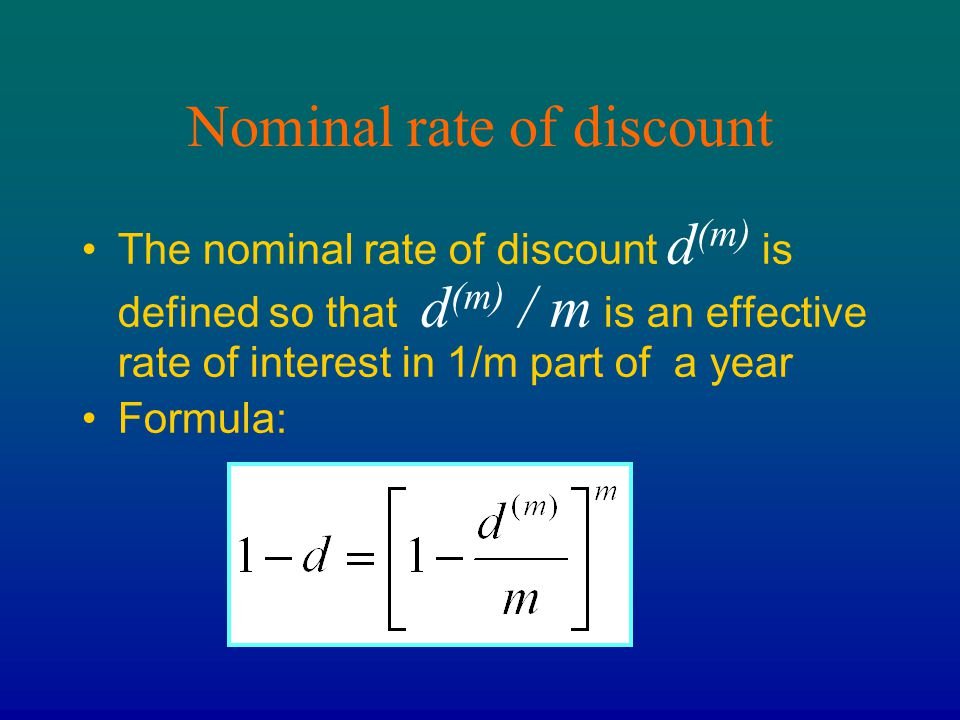
The nominal rate of discount d(m) is defined so that d(m) / m is an effective rate of interest in 1/m part of a year. Formula:

Relationship between Interest and Discount

The rate charged by the Reserve Bank from the commercial banks and the depository institutions for the overnight loans given to them. The discount rate is fixed by the Federal Reserve Bank and not by the rate of interest in the market.

Also, the discount rate is considered as a rate of interest which is used in the calculation of the present value of the future cash inflows or outflows. The concept of time value of money uses the discount rate to determine the value of certain future cash flows today. Therefore, it is considered important from the investor’s point of view to have a discount rate for the comparison of the value of cash inflows in the future from the cash outflows done to take the given investment.

Interest Rate

If a person called as the lender lends money or some other asset to another person called as the borrower, then the former charges some percentage as interest on the amount given to the later. That percentage is called the interest rate. In financial terms, the rate charged on the principal amount by the bank, financial institutions or other lenders for lending their money to the borrowers is known as the interest rate. It is basically the borrowing cost of using others fund or conversely the amount earned from the lending of funds.

There are two types of interest rate:

  • Simple Interest: In Simple Interest, the interest for every year is charged on the original loan amount only.
  • Compound Interest: In Compound Interest, the interest rate remains same but the sum on which the interest is charged keeps on changing as the interest amount each year is added to the principal amount or the previous year amount for the calculation of interest for the coming year.

Features of Indian Social System

Social structure denotes the network of social relationship. The social relationship is created among the individuals when they interact with each other according to their statuses in accordance with the patterns of society. In a social structure, individuals having common object organize themselves into associations.

Social structure is an abstract phenomenon. It denotes external aspects of society. Each society has a pattern of organization, which has structures that result from association of individuals with one another. It may be a group, institution, an association, community, or an organization all of which are parts of social structure through which it functions.

Features of Indian Social System

The following are the important features of social structure of Indian society:

  1. Complex Society

Indian society is characterized as a pluralistic society because it possesses complex social order. It suffers from multitude of ethnic, linguistic, religious and caste divisions.

  1. Rural Society

About 70% of the Indian people live in villages. Indian villages continue to be underdeveloped. Even rural areas suffer from lack of infrastructural facilities. The gains of industrialization and technological breakthrough which once enjoyed by urban areas not yet reached the rural areas. Only now our Government has started giving due importance to the objective of rural development.

  1. Economically Backward Country

India has made considerable progress in the fields of agriculture and industrialization. But still it continues to be an economically backward country. Even now it remains 64th poorest nation in the world. Major part of our population continues to live below the poverty line.

  1. illiteracy

Illiteracy and ignorance among the people of India is another important feature of the social system in India. About 60% of the population continues to be illiterate in India. Illiteracy creates many social problems. Concerted Governmental action and strong social support are needed in removing the rate of illiteracy.

  1. Diversified Languages

Diversity in languages is another feature of the social environment in India. The Constitution of India recognizes 22 languages as the major languages, which are spoken by 87% of the population. Of them Hindi is spoken by 31% of the population. Linguistic diversity and love and affection of people towards their regional languages have made the Government to reorganize Indian states on the basis of languages. Hence, language has emerged as a key factor of social and political climate in India.

  1. Racial Diversity

As already stated, people belong to different races such as Aryan, Dravidian, and Mongolian. inhabit India. People in the Eastern States, have affinity with Mongolian race. Hence the racial Inter-mixing has taken place to a limited extent in India.

Even though the principle of unity in diversity is accepted diversities are many times allowed to dominate the objective of unity. The Constitution provides for secularism. But racial factor plays major role in real operation of socio-political processes in India.

  1. Caste

Caste has been the predominant feature of Indian social system. The Constitution, has taken a great step towards the dilution of caste and casteism. Caste and Casteism have been playing important factor in Social, Economic, Cultural and Political life in India. As caste system has deep historical roots, it cannot be abolished.

  1. Existence of Communalism

The existence of communalism in the society is another feature of Indian social system. It constitutes a big danger to the unity and integrity of the nation.

  1. Regionalism

People belonging to a particular region consider those who belong to other regions as outsiders. Diversities in Caste, religion, language and culture have contributed to forces of regionalism. Channelizing “Regionalism” and make it to contribute to nationalism is one of the difficult tasks before the Indian socio-political system.

  1. Tradition

In India, both tradition and modernity exist side by side. Tradition is clearly affected by modern trends and pressures.

  1. Lack of Free Movement

There is increased gap between the elites and the masses. There is no free movement among different linguistic groups, castes etc. This problem is clearly reflected between high and low castes, literates and illiterates, urbanites and ruralites etc.

Thus the social structure of Indian society is characterized by religious, regional, linguistic, communal and caste diversities. All these factors determine the environment of Indian social structure, social system and political system. All institutions are in a position to continuously adjusting themselves to a changing society, though there still exists many conflicts between them. The Socio-political system is maintained stable despite these constraints.

error: Content is protected !!