Determinants of interest rate risk

The inverse relationship between the interest rate and bond prices can be explained by opportunity risk. By purchasing bonds, an investor assumes that if the interest rate increases, he or she will give up the opportunity of purchasing the bonds with more attractive returns. Whenever the interest rate increases, the demand for existing bonds with lower returns declines as new investment opportunities arise (e.g., new bonds with higher return rates are issued).

Although the prices of all bonds are affected by interest rate fluctuations, the magnitude of the change varies among bonds. Different bonds show different price sensitivities to interest rate fluctuations. Thus, it is imperative to evaluate a bond’s duration while assessing the interest rate risk.

Generally, bonds with a shorter time to maturity carry a smaller interest rate risk compared to bonds with longer maturities. Long-term bonds imply a higher probability of interest rate changes. Therefore, they carry a higher interest rate risk.

How to Mitigate Interest Rate Risk?

Similar to other types of risks, the interest rate risk can be mitigated. The most common tools for interest rate mitigation include:

  1. Diversification

If a bondholder is afraid of interest rate risk that can negatively affect the value of his portfolio, he can diversify his existing portfolio by adding securities whose value is less prone to the interest rate fluctuations (e.g., equity). If the investor has a “bonds only” portfolio, he can diversify the portfolio by including a mix of short-term and long-term bonds.

  1. Hedging

The interest rate risk can also be mitigated through various hedging strategies. These strategies generally include the purchase of different types of derivatives. The most common examples include interest rate swaps, options, futures, and forward rate agreements (FRAs).

Types of Interest Rate Risks

There are quite a few types of interest rate risks, which must be noted by every investor, be it an individual or a firm. These are explained below in detail.

  • Price risk

The risk of change in the price of an investment bond or certificate is known as its price risk. This leads to unforeseen loss or gains while selling security in the future.

  • Reinvestment risk

The risk of change in their interest rate might lead to the selling of the securities. In turn, this can lead to a loss of opportunity to re-invest in the current interest rate. Known as reinvestment risk, these types of interest rate risk can be further divided into 2 categories.

Name Definition
Duration risk Risk due to the probability of unwillingness to extend an investment beyond its maturity period.
Basis risk Risk of being subjected to a negative downturn in the market.

Factors Impacting Interest Rate Risks of a Firm

There are many factors, which directly impact the interest rate risk associated with a company. These factors are discussed below in detail.

  • Credit risk associated with a company: A company’s debt to equity ratio is one of the primary determinants of credit risk. A rise in interest rates leads to more expense for a company since they have to pay more interest to its investors. As a result, the credit risk of an institution increases.
  • Length of loan terms: Length of loan terms, both as a borrower as well as a lender, are major determinants of the interest rate risks of an institution. Companies and ventures charging a fixed interest on its receivable accounts might have baselines dropping down if they need to refinance themselves. This, in turn, increases the risk involved with the shift in interest rates.
  • Market fluctuation: Market fluctuation and inflation can immensely impact the risk related to interest rates since refinancing, or other such necessities can become more difficult during such times. Such circumstances often lead to a situation where outgoing cash flow crosses the incoming cash flow, making it more difficult for the institution to function.
  • Foreign exchange rates: Any company which has a foreign debt is also affected by a change in foreign exchange rates. The associated interest rate risks increase with fall in the price of the prevalent currency, while the inverse happens in case there is a rise in the price of the currency.

Manage Interest Rate Risks

It is important to learn how to manage interest rate risk since it can potentially make an institution dysfunctional and ultimately bankrupt. The few methods which can be employed to manage the interest rate and in turn associated risks are discussed below.

  • Diversification: Among the different options that can be employed by an institution to manage the interest rate risk associated with them, one of the most effective options is to diversify their financial investments. For investors who invest in both equity and fixed investment options, this is the best method to manage the risks associated with interest rates.
  • Safer investments: The safest option for investors who are trying to reduce the risks associated with interest rates is to invest in bonds and certificates, which have short maturity tenure. Securities with short maturity tenure are less susceptible to the fluctuations in interest rate. This method for interest rate management reduces the chance of being subjected to interest rate fluctuations since they have low maturity tenure.
  • Hedging: Hedging is an option, which can be used successfully to reduce the risks related to interest rates. Generally referring to the purchase of various types of derivatives which are available, there are many ways of hedging. A few of the hedging strategies are illustrated in the table below.
Strategy Definition
1. Forwards The simplest of strategies to combat interest rate risks, this option is the fundamental one on which many other strategies have been formulated. The basic idea behind this management method is to make a specific trade or exchange agreement under the given circumstances though the exchange is to be scheduled for a future date.
2. Forward Rate Agreements As suggested by the name, forward rate agreements are a type of forwarding where the interest rate which is applicable decides the gain or loss. In these types of agreements for interest rate management, one of the involved parties offer fixed interest rates in exchange for floating interest rates which are equal to reference rates.
3. Swaps Much like the name and what it suggests, this method which is often used to manage risks related to interest rates is quite similar to Forwarding rate agreements. Here, the 2 parties involved in an agreement swap the interest rates.
4. Futures Very similar to forwarding contracts, this method of managing interest rate risk involves an intermediary. Typically, the default is lessened in this method. Additionally, the liquidity risk involved in these agreements is much lesser than those of forwards.
  • Selling long-term bonds: A common method which is often used is that of selling the long-term bonds. This effectively clears up the investment funds for re-investment in bonds with higher returns, thus allowing investors to manage the interest rate risk better. It is advisable to re-invest in securities which have shorter maturity tenure since these carry lesser risks related to interest rates.
  • Purchasing floating-rate bonds: Floating rate bonds, as suggested by its name, have a rate of interest, which is directly related to market fluctuations. It is advisable to invest in these securities since being related to the market fluctuations, the return on these investments go up and down too. These should also be bought in a healthy mix of long-term and short-term investments. While this cannot always be used to calculate the exact return, it is helpful in reducing the interest rate risk involved.

It is important for investors to note the above risk management options since risks related to interest rates can greatly affect a company or an investor. Evident from the interest rate risk example mentioned above in this article, managing the risk is necessary to prevent the devaluation of any investment security.

Determinants of the Value of Bonds

Bonds are fixed-income securities that represent a loan from an investor to a borrower, typically a corporation or government. When purchasing a bond, the investor lends money in exchange for periodic interest payments and the return of the bond’s face value at maturity. Bonds are used to finance various projects and operations, providing a predictable income stream for investors.

Valuation of Bonds

The method for valuation of bonds involves three steps as follows:

Step 1: Estimate the expected cash flows

Step 2: Determine the appropriate interest rate that should be used to discount the cash flows.

& Step 3: Calculate the present value of the expected cash flows (step-1) using appropriate interest rate (step- 2) i.e. discounting the expected cash flows

Step 1: Estimating cash flows

Cash flow is the cash that is estimated to be received in future from investment in a bond. There are only two types of cash flows that can be received from investment in bonds i.e. coupon payments and principal payment at maturity.

The usual cash flow cycle of the bond is coupon payments are received at regular intervals as per the bond agreement, and final coupon plus principle payment is received at the maturity. There are some instances when bonds don’t follow these regular patterns. Unusual patterns maybe a result of the different type of bond such as zero-coupon bonds, in which there are no coupon payments. Considering such factors, it is important for an analyst to estimate accurate cash flow for the purpose of bond valuation.

Step 2: Determine the appropriate interest rate to discount the cash flows

Once the cash flow for the bond is estimated, the next step is to determine the appropriate interest rate to discount cash flows. The minimum interest rate that an investor should require is the interest available in the marketplace for default-free cash flow. Default-free cash flows are cash flows from debt security which are completely safe and has zero chances default. Such securities are usually issued by the central bank of a country, for example, in the USA it is bonds by U.S. Treasury Security.

Consider a situation where an investor wants to invest in bonds. If he is considering to invest corporate bonds, he is expecting to earn higher return from these corporate bonds compared to rate of returns of U.S. Treasury Security bonds. This is because chances are that a corporate bond might default, whereas the U.S. Security Treasury bond is never going to default. As he is taking a higher risk by investing in corporate bonds, he expects a higher return.

One may use single interest rate or multiple interest rates for valuation.

Step 3: Discounting the expected cash flows

Now that we already have values of expected future cash flows and interest rate used to discount the cash flow, it is time to find the present value of cash flows. Present Value of a cash flow is the amount of money that must be invested today to generate a specific future value. The present value of a cash flow is more commonly known as discounted value.

The present value of a cash flow depends on two determinants:

  • When a cash flow will be received i.e. timing of a cash flow &;
  • The required interest rate, more widely known as Discount Rate (rate as per Step-2)

First, we calculate the present value of each expected cash flow. Then we add all the individual present values and the resultant sum is the value of the bond.

The formula to find the present value of one cash flow is:

Present value formula for Bond Valuation

Present Value n = Expected cash flow in the period n/ (1+i) n

Here,

i = rate of return/discount rate on bond
n = expected time to receive the cash flow

By this formula, we will get the present value of each individual cash flow t years from now. The next step is to add all individual cash flows.

Bond Value = Present Value 1 + Present Value 2 + ……. + Present Value n

Dividend discount Model (Zero growth, Constant growth, Multiple growth)

The Dividend Discount Model (DDM) is a quantitative method of valuing a company’s stock price based on the assumption that the current fair price of a stock equals the sum of all company’s future dividends discounted back to their present value.

The dividend discount model was developed under the assumption that the intrinsic value of a stock reflects the present value of all future cash flows generated by a security. At the same time, dividends are essentially the positive cash flows generated by a company and distributed to the shareholders.

Generally, the dividend discount model provides an easy way to calculate a fair stock price from a mathematical perspective with minimum input variables required. However, the model relies on several assumptions that cannot be easily forecasted.

Depending on the variation of the dividend discount model, an analyst requires forecasting future dividend payments, the growth of dividend payments, and the cost of equity capital. Forecasting all the variables precisely is almost impossible. Thus, in many cases, the theoretical fair stock price is far from reality.

  1. Gordon Growth Model (Costant)

The Gordon Growth Model (GGM) is one of the most commonly used variations of the dividend discount model. The model is called after American economist Myron J. Gordon, who proposed the variation.

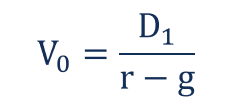
The GGM is based on the assumptions that the stream of future dividends will grow at some constant rate in future for an infinite time. Mathematically, the model is expressed in the following way:

Where:

  • V– the current fair value of a stock
  • D– the dividend payment in one period from now
  • r – the estimated cost of equity capital (usually calculated using CAPM)
  • g – the constant growth rate of the company’s dividends for an infinite time
  1. One-period Dividend Discount Model

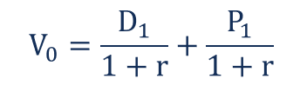
The one-period discount dividend model is used much less frequently than the Gordon Growth model. The former is applied when an investor wants to determine the intrinsic price of a stock that he or she will sell in one period from now. The one-period dividend discount model uses the following equation:

Where:

  • V– the current fair value of a stock
  • D– the dividend payment in one period from now
  • P– the stock price in one period from now
  • r – the estimated cost of equity capital
  1. Multi-period Dividend Discount Model

The multi-period dividend discount model is an extension of the one-period dividend discount model wherein an investor expects to hold a stock for the multiple periods. The main challenge of the multi-period model variation is that forecasting dividend payments for different periods is required. The model’s mathematical formula is below:

Interest rate risk

Interest rate risk is the potential for investment losses that result from a change in interest rates. If interest rates rise, for instance, the value of a bond or other fixed-income investment will decline. The change in a bond’s price given a change in interest rates is known as its duration.

Interest rate risk can be reduced by holding bonds of different durations, and investors may also allay interest rate risk by hedging fixed-income investments with interest rate swaps, options, or other interest rate derivatives.

  • Interest rate risk is the potential that a change in overall interest rates will reduce the value of a bond or other fixed-rate investment:
  • As interest rates rise bond prices fall, and vice versa. This means that the market price of existing bonds drops to offset the more attractive rates of new bond issues.
  • Interest rate risk is measured by a fixed income security’s duration, with longer-term bonds having a greater price sensitivity to rate changes.
  • Interest rate risk can be reduced through diversification of bond maturities or hedged using interest rate derivatives.

Interest rate changes can affect many investments, but it impacts the value of bonds and other fixed-income securities most directly. Bondholders, therefore, carefully monitor interest rates and make decisions based on how interest rates are perceived to change over time.

For fixed-income securities, as interest rates rise security prices fall (and vice versa). This is because when interest rates increase, the opportunity cost of holding those bonds increases that is, the cost of missing out on an even better investment is greater. The rates earned on bonds therefore have less appeal as rates rise, so if a bond paying a fixed rate of 5% is trading at its par value of $1,000 when prevailing interest rates are also at 5%, it becomes far less attractive to earn that same 5% when rates elsewhere start to rise to say 6% or 7%. In order to compensate for this economic disadvantage in the market, the value of these bonds must fall – because who will want to own a 5% interest rate when they can get 7% with some different bond.

Therefore, for bonds that have a fixed rate, when interest rates rise to a point above that fixed level, investors switch to investments that reflect the higher interest rate. Securities that were issued before the interest rate change can compete with new issues only by dropping their prices.

Interest rate risk can be managed through hedging or diversification strategies that reduce a portfolio’s effective duration or negate the effect of rate changes.

Price earning Model

The Price Earnings Ratio (P/E Ratio) is the relationship between a company’s stock price and earnings per share (EPS). It is a popular ratio that gives investors a better sense of the value of the company. The P/E ratio shows the expectations of the market and is the price you must pay per unit of current earnings (or future earnings, as the case may be).

Earnings are important when valuing a company’s stock because investors want to know how profitable a company is and how profitable it will be in the future. Furthermore, if the company doesn’t grow and the current level of earnings remains constant, the P/E can be interpreted as the number of years it will take for the company to pay back the amount paid for each share.

P/E Ratio in Use

Looking at the P/E of a stock tells you very little about it if it’s not compared to the company’s historical P/E or the competitor’s P/E from the same industry. It’s not easy to conclude whether a stock with a P/E of 10x is a bargain, or a P/E of 50x is expensive without performing any comparisons.

The beauty of the P/E ratio is that it standardizes stocks of different prices and earnings levels.

The P/E is also called earnings multiple. There are two types of P/E: trailing and forward. The former is based on previous periods of earnings per share, while a leading or forward P/E ratio is when EPS calculations are based on future estimates, which predicted numbers (often provided by management or equity research analysts).

Price Earnings Ratio Formula

P/E = Stock Price Per Share / Earnings Per Share

or

P/E = Market Capitalization / Total Net Earnings

or

Justified P/E = Dividend Payout Ratio / R – G

where;

R = Required Rate of Return

G = Sustainable Growth Rate

Why Use the Price Earnings Ratio?

Investors want to buy financially sound companies that offer a good return on investment (ROI). Among the many ratios, the P/E is part of the research process for selecting stocks, because we can figure out whether we are paying a fair price. Similar companies within the same industry are grouped together for comparison, regardless of the varying stock prices.  Moreover, it’s quick and easy to use when we’re trying to value a company using earnings. When a high or a low P/E is found, we can quickly assess what kind of stock or company we are dealing with.

High P/E

Companies with a high Price Earnings Ratio are often considered to be growth stocks. This indicates a positive future performance, and investors have higher expectations for future earnings growth and are willing to pay more for them. The downside to this is that growth stocks are often higher in volatility and this puts a lot of pressure on companies to do more to justify their higher valuation. For this reason, investing in growth stocks will more likely be seen as a risky investment. Stocks with high P/E ratios can also be considered overvalued.

Low P/E

Companies with a low Price Earnings Ratio are often considered to be value stocks. It means they are undervalued because their stock price trade lower relative to its fundamentals. This mispricing will be a great bargain and will prompt investors to buy the stock before the market corrects it. And when it does, investors make a profit as a result of a higher stock price. Examples of low P/E stocks can be found in mature industries that pay a steady rate of dividends.

Yield to Maturity

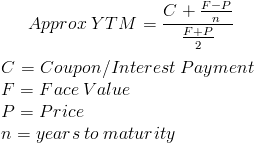
Yield to maturity (YTM) is the total return anticipated on a bond if the bond is held until it matures. Yield to maturity is considered a long-term bond yield but it is expressed as an annual rate. In other words, it is the internal rate of return (IRR) of an investment in a bond if the investor holds the bond until maturity, with all payments made as scheduled and reinvested at the same rate.

Because yield to maturity is the interest rate an investor would earn by reinvesting every coupon payment from the bond at a constant interest rate until the bond’s maturity date, the present value of all the future cash flows equals the bond’s market price. An investor knows the current bond price, its coupon payments and its maturity value, but the discount rate cannot be calculated directly. However, there is a trial-and-error method for finding YTM with the following present value formula:

Alternative formula for finding YTM

Each one of the future cash flows of the bond is known and because the bond’s current price is also known, a trial-and-error process can be applied to the YTM variable in the equation until the present value of the stream of payments equals the bond’s price.

Solving the equation by hand requires an understanding of the relationship between a bond’s price and its yield, as well as of the different types of bond pricings. Bonds can be priced at a discount, at par or at a premium. When the bond is priced at par, the bond’s interest rate is equal to its coupon rate. A bond priced above par, called a premium bond, has a coupon rate higher than the realized interest rate and a bond priced below par, called a discount bond, has a coupon rate lower than the realized interest rate. If an investor were calculating YTM on a bond priced below par, he or she would solve the equation by plugging in various annual interest rates that were higher than the coupon rate until finding a bond price close to the price of the bond in question.

Calculations of yield to maturity (YTM) assume that all coupon payments are reinvested at the same rate as the bond’s current yield and take into account the bond’s current market price, par value, coupon interest rate and term to maturity. The YTM is merely a snapshot of the return on a bond because coupon payments cannot always be reinvested at the same interest rate. As interest rates rise, the YTM will increase; as interest rates fall, the YTM will decrease.

Reinsurance, Importance, Reasons, Types, Challenges, Products

Reinsurance is fundamentally “insurance for insurance companies.” It is a risk management tool where an insurer (the cedant) transfers a portion of its risk portfolio to another party (the reinsurer) to reduce the likelihood of paying a large obligation resulting from an insurance claim.

This process enhances the primary insurer’s financial stability by protecting against catastrophic losses, stabilizing underwriting results, and increasing underwriting capacity—allowing them to issue larger policies than their own capital would permit. Reinsurance can be structured in two primary ways: Treaty (automatic cover for a class of business) and Facultative (negotiated for a single, specific risk). It is a global industry essential for spreading risk across borders, ensuring that the insurance market remains solvent and resilient, especially after major disasters.

Importance of Reinsurance:

  • Risk Transfer and Management

Reinsurance plays a crucial role in transferring risk from primary insurers to reinsurers, allowing insurers to manage exposure to large or catastrophic losses. By sharing risks, primary insurers can undertake higher-value policies and expand coverage without threatening their solvency. This risk-sharing mechanism ensures financial stability, protects policyholders, and enhances insurer confidence. Reinsurance also enables better portfolio diversification, reducing the impact of unexpected claims. In India and globally, effective reinsurance arrangements help insurers maintain solvency, manage volatility, and provide comprehensive protection to clients, ensuring a resilient and robust insurance sector.

  • Capital Relief and Solvency Support

Reinsurance provides capital relief, allowing insurers to maintain adequate solvency margins while underwriting more policies. By transferring part of the risk, insurers can reduce the amount of capital required to cover potential losses. This enhances financial flexibility, supports growth, and enables compliance with regulatory capital requirements. In India, reinsurers help insurers optimize capital allocation, manage reserves, and meet IRDAI solvency norms. By reducing financial strain, reinsurance allows companies to focus on expanding business, innovating products, and improving services, ensuring both stability and profitability in a competitive insurance market.

  • Protection Against Catastrophic Losses

Reinsurance is essential for protecting insurers from large-scale or catastrophic losses, such as natural disasters, pandemics, or industrial accidents. By sharing the financial burden with reinsurers, insurance companies can safeguard solvency and ensure uninterrupted claims settlement. Reinsurance allows for excess-of-loss coverage, mitigating the impact of extreme events that could otherwise threaten an insurer’s existence. It enables insurers to underwrite high-risk policies confidently, knowing that major losses will be partially absorbed by the reinsurer. This protection maintains policyholder trust, market stability, and overall resilience of the insurance sector in the face of unpredictable and severe risks.

  • Encouragement of Business Growth

Reinsurance supports business expansion and market development by enabling insurers to underwrite larger or more diverse policies without exceeding retention limits. It provides the financial backing and security needed to explore new markets, launch innovative products, and cater to high-value clients. In India, reinsurance facilitates rural insurance, microinsurance, and specialized commercial coverage, encouraging insurers to reach underserved areas. By reducing risk exposure, insurers can focus on profitability, customer acquisition, and long-term growth. Reinsurance thus acts as a catalyst for business development, promoting a healthy, competitive, and dynamic insurance industry.

  • Expertise and Technical Support

Reinsurers bring technical expertise, actuarial analysis, and industry knowledge to primary insurers. They assist in risk assessment, pricing, portfolio management, and claim handling, enhancing the efficiency and accuracy of insurance operations. This support is particularly valuable for emerging or complex risks, such as cyber threats, climate-related hazards, and large commercial projects. Reinsurers provide guidance on product design, risk mitigation, and regulatory compliance, strengthening the insurer’s decision-making capabilities. By leveraging reinsurers’ experience, primary insurers can improve underwriting quality, minimize losses, and deliver better services, making expertise transfer a key component of reinsurance importance.

Reasons of Reinsurance:

  • Risk Transfer and Catastrophe Protection

The fundamental reason for reinsurance is to transfer risk and protect the primary insurer from financial ruin due to a catastrophic event or an accumulation of large losses from a single event (e.g., a hurricane, earthquake, or major industrial fire). No single insurer has the capital to comfortably absorb such immense losses alone. Reinsurance allows the cedant to share these extreme risks with a global network of reinsurers, ensuring that a single disaster does not threaten its solvency or ability to pay all its policyholders’ claims, thereby maintaining market stability.

  • Capital Management and Solvency

Reinsurance is a crucial tool for capital management. By ceding risk, an insurer reduces the amount of capital it is required to hold in reserve as mandated by regulators (like IRDAI) to ensure solvency. This process, known as capital relief, frees up significant funds that can be redeployed for other profitable purposes, such as writing new business, investing, or expanding operations. It directly improves the company’s key financial ratios and ensures compliance with stringent regulatory capital requirements, making its balance sheet stronger and more efficient.

  • Underwriting Capacity Expansion

Reinsurance enables an insurance company to expand its underwriting capacity. This means it can accept risks—especially large, single risks that exceed its normal retention limit—that would otherwise be too sizeable or hazardous to insure on its own. For example, a mid-sized insurer can underwrite a large industrial project or a jumbo jet by ceding a substantial portion of the risk to reinsurers. This allows the insurer to compete for larger clients, diversify its book of business, and increase premium income without exposing itself to an unacceptable level of risk.

  • Stabilizing Underwriting Results

Insurance results can be volatile, with profitable years followed by years of heavy losses. Reinsurance helps smooth out this volatility and stabilize underwriting results over time. By protecting against severe losses, reinsurance reduces the likelihood of extreme financial fluctuations. This creates more predictable earnings, which is highly valued by investors, rating agencies, and management. This stability also provides the insurer with the confidence to underwrite cyclical or more volatile lines of business, knowing that its financial performance will be shielded from the worst-case scenarios.

Types of Reinsurance:

  • Facultative Reinsurance

Facultative reinsurance is arranged for individual risks or specific policies. The ceding company (primary insurer) negotiates terms with the reinsurer for each risk separately. It provides flexibility, allowing the insurer to transfer high-value or unusual risks that exceed its retention capacity. Both parties evaluate the risk individually, and the reinsurer can accept or reject coverage. Facultative reinsurance is typically used for large commercial, industrial, or specialized risks, where standard treaty arrangements may not be sufficient. This type of reinsurance ensures adequate coverage for exceptional cases, enhances the insurer’s capacity, and reduces the potential financial impact of catastrophic losses.

  • Treaty Reinsurance

Treaty reinsurance is a pre-agreed arrangement where the reinsurer automatically covers a portfolio or class of risks of the ceding company. Unlike facultative reinsurance, individual policies are not negotiated separately. Treaties can be proportional (sharing premiums and losses) or non-proportional (coverage after a loss threshold). This type of reinsurance provides stability, predictability, and continuous risk transfer for the insurer, allowing them to underwrite large volumes of policies without exceeding retention limits. Treaty reinsurance simplifies administration, reduces underwriting burden, and protects insurers from accumulated or catastrophic losses. It is widely used for standard risks like motor, property, and health insurance portfolios.

  • Proportional Reinsurance

Proportional reinsurance involves sharing both premiums and losses between the ceding company and the reinsurer in a pre-determined ratio. It can take the form of quota share (fixed percentage of each policy) or surplus share (only amounts above the insurer’s retention). This type of reinsurance ensures that both parties share risk fairly and proportionally, reducing the insurer’s exposure while allowing the reinsurer to earn a corresponding share of the premium. Proportional reinsurance is widely used to expand underwriting capacity, stabilize financial results, and maintain solvency margins. It encourages careful underwriting and ensures that large claims are shared responsibly between insurers and reinsurers.

  • Non-Proportional Reinsurance

Non-proportional reinsurance provides coverage only when losses exceed a specified threshold, known as the retention limit. Common forms include excess of loss reinsurance, stop-loss reinsurance, and catastrophe covers. The reinsurer pays for the portion of the loss above the retention, protecting the ceding company from large, unexpected claims. Non-proportional reinsurance is ideal for catastrophic risks, high-value properties, or portfolios with volatile claims patterns. It reduces the financial impact of major losses, stabilizes profits, and allows insurers to underwrite policies with higher exposure. Unlike proportional reinsurance, the premium is calculated based on risk exposure, potential severity, and historical loss data, not merely a fixed percentage.

Challenges of Reinsurance:

  • Risk Assessment and Pricing

One major challenge in reinsurance is accurately assessing risks and determining premiums. Reinsurers must evaluate complex, large-scale, or catastrophic risks, often with limited historical data. Incorrect risk assessment can lead to underpricing, resulting in financial losses, or overpricing, making the product unattractive to primary insurers. Emerging risks like cyber threats, climate change, and pandemics further complicate pricing. Reinsurers rely on advanced modeling, actuarial analysis, and industry expertise, but uncertainties remain. Maintaining a balance between competitive premiums and adequate risk coverage is a continuous challenge in the dynamic insurance environment.

  • Regulatory and Compliance issues

Reinsurance companies face strict regulatory requirements in multiple jurisdictions. Differences in capital adequacy norms, reporting standards, and solvency regulations create compliance complexities. Cross-border reinsurance adds challenges related to taxation, foreign exchange, and legal frameworks. Non-compliance can lead to penalties, license revocation, or reputational damage. In India, reinsurers must adhere to IRDAI guidelines, including solvency margins and reporting obligations. Managing compliance while remaining competitive in pricing and risk acceptance is challenging. Constantly evolving regulations require reinsurers to update policies, maintain accurate records, and implement robust internal controls, adding operational and administrative burdens.

  • Catastrophic and Accumulation Risk

Reinsurers face challenges in managing catastrophic events, such as earthquakes, floods, or pandemics, which can result in massive simultaneous claims. Accumulation risk occurs when multiple policies or portfolios are exposed to the same event, increasing potential losses. Estimating the frequency and severity of such events is difficult, requiring sophisticated risk modeling and historical data analysis. Failure to manage these risks can threaten financial solvency and stability. Reinsurers often use diversification, catastrophe bonds, and excess-of-loss covers to mitigate exposure, but extreme or unprecedented events remain a significant challenge in the reinsurance industry.

  • Counterparty and Credit Risk

Reinsurance involves interdependence between primary insurers and reinsurers, making counterparty risk critical. If a reinsurer fails to honor claims due to financial instability or insolvency, the ceding company bears the loss, disrupting operations and finances. Similarly, primary insurers must meet obligations for accurate reporting, timely premiums, and transparency. Credit risk arises when reinsurers are exposed to delayed payments, disputes, or defaults. Managing these risks requires careful selection of partners, credit monitoring, and contractual safeguards. Strong financial evaluation and regulatory compliance are essential to minimize exposure to counterparty risk and ensure smooth claim settlement.

  • Technological and Data Challenges

Modern reinsurance relies heavily on data analytics, risk modeling, and digital platforms. Challenges arise from inaccurate, incomplete, or inconsistent data, which can affect risk evaluation, pricing, and claim settlement. Emerging risks like cyberattacks and digital fraud require sophisticated technological infrastructure for monitoring and mitigation. Implementing advanced analytics, AI, and predictive models involves high costs, skilled personnel, and system integration, which can be challenging for smaller reinsurers. Maintaining data security, privacy compliance, and real-time reporting is essential. Technology gaps or errors can lead to financial loss, operational inefficiency, and reputational damage, making technological management a critical challenge.

Reinsurance Products in India:

  • Treaty Reinsurance

Treaty reinsurance is a pre-arranged agreement between a primary insurer and a reinsurer covering a portfolio or class of policies. It provides automatic coverage for all risks falling under the treaty, eliminating the need to negotiate each policy individually. Treaty reinsurance can be proportional (sharing premiums and losses) or non-proportional (coverage beyond a retention limit). In India, treaty reinsurance ensures risk diversification, financial stability, and solvency compliance. It allows insurers to underwrite large volumes of policies confidently, manage catastrophic exposure, and maintain consistent protection across standard and recurring risks, supporting overall business growth.

  • Facultative Reinsurance

Facultative reinsurance covers specific individual risks or policies rather than an entire portfolio. Each risk is evaluated separately, and the reinsurer can accept or reject coverage. This type of reinsurance is suitable for high-value, unusual, or complex risks, like industrial projects, large commercial properties, or specialized assets. Facultative reinsurance provides flexibility and customized solutions for individual exposures. In India, it helps insurers expand underwriting capacity and manage risk selectively. By sharing responsibility for exceptional or high-risk policies, facultative reinsurance reduces financial strain, enhances solvency, and ensures protection against catastrophic or unpredictable losses.

  • Proportional Reinsurance

Proportional reinsurance involves sharing both premiums and claims between the ceding insurer and the reinsurer in a predetermined ratio. Common forms include quota share, where a fixed percentage of every policy is transferred, and surplus share, covering amounts above the insurer’s retention. This product ensures equitable risk distribution, stabilizes financial results, and increases underwriting capacity. In India, proportional reinsurance is widely used in motor, health, and property insurance portfolios. It allows insurers to underwrite more policies confidently, maintain solvency, and balance claims exposure. Proportional reinsurance strengthens insurer-reinsurer collaboration and supports sustainable growth in the insurance sector.

  • Non-Proportional Reinsurance

Non-proportional reinsurance provides coverage only when losses exceed a specified threshold. It includes excess-of-loss, stop-loss, and catastrophe covers. The reinsurer pays for claims above the insurer’s retention limit, protecting against large, unpredictable, or catastrophic losses. This product is crucial for disaster-prone regions, high-value assets, and volatile risk portfolios. In India, non-proportional reinsurance helps insurers manage solvency, reduce risk concentration, and stabilize profits. By mitigating financial impact from extreme events, it ensures policyholder protection and insurer confidence, enabling sustainable operations and fostering growth in challenging insurance markets.

  • Catastrophe Reinsurance

Catastrophe reinsurance covers extreme events such as earthquakes, floods, cyclones, or pandemics that could result in massive simultaneous claims. It is often structured as excess-of-loss or parametric reinsurance, triggered when losses exceed a defined threshold. In India, catastrophe reinsurance protects insurers from natural disasters and regional calamities, ensuring financial stability and uninterrupted claim settlement. It helps insurers expand coverage in high-risk areas and maintain solvency during catastrophic events. By pooling and transferring extreme risks to reinsurers, catastrophe reinsurance enhances resilience, reduces volatility, and supports sustainable insurance operations in a disaster-prone economy.

  • Retrocession

Retrocession is a form of reinsurance where a reinsurer transfers part of its risk to another reinsurer. This helps distribute large or concentrated exposures, manage solvency, and reduce financial strain. Retrocession ensures that no single reinsurer bears excessive loss, maintaining stability in the insurance chain. In India, retrocession is used for high-value, catastrophic, or complex portfolios, particularly in life, health, and general insurance. It promotes risk diversification, operational continuity, and capital efficiency. By spreading risks across multiple reinsurers, retrocession strengthens the resilience of both primary insurers and reinsurers, ensuring reliable protection for policyholders.

Risk Retention

Risk retention is a company’s decision to take responsibility for a particular risk it faces, as opposed to transferring the risk over to an insurance company. Companies often retain risks when they believe that the cost of doing so is less then the cost of fully or partially insuring against it.

If a company retains a certain risk, it will have to pay for losses from that risk out of its own reserve funds. For this reason, it is important for companies to make sure that they can properly afford to pay for potential losses before they make the decision to retain particular risks. Companies may retain risks if the premiums for insuring against it are particularly high.

A risk retention group (RRG) is an alternative risk transfer entity created by the federal Liability Risk Retention Act (LRRA). RRGs must form as liability insurance companies under the laws of at least one state its charter state or domicile. The policyholders of the RRG are also its owners and membership must be limited to organizations or persons engaged in similar businesses or activities, thus being exposed to the same types of liability. Most RRGs are regulated as captive insurance companies. However, RRGs domiciled in states without captive law are regulated as traditional insurance companies.

A risk retention group is a corporation or limited liability association formed under the laws of any state for the primary purpose of assuming liability exposures on behalf of its members. Members of the group must be engaged in similar activities or related with respect to liability exposures by virtue of any related or common business exposure, trade, product, service, or premise. Members must have an ownership interest in the group and only members may benefit from the group. Risk retention groups only apply to liability loss exposures.

RRGs provide their members with the following benefits:

  • Program control
  • Long-term rate stability
  • Customized Loss control and risk management practices
  • Dividends for good loss experience
  • Access to reinsurance markets
  • Stable source of liability coverage at affordable rates
  • Multi-state operations

Advantage of Risk Retention

  • Avoidance of multiple state filing and licensing requirements
  • Member control over risk and litigation management issues
  • Establishment of stable market for coverage and rates
  • Elimination of market residuals
  • Exemption from countersignature laws for agents and brokers
  • No expense for fronting fees
  • Unbundling of services

Disadvantage Risk Retention

  • Risks are limited to liability insurance
  • Not permitted to write risks outside its homogenous group
  • No guaranty fund coverage for members
  • May not be able to comply with proof of financial responsibility laws
  • Can be without a financial rating from a rating agency

Transfer of Risks

A transfer of risk is a business agreement in which one party pays another to take responsibility for mitigating specific losses that may or may not occur. This is the underlying tenet of the insurance industry.

Risks may be transferred between individuals, from individuals to insurance companies, or from insurers to reinsurers. When homeowners purchase property insurance, they are paying an insurance company to assume various specific risks associated with homeownership.

When purchasing insurance, the insurer agrees to indemnify, or compensate, the policyholder up to a certain amount for a specified loss or losses in exchange for payment.

Insurance companies collect premiums from thousands or millions of customers every year. That provides a pool of cash that is available to cover the costs of damage or destruction to the properties of some small percentage of its customers. The premiums also cover administrative and operating expenses, and provide the company’s profits.

Life insurance works the same way. Insurers rely on actuarial statistics and other information to project the number of death claims it can expect to pay out per year. Because this number is relatively small, the company sets its premiums at a level that will exceed those death benefits.

Working

Risk transfer is a common risk management technique where the potential of an adverse outcome faced by an individual or entity is shifted to a third party. To compensate the third party for bearing the risk, the individual or entity will generally provide the third party with periodic payments.

The most common example of risk transfer is insurance. When an individual or entity purchases insurance, they are insuring against financial risks. For example, an individual who purchases car insurance is acquiring financial protection against physical damage or bodily harm that can result from traffic incidents.

As such, the individual is shifting the risk of having to incur significant financial losses in a traffic incident to an insurance company. In exchange for bearing such risks, the insurance company will typically require periodic payments from the individual.

Reinsurance companies accept transfers of risk from insurance companies.

The insurance industry exists because few individuals or companies have the financial resources necessary to bear the risks of the loss on their own. So, they transfer the risks.

Risk Transfer to Reinsurance Companies

Some risks are too big for insurance companies to bear alone. That’s where reinsurance comes in.

When insurance companies don’t want to assume too much risk, they transfer the excess risk to reinsurance companies. For example, an insurance company may routinely write policies that limit its maximum liability to $10 million. But it may take on policies that require higher maximum amounts and then transfer the remainder of the risk in excess of $10 million to a reinsurer. This subcontract comes into play only if a major loss occurs.

Property Insurance Risk Transfer

Purchasing a home is the most significant expense most individuals make. To protect their investment, most homeowners buy homeowners insurance. With homeowners insurance, some of the risks associated with homeownership are transferred from the homeowner to the insurer.

Insurance companies typically assess their own business risks in order to determine whether a customer is acceptable, and at what premium. Underwriting insurance for a customer with a poor credit profile and several dogs is riskier than insuring someone with a perfect credit profile and no pets. The policy for the first applicant will command a higher premium because of the higher risk being transferred from the applicant to the insurer.

  • A transfer of risk shifts responsibility for losses from one party to another in return for payment.
  • The basic business model of the insurance industry is the acceptance and management of risk.
  • This system works because some risks are beyond the resources of most individuals and businesses.

Methods of Risk Transfer

There are two common methods of transferring risk:

  1. Insurance policy

As outlined above, purchasing insurance is a common method of transferring risk. When an individual or entity is purchasing insurance, they are shifting financial risks to the insurance company. Insurance companies typically charge a fee an insurance premium for accepting such risks.

  1. Indemnification clause in contracts

Contracts can also be used to help an individual or entity transfer risk. Contracts can include an indemnification clause  a clause that ensures potential losses will be compensated by the opposing party. In simplest terms, an indemnification clause is a clause in which the parties involved in the contract commit to compensating each other for any harm, liability, or loss arising out of the contract.

For example, consider a client that signs a contract with an indemnification clause. The indemnification clause states that the contract writer will indemnify the client against copyright claims. As such, if the client receives a copyright claim, the contract writer would

  • Be obliged to cover the costs related to defending against the copyright claim.
  • Be responsible for copyright claim damages if the client is found liable for copyright infringement.

Risk Financing

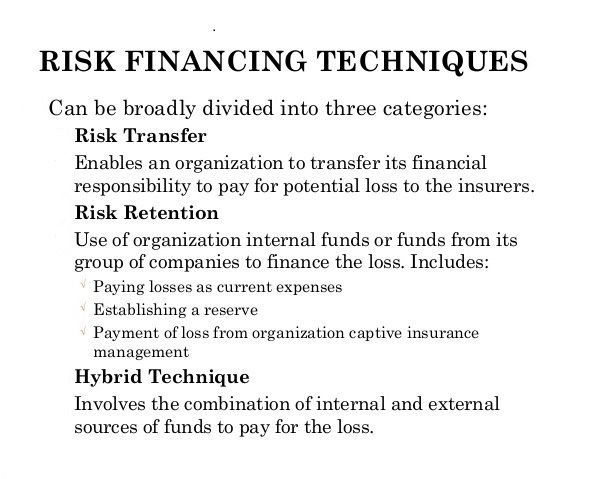
Risk financing is the determination of how an organization will pay for loss events in the most effective and least costly way possible. Risk financing involves the identification of risks, determining how to finance the risk, and monitoring the effectiveness of the financing technique that is chosen.

Risk financing is designed to help a business align its desire to take on new risks to grow, with its ability to pay for those risks. Businesses must weigh the potential costs of their actions and whether the action will help the business reach its objectives. The business will examine its priorities to determine whether it is taking on the appropriate amount of risk to achieve its objectives. It’ll also examine whether it is taking the right types of risks and whether the costs of these risks are being accounted for financially.

Companies have a variety of options when it comes to protecting themselves from risk. Commercial insurance policies, captive insurance, self-insurance, and other alternative risk transfer schemes are available, though the effectiveness of each depends on the size of the organization, the organization’s financial situation, the risks that the organization faces and the organization’s overall objectives. Risk financing seeks to choose the option that is the least costly, but it also must ensure the organization has the financial resources available to continue its objectives after a loss event occurs.

The process for determining risk financing typically involves a company forecasting the losses that they expect to experience over a period of time and then determining the net present value of the costs associated with the different risk financing alternatives available to them. Each option is likely to have different costs, depending on the risks that need coverage, the loss development index that is most applicable to the company, the cost of maintaining a staff to monitor the program and any consulting, legal, or external experts that are needed.

Risk Financing as an Indicator of Financial Health

How a company manages situations that call for risk financing is a good indicator of that organization’s competitiveness and potential for long term success. That’s because risk financing depends on the aptitude of business leaders to identify and monitor key metrics that provide insight into its financial health. One of the most widely accepted of those key metrics is Cost of Risk (COR), a quantitative measure of the total direct and indirect expenditures dedicated to mitigating the risk exposures. While typically interpreted to capture only those costs arising out of insurance activities (i.e. retained losses, risk control costs, insurance premiums, and dept administration expenses), true COR captures expenditures (risk spend) from external risk transfer, retained/self-insured losses, external consultancy fees, internal program administration, collateral costs and missed opportunity costs.

error: Content is protected !!