Secondary Equity Market

Secondary market is also called as after market. Stock exchange is the secondary market. The stock exchange is the medium through which the exchange of shares, Equities takes place between the seller and the buyer. Secondary market is the place where most of the trading takes place. The trading of shares and capital in secondary market takes place between the buyer and the seller, company is not involved in transactions. The price of share is decided by demand and supply of the shares and price keeps on fluctuating. In secondary market no new stocks are issued, only trading of stocks is there.

Features of Secondary Market

  • Gives liquidity to all investors. Any seller in need of cash can easily sell the security due to the presence of a large number of buyers.
  • Very little time lag between any new news or information on the company and the stock price reflecting that news. The secondary market quickly adjusts the price to any new development in the security.
  • Lower transaction costs due to the high volume of transactions.
  • Demand and supply economics in the market assist in price discovery.
  • An alternative to saving.
  • Secondary markets face heavy regulations from the government as they are a vital source of capital formation and liquidity for the companies and the investors. High regulations ensure the safety of the investor’s money.

Major Instruments and Players in Secondary Market

The secondary market deals with fixed income, variable income, and hybrid instruments.

Fixed income instruments are usually debt securities like bonds, debentures. It also includes Preference shares.

Variable income instruments are equity and derivatives.

Hybrid instruments are preference shares and convertible debentures.

Major players in the market are Brokerage and Advisory services (commission broker, security dealers and more); Financial Intermediaries (Banks, Insurance companies, Mutual Fund, Non-Banking Financial companies); and retail investors.

Types of Secondary Markets

There are two types of secondary markets:

Exchanges

It is a marketplace, wherein there is no direct contact between the buyer and the seller, like NYSE or NASDAQ. There is no counterparty risk as an exchange is a guarantor. Also, heavy regulations make it a safe place for investors to trade securities. However, investors face a comparatively higher transaction cost due to exchange fees and commission.

Over-The-Counter (OTC) Markets

It is a decentralized place, where the market is made up of members trading among themselves. Foreign exchange market (FOREX) is one such type of market. There is more competition among the participants to get higher volume, so prices of security may vary from seller to seller. Also, OTC markets suffer from counterparty risk as parties deal with each other directly.

Pricing in Secondary Markets

In the primary market, the price of a security is set beforehand. However, in the secondary market, the price of a security is determined by its supply and demand. For instance, if most of the investors believe that the stock would gain going ahead, the demand for that stock goes up, and hence, its price. Similarly, if investors feel the stock will lose value, they will want to sell it, resulting in a price drop.

Importance of Secondary Markets

  • It is a good indicator of a country’s economic condition. A rise or drop in the stock market suggests a boom or recession in an economy.
  • It helps in valuing a company as economic forces of supply and demand determine the prices.
  • Ensures liquidity for the investors as one can easily buy or sell the securities.
  • It gives investors a chance to use their idle money to earn some returns.
  • It helps the company to monitor and control public perceptions.

Functions of Secondary Market

  • A stock exchange provides a platform to investors to enter into a trading transaction of bonds, shares, debentures and such other financial instruments.
  • Transactions can be entered into at any time, and the market allows for active trading so that there can be immediate purchase or selling with little variation in price among different transactions. Also, there is continuity in trading, which increases the liquidity of assets that are traded in this market.
  • Investors find a proper platform, such as an organized exchange to liquidate the holdings. The securities that they hold can be sold in various stock exchanges.
  • A secondary market acts as a medium of determining the pricing of assets in a transaction consistent with the demand and supply. The information about transactions price is within the public domain that enables investors to decide accordingly.
  • It is indicative of a nation’s economy as well, and also serves as a link between savings and investment. As in, savings are mobilized via investments by way of securities.

Significance of Secondary Markets

  • It is a good indicator of a country’s economic condition. A rise or drop in the stock market suggests a boom or recession in an economy.
  • It helps in valuing a company as economic forces of supply and demand determine the prices.
  • Ensures liquidity for the investors as one can easily buy or sell the securities.
  • It gives investors a chance to use their idle money to earn some returns.
  • It helps the company to monitor and control public perceptions.

Advantages of Secondary Market

  • Investors can ease their liquidity problems in a secondary market conveniently. Like, an investor in need of liquid cash can sell the shares held quite easily as a large number of buyers are present in the secondary market.
  • The secondary market indicates a benchmark for fair valuation of a particular company.
  • Price adjustments of securities in a secondary market takes place within a short span in tune with the availability of new information about the company.
  • Investor’s funds remain relatively safe due to heavy regulations governing a secondary stock market. The regulations are stringent as the market is a source of liquidity and capital formation for both investors and companies.
  • Mobilization of savings becomes easier as investors’ money is held in the form of securities.

Disadvantages of Secondary Market

  • Prices of securities in a secondary market are subject to high volatility, and such price fluctuation may lead to sudden and unpredictable loss to investors.
  • Before buying or selling in a secondary market, investors have to duly complete the procedures involved, which are usually a time-consuming process.
  • Investors’ profit margin may experience a dent due to brokerage commissions levied on each transaction of buying or selling of securities.

Investments in a secondary capital market are subject to high risk due to the influence of multiple external factors, and the existing valuation may alter within a span of a few minutes.

Stock market indices

A stock market index is a statistical measure which shows changes taking place in the stock market. To create an index, a few similar kinds of stocks are chosen from amongst the securities already listed on the exchange and grouped together.
The criteria of stock selection could be the type of industry, market capitalisation or the size of the company. The value of the stock market index is computed using values of the underlying stocks. Any change taking place in the underlying stock prices impact the overall value of the index. If the prices of most of the underlying securities rise, then the index will rise and vice-versa.
In this way, a stock index reflects overall market sentiment and direction of price movements of products in the financial, commodities or any other markets.
Some of the notable indices in India are as follows:

  1. Benchmark indices like NSE Nifty and BSE Sensex
  2. Broad-based indices like  Nifty 50 and BSE 100
  3. Indices based on market capitalization like the BSE Smallcap and BSE Midcap
  4. Sectoral indices like Nifty FMCG Index and CNX IT

The stock market index acts like a barometer which shows the overall conditions of the market. They facilitate the investors in identifying the general pattern of the market. Investors take the stock market as a reference to decide about which stocks to go for investing.
The following lists the importance of stock market index:

a. Aids in Stock-Picking

In a share market, you would thousands of companies listed on the exchange. Broadly, picking the appropriate stock for investment may seem like a nightmare. Without a benchmark, you may not be able to differentiate between the stocks. Simultaneously sorting the stocks becomes a challenge. In this situation, a stock market acts like an instant differentiator. It classifies the companies and their shares based on key characteristics like the size of company, sector, industry type and so on.

b. Acts as a Representative

Investing in equities involves risk and you need to take an informed decision. Studying about stocks individually may seem very impractical. Indices help to fill the knowledge gaps that exist among the investors. They represent the trend of the whole market or a certain sector of the market. In India, the NSE Nifty the BSE Sensex act as the benchmark indices. They are believed to indicate the performance of the entire stock market. In the same manner, an index which is made up of pharma stocks is assumed to portray the average price of stocks of companies operating in the pharmaceutical industry.

c. The Parameter for Peer Comparison

Before including a stock in your portfolio, you have to assess whether it’s worth the money. By comparing with the underlying index, you can easily judge the performance of a stock. If the stock gives higher returns than the index, it’s said to have outperformed the index. If it gives lower returns than the index, it’s said to have underperformed the index.
You would definitely want to invest in a multibagger so as to justify the risk assumed. Else you can be better off investing in low-cost professionally managed index funds. You may also compare the index with a set of stocks like the Information technology sector. As an investor, you can know market trends easily.

d. Reflects Investor Sentiment

When you are participating in equity markets, amongst other things, knowing investor sentiment becomes an important aspect. It is because the sentiment affects the demand for a stock which in turn impacts the overall price. In order to invest in the right stock, you should know the reason behind the rise/fall in its prices. At this juncture, indices help to gauge the mood of investors. You may even recognize investor sentiment for a particular sector and across market capitalizations.

e. Helps in Passive Investment

Passive investment refers to investing in a portfolio of securities which replicates the stocks of an index. Investors who want to cut down on the cost of research and stock selection prefer to invest in index portfolio. Consequently, the returns of the portfolio will resemble that of the index. If an investor’s portfolio resembles the Sensex, then his portfolio is going to deliver returns of around 8% when the Sensex earns 8% returns.

How are stock market indices developement

An index is made up of similar stocks based on market capitalization, industry or company size. Upon selection of stocks, the index value is computed. Each stock will have a different price and price change in one stock would not be proportionately equal to the price change in another. So, the value of the index value cannot be arrived at as a simple sum of the prices of all the stocks.
Here is when the importance of assigning weights to stocks comes into play. Each stock in the index is assigned a particular weightage based on its market capitalization or price. The weight represents the extent of the impact that the stock’s price change has on the value of the index.
The two most commonly used stock market indices are as follows:

a. Market-cap weightage

Market capitalization refers to the total market value of the stock of a company. It is calculated by multiplying the total number of outstanding stocks floated by the company with the share price of a stock. It, therefore, considers both the price as well as the size of the stock. In an index which uses market-cap weightage, the stocks are assigned weightage based on their market capitalization as compared to the total market capitalization of the index.
Suppose a stock has a market capitalization of Rs. 50,000 whereas the underlying index has a total market-cap of Rs. 1,00,000. Thus, the weightage given to the stock will be 50%.
It is important to note that market capitalization of a stock changes every day with the fluctuation in its price. Due to this reason, weightage of the stock would change daily. But usually such a change is marginal in nature. Moreover, the companies with higher market-caps get more importance in this method.
In India, free-float market capitalization is used by most of the indices. Here, the total number of shares listed by a company is not used to compute market capitalization. Instead, use only the amount of shares available for trading publicly. Consequently, it gives a smaller number than the market capitalization.

b. Price weightage

In this method, the value of an index value is computed based on the stock price of a company rather than the market capitalization. Thus, the stocks which have higher prices receive greater weightages in the index as compared to the stocks which have lower prices. This method has been used in The Dow Jones Industrial Average in the US and the Nikkei 225 in Japan.

Features of Bonds

  1. Repayment of Principal:

Bonds are issued in denomination of Rs. 1,000 but there are also bonds of values of Rs. 500 and Rs. 100 and of values as high as Rs. 5,000 and Rs. 10,000. Financial institutions are known to buy corporate bonds bearing higher values. The value of the bond is called the ‘face value, par value or maturity value’.

The face value of the bond represents the promise to repay the amount to the bondholder at the end of the specified period. This, in other words, may be called the most important feature of bond, return of the principal to the lender on a fixed date specified earlier.

  1. Specified Time Period:

The second feature is the maturity date of the bond. The time specified in the bond is called the maturity date or date of repayment of principal amount. The maturity date of bonds varies according to the requirement of each organization. Some organizations issue bonds of a long-term nature. The number of years of these bonds varies from 20 years to 100 years maturity.

Other issues of bonds are for medium term and their maturity is between 5-10 years. Shorter-term bonds are identified as those whose maturity is below 4 years. The bond indenture specifically gives the maturity date of the bond. This is the promise to pay the principal amount on a specified date after the expiry of the number of years for which it is issued.

  1. Call:

Bonds have an additional feature of ‘call’. This is a privilege to the issuing company to re-purchase bonds at a slightly higher price above the par value. For example, a bond of face value of Rs. 1,000 and maturity of 20 years yields an interest of Rs. 70 annually. After the first 5 years of issue, the market rate of interest on bonds falls considerably.

The ruling rate being 5% the company may choose to use the call feature and buy back the bond for Rs. 1,050. This is a little higher than the face value of Rs. 1,000. By calling the bonds, the company saves money. It may call back the bonds yielding interest of Rs. 70 and issue fresh bonds which will yield Rs. 50 per year.

The firm has been able to save Rs. 20 per year per bond for the next 15 years till the maturity of the bond. By paying Rs. 50 higher than the face value on the bond for early redemption of the bond, the company saves a much higher amount.

The bond holder is on the losing side because he gets the return of the principal amount earlier than he expected. Since, the current market rate of interest is prevailing at a lower rate he cannot buy any other bond which will fetch him an income of Rs. 70 per bond per year. This feature gives a right to the issuing company.

The bondholder should be aware of the call feature before he makes an investment in bonds. He can protect himself by investing in bonds of shorter durations. Although there is risk of fluctuations in interest rates for short durations, a ten year period is considered to be good life of a bond from the point of view of the bondholder.

  1. Pledge of Security:

The issuing company sometimes promises to pay to the bondholder by offering some security like property. The pledge of security is a promise to the bondholders in writing and signed under seal and presented to the trustee by the company. A simple promise to pay without the proper formalities is not considered as a pledge of security.

  1. Interest:

The rate of interest to be paid to bondholder and the time of payment is recorded in the bond as well as in the indenture, ‘interest rate’ is also called the ‘coupon rate’. Interest on bond may be made by cheque or coupon. When interest is paid to the bondholder by cheque the principal amount on the bond is usually registered to interest value.

The coupons are numbered and every coupon represents, the interest payment period. When the coupon becomes due, the bondholder presents the coupon to the authorized banker and receives interest. The coupons are usually bearer bonds and are negotiable when they become due and payable.

Coupons should be kept safely because it is difficult to recover them if they are lost, since the name of the owner is not required in order to en-cash them. Interest either by coupon or by cheque is paid on the face value of the bond. The rate cannot be changed once it has been fixed. The interest is paid in Rupee Value in India. Gold bonds were issued in India in the early 1950s but now only Rupee Bonds are issued.

Interest on bonds should be paid regularly by the issuing authority. Government bonds are very reliable as they are paid in time. Sometimes, interest is not paid by companies when it is due. The bond issue in this case is considered to be in default and both the interest and principal become due and payable to the bondholder. The trustees of the bondholder at this point of time protect the interest of the bondholders.

In order to be sure that interest and principal sum on the bond will be repaid, it is necessary that the bonds are evaluated and analysed before investing in them.

An investor must look into the net operating profit of the firm as well as its net income after taxes. This will to a great extent determine the quality of the bond. It must be emphasized that bonds will be considered secure when the interest charges are low and the net operating income is high.

Sometimes, the bond issuing companies offer security through assets and in writing, assuring the bondholders of the payment of interest. Sometimes, the company promises to maintain a minimum working capital position or a particular cash position. Interest is guaranteed in assumed bond, guaranteed bond or joint bond.

Interest on bonds is also protected by the ‘acceleration clause’. When interest is due but not paid, this clause gives the right to the bondholder to represent himself through the trustee. This clause gives the bondholder the right of a creditor and he can make a claim on his assets but cannot be sure of receiving the principal amount.

The bondholder will be reassured if on an analysis of the company’s position. It is found that the company’s operating income is sufficient to cover all expenses pertaining to the company’s account inclusive of all interest charges made on its issue of debt.

  1. Covenants:

Covenants are productive clauses in the bond indenture. They are agreements between the company and the bondholders through the trustees. Through these agreements the company binds itself to the bondholders.

The company agrees to control its operations and in this way offers some protection to bondholders. Sometimes, a company makes an agreement to limit the amount of dividend to be paid to its equity shareholders. Other covenants protect the bondholder by ensuring a minimum, cash balance to be maintained by the firm.

Certain covenants or agreements are specifically used on a particular class of bonds. For example, mortgage bonds may include a covenant to limit the company’s expenses or debt position up to a fixed percentage of the value of new purchases of property, for example, 75% of the property.

Covenants are agreements or promises which tone up the quality of the bonds and assure repayment of principal and interest. There are different kinds of bonds based on these special features: Repayment of principal, Maturity date, Call, Pledge of security, Interest and Covenants. 

Govt. Securities

The Reserve Bank of India (RBI) defines government securities as tradable instruments issued by the Central Government or State Governments.” These securities carry a minimum risk of default and are sometimes called “risk-free gilt-edged instruments.” The following are some securities offered by the RBI:

Treasury Bills

These are short-term government securities with maturities of up to one year. They are currently issued in three different types, that is, the ninety-one day, the one hundred and eighty-two day, and the three hundred- and sixty-four-day bills. Since they do not pay interest, the investor’s profit is the difference between the discounted issue price and the face value. The RBI performs weekly auctions to issue the treasury bills.

Cash Management Bills

These are short-term securities that are highly flexible since they can be issued when needed. Their tenure and date of issue are based on the temporary cash needs of the government; however, the chosen tenure must still be less than 91 days. Like Treasury Bills, they are given at discounts on the face value via RBI auctions.

Dated Government Securities

These are long-term securities that have either a fixed or floating rate of interest. The investor benefits from the interest paid (coupon) on each bond. These securities are termed “dated” because of the explicitly stated date of maturity; for instance, a January 1st, 2019 security will mature on January 1st of 2019. The RBI sells these securities via auctions. The main investors in dated securities are primary dealers such as commercial banks and insurance companies. Examples of dated securities are fixed and floating rate bonds, zero coupon bonds, capital indexed bonds, and bonds with call or put options.

State Development Loans

These are dated securities that are issued by state governments for purposes of meeting their budgetary requirements. The RBI facilitates the issuance of these security types via auctions through the Negotiated Dealing System. These auctions are usually done once every two weeks. The rates of interest for these securities are determined at the time of auction, though their rates are often slightly higher than for the Dated Government Securities.

FURTHER READING:

https://rbi.org.in/scripts/FAQView.aspx?Id=79

Open Market operations

Open Market Operations (OMO) are a monetary policy tool used by the central bank to regulate money supply, credit availability, and liquidity in the economy. The concept revolves around the buying and selling of government securities in the open market to influence banking liquidity, control inflation, and maintain financial stability.

OMO is based on the principle that by adjusting the level of liquidity in the banking system, the central bank can indirectly influence interest rates, lending activity, and overall economic growth. In India, OMOs are a crucial instrument used by the Reserve Bank of India (RBI) to achieve price stability and economic growth.

Meaning of Open Market Operations

Open Market Operations refer to the purchase or sale of government securities by the central bank in the open market to control the supply of money and credit.

  • Purchase of securities by the central bank injects liquidity into the banking system, increasing credit availability and stimulating economic activity.

  • Sale of securities withdraws liquidity from the banking system, reducing credit availability, curbing excessive spending, and controlling inflation.

OMO is considered a flexible, market-based tool because it can be applied rapidly and adjusted according to changing economic conditions.

Definitions of Open Market Operations

  • R.S. Sayers

“Open market operations are operations by the central bank involving the buying and selling of securities in the open market to regulate liquidity and credit in the economy.”

  • H.L. Hart

“Open market operations are the purchase and sale of government securities in the open market by the central bank to control the volume of money and credit in the economy.”

  • Reserve Bank of India (RBI)

According to RBI, “Open market operations are the buying and selling of approved government securities by the central bank in the secondary market to regulate liquidity and credit conditions in the country.”

Objectives of Open Market Operations

  • Control of Money Supply

One of the primary objectives of Open Market Operations is to regulate the overall money supply in the economy. By buying government securities, the central bank injects liquidity, increasing credit availability and stimulating investment and consumption. Conversely, selling securities absorbs liquidity, reducing excessive money supply and controlling inflation. In India, the Reserve Bank of India uses OMO as a flexible tool to ensure that the money supply matches the needs of economic growth.

  • Price Stability

A key objective of OMO is to maintain price stability by preventing inflation or deflation. Excessive liquidity can lead to inflation, while insufficient money supply can cause deflation and economic slowdown. Through the sale or purchase of government securities, the central bank controls liquidity, stabilizing prices in the economy. In India, RBI uses OMO to ensure that inflation remains within the target range, supporting sustainable economic growth.

  • Interest Rate Stabilization

Open Market Operations also aim to stabilize short-term interest rates in the financial markets. When the central bank injects liquidity through OMOs, borrowing becomes cheaper, reducing interest rates. Conversely, liquidity absorption increases rates. Stabilizing interest rates ensures predictable lending and borrowing conditions, encourages investment, and promotes financial stability. In India, RBI uses OMOs to maintain a balance between economic growth and monetary stability.

  • Liquidity Management

A critical objective of OMO is effective liquidity management in the banking system. By buying securities, RBI provides banks with additional funds for lending, enhancing economic activity. By selling securities, excess liquidity is absorbed, preventing overheating in the economy. This helps commercial banks maintain adequate cash reserves and meet daily credit requirements. Proper liquidity management ensures smooth functioning of the financial system.

  • Promotion of Economic Growth

OMOs support economic growth by ensuring adequate credit for productive sectors. When RBI purchases government securities, banks have more funds to lend for agriculture, industry, infrastructure, and MSMEs. Increased credit availability stimulates production, investment, and employment generation. Thus, OMOs act as a developmental tool of monetary policy, complementing quantitative and qualitative measures to support growth objectives in India’s developing economy.

  • Financial Market Development

Open Market Operations help in the development and stability of financial markets. By buying and selling securities, RBI ensures sufficient liquidity and fosters active trading in government bonds. This strengthens the money and capital markets, enhances investor confidence, and ensures smooth price discovery. Active financial markets are essential for mobilizing resources efficiently, which supports both economic growth and monetary stability.

  • Support to Government Borrowing

OMOs indirectly support government borrowing programs. By managing liquidity through purchase or sale of government securities, the central bank ensures stable demand and supply for government debt instruments. This helps maintain low borrowing costs for the government and efficient public debt management. RBI’s OMO operations play a vital role in ensuring fiscal stability alongside monetary objectives.

  • Counter-Cyclical Economic Stabilization

A final objective of OMOs is to counter economic fluctuations. During periods of economic slowdown, RBI purchases securities to inject liquidity and boost credit, stimulating growth. During periods of excess demand or inflation, it sells securities to absorb liquidity and cool down the economy. Through OMOs, RBI applies a counter-cyclical policy that ensures both financial stability and sustained economic development.

Features of Open Market Operations

Open Market Operations (OMO) are a key tool of monetary policy used by central banks, like the Reserve Bank of India (RBI), to regulate liquidity, credit, and money supply in the economy. OMOs involve the buying and selling of government securities in the open market to achieve economic stability, control inflation, and maintain financial system health. The features of OMO highlight its importance as a flexible and market-oriented instrument.

  • Conducted by the Central Bank

Open Market Operations are exclusively carried out by the central bank of a country. In India, the RBI is authorized to buy and sell approved government securities to influence liquidity in the banking system. Commercial banks or private entities cannot conduct OMOs, as this function is central to monetary control.

  • Market-Based Operations

Open Market Operations are conducted in the open market, which includes the money market and government securities market. The central bank interacts with commercial banks and other financial institutions to buy or sell securities. This market-oriented mechanism ensures transparency and allows smooth transmission of monetary policy.

  • Liquidity Management Tool

The primary feature of Open Market Operations is its role in liquidity management. By purchasing government securities, the central bank injects liquidity into the banking system, increasing the availability of credit. By selling securities, it absorbs excess liquidity, controlling inflation and preventing overheating of the economy. OMOs help maintain adequate liquidity for financial stability.

  • Flexible and Adjustable

OMOs are highly flexible and can be used for short-term or long-term monetary management. The central bank can adjust the volume, timing, and type of operations based on economic conditions. This flexibility makes OMOs an effective instrument to respond quickly to inflation, deflation, or liquidity shortages.

  • Indirect Control over Money Supply

Unlike direct tools, OMOs provide indirect control over credit and money supply. The central bank does not force commercial banks to act; instead, changes in liquidity and interest rates influence lending behavior. This ensures that monetary policy is market-driven and less intrusive.

  • Dual Objective: Inflation Control and Growth

Controlling Inflation: Selling securities absorbs excess liquidity and prevents price rise and Promoting Growth: Buying securities injects funds, encourages credit flow, and stimulates investment.

This dual objective makes OMOs essential for balanced economic development.

  • Short-Term and Long-Term Tool

Open Market Operations can target both short-term liquidity needs and long-term credit management. Short-term operations involve repurchase agreements (repo and reverse repo) to manage daily liquidity, while outright purchase or sale of securities targets medium-to-long-term money supply adjustments.

  • Enhances Financial Market Stability

By influencing liquidity and credit, OMOs stabilize the money and government securities markets. A well-managed OMO ensures sufficient supply of funds, smooth trading in securities, and stability in short-term interest rates. This enhances investor confidence and supports financial market development.

  • Complements Other Monetary Tools

Open Market Operations are not used in isolation. They complement other quantitative and qualitative instruments like repo/reverse repo rates, CRR, SLR, and credit rationing. Together, these tools ensure effective control over money supply, credit allocation, and economic stability.

  • Predictable and Transparent

Open Market Operations operations are generally pre-announced and systematic, ensuring predictability for banks and financial markets. Transparency in OMOs ensures that market participants can adjust their lending and borrowing behavior in line with central bank actions.

Types of Open Market Operations

Open Market Operations (OMO) are conducted by a central bank, such as the Reserve Bank of India (RBI), to regulate liquidity, credit, and money supply in the economy. OMOs can be broadly classified into different types based on the duration, purpose, and method of operation. Understanding the types of OMO helps in analyzing how the central bank controls short-term and long-term monetary conditions.

1. Outright Operations

Definition: Outright operations involve the permanent buying or selling of government securities by the central bank in the open market.

  • Outright Purchase: The central bank buys government securities from commercial banks or the market, injecting permanent liquidity into the banking system. This increases money supply and encourages lending and investment.

  • Outright Sale: The central bank sells government securities to absorb liquidity from banks, reducing the money supply and controlling inflation.

Purpose: Outright operations are mainly used for long-term liquidity adjustments and to influence the overall money supply permanently.

2. Repurchase (Repo) Operations

Definition: Repo operations involve the sale of government securities by banks to the central bank with an agreement to repurchase them at a fixed price after a short period.

  • This is a short-term liquidity management tool.

  • Repo Rate: The interest rate at which banks borrow funds from the central bank against securities.

Purpose: Repo operations are used to inject liquidity temporarily into the banking system and influence short-term credit conditions.

3. Reverse Repo Operations

Definition: Reverse repo is the opposite of repo operations. It involves the central bank borrowing funds from commercial banks by selling government securities with an agreement to repurchase them later.

  • Reverse Repo Rate: The rate at which RBI absorbs funds from banks.

Purpose: This is used to absorb excess liquidity from the banking system and control inflation or overheating in the economy.

4. Fine-Tuning Operations

Definition: Fine-tuning operations are short-term interventions by the central bank to manage temporary liquidity fluctuations in the market.

  • These can include overnight repo/reverse repo operations or short-term outright transactions.

  • Used mainly to stabilize short-term interest rates and maintain smooth functioning of money markets.

Purpose: To address daily or weekly liquidity mismatches in banks without altering long-term credit conditions.

5. Variable OMOs (Flexible OMOs)

Definition: Variable OMOs allow the central bank to adjust the volume, duration, and type of OMO according to changing market conditions.

  • RBI may conduct OMOs for different maturity periods, such as short-term (14 days), medium-term (1–3 months), or long-term (up to 1 year).

  • Helps the central bank respond to unexpected liquidity shocks or inflationary pressures.

Purpose: Provides flexibility and precision in liquidity management and monetary policy implementation.

6. Compulsory OMOs

Definition: Compulsory OMOs are mandated transactions where banks are required to buy or sell securities according to central bank directives.

Purpose: These are used rarely, usually in emergency conditions when the central bank needs to quickly adjust liquidity and credit in the economy.

7. Purchase or Sale Operations in Secondary Market

Definition: The central bank may conduct OMOs in the secondary market of government securities rather than the primary market.

  • Buying in secondary market: Injects liquidity and encourages lending.

  • Selling in secondary market: Absorbs liquidity to control inflation.

Purpose: To influence money supply and interest rates without interfering with government borrowing requirements.

Advantages of Open Market Operations

  • Flexibility in Monetary Management

OMOs are highly flexible. The central bank can buy or sell government securities in different volumes, durations, and types, allowing for quick responses to changes in liquidity and credit conditions.

  • Short-Term and Long-Term Utility

OMOs can manage both short-term liquidity fluctuations and long-term credit supply. Short-term operations like repo and reverse repo stabilize daily liquidity, while outright operations adjust overall money supply.

  • Market-Oriented Instrument

OMOs operate through the open market, making them market-driven and transparent. Banks and financial institutions participate voluntarily, ensuring efficient and predictable results.

  • Indirect Control over Money Supply

Unlike direct controls, OMOs influence money supply and credit indirectly. By adjusting liquidity, the central bank affects banks’ lending behavior without imposing rigid restrictions.

  • Stabilizes Interest Rates

By managing liquidity, OMOs help maintain short-term interest rate stability. Predictable interest rates encourage borrowing, lending, and investment, supporting economic growth.

  • Inflation Control

Selling government securities through OMOs absorbs excess liquidity, reducing credit availability and controlling inflation. It is an effective tool to prevent demand-pull inflation.

  • Supports Economic Growth

Buying government securities injects liquidity into the banking system, increasing credit flow to productive sectors like agriculture, industry, and MSMEs, stimulating economic growth.

  • Enhances Financial Market Stability

OMOs ensure smooth functioning of money markets and government securities markets. Adequate liquidity reduces volatility, encourages investment, and boosts confidence in the financial system.

Limitations of Open Market Operations

  • Dependence on Market Conditions

OMOs are effective only if there is active participation by banks and financial institutions. In illiquid or underdeveloped markets, OMOs may fail to achieve desired outcomes.

  • Limited Impact in Underdeveloped Markets

In countries with a thin or shallow securities market, OMOs cannot significantly influence liquidity or credit, reducing their effectiveness.

  • Short-Term Nature

Some OMOs, especially repo/reverse repo operations, affect liquidity temporarily. Long-term monetary control requires other instruments like CRR, SLR, or bank rate adjustments.

  • Delayed Transmission

The impact of OMOs may take time to filter through the banking system into lending, investment, and consumption, limiting immediate effectiveness.

  • Interest Rate Volatility

Frequent OMO operations can lead to fluctuations in short-term interest rates, affecting borrowing costs and financial stability.

  • Dependence on Government Securities

OMOs rely on a sufficient supply of government securities. Limited availability may restrict the central bank’s ability to manage liquidity efficiently.

  • Complexity in Implementation

OMO operations require expertise, monitoring, and coordination with banks and financial markets. Mismanagement can lead to liquidity mismatches or market instability.

  • Cannot Address Sector-Specific Credit Needs

OMOs are general instruments affecting overall liquidity. They cannot direct credit to specific sectors or priority areas like agriculture or MSMEs, requiring qualitative instruments for targeted credit allocation.

Primary Dealers in Govt. Securities

A primary dealer is a firm that buys government securities directly from a government, with the intention of reselling them to others, thus acting as a market maker of government securities. The government may regulate the behaviour and number of its primary dealers and impose conditions of entry. Some governments sell their securities only to primary dealers; some sell them to others as well. Governments that use primary dealers include Australia,[1] Belgium, Brazil,[2] Canada, China, France, Hong Kong, India, Italy, Japan, Singapore, Spain, the United Kingdom, and the United States.

Role of Primary Dealers in the government securities market are:

PDs are expected to play an active role in primary the government securities market, both in its primary and secondary segments. A Primary Dealer will be required to have a standing arrangement with RBI based on the execution of an undertaking and the authorisation letter issued by RBI covering inter-alia the following aspects:

(i) A Primary Dealer will have to commit to aggregative bid for Government of India dated securities on an annual basis of not less than a specified amount and auction Treasury Bills for specified percentage for each auction. The agreed minimum amount/ percentage of bids would be separately indicated for dated securities and Treasury Bills.

(ii) A Primary Dealer would be required to achieve a minimum success ratio of 40 per cent for dated securities and 40 per cent for Treasury Bills.

(iii) Underwriting of Dated Government Securities: Primary Dealers will be collectively offered to underwrite up to 100% of the notified amount in respect of all issues where the amounts are notified.

A Primary Dealer can offer to underwrite an amount not exceeding five times of its net owned funds. The amount so arrived at should not exceed 30% of the notified amount of the issue. If two or more issues are floated at the same time, the limit of 30% is applied by taking the notified amounts of both the issues together.

In the case of devolvement, allotment of securities will be at the competitive cut-off price/yield decided at the auction or at par in the case of pre-determined coupon floatation. Obligations under items (i) to (iii) above would be confined for the present only to Central Government dated securities and obligations under items (i) to (ii) to Treasury Bills.

(iv) Treasury bill issues are not underwritten. Instead, Primary Dealers are required to commit to submit minimum bids at each auction. The commitment of Primary Dealer’s participation in treasury bills subscription works out as follows:

(a) Each Primary Dealer individually commits, at the beginning of the year, to submit minimum bids as a fixed percentage of the notified amount of treasury bills, in each auction.

(b) The minimum percentage of the bids for each Primary Dealer is determined by the Reserve Bank through negotiation with the Primary Dealer so that the entire issue of treasury bills is collectively apportioned among all Primary Dealers.

(c) The percentage of minimum bidding commitment determined by the Reserve Bank remains unchanged for the entire financial year or till furnishing of undertaking on bidding commitments for the next financial year, whichever is later. In determining the minimum bidding commitment, the Reserve Bank takes into account the offer made by the Primary Dealer, its net owned funds and its track record.

(v) A Primary Dealer shall offer firm two-way quotes either through the Negotiated Dealing System or over the counter telephone market or through a recognised Stock Exchange of India and deal in the secondary market for Government securities and take principal positions.

(vi) A Primary Dealer shall maintain the minimum capital standards at all points of time.

(vii) A Primary Dealer shall achieve a sizeable portfolio in government securities before the end of the first year of operations after authorisation.

(viii) The annual turnover of a Primary Dealer in a financial year shall not be less than 5 times of average month end stocks in government dated securities and 10 times of average month end stocks in Treasury Bills.

Of the total, turnover in respect of outright transactions shall not be less than 3 times in respect of government dated securities and 6 times in respect of Treasury Bills. The target should be achieved by the end of the first year of operations after authorisation by RBI.

(ix) A Primary Dealer shall maintain physical infrastructure in terms of office, computing equipment, communication facilities like Telex/Fax, Telephone, etc. and skilled manpower for efficient participation in primary issues, trading in the secondary market, and to advise and educate the investors.

(x) A Primary Dealer shall have an efficient internal control system for fair conduct of business and settlement of trades and maintenance of accounts.

(xi) A Primary Dealer will provide access to RBI to all records, books, information and documents as may be required,

(xii) A Primary Dealer shall subject itself to all prudential and regulatory guidelines issued by RBI.

(xiii) A Primary Dealer shall submit periodic returns as prescribed by RBI.

(xiii) A Primary Dealer’s investment in G-Secs and Treasury Bills on a daily basis should be at least equal to its net call borrowing plus net RBI borrowing plus net owned funds of Rs 50 crore.

The Reserve Bank would extend the following facilities to PDs to enable them to effectively fulfill their obligations: (i) Access to Current Account facility with Reserve Bank Of India, (ii) Access to Subsidiary General Ledger (SGL) Account facility (for Government securities), (iii) Permission to borrow and lend in the money market including call money market and to trade in all money market instruments, (iv) Access to liquidity support through Repo operations with RBI in Central Government dated securities and Auction Treasury Bills up to the limit fixed by RBI. The Scheme is separately notified every year, (v) Access to Liquidity Adjustment Facility (LAF) of Reserve Bank of India, (v) Favoured access to open market operations by Reserve Bank of India.

RBI will have access to records and accounts of an authorised Primary Dealer and the right to inspect its books. A Primary Dealer will be required to submit prescribed returns to RBI, IDM Cell a daily report on transactions and market information, monthly report of transactions in securities, risk position and performance with regard to participation in auctions, quarterly return on capital adequacy, an annual report on its performance together with annual audited accounts and such other statements and returns as are prescribed either specifically or generally by Reserve Bank of India vide any of its institutions/circulars/ directives.

Further, PDs are required to meet such registration and other requirements as stipulated by Securities and Exchange Board of India (SEBI) including operations on the Stock Exchanges. Authorised PDs are expected to join self-regulatory organisations (SROs) like Primary Dealers Association of India (PDAI) and Fixed Income Money Market and Derivatives Association (FIMMDA) and abide by the code of conduct framed by them and such other actions initiated by them in the interests of the securities markets.

In respect of transactions in government securities, a Primary Dealer should have a separate desk and should maintain separate accounts and have an external audit of annual accounts. The Primary Dealer should maintain separate accounts in respect of its own position and customer transactions.

A Primary Dealer should bring to the RBI’s attention any major complaint against it or action initiated/taken against it by authorities such as the Stock Exchanges, SEBI, CBI, Enforcement Directorate, Income Tax, etc.

Reserve Bank of India reserves the right to cancel the Primary Dealership if, in its view, the concerned institution has not fulfilled any of the prescribed performance criteria contained in the authorisation letter. Reserve Bank of India reserves its right to amend or modify these guidelines from time to time, as may be considered necessary.

Public sector bonds & corporate bonds

Government bonds: The government bond sector is a broad category that includes “sovereign” debt, which is issued and generally backed by a central government. Government of Canada Bonds (GoCs), U.K. Gilts, U.S. Treasuries, German Bunds, Japanese Government Bonds (JGBs) and Brazilian Government Bonds, Indian govt. bonds are all examples of sovereign government bonds. The U.S., Japan and Europe have historically been the biggest issuers in the government bond market.

A number of governments also issue sovereign bonds that are linked to inflation, known as inflation-linked bonds or, in the U.S., Treasury Inflation-Protected Securities (TIPS). On an inflation-linked bond, the interest and/or principal is adjusted on a regular basis to reflect changes in the rate of inflation, thus providing a “real,” or inflation-adjusted, return. But, unlike other bonds, inflation-linked bonds could experience greater losses when real interest rates are moving faster than nominal interest rates.

In addition to sovereign bonds, the government bond sector includes subcomponents, such as:

  • Agency and “quasi-government” bonds: Central governments pursue various goals supporting affordable housing or the development of small businesses, for example through agencies, a number of which issue bonds to support their operations. Some agency bonds are guaranteed by the central government while others are not. Supranational organizations, like the World Bank and the European Investment Bank, also borrow in the bond market to finance public projects and/or development.
  • Local government bonds: Local governments whether provinces, states or cities borrow to finance a variety of projects, from bridges to schools, as well as general operations. The market for local government bonds is well established in the U.S., where these bonds are known as municipal bonds. Other developed markets also issue provincial/local government bonds.

Corporate bonds: After the government sector, corporate bonds have historically been the largest segment of the bond market. Corporations borrow money in the bond market to expand operations or fund new business ventures. The corporate sector is evolving rapidly, particularly in Europe and many developing countries.

Corporate bonds fall into two broad categories: investment grade and speculative-grade (also known as high yield or “junk”) bonds. Speculative-grade bonds are issued by companies perceived to have lower credit quality and higher default risk than more highly rated, investment grade companies. Within these two broad categories, corporate bonds have a wide range of ratings, reflecting the fact that the financial health of issuers can vary significantly.

Speculative-grade bonds tend to be issued by newer companies, companies in particularly competitive or volatile sectors, or companies with troubling fundamentals. While a speculative-grade credit rating indicates a higher default probability, higher coupons on these bonds aim to compensate investors for the higher risk. Ratings can be downgraded if the credit quality of the issuer deteriorates or upgraded if fundamentals improve.

Security Trading corp. of India

The Security Printing & Minting Corporation of India Ltd. (SPMCIL) is a Mini-Ratna Central Public Sector Enterprise (CPSE). It is a wholly owned by Government of India Schedule “A” Company of the Government of India and was incorporated on 13 January 2006 with its registered office at New Delhi. The Corporation is engaged in the manufacture / production of Currency and Bank Notes, Security Paper, Non-judicial Stamp Papers, Postal Stamps & Stationery, Travel Documents viz., Passport and Visa, Security Certificates, Cheques, Bonds, Warrants, Special Certificates with Security Features, Security Inks, Circulation & Commemorative Coins, Medallions, Refining of Gold, Silver and Assay of Precious Metals, etc.

The company was formed in 2006 as the result of corporatisation of security presses and mints functioning under the Indian Ministry of Finance. It contains nine units, four mints, four presses and a paper mill.

Organisation structure

SPMCIL organisational sturcute

Corporate Structure of SPMCIL

SPMCIL is headed by a board of directors, presided by the chairman and managing director. The other board members include three functional directors who head the departments of technology, finance and human resource. Apart from the four functional directors, two independent directors are nominated by the Ministry of Finance and one by the Ministry of External Affairs. The board also commissions a Chief Vigilance Officer (CVO) who heads the organisation’s internal vigilance department. His functional responsibilities include managing production planning, maintenance, technology, R&D, logistics, procurement and marketing. Every individual unit is headed by a Chief General Manager who functions under the control and directions of the head office.

Finance Department

The finance department handles accounts, taxation, internal audits, costing, budgeting, capital investments corporate finance, co-ordination with auditors, systems and co-ordination, company secretariat etc.

Human Resource

The human resource department handles administration, establishment, legal matters, training, personnel and industry relations.

Units

According to the information made available, SPMCIL broadly operates through four production verticals i.e. currency printing presses, security printing presses, security paper mill and India Government mints.

Currency Printing Presses

SPMCIL consists of two currency printing presses: The Currency Note Press (CNP) in Nashik and the Bank Note Press (BNP) in Dewas. The two units are engaged in production of bank notes for India as well as a few foreign countries including Iraq, Nepal, Sri Lanka, Myanmar and Bhutan. More than 40% of Currency Notes circulated in India are printed by the two units. These units are equipped with designing, engraving, complete Pre-printing and Offset facilities, Intaglio Printing machines, Numbering & Finishing machines etc.

The CNP was established in 1928 as the first printing press for bank notes in India. They are currently responsible for the printing of the new 500 rupee notes following the demonetisation of the old 500 rupee and 1000 rupee note. Currency is also printed by the two presses of Bharatiya Reserve Bank Note Mudran Private Limited, a wholly owned subsidiary of Reserve Bank of India. They are currently responsible for the printing of the new 2000 rupee notes, and speculations suggest that the printing of the 500 rupee notes will also shift to these presses for better speed and fewer errors. BNP also has an ink factory that produces ink for security printing.

Security Printing Presses

There are two Security printing presses of SPMCIL, namely the India Security Press (ISP) at Nashik and Security Printing Press (SPP) at Hyderabad. These presses print the 100% requirement of passports and other travel documents, non-judicial stamp papers, cheques, bonds, warrants, postal stamps and postal stationery and other security products. The Security Printing Presses have the capability of incorporating security features like chemically reactive elements, various Guilloche patterns, micro lettering, designs with UV inks, bi-fluorescent inks, optical variable inks, micro perforation, adhesive/glue, embossing, die-cutting and personalization, etc.

Mints

SPMCIL comprises four units of India Government Mint located in the cities of Mumbai, Kolkata, Hyderabad and Noida.[9] These mints produce circulation coins, commemorative coins, medallions and bullion, as required by the Government of India.

Paper mill

Security Paper Mill was established in 1968 at Hoshangabad, Madhya Pradesh. It produces papers for banknotes and non–judicial stamps and further prints with new enhanced unit.

Types of Bonds

1. Serial Bonds:

Serial bonds are issued by an organization with different maturity dates. This is done to enable the company to retire the bonds in instalments rather than all together. It is less likely to disturb the cash position of the firm than if all the bonds were retired together.

From the point of view of the bondholder, this gives him a chance to select a bond of the maturity date which would suit his portfolio. He may select a short-term maturity bond if it meets his need or take a bond with a long-term maturity if he already has too many shorter-term investments.

Serial bonds usually do not have the call feature and the company retires the debt when it becomes payable on the maturity date. Such bonds are useful to those companies that wish to retire their bonds in series. Serial bonds, resemble sinking fund bonds and have an effect on the yields of bonds. Bonds with shorter-term maturity have lower yields compared to those of long- term maturities.

2. Sinking Fund Bonds:

Sometimes, an organization plans the issue of its bonds in such a way that there is no burden on the company at the time of retiring bonds. This has the advantage of using the funds are well as retiring them without any excessive liquidity problems.

The company sets apart an amount annually for retirement of bonds. The annual installment is usually fixed and put in a sinking fund through the trustees. The trustee uses his discretion in investing these funds. He may use the fund to call the bonds every year or purchase bonds from them at a discount. Sinking fund bonds are commonly used as a measure of industrial financing.

3. Registered Bonds:

Registered bonds offer an additional security by a safety value, attached to them. A registered bond protects the owner from loss of principal. The bondholder’s bond numbers, name address and type of bond are entered in the register of the issuing company. The bondholder has to comply with the firm’s formalities at the time of transfer of bonds.

While receiving interest, registered bondholders usually get their payment by cheque. The main advantage of registering a bond is that if the bond is misplaced or lost, the bondholder does not suffer a loss unlike the unregistered bonds. However, registered bonds do not offer security of principal at maturity.

4. Debenture Bonds:

Debentures in the USA are considered to be slightly different from bonds. Debenture bonds are issued by those companies who have an excellent credit rating but do not have security in the form of assets to pledge to the bondholders. The debenture holders are creditors of the firm and receive the full rate of interest whether the company makes a profit or not.

In India, debentures can be issued with the specific permission of the Controller of Capital Issues. Bearer debentures are not considered legal and permissible documents in India. Convertible debentures have become popular in recent years.

Convertible debentures have lower rates of interest but the convertible clause makes it an attractive investment. While permission has to be sought for the convertibility clause, it is not necessary if they are solely offered to financial institutions. Debentures can be of different kinds. They may be registered, convertible, mortgage, guaranteed and may also combine more than one feature in one issue.

5. Mortgage Bonds:

A mortgage bond is a promise by the bond issuing authority to pledge real property as additional security. If the company does not pay its bondholders the interest or the principal, when it falls due, the bondholders have the right to sell the security and get back their dues.

The value of mortgage bonds depends on the quality of property mortgages and the kind of charge on property. A first charge is the most suitable and highly secure form of investment, since its claims will be on priority of the asset.

A specific claim on a particular property is also an important consideration compared to a general charge. A second and third charge on security of property is considered to be a weak form of security, and is less sound than a first charge. Sometimes, however, second or third charges prove useful when the quality of the property with a first charge is poor.

This means that a property which is of high value and immediately saleable because of its strategic placement should be considered very valuable even if it offers a second and third charge.

Another property offering no saleable features but giving a first charge may be worthless to the bondholders. The quality of the mortgage is, therefore, an important consideration to the mortgage bondholders. Mortgage bonds may be open end, close end and limited open end.

An open end mortgage bond permits the bond issuing company to issue additional bonds if earnings and asset coverage make it permissible to do so. In close end mortgage bonds, the company can make only one issue of bonds and while those bonds exist, new bonds cannot be issued.

If additional bonds are issued they get the ranking of junior bonds and the prior issue gets the first priority in receiving payments. The limited open end bonds permit the organization to issue specified number of fresh bonds series distributed over a number of years.

6. Collateral Trust Bonds:

A collateral trust bond is issued generally when two companies exist and are in the relationship of parent and subsidiary. The collateral that is provided in these bonds is the personal property of the company which issues the bonds. A typical example of such bonds is when a parent company requires funds, it issues collateral bonds by pledging securities of its own subsidiary company.

The collaterals are generally in the form of intangible securities like shares or bonds. These bonds have a priority charge on the shares or bonds which are used as collaterals. The quality of the collateral bonds is determined by the assets and earning position of both the parent as well as the subsidiary company.

7. Equipment Trust Bonds:

In the USA, a typical example of Equipment Trust Bonds is the issue of bonds with equipment like machinery as security. The property papers are submitted to trustees. These bonds are retired serially.

The usual method of using these bonds was to issue 20% equity and 80% bonds. The equity issue is like a reverse to protect the lender in cases where the value of the asset falls in the market. The trustee also has the right to sell the equipment and pay the bondholders in case of default.

8. Supplemental Credit Bonds:

When additional pledge is guaranteed to the bondholders their bonds are categorized as supplemental by an additional non-specific guarantee. Such bonds are classified as: Guaranteed Bonds, Joint Bonds and Assumed Bonds.

9. Guaranteed Bonds:

Guaranteed Bonds are issued as bonds secured by the issuing company and they are guaranteed by another company. Sometimes, a company takes assets through a lease. The leasing company guarantees the bonds of the bond issuing company regarding interest and principal amount due on bonds.

10. Joint Bonds:

Joint bonds are guaranteed bonds secured jointly by two or more companies. These bonds are issued when two or more companies are in need of finance and decide to raise the funds together through bonds. It serves the purpose of the company as well as the investor.

The company raises funds at reduced cost. Since funds are raised jointly, dual operations of advertising and the formalities of capital issues control are avoided. The investor is in a favourable position as he has security by pledge of two organizations.

11. Assumed Bonds:

These bonds are the result of a decision between two companies to amalgamate or merge together. For example, Company-X decides to merge into Company-Y. X’s issue of bonds prior to merger then becomes the obligation of Company-Y when merger is effected.

These are called assumed bonds as Company-Y did not originally issue them but as a result of merger the debt was passed on to them. The bondholder receives an additional pledge from Company-Y. He is more secured as his bonds due to merger get the safety of both Companies X and Y.

12. Income Bonds:

Such bonds offer interest to the bondholders only when the firm earns a profit. If profit is not declared in a particular year, interest on bonds is cumulated for a future period when the company can sufficiently earn and make a profit.

Income bonds are frequently issued in case of reorganization of companies. When income bonds arise out of reorganization they are called adjustment bonds. They are also used to recapitalize the firm and take the benefit of deduction of tax by changing preference shares with income bonds.

13. Bonds with Warrants:

Bonds with warrants are also called Warrant Bonds. Each bond has one warrant attached to it and it gives the right to the bondholder to pay a subscription price and exchange the bonds for equity shares. This right is given, for a limited period of time. Usually, a time period is put up in a legal document with the trustee.

Warrant bonds may be detachable or non-detachable. Detachable warrants are used by the investor (a) to sell the warrant during price increase in the market, and (b) to buy stock at an option price and to be sold at market value. A non-detachable bond is slightly more complicated. It has to be sent to the company’s trustee at the time of exercising an option. The warrant is detached by the trustee and sent to the investor.

Warrant bonds like convertible bonds offer a chance to the investor to share in the growth of the company, but convertible bonds are more popular than warrant bonds.

In India, convertible debenture bonds are also relatively new and not as popular as equity issues. The warrant bond gives the right to its holder to sell a warrant if the price increases in the market and retain the bond. If the price does not increase, the bondholder may retain the bond with a warrant.

14. Foreign Bonds:

Bonds raised in India by foreign companies but for Indian investor will he called a ‘foreign bond’. A foreign bond, for example, an American Bond or Japanese Bond in India may be very attractive to investors because (a) the dollar yield is much higher than the rupee, (b) deposits in dollars are considered a good investment, and (c) risk on the portfolio is diversified.

Having described the different kinds of bonds, let us find out the objective of issuing such bonds as well as evaluate bonds as an investment.

Balance sheet valuation

Debt investments and equity investments recorded using the cost method are classified as trading securities, available‐for‐sale securities, or, in the case of debt investments, held‐to‐maturity securities. The classification is based on the intent of the company as to the length of time it will hold each investment. A debt investment classified as held‐to‐maturity means the business has the intent and ability to hold the bond until it matures. The balance sheet classification of these investments as short‐term (current) or long‐term is based on their maturity dates.

Debt and equity investments classified as trading securities are those which were bought for the purpose of selling them within a short time of their purchase. These investments are considered short‐term assets and are revalued at each balance sheet date to their current fair market value. Any gains or losses due to changes in fair market value during the period are reported as gains or losses on the income statement because, by definition, a trading security will be sold in the near future at its market value. In recording the gains and losses on trading securities, a valuation account is used to hold the adjustment for the gains and losses so when each investment is sold, the actual gain or loss can be determined. The valuation account is used to adjust the value in the trading securities account reported on the balance sheet.

Debt and equity investments that are not classified as trading securities or held‐to‐maturity securities are called available‐for‐sale securities. Whereas trading securities are short‐term, available‐for‐sale securities may be classified as either short‐term or long‐term assets based on management’s intention of when to sell the securities. Available‐for‐sale securities are also valued at fair market value. Any resulting gain or loss is recorded to an unrealized gain and loss account that is reported as a separate line item in the stockholders’ equity section of the balance sheet. The gains and losses for available‐for‐sale securities are not reported on the income statement until the securities are sold. Unlike trading securities that will be sold in the near future, there is a longer time before available‐for‐sale securities will be sold, and therefore, greater potential exists for changes in the fair market value.

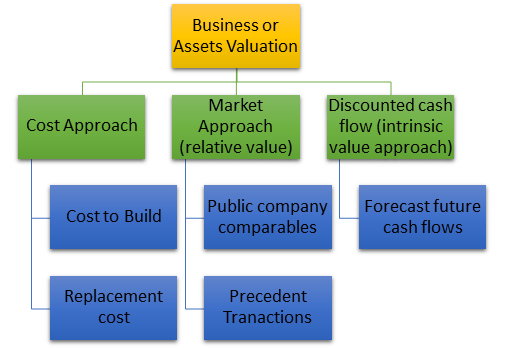
When valuing a company as a going concern, there are three main valuation methods used by industry practitioners:

(1) DCF analysis

(2) comparable company analysis,

(3) precedent transactions.

These are the most common methods of valuation used in investment banking, equity research, private equity, corporate development, mergers & acquisitions (M&A), leveraged buyouts (LBO), and most areas of finance.

As shown in the diagram above, when valuing a business or asset, there are three broad categories that each contain their own methods. The Cost Approach looks at what it costs to build something and this method is not frequently used by finance professionals to value a company as a going concern. Next is the Market Approach, this is a form of relative valuation and frequently used in the industry. It includes Comparable Analysis Precedent Transactions.  Finally, the discounted cash flow (DCF) approach is a form of intrinsic valuation and is the most detailed and thorough approach to valuation modeling.

Method 1: Comparable Analysis (“Comps”)

Comparable company analysis (also called “trading multiples” or “peer group analysis” or “equity comps” or “public market multiples”) is a relative valuation method in which you compare the current value of a business to other similar businesses by looking at trading multiples like P/E, EV/EBITDA, or other ratios. Multiples of EBITDA are the most common valuation method.

The “comps” valuation method provides an observable value for the business, based on what companies are currently worth. Comps are the most widely used approach, as they are easy to calculate and always current.

Method 2: Precedent Transactions

Precedent transactions analysis is another form of relative valuation where you compare the company in question to other businesses that have recently been sold or acquired in the same industry. These transaction values include the take-over premium included in the price for which they were acquired.

These values represent the en bloc value of a business. They are useful for M&A transactions, but can easily become stale-dated and no longer reflective of the current market as time passes. They are less commonly used than Comps or market trading multiples.

Method 3: DCF Analysis

Discounted Cash Flow (DCF) analysis is an intrinsic value approach where an analyst forecasts the business’ unlevered free cash flow into the future and discounts it back to today at the firm’s Weighted Average Cost of Captial (WACC).

A DCF analysis is performed by building a financial model in Excel and requires an extensive amount of detail and analysis.  It is the most detailed of the three approaches, requires the most assumptions, and often produces the highest value. However, the effort required for preparing a DCF model will also often result in the most accurate valuation. A DCF model allows the analyst to forecast value based on different scenarios, and even perform a sensitivity analysis.

For larger businesses, the DCF value is commonly a sum-of-the-parts analysis, where different business units are modeled individually and added together.

error: Content is protected !!