Controlling Your Financial Future: Starting Early, Retirement Planning, Estate Planning

Starting Early

When you are young, you think you don’t have enough money to invest. Your initial steps into the working world also come with more expenses. Now that you finally have the money to buy that cell phone, TV or the car you always wanted, your salary or income disappears faster than you realise. Keeping some money aside for investing may feel unimportant. So you may think why not start investing a few years later when you have more money to spend and save? Unfortunately, this cycle never ends. By the time you realise the importance of investing, you may lose the advantage of time by your side.

Even a small amount can create a big value if given enough time.

Investing early can give you a big advantage. You can not only plan your investments but also give them enough time to grow into a corpus that meets your financial goals.

Power of compounding

Compounding essentially means reinvesting the profits from your investments to make your investments grow exponentially. Let us say you start with just Rs1 that keeps doubling every day for 25 days. How much do you think will be the final amount at the end of the 25th day? From Rs 1 it will go to Rs 2 the second day, Rs 4 the third day and so on, reaching a phenomenal amount of Rs 1.67 crore rupees on the 25th day!

This is the power of compounding. However, if you follow the same example for 20 days, then the amount is just Rs 5.24 lakh ‘96% less than what you get after 5 more days. This shows that when giving your investments the power of compounding, giving enough time for them to grow is equally important.

Benefits of compounding

So how do you take advantage of the power of compounding in your investments?

Make sure you start investing, even small amounts, as soon as you start earning for compounding to work.

Avoid any withdrawals as it reduces your invested amount, giving lower returns.

Consider an example:

Mayank and Vivek are brothers. Mayank is 25 years old and starts a Systematic Investment Plan (SIP) of Rs 5,000 per month in a mutual fund, with growth option (which means returns will be reinvested for compounding to work). SIP essentially means that he does not need to have a large sum to invest in a mutual fund. He can instead break it into monthly regular parts for his investment.

Meanwhile, 30-year-old Vivek also starts the same SIP with Mayank. They both want to keep investing till they retire at 60 years. Assuming they got an average return of 9% each year when they both turn 60, Mayank’s accumulated amount would have reached Rs1.35 crore and Vivek’s amount will be Rs 85.7 lakh rupees. So by starting just five years earlier, Mayank will get Rs 49.9 lakh more than Vivek!

This simple example shows that if you start early, invest regularly and avoid withdrawing from this accumulating amount, your investment will grow manifold. This will enable you to create wealth and fulfil your financial goals in life like buying that dream house, funding your child’s education or your own retirement in a much easier way.

Retirement Planning

1. Peace of Mind

This is by far one of the most important benefits of retirement planning. Planning ahead not only reduces your stress during retirement but also in the years leading up to it. The lack of planning can leave a cloud of uncertainty around the topic that can create an unnecessary level of stress.

2. Contextualize Pre-Retirement Decisions

If you take the time to plan for your retirement early on, you will be able to make more efficient career-related and general financial decisions prior to retirement with appropriate planning. Is it better to stay at the current law firm or start your own practice? Will the mid to late career degree, license or other credential make sense monetarily? These decisions may be different for someone with fifteen years to retirement compared to someone with only five years until retirement.

3. Getting on the Same Page

One of the benefits of early retirement planning is that you can make sure your plans work well with other relevant parties. It’s never too early to make sure that you and your spouse are on the same page with spending and lifestyle desires in retirement, but your significant other may not be the only family member you may wish to have a conversation with.

Some retirement plans are often affected by a saver’s desire to meet other objectives such as assisting an adult child in starting or acquiring their business. To the extent that these goals may affect your own retirement savings, you will benefit from planning beforehand.

4. Tax Benefits

There are several tax benefits of retirement planning, including reducing the amount of income taxes you will pay during retirement and ensuring that beneficiaries to retirement and other account types pay as little tax as possible.

One of the key areas that many people overlook during their life while saving for retirement is tax diversification. This involves establishing different “pools” of money in accounts that are taxable, tax-free and tax-deferred. These different accounts allow income during retirement to be strategically withdrawn from a variety of sources depending on future conditions.

One retirement saver who only has a tax-deferred account (a traditional IRA, for example) may pay substantially more in taxes for the same withdrawal amount as another saver with a traditional IRA, Roth IRA and regular taxable funds. The earlier your planning begins, the easier it is to establish and grow your funds among these available “pools” of money.

5. Cost Saving

There are many ways to reduce costs with appropriate planning. Many of the insurance policies you may need (long-term care, etc.) can be acquired at a lower premium when younger and in good health rather than waiting until retirement and risking a higher rate or denial of coverage.

Those who know where they would like to reside geographically often wish to examine options other than buying at the time they retire. Would it make good financial sense to acquire the property in the desired retirement location in advance and rent it out until retirement? How much time do you need beforehand if you plan to build a new property? Early retirement planning can increase the likelihood that your goals are met with the least cost.

6. Viewing Financial Issues in Context

One of the greatest benefits of planning, in general, is that you can determine how all your financial objectives relate to one another rather than evaluating them in isolation.

What are the tax consequences of my investment decision? How will the decision to purchase additional insurance affect my contribution to saving? How do these issues affect my heirs?

Think of your financial decisions not as a series of yes/no decisions unrelated to one another, but as many competing interests, each of which is affected by the rest.

7. Legacy Opportunities

Planning for retirement can also provide benefit to your heirs or your favorite charitable causes. View your legacy in total, not just the distribution of your assets at death to various beneficiaries. Your wishes may be more complex than you think.

Perhaps your retirement decision involves unwinding or selling a business you’ve started. You may find your decisions affect not just yourself but many employees. Perhaps you have charitable interests and plan to commit a certain amount of your worth to various causes.

By planning beforehand, you may be able to take from sources (during life or after) that have the most favorable tax consequences, thus giving in the most efficient manner.

Estate Planning

Provide For Your Family

Without an estate plan in place, your family will get less and it will take them longer to get it. This means your loved ones will be left in limbo and might end up without enough money to pay bills and other living expenses. It’s not uncommon for families with an unexpected death to nearly fall apart due to the financial strain in the weeks, months, and years to come.

Good estate planning will make sure that your family is provided for and not left to face financial ruin once you’re gone.

Keep Your Children Out Of Child Protective Services

As unpleasant as this next thought is going to be, take a minute and ask yourself what would happen to your kids if you and/or your spouse were involved in a major car accident on the way home from work tomorrow?

Really, think about it. Who will pick them up from school or daycare? Where will they sleep that night and the nights to come? Who will ultimately end up as their guardian?

If you don’t have an estate plan in place, than you might not like the answers to these questions. Why let your kids end up in Child Protective Services while the courts sort out who will serve as their guardian?Why leave that decision up to the courts at all? Do you really want a judge to decide who will raise your kids without any input from you or your spouse?

Minimize Your Expenses

Do you know where most of the money goes when people don’t have a good estate plan? Attorney’s fees and court costs.

When you die without an estate plan (and without a living trust, in particular) the courts are forced to handle everything: the distribution of your property, the guardianship of your children, the dissolution of your business. This is known as “probate,” and it get’s very expensive easily exceeding $10,000 for even modest estates. That’s money your family and kids could’ve used for living expenses and other bills, but instead it’s just lining the pockets of your attorney.

Get Property to Loved Ones Quickly

You have two options here. Option 1, your family has to wait anywhere from 3-9 months to get anything after you die. Option 2, your family gets money they need to pay bills, to pay for your funeral, to pay for your outstanding medical bills, and to pay for anything else they need right away and without delay.
Which one would you choose? Good estate planning let’s you avoid the big delays that can put a real financial strain on your family.

Save Your Family From The Difficult Decisions

Can you imagine trying to decide when to pull the plug on your spouse who is in a coma or similar condition? Or deciding how his or her remains should be handled?

Those are heart breaking decisions that no one should have to face. You can ease this burden by thinking about this kind of thing in advance and planning ahead for it. You can specify in your estate plan how you want end-of-life care to be handled and what kind of disposal arrangements you want made for your remains. And there’s no one better to make those decisions than you.

Reduce Taxes

Every single dollar that you pay in taxes is one less dollar that your family will have for paying bills and other expenses. There are numerous tax reduction strategies that you can use to keep as much money in the hands of your family as possible.The key is to start tax planning sooner rather than later and definitely not to wait until it’s too late.

Make Retirement Easier

You might be surprised to hear that estate planning can actually benefit you while you’re alive, not just your family after you’re gone. Healthcare in particular is an area where estate planning can benefit you enormously down the road by making sure you’re eligible for government benefits like Medicare (that you’ve been paying into most of your working life anyways, so you might as well get something back), that can significantly reduce your healthcare costs and leave more money to your loved ones.

Plan For Incapacity

Estate planning is not just about death. It’s very common for people to become incapacitated by an accident or sudden medical episode like a stroke that leaves them unable to manage their financial affairs.

If this happens to you, who will take care of paying your bills or managing your healthcare? A power of attorney designation for both financial and healthcare decisions can save your family a lot of time and money and make sure everything is handled according to your wishes.

Support Your Favorite Cause

You might have heard that Mark Zuckerberg (the founder of Facebook) decided to join Bill Gates and Warren Buffet in leaving the vast majority of his fortune to charity instead of his family. Even though you don’t have billions of dollars to leave to charity, you can still make a difference by supporting your favorite educational, religious, or other charitable cause. Even if it’s just a hundred dollars, that money can help others and make a difference in their lives.

Make Sure Your Business Runs Smoothly

If you are a small business owner, then you absolutely must have an estate plan. It’s one of the most important things you can do and is really not optional. Without one, your business will likely fall apart quickly and completely if something happens to you, and that can cause incredible financial hardship on your family.

You have the opportunity to provide for an orderly transition to someone else and continue the business by spelling out what happens if you become disabled or die. Don’t do a disservice to your family by leaving these kinds of ends untied.

Investing in Bonds

There are two reasons for it: (a) Government bonds are issued by the central government in India, (b) These bonds are regulated and managed by Reserve Bank of India (RBI).

What makes government bonds risk free is the security of the principal amount, and the certainty of the promised return. A person who wants to invest for long term, but wants to keep it risk-free, Government bonds are the best option.

Government Bonds

What are bonds and T-bills? These are Securities (G-secs) issued by the government of India to borrow money from investors. Who are investors?

  • Big Investors: Banks, insurance companies, mutual funds, trusts, corporates etc. These are called big because their size of investment (in G-Secs) are large compared to small investors. Know more about mutual funds.
  • Small Investors: HNI’s, NRIs, HUF members, individuals etc. In this group of people, ‘individual investors’ are the ones where we common men are placed. Read more about Peter Lynch a big HNI investor.

Government borrows money from these investors by offering them G-secs through “auctions“. How the auction is done? Through “competitive bidding” process. We will read more about it below.

In good old days, G-sec market was dominated by big players like banks, insurance companies, mutual funds etc. Small investors stood away from investing directly in bonds. Why? 

  • First because of the difficult process of investing in bonds. A common man just did not knew how to buy government bonds. The ease with which they can buy stocks, mutual funds etc, Government bonds purchase was not as simple. Read more about how to buy stock online.
  • Secondly, because the big players used to deal in much larger volumes, individuals just could not compete with them in the “auction” process. Know if small investors shall invest in debt funds.

Government Bonds – Process of Purchase

Before Nov’2017, Government Securities (G-Secs) like bonds and T-bills were virtually non-accessible for common men (small investors). But then RBI started the “Non-competitive Bidding Facility“. This made G-secs more accessible for common men.

Lets understand more about competitive and non-competitive bidding process:

  • Competitive bidding: Example: Government issues a bond of Face Value of Rs.1,000, offering an interest @8.0% p.a. In the competitive bidding process (auction), “investors” will quote a price higher than the face value (Rs.1,000). Suppose based on all bids, RBI accepts a cut-off price as Rs.1,060. In this case everyone who has quoted Rs.1,060 or more will get their quoted lot of the bond. [Note: In this case, their yield will be lower than 8.0%. How much lower? 7.54% (=8.0% / 1,060 * 1000)].
  • Non-competitive bidding: RBI’s “non-competitive bidding facility” for retail investors like me and you. Small investors just need to access the mobile and web app of NSE.

mall investors like me and you can buy government bonds in India using a mobile app or a web based app of National Stock Exchange (NSE). This app is called “NSE goBID“. Either of these two apps can be used to buy the following:

  • Long-dated government bonds: holding time: 5 to 40 year.
  • Treasury bills (T-bills): holding time less than 1 year.

Before one can go ahead and buy the government bonds using NSE goBID, the “process of registration” must be completed. But do not worry, everything is online. 

About NSE goBID APP

To get a better perspective of how/why a common man can invest in bonds, let’s understand why rich and wealthy like bonds.

Why wealthy prefer bonds?

The way high net worth investors think investment is slightly different than majority. They invest money in a backdrop of a condition where they have excess of it (money). How does it make a difference?

As they have money in excess, they can afford to buy bonds and not need it easily for next 10-15 years. This money can stay invested for prolonged period of time, and yield low returns (like 8% p.a.). Wealthy people do not mind it. They invest money mostly for wealth protection.

In the process of wealth protection, if their investment can yield even 8% p.a. odd returns, it is like icing on the cake. Moreover, the returns of the government bonds are almost guaranteed. How? Because they are backed by the Indian government. 

Whereas when we (common men) invest money for time horizons like 10-15 years, we think about growth. For such prolonged horizons we will instead invest in equity. Why? Because our objective is wealth creation. Read more about where to invest money for high returns.

So what does this tell us about bonds? It is only for rich and wealthy, right? But there are conditions where bonds may become good investment option for common men as well. Let’s see how…

When bonds are useful for common men…

Generally speaking, when common men invest money, they do it for wealth creation. Hence, they often invest with a long term perspective (5+ years). Equity based investment options can give much higher returns than bonds.

In India, a government bond will yield returns between 7-8% per annum even in long term. But a good equity based plan can easily give 14% p.a. in a time horizon of 5+ years. Read more about types of mutual funds and their potential returns.

Types of Government Bonds in India

The multiple variants of Government bonds are discussed below:

  • Fixed-rate bonds

Government bonds of this nature come with a fixed rate of interest which remains constant throughout the tenure of investment irrespective of fluctuating market rates.

The coupon on a Government Bond is mentioned in nomenclature. For instance, 7% GOI 2021 means the following

Rate of interest on face value 7%
Issuer Government of India
Maturity year 2021
  • Floating Rate Bonds (FRBs)

As the name suggests, FRBs are subject to periodic changes in rate of returns. The change in rates is undertaken at intervals which are declared beforehand during the issuance of such bonds. For instance, an FRB could have a pre-announced interval of 6 months; which means interest rates on it would be re-set every six months throughout the tenure.

There is another variant to FRBs, wherein the rate of interest rate is bifurcated into two components: a base rate and a fixed spread. This spread is decided through auction and remains constant throughout the maturity tenure.

  • Sovereign Gold Bonds (SGBs)

The Central Government issues sovereign Gold Bonds, wherein entities can invest in gold for an extended period through such bonds, without the burden of investing in physical gold. The interest earned on such bonds is exempted from tax.

Prices of such bonds are linked with gold’s prices. The nominal value of SGBs is reached by calculating the simple average of closing prices of 99.99% purity gold, three days preceding such bonds’ issuance. SGBs are also denominated in terms of one gram of gold.

As per RBI regulations, there are individual ceilings concerning SGB possession for different entities. Individuals and Hindu Undivided Families can only hold up to 4 kg of Sovereign Gold Bonds in a financial year. Trusts and other relevant entities can hold up to 20 kg if SGBs during a similar time frame. Interest at 2.50% is disbursed periodically on such SGBs and has a fixed maturity period of 8 years unless stated otherwise. Also, no tax is levied on interest earnings through such SGBs.

Investors seeking liquidity from such bonds shall need to wait for the first five years to redeem it. However, redemption shall only take effect on the date of subsequent interest disbursal.

Assuming that Mr A invested in an SGB on 1st April 2014, and interest disbursals are set on 1st May 2014 and every six months from thereon. In case he decides to withdraw it on 1st June 2019, he shall need to wait till 1st November 2019(interest disbursal date) to receive the redemption amount.

  • Inflation-Indexed Bonds

It is a unique financial instrument, wherein the principal, as well as the interest earned on such bond, is accorded with inflation. Mainly issued for retail investors, these bonds are indexed as per the Consumer Price Index (CPI) or Wholesale Price Index (WPI). Such IIBs ensure real returns accrued with such investments remain constant, thereby allowing investors to safeguard their portfolio against inflation rates.

Another variant of such inflation-adjusted securities is Capital Indexed Bond. However, unlike IIBs, only the capital or principal proportion of balance is accorded with an inflation index.

  • 7.75% GOI Savings Bond

This G-Sec was introduced as a replacement to the 8% Savings Bond in 2018. As noted from its nomenclature, the interest rate of such bonds is set at 7.75%. As per RBI regulations, these bonds can only be held by:

  • An individual or individuals who are/are not NRI(s) in any capacity
  • A minor with a legal guardian representative
  • A Hindu Undivided Family

Interest earnings from such bonds are taxable under the Income Tax Act 1961 as per the investors’ applicable income tax slab. The minimum amount at which these bonds are issued is Rs. 1000 and in multiples of Rs. 1000 thereof.

  • Bonds with Call or Put Option

The distinguishing feature of this type of bonds is the issuer enjoys the right to buy-back such bonds (call option) or the investor can exercise its right to sell (put option) them to such issuer. This transaction shall only take place on a date of interest disbursal.

Participating entities, i.e. the government and investor can only exercise their rights after the lapse of 5 years from its issuance date. This type of bonds might come with either:

  • Call option only
  • Put option only
  • Both

In any case, the government can buy back its bonds at face value. Similarly, investors can sell such bonds to the issuer at face value. This ensures the preservation of the corpus invested in case of any downturn of the stock market.

  • Zero-Coupon Bonds

As the name suggests, Zero-Coupon Bonds do not earn any interest. Earnings from Zero-Coupon Bonds arise from the difference in issuance price (at a discount) and redemption value (at par). This type of bonds are not issued through auction but rather created from existing securities.

Advantages of Investing in Government Bonds

  • Sovereign Guarantee 

Government Bonds enjoy a premium status with respect to the stability of funds and promise of assured returns. As G-Secs are a form of a formal declaration of Government’s debt obligation, it implies the issuing governmental body’s liability to repay as per the stipulated terms.

  • Inflation-adjusted 

Balances held in Inflation-Indexed Bonds are adjusted against increasing average price level. Other than that, the principal amount invested in Capital Indexed Bonds is also adjusted against inflation. This feature provides an edge to investors as they are less susceptible to be financially undermined as investing in such funds increase the real value of the deposited funds.

  • Regular source of income

As per RBI regulations, interest earnings accrued on Government Bonds are supposed to be disbursed every six months to such debt holders. It provides investors with an opportunity to earn regular income by investing their idle funds.

Disadvantages of Investing in Government Bonds

  • Low Income

Other than 7.75% GOI Savings Bond, interest earnings on other types of bonds are relatively lower.

  • Loss of relevancy

As Government Bonds are long-term investment options with maturity tenure ranging from 5 – 40 years, it can lose relevancy over time. It means such bonds value loses relevance in the face of inflation, barring IIBs and Capital Indexed Bonds.

Investing in Mutual Funds

Mutual funds are investment vehicles that pool money from many different investors to increase their buying power and diversify their holdings. This allows investors to add a substantial number of securities to their portfolio for a much lower price than purchasing each security individually.

Benefits of Mutual Funds

Risk reduction

As mutual funds are managed professionally it reduces the risk factor. Also, they are invested in a huge number of companies. Thus, the risk factor is reduced more.

Diversification

There are a large number of investors that has savings with them. Thus, these small savings are brought together and a mutual fund is created. So, this can be used to buy the share of many different companies. Also, because of this diversification, the investment ensures capital appreciation and regular return.

Tax advantage

There are many schemes in a mutual fund that provide a tax advantage under the new income tax act. So, the liability of paying the tax of an investor is also reduced. This can be possible only when he/she invests in mutual funds.

Investor protection

Mutual funds are monitored and regulated by the SEBI. Thus, it provides better protection to its investors. Also, this makes sure that there is no legal obligation for the investors.

Disadvantages of Mutual Funds

Although mutual funds can be beneficial in many ways, they are not for everyone.

  1. No Control over Portfolio. If you invest in a fund, you give up all control of your portfolio to the mutual fund money managers who run it.
  2. Capital Gains. Anytime you sell stock, you’re taxed on your gains. However, in a mutual fund, you’re taxed when the fund distributes gains it made from selling individual holdings even if you haven’t sold your shares. If the fund has high turnover, or sells holdings often, capital gains distributions could be an annual event.
  3. Fees and Expenses. Some mutual funds may assess a sales charge on all purchases, also known as a “load” this is what it costs to get into the fund. Plus, all mutual funds charge annual expenses, which are conveniently expressed as an annual expense ratio this is basically the cost of doing business. The expense ratio is expressed as a percentage, and is what you pay annually as a portion of your account value. The average for managed funds is around 1.5%. Alternatively, index funds charge much lower expenses (0.25% on average) because they are not actively managed. Since the expense ratio will eat directly into gains on an annual basis, closely compare expense ratios for different funds you’re considering.
  4. Over-diversification. Although there are many benefits of diversification, there are pitfalls of being over-diversified. Think of it like a sliding scale: The more securities you hold, the less likely you are to feel their individual returns on your overall portfolio. What this means is that though risk will be reduced, so too will the potential for gains. This may be an understood trade-off with diversification, but too much diversification can negate the reason you want market exposure in the first place.
  5. Cash DragMutual funds need to maintain assets in cash to satisfy investor redemptions and to maintain liquidity for purchases. However, investors still pay to have funds sitting in cash because annual expenses are assessed on all fund assets, regardless of whether they’re invested or not. According to a study by William O’Reilly, CFA and Michael Preisano, CFA, maintaining this liquidity costs investors 0.83% of their portfolio value on an annual basis.

Investing Your Financial Resources: Investing Fundamentals

The word “investment” can be defined in many ways according to different theories and principles. It is a term that can be used in a number of contexts. However, the different meanings of “investment” are more alike than dissimilar. Generally, investment is the application of money for earning more money. Investment also means savings or savings made through delayed consumption. According to economics, investment is the utilization of resources in order to increase income or production output in the future.

An amount deposited into a bank or machinery that is purchased in anticipation of earning income in the long run is both examples of investments. Although there is a general broad definition to the term investment, it carries slightly different meanings to different industrial sectors.

According to economists, investment refers to any physical or tangible asset, for example, a building or machinery and equipment. On the other hand, finance professionals define an investment as money utilized for buying financial assets, for example stocks, bonds, bullion, real properties, and precious items.

According to finance, the practice of investment refers to the buying of a financial product or any valued item with anticipation that positive returns will be received in the future. The most important feature of financial investments is that they carry high market liquidity. The method used for evaluating the value of a financial investment is known as valuation. According to business theories, investment is that activity in which a manufacturer buys a physical asset, for example, stock or production equipment, in expectation that this will help the business to prosper in the long run.

Types of Investment in Security Analysis and Portfolio Management

Types of investments

Investments may be classified as financial investments or economic investments.In Finance investment is putting money into something with the expectation of gain that upon thorough analysis has a high degree of security for the principal amount, as well as security of return, within an expected period of time. In contrast putting money into something with an expectation of gain without thorough analysis, without security of principal, and without security of return is speculation or gambling. Investment is related to saving or deferring consumption. Investment is involved in many areas of the economy, such as business management and finance whether for households, firms, or governments.

Economic investments are undertaken with an expectation of increasing the current economy’s capital stock that consists of goods and services. Capital stock is used in the production of other goods and services desired by the society. Investment in this sense implies the expectation of formation of new and productive capital in the form of new constructions, plant and machinery, inventories, and so on. Such investments generate physical assets and also industrial activity. These activities are undertaken by corporate entities that participate in the capital market.

Financial investments and economic investments are, however, related and dependent. The money invested in financial investments is ultimately converted into physical assets. Thus, all investments result in the acquisition of some asset, either financial or physical. In this sense, markets are also closely related to each other. Hence, the perfect financial market should reflect the progress pattern of the real market since, in reality, financial markets exist only as a support to the real market.

Nature and Objectives of Investment Management

Nature of investment

The features of economic and financial investments can be summarized as return, risk, safety, and liquidity.

  1. Return
  • All investments are characterized by the expectation of a return. In fact, investments are made with the primary objective of deriving a return.
  • The return may be received in the form of yield plus capital appreciation.
  • The difference between the sale price and the purchase price is capital appreciation.
  • The dividend or interest received from the investment is theyield.
  • The return from an investment depends upon the nature of the investment, the maturity period and a host of other factors.

Return = Capital Gain + Yield (interest, dividend etc.)

  1. Risk

Risk refers to the loss of principal amount of an investment. It is one of the major characteristics of an investment.

The risk depends on the following factors:

  • The investment maturity period is longer; in this case, investor will take larger risk.
  • Government or Semi Government bodies are issuing securities which have less risk.
  • In the case of the debt instrument or fixed deposit, the risk of above investment is less due to their secured and fixed interest payable on them. For instance, debentures.
  • In the case of ownership instrument like equity or preference shares, the risk is more due to their unsecured nature and variability of their return and ownership character.
  • The risk of degree of variability of returns is more in the case of ownership capital compare to debt capital.
  • The tax provisions would influence the return of risk.
  1. Safety:

Safety refers to the protection of investor principal amount and expected rate of return.

  • Safety is also one of the essential and crucial elements of investment. Investor prefers safety about his capital. Capital is the certainty of return without loss of money or it will take time to retain it. If investor prefers less risk securities, he chooses Government bonds. In the case, investor prefers high rate of return investor will choose private Securities and Safety of these securities is low.
  1. Liquidity:

Liquidity refers to an investment ready to convert into cash position. In other words, it is available immediately in cash form. Liquidity means that investment is easily realizable, saleable or marketable. When the liquidity is high, then the return may be low. For example, UTI units. An investor generally prefers liquidity for his investments, safety of funds through a minimum risk and maximization of return from an investment.

 Four main investment objectives cover how you accomplish most financial goals. These investment objectives are important because certain products and strategies work for one objective, but may produce poor results for another objective. It is quite likely you will use several of these investment objectives simultaneously to accomplish different objectives without any conflict. Let’s examine these objectives and see how they differ.

Capital Appreciation

Capital appreciation is concerned with long-term growth. This strategy is most familiar in retirement plans where investments work for many years inside a qualified plan. However, investing for capital appreciation is not limited to qualified retirement accounts. If this is your objective, you are planning to hold the stocks for many years. You are content to let them grow within your portfolio, reinvesting dividends to purchase more shares. A typical strategy employs making regular purchases. You are not very concerned with day-to-day fluctuations, but keep a close eye on the fundamentals of the company for changes that could affect long-term growth.

Current Income

If your objective is current income, you are most likely interested in stocks that pay a consistent and high dividend. You may also include some top-quality real estate investment trusts (REITs) and highly-rated bonds. All of these products produce current income on a regular basis. Many people who pursue a strategy of current income are retired and use the income for living expenses. Other people take advantage of a lump sum of capital to create an income stream that never touches the principal, yet provides cash for certain current needs (college, for example).

Capital Preservation

Capital preservation is a strategy you often associate with elderly people who want to make sure they don’t outlive their money. Retired on nearly retired people often use this strategy to hold on the detention has. For this investor, safety is extremely important – even to the extent of giving up return for security. The logic for this safety is clear. If they lose their money through foolish investment and are retired, it is unlike they will get a chance to replace it. Investors who use capital preservation tend to invest in bank CDs, U.S. Treasury issues and savings accounts.

Speculation

The speculator is not a true investor, but a trader who enjoys jumping into and out of stocks as if they were bad shoes. Speculators or traders are interested in quick profits and used advanced trading techniques like shorting stocks, trading on the margin, options and other special equipment. They have no love for the companies they trade and, in fact may not know much about them at all other than the stock is volatile and ripe for a quick profit. Speculators keep their eyes open for a quick profit situation and hope to trade in and out without much thought about the underlying companies. Many people try speculating in the stock market with the misguided goal of getting rich. It doesn’t work that way. If you want to try your hand, make sure you are using money you can afford to lose. It’s easy to get addicted, so make sure you understand the real possibilities of losing your investment.

The secondary objectives are tax minimization and Marketability or liquidity.

Tax Minimization:

An investor may pursue certain investments in order to adopt tax minimization as part of his or her investment strategy. A highly-paid executive, for example, may want to seek investments with favorable tax treatment in order to lessen his or her overall income tax burden. Making contributions to an IRA or other tax-sheltered retirement plan can be an effective tax minimization strategy.

Marketability/Liquidity:

Many of the investments we have discussed are reasonably illiquid, which means they cannot be immediately sold and easily converted into cash. Achieving a degree of liquidity, however, requires the sacrifice of a certain level of income or potential for capital gains.

Common stock is often considered the most liquid of investments, since it can usually be sold within a day or two of the decision to sell. Bonds can also be fairly marketable, but some bonds are highly illiquid, or non-tradable, possessing a fixed term. Similarly, money market instruments may only be redeemable at the precise date at which the fixed term ends. If an investor seeks liquidity, money market assets and non-tradable bonds aren’t likely to be held in his or her portfolio.

Investing in Stocks

Despite its popularity and presence in the news, the stock market is just one of many potential places to invest your money. Investing in stock is often risky, which draws attention to the huge gains and losses of some investors. If you manage the risks, you can take advantage of the stock market to secure your financial position and earn money.

Investment Gains

One of the primary benefits of investing in the stock market is the chance to grow your money. Over time, the stock market tends to rise in value, though the prices of individual stocks rise and fall daily. Investments in stable companies that are able to grow tend to make profits for investors. Likewise, investing in many different stocks will help build your wealth by leveraging growth in different sectors of the economy, resulting in a profit even if some of your individual stocks lose value.

Dividend Income

Some stocks provide income in the form of a dividend. While not all stocks offer dividends, those that do deliver annual payments to investors. These payments arrive even if the stock has lost value and represent income on top of any profits that come from eventually selling the stock. Dividend income can help fund a retirement or pay for even more investing as you grow your investment portfolio over time.

Diversification

For investors who put money into different types of investment products, a stock market investment has the benefit of providing diversification. Stock market investments change value independently of other types of investments, such as bonds and real estate. Holding stock can help you weather losses to other investment products. Stock also adds risk to a portfolio, as well as the potential for large, rapid gains, helping investors avoid risk-averse or overly conservative investment strategies.

Ownership

Buying shares of stock means taking on an ownership stake in the company you purchase stock in. This means that investing in the stock market also brings benefits that are part of being one of a business’s owners. Shareholders vote on corporate board members and certain business decisions. They also receive annual reports to learn more about the company. Owning stock in the company you work for can be a way to express loyalty and tie your personal finances to the success of the business as a whole.

Higher Liquidity:

In the Indian stock market, two exchanges, the Bombay Stock Exchange (BSE) and National Stock Exchange (NSE) play important roles. Most companies trade their shares on either or both of these exchanges. This provides higher liquidity to investors because average daily volumes are high. Therefore, if an investor wants to buy or sell any product on the stock exchanges, this liquidity makes it easy.

Versatility:

The stock market offers different financial instruments, such as shares, bonds, mutual funds, and derivatives. This provides investors a wide choice of products in which to invest their monies. In addition to providing investment choices, this flexibility is beneficial in mitigating the risks inherent to stock investing by enabling diversification of investment portfolios.

Higher Returns in Shorter Periods of Time:

Compared to other investment products like bonds and fixed deposits, stock investing provide investors an excellent possibility of making greater returns in comparatively shorter time periods. Adhering to the stock market basics, such as planning the trade, using stop-loss and take-profit triggers, doing the research and due diligence, and being patient can significantly mitigate the risks inherent to stock investing and maximize the returns on share market investments.

Acquire Ownership and Right to Vote:

Even if an investor acquires a single share in a company, he acquires a portion of ownership in the company. This ownership, in turn, provides investors the right to vote and offer his contribution in the strategic movement of the business. Although this may seem like an exaggeration, it is true and there are several instances when shareholders have prevented company management from making unreasonable decisions that are detrimental to their interests.

Regulatory Environment and Framework:

The Indian stock market is regulated by the Stock Exchange Board of India (SEBI). The SEBI has the responsibility of regulating the stock exchanges, its development, and protecting the rights of the investors. This means when investors invest in financial products on the stock market, their interests are well-protected by a regulatory framework. This significantly helps in reducing risks due to fraudulent activities of companies.

Convenience:

Technical development has influenced every aspect of modern living. The stock exchanges are also using various technical advancements to provide greater convenience to the investors. The trades are all executed on an electronic platform to ensure the best investment opportunities to investors in an open environment. In addition, broking service providers offer online share trading facilities that make investing convenient, because investors can place their orders through a computer from the comfort of their homes or offices. The demat account makes it easier for investors to hold all the products within their investment portfolio electronically in a single location, which makes it easier to track and monitor the performance.

Although stock investing has several benefits, investors must also be cautious while making their decisions. Understanding the stock market basics and doing their research before investing is advisable to mitigate risks and maximize returns.

Other Investment Alternatives

Stock Investment

Stock investment is one of the most preferred investment options due to the high return potential. As the stock investments carry a little higher risk and hence are also capable of generating high returns.

You can expect an annual return of 15% – 18%, if you know the art of investing in the right stocks at the right time. I would recommend you to start with a small investment in stock with an intent to learn before making big investments.

Best Investment Options for a Salaried Person

1. Public Provident Fund (PPF)

Apart from your regular pension contribution, an investment in PPF account can save lots of tax as all the deposits made are deductible under section 80C.

Further, all the accumulated principal and interest are exempted from tax at the time of withdrawal.

2. National Pension System (NPS)

NPS scheme is portable across jobs and locations. The added benefit is the returns from equity and debt investments.

All your contributions up to Rs. 1.5 Lac to Tier I capital are exempted under section 80C. Plus you can claim an additional up to Rs. 50,000 of tax benefits.

So here you can save Rs. 2 Lacs of tax.

3. Equity Linked Savings Scheme (ELSS)

You get a higher return of 15% to 18% while investing in ELSS. Investment in ELSS funds have a lesser lock-in period of 3 years and any earning over Rs. 1 Lac are taxable.

4. Tax Savings Fixed Deposit

If you want to have a safe investment option without investing in equities then pick tax saving fixed deposit of any bank or post office.

The interest rates vary from bank to bank and are in the range of 6% to 8.5%.

5. Unit Linked Insurance Plans (ULIPs)

Investments in ULIPs gives you wealth creation option along with life cover. Premium paid are eligible for deduction under section 80C. Plus the returns on maturity are exempt under section 10(10D).

The returns vary depending on the combination of equity, debt or hybrid funds.

Best Investment Plan with High Returns

6. Direct Equity Investment

All the equity investments carry higher risks and hence are also capable of generating very high returns. Opt for equity investment option if you are comfortable losing as much as 50% of the capital.

The last 1-year return of NSE is 12.40% and in the last 2 year generated a 26.5% returns. Likewise, shares of blue-chip companies have delivered huge returns in the near past.

7. Mutual Funds

Mutual funds are the safest and the most convenient way of investing in the markets when you do not have the time and expertise.

The equity mutual funds have generated consistently higher returns. With funds like L&T India Value, Mirae Asset India and ICICI Prudential Blue Chip delivering 3 years return in the range of 14% to 18%.

The investment in mutual funds can be a lump sum or monthly SIP for an amount as low as Rs. 500.

8. Commercial Real Estate

Commercial real estate provides rental income and capital appreciation. The higher appreciation is due to demand for office space and growth of corporate environment.

But the location, building quality, market space rent and the demand-supply plays a major factor in deciding returns.

A good investment in office and shop spaces not only fetches higher returns but also helps in the diversification of investment assets.

9. Initial Public Offer (IPO)

The best part of investing in IPO is that the money gets blocked only for 7 to 15 days. Prudent investment in a good company coming out with IPO can fetch returns as high as 20-25% over a period of time.

Best Investment Plan for 1 Year

10. Fixed Deposit

FDs are the safest and secure investment options provided by banks and post offices which earn higher interest rates than a savings account.

Any excess amount which you are not going to use for a certain period of time can be safely put into a fixed deposit.

11. Recurring Deposit

Like fixed deposit, RD to earns a higher interest rate than a savings account.

RD let you invest any amount which can be as small as Rs. 5 per month and is the best option for promoting the habit of savings.

12. Liquid Mutual Fund

The option carries the least amount of risk and is for persons who have idle money for short period of time.

The mutual fund invests your money in the highly liquid short term instruments like the bank’s CD, T-bills and commercial papers generally with a maturity period of less than 91 days.

13. Ultra Short Term Debt MF Plans

Unlike, liquid MF the money is invested in bonds and other instruments with maturity more than 91 days and less than 1 year.

Ultra ST debt MF does carry interest rate risk, are not so liquid and hence gives you higher returns.

Best Investment Plan for 3 Years

14. Savings Account with Sweep in Facility

The sweep in option lets you enjoy flexibility in managing your savings and also enjoy higher returns from a fixed deposit.

Here, any excess money lying in your savings account, above a particular threshold level gets automatically converted into a fixed deposit and vice versa.

15. Short Term Debt MF

Is a good option for generating stable returns with modest risk.

The funds are locked for up to 3 years and there is a 1% penalty for premature redemption. Still you can expect returns a bit higher than the fixed deposit in a range of 8-10%.

16. Equity Linked Savings Scheme (ELSS)

There are numerous benefits when you invest in ELSS like tax savings, higher returns (15% to 18%), option to invest monthly (SIP) and can be started with as low as investing Rs. 500.

17. Fixed Deposit

Returns on a 3-year FDs vary from bank to bank, usually in a range of 6.5% to 8%. Also there are no associated tax benefits in this investment option.

8. Recurring Deposit (RD)

The returns generated are almost the same as a fixed deposit for a 3 year period.

Investing in Real Estate

There are hundreds of people around who can share their property investment ideas with us. Almost everyone, at some stage in their life, has experienced a property dealing. 

Bottom of Form

We’ve seen our parents, elder siblings etc buy a property. It has enriched our knowledge. Even listening about property dealing from friends also adds to our knowledge base. But nothing is more valuable than self indulgence.

Which are those deeper insights about property investment which experienced buyers use as their guide? How a beginner can invest in real estate in India as a pro?

This is what we are going to discuss in this article. But before that, lets’ refresh some basics about the property market in India.

Rich and wealthy invest in real estate directly. They own multiple residential or commercial properties. Steady and decent capital appreciation of their real estate property is common.

But the part which makes property investment so dear is its capability of generating stable short term income. The short term income is generated in form of “monthly rents“. 

The rate at which the rental income grows, generally beats inflation in long term. This is specially true for Metro, Tier1, and Tier 2 Cities. As the monthly yield of property grows, this also pushes the overall property price up. 

What is shown in the above infographic? Real estate investment generates assured returns. The returns are in form of rent and capital appreciation.

The rental yield (fixed income) grows with time. Generally this growth keeps pace with the inflation. Capital appreciation will happen due to demand growth. India being a growing and young population, demand for property keeps rising.

This dual effect (of assured rent and value growth) makes the real estate sector generate unparalleled returns, unlike any other asset.

Property investment is one of the best inflation hedge. This is the reason why big investors like Robert Kiyosaki and Donald Trump has special liking for it.

Tread With Caution

Why? Because, except for few Indian cities, real estate market has not really matured in India? Why I say so? Because we still see random development of properties in majority cities in India. 

A good real estate property must be developed, sold, and maintained as per a master plan incorporating all facilities.

Unless property has a master plan, its long term value appreciation is doubtful. In most cases, value of such properties depreciates with time.

The problem is, most of the properties are by either unplanned or are developed by below-par developers. This makes real estate investing in India slightly risky.

for a beginner, it is essential to know what to look at in a property. Investing in real estate cannot be done just on basis of aesthetics. Proportional weightage must be given to at least 14 parameters listed below:

Price

  • Affordability: If one’s affordability is Rs.35 Lakhs, and the property on offer is costing Rs.40 Lakhs, it is clearly not affordable. This is one reason why affordability calculation in step #1 is essential before making a commitment.

Vicinity

  • Location: Property investment must be done in a location which is known to the investor. Investing in an unknown city/town shall be avoided. Location of property within the city is also important. A property which has schools, markets, hospitals nearby is preferable.
  • Transportation: Approach road is important. If there is a broad and paved road connecting the property, it’s a big thumbs up. Public transport connectivity like metro, bus depot, auto rickshaw stand, Ola/Uber connectivity also adds to the value.
  • Negatives: Special attention must be given to the drawbacks of the property. Typical ones can be like busy roads, too close to railway station or airport, traffic noise, remote location, old society etc. These factors cause hardships & also lowers the quality of life of the residents.

Specification

  • Type of House: If the preference is a row house, multi-storeyed apartment will not work and vice versa. Before venturing out for property search, type of house must be finalised.
  • New or Used: Second hand homes can be great value for money. They have an advantage of ready possession and established locality. They may also have pre-built facilities like internet, heaters, wood work, modular kitchens etc. But a new property also comes with its own advantages.
  • Number of bedroom: For a small family, even a studio apartment is enough. For others, requirement may range from 1/2BHK to higher size flats. I personally like evaluating property first on basis of their size (in SQFT), and then on the number of bedrooms it can offer.
  • Open Floor: There are some properties which has slots & pockets for wardrobes, cabinets, fridge etc. Such homes offer better ‘open floor space management’ after the furnitures are put in place. Generally speaking, a house must be able to accommodate your special furnitures (like over , bicycle, pram etc).
  • Parking: If you own a car, two wheeler etc the property must offer an adequate parking facility.

Other Features

  • Communication: If the property has facilities already laid for services like cable TV and broadband etc, it can save few bucks. Generally speaking, look for mobile & internet connectivity in the area. There are some areas which has inherently poor mobile network connectivity.
  • Extension: Over a period of time, owners like to extend their living space. Properties which has provisions for extension may prove handy in times to come.
  • Gardening: For some, building a hanging garden in their balcony is a big plus. If you are looking for a row house, check if the open space provides the possibility of gardening. Property with such provisions becomes desirable.
  • Present Condition: Check the ‘built condition’ of the property. If it is a new property, no problem. But in a second hand house, rework or repairs may be required. Being aware of this extra cost before taking the possession is advisable.
  • Condition on Outside: Apartment may be good from inside, but the outside building is equally good? Make sure to check the property from outside. Scan the painting, cracks, seepage, loose wirings, encroachments, quality of parking etc.
  • Security: These days the societies are plagued with random thefts and pilferages. Make sure to check if the property has a dedicated security protection.

The Housing Decision: Factors and Finances

Main factors that affect the housing market

  • Economic growth. Demand for housing is dependent upon income. With higher economic growth and rising incomes, people will be able to spend more on houses; this will increase demand and push up prices. In fact, demand for housing is often noted to be income elastic (luxury good); rising incomes leading to a bigger % of income being spent on houses. Similarly, in a recession, falling incomes will mean people can’t afford to buy and those who lose their job may fall behind on their mortgage payments and end up with their home repossessed.
  • Unemployment. Related to economic growth is unemployment. When unemployment is rising, fewer people will be able to afford a house. But, even the fear of unemployment may discourage people from entering the property market.
  • Interest rates. Interest rates affect the cost of monthly mortgage payments. A period of high-interest rates will increase cost of mortgage payments and will cause lower demand for buying a house. High-interest rates make renting relatively more attractive compared to buying. Interest rates have a bigger effect if homeowners have large variable mortgages. For example, in 1990-92, the sharp rise in interest rates caused a very steep fall in INDIA house prices because many homeowners couldn’t afford the rise in interest rates.
  • Consumer confidence. Confidence is important for determining whether people want to take the risk of taking out a mortgage. In particular expectations towards the housing market is important; if people fear house prices could fall, people will defer buying.
  • Mortgage availability. In the boom years of 1996-2006, many banks were very keen to lend mortgages. They allowed people to borrow large income multiples (e.g. five times income). Also, banks required very low deposits (e.g. 100% mortgages). This ease of getting a mortgage meant that demand for housing increased as more people were now able to buy. However, since the credit crunch of 2007, banks and building societies struggled to raise funds for lending on the money markets. Therefore, they have tightened their lending criteria requiring a bigger deposit to buy a house. This has reduced the availability of mortgages and demand fell.
  • Supply. A shortage of supply pushes up prices. Excess supply will cause prices to fall. For example, in the Irish property boom of 1996-2006, an estimated 700,000 new houses were built. When the property market collapsed, the market was left with a fundamental oversupply. Vacancy rates reached 15%, and with supply greater than demand, prices fell.
  • Affordability/house prices to earnings. The ratio of house prices to earnings influences the demand. As house prices rise relative to income, you would expect fewer people to be able to afford. For example, in the 2007 boom, the ratio of house prices to income rose to 5. At this level, house prices were relatively expensive, and we saw a correction with house prices falling.
  • Geographical factors. Many housing markets are highly geographical. For example, national house prices may be falling, but some areas (e.g. London, Oxford) may still see rising prices. Desirable areas can buck market trends as demand is high, and supply limited. For example, houses near good schools or a good rail link may have a significant premium to other areas.

Financial Aspects of Career Planning

A

B

Job Work that you do mainly to earn money
Career Is a commitment to work in a field that you find interesting and fulfilling
Standard of living A measure of quality of life based on the amounts and kinds of goods and services a person can buy
Trends Developments that mark changes in a particular area-indicate that some people are making career decisions that allow them to spend more time with their families or to enjoy their hobbies and interests
Potential earning power The amount of money you may earn over time.
Aptitudes Are the natural abilities that people possess
Interest inventories Are tests that help you identify the activities you enjoy the most.
Demographic trends Are ways in which groups of people change over time?
Service industries Those that provide services for a fee, will offer some of the greatest employment potential in coming years
Internship Is a position in which a person receives training by working with people who are experienced in a particular field
Cooperative education Programs allow students to enhance classroom learning with part-time work related to their majors and interests
Networking Is a way of making and using contacts to get job information and advice
Informational interview A meeting with someone who works in your area of interest who can provide you with practical information about the career or company you’re considering
Resume one page document that summarizes a person’s skills, education, experience, and achievements
Cover letter Sent with the resume to provide information about your qualifications and why you are interested in the job. Also, to help you get an interview.
Cafeteria-style employee benefits Programs that allow workers to choose the benefits that best meet their personal needs.
Pension plan A retirement plan that is funded at least in part by an employer
Mentor An experienced employee who serves as a teacher and counselor for a less experienced person.

Need for Career Planning:

Career Planning is necessary due to the following reasons:

  1. To attract competent persons and to retain them in the organization.
  2. To provide suitable promotional opportunities.
  3. To enable the employees to develop and take them ready to meet the future challenges.
  4. To increase the utilization of managerial reserves within an organization.
  5. To correct employee placement.
  6. To reduce employee dissatisfaction and turnover.
  7. To improve motivation and morale.

Process of Career Planning:

The following are the steps in Career Planning:

  1. Analysis of individual skills, knowledge, abilities, aptitudes etc.
  2. Analysis of career opportunities both within and outside the organization.
  3. Analysis of career demands on the incumbent in terms of skills, knowledge, abilities, aptitude etc., and in terms of qualifications, experience and training received etc.
  4. Relating specific jobs to different career opportunities.
  5. Establishing realistic goals both short-term and long-term.
  6. Formulating career strategy covering areas of change and adjustment.
  7. Preparing and implementing action plan including acquiring resources for achieving goals.

Pre-requisites for the success of career planning.

  1. Strong commitment of the top management in career planning, succession planning and development.
  2. Organization should develop, expand and diversify its activities at a phased manner.
  3. Organization should frame clear corporate goals.
  4. Organization should have self-motivated, committed and hard working employees.
  5. Organization’s goal in selection should be selecting the most suitable man and place him in the right job.
  6. Organization should take care of the proper age composition in manpower planning and in selection.
  7. Organization should take steps to minimize career stress.
  8. Organization should have fair promotion policy.
  9. Organization should publicize widely the career planning and development programmes.

Advantages of Career Planning:

For Individuals:

  1. The process of career planning helps the individual to have the knowledge of various career opportunities, his priorities etc.
  2. This knowledge helps him select the career that is suitable to his life styles, preferences, family environment, scope for self-development etc.
  3. It helps the organization identify internal employees who can be promoted.
  4. Internal promotions, upgradation and transfers motivate the employees, boost up their morale and also result in increased job satisfaction.
  5. Increased job satisfaction enhances employee commitment and creates a sense of belongingness and loyalty to the organization.

Money Management Strategy

  1. Successful Money Management

A. Money management: The day-to-day financial activities necessary to manage current personal economic resources while working toward long-term financial security.

B. Opportunity Cost and Money Management

      1. Spending money on current living expenses reduces the amount you can use for saving and investing for long-term financial security.
      2. Saving and investing for the future reduce the amount you can spend now.
      3. Buying on credit results in payments later and reduces the amount of future income available for spending.
      4. Using savings for purchases results in lost interest earnings and an inability to use savings for other purposes.
      5. Comparison shopping can save you money and improve the quality of your purchases but uses up something of value you cannot replace: your time.

C. Components of Money Management

      1. Personal Financial Records and Documents
      2. Personal Financial Statements
      3. A Budget or Spending Plan
    1. A System for Personal Financial Records

            3. Personal Financial Statements

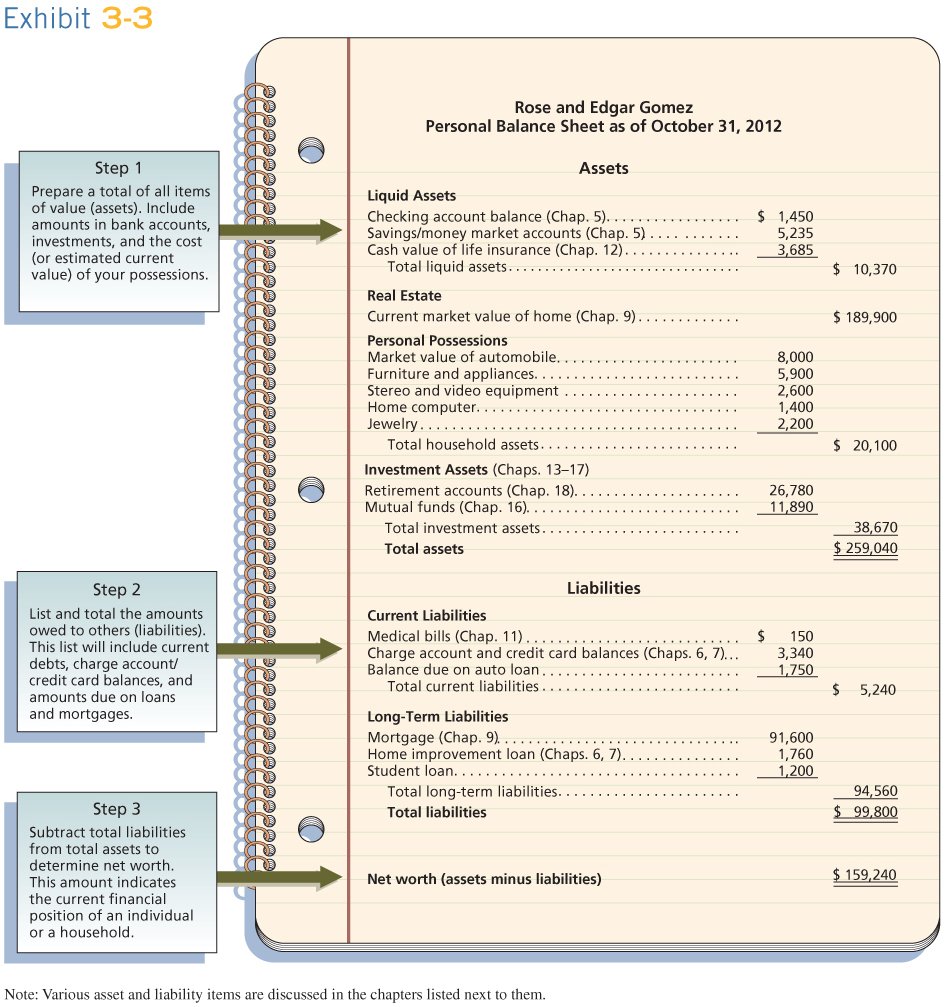
A. The Personal Balance Sheet: Where are You Now?

Items of Value – Amounts Owed = Net Worth

B. Evaluating Your Financial Positiion

If you are a traditional college student, don’t be surprised if your net worth is negative.

C. The Cash Flow Statement: Where Did Your Money Go?

Total Cash Received during the time period – Cash Outflow during the time period = Cash Surplus or Deficit

error: Content is protected !!