Principles of Good Reporting System

A good reporting system helps the management in proper planning and controlling. If the reports are available to every level of management at the proper time, current activities may be regulated and controlled and necessary corrective actions may also be taken in time. Hence, some principles have been followed for making the reporting system more effective. Such principles are briefly explained below.

General Principles of Reporting System

  1. Proper Flow of Information: The information should be free flow from the proper place to the right end user of the report. Hence, the information should be presented in the right format and at a proper time so that it helps in planning and co-ordination. The flow of report should not be delayed at any cost. Flow of information is a continuous activity. Information may flow upward, downward or sideways within an organization. Orders, instructions, plans etc may flow from top to bottom. Reports of grievances, suggestions etc. may flow from bottom to top. Notifications, letters, settlements and complaints may flow from outside. Annual Report, Financial Statement Analysis Report, Directors Report, Auditors report etc. may flow from inside to outside. Information flows as sideways from one manager to another at the same level through meetings, discussion etc.
  2. Proper Timing: The very purpose of preparation of report is controlling the unfavorable activities. Hence, the report should be submitted at the required time at any cost. If not so, there is no use of preparing such report. Moreover, the efforts used for preparing the report and time are also waste. In the case of routine report, the time schedule should be strictly adhered to. The absence of information at required time leads to taking wrong decision.
  3. Accurate Information: The report contains only accurate information. If wrong information are included in the report, it may lead to take wrong decision. Hence, the supply of accurate information helps the managerial executives to understand the situation very clearly. At the same time, the presentation of accurate information in the report should not involve excessive cost of preparation and should not result in the delay in the presentation of report.
  4. Relevant Information: Proper attention should be devoted to include only relevant information in the report. The inclusion of irrelevant information is waste one and increase the time in the report preparation. Moreover, the irrelevant information confuse the end user of the report.
  5. Basis of Comparison: The information bestowed by reports will be helpful when it carries provision to compare with past figures, standards set or objectives. The trend of the variation can be find out only through the comparison. Corrective action can be taken with the help of comparative information.
  6. Reports should be Clear and Simple: The very purpose of preparing a report is helping the management in planning, coordinating and controlling. Hence, the report should be presented in very simple terms and can be clearly understood by anybody. If not so, there is no meaning of preparing a report. The method of presenting a report is in such a way that attracts the eye of the readers and enables them to arrive at a conclusion. The arrangement of information in a report is in brief, complete, clear and simple.
  7. Cost: The management incur some expenses with regard to report preparation. Such expenses should be commensurate with the benefits derived from the report preparation. If possible, more benefits may be available than the expenses incurred. In this way, reporting system can be installed. In other words, there should be an endeavor to make the system as economical as possible.
  8. Evaluation of Responsibility: The reporting system has been installed in such a way to evaluate the managerial responsibility. The standards or targets are fixed for each functional department. The record of actual performance is monitored along with the standards so as to enable management to assess the performance of different individuals.
  9. Factual: A good reporting system should be based on reports containing factual information’s. Management has to take decision in future on the basis of the information contained in various reports. Any false information contained in the reports will not be helpful in taking correct decisions.
  10. Principle of Brevity: Principle of brevity should be followed while reporting since long reports are very difficult to analyze and long reports generally rely greatly on highlighting irrelevant minor details and major issues involved are not taken up properly.
  11. Principle of Scheduling: Principle of scheduling should also be followed in a way that reports can be prepared without excess burden on the staff. Employees must be given sufficient time to do the work well on the preparation of report. Time lag between collection of data and finished report should not be much longer.

Kinds of Management Reports

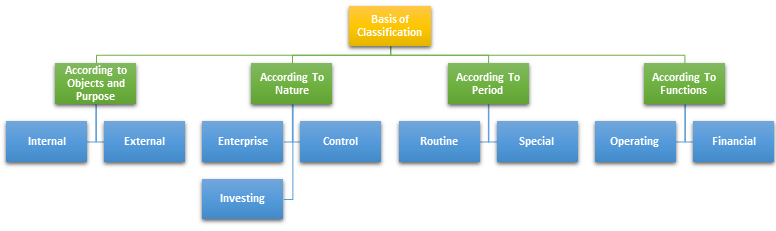
  1. Classification on the Basis of Object and Purpose:
(a) External Reports:

The reports prepared for external users or for the persons outside the business are known as external reports. External users may include shareholders, investors, creditors, suppliers and bankers. Though company may not be answerable to outsiders but still some reports are meant for outsiders.

The company publishes income statement and balance sheet at the end of every financial year and these statements are filed with the Registrar of companies and stock exchanges. Final statements of accounts are expected to conform to certain basic details in India Companies Act 1956 has made it obligatory to disclose some minimum information in final accounts. Following is an instance of Balance

(b) Internal Reports:

Internal reports refers to those reports which are meant for different level of management. Internal reports are not public documents and they are not expected to conform to any standards. These reports are prepared by keeping in view the needs of disposal for scanning them.

These reports may be meant for top level, middle level and lower level. The report meant for different levels of management may be regarded as internal reports. The frequency of these reports vary in accordance with purpose they serve.

Some of the internal reports that are commonly used are! Period report about profit and loss account and financial position, statement of cash flow, changes in working capital, report about cost of production, production trends and utilization of capacity.Labour turnover reports, material utilization reports, periodic reports on sales, credit collection periods and selling and distribution expenses, report on stock position etc.

2. Classification on the Basis of Nature:

According to nature, reports can be classified into three categories:

(a) Enterprise Reports:

These reports are prepared for the concern as a whole. These reports serve as a channel of communication with outsiders. Enterprise reports may concern all activities of the enterprise or may be related to different activities. Enterprise reports may include balance sheet, income statement, income tax returns, employment report, chairman’s report.

These reports contain standardized information and are beneficial to outsiders. The interpretation of financial statement can also be undertaken from these reports. The reports are important from financial analysis point of view. For instance following is chairman’s report presented by ShashiRuia Chairman of Essar Steel Ltd. reproduced for information:

Chairman’s Statement:

Dear Shareholder,

It is now well accepted by economic pundits and studies conducted across the globe that India and China will dominate the world economy in the 21st century. India is today the fourth largest economy in terms of purchasing power parity and is expected to overtake Japan and become third largest economic power after the United States of America and China, before the end of the decade. As India prepares to become an economic super power, it must further quicken the pace of reform and liaberalization by enabling the development of world class infrastructure, competitive manufacturing in scale and technology and sustainable development.

GDP growth of over 6.5% significant investments in infrastructure, a good agricultural output and a spurt in consumer demand across all sectors augurs for industry. If we are able to achieve a GDP growth of 8% annually, India will be the fastest growing free market democracy in the world.

Steel the backbone of Industry:

The steel industry is crucial to a nation’s economic competitiveness and security. Steel is integral to building of bridges, railroads, homes, automobiles, appliances and much more. Today’s steels are radically different than what was available ten years ago. They are lighter, higher in strength and more versatile.

The industry has undergone a major transformation in the last few years with companies investing in new process and product technologies, capacity enhancements and customer service initiatives. Indian steel companies are at the ‘leading edge’ of technology and spend considerable amounts on research and development.

The industry and particularly your company are able to compete internationally on technology, quality and price and have demonstrated that the India of tomorrow belongs to Indian entrepreneurs and Indian consumers. The Government needs to encourage and support the industry with a more realistic iron ore policy that creates level playing field.

Essar Steel- an eventful year:

Essar Steel’s excellent results demonstrate the company’s success in structurally improving its operating performance as a result of strategic actions and timely execution of projects. We have seen some signs of over-supply in international markets, but we do not see this as a long term issue. Your company is also much better prepared to manage cyclically in markets due to its geographic coverage and product portfolio.

Essar Steel is now a fully integrated producer with end-to-end control of all operations related to steel making. The acquisition of Hy-Grade Pellets Ltd. and Steel Corporation of Gujarat Ltd. make your company a totally integrated steel producer. The company has taken a number of initiatives in its manufacturing facilities to fulfill its mission of being one of the most cost efficient producers of steel globally.

From Bailadilla- where the iron ore beneficiation plant is located, close to the iron mines- to the final stage where the end products are dispatched to domestic and international destinations, your company has ensured that every stage of manufacture is seamlessly integrated. This will enable us to offer high quality, customized products for use by wide range of industries such as automobile and auto components, white goods, construction and consumer durables.

We focus on value addition at every stage of manufacture and also direct our efforts to high revenue generating markets. We do this by targeted marketing in specialized customer segments and technical and aftermarket support. We expect these value added products to contribute over 35% of the company’s revenues in the coming year.

Looking Ahead:

Currently we are producing at a capacity of 3 million tonnes and we have planned to augment this to 4.6 million tonnes by June 2006, making us the largest producer of flat steel in the private sector in India. This will involve an incremental investment ofRs 2000 crore, which is much below industry average and will considerably reduce our cost of production. We also plan to increase the pellet making capacity at Visakhapatnam from 4 to 8 million tonnes in this fiscal year.

The acquisitions, capacity expansions, technology upgradation and other productivity improvement measures will give you company a significant competitive edge in domestic and international markets. Our thrust on maintaining cost leadership through integrated manufacturing processes, research and new innovation and high productivity will provide a hedge against cyclically.

Managing Financial Turnaround:

Your company has been able to build a platform for consolidation and sustain the rejuvenation of its performance. In October 2002, at the time of the announcement of the CDR package, the Company had a term debt of? 5371 crore, which has been reduced to Rs 4262 crore as at March 31, 2005, a reduction of over Rs 1100 crore. The significant financial turnaround by the Company in such a short period of time is indeed noteworthy. With all other parameters of financial performance showing considerable improvement, your company is in a much stronger position to plan for more aggressive growth.

Our Driving Force:

Essar Steel is today at a significant point in its history. The past has given us learning’s that we have used to build a platform of security from the future. I must acknowledge the tremendous efforts put in by employees at all levels, who have to admirably risen to the challenges that change inevitably brings. Organizations must continuously change in order to survive and prosper. The Essar family has shown the capability and resilience to manage this change. We look to the future with confidence that arises out of our actions and the achievements of our people, as we prepare to face the “Brave New World”.

I also take this opportunity to thank our customers, vendors, business associates and bankers who have helped us come this far and look forward to their continued support in our journey to globalization.

Thank You.

ShashiRuia Chairman

(b) Control Reports:

Control reports deal with two aspects. One aspect relates to the personal performance and the other aspect deals with the economic performance. The first type of reports are prepared and reported to judge performance of managers and heads of various responsibility centres with what performance should have been under the prevailing circumstances.

The reasons for deviations in performance are also identified. The second type of reports shows how well the responsibility centre has fared as an economic activity. Such analysis is made periodically. This type of analysis requires the use of full cost accounting rather than responsibility accounting.

Control reports should consider the following:

(i) Control reports should be related to personal responsibility.

(ii) They should compare actual performance with the standards.

(iii) They should highlight significant information.

(iv) These reports should be sent at a proper time as to enable taking corrective measures.

(v) If possible various accounting ratios like, capacity, efficiency, activity and calendar ratios may be calculated.

(c) Investigating Reports:

These reports are linked with control reports. In case some serious problem arises then the causes of this situation are studied and analyzed, investigative reports are based on outcome of special solution studies. These reports are intermittent and are prepared only when a situation arises. They are prepared according to the nature of every situation. They are helpful to the management in analyzing the causes of some problem.

Example of Investigating Report:

The following information is available from monthly cost report of M/s Hard Engineering Co.:—

3. Classification on the Basis of Period:

According to the period repots can be classified as under:

(a) Routine Reports:

These reports are prepared about day to day working of the concern. They are periodically sent to various levels of management. These persons may differ according to the nature of information about details to be reported so far as the timing is concerned they may be sent daily, weekly, monthly or quarterly.

Routine reports may relate to sales information, production figures, capital expenditures, purchases of raw materials, market trends etc. There is a tendency to ignore routine reports by all recipients because of their routine nature. Important information in the report should be high-lighted or presented in a different way or may be written in a different ink.

Example of two routine reports are:

  1. Statement of Production
  2. Statement of Expenses

(b) Special Reports:

The management may confront some difficulties and routine report may not give sufficient information to tackle such situations. Under such circumstances, special reports are called for. Special reports are required for special purposes only.

These reports are prepared according to the need of situation. Available accounting information may not be sufficient, so data may have to be specially collected. There may be need to put extra staff for compiling these reports. It may also involve co-ordination of different departments and different levels of management. According to J. Batty33 special reports should be divided into sections each covering the following main purposes: 1. Reason for the report 2. Investigation made 3. Finding a conclusion and recommendations.

Special reports may deal with following topics:

(i) Information about market analysis and methods of distribution of competitors.

(ii) Technological changes in industry.

(iii) Problems about the purchase of materials.

(iv) Reports about change in methods of production and their implications.

(v) Trade association matters.

(vi) Report by secretary on company matters.

(vii) Political development at home and abroad having impact on business.

(ix) Report effect of idle capacity on cost of production.

(x) Make or buy decisions.

(xi) Report most suitable method of raising funds.

(xii) The effect of labour disputes on production and cost of production.

(xiii) Report on general economic forecast.

(xiv) Feasibility study for a project.

(xv) Report on effect of change in Government Policy.

4. Classification of Reports on the Basis of Functions:

According to function the reports may be divided into two categories:

(a) Operating Reports

(b) Financial Reports

(a) Operating Reports:

These reports provide information about operations of the concern.

The operating reports may consist of the following:

(i) Control Reports:

These reports are used for management control purposes. They are intended to spot deviations from budgeted performance without loss of time so that corrective action can be taken. Control reports are also used to assess the performance of individuals.

(ii) Information Reports:

These reports are prepared to provide useful information which will enable planning and policy formation for future. Information reports can take the form of trend reports and analytical reports. Trend reports provide information in comparative form over a period of time. Graphic presentation can be effectively used in trend reports. As opposed to trend reports, analytical reports provide information in a classified manner about composition of certain results so that one can identify specific factors in the overall total.

(b) Financial Reports:

These reports provide information about the financial position of the concern on specific dates or movement of finances during a specific period. The Balance Sheet provides information about a concern on a specific date. On the other hand Cash Flow Statement provides data about the movement of cash during a particular period. These reports can be either static or dynamic. Balance Sheet and other subsidiary reports are examples of static reports; Cash Flow, Fund Flow Statements and other reports showing financial position as compared to the budgeted are examples of dynamic reports.

Limitations of Cash Flow Statement

  • A Cash Flow Statement only reveals the inflow and outflow of cash. The cash balance disclosed by this statement may not depict the true liquid position. There are controversies over a number of items like Cheques, stamps, postal orders etc. to be included in cash.
  • A Cash Flow Statement cannot be equated with the income statement. An income statement takes into account both cash and non-cash items. Hence Cash Fund does not mean net income of the business.
  • Working Capital being a wider concept of funds, a funds flow statement presents a more complete picture than cash flow statement.
  • Fails to Present Net Profit: The cash flow statement fails to present the net income of a firm for the period as it ignores non-cash items which are considered by Profit and Loss Statement. The cash flow statement does not help to assess profitability as it neither considers cost nor revenues. However, it can be used as a supplement to the income statement.
  • Not a substitute to Funds Flow Statement or Income Statement: The functions which are performed by funds flow statement or income statement cannot be done by cash flow statement.
  • Industry Comparison not possible: As the cash flow statement does not measure the efficiency of the firm, intercomparison with other inter-industry is not possible. A firm having less capital investment shall have less cash flow than the firm which more capital investment resulting in higher cash flows.
  • Does not Properly Assess Liquidity position: In a practical scenario, the cash flow statement does not assess liquidity or solvency position of the firm as it presents cash position only on a particular date. It only helps to know what amount of obligation can be met. In nutshell, it does not represent the real liquidity position.
  • It does not give complete picture of the financial position of the business concern.
  • The preparation of cash flow statement is only postmortem analysis. There is no projection of cash in future in this method.
  • It is not a substitute of Income Statement.
  • The accuracy of cash flow statement is based on the balance sheet. If balance sheet is wrong, the cash flow statement is also wrong.
  • It is not prepared on the basic accounting concept of accrual basis. Hence, the accuracy of cash flow statement is questionable.
  • It is not suitable for judging the profitability of a firm as non-cash items are not included in the calculation of cash flow from operating activities.

Uses of Cash Flow Statement

The purpose of the cash flow statement is to show where an entities cash is being generated (cash inflows), and where its cash is being spent (cash outflows), over a specific period of time (usually quarterly and annually). It is important for analyzing the liquidity and long term solvency of a company.

The cash flow statement uses cash basis accounting instead of accrual basis accounting which is used for the balance sheet and income statement by most companies. This is important because a company may accrue accounting revenues but may not actually receive the cash. This could produce profits and taxes payable but not provide the resources to stay solvent.

Cash Flow Statement Components

The cash flow statement components provide a detailed view of cash flow from operations, investing, and financing:

Cash Flow from Operating Activities

The net amount of cash coming in or leaving from the day to day business operations of an entity is called Cash Flow from Operations. Basically it is the operating income plus non-cash items such as depreciation added. Since accounting profits are reduced by non-cash items (i.e. depreciation and amortization) they must be added back to accounting profits to calculate cash flow.

Cash flow from operations is an important measurement because it tells the analyst about the viability of an entities current business plan and operations. In the long run, cash flow from operations must be cash inflows in order for an entity to be solvent and provide for the normal outflows from investing and finance activities.

Cash Flow from Investing Activities

Cash flow from investing activities would include the outflow of cash for long term assets such as land, buildings, equipment, etc., and the inflows from the sale of assets, businesses, securities, etc. Most cash flow investing activities are cash out flows because most entities make long term investments for operations and future growth.

Cash Flow from Finance Activities

Cash flow from finance activities is the cash out flow to the entities investors (i.e. interest to bondholders) and shareholders (i.e. dividends and stock buybacks) and cash inflows from sales of bonds or issuance of stock equity. Most cash flow finance activities are cash outflows since most entities only issue bonds and stocks occasionally.

Main uses of cash flow statement.

  • Since a cash flow statement is based on the cash basis of accounting, it is very useful in the evaluation of cash position of a firm.
  • A projected cash flow statement can be prepared in order to know the future cash position of a concern so as to enable a firm to plan and coordinate its financial operations properly. By preparing this statement, a firm can come to know as to how much cash will be generated into the firm and how much cash will be needed to make various payments and hence the firm can well plan to arrange for the future requirements of cash.
  • A comparison of the historical and projected cash flow statements can be made so as to find the variations and deficiency or otherwise in the performance so as to enable the firm to take immediate and effective action.
  • A series of intra-firm and inter-firm cash flow statements reveals whether the firm’s liquidity (short-term paying capacity) is improving or deteriorating over a period of time and in comparison to other firms over a given period of time.
  • Cash flow statement helps in planning the repayment of loans, replacement of fixed assets and other similar long-term planning of cash. It is also significant for capital budgeting decisions.
  • It better explains the causes for poor cash position in spite of substantial profits in a firm by throwing light on various applications of cash made by the firm. It further helps in answering some intricate questions like -what happened to the net profits? Where did the profits go? Why more dividends could not be paid in spite of sufficient available profit?
  • Cash flow analysis is more useful and appropriate than funds flow analysis for short-term financial analysis as in a very short period it is cash which is more elevant then the working capital for forecasting the ability of the firm to meet its immediate obligations.
  • Cash flow statement prepared according to AS-3 (Revised) is more suitable for making comparisons than the funds flow statement as there is no standard format used for the same.
  • Cash flow statement provides information of all activities classified under operating, investing and financing activities. The funds statement even when prepared on cash basis, did not disclose cash flows from such activities separately. Thus, cash flow statement is more useful than the funds statement.

Concept of Cash and Cash Equivalents

Cash and cash equivalents (CCE) are the most liquid current assets found on a business’s balance sheet. Cash equivalents are short-term commitments “with temporarily idle cash and easily convertible into a known cash amount”. An investment normally counts to be a cash equivalent when it has a short maturity period of 90 days or less, and can be included in the cash and cash equivalents balance from the date of acquisition when it carries an insignificant risk of changes in the asset value; with more than 90 days maturity, the asset is not considered as cash and cash equivalents. Equity investments mostly are excluded from cash equivalents, unless they are essentially cash equivalents, for instance, if the preferred shares acquired within a short maturity period and with specified recovery date.

Cash is the money in the form of currency. Currency includes currency notes and coins. Any currency notes and coins held by an enterprise are part of the term “cash”.

Demand deposit is a type of an account from which funds can be withdrawn at any time without having to inform the bank or depository institution. Most of the checking and saving accounts are demand deposits.

One of the company’s crucial health indicators is its ability to generate cash and cash equivalents. So, a company with relatively high net assets and significantly less cash and cash equivalents can mostly be considered an indication of non-liquidity. For investors and company’s cash and cash equivalents are generally counted to be “low risk and low return” investments and sometimes analysts can estimate company’s ability to pay its bills in a short period of time by comparing CCE and current liabilities. Nevertheless, this can happen only if there are receivables that can be converted into cash immediately.

First, owners and investors can contribute money to the business in exchange for a percentage ownership in the company. Second, the company can generate money from selling goods or services to customers as part of its ongoing operations. Third, the business can borrow money from banks, financial institutions, and other lenders.

Controlling cash flow and financing is a crucial part of running any business. A business can be profitable and still not be able to pay its bills on time because money was not managed properly. Profitability does not always equate to large amount of free cash flow. Investors and creditors need to know where the company’s cash comes from and where it goes. That’s why management details each cash activity for the period on the statement of cash flows.

However, companies with a big value of cash and cash equivalents are targets for takeovers (by other companies), since their excess cash helps buyers to finance their acquisition. High cash reserves can also indicate that the company is not effective at deploying its CCE resources, whereas for big companies it might be a sign of preparation for substantial purchases. The opportunity cost of saving up CCE is the return on equity that company could earn by investing in a new product or service or expansion of business.

Examples of cash are:

  • Coins
  • Currency
  • Cash in checking accounts
  • Cash in savings accounts
  • Bank drafts
  • Money orders
  • Petty cash

Cash Equivalent

Cash equivalents are investments that can be readily converted to cash. Common examples of cash equivalents include commercial paper, treasury bills, short term government bonds, marketable securities, and money market holdings. An item should satisfy the following criteria to qualify for cash equivalent.

  • The investment should be short term. They should mature in less than three months. If they mature in more than three months they will be classified as other investments.
  • They should be highly liquid. This means that they should be easily sold in the market. The buyers of these investments should be easily available.
  • They should be convertible to known amounts of cash. This means that their market price should be available and this market price should not be subject to significant fluctuations.
  • They should not be too risky. There should be very little risk of changes in their value. This means that equity shares cannot be classified as cash equivalents. But preferred shares purchased shortly before the redemption date can be classified as cash equivalents.

In short, cash and cash equivalents mean the cash and those assets which are immediately convertible to cash. Cash and cash equivalents are the most liquid assets of any business. Cash and cash equivalents are very important for the liquidity of a business. A company should have sufficient cash and cash equivalents to meet its urgent liabilities when they fall due. 

Examples of cash equivalents are:

  • Commercial paper
  • Marketable securities
  • Money market funds
  • Short-term government bonds
  • Treasury bills

Businesses can report these two categories of assets on the balance sheet separately or together, but most companies choose to report them together.

GAAP allows this financial statement presentation because some investments are so liquid and risk adverse that they are considered cash. Take T-bills for example. These investments are backed by the U.S. government and will always be paid. It’s not like a private short-term bond or loan where the company can default or go bankrupt. T-bills are a safe, guaranteed investment that can be cashed in at any time. Thus, GAAP recognizes these investments as if they were actual currency.

If the T-bills can’t be cashed in because of debt covenants or some other agreement, like in our debt restriction example above, the restricted T-bills must be reported in a separate investment account from the non-restricted T-bills on the balance sheet.

Accounts receivable is not considered cash because it isn’t currency. It is, however, considered an equivalent because it is highly liquid and easily converted into cash in a short period of time. Thus, it would be included in equivalents calculation.

CDs are short-term securities that are easily converted into a known amount of cash in a short period of time. Certificates of Deposit are always included in cash equivalents.

Procedure for preparation of Cash Flow Statement

Sources of Cash Flow Statements:

Cash flow statement is not a substitute of income statement, i.e., a profit and loss account, and a balance sheet. It provides additional information and explains the reasons for changes in cash and cash equivalents, derived from financial statements at two points of time.

A cash flow statement, also known as the statement of cash flows, is a financial statement that summarizes the amount of all cash inflows and outflows of the company.

The cash flow statement is a mandatory part of a company’s financial reports since 1987.

The Statement of Cash Flows is one of the 3 key financial statements that reports the money generated and spent throughout a particular amount of period within the organization.

The procedure for preparing a cash flow statement is different from the procedure followed in respect of profit and loss account and balance sheet. It is prepared with the help of financial statements.

The basic information required for the preparation of a cash flow statement is obtained from the following three sources:

(i) Comparative balance sheets at two points of time, i.e. in the beginning and at the end of the accounting period.

(ii) Income statement of the current accounting period or the profit and loss account.

(iii) Some selected additional data to extract the hidden transactions.

Steps for Preparation of Cash Flow Statement:

The preparation of a cash flow statement involves the following steps:

Step 1: Compute the net increase or decrease in cash and cash equivalents by making a comparison of these accounts given in the comparative balance sheets.

Step 2: Calculate the net cash flow provided (used in) operating activities by analyzing the profit and loss account, balance sheet and additional information. There are two methods of converting net income into net cash flows from operating activities: the direct method and the indirect method. These methods have been discussed separately in this chapter.

Step 3: Calculate the net cash flow from investing activities.

Step 4: Calculate the net cash flow from financing activities.

Step 5: Prepare a formal cash flow statement highlighting the net cash flow from (used in) operating, investing and financing activities separately.

Step 6: Make an aggregate of net cash flows from the three activities and ensure that the total net cash flow is equal to the net increase or decrease in cash and cash equivalents as calculated in Step 1.

Step 7: Report significant non-cash transactions that did not involve cash or cash equivalents in a separate schedule to the cash flow statement e.g., purchase of machinery against issue of share capital or redemption of debentures in exchange for share capital.

For a business organization, the cash flow statement is the foremost vital financial statement to prepare. It traces the flow of funds (or working capital) into and out of the business throughout an accounting period.

For a small business, a cash flow statement ought to be in all probability to be ready as often as possible.

Three Sections of a Statement of Cash Flows:

  1. Cash from operating activities,
  2. Cash from investing activities,
  3. Cash from financing activities.

Cash from operating activities

Cash Flow from Operations usually includes the money flows related to sales, purchases, and other expenses. In other words, it reflects how a lot of money is generated from a company’s products or services.

These operating activities include Receipts from sales of product and services, Interest payments, Income tax payments, Payments made to suppliers of product and services, Salary and wage, Rent payments etc.

Cash from investing activities

Cash Flow from investment Activities includes the cash flows related to buying or selling property, plant, and equipment, other non-current assets, and other financial assets.

Usually, cash flow from investment activities is a “cash out” item, because money is used to spend for new instrumentation, buildings, or short-term assets such as marketable securities.

Cash from financing activities

Cash flows from financing activities generally include cash flows associated with borrowing and repaying bank loans, and issuing and buying back shares.

The payment of a dividend is also treated as a finance income. If a company issues a bond to the general public, the company receives cash financing; but, when interest is paid to bondholders, the company is reducing its cash.

Here is an example of statement of cash flow:

Cash Flow Statement Rs.
Operating Cash Flow

Net Earning

Plus: Depreciation and Amortization

Less: Changes in Working Capital


15,474

19,500

9,003

Cash from Operations


Investing cash flow

Investment in Property & Machines

25,971


(15,000)

Cash from Investing

Financing cash Flow

Issuance of Debt

Issuance of Equity

(15,000)


(8,000)

1,70,000

Cash from Financing


Net increase/Decrease  in Cash

Opening cash Balance

1,62,000


1,72,971

11,000

Closing Cash Balance 1,83,971

Importance of Cash Flow Statement:

It is equally as important as like as the profit-and-loss statement and balance sheet for cash flow analysis.

Without a cash flow statement, it may be tough to have a correct image of a company’s performance.

The income statement can tell you the way a lot of interest you paid on a loan and therefore the record can tell you the way a lot of you owe, but solely the cash flow statement can tell you the way a lot of money was consumed servicing that loan.

The income statement can record sales and profits however it’s the income statement that may provide you with a warning if those sales aren’t generating enough money to cover expenses.

Provisions of Ind AS-7 (old AS 3)

Foreign currency cash flows:

  • Record cash flows (those cash flows which arise from transactions in foreign currency) in functional currency.
  • Cash flows of a foreign subsidiary shall be translated at the exchange rates between functional currency and foreign currency.
  • Exchange rate at the date of cash flows shall be applied. Ind AS 21 permits the use of exchange rate that approximates the actual rate.
  • Unrealized gains and losses arising from changes in foreign currency exchange rates are not cash flows. However, the effect of exchange rate changes on cash and cash equivalents is reported in the statement of cash flows in order to reconcile cash and cash equivalents at the beginning and the end of the period. This amount is presented separately from cash flows from operating, investing and financing activities.

Change in ownership (no such concept under AS 3):

  1. Cash flows from obtaining / losing control in businesses (including subsidiary) shall be presented separately and classified as Investing activity and disclose the following:
  • Total amount of consideration
  • Portion of consideration consisting of cash and cash equivalents
  • Amount of cash and cash equivalent over which control is obtained / lost
  • Assets and liabilities (other than cash and cash equivalent) over which control is obtained / lost summarised in each major category.

2. Cash flow effects of losing control are not deducted from those of obtaining control.
3. Cash paid / received as consideration is reported net of cash and cash equivalents acquired / disposed on account of such transaction.
4. Cash flows arising from changes in ownership in subsidiary that do not result in a loss of control shall be classified as cash flows from financing activities, unless subsidiary is held by investment entity.

Non-cash Transactions:

Many investing and financing activities do not impact cash flows although they do affect the capital and asset structure of an entity. These shall be excluded from the statement of cash flows. Examples:

  • Acquisition of assets by means of a finance lease;
  • Conversion of debt to equity.
  • Issue of bonus shares
  • Conversion of term loan into equity shares

Such transactions shall be disclosed in the financial statements indicating investing / financing activity.

Changes in liabilities arising from financing activities (It was an amendment in Ind AS 7 and this provision was not there in AS 3):
• An entity shall provide the following disclosures to evaluate changes in liabilities arising from financing activities including both changes arising from cash flows and non-cash changes:
o changes from financing cash flows
o changes arising from obtaining or losing control of subsidiaries or other businesses;
o the effect of changes in foreign exchange rates;
o changes in fair values; and
o other changes.
• It also applies to changes in financial assets (for example, assets that hedge liabilities arising from financing activities) if cash flows from those financial assets included in cash flows from financing activities.
• Disclosure requirement can be fulfilled by: Reconciliation between the opening and closing balances in the balance sheet for liabilities arising from financing activities.
• If an entity discloses the same with disclosures of changes in other assets and liabilities, it shall disclose financing activities separately.
Disclosures:
• Components of cash and cash equivalents and reconciliation with amount appearing in balance sheet
• Policy adopted in determining composition of cash and cash equivalents
• Significant cash and cash equivalent that are not available for use by the entity (with commentary by management).
Examples: balance in unpaid dividend account, bank balance subject to legal restrictions, earmarked balances, bank balance for share application money / pending allotment of shares.
• Additional information (optional but standard encouraged the following disclosure):
o amount of undrawn borrowing facilities (indicating any restrictions on use)
o cash flows representing increases in operating capacity separately from cash flows required to maintain operating capacity;
o cash flows from operating, investing and financing activities of each reportable segment (same is required by Ind AS 108).

Statement of Funds from Operations

Funds from operations is the cash flows generated by the operations of a business, usually a real estate investment trust (REIT). This measure is commonly used to judge the operational performance of REITs, especially in regard to investing in them. Funds from operations does not include any financing-related cash flows, such as interest income or interest expense. It also does not include any gains or losses from the disposition of assets, or any depreciation or amortization of fixed assets. Thus, the calculation of funds from operations is:

Funds from operations = Net income – Interest income + Interest expense + Depreciation – Gains on asset sales + Losses on asset sales

After preparing the schedule of changes in net working capital, the second step is to determine the amount of funds (loss) from business operations. It refers to the funds or loss, which is generated or suffered in the business as a result of its regular operations during the period. The funds from operation is an important source of fund, while loss from operation is one of the important applications of funds. The funds or loss from operation is determined by adjusting the firm’s net income in a statement called the statement of funds from operations. In this statement, the items such as non-operating incomes and non-cash expenses are adjusted while determining the amount of funds (loss) from operations.

Non-cash expenses such as depreciation and amortization of intangible assets do not result in actual cash outflow. Non-operating expenses are those which are not treated as regular expenses of the business. These expenses matter while ascertaining the business income, but are irrelevant in determining the funds (loss) from operations. Therefore non-operating incomes should be deducted from and non-operating and non-cash expenses should be added back to the business income shown by the income statement.

Non-operating and non-cash expenses

  • Depreciation for the year
  • Amortization of Goodwill, Copyright, Patent, Trademark, Preliminary expenses
  • Discount on issue of share and debenture written off
  • Loss on sale of fixed assets or investment
  • Loss of revaluation of fixed assets
  • Premium on redemption of debentures and preference share

Incomes and gains which are not earned from the normal business operations are called non-operating incomes. These incomes are included while ascertaining the business income, but are excluded while determining the funds (loss)from operations. The following are the examples of non-operating incomes.

  • Gain on sale of fixed assets or investment
  • gain on revaluation of fixed assets
  • Discount on redemption of debentures and preference share
  • Compensation received
  • Interest received
  • Refund of tax
  • Transfer fees received
  • Appreciation on fixed assets

Preparation of Statement Of Funds From Operation

Funds from operations can be determined by using one of the two following methods.

  1. Add Back Method

Under this method,net profit is taken as the base. All the non-operating and non-cash expenses are added to net profit and non-operating incomes are deducted.

Funds from operations = Net profit+Non-operating and non-cash expenses-Non operating Incomes.

  1. Profit And Loss Adjustment Account Method

Funds from operations can also be determined by preparing an account called profit and loss adjustment account begins with opening balance of profit on its credit side and closing balance on the debit side. Instead of opening and closing balance of profit and loss account, only the amount of net profit for the year can also be brought down to the debit side of this account. Then the items of non-operating expenses and non-cash expenses are adjusted to the debit side and the items of non-operating incomes are adjusted to the credit side to determine the amount of funds (loss) from operations.

Statement of Sources and Applications of Funds

Generally, the statement consists of two sections: the source (where the money has come from) and the application (where the money has gone).

The sources of funds originate from:

  • A decrease in liabilities or an increase in assets
  • Net income after tax
  • The disposal or revaluation of fixed assets
  • Proceeds of loans obtained
  • Proceeds of shares that were issued
  • Repayments received on loans previously granted by the company
  • Any increase in net working capital

The application of funds includes:

  • Losses to be met by the company
  • The purchase of fixed assets/investments
  • The full or partial payment of loans
  • Granting of loans
  • Liability for taxes
  • Dividends paid or proposed
  • Any decrease in net working capital

Sources of Funds

Items to be shown under the head Sources of Funds are as follows:

  • Issue of Shares and Debentures for Cash: The total amount received from the Issue of Shares or Debentures is to shown under this head. But, the Issue of bonus Shares or Conversion of Debentures into Equity Shares or Shares issued to vendors shall not be shown here as there is no inflow of Cash
  • Long Term Loans: The Amount received on raising Long Term Loans is shown under this head. Short Term Loans are not to be shown here as their treatment has already been done while preparing the Statement of Changes in Working Capital.
  • Sale of Investments and other Fixed Assets: The Total Amount received on the sale of Investments and other Fixed Assets is to be shown under this head.
  • Funds from Operations: The Funds generated from Operations as computed in Step II are also required to be shown here.
  • Decrease in Working Capital: This would be the Balancing Figure of the Statement and will come from change in Working Capital Statement

Application of Funds

Items to be shown under Application of Funds are as follows:

  • Purchase of Fixed Assets and Investments: The Cash Payment made for purchase of Fixed Assets and Investments is an application of Funds. But if the purchase if made by issue of shares or debentures, such a transaction will not constitute application of funds. Similarly, if the purchases are on credit, these will not constitute fund applications.
  • Redemption of Debentures, Preference Shares and Repayment of Loan: Payment made including Premium (less: Discount) is to be taken as fund application
  • Payment of Dividend & Tax: Payment of Dividend and Tax are to be taken as applications of fund if the provisions are excluded from Current Liabilities and Current Provisions are added back to profit to determine the “Funds from Operations
  • Increase in Working Capital: This would be the Balancing Figure of the Statement and will come from change in Working Capital Statement

Procedure for preparation of Fund Flow Statement

Steps for Preparing Funds Flow Statement:

The steps involved in preparing the statement are as follows:

  1. Determine the change (increase or decrease) in working capital.
  2. Determine the adjustments account to be made to net income.
  3. For each non-current account on the balance sheet, establish the increase or decrease in that account. Analyze the change to decide whether it is a source (increase) or use (decrease) of working capital.
  4. Be sure the total of all sources including those from operations minus the total of all uses equals the change found in working capital in Step 1.

General Rules for Preparing Funds Flow Statement:

The following general rules should be observed while preparing funds flow statement:

  1. Increase in a current asset means increase (plus) in working capital.
  2. Decrease in a current asset means decrease (minus) in working capital.
  3. Increase in a current liability means decrease (minus) in working capital.
  4. Decrease in a current liability means increase (plus) in working capital.
  5. Increase in current asset and increase in current liability does not affect working capital.
  6. Decrease in current asset and decrease in current liability does not affect working capital.
  7. Changes in fixed (non-current) assets and fixed (non-current) liabilities affects working capital.

Format of Funds Flow Statement:

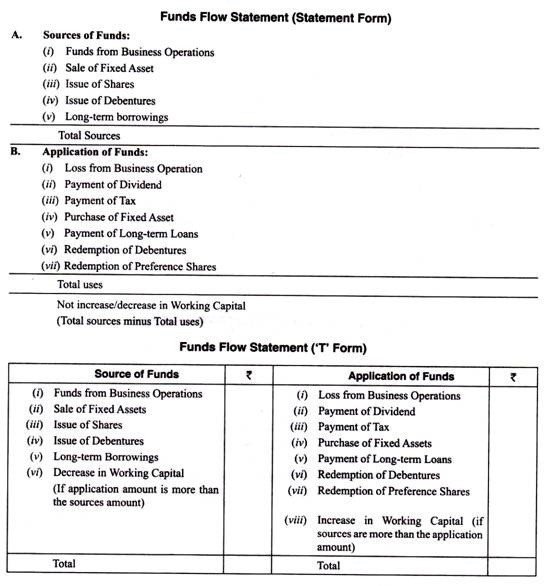
A funds flow statement can be prepared in statement form or ‘T’ form.

Both the formats are given below:

Schedule of Changes in Working Capital:

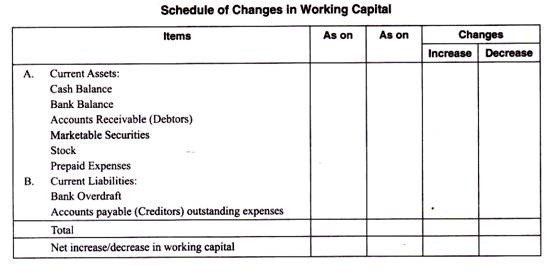
Many business enterprises prefer to prepare another statement, known as schedule of changes in working capital, while preparing a funds flow statement, on a working capital basis. This schedule of changes in working capital provides information concerning the changes in each individual current assets and current liabilities accounts (items).

This schedule is a part of the funds flow statement and increase (decrease) in working capital indicated by the schedule of changes in working capital will be equal to the amount of changes in working capital as found by funds flow statement. The schedule of changes in working capital can be prepared by comparing the current assets and current liabilities at two periods.

The format of schedule of changes in working capital is as follows:

error: Content is protected !!