Uniform costing and interfirm comparison

Inter-firm comparison is a natural outcome of uniform costing system. Uniform costing is the foundation stone over which the structure of IFC is developed and adopted in a large scale. Inter-firm comparison can be defined as the technique of evaluating the relative performance, efficiency, costs and profits of firms in a given industry’. The meaning of IFC can be easily explained by considering the main object of the system.

In other words IFC consists of following procedure:

(a) Data are collected from participating organization or firm by their trade organization or centre of inter-firm comparison.

(b) The management of an organisation is provided with information which will allow them to determine the efficiency being achieved, measured by comparing the performances of other business.

(c) An attempt is made to show why results vary from one business to another, i.e., any weakness is highlighted.

(d) Extensive use is made of financial and cost ratios.

Objects of Inter Firm Comparison:

The main purpose of IFC is improvement of efficiency by showing the management of participating firm its present achievements and possible weaknesses. These firms have to contribute their data to the central body which acts as a neutral body. This central body ensures confidence and it gives report regarding comparisons only to participants.

Following are important objectives of inter-firm comparison:

(a) IFC analyses costs of different firms with a view to spot out relative efficiency.

(b) IFC provides aid to management in enforcing and reviewing budgetary control and standard costing. These techniques enforced in one firm are compared with those in other firms making more efficient use of the same. Inadequacies of standard costing and budgetary control are located by making inter-firm comparisons and remedial measures are introduced.

(c) IFC helps to prepare a comprehensive and detailed plan for firms or units to obtain optimum use of human and material resources.

The main objection of IFC is the improvement of efficiency and identification of weak points. IFC is a scheme consisting of exchange of information with regard to cost, profit, productivity and efficiency between the participating firms through a central organisation. IFC focuses the remedial measure of a number of problems related to profit, sales and production.

In inter-firm comparison coordinated and monitored through an apex body or central organisation, attention is usually concentrated on the following major important are:

(i) Is profit adequate?

(ii) How efficient is selling?

(iii) How efficient is production?

Organisation of IFC:

The organisational set up for inter firm comparison may be in the form of either a trade association or a Government department or centre for inter-firm comparison. There may be a trade association of participating firms. Firms submit their required information to the association. Trade association analyses the information collected from firm and presents report to each member firm.

The job of coordinating and analyzing of data provided by firms of an industry may be entrusted to a Government Department. The main objective of such organisation structure of IFC is to exercise price control and regulation of firms.

In UK, the British Institute of Management had set up centre for Inter-firm comparison in association with British Productivity council. The centre was established just to meet the demands of trade and industry for an expert body for inter-firm comparison. Such a type of organisation has to prepare schemes for inter firm comparison. In India also there is need of such centre. Thus there should be a central body to coordinate and monitor inter-firm comparison.

Method or Approach for Inter-Firm Comparison:

Firms wishing to obtain the benefits of inter-firm comparison have to approach the central body or apex body constituted for IFC. A fee may be charged for carrying out comparisons. The method of approach adopted by the central body will be governed by the type of industry or trade and the problems and circumstances present.

The possible procedure may be as below:

  1. Firms which are to participate in an inter-firm comparison have to submit their data to the central body. These figures are compiled on the basis of uniform definitions of terms, procedures, methods and accounting periods.
  2. After all necessary steps have been taken to ensure that the participating firms can benefit from the comparison, a number of ratios are compiled. These ratios are shown in a summary form distinguishing.

(a) Ratios for the group of firm participating in the inter-firm comparison.

(b) Ratios for a single firm.

Each firm is given a report compiled along these lines.

  1. The ratios for the group and the ratios for the single firm are compared one by one.
  2. Once any significant deviation from the norm (average return on capital employed) is established, the possible reasons for this deviation may be located by examining other ratios.

Ratios of Inter-Firm Comparison:

Ratios used in the inter-firm comparison are of four types:

(i) Primary Ratios

(ii) Supporting Ratios

(iii) General Explanatory Ratios

(iv) Specific Explanatory Ratios

All the ratios can be taken together to form a pyramid as given below:

In addition to above ratios, some other ratios may be used for the purpose of systematic analysis of operational results. These cover all aspects of business activities and are meant for measurement of effectiveness of the resources.

These additional ratios are briefly explained below:

(A) Ratios of Performance Measurement:

  1. Value of Direct Material/Value of Production
  2. Cost of Materials/Quantity Produced
  3. Cost of Scrap / Cost of Raw Material
  4. Quantity of Scrap / Quantity of Raw Material
  5. Cost of Rejection / Cost of Production
  6. Total Output / No. of Workers
  7. Cost of Production/Machine Hours or Labour Hours
  8. P.V. Ratio i.e., Contribution x 100/Sales
  9. Contribution / Labour Hours
  10. Wages/No. of Workers
  11. Total Fringe Benefits/No. of Workers
  12. Idle Time / Total Time
  13. Overtime Hours / Total Labour Hours
  14. Standard Hours for Actual Production / Actual Hours
  15. Actual Hours / Budgeted Hours
  16. Power Cost / Machine Hours
  17. Repair and Maintenance Cost / Cost of Production
  18. Advertising Cost / Selling Cost

(B) Ratios to Judge Profitability:

These ratios show how profitable are company’s operations.

  1. Gross Profit Ratio i.e., (GP/Sales) ×100
  2. Net Profit Ratio i.e., (NP / Sales) × 100

GP ratio indicates manufacturing or trading efficiency while NP ratio shows overall profitability

  1. Return on capital employed i.e., Profit / Capital employed

ROLE indicates overall performance from the stand point of profitability. It is primary ratio in the pyramid of ratios

(C) Ratios related to Turnover:

Turnover Ratio show how efficiently company is managing current assets.

  1. Stock turnover ratio i.e., cost of sales/Average stock

This ratio shows the efficiency of inventory management. Average stock is average of opening and closing stock

  1. Debtors Turnover Ratio i.e., Debtors * Days or Months in a year / Annual Credit Sales

Debtor’s turnover measures the efficiency in collection of debts

  1. Creditors Turnover Ratio i.e., (Creditors x No. of days of months in a year)/Annual Credit Purchases.

This ratio measures the efficiency of purchase department in realizing credit facilities

(D) Liquidity Ratios:

These ratios show the liquidity position of the company to meet its day to day needs of working capital

  1. Current Ratio i.e., Current Assets/Current Liabilities

Current Ratio shows the ability of the company to meet its maturing current liabilities. An ideal ratio is 2:1 but it may differ due to nature of business.

  1. Quick Ratio or Acid Test Ratio i.e., Quick Assets i.e., Current Assets excluding inventory/ Current Liabilities

Quick Ratio indicates ability of the company to meet its immediate current liabilities out of readily realizable current assets.

Reporting:

The central body collects and analysis the data supplied by participating firm, calculates relevant ratios and prepares report to be sent to individual member firm. Normally code numbers are used in place of names of the firms so that information may remain confidential. The results and interpretations are presented in the report in such a way that individual firm data could not be identified.

On receipt of the comparative data and report of inter-firm comparison, it is the job of the management of the firm to compare operating and other results and the corresponding ratios with ratio furnished by the central body of IFC.

Advantages of Inter-Firm Comparison:

  1. Under IFC the weakness of participating firms are revealed and the management will be guided to remedial actions.
  2. The firm will come to know the trend of sales, profit and cost of an industry or trade as shown by different ratios. If all firms are suffering from falling sales, it will be indicated by sales to capital or asset employed ratio. When an individual firm compares its own ratio with the ratio of the group, it will see that there are general reduction sales.
  3. Management of participating firm are provided with most significant facts on the basis of ratios carefully selected by the central body. The firm will have to do only the study of the ratios and the necessary action.
  4. Whether firm is doing better or worse than other firms is made known through the ratios. The firm can take positive steps to improve efficiency.
  5. The experience of the central body is at the disposal of participating firms. This knowledge can be very valuable in the analysis of performance and profitability of the firm.
  6. Participating firm provide information willingly knowing that this remains confidential.
  7. IFC develops cost consciousness among participating firm.
  8. IFC leads to avoidance of unfair competition. It guides in the direction of proper and positive efforts towards improvement of performances.
  9. Inter-firm comparisons and related data help in representing the problem of the industry to regulating authorities and the Government in an effective and convincing matter. Information regarding entire industry can be presented before the Government and not the isolated problem of individual firm.
  10. Collective information provided under IFC can help the industry in its negotiations with trade unions.

Limitations of IFC:

It is obvious that inter-firm comparison is useful in improving productivity, efficiency and profitability. But benefits are obtained only when ratios are properly calculated and impartially used. The limitations of ratio analysis should be taken into consideration. It should be noted that a single ratio is of a limited value and their trend is most important. Moreover the limitation of uniform costing should also be taken into consideration because uniform costing provides the very basis of inter-firm comparison

It should also not be ignored that certain extraneous factors such as prolonged strike, power shortage may also adversely affect the performance of the industry in a particular period. Limitations and short comings of annual returns and data may also affect the reliability of conclusions.

It can also be pointed out that there are practical limitation in the formation and maintenance of an independent central agency for inter-firm comparisons. The cost of introducing uniform costing may make the management of firm reluctant to participate in a scheme of inter-firm comparison.
Target costing

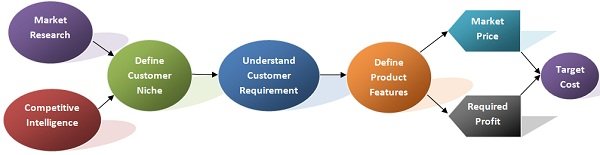
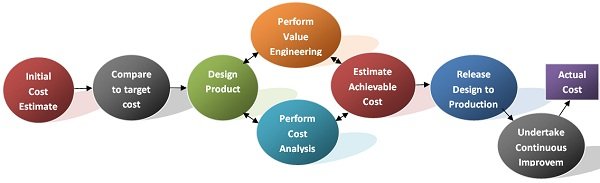
Target costing can be viewed as a proactive cost management tool used to reduce the total cost of the product, over its complete lifecycle, through production, engineering, research and design. It helps the firm in managing the business in reaping profits in the extremely competitive market.

Simply put, target costing is a process of ascertaining and attaining full stream cost, at which the intended product with specific requirements, must be produced so as to realise the desired profits, at an anticipated selling price over a specified period. It involves the discernment of maximum cost to be incurred on a new product, followed by the development of sample that can be profitably created for that target cost figure.

Target Costing and Product Development Phase

In this technique, the costs are planned and managed out of the product or process early in the introduction phase like development or designing, instead of performing it in the latter phase of product development.

Target Costing applies to new products and succeeding generations of a product. It begins with understanding the market thoroughly and an intention to satisfy customer needs, concerning product quality, features, timeliness and price.

Target Cost

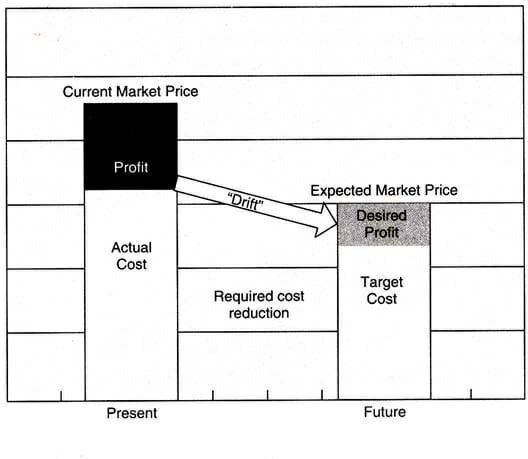
Target Cost = Anticipated selling price – Desired profit

Target Cost refers to an estimate of product cost reached by deducting a desired profit margin from the competitive market price.

Target Costing Process

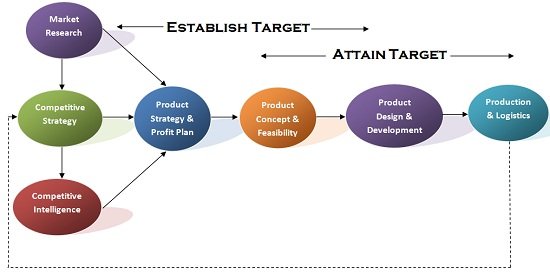
Establishment Phase of Target Cost

  1. Determine selling price for the new product and estimated output from market analysis and target profit.
  2. Ascertainment of the target cost by deducting the profit from the selling price.
  3. Functional cost analysis for specific components and processes
  4. Decide the estimated product cost.
  5. Make comparison between estimated cost and target cost.
  6. If the estimated cost is greater than the targeted one, then repeat cost analysis, to reduce the estimated cost.
  7. Final decision to be taken, on the introduction of the product, once the estimated cost is on target.
  8. Cost management while production is performed.

Attainment Phase of Target Cost

In target costing process, the cost which is directly influenced by it is given priority, which includes material and purchase parts, tooling cost, conversion cost, development expenses and depreciation. Nevertheless, it is a comprehensive cost management technique, so all those cost and assets which are influenced by initial product planning decision are taken into account.

Target Costing Principles

  • Price-led costing
  • Cross functional teams
  • Customer focus
  • Focus on product design and process
  • Lifecycle cost reduction
  • Value Chain involvement

Target Costing is all about planning or projecting the cost of a product prior to its introduction, to make sure that products with low margin are not introduced, as they are not able to reap sufficient returns. It is also used for controlling the design specification and production techniques, and encouraging a focus on the customer.

Advantages of Target Costing:

  • It shows management’s commitment to process improvements and product innovation to gain competitive advantages.
  • The product is created from the expectation of the customer and hence cost is also based on similar lines. Thus, the customer feels more value is delivered.
  • With the passage of time, the company’s operations improve drastically, creating economies of scale.
  • The company’s approach to designing and manufacturing products becomes market-driven.
  • New market opportunities can be converted into real savings to achieve the best value for money rather than to simply realize the lowest cost.

Benchmarking Concept, Essence, Levels, Process

Benchmarking is a Strategic Management tool used to compare an organization’s performance, processes, or practices against those of industry peers or best-in-class companies. It involves identifying key performance indicators (KPIs), metrics, or standards that are relevant to the organization’s goals and objectives. By benchmarking, organizations can gain insights into their strengths, weaknesses, and areas for improvement relative to competitors or industry standards. This process enables organizations to identify best practices, adopt innovative strategies, and drive continuous improvement in areas such as quality, efficiency, customer satisfaction, and profitability. Benchmarking can be applied to various functions and processes within an organization, including operations, finance, marketing, human resources, and supply chain management, to enhance performance and competitiveness.

Essence of Benchmarking:

At its core, the essence of benchmarking lies in the pursuit of excellence through comparison, learning, and improvement. Benchmarking enables organizations to assess their performance, processes, and practices against industry standards, best practices, or competitors to identify opportunities for enhancement. By understanding where they stand relative to others, organizations can set realistic goals, prioritize areas for improvement, and implement strategies to bridge performance gaps. The essence of benchmarking is not merely about emulation but rather about gaining insights, adapting successful practices to suit specific contexts, and driving continuous improvement. Ultimately, benchmarking fosters a culture of innovation, excellence, and competitiveness, empowering organizations to evolve, thrive, and achieve their strategic objectives in a dynamic and ever-changing business environment.

  • Comparison:

Benchmarking involves comparing an organization’s performance, processes, or practices against those of industry peers, competitors, or best-in-class companies. This comparison provides valuable insights into relative strengths, weaknesses, and areas for improvement.

  • Learning:

Benchmarking is fundamentally a learning process. It enables organizations to gain knowledge about best practices, innovative strategies, and performance standards employed by top performers in their industry or sector.

  • Improvement:

The primary objective of benchmarking is improvement. By identifying performance gaps and learning from others, organizations can implement changes and initiatives to enhance their performance, efficiency, and competitiveness.

  • Adaptation:

Benchmarking involves adapting successful practices and strategies discovered through comparison to fit the organization’s unique context, culture, and objectives. It’s not about blindly copying but rather about leveraging insights for tailored improvement.

  • Innovation:

Benchmarking fosters a culture of innovation by exposing organizations to new ideas, approaches, and technologies. It encourages experimentation, creativity, and the adoption of emerging trends to stay ahead of the competition.

  • Continuous Improvement:

Benchmarking is a continuous process. It’s not a one-time exercise but rather an ongoing commitment to monitor performance, seek new benchmarks, and strive for excellence. It involves setting new targets, measuring progress, and iterating to drive sustained improvement over time.

Levels of Benchmarking:

  • Internal Benchmarking:

Internal benchmarking involves comparing performance, processes, or practices within different departments, divisions, or units of the same organization. It aims to identify best practices and opportunities for improvement by leveraging internal expertise and resources.

  • Competitive Benchmarking:

Competitive benchmarking involves comparing an organization’s performance, processes, or practices against direct competitors within the same industry or sector. It helps organizations understand their competitive position, strengths, weaknesses, and areas for differentiation.

  • Functional Benchmarking:

Functional benchmarking involves comparing specific functions, processes, or practices across different industries or sectors. It allows organizations to gain insights from best practices in unrelated industries that may have relevance or applicability to their own operations.

  • Strategic Benchmarking:

Strategic benchmarking involves comparing overall strategies, business models, and performance metrics across industries or sectors. It focuses on understanding how top-performing organizations achieve strategic objectives and competitive advantage, enabling organizations to identify strategic opportunities and challenges.

  • Process Benchmarking:

Process benchmarking involves comparing specific processes, workflows, or procedures within an organization or across industries. It aims to identify inefficiencies, bottlenecks, and opportunities for process improvement by analyzing best practices and performance metrics.

  • Performance Benchmarking:

Performance benchmarking involves comparing key performance indicators (KPIs), metrics, or financial ratios against industry benchmarks, standards, or peer group averages. It helps organizations assess their performance relative to industry norms and identify areas for performance improvement.

  • Best-in-Class Benchmarking:

Best-in-class benchmarking involves comparing performance, processes, or practices against top-performing organizations within a specific industry or sector. It focuses on identifying and adopting best practices and strategies from industry leaders to achieve superior performance and competitive advantage.

Process of Benchmarking:

  • Identify Objectives and Scope:

Define the objectives of the benchmarking initiative and the scope of the comparison. Determine what aspects of performance, processes, or practices you want to benchmark and the criteria for selection.

  • Select Benchmarking Partners:

Identify potential benchmarking partners, which could include internal departments, external organizations within the same industry, or companies in unrelated industries with relevant best practices.

  • Gather Data and Information:

Collect relevant data and information related to the performance, processes, or practices to be benchmarked. This may include financial metrics, operational data, process documentation, and qualitative insights.

  • Analyze Performance Metrics:

Analyze the collected data and performance metrics to understand current performance levels, identify areas of strength and weakness, and determine opportunities for improvement.

  • Identify Best Practices:

Research and analyze best practices employed by benchmarking partners or industry leaders. Identify innovative strategies, processes, or practices that contribute to superior performance or outcomes.

  • Perform Gap Analysis:

Compare your organization’s performance, processes, or practices against benchmarking partners or industry benchmarks. Identify performance gaps and areas where improvements can be made to align with best practices.

  • Develop Action Plan:

Based on the findings of the benchmarking analysis, develop a comprehensive action plan outlining specific initiatives, strategies, and timelines for improvement. Assign responsibilities and resources for implementing the action plan.

  • Implement Improvements:

Implement the identified improvements and initiatives as outlined in the action plan. This may involve process redesign, technology adoption, organizational changes, or training and development programs.

  • Monitor and Measure Progress:

Continuously monitor and measure progress against the established benchmarks and performance targets. Track key performance indicators (KPIs), metrics, and outcomes to assess the effectiveness of implemented improvements.

  • Review and Iterate:

Regularly review benchmarking results, performance metrics, and outcomes to evaluate the effectiveness of implemented improvements. Identify further opportunities for refinement, iteration, and continuous improvement.

  • Share Learnings and Best Practices:

Share learnings, insights, and best practices gained through the benchmarking process with stakeholders, teams, and relevant departments within the organization. Encourage knowledge sharing and collaboration to foster a culture of continuous improvement.

  • Repeat Benchmarking Process:

Periodically repeat the benchmarking process to ensure ongoing performance improvement and to stay aligned with industry standards, market trends, and evolving best practices.

Just in Time (JIT), Features, Components, Challenges

Just-in-Time (JIT) is an inventory management system that focuses on reducing waste by ordering and receiving materials only when they are needed in the production process. This minimizes holding costs, improves efficiency, and enhances cash flow. JIT relies on accurate demand forecasting and strong supplier coordination to avoid delays. It is widely used in industries like manufacturing and retail to maintain lean operations. While JIT reduces excess inventory, it also poses risks if there are supply chain disruptions. Successful JIT implementation requires efficient logistics, reliable suppliers, and a flexible workforce to meet production demands efficiently.

Features of Just in Time (JIT):

  • Elimination of Waste

JIT focuses on reducing waste in inventory, time, and resources by producing only what is required, when it is needed. Waste in the form of excess inventory, overproduction, defective products, and waiting time is minimized. By streamlining operations, businesses can optimize resource utilization and lower costs. This lean approach ensures that raw materials, work-in-progress, and finished goods do not pile up unnecessarily, leading to better efficiency. Companies using JIT aim for a zero-waste production system, making operations more sustainable and cost-effective.

  • Demand-Driven Production

JIT operates on a pull-based system, meaning production is initiated only when there is actual customer demand. Unlike traditional systems that rely on forecasts, JIT ensures that goods are produced based on real-time orders, reducing the risk of overproduction. This approach helps businesses align supply with demand, improving responsiveness to market changes. It also minimizes unsold inventory, ensuring that resources are allocated effectively. By adopting demand-driven production, companies can enhance customer satisfaction while avoiding excessive stockpiling of goods.

  • Strong Supplier Relationships

JIT requires timely and reliable deliveries of raw materials and components, making strong supplier relationships essential. Businesses must work closely with their suppliers to ensure a steady supply of materials without delays. Long-term partnerships, frequent communication, and trust are key to a successful JIT system. Companies often choose local or strategically located suppliers to reduce lead time and transportation costs. A well-integrated supply chain helps in maintaining smooth production flow without the need for large safety stocks.

  • Continuous Improvement (Kaizen)

JIT is closely linked with the philosophy of Kaizen, or continuous improvement. Businesses using JIT constantly strive to enhance their processes by identifying inefficiencies and making incremental improvements. This ensures higher quality, better productivity, and cost reduction. Employees at all levels are encouraged to participate in problem-solving and innovation. Regular performance evaluations, training programs, and lean management techniques help companies achieve operational excellence while maintaining flexibility in production.

  • Small Lot Production

JIT emphasizes producing in small batches rather than in large quantities. This reduces inventory holding costs and allows businesses to quickly adapt to changing customer demands. Small lot production minimizes storage space requirements and reduces the risk of defects going unnoticed. It also improves cash flow, as businesses do not have to invest heavily in raw materials upfront. By keeping batch sizes small, companies can be more agile and responsive to shifts in the market.

  • Zero Inventory Concept

JIT aims to maintain minimal inventory levels by ensuring that raw materials arrive just in time for production and finished goods are dispatched immediately after manufacturing. This reduces storage costs and prevents capital from being tied up in unused stock. While complete zero inventory may not always be practical, the goal is to keep inventory levels as low as possible without disrupting production. Businesses implementing JIT must have accurate demand forecasting and a reliable supply chain to avoid stockouts.

  • High Product Quality

Since JIT operates with minimal stock, businesses must maintain high-quality standards to prevent defects and rework. There is little room for errors, as defects can cause delays and production stoppages. JIT promotes a “right first time” approach, where quality control is integrated into every stage of the production process. Companies use techniques like Total Quality Management (TQM) and Six Sigma to ensure consistent quality. By focusing on defect prevention rather than correction, JIT helps in reducing waste and improving overall efficiency.

Components of Just in Time (JIT):

  • Continuous Improvement (Kaizen)

Kaizen, meaning “continuous improvement”, is a key component of JIT that focuses on incremental improvements in processes, products, and workflows. It involves identifying inefficiencies, reducing waste, and enhancing productivity through employee participation and innovation. Continuous monitoring, feedback loops, and performance evaluations help ensure that businesses achieve operational excellence while minimizing costs.

  • Waste Elimination (Muda)

JIT emphasizes reducing waste (Muda) in various forms, including overproduction, excess inventory, unnecessary transportation, defects, waiting time, and inefficient processes. The goal is to create a lean system where only the required materials are used, ensuring smooth and cost-effective operations. Businesses use lean manufacturing techniques to identify and eliminate waste.

  • Demand-Pull System

Unlike traditional push systems where production is based on forecasts, JIT operates on a pull system, where production is triggered by actual customer demand. This minimizes overproduction, reduces inventory costs, and ensures that only necessary goods are produced. Companies use real-time data, market trends, and customer orders to optimize production schedules.

  • Supplier Integration

JIT requires a strong relationship with reliable suppliers to ensure timely delivery of high-quality materials. Businesses often adopt long-term contracts, just-in-time delivery agreements, and vendor-managed inventory (VMI) systems to streamline procurement. Effective communication and coordination with suppliers help maintain a steady supply chain without excessive stockpiling.

  • Total Quality Management (TQM)

Quality is crucial in JIT since there is no buffer stock to compensate for defects. TQM ensures that every stage of production maintains high quality through continuous monitoring, process standardization, employee training, and defect prevention techniques. Companies use statistical process control (SPC) and six sigma methodologies to minimize errors.

  • Flexible Workforce

A skilled and adaptable workforce is essential for JIT to function effectively. Employees must be trained in multiple roles, problem-solving techniques, and quick decision-making to handle fluctuations in demand. Cross-training and team collaboration enhance efficiency and prevent bottlenecks in production.

  • Cellular Manufacturing

JIT promotes cellular manufacturing, where machines and workstations are arranged in a way that minimizes movement and handling. This layout increases efficiency, reduces setup time, and ensures a seamless flow of materials and products through the production process.

Challenges of Just in Time (JIT):

  • Supply Chain Disruptions

JIT heavily depends on a smooth and uninterrupted supply chain, making it vulnerable to disruptions. Any delay in the delivery of raw materials can halt production, leading to missed deadlines and customer dissatisfaction. Factors like natural disasters, supplier failures, political instability, and transportation issues can severely impact operations. Unlike traditional systems that maintain buffer stock, JIT has minimal inventory, leaving no room for error. Businesses using JIT must establish strong supplier relationships and contingency plans to mitigate risks and avoid production stoppages.

  • High Dependence on Reliable Suppliers

JIT requires frequent and timely deliveries of materials, making supplier reliability crucial. If a supplier fails to meet the required quality standards, quantity, or delivery schedule, production can be severely affected. Companies must carefully select and monitor suppliers, ensuring they adhere to strict performance standards. A single unreliable supplier can disrupt the entire production process. To minimize risk, businesses often establish long-term partnerships, use multiple suppliers, or implement backup supply strategies to maintain a steady flow of materials.

  • Increased Production Pressure

Since JIT minimizes inventory, production processes must be highly efficient and error-free. Employees often face pressure to meet strict deadlines, leading to stress and potential burnout. The system requires continuous monitoring, coordination, and quick decision-making to ensure smooth operations. Any minor mistake can cause delays, leading to significant losses. Businesses must train employees, invest in process automation, and implement effective workflow management to handle the fast-paced production environment without compromising quality or worker well-being.

  • Demand Fluctuations

JIT works best in a stable demand environment, but unexpected demand fluctuations can create challenges. If customer demand suddenly increases, companies may struggle to fulfill orders due to limited raw material availability. On the other hand, a sudden drop in demand can lead to wasted resources and operational inefficiencies. Accurate demand forecasting is essential, but predicting market trends is never foolproof. Businesses must adopt flexible production strategies and data-driven forecasting techniques to manage fluctuating demand effectively.

  • High Implementation Costs

Setting up a JIT system requires significant investment in technology, supplier relationships, and process optimization. Businesses need advanced inventory tracking systems, real-time data analytics, and skilled personnel to implement JIT successfully. Small and medium-sized enterprises (SMEs) may struggle with the initial costs and complexity of integrating JIT into their operations. While JIT can lead to long-term savings, companies must assess their financial capabilities and ensure they have the necessary infrastructure before transitioning to a JIT model.

  • Quality Control Challenges

JIT requires strict quality control because there is no buffer stock to compensate for defective products. Any defects in materials or production errors can halt operations, delay shipments, and increase costs. Unlike traditional systems that allow room for minor quality issues, JIT demands a “zero-defect” approach to avoid disruptions. Companies must implement robust quality control measures, conduct frequent inspections, and train employees in quality management techniques to ensure smooth production without defects affecting output.

  • Risk of Over-Reliance on Technology

JIT relies on real-time data, automated systems, and digital supply chain management for efficiency. Any technical failure, cyberattack, or system malfunction can disrupt the entire workflow, leading to production delays and financial losses. Companies must ensure strong IT security, regular system maintenance, and backup solutions to prevent data breaches or operational failures. Over-reliance on technology also means businesses must continuously upgrade their systems, which can be costly and require specialized expertise.

Preparing to Build Your Balanced Scorecard, Features, Benefits, Limitations

Balanced Scorecard (BSC) is a strategic planning and management system that organizations use to align business activities to the vision and strategy of the organization, improve internal and external communications, and monitor organizational performance against strategic goals. It was originated by Drs. Robert Kaplan and David Norton in the early 1990s as a performance measurement framework that added strategic non-financial performance measures to traditional financial metrics to give managers and executives a more ‘balanced’ view of organizational performance.

Building a Balanced Scorecard is a detailed and nuanced process that requires careful planning, execution, and maintenance. It involves understanding the organization’s strategic direction, engaging leadership, developing a multidisciplinary team, defining strategic objectives, and setting measurable targets. Through this process, the Balanced Scorecard becomes a living document that guides strategic execution, facilitates communication, and drives performance improvement. By following the steps outlined above and remaining aware of potential challenges, organizations can successfully implement a Balanced Scorecard to transform their strategic vision into operational reality, ensuring sustained strategic success.

Understanding the Balanced Scorecard

The Balanced Scorecard transforms an organization’s strategic plan from an attractive but passive document into the “marching orders” for the organization on a daily basis. It provides a framework that not only provides performance measurements but helps planners identify what should be done and measured. It enables executives to truly execute their strategies.

This system divides the Business Environment into Four perspectives:

  1. Financial Perspective

The Financial Perspective focuses on the financial objectives of an organization and allows managers to track financial success and shareholder value. This perspective answers the question, “How do we look to our shareholders?” Key performance indicators (KPIs) in this perspective typically include measures such as return on investment (ROI), economic value added (EVA), revenues, profits, cost reduction, and cash flow. The goal is to provide a clear view of whether the company’s strategy, implementation, and execution are contributing to bottom-line improvement.

  1. Customer Perspective

This perspective emphasizes the importance of customer satisfaction and measures the company’s performance from the viewpoint of its customers. It answers the question, “How do customers see us?” KPIs under the customer perspective include customer satisfaction scores, customer retention rates, new customer acquisition, customer loyalty, and market and account share in target segments. The focus is on creating and maintaining value for the customer, which is considered a leading indicator of future financial performance.

  1. Internal Process Perspective

The Internal Process Perspective looks at the internal operational goals of the organization and focuses on the critical operations that enable the organization to satisfy customer and shareholder expectations. This perspective answers the question, “What must we excel at?” It involves identifying and measuring the key processes that drive business success, focusing on areas such as process efficiency, throughput, quality, and delivery performance. KPIs might include measures of process efficiency, cycle times, quality levels, and productivity.

  1. Learning and Growth Perspective

Also known as the Innovation and Growth Perspective, this dimension focuses on the intangible drivers of future success—employee capabilities, information system capabilities, and the organization’s climate for action. It answers the question, “Can we continue to improve and create value?” This perspective emphasizes the role of organizational culture, employee training and development, knowledge management, and the ability to innovate and adapt to changes in the business environment. KPIs might include employee satisfaction, employee retention, skill sets, the availability of critical information, and the effectiveness of information systems.

Balanced Scorecard Features:

  • Strategic Alignment:

Integrates and aligns business activities with the vision and strategy of the organization.

  • Holistic View:

Provides a comprehensive view of the business by incorporating financial and non-financial measures across multiple perspectives.

  • Performance Measurement:

Goes beyond traditional financial metrics to include measures of performance in areas that are critical for future success, such as customer satisfaction, internal processes, and learning and growth.

  • Management Tool:

Serves as a management system for strategic decision-making and focusing the entire organization on what’s important.

  • Communication Tool:

Facilitates communication and understanding of business goals and strategies at all levels of the organization.

  • Feedback and Learning:

Encourages feedback and continuous improvement by tracking progress against strategic targets and facilitating strategy adjustment in response to changes in performance.

Steps

  • Step 1: Establish a Vision for the Initiative

Before embarking on the development of a Balanced Scorecard, it is crucial to have a clear understanding of the organization’s vision and strategic objectives. This vision will guide the entire process, ensuring that the Balanced Scorecard aligns with the overarching goals of the organization.

  • Step 2: Secure Executive Sponsorship

For the Balanced Scorecard to be successful, it must have strong support from the top management. Executive sponsorship provides the necessary authority and resources for the initiative and helps in overcoming resistance to change within the organization.

  • Step 3: Create a Balanced Scorecard Team

Assemble a cross-functional team that represents all major areas of your organization. This team will lead the development and implementation of the Balanced Scorecard. The team should include individuals with strategic insight, operational expertise, and financial acumen to ensure a comprehensive approach.

  • Step 4: Conduct a Strategic Review

A thorough review of the organization’s strategic documents (mission, vision, strategic plans, etc.) is essential. This helps in reaffirming the strategic objectives that the Balanced Scorecard will support. Understanding the current strategic objectives and performance measures is critical for developing a Balanced Scorecard that truly reflects the organization’s strategy.

  • Step 5: Define Strategic Objectives

With a clear understanding of the organization’s vision and strategy, the next step is to define specific, measurable, achievable, relevant, and time-bound (SMART) strategic objectives for each of the four perspectives of the Balanced Scorecard.

  • Step 6: Develop Strategic Measures and Targets

For each strategic objective, develop metrics that will be used to measure performance. These should be a mix of leading and lagging indicators that provide insights into both current performance and future trends. Alongside each measure, set realistic yet challenging targets.

  • Step 7: Identify Strategic Initiatives

Once you have your measures and targets in place, identify the strategic initiatives or actions that need to be taken to achieve the targets. These initiatives should be directly linked to the strategic objectives and measures.

  • Step 8: Build the Scorecard

With strategic objectives, measures, targets, and initiatives defined, you can now build the Balanced Scorecard. This involves creating a framework that visually represents the strategy and how the objectives, measures, targets, and initiatives interconnect across the four perspectives.

  • Step 9: Validate and Refine

Present the draft Balanced Scorecard to stakeholders (including leadership and employees) for feedback. Use this feedback to refine and improve the Scorecard. Validation ensures that the Scorecard accurately reflects the strategic priorities and is understood by all.

  • Step 10: Implement the Balanced Scorecard

The implementation involves integrating the Balanced Scorecard into the organization’s management processes. This includes setting up reporting systems, aligning organizational and individual goals with the Scorecard, and ensuring that resources are allocated to strategic initiatives.

  • Step 11: Training and Communication

To ensure the successful adoption of the Balanced Scorecard, it is vital to conduct comprehensive training and communication across the organization. Everyone should understand how the Scorecard works, its relevance to their role, and how it will be used to measure and guide performance.

  • Step 12: Monitor, Review, and Adapt

The Balanced Scorecard is not a set-and-forget tool; it requires ongoing monitoring and review. Regularly review the Scorecard to assess performance against targets, learn from the outcomes, and make necessary adjustments to strategies, objectives, and targets.

Challenges and Solutions

Implementing a Balanced Scorecard is not without challenges. These can include resistance to change, difficulties in selecting the right metrics, and ensuring data accuracy. To overcome these challenges, organizations should focus on strong leadership, clear communication, ongoing education, and the flexibility to adjust the Scorecard as necessary.

Build Your Balanced Scorecard Benefits:

Strategic Alignment

  • Aligns Activities with Strategy:

The BSC helps ensure that the day-to-day activities of the organization are aligned with its strategic objectives. This alignment ensures that all efforts are directed towards achieving the long-term goals of the company.

  • Clarifies Strategy:

By breaking down strategic objectives into specific, measurable goals across different perspectives, the BSC clarifies the strategy, making it easier for employees at all levels to understand and engage with it.

Improved Performance Measurement

  • Balanced Perspective:

The BSC provides a more balanced view of organizational performance by including financial and non-financial metrics. This holistic approach helps organizations focus on long-term success and sustainability.

  • Enables Performance Analysis:

By tracking performance against predefined targets, the BSC allows organizations to analyze where they are succeeding and where they need improvement, enabling more informed decision-making.

Enhanced Communication and Focus

  • Improves Internal and External Communications:

The BSC facilitates clearer communication of the organization’s strategy both internally and externally. It helps ensure that all stakeholders, including employees, management, and external partners, have a consistent understanding of the organization’s strategic goals.

  • Focuses Efforts on Strategic Priorities

 By making strategic objectives clear and measurable, the BSC helps employees understand how their work contributes to the company’s strategic goals, focusing their efforts on activities that are most impactful.

Better Strategic Planning

  • Facilitates Strategic Review and Learning:

The BSC framework encourages regular strategic review meetings to assess performance, discuss strategic initiatives, and adapt plans based on results and changing conditions. This iterative process fosters organizational learning and agility.

  • Supports Strategy Refinement:

Continuous monitoring and analysis of performance data help organizations refine their strategies based on empirical evidence, ensuring that strategic plans evolve with changing market conditions and internal capabilities.

Enhanced Organizational Growth and Learning

  • Promotes Learning and Growth:

The learning and growth perspective of the BSC emphasizes the importance of employee development, organizational culture, and the capacity to innovate. By focusing on these areas, organizations can improve their adaptability, innovation, and competitiveness.

  • Encourages a Forward-Looking Approach:

By incorporating leading indicators into the scorecard, organizations can focus not only on past performance but also on future potential, encouraging a proactive rather than reactive approach to management.

Improved Resource Allocation

  • Optimizes Resource Allocation:

With clear strategic priorities and performance metrics, organizations can make more informed decisions about where to allocate resources for maximum strategic impact.

  • Links Budgets with Strategy:

The BSC helps align budgeting and financial planning with strategic priorities, ensuring that financial resources are allocated to support the achievement of strategic objectives.

Enhanced Stakeholder Satisfaction

  • Improves Customer and Stakeholder Satisfaction:

By incorporating the customer perspective, the BSC ensures that strategies are aligned with customer expectations and needs, leading to improved customer satisfaction. Similarly, understanding and addressing the needs of other stakeholders enhances overall stakeholder satisfaction.

Build Your Balanced Scorecard Challenges:

  1. Lack of Understanding or Commitment

Without a clear understanding of the BSC’s purpose and benefits, there may be a lack of commitment from leadership and staff. This can hinder the effective implementation and utilization of the BSC.

  1. Misalignment with Strategy

The BSC must be closely aligned with the organization’s strategic objectives. Misalignment can lead to efforts that do not support the overarching goals of the organization.

  1. Resistance to Change

Implementing a BSC often requires changes in culture, processes, and systems. Resistance from employees, who are accustomed to traditional ways of working, can impede progress.

  1. Overemphasis on Financial Metrics

Organizations might struggle to move beyond financial metrics to include non-financial measures that are equally important for long-term success.

  1. Difficulty in Selecting Appropriate Measures

Identifying the right metrics that accurately reflect the performance and health of the organization can be challenging.

  1. Data Collection and Analysis

Collecting and analyzing data for the chosen metrics can be time-consuming and resource-intensive. Additionally, ensuring data accuracy and integrity can be difficult.

  1. Creating Overly Complex Scorecards

There is a risk of creating a BSC that is too detailed and complex, making it difficult to use effectively for strategic management.

  1. Failure to Integrate with Other Management Systems

The BSC should not operate in isolation but needs to be integrated with other management systems and processes within the organization.

  1. Lack of Continuous Review and Adaptation

Failing to regularly review and update the BSC can lead to it becoming outdated and irrelevant.

  1. Insufficient Communication

Inadequate communication about the progress and results of the BSC can lead to disengagement and skepticism among stakeholders.

Strategic based control

Managers exercise strategic control when they work with the part of the organisation they have influence over to ensure that it achieves the strategic aims that have been set for it. To do this effectively, the managers need some decision making freedom: either to decide what needs to be achieved or how best to go about achieving the strategic aims. Such decision making freedom is one of the characteristics that differentiate strategic control from other forms of control exercised by managers (e.g. Operational control – the management of operational processes).

Strategic controls take into account the changing assumptions that determine a strategy, continually evaluate the strategy as it is being implemented, and take the necessary steps to adjust the strategy to the new requirements. In this manner, strategic controls are early warning systems and differ from post-action controls which evaluate only after the implementation has been completed.

Important types of strategic controls used in organizations are:

  1. Premise Control: Premise control is necessary to identify the key assumptions, and keep track of any change in them so as to assess their impact on strategy and its implementation. Premise control serves the purpose of continually testing the assumptions to find out whether they are still valid or not. This enables the strategists to take corrective action at the right time rather than continuing with a strategy which is based on erroneous assumptions. The responsibility for premise control can be assigned to the corporate planning staff who can identify key asumptions and keep a regular check on their validity.
  2. Implementation Control: Implementation control may be put into practice through the identification and monitoring of strategic thrusts such as an assessment of the marketing success of a new product after pre-testing, or checking the feasibility of a diversification programme after making initial attempts at seeking technological collaboration.
  3. Strategic Surveillance: Strategic surveillance can be done through a broad-based, general monitoring on the basis of selected information sources to uncover events that are likely to affect the strategy of an organisation.
  4. Special Alert Control: Special alert control is based on trigger mechanism for rapid response and immediate reassessment of strategy in the light of sudden and unexpected events called crises. Crises are critical situations that occur unexpectedly and threaten the course of a strategy. Organisations that hope for the best and prepare for the worst are in a vantage position to handle any crisis.

Process of Strategic Control

Strategic control processes ensure that the actions required to achieve strategic goals are carried out, and checks to ensure that these actions are having the required impact on the organisation. An effective strategic control process should by implication help an organisation ensure that is setting out to achieve the right things, and that the methods being used to achieve these things are working.

Regardless of the type or levels of strategic control systems an organization needs, control may be depicted as a six-step feedback model:

  1. Determine What to Control: The first step in the strategic control process is determining the major areas to control. Managers usually base their major controls on the organizational mission, goals and objectives developed during the planning process. Managers must make choices because it is expensive and virtually impossible to control every aspect of the organization’s
  2. Set Control Standards: The second step in the strategic control process is establishing standards. A control standardis a target against which subsequent performance will be compared. Standards are the criteria that enable managers to evaluate future, current, or past actions. They are measured in a variety of ways, including physical, quantitative, and qualitative terms. Five aspects of the performance can be managed and controlled: quantity, quality, time cost, and 

Standards reflect specific activities or behaviors that are necessary to achieve organizational goals. Goals are translated into performance standards by making them measurable. An organizational goal to increase market share, for example, may be translated into a top-management performance standard to increase market share by 10 percent within a twelve-month period. Helpful measures of strategic performance include: sales (total, and by division, product category, and region), sales growth, net profits, return on sales, assets, equity, and investment cost of sales, cash flow, market share, product quality, valued added, and employees productivity.

Quantification of the objective standard is sometimes difficult. For example, consider the goal of product leadership. An organization compares its product with those of competitors and determines the extent to which it pioneers in the introduction of basis product and product improvements. Such standards may exist even though they are not formally and explicitly stated.

Setting the timing associated with the standards is also a problem for many organizations. It is not unusual for short-term objectives to be met at the expense of long-term objectives. Management must develop standards in all performance areas touched on by established organizational goals. The various forms standards are depend on what is being measured and on the managerial level responsible for taking corrective action.

  1. Measure Performance: Once standards are determined, the next step is measuring performance. The actual performance must be compared to the standards. Many types of measurements taken for control purposes are based on some form of historical standard. These standards can be based on data derived from the PIMS (profit impact of market strategy)program, published information that is publicly available, ratings of product / service quality, innovation rates, and relative market shares standings.

Strategic control standards are based on the practice of competitive benchmarking – the process of measuring a firm’s performance against that of the top performance in its industry. The proliferation of computers tied into networks has made it possible for managers to obtain up-to-minute status reports on a variety of quantitative performance measures. Managers should be careful to observe and measure in accurately before taking corrective action.

  1. Compare Performance to Standards: The comparing step determines the degree of variation between actual performance and standard. If the first two phases have been done well, the third phase of the controlling process – comparing performance with standards – should be straightforward. However, sometimes it is difficult to make the required comparisons (e.g., behavioral standards). Some deviations from the standard may be justified because of changes in environmental conditions, or other reasons.
  2. Determine the Reasons for the Deviations: The fifth step of the strategic control process involves finding out: “why performance has deviated from the standards?” Causes of deviation can range from selected achieve organizational objectives. Particularly, the organization needs to ask if the deviations are due to internal shortcomings or external changes beyond the control of the organization. A general checklist such as following can be helpful:
  • Are the standards appropriate for the stated objective and strategies?
  • Are the objectives and corresponding still appropriate in light of the current environmental situation?
  • Are the strategies for achieving the objectives still appropriate in light of the current environmental situation?
  • Are the firm’s organizational structure, systems (e.g., information), and resource support adequate for successfully implementing the strategies and therefore achieving the objectives?
  • Are the activities being executed appropriate for achieving standard?
  1. Take Corrective Action: The final step in the strategic control process is determining the need for corrective action. Managers can choose among three courses of action: (1) they can do nothing (2) they can correct the actual performance (3) they can revise the standard.

When standards are not met, managers must carefully assess the reasons why and take corrective action. Moreover, the need to check standards periodically to ensure that the standards and the associated performance measures are still relevant for the future.

The final phase of controlling process occurs when managers must decide action to take to correct performance when deviations occur. Corrective action depends on the discovery of deviations and the ability to take necessary action. Often the real cause of deviation must be found before corrective action can be taken. Causes of deviations can range from unrealistic objectives to the wrong strategy being selected achieve organizational objectives. Each cause requires a different corrective action. Not all deviations from external environmental threats or opportunities have progressed to the point a particular outcome is likely, corrective action may be necessary.

To conclude, strategic control is an integral part of strategy. Without properly placed controls the strategy of the company is bound to fail. Strategic control is a tool by which companies check their internal business process and environment and ascertain their progress towards their goal.

The type of business strategy you pursue is a key to whether or not your company will have long-term growth and success. The challenge, however, is that it’s difficult to assess if the strategy you’ve chosen is the right one or if you need to make adjustments. That process is made easier if you use the four common types of strategic control to analyze the strategy you’ve put in place to determine its effectiveness, and to find areas of strength and weakness. Without strategic control, your company will fail to adapt to any external changes in your industry that require immediate and corrective action.

Testing the Validity of Assumptions

The business strategy you’ve chosen was likely based on some assumptions you made about what you believed would happen several years in the future. Whether those assumptions are about your target audience, your competitors, or product development, premise control lets you test those assumptions to see if they’re still valid. For example, if you own a skateboard company, you may have assumed that your ideal buyers were Millennials, but you may discover that premise was flawed after premise control measures reveal that the fastest-growing skateboard consumers are actually an entire generation younger.

Strategic Surveillance Control

It’s impossible for you to anticipate every external threat that could impact the success of your business, which is why strategic surveillance control lets you identify information sources that monitor these external forces. Examples of these information sources are financial journals, trade magazines, newspapers, economic forums, and industry conferences. These sources are often the first to identify the potential challenges that businesses in your industry will face, and may even offer potential responses to these challenges.

Special Alert Control

At some point in time, your company will go through a rough patch that’s triggered by some kind of unexpected occurrence that impacts your business in a negative way. This could include a sudden crash in the U.S. stock market, a domestic terrorist attack, or even a natural disaster that affects your customers’ buying habits. Special alert control helps your business respond to these events without having to change your entire strategy to deal with this new event. For example, after the September 11, 2001, terrorist attacks in the U.S., many commercial airlines were forced to adopt stricter safety protocols to account for the intense fears that passengers had about flying on a plane.

Implementation Control Measures

As you begin to implement a business strategy, you must use implementation control measures to assess whether or not your plan needs adjustment. Common types of implementation control include setting performance standards, measuring actual performance, analyzing the reasons your staff failed to meet specific performance standards, and developing a plan to correct performance deviations. Implementation control also includes things such as budgets, schedules, and milestones that the company is trying to achieve.

Financial Services in India

Financial Services refer to a broad range of services provided by the finance industry, including banking, investment, insurance, and wealth management. These services help individuals, businesses, and governments manage their financial needs, investments, and risks. Key financial services include loans, savings, insurance products, asset management, financial advisory, and payment processing. The sector also encompasses activities like stock broking, mutual funds, and retirement planning. Financial services are essential for facilitating economic growth, enabling capital flow, providing financial security, and supporting investment opportunities. They offer consumers and businesses access to resources that can help them make informed financial decisions, build wealth, and protect against unforeseen events. The industry is highly regulated to ensure stability and protect the interests of investors and stakeholders.

Overview of Financial Services Industry:

The financial services industry in India plays a pivotal role in the economic development of the country by supporting various sectors such as banking, insurance, asset management, and capital markets. This industry facilitates the smooth flow of capital, ensuring that businesses, individuals, and government entities have access to the necessary financial resources for growth and development.

  • Banking Sector

Banking sector in India is one of the most developed and regulated financial services industries. It comprises public sector banks, private sector banks, and foreign banks. These banks offer a wide range of services, including savings accounts, loans, credit cards, and online banking. The Reserve Bank of India (RBI) acts as the regulatory authority overseeing the banking system, ensuring financial stability and liquidity.

  • Insurance

India’s insurance industry is another major component of the financial services sector. The life and non-life insurance markets have witnessed significant growth due to increased awareness, regulatory reforms, and the development of innovative products. The Insurance Regulatory and Development Authority of India (IRDAI) is the regulatory body for the insurance sector. Life insurance provides financial protection to policyholders, while non-life insurance covers risks related to health, property, and motor vehicles.

  • Capital Markets and Securities

Indian capital markets have grown considerably, offering investment opportunities in stocks, bonds, and other financial instruments. Stock exchanges like the Bombay Stock Exchange (BSE) and the National Stock Exchange (NSE) provide platforms for trading securities. Securities and Exchange Board of India (SEBI) regulates these markets to ensure transparency, fairness, and investor protection.

  • Asset Management

Asset management industry in India is another significant contributor to the financial services sector. Mutual funds, portfolio management services (PMS), and alternative investment funds (AIFs) are among the key offerings. With an increasing number of retail investors entering the market, asset management companies (AMCs) are expanding their product offerings to include equity, debt, hybrid, and sectoral funds, helping individuals diversify their investment portfolios.

  • Financial Advisory and Wealth Management

Financial advisory services in India are growing as individuals seek expert guidance in managing their wealth. These services include financial planning, tax planning, retirement planning, and investment strategies. Wealth management has become increasingly popular among high-net-worth individuals (HNWIs) and institutional investors, providing tailored solutions to manage large investment portfolios.

Functions of Financial Services

  • Mobilization of Savings

One of the primary functions of financial services is to mobilize savings from individuals and organizations. The financial system provides a platform where people can invest their savings in different instruments like savings accounts, fixed deposits, and mutual funds. These funds are then channeled into productive investments, which are essential for economic growth. By encouraging saving habits, financial services help improve the overall capital available for investment and development.

  • Facilitating Investment

Financial services facilitate investment by providing individuals and businesses with a range of investment options. This includes equities, bonds, real estate, and mutual funds, among others. By offering avenues for both short-term and long-term investments, these services help investors diversify their portfolios and maximize returns. Investment products are designed to suit different risk profiles, making it easier for people to invest in line with their financial goals.

  • Risk Management

Risk management is an essential function of financial services. Insurance companies, for example, offer products that help individuals and businesses manage risks related to health, life, property, and business. Financial services like derivatives, hedging, and pension plans also help investors and organizations protect themselves from financial uncertainties such as market fluctuations, interest rate changes, and natural disasters. By providing risk mitigation tools, financial services enhance the stability of the economy.

  • Providing Liquidity

Liquidity refers to the ease with which an asset can be converted into cash without significantly affecting its price. Financial services ensure liquidity through mechanisms such as stock exchanges and money markets. Instruments like treasury bills, commercial paper, and certificates of deposit provide a quick and safe avenue for investors to liquidate their holdings when necessary. By ensuring liquidity, financial services help maintain the balance between the supply and demand for funds in the economy.

  • Capital Formation

Financial services contribute to capital formation by channeling funds from savers to investors, facilitating the growth of industries, businesses, and infrastructure projects. Banks and financial institutions lend money to businesses, enabling them to expand operations and create jobs. Additionally, the stock market provides a platform for companies to raise capital through the issuance of shares. This capital formation is vital for the long-term growth and development of the economy.

  • Facilitating Payments and Settlements

Financial services also play a crucial role in the payment and settlement system of an economy. Payment services such as credit cards, digital wallets, mobile payments, and online banking enable smooth and secure transactions. Financial institutions ensure the timely settlement of payments and transfers, whether it’s for day-to-day purchases, large-scale transactions, or cross-border remittances. This function promotes efficient and convenient financial exchanges, supporting business operations and individual transactions alike.

Characteristics and Features of Financial Services

The following Characteristics and Features of Financial Services below are;

  • Customer-Specific

They are usually customer focused. The firms providing these services, study the needs of their customers in detail before deciding their financial strategy, giving due regard to costs, liquidity and maturity considerations. Financial services firms continuously remain in touch with their customers, so that they can design products that can cater to the specific needs of their customers.

  • Intangibility

In a highly competitive global environment, brand image is very crucial. Unless the financial institutions providing financial products; and services have a good image, enjoying the confidence of their clients, they may not be successful. Thus institutions have to focus on the quality and innovativeness of their services to build up their credibility.

  • Concomitant

Production of financial services and the supply of these services have to be concomitant. Both these functions i.e. production of new and innovative services and supplying of these services are to perform simultaneously.

  • The tendency to Perish

Unlike any other service, they do tend to perish and hence cannot be stored. They have to supply as required by the customers. Hence financial institutions have to ensure proper synchronization of demand and supply.

  • People-Based Services

Marketing of financial services has to be people-intensive and hence it’s subjected to the variability of performance or quality of service. The personnel in their organizations need to select based on their suitability and trained properly so that they can perform their activities efficiently and effectively.

  • Market Dynamics

The market dynamics depends to a great extent, on socioeconomic changes such as disposable income, the standard of living and educational changes related to the various classes of customers.

The institutions providing their services, while evolving new services could be proactive in visualizing in advance what the market wants, or being reactive to the needs and wants of their customers.

Scope of Financial Services

The following scope of Financial services, and cover a wide range of activities. They can broadly classify into two, namely:

1. Traditional Activities

Traditionally, the financial intermediaries have been rendering a wide range of services encompassing both capital and money market activities. They can group under two heads, viz.

(a) Fund based activities

The traditional services which come under fund based activities are the following:

  • Underwriting or investment in shares, debentures, bonds, etc. of new issues (primary market activities).
  • Dealing with secondary market activities.
  • Participating in money market instruments like commercial papers, certificates of deposits, treasury bills, discounting of bills, etc.
  • Involving in equipment leasing, hire purchase, venture capital, seed capital, etc.
  • Dealing in foreign exchange market activities.

(b) Non-fund based activities

Financial intermediaries provide services-based on non-fund activities also. This can calls “fee-based” activity. Today customers, whether individual or corporate, not satisfy mere provisions of finance. They expect more from their companies. Hence a wide variety of services, are being provided under this head.

  • Managing the capital issue i.e. management of pre-issue and post-issue activities relating to the capital issued by the SEBI guidelines and thus enabling the promoters to market their issue.
  • Making arrangements for the placement of capital and debt instruments with investment institutions.
  • The arrangement of funds from financial institutions for the client’s project cost or his working capital requirements.
  • Assisting in the process of getting all Government and other clearances.

2. Modern Activities

Besides the above traditional services, the financial intermediaries render innumerable services in recent times. Most of them are like the non-fund based activities. Because of the importance, these activities have been in brief under the head “New-financial-products-and-services”. However, some of the modern services provided by them are given in brief hereunder.

  • Rendering project advisory services right from the preparation of the project report until the raising of funds for starting the project with necessary Government approvals.
  • Planning for M&A and assisting with their smooth carry out.
  • Guiding corporate customers in capital restructuring.
  • Acting as trustees to the debenture holders.
  • Recommending suitable changes in the management structure and management style to achieve better results.
  • Structuring the financial collaborations/joint ventures by identifying suitable joint venture partners and preparing joint venture agreements.
  • Rehabilitating and restructuring sick companies through an appropriate scheme of reconstruction and facilitating the implementation of the scheme.

Fund and Fee Based Services

These terms typically relate to banking activities. The revenue that banks get out of their lending activities is fund based income, i.e. they borrow from depositors through fixed deposits/ savings accounts and lend to borrowers at a higher interest rate, the difference is their interest margins, i.e. fund based income.

In a fund based income it is more dynamic and relates to the fund’s performance.

As per your question I assume it is something to do with mutual fund. SO taking this assumption into consideration, in a fee based system it’s fixed fee for the investment you make. Whereas on the fund based, the income would be based on the fund’s performance.

On the other hand, banks make money out of services, such as selling mutual funds and insurance products to their customers, this income is called fee based income. Even banking services which do not involve lending, such as issue of demand drafts or guarantees, transfer of funds, etc. give the bank fee based income.

In a fee based income it’s a more straight forward like for this much this is the fee/charge kind of thing.

Fund Based Financial Services

Involve provision of funds against assets, bank deposits, etc.

Fund based income comes mainly from interest spread (the difference between the interest earned and interest paid), lease rentals, income from investments in capital market and real estate

Major part of the income is earned through fund-based activities. At the same time, it involves a large share of expenditure also in the form of interest and brokerage.

Examples of Fund Based Financial Services

  • Underwriting shares, debentures, bonds, etc. of new issue
  • Equipment Leasing
  • Hire Purchase
  • Bill discounting
  • Venture capital
  • Housing finance
  • Insurance services
  • Factoring

(i) Equipment leasing

A lease is an agreement under which a company or a firm acquires a right to make use of a capital asset like machinery, on payment of a prescribed fee called „rental charges‟. Long-term.

(ii) Hire Purchase

Hire purchase is a mode of financing the price of the goods to be sold on a future date. In a hire purchase transaction, the goods are let on hire, the purchase price is to be paid in installments and hirer is allowed an option to purchase the goods by paying all the installments.

(iii) Bills Discounting

Bill discounting is a short tenure financing instrument for companies willing to discount their purchase / sales bills to get funds for the short run and as for the investors in them, it is a good instrument to park their spare funds for a very short duration.

(iv) Accounts Receivable Financing / Factoring

A type of asset-financing arrangement in which a company uses its receivables – which is money owed by customers – as collateral in a financing agreement. The company receives an amount that is equal to a reduced value of the receivables pledged.

Factoring is similar to the above with the only difference that the factoring firms purchase the receivables outright taking ownership of the receivables. The entire responsibility of collecting the book debts passes on to the factor.

(v) Venture Capital

Venture capital (VC) is financial capital provided to early- stage, high-potential, high risk, growth startup companies.

The venture capital fund makes money by owning equity in the companies it invests in, which usually have a novel technology or business model in high technology industries, such as biotechnology, IT, software, etc.

(vi) Housing Finance

Housing finance refers to providing finance to an individual or a group of individuals for purchase, construction or related activities of house/flat etc.

Housing loan is extended by way of term loans; for a number of years (5-20) at a certain rate of interest and against some.

(vii) Insurance Services

Insurance is a form of risk management in which the insured transfers the cost of potential loss to another entity in exchange for monetary compensation known as premium

(viii) Mutual Funds.

A mutual fund refers to a fund raised by a financial service company by pooling the savings of the public. It is invested in a diversified portfolio with a view to spreading and minimizing the risk.

Free Based Financial Services

Fee based income does not involve much risk. But, it requires a lot of expertise on the part of a financial company to offer such fee-based services.

Examples of Free Based Financial Services

  • Corporate advisory services
  • Bank guarantees
  • Merchant banking
  • Issue management
  • Loan syndication
  • Credit rating
  • Stock Broking
  • M & A, Capital restructuring

(i) Merchant banking

A merchant banker is a financial intermediary who helps to transfer capital from those who possess it to those who need it.

Merchant banking includes a wide range of activities such as management of customer securities, portfolio management, project counseling and appraisal, underwriting of shares and debentures, loan syndication, acting as banker for the refund orders, handling interest and dividend warrants etc.

(ii) Loan Syndication

  • Similar to consortium financing.
  • Taken up by the merchant banker as a lead manager.
  • It refers to a loan arranged by a bank called lead manager for a borrower who is usually a large corporate customer or a government department.
  • It also enables the members of the syndicate to share the credit risk associated with a particular loan among themselves.

(iii) Credit Rating

Evaluates the credit worthiness of a debtor, especially a business (company) or a government. It is an evaluation made by a credit rating agency of the debtors ability to pay back the debt and the likelihood of default. Some credit rating agencies; ICRA, CRISIL, S & P, Moody’s.

Utility of Financial Services

With increasing frequency, companies in the financial-services industry are pooling resources, expertise, and capabilities to create market utilities focused on specific functions such as client services and on-boarding, trading and execution, and cash and collateral management. We define a market utility as follows: a multiparty commercial cooperative that fulfills a common need in a mutually beneficial way based on the capabilities that each party brings to the cooperative and the role that each plays.

More than 40 market utilities have been founded in the financial-services industry over the past several years, and in some cases multiple utilities have sprung up to perform the same function for example, trading and execution, or data management. Many of our clients have pondered whether the formation of these utilities is a fad, and if not, whether they need to participate and in what capacity. It is our opinion that market utilities are going to be a permanent fixture in the industry. The formation of cooperative functions is a necessary response to the massive structural changes  regulatory as well as macroeconomic that are sweeping the industry and creating a common set of needs in areas such as liquidity, compliance, and data sharing. Companies can tackle these needs more efficiently if they work as part of a consortium rather than on their own.

Therefore, it is critical for industry participants to decide which market utilities they will participate in and what roles they will play. Should they team up with others to start and control their own utility? Should they join an existing utility with the idea of exerting some influence over its direction? Should they collaborate by offering expertise to a utility without concern for exerting control? Or should they simply use the facility and not worry about contributing capabilities or controlling its direction? For each organization, the answer will depend on the utility’s function, the level of control the company wants to exert, and the capabilities it will bring to the table.

We believe that in the near future, most financial-services industry firms will play different roles in several market utilities, and will thus need to manage a “portfolio” of market utilities in which they participate. With this in mind, we have developed a series of screening questions for executives to consider to determine if a particular activity done in-house is better suited to a utility and, if so, what role the organization should play in that utility.

Which activities are right for a utility?

With market utilities addressing more and more components of the value chain, executive teams need a set of criteria to determine which current functions are candidates for moving to a utility. Cost savings are an important consideration; however, a decision based solely on anticipated cost savings may ultimately disappoint. The decision about whether to participate in a utility should be grounded in the organization’s competitive strategy.

To identify the functions within the enterprise that might be better suited to a utility, we have developed several questions that an executive team should consider about internal functions.

Does the activity create a competitive advantage? If the answer to this question is yes meaning that the executive team believes that the activity is differentiating for the organization and creates a true competitive advantage then the organization should probably keep the function in-house and not participate in a utility. If the answer is no meaning the activity is non-differentiating and can be shared without a loss of competitive advantage then the activity is suited to a utility.

Does the activity address a common need of many industry participants? If the answer is yes, then the activity is suited for a utility; the high demand for a common solution is likely to promote collaboration and engagement. If the answer is no, or if a common solution could create disagreement and rivalry, then the activity is better suited to an internal shared service.

Does the activity have critical mass or global reach across many industry participants? Here again, if the answer is yes, then the function is suitable for a utility; the critical mass/global reach will encourage quick adoption and thus more rapid economic benefits. If the answer is no, or if a lack of scale or global reach would distort the economic value proposition, then the activity is better addressed by a technology solution or internal shared service.

Does the activity meet the common need in a mutually agreed-upon way? If the answer is yes, then a utility is appropriate. By agreeing on a standardized solution, individual players aren’t inclined to customize their own solutions. If the answer is no, and this lack of agreement among individual players would lead to customization, then the activity is better served by outsourcing providers.

Is the need met by a combination of capabilities that can be provided by collaboration? Once again, if the answer is yes, then the function is a candidate for a utility. There is a powerful incentive for players to cooperate if they recognize that cooperation will result in a solution superior to any individual solution. But if the answer is no, or if a single industry player could offer its own solution, then the activity is better served by an outsourcing provider.

Conclusion: Managing a utility portfolio

Market utilities have been heralded by some as the solution to the industry’s stagnant ROE, providing a level of scale and efficiency unachievable by any single participant’s transformational efforts. However, although we believe utilities offer a massive opportunity for cost savings, they should not be thought of solely as an extension of the shared-services model. Rather, they are an opportunity to address common industry needs through cooperation and capability sharing.

As the market utility landscape develops, firms must carefully consider their own roles given the utility’s purpose, the capabilities required to make the utility successful, and the level of control necessary for the firm to execute on its own strategy. As more of the value chain comes into play and more utilities are formed, executives will need to manage a portfolio of utilities and strike the right balance of roles based on business priorities and resources.

Significance of Financial Services

It is the presence of financial services that enables a country to improve its economic condition whereby there is more production in all the sectors leading to economic growth.

The benefit of economic growth is reflected on the people in the form of economic prosperity wherein the individual enjoys higher standard of living. It is here the financial services enable an individual to acquire or obtain various consumer products through hire purchase. In the process, there are a number of financial institutions which also earn profits. The presence of these financial institutions promote investment, production, saving etc.

Hence, we can bring out the Significance of financial services in the following points:

Significance of Financial Services are:

  1. Promoting investment

The presence of financial services creates more demand for products and the producer, in order to meet the demand from the consumer goes for more investment. At this stage, the financial services comes to the rescue of the investor such as merchant banker through the new issue market, enabling the producer to raise capital.

The stock market helps in mobilizing more funds by the investor. Investments from abroad is attracted. Factoring and leasing companies, both domestic and foreign enable the producer not only to sell the products but also to acquire modern machinery/technology for further production.

  1. Promoting savings

Financial services such as mutual funds provide ample opportunity for different types of saving. In fact, different types of investment options are made available for the convenience of pensioners as well as aged people so that they can be assured of a reasonable return on investment without much risks.

For people interested in the growth of their savings, various reinvestment opportunities are provided. The laws enacted by the government regulate the working of various financial services in such a way that the interests of the public who save through these financial institutions are highly protected.

Financial Services offered by various financial institutions

  • Factoring
  • Leasing
  • Forfaiting
  • Hire Purchase Finance
  • Credit card
  • Merchant Banking
  • Book Building
  • Asset Liability Management
  • Housing Finance
  • Portfolio Finance
  • Underwriting
  • Credit Rating
  • Interest & Credit Swap
  • Mutual Fund
  1. Minimizing the risks

The risks of both financial services as well as producers are minimized by the presence of insurance companies. Various types of risks are covered which not only offer protection from the fluctuating business conditions but also from risks caused by natural calamities.

Insurance is not only a source of finance but also a source of savings, besides minimizing the risks. Taking this aspect into account, the government has not only privatized the life insurance but also set up a regulatory authority for the insurance companies known as IRDA, 1999 (Insurance Regulatory and Development Authority) .

  1. Maximizing the Returns

The presence of financial services enables businessmen to maximize their returns. This is possible due to the availability of credit at a reasonable rate. Producers can avail various types of credit facilities for acquiring assets. In certain cases, they can even go for leasing of certain assets of very high value.

Factoring companies enable the seller as well as producer to increase their turnover which also increases the profit. Even under stiff competition, the producers will be in a position to sell their products at a low margin. With a higher turnover of stocks, they are able to maximize their return.

  1. Ensures greater Yield

As seen already, there is a subtle difference between return and yield. It is the yield which attracts more producers to enter the market and increase their production to meet the demands of the consumer. The financial services enable the producer to not only earn more profits but also maximize their wealth.

Financial services enhance their goodwill and induce them to go in for diversification. The stock market and the different types of derivative market provide ample opportunities to get a higher yield for the investor.

  1. Economic growth

The development of all the sectors is essential for the development of the economy. The financial services ensure equal distribution of funds to all the three sectors namely, primary, secondary and tertiary so that activities are spread over in a balanced manner in all the three sectors. This brings in a balanced growth of the economy as a result of which employment opportunities are improved.

The tertiary or service sector not only grows and this growth is an important sign of development of any economy. In a well developed country, service sector plays a major role and it contributes more to the economy than the other two sectors.

  1. Economic development

Financial services enable the consumers to obtain different types of products and services by which they can improve their standard of living. Purchase of car, house and other essential as well as luxurious items is made possible through hire purchase, leasing and housing finance companies. Thus, the consumer is compelled to save while he enjoys the benefits of the assets which he has acquired with the help of financial services.

  1. Benefit to Government

The presence of financial services enables the government to raise both short-term and long-term funds to meet both revenue and capital expenditure. Through the money market, government raises short term funds by the issue of Treasury Bills. These are purchased by commercial banks from out of their depositors’ money.

In addition to this, the government is able to raise long-term funds by the sale of government securities in the securities market which forms apart of financial market. Even foreign exchange requirements of the government can be met in the foreign exchange market.

The most important benefit for any government is the raising of finance without offering any security. In this way, the financial services are a big boon to the government.

  1. Expands activities of Financial Institutions

The presence of financial services enables financial institutions to not only raise finance but also get an opportunity to disburse their funds in the most profitable manner. Mutual funds, factoring, credit cards, hire purchase finance are some of the services which get financed by financial institutions.

The financial institutions are in a position to expand their activities and thus diversify the use of their funds for various activities. This ensures economic dynamism.

  1. Capital Market

One of the barometers of any economy is the presence of a vibrant capital market. If there is hectic activity in the capital market, then it is an indication of the presence of a positive economic condition. The financial services ensure that all the companies are able to acquire adequate funds to boost production and to reap more profits eventually.

In the absence of financial services, there will be paucity of funds which will adversely affect the working of companies and will only result in a negative growth of the capital market. When the capital market is more active, funds from foreign countries also flow in. Hence, the changes in capital market is mainly due to the availability of financial services.

  1. Promotion of Domestic and Foreign Trade

Financial services ensure promotion of domestic as well as foreign trade. The presence of factoring and forfaiting companies ensures increasing sale of goods in the domestic market and export of goods in the foreign market. Banking and insurance services further contribute to step up such promotional activities.

  1. Balanced Regional development

The government monitors the growth of economy and regions that remain backward economically are given fiscal and monetary benefits through tax and cheaper credit by which more investment is promoted. This generates more production, employment, income, demand and ultimately increase in prices.

The producers will earn more profits and can expand their activities further. So, the presence of financial services helps backward regions to develop and catch up with the rest of the country that has developed already.

error: Content is protected !!